 The orchid bee fauna (Hymenoptera, Apidae, Euglossini) from the Capadócia Nordestina, Piauí State, Brazil
Abstract
Surveys of local Euglossini faunas have largely focused on forests, considering the relationship that orchid bees have with such environments. So, large areas of Caatinga and even Cerrado are yet to be inventoried. Besides the relevance of knowing those faunas themselves, understanding the distribution of species in the dry diagonal of South America is central also to understanding the patterns of richness and endemism of orchid bees in the Amazon and Atlantic Forest. Orchid bees were collected in an area of shrubby Caatinga at the locality of Três Irmãos, municipality of São José do Piauí, Piauí State, northeastern Brazil, using traps baited with aromatic compounds, from October, 2022 to November, 2023. Fifty-nine individuals of five species were sampled, and Euglossa cordata (Linnaeus, 1758) was the most common species, followed by Eulaema nigrita Lepeletier, 1841. Data collected in the region reinforce what is already known regarding the general patterns of orchid bees in the Caatinga biome: assemblages with a reduced number of species, mostly composed of widely distributed species, low abundance of individuals and marked seasonality.
Keywords
Caatinga; Euglossa cordata; Eulaema nigrita
Resumo
Amostragens das faunas locais de Euglossini vem focando principalmente em florestas, considerando a relação entre essas abelhas e ambientes florestais. Assim, áreas extensas da Caatinga e mesmo do Cerrado permanecem sem inventariamentos sistematizados. Além da relevância de conhecer tais faunas, entender a distribuição das espécies na diagonal seca da América do Sul é também central para entendermos os padrões de riqueza e endemismo das abelhas Euglossini na Amazônia e Floresta Atlântica. Abelhas-das-orquídeas foram coletadas em uma área de Caatinga arbustiva na localidade de Três Irmãos, município de São José do Piauí, Piauí, Brasil, usando armadilhas com iscas-odores, entre outubro de 2022 e novembro de 2023. Cinquenta e nove indivíduos de cinco espécies foram amostrados, sendo Euglossa cordata (Linnaeus, 1758) a espécie mais abundante, seguido por Eulaema nigrita Lepeletier, 1841. Os dados coletados na região reforçam o que já se conhece em termos dos padrões gerais das faunas destas abelhas na Caatinga: assembleias com riqueza reduzida de espécies, majoritariamente compostas por espécies de ampla distribuição, abundância reduzida e sazonalidade bastante marcada.
Palavras-chave
Caatinga; Euglossa cordata; Eulaema nigrita
Introduction
Orchid bees (Apidae, Euglossini) are indisputably one of the most studied groups among all the bees (e.g. Pereira et al. 2021). This Neotropical, monophyletic taxa (Ramírez et al. 2010), that encompasses ca. 260 described species (Moure & Melo 2023), has been consistently studied in what regards e.g. its systematics/taxonomy (e.g. Moure 1989), nesting biology (e.g. Augusto & Garófalo 2004), ecology (e.g. Nemésio et al. 2015), genetics (e.g. Martins et al. 2021), distributional patterns (e.g. Sydney et al. 2010) and plant interaction patterns (e.g. Rocha-Filho et al. 2012). One distinctive feature of the euglossine biology, and that makes this group unique among all the bees, is the scent collecting behavior of males (Dodson et al. 1969). Substances that the males collect in the flowers, or even in non-floral sources (e.g. Roberts et al. 1982), play a paramount role in the reproductive biology of the species (Dressler 1982). The discovery that baits soaked with synthetic mimicries of those substances collected by the males could attract them (Dodson et al., 1969), allowing their collection, completely changed the panorama of knowledge about orchid bees (e.g. Nemésio 2012). If the number of euglossine females housed in entomological collections was much higher before this discovery, the pattern was reversed from the following decades (see Moure 1978). There are even species that are still known only from males (see e.g. Nemésio & Ferrari 2012), and the identification of females is still precarious (Faria & Melo 2007).
As this group is known for their close relation with forested environments (Dressler 1982), it is not a surprise that most euglossine inventories had focused on such areas (Nemésio & Faria 2004). In the specific case of Brazil, most inventories are concentrated in the Atlantic Forest, mainly in the coast or coastal-related sites, while extensive areas within the Amazon, for instance, are yet to be inventoried. Some studies (e.g. Sydney et al. 2010) hypothesized, using distinct methods, the existence of specific faunas of Euglossini (mainly in terms of endemisms) in the Central America, Amazon and Atlantic Forest. However, a fine appraisal of such patterns, including the separation of the Amazon and Atlantic faunas, relies on understanding if and how the various species found in these biomes are distributed in the dry diagonal (Vanzolini 1963) that separates the Amazon from the Atlantic Forest.
The carrying out of inventories in the Cerrado, for example, continues at a slower pace than in the Atlantic Forest, even though several works have been published in the last 10–15 years (e.g. Faria & Silveira 2011, Silva 2012, Viotti et al. 2013, Antonini et al. 2016, Martins et al. 2018, Leão-Gomes & Nemésio 2020, Viana et al. 2021, Mariano et al. 2024). The studies suggest that there is not an orchid bee fauna characteristic of the Cerrado, which would be composed of a subset of elements from adjacent forest biomes (see Faria & Silveira 2011). It should be noted, however, that the faunas from areas of Cerrado that are close to or in transition areas with adjacent forest biomes, also include species from the latter locations (Amazonian species: Rebêlo & Cabral 1997; Carvalho et al. 2006; Mendes et al. 2008; Atlantic species: Nemésio & Faria 2004 and Alvarenga et al. 2007).
In the case of the Caatinga, the only biome that is entirely Brazilian (Ganem et al. 2020), characterized by a predominant semiarid climate and composed of xeric shrubs, dry forests, and deciduous forests (Souza et al. 2023), studies remain scarce and are generally associated with areas closer to adjacent forest biomes. Although the expected species richness of Euglossini in the Caatinga is not high, the understanding of the distribution patterns of Euglossini species remains limited by surveys both in this latter biome as in the Cerrado.
The importance of gallery forests as mesic enclaves for the entry of forest elements into the dry diagonal has been subject of debate. While there are studies suggesting that gallery forests are important dispersal routes for many species (Silva 2012), there is also evidence that such environments are not relevant for the entry of forest species into the Cerrado (Faria & Silveira 2011). Anyway, there are records of species characteristic of adjacent forested biomes invading the Cerrado via gallery forests, albeit in more marginal regions of the biome (Martins et al. 2018). In a study in the riparian forests of the São Francisco River (states of Alagoas, Bahia and Sergipe), Moura & Schlindwein (2009) observed that species more closely related to forest environments (Euglossa adiastola Hinojosa-Díaz, Nemésio & Engel, 2012 [as Euglossa crassipuncatata Moure, 1968 in their paper], Euglossa imperialis Cockerell, 1922 and Euglossa perpulchraMoure & Schlindwein, 2002) were collected in gallery forests close to the river mouth or in riparian forests amidst the Caatinga in the lower course of the river (ca. 170 km from the mouth). They conclude that the riparian forests of the São Francisco river function as biocorridors, sheltering and maintaining orchid bee species of tropical forests in the Caatinga (Moura & Schlindwein 2009). However, it is important to emphasize that in riparian forests in areas of the Caatinga furthest from the coast (ca. 310 km from the mouth), only species typical of open environments (e.g. Euglossa cordata and Eulaema nigrita) were sampled. Similarly, those species typical of forests were also not recorded in forests associated with the São Francisco River further inland in the Caatinga (ca. 750 km from the mouth) (Neves & Viana 1999).
In general, we can state that the euglossine faunas in the dry diagonal present lower species richness than those found in adjacent forest biomes (Lopes et al. 2007; Carneiro et al. 2018) and very few endemic elements (Carneiro et al. 2018). The very question of the existence of endemic euglossine species in the dry diagonal is complicated, considering the urgent need for taxonomic review of the species of Eufriesea placed in the mussitans group, which includes Eufriesea nordestina (Moure, 1999), and the existence of a record for Eulaema helvola Moure, 2003 on the coast of São Paulo state, Brazil (see the specific entries in the Moure’s Catalogue (Moure & Melo 2023). A complex history can also be seen, in which the species richness and composition seems to be closely related to the distance from the forest biomes (Santos 2015), with a possible effect of riparian forests as mesic corridors (Moura & Schlindwein 2009).
An excellent example of this complexity comes from surveys conducted in Maranhão, a state located in the ecotone between the Amazon Rainforest, the Cerrado of central Brazil and the Caatinga of the Northeastern Region (Rebêlo & Silva 1999). In a study discussing the distribution of orchid bees in the state, Rebêlo & Silva (1999) analyzed the fauna of the Caatinga together with dunes, sandbanks and cerrados, which reflects, in fact, the difficulty of establishing the phytophysiognomies of Maranhão. The study reveals the occurrence of Amazonian species, e.g. Euglossa chalybeata Friese, 1925 and Eufriesea ornata (Mócsary, 1896), in these more open areas, which does not occur in central areas deeper into either the Caatinga or the Cerrado.
As far as we know, there are three published structured surveys of orchid bees that were carried out in Piauí State. In the first, in the Parnaíba Delta region, Oliveira et al. (2021) reported the occurrence of 11 species in four genera. The occurrence of some elements in the fauna, such as Euglossa modestiorDressler, 1982 and Eufriesea surinamensis (Linnaeus, 1758), is noteworthy, possibly occurring in the location due to its greater association with more humid environments and riparian forests. In other study, Nascimento et al. (2016) presented data on the occurrence of ten species in the Parque Nacional de Sete Cidades, an area close to the Cerrado, as commented by the authors themselves. It is interesting to note that the species inventoried by them are only those expected to occur in a less humid environments. Finally, Oliveira-Filho et al. (2021) report the collection of only one species, Eulaema nigrita, in two fragments of Caatinga in the municipality of Picos.
The way in which the loss of species that occur in more forested formations/sites with more humid climates occurs, towards more open formations/drier environments, is a central issue for understanding the distribution patterns of Euglossini. So, in order to answer the question “which orchid bees inhabit the Caatinga of Piauí?”, we aim at presenting an inventory of the assemblage of orchid bees from the region known as Capadócia Nordestina, in the municipality of São José do Piaui, Piauí State, Brazil.
Material and Methods
1. Study site
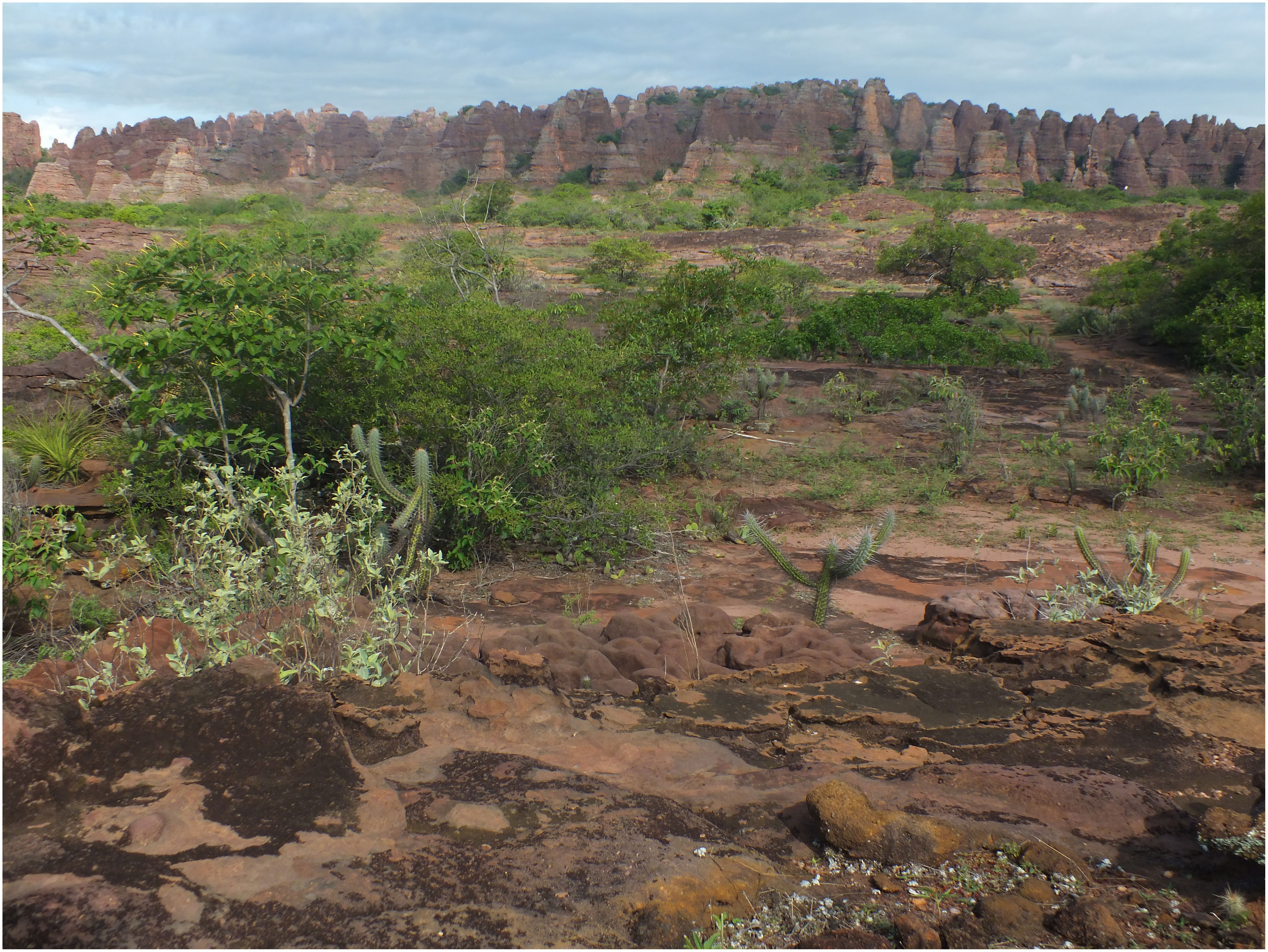
Fieldwork was carried out at the locality of Três Irmãos, municipality of São José do Piauí, Piauí State, northeastern Brazil (6°53’03”S 41°25’14”W). The climate of the area, according to Koppen’s classification, is characterized as tropical semiarid (BSh), with temperatures varying between 21ºC and 36ºC (Silva et al. 2020). The mean annual pluviosity reaches ca. 820 mm, mostly concentrated between December and April (Piauí 2010) with nine months of water deficit (Mendes & Castro 2010). The vegetation in the area presents some elements characteristic of shrubby Caatinga, with the presence of cacti and bromeliads, and even trees typical of the Cerrado (Silva & Aquino, 2022). Regarding plant richness, an important element in any bee study, a survey in the same municipality (Mendes & Castro 2010) recorded 136 species in 46 families, with greater richness in the families Caesalpiniaceae, Fabaceae, Bignoniaceae and Mimosaceae. According to Mendes & Castro (2010), plant species typical of the sedimentary Caatinga are found in the region, although local conditions favor the appearance of plant species that occur in Carrasco and Cerrado. The geoenvironment of the municipality of São José do Piauí is characterized by a transition Cerrado/ Caatinga/ Carrasco, leading to the occurrence of plant species of both formations (Mendes & Castro 2010). The region is part of the region known as “Capadócia Nordestina”, known for its high geodiversity and outstanding geomorphological heritage, leading to a great tourist appeal due to its beauty and diversity of relief features (Silva et al. 2020, Silva & Aquino, 2022) (Figure 1).

Overview of the studied area in the locality of Três Irmãos, municipality of São José do Piauí, Piauí state, northeastern Brazil, highlighting the shrubby Caatinga found in the region (photo by J. N. Bendini).
2. Data collection and analysis
Three sampling points were established in the studied area: two points near a flooded area associated with a water source, in which even some buriti palms are found; the third point within a small cashew plantation, in which some Heliconia psittacorum L. f. (Heliconiaceae) plants could be found. Thirteen samples (one day a month) were carried out from October, 2022 to November, 2023 (the sample scheduled for November, 2022 could not be carried out). Six aromatic compounds known to attract male orchid bees were used during fieldwork: β-ionone, eucalyptol, eugenol, methyl salicylate, trans-methyl cinnamate and vanillin. Traps made from plastic bottles, quite similar to those described by Gonçalves et al. (2014) and Sydney & Gonçalves (2015), were employed in this study: each trap was made from a commercial plastic bottle of 500 ml, with two entrance holes in which landing platforms were provided (a thin layer of sand was glued in the surface of landing platforms), and with 70% ethanol (ca. 20 ml) in the bottom of the bottle. Thus, a kit with six traps, one for each of the aromatic compounds, was installed in each of the three areas. In each trap, cotton waddings soaked with a single out of the six presented substances were offered to bees. Traps were placed ca. 2 m apart from each other and ca. 1.5 m above the ground. Collections were carried out once each month, when the traps were installed at 6 PM one day and collected at 6 PM the next day. It is important to note that the essences were not replenished throughout the day during the collection period. Access to the collection area was quite difficult, so, for logistical reasons, we chose to install the traps in the late afternoon (6 PM) so that they would be available to the males as soon as the sun rose the next day. At the end of each sampling day, bees attracted to the presented lures were gently removed from traps and then killed with 70% ethanol. After being mounted in entomological pins and dried in an oven, bees were identified with help of taxonomic keys (Rebêlo & Moure 1996, Nemésio 2009) and by comparison with specimens previously identified by specialists. Taxonomy follows Moure & Melo (2023).
The labels of examined specimens are presented in the species list section, transcribed as follows: quotation marks indicate distinct labels associated with a given specimen, and one inverted bar (\) indicates distinct lines in a label. When a label was very similar to another associated with a specimen, only the different information (e.g. date, collector, etc.) is presented. All the collected specimens are deposited in the Coleção Entomológica Danúncia Urban, Universidade Federal da Integração Latino-Americana (CEDU-UNILA), Foz do Iguaçu, Paraná, Brazil. The study was conducted under ICMBIO permit #81818.
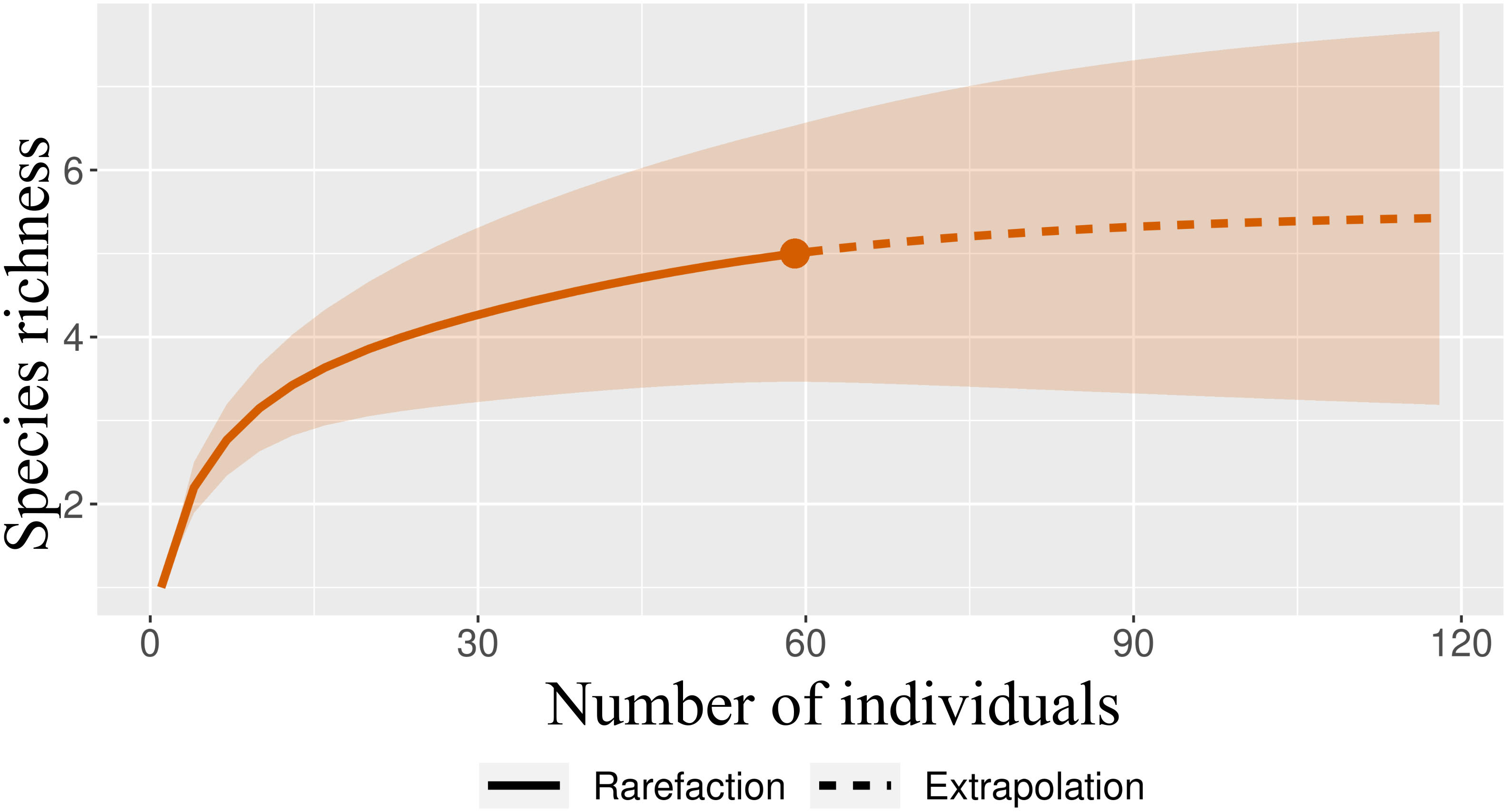
An individual-based rarefaction curve (q = 0, species richness; bootstrap replicates: 200; confidence interval level: 0.95) was built on iNEXT Online (Chao et al. 2014, Chao et al. 2024).
Results
Fifty-nine euglossine males, belonging to five species, were sampled in the studied site (Table 1). The most common species was Euglossa cordata (37 individuals; 62.7%), followed by Eulaema nigrita (12; 20.3%) and Exaerete smaragdina (7; 11.8%). The other two species were a doubleton (Eufriesea nordestina) or a singleton (Euglossa securigera). The rarefaction curve (Figure 2) suggests that the asymptote was reached considering the number of collected individuals. In this regard, the extrapolation curve (dotted line) even shows that doubling the number of collected individuals would not result in a new species being registered. Most specimens (34; 57.6%) were collected in February and March, and all the five species were collected in February. Euglossa cordata, the most common species, was collected from December to May, in addition to two specimens collected in July and August (one specimen each month). It is noteworthy, even if expected, that only two individuals were sampled between June and September, the driest period of the year in the region. The only collected species of the highly seasonal genus Eufriesea, Ef. nordestina, was solely found in February.
Number of individuals of each species monthly (from October, 2022 to November, 2023) collected at a shrubby Caatinga area, municipality of São José do Piauí, Piauí state, Brazil.
Individual-based rarefaction curves with 95% confidence intervals (shaded areas) for the sampled euglossine assemblage (solid lines: rarefaction; dotted lines: extrapolation).
Species List
1. Eufriesea nordestina (Moure, 1999)
Distribution: Brazil: Bahia, Paraíba, Piauí.
Examined material. 1 male, labelled “Brasil, PI, São José\ 01. Fevereiro. 2023\ Borges, K.M.L.\ No 15”; 1 male, “Brasil, PI, São José\ Fevereiro. 2023\ Bendini, J.N.\ No 28”.
Additional information. As stated by G. A. R. Melo (unpublished, in Moure & Melo, 2023), the melanic forms of Eufriesea in the mussitans group need an extensive taxonomic revision. Eufriesea nordestina, which is part of the problem, has the additional matter of having been described from a female, which also poses the question of sex association among the melanic forms. A more robust proposal of the geographic distribution of the species will only be possible after such a taxonomic revision, considering the existence of some synonyms and species yet to be described (see the entries for Eufriesea auriceps (Friese, 1899) and Eufriesea nordestina in the online version of Moure’s Bee Catalogue (Moure & Melo, 2023)).
2. Euglossa (Euglossa) cordata (Linnaeus, 1758)
Distribution: Brazil: Alagoas, Amapá, Amazonas, Bahia, Ceará, Espírito Santo, Goiás, Maranhão, Mato Grosso, Mato Grosso do Sul, Minas Gerais, Paraná, Paraíba, Pará, Pernambuco, Piauí, Rio Grande do Sul, Rio de Janeiro, Sergipe, São Paulo; Colombia, Costa Rica, Ecuador, French Guiana, Guatemala, Guyana, Honduras, Jamaica, Mexico, Panama, Paraguay, Suriname, Trinidad and Tobago, Venezuela (Moure & Melo, 2023). Bembé (2007) states that the species is also found in Bolivia.
Examined material. 1 male, labelled “Brasil, PI, São José\ Dezembro. 2022\ Bendini, J.N.\ No 3”; 1 male, idem, except “No 4”; 1 male, idem, except “No 5”; 1 male, “Brasil, PI, São José\ Janeiro. 2023\ Bendini, J.N.\ No 7”; 1 male, idem, except, “No 8”; 1 male, idem, except “No 9”; 1 male, idem, except “No 10”; 1 male, idem, except “No 11”; 1 male, idem, except “No 12”; 1 male, “Brasil, PI, São José\ 01. Fevereiro. 2023\ Borges, K.M.L.\ No 16”; 1 male, idem, except “No 17”; 1 male, idem, except “No 18”; 1 male, “Brasil, PI, São José\ Fevereiro. 2023\ Borges, K.M.L.\ No 19”; 1 male, idem, except “No 20”; 1 male, “Brasil, PI, São José\ Fevereiro. 2023\ Bendini, J.N.\ No 31”; 1 male, idem, except “No 33”; 1 male, idem, except “No 34”; 1 male, idem, except “No 35”; 1 male, “Brasil, PI, São José\ Março. 2023\ Borges, K.M.L.\ No 36”; 1 male, idem, except “No 40”; 1 male, idem, except “No 43”; 1 male, idem, except “No 44”; 1 male, idem, except “No 45”; 1 male, idem, except “No 46”; 1 male, idem, except “No 47”; 1 male, “Brasil, PI, São José\ Abril. 2023\ Bendini, J.N.\ No 48”; 1 male, idem, except “No 49”; 1 male, idem, except “No 50”; 1 male, idem, except “No 52”; 1 male, “Brasil, PI, São José\ Maio. 2023\ Borges, K.M.L.\ No 54”; 1 male, idem, except “No 55”; 1 male, idem, except “No 56”; 1 male, idem, except “No 57”; 1 male, idem, except “No 58”; 1 male, idem, except “No 59”; 1 male, “Brasil, PI, São José\ Julho. 2023\ Bendini, J.N.”; 1 male, “Brasil, PI, São José\ Agosto. 2023\ Bendini, J.N.”.
3. Euglossa (Euglossa) securigera Dressler, 1982
Distribution: Brazil: Acre, Alagoas, Amapá, Amazonas, Bahia, Espírito Santo, Maranhão, Mato Grosso, Minas Gerais, Paraíba, Pará, Pernambuco, Piauí, Rio de Janeiro, Rondônia, São Paulo; Colombia, Venezuela (Moure & Melo, 2023). Bembé (2007) states that the species is also found in Bolivia, and Dressler (1985) and Nemésio & Rasmussen (2014) present records for the species in Peru.
Examined material. 1 male, labelled “Brasil, PI, São José\ Fevereiro. 2023\ Bendini, J.N.\ No 30”.
4. Eulaema (Apeulaema) nigrita Lepeletier, 1841
Distribution: Argentina; Bolivia; Brazil: Acre, Alagoas, Amapá, Amazonas, Bahia, Ceará, Distrito Federal, Espírito Santo, Goiás, Maranhão, Mato Grosso, Mato Grosso do Sul, Minas Gerais, Paraná, Paraíba, Pará, Pernambuco, Piauí, Rio Grande do Norte, Rio Grande do Sul, Rio de Janeiro, Rondônia, Roraima, Santa Catarina, São Paulo, Tocantins; Colombia; Costa Rica; French Guiana; Guyana; Panama; Paraguay; Peru; Suriname; Trinidad and Tobago; Venezuela (Moure & Melo, 2023).
Examined material. 1 male, labelled “Brasil, PI, São José\ Outubro. 2022\ Bendini, J.N.\ No 1”; 1 male, “Brasil, PI, São José\ Fevereiro. 2023\ Bendini, J.N.\ No 22”; 1 male, idem, except “No 23”; 1 male, idem, except “No 24”; 1 male, idem, except “No 25”; 1 male, idem, except “No 26”; 1 male, idem, except “No 28”; 1 male, idem, except “No 29”; 1 male, “Brasil, PI, São José\ Março. 2023\ Bendini, J.N.\ No 27”; 1 male, idem, except “No 37”; 1 male, idem, except “No 38”; 1 male, idem, except “No 39”.
5. Exaerete smaragdina (Guérin, 1844)
Distribution. Argentina; Bolivia; Brazil: Acre, Alagoas, Amapá, Amazonas, Bahia, Espírito Santo, Goiás, Maranhão, Mato Grosso, Mato Grosso do Sul, Minas Gerais, Paraná, Paraíba, Pará, Pernambuco, Piauí, Rio de Janeiro, Rondônia, Roraima, São Paulo; Colombia; Costa Rica; Ecuador; French Guiana; Guyana; Mexico; Panama; Paraguay; Peru; Trinidad and Tobago; Venezuela (Moure & Melo, 2023).
Examined material. 1 male, labelled “Brasil, PI, São José\ Dezembro. 2022\ Bendini, J.N.\ No 2”; 1 male, “Brasil, PI, São José\ Janeiro. 2023\ Borges, K.M.L.\ No 6”; 1 male, “Brasil, PI, São José\ Fevereiro. 2023\ Bendini, J.N.\ No 13”; 1 male, idem, except “No 14”; 1 male, “Brasil, PI, São José\ Março. 2023\ Borges, K.M.L.\ No 41”; 1 male, idem, except “No 42”; 1 male, “Brasil, PI, São José\ Abril. 2023\ Borges, K.M.L.\ No 51”.
Discussion
The survey conducted in the region of São José do Piauí reveals, as expected, a local orchid bee fauna characterized by a reduced number of species, although comparable to what is observed in surveys of more central areas of the dry diagonal biomes (Cerrado: e.g. Faria & Silveira 2011, Caatinga: see Carneiro et al. 2018 for a relation of species previously collected in the biome). When considering the location of the studied area, further inland in the Caatinga, it is safe to assume a very reduced influence of the adjacent forest biome (Atlantic Forest), in the same way as to disregard the influence of the Amazon, via the entry of species from the Cerrado (e.g. Martins et al. 2018), in the assembly of the fauna of the studied region. Evidence suggests that a general pattern, similar to that suggested in the Cerrado (Faria & Silveira 2011), also occurs in the Caatinga: an impoverishment of the orchid-bee fauna towards the core of such biomes.
In any case, we should also consider the importance that factors that operate on smaller scales have in the assembly of assemblages. There is some consensus in the proposal that more humid areas immersed in the Caatinga, such as riparian forests and mountain areas such as “brejos de altitude”, even if small in size, could have a positive effect on the maintenance of more diverse euglossine faunas in the biome (Moura & Schilindwein 2009, Mariano et al. 2024). It should be stressed that species regarded to be associated with forests (Euglossa imperialis) was even collected in riparian forests further inland in the Caatinga (ca. 200 km from the coast) (Moura & Schlindwein 2009). This proposal becomes particularly interesting when we consider that our collections were carried out in areas close to a flooded area, with buriti palms and less harsh humidity and temperature conditions, with a possible positive impact on the observed richness. After all, in a study carried out in the city of Picos/PI, very close to the area studied by us, Oliveira Filho et al. (2021) collected only Eulaema nigrita in traps with aromatic baits. There is, however, the possibility of confounding factors, considering that the work of these authors was carried out in an area close to a river (Guaribas River), which might also suggest an effect of riparian forests, but under the distinct context of being carried out in urban and peri-urban areas (see Oliveira Filho et al. 2021). There is an interaction between the effects of anthropic disturbances and riparian forests on the euglossine faunas, as diversity and species richness of those bees become more compromised by disturbance near the rivers (Mariano et al. 2024). We do not find it reasonable, however, to assume that a fauna with significantly higher species richness would be collected in the region, even in well-preserved gallery forests. We understand that the more general pattern of impoverishment of faunas towards the core of the Caatinga applies here, so that the regional species pool would be quite restricted.
Santos (2015) provided an excellent example of how this loss of species from the Atlantic Forest towards the Caatinga is pronounced and could occur in restricted spatial contexts. While she reported the occurrence of 14 and 15 species of orchid bees in two forested areas in the region of the municipality of Capela, Sergipe State, Brazil, the number was much lower in two Caatinga areas in the Poço Redondo region, also in the Sergipe State (three species in both cases), places that are only ca. 120 km away from each other (see Santos 2015). In the same direction, Carneiro et al. (2018), in a table in which they systematize the surveys carried out in the Caatinga up to that point, showed that the species richness in areas of shrub Caatinga and/or areas distant from adjacent forest biomes is consistently low. And, as far as we know, no subsequent survey conducted in more open and/or central areas of the Caatinga has found a fauna with a species richness so much higher than the five species found here. In general, the only survey conducted in the Caatinga that shows a local richness equal to or greater than eight species was conducted in areas of the Chapada Diamantina, a quite complex ecotonal region, and with a significantly more mesic climate (Andrade-Silva et al. 2012).
Regarding species composition, with the exception of Eufriesea nordestina, all the other species are widely distributed (Nemésio 2009; Moure & Melo 2023). Two of them, Eg. cordata and El. nigrita, are species widely distributed in the Neotropical Region, and generally very abundant in surveys carried out in areas of Atlantic Forest, Cerrado and Caatinga (Atlantic Forest: Farias et al. 2007; Machado et al. 2018; Cordeiro et al. 2019; Cerrado: Silva 2012; Martins et al. 2018; Leão-Gomes & Nemésio 2020 [Euglossa cordata treated as Euglossa carolinaNemésio, 2009]; Caatinga: Neves & Viana 1999; Lopes et al. 2007; Carneiro et al. 2018). In fact, these are two species considered in several studies (see Nemésio 2009) as associated with more open and/or degraded areas. Eg. securigera is also a taxon frequently collected in different biomes in Brazil (Moure & Melo 2023), in addition to records in Colombia and Venezuela (Moure & Melo 2023) and Peru (Nemésio & Rasmussen 2014). Regarding Ex. smaragdina, it is a taxon with a distribution that greatly overlaps with that of El. nigrita, an expected pattern considering the cleptoparasitic relationship between them (Nemésio & Silveira 2006). The only collected taxon that could allow some consideration in terms of endemism is Ef. nordestina, described by Father Moure (Moure 1999) from Paraíba. The species is currently considered to be endemic to the northeastern region of Brazil/ Caatinga according to the records existing to date (Moure & Melo 2023). However, the definition of all the melanic species of Eufriesea from the mussitans group is currently problematic (Melo unpublished in Moure & Melo 2023), in such a way that a extensive revision of the group could eventually lead to the reconsideration of the status of Eufriesea nordestina as endemic to the Caatinga (and even its status as a valid species).
We’d like to highlight that this pattern found for Euglossini in the Caatinga contradicts what is suggested for bees as a whole, considering the significant number of bees endemic to the biome (Zanella 2000, Zanella & Martins 2003). The pattern of a few - if any - endemic species, on the other hand, corroborates proposals made for other taxa, e.g. for lizards by Vanzolini (1974), who stated that there is no specific lizard fauna for the Caatinga. The statement originally made by Faria & Silveira (2011) for the euglossine faunas in the Cerrado - at least those from areas of this biome most related to the Atlantic Forest -, that such faunas would be a subset of the Atlantic Forest fauna (Faria & Silveira 2011), also seems to apply to the euglossine assemblages of the Caatinga.
It is also interesting to consider the possible effects that the different forest formations in the Caatinga could have on the Euglossini faunas. Enclaves in Caatinga are very different regarding their floristic composition: if the brejos (upland forests) present both Atlantic forest and Caatinga elements, other enclaves in western Caatinga (e.g. Baturité mountains), for example, seem to be more related to the Amazon than to the Atlantic forest (Oliveira 2011). It is noteworthy that, in general, the woody plant species in Caatinga seem to have a much more restricted distribution than plants in the Cerrado (Moro et al. 2014). However, the effects of the forests on orchid bees assemblages (both in terms of species richness and composition) seem to be much more related to the structural role of the forests, maintaining a mesic environment for the species throughout the year, than to floristic particularities (e.g. Faria & Silveira 2011). In any case, this is an interesting subject to be further explored as surveys of Euglossini are carried out both in core areas of the Caatinga and also in ecotonal regions.
The low abundance of collected individuals, totalizing only 59 bees during the entire collection period, is also remarkable. These results confirm the expectations of faunas in the Caatinga characterized by low abundances, compared to the numbers found in assessments carried out in forested biomes, and dominated by Eg. cordata or Eg. cordata and El. nigrita (e.g. Lopes et al. 2007; Santos, 2015; Carneiro et al. 2018). But this pattern is, in fact, quite expected, considering the relationship of orchid bees with forest formations (Dressler 1982) and the environmental harshness of the location itself, with high temperatures and low rainfall (Santos et al. 2020). The issue of small populations, however, deserves a little more attention when considering the effect that it could have on the interpretation of parameters as species richness and composition in the local faunas. We collected a singleton, Eg. securigera, and a doubleton, Ef. nordestina, which suggests that, with the exception of Eg. cordata and El. nigrita, the populations of the other species should be small. If we consider that other studies also present many species represented by singletons and doubletons (Neves & Viana, 1999; Santos, 2015; Carneiro et al. 2018), the possibility that some species are not recorded during systematic surveys becomes quite reasonable. Thus, it becomes even more important to carry out structured inventories, preferably long-term ones, and with a large number of traps (i.e. greater than what we use here), in order that the distribution patterns of orchid bee faunas in the Caatinga can be better understood. By the way, it is tempting to speculate if the populations of euglossine species in the Caatinga, with the exception of Eulaema nigrita and Euglossa cordata, are not very stable, quite subject to recurrent colonization and extinction processes (see Faria et al. 2019).
An important methodological issue, however, must be considered when evaluating abundance data, considering that there was no replenishment of the essences (particularly eucalyptol) throughout the day during collections. Although we do not understand exactly how the dispersion and volatilization of essences occur during collections (Nemésio 2012), it is important to consider that volatilization may be even faster in dry environments such as the Caatinga, especially since, for logistical reasons, we made the traps available at the beginning of the night. Anyway, even if several studies adopted the practice of replenishing the eucalyptol (see e.g. Sofia and Suzuki, 2004; Nemésio and Silveira, 2006), others did not (e.g. Faria & Silveira 2011, Mattozo et al. 2011). Although the perception that eucalyptol/cineole baits become less attractive over time (e.g. Coswosk et al. 2019), Euglossa cordata, the most abundant species in our study, was collected after eight days, without eucalyptol replacement, in aromatic traps (Coswosk et al. 2019).
The high seasonality found by us is also expected for orchid bees (e.g. Carneiro et al. 2018), as well as for bees in general (e.g. Lorenzon et al. 2003) in the Caatinga. Beyond the issue of environmental harshness, such patterns have a strong component that regards resource disponibility, considering that the scarcity of floral resources is paramount to explain the decline in bee abundance and richness in the Caatinga during the dry season (Lorenzon et al. 2003). In the same direction, studies using trap-nests report similar scenarios, with a sharp decline in bee nesting activity during the dry season (Aguiar et al. 2005; Melo & Zanella 2010). A very interesting question regards the seasonality of Euglossa cordata, the dominant species, collected here mostly in the rainy season. Carneiro et al. (2018), in collections carried out in two fragments of shrub Caatinga in the municipality of Pé de Serra, Bahia State, reported that while in one fragment the species was collected only in the rainiest months, in the other, the species was collected both in the dry and in the rainy season. The result is interesting because it could suggest that the species has very particular population dynamics that is structured on very restricted scales, considering the proximity of the fragments sampled by them. Factors that directly or indirectly affect the seasonal patterns of Euglossini species are expected to greatly vary depending on the study area, largely due to issues more directly related to precipitation (Silva & Rebêlo 2002). Although there may be a greater association of the species with the rainy season, Euglossa cordata is frequently collected throughout the year in surveys of local faunas (e.g. Andrade-Silva et al. 2012; Silva & Rebêlo 2002). Even if this latter information could already be enough to infer that it is generally a multivoltine species, what we know about the biology of Euglossa cordata reinforces the species as a multivoltine taxon. Reports of nest re-use and reactivation, and social cohesion in multifemale nests, possibly leading to long-lived colonies (Garófalo 1985; Augusto & Garófalo 2011) are both known for the species. Such characteristics could certainly increase the temporal stability of the species in highly seasonal environments (Margatto et al. 2019), as is the case of the Caatinga. However, it is interesting to consider the possibility that even Euglossa cordata, with its remarkably environmental plasticity (Ramalho et al. 2009) and generalist diet (Miranda et al. 2021), could be a species with variations in terms of voltinism, including the possibility of presenting an univoltine behavior in notably harsh and/or extreme seasonal environments. After all, different and spatially structured life histories regarding voltinism can be found in a same species (Roubik, 1989). Bees could enter in diapause in unfavorable contexts (Roubik & Michener, 1980), and occasional diapause could even be a very important element for the dynamics of insect populations in the Caatinga (Melo & Zanella, 2010). In any case, Melo & Zanella (2010), studying trap-nesting bees and wasps, found no evidence of diapause in bees, so the question remains open (see e.g. Santos et al. 2019 for a discussion on diapause on bees). Finally, we believe it is important to highlight that a brief discussion on the spatial variation of voltinism in another species of Euglossa, also from the cordata group, Euglossa fimbriata Moure, 1968, was presented by Margatto et al. (2019), which also supports the proposal made here.
In conclusion, the data collected in São José do Piauí reinforce the general patterns known for Euglossini species in the Caatinga, particularly in shrub Caatinga and/or core areas of the biome: (i) assemblages with a reduced number of species; (ii) mostly composed of widely distributed species; (iii) species generally with low abundances, and (iv) markedly seasonal.
Acknowledgments
We are grateful to the Alves family, particularly Mrs. Conceição Alves, for granting access to the study area; we also thank M. M. Rodrigues for help with data collection; LRRF acknowledges PRPPG/UNILA for support (PRPPG 137/2018, 80/2019 and 214/2021); Dr. Michel Varajão Garey (UNILA) is acknowledged for helping with editing Figure 2. We appreciate all the reviewers’ and editor’s efforts in contributing to this manuscript through their comments, criticisms, and suggestions.
Data Availability
The datasets generated during the current study are available at https://doi.org/10.5281/zenodo.14100379.
References
- AGUIAR, C.M.L., GARÓFALO, C.A. & ALMEIDA, G.F. 2005. Trap-nesting bees (Hymenoptera, Apoidea) in areas of dry semideciduous forest and caatinga, Bahia, Brazil. Rev. Bras. Zool. 22(4):1030–1038.
- ALVARENGA, P.M.F., FREITAS, R.F & AUGUSTO, S.C. 2007. Diversidade de Euglossini (Hymenoptera: Apidae) em áreas de Cerrado do Triângulo Mineiro, MG. Biosci. J. 23(Supp.1):30–37.
- ANDRADE-SILVA, A.C.R., NEMÉSIO, A., OLIVEIRA, F.F. & NASCIMENTO, F.S. 2012. Spatial-temporal variation in orchid bee communities (Hymenoptera: Apidae) in remnants of arboreal Caatinga in the Chapada Diamantina region, State of Bahia, Brazil. Neotrop. Entomol. 41(4):296–305.
- ANTONINI, Y., SILVEIRA, R.A., OLIVEIRA, M., MARTINS, C. & OLIVEIRA, R. 2016. Orchid bee fauna responds to habitat complexity on a savanna area (Cerrado) in Brazil. Sociobiology 63(2):819–825.
- AUGUSTO, S.C. & GARÓFALO, C.A. 2004. Nesting biology and social structure of Euglossa (Euglossa) townsendi Cockerell (Hymenoptera, Apidae, Euglossini). Insect. Soc. 51(4):400–409.
- AUGUSTO, S.C. & GARÓFALO, C.A. 2011. Task allocations and interactions among females in Euglossa carolina nests (Hymenoptera, Apidae, Euglossini). Apidologie 42:162–173.
- BEMBÉ, B. 2007. Revision der Euglossa cordata-Gruppe und Untersuchungen zur Funktionsmorphologie und Faunistik der Euglossini (Hymenoptera, Apidae). Entomofauna 14:1–146.
- CARNEIRO, L.S., AGUIAR, W.M., AGUIAR, C.M.L & SANTOS, G.M.M. 2018. Orchid bees (Hymenoptera: Apidae: Euglossini) in seasonally dry tropical forest (Caatinga) in Brazil. Sociobiology 65(2):253–258.
- CARVALHO, C.C., RÊGO, M.M.C & MENDES, F.N. 2006. Dinâmica de populações de Euglossina (Hymenoptera, Apidae) em mata ciliar, Urbano Santos, Maranhão. Brasil. Iheringia Sér. Zool. 96(2):249–256.
- CHAO, A., GOTELLI, N.I., HSIEH, T.C., SANDER, E.L., MA, K.H., COLWELL, R.K. & ELLISON, A.M. 2014. Rarefaction and extrapolation with Hill numbers: a framework for sampling and estimation in species diversity studies. Ecol. Monogr. 84(1): 45–67.
-
CHAO, A., MA, K.H. & HSIEH, T.C. 2024. iNEXT (iNterpolation and EXTrapolation) online: software for interpolation and extrapolation of Species Diversity. Available at https://chao.shinyapps.io/iNEXTOnline/ (last access: (last access on 02/11/2025">).
» https://chao.shinyapps.io/iNEXTOnline/ - CORDEIRO, M., GARRAFONI, A.R.S. & LOURENÇO, A.P. 2018. Rapid assessment of the orchid bee fauna (Hymenoptera: Apidae: Euglossini) in the vicinity of an urban Atlantic Forest remnant in São Paulo, Brazil. Braz. J. Biol. 79(1):149–151.
- COSWOSK, J.A., SOARES, E.D.G. & FARIA, L.R.R. 2019. Bait traps remain attractive to euglossine bees even after two weeks: a report from Brazilian Atlantic forest. Rev. Bras. Entomol. 63(1):1–9.
- DODSON, C.H., DRESSLER, R.L., HILLS, H.G., ADAMS, R.M. & WILLIAMS, N.H. 1969. Biologically active compounds in orchid fragrances. Science 164(3885):1243–1249.
- DRESSLER, R.L. 1982. Biology of the orchid bees (Euglossini). Annu. Rev. Ecol. Syst. 13:373–394.
- DRESSLER, R.L. 1985. Euglossine bees (Hymenoptera: Apidae) of the Tambopata Reserved Zone, Madre de Dios, Perú. Rev. Per. Ent. 27:75–79.
- FARIA, L.R.R. & MELO, G.A.R. 2007. Species of Euglossa (Glossura) in the Brazilian Atlantic forest, with taxonomic notes on Euglossa stellfeldi Moure (Hymenoptera, Apidae, Euglossina). Rev. Bras. Entomol. 51(3):275–284.
-
FARIA, L.R.R. & SILVEIRA, F.A. 2011. The orchid bee fauna (Hymenoptera, Apidae) of a core area of the Cerrado, Brazil: the role of riparian forests as corridors for forest-associated bees. Biota Neotrop. 11(4):87–94. https://doi.org/10.1590/S1676-06032011000400009
» https://doi.org/10.1590/S1676-06032011000400009 -
FARIA, L.R.R., NEVES, B.C., ARCE, A.J., HIRSCHFELD, M.N.C. & ZANELLA, F.C.V. 2019. News from the west: the orchid bees from Parque Nacional do Iguaçu, Paraná, Brazil (Hymenoptera, Apidae, Euglossina). Biota Neotrop. 19(2):e20180645. https://doi.org/10.1590/1676-0611-BN-2018-0645
» https://doi.org/10.1590/1676-0611-BN-2018-0645 - FARIAS, R.C.A.P., MADEIRA-DA-SILVA, M.C., PEREIRA-PEIXOTO, M.H. & MARTINS, C.F. 2007. Horário de atividade de machos de Euglossina (Hymenoptera: Apidae) e preferência por fragrâncias artificiais em mata e dunas na Área de Proteção Ambiental da Barra do Rio Mamanguape, Rio Tinto, PB. Neotrop. Entomol. 36(6):863–867.
- GANEM, K.A., DUTRA, A.C., OLIVEIRA, M.T., FREITAS, R.M., GRECCHI, R.C., VIEIRA, R.M.S.P., ARAI, E., SILVA, F.B., SAMPAIO, C.B.V., DUARTE, V. & SHIMABUKURO, Y.E. 2020. Mapping Caatinga vegetation using optical Earth observation data – opportunities and challenges. Rev. Bras. Cartogr. 72 (50th Anniversary Special Issue):855–879.
- GARÓFALO, C.A. 1985. Social structure of Euglossa cordata nests (Hymenoptera: Apidae: Euglossini). Entomol. Gen. 11(1–2):77–83.
- GONÇALVES, R.B., SCHERER, V.L. & OLIVEIRA, P.S. 2014. The orchid bees (Hymenoptera, Apidae, Euglossina) in a forest fragment from western Paraná state, Brazil. Pap. Avulsos Zool. 54(6):63–68.
- LEÃO-GOMES, B. & NEMÉSIO, A. 2020. Orchid bees (Hymenoptera: Apidae: Euglossina) of a savanna-like ‘Cerrado’ remnant inside an urban area in Central Brazil. North-West J. Zool. 16(1):50–58.
- LOPES, A.V., MACHADO, I.C., AGUIAR, A.V. & REBÊLO, J.M.M. 2007. A scientific note on the occurrence of Euglossini bees in the Caatinga, a Brazilian tropical dry forest. Apidologie 38:472–473.
- LORENZON, M.C.A., MATRANGOLO, C.A.R. & SCHOEREDER, J.H. 2003. Flora visitada pelas abelhas eussociais (Hymenoptera, Apidae) na Serra da Capivara, em caatinga do Sul do Piauí. Neotrop. Entomol. 32(1):27–36.
- MACHADO, C.A.S., COSTA, C.P. & FRANCOY, T.M. 2018. Different physiognomies and the structure of Euglossini bee (Hymenoptera: Apidae) communities. Sociobiology 65(3):471–481.
-
MARGATTO, C., BERNO, V.O., GONÇALVES, R.B. & FARIA, L.R.R. 2019. Orchid bees (Hymenoptera, Apidae, Euglossini) are seasonal in Seasonal Semideciduous Forest fragments, southern Brazil. Pap. Avulsos Zool. 59:e20195907. https://doi.org/10.11606/1807-0205/2019.59.07
» https://doi.org/10.11606/1807-0205/2019.59.07 - MARIANO, A.M.C., DOMINGOS-MELO, A., SILVA, E.G., SANTOS, A.M., RIBEIRO, M.F. & MILET-PINHEIRO, P. 2024. Where the risk is more intense: riparian forests keep the euglossine bees community most affected by anthropic disturbance in the Caatinga dry forest. Urban Ecosyst. 27(5):1551–1564.
- MARTINS, D.C., ALBUQUERQUE, P.M.C., SILVA, F.S. & REBÊLO, J.M.M. 2018. Orchid bees (Apidae: Euglossini) in Cerrado remnants in northeast Brazil. J. Nat. Hist. 52(11–12):627–644.
- MARTINS, D.C., ALBUQUERQUE, P.M.C., REBÊLO, J.M.M., KOTELOK-DINIZ, T., SOFIA, S.H. & FRANTINE-SILVA, W. 2021. Phytogeographic regions and geographic distance do not predict genetic structure in the orchid bee Euglossa cordata J. Apicult. Res. 62(4):663–674.
- MATTOZO, V.C., FARIA, L.R.R. & MELO, G.A.R. 2011. Orchid bees (Hymenoptera: Apidae) in the coastal forests of southern Brazil: diversity, efficiency of sampling methods and comparison with other Atlantic forest surveys. Pap. Avulsos Zool. 51(33):505–515.
- MELO, R.R. & ZANELLA, F.C.V. 2010. Seasonality of nidification of solitary bees and wasps in trap-nests at Caatinga area. SITIENTIBUS, Sér. Ciênc. Biol., 10(2):258–266.
- MENDES, M.A, & CASTRO, A.J.F. 2010. Vascular flora of semi-arid region, São José do Piauí, state of Piauí, Brazil. Check List 6(1):39–44.
- MENDES, F.N., RÊGO, M.M.C. & CARVALHO, C.C. 2008. Abelhas Euglossina (Hymenoptera, Apidae) coletadas em uma monocultura de eucalipto circundada por Cerrado em Urbano Santos, Maranhão, Brasil. Iheringia, Sér. Zool. 98(3):285–290.
- MIRANDA, E.A., LIMA, I.D.N., OI, C.A., LÓPEZ-URIBE, M.M., DEL LAMA, M.A., FREITAS, B.M., SILVA, C.I. 2021. Overlap of ecological niche breadth of Euglossa cordata and Eulaema nigrita (Hymenoptera, Apidae, Euglossini) accessed by pollen loads and species distribution modeling. Neotrop Entomol. 50(2):197–207.
- MORO, M.F.; LUGHADHA, E.N.; FILER, D.L.; ARAÚJO, F.S.; MARTINS, F.R. 2014. A catalogue of the vascular plants of the Caatinga Phytogeographical Domain: a synthesis of floristic and phytosociological surveys. Phytotaxa 160(1):1–118.
- MOURA, D.C. & SCHLINDWEIN, C. 2009. Mata ciliar do Rio São Francisco como biocorredor para Euglossini (Hymenoptera: Apidae) de florestas tropicais úmidas. Neotrop. Entomol. 38(2):281–284.
- MOURE, J.S. 1978. Reestudo dos tipos de algumas espécies de Euplusia descritos por Friese (Hymenoptera: Apidae). Studia Entomologica 20(1–4):253–267.
- MOURE, J.S. 1989. Glossuropoda, novo subgênero de Euglossa, e duas espécies novas da Amazônia, do mesmo subgênero (Apidae, Hymenoptera). Mem. I. Oswaldo Cruz 84(suppl. 4):387–389.
- MOURE, J.S. 1999. Novas espécies e notas sobre Euglossinae do Brasil e Venezuela (Hymenoptera, Apidae). Rev. Bras. Zool. 16(suppl. 1):91–104.
-
MOURE, J.S. & MELO, G.A.R. 2023. Euglossini Latreille, 1802. In Catalogue of Bees (Hymenoptera, Apoidea) in the Neotropical Region - online version (J.S. Moure, D. Urban & G.A.R. Melo, org.). https://www.moure.cria.org.br/catalogue (last access on 01/11/2024)
» https://www.moure.cria.org.br/catalogue - NASCIMENTO, G.S., SANTOS, K.P.P., FONTENELE, W.M., BARROS, R.F.M., SOUSA, D.C., LIMA, R.A. & SILVA, P.R.R. 2016. Atração de machos de abelhas da tribo Euglossini (Hymenoptera, Apoidea) por compostos aromáticos sintéticos no Parque Nacional de Sete Cidades, Piauí, Brasil. Espacios 37(5):9.
- NEMÉSIO, A. 2009. Orchid bees (Hymenoptera: Apidae) of the Brazilian Atlantic Forest. Zootaxa 2041:1–242.
- NEMÉSIO, A. 2012. Methodological concerns and challenges in ecological studies with orchid bees (Hymenoptera: Apidae: Euglossina). Biosci. J. 28(1):118–135.
- NEMÉSIO, A. & FARIA, L.R.R. 2004. First assessment of the orchid-bee fauna (Hymenoptera: Apidae) at Parque Estadual do Rio Preto, a cerrado area in southeastern Brazil. Lundiana 5(2):113–117.
- NEMÉSIO, A. & SILVEIRA, F.A. 2006. Deriving ecological relationships from geographical correlations between host and parasitic species: an example with orchid bees. J. Biogeogr. 33(1):91–97.
- NEMÉSIO, A. & FERRARI, R.R. 2012. Euglossa (Glossura) bazinga sp. n. (Hymenoptera: Apidae: Apinae, Apini, Euglossina), a new orchid bee from western Brazil, and designation of a lectotype for Euglossa (Glossura) ignita Smith, 1874. Zootaxa 3590:63–72.
- NEMÉSIO, A. & RASMUSSEN, C. 2014. Sampling a biodiversity hotspot: the orchid-bee fauna (Hymenoptera: Apidae) of Tarapoto, northeastern Peru, the richest and most diverse site of the Neotropics. Braz. J. Biol. 74(3):33–44.
- NEMÉSIO, A.,SANTOS, L.M. & VASCONCELOS, H.L. 2015. Long-term ecology of orchid bees in an urban forest remnant. Apidologie 46(3):359–368.
- NEVES, E.L. & VIANA, B.F. 1999. Comunidade de machos de Euglossinae (Hymenoptera: Apidae) das matas ciliares da margem esquerda do médio Rio São Francisco, Bahia. An. Soc. Entomol. Bras. 28(2):201–210.
- OLIVEIRA, O.F. 2011. Caatinga of Northeastern Brazil: vegetation and floristic aspects. In Poisoning by plants, mycotoxins, and related toxins F. Riet-Correa, J. Pfister, A.L. Schild & T. Wierenga, ed.). CABI International, London, p. 2–24.
-
OLIVEIRA, B.G.A., LIMA, R.A., VAZ, M.A., SOUZA, D.C., ROSA, I.N. & MORAIS, M.A.C. 2021. Atratividade de substâncias aromáticas utilizadas em armadilhas para captura de machos das abelhas Euglossini, Parnaíba-Piauí, Brasil. Braz. J. Dev., 7(5):53338–53349. https://doi.org/10.34117/bjdv7n5-644
» https://doi.org/10.34117/bjdv7n5-644 -
OLIVEIRA-FILHO M.C.O., NASCIMENTO R.M.L., SILVA, A.V., VIEIRA, F.J. & VAZ, M.A. 2021. Levantamento de espécies de abelhas nativas em fragmentos antropizados de caatinga no semiárido piauiense. Jornal Interdisciplinar de Biociências 6(1):1–6. https://doi.org/10.26694/jibi.v6i1.11448
» https://doi.org/10.26694/jibi.v6i1.11448 - PEREIRA, F.W., GONÇALVES, R.B. & RAMOS, K.S. 2021. Bee surveys in Brazil in the last six decades: a review and scientometrics. Apidologie 52:1152–1168.
- PIAUÍ - SECRETARIA DE MEIO AMBIENTE E RECURSOS HÍDRICOS. 2010. Plano estadual de recursos hídricos. Diagnóstico e prognóstico das disponibilidades hídricas das bacias hidrográficas – RTP-6. Diagnóstico referencial consolidado sobre os recursos hídricos no estado do Piauí. SEMAR, Teresina.
- RAMALHO, A.V., GAGLIANONE, M.C. & OLIVEIRA, M.L. 2009. Comunidades de abelhas Euglossina (Hymenoptera, Apidae) em fragmentos de Mata Atlântica no Sudeste do Brasil. Rev. Bras. Entomol. 53(1):95–101.
- RAMÍREZ, S.R., ROUBIK, D.W., SKOV, C. & PIERCE, N.E. 2010. Phylogeny, diversification patterns and historical biogeography of euglossine orchid bees (Hymenoptera: Apidae). Biol. J. Linn. Soc. 100(3):552–572.
- REBÊLO, J.M.M. & CABRAL, A.J. 1997. Espécies de Euglossinae (Hymenoptera, Apidae) de Barreirinhas, Zona do Litoral da Baixada Oriental Maranhense. Acta Amaz. 27(2):145–152.
- REBÊLO, J.M.M. & MOURE, J.S. 1996 [1995]. As espécies de Euglossa Latreille do nordeste de São Paulo (Apidae, Euglossinae). Revta. bras. Zool. 12(3):445–466.
- REBÊLO, J.M.M. & SILVA, F.S. 1999. Distribuição das abelhas Euglossini (Hymenoptera: Apidae) no estado do Maranhão, Brasil. An. Soc. Entomol. Brasil 28(3):389–401.
- ROBERTS, D.R., ALECRIM, W.D., HELLER, J.M., EHRHARDT, S.R. & LIMA, J.B. 1982. Male Eufriesea purpurata, a DDT-collecting euglossine bee in Brazil. Nature 297:62–63.
-
ROCHA-FILHO, L.C., KRUG, C., SILVA, C.I. & GARÓFALO, C.A. 2012. Floral resources used by Euglossini bees (Hymenoptera: Apidae) in coastal ecosystems of the Atlantic Forest. Psyche 2012:934951. https://doi.org/10.1155/2012/934951
» https://doi.org/10.1155/2012/934951 - ROUBIK, D.W. 1989. Ecology and natural history of tropical bees. Cambridge University Press, Cambridge.
- ROUBIK, D.W. & MICHENER, C.D. 1980. The seasonal cycle and nests of Epicharis zonata, a bee whose cells are below the wet-season water table (Hymenoptera, Anthophoridae). Biotropica 12(1):56–60.
- SANTOS, A.B. 2015. Dinâmica das populações, estrutura genética e química cuticular de Euglossini em fragmentos de Caatinga e Mata Atlântica de Sergipe, Brasil. Tese de doutorado, Universidade de São Paulo, Ribeirão Preto.
- SANTOS, P.K.F., ARIAS, M.C. & KAPHEIM, K.M. 2019. Loss of developmental diapause as prerequisite for social evolution in bees. Biol. Lett. 15(8):20190398.
- SANTOS, C.A.C., MARIANO, D.A., NASCIMENTO, F.C.A., DANTAS, F.R.C., OLIVEIRA, G., SILVA, M.T., SILVA, L.L., SILVA, B.B., BEZERRA, B.G., SAFA, B., MEDEIROS, S.S. & NEALE, C.M.U. 2020. Spatio-temporal patterns of energy exchange and evapotranspiration during an intense drought for drylands in Brazil. Int. J. Appl. Earth Obs. 85:101982.
- SILVA, F.S. 2012. Orchid bee (Hymenoptera: Apidae) community from a gallery forest in the Brazilian Cerrado. Rev. Biol. Trop. 60(2):625–633.
- SILVA, J.F.A. & AQUINO, C.M.B. 2022. Análise do inventário e quantificação de geomorfossítios da Capadócia Piauiense. PerCursos 23(52):183–218.
- SILVA, F.S. & REBÊLO, J.M.M. 2002. Population dynamics of euglossinae bees (Hymenoptera, Apidae) in an early second-growth forest of Cajual island, in the state of Maranhão, Brasil. Braz. J. Biol. 62(1):15–23.
- SILVA, J.F.A., AQUINO, C.M.S. & NUNES, H.K.B. 2020. Geodiversidade, geopatrimônio e valores dos geomorfossítios na “Capadócia Nordestina”, Piauí, Brasil. William Morris Davis - Revista de Geomorfologia 1(1):232–250.
- SOFIA, S.H. & SUZUKI, K.M. 2004. Comunidades de machos de abelhas Euglossina (Hymenoptera: Apidae) em fragmentos florestais no sul do Brasil. Neotrop. Entomol. 33(6):693–702.
-
SOUZA, J.J.L.L., MEDEIROS, V.B., OLIVEIRA, P.E., SOUZA, B.I., BARRETO, A.M.F., OLIVEIRA, E.V., PESSENDA, L.C.R. 2023. Vegetable coverage, anthropogenic action, and paleoclimates in the Caatinga. Mercator 22:E22011. https://doi.org/10.4215/rm2023.e22011
» https://doi.org/10.4215/rm2023.e22011 - SYDNEY, N.V. & GONÇALVES, R.B. 2015. Is the capture success of orchid bees (Hymenoptera, Apoidea) influenced by different baited trap designs? A case study from southern Brazil. Rev. Bras. Entomol. 59(1):32–36.
- SYDNEY, N.V., GONÇALVES, R.B. & FARIA, L.R.R. 2010. Padrões espaciais na distribuição de abelhas Euglossina (Hymenoptera, Apidae) da região Neotropical. Pap. Avulsos Zool. 50(43):667–679.
- VANZOLINI, P.E. 1963. Problemas faunísticos do Cerrado. In Simpósio sobre o Cerrado (M.G. Ferri, ed.). Universidade de São Paulo, São Paulo, p.305–321.
- VANZOLINI, P.E. 1974. Ecological and geographical distribution of lizards in Pernambuco, northeastern Brazil (Sauria). Pap. Avulsos Zool. 8(4):61–90.
- VIANA, T.A., MARTINS, F.M. & LOURENÇO, A.P. 2021. The orchid bee fauna (Hymenoptera: Apidae: Euglossini) of a Neotropical savanna: an efficient protocol to assess bee community and diversity along elevational and habitat complexity gradients. Neotrop. Entomol. 50:748–758.
- VIOTTI, M.A., MOURA, F.R. & LOURENÇO, A.P. 2013. Species diversity and temporal variation of the orchid-bee fauna (Hymenoptera, Apidae) in a conservation gradient of a rocky field area in the Espinhaço Range, state of Minas Gerais, southeastern Brazil. Neotrop. Entomol. 42(6):565–575.
- ZANELLA, F.C.V. 2000. Padrões de distribuição geográfica das espécies de abelhas que ocorrem na Caatinga (NE do Brasil). In Anais do IV Encontro sobre Abelhas (M.M.G. Bitondi & K. Hartfelder, ed.). Universidade de São Paulo, Ribeirão Preto, p.197–203.
- ZANELLA, F.C.V. & MARTINS, C.F. 2003. Abelhas da caatinga: biogeografia, ecologia e conservação. In Ecologia e Conservação da Caatinga (I.R. Leal, M. Tabarelli & J.M.C. Silva, ed.). Editora Universitária da UFPE, Recife, p.75–134.