 Herpetofauna of a Cerrado-Caatinga transition area in the municipality of Pedro II, Piauí state, Northeastern Brazil
Abstract
Anthropogenic disturbances represent a direct threat to populations of amphibians and reptiles. Therefore, herpetofaunal checklists are important to understand the species distribution, to fill sampling gaps, and aiding protection initiatives for these animals. Herein, we present the first herpetofaunal checklist of the municipality of Pedro II, Piauí state, Northeastern Brazil. It is inserted in the Complexo da Serra Grande bioregion within a transitional area between the Caatinga and Cerrado biomes. We searched for amphibians and reptiles using a non-systematic methodology over five years, from January 2019 and April 2023. We found 82 species, 27 amphibians, and 55 reptiles, representing the third region with the highest species richness in Piauí state. Except for the species with deficient data or not evaluated, all amphibians and reptiles are classified as least concern regarding the risk extinction. Most amphibians and reptiles reported in Pedro II are widely distributed in Brazilian biomes, but three snakes are endemic to the Caatinga biome and transitional zones: Boiruna sertaneja, Erythrolamprus viridis, and Epictia borapeliotes. Additionally, it is the only region in Piauí state where the species Kinosternon scorpioides, Epictia borapeliotes, and Micrurus lemniscatus occur. Almost half of the species of amphibians and reptiles known in Piauí state occur in the municipality of Pedro II, which might be associated with different phytophysiognomies within the Caatinga and Cerrado biomes influencing this region. Overall, our work contributes to unveiling the rich herpetofauna of this understudied area from the Complexo da Serra Grande bioregion, raising awareness of the need for effective conservation plans to maintain and preserve this real herpetofaunal “hotspot” in Piauí state.
Keywords
Amphibians; conservation; ecotonal areas; Ibiapaba complex; Serra dos Matões; reptiles
Resumo
Perturbações antropogênicas representam uma ameaça direta às populações de anfíbios e répteis. Portanto, inventários da herpetofauna são importantes para entender a distribuição das espécies, preencher lacunas amostrais e auxiliar iniciativas de proteção desses animais. Aqui, apresentamos a primeira lista de espécie da herpetofauna do município de Pedro II, Piauí, Nordeste do Brasil. Pedro II está inserido na biorregião do Complexo da Serra Grande, em uma área de transição entre os biomas Caatinga e Cerrado. Buscamos anfíbios e répteis usando uma metodologia não sistematizada durante cinco anos, entre janeiro de 2019 e abril de 2023. Encontramos 82 espécies de herpetofauna, 27 anfíbios e 55 répteis, representando a terceira região com maior riqueza de espécies no Piauí. Com exceção das espécies com dados deficientes ou não avaliadas, todos os anfíbios e répteis são classificados como de menor preocupação quanto ao risco de extinção. A maioria dos anfíbios e répteis relatados em Pedro II estão amplamente distribuídos nos biomas brasileiros, mas três serpentes são endêmicas do bioma Caatinga e zonas de transição: Boiruna sertaneja, Erythrolamprus viridis e Epictia borapeliotes. Além disso, é a única região onde as espécies Kinosternon scorpioides, Epictia borapeliotes e Micrurus lemniscatus ocorrem no estado do Piauí. Quase metade das espécies de anfíbios e répteis conhecidas no estado do Piauí ocorrem no município de Pedro II, o que pode estar associado a diferentes fisionomias vegetais dentro dos biomas Caatinga e Cerrado influenciando esta região. No geral, nosso trabalho contribui para revelar a rica herpetofauna desta área pouco estudada da biorregião do Complexo da Serra Grande, aumentando a conscientização sobre a necessidade de planos de conservação eficazes para manter e preservar este verdadeiro “hotspot” da herpetofauna no estado do Piauí.
Palavras-chave
Anfíbios; conservação; áreas ecotonais; complexo da Ibiapaba; Serra dos Matões; répteis
Introduction
The Caatinga and Cerrado biomes comprise part of the dry diagonal of the Neotropical region, and they are responsible for harboring a large part of the biodiversity known in South America (Werneck 2011). However, although they are considered biomes with high biological diversity, their knowledge is still quite underestimated, as evidenced by the countless species described each year (Mângia et al. 2018, Barbo et al. 2022, Dubeux et al. 2022). The transition between biomes and ecosystems does not have well-defined limits, and it is consensus ecotonal areas can harbor a unique and peculiar biodiversity, including endemism (Smith et al. 2001, Yarrow and Marín 2007, Nogueira et al. 2010, Gutiérrez and Marinho-Filho 2017). However, these biomes have been impacted by global climatic changes, forest fires, and anthropogenic disturbances, which cause the loss of natural habitats and, consequently, fauna and flora (Araujo et al. 2023, Fiorillo et al., 2023).
Amphibians and reptiles are two of the most diverse vertebrate groups, with 8877 (Frost, 2024) and 12,386 (Uetz et al. 2025) species registered, respectively. These animals have important ecosystem functions, participating in diverse food networks and providing ecosystem services such as biological pest control, seed dispersal, and water quality (Cortéz-Gómez et al. 2015), thus being important environmental bioindicators (Saber et al. 2017, Jacob et al. 2024). The Caatinga and Cerrado biomes host a high diversity of species, including many endemics (Guedes, Nogueira, and Marques 2014; Azevedo et al. 2016; Garda et al. 2018); however, human activities have impacted these herpetofaunal populations (Hill et al. 2019; Fiorillo et al. 2023; With et al. 2024). Amongst the main threats in the Caatinga and Cerrado biomes are habitat fragmentation, substitution of natural areas for agriculture and pasture, pollution, and exotic species (Araujo et al. 2023, Fiorillo et al., 2023). Therefore, carrying out herpetofauna inventories is important for understanding the health and dynamics of the local population and for studies on the distribution and degree of threat to species, enabling the filling of geographic sampling gaps and subsidizing species conservation and preservation plans (Oitaven et al. 2021).
With extensive areas covered by the Cerrado and Caatinga biomes, the Piauí state harbors a rich and diverse vegetation (Castro et al. 2007), reflecting on its herpetofauna. Most studies in Piauí state dealing with amphibians and reptiles were carried out in protected areas (Pantoja et al. 2022; Rocha and Prudente 2010, Dal Vechio et al. 2013, Cavalcanti et al. 2014, Dal Vechio et al. 2016, Araújo et al. 2020a, b, Marques et al. 2023), with few works in unprotected areas (e.g., Rodrigues and Prudente 2011, Benício, Silva and Fonseca 2014, Benício, Silva and Fonseca 2015, Benício, Lima and Fonseca 2015). These studies highlight the rich diversity of amphibians and reptiles in Piauí state. However, there are some regions understudied, such as the Complexo da Serra Grande bioregion, where most of herpetofaunal studies were performed just in the Ibiapaba plateau, Ceará state (e.g., Loebmann and Haddad 2010, Castro et al. 2019). As part of this complex, the municipality of Pedro II is under the influence of different phytophysiognomies within a transitional area between the Caatinga and Cerrado biomes (IBGE 2019). However, herpetological studies are incipient, typically limited to research on range extensions and natural history (e.g., Araújo et al. 2020a, c, Araújo et al. 2022a, b, Uchôa et al. 2023, Oliveira et al. 2023). Thus, we present the first herpetofaunal checklist of the municipality of Pedro II, Piauí state, Northeastern Brazil, with data about the conservation status and distribution of amphibians and reptiles.
Material and Methods
1. Study area
This study was conducted in the municipality of Pedro II (PedII), located in the Center-North region of Piauí state, Northeastern Brazil (04°25’23’’ S, 41°27’34’’ W, WGS84 datum, Figure 1). It is inserted within the Environmental Protection Area (EPA) Serra da Ibiapaba and belongs to the Complexo da Serra Grande bioregion, which comprises a group of mountain ranges inserted in the Ibiapaba plateau with altitudes ranging from 200 to 820 m (Lima and Guerra 2020), with the highest altitude is restricted to Serra dos Matões (Gomes 2004). Pedro II is located in the Parnaíba Sedimentary Basin, in a transitional area between the Caatinga and Cerrado biomes, characterized by the presence of typical Cerrado vegetation at mid and high altitudes, whereas the lowlands are characterized by the presence of Caatinga on the rocky outcrops (Gomes 2004, IBGE 2019). Concentrated between December and May, the annual mean precipitation is 1043 mm (Aguiar and Gomes, 2004) and the annual mean temperatures range from 18 to 30 °C (Freitas, Gomes and Aquino 2016).

Geographic location map of amphibian and reptile collection points in the municipality of Pedro II, state of Piauí, Northeastern Brazil, highlighting the Serra da Ibiapaba Environmental Protection Area (EPA). States of the Brazilian Northeast: Maranhão - MA; Piauí - PI; Ceará - CE, Rio Grande do Norte - RN; Paraíba - PB; Pernambuco - PE; Alagoas - AL; Sergipe - SE.
2. Sampling
We searched for amphibians and reptiles in a non-systematic method over five years, from January 2019 to April 2023, using complementary sampling methods in different natural areas of Pedro II, Piauí state. For amphibians, we carried out species searches mainly from January 2019 to January 2021, conducting searches biweekly during the rainy season (January–May) and monthly during the dry season (June–December), with an average duration of two days using visual search and auditory search methods (Crump and Scott Jr. 1994). We conducted complementary random searches during the rainy seasons of 2022 and 2023. Samplings started around 18h00 and ended at 23h00 depending on the vocalization activity of anurans and the number of environments visited per night (see Table 1 to consult the geographical coordinates of the visited sampling points). Due to the qualitative nature of this study, the collection time was not standardized, being carried out by three to six people.
Collection points for amphibians and reptiles in the municipality of Pedro II, state of Piauí, Northeastern Brazil. The species collected are represented by number according to tables 2 and 3.
We searched for reptiles from September 2020 to November 2021 using four sampling methods: passive collections using pitfall trap, visual active search, occasional encounters, and collection by third parties (Foster 2012). We installed one pitfall traps in two sampling points located in the rural zone of Pedro II (“Pimenta” and “Riacho Fundo” communities; Table 1). Each pitfall trap consisted of three lines 0.6 m high plastic canvas guide fence arranged in a radial “Y” shape, with each line 10 m long, buckets of 60 L buried at ground level at each extremity, and one at the interception point of each line (see Corn 1994, Cechin and Martins 2000). We kept the pitfall traps open for five consecutive days and covered them on the weekend from September to October 2020 in the “Pimenta” community and from October 2020 to January 2021 in the “Riacho Fundo”, totaling 32 and 59 sampling days, respectively, totaling 8,736 hours/trap performed. Additionally, we searched for reptiles in different microhabitats such as rock outcrops, fallen logs, trees, exposed soil, and leaf litter in natural areas of Pedro II from February to March 2021 and October to November 2021 during the morning and night. We considered as occasional encounters the recording of live or dead reptiles by one of the researchers during other activities than those linked to the previous sampling methods (Foster 2012). We also considered dead specimens collected by third parties (Fitzgerald 2012) within the Pedro II limits. In this case, only complete and uninjured specimens that could be correctly identified were included in the list.
We manually collected the amphibians and captured the reptiles using herpetological hooks (collection license #61838-4/21), then transported them to the lab, where they were euthanized through intraperitoneal injection of 2% lidocaine for reptiles and topical application for amphibians, following the method described by Jared et al. (2023). We fixed the collected individuals in formal 10% and conserved them in alcohol 70%. Voucher specimens were housed in the Coleção Biológica of the Instituto Federal de Educação, Ciência e Tecnologia do Piauí, Campus Pedro II (CBPII). Nomenclature follows Frost (2024) and Uetz et al. (2025). Data on the conservation status and distribution of species were extracted from the Biodiversity Extinction Risk Assessment System - SALVE (ICMBio 2024).
Statistical Analysis
We used a sample-size-based rarefaction and extrapolation sampling curve, with a 95% confidence interval from 500 replicates, to estimate the rate of growth of richness from increasing the number of samples (Chao et al. 2014). For this analysis, we considered each day of species records, regardless of sampling method, as continuous samples. We used the R package iNEXT 2.0.2 (Chao et al. 2014, Hsieh, Ma and Chao 2016) to produce the rarefaction curves of amphibians and reptiles. We used the non-parametric estimators Chao 1 and Jackknife 1 (Magurran and McGill 2011) with 10,000 replications (Colwell et al. 2012) to estimate the species richness of amphibians and reptiles of Pedro II using the R package Vegan (Oksanen et al. 2016).
We calculated the Local Contribution to Beta Diversity (LCBD) (sensuLegendre and De-Cáceres 2013) of amphibians and reptiles to compare the species composition dissimilarity from Pedro II with other localities in Piauí state whose herpetofauna are known (see Araújo et al. 2020a). We used each separated group because most localities have different herpetofaunal checklists. The LCBD values were obtained by the Jaccard dissimilarity index of the Baselga family for presence/absence data (Legendre 2014). Thereafter, we performed the Jaccard Similarity coefficient (Magurran and McGill 2011) followed by a cluster analysis using the Unweighted Pair Group Average Method (UPGAM). The LCBD and Jaccard index were calculated using R packages Adespatial (Dray et al. 2019), BiodiversityR (Kindt and Coe 2005), and Vegan (Oksanen et al. 2016). For this analysis, we used data about 144 species distributed in three matrixes containing 52 amphibians, 39 lizards, and 53 snakes (see Data Availability section; Suppl. 1-3). Other reptiles were not included because few species are known in Piauí state. Species composition and richness data were obtained from the following localities: municipalities of José de Freitas - JFrei (Rocha and Santos 2004), Castelo do Piauí - CasPi (Rodrigues and Prudente 2011), Caxingó - Caxin, Ribeiro Gonçalves - RiGon, and São Raimundo Nonato - SRNon (Roberto, Ribeiro and Loebmann 2013), Barras - Barra (Benício, Silva and Fonseca 2014; Benício et al. 2015), Picos - Picos (Benício, Silva and Fonseca 2015, Benício, Lima and Fonseca 2015), Batalha - Batal (Silva, Carvalho and Rodrigues 2015), and Floriano - Flori (Lima et al. 2019), Uruçuí-Una Ecological Station - UUnES (Dal Vechio et al. 2013), National Parks of Serra da Capivara - SCaNP (Cavalcanti et al. 2014), Serra das Confusões - SCoNP (Dal Vechio et al. 2016, Marques et al. 2023), and Sete Cidades - SCiNP (Rocha and Prudente 2010, Araújo et al. 2020a), Delta do Parnaíba Environmental Protection Area - DPEPA (Araújo et al. 2020b), and Middle Gurguéia River Basin - MeGur (Madella-Auricchio, Auricchio and Soares 2017).
We reviewed each species distribution, and we excluded species without specific identification (“gr.”, “aff.” and “sp.”) to avoid biases regarding nomenclature. The nomenclature of Leptophis ahaetulla (Linnaeus, 1758) and L. dibernadoiAlbuquerque, Santos, Borges-Nojosa & Ávila, 2022 followed the distribution provided by Albuquerque et al. (2022); Ameivula pyrrhogularis (Silva & Ávila-Pires, 2013) and A. ocellifera (Spix, 1825) followed Silva and Ávila-Pires (2013). Thamnodynastes sp. was recognized as Dryophilax phoenix (Franco, Trevine, Montingelli & Zaher, 2017) according to Franco et al. (2017), and Micrurus ibiboboca (Merrem, 1820) was recognized as M. bonitaNascimento, Graboski, Silva Jr & Prudente, 2024 according to Nascimento et al. (2024). On the other hand, we included Dermatonotus aff. muelleri and Leptodactylus aff. mystaceus in the analysis because their populations in Piauí state are considered unique lineages (Oliveira et al. 2018, Silva et al. 2020), but we excluded Elachistocleis spp. because of their taxonomic uncertainties (Novaes-e-Fagundes et al. 2023). We excluded data on anuran species composition from Serra da Capivara National Park to avoid bias due to its low species richness.
Results
1. Amphibian species composition
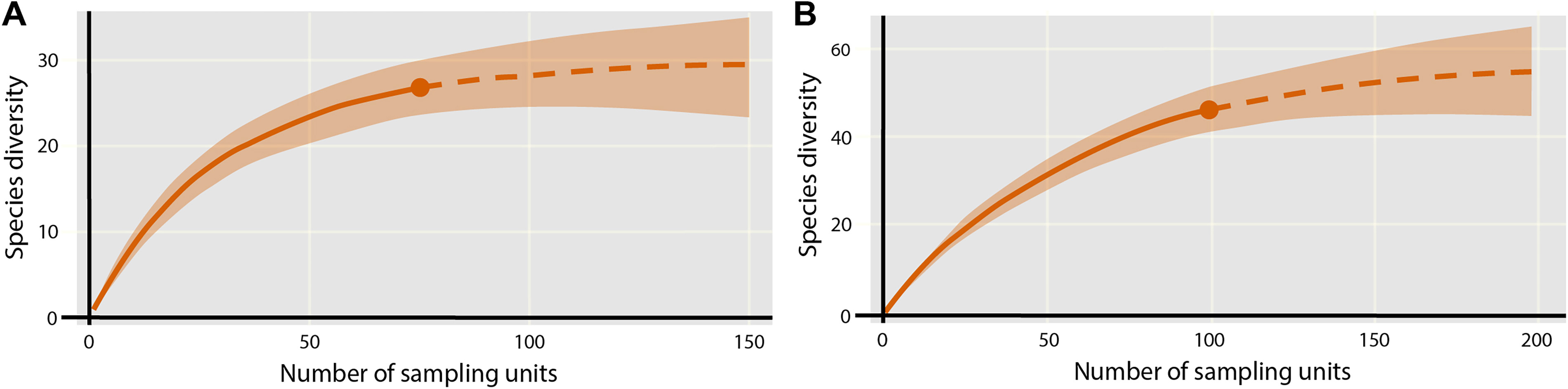
We found 27 species of amphibian anurans belong to five families: Bufonidae (N = 3 spp.), Hylidae (N = 9 spp.), Leptodactylidae (N = 12 spp.), Microhylidae (N = 2 spp.), and Odontophrynidae (N = 1 sp.) (Table 2, Figure 2). The rarefaction curve shows a slight tendency to stabilize (Figure 3a), and the richness estimators Chao1 (27.47 ± 1.85) and Jacknife1 (31.89 ± 2.29) suggest including at least four anuran species in Pedro II; thus, we sampled around 87% of the anuran species that likely occur in the region. All species are classified as least concern (LC) regarding the imminent risk of extinction (ICMBio 2024). Most of the species are widely distributed in the Brazilian biomes, and although some are considered typical of the Caatinga and Cerrado environments (Uchôa et al. 2022; Santana et al. 2024), they occur in adjacent biomes or transitional areas. No endemism occurs in Pedro II (Table 2).
Amphibian species recorded in the municipality of Pedro II, Piauí State, Northeastern Brazil, with their respective authors; vouchers; conservation status (IUCN and ICMbio): LC (Least Concern), NE (Not Evaluated) and DD (Data Deficient); and distribution in Brazilian biomes: CA (Caatinga), CE (Cerrado), AT (Atlantic Forest), AM (Amazon Forest), and widely distribution (WD). Species without information (?).

Anuran amphibians recorded in the municipality of Pedro II, Piauí State, Northeastern Brazil. A. Rhinella diptycha; B. R. mirandaribeiroi; C. Boana raniceps; D. Corythomantis greeningi; E. Dendropsophus minutus; F. D. nanus; G. D. soaresi; H. Scinax x-signatus; I. S. aff. similis; J. Adenomera hylaedactyla; K. A. juikitam; L. Leptodactylus fuscus; M. L. macrosternum; N. L. aff. mystaceus; O. L. troglodytes; P. L. vastus; Q. Physalaemus albifrons; R. P. cuvieri; S. Pleurodema diplolister; T. Pseudopaludicola mystacalis; U. Dermatonotus aff. muelleri; V. Elachistocleis aff. piauiensis; W. Proceratophrys cristiceps; X. Pithecopus gonzagai.

Sample-size-based rarefaction and extrapolation sampling curves, with their respective confidence intervals (95%), performed with incidence data of anurans (A) and squamate reptiles (B) collected in the municipality of Pedro II, Piauí State, Northeastern Brazil.
Regarding the amphibian species composition similarity, we observed a high species turnover in the localities sampled in Piauí state (75.6% of total beta diversity). The loss of species contributes just 24.4% of the total beta diversity (Figure 4a). Differences in species composition were mainly due to Flori (LCBD = 0.1436) and SRNon (LCBD = 0.1274), which have the lowest species richness, and by RiGon (LCBD = 0.1412) and UUnES (LCBD = 0.1297), which presented the highest numbers of exclusive or shared species (p.LCBD < 0.05). Just Leptodactylus fuscus (Schneider, 1799), Leptodactylus troglodytes Lutz, 1926, and Physalaemus cuvieri Fitzinger, 1826 were common to all sampled areas. Other 13 species were exclusive to one locality (see Data Availability section). Additionally, we observed that anuran composition of Pedro II was more similar to those areas located in Caatinga than Cerrado environments (Figure 4a). Amongst the study areas, we observed it as more similar to SCoNP (j = 0.8571), Picos (j = 7407), Caxin (j = 0.7241), SCiNP (j = 0.6774), and Barra (j = 0.6333).

Ternary diagram of beta diversity and similarity (Jaccard index and “UPGMA” clustering method) between different inventories carried out in Piauí, northeastern Brazil. A - anurans, B - lizards, C - snakes. Each point represents a pairwise comparison of the sites and the dotted lines represent the links between the mean values (black square).
2. Reptile species composition
We found 55 reptile species belong to three orders: Crocodylia with one only species belonging to the Alligatoridae family; Testudines with five species belonging to the families Chelidae (N = 3 spp.), Kinosternidae (N = 1 sp.), and Testudinidae (N = 1 sp.); and Squamata with 46 species recorded from 16 families (Table 3, Figures 5–6). Among the amphisbaenas, we found only three species belonging to the Amphisbaenidae family. Among lizards, we recorded 20 species from the following families: Gekkonidae (N = 3 spp.), Gymnophthalmidae (N = 4 spp.), Iguanidae (N = 1 sp.), Phyllodactylidae (N = 1 sp.), Polychrotidae (N = 1 sp.), Sphaerodactylidae (N = 2 spp.), Scincidae (N = 3 spp.), Teiidae (N = 3 spp.), and Tropiduridae (N = 2 spp.). Snakes correspond to 56.5% of the Squamata recorded with 26 species from the following families: Boidae (N = 2 spp.), Colubridae (N = 6 spp.), Dipsadidae (N = 14 spp.), Elapidae (N = 2 spp.), Leptotyphlopidae (N = 1 sp.), and Viperidae (N = 1 sp.). The rarefaction curve also has a slight tendency to stabilize (Figure 3b), and the richness estimators Chao1 (53.48 ± 4.93) and Jacknife1 (62.79 ± 3.64) suggest including of seven and 16 reptile species in Pedro II, respectively. We sampled around 79% of the reptile species that likely occur in the region. Except for Micrurus bonita, which do not have sufficient data to evaluate their conservational status, all species are classified as having the least concern regarding the imminent risk of extinction (ICMBio 2024). We found three snakes typical to the Caatinga biome: Boiruna sertaneja Zaher, 1996, Erythrolamprus viridis (Günther, 1862), and Epictia borapeliotes (Vanzolini, 1996), whereas other reptiles have a wide distribution in the Brazilian biomes or occur in more than two biomes and transitional areas (Table 3).
Reptile species recorded in the municipality of Pedro II, Piauí State, Northeastern Brazil, with their respective authors; vouchers; conservation status (IUCN and ICMbio): LC (Least Concern), NE (Not Evaluated) and DD (Data Deficient); and distribution in Brazilian biomes: CA (Caatinga), CE (Cerrado), AT (Atlantic Forest), AM (Amazon Forest), and widely distribution (WD). Species viewed and not collected (*). Invasive species (-).

Reptiles recorded in the municipality of Pedro II, Piauí State, Northeastern Brazil. A. Mesoclemmys perplexa; B. M. tuberculata; C. Kinosternon scorpioides; D. Amphisbaena alba; E. A. vermicularis; F. Leposternon polystegum; G. Hemidactylus agrius; H. H. brasilianus; I. Colobosauroides cearensis; J. Micrablepharus maximiliani; K. Vanzosaura multiscutata; L. Iguana iguana; M. Phyllopezus pollicaris; N. Polychrus acutirostris; O. Brasiliscincus heathi; P. Copeoglossum arajara; Q. Coleodactylus meridionalis; R. Gonatodes humeralis; S. Ameiva ameiva; T. Ameivula pyrrhogularis; U. Tropidurus hispidus; V. Tropidurus semitaeniatus; W. Boa constrictor; X. Epicrates assisi.

Reptiles recorded in the municipality of Pedro II, Piauí State, Northeastern Brazil. A. Drymoluber brazili; B. Drymarchon corais; C. Leptophis dibernardoi; D. Oxybelis aeneus; E. Spilotes pullatus; F. Apostolepis cearensis; G. Dryophylax phoenix; H. Erythrolamprus poecilogyrus; I. E. viridis; J. Leptodeira tarairiu; K. Oxyrhopus trigeminus; L. Philodryas nattereri; M. P. olfersii; N. Pseudoboa nigra; O. Psomophis joberti; P. Xenodon merremii; Q. Micrurus bonita; R. M. lemniscatus; S. Epictia borapeliotes; T. Crotalus durissus.
Regarding reptile species composition, we observed a high lizard species turnover (76.82% of the total beta diversity). The loss of species contributes 23.18% of the total beta diversity (Figure 4b). Differences in species composition were mainly due to UUnES (LCBD = 0.1387) and SCapNP (LCBD = 0.1371), which had the highest species richness (p.LCBD < 0.05). Just the lizards Iguana iguana (Linnaeus, 1758), Ameiva ameiva (Linnaeus, 1758), and Salvator merianae Duméril & Bibron, 1839 were common to all sampled areas, whereas nine species were exclusive to one unique sampled area (see Data Availability section). The lizard fauna of Pedro II was more similar to Batal (j = 0.7000; Figure 4b). Regarding snakes, differences in species composition were mainly due to SCapNP (LCBD = 0.1054) and Picos (LCBD = 0.1050), which had the highest species richness. The species turnover contributes 65.36% of the total beta diversity, whereas the loss of species was 34.64% (Figure 4c). Just Oxyrhopus trigeminus Duméril, Bibron & Duméril, 1854 was common to all sampled areas, whereas 14 species were exclusive to one unique sampled area (see Data Availability section). The snake fauna of Pedro II was more similar to SCiNP (j = 0.7; Figure 4c).
Discussion
Given the increasing impacts on natural landscapes caused by human activity and the imminent climate crisis, the need to obtain basic knowledge about Neotropical biodiversity is becoming increasingly urgent. In this context, the state of Piauí still has large unknown areas (Pantoja et al. 2022), including areas with high species richness and/or priority areas for conservation (MMA 2023). In general, we observed a high species richness in Pedro II, representing about 45% of the amphibian and reptile species recorded in Piauí state (Roberto, Ribeiro and Loebmann 2013, Guedes, Entiauspe-Neto and Costa 2023). Ecotone areas are usually diverse because species from different biomes coexist in these environments, increasing species richness (Kark and Rensburg 2006, Kark 2013, Marques et al. 2023). Therefore, Pedro II is an ecotone area of Caatinga and Cerrado influenced by different phytophysiognomies, which might explain the high species richness in this region. Additionally, Pedro II is located in the Complexo da Serra Grande bioregion (Lima and Guerra 2020), in which some areas are considered real herpetofaunal “hotspots” (Loebmann and Haddad 2010). This region was formed from the removal of different surface layers of the Ibiapaba plateau (Andrade and Lins 1977, Lima 1987) that previously constituted a single geological unit, facilitating the sharing of species between previously connected areas.
The total of species recorded is expressive (82 species) compared with other herpetological studies in Piauí state. Araújo et al. (2020b) recorded 96 herpetofaunal species in the Delta do Parnaíba Environmental Protection Area (DPEPA), which comprises a total area of 3138 km2 between the states of Ceará, Piauí, and Maranhão. At the opposite extreme of Piauí state, Marques et al. (2023) reported 94 species of amphibians and reptiles in the region of the Serra das Confusões National Park (SCoNP), a protected area of around 5500 km2. Although Pedro II comprises a total area of about 1550 km2, we found the third region with the highest herpetofauna in Piauí state. Therefore, we reinforce the biological importance of ecotone areas to the maintenance and conservation of biodiversity, besides the ecosystem services provided by them.
Comparing the species composition separately (between groups: “amphibians”, “snakes”, and “lizards”) with other checklists, we observed Pedro II shared with Caxingó (Roberto, Ribeiro and Loebmann 2013) the fourth highest amphibian richness in Piauí state (25 species; see Statistical analysis topic). In this case, DPEPA (Araújo et al. 2020b; 30 species), SCiNP and ScoNP (Dal Vechio et al. 2016, Araújo et al. 2020a, Marques et al. 2023, 27 species), and RiGon (Roberto, Ribeiro and Loebmann 2013, 26 species) have the highest amphibian richness. Pedro II shared with DPEPA (Araújo et al., 2020b) the second-highest snake richness in Piauí state (27 species), behind only UUnEE (Dal Vechio et al. 2013, 34 species). Similarly, we found the second-highest lizard richness in Piauí state (20 species), being behind only ScoNP (Dal Vechio et al. 2016, Marques et al. 2023, 24 species). Other reptiles were not included in these comparisons separately because they represent incidental or random sporadic reports. However, Pedro II had five (83%) of the six continental Testudines and three (60%) of the five Amphisbaenidae reported in Piauí state (Guedes, Entiauspe-Neto and Costa 2023).
Pedro II stands out by the presence of unique species in the state, for instance, Kinosternon scorpioides (Linnaeus, 1766) (Andrade 2019), Epictia borapeliotes (Araújo et al. 2020c), and Micrurus lemniscatus (Linnaeus, 1758) (Araújo et al. 2022a) have wide geographical distribution, however, their occurrences were recently recorded and correspond to the only known records for Piauí state (Guedes, Entiauspe-Neto and Costa 2023). In addition, Drymoluber brazili (Gomes, 1918) is a snake poorly known in the Northeast region, having its distribution updated until the Pedro II limits, being the northmost report of this species (Araújo et al. 2022b). However, we believe the species richness in Pedro II is still underestimated because species with the potential to occur in the region have not yet been found. For instance, Eunectes murinus (Linnaeus, 1758) and Bothrops lutzi (Miranda-Ribeiro, 1915) were recorded around 50 km in the Sete Cidades National Park (Rocha and Prudente 2010) and around 100 km in the municipality of Castelo do Piauí (Rodrigues and Prudente 2011). Additionally, other herpetofaunal species recorded in the Ibiapaba plateau (see Loebmann and Haddad 2010) might occur in Pedro II due to its geographical proximity and similarity in phytophysiognomies in the highlands of the municipality.
Most species recorded in Pedro II have wide geographic distribution (45 species) or occur only in the Caatinga and Cerrado biomes (12 species). We observed the species composition similarity varied according to the studied group, for example, the amphibian fauna was more similar to the Serra das Confusões National Park (Marques et al. 2023), Sete Cidades National Park (Araújo et al. 2020a), and to the municipalities of Picos (Benício, Silva and Fonseca 2015), Barras (Benício, Silva and Fonseca 2014), and Caxingó (Roberto, Ribeiro and Loebmann 2013). The lizard community was more similar to the municipality of Batalha (Silva, Carvalho and Rodrigues 2015), whereas the snake fauna was more similar to the Sete Cidades National Park (Rocha and Prudente 2010) and the municipality of José de Freitas (Rocha and Santos 2004). In any case, the herpetofauna in Piauí state consists of typical species of Caatinga, Cerrado, and transitional zones, besides those widely distributed in Brazilian biomes. However, comparisons between these sampled areas are difficult because they were conducted in different sampling periods, having distinct sample sizes and methodologies. Furthermore, there is still a large sampling gap in the state, in which most studies were carried out within conservation units, especially those with restricted use (Pantoja et al. 2022).
Pedro II is located in a region of great natural and economic importance for the Piauí, sometimes generating a conflict between economic development and conservation in the municipality. The municipality is considered the only producer of Precious Opal gemstone in all of Brazil (Milanez and Oliveira 2009, Sousa et al. 2020) extracted from several mining areas in rural areas of the municipality (Santos et al. 2024). Some negative environmental impacts have been identified in these mining areas, such as the strong alteration of the natural landscape due to changes in topography, rainfall erosion processes, soil pollution, and displacement of local fauna (Santos et al. 2024). Additionally, the municipality also has extensive natural areas that have been impacted in recent years due to the increase in real estate speculation in natural preservation areas, such as near hillsides, springs, and/or river courses, and irregular tourism practices developed in an unsustainable manner (Lima and Gerra 2020).
In this context, the collection of data on local biodiversity, including herpetofauna (Santos et al. 2019), is the initial step towards developing adequate conservation and land use control measures. Although it belongs to the Complexo da Serra Grande bioregion and is included within a federal conservation unit, this is the first long-term study to characterize the amphibian and reptile fauna of the municipality of Pedro II, highlighting the importance of faunal surveys for regions that are still little explored. As discussed in recent years, the decline in reptile and amphibian populations in the world has been growing alarmingly, and many of these losses are due to anthropic actions and climate change (Gibbons et al. 2000, Luedtke et al. 2023). Therefore, measures to conserve areas that have great species richness should be taken especially in ecotonal areas, since these areas usually harbor a high species diversity (Smith et al. 2001, Walker et al. 2003, Yarrow and Marín 2007), including amphibians and reptiles (Matavelli et al. 2019, Madani et al. 2024).
Supplementary Material
The following online material is available for this article:
Supplementary material 1 – Table of presence/absence of amphibian species at all localities in the state of Piauí used in the analyses comparing species richness and composition.
Supplementary material 2 – Table of presence/absence of serpentes species at all localities in the state of Piauí used in the analyses comparing species richness and composition.
Supplementary material 3 – Table of presence/absence of lizard species at all localities in the state of Piauí used in the analyses comparing species richness and composition
Acknowledgments
We thank the Instituto Federal de Educação, Ciência e Tecnologia do Piauí-IFPI for providing a grant through the Programa de Apoio à Pesquisa, Estruturação e Reestruturação Laboratorial-PROAGRUPAR-INFRA (edital nº 29/2021) and to Instituto Chico Mendes de Conservação da Biodiversidade by collection license (#61838-4/21). MAP thanks the Instituto Federal de Educação, Ciência e Tecnologia do Piauí-IFPI for providing a scholarship through the Institutional Scientific Initiation Program (Edital nº 7843 - PIBIC IFPI 2020). CAC (Process: 88887.765685/2022-00), SCMA (Process: 88887.706181/2022-00), and NLAR (Process: 8888.7827305/2023-00) thanks the Coordenação de Aperfeiçoamento de Pessoal de Nível Superior (CAPES) for providing research fellowship. FPS (Process: 073.6819.2024.0005705-43), LRU (Process: BO0450/2022), and JLPF (Process: 073.6819.2024.0005706-24) thanks the Fundação de Amparo à Pesquisa do Estado da Bahia (FAPESB) for providing a research fellowship. KCA thanks Conselho Nacional de Desenvolvimento Científico e Tecnológico (CNPq) and Fundação de Amparo à Pesquisa do Estado do Piauí (FAPEPI) for providing research fellowship (Process: 150013/2023-0). We thank all those who contributed directly and indirectly to the completion of this work, including all former Biotecpi members who helped with data collection activities.
Data availability
Supporting data are available at https://doi.org/10.48331/scielodata.5VSHR0
References
- AGUIAR, R. & GOMES, J.R.C. 2004. Projeto cadastro de fontes de abastecimento por água subterrânea, estado do Piauí: diagnóstico do município de Pedro II Fortaleza: CPRM - Serviço Geológico do Brasil.
-
ALBUQUERQUE, N.R., MARTINS, F.S., BORGES-NOJOSA D.M. & ÁVILA, R.W. 2022. A New Species of Parrot-Snake of the Genus Leptophis Bell, 1825 (Serpentes, Colubridae) from the Semi-Arid Region of Brazil. South American Journal of Herpetology 23(2), 7–24. https://doi.org/10.2994/SAJH-D-19-00113.1
» https://doi.org/10.2994/SAJH-D-19-00113.1 -
ANDRADE, E.B. 2019. First documented record of Kinosternon scorpioides (Chelonia: Kinosternidae) in the state of Piauí, Northeastern Brazil. Pesquisa e Ensino em Ciências Exatas e da Natureza 3(2), 216–223. https://doi.org/10.29215/pecen.v3i2.1288
» https://doi.org/10.29215/pecen.v3i2.1288 - ANDRADE, G.O. & LINS, R.C. 1977. Bacia do Parnaíba: aspectos morfológicos Recife: Fundação Joaquim Nabuco.
-
ARAUJO, H.F.P., CANASSA, N.F., MACHADO, C.C.C. & TABARELLI, M. 2023. Human disturbance is the major driver of vegetation changes in the Caatinga dry forest region. Scientific Report 13, 18440. https://doi.org/10.1038/s41598-023-45571-9
» https://doi.org/10.1038/s41598-023-45571-9 -
ARAÚJO, K., ANDRADE, E., BRASILEIRO, A., BENÍCIO, R., SENA, F., SILVA, R., SANTOS, A., COSTA, C. & ÁVILA, R. 2020a. Anurans of Sete Cidades National Park, Piauí state, northeastern Brazil. Biota Neotropica 20, e20201061. https://doi.org/10.1590/1676-0611-BN-2020-1061
» https://doi.org/10.1590/1676-0611-BN-2020-1061 -
ARAÚJO, K., RIBEIRO, A., ANDRADE, E., PEREIRA, O., GUZZI, A. & ÁVILA, R. 2020b. Herpetofauna of the Environmental Protection Area Delta do Parnaíba, Northeastern Brazil. Cuadernos de Herpetología 34(2), 185–199. https://doi.org/10.31017/CdH.2020.(2019-038
» https://doi.org/10.31017/CdH.2020.(2019-038 -
ARAÚJO, S.C.M., RODRIGUES, F.E.G., NUNES, R.C. & ANDRADE, E.B. 2020c. First record and geographic distribution of Epictia borapeliotes (Vanzolini, 1996) (Squamata: Leptotyphlopidae) in the state of Piauí, northeastern Brazil. Cuadernos de Herpetología 34, 295–298. https://doi.org/10.31017/CdH.2020.(2020-017)
» https://doi.org/10.31017/CdH.2020.(2020-017) -
ARAÚJO, S.C.M., UCHÔA, L.R., COSTA, C.A., SENA, F.P. & ANDRADE, E.B. 2022a. First record of Micrurus lemniscatus (Elapidae) in the state of Piauí, northeastern Brazil. Caldasia 45, 191–194. https://doi.org/10.15446/caldasia.v45n1.101553
» https://doi.org/10.15446/caldasia.v45n1.101553 -
ARAÚJO, S.C.M., UCHÔA, L.R., SENA, F.P., BARBOSA, C.U., SOUSA, A.P.A.G. C. & ANDRADE, E.B. 2022b. New record and updated distribution map for Drymoluber brazili (Gomes, 1918) (Serpentes: Colubridae). Cuadernos de herpetologia 36(1), 115–117. https://doi.org/10.31017/CdH.2022.(2021–037)
» https://doi.org/10.31017/CdH.2022.(2021–037) -
AZEVEDO, J.A., VALDUJO, P. & NOGUEIRA, C. 2016. Biogeography of anurans and squamates in the Cerrado hotspot: Coincident endemism patterns in the richest and most impacted savanna on the globe. Journal of Biogeography 43(12), 2454–2464. https://doi.org/10.1111/jbi.12803
» https://doi.org/10.1111/jbi.12803 -
BARBO, F.E., GRAZZIOTIN, F.G., PEREIRA-FILHO, G.A., FREITAS, M.A., STEPHENSON, A.H.F. & KOKUBUM, M.N.C. 2022. Isolated by dry lands: integrative analyses unveil the existence of a new species and a previously unknown evolutionary lineage of Brazilian Lanceheads (Serpentes: Viperidae: Bothrops) from a Caatinga moist-forest enclave. Canadian Journal of Zoology 100(2), 147–159. https://doi.org/10.1139/cjz-2021-0131
» https://doi.org/10.1139/cjz-2021-0131 - BENÍCIO, R.A., SILVA, G.R. & FONSECA, M.G. 2015. Anurans from a Caatinga area in state of Piauí, northeastern Brazil. Boletim do Museu de Biologia Mello Leitão 37(2), 207–217.
- BENÍCIO, R., LIMA, D. & FONSECA, M. 2015. Species richness of reptiles in a Caatinga area in northeastern Brazil. Gaia Scientia 9(1), 95–100.
- BENÍCIO, R.A., MESQUITA, P.C.D., CAVALCANTE, V.H.G.L. & FONSECA, M.G. 2015. Répteis de uma região de ecótono no estado do Piauí, nordeste do Brasil. Gaia Scientia 9(1), 89–94.
- BENÍCIO, R., SILVA, G. & FONSECA, M. 2014. Comunidade de anuros em uma área de ecótono no nordeste do Brasil Community of anurans in an ecotonal area in northeastern Brazil. Boletim do Museu Paraense Emílio Goeldi. Ciências Naturais 9, 511–517.
- CASTRO, A.A.J.F., CASTRO, N.M.C.F., COSTA, J.M.C., FARIAS, R.R.S., MENDES, M.R.A., ALBINO, R.S., BARROS, J.S. & OLIVEIRA, M.E.A. 2007. Cerrados marginais do Nordeste e ecótonos associados. Revista Brasileira de Biociências 5(1), 273–275.
- CASTRO, D.P., MÂNGIA, S., MAGALHÃES, F.D., RÖHR, D.L., CAMURUGI, F., FILHO, R.R., SILVA, M.M., ANDRADE-OLIVEIRA, J.A., SOUSA, T.A., FRANÇA, F.G., ... BORGES-NOJOSA, D.M. 2019. Herpetofauna of protected areas in the Caatinga VI: The Ubajara National Park, Ceará, Brazil. Herpetology notes 12, 727–742.
-
CAVALCANTI, L., PELEGRIN, N., COSTA, T., COLLI, G., TUCKER, D., COSTA, G., PALMEIRA, C., FRANÇA, F., SOARES, A., MESQUITA, D. & GARDA, A. 2014. Herpetofauna of protected areas in the Caatinga II: Serra da Capivara National Park, Piauí, Brazil. Check List 10(1), 18–27. https://doi.org/10.15560/10.1.18
» https://doi.org/10.15560/10.1.18 - CECHIN, S.Z. & MARTINS, M. 2000. Eficiência de armadilhas de queda (pitfall traps) em amostragens de anfíbios e répteis no Brasil. Revista brasileira de zoologia 17, 729–740.
-
CHAO, A., GOTELLI, N., HSIEH, T.C., SANDER, E., MA, K., COLWELL, R. & ELLISON, A. 2014. Rarefaction and extrapolation with Hill numbers: A framework for sampling and estimation in species diversity studies. Ecological Monographs 84, 45–67. https://doi.org/10.1890/13-0133.1
» https://doi.org/10.1890/13-0133.1 -
COLWELL, R.K., CHAO, A., GOTELLI, N.J., LIN, S.Y., MAO, C.X., CHAZDON, R.L. & LONGINO, J.T. 2012. Models and estimators linking individual–based and sample–based rarefaction, extrapolation and comparison of assemblages. Journal of Plant Ecology 5(1), 3–21. https://doi.org/10.1093/jpe/rtr044
» https://doi.org/10.1093/jpe/rtr044 - CORN, P.S. 1994. Straight-line drift fences and pitfall traps. In W. R. Heyer, M. A. Donnely, R. W. McDiarmid, L. A. Hayek & M. Foste (Eds.), Measuring and monitoring biological diversity: standard methods for amphibians (pp. 109–117). Washington, D. C.: Smithsonian Institution Press.
-
CORTÉZ-GÓMEZ, A.M.M., RUIZ-AGUDELO, C.A., VALENCIA-AGUILAR, A. & LADLE, R. J. 2015. Ecological functions of neotropical amphibians and reptiles: a review. Universitas Scientiarum 20(2), 229–245. https://doi.org/10.11144/Javeriana.SC20-2.efna
» https://doi.org/10.11144/Javeriana.SC20-2.efna - CRUMP, M.L. & SCOTT, N.J. 1994. Visual encounter surveys. In W.R. Heyer, M.A. Donnely, R.W. McDiarmid, L.A. Hayek & M. Foste (Eds.), Measuring and monitoring biological diversity: standard methods for amphibians (pp. 84–92). Washington, D. C.: Smithsonian Institution Press.
-
DAL VECHIO, F., RECODER, R., RODRIGUES, M.T. & ZAHER, H. 2013. The herpetofauna of the Estação Ecológica de Uruçuí-Una, state of Piauí, Brazil. Papéis Avulsos de Zoologia 53(16), 225–243. https://doi.org/10.1590/S0031-10492013001600001
» https://doi.org/10.1590/S0031-10492013001600001 -
DAL VECHIO, F., TEIXEIRA JR., M., RECODER, R.S., RODRIGUES, M.T. & ZAHER, H. 2016. The herpetofauna of Parque Nacional da Serra das Confusões, state of Piauí, Brazil, with a regional species list from an ecotonal area of Cerrado and Caatinga. Biota Neotropica 16(3), e20150105. https://doi.org/10.1590/1676-0611-BN-2015-0105
» https://doi.org/10.1590/1676-0611-BN-2015-0105 -
DRAY, S., BAUMAN, D., BLANCHET, G., BORCARD, D., CLAPPE, S., GUÉNARD, G., JOMBART, T., LAROCQUE, G., LEGENDRE, P., MADI, M. & WAGNER, H.H. 2019. Adespatial: Multivariate multiscale spatial analysis R package version 0.3–3. https://cran.r-project.org/package=adespatial
» https://cran.r-project.org/package=adespatial -
DUBEUX, M.J.M., GONÇALVES, U., PALMEIRA, C.N.S., NUNES, P.M.S., CASSIMIRO, J., GAMBLE, T., WERNECK, F.P., RODRIGUES, M.T. & MOTT, T. 2022. Two new species of geckos of the genus Phyllopezus Peters, 1878 (Squamata: Gekkota: Phyllodactylidae) from northeastern Brazil. Zootaxa 5120(3), 345–372. https://doi.org/10.11646/zootaxa.5120.3.3
» https://doi.org/10.11646/zootaxa.5120.3.3 -
FIORILLO, B.F., FAGGIONI, G.P., CEREZER F.O., BECKER C.G., DÍAZ-RICAURTE J.C. & MARTINS M. 2023. Effects of environmental factors on the ecology and survival of a widespread, endemic Cerrado frog. Biotropica 55, 551–562. https://doi.org/doi:10.1111/btp.13209
» https://doi.org/doi:10.1111/btp.13209 - FITZGERALD, L.A. 2012. FINDING AND CAPTURING REPTILES. IN R. W. MCDIARMID, M. S. FOSTER, C. GUYER, J. W. GIBBONS, & N. CHERNOFF (Eds.), Reptile Biodiversity: Standard Methods for Inventory and Monitoring (pp. 77–88). University of California Press.
- FOSTER, M.S. 2012. Standard techniques for inventory and monitoring. In R. W. McDiarmid, M. S. Foster, C. Guyer, J. W. Gibbons, & N. Chernoff (Eds.), Reptile Biodiversity: Standard Methods for Inventory and Monitoring (pp. 205–240. University of California Press.
- FRANCO, F.L., TREVINE, V.C., MONTINGELLI, G.G. & ZAHER, H. 2017. A new species of Thamnodynastes from the open areas of central and northeastern Brazil (Serpentes: Dipsadidae: Tachymenini). Salamandra 53(3), 339–350.
- FREITAS, S.O., GOMES, J.M.A. & AQUINO, C.M.S. 2016. Análise dos impactos ambientais da extração de opala no munícipio de Pedro II, Piauí. Geociências 35(3), 443–456.
-
FROST, D.R. 2024. Amphibian Species of the World: an Online Reference Version 6.2 (03 August 2024). Electronic Database accessible at: https://amphibiansoftheworld.amnh.org/index.php American Museum of Natural History, New York, USA. https://doi.org/10.5531/db.vz.0001
» https://doi.org/10.5531/db.vz.0001» https://amphibiansoftheworld.amnh.org/index.php - GARDA, A.A., LION, M.B., LIMA, S.M.D.Q., MESQUITA, D.O., ARAÚJO, H.F.P.D. & NAPOLI, M.F. 2018. Os animais vertebrados do Bioma Caatinga. Ciência e Cultura 70(4), 29–34.
- GIBBONS, J.W., SCOTT, D.E, RYAN, T.J., BUHLMANN, K.A., TUBERVILLE, T.D., METTS, S.B., GREENE, J.L., YALE LEIDEN, T.M., CHRISTOPHER, S.P. & WINNE, T. 2000. The Global Decline of Reptiles, Déjà Vu Amphibians: Reptile species are declining on a global scale. Six significant threats to reptile populations are habitat loss and degradation, introduced invasive species, environmental pollution, disease, unsustainable use, and global climate change. BioScience 50(8), 653–666,
- GOMES, E.R. 2004. Estudo de Impacto Ambiental: Boi Morto, Pedro II, Piauí: SEMAR.
-
GUEDES, T., ENTIAUSPE-NETO, O. & COSTA, H. 2023. Lista de répteis do Brasil: atualização de 2022. Herpetologia Brasileira 12, 56–161. https://doi.org/10.5281/zenodo.7829013
» https://doi.org/10.5281/zenodo.7829013 -
GUEDES, T., NOGUEIRA, C. & MARQUES, O. 2014. Diversity, natural history, and geographic distribution of snakes in the Caatinga, Northeastern Brazil. Zootaxa 1, 01–93. https://doi.org/10.11646/zootaxa.3863.1.1
» https://doi.org/10.11646/zootaxa.3863.1.1 -
GUTIÉRREZ, E.E. & MARINHO-FILHO, J. 2017. The mammalian fauna endemic to the Cerrado and the Caatinga. Zookeys 10(644), 105–157. https://doi.org/10.3897/zookeys.644.10827
» https://doi.org/10.3897/zookeys.644.10827 -
HILL, J. E., DEVAULT, T. L. & BELANT, J. L. (2019). Impact of the human footprint on anthropogenic mortality of North American reptiles. Acta Oecologica 101, 103486. https://doi.org/10.1016/j.actao.2019.103486
» https://doi.org/10.1016/j.actao.2019.103486 -
HSIEH, T.C., MA, K.H. & CHAO, A. 2016. iNEXT: An R package for interpolation and extrapolation of species diversity (Hill numbers). Methods in Ecology and Evolution 7, 1451–1456. https://doi.org/10.1111/2041-210X.12613
» https://doi.org/10.1111/2041-210X.12613 - IBGE – Instituto Brasileiro de Geografia e Estatística. 2019. Biomas e sistema costeiro-marinho do Brasil Coordenação de Recursos Naturais e Estudos Ambientais. - Rio de Janeiro: IBGE, 2019.
-
JACOB, D.E., NЕLSON, I.U., EFENAKPO, O.D., IZAH, S.C. 2024. Reptiles as Environmental Sentinels: Exploring Their Significance. In S.C. Izah, M.C. Ogwu, H. Hamidifar (Eds.), Biomonitoring of Pollutants in the Global South (pp 485–533). Springer, Singapore. https://doi.org/10.1007/978-981-97-1658-6_14
» https://doi.org/10.1007/978-981-97-1658-6_14 - JARED, C.A.G.S., GREGO, K.F., ANTONIAZZI, M.M., SANT’ANNA, S.S., SANTOS, S.M.A. & MATTARAIA, V.G.M. 2023. Capítulo 7 - Anfíbios e serpentes. In V.G.M. Mattaraia (coord.). A.A.B. Viana, K. De Angelis, L.M. G.M. Braga (Org.), Guia brasileiro de produção, manutenção ou utilização de animais em atividades de ensino ou pesquisa científca/Concea (pp. 459–521). 1ª ed. Brasília/DF. Ministério da Ciência, Tecnologia e Inovação.
-
KARK, S. 2013. Effects of Ecotones on Biodiversity. In S.A. Levin (ed.), Encyclopedia of Biodiversity (pp. 142–148). Elsevier. https://doi.org/10.1016/B978-0-12-384719-5.00234-3
» https://doi.org/10.1016/B978-0-12-384719-5.00234-3 -
KARK, S. & RENSBURG, B.J.V. 2006. Ecotones: marginal or central areas of transition? Israelitan Jounal of Ecology and Evolution 52(1), 29–53. https://doi.org/10.1560/IJEE.52.1.29
» https://doi.org/10.1560/IJEE.52.1.29 -
KINDT, R. & COE, R. 2005. Tree diversity analysis A manual and software for common statistical methods for ecological and biodiversity studies. World Agroforestry Centre (ICRAF). http://www.worldagroforestry.org/output/tree-diversity-analysis
» http://www.worldagroforestry.org/output/tree-diversity-analysis -
LEGENDRE, P. 2014. Interpreting the replacement and richness difference components of beta diversity. Global Ecology Biogeography 23(11), 1324–1334. https://doi.org/10.1111/geb.12207
» https://doi.org/10.1111/geb.12207 -
LEGENDRE, P. & DE-CÁCERES, M. 2013. Beta diversity as the variance of community data: dissimilarity coefficients and partitioning. Ecology Letters 16(8), 951–963. https://doi.org/10.1111/ele.12141
» https://doi.org/10.1111/ele.12141 - LIMA, I.M.M.F. 1987. Relevo do Piauí: uma proposta de classificação. Carta CEPRO 12(2), 55–84.
-
LIMA, I.M.D.M.F. & GUERRA, A.J.T. 2020. Ambiente montanhoso e turismo em Pedro II, Piauí. Geosul 35(74), 518–538. http://doi.org/10.5007/1982-5153.2020v35n74p518
» https://doi.org/10.5007/1982-5153.2020v35n74p518 -
LIMA, M.S.C.S., PEDERASSI, J., PINESCHI, R.B. & BARBOSA, D.B.S. 2019. Acoustic niche partitioning in an anuran community from the municipality of Floriano, Piauí, Brazil. Brazilian Journal of Biology 79(4), 566–576. https://doi.org/10.1590/1519-6984.180399
» https://doi.org/10.1590/1519-6984.180399 -
LOEBMANN, D., & HADDAD, C.F.B. 2010. Amphibians and reptiles from a highly diverse area of the Caatinga domain: composition and conservation implications. Biota Neotropica 10, 227–256. https://doi.org/10.1590/S1676-06032010000300026
» https://doi.org/10.1590/S1676-06032010000300026 - LUEDTKE, J.A., CHANSON, J., NEAM, K., HOBIN, L., MACIEL, A.O., CATENAZZI, A., BORZÉE, A., HAMIDY, A., AOWPHOL, A., JEAN, A. ... STUART, S. 2023. Ongoing declines for the world’s amphibians in the face of emerging threats. Nature 622, 308–314.
-
MADANI, G., HARTLEY, R., SCHULZ, M. & BERANEK, C.T. 2024. Life on the edge: Considering ecotonal habitat for the conservation of alpinereptile metacommunities. Journal for Nature Conservation 79, 1266232. https://doi.org/10.1016/j.jnc.2024.126623
» https://doi.org/10.1016/j.jnc.2024.126623 -
MADELLA-AURICCHIO, C., AURICCHIO, P. & SOARES, E. 2017. Reptile species composition in the Middle Gurguéia and comparison with inventories in the eastern Parnaíba River Basin, State of Piauí, Brazil. Papéis Avulsos de Zoologia 57(28), 375–386. https://doi.org/10.11606/0031-1049.2017.57.28
» https://doi.org/10.11606/0031-1049.2017.57.28 - MAGURRAN, A.E. & MCGILL, B.J. 2011. Biological diversity: Frontiers in measurement and assessment Oxford University Press, Oxford.
-
MÂNGIA, S., KOROIVA, R., NUNES, P.M.S., ROBERTO, I.J., ÁVILA, R.W., SANT’ANNA, A.C., SANTANA, D.J. & GARDA. A.A. 2018. A new species of Proceratophrys (Amphibia: Anura: Odontophrynidae) from the Araripe Plateau, Ceará State, northeastern Brazil. Herpetologica 74, 255–268. https://doi.org/10.1655/Herpetologica-D-16-00084.1
» https://doi.org/10.1655/Herpetologica-D-16-00084.1 -
MARQUES, R., GARDA, A., FURTADO, A., BRUINJÉ, A., PROTÁZIO, A., DE CARVALHO, B.F., VIEIRA, C., GOMES, D., PANTOJA, D., FIGUEIREDO, D., ... MESQUITA, D. 2023. Herpetofauna of protected areas in the Caatinga VIII: An updated checklist for the Serra das Confusões region with new data from Serra Vermelha, Piauí, Brazil. Biota Neotropica 23(4), e20231520. https://doi.org/10.1590/1676-0611-bn-2023-1520
» https://doi.org/10.1590/1676-0611-bn-2023-1520 - MATAVELLI, R., CAMPOS, A.M., SANTOS, C.L., ANDRADE, G.V. 2019. Anuran community in a Neotropical natural ecotone. Herpetology Notes 12, 1145–1156.
- MILANEZ, B. & PUPPIM, J.A.O. 2009. Ambiente, pessoas e labor: APLs para além do desenvolvimento econômico na mineração de opalas em Pedro II, Piauí. Cadernos EBAPE. BR (FGV) 7, 528–546.
- MMA – Ministério do Meio Ambiente. 2023. Áreas prioritárias para a conservação, utilização sustentável e repartição dos benefícios da biodiversidade 2ª Atualização. Série Biodiversidade 56. Brasília - DF.
-
NASCIMENTO, L.R.S., GRABOSKI, R.N.J., SILVA, J.R. & PRUDENTE, A.L.C. 2024. Integrative taxonomy of Micrurus ibiboboca (Merrem, 1820) (Serpentes, Elapidae) reveals three new species of coral snake. Systematics and Biodiversity 22(1), 2315958, https://doi.org/10.1080/14772000.2024.2315958
» https://doi.org/10.1080/14772000.2024.2315958 - NOGUEIRA, C., COLLI, G.R., COSTA, G.C. & MACHADO, R.B. 2010. Diversidade de répteis Squamata e evolução do conhecimento faunístico no Cerrado. In I. R. Diniz, J. Marinho-Filho, R.B. Machado & R.B. Cavalcanti (Eds.), Cerrado: conhecimento científico quantitativo como subsídio para ações de conservação (pp. 333–375). Thesaurus editora, Brasília.
-
NOVAES-E-FAGUNDES, G., LYRA, M.L., LOREDAM, V.S.A., CARVALHO, T.R., HADDAD, C.F.B., RODRIGUES, M.T., BALDO, D., BARRASSO, D.A., LOEBMANN, D., ÁVILA, R.W., BRUSQUETTI, F., ... PELOSO P.L.V. 2023. A tale of two bellies: Systematics of the Oval Frogs (Anura: Microhylidae: Elachistocleis Parker, 1927). Zoological Journal of the Linnean Society 197, 545–568. https://doi.org/10.1093/zoolinnean/zlac057
» https://doi.org/10.1093/zoolinnean/zlac057 - OITAVEN, L., BARRETO, D., ASSUNÇÃO, M., OLIVEIRA-SANTOS, J., ARAÚJO, A. & MOURA, G. 2021. Herpetofauna of Marechal Newton Cavalcanti Instruction Center, a hotspot Atlantic Forest fragment in Pernambuco, north-eastern Brazil. Amphibian and Reptile Conservation 15, 59–71.
-
OKSANEN, J., BLANCHET, F. G., KINDT, R., LEGENDRE, P., MINCHIN, P.R., O’HARA, R.B., SOLYMOS, P., STEVENS, M.H.H., SZOECS, E. ... WEEDON, J. 2015. The vegan package Community ecology package. R package version 2.3–2. Available at: http://CRAN.R-project.org/package=vegan Accessed on 05 August 2024.
» http://CRAN.R-project.org/package=vegan -
OLIVEIRA, E., GEHARA, M., SÃO‐PEDRO, V., COSTA, G., BURBRINK, F., COLLI, G., RODRIGUES, M. & GARDA, A. 2018. Phylogeography of Muller’s termite frog suggests the vicariant role of the Central Brazilian Plateau. Journal of Biogeography 00,1–12. https://doi.org/10.1111/jbi.13427
» https://doi.org/10.1111/jbi.13427 -
OLIVEIRA, M.S., RODRIGUES, N.L.A., ARAÚJO, K.C. & ANDRADE, E.B. 2023. Eating on the City: Diet Composition of Leptodactylus troglodytes Lutz, 1926 in Pedro II Municipality, Piauí, Brazil. Ensaios e Ciência C Biológicas Agrárias e da Saúde 27(2), 161–166. https://doi.org/10.17921/1415-6938.2023v27n2p161-166
» https://doi.org/10.17921/1415-6938.2023v27n2p161-166 - PANTOJA, D.L., ANDRADE, E.B., ÁVILA, R.W., BENÍCIO, R.A., CAVALCANTE, V.H.G.L., COLLI, G.R., GARDA, A.A., MESQUITA, D.O., ROCHA, W.A., SANTANA, G.L., ... SILVA, M.B. 2022. Herpetofauna das unidades de conservação doestado do Piauí, Nordeste do Brasil. In M. M. M. Ivanov & J. R. Lemos (Org.), Unidades de conservação do Estado do Piauí (pp. 144–188). vol. 2. Teresina: IFPI.
-
ROBERTO, I.J., RIBEIRO, S.C. & LOEBMANN, D. 2013. Amphibians of the state of Piauí, Northeastern Brazil: a preliminary assessment. Biota Neotropica 13(1), 322–330. https://doi.org/10.1590/S1676-06032013000100031
» https://doi.org/10.1590/S1676-06032013000100031 -
ROCHA, W. & PRUDENTE, A. 2010. The Snake Assemblage of Parque Nacional de Sete Cidades State of Piauí, Brazil. South American Journal of Herpetology 5, 132–142. https://doi.org/10.2994/057.005.0207
» https://doi.org/10.2994/057.005.0207 - ROCHA, W.A. & SANTOS, M.P.D. 2004. Análise ecológica da ofidiofauna da área do Eco Resort Nazareth, município de José de Freitas, Piauí. Publicações Avulsas Ciências Ambientais 11, 1–12.
-
RODRIGUES, F.D.S. & PRUDENTE, A.L.D.C. 2011. The snake assemblage (Squamata: Serpentes) of a Cerrado-Caatinga transition area in Castelo do Piauí, state of Piauí, Brazil. Zoologia 28, 440–448. https://doi.org/10.1590/S1984-46702011000400005
» https://doi.org/10.1590/S1984-46702011000400005 -
SABER, S., WONDWOSEN, T., RASHAD, S., SEYOUM, M. & ABDULAZIZ, A. 2017. Amphibians as Bioindicators of the Health of Some Wetlands in Ethiopia. The Egyptian Journal of Hospital Medicine 66, 66–73. https://doi.org/10.12816/0034635
» https://doi.org/10.12816/0034635 -
SANTANA, G.L., PANTOJA, D.L., PELOSO, P., SILVA, G.F., SILVA, M.S., MASCHIO, G.F. 2024. Endemic amphibians of the Cerrado and Caatinga: species richness, geographic range and conservation. The Herpetological Journal 4(2), 116-126. https://doi.org/10.33256/34.2.116126
» https://doi.org/10.33256/34.2.116126 - SANTOS, A.J.S., COSTA, C.A., SENA, F.P., ARAÚJO, K.C.& ANDRADE, E.B. 2019. New record and geographic distribution of Proceratophrys caramaschii Cruz, Nunes, and Juncá, 2012 in the state of Piauí, northeastern Brazil (Anura: Odontophrynidae). Herpetology Notes 12, 675–679.
-
SANTOS, L.C., MEDEIROS, A.R.S., VIEIRA, R.V.S., GOMES, M.E. M., GOMES, L.C.F., CAVALCANTE, J.N., OLIVEIRA, M.B.L.L., CRUZ, M.A.S., CUNHA, M.E.S. & LIMA, S.A. 2024. Avaliação dos impactos ambientais causados pela mineração de opala no município de Pedro II – Piauí. Ciências Exatas e da Terra 28(133), 59. https://doi.org/10.5281/zenodo.10980359
» https://doi.org/10.5281/zenodo.10980359 -
SILVA, L.A., MAGALHÃES, F.M., THOMASSEN, H., LEITE, F.S.F., GARDA, A.A., BRANDÃO, R.A., HADDAD, C.F.B., GIARETTA, A.A. & DE CARVALHO T.R. 2020. Unraveling the species diversity and relationships in the Leptodactylus mystaceus complex (Anura: Leptodactylidae), with the description of three new Brazilian species. Zootaxa 4779, 151–189. https://doi.org/10.11646/zootaxa.4779.2.1
» https://doi.org/10.11646/zootaxa.4779.2.1 - SILVA, M., CARVALHO, L.S. & RODRIGUES, L. 2015. Reptiles in an ecotonal area in northern State of Piauí, Brazil. Boletim do Museu de Biologia Mello Leitão 37, 437–455.
-
SILVA, M.B. & ÁVILA-PIRES, T.C.S. 2013. The genus Cnemidophorus (Squamata: Teiidae) in State of Piauí, northeastern Brazil, with description of a new species. Zootaxa 3681, 455–477. https://doi.org/10.11646/zootaxa.3681.4.8
» https://doi.org/10.11646/zootaxa.3681.4.8 -
SMITH, T.B., KARK, S., SCHNEIDER, C.J., WAYNE, R.K. & MORITZ, C. 2001. Biodiversity hotspots and beyond: the need for preserving environmental transitions. Trends in Ecology & Evolution 16, 431. https://doi.org/10.1016/S0169-5347(01)02201-7
» https://doi.org/10.1016/S0169-5347(01)02201-7 -
SOUSA, L.M., COSTA NETO, P.L.O., DIAS, S.C. & OLIVEIRA, F.C. 2020. Arranjo Produtivo Local -APL de base mineral: Estudo da Cadeia de Suprimentos da Opala de Pedro II- PI. Research, Society and Development 9(8), e83984875, http://dx.doi.org/10.33448/rsd-v9i8.4875
» https://doi.org/10.33448/rsd-v9i8.4875 -
UCHÔA, L.R., ABREU-COSTA, C., ARAÚJO, S.C.M., UCHÔA-BARBOSA, C., PEREIRA, M.A. & ANDRADE, E.B. 2023. Record of Hemidactylus agrius (Gekkonidae) in the diet of Thamnodynastes phoenix (Dipsadidae) in Northeastern Brazil. Acta Biológica Colombiana 28(1), 173–177. https://doi.org/10.15446/abc.v28n1.97927
» https://doi.org/10.15446/abc.v28n1.97927 -
UCHÔA, L.R., DELFM, F.R., MESQUITA, D.O., COLLI, G.R., GARDA, A.A., GUEDES, T.B. 2022. Lizards (Reptilia: Squamata) from the Caatinga, northeastern Brazil: Detailed and updated overview. Vertebrate Zoology 72, 599–659. https://doi.org/10.3897/vz.72.e78828
» https://doi.org/10.3897/vz.72.e78828 -
UETZ, P., FREED, P, AGUILAR, R., REYES, F., KUDERA, J. & HOŠEK, J. 2025. The Reptile Database Electronic Database accessible at: http://www.reptile-database.org Accessed on 03 August 2024.
» http://www.reptile-database.org - WALKER, S., WILSON, J.B., STEEL, J.B., RAPSON, G.L., SMITH, B., KING, W.M. & COTTAM, Y.H. 2003. Properties of ecotones: Evidence from five ecotones objectively determined from a coastal vegetation gradiente. Journal of Vegetation Science 14, 579–590, 2003.
-
WERNECK, F. 2011. The diversification of eastern South American open vegetation biomes: Historical biogeography and perspectives. Quaternary Science Reviews 30, 1630–1648. https://doi.org/10.1016/j.quascirev.2011.03.009
» https://doi.org/10.1016/j.quascirev.2011.03.009 -
WITH, K. A., RAMALHO, W.P., MCINTOSH, T. & SIGNORELLI, L. 2024. The agricultural transformation of Brazil’s Cerrado is influencing the diversity and distribution of tadpoles via lentification. Biodiversity and Conservation 33, 2567–2592. https://doi.org/10.1007/s10531-024-02873-2
» https://doi.org/10.1007/s10531-024-02873-2 -
YARROW, M.M. & MARÍN, V.H. (2007). Toward conceptual cohesiveness: a historical analysis of the theory and utility of ecological boundaries and transition zones. Ecosystems 10, 462–476. https://doi.org/10.1007/s10021-007-9036-9
» https://doi.org/10.1007/s10021-007-9036-9