 First record of pigmentation anomaly in a lowland tapir, Tapirus terrestris (Perissodactyla: Tapiridae), in the Brazilian Cerrado
Abstract:
Pigmentation anomalies, though rare in wild populations, can have implications for individual survival through various mechanisms. Here we report the first documented case of piebaldism in the lowland tapir (Tapirus terrestris) and the first report of a pigmentation anomaly for the species in the Brazilian Cerrado, documented by camera traps at Veredas do Peruaçu State Park in the state of Minas Gerais. Between September and December 2024, we obtained multiple photos of a single tapir individual with large patches of unusual white pelage on the torso and limbs. The individual was a lactating adult female and the accompanying calf showed no signs of pigmentation anomalies. All photos of the tapir with piebaldism came from camera trap stations located in or near veredas (swamps dominated by the buriti palm - Mauritia flexuosa). This record expands the types of pigmentation anomalies known for tapirids and the geographic distribution of these anomalies, underscoring the need for genetic and population monitoring to understand the prevalence, causes and consequences of these rare phenotypes, particularly in protected areas under anthropogenic pressure.
Keywords:
Camera trapping; Chromatic disorder; Neotropical mammals; Piebaldism; Tapiridae
Resumo:
Anomalias de pigmentação, embora raras em populações selvagens, podem afetar a sobrevivência individual por meio de diversos mecanismos. Relatamos aqui o primeiro caso de piebaldismo em Tapirus terrestris e o primeiro registro de anomalia de pigmentação para a espécie no Cerrado brasileiro, documentado por armadilhas fotográficas no Parque Estadual Veredas do Peruaçu, em Minas Gerais. Entre setembro e dezembro de 2024, obtivemos várias fotos de um único indivíduo de anta apresentando grandes áreas de pelagem branca atípica no tronco e nos membros. O indivíduo era uma fêmea adulta em fase de lactação, e o filhote que a acompanhava não apresentava sinais de anomalia de pigmentação. Todas as fotos da anta com piebaldismo foram obtidas em estações de amostragem situadas em veredas ou nas suas proximidades. Este registro amplia os tipos de anomalia de pigmentação conhecidos para tapirídeos e a distribuição geográfica dessas anomalias, destacando a necessidade de monitoramento genético e populacional para compreender a prevalência, as causas e as consequências desses fenótipos raros, especialmente em áreas protegidas sujeitas a pressões antrópicas.
Palavras-chave:
Armadilhas fotográficas; Distúrbio cromático; Mamíferos neotropicais; Piebaldismo; Tapirídeos.
Introduction
Pigmentation anomalies have been widely documented across various wild vertebrate species (Cotts et al., 2024; Cotts et al., 2023; Fuentes et al., 2024). Among these conditions, albinism, leucism, and piebaldism constitute the primary forms of hypopigmentation, each involving different alterations in pigmentation processes and resulting in distinct phenotypes (Cotts et al., 2023; Acevedo & Aguayo, 2008; Abreu et al. 2013). While albinism involves the complete absence of melanin due to defects in its biosynthetic pathway, in leucism, failures in melanocyte migration or differentiation during embryonic development result in a partial or total loss of pigment in the skin, fur, or feathers, with leucistic individuals retaining normal eye pigmentation (Miller, 2005; Lucati & López-Baucells, 2017). On the other hand, piebaldism is characterized by genetic mutations that lead to a localized absence of melanin, resulting in a characteristic pattern of asymmetrical, unpigmented patches distributed across the body, while adjacent areas and eyes maintain the typical coloration of the species. Piebaldism cases are often associated with mutations on a handful of genes, although the genetic underlying mechanism varies (Cotts et al., 2023; Guastalla et al., 2021).
Hypopigmentation anomalies in mammals are rarely reported, nonetheless such records can provide useful information about these conditions (Abreu et al., 2013). Among medium and large-sized Neotropical mammals, piebaldism has been documented in gray brocket deer (Subulo gouazoubira), red brocket deer (Mazama americana), brown brocket deer (Passalites nemorivagus) (Guastalla et al., 2021), collared peccary (Dicotyles tajacu) (Leão-Vulcão et al., 2024) and the pampas fox (Lycalopex gymnocercus) (Mello et al., 2020), while leucism has been reported across several species, including pampas deer (Ozotoceros bezoarticus) (Rodrigues et al., 1999), gray brocket deer (Subulo gouazoubira) (Guastalla et al., 2021), collared peccary (Silva et al. 2019), crab-eating fox (Cerdocyon thous) (Oliveira et al., 2019) and in tayra (Eira barbara) (Talamoni et al., 2017; Pinheiro-Costa & Norris, 2025). For the genus Tapirus, reports of such pigmentation anomalies are equally scarce. A leucistic mountain tapir (Tapirus pinchaque) was recorded by camera-trap in Río Negro-Sopladora National Park, Ecuador (Nivelo-Villavicencio & Rodas-López, 2021), and only three cases of pigmentation anomaly have been documented for the lowland tapir (Tapirus terrestris): a leucistic captive-born individual in Ecuador (Tirira & Arbeláez, 2020), a record of leucism in a wild individual in Arauca, Colombia (Alviz et al., 2025), and a case of albinism in the Brazilian Atlantic Forest (Landis et al., 2020). Here, we report the first ever record of piebaldism in the lowland tapir (T. terrestris), which also constitutes the first documentation of a pigmentation anomaly for this species within the Brazilian Cerrado.
Material and Methods
1. Study area
The study was conducted at Veredas do Peruaçu State Park (VPSP), a strictly protected area in northern Minas Gerais, Brazil. Covering approximately 310 km2, the park protects part of the upper Peruaçu River basin and overlaps partially with a multiple-use protected area - the Cavernas do Peruaçu Environmental Protection Area. Vegetation in VPSP consists predominantly of cerrado stricto sensu (a savanna formation found in roughly 95% of the area; WWF-Brasil, 2013) and veredas, which are seasonally flooded areas, dominated by the palm Mauritia flexuosa - concentrated along the park’s northern and northwestern boundaries (Souza et al., 2020, Projeto MapBiomas, 2026).
2. Data collection
Between September and mid-December 2024, we deployed 39 camera trap stations along pre-existing trails and roads within VPSP (Figure 1). Each station was surveyed for an average of 80 days (range: 40–96 days), totaling 3,127 trap-days. We used two camera trap models from Bushnell (Trophy Cam HD and Trophy Cam HD Aggressor) and two from Browning (Strike Force Pro X 1080 and Dark Ops Pro X 1080). Cameras were programmed to operate 24 hours per day with a 1-second interval between sequential triggers. No bait was used to attract animals.
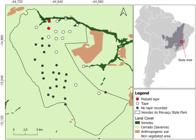
Camera trap sites and record points of the tapir with piebaldism and other tapirs with regular coloration. In the upper right inset, the darker shading indicates the geographic limit of the Brazilian Cerrado.
Results
We recorded an adult female lowland tapir with pigmentation anomaly characterized by a large unpigmented patch predominantly located on the ventral and lateral portions of the torso, extending continuously over the entire left hindlimb. Within this major white patch, two small pigmented spots remain visible (Figure 2a). An additional, smaller unpigmented patch occurs on the distal portion of the left forelimb. This asymmetrical pattern of well-defined unpigmented patches, combined with normal eye pigmentation (Figure 2b), are indicative of piebaldism. The same individual was recorded on 21 occasions (using 15 minutes as the threshold for independent records) between September and November 2024 at two camera trap stations 1.5km apart (Figure 1), and was confidently identified across all events by the unique, identical shape of its asymmetrical white patches. All records of the piebald individual were obtained near veredas, the most critical habitat type for T. terrestris occurrence in the region.
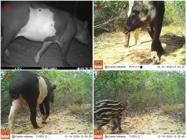
Records of a tapir with piebaldism in Veredas do Peruaçu State Park: a - piebaldism on the torso and posterior part of the left forelimb; b - normal eye coloration; c - record of the individual with piebaldism accompanied by its calf and evidence of being in a lactation period; d - calf without color anomaly.
On five events, the piebald female was observed accompanied by a calf with no evidence of pigmentation anomalies and appeared to be lactating (Figure 2c-d). The camera trap records were made mostly during twilight, with peaks at sunrise and sunset. Regular-colored tapirs (Figure 1) were recorded on 286 occasions at 16 sites during the survey, including the camera trap stations where the piebald tapir was recorded. The piebald phenotype accounted for approximately 6.8% of the total independent tapir records (21 out of 307) and was restricted to a single individual, underscoring its rarity within the local population.
Discussion
The records presented here are the first report of piebaldism in tapirids and represents the first record of a hypopigmentation anomaly in T. terrestris in the Cerrado biome. This report expands the known geographic distribution of pigmentation anomalies in tapirids, indicating that such phenotypes, although rare, can occur across different South American ecosystems. The individual recorded exhibits a distinct coat pattern diagnostic of piebaldism, characterized by well-defined, asymmetrical white patches on the flank and venter against the species-typical dark background (Abreu et al., 2013; Guastalla et al., 2021; Cotts et al., 2023; Cotts et al., 2024). Given the extensive sampling effort conducted during this study, and the absence of any tapirs with pigmentation anomalies in previous large-scale surveys carried out in this area (Ferreira et al., 2011, 2017), we conclude that this very likely represents a single individual with hypopigmentation anomaly within the population.
The occurrence of a calf born without an apparent pigmentation anomaly to a piebald female provides an important empirical record and underscores the need for genetic studies to clarify the mechanisms underlying this phenotype. Furthermore, the records of this female accompanied by a calf demonstrate that, despite the potential selective disadvantages typically associated with depigmentation, such as increased visual conspicuousness and vulnerability to predation (Caro, 2005), this female was able to reach reproductive maturity and successfully rear offspring. While a single observation cannot imply population-level persistence, this evidence highlights that under certain environmental conditions, such chromatic anomalies may not strictly compromise individual survival and reproductive success in wild lowland tapirs.
VPSP is part of a mosaic of protected areas (Sertão Veredas-Peruaçu Mosaic, ca. 20,000 km2) located in a region of high biodiversity relevance (WWF-Brasil, 2015) and where strictly protected areas are essential for the conservation of large and threatened mammals, including the lowland tapir (Ferreira et al., 2020). Nevertheless, the park has been experiencing severe environmental stressors, including the drying up of the Peruaçu river’s source and, in 2024, just months before the first records described here, a large-scale fire reached the park’s veredas, originating in adjacent areas and spreading into the protected area (Funatura, 2024). Such disturbances exacerbate threats to local biodiversity and may compromise already vulnerable populations of large-bodied species such as tapirs.
Although there is currently no evidence of tapir population decline in the study area, local populations may experience isolation due to the stark contrast in habitat suitability across the region. Within our study area, this is evidenced by the substantially higher probability of tapir occupancy within strictly protected areas compared to their sparse occurrence outside them (Ferreira et al., 2020). While the exact causes of this pigmentation anomaly remain unknown, reduced connectivity among populations could limit gene flow and increase the likelihood of inbreeding, potentially leading to greater homozygosity and the expression of rare recessive alleles (Bosse & van Loon, 2022; Bertorelle et al., 2022). Nevertheless, because this represents only the second documented case of a rare color disorder in mammal species in the entire mosaic of protected areas, alongside a single melanistic maned wolf (Chrysocyon brachyurus; Ferreira et al., 2017), this piebald tapir record should be treated as a random event rather than an indicator of generalized genetic degradation. Together, these records highlight the need for genetic and ecological investigations to understand the causes and consequences of pigmentation anomalies in wild Neotropical mammal populations, particularly in this region of the Brazilian Cerrado.
-
Ethics
We declare that this research was conducted in accordance with applicable Brazilian and international laws and regulations. This study did not involve human subjects or clinical trials requiring approval from an Institutional Review Board (IRB). No biological specimens were collected; only photographs were taken during the fieldwork. Authorization to conduct research within the protected area was obtained from the Instituto Estadual de Florestas de Minas Gerais (IEF-MG), the agency responsible for managing the park.
Acknowledgements
We thank the Durrell Wildlife Conservation Trust for funding this work. Additional funding came from Synchronicity Earth and PPBio/ComCerrado (Proc. CNPQ 442499/2023-0). We are also grateful to Instituto Estadual de Florestas (IEF-MG) for granting the research permit, and to the staff of Veredas do Peruaçu State Park (IEF-MG) and of Cavernas do Peruaçu Environmental Protection Area (APACP/ICMBio) for their logistical support and assistance during fieldwork.
Data Availability
All relevant data supporting the conclusions of this short communication are fully included and presented within the article.
References
-
ABREU, M., MACHADO, R., BARBIERI, F., FREITAS, N., & OLIVEIRA, L. 2013. Anomalous colour in Neotropical mammals: a review with new records for Didelphis sp. (Didelphidae, Didelphimorphia) and Arctocephalus australis (Otariidae, Carnivora). Brazilian Journal of Biology, 73(1), 185–194. https://doi.org/10.1590/S1519-69842013000100020
» https://doi.org/10.1590/S1519-69842013000100020 -
ACEVEDO, J., & AGUAYO, M. 2008. Leucistic South American sea lion in Chile, with a review of anomalously color in otariids. Revista de Biología Marina y Oceanografía, 43(2), 413–417. https://doi.org/10.4067/S0718-19572008000200017
» https://doi.org/10.4067/S0718-19572008000200017 -
ALVIZ, Á., QUINTERO, G., FARFÁN-ARDILA, N., & PÉREZ-ALBARRACÍN, K. 2025. First record of leucism in a wild lowland tapir Tapirus terrestris (Linnaeus, 1758) from the Orinoquia region of Colombia. Notas Sobre Mamíferos Sudamericanos, 7 https://doi.org/10.31687/SaremNMS25.1156
» https://doi.org/10.31687/SaremNMS25.1156 -
BERTORELLE, G., RAFFINI, F., BOSSE, M., BORTOLUZZI, C., IANNUCCI, A., TRUCCHI, E., MORALES, H.E., & VAN OOSTERHOUT, C. 2022. Genetic load: genomic estimates and applications in non-model animals. Nature Reviews Genetics, 23(August), 492–503. https://doi.org/10.1038/s41576-022-00448-x
» https://doi.org/10.1038/s41576-022-00448-x -
BOSSE, M., & VAN LOON, S. 2022. Challenges in quantifying genome erosion for conservation. Frontiers in Genetics, 13(960958), 1–16. https://doi.org/10.3389/fgene.2022.960958
» https://doi.org/10.3389/fgene.2022.960958 -
CARO, T. 2005. The Adaptive Significance of Coloration in Mammals. BioScience, 55(2), 125–136. http://dx.doi.org/10.1641/0006-3568(2005)055[0125:TASOCI]2.0.CO;2
» https://doi.org/10.1641/0006-3568(2005)055[0125:TASOCI]2.0.CO;2 -
COTTS, L., COSTA, G., GABRIEL, S.I., & BARBOSA, O.R. 2024. Unveiling the Colors of Mustelids: A Historical Review on the Emergence of Chromatic Disorders and Their Ecological Effects in Mustelids Worldwide with Report of the First Case of Erythrism in Eira barbara (Carnivora, Mustelidae). Animals, 14(3354), 1–29. https://doi.org/10.3390/ani14233354
» https://doi.org/10.3390/ani14233354 -
COTTS, L., SLIFKIN, J.P., MORATELLI, R., GONÇALVES, L., & ROCHA-BARBOSA, O. 2023. Multiple colors in anteaters: review and description of chromatic disorders in Tamandua (Xenarthra: Pilosa) with reports of new and rare coat colorations. Zoologia, 40(e22034), 1–17. https://doi.org/https://doi.org/10.1590/S1984-4689.v40.e22034
» https://doi.org/10.1590/S1984-4689.v40.e22034 -
FERREIRA, G.B., AHUMADA, J.A., OLIVEIRA, M.J.R., DE PINHO, F.F., BARATA, I.M., CARBONE, C., & COLLEN, B. 2017. Assessing the conservation value of secondary savanna for large mammals in the Brazilian Cerrado. Biotropica, 49(5), 734–744. https://doi.org/10.1111/btp.12450
» https://doi.org/10.1111/btp.12450 -
FERREIRA, G.B., COLLEN, B., NEWBOLD, T., OLIVEIRA, M.J.R., PINHEIRO, M.S., DE PINHO, F.F., ROWCLIFFE, M., & CARBONE, C. 2020. Strict protected areas are essential for the conservation of larger and threatened mammals in a priority region of the Brazilian Cerrado. Biological Conservation, 251(108762), 1–9. https://doi.org/10.1016/j.biocon.2020.108762
» https://doi.org/10.1016/j.biocon.2020.108762 - FERREIRA, G.B., OLIVEIRA, M.J.R., JUNIOR, E.A.M., SILVA, J.A., & RODRIGUES, F.H.G. 2011. Mamíferos de médio e grande porte do Parque Estadual Veredas do Peruaçu: riqueza, composição e estratégias de conservação. MG Biota, 4(2), 6–19.
-
FUENTES, R., CASTILLO, M., MORENO, R., QUINTERO-ARRIETA, H., PÉREZ, E., ARAÚZ, J., AÑINO, Y., MURCIA-MORENO, D., VALDÉS, R., BONILLA, B., & GÁLVEZ, D. 2024. Report of coloration anomalies in mammals from Panama. Neotropical Biology and Conservation, 19(1), 333–345. https://doi.org/10.3897/neotropical.19.e125890
» https://doi.org/10.3897/neotropical.19.e125890 - Funatura. 2024. Relatório técnico: Incêndios florestais no Parque Estadual Veredas do Peruaçu – 2024 Brasília: Fundação Pró-Natureza.
-
GUASTALLA, M.G., AZEVEDO, F.C.DE., VOGLIOTTI, A., LACERDA, W.R., MAGINA, G.C., CARDOSO, C.A.C., ENDO, W., PERES, C.A., HAUGAASEN, T., ROCHA, D.G., & LEMOS, F.G. 2021. The mysterious white deer: anomalous coloring in different Neotropical deer. Mammalian Biology, 101(5), 665–673. https://doi.org/10.1007/s42991-021-00156-9
» https://doi.org/10.1007/s42991-021-00156-9 -
LANDIS, M.B., CANDISANI, L., MUNHOES, L.P., GEBIN, J.C.Z., REZENDE, F., JESUS, M.M.F. DE, MEDICI, E.P., & FERRAZ, K.M.P.M.DE.B. 2020. First record of albino lowland tapirs (Tapirus terrestris Linnaeus 1758) in an important Brazilian Atlantic Forest hotspot. Mammalia, 84(6), 601–604. https://doi.org/10.1515/mammalia-2019-0084
» https://doi.org/10.1515/mammalia-2019-0084 -
LEÃO-VULCÃO, O.A.P., GURJÃO, H., BRASIL, G.R., CARLOS, J., PEZZUTI, B., & RIBEIRO, E.A. 2024. First record of White-Collared Peccary (Dicotyles Tajacu) with Piebaldism across its entire distribution. Mammalogy Notes, 10(2), 1–6. https://doi.org/10.47603/mano.v10n2.450
» https://doi.org/10.47603/mano.v10n2.450 -
LUCATI, F., & LÓPEZ-BAUCELLS, A. 2017. Chromatic disorders in bats: a review of pigmentation anomalies and the misuse of terms to describe them. Mammal Review, 47(2), 112–123. https://doi.org/10.1111/mam.12083
» https://doi.org/10.1111/mam.12083 -
MELLO, L.M.DE., PEDRA, R.M., OLIVEIRA, S.V.DE., BENEMANN, V.R.F., & CORRÊA, L.L.C. 2020. First record of piebaldims in Lycalopex gymnocercus (Carnivora, Canidae) in the Pampa biome, Southern Brazil. Oecologia Australis, 24(1), 191–195. https://doi.org/10.4257/oeco.2020.2401.17
» https://doi.org/10.4257/oeco.2020.2401.17 - MILLER, J.D. 2005. All about albinism. Missouri Conservationist, 66(6), 5–7.
-
NIVELO-VILLAVICENCIO, C., & RODAS-LÓPEZ, F. 2021. Primer reporte de leucismo en Tapirus pinchaque (Perissodactyla, Tapiridae). Mammalia Aequatorialis, 3, 97–100. https://doi.org/10.59763/mam.aeq.v3i.30
» https://doi.org/10.59763/mam.aeq.v3i.30 -
OLIVEIRA, L.DA.S., VARJÃO, I.C.G., PEREIRA, L.C.M., & NICOLA-PEREIRA, P.A. 2019. Primeiro registro de leucismo no cachorro-do-mato Cerdocyon thous (Linnaeus, 1766 ) (Carnivora: Canidae) no Brasil. Biotemas, 32(1), 93–98. http://dx.doi.org/10.5007/2175-7925.2019v32n1p93
» https://doi.org/10.5007/2175-7925.2019v32n1p93 -
PINHEIRO-COSTA, N.C., & NORRIS, D. 2025. Leucism occurrence frequency in an island population of tayra (Eira barbara), in Roraima, Brazil: A comparative analysis with camera trap records. Acta Amazonica, 55(e55bc23368), 1–9. http://dx.doi.org/10.1590/1809-4392202303681
» https://doi.org/10.1590/1809-4392202303681 -
PROJETO MAPBIOMAS. 2026. Coleção 10 da Série Anual de Mapas de Cobertura e Uso da Terra do Brasil. Available from: https://storage.googleapis.com/mapbiomas-public/initiatives/brasil/collection_10/lulc/coverage/brazil_coverage_2024.tif (last accessed 07/07/2026).
» https://storage.googleapis.com/mapbiomas-public/initiatives/brasil/collection_10/lulc/coverage/brazil_coverage_2024.tif -
RODRIGUES, F.H.G., SILVEIRA, L., JÁCOMO, A.T., & MONTEIRO-FILHO, E.L.A. 1999. Um albino parcial de veado campeiro (Ozotoceros bezoarticus, Linnaeus) no Parque Nacional das Emas, Goiás. Revista Brasileira de Zoologia, 16(4), 1229–1232. https://doi.org/10.1590/S0101-81751999000400032
» https://doi.org/10.1590/S0101-81751999000400032 -
SILVA, V.L.DA., CÂNDIDO, J., CAMPANHA, J. N., OLIVEIRA, D.R.DE., GHELER-COSTA, C., & ODA, F.H. 2019. A stranger in the family? On the social behavior of a leucistic collared peccary (Pecari tajacu) with pigmented conspecifics. Tropical Ecology, 60, 303–305. https://doi.org/10.1007/s42965-019-00036-x
» https://doi.org/10.1007/s42965-019-00036-x -
SOUZA, C.M. Jr. et al. 2020. Reconstructing Three Decades of Land Use and Land Cover Changes in Brazilian Biomes with Landsat Archive and Earth Engine. Remote Sensing, 12(17), 2735. https://doi.org/10.3390/rs12172735
» https://doi.org/10.3390/rs12172735 -
TALAMONI, S., VIANA, P.I.M., COSTA, C.G., PALÚ, L., OLIVEIRA, R.B., & PESSÔA, L.M. 2017. Occurrence of leucism in Eira barbara (Carnivora, Mustelidae) in Brazil. Biota Neotropica, 17(3), 106. http://dx.doi.org/10.1590/1676-0611-BN-2017-0328
» https://doi.org/10.1590/1676-0611-BN-2017-0328 -
TIRIRA, D.G., & ARBELÁEZ, E. 2020. Primer reporte de leucismo en un tapir amazónico (Perissodactyla, Tapiridae) nacido bajo cuidado humano. Mammalia Aequatorialis, 2, 85–88. https://doi.org/10.59763/mam.aeq.v2i.19
» https://doi.org/10.59763/mam.aeq.v2i.19 -
WWF-Brasil. 2013. Uso e Ocupação do Mosaico Sertão Veredas Peruaçu- 2010. WWF-Brasil, Brasília, Brazil. https://www.wwf.org.br/?29802/Mapa-revela-situao-do-Mosaico-Serto-Veredas-Peruau (last accessed 07/07/2026).
» https://www.wwf.org.br/?29802/Mapa-revela-situao-do-Mosaico-Serto-Veredas-Peruau -
WWF-Brasil. 2015. Áreas prioritárias para conservação da biodiversidade no cerrado e pantanal. https://wwfbr.awsassets.panda.org/downloads/publicacao_areasprioritarias_cerrado_pantanal_1.pdf (last accessed 07/07/2026).
» https://wwfbr.awsassets.panda.org/downloads/publicacao_areasprioritarias_cerrado_pantanal_1.pdf


