 Measurement properties of the pain numerical rating scale in Brazilian children and adolescents with musculoskeletal pain
ABSTRACT
BACKGROUND AND OBJECTIVES Musculoskeletal pain is highly prevalent among children and adolescents and may negatively impact physical function, participation in daily activities, and quality of life. Reliable and valid instruments are essential for accurately assessing pain intensity and monitoring clinical outcomes in both research and clinical practice. Although the Pain Numerical Rating Scale (PNRS) is widely used, evidence regarding its measurement properties in Brazilian children and adolescents with musculoskeletal pain remains limited. Therefore, this study aimed to test the measurement properties related to reliability and construct validity of the PNRS in children and adolescents with musculoskeletal pain.
METHODS We conducted a methodological study to evaluate the measurement properties of the PNRS. Children and adolescents with musculoskeletal pain were recruited from public schools. Data were collected using self-reported questionnaires. Test-retest reliability was evaluated using the Intraclass Correlation Coefficient (ICC) and the Measurement error was evaluated using Standard Error of Measurement (SEM) and Minimal Detectable Change (MDC). The hypothesis testing of construct validity was measured using a Pearson Correlation (r) between the PNRS and the Brief Pain Inventory.
RESULTS A sample of 153 children and adolescents with musculoskeletal pain and with a mean age of 16.0 years old (Standard Deviation (SD): 2.7) were included in this study. Test-rest reliability by ICC was of 0.71 (95% Confidence Interval (CI): 0.62 to 0.78). The SEM was 1.74 (15.8%), with an MDC of 3.66 points. The hypothesis testing of construct validity was confirmed with 90% by prior hypotheses. Children and adolescents with disabling musculoskeletal pain reported more intense pain than children and adolescents with musculoskeletal pain (mean difference 1.9 (95% CI: 2.65 to 1.15)).
CONCLUSION The PNRS demonstrated adequate reliability and construct validity for assessing pain intensity in children and adolescents with musculoskeletal pain, supporting its use in clinical and research settings., considering the Brazilian context; however, caution is needed with the MDC values.
Keywords:
Adolescent; Children; Disability; Musculoskeletal pain
HIGHLIGHTS
The Pain Numerical Rating Scale demonstrated adequate reliability in children and adolescents with musculoskeletal pain
Construct validity was supported, with 90% of the a priori hypotheses confirmed
The scale is suitable for clinical and research use in Brazil, although caution is warranted
RESUMO
JUSTIFICATIVA E OBJETIVOS A dor musculoesquelética é altamente prevalente em crianças e adolescentes e pode impactar negativamente a função física, a participação em atividades diárias e a qualidade de vida. Instrumentos confiáveis e válidos são essenciais para avaliar adequadamente a intensidade da dor e monitorar desfechos clínicos na prática clínica e em pesquisas. Embora a Escala Numérica de Dor (END) seja amplamente utilizada, ainda existem evidências limitadas sobre suas propriedades de medida em crianças e adolescentes brasileiros com dor musculoesquelética. Portanto, este estudo teve como objetivo testar as propriedades de medida relacionadas à confiabilidade e à validade de construto da Escala Numérica de Dor em crianças e adolescentes com dor musculoesquelética.
MÉTODOS Foi realizado um estudo metodológico para avaliar as propriedades de medida da END. Crianças e adolescentes com dor musculoesquelética foram recrutados em escolas públicas. Os dados foram coletados por meio de questionários de autorrelato. A confiabilidade teste-reteste foi avaliada pelo Coeficiente de Correlação Intraclasse (CCI), e o erro de medida foi avaliado pelo Erro Padrão de Medida (EPM) e pela Mudança Mínima Detectável (MMD). O teste de hipóteses para validade de construto foi mensurado por meio da correlação de Pearson (r) entre a END e o Brief Pain Inventory.
RESULTADOS Uma amostra de 153 crianças e adolescentes com dor musculoesquelética, com idade média de 16,0 anos (Desvio Padrão [DP]: 2,7), foi incluída neste estudo. A confiabilidade teste-reteste apresentou CCI de 0,71 (Intervalo de Confiança de 95% [IC95%]: 0,62 a 0,78). O EPM foi de 1,74 (15,8%), com uma MMD de 3,66 pontos. O teste de hipóteses para validade de construto confirmou 90% das hipóteses previamente estabelecidas. Crianças e adolescentes com dor musculoesquelética incapacitante relataram dor mais intensa do que aqueles com dor musculoesquelética não incapacitante (diferença média de 1,9 pontos; IC95%: 1,15 a 2,65).
CONCLUSÃO A END demonstrou confiabilidade e validade de construto adequadas para avaliar a intensidade da dor em crianças e adolescentes com dor musculoesquelética, apoiando seu uso em contextos clínicos e de pesquisa no contexto brasileiro; entretanto, é necessário cautela na interpretação dos valores de MMD.
Descritores:
Adolescente; Crianças; Dor musculoesquelética; Incapacidade
INTRODUCTION
Musculoskeletal pain has a high prevalence in general population, and it is associated with limitations in activities of daily living1,2. Most of the general population has experienced one or more episodes of musculoskeletal pain during life period3. A third of children and adolescents’ population also report having musculoskeletal pain4. Musculoskeletal pain in children and adolescents have an impact on school life, daily and physical activities5. Some studies have shown that adolescents who report persistent pain have an increased risk of developing chronic pain in adulthood6,7. When studying pain in children and adolescents it is important to identify different types of pain, understand the course of pain during this life period, and possibly provide the best adequate management of this condition. Pain is considered as a subjective outcome and defined as an unpleasant sensation associated with, or similar to associated with potential or current tissue damage to tissues8. Pain is evaluated and perceived in a unique and individual way, and it seems to be influenced by personal experience, in addition to biological, physiological, and social factors8. Therefore, since pain is considered a subjective construct, the individual’s self-report becomes relevant.
Pain can be understood through different dimensions that can refer, for example, to functionality (e.g., resulting in disability), sociocultural dimension (e.g., participation in society), and affective dimension (e.g., emotions/feelings), the cognitive, behavioral, and sensory dimensions (e.g., intensity of perceived pain)8. The Pediatric Initiative on Methods, Measurements, and Evaluation of Pain in Clinical Trials (PedIMMPACT), defined pain intensity as the most relevant outcome in clinical trials for reporting both acute and chronic or recurrent pain in children and adolescents9. Pain intensity is also the most measured outcome in clinical trials in both pediatric and adult populatio10,11. A systematic review evaluated instruments that measure pain intensity in children and adolescents including different instruments such as the Pain Numerical Rating Scale-11, the Color Analogue Scale (CAS), the Revised Faces Scale (FPS-R; and original FPS), the Pieces of hurt, Oucher – Photographic and Numeric Scale, the Visual Analogue Scale (VAS), and the Wong-Baker FACES Pain Rating Scale (FACES)12. This systematic review concluded that the Pain Numerical Rating Scale-11 should be used for the age group between 6 and 8 years old (or older), more specifically for acute pain12. For chronic pain literature still has weak recommendations, with more studies being necessary12.
Despite the widespread use of the PNRS in both, clinical practice or research, involving children and adolescents, there is a paucity of evidence regarding its measurement properties in paediatric populations with musculoskeletal pain. Most studies evaluating pain intensity instruments in children and adolescents have focused on acute pain conditions, and evidence supporting the use of the PNRS in chronic or recurrent musculoskeletal pain remains limited12. Moreover, the PNRS has been frequently used in paediatric research and clinical practice without prior validation in children and adolescents with musculoskeletal pain, including in low- and middle-income countries, where sociocultural and contextual factors may influence pain perception and reporting13-16. The use of an instrument without established reliability and validity in the target population may compromise the interpretation of clinical and research findings. Therefore, there is a clear need to investigate the measurement properties of the PNRS in children and adolescents with musculoskeletal pain in a middle-income country. Thus, the aim of this study is to test the measurement properties of the Pain Numerical Rating Scale17, including reliability (through test-retest reliability and measurement error) and the hypothesis testing for construct validity in children and adolescents with musculoskeletal pain in a middle-income country.
METHODS
This is an observational methodological study designed to evaluate the measurement properties of the PNRS based on the taxonomy, terminology and definition of the Consensus-based Standards for the selection of health status Measurement Instruments (COSMIN)18. The measurement properties evaluated in this study were reliability (test-retest reliability and measurement error) and and hypothesis testing for construct validity of the PNRS19. This study was approved by the Human Ethics Committee of Universidade Cidade de São Paulo (UNICID) (CAAE: 18752219.0000.0064).
Participants and procedures
We included children and adolescents with musculoskeletal pain from public schools in the state of São Paulo (Brazil) aged 8 to 18 years old to test the measurement properties of the PNRS. The PNRS instrument was answered by children and adolescents who self-reported having musculoskeletal pain at baseline20. The minimum age of eight years old was chosen, since at this age it is expected that the child will be able to express their feelings according to the maturation of the cognitive and linguistic system on the period21. Musculoskeletal pain was considered if the participant answered “yes” to question 1 (Have you had any pain in your back, neck, arms (including hands) or legs (including feet) in the last month?) from the PIP-Kids questionnaire22. The participants were also asked about the impact of the reported musculoskeletal pain and classified as having disabling musculoskeletal pain if answering “yes” to question 1 (Have you had any pain in your back, neck, arms (including hands) or legs (including feet) in the last month?) and “yes” to questions 8 (Have you missing school due to back, neck, upper or lower limb pain in the last month?) 9 (Has your back, neck, upper or lower limb pain interfered in your normal activities in the last month?) and/or 10 (Has your back, neck, upper or lower limb pain interfered in your recreational physical activities (e.g.: sport, walking, cycling, etc.) in the last month?) of the PIP-Kids questionnaire22. We contacted the municipal district councils and received their approval before the public schools were invited. We included the participants in this study after their parents and/or guardians signed the Free Informed Consent Form. Children and adolescents were also invited to sign an Informed Assent Form. Participants received the Presence and Impact of Pain in Kids (PIP-kids), the Brief Pain Inventory (BPI), and the PNRS. Participants reported the average intensity of their pain in the last month, using the Pain Numerical Rating Scale, and indicated the body region of pain (e.g., upper limb, lower limbs, back, or neck). All participants who answered "yes" to question 1 of the PIP-Kids questionnaire, were invited to complete the PIP-Kids questionnaire and the Numerical Pain Assessment Scale in two different time points at the same context (i.e., environment, self-report version), baseline and after an interval of 24-48 hours, to ensure clinical stability in the test-retest analyses. The test–retest interval of 24 to 48 hours was chosen to minimise recall bias while reducing the likelihood of true clinical changes in pain intensity, particularly in children and adolescents with musculoskeletal pain. Short intervals are recommended in reliability studies to ensure clinical stability of the construct being measured18,23. The participants answered the questionnaire individually. In case of difficulties related to reading or understanding the wording of the items, they were allowed to ask for clarification from the teachers and/or researchers who were present in the classroom, without any guidance or influence on their responses. Children and adolescents were excluded if they reported cognitive or neurological conditions that could impair the understanding of the questionnaires.
Instruments
Pain Numerical Rating Scale19
This instrument was previously translated and cross-cultural adapted into Brazilian Portuguese, and its measurement properties have been evaluated in a population of adults with low back pain19. The instrument has also been globally used in children and adolescents12,19. The PNRS is a scale presented horizontally with 11-point. The PNRS allows participants to rate the intensity of their pain, ranging from 0 (no pain) to 10 (worst possible pain). The participant can mark an “X” on the scale in the number that indicates the average of pain in the last month. The scale had a reliability of 0.94 (CI 95% 0.90 to 0.96) in an adult population with low back pain19. In this study, children and adolescents were asked to answer about their average pain intensity referring to pain in the last month.
Brief Pain Inventory22
This is a multidimensional instrument that was previously translated and cross-cultural adapted into Brazilian Portuguese19. This instrument consists of nine items divided into two dimensions: Intensity/severity and pain interference in the patient’s life. The BPI access intensity and interference of pain (on general activities, mood, ability to walk, normal work, relationship with others, sleep, and enjoyment of life) using an 11-point scale ranging from 0 (without pain/no interference) to 10 (with pain/ completely interfered). Furthermore, it also includes a body diagram for the participants to mark the location of pain as well as measures to indicate the percentage of pain relief with a recall period of today and 24 hours. The instrument also considers questions about treatments being used for pain management. The scores for the two dimensions vary from 0 to 10 and the final score is the sum of the items divided by the number of items answered. The higher the score means worse intensity or interference of pain. The instrument was previously tested on an adult population with cancer-related pain and presented internal consistency of 0.91 (pain intensity) and 0.87 (pain interference) through Cronbach's alpha24.
Presence and Impact of Pain in Kids – PIP-Kids22
The Presence and Impact of Pain in Kids questionnaire is validated, translated and cross-cultural adapted into Brazilian Portuguese22.
This is a multidimensional instrument with ten items, in which five assess the presence of pain (presence of pain, location, duration and frequency (continuous or intermittent) and sports injury) and the other five items assess how pain impacts on activities of daily living (e.g., use of medication, medical consultation, school absence and interference in daily and physical activities)22. Participants must answer “yes” or “no” for each item with a recall period of one month22. The PIP-Kids questionnaire presented adequate construct validity based on prior hypotheses, and test-retest reliability from 0.20 (no agreement) to 0.68 (moderate agreement) using the Kappa coefficient. The measurement error (through the percentage of agreement) ranged from 60.2% to 92.0%, and the instrument did not show a ceiling and floor effect22.
Assessment of measurement properties
-
Reliability (domain): evaluates how the measurement is error-free18. Reliability encompasses the following measurements’ properties:
-
Reliability: evaluates the proportion of variance of the results reported in the questionnaire is due to the “true” difference between participants regarding pain intensity18.
-
Measurement error: refers to the systematic and random error of participants that is not attributed to “true” change/difference in pain intensity18.
-
Validity (domain): it is the degree to which the PROM measures what it proposed to measure18. Validity includes, among others, the following measurement property.
-
Construct validity: Construct validity was assessed through hypothesis testing, as recommended by COSMIN, by examining the correlations between the PNRS and the Brief Pain Inventory (BPI) items18. Although the BPI is a multidimensional instrument, it includes a pain intensity domain that allows the assessment of convergent and divergent validity hypotheses. According to COSMIN guidelines, construct validity does not require the use of an instrument measuring the exact same construct, but rather the formulation and testing of a priori hypotheses regarding the expected magnitude and direction of correlations between instruments that assess related constructs18. Therefore, moderate correlations were expected between the PNRS and BPI pain intensity items, while weaker correlations were hypothesised for domains related to pain interference. The difference in recall periods between the PNRS (average pain in the last month) and the BPI items (pain intensity in the last 24 hours or at the time of assessment) was considered in the interpretation of the results. Based on COSMIN recommendations, such differences are expected to reduce the magnitude of correlations and were therefore accounted for in the formulation of the a priori hypotheses, which anticipated moderate rather than strong correlations between instruments18.
-
Know-group validity: measures an instrument’s ability to distinguish between groups. In this case, it evaluates the ability to distinguish children and adolescents with musculoskeletal pain (without impact) from children and adolescents with disability musculoskeletal pain according to the intensity pain25,26.
-
Ceiling effects: the proportion of individuals who get the maximum score from a questionnaire27.
The formulation of a priori hypotheses regarding the expected magnitude and direction of correlations between the PNRS and related constructs was guided by theoretical considerations and previous literature, in accordance with COSMIN guidelines for hypothesis testing of construct validity18. The assessment of reliability and validity followed a predefined analytical framework, in which each statistical analysis was selected to address a specific measurement property. Test-retest reliability and measurement error were used to evaluate the stability and precision of the PNRS scores over time, while hypothesis testing of construct validity was employed to examine whether the observed relationships between the PNRS and related constructs behaved as theoretically expected, in accordance with COSMIN recommendations18.
Statistical analysis
We reported the sample characteristics through descriptive analysis. Mean and standard deviation were used for continuous data, and absolute frequency and percentage for categorical data.
The reliability was evaluated using the Intraclass Correlation Coefficient (ICC – two-way mixed effects, absolute agreement, single rater/measurement) and its respective 95% confidence interval28. The ICC ≥0.70 is considered adequate23.
The measurement error was calculated using the Standard Error of Measurement (SEM) and the Minimum Detectable Change (MDC)23. The measurement error was evaluated using the square root of the error variance obtained from the ANOVA analysis28. Minimum Detectable Change was evaluated using the equation MDC=1.96√2xSEM29.
The construct validity was measured using the Pearson Correlation (r) between the PNRS and the BPI items. The strength of correlations was interpreted as: ≥0,10 a ≤0,30: weak; ≥0,40 a ≤0,60: moderate; ≥0,70 a ≤0,90: strong; e >0,90: perfect30. The construct validity was considered adequate if at least 75% of the results agreed with the hypotheses developed a priori. Table 1 describes the pre-established hypotheses.
Hypotheses of correlations between the Pain Numerical Rating Scale and the Brief Pain Inventory.
The known-group validity was measured by mean differences and 95% confidence intervals39. We hypothesised that children and adolescents with disabling musculoskeletal pain will have more pain intensity than children and adolescents with musculoskeletal pain (without impact).
Ceiling effects are potentially present when 15% or more individuals score the maximum score on the questionnaire27. All analyses were performed using the SPSS statistical package (version 20), and the known-group validity was measured by the PEDro (Physiotherapy Evidence Database) confidences interval calculator39.
A formal sample size calculation was not performed, as this is an observational methodological study focusing on the evaluation of measurement properties. According to COSMIN recommendations, a sample size of at least 100 participants is considered very good for studies assessing reliability and construct validity18. Construct validity was considered adequate when at least 75% of the predefined hypotheses were confirmed, as recommended by COSMIN. Known-groups validity was evaluated by comparing PNRS scores between children and adolescents with and without disabling musculoskeletal pain, based on the a priori hypothesis that individuals with pain-related disability would report higher pain intensity scores.
Missing data were handled using complete-case analysis across all statistical analyses, including descriptive statistics, reliability, measurement error, construct validity, known-groups validity, and ceiling effects. Participants with missing data were excluded only from the specific analyses for which the data were unavailable.
RESULTS
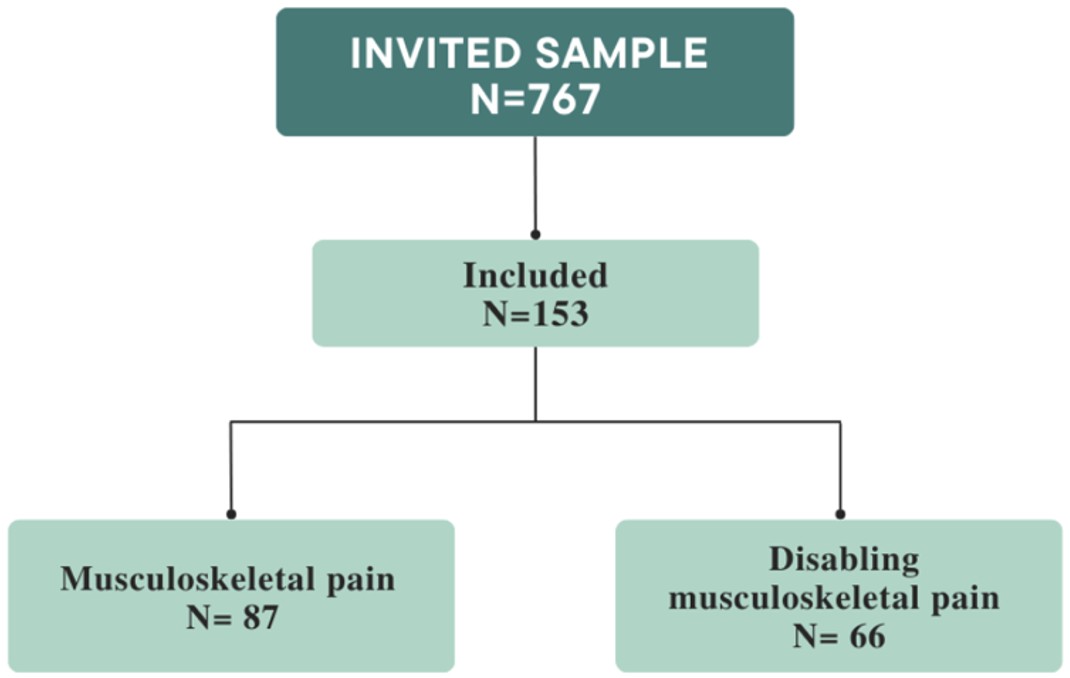
A total of 767 children and adolescents from public schools were invited to participate in this study (Figure 1). From 767 children and adolescents, 153 (19.9%) reported musculoskeletal pain (disabling or not) and were included in our study. A total of 153 children and adolescents with musculoskeletal pain were included in the analysis. Of these, 87 reported musculoskeletal pain without disability and 66 reported disabling musculoskeletal pain. The sample was predominantly female (58.8%), with a mean age of 16.0 ± 2.7 years. Children and adolescents with disabling musculoskeletal pain reported higher mean pain intensity scores (5.7 ± 2.2) compared with those with non-disabling musculoskeletal pain (3.8±2.4). Demographic and clinical characteristics of the total sample and subgroups are presented in Table 2. From 153 children and adolescents with musculoskeletal pain, 87 (56.9%) had musculoskeletal pain without impact and 66 (43.1%) reported disabling musculoskeletal pain (showing impact in missing schools’ days and/or any of the daily or recreational activities). The mean age of children and adolescents included in the study was 16.0 (SD 2.7) years old and most were girls (n=90, 58.8%). Table 2 presents the characteristics of the sample.
Reliability
Table 3 presents the test-retest reliability values found in our study. Reliability through the Intraclass Correlation Coefficient (ICC) was 0.71 (95% CI: 0.62 to 0.78) for the total sample of children and adolescents with pain (n=153). The reliability through the ICC for the sample with general musculoskeletal pain (n=87) was 0.67 (95% CI: 0.53 to 0.77), and the reliability through the ICC for the sample with disabling musculoskeletal pain (n=66) was 0.67 (95% CI: 0.52 to 0.79). The SEM of the general sample was 1.74 (15.8%), with an MDC of 3.66 points. In the musculoskeletal pain subsample, the SEM was 1.76 (16.09%) and the MDC was 3.69 points. For the disabling musculoskeletal pain subsample, the SEM was 1.59 (14.4%), with an MDC of 3.49 points.
Construct validity
Table 4 presents the correlations between the PNRS and the BPI. Of the 10 previously pre-specified hypotheses regarding the correlation between both instruments (PNRS and BPI), nine (90%) hypotheses were confirmed, indicating adequate construct validity.
Know-groups validity
Children and adolescents with disabling musculoskeletal pain have more pain intensity than children and adolescents with musculoskeletal pain, with mean difference being 1.9 (95% CI: 2.65 to 1.15), also confirming our hypothesis.
Ceiling effects
Ceiling effects were not detected. Of the total sample (n=153), four (2.6%) participants reached the maximum score of the questionnaire. In the general musculoskeletal pain subsample (n=87), seven participants (8%) reached the maximum score. In the subsample of disabling musculoskeletal pain (n=66) only three participants (4.5%) reached the maximum score.
DISCUSSION
This study evaluated the measurement properties of the PNRS in children and adolescents with musculoskeletal pain in a middle-income country. Overall, the findings demonstrated that the PNRS presents adequate reliability and construct validity, supporting its use for assessing pain intensity in this population. The PNRS demonstrated adequate reliability, indicating that the instrument is capable of consistently distinguishing pain intensity levels among different individuals. Adequate construct validity was also observed when compared with the BPI items, supporting that the PNRS effectively reflects the construct it intends to measure in children and adolescents with musculoskeletal pain. In addition, the PNRS was able to discriminate between children and adolescents with musculoskeletal pain and those reporting disabling musculoskeletal pain, defined as pain with an impact on daily activities. The absence of ceiling effects across the sample, including participants with disabling pain, suggests that the scale captures a wide range of pain intensities without saturation. Furthermore, the MDC of 3.66 points indicates that changes equal to or greater than this value can be interpreted as a true change in pain intensity beyond measurement error, reinforcing the clinical interpretability of the PNRS. Known-groups validity indicated that the PNRS was able to differentiate between children and adolescents with different levels of pain-related disability.
In this study, we considered a small-time interval (24 to 48 hours) for the test-retest analyses to reduce memory bias in our population. In accordance with the COSMIN recommendations, we included in our study a representative sample of the target population to be able to assess the proposed measurement properties. The study was conducted with children and adolescents from public schools in the state of São Paulo, representing the reality of most children and adolescents in Brazil40. Although we found adequate construct validity of the PNRS when compared to the BPI items, we recognise the limitation of using this questionnaire as a comparator. The BPI was validated only in a Brazilian adult population with cancer-related painn24. To minimise this limitation, we developed a well-structured prior hypothesis based on previous literature and the COSMIN recommendations41.
Previous studies have tested the measurement properties of other instruments evaluating the same construct (pain intensity) in children and adolescents12. Two instruments were previously tested in children and adolescents, the Analog Color Scale and the Faces-Revised Scale. The Analog Color Scale ranges from 0 to 10 cm and presented reliability through the ICC of 0.97 (95% CI: 0.95 - 0.98), with an MDC of 1 to 5 points12,42. The Faces-Revised Scale ranges from 0 to 10 points and presented a Kappa reliability of 0.85 (95% CI: 0.79; 0.90) and an MDC of 2 to 3 points12,33. Previous studies with the PNRS in children and adolescents found a reliability that varied from 0.58 to 0.86 through the Intraclass Correlation Coefficient43,44, indicating similar results of reliability with our study (0.71). Regarding the MDC in repeated measurements of the PNRS, a previous study in adolescents found a variation of 1.0 to 2.1 points, indicating a lower MDC when compared to our findings (3.66 points)44. When compared to studies carried out on adults, we found a MDC of 2.6 to 4.1 points, which is similar to our results45. We believe that this difference can be explained because pain intensity is an individual perception, and the context can influence the results. Previous studies have been performed considering different time points, for example the average pain over the last three months or in three painful events43,44. Our study considered the average pain intensity in the last month. We believe that the variation in time can also contribute to changing the individual's perception of the intensity of their pain. The individual can, for example, consider the average of the previous month, thinking about more or less painful events, and this perception can change even more between evaluation periods.
According to our findings, the PNRS seems to measure the construct that it proposes (pain intensity). The instrument also presented stability in the test-retest analysis over a period of 24 to 48 hours. The instrument has good reliability, indicating that the instrument has adequate differentiation between individuals. However, we recommend caution with these results, as changes smaller than the MDC may not signify a genuine change. We suggest future studies to evaluate the responsiveness of the PNRS for a better investigation of its ability to identify changes over time. We also believe that it might be interesting for the PNRS to be tested in other health conditions in children and adolescents beyond musculoskeletal pain (e.g., headaches, pelvic pain, fractures), to find out if the PNRS behaves differently in different health conditions.
CONCLUSION
The PNRS demonstrated adequate reliability and construct validity for assessing pain intensity in children and adolescents with musculoskeletal pain. The instrument is simple, easy to administer, and capable of detecting clinically relevant differences in pain intensity, supporting its use in both clinical practice for pain assessment and monitoring, as well as in research settings, particularly in middle-income countries. However, caution is needed with the Minimum Detectable Change values.
-
Sponsoring sources:
YBS receives a scientific initiation scholarship from the National Council for Scientific and Technological Development (CNPq) - Process number: 162781/2022-9. VSS receives a doctoral scholarship from São Paulo Research Foundation (FAPESP-Brazil) - Process number: 2019/12049-0. TPY received a research grant from São Paulo Research Foundation (FAPESP-Brazil). Process number: 2017/17484-1.
-
Ethics statement:
none.
-
Data availability
The data that support the findings of this study are available from the corresponding author upon reasonable request.
-
The study was carried out at Universidade Cidade de São Paulo (UNICID), São Paulo, SP, Brasil.
REFERENCES
-
1 Henschke N, Kamper SJ, Maher CG. The epidemiology and economic consequences of pain. Mayo Clin Proc. 2015;90(1):139-47. https://doi.org/10.1016/j.mayocp.2014.09.010 PMid:25572198.
» https://doi.org/10.1016/j.mayocp.2014.09.010 -
2 Institute for Health Metrics and Evaluation. Global Burden of Disease 2021 [Internet]. 2021 [cited 2024 Jun 9]. Available from: https://vizhub.healthdata.org/gbd-compare/
» https://vizhub.healthdata.org/gbd-compare/ -
3 Balagué F, Mannion AF, Pellisé F, Cedraschi C. Non-specific low back pain. Lancet. 2012;379(9814):482-91. https://doi.org/10.1016/S0140-6736(11)60610-7 PMid:21982256.
» https://doi.org/10.1016/S0140-6736(11)60610-7 -
4 Kamper SJ, Henschke N, Hestbaek L, Dunn KM, Williams CM. Musculoskeletal pain in children and adolescents. Braz J Phys Ther. 2016;20(3):275-84. https://doi.org/10.1590/bjpt-rbf.2014.0149 PMid:27437719.
» https://doi.org/10.1590/bjpt-rbf.2014.0149 -
5 O’Sullivan PB, Beales DJ, Smith AJ, Straker LM. Low back pain in 17 year olds has substantial impact and represents an important public health disorder: a cross-sectional study. BMC Public Health. 2012;12(1):100. https://doi.org/10.1186/1471-2458-12-100 PMid:22304903.
» https://doi.org/10.1186/1471-2458-12-100 -
6 Hestbaek L, Leboeuf-Yde C, Kyvik KO. Is comorbidity in adolescence a predictor for adult low back pain? A prospective study of a young population. BMC Musculoskelet Disord. 2006;7(1):29. https://doi.org/10.1186/1471-2474-7-29 PMid:16539740.
» https://doi.org/10.1186/1471-2474-7-29 -
7 Hestbaek L, Leboeuf-Yde C, Kyvik KO, Manniche C. The course of low back pain from adolescence to adulthood. Spine. 2006;31(4):468-72. https://doi.org/10.1097/01.brs.0000199958.04073.d9 PMid:16481960.
» https://doi.org/10.1097/01.brs.0000199958.04073.d9 -
8 Raja SN, Carr DB, Cohen M, Finnerup NB, Flor H, Gibson S, Keefe FJ, Mogil JS, Ringkamp M, Sluka KA, Song XJ, Stevens B, Sullivan MD, Tutelman PR, Ushida T, Vader K. The revised International Association for the Study of Pain definition of pain: concepts, challenges, and compromises. Pain. 2020;161(9):1976-82. https://doi.org/10.1097/j.pain.0000000000001939 PMid:32694387.
» https://doi.org/10.1097/j.pain.0000000000001939 -
9 McGrath PJ, Walco GA, Turk DC, Dworkin RH, Brown MT, Davidson K, Eccleston C, Finley GA, Goldschneider K, Haverkos L, Hertz SH, Ljungman G, Palermo T, Rappaport BA, Rhodes T, Schechter N, Scott J, Sethna N, Svensson OK, Stinson J, von Baeyer CL, Walker L, Weisman S, White RE, Zajicek A, Zeltzer L, PedIMMPACT. Core outcome domains and measures for pediatric acute and chronic/recurrent pain clinical trials: PedIMMPACT Recommendations. J Pain. 2008;9(9):771-83. https://doi.org/10.1016/j.jpain.2008.04.007 PMid:18562251.
» https://doi.org/10.1016/j.jpain.2008.04.007 -
10 Santos VS, Fandim JV, Silva FG, Hatakeyama BA, Fioratti I, Costa LOP, Saragiotto BT, Yamato TP. Evaluation of methodological and reporting quality of systematic reviews on conservative non-pharmacological musculoskeletal pain management in children and adolescents: A methodological analysis. Musculoskelet Sci Pract. 2024;69:102902. https://doi.org/10.1016/j.msksp.2023.102902 PMid:38211435.
» https://doi.org/10.1016/j.msksp.2023.102902 -
11 Yamato TP, Maher CG, Saragiotto BT, Hancock MJ, Ostelo RWJG, Cabral CMN, Costa LCM, Costa LOP. Pilates for Low Back Pain. Spine. 2016;41(12):1013-21. https://doi.org/10.1097/BRS.0000000000001398 PMid:26679894.
» https://doi.org/10.1097/BRS.0000000000001398 -
12 Birnie KA, Hundert AS, Lalloo C, Nguyen C, Stinson JN. Recommendations for selection of self-report pain intensity measures in children and adolescents: a systematic review and quality assessment of measurement properties. Pain. 2019;160(1):5-18. https://doi.org/10.1097/j.pain.0000000000001377 PMid:30180088.
» https://doi.org/10.1097/j.pain.0000000000001377 -
13 Guskuma RC, Lages VA, Hafner MB, Rando-Meirelles MPM, Cypriano S, Sousa MLR, Batista MJ. Fatores associados à prevalência e intensidade de odontalgia em crianças de municípios da região de Campinas, São Paulo. Rev Paul Pediatr. 2017;35(3):322-30. https://doi.org/10.1590/1984-0462/;2017;35;3;00001 PMid:28977286.
» https://doi.org/10.1590/1984-0462/;2017;35;3;00001 -
14 Garcia de Avila MA, Hamamoto Filho PT, Jacob FLDS, Alcantara LRS, Berghammer M, Jenholt Nolbris M, Olaya-Contreras P, Nilsson S. Children’s anxiety and factors related to the COVID-19 pandemic: an exploratory study using the children’s anxiety questionnaire and the numerical rating scale. Int J Environ Res Public Health. 2020;17(16):5757. https://doi.org/10.3390/ijerph17165757 PMid:32784898.
» https://doi.org/10.3390/ijerph17165757 -
15 Hatakeyama BA, Camargo BIA, Santos VS, Leite MN, Espirito Santo CM, Kamper SJ, Maher CG, Costa LOP, Yamato TP. Prevalence of disabling musculoskeletal pain in children and adolescents in Brazil: a cross-sectional study. Braz J Phys Ther. 2024;28(1):100593. https://doi.org/10.1016/j.bjpt.2024.100593 PMid:38394719.
» https://doi.org/10.1016/j.bjpt.2024.100593 -
16 Santos VS, Leite MN, Camargo BIA, Saragiotto BT, Kamper SJ, Yamato TP. Three in every 10 school-aged children in brazil report back pain in any given year: 12-month prospective cohort study of prevalence, incidence, and prognosis. J Orthop Sports Phys Ther. 2022;52(8):554-62. https://doi.org/10.2519/jospt.2022.10819 PMid:35722760.
» https://doi.org/10.2519/jospt.2022.10819 -
17 Downie WW, Leatham PA, Rhind VM, Wright V, Branco JA, Anderson JA. Studies with pain rating scales. Ann Rheum Dis. 1978;37(4):378-81. https://doi.org/10.1136/ard.37.4.378 PMid:686873.
» https://doi.org/10.1136/ard.37.4.378 -
18 Mokkink LB, Terwee CB, Patrick DL, Alonso J, Stratford PW, Knol DL, Bouter LM, de Vet HC. The COSMIN study reached international consensus on taxonomy, terminology, and definitions of measurement properties for health-related patient-reported outcomes. J Clin Epidemiol. 2010;63(7):737-45. https://doi.org/10.1016/j.jclinepi.2010.02.006 PMid:20494804.
» https://doi.org/10.1016/j.jclinepi.2010.02.006 -
19 Costa LOP, Maher CG, Latimer J, Ferreira PH, Ferreira ML, Pozzi GC, Freitas LM. Clinimetric testing of three self-report outcome measures for low back pain patients in Brazil. Spine. 2008;33(22):2459-63. https://doi.org/10.1097/BRS.0b013e3181849dbe PMid:18923324.
» https://doi.org/10.1097/BRS.0b013e3181849dbe -
20 Brasil. Lei nº 8.069, de 13 de Julho de 1990. Dispõe sobre o Estatuto da Criança e do Adolescente e dá outras providências. Diário Oficial da União [Internet]. Brasília; 1990 [cited 2020 Aug 9]. Available from: http://www.planalto.gov.br/ccivil_03/leis/l8069.htm
» http://www.planalto.gov.br/ccivil_03/leis/l8069.htm -
21 Arbuckle R, Abetz-Webb L. “Not Just Little Adults”: qualitative methods to support the development of pediatric patient-reported outcomes. The Patient - Patient-Centered Outcomes Research. 2013;6(3):143-59. https://doi.org/10.1007/s40271-013-0022-3
» https://doi.org/10.1007/s40271-013-0022-3 -
22 Santos VS, Downie A, Kamper SJ, Yamato TP. A new version of a measurement for presence and impact of pain in children and adolescents - Presence and impact of pain in Kids (PIP-KIDS) questionnaire: Translation, cross-cultural adaptation and measurement properties into Brazilian-Portuguese. Musculoskelet Sci Pract. 2023;65:102772. https://doi.org/10.1016/j.msksp.2023.102772 PMid:37182390.
» https://doi.org/10.1016/j.msksp.2023.102772 -
23 Terwee CB, Bot SDM, de Boer MR, van der Windt DAWM, Knol DL, Dekker J, Bouter LM, de Vet HC. Quality criteria were proposed for measurement properties of health status questionnaires. J Clin Epidemiol. 2007;60(1):34-42. https://doi.org/10.1016/j.jclinepi.2006.03.012 PMid:17161752.
» https://doi.org/10.1016/j.jclinepi.2006.03.012 -
24 Ferreira KA, Teixeira MJ, Mendonza TR, Cleeland CS. Validation of brief pain inventory to Brazilian patients with pain. Support Care Cancer. 2011;19(4):505-11. https://doi.org/10.1007/s00520-010-0844-7 PMid:20221641.
» https://doi.org/10.1007/s00520-010-0844-7 -
25 Rodrigues IB, Adachi JD, Beattie KA, Lau A, MacDermid JC. Determining known-group validity and test-retest reliability in the PEQ (personalized exercise questionnaire). BMC Musculoskelet Disord. 2019;20(1):373. https://doi.org/10.1186/s12891-019-2761-3 PMid:31412834.
» https://doi.org/10.1186/s12891-019-2761-3 -
26 McConnell S, Kolopack P, Davis AM. The Western Ontario and McMaster Universities Osteoarthritis Index (WOMAC): a review of its utility and measurement properties. Arthritis Rheum. 2001;45(5):453-61. https://doi.org/10.1002/1529-0131(200110)45:5<453::AID-ART365>3.0.CO;2-W PMid:11642645.
» https://doi.org/10.1002/1529-0131(200110)45:5<453::AID-ART365>3.0.CO;2-W -
27 de Vet HCW, Terwee CB, Mokkink LB, Knol DL. Measurement in medicine. Cambridge: Cambridge University Press; 2011. https://doi.org/10.1017/CBO9780511996214
» https://doi.org/10.1017/CBO9780511996214 -
28 Koo TK, Li MY. A guideline of selecting and reporting intraclass correlation coefficients for reliability research. J Chiropr Med. 2016;15(2):155-63. https://doi.org/10.1016/j.jcm.2016.02.012 PMid:27330520.
» https://doi.org/10.1016/j.jcm.2016.02.012 -
29 Terwee CB, Bot SDM, de Boer MR, van der Windt DAWM, Knol DL, Dekker J, Bouter LM, de Vet HC. Quality criteria were proposed for measurement properties of health status questionnaires. J Clin Epidemiol. 2007;60(1):34-42. https://doi.org/10.1016/j.jclinepi.2006.03.012 PMid:17161752.
» https://doi.org/10.1016/j.jclinepi.2006.03.012 -
30 Akoglu H. User’s guide to correlation coefficients. Turk J Emerg Med. 2018;18(3):91-3. https://doi.org/10.1016/j.tjem.2018.08.001 PMid:30191186.
» https://doi.org/10.1016/j.tjem.2018.08.001 -
31 Stommen NC, Verbunt JA, Gorter SL, Goossens ME. Physical activity and disability among adolescents and young adults with non-specific musculoskeletal pain. Disabil Rehabil. 2012;34(17):1438-43. https://doi.org/10.3109/09638288.2011.645112 PMid:22256958.
» https://doi.org/10.3109/09638288.2011.645112 -
32 Barney CC, Stibb SM, Merbler AM, Summers RLS, Deshpande S, Krach LE, Symons FJ. Psychometric properties of the brief pain inventory modified for proxy report of pain interference in children with cerebral palsy with and without cognitive impairment. Pain Rep. 2018;3(4):e666. https://doi.org/10.1097/PR9.0000000000000666 PMid:30123858.
» https://doi.org/10.1097/PR9.0000000000000666 -
33 Juan W, Rui L, Wei-Wen Z. Chronic neck pain and depression: the mediating role of sleep quality and exercise. Psychol Health Med. 2020;25(8):1029-35. https://doi.org/10.1080/13548506.2020.1724308 PMid:32013565.
» https://doi.org/10.1080/13548506.2020.1724308 -
34 Umucu E, Reyes A, Carrola P, Mangadu T, Lee B, Brooks JM, Fortuna KL, Villegas D, Chiu CY, Valencia C. Pain intensity and mental health quality of life in veterans with mental illnesses: the intermediary role of physical health and the ability to participate in activities. Qual Life Res. 2021;30(2):479-86. https://doi.org/10.1007/s11136-020-02642-y PMid:32974882.
» https://doi.org/10.1007/s11136-020-02642-y -
35 Gauntlett‐Gilbert J, Kavirayani A, Clinch J. Physical and social functioning in adolescents with rheumatological conditions: a study of predictors. Acta Paediatr. 2013;102(3):e131-6. https://doi.org/10.1111/apa.12094 PMid:23190316.
» https://doi.org/10.1111/apa.12094 -
36 Cervilla O, Miró E, Martínez MP, Sánchez AI, Sabio JM, Prados G. Sleep quality and clinical and psychological manifestations in women with mild systemic lupus erythematosus activity compared to women with fibromyalgia: A preliminary study. Mod Rheumatol. 2020;30(6):1016-24. https://doi.org/10.1080/14397595.2019.1679973 PMid:31599659.
» https://doi.org/10.1080/14397595.2019.1679973 -
37 Sen Sribastav S, Peiheng H, Jun L, Zemin L, Fuxin W, Jianru W, et al. Interplay among pain intensity, sleep disturbance and emotion in patients with non-specific low back pain. PeerJ. 2017;5:e3282. https://doi.org/10.7717/peerj.3282 PMid:28533953.
» https://doi.org/10.7717/peerj.3282 -
38 Putri Mellaratna W, Jusuf NK, Yosi A. The impact of pain intensity on quality of life of postherpetic neuralgia patients. Med Glas. 2020;17(2):439-44. https://doi.org/10.17392/1111-20 PMid:32253903.
» https://doi.org/10.17392/1111-20 -
39 Herbert R. Confidence Interval Calculator 2013 [Internet]. 2013 [cited 2023 Nov 9]. Available from: https://pedro.org.au/english/resources/confidence-interval-calculator/
» https://pedro.org.au/english/resources/confidence-interval-calculator/ -
40 Brasil. Ministério da Educação. Escolas públicas atendem 45 milhões de alunos no Brasil 2010 [Internet]. 2010 [cited 2023 Jun 9]. Available from: https://www.gov.br/inep/pt-br/assuntos/noticias/censo-escolar/escolas-publicas-atendem-45-milhoes-de-alunos-no-brasil
» https://www.gov.br/inep/pt-br/assuntos/noticias/censo-escolar/escolas-publicas-atendem-45-milhoes-de-alunos-no-brasil -
41 Prinsen CAC, Mokkink LB, Bouter LM, Alonso J, Patrick DL, de Vet HCW, Terwee CB. COSMIN guideline for systematic reviews of patient-reported outcome measures. Qual Life Res. 2018;27(5):1147-57. https://doi.org/10.1007/s11136-018-1798-3 PMid:29435801.
» https://doi.org/10.1007/s11136-018-1798-3 -
42 Ruskin D, Lalloo C, Amaria K, Stinson JN, Kewley E, Campbell F, Brown SC, Jeavons M, McGrath PA. Assessing pain intensity in children with chronic pain: convergent and discriminant validity of the 0 to 10 numerical rating scale in clinical practice. Pain Res Manag. 2014;19(3):141-8. https://doi.org/10.1155/2014/856513 PMid:24712019.
» https://doi.org/10.1155/2014/856513 -
43 Castarlenas E, Miró J, Sánchez-Rodríguez E. Is the verbal numerical rating scale a valid tool for assessing pain intensity in children below 8 years of age? J Pain. 2013;14(3):297-304. https://doi.org/10.1016/j.jpain.2012.12.004 PMid:23380267.
» https://doi.org/10.1016/j.jpain.2012.12.004 -
44 Hirschfeld G, Wager J, Schmidt P, Zernikow B. Minimally clinically significant differences for adolescents with chronic pain: variability of ROC-Based Cut Points. J Pain. 2014;15(1):32-9. https://doi.org/10.1016/j.jpain.2013.09.006 PMid:24268356.
» https://doi.org/10.1016/j.jpain.2013.09.006 -
45 Modarresi S, Lukacs MJ, Ghodrati M, Salim S, MacDermid JC, Walton DM, CATWAD Consortium Group. A systematic review and synthesis of psychometric properties of the numeric pain rating scale and the visual analog scale for use in people with neck pain. Clin J Pain. 2022;38(2):132-48. https://doi.org/10.1097/AJP.0000000000000999 PMid:34699406.
» https://doi.org/10.1097/AJP.0000000000000999
Edited by
-
Associate editor in charge:
Isabela Azevedo-Santos https://orcid.org/0000-0001-8836-8640
-
Editor in charge:
Juliana Barcellos de Souza https://orcid.org/0000-0003-4657-052X
The data that support the findings of this study are available from the corresponding author upon reasonable request.