 Simultaneity of health risk behaviors in Brazilian older adults
Abstract
Background: The older adult population is rapidly growing, along with an increase in the prevalence of chronic diseases and health risk behaviors. These factors impact morbidity, mortality, and healthcare costs, making their monitoring essential.
Objective: The objective of this study was to assess the presence of the simultaneity of health risk behaviors (HRBs) among the older adults included in the 2013 National Health Survey (PNS).
Method: This was a population-based cross-sectional study using data from PNS. The outcome "simultaneity of HRBs" resulted from the sum of such behaviors (tabagism, alcoholism, physical inactivity, inadequate diet, non-vaccination against influenza). χ2 test was used to describe the prevalence of the outcome in accordance with the independent variables, and adjusted Poisson regression was used to estimate the prevalence ratio and the respective 95% confidence intervals (95%CIs).
Results: There was a prevalence of 39.5% (95%CI [38.0–41.2]) for 0–1 HRB and of 60.5% (95%CI [58.8–62.0]) for 2–5 HRBs. A higher prevalence of HRBs was observed among males, widowed and single people, older adults without health insurance, those living in households not registered in the ESF, and those living in the South and Southeast regions of the country. A lower prevalence of the outcome was observed in older adults with yellow skin color.
Conclusions: More than half of the Brazilian older adults presented two or more HRBs. These findings reinforce the need to guarantee the availability and continuous quality improvement of primary health care since the evaluated HRBs can be monitored and reduced through guidance, mainly because most independent variables are related to an increased vulnerability of the older adults, who are among the main populations focused by the basic attention.
Keywords:
risk factors; aged; health surveys
Resumo
Introdução: A população idosa está crescendo rapidamente, acompanhada por um aumento na prevalência de doenças crônicas e comportamentos de risco à saúde. Esses fatores impactam a morbimortalidade e os gastos em saúde, tornando seu monitoramento essencial.
Objetivo: Avaliar a presença de simultaneidade de comportamentos de risco (CR) à saúde entre os idosos participantes da Pesquisa Nacional de Saúde (PNS) de 2013.
Método: Trata-se de um estudo transversal de base populacional que utilizou dados da PNS. O desfecho "simultaneidade de CR à saúde" foi definido por meio do somatório de tais comportamentos (tabagismo, consumo de álcool, inatividade física, alimentação inadequada, não vacinação contra a gripe). O teste do χ2 foi empregado para a descrição da prevalência do desfecho segundo as variáveis independentes, e foi realizada regressão de Poisson para estimar a razão de prevalência e os respectivos intervalos de confiança de 95% (IC95%).
Resultados: Verificou-se prevalência de 39,5% (IC95% 38,0–41,2) em zero a um comportamento e de 60,5% (IC95% 58,8–62,0) em dois a cinco comportamentos. Observou-se maior prevalência de CR à saúde entre os idosos do sexo masculino, viúvos e solteiros, sem plano de saúde, residentes em domicílios não cadastrados na Estratégia Saúde da Família e nas Regiões Sul e Sudeste do país. Menor prevalência do desfecho foi observada nos idosos de cor de pele amarela.
Conclusão: Mais da metade dos idosos brasileiros apresentaram dois ou mais comportamentos de risco à saúde. Os achados reforçam a necessidade de garantir a disponibilidade e qualificação contínua da atenção básica, uma vez que a simultaneidade de CR avaliada pode ser monitorada e reduzida por meio de orientações. Além disso, a maioria das variáveis independentes está relacionada ao aumento da vulnerabilidade dos idosos, que estão entre as principais populações assistidas pela atenção básica.
Palavras-chave:
fatores de risco; idoso; inquéritos epidemiológicos
INTRODUCTION
The demographic transition is leading toward a worldwide decrease in the younger population and an exponential increase in the older adult population. In Brazil, older adults corresponded to approximately 20.5 million people in 2010, around 39 for every 100 youngsters. Projections for 2040 estimate that this proportion will reach 153 older adults for every 100 youngsters1.
Along with the growth of the older adult population is the increase in the prevalence of chronic diseases, which is estimated that 8 in every 10 older adults have at least one chronic disease2, accounting for 78% of deaths and disabilities worldwide until 20203,4. In Brazil, the main causes of death are due to cardiovascular, respiratory, endocrine/metabolic, and neoplastic diseases. It is not surprising that the highest investment with medical attention in the Unified Health System (SUS) is mainly due to these illnesses, accounting for nearly 60% of the overall spending, with 22% for cardiovascular diseases, 15% for respiratory diseases, and 11% for neoplasms5.
The majority of deaths by chronic diseases are attributed to a set of health risk behaviors (HRBs) that mainly include tabagism, physical inactivity, alcoholism, insufficient consumption of fruits and vegetables, excessive consumption of saturated animal fats, being overweight, and others6–9. As these conditions are amendable through interventions, it is important to monitor these HRBs, especially in primary health care1.
Even though the main HRBs are already well-described9,10, little is known about the impact of some of them on the older adult population6,11. Some national studies, such as EpiFloripa and Telephone Survey Surveillance System for Risk and Protective Factors for Chronic Diseases (VIGITEL), have estimated that 40–60% of older adults present two or more HRBs, such as inadequate diet, alcohol consumption, and tabagism6,10,12.
Additionally, other behaviors can be considered risky in this vulnerable population. In Brazil, respiratory diseases represent the second most frequent cause of morbidity and mortality among older adults13. The hospitalization rate for influenza and pneumonia is 6.7/1,000 inhabitants, increasing to 12.5 in the older population14. Influenza vaccination is one of the greatest achievements of public health, available free of charge in the public health-care system for the older adult population since 199915. Influenza vaccination contributes to the reduction of mortality attributable to influenza and has an indirect impact on reducing hospital admissions and drug costs for the treatment of secondary infections. Thus, non-vaccination against influenza can also be considered an HRB, especially among older adults16. However, we did not identify studies that included non-vaccination as an HRB or that considered the lack of coverage by the Estratégia Saúde da Família as an independent variable. These HRBs are not available in the current population-based studies, with the 2013 National Health Survey (PNS) being the most recent research that simultaneously evaluated these HRBs, making it relevant independently of its temporality.
The knowledge and control of these HRBs play an essential role, as they favor independence and a better quality of life in the years to come13. Thus, the goal of this study was to evaluate the presence of the simultaneity of HRBs among the older adult population included in the PNS 2013.
METHODS
This was a population-based cross-sectional study that used data from the National Health Survey (PNS 2013), carried out by the Brazilian Ministry of Health in partnership with the Brazilian Institute of Geography and Statistics (IBGE) in 201317. The PNS consists of a home-based epidemiological survey that aims to get information on the health and living conditions of the Brazilian population.
The survey included residents of particular permanent homes in the entire country's territory, selected using a three-stage cluster sampling design. In the first stage, the primary sampling units were randomly selected; in the second stage, the homes were selected; and in the third one, a resident with at least 18 years of age from each home was selected to answer an individual questionnaire. More details about the method used by the PNS are available elsewhere18,19. In total, 60,202 individual interviews were performed, on 23,815 people aged 60 years or above.
The outcome of the study was the simultaneity of HRBs. The behavioral risk factors were defined by five variables:
-
tabagism: assessed through the question "Do you currently smoke any tobacco products?", considering older adults who smoke every day or less;
-
alcohol consumption: using the question "How frequently do you usually drink alcoholic beverages?", with consuming alcohol at least once per month being considered a risk factor;
-
physical inactivity: through the question "Did you engage in some sort of physical activity or practiced any sports in the last 3 months?", with the older adults who gave a negative answer being considered inactive;
-
inadequate diet: evaluated using the following questions: "How many days per week do you usually drink soft drinks (or artificial fruit juices)?"; "How many days per week do you eat sweet food, such as pieces of cake, sweets, chocolates, candies, cookies, or sweet crackers?"; "How many days per week do you replace lunch or dinner by sandwiches, snacks, or pizzas?", and "Considering food prepared on the spot and industrialized food, you consider your salt consumption to be: …". Respondents who answered 3–7 times to at least one question and/or considered their salt intake to be "high" or "very high" were considered having an inadequate diet;
-
non-vaccination: assessed using the question "In the last 12 months, were you vaccinated against influenza?", with a negative answer being considered a risk factor. The outcome was defined by the sum of such behaviors: none, one, two, three, four, or five. For analysis, the variable was dichotomized in the absence (0–1 HRB) and presence (2–5 HRBs) of the simultaneity of HRBs.
The independent variables were sex (male, female); age (60–64 years, 65–69 years, 70–74 years, 75–79 years, and 80 or above); self-referred skin color (white, black, yellow, brown, or indigenous); marital status (married, separated or divorced, widowed, or single), schooling (no instruction, incomplete or complete elementary school, incomplete or complete high school, and incomplete or complete higher education); private health insurance (no, yes); household registered in a Family Health Unit (no, yes); censitary situation (urban, rural); and national macro-regions of residency (North, Northeast, Center-West, Southeast, and South).
Statistical analyses were carried out in Stata 13.0 (StataCorp LP, College Station, TX, EUA). The first step was to perform a univariate analysis, with the description of absolute and relative frequencies of the sample and of the HRBs and their respective confidence intervals (95%CIs). The chi-squared test was used in the bivariate analysis, for the description of the prevalence of the outcome (presence of simultaneity of the HRBs) according to the independent variables. Finally, crude and adjusted Poisson regression analyses were performed to estimate the prevalence ratio (PR) and the respective 95%CIs and p-values. In all analyses, the command "survey" was used, considering the effect of the PNS sampling design.
PNS was approved by the National Commission of Ethics in Research (CONEP), of the National Health Council (CNS), on June 26, 2013 (process number 328.159). The microdata of the research are available on the IBGE webpage (IBGE. Pesquisa Nacional de Saúde PNS. https://www.ibge.gov.br/estatisticas/sociais/saude/9160-pesquisa-nacional-de-saude.html?=&t=microdados).
RESULTS
Only the older adults with information on the five variables used for the outcome were considered, resulting in 11,177 individuals (46.9%). Most were women (57.7%), aged 60–64 years (32.0%), with white skin (54.2%), married or living with a partner (53.0%), with incomplete or complete basic education (45.6%), without a private health plan (67.2%), residing in a household registered in a Family Health Unit (60.7%), residing in an urban area (86.0%), and living in the Southeast region (49.7%) (Table 1).
Sample characteristics and health risk behaviors in Brazilian older adults according to demographic and socioeconomic variables, 2013 National Health Survey (PNS) (N=11,177).
Figure 1 shows the prevalence of each of the HRBs considered. The non-realization of physical activities in the last 3 months showed higher prevalence among the older adults (78.1%, 95%CI [76.7–79.5]), followed by inadequate diet (50.0%, 95%CI [48.3–51.7]), non-vaccination against influenza in the last year (27.2%, 95%CI [25.7–28.7]), alcohol consumption (15.4%, 95%CI [14.1–16.8]), and tabagism (12.3%, 95%CI [11.3–13.4]).

Prevalence of health risk behaviors in Brazilian older adults. 2013 National Health Survey (PNS) (N=11,177).
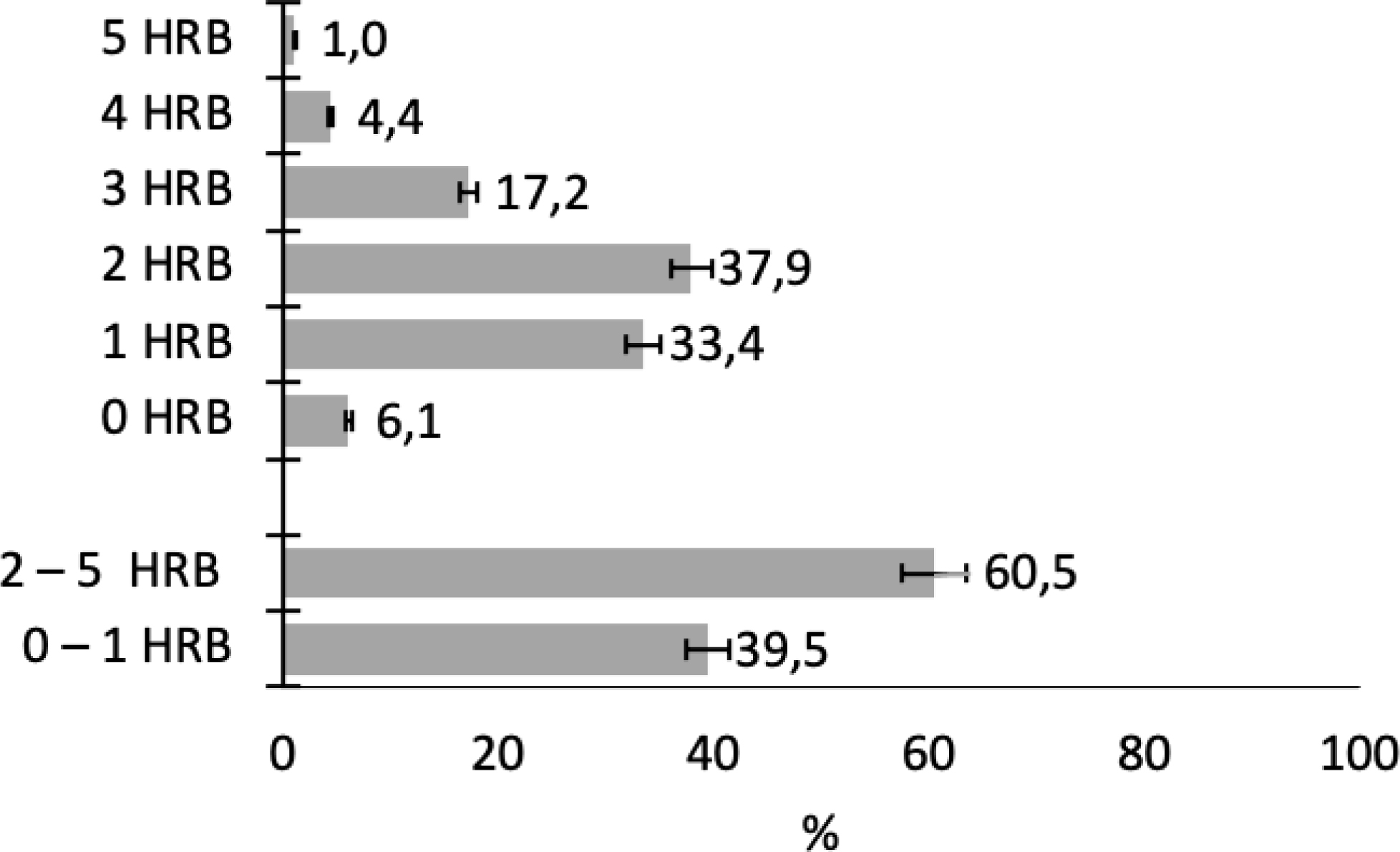
Concerning the prevalence of HRBs, only 6.1% (95%CI [5.5–6.9]) of the older adults showed no HRB, 33.4% (95%CI [31.9–34.9]) showed at least one, 37.9% (95%CI [36.4–39.5]) showed two, 17.2% (95%CI [15.9–18.5]) showed three, 4.4% (95%CI [3.7–5.2]) showed four, and 1.0% (95%CI [0.6–1.5]) showed all five HRBs studied. By evaluating the simultaneity of HRBs, we verified a prevalence of 39.5% (95%CI [38.0–41.2]) in 1 HRB and of 60.5% (95%CI [58.8–62.0]) in 2–5 HRBs (Figure 2).

Prevalence of the simultaneity of health risk behaviors in Brazilian older adults, 2013 National Health Survey (PNS) (n=11,177).
In the adjusted analysis, men (PR=1.07, 95%CI [1.05–1.10]), widowed (PR=1.04, 95%CI [1.01–1.07]) or single (PR=1.05, 95%CI [1.01–1.08]), those without private health insurance (PR=1.03, 95%CI [1.01–1.06]), those living in a household not registered in the ESF (PR=1.03, 95%CI [1.01–1.06]), and those residing in the Southeast (PR=1.07; 95%CI [1.03–1.11]) and South (PR=1.05, 95%CI [1.01–1.10]) regions of the country had a higher prevalence of the simultaneity of HRBs. Conversely, older people with yellow skin color (PR=0.86, 95%CI [0.78–0.94]) had a lower prevalence of this outcome (Table 2).
Crude and adjusted analyses of associations between the simultaneity of health risk behaviors and sociodemographic characteristics of Brazilian older adults. National Health Survey (PNS) 2013 (n=11,177).
DISCUSSION
This study evaluated the presence of simultaneity of HRBs among older adults in the Brazilian capitals and the Federal District. There was a high prevalence of HRBs among Brazilian older adults, mainly among males, widowed and single, those without private health insurance, those living in households not covered by the Family Health Unit, and those residing in the Southeast and South regions. In addition, a lower prevalence of HRBs was observed among Brazilian older adults with yellow skin color.
Nearly 60.0% of the older adults reported two or more HRBs. Still, there are only few national and international studies about the theme and even fewer with the older adult population. Even considering the different methodological approaches, our results corroborate with the existing published works, ranging from 57.3 to 88.1%6,10,12.
We identified that the most frequent HRBs were not engaging in physical activities and having an inadequate diet. Brazilian population-based studies have been showing a high prevalence of not practicing physical activities (70.0%) and inadequate diet (40.0%), referring to fear of injuries, feeling tired, being too old, having diseases of physical inabilities, not having a companionship, lack of time, and not enough resources to buy healthy food as the main barriers20,21. Besides, some HRBs increased the risk for the occurrence of other risk behaviors, such as unhealthy diet and sedentary behavior21,22.
Non-vaccination against influenza also showed an important prevalence (27.2%), and no previous studies have considered this variable as an HRB. This vaccine is known to be important in the reduction of hospitalizations and mortalities among older adults, and in Brazil, it is freely offered by the SUS23.
Our results also identified a higher occurrence of HRBs among men. This is in accordance with other reports, possibly because this group less commonly seeks medical care and has lower engagement in the practices of prevention and health promotion6,10,12,24,25. Our findings concerning age are also in accordance with previously published data26, suggesting that the older people in this age group may have quit some HRBs, such as smoking, drinking alcohol, and having a poor diet, as a way of prevention and/or therapy against emerging chronic conditions6. Survival bias must also be taken into consideration, as it is possible that the survival of older adults with the simultaneity of HRBs is lower6,11. An inverse association was observed between yellow skin color and the simultaneity of HRBs, as the older people with yellow skin color had a 14% lower probability of showing the simultaneity of HRBs when compared to white-skinned older adults. To the best of our knowledge, this is the first study that had evaluated the association between these two variables. A possible explanation for our findings is the maintenance of practices considered characteristic of the Eastern lifestyle. However, in this study, this group of older people was not the one with the lowest prevalence of all HRBs studied.
The absence of a partner increased the probability of simultaneity of HRBs. Our findings are similar to those reported in a study conducted on adults and older adults in the south of Brazil26. This association can be explained by the greater attention and care received from a partner, leading the person to seek more health services27. Additionally, positive health behaviors, such as physical activities and adequate diet, are concordant within couples16.
A study with data from a 2015 VIGITEL survey on adults and older adults also identified a higher occurrence of HRBs among people without private health insurance, which reinforces our finding. Access to private health insurance can be considered a proxy for higher income and schooling. These factors facilitate access to information concerning healthy habits, such as not smoking and drinking low amounts of alcohol, as well as access to environments and goods that favor the practice of physical activities and healthy eating habits12,28.
Another relevant finding identified in this study is the higher simultaneity of HRBs among older adults living in households not registered in the ESF. This result suggests that ESF is being successful in offering integral and qualified care to older adults, giving more evidence for the positive impact of this model on health indicators, reinforcing the importance of guaranteeing funding to maintain this program29,30.
We identified only one population-based study in Brazil that had evaluated HRBs in the rural population, emphasizing adults26. We believe that our results can be explained by the inequality of access to primary health care by the rural population, leading to fewer instructions and services concerning health promotion and disease prevention30.
The published data reinforce a higher prevalence of HRBs among the population in the North and Northeast regions, which differs from our findings that identified a higher prevalence in the Southeast and South regions. This difference might be related to the higher investment in more vulnerable regions (North and Northeast), aiming to reduce social inequality through public policies developed by the Brazilian Federal Government at the time when PNS data were collected. One such program was the Program for Improving Access and Quality of Basic Attention (PMAQ-AB)31,32.
Among the limitations of our study, we highlight that all information was self-referred and that, considering that the target population was of older adults, there is a possibility of memory and survival biases. Besides, there might be reverse causality, inherent to the cross-sectional design. The use of data from 2013 can also be considered a limitation, even though it is important to highlight that the variables investigated in this work were not made available yet by the most recent national survey, being to this moment impossible to make this analysis with more recent data.
As strengths of this study, we can refer to the comprehensiveness of the sample, including older adults from the five regions of the country, few studies on the theme, and, notably, the identification of variables that were unexplored by preceding works (non-vaccination against influenza and residence covered by ESF).
This study reinforces the need to guarantee the availability and continuous quality improvement of primary health care since the evaluated HRB can be monitored and reduced through guidance, mainly because most independent variables are related to the increased vulnerability of the older people, who are among the main populations focused by the basic attention.
REFERENCES
-
1 Miranda GMD, Mendes A da CG, Silva ALA da. Population aging in Brazil: current and future social challenges and consequences. Rev Bras Geriatr Gerontol. 2016;19(3):507-19. https://doi.org/10.1590/1809-98232016019.150140
» https://doi.org/10.1590/1809-98232016019.150140 -
2 Schenker M, Costa DH. Advances and challenges of health care of the elderly population with chronic diseases in primary health care. Ciênc Saúde Coletiva. 2019;24(4):1369-80. https://doi.org/10.1590/1413-81232018244.01222019
» https://doi.org/10.1590/1413-81232018244.01222019 -
3 Abbafati C, Abbas KM, Abbasi-Kangevari M, Abd-Allah F, Abdelalim A, Abdollahi M, et al. Global burden of 369 diseases and injuries in 204 countries and territories, 1990–2019: a systematic analysis for the Global Burden of Disease Study 2019. Lancet. 2020;396(10258):1204-22. https://doi.org/10.1016/s0140-6736(20)30925-9
» https://doi.org/10.1016/s0140-6736(20)30925-9 -
4 Abbafati C, Abbas KM, Abbasi-Kangevari M, Abd-Allah F, Abdelalim A, Abdollahi M, et al. Global burden of 87 risk factors in 204 countries and territories, 1990–2019: a systematic analysis for the Global Burden of Disease Study 2019. Lancet. 2020;396(10258):1223-49. https://doi.org/10.1016/s0140-6736(20)30752-2
» https://doi.org/10.1016/s0140-6736(20)30752-2 -
5 Saldiva PHN, Veras M. Gastos públicos com saúde: Breve histórico, situação atual e perspectivas futuras. Estud Av. 2018;32(92):47-61. https://doi.org/10.5935/0103-4014.20180005
» https://doi.org/10.5935/0103-4014.20180005 -
6 Cruz MF da, Ramires VV, Wendt A, Mielke GI, Martinez-Mesa J, Wehrmeister FC. Simultaneity of risk factors for chronic non-communicable diseases in the elderly in Pelotas, Rio Grande do Sul State, Brazil. Cad Saúde Pública. 2017;33(2):e00021916. https://doi.org/10.1590/0102-311X00021916
» https://doi.org/10.1590/0102-311X00021916 -
7 Boiça LG de O, Martins MSAS, Segri JN, Guimarães LV, Durante GD, Malta D de C. Simultaneidade de fatores de risco cardiovascular e fatores associados em adultos. Connect LINE. 2018;(19):79-97. https://doi.org/10.18312/connectionline.v0i19.1197
» https://doi.org/10.18312/connectionline.v0i19.1197 - 8 Brasil. Ministério da Saúde. Vigitel Brasil 2016: vigilância de fatores de risco e proteção para doenças crônicas por inquérito telefônico: estimativas sobre frequência e distribuição sociodemográfica de fatores de risco e proteção para doenças crônicas nas capitais dos 26 estados. Brasília: Ministério da Saúde, Secretaria de Vigilância em Saúde, Departamento de Vigilância de Doenças e Agravos não Transmissíveis e Promoção da Saúde; 2017. 160 p.
-
9 Kessler M, Thumé E, Scholes S, Marmot M, Facchini LA, Nunes BP, et al. Modifiable risk factors for 9-year mortality in older English and Brazilian adults: The ELSA and SIGa-Bagé ageing cohorts. Sci Rep. 2020;10(1):4375. https://doi.org/10.1038/s41598-020-61127-7
» https://doi.org/10.1038/s41598-020-61127-7 -
10 1Medeiros PA, Cembranel F, Figueiró TH, Souza BB, Antes DL, Silva DAS, et al. Prevalence and simultaneity of cardiovascular risk factors in elderly participants of a population-based study in southern Brazil. Rev Bras Epidemiol. 2019;22:e190064. https://doi.org/10.1590/1980-549720190064
» https://doi.org/10.1590/1980-549720190064 -
11 Christofoletti M, Duca GF Del, Gerage AM, Malta DC. Simultaneidade de doenças crônicas não transmissíveis em 2013 nas capitais brasileiras: prevalência e perfil sociodemográfico. Epidemiol Serv Saúde. 2020;29(1):e2018487. https://doi.org/10.5123/S1679-49742020000100006
» https://doi.org/10.5123/S1679-49742020000100006 -
12 Francisco PMSB, Assumpção D, Borim FSA, Senicato C, Malta DC. Prevalence and co-occurrence of modifiable risk factors in adults and older people. Rev Saúde Pública. 2019;53:86. https://doi.org/10.11606/s1518-8787.2019053001142
» https://doi.org/10.11606/s1518-8787.2019053001142 - 13 Daufenbach LZ, Carmo EH, Duarte EC, Campagna A de S, Teles CAS. Morbidade hospitalar por causas relacionadas à influenza em idosos no Brasil, 1992 a 2006. Epidemiol Serv Saúde. 2009;18(1):29-44.
-
14 Moura RF, de Andrade FB, Duarte YAO, Lebrão ML, Antunes JLF. Fatores associados à adesão à vacinação antiinfluenza em idosos não institucionalizados, São Paulo, Brasil. Cad Saúde Pública. 2015;31(10):1-11. https://doi.org/10.1590/0102-311X00065414
» https://doi.org/10.1590/0102-311X00065414 -
15 Brasil. Ministério da Saúde. Secretaria de Vigilância em Saúde. Informe técnico da Campanha Nacional de Vacinação do Idoso [Internet]. Brasília: Ministério da Saúde; 2007 [acessado em 15 ago. 2013]. Disponível em: http://portal.saude.gov.br/portal/arquivos/pdf/informe_tecnico_vacina_2007_idoso.pdf
» http://portal.saude.gov.br/portal/arquivos/pdf/informe_tecnico_vacina_2007_idoso.pdf -
16 Meyler D, Stimpson JP, Peek MK. Health concordance within couples: A systematic review. Soc Sci Med. 2007;64(11):2297-310. https://doi.org/10.1016/j.socscimed.2007.02.007
» https://doi.org/10.1016/j.socscimed.2007.02.007 -
17 Damacena GN, Szwarcwald CL, Malta DC, Souza Júnior PRB de, Vieira MLFP, Pereira CA, et al. O processo de desenvolvimento da Pesquisa Nacional de Saúde no Brasil, 2013. Epidemiol Serv Saúde. 2015;24(2):197-206. https://doi.org/10.5123/S1679-49742015000200002
» https://doi.org/10.5123/S1679-49742015000200002 -
18 Souza-Júnior PRB de, Freitas MPS de, Antonaci G de A, Szwarcwald CL. Desenho da amostra da Pesquisa Nacional de Saúde 2013. Epidemiol Serv Saúde. 2015;24(2):207-16. https://doi.org/10.5123/S1679-49742015000200003
» https://doi.org/10.5123/S1679-49742015000200003 -
19 Szwarcwald CL, Malta DC, Pereira CA, Vieira MLFP, Conde WL, de Souza Júnior PRB, et al. Pesquisa nacional de saúde no Brasil: Concepção e metodologia de aplica ção. Ciênc Saúde Coletiva. 2014;19(2):333-42. https://doi.org/10.1590/1413-81232014192.14072012
» https://doi.org/10.1590/1413-81232014192.14072012 -
20 Zaitune MPDA, Barros MBDA, César CLG, Carandina L, Goldbaum M. Fatores associados ao sedentarismo no lazer em idosos, Campinas, São Paulo, Brasil. Cad Saúde Pública. 2007;23(6):1329-38. https://doi.org/10.1590/S0102-311X2007000600008
» https://doi.org/10.1590/S0102-311X2007000600008 -
21 Pereira IF da S, Vale D, Bezerra MS, de Lima KC, Roncalli AG, Lyra C de O. Dietary patterns of the elderly in Brazil: National health survey, 2013. Ciênc Saúde Coletiva. 2020;25(3):1091-102. https://doi.org/10.1590/1413-81232020253.01202018
» https://doi.org/10.1590/1413-81232020253.01202018 -
22 Falkstedt D, Möller J, Zeebari Z, Engström K. Prevalence, co-occurrence, and clustering of health-risk behaviors among people with different socio-economic trajectories: A population-based study. Prev Med. 2016;93:64-9. https://doi.org/10.1016/j.ypmed.2016.09.017
» https://doi.org/10.1016/j.ypmed.2016.09.017 -
23 Neves RG, Duro SMS, Tomasi E. Vacinação contra influenza em idosos de Pelotas-RS, 2014: um estudo transversal de base populacional. Epidemiol Serv Saúde. 2016;25(4):755-66. https://doi.org/10.5123/S1679-49742016000400009
» https://doi.org/10.5123/S1679-49742016000400009 -
24 Muniz LC, Schneider BC, da Silva ICM, Matijasevich A, Santos IS. Accumulated behavioral risk factors for cardiovascular diseases in Southern Brazil. Rev Saúde Pública. 2012;46(3):534-42. https://doi.org/10.1590/S0034-89102012005000021
» https://doi.org/10.1590/S0034-89102012005000021 -
25 Costa FF da, Benedet J, Lea DB, Assis MAA de. Clustering of risk factors for non communicable diseases in adults from Florianopolis, SC. Rev Bras Epidemiol. 2013;16(2):398-408. https://doi.org/10.1590/s1415-790x2013000200015
» https://doi.org/10.1590/s1415-790x2013000200015 -
26 Hirschmann R, Bortolotto CC, Martins-Silva T, Machado AKF, Xavier MO, Fernandes MP, et al. Simultaneity of risk factors for chronic non-communicable diseases in a rural population of a Southern Brazilian city. Rev Bras Epidemiol. 2020;23:1-15. https://doi.org/10.1590/1980-549720200066
» https://doi.org/10.1590/1980-549720200066 -
27 Levorato CD, de Mello LM, da Silva AS, Nunes AA. Fatores associados à procura por serviços de saúde numa perspectiva relacional de gênero. Ciên Saúde Colet. 2014;19(4):1263-74. https://doi.org/10.1590/1413-81232014194.01242013
» https://doi.org/10.1590/1413-81232014194.01242013 -
28 Malta DC, Stopa SR, Pereira CA, Szwarcwald CL, Oliveira M, dos Reis AC. Cobertura de planos de saúde na população brasileira, segundo a Pesquisa Nacional de Saúde, 2013. Ciênc Saúde Coletiva. 2017;22(1):179-90. https://doi.org/10.1590/1413-81232017221.16782015
» https://doi.org/10.1590/1413-81232017221.16782015 -
29 Piccini RX, Facchini LA, Tomasi E, Thumé E, Silveira DS, Siqueira FV, et al. Necessidades de saúde comuns aos idosos: efetividade na oferta e utilização em atenção básica à saúde. Ciên Saúde Colet. 2006;11(3):657-67. https://doi.org/10.1590/S1413-81232006000300014
» https://doi.org/10.1590/S1413-81232006000300014 -
30 Arruda NM, Maia AG, Alves LC. Inequality in access to health services between urban and rural areas in Brazil: a disaggregation of factors from 1998 to 2008. Cad Saúde Pública. 2018;34(6):e00213816. https://doi.org/10.1590/0102-311x00213816
» https://doi.org/10.1590/0102-311x00213816 -
31 Soares C, Ramos M. Uma avaliação dos efeitos do PMAQ-AB nas internações por condições sensíveis à Atenção Básica. Saúde Debate. 2020;44(126):708-24. https://doi.org/10.1590/0103-1104202012609
» https://doi.org/10.1590/0103-1104202012609 -
32 Garnelo L, Lima JG, Rocha ESC, Herkrath FJ. Acesso e cobertura da Atenção Primária à Saúde para populações rurais e urbanas na região norte do Brasil. Saúde Debate. 2018;42(spe1):81-99. https://doi.org/10.1590/0103-11042018S106
» https://doi.org/10.1590/0103-11042018S106