Brazilian generations: a classification proposal in light of Brazilian socio-historical events
Abstract
This study conceptualizes generational formation as the outcome of specific historical and cultural events, questioning the transposability of generational classifications across different national contexts. A mapping of the literature evidenced the absence of a generational framework developed and validated for the Brazilian reality. In this context, this study aims to propose a classification of generations grounded in Brazilian socio-historical events and the reports of 452 participants regarding milestones significant to their individual and collective formation, spanning the period from the Vargas Era (1930) to the 2000s. Seven generational cohorts are proposed: Nationalist (1910-1929), Pre-Dictatorship (1930-1943), Repressed (1944-1958), Diretas (1959-1968), Hyperinflation (1969-1978), Social (1979-1991), and 4.0 (1992-2005). The results ratify that the constitution of generations is shaped by socio-historical experiences lived at different stages of life, especially during secondary socialization. These findings contribute to the literature by offering a framework situated in the Brazilian reality, with implications for studies on work, socialization, communication, and public policy.
Keywords:
classification of Brazilian generations; Brazilian generations; socio-historical events; secondary socialization; collective memory
Resumo
Este estudo compreende a formação geracional como resultado de eventos históricos e culturais específicos, problematizando a transposição de classificações geracionais entre diferentes contextos nacionais. Mapeamento da literatura evidenciou ausência de classificação geracional desenvolvida e validada para a realidade brasileira. Nesse contexto, objetivou-se propor uma classificação de gerações fundamentada em eventos sócio-históricos brasileiros e relatos de 452 participantes sobre acontecimentos marcantes para sua formação individual e coletiva, abrangendo o período desde a Era Vargas (1930) até os anos 2000. Propõem-se 7 coortes geracionais: Nacionalista (1910-1929), Pré-Ditadura (1930-1943), Reprimida (1944-1958), Diretas (1959-1968), Hiperinflação (1969-1978), Social (1979-1991) e 4.0 (1992-2005). Os resultados ratificam a constituição de gerações a partir de experiências sócio-históricas vivenciadas em diferentes momentos da vida, sobretudo na socialização secundária. Os achados contribuem ao oferecer uma proposta situada na realidade brasileira, com implicações para estudos sobre trabalho, socialização, comunicação e políticas públicas.
Palavras-chave:
classificação de gerações brasileiras; gerações brasileiras; eventos sócio-históricos; socialização secundária; memória coletiva
Resumen
Este estudio concibe la formación generacional como el resultado de eventos históricos y culturales específicos, problematizando la transposición de clasificaciones generacionales entre distintos contextos nacionales. Un mapeo de la literatura evidenció la ausencia de una clasificación generacional desarrollada y validada para la realidad brasileña. En este contexto, el estudio tuvo como objetivo proponer una clasificación de generaciones basada en eventos sociohistóricos brasileños y en los relatos de 452 participantes sobre acontecimientos marcantes para su formación individual y colectiva, abarcando el período desde la Era Vargas (1930) hasta los años 2000. Se proponen siete cohortes generacionales: Nacionalista (1910-1929), Pre-Dictadura (1930-1943), Reprimida (1944-1958), Diretas (1959-1968), Hiperinflación (1969-1978), Social (1979-1991) y 4.0 (1992-2005). Los resultados ratifican que la constitución de las generaciones se configura a partir de experiencias sociohistóricas vividas en diferentes momentos del ciclo vital, especialmente durante la socialización secundaria. Los hallazgos contribuyen al ofrecer una propuesta situada en la realidad brasileña, con implicaciones para estudios sobre trabajo, socialización, comunicación y políticas públicas.
Palabras clave:
clasificación de generaciones brasileñas; generaciones brasileñas; eventos sociohistóricos; socialización secundaria; memoria colectiva
INTRODUCTION
Social transformations over time redefine values, behaviors, and human relationships. Such changes reflect the experiences of individuals, from primary socialization, in early life, to secondary socialization, which occurs within a broader social context. These experiences affect individual and collective trajectories, forming socially shared memories and values that characterize different generations. Generations are defined by these shared collective memories, experienced by individuals who, although born within the same time frame, were exposed to specific and socially meaningful historical periods.
Therefore, understanding generations requires an analysis of how specific historical contexts influence characteristics that bring generational groups together or set them apart (Harari et al., 2023). This is because different countries, each with their own social, political, and cultural realities, experience the same chronological periods within diverse socio-historical contexts. Societies affected by major wars have developed symbolic repertoires, values, and institutions, distinct from those formed in contexts marked by authoritarian regimes or by long periods of civil rights restrictions. Similarly, the increasing technology use and the acceleration of communication have caused different effects, according to the formative periods experienced by individuals.
To examine socio-historical events that took place in Brazil, we must consider that the sociocultural context was distinct from that of the United States, where the generational ranking most widely used in the literature was created. A similar approach was adopted in studies carried out in other countries, like China (Egri & Ralston, 2004), Malaysia (Ting & Run, 2015), Mexico (Fernández-Durán, 2016), and South Africa (Duh & Struwig, 2015). In these countries, specific historical events with broad social reach - such as the Apartheid in South Africa, political and economic crises in Mexico, the Chinese Revolution in China, or British colonization and Tun Mahathir’s leadership in Malaysia - built symbolic and cognitive repertoires that shaped specific social values and behavioral patterns.
In this regard, as observed in other national contexts, the widely used generational classification, developed from the American experience, is not entirely suited to Brazilian society. Its uncritical application can result in analytical inaccuracies and interpretive errors (Lyons & Kuron, 2014). Therefore, it is important to rethink and discuss generations from a perspective grounded in the socio-historical events that have marked the trajectory of Brazilian society.
When searching for studies that addressed this issue, we found that Schewe and Meredith (2004) proposed a classification of generations in Brazil, based on very closely related historical periods, which were not empirically validated and included socio-historical events that occurred before Presidents Lula and Bolsonaro’s inaugurations - events that had substantial impacts on contemporary society. Therefore, the purpose of our study is to suggest a ranking of Brazilian generations in light of the socio-historical events that took place in the country, throughout the 20th and 21st centuries. We sought to answer this research question: Which generational groups can be identified in Brazilian society?
The relevance of a study that examines generational issues in the Brazilian environment is justified by the frequent use of generational categories to explain social, professional, and consumer behaviors, as well as patterns of interpersonal relationships. Generational cohorts have been widely employed to understand attitudes towards work, politics, the present, and the future. However, expanding this use without proper historical and sociocultural contextualization has spread generational stereotypes that have little to do with the specificities of Brazilian reality.
After this introduction, the article is structured as follows: first, we discuss social formation as a precursor to generations. Next, we outline the main socio-historical events and the generational cohorts associated with them. The theoretical background concludes with a presentation of Brazilian events with potential to separate generations. Next, we describe the methodological procedures adopted and present a proposal for Brazilian generational cohorts, based on socio-historical events. The following section presents and analyzes empirical data regarding those generations. Finally, the conclusions summarize the main contributions of the study.
SOCIAL FORMATION AS A PRECURSOR TO FUTURE GENERATIONS
Generations emerge from experiences shared by groups of individuals born within a specific time frame, stemming from significant historical moments for society as a whole. These result in common collective memories, which act as a “predisposition for the future” (Erll, 2022), shaping social and individual values and behaviors, without the need for a conscious process of recollection.
In turn, collective memory can be understood as a complex social structure that emerges from shared representations of the past between members of a group, serving as a pillar of collective identity, by creating landmarks of identity that guide both personal and social perceptions (Brug & Rekker, 2020; Erll, 2022). This concept includes processes of anchoring and objectification, which allow historical elements to become recurring narrative schemes (Licata, 2022). Such schemes shape social action and favor cultural continuity across generations, fostering a cohesion expressed in shared values and behaviors, often implicitly and unconsciously.
These memories are fixed during what is known as the secondary formative period, or secondary socialization, which occurs between late adolescence and early adulthood. This is a stage marked by an active process of identity rebuilding, when individuals cease to be guided mostly by family references (primary socialization), and incorporate broader social criteria, shaped by social expectations, cultural speeches, and structural conditions (labor market, extended schooling, economic instability), such as autonomy, responsibility, entry in the workplace, and future plans (Carneiro et al., 2023; Ingersgaard et al., 2024).
In this context, significant experiences shared socially contribute to the internalizing new social roles and norms associated with the adult world, as well as establishing values between members of the same generational cohort (Brug & Rekker, 2020; Santos et al., 2024). Although there is no consensus regarding the age range of this period, it is generally considered the span between 17 and 23 years old, though it may extend to 24 or even 30 years old.
SOCIO-HISTORICAL EVENTS AND GENERATIONAL COHORTS
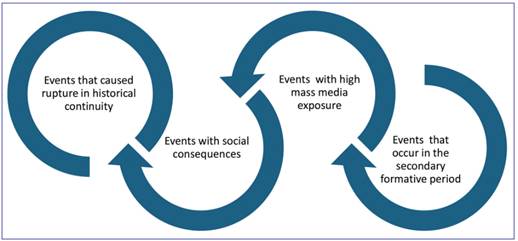
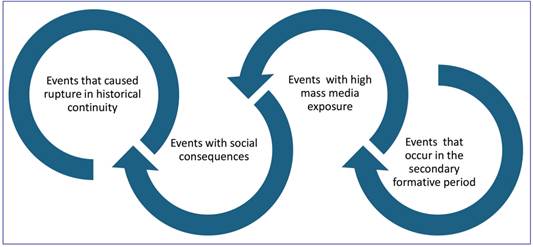
Socio-historical events have the potential to shape generations when they cause a break in historical continuity, introducing a social perception of “before” and “after.” In such circumstances, individuals tend to reinterpret the past and the future in light of the event, reorganizing expectations, life trajectories, and collective narratives. These are events that generate concrete social consequences, like changes in the conditions of education access, work, social mobility, security, and political participation, which are lived collectively and quite simultaneously, leading to shared experiences and collective memories.
In addition, the formation of generational cohorts assumes the existence of effective mass communication systems, capable of widely disseminating an event and sustaining the construction of socially shared interpretations of its meaning and consequences. These systems enable social understanding of the event, as well as its cognitive and symbolic internalization - processes that are essential to the consolidation of collective memories, and, therefore, to the formation of generational cohorts (Brug & Rekker, 2020; Carneiro et al., 2023; Schewe & Meredith, 2004). Figure 1 summarizes these characteristics.
In light of these attributes, we understand that events such as the Great Depression, World War II, the Cold War, the Vietnam War, and the attack on the World Trade Center had a great potential to mold future generations of American society, although not all of them had an equivalent impact on European and Asian countries. Western Europe, in turn, was marked by the two World Wars and the fall of the Berlin Wall, while Latin America was heavily marked by dictatorships and structural economic crises, and East Asia was strongly affected by the Chinese Revolution and the Japanese economic miracle.
Given the relevance of socio-historical and cultural factors in the formation of generations, Brug and Rekker (2020) and Lyons and Kuron (2014) argue that they emerge within a specific socio-historical location, being inappropriate to apply generational models from one society to another. This perspective justifies generational classifications adapted to different cultures, like Chinese (Egri & Ralston, 2004), Malay (Ting & Run, 2015), Mexican (Fernández-Durán, 2016), South African (Duh & Struwig, 2015) and Vietnamese (Cox et al., 2014). Although Edmunds and Turner (2005) suggest the existence of a “global generation”, due to influences of the modern era (like technology, communications, and economic globalization), it is still argued that socio-historical contexts within a culture define generations.
Similarly, in Brazil, there were socio-historical events that caused a break in continuity, had a social impact, were widely reported, and shaped cognitive and symbolic representations of the reality where people lived, especially when they occurred during formation periods. We discuss these events in detail in the next section.
BRAZILIAN EVENTS WITH POTENTIAL TO SHAPE GENERATIONS
Brazil’s sociopolitical and economic history is marked by socio-historical events that brought deep changes to society. Understanding the characteristics detailed in the previous section allows us to examine its history from the 20th century through the first two decades of the 21st century, in light of its potential impact on the formation of generational cohorts. Table 1 summarizes the features of the events that occurred in that period, which were relevant to the formation of Brazilian generations.
Source: Adapted from Capelato (2019), Santos (2021), and Schewe and Meredith (2004).
In an international scenario marked by the Great Depression and large-scale conflicts, Getúlio Vargas came to power with the population’s support, to face the economic crisis and political instability of the country, in the late 1920s. He created a national-developmentalist project that redefined the relationship between the State and society, resulting in a new social pact mediated by the State, especially regarding work, with the implementation of labor legislation and the reorganization of forms of citizenship.
On the economic front, policies like coffee protection, exchange control, and public deficit management aimed at stabilizing the economy and reorganizing the country’s integration to the international market (Marques & Silva, 2018). At the same time, the intensive use of government advertising, through the Department of Press and Propaganda, helped disseminate nationalist narratives and build socially shared interpretations on the role of the State and on national identity, strengthening nationalism and the valorization of the State as a central agent of social order.
The administrations that followed the Vargas Era continued the national-developmentalist project, fostering economic growth and infrastructure modernization. However, this process was followed by rising inflation and fiscal and external imbalances, aggravated by the institutional instability of Jânio Quadros’s and João Goulart’s governments. In a context of ideological polarization and the erosion of governance, the breakdown of the political order consolidated, culminating in the 1964 military coup. It undermined the democratic order and established an authoritarian pattern of governance, heightened by Institutional Act No. 5, in 1968, suspending constitutional guarantees and formalizing political repression. Censorship of the press and cultural production, coupled with the systematic repression of opponents, created an atmosphere of fear and social silencing.
At the same time, the regime employed strategies of mass communication and information control, spreading official narratives that introduced it as a “democratic revolution” aimed at preserving order in the face of communism, especially during the so-called “economic miracle”. In this context, practices of institutional violence, like arbitrary arrests, torture, murders, and disappearances had deep social effects, spreading fear, institutional distrust, and strategic silence in social and political relationships (Castro, 2019; Schewe & Meredith, 2004).
Despite economic growth and industrial expansion, this period was marked by increasing social and regional inequalities. From the mid-1970s, the economic crisis undermined the regime’s foundations, signaling its collapse and paving the way to the process of re-democratization. Throughout the 1980s, the exhaustion of the economic model and the loss of political support increased pressures for democratic transition, culminating in the end of the dictatorship, in 1985. This process was marked by recession and hyperinflation, deeply affecting the daily lives of families and their present and future expectations. The military dictatorship and its termination represent a long period of reconfiguration of social, political, and symbolic experiences of Brazilian society, whose effects extended beyond the formal end of the regime (Rosa, 2022).
The early years of re-democratization were defined by deep economic uncertainty, expressed in a long period of hyperinflation that eroded wages and undermined the capacity for economic planning, in the 1980s and early 1990s (Fernandes et al., 2021; Tullio & Ronci, 1996). This experience helped consolidate collective attitudes marked by uncertainty, institutional distrust, and appreciation of economic stability. In that context, Fernando Collor was elected as the first president by direct vote after the dictatorship, representing society’s expectations for political renewal and economic reorganization, linked to the recovery of purchasing power and trust in the State (Carvalho, 2003). However, exceptional measures taken by the Collor administration, like the freezing of savings accounts, had immediate effects on the daily lives of families. The combination of economic shock and political crisis ended with the presidential impeachment in 1992, reinforcing a culture of distrust in institutions (Andrada, 2018).
Following Collor’s impeachment, Itamar Franco assumed the presidency. At the end of his term, he announced the Real Plan, establishing a new standard of economic stability that redefined social expectations, consumer habits, and forms of economic planning. The new currency proved effective in reducing inflation and absolute poverty in the short term, although unevenly across regions and social groups (Azenha & Rodrigues, 2019; Schuhli, 2021). The Real strengthened a new macroeconomic regime, whose impacts extended throughout subsequent administrations (Varaschin, 2024). However, it kept regional disparities, with rising poverty levels in the North and Northeast regions.
This disparity showed the need for policies for income distribution and for fighting structural inequalities in the country; in this context, Lula’s election in 2002 represented a significant shift, by combining macroeconomic stability with the expansion of social policies. This new arrangement shaped long-term expectations regarding the functioning of the economy and redistributive policies, thus redefining the relationship between the State, the market, and society (Arantes et al., 2017).
In this regard, programs like Fome Zero (Zero Hunger) and Bolsa Família (Family Allowance) had a direct impact on the material living conditions of millions of Brazilians, producing long-lasting effects on income, consumption, and social protection (Azenha & Rodrigues, 2019). In parallel, advances in the field of education, by extending student financing, adoption of quota policies, and expansion of the federal education system have increased access to higher education and opportunities for social mobility (Marques et al., 2018; Mota, 2019). These changes have produced symbolic repertoires linked to valuing education, expectations of social protection, and confidence in economic stability.
However, the increase of corruption allegations against the Workers’ Party (PT) led to a growing process of political polarization within Brazilian society. While part of the population acknowledged the social and distributive advances promoted by PT governments, another part began to interpret this political project as essentially corrupt, mobilizing investigations and accusations related to broader disputes over power and class interests. This environment fostered the spread of mistrust, antagonism, and erosion of institutional trust, in a scenario where the formation of public opinion became object of dispute between political and media actors.
Dilma Rousseff’s impeachment worsened this situation, establishing a landmark rupture in the national political imagination. For Martuscelli (2020), the impeachment went beyond the formal-legal dimension and became the subject of intense interpretive debate, simultaneously legitimized as a moral response to corruption and denounced as a political coup against the sovereignty of the vote. The media played an active role in shaping public opinion, reflecting on and creating narratives that influenced social perceptions of legitimacy, crisis, and political responsibility, helping the consolidation of enduring symbolic repertoires about democracy, legality, and justice (Moritz & Rita, 2020; Mundim, 2023).
This process increased political polarization, reshaped institutional mediations, and deepened the crisis of political representation, particularly by facilitating the renewal of alliances between Centrão (a powerful political group in Congress) and business sectors (Costanzo, 2024). This context extended distrust towards institutions, and made room for legitimizing anti-systemic and authoritarian speeches, through the emergence of the so-called right-wing populism or reactionary populism (Silva & Rodrigues, 2021). Therefore, the far-right candidate Jair Bolsonaro was elected in 2018, as an anti-systemic alternative in the face of widespread discredit in political institutions. His rise expressed a conservative reaction to redistributive policies, expansion of rights, and the symbolic changes experienced in previous decades, mobilizing nationalist, moralizing, and authoritarian speeches, articulated with a “politically authoritarian, socially conservative, and economically neoliberal” agenda (Silva & Rodrigues, 2021, p. 87).
Active in politics since 1989, Bolsonaro built his career through successive changes and expulsions from political parties, in addition to recurring statements marked by institutional confrontation and contempt for the norms of democratic debate, which were widely spread by the media and social networks (Brito & Lara, 2023; Ezequiel & Valle, 2023). For Marques and Carlos (2025), this discursive pattern shaped a specific style of governance, through continuous antagonism, delegitimization of institutions, and the symbolic building of internal enemies. His administration deepened this pattern by adopting policies that negatively affected labor rights, the Unified Health System (SUS), public education, social security, and health policies, while authoritarian, anti-scientific, and exclusionary speeches became frequent (Nogueira, 2023; Santos & Araújo, 2024).
This governance pattern found fertile ground for growth and consolidation in the COVID-19 pandemic. Besides handling the health crisis negligently, it was ideologized and turned into a tool for political mobilization, with speeches that denied the severity of the disease, discrediting science, downplaying death, and attacking healthcare and democratic institutions (Silva, 2025).
In addition to its political and institutional impacts, the COVID-19 pandemic led to a deep reinterpretation of collective notions of risk, care, and vulnerability. For Lerner & Aisengart (2024), the health crisis was a moment when uncertainty about life and death permeated decisions on work, circulation, relationships, and social interactions, making risk an integral part of life experiences. In that process, notions of care took on multiple meanings, ranging from individual protection strategies to public debates about the role of the State and health systems. This scenario changed life and death perspectives; economic conditions; interpersonal relationships and with oneself; and attitudes toward work, career, family, and health, sharing a historical experience with significant potential to influence future generations.
In light of this historical path, certain sociopolitical events can be understood as socially shared experiences, capable of reorganizing expectations, values, and subjective dispositions over time. Given the specificities of the Brazilian context, these experiences provide an analytical basis for defining generations by specific socio-historical landmarks, rather than exclusively by age criteria. The next section presents the methodology used to implement this proposal, linking historical events, social trajectories, and generational experiences in Brazil.
METHODOLOGICAL PROCEDURES
To achieve the proposed goals, we carried out a qualitative, exploratory and descriptive study. The methodological design was based on Ting and Run (2015), Egri and Ralston (2004), Fernández-Durán (2016), and Duh and Struwig (2015), who conceived generations as socially built cohorts, from the shared experience of significant historical events, during formative periods of life.
Starting from these references, we structured the research design in two complementary stages. The first consisted of a historical-sociological and contextual analysis of political, economic, and social events that occurred in Brazil throughout the 20th and 21st centuries, with the potential to shape generations. For each identified event, we sought to understand cultural, normative, and socialization patterns, as well as forms of authority, values, and expectations that prevailed during the corresponding periods of formation. This analysis enabled outlining a preliminary ranking of generational periods, grounded in the literature on socialization and formation of subjective dispositions over the life course, besides building analytical categories about generational milestones in the Brazilian context.
The second stage addressed the collection of qualitative empirical data, carried out between February 20 and April 7, 2020, using the SurveyMonkey platform. The units of observation were reports from individuals belonging to different age cohorts, while the units of analysis corresponded to the sociopolitical events mentioned and the meanings assigned to them, in light of secondary socialization processes. Participants were invited by personal and professional emails, as well as through social media, resulting in 452 valid responses, from individuals born between 1946 and 2002.
For data collection we used an open-ended question, created with the purpose of bringing back autobiographical and collective memories related to historical events experienced by the participants, during periods considered formative. Participation was voluntary and contingent upon agreement to the Free and Informed Consent Term, which outlined the research goals, ensured anonymity for respondents, possibility of withdrawal at any time, and aggregated data processing, thus protecting participants’ identities.
Data were analyzed using content analysis, according to Bardin (2016). The answers were ranked according to: (a) year of birth; (b) mentioned events; and (c) reasons assigned to the relevance of these events. Next, we read the entire document, to identify recurring patterns and check which collective memories remained prominent in the different age groups. Based on the frequency of event citations and a qualitative analysis of the reasons, we identified periods of prevalent secondary socialization, which were used as criteria for defining the time frames of the proposed generations. Finally, the generational classification developed was submitted for review by four individuals belonging to different generations, to check the alignment between the events and assigned characteristics, and real-life experiences.
PROPOSED COHORTS FOR BRAZILIAN GENERATIONS: SOCIO-HISTORICAL EVENTS
The historical events analyzed had socially different impacts, depending on the stage of the life cycle when they were experienced, and on the prevailing social and cultural conditions of each period. In many cases, individuals were exposed to more than one potentially formative event in close temporal proximity, resulting in overlapping experiences and ambiguous meanings. Therefore, the suggested classification considers not only the occurrence of events and periods of secondary socialization, but also the broader social context where individuals’ primary and secondary socialization took place, including patterns of social organization, dominant values, and current forms of authority.
Figure 2 compares the classification proposed in this article with Schewe and Meredith’s (2004), who used political events to propose a classification of Brazilian generations. However, certain events did not cause sufficient breaks to create new generational cohorts. Hence, our study suggests an alternative and updated classification of Brazilian generations.
Comparing the current classification of Brazilian generations with Schewe and Meredith’s (2004) proposal
The Nationalist generation (those born between 1910 and 1929) underwent secondary socialization during the Vargas Era, a period marked by the centralization of political power, the building of a national-developmentalist project, and strong State intervention in the organization of social life. During childhood, rigid patterns of primary socialization prevailed, when respect for authority, for elders, for social norms, and for moral values was emphasized, as well as formal conduct and dress codes (Biasoli-Alves, 1997).
During the Vargas years, intense state propaganda and the glorification of national symbols and values helped to build a perception of the State as the central agent of order, protection, and solution of social problems, consolidating a favorable attitude toward authority, discipline, and institutional obedience, besides a strong sense of nationalism. There was also appreciation of life experiences over material possessions, reflecting a pattern of socialization oriented more toward “being” than “having”.
The Pre-Dictatorship generation (1930-1943) spent their childhood and adolescence under the impact of World War II, a period marked by shortage and rising prices of essential goods (Barone, 2013), as well as persistent effects of the political crisis associated with Vargas’s withdrawal from power, in 1945. Their secondary socialization took place in a scenario of social and institutional instability, precursors to the military regime. Material shortage and economic insecurity, resulting from the international conflict and domestic crisis, contributed to consolidate measures aimed at restraining and adapting to uncertain circumstances.
The Repressed Generation (1944-1958), consisting mainly of children of the Nationalist Generation, had a primary socialization marked by educational standards centered on behavioral control, discipline, and social conformity (Biasoli-Alves, 1997). The gradual retraction of children’s public interactions and the centrality of the domestic environment, increased by the spread of television from the 1950s, strengthened age segmentation and reduced intergenerational exchanges.
Their secondary socialization took place during the military dictatorship, particularly after the Institutional Act 5 (AI-5), with political repression and restriction of civil liberties. Unlike contemporary generations in developed countries, marked by greater cultural liberalization, this generation was formed under institutional violence and authoritarianism, leading to generational arrangements associated with restraint, strategic silence, and adjustment to repressive environments (Schewe & Meredith, 2004).
The “Diretas” generation (1959-1968) was born during the military regime, and experienced, during their childhood, the period of the dictatorship’s greatest tightening, marked by political repression, censorship, and restrictions on civil liberties. Their secondary socialization, however, took place within the context of the regime’s weakening, especially near the end of AI-5, with social mobilization around “Diretas Já” (Direct Elections Now) and re-democratization. This transition from repression to openness produced ambivalent experiences, combining the legacy of authoritarianism with the emergence of political participation as a force for social change.
At the same time, this generation faced successive economic crises that increased in the late 1970s and throughout the 1980s, deeply affecting living conditions and future expectations. Against this scenario, a belief in collective engagement and political action emerged, as a response to structural crises, while there was an expectation that the State would play a central role in mediating and solving social problems. These experiences led to attitudes oriented toward valuing political participation, popular mobilization, and institutional representation.
The Hyperinflation Generation (1969-1978) underwent its secondary socialization in an environment of intense economic instability, marked by the worsening of the crisis inherited from the military dictatorship, persistent hyperinflation, the failure of the Collor Plan and his impeachment, followed by the initial stabilizing effects of the Real Plan. These events affected directly families’ purchasing power, consumer patterns, the labor market, and the possibilities of long-term planning, setting up a scenario of economic unpredictability and weakening of institutional trust.
This context led to the emergence of more cautious and pragmatic attitudes, characterized by valuing economic stability and a greater aversion to risks associated with abrupt changes (Carvalho, 2003; Schuhli, 2021). At the same time, this generation witnessed the growth of globalization, with the influx of foreign products and internet expansion, extending access to information and reshaping educational and consumer practices. There was a combination between the search for material security and a pragmatic openness to technological and global transformations.
The Social Generation (1979-1991) experienced its secondary socialization in a context of relative economic stability, expansion of social policies, and increased access to higher education - particularly during the administrations of Lula and Dilma Rousseff - which favored social mobility, inclusion, and expansion of opportunities. During this period, previously neglected discussions emerged, like feminism, racism, sexuality, and social inequality, incorporated into this generation’s attitudes as legitimate agendas for social participation.
In addition, the spread of globalization and the fast expansion of communication technologies have increased access to information and reduced symbolic distances, while the rise of urban violence and the growing digital mediation of social interactions have affected face-to-face social gathering and the sense of daily safety. These conditions have led to attitudes oriented toward valuing diversity and social inclusion, followed by a more complex and ambivalent perception of contemporary social life.
Finally, the secondary socialization of Generation 4.0 (1992-2005) was marked by the overlap of sociopolitical, economic, and technological changes within a short period of time. Events like the impeachment of Dilma Rousseff, subsequent administrations, the increase of political polarization, and, most significantly, the COVID-19 pandemic, all experienced during the period of secondary socialization, resulted in attitudes defined by the coexistence of expectations of autonomy and unstable trajectories, especially regarding work, political participation, and future prospects.
These processes were followed by fast changes in the world of labor, through the redefinition of professions, new qualification requirements, and the erosion of traditional labor protections. That context contributed to the emergence of more flexible and adaptive attitudes, linked to the familiarity with digital technologies and the constant reshaping of career paths, which coexist with feelings of uncertainty about economic stability, social rights, and the conditions for long-term planning.
The proposed generational classification consists of an analytical model on the formation of cohorts in the Brazilian context. The next step tested this proposition against empirical data, examining significant events reported by participants and the meanings assigned to them, in order to assess their continued relevance as socially significant references in individual and generational trajectories.
EMPIRICAL DATA: GENERATIONS AND BRAZILIAN SOCIO-HISTORICAL EVENTS
The empirical study included 452 participants, of whom 60.4% were female, 32.3% were born in the 1980s, and 48% held a master’s or PhD degree. The statements showed that the events considered significant were mostly experienced during the period of secondary socialization. A systematic review of the answers revealed the presence of events shared by more than one generation, although associated with distinct collective memories, as well as events with a higher incidence in specific generations. Tables 2 and 3 present the events most frequently quoted, by all respondents and segmented by generation.
Among the most cited events, socio-historical occurrences in Brazil prevail, especially those lived during the formative years of adulthood. However, international events like the collapse of the Berlin Wall and the September 11 attacks, although less frequent, also evoked relevant social memories associated with personal values, sociopolitical systems, and global interdependence. Also, technological advances and the spread of the internet were often related to changes in social relations, forms of communication, and the organization of daily life.
Among the events most frequently mentioned by each generation, some take on a distinct centrality, depending on the period of socialization. “Diretas Já”, for example, was quoted equally by Diretas and Hyperinflation generations. While the former associates the movement with hope and collective mobilization, the latter links it to subsequent events, like the 1988 Constitution, the economic crisis, Collor’s election and impeachment, and currency stabilization, following the Real Plan.
When examining the details of each proposed generation, the “Repressed” generation (those born between 1944 and 1958), represented by 31 participants, consistently mentioned the 1964 military coup and the subsequent dictatorship as critical events that shaped their worldview. Although some of the respondents were children at the time of the coup, their secondary socialization took place mostly under the military dictatorship, especially during its most repressive period, as shown by the statements in Table 4.
The accounts indicate that political repression served as the foundation for political and civic education and as a source of long-lasting mistrust effects in interpersonal and institutional relationships. There are reports on the struggle for social justice and experiences marked by fear, silencing, and the weakening of social trust, especially in public spaces like universities and professional settings.
These findings can be understood in light of socialization trajectories that have established educational standards centered on behavior control, discipline, and social conformity (Biasoli-Alves, 1997) during childhood, and a secondary socialization experienced during the most violent period of the military dictatorship. Such combination helped the formation of a collective memory marked by political repression, restriction of civil rights, and spread of fear in social interactions.
In turn, the “Diretas” generation (those born between 1959 and 1968), represented by 69 participants, most often mentioned “Diretas Já” as a defining event, associating it with re-democratization, active political participation, and building a sense of collective belonging. In contrast to the previous generation, whose memories emphasize repression, fear, and silencing, this generations’ accounts highlight the emergence of hope and the perception of collective action as a driver of social change. Some of these meanings are described in the statements presented in Table 5.
The accounts presented in Table 5 show that, although these participants spent their childhood under the repressive regime of the military dictatorship, their secondary socialization took place when the authoritarian regime was weakening, marked by increased popular mobilization and the gradual expansion of civil liberties. In these reports, the “Diretas Já” movement emerges as a collective memory associated with a break from previous patterns of control and silencing, with the experience of freedom of expression, and with the emergence of hope as a political horizon. Such experiences are often told as processes of political and civic learning, where social participation is perceived as a concrete possibility for change, different from the meanings used by the Repressed generation, for whom the same event remains strongly linked to overcoming institutional violence and regaining basic civil rights.
The 99 participants from the Hyperinflation generation (born between 1969 and 1978) highlighted Fernando Collor’s election and impeachment, the freezing of savings accounts, and the Real Plan, associated with direct impacts on daily family life, consumption, planning possibilities, and perception of material security. Although “Diretas Já” is mentioned by some respondents, it is mostly linked to later events, cited as significant. Table 6 presents parts of this generation’s speech.
The reports indicate that these participants spent their childhood during a period marked by the weakening of the military regime and political mobilization around the “Diretas Já” movement, together with the intensification of the economic crisis that began in the 1970s and worsened throughout the 1980s, with high inflation rates and recurring episodes of shortage (Fernandes et al., 2021; Rosa, 2022). The secondary socialization, in turn, took place amidst the frustration of expectations associated with the Collor administration and, later, the reorganization of economic life fostered by the Real Plan.
The reasons presented reveal experiences marked by economic unpredictability, and the weakening of institutional trust. Unlike previous generations, when political events motivated feelings of repression or collective engagement, the accounts of the Hyperinflation generation emphasize the need for constant adaptation and practical strategies for economic survival. Monetary instability, recurring loss of resources, and difficulty with long-term planning emerged as central elements in the formation of their collective memories. In addition, the Real Plan was the contrast to that scenario, associated with the possibility of reorganizing daily life and future planning. Jointly, these findings point to the establishment of generational dispositions oriented towards caution, pragmatism, and valuing material stability.
The Social Generation (1979-1991) mentions, according to the 187 respondents, to experiences associated with the Collor Plan, the freezing of savings accounts, and the implementation of the Real Plan, mostly lived during childhood and mediated by their direct impact on family life. However, their secondary socialization took place in a context of relative economic stabilization and expansion of public policies aimed at social inclusion, especially during Lula and Dilma Rousseff’s administrations. Participants associate events like expanded access to higher education, social programs, and consolidation of monetary stability with perceptions of social mobility, increased opportunities, and acknowledgment of historically marginalized rights (Azenha & Rodrigues, 2019; Marques et al., 2018). Table 7 presents some of these statements.
The statements in Table 7 show that PT administrations are mostly remembered for their social advances and for the concrete opportunities they offered for educational and professional advancement, especially for individuals from low-income families. The experience of improved living conditions, access to university, and entry into the skilled labor market emerged as a central element of this generation’s collective memory, often associated with feelings of hope, belonging, and social recognition.
At the same time, the expanded access to educational, communicational, and public participation spaces has fostered the emergence and legitimization of debates on feminism, racism, sexuality, and social inequality, which have become central topics of collective identity and social engagement. The Social generation exhibits attitudes oriented to valuing diversity, inclusion, and articulation between individual and collective demands. Their testimonies reflect a more complex perception of social life, in which institutional and technological advances coexist with new forms of insecurity and social tension. The impeachment of Dilma Rousseff, although present in some narratives, takes on greater analytical centrality in the following generation, often being remembered as a threat to democracy and to spaces for women’s participation.
In turn, the 66 respondents from Generation 4.0 (born between 1992 and 2004) mentioned experiences associated with a series of sociopolitical and health-related events that occurred within a short period of time, disrupting the status quo and historical continuity. The most often cited event was the COVID-19 pandemic, associated with fear and the changes imposed by social isolation, as well as uncertainties about the future. Added to this context were the impeachment of Dilma Rousseff, in 2016, political polarization, the rise of the far right, and the election of Jair Bolsonaro, understood as politically interconnected events and markers of institutional instability, with a strong impact on society. Some of these statements are shown in Table 8.
The testimonies show that such events triggered perceptions of threat, insecurity, and social vulnerability, on an individual and collective level. The collective memories of this generation center around concerns related to the erosion of democracy, political and moral intolerance, and the growth of social vulnerability. These experiences helped forming generational dispositions marked by familiarity with environments of uncertainty, a heightened perception of risk, and high levels of anxiety, establishing a relationship different from other generations, regarding wishes, well-being, life plans, and personal, family, and professional trajectories. Given that data collection ended on April 7, 2020, when the pandemic was still spreading, we understand Generation 4.0 as a developing cohort, whose attitudes continue to be reshaped as these events still affect their trajectories.
CONCLUSION
This study suggests a Brazilian classification of generations, based on collective memories resulting from significant Brazilian socio-historical events, from the Vargas Era to the COVID-19 pandemic. Seven generations were identified: Nationalist, Pre-Dictatorship, Repressed, “Diretas”, Hyperinflation, Social, and 4.0. This proposal combined a review of the literature on events with significant social repercussions and the perspectives of people who experienced these events during specific formative periods. It was possible to confirm generations as a social, historical, and cultural construction, thus establishing initial conceptions of generational characteristics that are specific to Brazilian society.
The results presented here contribute to the literature on generations and fields related to understanding the individual, their behavior, and their interaction with the social environment, such as psychology, sociology, anthropology, and management. In addition, the paper updates the study by Schewe and Meredith (2004), which has not been empirically validated, after 22 years of its publication. Since that study, two new generations were identified, paving the way for new interpretations and studies to validate and enhance the proposed classification. In addition, understanding what characterizes the generations enables a broader comprehension of society, allowing various sectors to develop more harmonious social experiences, ways of working, and socialization, as well as more assertive communication and guidance. Additionally, any activity where segmentation by age groups or generations is necessary, will benefit from our results.
We acknowledge that one limitation that calls for further research is the imbalance in the number of respondents by generation, especially among the older ones. We suggest hybrid approaches, both face-to-face and virtual, so that future studies can achieve greater sample diversity. We also recommend studies that validate the proposed classification statistically, as well as research with constructs aimed at understanding the individual within society and at work, such as personal values, work-related values, behaviors, and organizational and work-related ties. Besides this limitation, there was the emergence of COVID-19 pandemic, still at its peak during data collection. Although global in scope, it was a unique experience in Brazil, influenced by the political context and cultural and historical specificities. This event suggests that the next Brazilian generation will have its own distinct characteristics, strengthening the importance of studies that include local features in the analysis of generational dynamics.
References
-
Andrada, A. S. F. (2018). Quem, afinal, apoiou o Plano Collor? Brazilian Journal of Political Economy, 38(4), 781-799. https://doi.org/10.1590/0101-35172018-2713
» https://doi.org/10.1590/0101-35172018-2713 -
Arantes, F., Lopreato, F. L., & Santos, F. (2017). O novo consenso em macroeconomia no Brasil: a política fiscal do Plano Real ao segundo governo Lula. Revista de Economia Contemporânea, 21(3), 1-34. https://doi.org/10.1590/198055272131
» https://doi.org/10.1590/198055272131 -
Azenha, A., Neto, & Rodrigues, R. (2019). Crescimento econômico nos governos FHC e Lula. Revista Teoria e Evidência Econômica, 25(53), 243-274. https://doi.org/10.5335/rtee.v25i53.9484
» https://doi.org/10.5335/rtee.v25i53.9484 - Bardin, L. (2016). Análise de Conteúdo Edições 70.
- Barone, J. (2013). 1942: O Brasil e sua guerra quase desconhecida Nova Fronteira.
-
Biasoli-Alves, Z. M. M. (1997). Famílias brasileiras do século XX: os valores e as práticas de educação da criança. Temas em Psicologia, 5(3), 33-49. https://pepsic.bvsalud.org/scielo.php?script=sci_arttext&pid=S1413-389X1997000300005
» https://pepsic.bvsalud.org/scielo.php?script=sci_arttext&pid=S1413-389X1997000300005 -
Brito, C. L., & Lara, G. M. P. (2023). Elementos de messianismo em pronunciamentos de Jair Bolsonaro. DELTA: Documentação e Estudos em Linguística Teórica e Aplicada, 39(3), 1-28. https://doi.org/10.1590/1678-460x202339356744
» https://doi.org/10.1590/1678-460x202339356744 -
Brug, W. van der, & Rekker, R. (2020). Dealignment, realignment and generational differences in the Netherlands. West European Politics, 44(4), 1-26. https://doi.org/10.1080/01402382.2020.1774203
» https://doi.org/10.1080/01402382.2020.1774203 - Capelato, M. H. (2019). O Estado Novo: o que trouxe de novo? In J. Ferreira & L. de A. N. Delgado (Eds.), O Brasil Republicano: O tempo do Nacional-estatismo: do início da década de 1930 ao apogeu do Estado Novo: Segunda República (1930-1945) (Vol. 2, pp. 103-137). Civilização Brasileira.
-
Carneiro, M. R., Souza, L. L. F., & Saldanha, J. A. V. (2023). Quando se formam preferências levadas por toda a vida? Evidências dos efeitos de coortes geracionais. Contribuciones A Las Ciencias Sociales, 16(9), 14154-14182. https://doi.org/10.55905/revconv.16n.9-019
» https://doi.org/10.55905/revconv.16n.9-019 -
Carvalho, C. E. (2003). O fracasso do Plano Collor: erros de execução ou de concepção? Economia, 4(2), 283-331. https://www.anpec.org.br/revista/vol4/v4n2p283_331.pdf
» https://www.anpec.org.br/revista/vol4/v4n2p283_331.pdf -
Castro, D. A., Neto. (2019). Ditadura militar, propaganda e otimismo no Brasil dos anos 1970. Revista Trilhas da História, 8(16), 72-96. https://trilhasdahistoria.ufms.br/index.php/RevTH/article/view/7829
» https://trilhasdahistoria.ufms.br/index.php/RevTH/article/view/7829 -
Costanzo, D. (2024). Centrão e empreiteiras no impeachment de Dilma Rousseff. Caderno CRH, 37, e024017. https://doi.org/10.9771/ccrh.v37i0.58693
» https://doi.org/10.9771/ccrh.v37i0.58693 -
Cox, A., Hannif, Z., & Rowley, C. (2014). Leadership styles and generational effects: examples of US companies in Vietnam. The International Journal of Human Resource Management, 25(1), 1-22. https://doi.org/10.1080/09585192.2013.778311
» https://doi.org/10.1080/09585192.2013.778311 -
Duh, H., & Struwig, M. (2015). Justification of generational cohort segmentation in South Africa. International Journal of Emerging Markets, 10(1), 89-101. https://doi.org/10.1108/IJOEM-08-2012-0078
» https://doi.org/10.1108/IJOEM-08-2012-0078 -
Edmunds, J., & Turner, B. S. (2005). Global generations: social change in the twentieth century. The British Journal of Sociology, 56(4), 559-577. https://doi.org/10.1111/j.1468-4446.2005.00083.x
» https://doi.org/10.1111/j.1468-4446.2005.00083.x -
Egri, C. P., & Ralston, D. A. (2004). Generation cohorts and personal values: a comparison of China and the United States. Organization Science, 15(2), 133-257. https://doi.org/10.1287/orsc.1030.0048
» https://doi.org/10.1287/orsc.1030.0048 -
Erll, A. (2022). The hidden power of implicit collective memory. Memory, Mind & Media, 1, e14. https://doi.org/10.1017/mem.2022.7
» https://doi.org/10.1017/mem.2022.7 -
Ezequiel, V. de C., & Valle, M. R. (2023). Do discurso do ódio à violência consumada: “Fuzilar a petralhada!”. Revista de Estudos Universitários - REU, 49, e023003. https://doi.org/10.22484/2177-5788.2023v49id5169
» https://doi.org/10.22484/2177-5788.2023v49id5169 -
Fernandes, A. J., Arbugeri, M., & Formiga, N. (2021). The brazilian economy in the 1980s: the lost decade or wins? The consequences of the external debt crisis, inflation and the state crisis. International Journal for Innovation Education and Research, 9(6), 173-184. https://doi.org/10.31686/ijier.vol9.iss6.3165
» https://doi.org/10.31686/ijier.vol9.iss6.3165 -
Fernández-Durán, J. J. (2016). Defining generational cohorts for marketing in Mexico. Journal of Business Research, 69(2), 435-444. https://doi.org/10.1016/j.jbusres.2015.06.049
» https://doi.org/10.1016/j.jbusres.2015.06.049 -
Harari, T. T., Sela, Y., & Bareket-Bojmel, L. (2023). Gen Z during the COVID-19 crisis: a comparative analysis of the differences between Gen Z and Gen X in resilience, values and attitudes. Current Psychology, 42, 24223-24232. https://doi.org/10.1007/s12144-022-03501-4
» https://doi.org/10.1007/s12144-022-03501-4 -
Ingersgaard, M. V., Grabowski, D., Willaing, I., & Tjørnhøj-Thomsen, T. (2024). It’s a part of what I am, but not all of who I am: a qualitative study of identity formation in adolescents and emerging adults with type 1 diabetes. SSM - Qualitative Research in Health, 5, 100391. https://doi.org/10.1016/j.ssmqr.2023.100391
» https://doi.org/10.1016/j.ssmqr.2023.100391 -
Lerner, K., & Aisengart, R. (2024). Covid-19 e tempos de crise: entre o risco e o cuidado. Saúde e Sociedade, 33(3), e240309pt. https://doi.org/10.1590/s0104-12902024240309en
» https://doi.org/10.1590/s0104-12902024240309en -
Licata, L. (2022). Collective memory: objectification or anchoring? Papers on Social Representations, 31(1), 5-1. https://psr.iscte-iul.pt/index.php/PSR/article/view/620
» https://psr.iscte-iul.pt/index.php/PSR/article/view/620 -
Lyons, S., & Kuron, L. (2014). Generational differences in the workplace: a review of the evidence and directions for future research. Journal of Organizational Behavior, 35(S1), S139-S157. https://doi.org/10.1002/job.1913
» https://doi.org/10.1002/job.1913 -
Marques, J. B., & Silva, E. F. C. (2018). O papel do Estado: um retrato da administração pública na Era Vargas com um diálogo a partir da obra de Pedro Cezar Dutra Fonseca. “Vargas: O capitalismo em construção”. Revista Mosaico, 9(2), 18-23. https://doi.org/10.21727/rm.v9i2.1288
» https://doi.org/10.21727/rm.v9i2.1288 -
Marques, M. S., & Carlos, E. (2025). O populismo de extrema direita no governo Bolsonaro: uma abordagem discursiva. Sociologias, 27, e140107. https://doi.org/10.1590/1807-0337/e140107
» https://doi.org/10.1590/1807-0337/e140107 -
Marques, R. M., Ximenes, S. B., & Ugino, C. K. (2018). Governos Lula e Dilma em matéria de seguridade social e acesso à educação superior. Brazilian Journal of Political Economy, 38(3), 526-547. https://doi.org/10.1590/0101-35172018-2784
» https://doi.org/10.1590/0101-35172018-2784 -
Martuscelli, D. E. (2020). Polêmicas sobre a definição do impeachment de Dilma Rousseff como golpe de Estado. Revista de Estudos e Pesquisas sobre as Américas, 14(2), 67-102. https://periodicos.unb.br/index.php/repam/article/view/28759
» https://periodicos.unb.br/index.php/repam/article/view/28759 -
Moritz, M. L. R. F., & Rita, M. B. B. (2020). Mídia impressa e gênero na construção do impeachment de Dilma Rousseff. Intercom: Revista Brasileira de Ciências da Comunicação, 43(2), 203-223. https://doi.org/10.1590/1809-58442020211
» https://doi.org/10.1590/1809-58442020211 -
Mota, W. P., Jr. (2019). O Banco Mundial e a contrarreforma da educação superior brasileira no governo Lula da Silva (2003-2010). Avaliação: Revista da Avaliação da Educação Superior (Campinas), 24(1), 213-233. https://doi.org/10.1590/s1414-407720190001000012
» https://doi.org/10.1590/s1414-407720190001000012 -
Mundim, P. S. (2023). A batalha pela opinião pública e o impeachment de Dilma Rousseff. Lua Nova: Revista de Cultura e Política, (119), 292-321. https://doi.org/10.1590/0102-292321/119
» https://doi.org/10.1590/0102-292321/119 -
Nogueira, B. (2023). Impactos do governo Jair Bolsonaro para as políticas públicas de cultura do Brasil. Políticas Culturais em Revista, 16(2), 153-178. https://doi.org/10.9771/pcr.v16i2.52814
» https://doi.org/10.9771/pcr.v16i2.52814 -
Rosa, L. (2022). Celso Furtado, o Golpe de 1964 e a Ditadura Militar. Revista do Instituto de Estudos Brasileiros, 1(81), 63-83. https://doi.org/10.11606/issn.2316-901X.v1i81p63-83
» https://doi.org/10.11606/issn.2316-901X.v1i81p63-83 -
Santos, A. P., & Araújo, A. S. (2024). Passando a boiada: representações do discurso ecológico sobre o Brasil na imprensa dos Estados Unidos no governo de Jair Bolsonaro. Revista Letra Magna, 20(35), 40-66. https://doi.org/10.29327/2206789.20.35-3
» https://doi.org/10.29327/2206789.20.35-3 -
Santos, C. P. C. S., Schmitberger, J. A., Santos, T. A. S., Caldas, L., Nkoso, B. A., Borges, J. S. L., & Gonçalves, B. D. (2024). Adultez emergente e universidade: o sentimento “in-between”. Pretextos - Revista da Graduação em Psicologia da PUC Minas, 9(18), 149-168. https://periodicos.pucminas.br/pretextos/article/view/32726
» https://periodicos.pucminas.br/pretextos/article/view/32726 -
Santos, M. S. (2021). Memória e ditadura militar: lembrando as violações de direitos humanos. Tempo Social, 33(2), 289-309. https://doi.org/10.11606/0103-2070.ts.2021.177990
» https://doi.org/10.11606/0103-2070.ts.2021.177990 -
Schewe, C. D., & Meredith, G. E. (2004). Segmenting global markets by generational cohorts: determining motivations by age. Journal of Consumer Behavior, 4(1), 51-63. https://doi.org/10.1002/cb.157
» https://doi.org/10.1002/cb.157 - Schuhli, G. T. (2021). Uma análise comparativa do plano cruzado e do plano real sob a perspectiva da socioeconomia. Revista da FAE, 24(1), e0711.
- Silva, L. K. A. (2025). Uso ideológico da pandemia de covid-19 na consolidação do extremismo de direita no Brasil. Revista de Políticas Públicas, 29(1), 275-294.
-
Silva, M. G., & Rodrigues, T. C. M. (2021). O populismo de direita no Brasil: neoliberalismo e autoritarismo no governo Bolsonaro. Mediações Revista de Ciências Sociais, 26(1), 86-107. https://doi.org/10.5433/2176-6665.2021v26n1p86
» https://doi.org/10.5433/2176-6665.2021v26n1p86 -
Ting, H., & Run, E. C. A. (2015). A qualitative inquiry into the formation of generational cohorts: a case of an emerging market. Journal of Economics and Business Research, 21(1), 126-143. https://uav.ro/jour/index.php/jebr/article/view/439
» https://uav.ro/jour/index.php/jebr/article/view/439 -
Tullio, G., & Ronci, M. (1996). Brazilian inflation from 1980 to 1993: causes, consequences and dynamics. Journal of Latin American Studies, 28(3), 635-666. https://doi.org/10.1017/S0022216X00023919
» https://doi.org/10.1017/S0022216X00023919 -
Varaschin, J. A. A. (2024). Plano Real: normatização de uma economia financeirizada. Economia e Sociedade, 33(1), 85-99. https://doi.org/10.1590/1982-3533.2024v33n1art05
» https://doi.org/10.1590/1982-3533.2024v33n1art05
-
15
[Translated version] Note: All quotes in English translated by the authors.
-
RESEARCH DATA AVAILABILITY
The dataset supporting the results of this study is not publicly available.
-
ARTIFICIAL INTELLIGENCE USAGE
We did not use artificial intelligence tools to write this paper.
-
REVIEWERS
Maria Luisa Mendes Teixeira, Universidade Presbiteriana Mackenzie, São Paulo, SP, Brazil. ORCID: https://orcid.org/0000-0002-0606-1723
-
REVIEWERS
Tania Casado, Universidade de São Paulo, São Paulo, SP, Brazil. ORCID: https://orcid.org/0000-0002-2069-288X
-
REVIEWERS
Felipe Moura Oliveira, Universidade Estadual do Piauí, Teresina, PI, Brazil. ORCID: https://orcid.org/0000-0001-6604-6827
-
REVIEWERS
One of the reviewers did not authorize the disclosure of their identity.
-
PEER REVIEW REPORT
The peer review report is available at https://periodicos.fgv.br/rap/article/view/94420
Edited by
-
EDITOR-IN-CHIEF
Hélio Arthur Reis Irigaray, Fundação Getulio Vargas, Rio de Janeiro, RJ, Brazil. ORCID: https://orcid.org/0000-0001-9580-7859
-
ASSOCIATE EDITOR
Fabricio Stocker, Fundação Getulio Vargas, Rio de Janeiro, RJ, Brazil. ORCID: https://orcid.org/0000-0001-6340-9127
-
GUEST EDITORS
Diego Costa Mendes, Federal Universidade Federal de Viçosa, Viçosa, MG, Brazil. ORCID: https://orcid.org/0000-0003-3193-7034
-
GUEST EDITORS
Kely Cesar Martins de Paiva, Universidade Federal de Minas Gerais, Belo Horizonte, MG, Brazil. ORCID: https://orcid.org/0000-0002-5185-9072
-
GUEST EDITORS
Sónia P. Gonçalves, Universidade de Lisboa, Lisbon, Portugal. ORCID: https://orcid.org/0000-0003-3704-2995
The dataset supporting the results of this study is not publicly available.

 Source: Adapted from