
 The gender affirmation process and health impacts of transgender people
ABSTRACT
Objective: Analyze the impact of the gender affirmation process on the health of the transgender population.
Method: Transversal and quantitative study, conducted with transsexual individuals from Aracaju, Sergipe, Brazil, between January and September 2023, using sociodemographic and health instruments. The analysis was done using Principal Component Analysis and descriptive statistics.
Results: Of the 58 participants, 51.7% had side effects during hormone therapy, highlighting headache and elevated blood pressure. About 41.0% performed hormone therapy without the supervision of a qualified healthcare professional. Transsexuals and non-binaries were 16 times (p=0.0002) more likely not to perform the cytopathological examination. These data reinforce the vulnerability scenario of the population in the health context.
Conclusion: The study demonstrated that institutional barriers drive the transgender population away from health services, generating limitations in access to preventive care with an emphasis on hormone therapy.
KEYWORDS:
Transsexualism; Transgender Persons; Health Services for Transgender Persons; Access to Health Services; Health Vulnerability
HIGHLIGHTS
Transgender people often undergo hormone therapy without professional support.
Most transgender people have side effects of hormone therapy.
The majority of transgender people did not undergo surgical procedures.
RESUMO
Objetivo: Analisar os impactos do processo de afirmação de gênero na saúde da população transexual.
Método: Estudo transversal e quantitativo, realizado com indivíduos transexuais de Aracaju, Sergipe, Brasil, entre janeiro e setembro de 2023, utilizando instrumentos sociodemográficos e de saúde. A análise foi feita por meio de Componente Principal e estatísticas descritivas.
Resultados: Dos 58 participantes, 51,7% apresentaram efeitos colaterais durante a hormonioterapia, destacando-se a cefaleia e a elevação da pressão arterial. Cerca de 41,0% realizaram a hormonioterapia sem o acompanhamento de um profissional de saúde qualificado. Os transexuais e não binários apresentaram 16 vezes (p=0,0002) mais chances de não realizar o exame citopatológico. Esses dados reforçam o cenário de vulnerabilidade da população no contexto de saúde.
Conclusão: O estudo demonstrou que as barreiras institucionais afastam a população transexual dos serviços de saúde gerando limitações no acesso a cuidados preventivos com ênfase na hormonioterapia.
DESCRITORES:
Transexualidade; Pessoas Transgênero; Serviços de Saúde para Pessoas Transgênero; Acesso aos Cuidados de Saúde; Vulnerabilidade em Saúde
HIGHLIGHTS
Transexuais frequentemente fazem hormonioterapia sem suporte profissional.
A maioria dos transexuais apresentam efeitos colaterais da hormonioterapia.
A maior parcela dos transexuais não passaram por procedimentos cirúrgicos.
RESUMEN
Objetivo: Analizar los impactos del proceso de afirmación de género en la salud de la población transexual.
Método: Estudio transversal y cuantitativo, realizado con personas transgénero de Aracaju, Sergipe, Brasil, entre enero y septiembre de 2023, utilizando instrumentos sociodemográficos y de salud. El análisis se realizó mediante el componente principal y estadísticas descriptivas.
Resultados: De las 58 participantes, el 51,7 % presentó efectos secundarios durante la hormonoterapia, entre los que destacaron cefalea y aumento de la presión arterial. Alrededor del 41,0 % se sometió a la terapia hormonal sin el seguimiento de un profesional sanitario cualificado. Las personas transgénero y no binarias presentaron 16 veces (p=0,0002) más probabilidades de no realizarse la citología. Estos datos refuerzan el panorama de vulnerabilidad de la población en el contexto de la salud.
Conclusión: El estudio demostró que las barreras institucionales alejan a la población transexual de los servicios de salud, lo que genera limitaciones en el acceso a la atención preventiva, con énfasis en la terapia hormonal.
DESCRIPTORES:
Transexualidad; Personas Transgénero; Servicios de Salud para las Personas Transgénero; Acceso a la Atención de Salud; Vulnerabilidad en Salud
HIGHLIGHTS
Las personas transexuales suelen someterse a terapia hormonal sin apoyo profesional.
La mayoría de las personas transgénero presentan efectos secundarios de la terapia hormonal.
La mayor parte de las personas transexuales no se han sometido a procedimientos quirúrgicos.
INTRODUCTION
Transgender people are characterized as individuals who do not identify with the sex attributed to birth and with the sociocultural impositions associated with this1. Because they do not fit into the cisgender patterns, the transgender segment may experience stigmatizing and discriminatory practices, which relate to resistance in the search and use of health services, even in front of serious clinical frames, in addition to reflecting on the abandonment of treatments and their low life expectancy in the Brazilian scenario, which corresponds to 35 years 2-3.
The incompatibility between anatomical gender and gender identity often leads trans individuals to seek the process of gender affirmation4. Such a mechanism consists of a series of bodily modification procedures, through the implementation of surgical interventions and/or hormonal therapy, to reduce biologically induced secondary sexual aspects, as well as introducing sexual characteristics compatible with gender identity5.
In this perspective, the Transsexual Process (PrTr) was established in 2008 within the Single Health System (SUS). The PrTr covers a range of procedures, outpatient and hospital services aimed at the health of transgender and transsexual people who express the desire to modify physical and sexual characteristics6. However, access to the services offered by the PrTr presents several barriers, including the deficit in quantity or variability of resources and procedures, as well as the geographical limitations of health units qualified to offer the PrTr, given that of the ten institutions existing in Brazil, six are located in the southeastern region7.
Restrictions on access to PrTr are reflected in actions such as indiscriminate use of estradiol, progesterone, and testosterone, performing surgical interventions, and clandestine aesthetic procedures, such as the application of industrial liquid silicone (ILS)8. The clandestine application of ILS injections is frequently used by transvestites and transgender women. The use of this substance is associated with various health problems, among which are tissue necrosis, infectious processes, migration of the product to other areas of the body, deformities, pulmonary embolism, and even death 9-10.
Given the above, the present study is justified by the gap in the development of research aimed at the process of gender affirmation and its reflexes in transsexual health, in addition it is reinforced that since it is an invisible population that is often removed from health services, there are several doubts inherent in the specific therapeutic approach for this population group. From this perspective, the study provides important foundations for healthcare professionals in developing care plans tailored to the challenges and real needs of the transgender audience. Thus, the study aims to analyze the impacts of the gender affirmation process on the health of the transgender population.
METHOD
Area of study
This is a cross-sectional study with a quantitative approach, developed in collaboration with members of the actions initiated by the non-governmental organization Astra - Human Rights and Citizenship of Lesbians, Gays, Bisexuals, Transgender, and Intersex (LGBT).
Population and sample
The method applied to recruit and interview the transgender population was the Snowball 11. In this perspective, the criteria for inclusion in the research include being over 18 years of age and regularly participating in activities developed by Astra, a non-governmental organization (NGO). At the same time, the non-inclusion criteria refer to the presence of severe cognitive impairment.
The strategy for data collection involves establishing contact with the Astra coordination to clarify the research objectives and relevance, as well as exchanging information and experiences regarding the institution’s operation, lines of action, and mission. This will enable the adaptation of the research to respect the institutional principles and values. Thus, an institutional agreement was created, which was signed by the NGO manager, ensuring the consolidation of the partnership between Astra and the research group in the data collection process.
Data Collection
Validation process
Between August and December 2022, quantitative data collection instruments underwent validation by a committee of three expert judges in studies on the LGBTQIAP+ population. The researchers were invited and selected via non-probability sampling, using the Lattes Curriculum for analysis. After assessing the guidelines of the experts, the questionnaires were adapted to consolidate the study’s variables.
Characterization of instruments
Quantitative instruments
The semi-structured quantitative data collection tool, “Socio-demographic Assessment”, was applied through Google Forms from January 2023 to September 2023. The questionnaire was made available in a link format for the Astra manager. The instrument was based on the studies of the Brazilian Institute of Geography and Statistics12, the National Network of Transsexual Persons13, and Barrientos-Delgado and collaborators14. Such a tool is composed of the following variables: gender identity, sexual orientation, ethnic description, highest level of education, and monthly income. In addition, the instrument “Sexual Health and Body Image” was applied, of a quantitative nature, based on the studies of the National Network of Transsexual Persons12 and Carone and collaborators15. The instrument consists of the variables: hormone therapy, body modification, surgical interventions, and side effects.
Data Analysis
The tabulation and organization of the database were performed using the Excel program, and then analyzed statistically with the Statistical Package for the Social Sciences (SPSS) 25.0, to obtain absolute and relative frequencies, along with a 95% confidence interval to present statistical significance (p < 0.05). The Analysis of Principal Components (APC) was performed using the PAST 4.0 program, and BioEstat 5.0 was utilized for evaluating the Odds Ratio. The sample was grouped according to the gender identity of the individuals.
Ethical aspects
The study was approved by the Ethics and Research Committee (CEP) of the Universidade de Tiradentes-UNIT with opinion 5,742,860, CAAE: 61245522.7.0000.5371. During the development of the methodological stages, the ethical and legal aspects were considered and safeguarded in accordance with Resolution No. 466/2012. Participants received guidance and clarification on voluntary participation, study objectives, and methodological stages. Participants who agreed to participate signed a Free and Informed Consent Clause.
RESULTS
The study included 58 transgender men, aged between 18 and 61, of whom 23 (39.7%) were transgender men, while the most observed sexual orientation was heterosexual, 22 (37.9%). The study showed that, among the respondents, 30 (51.8%) have a secondary education as their highest level of education, and 24 (41.4%) are black. A pattern of economic vulnerability was observed, characterized by most individuals lacking a monthly income and earning up to one minimum wage (Table 1).
When evaluating the gender affirmation processes, it was found that 29 (50.0%) affirmed that they perform or have already performed hormone therapy, of which the largest proportion had the follow-up of a qualified health professional. Another survey referred to the body modification through surgeries; in this scenario, the majority (75.9%) of the respondents deny the use of this mechanism. Of the total volunteers who performed body modification surgeries, the majority (85.7%) claim to have performed in legalized health units (Table 2).
According to the data presented in Table 2, the majority of the respondents reported having had side effects during hormone therapy. Figure 1 shows the distribution of adverse events due to hormone therapy. In trans women, the combined effects are highlighted: nausea/vomiting + dizziness + headache + increased systemic blood pressure (PA) - 5 (37.5%). In comparison, trans men showed headaches + an increase in PA 7 (42.8%).

Distribution of side effects of hormone therapy in transgender women and men. Aracaju, SE, Brazil, 2023
Table 2 shows that the smallest proportion of transsexuals underwent surgical body modification procedures. The majority of transsexual women, 57.1% performed surgical interventions in the breasts (placement of silicone prostheses), while 28.6% underwent surgical interventions in the face, glutes, and thighs, and 14.3% in the face. Already, 100% of transsexual men have undergone surgical procedures on their breasts (mastectomy).
According to the analysis of the main components (PCA), the first two components of the PCA, PC1 and PC2, explain most of the data variation (68.48%). Thus, it was possible to group transgender people into three distinct subgroups, based on the degree of similarity in the interactions among members of each set. The formation of the subgroups presented the following conformation: the subgroup G1, is formed by the axes PC1+ and PC2+, totals 28 individuals, the subgroup G2, is formed by the axes PC1- and PC2+, totals 13 individuals and the subgroup G3, is formed by the axes PC1- and PC2-, totals 16 individuals.
The subgroup G1 is composed of individuals who have not undergone hormone therapy and who have not undergone surgical interventions of body modification, being heterogeneous and composed of trans women, trans men, and non-binary individuals. Regarding the use of the social name, 4 (100%) of transgender women and 12 (75%) of non-binary men stated that society generally respects their social name, while 5 (62.5%) of transgender men report disrespect (Table 3).
The subgroup G2 is composed of men and women who have undergone hormone therapy and body modification surgeries. The majority of trans women report having undergone hormone therapy without the supervision of a healthcare professional. In contrast, 6 (100%) of trans men claim to have had the supervision of healthcare professionals during hormone therapy. Regarding the side effects of hormone therapy, the majority of trans women reported occurrence, while the majority of trans men denied side effects. Regarding performing body modification surgeries, 2 (28.57%) of transsexual women report that they performed these procedures in unlawful health units (Table 3).
The subgroup G3 consists of trans women and men who have undergone hormone therapy and who have not undergone surgical interventions of body modification. Most trans women stated that they had undergone hormone therapy without guidance from a healthcare professional, while almost all trans men had professional follow-up during hormone therapy (Table 3).
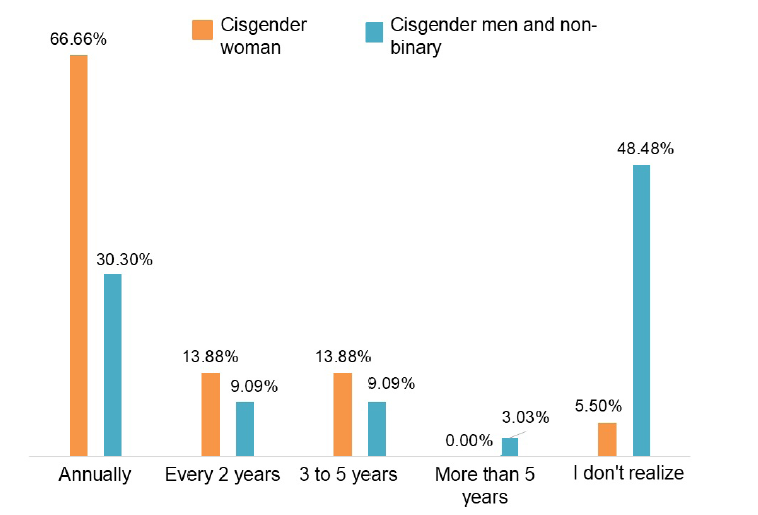
As regards the cytopathological examination, the target audience represented 36 cisgender women and 33 trans and non-binary men. It was observed that the frequency of examination differed between the two groups, as 24 (66.66%) of cisgender women take the examination annually, while 16 (48.48%) of trans and non-binary men do not (Figure 2). It was possible to verify that trans and non-binary men were 16 times more likely not to undergo the cytopathological examination, compared to cisgender women (95% CI between 3.29 and 77.76; p=0.0002).

Comparison between the frequency of cytopathological examinations in cisgender women X trans and non-binary men, Aracaju, SE, Brazil, 2023
DISCUSSION
The present study highlights fragilities in the level of education of the transgender population and their reflection in the low socioeconomic status of these individuals. According to the dossier published in 2022 by the Associação Nacional de Travestis e Transexuais (ANTRA), only 0.02% of transsexuals are enrolled in universities16.
There are, therefore, social disparities, especially in the scarcity of opportunities for access to inclusive education and in occupying well-paid positions. It is also highlighted that the limitations of public policies aimed at the development of actions that encourage the opening of formal vacancies for the transgender public, contribute to the fact that a large proportion of transgender people are unemployed or in subemployment such as prostitution, being exposed to a scenario of socioeconomic vulnerability17-18.
The gender affirmation process has the potential to promote positive impacts on the health of the transsexual public, as it reduces the effects of incongruence between gender identity and biological characteristics through procedures such as surgical interventions, legal recognition of gender, and hormone therapy19. In this sense, the present study demonstrates how such mechanisms affect the health of transgender men and women in different ways.
This study presents a tendency associated with transsexual women to perform the process of hormone therapy without professional supervision. This data may relate to different patterns of care from a gender perspective, according to the study that identified that the female gender presents a greater predisposition to seek regular health care, compared to the male gender. Thus, the fact that transgender men are biologically bound to the female sex can influence professional follow-up during hormone therapy20.
In this perspective, it was possible to observe that the lack of professional support during hormone therapy resulted in the intensification of the manifestation of side effects in transsexual women, when compared to transsexual men, who, in the majority, claimed to have professional guidance during hormone therapy. This result reinforces the importance of healthcare professionals in preventing complications and providing safe and effective treatments21.
A study conducted in Bahia reveals that facilities for obtaining estradiol and progesterone without a prescription are prevalent in Brazilian pharmaceutical environments, creating a favorable condition for self-medication practices, which poses a risk factor for adverse events. In addition, barriers to accessing healthcare can stimulate self-medication, as well as socioeconomic conditions, which can lead individuals to believe that the higher the hormone level administered, the faster the desired body changes will occur22.
Hormone therapy can trigger metabolic, cardiovascular, and endocrine changes that vary between transgender men and women, due to differences in the substances used and their distinct physiological mechanisms23. When evaluating the distribution of side effects in the study, it was found that an increase in blood pressure was a common occurrence among both genders. However, the mechanisms involved in this condition are different; in transsexual men, hypertension is linked to increased blood viscosity associated with the use of testosterone24, whereas in transsexual women, it is related to the repercussions of estrogen in the risk of thromboembolic events25.
The study highlighted that the majority of transsexuals did not undergo surgical interventions of body modification; this fact may be associated with the difficulty of accessing the Transsexualizing Process (PrTr). Although specialized health units offer a variety of surgical procedures, such as hysterectomy, thyreoplasty, breast prosthesis implants, and mastectomy, the waiting time for the acquisition of surgeries is still considered high, causing many individuals not to have access to the desired interventions. In addition, there are geographical restrictions, especially in the northeastern region, which has only one hospital equipped with the services of the PrTr, located in the metropolitan area of Recife 26.
The difficulty in accessing the body modification procedures can increase the risks of using services without adequate structural and professional regulation, predisposing serious health consequences, such as rejection of implants, occurrences of infections and bleeding, anesthetic complications and even deaths of 27-28.
Regarding the screening of cervical cancer in non-binary and non-hysterectomized trans men, the present study highlighted the low adherence of this population in performing the periodic cytopathological examination. Such findings corroborate the study conducted in the United States, which highlighted that about 51% of transsexual participants did not perform the cytopathological examination in the last 3 years. The study also highlighted that the majority of transsexual people prefer to carry out self-sampling of HPV as primary screening for cervical cancer, to avoid embarrassing situations attributed to discrimination and the unpreparedness of professionals during the cervicovaginal sampling 29.
As a limitation of the study, the difficulty of accessing the population is highlighted, as it is a historically marginalized group. The capture of participants for the study was a complex process, resulting in a restricted sample.
CONCLUSION
The present study enabled the analysis of the effects of the gender affirmation process on the health of the transgender population in the northeast of Brazil, demonstrating that hormone therapy is a mechanism often applied to obtain physical characteristics compatible with gender identity. Transsexual women are more likely to perform hormone therapy without the supervision of a health professional, and this is associated with an increased incidence of side effects. It was found that the majority of transsexuals did not undergo positive surgeries; this data may be associated with the difficulty of accessing health services.
The research has significant implications for the areas of health and nursing, as it provides a sociodemographic and clinical survey on the impacts of the gender affirmation process on transsexual health. Understanding these parameters contributes to the training in the follow-up of individuals undergoing hormonal therapy and positive surgeries, seeking to reduce risks and promote better clinical outcomes, while also encouraging the development of a more equitable and inclusive healthcare system.
ACKNOWLEDGEMENTS
Coordenação de Aperfeiçoamento de Pessoal de Nível Superior (CAPES) - funding code 001 (Project number: 88887.940250/2024-00) and the NGO Astra - LGBT Human Rights and Citizenship.
References
-
1 Rosa DF, Carvalho MVF, Pereira NR, Rocha NT, Neves VR, Rosa AS. Nursing Care for the transgender population: genders from the perspective of professional practice. Rev Bras Enferm [Internet]. 2019 [cited 2023 Sep 20];72(Suppl 1):299-306. Available from: https://doi.org/10.1590/0034-7167-2017-0644
» https://doi.org/10.1590/0034-7167-2017-0644 -
2 Roncon PC, Wandekoken KD, Barros MEB, Duarte MJO, Sodré F. Acesso à saúde pela população trans no brasil: nas entrelinhas da revisão integrativa. Trab Educ Saúde [Internet]. 2020 [cited 2023 Oct 5];18(1):e0023469. Available from: https://doi.org/10.1590/1981-7746-sol00234
» https://doi.org/10.1590/1981-7746-sol00234 -
3 Costa-Val A, Mangenelli MS, de Moraes VMF, Cano-Prais HA, Ribeiro GM. The care for the LGBT population from the perspective of Primary Health Care professionals. Physis [Internet]. 2022 [cited 2023 Oct 16];32(2):e320207. Available from: https://doi.org/10.1590/S0103-73312022320207
» https://doi.org/10.1590/S0103-73312022320207 -
4 Baker KE, Wilson LM, Sharma R, Dukhanin V, McArthur K, Robinson KA. Hormone therapy, mental health, and quality of life among transgender people: a systematic review. J Endocr Soc [Internet]. 2021 [cited 2023 Oct 16];5(4):1-16. Available from: https://doi.org/10.1210/jendso/bvab011
» https://doi.org/10.1210/jendso/bvab011 -
5 da Costa TLAC, Brandão FSS, Figueiredo WVA, Passos XS, Morais FD. Influência da hormonioterapia na incidência de câncer em transexuais. Braz J Dev [Internet]. 2021 [cited 2024 Jan 11];7(6):56017-39. Available from: https://doi.org/10.34117/bjdv7n6-150
» https://doi.org/10.34117/bjdv7n6-150 -
6 Ministério da Saúde (BR). Portaria n. 2.803, de 19 de novembro de 2013. Redefine e amplia o Processo Transexualizador no Sistema Único de Saúde (SUS). Diário Oficial da União. 2013 Nov 20 [cited 2023 Nov 18];225(Seção 1). Available from: https://bvsms.saude.gov.br/bvs/saudelegis/gm/2013/prt2803_19_11_2013.html
» https://bvsms.saude.gov.br/bvs/saudelegis/gm/2013/prt2803_19_11_2013.html -
7 Cazeiro F, Galindo D, de Souza LL, de Guimaraes RS. Transsexualization process in the SUS: Questions for psychology based on therapeutic itineraries and depathologization. Psicol Estud [Internet]. 2022 [cited 2023 Sep 20];27:e48503. Available from: https://doi.org/10.4025/psicolestud.v27i0.48503
» https://doi.org/10.4025/psicolestud.v27i0.48503 -
8 da Silva RA, da Silva LAV, Soares F, Dourado I. Use of non-prescribed hormones in body modification of transvestis and transsexual women in Salvador/Bahia, Brazil. Ciên Saúde Colet [Internet]. 2022 [cited 2023 Nov 18];27(2):503-14. Available from: https://doi.org/10.1590/1413-81232022272.44342020
» https://doi.org/10.1590/1413-81232022272.44342020 -
9 Pinto JJ, Santos RSS, Vargens OMC, de Araújo LM. The medicalization and pathologization from the perspective of transsexual women: accessibility or social exclusion. Rev Enferm UERJ [Internet]. 2017 [cited 2023 Nov 18];25:e29009. Available from: https://doi.org/10.12957/reuerj.2017.29009
» https://doi.org/10.12957/reuerj.2017.29009 -
10 Mcbritton M, Di Pietro T, Figueiredo R, Wolfe B, Schwach K, Guidolin FP, et al. Experiências de uma ONG na promoção de direitos e saúde trans em São Paulo. BIS, Bol Inst Saúde [Internet]. 2018 [cited 2024 Jan 11];19(2):125-34. Available from: https://doi.org/10.52753/bis.2018.v19.34633
» https://doi.org/10.52753/bis.2018.v19.34633 -
11 Naderifar M, Goli H, Ghaljaie F. Snowball Sampling: A Purposeful Method of Sampling in Qualitative Research. Strides Dev Med Educ [Internet]. 2017 [cited 2025 Mar 31];14(3):e67670. Available from: https://www.researchgate.net/publication/324590206_Snowball_Sampling_A_Purposeful_Method_of_Sampling_in_Qualitative_Research
» https://www.researchgate.net/publication/324590206_Snowball_Sampling_A_Purposeful_Method_of_Sampling_in_Qualitative_Research -
12 Instituto Brasileiro de Geografia e Estatística (IBGE). Coordenação de População e Indicadores Sociais. Síntese de indicadores sociais: uma análise das condições de vida da população brasileira 2019 [Internet]. Rio de Janeiro: IBGE; 2019 [cited 2024 Jan 16]. 130 p. Available from: https://biblioteca.ibge.gov.br/index.php/biblioteca-catalogo?view=detalhes&id=2101678
» https://biblioteca.ibge.gov.br/index.php/biblioteca-catalogo?view=detalhes&id=2101678 -
13 Souza D, Araújo T, editors. Reflexões sobre os dados do Censo Trans [Internet]. Aracaju, SE: RedeTrans; [2022] [cited 2024 Jan 11]. 50 p. Available from: https://redetransbrasil.org.br/wp-content/uploads/2022/06/REDE-TRANS_Censo-Trans-2020-pub-web.pdf
» https://redetransbrasil.org.br/wp-content/uploads/2022/06/REDE-TRANS_Censo-Trans-2020-pub-web.pdf -
14 Delgado JB, Saiz JL, Guzmán-González M, Bahamondes J, Gómez F, Castro MC, et al. Sociodemographic characteristics, gender identification, and gender affirmation pathways in transgender people: a survey study in Chile. Arch Sex Behav [Internet]. 2021 [cited 2023 Dec 6];50:3505-16. Available from: https://doi.org/10.1007/s10508-021-01939-4
» https://doi.org/10.1007/s10508-021-01939-4 -
15 Carone N, Rothblum ED, Bos HMW, Gartrell NK, Herman JL. Demographics and health outcomes in a U.S. probability sample of transgender parents. J Fam Psychol [Internet]. 2021 [cited 2023 Dec 15];35(1):57-68. Available from: https://doi.org/10.1037/fam0000776
» https://doi.org/10.1037/fam0000776 -
16 Associação Nacional de Travestis e Transexuais (ANTRA) [Internet]. Brasil: ANTRA; 2022 [cited 2024 May 13]. Nota da ANTRA sobre cotas e reservas de vagas em universidades destinadas as pessoas trans; [about 6 screens]. Available from: https://antrabrasil.org/2020/12/17/nota-antra-cotas-universidades-pessoas-trans/
» https://antrabrasil.org/2020/12/17/nota-antra-cotas-universidades-pessoas-trans -
17 Grubba LS, Donelli MP. Travestis e transexuais no mercado de trabalho: pesquisa em Passo Fundo/RS (março a abril de 2021). Confluências [Internet]. 2023 [cited 2023 Dec 6];25(2):106-26. Available from: https://periodicos.uff.br/confluencias/article/view/57595
» https://periodicos.uff.br/confluencias/article/view/57595 -
18 Lopes RAG, Kern CAR, Vidal GP, Castro A. Você não responde ao perfil: representações sociais sobre o mercado de trabalho para transexuais. Rev Psicol Divers Saúde [Internet]. 2020 [cited 2024 Feb 4];9(3):351-63. Available from: https://doi.org/10.17267/2317-3394rpds.v9i3.3269
» https://doi.org/10.17267/2317-3394rpds.v9i3.3269 -
19 Tordoff DM, Wanta JW, Collin A, Stepney C, Inwards-Breland DJ, Ahrens K. Mental health outcomes in transgender and nonbinary youths receiving gender-affirming care. JAMA Netw Open [Internet]. 2022 [cited 2024 Apr 2];15(2):e220978. Available from: https://doi.org/10.1001/jamanetworkopen.2022.0978
» https://doi.org/10.1001/jamanetworkopen.2022.0978 -
20 Levorato CD, de Mello LM, da Silva AS, Nunes AA. Fatores associados à procura por serviços de saúde numa perspectiva relacional de gênero. Ciênc Saúde Colet [Internet]. 2014 [cited 2024 Mar 14];19(4):1263-74. Available from: https://doi.org/10.1590/1413-81232014194.01242013
» https://doi.org/10.1590/1413-81232014194.01242013 -
21 Nolan BJ, Zwickl S, Locke P, Zajac JD, Cheung AS. Early access to testosterone therapy in transgender and gender-diverse adults seeking masculinization: a randomized clinical trial. JAMA Netw Open [Internet]. 2023 [cited 2024 Apr 02];6(9):e2331919. Available from: https://doi.org/10.1001/jamanetworkopen.2023.31919
» https://doi.org/10.1001/jamanetworkopen.2023.31919 -
22 Reback CJ, Clark K, Holloway IW, Fletcher JB. Health disparities, risk behaviors and healthcare utilization among transgender women in Los Angeles County: a comparison from 1998-1999 to 2015-2016. AIDS Behav [Internet]. 2018 [cited 2024 May 19];22:2524-33. Available from: https://doi.org/10.1007/s10461-018-2165-7
» https://doi.org/10.1007/s10461-018-2165-7 -
23 Cheung AS, Zwickl S, Miller K, Nolan BJ, Qi Wong AF, Jones P, et al. The impact of gender-affirming hormone therapy on physical performance. J Clin Endocrinol Metab [Internet]. 2024 [cited 2024 Apr 2];109(2):e455-e465. Available from: https://doi.org/10.1210/clinem/dgad414
» https://doi.org/10.1210/clinem/dgad414 -
24 Madsen MC, van Dijk D, Wiepjes CM, Conemans EB, Thijs A, den Heijer M. Erythrocytosis in a large cohort of trans men using testosterone: a long-term follow-up study on prevalence, determinants, and exposure years. J Clin Endocrinol Metab [Internet]. 2021 [cited 2024 Apr 1];106(6):1710-17. Available from: https://doi.org/10.1210/clinem/dgab089
» https://doi.org/10.1210/clinem/dgab089 -
25 Shatzel JJ, Connelly KJ, DeLoughery TG. Thrombotic issues in transgender medicine: a review. Am J Hematol [Internet]. 2017 [cited Apr 2];92(2):204-8. Available from: https://doi.org/10.1002/ajh.24593
» https://doi.org/10.1002/ajh.24593 -
26 Santos EJV, de Melo CPL. Caracterização e acesso aos cuidados em saúde de um serviço referência do processo transexualizador no SUS. Res Soc Dev [Internet]. 2022 [cited 2025 Mar 31];11(5):e13411527902. Available from: http://dx.doi.org/10.33448/rsd-v11i5.27902
» http://dx.doi.org/10.33448/rsd-v11i5.27902 -
27 Mundluru SN, Larson AR. Medical dermatologic conditions in transgender women. Int J Womens Dermatol [Internet]. 2018 [cited 2025 Apr 1];4:212-15. Available from: https://doi.org/10.1016/j.ijwd.2018.08.008
» https://doi.org/10.1016/j.ijwd.2018.08.008 -
28 Murariu D, Holland MC, Gampper TJ, Campbell CA. Illegal silicone injections create unique reconstructive challenges in transgender patients. Plast Reconstr Surg [Internet]. 2015 [cited Apr 2];135(5):932e-933e. Available from: https://doi.org/10.1097/PRS.0000000000001192
» https://doi.org/10.1097/PRS.0000000000001192 -
29 Seay J, Ranck A, Weiss R, Salgado C, Fein L, Kobetz E. Understanding transgender men’s experiences with and preferences for cervical cancer screening: a rapid assessment survey. LGBT Health [Internet]. 2017 [cited 2024 May 19];4(4):304-9. Available from: https://doi.org/10.1089/lgbt.2016.0143
» https://doi.org/10.1089/lgbt.2016.0143
-
HOW TO REFERENCE THIS ARTICLE:
Santana JT, Cardoso IG, de Oliveira VTP, Madi RR, Martins MCV, de Melo CM. The gender affirmation process and health impacts of transgender people. Cogitare Enferm [Internet]. 2025 [cited “insert year, month and day”];30:e96228en. Available from: https://doi.org/10.1590/ce.v30i0.96228en
-
*
Article extracted from the master’s thesis: “Fatores condicionantes de saúde e a configuração das interações sociais da população LGBTQIA+ inserida no Estado de Sergipe”, Universidade Tiradentes, Aracaju, SE, Brasil, 2024.

 Source: The authors (2023).
 Source: The authors (2023).