
 Racial inequalities in access to sewerage services in Brazilian metropolitan regions
Abstract
The proliferation of the environmental crisis and its unequal urban impacts, though a focus of recent research, intersects with longstanding Brazilian urban challenges such as basic sanitation. This article aims to provide an overview of racial inequalities in access to sewerage services, considering three factors: a comparative analysis at the metropolitan scale, an examination of the racial distribution of localities, and the quality of sanitation infrastructure. Our findings reveal an overall improvement in sewerage coverage between 2010 and 2022. Nonetheless, a robust and persistent disparity remains across all analyzed variables, displaying distinct patterns among different metropolitan regions and perpetuating historical environmental injustices.
Keywords
environmental racism; basic sanitation; environmental inequality; periphery; census
Resumo
A profusão da crise ambiental e de seus impactos desiguais sobre as cidades, embora foco de pesquisas recentes, faz companhia a antigos problemas urbanos brasileiros como o saneamento básico. Este artigo tem por objetivo traçar um panorama das desigualdades raciais no acesso a esgotamento, levando em conta três fatores: a análise comparativa no escopo metropolitano; a investigação ao longo da distribuição de composição racial das localidades; e a qualidade da infraestrutura sanitária. A análise através dos dados de setores censitários dos censos demográficos de 2010 e 2022 demonstra uma evolução no esgotamento no período, mas uma robusta e persistente desigualdade que se manifesta em todas as variáveis analisadas, com padrões diferentes conforme as regiões metropolitanas, perpetuando históricas injustiças ambientais.
Palavras-chave
racismo ambiental; saneamento básico; injustiça ambiental; periferia; censo
Introdução
The unequal effects of environmental degradation have received growing scholarly attention over recent decades, popularizing terms such as environmental injustice and environmental racism (Bullard, 2018; Mohai et al., 2009; Pulido, 1996), including in Brazil (Acselrad, Mello, & Bezerra, 2009; Porto, 2005; Herculano, 2008; Pacheco, 2008). However, urban research in Brazil adopting this lens, attentive to the variables and specificities of our cities, remains limited. Among the core challenges of Brazilian urbanism, basic sanitation has been the subject of historical and policy-oriented studies (Rezende & Heller, 2008; Britto et al., 2012; Marques, 2000) and analyses of access and overall inequalities (Saiani & Toneto Júnior, 2010; Marques, 2015). Nevertheless, we still lack assessments that trace its unequal distribution between and within metropolitan areas, foregrounding the racial composition of localities and the quality of sanitation infrastructures.
This article addresses part of these gaps by offering a comparative panorama of racial inequalities in access to sewerage across Brazilian metropolitan regions, using 2010 and 2022 demographic census data. The analysis centers on the racial distribution of territories, stratifying metropolitan areas by the share of non-White residents. Inequalities are measured using: (a) the presence of open sewage in the surrounding area; (b) households whose sewage is discharged into rudimentary pits, ditches, or water bodies; and (c) the existence of a sewer network. Results indicate consistent and persistent correlations between racial segregation and the distribution of sewerage across metropolitan regions.
The article unfolds in four sections. It begins with a literature review on inequality, racism, and environmental injustice in dialogue with Brazilian urban studies. The next section revisits the history of sanitation policy in Brazil, trends in indicators, and the persistence of inequalities. Subsequently, the databases and census sanitation categories used in the study are presented. The article concludes with results for 2010 and 2022 across selected metropolitan regions.
Environmental inequality and urban studies
A large body of international research, often quantitative, has documented correlations among income, race, and exposure to environmental risks. Key mechanisms of environmental inequality have been explored for years, particularly in the United States (Banzhaf et al., 2019a, 2019b; Mohai et al., 2009; Mohai & Saha, 2015a, 2015b; Shao et al., 2022; Downey et al., 2008). The U.S. literature largely centers on the siting of polluting facilities near poor and/or Black and Latin communities due to: (a) real-estate dynamics (industry seeking low land values and subsequent devaluation attracting low-income residents); (b) low sociopolitical resistance in affected communities; and (c) governmental inaction. A distinctly racial dimension is also present: socio-spatial segregation, including brokers limiting residential options (Mohai & Saha, 2015), enabling White households with similar purchasing power to move away from polluted neighborhoods more easily.
In Brazil, the topic gained traction with the Brazilian Environmental Justice Network (RBJA) in 2002. The agenda expanded beyond toxic waste siting – typical of U.S. cases (Acselrad, 2010) and was reframed for the Brazilian context. In 2005, the network defined environmental racism not only as actions with racist intent but also as actions that produce racialized impacts, regardless of original intent (Pacheco, 2008). Porto and Porto (2015) highlight five strands in Brazilian environmental conflicts: (1) labor movements mobilized around work--related diseases and accidents; (2) resistance to the agro-export and extractive model; (3) communities living near risky installations (e.g., chemical plants); (4) residents affected by dam and dike failures; and (5) slums residents, as a special case of “sacrifice zones.” The latter has often been sidelined by conservationist environmentalism, further obscuring and demobilizing around environmental problems in slums (favelas) and urban peripheries.
These “sacrifice zones” in favelas and metropolitan peripheries constitute prototypically urban environmental problems, the prime locus of environmental injustice (Acselrad et al., 2009). Nonetheless, international literature points to a lack of urban environmental inequality studies in low and middle-income countries, which paradoxically bear the brunt of pollution exposure. Shao et al. (2022) show that work tends to assess aggregate conditions and regional differences, with fewer studies mapping how pollution and socio- -economic constraints are distributed among residents. Fernández et al. (2023) likewise note limited attention to highly urbanized regions in the Global South, despite recent growth in Latin American publications.
In Brazil, the field’s theoretical consolidation revolves around core authors in environmental justice (Acselrad, 2002; 2010; Porto, 2005; Herculano, 2002). Yet systematic empirical urban studies on environmental inequality are still emerging, capable of addressing different territories, spatial scales, and longitudinal trajectories. Meanwhile, traditional urban studies often treat environmental degradation as one among many topics in the “urban issue” alongside sanitation, mobility, violence, and peripheral infrastructures – captured, for instance, by the notion of “urban spoliation” (Kowarick, 1979).
Research on “environmental inequality” need not employ the term explicitly and has also developed under other urban frameworks. For example, Marques (1996) on the spatial distribution of sanitation investments by socioeconomic groups in Rio; Passos (2023) on racialized and colonial structures in Rio’s waste management; Porto et al. (2015) on health – environment relations in favelas via uprooting, provisoriness, and invisibility; and Torres & Marques (2001) on heterogeneity within the periphery, identifying “hyper-periphery” zones where extreme poverty and risk overlap.
While the environmental-inequality and urban-studies literatures could converse more, Brazilian urban sociology has long examined favelas and peripheries. In the 1970s, these areas were construed as territories “absent” from the state, shaped by large-scale subdivisions lacking infrastructure – especially sewerage, with severe environmental and public-health impacts. According to Marques and Bichir (2001), two early approaches dominated. The first one, structuralist, linked infrastructure deficits to accumulation dynamics intrinsic to the economic system, manifest in urban space. The second explained higher public investment in affluent neighborhoods through political-economy dynamics, as wealthier groups wielded greater political influence (Vetter et al., 1979; 1981). This produced a “circular causation chain”: state actions generate uneven appropriation of benefits across space, shape land markets, feed residential segregation, and concentrate political power, which is then leveraged to secure further benefits. Metropolitan sewerage deficits were largely interpreted within these models.
Similar market mechanisms have been adapted to urban environmental problems. Elliott and Frickel (2013), for instance, describe a “vicious cycle”: communities become vulnerable to escalating pollution, aging infrastructure, loss of small businesses, and marked demographic shifts. We can call it a social accumulation of vulnerability mediated by regressive urban policies.
From the 1980s onward, the view strengthened that expansions in basic urban services were also driven by popular mobilization. Yet critiques of excessive mechanistic accounts emphasized how they overlooked internal state dynamics – bureaucratic inertia, technical routines, and political agency (Marques, 2000). Such internal dynamics enabled investments in sewerage in Rio’s periphery at least since the 1970s, before redemocratization, albeit at levels insufficient relative to central areas.
More recent scholarship centers on social agency, everyday life in peripheries and favelas, and more flexible analytical perspectives. The infrastructure dimension has been empirically central since the 1960s in Brazilian urban studies, typically through qualitative and ethnographic approaches. Cavalcanti and Araujo (2023) bring this tradition into international debates on urban infrastructures (Star, 1999; Simone, 2004; Larkin, 2020), including urban waters and sanitation.
Aligned with this turn, Anand et al. (2018) conceptualize water infrastructure as a socio-material terrain for reproducing racism in Black U.S. cities (Detroit, Flint), and in Mumbai, water services as material manifestations of the social contract and key to inclusion and urban inequalities (Anand, 2011). An “infrastructural” lens helps connect environmental debates to the urban problems of the Global South – largely tied to big cities. In sanitation, the everyday management of water in Rio has been analyzed through gendered practices (Pierobon & Fernandes, 2023), and “residual infrastructures” (Lima, 2023) foreground the embodied, racialized human dimension of waste and urban production.
These research traditions invite the tracing of patterns of environmental injustice that shape city-making in multiple ways, permeating daily life beyond dramatic events such as floods or landslides. A factor intrinsically linking “city” and “environment” is basic sanitation, which has been long addressed by public health studies but still under-operationalized as a central dimension of Brazilian urban environmental inequality. The next section revisits sanitation policies over time, key milestones, and how inequalities have been measured.
The historical deficit of sewerage in Brazil
In the late 19th century, sanitation and preventive health were initially integrated and often concessioned to private firms. From the 1910s onward, national public health policy prioritized water supply over sewerage expansion. Early-20th-century urban reforms, especially in Rio but also Recife, São Paulo, Curitiba, Santos, Porto Alegre, Manaus, and Belém, inaugurated a “modern urbanism” at the periphery (Maricato, 2000) combining environmental sanitation, landscape beautification, and territorial segregation by displacing the poor to city fringes.
Menicucci and D’Albuquerque (2018) argue that from the 1930s, health policy shifted from preventive, collective approaches toward individual medical care, creating a rift between health and sanitation. Rezende and Heller (2008) dub the period up to the 1950s the “era of sanitation,” when the health sector was de-federalized and private provision encouraged, while sanitation consolidated as a public function.
A truly autonomous sanitation policy agenda emerged with the National Sanitation Plan (Planasa) from 1971 onward. Although administratively centralized, Planasa spurred the creation of state-level sanitation companies in the 1970s, structured on business principles and expected to be self-financing (Marques, 2000). Planasa markedly increased water supply coverage and, to a lesser extent, sewerage (Britto et al., 2012). Yet it also entrenched patterns of exclusion, especially in favelas and urban peripheries, and widened the gap between water provision and sewerage: water expansions intensified sewage generation without commensurate investments in collection and treatment. Britto et al. (2012) invoke institutional inertia and path dependence to explain how fragmented governance, limited intersectorality, and an overly technocentric model (sanitary engineering-led) have constrained effective policy integration with urban planning and environmental quality.
Over the last 50 years, indicators show notable improvements in water coverage, with more modest gains in sewerage. Saiani and Toneto Júnior (2010) report weak progress after Planasa’s crisis in the 1980s, followed by 1990s investments aimed at sector modernization and marginal coverage gains. Access to the public sewer network rises with income; in 1980-1991, sewerage worsened for all income groups except the richest, while 1991-2000 brought increases across groups, but least for those below one minimum wage. Marques (2015) shows improvements from the 1970s to 2010 (greater for water, especially 1970-1991) but persistent sewerage deficits in small and medium municipalities and stark intra-urban inequalities between the top 10% and bottom 40%.
From a racial perspective, Rosemberg and Pinto (1995) were among the first to estimate racial inequality in sanitation using PNAD-1987, documenting large Black–White gaps within income bands and across Brazil’s macro-regions. Nationally, 73% of Whites had adequate sanitation versus 45% of Blacks. Using the 2000 National Sanitation Survey (IBGE), Acselrad et al. (2009) reported sewerage or septic coverage of 62.7% for Whites versus 39.6% for Blacks and Browns. From PNAD-2008, Moraes (2014) shows the sewerage deficit concentrated among Browns (30.8 million people): just over 60% had sewerage or septic coverage, compared with nearly 80% among Whites and just over 70% among Blacks. More recently, Cirne and de Sousa (2024), using 2022 census data, found 83.5% of Whites with sewerage or septic systems versus 75% of Blacks and 68.9% of Browns. In capital cities, gaps were smaller, rarely exceeding 5 percentage points.
Despite these contributions, more racially focused, metropolitan-scale diagnoses are needed, moving beyond global averages by individuals. At minimum, analyses could: (1) adopt an urban-metropolitan scope; (2) consider infrastructure quality (levels of adequacy); and (3) incorporate socio-spatial segregation, comparing across the racial distribution of localities.
Measuring sewerage: data and methods
There is no technical consensus on the definition of sanitation deficit (Moraes, 2014) in Brazil. Analyses typically focus on the quantity of service (access), overlooking quality. Adequacy is historically and contextually contingent, yet the recent National Sanitation Plan (Plansab) defines “adequate” sewerage as collection followed by treatment, or the use of a septic tank (Brazil, 2014).
The Population Census has used comparable categories for sewerage since 1950, with minor variations. Chart 1 summarizes these categories and their temporal comparability.
For dense urban environments, these options can be ranked by desirability: (1) public sewer network; (2) septic tank; (3) rudimentary pit; (4) other outflow (ditch, rivers, lakes, etc.). Rezende and Heller (2008) and Britto et al. (2012) question goals based solely on coverage indicators – the binary presence/absence of household connection – since “collection” alone ignores network separation and ultimate treatment. Septic tanks may be suitable in low-density settings but are often inadequate in metropolitan contexts; and household reports may also misclassify systems (Moraes, 2014).
Even within “public sewer network,” at least three sub-types matter: (1) separate sewer with treatment; (2) separate sewer without treatment; and (3) unitary/mixed systems (combined with stormwater). Ideally, household sewage in cities should flow via separate sewers to treatment plants.
Yet nationwide, there are no consistent intra-urban datasets on network separation or treatment (with local exceptions such as Rio’s PSAM).1 Treatment is only measured at the municipal level via the National Sanitation Information System (SNIS). While this limits interpretations from the Census, it remains the only countrywide intra-urban source, enabling metropolitan inequality assessment.
Other household surveys (e.g., PNAD) use similar categories but lack fine spatial granularity, restricting analyses to inter-individual averages (with or without multivariate controls). Such averages2 hide the fact that much of the population lives in racially mixed tracts. More illuminating is to examine the distribution, particularly its extremes. Census tracts3 allow the probing of segregation effects by looking across the racial distribution: What happens in disproportionately Black tracts? And in predominantly White tracts?
Accordingly, each metropolis is partitioned into deciles by the share of non-White residents (Black, Brown, and Indigenous), ordering tracts into ten equally populated strata from Whitest to least White. For each stratum, the mean of the sewerage variables is computed.
Multivariate models are deliberately not estimated (e.g., controlling for tract average income) for two reasons. First, the aim is a descriptive panorama, quantifying total racial inequality by sewerage variable, instead of partitioning it into “pure race” versus income effects. Pulido (1996, 2000) cautions against a paradigm where studies degenerate into a competition between “racial projects”:4 skeptics deny environmental racism (reducing everything to class), while others “prove” racism by showing limited class effects. Second, a pragmatic reason: tract-level income from the 2022 Census was not available in time for this work, risking reliance on outdated 2010 tract income.
Limitations inherent to self-declared race in household surveys5 are also noted, as is the aggregation of Black, Brown, and Indigenous as “non-White.” While analytically useful, this choice obscures within-group heterogeneity and reduces visibility for smaller urban groups (e.g., Indigenous). A substantial literature addresses sanitation with a racial focus on these populations (Marinho et al., 2021; Raupp, 2017; Cunha & Raupp, 2022).
All analyses are restricted to urban areas of Brazilian metropolitan regions, selecting only urban tracts of member municipalities to minimize low-density contexts where septic tanks may be appropriate. The analysis first examines all 81 metropolitan regions,6 then narrows to ten large, regionally representative metropolises.
Racial inequalities in sewerage across metropolitan regions
This section starts with the least desirable sanitation condition: the presence of raw sewage in the immediate surroundings of dwellings. Although this exposure correlates with inadequate household sewerage, it is not the same phenomenon – either substantively or in IBGE’s measurement for 2010. A household may be connected to some network while nearby households are not, leading to open sewage in the vicinity. Conversely, a household’s “channeled” sewage may be discharged into roadside ditches a short distance away, which still constitutes open sewage. The only nationwide source for this indicator is the 2010 Population Census “surroundings” microdata (conceptually distinct from the “household” microdata). The 2022 Census did not include this module.
In 2010, approximately 18.2% of residents living in metropolitan census tracts were exposed to open sewage in the surroundings. In tracts with open sewage, about 64% of residents were Black, Brown (pardo), or Indigenous; in tracts without this environmental burden, that share fell to 44%. Figure 1 summarizes the share exposed to open sewage by racial composition deciles (from the Whitest to the least White tracts), pooling all Brazilian metropolitan regions.

Interpretation is straightforward: in tracts with a high non-White share (> 75%), roughly 41% of residents lived with open sewage nearby; in predominantly White tracts, the figure is 4%. The gradient is monotonic across all ten deciles: higher non-White composition is associated with higher exposure, without exception. Centering the analysis on racial composition is informative in itself, but it does not isolate a race-specific effect, as socioeconomic and municipal/metropolitan factors are correlated with race and remain embedded in these distributions. Because sewerage is a public service installed in the public right-of-way, the patterns here are read less as a pure income effect and more as a manifestation of socio-spatial segregation, which is tightly coupled with racial composition.
To mitigate compositional differences across regions (e.g., southern metros are whiter with better infrastructure; southeastern metros are more populous), the analysis is replicated within each of ten major metropolitan regions for 2010. The visualization mirrors Figure 1 but plots line (one per metropolis) constructed from within-metropolis racial deciles.
On first inspection, Recife exhibits the sharpest inequality: exposure is near zero in the Whitest strata but reaches 71% in the Blackest decile. Belém, by contrast, shows high exposure almost across the board – a level effect rather than only a steep gradient. In general, northeastern metros (Recife, Salvador, Fortaleza) and, to a lesser extent, Rio de Janeiro are the most unequal: they move from negligible exposure among the White minority to concerning levels already by the median racial decile – indicative of a privileged White minority relatively shielded from the hazard.
São Paulo departs from a simple “White privilege” profile: exposure remains low through the middle of the distribution and then rises sharply in the upper deciles; in the top decile it surpasses Rio, with 46% of tracts reporting open sewage. The salient feature there lies at the opposite tail – exclusion concentrated in disproportionately Black localities, the well-known peripheral slums. All metros display the same qualitative pattern of racial inequality in 2010, albeit at lower levels in Belo Horizonte, Porto Alegre, and the Federal District.

The analysis then turns into 2022 tract data to identify inadequate sewerage, defined here as the absence of both a public sewer connection and a septic tank (recognizing that either one without treatment does not necessarily imply adequacy). This grouping includes discharge to rudimentary pits or holes, ditches, rivers, streams, the sea, lakes, or other outfalls. Figure 3 presents the distribution for the same ten metropolises.

– Sewerage via rudimentary pits/holes, ditches, water bodies, or other outfalls (2022), by racial stratum
Once again, Recife and Belém rank among the worst performers in the Blackest strata (44% and 37%, respectively) and at many points along the distribution, followed by Fortaleza. Rio de Janeiro generally posts worse outcomes than São Paulo across most deciles yet is overtaken by São Paulo in the top stratum, echoing the 2010 pattern: São Paulo performs well over much of the distribution but is extremely unequal at the Blackest edge, where 19% face critical sanitary conditions. The Federal District likewise exhibits concerning figures toward the least-White strata.
The 2022 inadequate sewerage indicator can be compared with the most comparable 2010 categories. To preserve a relative basis despite changes in racial composition over time, separate racial deciles are constructed within each metropolis for 2010 and for 2022. Figure 4 reports the percentage change from 2010 to 2022 — i.e., the extent to which territories reduced or increased inadequate sewerage.

Reductions are consistent across all metropolises and all strata, typically ranging from 25% to 70%. Although trend lines appear nearly flat at first sight, a slight upward slope toward the Blackest end indicates smaller proportional improvements among the most vulnerable strata. In absolute percentage-point terms, however, these same strata often register the largest gains because they began with the highest deficits.
Following a trajectory of increasing infrastructure desirability, the focus then shifts from open-sewage exposure to the presence of a public sewer connection. This can be measured for 2022⁷ using tract aggregates:⁸ the share of residents connected to the public sewer network directly or via a septic tank connected to that network (Figure 5).

– Share of households connected to the public sewer network by racial composition strata in metropolitan regions (2022)
Recife, Belém, and Fortaleza again draw attention. In the Federal District, coverage drops sharply beginning at the fifth racial decile; in the Blackest stratum, about half of households lack a connection – even in the national capital. Elsewhere, coverage declines mildly as tracts become less White, yet level differences remain substantial.
The temporal decline in inadequate sewerage (Figure 4), together with ≥ 75% connection rates in all 2022 strata for most metropolises, points to a broader movement toward universalization. Still, these measures do not guarantee treatment. According to SNIS, only 52% of sewage received treatment in 2022, with stark regional variation (about 19% in the North versus 61% in the Southeast). In practice, a sizable share of households classified as connected in the Census may lack treatment and, frequently, a separate sanitary – stormwater system. Mixed networks impede treatment and, critically, increase sanitary risk during floods. As attention moves from basic connection to the quality and destination of effluents, inequality changes form – from open sewage to inadequate outfalls, to nominal connections, and ultimately to effective treatment, the outcome with the lowest sanitary and environmental burden.
Final considerations
This article has mapped relevant strands in the environmental-inequality literature and argued that, in Brazil, analytical focus should fall on basic urban infrastructures delivered in peripheries and favelas – the core locus of environmental injustice (Acselrad et al., 2009) – with particular attention to metropolitan sewerage and its spatial distribution in relation to racial segregation. Long underemphasized in parts of the field and within some environmental movements (Porto & Porto, 2015), sanitation has recently gained ground, opening avenues for convergence between environmental-inequality research and the tradition of Brazilian urban studies.
After outlining the main policy milestones, the analysis highlighted the need for metropolitan-scale diagnoses that incorporate socio-spatial dimensions, especially race, and attend to the heterogeneity of sanitation infrastructures. To avoid the pitfalls of comparing only aggregate proportions, attention was placed on the distribution of localities along a racial-composition spectrum, revealing heterogeneous impacts that intensify toward the least-White. The empirical strategy was deliberately descriptive and comparative across metropolitan regions.
Two interpretive lenses help read these patterns. In metros such as Recife and Salvador, where open-sewage exposure was virtually absent in the Whitest stratum but rose rapidly from the second or third decile onward, the results resonate with Pulido’s (2000) call to examine White privilege and the spatiality of racism. At the other extreme, metros like São Paulo maintain relatively low deficits over most of the distribution but spike in the Blackest localities – cases that align with hyper-periphery (Torres & Marques, 2001), where social and environmental vulnerabilities accumulate. Longitudinally, 2010-2022 brought a reduction in the population exposed to inadequate sanitation, but proportionally smaller gains in the Blackest strata. More broadly, the histories of favelas, citizenship, and informality (Fischer, 2008) sustain a continuum of environmental injustice (Jesus, 2020) and racial segregation spanning more than a century, reflected in the slow pace of sewerage advances since Brazil’s earliest sanitary policies in the nineteenth century.
Finally, it bears asking what is meant by “sanitation”. Coverage (via public sewer connections or septic tanks) has expanded markedly since the 1970s (Saiani & Toneto Júnior, 2010; Marques, 2015), yet the destination of effluents remains a pressing challenge riddled with inequalities. Because household surveys provide limited measures of system quality (e.g., separation of sanitary and stormwater networks; treatment stages), advancing the agenda requires routine municipal and state-level reporting by utilities capable of revealing where collection and treatment are effectively delivered across urban territory — thereby enabling the rigorous analysis of persistent urban inequalities.
References
-
ACSELRAD, H. (2002). Justiça ambiental e construção social do risco. Desenvolvimento e Meio Ambiente, v. 5, pp. 49-60. Disponível em: https://revistas.ufpr.br/made/article/view/22116 Acesso em: 12 jan. 2025.
» https://revistas.ufpr.br/made/article/view/22116 - ACSELRAD, H. (2010). Ambientalização das lutas sociais: o caso do movimento por justiça ambiental. Estudos Avançados, v. 24, n. 68, pp. 103-119.
- ACSELRAD, H.; MELLO, C.; BEZERRA, G. (2009). O que é Justiça Ambiental Rio de Janeiro, Garamond.
- ANAND, N. (2011). PRESSURE: The PoliTechnics of Water Supply in Mumbai. Cultural Anthropology, v. 26, n. 4, pp. 542-564.
- ANAND, N.; GUPTA, A.; APPEL, H. (org.) (2018). The promise of infrastructure Durham, Duke University Press.
- BANZHAF, H.; MA, L.; TIMMINS, C. (2019a). Environmental Justice: Establishing Causal Relationships. Annual Review of Resource Economics, v. 11, n. 1, pp. 377-398.
- BANZHAF, H.; MA, L.; TIMMINS, C. (2019b). Environmental Justice: The Economics of Race, Place, and Pollution. Journal of Economic Perspectives, v. 33, n. 1, pp. 185-208.
- BOYCE, J.; ZWICKL, K.; ASH, M. (2016). Measuring environmental inequality. Ecological Economics, v. 124, pp. 114-123.
-
BRASIL (2014). Ministério das Cidades. Plano Nacional de Saneamento Básico - Plansab: mais saúde com qualidade de vida e cidadania. Brasília, Ministério das Cidades. 220 p. Disponível em: https://antigo.mdr.gov.br/images/stories/ArquivosSNSA/PlanSaB/plansab_texto_editado_para_download.pdf Acesso em: 6 abr 2022.
» https://antigo.mdr.gov.br/images/stories/ArquivosSNSA/PlanSaB/plansab_texto_editado_para_download.pdf - BRITTO, A. L.; LIMA, S.; HELLER, L. (2012). Da fragmentação à articulação: a política nacional de saneamento e seu legado histórico. Revista Brasileira de Estudos Urbanos e Regionais, v. 14, n. 1, p. 65.
- BULLARD, R. (2018). Dumping in Dixie: Race, class, and environmental quality Londres, Routledge.
- CAVALCANTI, M.; ARAUJO, M. (2023). Autoconstrução e produção da cidade: outra genealogia dos estudos de infraestruturas urbanas. Estudos Avançados, v. 37, n. 107, pp. 7-24.
-
CIRNE, M.; DE SOUSA, M. (2024). Racismo ambiental no Brasil: um olhar sobre o acesso desigual ao saneamento básico através dos dados do censo de 2022. Revista de Direito Agrário e Agroambiental, v. 10, n. 1. Disponível em: https://indexlaw.org/index.php/rdaa/article/view/10429 Acesso em: 18 mar 2025.
» https://indexlaw.org/index.php/rdaa/article/view/10429 - CUNHA, B.; RAUPP, L. (2022). Infraestrutura de saneamento básico da população indígena urbana no Brasil: 2016 a 2019. Revista Latinoamericana de Población, v. 16, pp. 1-30.
- DOWNEY, L; DUBOIS, S.; HAWKINS, B. et al. (2008). Environmental Inequality in Metropolitan America. Organization & Environment, v. 21, n. 3, pp. 270-294.
- ELLIOTT, J. R.; FRICKEL, S. (2013). The Historical Nature of Cities: A Study of Urbanization and Hazardous Waste Accumulation. American Sociological Review, v. 78, n. 4, pp. 521-543.
- FERNÁNDEZ, I. C.; KOPLOW-VILLAVICENCIO, T.; MONTOYA-TANGARIFE, C. (2023). Urban environmental inequalities in Latin America: A scoping review. World Development Sustainability, v. 2, pp. 1-12.
- FISCHER, B. (2008). A poverty of rights: citizenship and inequality in twentieth-century Rio de Janeiro. Stanford, Stanford University Press.
-
HERCULANO, S. (2002). Riscos e desigualdade social: a temática da Justiça Ambiental e sua construção no Brasil. In: ENCONTRO DA ANPPAS I, Indaiatuba, São Paulo, pp 1-15. Disponível em: https://www.professores.uff.br/seleneherculano/wp-content/uploads/sites/149/2017/09/Riscos__v4_e_desigualdade_social.pdf Acesso em: 2 out 2025.
» https://www.professores.uff.br/seleneherculano/wp-content/uploads/sites/149/2017/09/Riscos__v4_e_desigualdade_social.pdf - HERCULANO, S. (2008). O clamor por justiça ambiental e contra o racismo ambiental. Revista de gestão integrada em saúde do trabalho e meio ambiente, v. 3, n. 1, pp. 1-20.
- JESUS, V. (2020). Racializando o olhar (sociológico) sobre a saúde ambiental em saneamento da população negra: um continuum colonial chamado racismo ambiental. Saúde e Sociedade, v. 29, n. 2, pp. 1-15.
- KOWARICK, L. (1979). A espoliação urbana São Paulo, Paz e Terra.
- LARKIN, B. (2020). Políticas e Poéticas da Infraestrutura. Anthropológicas, v. 31, n. 2, pp. 28-60.
- LIMA, M. (2023). Infraestruturas residuais: colonialismos na gestão de resíduos e a política catadora. Estudos Avançados, v. 37, n. 107.
- MACHADO, L. (2011 [1967]). A política na favela. Dilemas, v. 4, n. 4, pp. 699-716
- MARICATO, E. (2000). Urbanismo na periferia do mundo globalizado: metrópoles brasileiras. São Paulo em Perspectiva, v. 14, n. 4, pp. 21-33.
- MARINHO, G.; RAUPP, L.; LUCENA, J. et al. (2021). Saneamento básico em domicílios indígenas de áreas urbanas da Amazônia Legal, Brasil. Cadernos Saúde Coletiva, v. 29, pp. 177-186.
- MARQUES, E. (1996). Equipamentos de saneamento e desigualdades no espaço metropolitano do Rio de Janeiro. Cadernos de Saúde Pública, v. 12, n. 2, pp. 181-193.
- MARQUES, E. (2000) Estado e redes sociais: permeabilidade e coesão nas políticas urbanas no Rio de Janeiro São Paulo, Revan/Fapesp.
- MARQUES, E. (2015). "Condições habitacionais e urbanas no Brasil". In: ARRETCHE, M. (org.). Trajetórias das Desigualdades: como o Brasil mudou nos últimos cinquenta anos São Paulo, Unesp/CEM.
- MARQUES, E.; BICHIR, R. (2001). Investimentos públicos, infra-estrutura urbana e produção da periferia em São Paulo. Espaço & Debates, v. 27, n. 42, pp. 9-30.
- MENICUCCI, T.; D'ALBUQUERQUE, R. (2018). "Política de saneamento vis-à-vis à política de saúde: encontros, desencontros e seus efeitos". In: HELLER, L. Saneamento como política pública: um olhar a partir dos desafios do SUS. Rio de Janeiro, Fiocruz.
- MOHAI, P.; PELLOW, D.; ROBERTS, J. (2009). Environmental Justice. Annual Review of Environment and Resources, v. 34, n. 1, pp. 405-430.
- MOHAI, P.; SAHA, R. (2015a). Which came first, people or pollution? A review of theory and evidence from longitudinal environmental justice studies. Environmental Research Letters, v. 10, n. 12, p. 125011.
- MOHAI, P.; SAHA, R. (2015b). Which came first, people or pollution? Assessing the disparate siting and post-siting demographic change hypotheses of environmental injustice. Environmental Research Letters, v. 10, n. 11, pp. 1-17.
- MORAES, L. R. S. (org.) (2014). Panorama do saneamento básico no Brasil - Análise situacional do déficit em saneamento básico Brasília, Ministério das Cidades, v. 2.
- OSÓRIO, R. (2003). O sistema classificatório "cor ou raça" do IBGE Brasília, Ipea. 53 p. (Texto Para Discussão 996).
- PACHECO, T. (2008). Inequality, environmental injustice, and racism in Brazil: beyond the question of colour. Development in Practice, v. 18, n. 6, pp. 713-725.
- PIEROBON, C.; FERNANDES, C. (2023). Cuidar do outro, cuidar da água: gênero e raça na produção da cidade. Estudos Avançados, v. 37, n. 107, pp. 25-44.
- PORTO, M. F. (2005). Saúde do trabalhador e o desafio ambiental: contribuições do enfoque ecossocial, da ecologia política e do movimento pela justiça ambiental. Ciência & Saúde Coletiva, v. 10, n. 4, pp. 829-839.
- PORTO, M. F.; CUNHA, M. B.; PIVETTA, F. et al. (2015). Saúde e ambiente na favela: reflexões para uma promoção emancipatória da saúde. Serviço Social & Sociedade, n. 123, p. 523-543.
- PORTO, P.; PORTO, M. F. (2015). Desastres, crise e justiça ambiental: reflexões a partir do contexto brasileiro. O Social em Questão, n. 33, pp. 153-176.
- PULIDO, L. (1996). A critical review of the methodology of environmental racism research. Antipode, v. 28, n. 2, pp. 142-159.
- PULIDO, L. (2000). Rethinking Environmental Racism: White Privilege and Urban Development in Southern California. Annals of the Association of American Geographers, v. 90, n. 1, pp. 12-40.
- RAUPP, L.; FÁVARO, T.; CUNHA, G. et al. (2017). Condições de saneamento e desigualdades de cor/raça no Brasil urbano: uma análise com foco na população indígena com base no Censo Demográfico de 2010. Revista Brasileira de Epidemiologia, v. 20, n. 1, pp. 1-15.
- REZENDE, S.; HELLER, L. (2008). O saneamento no Brasil: políticas e interfaces Belo Horizonte, Editora UFMG.
-
ROSEMBERG, F.; PINTO, R. (1995). Saneamento básico e raça. Journal of Human Growth and Development, v. 5, n. 1-2. Disponível em: http://www.revistas.usp.br/jhgd/article/view/38149 Acesso em: 15 nov 2023.
» http://www.revistas.usp.br/jhgd/article/view/38149 - SAIANI, C.; TONETO JÚNIOR, R. (2010). Evolução do acesso a serviços de saneamento básico no Brasil (1970 a 2004). Economia e Sociedade, v. 19, n. 1, pp. 79-106.
- SHAO, S.; LIU, L.; TIAN, Z. (2022). Does the environmental inequality matter? A literature review. Environmental Geochemistry and Health, v. 44, n. 9, pp. 3133-3156.
- SIMONE, A. (2004). People as Infrastructure: Intersecting Fragments in Johannesburg. Public Culture, v. 16, n. 3, pp. 407-429.
- STAR, S. (1999). The Ethnography of Infrastructure. American Behavioral Scientist, v. 43, n. 3, pp. 377-391.
- TORRES, H.; MARQUES, E. (2001). Reflexões sobre a hiperperiferia: novas e velhas faces da pobreza no entorno municipal. Revista Brasileira de Estudos Urbanos e Regionais, n. 4, pp. 49-70.
-
TRATA BRASIL (2025). Principais estatísticas: esgoto. Disponível em: https://tratabrasil.org.br/principais-estatisticas/esgoto/ Acesso em: 4 abr 2025.
» https://tratabrasil.org.br/principais-estatisticas/esgoto/ - VETTER, D. M.; MASSENA, R. (1981). "Quem se apropria dos benefícios líquidos dos investimentos em infraestrutura". In: MACHADO DA SILVA, L. A. (org.). Solo urbano: tópicos sobre o uso da terra. Rio de Janeiro, Zahar.
- VETTER, D. M.; MASSENA, R.; RODRIGUES, E. (1979). Espaço, valor da terra e eqüidade dos investimentos em infra-estrutura do município do Rio de Janeiro. Revista Brasileira de Geografia, v. 41, n. 1-2, pp. 32-71.
- VETTER, D.; PINTO, D.; FREDRICH, O. et al. (1981). A apropriação dos benefícios das ações do Estado em áreas urbanas - seus determinantes e análises através de ecologia fatorial. Revista Brasileira de Geografia, v. 43, n. 4, pp. 457-476.
Notes
-
1
State‐level Environmental Sanitation Program that mapped and released sewer network layers—nominally configured as separate sanitary–stormwater systems—as well as the locations of wastewater treatment plants.
-
2
As noted by Acselrad, Mello, and Bezerra (2009), the socio-spatial overlap between social and environmental deprivation is often obscured by territorial averages. The analytical strategy here is designed precisely to circumvent that masking effect.
-
3
Tract-level aggregates (universe results) were obtained from the IBGE portal: https://www.ibge.gov.br/estatisticas/downloads-estatisticas.html (accessed September 29, 2025). All analyses were conducted in the R statistical environment.
-
4
The author identifies three conceptual pitfalls in how “racism” is often operationalized in environmental-inequality scholarship: (i) reducing racism to overt, observable acts at the moment of discrimination; (ii) denying racism as an ideology; and (iii) treating racism as fixed, unitary, and monolithic.
-
5
For a concise history of IBGE’s racial classification system, see Osório (2003).
-
6
The metropolitan-region universe comprises the 81 regions identified and published in Pereira and Gonçalves (2019).
-
7
This variable is not compared to 2010 due to a classification inconsistency regarding septic tanks: in 2010 there was a single category, whereas in 2022 IBGE Census distinguishes between septic tank connected to the network and septic tank not connected (see Table 1). A direct temporal comparison would therefore be biased.
-
8
The IBGE Census 2022 files show inconsistencies and high missingness for variables that combine two tract-level attributes (e.g., “number of households whose head self-identifies as White and is connected to the public sewer network”). Methodologically, it is more robust to model separately the share of Black residents and the share connected to the public network within each tract. Given the small spatial scale of tracts and the collective nature of sewerage infrastructure, risks of ecological inference are minimal in this context.
-
Data Availability Statement:
The entire dataset supporting the results of this study was published in the article itself.
-
Editors:
Lucia BógusLuiz César de Queiroz Ribeiro
The entire dataset supporting the results of this study was published in the article itself.

 Source: author’s calculations, in 2025, using the 2010 Census.
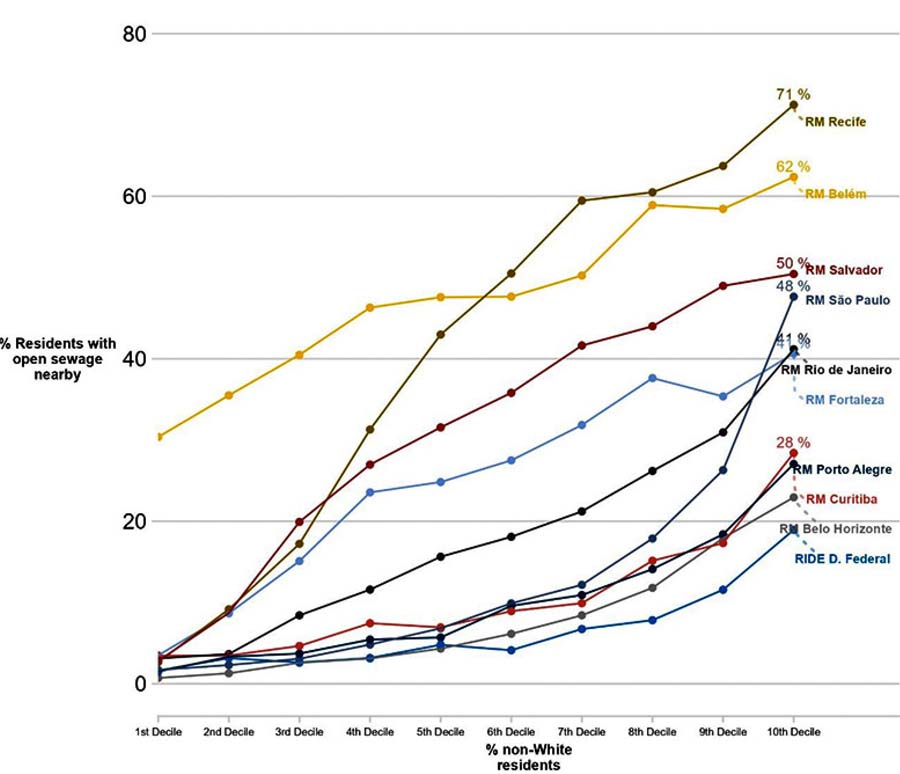 Source: author’s calculations, in 2025, using the 2010 Census and geobr metropolitan boundaries (Ipea).
 Source: author’s calculations, in 2025, using the 2022 Census and geobr metropolitan boundaries (Ipea).
 Source: author’s calculations, in 2025, using the 2022 Census and geobr metropolitan boundaries (Ipea).
 Source: author’s calculations, in 2025, using the 2022 Census and geobr metropolitan boundaries (Ipea).