
 Contested public space: scenarios for street vendors in Juiz de Fora
Abstract
This paper addresses the topic of street vendors in Juiz de Fora, State of Minas Gerais. The investigation arises from recent attempts to ban the activity, transfer it to a popular shopping mall, and implement new regulations. The study adopts an exploratory, qualitative approach aiming to envision future scenarios for street vendors in the municipality’s central region in a democratic way. The methodology adopted to construct the scenarios included a literature review of interventions carried out in other Brazilian cities, followed by interviews with street vendors and representatives of institutions involved in the discussions. Six main scenarios for the spatial organization of street vendors were proposed. They can be made more flexible through a temporal dimension and may be adopted individually or in combination.
Keywords
popular commerce; urbanism; urban planning
Resumo
Este artigo aborda o tema dos camelôs em Juiz de Fora, Minas Gerais. A investigação surge devido às recentes tentativas de proibição da atividade, transferência para um shopping popular e implementação de nova regulamentação. Trata-se de uma pesquisa exploratória e de abordagem qualitativa que tem o objetivo de vislumbrar cenários futuros para os camelôs na região central do município de forma democrática. A metodologia adotada para construção dos cenários contemplou uma etapa de levantamento bibliográfico sobre intervenções ocorridas em outras cidades brasileiras; na etapa seguinte, realizaram-se entrevistas com camelôs e representantes de órgãos envolvidos nas discussões. Ao final, foram propostos seis cenários principais de espacialização dos camelôs, os quais podem ser flexibilizados pela dimensão temporal, adotados individualmente ou combinados entre si.
Palavras-chave
comércio popular; Urbanismo; planejamento urbano
Introduction
According to Sposito (2012), since the Industrial Revolution, new technologies and modes of production have emerged and have influenced broad commercial and urban transformations, especially the capitalist economic mode. With these transformations, new commercial typologies have also emerged, such as department stores, supermarkets and shopping malls, providing new forms of consumption (Vargas, 2018). Nevertheless, Pamplona (2013) considers that, in spite of economic and urban transformations and contemporary capitalist pressure, popular commerce resists in the great centers of Brazil, occupying public spaces and harking back to the oldest modes of exchange.
Popular commerce can be understood as an activity of the tertiary sector mainly practiced on streets, comprising several modalities of urban space occupation. It can be integrated into small shops with low-cost rent, popular malls (Cabral, 2018) and, primarily, carts, stalls, stands, street vendors and tarps with products on the ground (Kitamura, Miranda e Ribeiro Filho, 2007).
Among the modalities of popular commerce, the one chosen for an in-depth approach in this article is that of street vendors (camelôs in Brazilian Portuguese). According to Kitamura, Miranda and Ribeiro Filho (2007), street vendors are fixed traders, since they are not itinerant; their work frequency is daily, occupying tents to sell products. The activity of street vendors tends to generate discussions, as in several occasions it is linked to a universe of illegalities, such as piracy, counterfeiting and contraband, in addition to spatial questions such as the pollution of urban landscapes and the obstruction of sidewalks and vehicle lanes (Goularte, 2008; Moreira, 2008).
From the 1980s onward there occurred, in Brazil, an expansion of street vendors with a certain tolerance from the public sector, which accepted their commercial activities due to the economic crisis and the high unemployment rates in the country (Mamani, 2017). In the beginning of the 2000s, some policies were created to revitalize central areas, repressing the activity of street vendors, who, in many cities, were prohibited from selling on the streets and were relocated to public squares and popular malls (camelódromos) or banned definitely (Mamani, 2017; Moreira, 2008).
In the city of Juiz de Fora, in the state of Minas Gerais, conflicts between street vendors and urban agents emphasized the necessity of interventions in its central region in order to mitigate this issue, as several municipal administrations have been alternating between targeted and high-impact interventions in an attempt to (re)organize street vendors. However, most interventions have occurred without effective results and without the democratic participation of all those involved (Silva, G., 2021).
Considering the recent context of debates on the occupation of public space in the central region by street vendors, as well as its consequences and possible future implications, the following research question is presented: what are the possible scenarios for the street vendors in the central region of the city of Juiz de Fora?
The aim of this article is to envision future scenarios for the activity of the street vendors in the central region of Juiz de Fora. It must be highlighted that this proposition of scenarios takes into account the usual dynamics of urban space, in which it is difficult to anticipate emergent and/or spontaneous, planned or controlled commercial processes. This is a qualitative and exploratory study, as it sought to propose scenarios for the street vendors based on the comprehension of their main characteristics and particularities in the public space.
As methodological approach, the exercise of scenario proposition developed by Moreira (2004) was adopted. The author elaborated possible scenarios for the port region of the city of Rio de Janeiro, functioning as “[...] imaginary hypotheses or propositions” (ibid., p. 22). The scenario proposition method aimed at probing the array of possibilities for the future of street vendors in public space.
To construct the scenarios, measures adopted in some Brazilian cities – as investigated by Lima et al. (2024) – were reviewed. (2024). Furthermore, interviews1 were carried out with two groups: Group 1 – street vendors from the Center of Juiz de Fora; Group 2 – specialists on commerce and cities (Figure 1).

Group 1 contains the identification of the future aspirations of street vendors to continue operating in public spaces. As a way of understanding their demands in relation to facilities and points essential for carrying out their activities, a listing was done of issues frequently raised in the debates and references concerning these workers. Interviews were carried out focusing on their relationships with the public space and their necessities in order to keep operating in the central region. To recruit participants, 48 street vendors operating out of stalls in the Juiz de Fora Center were invited, between May 20 and 23, 2024. In total, 23 street vendors agreed to participate in the interview.
In Group 2, the proposed scenarios were criticized. It was thought that, based on the comments and considerations of the interviewed specialists, new scenarios could emerge. The comments obtained in the interviews were critically analyzed and consisted of observations of positive and negative points raised by the participants regarding the envisioned scenarios, based on their discourses and their different points of view, according to their educational background, professional field and personal ideologies.
Representatives from the Sesmaur and Sindicomércio agencies participated in the Group 2 interviews. Both participants, in addition to representing their institutions, are part of the Permanent Commission on Popular Commerce (Comissão Permanente do Comércio Popular) of Juiz de Fora, which was created by Municipal Law 14,403/2022 (Juiz de Fora, 2022); it is a consultative and deliberative commission that oversees and suggests actions to city hall with regard to popular commerce issues. In addition to the selected agencies, a researcher on commerce and cities, PhD in Architecture and Urbanism and Full Professor in the University of São Paulo (USP), was invited to participate in the interviews. She represented a neutral stance, without connection to or influence on the conflicts between the aforementioned agencies in the city. The ACAAJF was invited to participate but did not provide a representative during the interview period.
To support the interviewing process with Group 2, five scenarios were constructed, which functioned as an initial point for discussions on possibilities for the street vendors of Juiz de Fora: (a) zero intervention; (b) small adjustments to the current situation; (c) street vendors operating in squares; (d) creation of popular malls (camelódromos); (e) prohibition of street vendor activity in public spaces. After the interviews, another scenario emerged, one that had not been proposed thus far: (f) increase of street vendors on the streets.
It is important to emphasize that these proposals were not presented as architectural and urban projects, but rather as texts in the case of some guidelines. These guidelines constitute “possible scenarios,” which may or may not materialize depending on the actions taken, especially by the public administration.
The street vendors in Juiz de Fora
The municipality of Juiz de Fora, Minas Gerais, has a strong bond with commerce in its central area. There are promenades and streets where vehicular traffic is restricted (a factor contributing to pedestrian mobility) as well as commercial arcades connecting the streets, which dynamizes the flow of consumers searching for products and services. The connections between commercial arcades and promenades are named “networked pathways” (passagens em rede) by Braida (2011), since they simultaneously contribute to pedestrian mobility and offer tertiary sector activities.
In central Juiz de Fora, a balance is struck between commercial, habitational, and leisure and service functions, which provides vitality to the region. The commercial function stands out, in particular because the system of arcades and promenades is characterized as an “open-air mall” (ibid.). Unlike other cities, the balance between diverse activities in the Center allows for continuous vitality of use, preventing urban decay and population flight.
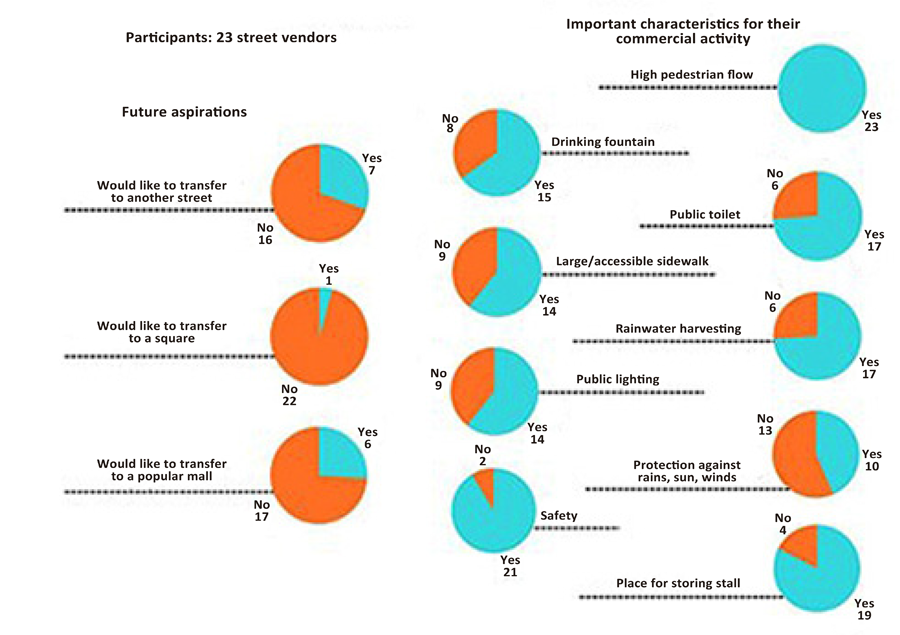
During the interviews with Group 1, the participants responded to public space aspects related to their activities, showing their necessities and expectations (Figure 2). The detailed results were included in the discussions presented below regarding the proposed scenarios, and linked to the comments of the Group 2 participants.

Overall, it can be noted that most participants prefer to stay where they are currently located, in the same spaces they already occupy, while recognizing the need for urban infrastructure to ensure the proper performance of their commercial activities.
Possible scenarios for the street vendors
Scenario proposition consists of an exercise in constructing possibilities for the future of Juiz de Fora’s street vendors based on previously investigated situations in other Brazilian cities (Lima et al., 2024), adding to the specific characteristics of the Juiz de Fora street vendors, which were gathered through interviews with them and contributions from experts and representatives of agencies involved in discussions on the theme.
According to Moreira (2004), scenarios are considered hypotheses or imaginary propositions aimed at contributing to discussions in Architecture and Urbanism, indicating several possibilities for urban interventions, be these scenarios mutually complementary or opposite.
It is important to emphasize that the proposed scenarios assume the perspective that, in Brazil, major urban interventions stem from the public sector, which plays a prominent role in urban planning through regulations, public works and other interventions in public spaces. Therefore, the scenarios are a construction of possibilities of actions directed to street vendors and carried out by the public sector, which are negotiated with the general population.
This exercise addresses the possibilities for urban space enhancement, via democratic and participatory interventions using urban planning, regulatory instruments and incentives aimed at stimulating and diversifying commercial typologies in city centers. The premise of this approach is that the State alone must not concentrate decisions on urban planning, but rather involve all agents in this process, guaranteeing the continuous reinvention of the territory as well (Silva, 2008).
It is worth noting that each scenario has implications for the urban, social and economic spheres. As certain characteristics of the street vendors are restricted or increased, numerous consequences (predictable or not) can occur. These consequences were raised and discussed by the Group 2 participants during the interviews.
Scenario 1: zero intervention
This scenario is related to non-intervention in urban space, admitting a laissez-faire status, a situation where no measures will be taken regarding street vendor activity. It is based on situations that have already occurred in Juiz de Fora during certain municipal administrations, which chose not to propose new regulations, not to remove these traders from the streets and not to provide improvements to the public space, whether for the operations of the street vendors or for spatial requalification.
This scenario is historically related to certain cases of Brazilian municipalities that did not carry out interventions to control the number of street vendors or to implement policies for licensing and regulating spots (Mamani, 2017).
It is assumed that the latest interventions carried out in Juiz de Fora regarding street vendors meet the demands of all agents involved: street vendors, brick-and-mortar shopkeepers, pedestrians and vehicles. Therefore, it is understood that the prohibition of the activities of street vendors on Getúlio Vargas Avenue in November 2021, in addition to the public bidding process for commercial stalls in the central area, distributed in February 2024 following the implementation of the current legislation – Law 14,403/2022, which also provides for the standardization of stalls (Juiz de Fora, 2022) –, are sufficient to ensure the mitigation of conflicts related to street vending activity in the Center.
This scenario allows street vendors to remain operating on the streets, at the commercial spots negotiated among the street vendors, shopkeepers and the public sector during the drafting process of the new legislation of the sector, between 2020 and 2022, ensuring that the vendors remain established in high pedestrian traffic locations near the shopping arcades and promenades of the central region.
Based on the interviews conducted with street vendors, this scenario could cause discontent among regulated stall owners, who were apprehensive of competition from other vendors operating without public authorization and constant supervision.
According to the Sesmaur representative
[...] the implementation of this scenario is not feasible, and it is impossible to occur, since the city is dynamic and in constant change. That is why the Permanent Commission on Popular Commerce was created. It can request, from city hall, changes to the streets and to the distribution of stalls after an agreement is reached between the popular vendors and established vendors. For instance, in the future, the Commission may find it necessary to reduce vehicle parking spaces to create new spots for street vendors.
Contrary to what Sesmaur states, Sindicomércio considers the implementation of this scenario partially possible
[...] since Law 14,403/2022, in spite of not being the best solution, allowed for an organization of the street vendors in the Center compared to the previous years, which had remained without intervention from public administrations and an update of the legislation on popular commerce since 1992.
It is worth noting that despite the discourse employed by Sesmaur – which focused on the constant need for revisions in urban planning –, by emphasizing that the city is undergoing continuous transformations and that the non-adoption of interventions is impossible to materialize, Sindicomércio stresses that the city went 30 years without updates to the legislation on street commerce. This resulted in a period devoid of public sector intervention, whether due to the complexity of the issue, which also involves social questions, or due to a lack of effort and interest in restructuring the activity of street vendors.
The USP researcher considers that:
[...] this scenario is possible as long as an in-depth study is conducted on the public bidding process for street vendors, questioning whether most agents involved are satisfied with the spot distribution, or whether someone feels wronged.
Reflecting on the considerations done by the researcher, it is observed that Sindicomércio is one of the agents taking part in the discussions that does not show total satisfaction, as it states that the legislation implemented in 2022 still was not the best solution for street vending activities in Juiz de Fora; however, it considers that after a long period with no interventions, the instrument improved regarding the Center.
Regarding the position of the interviewed street vendors, this scenario does not allow for a relocation of spots or the distribution of new locations for the stalls. These desires were highlighted by some merchants, who expressed interest in occupying other streets or spots closer to commercial facilities, particularly those who were dissatisfied with the new spots assigned to them by city hall.
It is understood that, despite constant changes in urban public spaces over the years and the resulting demands for modifications and interventions, public administrators may decide not to intervene in a given sector. This choice may stem from a desire to avoid bureaucratic and controversial issues, making a zero-intervention scenario a possibility, even if it is still viewed as a folly by urban planners.
It is also worth mentioning that, in this scenario, two variations in the stance of the municipal public sector on the control and enforcement of street vendors are possible: (a) maintaining oversight (including the use of force, if necessary) to ensure compliance with the current law; and (b) complete inaction regarding this issue, relying instead on the self-organization of the city, which may lead to a disorderly increase of street vendors in the Juiz de Fora Center, who could then begin to appropriate public space without prior negotiation with the various agents.
Scenario 2: small adjustments to the current situation
This scenario envisions proposing small adjustments to the central area to improve vitality and reorganize street vendors. It is understood that, by means of targeted, low-impact interventions, street vendors will not be abruptly disadvantaged, and conflicts will be mitigated simply through small reallocations negotiated with the agents involved. In addition, this scenario includes efforts by the public sector to regularize street vendors who possibly operate without municipal licensing.
This scenario is based on several cases observed in Brazilian cities where the public sector allowed street vendors to occupy central streets, distributing them across strategic points with the intention of avoiding conflicts with store owners, pedestrians and vehicles. Notable examples include the interventions carried out in Campinas/SP and Niterói/RJ during the 1980s and 1990s, which, in addition to organizing commercial spots across various streets, implemented registration and regularization policies for street vendors (Sakai, 2011; Silva, T., 2021).
Historically, according to Ribeiro (2021), an attempt at a small-scale relocation of street vendors was made in central Juiz de Fora in December 2020, during the Covid-19 pandemic; the primary goal was to clear the roads where the stalls were located and transfer them to the sidewalks. This first step initiated the process of discussion and implementation of the new popular commerce law in the city in 2022 (Juiz de Fora, 2022).
Considering the interviews with the street vendors, it must be noted that the implementation of this scenario covers a segment of the vendors who display interest in moving to strategically better spots, which have greater pedestrian traffic and are near other commercial installations such as arcades. On the other hand, the issue of an increased number of vendors on the streets, due to more permits being granted, leads to the same concern found in the previous scenario: the high competition between these merchants and, hypothetically, with the regularized majority.
For the implementation of this scenario, the first step consists of a planned and diversified redistribution of commercial spots. This involves creating new spots for street vendors in high pedestrian flow areas, on streets not yet occupied by this type of commerce, such as Braz Bernardino, Mister Moore, Floriano Peixoto and São Sebastião streets. In return, certain existing vendor spots located near intersections, pedestrian crossings and narrow sidewalks would be removed, allowing for greater pedestrian accessibility and smoother vehicle traffic.
The second step consists of regularizing street vendors operating without a city permit, ensuring they have the necessary documentation and preventing them from bypassing inspections. This creates an attempt at harmony between shopkeepers and street vendors, mitigating disputes and potential unfair competition.
This scenario also allows vendors to keep operating on the streets, but with specific criteria for setting up commercial spots, aiming to ease conflicts with pedestrians, vehicle traffic, and other types of trade and services.
According to the Sindicomércio representative, this scenario is already being implemented, as Law 14,403/2022 allows the Permanent Commission on Popular Commerce to do small adjustments:
When the law was drafted, this possibility of making specific changes without completely altering the law was kept in mind. Given that this process of amending laws involves slow and bureaucratic procedures in our Country, these minor adjustments were created to accommodate the demands that spontaneously arise in the daily routine of street vendors.
The USP researcher also agrees:
[...] this scenario can be implemented because of the unceasing need of the public sector for control and organization of thoroughfares, constantly requiring small adjustments. There is also a routine need for area control, to ensure the places that can receive the vendors and those that cannot spatially host their activities.
The Sesmaur representative highlights that, following the implementation of the new legislation and the bidding process, demands for minor adjustments were raised by the commission and forwarded to city hall. An example of these small changes, which are already taking place after the bidding process, was the need to create 16 new commercial spots in the lower part of Halfeld Street, as well as: minor alterations to the standardized stall model; the possibility of switching spots, provided they are located near those occupied by the same vendor prior to the bidding process; and modifications to the types of permitted products sold at each spot.
The implementation of standardized stalls was a point of agreement between Sesmaur and Sindicomércio; however, the USP researcher highlights that
[...] a certain liberty must be granted to the street vendors, so they can use their creativity in the interventions and characterizations of their equipment, generating stall diversity on the streets, but the normative issues pertaining to safety and manufacturing materials must be always considered.
Making minor adjustments related to the possibility of transferring and creating new commercial spots tends to favor the expectations of street vendors. During the interviews, they showed support for improvements in urban spaces, the creation of new spots and potential transfers to thoroughfares closer to commercial promenades, arcades and facilities. However, the alternative of removing certain spots near corners and pedestrian crossings could generate more conflict, given the potential dissatisfaction of street vendors.
When analyzing the discourses, a consensus emerges that the need for minor adjustments is constant and must be implemented once identified and monitored by the agents involved. In the case of Juiz de Fora, the Permanent Commission on Popular Commerce was organized to this end as well, functioning as a support instrument to the public sector in the adoption of modifications. This scenario proves to be feasible for implementation and is part of the complex “card game” (Santos, 1988) present in the dispute over the occupation of urban public spaces, negotiated among the participating agents. The important fact to be debated is the degree of intervention of these minor adjustments and their ramifications.
Scenario 3: street vendors operating in squares
This scenario seeks to relocate street vendors from the streets to the public squares of the central region. It is based on the premise that these spaces can be repurposed to accommodate commercial spots, ensuring a safe environment for vendor activities while avoiding conflicts with pedestrians and vehicles.
Historically, this scenario is based on interventions carried out in several Brazilian cities, such as Rio de Janeiro during the 1980s, which promoted the removal of street vendors from the streets and their relocation to public squares (Moreira, 2008). In the 1990s, this practice became more widely adopted by urban administrators. In Presidente Prudente/SP, street vendors were relocated from the streets to a public square by the public sector (Ribeiro, 2019), as was the case in Feira de Santana/BA and Manaus/AM, which transferred their street vendors to squares located in their central areas (Silva, T., 2021).
The scenario in question resembles the intervention done by Juiz de Fora’s City Hall in late 2019, which mandated the transfer of street vendors from Getúlio Vargas Avenue to Deputado Clodesmidt Riani Square (Ribeiro, 2021). However, unlike the aforementioned action, this scenario includes the participation of all agents involved in a democratic fashion, ensuring that different aspirations are understood and met, either partially or fully, in accordance with negotiations and the unique characteristics of each square.
Based on national and local historical factors, this scenario envisions a process of studying and transferring vendors to occupy demarcated spots in the following public squares in the central region of Juiz de Fora: Halfeld Park, Antônio Carlos Square, Deputado Clodesmidt Riani Square and Estação Square.
It is important to emphasize that each square of the central region has its own characteristics and peculiarities, leaving it to the public authorities to conduct debates and negotiations with all involved agents to identify the profile of each square, to ensure that the activities and products to be commercialized are compatible with the space and the existing infrastructure.
This scenario envisions improvements in certain spatial aspects of the streets following the removal of street vendors, allowing for better accessibility and greater mobility. On the other hand, it enables street vendors to have access to public toilets and potable water, which will be implemented in the readequation process of the squares. Furthermore, it enables street vendors to set up in spatially safer and more comfortable locations.
According to data gathered from interviews with the street vendors, for the category, this scenario would be unfeasible due to the dissatisfaction of the vendors operating in Clodesmidt Riani and Estação squares, in addition to the fear among those working on the streets of being transferred to these spaces, claiming a lack of pedestrian traffic and adequate infrastructure.
According to the USP researcher, “[...] in Brazil, this relationship between squares and commerce is strong, but caution must be exercised regarding illegalities, such as drug trafficking and smuggling, which can cause a certain insecurity.” The Sindicomércio representative considers that “[...] this scenario would not be possible to implement in the city, because the Center squares cannot accommodate the number of street vendors currently occupying the streets, causing conflicts in the transfer process”.
In agreement with Sindicomércio, Sesmaur considers that this scenario is impossible to implement, as “[...] it would automatically result in an availability of open spaces on the streets for unauthorized informal traders, necessitating an increase in inspection and enforcement activities targeting these traders”.
According to the USP researcher, the occupation of squares by street vendors is justifiable in situations where there is a significant flow of people: “It must occur in an organized manner, without hampering other existing activities, and the stalls can sell products related to the uses of the square surroundings”.
In Sesmaur’s discourse, there is a perceivable urbanistic yearning for the occupation of the squares, bringing more activities and creating new urban dynamics for this public space, but not for the occupation by street vendors, who are already consolidated in the Center streets, especially following the bidding process concluded in February 2024. “The squares can be occupied not by street vendors, but by other categories, such as craft and solidarity economy fairs, through the creation of specific public bidding notices on a seasonal basis”.
Sindicomércio stresses that:
[...] during the discussions for the implementation of Law 14,403/2022, it was noted that the Center squares showed a vocation for temporary activities, such as occasional fairs, which already take place in Parque Halfeld Square and Estação Square on certain days of the week – with only a few street vendors remaining in Deputado Clodesmidt Riani Square due to previous city hall issues.
Complementarily to Sindicomércio’s information, Sesmaur defends that:
[...] the process of removing street vendors from Getúlio Vargas Avenue and transferring them to Deputado Clodesmidt Riani Square was an isolated case, as the avenue concentrates a large number of bus stops, stores, parking lots and a supermarket, and intersects with the main Center thoroughfares, making it unable to accommodate the street vendors. An analysis was done on the case of the street vendors on the avenue, and those who were in a regular and active registration status with city hall were transferred to Batista de Oliveira Street. The others – who were utilizing third-party spots, either because they had purchased them illegally or inherited them from deceased permit holders – were transferred to the closest square to the avenue, Deputado Clodesmidt Riani Square.
Overall, there is an optimistic view among all participants, who favor the initiative of bringing activities to the squares, contributing with more uses and diversity. In her discourse, the USP researcher defends that it is possible to implement the scenario, provided that the squares have infrastructure and foot traffic. However, the representatives from Sesmaur and Sindicomércio suggest that the Center squares are better suited for a different type of popular commerce, opposing the relocation of street vendors from the streets to these areas, showing concern over the potential consequences of irregular popular merchants occupying these streets and the high concentration of street vendors solely in the squares.
In agreement with Sesmaur and Sindicomércio, the interviews with Group 1 participants demonstrate that street vendors are not in favor of occupying the central squares, mainly due to the lack of pedestrian traffic and insecurity. According to them, relocating to the squares would contribute to the decline of their business due to sales difficulties, jeopardizing the livelihoods of their families.
It should be highlighted that the success of integrating street vendors into the squares depends largely on these spaces having vitality and pedestrian traffic, just like the streets. In cases where the square resembles a roundabout or is located in a way that lacks a considerable flow of passersby, the likelihood of street vendors failing to remain there is very high. Another predominant aspect is the perception of safety. Based on the accounts of the street vendors in Juiz de Fora, it is clear that unsafe squares are not attractive locations for them to stay.
Scenario 4: creation of popular malls (camelódromos)
This scenario envisions the creation (or actual construction) of a commercial building with several stalls to house the street vendors from the central region of the city. A site with a considerable area in the central region would be chosen for the construction of the commercial facility.
Historically, this intervention has been the most recurrent in Brazilian cities due to the enactment of decrees that prohibit street vending on central streets and, consequently, the adoption of bidding processes aimed at distributing street vendors into commercial buildings, popularly known as camelódromos and popular shopping malls (Lima et al., 2024).
In other Brazilian cities, these buildings constructed to house street vendors are either the result of public sector initiatives or implemented through public-private partnerships. An example of this was the creation of six popular malls to house the street vendors removed from the streets of Belo Horizonte/MG’s Center, set up in disused historic buildings or vacant lots located in the central region (Vilela, 2006).
In the cases of Cuiabá/MT and Feira de Santana/BA, the public sector transferred street vendors to modest popular shopping malls in the late 1990s and early 2000s. Through the organization of the street vendors, infrastructure improvements were developed in the 2010s, which resulted in the expansion and consolidation of these shopping malls, funded and managed by the association of merchants and stall owners, who are former street vendors (Fonseca, 2021; Queiroz, 2013).
Regarding the context of Juiz de Fora, there were discussions in the past about constructing a building in the central region to house the street vendors who would be removed from the streets. The administrative processes for the construction of the commercial facility intensified in the early 2010s. However, without a partnership with the private sector, the construction process of the popular shopping mall did not proceed (Valente, 2016).
It is worth mentioning that, a few years ago in Juiz de Fora, the formation of commercial spaces was frequently made up of stands or stalls. The former Casas Regente store, on Marechal Deodoro Street, where the current Marechal Shopping gallery was built, housed one of these spaces, occupied not exactly by street vendors, but by shopkeepers and artisans who typically sold popular goods. It was “[...] a large store divided into stalls of small shops, called Free Shopping Marechal” (Dias, 2017, p. 117). Therefore, it cannot exactly be called a camelódromo, but it can be considered a similar structure. Within this same logic, the non-food commerce of the Municipal Market can be mentioned.
Drawing on the cases of other cities and on the attempt at building a popular shopping mall in Juiz de Fora, this scenario assumes that the streets will not be suitable for street vending, with the concentration of vendors in a building with an infrastructure that includes restrooms, water fountains, lighting and adequate ventilation, allowing for better pedestrian and vehicle flow on the streets by clearing roads and sidewalks, and providing greater protection against bad weather and security for this activity.
Thus, in addition to reducing mobility and accessibility conflicts in urban areas, the friction caused by commercial competition between street vendors and shopkeepers can be eased, as vendors will no longer occupy the streets.
It can be noted, according to the interviews conducted with the street vendors, that implementing this scenario would increase conflicts with this category of workers, which tends to remain on the streets, operating illegally even after the ban. In addition, street vendors fear a drop in sales volume when moving from the streets to a commercial building.
According to Sesmaur:
[...] during the discussions surrounding the drafting of Law 14,403/2022, it was observed that there is a future need to consider a popular shopping mall in the central area. Should building this facility be of interest to the commission, there must be a debate on how it will be occupied. Will it be by some street vendors who wish to leave the streets? By people who do not yet work as street vendors? Will there be a new bidding process to occupy the spots that become vacant, if their licensees choose to move to the camelódromo?
The Sindicomércio representative considers that “[...] the construction of a street market complex is the best scenario for the city of Juiz de Fora, enabling a revitalization of the downtown area and making the streets more accessible for pedestrians”. This discourse reinforces the stance of the shopkeepers, who, since 2012, have been eager for the construction of a building to house the street vendors. A sense of city “beautification” is noticeable, which assumes that removing street vendors from the streets would improve its image and eliminate competition with shopkeepers.
With a completely opposing argument, the USP researcher considers this scenario to be ineffective:
[...] when transferring street vendors to these buildings, the workers are faced with paying fees, even if minimal ones, for the monthly use of the stalls, and without a guaranteed flow of pedestrians, there is no success. To attract pedestrian flow, there would need to have events that attract people such as shows and food courts, as is the case with some public markets, with affordable prices and on a regular basis, which is not very common and carries a high cost for these street market malls, camelódromos.
Among these opposing discourses, there is a stance directed toward new, more democratic possibilities, revealing the ideology in the viewpoint of an urban planner, according to Sesmaur:
[...] building a popular shopping mall in the city is interesting from the perspective of having a new commercial facility in the Center; however, banning street vendors from the streets and transferring them to this facility is not viable. During the discussions for implementing the current law, the need to build this popular shopping mall in the future was identified, since the streets alone will not accommodate all of the street vendors, requiring the simultaneous existence of vendors both on the streets and in the popular mall.
Sindicomércio argues that moving street vendors from the streets to a popular mall will provide “[...] comfort to the street vendors, who will be protected from bad weather, improving their physical and emotional health”. On the other hand, there is economic risk, which results in a concern about the high risk of failure for the camelódromos, as has occurred in other Brazilian cities. As is mentioned by the USP researcher, these street vendor malls do not allow for impulse buying, which happens on streets and thoroughfares. Very seldom do people go to a street market mall as their final destination; instead, they buy from street stalls when passing by on their way to somewhere else.
As previously pointed out by the researcher, Sesmaur reinforces the discourse about the difficulty of the mall depending solely on street vendors to operate: “[...] for implementation, it is necessary to consider doing more supporting activities, such as occupying some shops and other uses of different segments of trade and services”.
Considering the discourse of the participants, it is observed that the decision to build a popular shopping mall carries various issues, which are often complex to debate and even to define. Following construction, new demands will emerge, such as the need for constant enforcement to ensure that the streets are not occupied by street vendors again, even if illegally.
The activity of street vendors in commercial buildings raises several concerns for them, as evidenced in the interviews, such as the monthly cost to be covered for occupying these facilities and the risk of a drop in sales due to low customer flow, which would gradually trigger a process of these merchants returning to the streets. An attempt to mitigate operational costs, observed in other Brazilian cities, is the integration of camelódromos into abandoned buildings in central areas and the involvement of public-private partnerships in their management.
It is also necessary to consider issues relating to the possible subleasing or selling (even if illegally) of stalls in the street vendor markets, configuring a form of gentrification. Therefore, especially in this scenario, a close monitoring by the municipal administration is paramount to ensure that only registered and authorized street vendors can carry out their activities in these establishments.
Scenario 5: prohibition of street vendor activity in public spaces
This scenario envisions the prohibition of street vendors on the streets and squares of Juiz de Fora via the implementation of municipal legislation – which seeks the non-occupation of popular commerce stalls in the urban environment –, alongside constant enforcement and monitoring efforts. It is understood that the implementation of this scenario will bring an end to the existing conflicts related to street vendors in public spaces.
Based on other Brazilian cities, the proposed scenario is similar to what occurred in two Brazilian capitals: in Cuiabá, street vendors were removed from the public spaces where they operated in the central area through an urban operation promoted by the public sector in 1995 (Fonseca, 2021); and, in 2003, Belo Horizonte implemented its municipal code of conduct, which prohibited street vending on all streets and squares of the Center, on the assumption that removing this commercial modality from urban areas would bring improvements to mobility and spatial organization (Araújo Filho, 2021).
Historically, no actions by the local government have been found that completely prohibited street vending activities in the city of Juiz de Fora. Perhaps the situation that most closely resembles this scenario is that of the lockdown measures imposed in 2020 due to the Covid-19 pandemic, when, during certain periods, the closure of commercial activities and services classified as non-essential for human survival was decreed, including street vending.
This is a radical scenario envisioning the prohibition of street vending in all public spaces of central Juiz de Fora, assuming that the commercial vocation of this region will be geared toward brick-and-mortar shopkeepers, and that public spaces will not be occupied by street vendors, aiming to clear streets and sidewalks and to organize trade in the central region of the city.
Similar to the previous scenario, based on the interviews conducted with the street vendors, the implementation of this scenario has a high probability of leading these merchants to operate on the streets irregularly, without government authorization and in constant conflict with enforcement agents and other shopkeepers.
The researcher from USP considers that:
[...] the implementation of this scenario is impossible, since wherever there is prohibition there will be transgression. Street vendors are in a movement of survival. If the street vendors are there, it is because people are consuming.
In agreement, Sindicomércio states that “[...] prohibition is not the solution; behind the activity of street vendors, there are social issues, and a policy cannot be radical to that point; it ends up discouraging a productive chain, because people tend to be entrepreneurial”.
Despite the positioning of the researcher and Sindicomércio, who consider prohibition impossible, in its discourse, Sesmaur, although opposed to prohibition, considers it to be even possible in some cases, due to the political will of municipal managers. Yet prohibition does not happen overnight, being a process of constant conflict.
Considering the discourses, it is worth noting that the prohibition of the activity is characterized as a theoretical guideline because, in practice, the need for work, combined with consumer demands, leads people to the streets to sell products, even if irregularly or illegally.
The USP researcher defends that
[...] prohibition is not correct, as it is a flawed attempt by the administration to think that to become a wonderful city, street vending must be prohibited. In our country, there is a market demand for these workers; even if prohibited, they would continue to work, constantly changing locations and evading inspections in search of high pedestrian traffic areas.
The Sesmaur representative further states that this scenario cannot be implemented in the city:
[...] the current law guarantees that street vendors can keep occupying their spots for a minimum period of five years. This instrument was designed to prevent subsequent administrations from making drastic changes to informal trade, guaranteeing the rights of the street vendors covered by the public notice. Furthermore, due to the dynamics of downtown Juiz de Fora, banning the activity is not feasible.
In the interviews conducted with the street vendors, even though the hypothesis of banning the activity on the streets was not raised, given their constant discourse on the need to increase the number of spots and improve street infrastructure, it can be surmised that they would be totally opposed to such a scenario, as they would obviously be the main affected parties.
It is observed that the implementation of this scenario is conditioned on the emergence of other social and economic issues, and to the increase in unauthorized street vendors. Even with the introduction of strict legislation, the activity tends to persist, demanding repressive policies and intense inspection from public authorities. Perhaps because of all these factors, prohibition has not been the primary tool adopted by urban planners today.
Scenario 6: increase of vendors on the streets
This scenario, which was not presented to the Group 2 interviewees because it emerged after the interviews were conducted, assumes a significant expansion of popular commerce in the Juiz de Fora Center, considerably increasing the number of spots officially authorized by city hall. It is considered, in this case, that the Center is capable of absorbing a much larger quantity of street vendors than currently allocated.
This scenario recognizes the high demand among citizens to obtain a city hall license to market their products in stalls allocated throughout the central area. It brings to light the question of how public bidding processes should occur, given that past registration processes for street vendors demonstrated that the less qualified a person is and the lower their income, the more eligible they are to work on the street. This reproduces the cycle of prejudice against street vendors. However, without these criteria, there is a risk that other professionals or business owners would claim these spots and compete with informal traders.
In relation to the street vendors interviewed, this scenario would be partially accepted by the category, because it would be beneficial if there was an increase in the number of spots and the government allowed the choice/exchange of commercial points for the street vendors already selected by the public tender notice. On the other hand, the significant increase in the number of street vendors could cause increased competition among street vendors, generating new conflicts between the category.
It should be taken into account that this scenario tends to increase the conflict between street vendors and shopkeepers, who recurrently show a desire to expel street vendors from the streets. It should also be considered that, from the point of view of urban quality, there is a need to have a balanced ecosystem, with an adequate mix of street vendors and stores. Therefore, it appears that this scenario can be implemented, but it requires an in-depth technical study to verify what its true impacts will be, both to the landscape and to the dynamics of commerce as a whole.
Other scenarios
As a way to stimulate the reflection of the participants of Group 2 and generate more answers to the research question of this study, at the end of the interviews, the participants were encouraged to envision new scenarios, in order to complement and expand the possibilities for their activity in the urban space of the city.
According the USP researcher:
[...] another scenario could include mixed situations, such as the choice of streets to receive street vendors on weekends, outside the opening hours of the stores. The same can be done in relation to the squares, thus creating new points for more street vendors to work on weekends, while the others continue to work during business hours. When taking the stalls to the streets that are closed after a certain time, one can consider occupying stalls with various types of marketed products, such as food and handicrafts, for example.
In the context of the city of Juiz de Fora, the activity of street vendors on the streets of the Center outside business hours may not be so successful, since, despite housing residential buildings, the flow of people drops sharply on weekdays at night. On weekends, the flow of people is even lower, making it difficult or unfeasible to implement the proposal.
Sindicomércio states that, in the current perspective of the city “[...] it does not envisage other scenarios, except the scenario of construction of a popular shopping mall, as previously said, the most viable proposal for a revitalization of the Center”.
The proposition of combined scenarios, simultaneously, was found in some discourses, as observed by Sesmaur in the possibility of the existence of a popular mall, maintaining the activity of street vendors also in the streets, or by the coexistence of street vendors in the streets and squares, as envisioned by the USP researcher. These situations tend to make the occupation of popular commerce in the Center more dynamic, but they may bring new questions from other agents involved, such as Sindicomércio, which was contrary to the agglomeration of street vendors in public spaces, fearing the densification of activity in the central region.
The Sesmaur representative considers that, in relation to the popular trade in the central region, “[...] there is still a long way to go, the debates should include the distribution of fixed points and seasonal points, creative economy fairs, in order to make commerce in the Center more dynamic and attractive to consumers”.
The discourses allow us to identify that, during this complex scenario proposition exercise, there is a game of forces and interests, political and cultural aspects involved. As a result of this, in the extensive urban planning agenda, oppositions and agreements will arise, in addition to measures favoring a certain portion of urban agents and privileging others, until a common denominator is reached, in a democratic way, that is optimal for all sectors involved, reaching a supposed (utopian) balance.
It should be said that the scenarios were instituted based on the “space” dimension so precious to the field of Architecture and Urbanism; however, the discussions also pointed to the proposition of scenarios that considered the "time" dimension, which cannot be overlooked. Thus, the time dimension can be incorporated as a variable to relativize some proposed scenarios, such as the institution of seasonal permits and/or prohibitions. In this case, in scenario 5, the ban on street vendors in public spaces could be permanent or temporary (seasonal).
Chart 1 presents a summary of the possible scenarios for street vendors in central areas of cities:
It can be observed that Table 1 presents a universe of possibilities for the spatio-temporal insertions of street vendors in cities. Although the entire study focused on the city of Juiz de Fora, the table is abstract enough to allow its application to other contexts, provided, obviously, that the realities of street commerce in different cities are respected.
Final considerations
Among the categories of popular commerce, the subject of street vendors is a constant in discussions about urban planning and the revitalization of public spaces in Brazilian cities. This reveals that these merchants are active participants in the dynamics of urban centers, which involves complex economic and social issues, and contributes to product distribution and economic activity.
Regarding the street vendors of Juiz de Fora, interventions have intensified mainly over the last four years, with actions to ban street vending on Getúlio Vargas Avenue, the relocation to Deputado Clodesmidt Riani Square, protests by street vendors, and the drafting of legislation on popular commerce published in 2022 (Juiz de Fora, 2022), culminating in a new public bidding process for the distribution of existing street vending spots.
Six main scenarios for the spatialization of street vendors were proposed, which can be flexibilized by the temporal dimension and adopted individually or combined with one another. In each of them, considerations regarding potential impacts on the city were presented; however, there was no attempt to find “the best solution”, because it varies according to the viewpoint (or interests) of a given group or urban development agent. Furthermore, it can be stated that there is no single solution, as, given the dynamics of trade in the central area, the combination of various scenarios presents itself as an alternative for diversifying the distribution of street vendors in the central area. It is believed that the mediation of the public sector in the proposition, in a negotiated and democratic manner, of different combined scenarios can be a strategy capable of dissipating major conflicts and finding an optimal solution for the collective good, especially with the active participation of street vendors in discussions and decision-making, as they are the main affected agents.
Regarding the path toward implementing legislation, interventions and urban operations related to street vending activity, the adoption of characteristics of participatory public management is recommended. This approach consists of creating committees and working groups to analyze situations and give a voice to all agents involved, aiming for decisions that will alleviate conflicts and collectively build a democratic urban space.
In relation to the breadth of the research topic and the consolidation of many popular commerce modalities in Brazilian cities due to cultural, social and economic aspects, the scenarios proposed for the street vendors of central Juiz de Fora can be widely adopted by other municipalities, bearing in mind their respective scales and particularities, thus broadening the discussions on the possibilities of maintaining street vending activity in Brazilian public space.
While, on the one hand, these limitations could be interpreted as weak spots, such as the non-participation of other municipal secretariats and public space agents in the interviews, on the other hand, they constitute gaps that could serve as precursors to future research. It is understood that, in the process of constructing the scenarios, it is also possible to incorporate further discourses from other agents involved in street vending activities, such as other municipal departments, the city council, pedestrians, consumers, drivers and Center residents. It is also worth mentioning that the situation of street vendors, and of popular commerce in general, is complex and demands to be treated in a multidisciplinary manner, rather than solely from an architectural and urban planning perspective.
References
-
ARAÚJO FILHO, T. P. (2021). Viver na tora: trabalho ambulante e estratégias de vida nas encruzilhadas da gestão contemporânea do comércio popular. Tese de doutorado. São Carlos, Universidade Federal de São Carlos. Disponível em: https://repositorio.ufscar.br/bitstream/handle/ufscar/15420/TESE%20COMPLETA%20-%20VERS%c3%83O%20DEFINITIVA%20-%2028-12-21%20-%20FINAL.pdf?sequence=1&isAllowed=y Acesso em: 28 jan 2024.
» https://repositorio.ufscar.br/bitstream/handle/ufscar/15420/TESE%20COMPLETA%20-%20VERS%c3%83O%20DEFINITIVA%20-%2028-12-21%20-%20FINAL.pdf?sequence=1&isAllowed=y - BRAIDA, F. (2011). Passagens em rede: a dinâmica das galerias comerciais e dos calçadões nos centros de Juiz de Fora e Buenos Aires Juiz de Fora, UFJF.
-
CABRAL, M. P. (2018). Território urbano em disputa: as transformações no centro de Porto Alegre como resultado de disputa de múltiplos agentes urbanos no período de 2005 a 2017. Dissertação de mestrado. Porto Alegre, Universidade Federal do Rio Grande do Sul. Disponível em: https://lume.ufrgs.br/bitstream/handle/10183/188389/001086148.pdf?sequence=1&isAllowed=y Acesso em: 20 ago 2022.
» https://lume.ufrgs.br/bitstream/handle/10183/188389/001086148.pdf?sequence=1&isAllowed=y -
DIAS, F. (2017). As galerias comerciais em Juiz de Fora após os anos 2000: demandas, agentes e projetos. Dissertação de mestrado. Juiz de Fora, Universidade Federal de Juiz de Fora. Disponível em: https://repositorio.ufjf.br/jspui/bitstream/ufjf/5925/1/fabriciosouzadias.pdf Acesso em: 17 abr 2023.
» https://repositorio.ufjf.br/jspui/bitstream/ufjf/5925/1/fabriciosouzadias.pdf -
FONSECA. C. R. (2021). De camelô a empreendedor: os "lojistas" do shopping popular de Cuiabá. Tese de doutorado. São Carlos, Universidade Federal de São Carlos. Disponível em: https://repositorio.ufscar.br/bitstream/handle/ufscar/14342/Tese%20Final_Christiany%20Regina%20Fonseca%20reposito%cc%81rio.pdf?sequence=1&isAllowed=y Acesso em: 2 maio 2024.
» https://repositorio.ufscar.br/bitstream/handle/ufscar/14342/Tese%20Final_Christiany%20Regina%20Fonseca%20reposito%cc%81rio.pdf?sequence=1&isAllowed=y -
GOULARTE, C. C. (2008). Cotidiano, identidade e memória: narrativas de camelôs em Pelotas (RS). Dissertação de mestrado. Pelotas, Universidade Federal de Pelotas. Disponível em: https://wp.ufpel.edu.br/ppgs/files/2014/06/claudia_goularte_dissertacao.pdf Acesso em: 22 set 2022.
» https://wp.ufpel.edu.br/ppgs/files/2014/06/claudia_goularte_dissertacao.pdf -
JUIZ DE FORA (2022). Decreto n. 15.253 de 25 de maio. Regulamenta a Lei n. 14.403, de 28 de abril de 2022, que dispõe sobre o exercício do comércio popular nos espaços públicos do Município de Juiz de Fora. Disponível em: https://jflegis.pjf.mg.gov.br/norma.php?chave=0000049932 Acesso em: 26 out 2023.
» https://jflegis.pjf.mg.gov.br/norma.php?chave=0000049932 -
KITAMURA, C. K.; MIRANDA, M.; RIBEIRO FILHO, V. (2007). O comércio e serviços ambulantes: uma discussão. Caminhos de Geografia. Uberlândia, v. 8, n. 23, pp. 20-26. Disponível em: https://seer.ufu.br/index.php/caminhosdegeografia/article/view/15656/8855 Acesso em: 30 set 2022.
» https://seer.ufu.br/index.php/caminhosdegeografia/article/view/15656/8855 -
LIMA, P. C.; NASCIMENTO, V. C.; COCATE, I. P.; BRAIDA, F. (2024). O comércio popular nas cidades brasileiras. Vernácula - Territórios Contemporâneos, v. 2, n. 7, pp. 66-79. Disponível em: https://www.periodicos.univag.com.br/index.php/Vernacula/article/view/2585 Acesso em: 28 ago 2024.
» https://www.periodicos.univag.com.br/index.php/Vernacula/article/view/2585 -
MAMANI, H. A. (2017). Conflito urbano e comércio informal: quadros da repressão e da tolerância aos camelôs na cidade do Rio de Janeiro (1983-2009). Dilemas - Revista de Estudos de Conflito e Controle Social, v. 10, n. 3, pp. 523-551. Disponível em: https://revistas.ufrj.br/index.php/dilemas/article/view/14562 Acesso em: 5 set 2022.
» https://revistas.ufrj.br/index.php/dilemas/article/view/14562 -
MOREIRA, A. (2008). Mercados populares ou camelódromos: nascimento e variações de um objeto arquitetônico. In: COLÓQUIO INTERNACIONAL SOBRE COMÉRCIO E CIDADE: Uma Relação de Origem, 2. Anais ... São Paulo. Disponível em: http://www.labcom.fau.usp.br/wpcontent/uploads/2015/05/2_cincci/4002%20Moreira.pdf Acesso em: 29 set 2022.
» http://www.labcom.fau.usp.br/wpcontent/uploads/2015/05/2_cincci/4002%20Moreira.pdf - MOREIRA, C. da C. (2004). A cidade contemporânea entre a tabula rasa e a preservação: cenários para o porto do Rio de Janeiro São Paulo, Unesp.
-
PAMPLONA, J. B. (2013). Mercado de trabalho, informalidade e comércio ambulante em São Paulo. Revista Brasileira de Estudos de População. Rio de Janeiro, v. 30, n. 1, pp. 225-249. Disponível em: https://rebep.org.br/revista/article/view/23/pdf_19 Acesso em: 29 abr 2023.
» https://rebep.org.br/revista/article/view/23/pdf_19 -
QUEIROZ, A. M. V. de L. (2013). Da rua para o Shopping Feiraguay: desenho urbano e memória visual do comércio popular em Feira de Santana, BA (1970-2012). Dissertação de mestrado. Feira de Santana, Universidade Estadual de Feira de Santana. Disponível em: http://tede2.uefs.br:8080/bitstream/tede/92/2/Vers%c3%a3o%20revisada%20Amanda.pdf Acesso em: 30 abr 2024.
» http://tede2.uefs.br:8080/bitstream/tede/92/2/Vers%c3%a3o%20revisada%20Amanda.pdf -
RIBEIRO, G. B. (2019). Circuitos da economia urbana em cidades médias: os camelódromos de Presidente Prudente (SP) e Londrina (PR). Dissertação de mestrado. Presidente Prudente, Universidade Estadual Paulista. Disponível em: https://repositorio.unesp.br/server/api/core/bitstreams/4d2c7e97-1e81-4bb5-a1e3-b9786b75f792/content Acesso em: 24 fev 2024.
» https://repositorio.unesp.br/server/api/core/bitstreams/4d2c7e97-1e81-4bb5-a1e3-b9786b75f792/content -
RIBEIRO, R. (2021). PJF irá transferir ambulantes da Getúlio Vargas para a Praça do Riachuelo. Disponível em: https://tribunademinas.com.br/noticias/cidade/05-11-2021/pjf-anuncia-mudancas-no-trafego-do-centro-para-a-inauguracao-do-viaduto-helio-fadel.html Acesso em: 22 ago 2022.
» https://tribunademinas.com.br/noticias/cidade/05-11-2021/pjf-anuncia-mudancas-no-trafego-do-centro-para-a-inauguracao-do-viaduto-helio-fadel.html -
SAKAI, R. Y. (2011). A ocupação da área central pelo comércio ambulante: negociações e produção do espaço urbano. Dissertação de mestrado. São Carlos, Universidade de São Paulo. Disponível em: https://teses.usp.br/teses/disponiveis/18/18142/tde-27082012-163631/publico/Dissertacaorobertasakai.pdf Acesso em: 8 abr 2024.
» https://teses.usp.br/teses/disponiveis/18/18142/tde-27082012-163631/publico/Dissertacaorobertasakai.pdf - SANTOS, C. N. F. dos (1988). A cidade como um jogo de cartas São Paulo, Projeto Editores.
-
SILVA, G. (2021). Situação dos ambulantes permanece sem solução em Juiz de Fora. Disponível em: https://tribunademinas.com.br/noticias/cidade/18-07-2021/situacao-dos-ambulantes-permanece-sem-solucao-em-juiz-de-fora.html Acesso em: 22 ago 2022.
» https://tribunademinas.com.br/noticias/cidade/18-07-2021/situacao-dos-ambulantes-permanece-sem-solucao-em-juiz-de-fora.html -
SILVA, L. T. (2008). Comércio ambulante: planejar e acontecer. O que realmente acontece? In: COLÓQUIO INTERNACIONAL SOBRE COMÉRCIO E CIDADE: Uma Relação de Origem, 2. Anais... São Paulo. Disponível em: http://www.labcom.fau.usp.br/wp-content/uploads/2015/05/2_cincci/3016%20Tabachi.pdf Acesso em: 14 out 2022.
» http://www.labcom.fau.usp.br/wp-content/uploads/2015/05/2_cincci/3016%20Tabachi.pdf - SILVA, T. J. A. da (2021). Metamorfose ambulante: o discurso empreendedor do comércio ambulante em Niterói. In: ENCONTRO NACIONAL DE ANTROPOLOGIA DO DIREITO, 7. Anais... São Paulo.
- SPOSITO, M. E. B. (2012). Capitalismo e urbanização São Paulo, Contexto.
-
VALENTE, E. (2016). PJF desiste de shopping popular. Disponível em: https://tribunademinas.com.br/noticias/politica/26-04-2016/pjf-desiste-de-shopping-popular.html Acesso em: 20 ago 2022.
» https://tribunademinas.com.br/noticias/politica/26-04-2016/pjf-desiste-de-shopping-popular.html - VARGAS, H. C. (2018). Espaço terciário: o lugar, a arquitetura e a imagem do comércio Barueri, Manole.
-
VILELA, N. M. (2006). Hipercentro de Belo Horizonte: movimentos e transformações espaciais recentes. Dissertação de mestrado. Belo Horizonte, Universidade Federal de Minas Gerais. Disponível em: https://repositorio.ufmg.br/handle/1843/MPBB-6XRKL9 Acesso em: 4 jul 2022.
» https://repositorio.ufmg.br/handle/1843/MPBB-6XRKL9
Note
Edited by
-
Editors:
Lucia BógusLuiz César de Queiroz Ribeiro
The dataset supporting the results of this study is not publicly available.

 Source: the authors, in 2024.
 Source: the authors, in 2024.