 Critical period of smooth pigweed control in soybean
ABSTRACT:
Species from the genre Amaranthus represent the main weeds present in Brazilian agricultural areas. Amaranthus hybridus (smooth pigweed) is distinguished by its ecophysiological characteristics and the presence of resistant biotypes to the ALS and EPSPs inhibiting herbicides. Crop-weed competition is one of the major constraints to grain yield. To avoid decreases in production, crop-weed competition studies are developed to determine the critical periods of interference, aiming to define the best time for weed control. The aim of this study is to determine the critical periods of A. hybridus control in soybeans and their effects on grain yield. Therefore, two experiments were carried out during the 2020/21 and 2021/22 growing seasons in an area infested naturally by A. hybridus. The treatments consisted of various coexistence periods between soybean and A. hybridus. The experimental designs were randomized block designs arranged in a factorial scheme; the first factor was the presence or absence of the weed, and the second factor was the coexistence period from 0 to 60 DAE (0, 10, 20, 30, 40, 50 and 60 DAE). The presence of A. hybridus at soybean emergence caused a 35.47% decrease in grain yield in the 2020/21 growing season and 25.26% in 2021/22. The critical control periods were determined based on the data adjusted to fit the four-parameter logistic regression model. Thus, the CWFP occurs at 7 to 56 DAE of soybean, the CTWR goes from 0 to 7 DAE, and the CPWC continues from 0 to 56 DAE of the crop.
Key words:
Amaranthus hybridus (L.); Glycine max (L.) Merril; coexistence periods; crop-weed competition; interference.
RESUMO:
As espécies do gênero Amaranthus estão entre as principais plantas daninhas que infestam áreas agrícolas brasileiras. O Amaranthus hybridus se destaca por suas características ecofisiológicas e pela presença de biótipos resistentes aos herbicidas inibidores das enzimas ALS e EPSPs. A competição entre plantas daninhas e culturas é um dos principais entraves no rendimento de grãos. A fim de evitar estas perdas de rendimento, são desenvolvidos estudos de competição entre plantas daninhas e culturas, os quais determinam os períodos críticos de interferência que visam definir o melhor momento para o controle de plantas daninhas. O objetivo deste estudo foi determinar os períodos críticos de controle para caruru-roxo em soja e seus efeitos na produtividade de grãos. Para tanto, foram desenvolvidos dois experimentos nas safra 2020/21 e 2021/22 em área naturalmente infestada por A. hybridus. Os tratamentos consistiram em períodos de convivência entre a soja e A. hybridus. Os experimentos foram desenvolvidos em delineamento de blocos ao acaso com arranjo fatorial, em que o primeiro fator foi a presença ou a ausência da planta daninha, e o segundo fator foram os períodos de convivência dos 0 aos 60 DAE (0, 10, 20, 30, 40, 50 e 60 DAE). A presença de A. hybridus desde a emergência da cultura causou a redução de 35,47% no rendimento de grãos na safra 2020/21, e de 25,26% na safra 2021/22. Com base no ajuste dos dados no modelo de regressão de quatro parâmetros foram determinados os períodos críticos de controle, sendo que o PCPI ocorre dos 7 aos 56 DAE da cultura; o PAI perdura dos 0 aos 7 DAE, e o PTPI se estende dos 0 aos 56 DAE da soja.
Palavras-chave:
Amaranthus hybridus (L.); Glycinemax (L.) Merril; períodos de convivência; matocompetição; interferência.
INTRODUCTION
In Brazilian soybean-producing regions, species from the genus Amaranthus are among the most problematic weeds (ZANDONÁ et al., 2022). Commonly known as pigweeds, these species are characterized by rapid initial growth, high seed production and viability, and uneven germination, leading to continuous seedling emergence throughout the crop cycle (NETTO et al., 2016). Among the Amaranthus species widely distributed in Brazil, Amaranthus hybridus (smooth pigweed) is the most relevant, with biotypes exhibiting multiple resistance to acetolactate synthase (ALS) and 5-enolpyruvylshikimate-3-phosphate (EPSP) synthase inhibitor herbicides (HEAP, 2024). The combination of herbicide-resistant biotypes and the species’ ecophysiological traits makes A. Hybridus particularly difficult to control, increasing the likelihood of competition and coexistence with soybean.
Weed competition is one of the major challenges affecting crop yield (CORREIA, 2023). The extent of this competition depends on factors such as the weed species present, population density, growth stage, and duration of coexistence with the crop, as well as edaphoclimatic conditions (VITORINO et al., 2017). The intensity and duration of weed interference directly influence yield losses, which can reach up to 90% in soybean if no control measures are implemented (ALMARIE, 2017).
However, during the early growth stages, soybean can tolerate weed presence without significant yield losses. This phase is known as the critical time for weed removal (CTWR) (RIZZARDI et al., 2020), in which environmental resources can sustain both crop and weed development. In contrast, during the critical period for weed control (CPWC), weed interference must be minimized to prevent yield reductions. At the end of the total period of weed interference (TPWI), the crop gains competitive advantage and can suppress emerging weeds without significant yield impact (KNEZEVIC & DATTA, 2015). The interval between CTWR and CPWC is referred to as the critical weed-free period (CWFP), during which effective weed management is essential to prevent irreversible yield losses (KNEZEVIC & DATTA, 2015). Since yield losses may already occur during CWFP, weed control strategies should be implemented as close as possible to CTWR (AGOSTINETTO et al., 2020).
Studies on weed interference aim to define critical periods for weed control, ensuring optimal crop management and preventing yield reductions (FURTADO et al., 2012; RONCATTO et al., 2023). Given the competitive nature and widespread occurrence of A. Hybridus in soybean fields, understanding its interference dynamics is crucial for improving control strategies. Therefore, this study determined the critical periods for A. hybridus control in soybean crops and assess their effects on grain yield.
MATERIALS AND METHODS
Two field experiments were conducted during the 2020/21 and 2021/22 growing seasons to determine the critical periods of Amaranthus hybridus (smooth pigweed) control in soybean (Glycine max). The trials were carried out in a field naturally infested with A. hybridus located in Passo Fundo, RS, Brazil (28˚2’31” S, 52˚34’49” W; 695 m a.s.l.).
The experimental design was a randomized complete block with four replications. Treatments consisted of different soybean-weed coexistence periods (0, 10, 20, 30, 40, 50, and 60 days after soybean emergence [DAE]) to determine the period before interference (PBI). Corresponding weed-free treatments for the same periods (0 to 60 DAE) were included to determine the total period of interference prevention (TPIP).
To ensure uniform emergence and consistent interference across plots, A. Hybridus was artificially sown at a density of approximately 200 seeds m-², seven days prior to each coexistence period. This procedure; although, differing from natural emergence dynamics, allowed for controlled experimental conditions and reproducibility, and is a common approach in weed interference studies. Weed density at the end of the coexistence period was determined by counting individuals within a 0.5 m² quadrat (0.25 m × 0.25 m) per plot.
Soybean was sown on October 30, 2020, in the first season using cultivar SYN 1059RR (maturity group 5.9), and on November 11, 2021, in the second season with cultivar BRS 5804RR (maturity group 5.8). Both are early-maturing cultivars with high yield potential. The preceding crop was black oat (Avenastrigosa). Sowing was performed in no-till systems, at 0.45 m row spacing, and at a rate of 14 seeds per meter. Each plot measured 5 m × 4 m, with a central area of 1.5 m (two rows) used for final yield evaluation. Fertilization and pest management followed regional technical recommendations (MARTIN et al., 2022). All other weeds were manually removed weekly throughout the growing season.
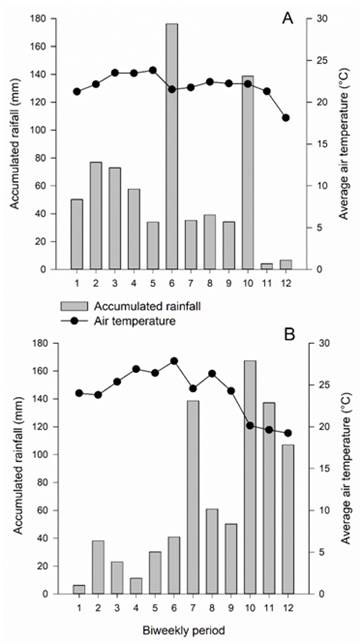
The evaluated variables included A. hybridus aboveground biomass, plant height, number of pods per plant, number of grains per pod, and grain yield. Aboveground biomass of A. hybridus was determined by harvesting all plants within a 0.5 m² quadrat per plot at the end of the coexistence period, followed by drying at 65 °C for 72 hours. Plant height was measured at the R3 stage, from the soil surface to the inflorescence tip in A. hybridus and to the last node bearing a fully developed trifoliate leaf in soybean. The number of pods per plant was obtained by counting the pods of 10 randomly selected soybean plants per plot at the R6 stage, and the number of grains per pod was assessed using the same plants. Grain yield was estimated by harvesting two central rows (1.5 m in total length) per plot and adjusting the grain moisture to 13%. Weather conditions during the crop cycle in each season are presented in figure 1.
Accumulated rainfall (mm) and air temperature (°C) daily average in the 2020/2021 (A) and 2021/2022 (B) harvests. (1)Accumulated rainfall and average air temperature data were grouped by fortnight during the period during which the experiments were carried out. In this way, Figure A alluding to the 2020/21 harvest shows the period from 11/01/2020 to 04/30/2021. Figure B, referring to the 2021/2022 harvest, shows the period from 11/01/2021 to 04/30/2022. The fortnights are represented by the numbers 1 to 12 in the Figures, with “1” referring to the period from 11/01/2020 to 11/15/2020, “2” to the period from 11/16/2020 to 11/30/2020 and so on. Source: Adapted from INMET, 2022.
Data were subjected to analysis of variance (ANOVA), and means were compared using the Tukey-test (P ≤ 0.05). Normality of residuals was assessed by the Shapiro-Wilk test, and homogeneity of variance was verified using Bartlett’s test using software R. When appropriate, data were fitted to a four-parameter logistic regression model (Equation 1) to estimate the critical time for weed removal (CTWR) and the critical period for weed control (CPWC), based on yield loss thresholds of 2.5%, 5%, and 10%, relative to the weed-free control (KNEZEVIC & DATTA, 2015). The critical weed-free period (CWFP) was calculated as the difference between CPWC and CTWR.
Equation 1:
where y is the predicted grain yield (kg ha-¹); y₀ is the minimum yield under weed interference; a is the difference between maximum yield (weed-free) and minimum yield (weedy); x is the time in DAE; x₀ is the time at which yield is reduced by 50%; and b is the slope of the curve.
RESULTS AND DISCUSSION
The number of pods per plant was higher in the absence of A. hybridus, with an average of 21 pods per plant (Table 1). In contrast, when the weed was present, the average decreased to 18 pods per plant. A 45% to 50% reduction in the number of pods per soybean plant was observed as the Amaranthus hybridus population increased (ZANDONÁ et al., 2022). However, the number of grains per pod did not significantly differ between the coexistence periods with and without A. hybridus (Table 1).
Soybean density ranged from 15 to 17 plants per meter, indicating that the coexistence periods did not interfere with crop establishment (Table 2). However, soybean plants exhibited greater height in the presence of A. hybridus compared to when the weed was absent. This response is likely due to competition for light, which prompts crops to grow taller to enhance light capture one of the first symptoms of plant competition (VITORINO et al., 2017).
Amaranthus hybridus plants were taller when competing with soybean from the start of crop establishment (Table 3). Weed dry mass was highest during the 0 and 30 DAE coexistence periods, with values ranging from 32.1 to 50.5 g. At 40 DAE, dry mass accumulation was similar in both weed-free and infested conditions. However, at 50 and 60 DAE, dry mass accumulation was greater in the weed-free environment than in the presence of A. hybridus. This pattern was expected, as early coexistence periods allowed more time for A. hybridus to develop and accumulate biomass. The accumulated dry mass of a plant is a direct result of available environmental resources. Plants that accumulate more dry mass exert stronger competition for resources, thereby suppressing the growth and development of neighboring plants (AGOSTINETTO et al., 2020).
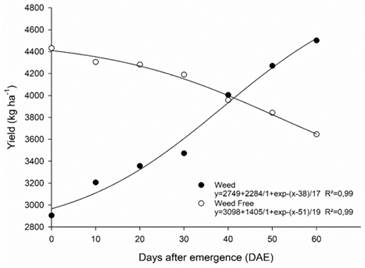
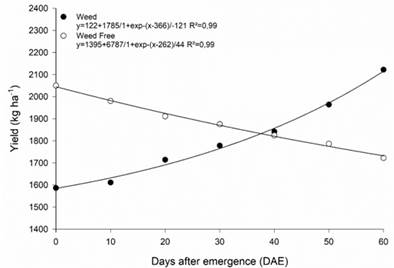
Grain yield was significantly affected by smooth pigweed competition in both growing seasons (Table 4). In 2020/21, yield was higher at 0 and 20 DAE in the weed-free treatments compared to those with weed presence. Similarly, in 2021/22, higher yields were recorded at 0 and 10 DAE in the absence of A. hybridus. Notably, weed absence from 60 DAE onward led to a yield decrease compared to treatments with weed presence in the same period. The calculated yield values for 2020/21 were 4502 kg ha-¹ (weed-free) and 3646 kg ha-¹ (with weed). In the 2021/22 season, yields were 2122 kg ha-¹ (weed-free) and 1722 kg ha-¹ (with weed). Throughout the 0 to 60 DAE coexistence period, a gradual increase in yield loss was observed as competition duration extended, supporting the principle that prolonged weed interference intensifies competition stress on crops (AGOSTINETTO et al., 2020). Early crop cycles may tolerate weed interactions with minimal yield impact, but competition intensifies as the season progresses (RIZZARDI et al., 2020).
The overall yield reductions were more pronounced in the 2021/22 season compared to 2020/21, likely due to the drought that affected Southern Brazil during that period (Figure 1). Differences in soybean yield across coexistence periods were more significant in 2020/21, with a 35.5% reduction in yield when smooth pigweed was present from 0 DAE compared to 60 DAE. In 2021/22, the reduction was 25.6% for the same period. Previous studies found that competition between Amaranthus rudis and soybean for ten weeks post-unifoliate leaf expansion resulted in a 43% yield decrease (HAGER et al., 2002). Additionally, one A.hybridus plant per square meter can reduce soybean yield by 4.5% to 8.3% (ZANDONÁ et al., 2022). Early establishment of Amaranthus palmeri (0-2 weeks after soybean emergence) can reduce yield by 24% compared to late establishment (8 weeks after emergence) (KORRES et al., 2019).
The effects of soybean-Amaranthus hybridus coexistence periods in 2020/21 are illustrated in figure 2. Removing A. Hybridus after approximately 40 DAE does not mitigate the damage caused by early interference. This reinforces the importance of timely weed control to avoid irreversible yield loss. Crop-weed competition results in irreversible yield losses, emphasizing the importance of early control (AGOSTINETTO et al., 2020). The earlier the weed establishes, the greater its impact on yield (KORRES et al., 2019).
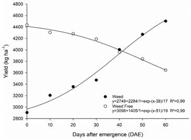
Effect of the coexistence periods in the presence and absence of Amaranthus hybridus on soybean yield in the 2020/21 growing season (cultivar Syn 1059RR).
The 2021/22 season, severely affected by drought (Figure 1), exhibited different competition dynamics. Figure 3 shows that, in contrast to the previous season, regression curves intersect slightly before 40 DAE, suggesting that water stress intensified the effects of early competition under drought conditions. As a result, the critical weed-free period (CWFP) started earlier and lasted longer.
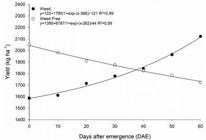
Effect of the coexistence periods in the presence and absence of Amaranthus hybridus on soybean yield in the 2021/22 growing season (cultivar BRS 5804RR).
Table 5 presents the four-parameter logistic regression model parameters for soybean-Amaranthus hybridus coexistence periods. The model fit the data well in both seasons (R2 = 0.99); however, statistical significance (P ≤ 0.05) was observed only in 2020/21. Using regression models, the critical periods for A. Hybridus control were determined for yield loss thresholds of 2.5%, 5%, and 10% (Table 6). These thresholds were chosen as they represent acceptable yield losses; although, adjustments may be made based on weed control costs and financial gains (KNEZEVIC & DATTA, 2015).
Parameters of the four-parameter logistic regression equation to the presence and absence of Amaranthus hybridus, in the 2020/21 and 2021/22 growing seasons.
Critical weed-free period (CWFP) estimated values of Amaranthus hybridus in soybean by the four-parameter logistic regression equation, based on the arbitrary levels of yield reduction of 2.5; 5 e 10%.
For a 2.5% yield loss threshold, the period prior to interference (PPI) lasted from 0 to 9 DAE in 2020/21 and from 0 to 7 DAE in 2021/22. The CPWC ended at 55 and 56 DAE for the respective seasons, resulting in a CWFP of 7 to 56 DAE. At a 5% yield loss threshold, CPWC persisted from 0 to 53 DAE in 2021/22 and from 0 to 50 DAE in 2020/21, while CTWR ended at 15 and 17 DAE, respectively. Thus, CWFP lasted from 15 to 53 DAE in 2021/22 and from 17 to 50 DAE in 2020/21. With a 10% yield loss threshold, CPWC ranged from 0 to 46 DAE (2021/22) and 0 to 41 DAE (2020/21), while CTWR ended at 30 and 35 DAE, resulting in CWFP periods of 30 to 46 and 35 to 41 DAE, respectively.
Considering soybean prices and control costs, a 2.5% yield loss threshold is the most acceptable (KNEZEVIC & DATTA, 2015). Consequently, A. hybridus control must occur between 7 and 56 DAE to prevent yield losses. Early weed removal, around 7 DAE, ensures effective control while minimizing biomass accumulation, thereby enhancing management efficiency (AGOSTINETTO et al., 2020). Residual herbicides, like flumioxazin, can extend the critical time for weed removal, facilitating crop establishment and controlling additional weed emergence (RIZZARDI et al., 2020).
Keeping fields weed-free throughout the crop cycle is crucial to preventing the spread of herbicide-resistant Amaranthus hybridus populations. Amaranthus palmeri and Amaranthus tuberculatus exhibit high seed retention rates during soybean maturation, leading to increased weed seed dispersal during harvest (SCHWARTZ et al., 2016). Identifying critical weed control periods aids in optimizing management decisions, reducing herbicide use, and promoting sustainable agricultural practices (GALON et al., 2022). These results emphasize the need to implement proactive management strategies, particularly the use of pre-emergence residual herbicides and early post-emergence applications to minimize interference. Integrating multiple weed management strategies beyond chemical control is essential for long-term sustainability.
CONCLUSION
The critical weed-free period for Amaranthus hybridus in soybean spans from 7 to 56 days after crop emergence when 2,5% loss is adopted. Weed removal should begin within the first week after emergence to prevent early-season competition and must be sustained until the end of the critical period to ensure yield preservation. These findings highlighted the importance of timely weed control and suggested that integrating pre-emergence residual herbicides, early post-emergence applications, and non-chemical methods can enhance management effectiveness. Preventing seed production of herbicide-resistant Amaranthus species is essential for sustainable weed management in soybean production systems.
ACKNOWLEDGMENTS
The authors would like to express their gratitude to the Brazilian federal agencies: Coordenação de Aperfeiçoamento de Pessoal de Nível Superior (CAPES) and Conselho Nacional de Desenvolvimento Científico e Tecnológico (CNPq).
REFERENCES
-
AGOSTINETTO, D. et al. Interference periods of Raphanus raphanistrum L. in sunflower crop. Planta Daninha, v.38, p.1-8, 2020. Available from: <Available from: https://doi.org/10.1590/S0100-83582020380100050 >. Accessed: Oct. 18, 2023. doi: 10.1590/S0100-83582020380100050.
» https://doi.org/10.1590/S0100-83582020380100050.» https://doi.org/10.1590/S0100-83582020380100050 -
ALMARIE, A. A. The critical period of weed competition in soybean Glycine max (L.) Merr. Under Iraqi irrigated areas. Journal Agriccultural & Biological Science, v.12, p.128-132, 2017. Available from: <Available from: http://www.arpnjournals.org/jabs/research_papers/rp_2017/jabs_0417_855.pdf >. Accessed: Feb. 22, 2024.
» http://www.arpnjournals.org/jabs/research_papers/rp_2017/jabs_0417_855.pdf -
CORREIA, N. M. Interference of glyphosate-resistant Conyza sumatrensis in soybean crops in Central Brazil. Advances in Weed Science, v.41, p.e020230071, 2023. Available from: <Available from: https://awsjournal.org/article/interference-of-glyphosate-resistant-conyza-sumatrensis-in-soybean-crops-in-central-brazil/ >. Accessed: Feb. 22, 2024. doi: 10.51694/AdvWeedSci/2023;41:00018.
» https://doi.org/10.51694/AdvWeedSci/2023;41:00018.» https://awsjournal.org/article/interference-of-glyphosate-resistant-conyza-sumatrensis-in-soybean-crops-in-central-brazil/ -
FURTADO, G. F. et al. Interference periods of weeds in sunflower crop. Revista Verde AgroecologiaDesesenvolvimento Sustentável, v.7, p.12-17, 2012. Available from: <Available from: https://www.gvaa.com.br/revista/index.php/RVADS/article/view/1324/1203 >. Accessed: Feb. 15, 2024.
» https://www.gvaa.com.br/revista/index.php/RVADS/article/view/1324/1203 -
GRAMMARLY INC. Grammarly - Verificador gramatical e corretor ortográfico. 2025. Available from: <Available from: https://www.grammarly.com/ >. Accessed: Feb. 20, 2025.
» https://www.grammarly.com/ -
GALON, L. Weed interference period and economic threshold level in barley. J. Plant Prot. Res., v.62, p.33-48, 2022. Available from: <Available from: https://doi.org/10.24425/jppr.2022.140295 >. Accessed: Feb. 22, 2024. doi: 10.24425/jppr.2022.140295.
» https://doi.org/10.24425/jppr.2022.140295.» https://doi.org/10.24425/jppr.2022.140295 -
HAGER, A. G. et al. Common water hemp (Amaranthus rudis) interference in soybean. Weed Science, v.50, p.607-610, 2002. Available from: <Available from: https://doi.org/10.1614/0043-1745 >. Accessed: Feb. 22, 2024. doi: 10.1614/0043-1745.
» https://doi.org/10.1614/0043-1745.» https://doi.org/10.1614/0043-1745 -
HEAP, I. The international herbicide-resistant weed database. Online. 2024. Available from: <Available from: https://www.weedscience.org >. Accessed: Feb. 22, 2024.
» https://www.weedscience.org -
KNEZEVIC, S. Z.; DATTA, A. The critical period for weed control: revisiting data analysis. Weed Science, v.63, p.188-202, 2015. Available from: <Available from: https://doi.org/10.16/WS-D-14-00035.1 >. Accessed: Apr. 12, 2024. doi: 10.16/WS-D-14-00035.1.
» https://doi.org/10.16/WS-D-14-00035.1.» https://doi.org/10.16/WS-D-14-00035.1 -
KORRES, N. E. et al. Effects of palmer amaranth (Amaranthus palmeri) establishment time and distance from the crop row on biological and phenological characteristics of the weed: Implications on soybean yield. Weed Science, v.67, p.126-135, 2019. Available from: <Available from: https://doi.org/10.1017/wsc.2018.84 >. Accessed: Apr. 12, 2024. doi: 10.1017/wsc.2018.84.
» https://doi.org/10.1017/wsc.2018.84.» https://doi.org/10.1017/wsc.2018.84 -
MARTIN, T. N. et al. Technical recommendations of the soybean crop to the states Rio Grande do Sul and Santa Catarina, 2022/2023 and 2023/2024 growing season. Santa Maria: Editora GR, 2022. 136p. Available from: <Available from: https://www.embrapa.br/busca-de-publicacoes/-/publicacao/1152019/indicacoes-tecnicas-para-a-cultura-da-soja-no-rio-grande-do-sul-e-em-santa-catarina-safras-20222023-e-20232024 >. Accessed: Apr. 12, 2024.
» https://www.embrapa.br/busca-de-publicacoes/-/publicacao/1152019/indicacoes-tecnicas-para-a-cultura-da-soja-no-rio-grande-do-sul-e-em-santa-catarina-safras-20222023-e-20232024 -
NETTO, A. G. et al. Multiple resistance of Amaranthus plameri to ALS and EPSPs inhibiting herbicides in the State of Mato Grosso, Brazil. Planta Daninha, v.34, p.581-587, 2016. Available from: <Available from: https://doi.org/10.1590/S0100-83582016340300019 >. Accessed: Apr. 12, 2024. doi: 10.1590/S0100-83582016340300019.
» https://doi.org/10.1590/S0100-83582016340300019.» https://doi.org/10.1590/S0100-83582016340300019 -
OPENAI. ChatGPT (GPT-4). San Francisco: OpenAI, 2025. Available from: <Available from: https://chat.openai.com/ >. Accessed: Feb. 12, 2025.
» https://chat.openai.com/ -
RIZZARDI, M. A. et al. Residual herbicides increase the period prior to interference in soybean cultivars. PlantaDaninha, v.38, p.1-7, 2020. Available from: <Available from: https://doi.org/10.1590/S0100-83582020380100091 >. Accessed: Apr. 12, 2024. doi: 10.1590/S0100-83582020380100091.
» https://doi.org/10.1590/S0100-83582020380100091.» https://doi.org/10.1590/S0100-83582020380100091 -
RONCATTO, E. et al. Shortening critical period of weed control at soybean by residual herbicide mixtures. Advances in Weed Science, v.41, e020220075, 2023. Available from: <Available from: https://awsjournal.org/article/shortening-critical-period-of-weed-control-at-soybean-by-residual-herbicide-mixtures >. Accessed: Apr. 12, 2024. doi: 10.51694/AdvWeedSci/2023;41:00009.
» https://doi.org/10.51694/AdvWeedSci/2023;41:00009.» https://awsjournal.org/article/shortening-critical-period-of-weed-control-at-soybean-by-residual-herbicide-mixtures -
SCHWARTZ, L. M. et al. Tall waterhemp (Amaranthustu berculatus) and Palmer amaranth (Amaranthus palmeri) seed production and retention at soybean maturity. Weed Technology, v.30, p.284-290, 2016. Available from: <Available from: https://doi.org/10.1614/WT-D-15-00130.1 >. Accessed: Apr. 12, 2024. doi: 10.1614/WT-D-15-00130.1.
» https://doi.org/10.1614/WT-D-15-00130.1.» https://doi.org/10.1614/WT-D-15-00130.1 -
VITORINO, H. D. S. et al. Interference of weed community in the soybean crop functions of sowing spacing. Revista Ciência Agronômica, v.48, p.605-613, 2017. Available from: <Available from: https://doi.org/10.5935/1806-6690.20170070 >. Accessed: Apr. 14, 2024. doi: 10.5935/1806-6690.20170070.
» https://doi.org/10.5935/1806-6690.20170070.» https://doi.org/10.5935/1806-6690.20170070 -
ZANDONÁ, R. R. et al. Economic threshold of smooth pigweed scaped from herbicide program in Roundup Ready® soybean. Advances in Weed Science, v.40, p.1-7, 2022. Available from: <Available from: https://doi.org/10.51694/AdvWeedSci/2022;40:amarathus002 >. Accessed: Apr. 14, 2024. doi: 10.51694/AdvWeedSci/2022;40:amarathus002.
» https://doi.org/10.51694/AdvWeedSci/2022;40:amarathus002.» https://doi.org/10.51694/AdvWeedSci/2022;40:amarathus002
-
CR-2025-0103.R1
-
DATA AVAILABILITY STATEMENT
The raw data is available directly from the corresponding author.
-
DECLARATION OF USE OF ARTIFICIAL INTELLIGENCE
They also acknowledge the support of artificial intelligence tools in proofreading and grammar checking this manuscript to make the text more fluid and formal. (Grammarly, 2025; OpenAI, 2025).
-
Funding Statement
There was no funding for this publication
Edited by
-
ASSOCIATE EDITOR:
Alessandro Dal’Col Lúcio (0000-0003-0761-4200)
-
SCIENTIFIC EDITOR:
Anderson Cesar Ramos Marques (0000-0003-0866-8761)
The raw data is available directly from the corresponding author.