 Bartonella spp. Infection in bats in the brazilian amazon: a literature review
ABSTRACT:
Bartonellosis is a vector-borne global zoonosis caused by Bartonella spp., a genus of intracellular gram-negative bacteria. It is one of 14 neglected emerging infectious diseases that have recently been identified. These pathogens infect mammals and are transmitted by arthropod vectors, causing non-specific clinical manifestations. Several Bartonella genotypes have been identified in wild mammalian species, with bats recognized as important reservoirs of Bartonella sp. Bats play crucial roles in the origin and spread of Bartonella between geographic regions. They host several blood-feeding arthropod taxa, which may aid in the dispersal of these bacteria. This study investigated the occurrence of bartonellosis in the Brazilian Amazon biome through an extensive literature review.
Key words:
bartonellosis; neglected disease; neotropical bats
RESUMO:
A bartonelose é uma zoonose de distribuição global, transmitida por vetores, causada por bactérias do gênero Bartonella spp., bacilos Gram-negativos intracelulares associados a infecções em diversos mamíferos e manifestações clínicas inespecíficas em humanos. Trata-se de uma das doenças infecciosas emergentes negligenciadas recentemente reconhecidas. Diversos genótipos de Bartonella já foram descritos em mamíferos silvestres, com destaque para os morcegos, considerados importantes reservatórios desse patógeno. Os quirópteros apresentam ampla distribuição geográfica, diversidade ecológica e intensa interação com artrópodes hematófagos, fatores que favorecem a manutenção e disseminação da bactéria entre diferentes regiões e hospedeiros. Esta revisão bibliográfica teve como objetivo investigar a ocorrência de Bartonella spp. em morcegos no bioma Amazônia Brasileira, reunindo evidências sobre prevalência, diversidade genética e fatores ecológicos associados. Os estudos analisados demonstram elevada diversidade de linhagens de Bartonella em morcegos amazônicos, frequentemente associadas a ectoparasitas hematófagos, como dípteros e hemípteros. Observou-se ainda correlação entre o comportamento sinantrópico das espécies de morcegos e maiores taxas de infecção, especialmente em áreas de várzea e ambientes com intensa modificação antrópica. Conclui-se que os morcegos desempenham papel relevante na ecologia da Bartonella spp. na Amazônia, atuando como reservatórios potenciais e contribuindo para o risco de transbordamento zoonótico. Esses achados reforçam a necessidade de vigilância epidemiológica integrada, dentro da abordagem de Saúde Única, bem como da ampliação de estudos que avaliem o potencial zoonótico das linhagens circulantes na região.
Palavras-chave:
bartonelose; doença negligenciada; morcegos neotropicais
INTRODUCTION
Bats are the only flying mammals belonging to the order Chiroptera, which comprises more than 1,460 species (LEAL et al., 2023). This group represents 25% of all mammalian species. They play important roles as potential reservoirs of various infectious agents that cause diseases worldwide. Bats are known reservoirs for a wide range of pathogenic microorganisms, including viruses (e.g., SARS-CoV, Ebola, Henipavirus, and Lyssavirus), bacteria (e.g., Bartonella and Borrelia), fungi (e.g., Histoplasma, Cryptococcus, and Paracoccidioides), and protozoan parasites (e.g., Trypanossomatids and Plasmodium), and function as sources and/or amplifiers in their transmission cycles (LUNA et al., 2024).
Bartonella sp. is a genus of facultative intracellular gram-negative bacteria belonging to Alphaproteobacteria. These microorganisms exhibit tropism in endothelial cells and erythrocytes, especially in mammals. Bartonella is transmitted mainly by vectors, usually hematophagous arthropods such as sandflies, lice, fleas, and ticks; although, it has also been found in ants and bees. A total of 45 species or genotypes of Bartonella have been described, all of which have a high degree of molecular diversity (OLIVEIRA et al., 2020).
Bartonella spp. has been reported in > 60 bat species worldwide. Additionally, the diversification of Bartonellas into bats appears to have followed the diversification of bats, with the grouping of Bartonellas restricted to unique bat families (BRAGA et al., 2020). Over ten species of Bartonella are known to cause disease in humans, including B. bacilo, B. Quintana, B. henselae, B. elizabethae, B. clarridgeiae, B. koehlerae, and B. vinsonii subsp. arupensis, B. vinsonii subsp. Berkhoffii, B. Grahamii, B. rochalimae, B. Tamiae, B. ancashensis, and B. washoensis. Clinical manifestations include intermittent fever and polythecdural inflammation in the heart, liver, lymph nodes, and other tissues (JUAN et al., 2022).
In addition, to date, three species of bats (Bartonella tamiae, Candidatus Bartonella mayotimonensis, and Candidatus Bartonella rousetti) have been identified as zoonotic agents. These pathogens cause manifestations ranging from asymptomatic and chronic diseases to severe hemolytic anemia owing to the ability of erythrocytes to adhere to the surface, causing indentation or deformation of the target cell membrane. Animals with acute infections may also be present with anorexia, fever, jaundice, and hypoglycemia, depending on the species involved. Most are re-emerging and zoonotic pathogens (IKEDA et al., 2017).
Diseases such as bacillary peliosis often occur in organs that contain blood, including the liver and spleen (REBEKAH et al., 2024). The disease is characterized by angioproliferative lesions associated with capillary dilatation and formation of cavernous spaces filled with blood affecting the respective organs and bone marrow (LOUTIT, 1997)
Literature review
Order Chiroptera: general aspects
Bats belong to the Kingdom Animalia, Phylum Chordata, Class Mammalia, and order Chiroptera, which means “hands in the form of wings” (from the Greek: kheir = hand + pteron = wing). Chiroptera is divided into two suborders: Megachiroptera and Microchiroptera (ALBUQUERQUE et al., 2023).
Bat species are classified according to their morphology and feeding habits and are divided into insectivores (insects), frugivores or phytophagous (fruits, seeds, and leaves), nectarivores (nectar and pollen), piscivores (fish), omnivores (small animals, such as rodents, reptiles, birds, and other bats), and hematophagous (exclusively, blood). Bats participate in the preservation of nature, disperse seeds, and help to control populations of harmful insects and animals that are harmful to health, agriculture, and other environmental aspects (ALBUQUERQUE et al., 2023).
Studies with bats require patience, dedication, and persistence, as they generally fly only at night or at dusk, form colonies in accessible locations, are agile and elusive, and may use different areas inside shelters depending on the time of day and season. Wildlife inventories are often under sampled, disregarded, or unfocused. Bats are distributed globally, except in the polar regions, extreme desert climates, and a few oceanic islands (MORAES-ORNELLAS & ORNELLAS, 2023).
Bats in the Amazon
The Amazon region (6.9 million km2) is home to many of the largest rivers on the planet. Rivers are important geographical barriers for the dispersion and distribution of different taxa worldwide; in particular, in the Amazon region, they form the conceptual and empirical bases for the recognition of terrestrial vertebrate endemic areas (SILVA et al., 2022). The Amazon covers more than one-third of the Neotropical region and contains some of the richest bat communities worldwide. It is home to over 170 species of bats, representing more than 10% of the global total, and more than 100 species can be recorded in a single locality (MEDLIN et al., 2010; BURGIN et al., 2018; SANTOS et al., 2020).
Although, some bat species are capable of long-distance dispersal, many Neotropical species have small home ranges and specific ecological requirements that may limit their range and contribute to the origin and maintenance of local endemic patterns (ARNONE et al., 2016; ESBÉRARD et al., 2017).
Despite contributing the largest share of species diversity, there is a huge knowledge gap regarding Brazil’s bat fauna in the Amazon. There are formal records of bat species in less than 24% of the Amazon biome, compared to approximately 80% of the Atlantic Forest. Most collections and records in the Amazon are concentrated in a few areas, generally with quick access and easy logistics, close to the largest urban centers, such as Manaus, Belém, Santarém, and Macapá, or along some of the major rivers in the region (BERNARD et al., 2011).
Of the 167 bat species recorded in Brazil, at least 146 have been documented in the Brazilian Legal Amazon region, representing 87% of the national total. This percentage is higher than that in the other groups of animals, including birds (76%), snake species (42%), and lizards and amphisbaenians (39%), confirming the importance of this biome for national diversity for bats (MARINI & GARCIA, 2005; RODRIGUES, 2005).
Bartonella sp.
Bartonella are facultative gram-negative intracellular bacteria (BRENNER et al., 1993) first described in 1909. Since its last reclassification in 1993, the number of Bartonella species has increased to 45 (OKARO et al., 2017), and new species have continued to be identified in recent years.
The transmission of Bartonella between hosts is mainly mediated by several blood-sucking arthropod vectors such as fleas, body lice, ticks, and sandflies. These pathogens have a wide range of mammalian hosts, including primates, rodents, bats, and cats. However, each species of Bartonella typically adapts to a specific mammalian host (JIN et al., 2023).
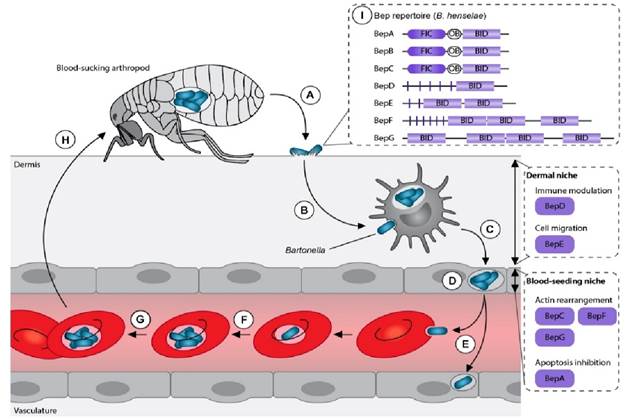
In arthropods, the life cycle of most Bartonella species is divided into replication in the midgut of the intestinal tract and dissemination by excretion (Figure 1). The pathogen is released in the feces of arthropods on the skin of mammals and can be superficially inoculated into the dermis by scratching or biting. Bartonella, with its dermal niche, can penetrate endothelial cells, facilitated by dendritic cells and Bartonella effector proteins (Beps) (SIAMER & DEHIO, 2015; FROMM & DEHIO, 2021).
Bartonella’s life cycle model. (A) Bartonellas replicate within the midgut of their arthropod vector and are secreted with their feces. (B) After inoculation into the dermis, the bacteria colonize the “dermal niche,” which likely includes dendritic cells. During this stage of infection, downregulation of the immune response mediated by BepD may play an essential role. (C) Migratory immune cells are thought to spread the bacterium into the “blood-seeding niche”, a process that appears to depend on BepE. (D) Within the “blood-seeding niche”, bacteria probably colonize endothelial cells, which may require the action of BepC, BepF, BepG, and BepA. (E) From the “blood-seeding niche”, Bartonellae are disseminated into the bloodstream, where they invade erythrocytes. (F) Bacteria replicate and (G) persist until (H) can be absorbed during the next blood meal by another arthropod. (I) Representative repertoire of the effector protein Bartonella (Bep) of the model organism B. henselae. Source: FROMM & DEHIO, 2021.
Subsequently, endothelial cell-resident bacteria enter the bloodstream, invade erythrocytes, multiply within them, and await the next round of transmission when arthropods bite the infected mammalian host again (FROMM & DEHIO, 2021; JIN et al., 2023).
Bartonellosis is an emerging zoonotic bacterial disease transmitted by bats that is responsible for several human clinical syndromes. It can spread among bat populations via hematophagous arthropods. Among bat ectoparasites, bat flies (Diptera: Nycteribiidae and Streblidae) are one of the common potential vectors for transmission and maintenance of Bartonella spp. in bat populations (PENG et al., 2024).
Bats have a very long life expectancy compared to other mammals of similar body size, such as rodents. This longevity may contribute to their role as reservoirs and contribute to the maintenance and transmission of Bartonella spp. to other animals and/or humans. Some bat species directly transmit infections to humans. For example, hematophagous animals (Desmodus rotundus) have long been recognized as the main reservoir of the rabies virus and have been responsible for human rabies outbreaks in Brazil. In addition, D. rotundus is the main transmitter of rabies in cattle and causes significant damage to Brazilian livestock (BAY & KOSOY, 2012).
Occurrence of Bartonella spp. in Brazil
In Brazil, it was only in 2014 that the notification of bartonellosis became mandatory in the context of the differential diagnosis of spotted fever, and the participation of domestic, wild, and human animals, and the clinical-epidemiological relationship began to raise a series of ecological questions regarding the interaction between these groups of hosts. In this context, little is known about the maintenance of the zoonotic cycle in urban areas and forest reserves, as well as the participation of potential vectors in the state of Rio de Janeiro, as well as throughout the national territory (BERNAL et al., 2023).
In Brazil, the occurrence of Bartonella in wild rodents was only confirmed by PCR in 2015, using samples obtained from seven species of sigmodontine rodents from the Cerrado region of central Brazil. Since then, Bartonella has been recorded in wild rodents from several Brazilian locations across all biomes of Brazil (FAVACHO et al., 2015).
Eleven species of bats also tested positive for Bartonella by PCR, including animals in protected areas in the Amazon and Cerrado biomes and in the Atlantic Forest region of the states of Rio de Janeiro (Pedra Branca State Park), Bahia (Pratigi APA), and Santa Catarina (Serra do Tabuleiro State Park). However, to date, no evidence of Bartonella infection has been reported in Brazilian non-human primates or marsupials (OLIVEIRA et al., 2020).
The manifestations of bartonellosis in humans can range from asymptomatic infections to subclinical and self-limiting infections to severe and life-threatening illness (STEPANIĆ et al., 2024). To date, more than 35 species of Bartonella have been identified, more than 15 of which can cause diseases in humans. A wide variety of animals are known as Bartonella hosts and reservoirs. Among wild mammals, very high infection rates (greater than 50%) of bartonellosis are common (STEPANIĆ et al., 2024).
Bartonella spp. is the most reported bacterial genus in bats sampled from Brazil (CASTELO-BRANCO et al., 2023). The occurrence of such pathogens has been reported in hematophagous and non-hematophagous bats, as well as in related ectoparasites sampled in the states of São Paulo, Espírito Santo, Mato Grosso do Sul, Pará, Minas Gerais, Mato Grosso, Paraná, Amazonas, Bahia, Tocantins, Santa Catarina, Maranhão, and Rio de Janeiro (PACHECO et al., 2024).
Climate change indirectly affects the spread of Bartonella spp. by disrupting the proliferation of blood-sucking arthropods. When the number of blood-sucking arthropods increases under hot and humid conditions, such as during El Niño, the infection rate of Bartonella also appears to increase. These findings highlight the critical role of blood-sucking arthropods in Bartonella transmission (JIN et al., 2023).
Little information is available regarding the diversity of Bartonella. To date, B. henselae, B. quintana, B. clarridgeiae, and B. vinsonii subsp. berkhoffii, and B. vinsonii subsp. arupensis have been identified in humans and animals (BERNAL et al., 2023).
Occurrence of Bartonella spp. in bats
Bats carry several species of Bartonella, some of which infect humans. However, as the second largest group of mammals across multiple species, the role of bats as reservoirs for Bartonella species has not been fully explored in terms of species diversity or worldwide distribution. China, especially the north, is home to several endemic species of insectivorous bats; however, studies on Bartonella in bats in Brazil are scarce (HAN et al., 2017).
Vector-borne bacteria (Bartonella, Rickettsia, Borrelia, and Neorickettsia risticii) have been detected in the blood and tissues of bats worldwide. A study in Argentina reported the first detection of M. nigricans. Based on the molecular marker gltA, a high diversity of Bartonella was found in the studied bat species, which is consistent with previous reports (SALVO et al., 2024). Bartonella spp. found in the Phyllostomidae family were related to findings from the New World family (South and Central America), whereas the Bartonella sp. from Vespertilionidae (M. nigricans) were grouped with sequences from the Old World family (SALVO et al., 2024).
The presence of Bartonella spp. in Chiroptera has been reported in the United Kingdom, Kenya, Taiwan, Peru, Nigeria, Puerto Rico, Finland, Madagascar, Costa Rica, Guatemala, French Guiana, Ganha, Algeria, and South Africa. In Brazil, the Bartonella genotype detected in a specimen of G. soricina sampled from the state of Tocantins was positioned far from the other Bartonella genotypes detected in the state of Paraná. These findings suggested the presence of different Bartonella genotypes among bats in Brazil (IKEDA et al., 2017).
ARANTES et al. (2025) determined the occurrence and molecular identity of Bartonella spp. in 345 specimens of Culicoides Latreille collected from the Brazilian Amazon. Specimens were collected from Amazon National Park, Pará State, Brazil, where 86.7% (299/345) were positive using quantitative real-time PCR targeting the internal transcribed spacer (ITS) region.
KOSOY et al. (2007) conducted research with spleen and liver samples that were collected from 102 bats from urban areas in the state of São Paulo, Brazil, and that were evaluated by real-time PCR. The positive samples were submitted to conventional PCR and subsequent sequencing to identify the species. In total, 3.9% of the bats were positive for Bartonella spp. in real-time PCR, and 2.9% were sequenced. Of the positive bats, two were Artibeus lituratus and two were Myotis nigricans.
Recently, ALCÂNTARA et al. (2020) found molecular evidence of Bartonella sp. DNA in opossums captured from peri-urban areas of the Atlantic Forest of Rio de Janeiro, with an infection rate of 40-46%; however, the species of Bartonella involved has yet to be characterized.
GOMEZ-PUERTA et al. (2025) identified the molecular diversity of Bartonella spp. in bats from the Peruvian Amazon. Blood samples from 62 bats were analyzed molecularly for the detection of Bartonella spp. by amplifying the region of the internal transcribed spacer (ITS) 16S-23S and citrate synthase gene (gltA). Amplification of the ITS region revealed the presence of Bartonella spp. DNA was detected in 12 bats (19.4%). The bats included four Carollia perspicillata, three Uroderma bilobatum, two Phyllostomus hastatus, one Platyrrhinus infuscus, and one Noctilio albiventris. Partial analysis of the gltA gene successfully evaluated Bartonella genetic variants in 11 ITS-positive samples.
In light of the above, it is essential to continue monitoring potential Bartonella infections in this group to determine whether these mammals are resistant to Bartonella or susceptible to infection by this bacterium.
CONCLUSION
Bartonella sp. harbors several infectious agents with zoonotic potential, and the Amazon Region is among the main hotspots for pathogens transmitted by rodents and disseminated by bats. In addition, through this study, it is possible to generate data for future research on the prevalence of vector-borne pathogens in the Amazon Region, especially in bats, followed by awareness campaigns and other single health interventions to reduce the risk of human and animal exposure to pathogens with the capacity for endemic infections, such as bartonellosis.
ACKNOWLEDGMENTS
The authors gratefully acknowledge the Coordenação de Aperfeiçoamento de Pessoal de Nível Superior (CAPES), Brazil, for the support of this research.
REFERENCES
-
ALBUQUERQUE, S. R. M. et al. Biossegurança no trabalho de campo e no manejo de quirópteros hematófagos: reconhecimento dos riscos entre graduandos e graduados em ciências biológicas. Ciência Atual. Rio de Janeiro, v.19, n.1, 2023. Available from: <Available from: https://revista.saojose.br/index.php/cafsj/article/view/605 >. Accessed: Jul. 28, 2024.
» https://revista.saojose.br/index.php/cafsj/article/view/605 -
ALCÂNTARA, A. et al. Molecular evidence of Bartonella spp. in free-living opossums (Didelphimorphia: Didelphidae) from peri-urban Atlantic Forest fragments of Brazil. Authorea Preprints, 2020. Available: <Available: https://doi.org/10.22541/au.160029787.76756825 >. Accessed: Jan. 31, 2026. doi: 10.22541/au.160029787.76756825.
» https://doi.org/10.22541/au.160029787.76756825.» https://doi.org/10.22541/au.160029787.76756825 -
ARANTES, P. V. C. et al. Molecular evidence of Bartonella spp. in sand flies (Diptera: Psychodidae) from the Brazilian Amazon. Acta Tropica, v.267, 2025. Available from: <Available from: https://doi.org/10.1016/j.actatropica.2025.107682 >. Accessed: Jan. 31, 2026. doi: 10.1016/j.actatropica.2025.107682.
» https://doi.org/10.1016/j.actatropica.2025.107682.» https://doi.org/10.1016/j.actatropica.2025.107682 -
ARNONE, I. S. et al. Long-distance movement by a great fruit-eating bat, Artibeus lituratus (Olfers, 1818), in southeastern Brazil (Chiroptera, Phyllostomidae): evidence for migration in Neotropical bats? Biota Neotrop, v.16, n.1, 2016. Available from: <Available from: https://doi.org/10.1590/1676-0611-BN-2015-0026 >. Accessed: Jul. 28, 2024. doi: 10.1590/1676-0611-BN-2015-0026.
» https://doi.org/10.1590/1676-0611-BN-2015-0026.» https://doi.org/10.1590/1676-0611-BN-2015-0026 -
BAI, Y.; KOSOY, M. Bartonella Infections in rodents and bats in tropics. Current Topics in Tropical Medicine, 2012. Available from: <Available from: https://www.intechopen.com/chapters/32488 >. Accessed: Aug. 10, 2024. doi: 10.5772/27827.
» https://doi.org/10.5772/27827.» https://www.intechopen.com/chapters/32488 -
BERNAL, M. K. M. et al. Bartonelose: Doença De Importância para a Saúde Pública Envolvendo a Tríade Homem-Ambiente-Animal. Arquivos de Ciências Veterinárias e Zoologia da UNIPAR, v.26, n.1cont, p.01-24, 2023. Available from: <Available from: https://revistas.unipar.br/index.php/veterinaria/article/view/9469 >. Accessed: Jan. 31, 2026. doi: 10.25110/arqvet.v26i1cont-001.
» https://doi.org/10.25110/arqvet.v26i1cont-001.» https://revistas.unipar.br/index.php/veterinaria/article/view/9469 -
BERNARD, E. et al. Updated compilation of bat species (Chiroptera) for the Brazilian Amazonia. Biota Neotrop, v.11, n.1, 2011. Available from: <Available from: http://www.biotaneotropica.org.br/v11n1/en/abstract?article+bn00611012011 >. Accessed: Aug. 10, 2024.
» http://www.biotaneotropica.org.br/v11n1/en/abstract?article+bn00611012011 -
BRAGA, M. S. C. O. et al. Occurrence of Bartonella genotypes in bats and associated Streblidae flies from Maranhão state, northeastern Brazilian Journal of Veterinary Parasitology, v.29, n.4, e014420, 2020. Available from: <Available from: https://doi.org/10.1590/S1984-29612020088 >. Accessed: Feb. 12, 2024. doi: 10.1590/S1984-29612020088.
» https://doi.org/10.1590/S1984-29612020088.» https://doi.org/10.1590/S1984-29612020088 -
BRENNER, D. J. et al. Proposals to unify the genera Bartonella and Rochalimaea, with descriptions of Bartonella Quintana comb. nov., Bartonella vinsonii comb. nov., Bartonella henselae comb. nov., and Bartonella elizabethae comb. nov., and to remove the Family Bartonellaceae from the order Rickettsiales. International Journal Systematic Bacteriology, v.43, p.777-786, 1993. Available from: <Available from: https://doi.org/10.1099/00207713-43-4-777 >. Accessed: Jul. 28, 2024. doi: 10.1099/00207713-43-4-777.
» https://doi.org/10.1099/00207713-43-4-777.» https://doi.org/10.1099/00207713-43-4-777 -
BURGIN, C. J. et al. How many species of mammals are there? Journal of Mammalogy, v.99, n.1, p.1-14, 2018. Available from: <Available from: https://doi.org/10.1093/jmammal/gyx147 >. Accessed: Jul. 28, 2024. doi: 10.1093/jmammal/gyx147.
» https://doi.org/10.1093/jmammal/gyx147.» https://doi.org/10.1093/jmammal/gyx147 -
CASTELO-BRANCO, D. S. C. M. et al. Role of Brazilian bats in the epidemiological cycle of potentially zoonotic pathogens. Microbial Pathogenesis, v.177, 106032, 2023. Available from: <Available from: https://www.sciencedirect.com/science/article/pii/S0882401023000657?via%3Dihub >. Accessed: Jul. 28, 2024. doi: 10.1016/j.micpath.2023.106032.
» https://doi.org/10.1016/j.micpath.2023.106032.» https://www.sciencedirect.com/science/article/pii/S0882401023000657?via%3Dihub -
ESBÉRARD, C. E. L. et al. Novel long-distance movements by Neotropical bats (Mammalia: Chiroptera: Phyllostomidae) evidenced by recaptures in southeastern Brazil. Studies on Neotropical Fauna and Environment, v.52, 2017. Available from: <Available from: https://doi.org/10.1080/01650521.2016.1273751 >. Accessed: Jul. 28, 2024. doi: 10.1080/01650521.2016.1273751.
» https://doi.org/10.1080/01650521.2016.1273751.» https://doi.org/10.1080/01650521.2016.1273751 -
FAVACHO, A. R. M. et al. Zoonotic Bartonella species in wild rodents in the state of Mato Grosso do Sul, Brazil. Microbes and Infection, v.17, 889e892, 2015. Available from: <Available from: http://dx.doi.org/10.1016/j.micinf.2015.08.014 >. Accessed: Jul. 28, 2024. doi: 10.1016/j.micinf.2015.08.014.
» https://doi.org/10.1016/j.micinf.2015.08.014.» http://dx.doi.org/10.1016/j.micinf.2015.08.014 -
FROMM, K.; DEHIO, C. The Impact of Bartonella VirB/VirD4 Type IV Secretion System Effectors on Eukaryotic Host Cells. Frontiers. Microbiology, v.12, 2021. Available from: <Available from: https://doi.org/10.33.89/fmicb.2021.762582 >. Accessed: Aug. 10, 2024. doi: 10.3389/fmicb.2021.762582.
» https://doi.org/10.3389/fmicb.2021.762582.» https://doi.org/10.33.89/fmicb.2021.762582 -
GOMEZ-PUERTA, L. A. et al. Molecular detection and diversity of Bartonella spp. in non-hematophagous bats from the Peruvian Amazon. Acta Tropica, v.262, February 2025. Available from: <Available from: https://doi.org/10.1016/j.actatropica.2025.107539 >. Accessed: Aug. 27, 2025. doi: 10.1016/j.actatropica.2025.107539.
» https://doi.org/10.1016/j.actatropica.2025.107539.» https://doi.org/10.1016/j.actatropica.2025.107539 -
HAN, H-J. et al. Novel Bartonella Species in Insectivorous Bats, Northern China. PLoS ONE, v.12, n.1, e0167915, 2017. Available from: <Available from: https://doi.org/10.1371/journal.pone.0167915 >. Accessed: Aug. 05, 2024. doi: 10.1371/journal.pone.0167915.
» https://doi.org/10.1371/journal.pone.0167915.» https://doi.org/10.1371/journal.pone.0167915 -
IKEDA, P. et al. Evidence and molecular characterization of Bartonella spp. and hemoplasmas in neotropical bats in Brazil. Epidemiology and Infectection, v.145, n.10, p.2038-2052, 2017. Available from: <Available from: https://doi.org/10.1017/S0950268817000966 >. Accessed: Feb. 12, 2024. doi: 10.1017/S0950268817000966.
» https://doi.org/10.1017/S0950268817000966.» https://doi.org/10.1017/S0950268817000966 -
JIN, X. et al. Advancements in understanding the molecular and imune mechanisms of Bartonella pathogenicity. Frontiers in Microbiology, v.14, 2023. Available from: <Available from: https://doi.org/10.3389/fmicb.2023.1196700 >. Accessed: Jul. 28, 2024. doi: 10.3389/fmicb.2023.1196700.
» https://doi.org/10.3389/fmicb.2023.1196700.» https://doi.org/10.3389/fmicb.2023.1196700 -
JUAN, Y. et al. Detection and genetic diversity of Bartonella species in small mammals from the central region of the Qinghai-Tibetan Plateau, China. Scientific Reports, v.12, n.6996, 2022. Available from: <Available from: https://doi.org/10.1038/s41598-022-11419-x >. Accessed: Jul. 27, 2024. doi: 10.1038/s41598-022-11419-x.
» https://doi.org/10.1038/s41598-022-11419-x.» https://doi.org/10.1038/s41598-022-11419-x -
KOSOY, M. et al. Bartonella tamiae sp. nov., a newly recognized pathogen isolated from three human patients from Thailand. Journal of Clinical Microbiology, 2008 Available from: <Available from: https://pubmed.ncbi.nlm.nih.gov/18077632/ >. Accessed: Jan. 31, 2026. doi: 10.1128/JCM.02120-07.
» https://doi.org/10.1128/JCM.02120-07.» https://pubmed.ncbi.nlm.nih.gov/18077632/ -
LEAL, E. S. B. et al. Morcegos no estado de Pernambuco: histórico e desafios. CPRH, 2023. Available from: <Available from: https://www2.cprh.pe.gov.br/wp-content/uploads/2023/12/morcego-do-estdo-de-pe.pdf >. Accessed: Aug. 27, 2025.
» https://www2.cprh.pe.gov.br/wp-content/uploads/2023/12/morcego-do-estdo-de-pe.pdf -
LOUTIT, J. S. Bartonella infections. Current Clinical Topics in Infectious Diseases, v.17, p.269-90, 1997. Available from: <Available from: https://pubmed.ncbi.nlm.nih.gov/9189670/ >. Accessed: Jul. 30, 2024.
» https://pubmed.ncbi.nlm.nih.gov/9189670/ -
LUNA, N. et al. Microbial community dynamics in blood, faeces and oral secretions of neotropical bats in Casanare, Colombia. Scientific Reports, v.14, 25808, 2024. Available from: <Available from: https://doi.org/10.1038/s41598-024-77090-6 >. Accessed: Aug. 27, 2025. doi: 10.1038/s41598-024-77090-6.
» https://doi.org/10.1038/s41598-024-77090-6.» https://doi.org/10.1038/s41598-024-77090-6 -
OLIVEIRA, J. G. et al. Investigation of Bartonella spp. in brazilian mammals with emphasis on rodents and bats from the Atlantic Forest. International Journal for Parasitology: Parasites and Wildlife, v.13, p.80-89, 2020. Available from: <Available from: https://doi.org/10.1016/j.ijppaw.2020.07.004 >. Accessed: Jul. 28, 2024. doi: 10.1016/j.ijppaw.2020.07.004.
» https://doi.org/10.1016/j.ijppaw.2020.07.004.» https://doi.org/10.1016/j.ijppaw.2020.07.004 -
OKARO, U. et al. Bartonella species, an emerging cause of blood-culture-negative endocarditis. Clinical Microbiology Reviews, v.30, p.709-746, 2017. Available from: <Available from: https://doi.org/10.1128/cmr.00013-17 >. Accessed: Jul. 28, 2024. doi: 10.1128/cmr.00013-17.
» https://doi.org/10.1128/cmr.00013-17.» https://doi.org/10.1128/cmr.00013-17 -
MARINI, M. A.; GARCIA, F. I. Conservação de aves no Brasil. Megadiversidade, v.1, n.1, 2005. Available from: <Available from: https://www.researchgate.net/publication/268975009 >. Accessed: Aug. 10, 2024.
» https://www.researchgate.net/publication/268975009 -
MEDLIN, R. E. et al. Responses of bats to forest fragmentation in the Mississippi River Alluvial Valley, Arkansas, USA. Diversity, v.2, p.1146-1157, 2010. Available from: <Available from: https://doi.org/10.3390/d2101146 >. Accessed: Jul. 28, 2024. doi.org/10.3390/d2101146.
» https://doi.org/doi.org/10.3390/d2101146» https://doi.org/10.3390/d2101146 -
MORAES-ORNELLAS, V. S.; ORNELLAS, R. B. Etnoconservação de morcegos em unidades de conservação de uso sustentável da Amazônia Brasileira. Biodiversidade Brasileira, v.13, n.2, p.1-14, 2023. Available from: <Available from: https://doi.org/10.37002/biodiversidadebrasileira.v13i2.2402 >. Accessed: Jul. 28, 2024. doi: 10.37002/biodiversidadebrasileira.v13i2.2402.
» https://doi.org/10.37002/biodiversidadebrasileira.v13i2.2402.» https://doi.org/10.37002/biodiversidadebrasileira.v13i2.2402 -
PACHECO, T. A. et al. Molecular detection and characterization of Bartonella spp. in small mammals in the Amazonia and Cerrado biomes, midwestern Brazil. Acta Tropica, v.251, 107129, 2024. Available from: <Available from: https://doi.org/10.1016/j.actatropica.2024.107129 >. Accessed: Jul. 28, 2024. doi: 10.1016/j.actatropica.2024.107129.
» https://doi.org/10.1016/j.actatropica.2024.107129.» https://doi.org/10.1016/j.actatropica.2024.107129 -
PENG, T. L. et al. Molecular prevalence of Bartonella spp. in bat flies in east coast Malaysia. Heliyon, v.10, n.9, e29785, 2024. Available from: <Available from: https://doi.org/10.1016/j.heliyon.2024.e29785 >. Accessed: Jul. 28, 2024.doi: 10.1016/j.heliyon.2024.e29785.
» https://doi.org/10.1016/j.heliyon.2024.e29785.» https://doi.org/10.1016/j.heliyon.2024.e29785 -
REBEKAH, L. et al. Evaluation of the available animal models for Bartonella infections. One Health, v.18, 100665, 2024. Available from: <Available from: https://doi.org/10.1016/j.onehlt.2023.100665 >. Accessed: Feb. 12, 2024. doi: 10.1016/j.onehlt.2023.100665.
» https://doi.org/10.1016/j.onehlt.2023.100665.» https://doi.org/10.1016/j.onehlt.2023.100665 -
RODRIGUES, M. T. Conservação dos répteis brasileiros: os desafios para um país megadiverso. Megadiversidade, v.1, n.1, 2005. Available from: <Available from: https://repositorio.usp.br/item/001468966 >. Accessed: Aug. 10, 2024.
» https://repositorio.usp.br/item/001468966 -
SALVO, M. N. et al. Bartonella spp. in different species of bats from Misiones (Argentina) Circulación de Bartonella spp. en diferentes especies de murciélagos en la provincia de Misiones (Argentina). Revista Argentina de Microbiología, v.56, p.227-231, 2024. Available from: <Available from: https://doi.org/10.1016/j.ram.2024.04.001 >. Accessed: Aug. 10, 2024. doi: 10.1016/j.ram.2024.04.001.
» https://doi.org/10.1016/j.ram.2024.04.001.» https://doi.org/10.1016/j.ram.2024.04.001 -
SANTOS, T. C. M. et al. Bats in three protected areas of the Central Amazon Ecological Corridor in Brazil. Acta Chiropterologica, v.21, n.2, p.425-442, 2020. Available from: <Available from: https://doi.org/10.3161/15081109ACC2019.21.2.017 >. Accessed: Jul. 28, 2024. doi: 10.3161/15081109ACC2019.21.2.017
» https://doi.org/10.3161/15081109ACC2019.21.2.017» https://doi.org/10.3161/15081109ACC2019.21.2.017 -
SIAMER, S.; DEHIO, C. New insights into the role of Bartonella effector proteins in pathogenesis. Current Opinion in Microbiology, v.23, p.80-85, 2015. Available from: <Available from: https://doi.org/10.1016/j.mib.2014.11.007 >. Accessed: Aug. 10, 2024. doi: 10.1016/j.mib.2014.11.007
» https://doi.org/10.1016/j.mib.2014.11.007» https://doi.org/10.1016/j.mib.2014.11.007 -
SILVA, D. et al. Flying Over Amazonian Waters: The Role of Rivers on the Distribution and Endemism Patterns of Neotropical Bats. Frontiers in Ecology and Evolution, v.10, 774083, 2022. Available from: <Available from: https://doi.org/10.3389/fevo.2022.774083 >. Accessed: Jul. 28, 2024. doi: 10.3389/fevo.2022.774083.
» https://doi.org/10.3389/fevo.2022.774083.» https://doi.org/10.3389/fevo.2022.774083 -
STEPANIĆ, M. et al. Epidemiology of Bartonella henselae infection in pet and stray cats in Croatia with risk factors analysis. Parasites & Vectors, v.17, n.48, 2024. Available from: <Available from: https://doi.org/10.1186/s13071-024-06117-8 >. Accessed: Jul. 25, 2024. doi: 10.1186/s13071-024-06117-8.
» https://doi.org/10.1186/s13071-024-06117-8.» https://doi.org/10.1186/s13071-024-06117-8
-
CR-2025-0045.R3
-
DATA AVAILABILITY STATEMENT
Data supporting the results and conclusions of this study are available and may be requested from the author upon reasonable request.
-
DECLARATION OF USE OF ARTIFICIAL INTELLIGENCE
No AI tools were used in the preparation of this manuscript.
-
Funding Statement
There was no funding for this publication
Edited by
-
ASSOCIATE EDITOR:
Rudi Weiblen (0000-0002-1737-9817)
-
SCIENTIFIC EDITOR:
Juliana Felipetto Cargnelutti (0000-0002-3160-3643)
Data supporting the results and conclusions of this study are available and may be requested from the author upon reasonable request.