 Macauba (Acrocomia aculeata) pulp and kernel oils, and co-products: chemical characterization and antioxidant properties
ABSTRACT:
Macauba is a brazilian palm tree, whose fruits have great potential to be used by the food industry due to their chemical composition. However, there is little information on the chemical characterization of macauba fruit parts, especially its shell and both pulp and kernel oil extraction coproducts, and on the antioxidant properties of macauba oils. Chemical characterization of macauba oils and co-products (shell, pulp and kernel press-cakes), and the in vitro effect of macauba oils on the production of reactive oxygen species (ROS) were evaluated. Macauba co-products showed high concentrations of dietary fiber (shell 25.59%, pulp press-cake 25.41% and kernel press-cake 20.13%). Kernel press-cake stood out for its high concentration of protein and pulp press-cake high iron. Macauba kernel oil had a higher content of lauric acid (45.10%) and tocopherol (45.22 μg/g), and macauba pulp oil had higher content of oleic acid (49.32%) and carotenoids (207.52 μg/g). Macauba oils were able to reduce the formation of ROS in cell lines (HepG2, A549 and IMR90). Therefore, macauba oils and co-products are rich in bioactive compounds and nutrients and are promising raw materials to be used in the development of healthy foods.
Key words:
macauba; HPLC; bioactive compounds; reactive oxygen species
RESUMO:
A macaúba é uma palmeira brasileira, cujos frutos apresentam grande potencial para serem utilizados pela indústria alimentícia devido a sua composição química. No entanto, existem poucas informações sobre a caracterização química das partes da fruta da macaúba, especialmente sua casca e coprodutos da extração da polpa e do óleo da amêndoa, e sobre as propriedades antioxidantes dos óleos da macaúba. A caracterização química dos óleos de macaúba e co-produtos (casca, polpa e torta de amêndoa) e o efeito in vitro dos óleos de macaúba na produção de espécies reativas de oxigênio (ROS) foram avaliados. Os coprodutos da macaúba apresentaram altas concentrações de fibra alimentar (casca 25,59%, torta de polpa 25,41% e torta de amêndoa 20,13%). A torta de amêndoa destacou-se pelo alto teor de proteína e a torta de polpa pelo alto teor de ferro. O óleo de amêndoa de macaúba apresentou maior teor de ácido láurico (45,10%) e tocoferol (45,22 μg/g), e o óleo da polpa de macaúba apresentou maior teor de ácido oleico (49,32%) e carotenoides (207,52 μg/g). Os óleos de macaúba foram capazes de reduzir a formação de ROS nas linhagens celulares (HepG2, A549 e IMR90). Portanto, os óleos e coprodutos da macauba são ricos em compostos bioativos e nutrientes, sendo matérias-primas promissoras no desenvolvimento de alimentos saudáveis.
Palavras-chave:
macauba; HPLC; compostos bioativos; espécies reativas de oxigênio
INTRODUCTION
Macauba (Acrocomia aculeata) is a Brazilian palm tree and its fruits are formed in clusters and have a spherical shape (VIANNA et al., 2017). Macauba fruits consist of epicarp (shell), mesocarp (pulp), endocarp and kernel, and it is economically interesting to explore macauba, given its general use, and the fact that all its parts can be commercially explored (LESCANO et al., 2015). The shell can be used in handicrafts, the pulp oil for the biodiesel production, the pulp-press cake in animal feed, the endocarp used in the production of charcoal and the kernel oil in the cosmetic industry. Moreover, macauba pulp and kernel can be consumed in regional culinary preparations; however, macauba is still little utilized in human foods (LESCANO et al., 2017; COIMBRA & JORGE, 2012).
Among the products obtained from macauba, the oil stands out, with two types, pulp and kernel oils, with different compositions (COIMBRA & JORGE, 2011). Lauric acid is the major fatty acid present in kernel oil, followed by oleic acid, whereas pulp oil has expressive content of oleic acid (COIMBRA & JORGE, 2011; LIEB et al., 2019). In relation to macauba co-products, there are no studies on chemical composition and application in human food of macauba shell. Moreover, there is little research on macauba pulp and kernel press-cakes, a co-product from physical oil extraction, and their potential applications in human foods.
The complete use of a given raw material has advantages at an economic, environmental and social level, and has become a focus in recent years due to the need for alternative sources of food and nutrients to meet the consumption demand of the population, associated with a reduction in the environmental damage generated by large-scale production (REGUENGO et al., 2022). In this sense, macauba stands out as promising, given the potential indication of the use of its main products and its co-products in human foods. In addition, macauba is rich in bioactive compounds and nutrients, which can contribute to the prevention or reduction of diseases and confer health benefits related to its consumption.
Previous studies (COIMBRA & JORGE, 2012; LIEB et al., 2019) have determined the chemical composition of macauba pulp and kernel; however, this is the first study to perform a characterization of macauba co-products (shell, pulp and kernel press-cakes), and to evaluate the intracellular antioxidant activity of macauba oils. This study provided new knowledge about macauba oils and co-products, promoting macauba use by the food industry; and consequently, the generation of new opportunities to family farming and the development of healthy foods. Thus, the objective of the study was to evaluate the chemical characterization of macauba oils and co-products (pulp and kernel press-cakes), and the in vitro antioxidant activity of macauba oils.
MATERIALS AND METHODS
Macauba fruits were harvested, peeled and pulped (Araponga - Minas Gerais/Brazil). Pulp and kernel oils were extracted using manual hydraulic press (Laboratory Press, Fred S. Carver Inc-Summit, New Jersey-USA). After extraction, the oils were centrifuged at 5000 rpm for 20 minutes. Shell, pulp press-cake, kernel press-cake and the oils were stored in a freezer at -80 ºC until use for analysis.
Macronutrients, moisture, ash, total dietary fiber, and minerals analysis of macauba co-products
The analysis of content of moisture, ash, proteins, lipids, and total dietary fiber were performed in three repetitions (AOAC, 2012). Carbohydrates were calculated as the difference, using the following equation: [100 - (% moisture + % lipids + % proteins + % total dietary fiber + % ash)]. Concentrations of minerals were determined according to the methodology proposed by OLIVEIRA et al. (2024).
Bioactive compounds composition of macauba oils and co-products
Total phenolic compounds were determined spectrophotometrically, using Folin-Ciocalteu reagent and a standard curve of gallic acid. Results were expressed as milligrams gallic acid equivalents per gram of sample (mg GAE g-1) (SINGLETON et al., 1999).
Antioxidant capacity was assessed by the DPPH (2,2-diphenyl-1-picrylhydrazyl) method. The absorbance reading at 517 nm was performed on a spectrophotometer. The results of DPPH assay were expressed as μM TEAC (Trolox equivalent antioxidant activity) per g sample (LEE et al., 2007).
Carotenoid analysis was carried out by high-performance liquid chromatography (HPLC) with detection of 450 nm (PINHEIRO-SANT’ANA et al., 1998). Analysis of tocopherol and tocotrienols were determined by HPLC with fluorescence detection of 450 nm. The concentration values were calculated with the assessment of the peak area of excitation and expressed as separate values for each isomer. The concentration of total tocopherols (μg/g) was expressed as a sum of the major tocopherols (AOCS, 2012).
Tannins were analyzed according to the methodology by PRICE et al. (1978), and phytic acid content was analyzed with kit Phytic acid (phytate)/total phosphorus (K-PHYT 05/17 - Magazyme®).
Fatty acids composition of macauba oils
The oil was converted to fatty acid methyl esters (FAMEs) to obtain the fatty acid profile ICHIHARA & FUKUBAYASHI (2010). Samples were injected in a gas chromatograph equipped with a Flame Ionization Detector (Shimadzu, GC-2010, Japan) and a capillary column of 100 m x 0.25 mm (SP-2560, Sigma-Aldrich, USA). Peak identification was confirmed by comparison with the standard FAME mix (Supelco 37 FAME mix, Sigma-Aldrich, USA).
In vitro assay on cell lines: intracellular reactive oxygen species activity of macauba oils
Generation of intracellular reactive oxygen species (ROS) was measured by a ROS assay with dichlorofluorescein diacetate (DCFH-DA) (WOLFE & LIU, 2007). Briefly, the cell lines Caco-2 (colorectal adenocarcinoma epithelial cells), HepG2 (human hepatocarcinoma cells), A549 (lung adenocarcinoma epithelial cells) and IMR90 (human lung fibroblast) (60000 cell/well) were treated with different concentrations (100 and 1000 μg/mL) of each macauba oil (pulp or kernel), which were diluted in DCFH-DA solution (25 mmol/L). For oil solubilization, dimethylsulfoxide (DMSO - 40%) and Tween (1%) were used. For the positive control, the cells were treated with 15 μmol/L H2O2, and for the negative control, the cells were only treated with culture medium. Before the measurement, H2O2 at 15 μmol/L was in all wells and the fluorescence intensity was measured at an excitation wavelength of 485 nm and at an emission wavelength of 538 nm. The data were expressed as the percentage of fluorescence intensity relative to the control group.
Statistical analysis
Data were submitted to analysis of variance (ANOVA) and analyzed using a t-test to verify the difference between two groups, and Tukey test was performed to investigate differences between three or more groups. P - value ≤ 0.05 were considered statistically significant. Statistical analyses were performed using GraphPad Prism® version 8.0 (GraphPad Software, USA).
RESULTS
Proximate composition of macauba co-products
The co-products of oil extraction (pulp and kernel press-cake) had high lipid content, even after oil extraction. About protein content, kernel press-cake showed higher content. All macauba co-products (shell, pulp press-cake, kernel press-cake) have a high content of total dietary fiber, and the pulp press-cake has a higher content of soluble fiber, while the shell and kernel press-cake have more of the insoluble fiber (Table 1).
Among the minerals presented in macauba shell, potassium, phosphorus and sulfur were the ones in higher concentrations, while the kernel press-cake presented highest magnesium, phosphorus, and potassium content, and pulp press-cake presented highest potassium, magnesium and calcium content, with emphasis on the iron content in this co-product (1).
Bioactive compounds composition of macauba oils and co-products
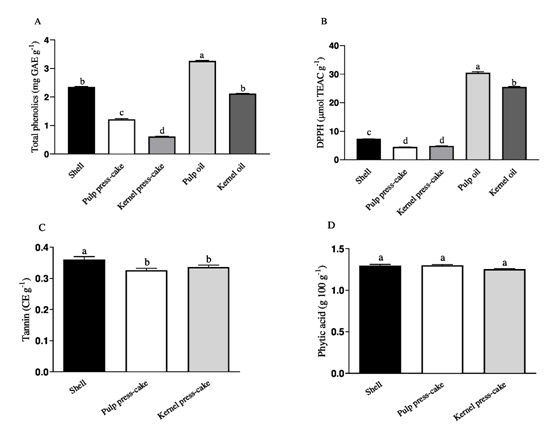
Macauba oils showed the highest level of phenolic compounds (Figure 1A) and antioxidant capacity (Figure 1B), highlighting the macauba pulp oil. Higher tannin content was reported in the shell (Figure 1C) and the phytic acid content was similar in the macauba co-products (pulp press-cake and kernel press-cake) (Figure 1D).

Total phenolics (A), Antioxidant (B), Tannin (C) and Phytic acid (D) of macauba co-products and oils. Different letters mean statistical difference by Tukey test (P ≤ 0.05). Data expressed as mean ± standard deviation (n = 3). GAE: galic acid equivalent; TEAC: trolox equivalent antioxidant capacity; CE: catechin equivalent.
Macauba pulp oil showed a high carotenoids content compared to kernel oil. Still, it stood out in high content of β-carotene, representing 78% of the total. Total tocopherol was higher in macauba kernel oil, and α-tocopherol and γ-tocotrienol were predominant isomers. In pulp oil, in addition to α-tocopherol, α-tocotrienol showed high values (Table 2).
Fatty acids composition of macauba oils
Macauba pulp oil showed a high content of monounsaturated fatty acids (55%), with 49.32% of oleic acid, and macauba kernel oil high saturated fatty acids (70%), with 45.10% of lauric acid and 26.27% of oleic acid (Table 3).
Effect of macauba oils on the formation of intracellular reactive oxygen species
Macauba pulp and kernel oils, in the two doses tested (100 and 1000 µg/mL) did not increase the ROS formation, maintaining levels similar to spontaneous production (negative control) in all analyzed cells (Figure 2). In addition, when testing these two doses in the presence of H2O2, the oils were able to reduce the formation of reactive oxygen species at levels statistically lower than the group with H2O2 (positive control) in A549, HepG2 and IMR90 cells, showing the protective and beneficial effect of these oils in reducing the formation of reactive oxygen species, which is harmful to the cell. Furthermore, in the presence of H2O2, at a dose of 1000 µg/mL, in A549 and HepG2 cells, the reduction was comparable to the negative control group. In Caco-2 cell, it maintained ROS levels similar the negative control group, causing no greater increase in the formation of ROS (Figure 2).

Effect of macauba pulp and kernel oil on the formation of reactive oxygen species (ROS). (A) Pulp oil - CACO-2; (B) Kernel oil - CACO-2; (C) Pulp oil - IMR90; (D) Kernel oil - IMR90; (E) Pulp oil - A549; (F) Kernel oil - A549; (G) Pulp oil - HepG2; (H) Kernel oil - HepG2. Treatment = macauba pulp and kernel oil at 100 and 1000 µg/mL. Different letters mean statistical difference by Tukey test (P ≤ 0.05). Data expressed as mean ± standard deviation.
DISCUSSION
The protein content found in macauba co-products demonstrated that the co-product of kernel oil extraction is a rich source of protein, higher than others vegetable protein sources, such as peanuts and soybean (WU et al., 2014), which is important given the current market that seeks sources of vegetable proteins for its application in the formulation of new products, aimed mainly at the vegan public and to supply market demand (ORTOLÁ et al., 2019).
Consumption of 100 g of pulp press-cake accounts for approximately 100% of the total amount of fiber consumption indicated per day, which is about 25 g, while the consumption of 100 g of each kernel press-cake accounts for around 80% of daily needs (INSTITUTE OF MEDICINE, 2005). Changes in eating habits, with less dietary fiber intake has refocused the food industry on the benefits of incorporating different dietary fiber in the foodstuff, thus, foods that add dietary fiber to formulations are desired by industries. The macauba shell, which is a generally discarded co-product, showed a high dietary fiber content, with an emphasis on the insoluble fraction, with this part of the macauba demonstrating a potential application, becoming a new source of dietary fiber, besides low cost, a point of interest for companies. A previous study also demonstrated similar results in relation to the total fiber content in the macauba shell (ALFARO-SOLIS et al., 2020). The results of this present study are innovative, as it is the first to determine the content of soluble and insoluble dietary fibers in the macauba co-products. The pulp press-cake, a co-product from macauba pulp oil extraction, presented high total and soluble fiber content. Soluble fiber is fermented by the intestinal microbiota, producing short chain fatty acid, which are an important to improve intestinal health (KOH et al., 2016).
Macauba co-products showed significant levels of several minerals, which participate in important metabolic functions, corroborating the importance of the intake of these nutrients. The iron content present in the pulp press-cake stands out, with values higher than that of beans, a traditional food source of iron (SANT’ANA et al., 2019). Iron deficiencies have a great impact on the health of the population, with serious consequences on human health, therefore, the insertion of about 100 grams of macauba pulp press-cake per day can meet the need for this mineral (INSTITUTE OF MEDICINE, 2000). Corroborating our results, high iron levels were found in the pulp and kernel of two different macauba varieties (MACHADO et al., 2015).
The high phenolic content in the macauba co-products shows the potential application these products may have as ingredients for food product development, or as extracts to be used in antioxidant supplements. There has recently been growing interest in research into the role of plant-derived antioxidants in food because they can protect the human body from free radicals and the effects of ROS on human health (GÜLÇIN, 2012). Regarding tannins and phytates, this is the first study that evaluated the content of these compounds in the macauba. The levels obtained are considered low when compared to other foods, for example beans (phytic acid 2.0 g/100g and tannin 0.50 mg/g) and other Brazilian fruits, as pequi (phytic acid 3.0 g/100g and tannin 0.35 mg/g) (MARIN et al., 2009).
Macauba pulp oil had high oleic acid content, which is similar to the lipid profile of olive oil, so its applicability in health can trigger benefits, the same already consolidated to olive oil associated with high oleic content (LIEB et al., 2019). In addition, the final cost of macauba pulp oil will be lower than that practiced for olive, making it more accessible to the Brazilian population. Macauba kernel oil; conversely, has a lipid profile similar to coconut oil, with a high content of lauric acid, however, it has a high content of oleic acid, unlike coconut oil, which has very little amount of this healthy fatty acid (COIMBRA & JORGE, 2012).
In addition to a good lipid profile, the pulp oil has a high carotenoid content, with the content obtained greater than consolidated sources of this bioactive compound. By comparison, other studies have found a β-carotene content of 62 µg/g in carrots and 57 µg/g in pumpkins (ELVIRA-TORALES et al., 2019). Vitamin A recommendations for adult individuals are 700 to 900 µg per day, and the consumption of 100 g of macauba pulp oil represents 100% of this recommendation (INSTITUTE OF MEDICINE, 2005). Important health benefits have been attributed to the carotenoids, can act as antioxidants, due to the ability to sequester and inactivate free radicals, and act against cardiovascular conditions, certain cancers, neurological disorders, strengthen the immune system, macular degeneration, gene activation and inflammatory processes (ELVIRA-TORALES et al., 2019).
In addition, macauba oils have higher tocopherol content than other oils, such as olive oil, soybeans, and cotton (COIMBRA & JORGE, 2011). This is the first study that analyzed the tocotrienols profile of these oils. In the human body, tocopherol exhibits biological activity vitamin E and antioxidant action, acting in several diseases, such as cancer, inflammation and neurodegenerative diseases, and in vegetable oils act protecting the unsaturated fatty acids from lipid oxidation and in the food industry they are used as natural antioxidants in foods (SHAHIDI & CAMARGO, 2016). The recommended intake of Vitamin E for adults is 15 mg of tocopherol equivalent, thus, 100 g of macauba pulp and kernel oil corresponds to about 3% and 15% of this recommendation, respectively (INSTITUTE OF MEDICINE, 2001).
The effects of reducing the ROS formation in cell lines can be related to the carotenoids, tocopherol and phenolic compounds present in macauba oils. The role of ROS in the pathogenesis of many human diseases is becoming increasingly recognized; and however, an increase in ROS formation in the human body can be blocked by bioactive compounds and antioxidants (YEN et al., 2013). Cell death was not observed in the present study, showing that macauba oils were able to overcome the toxic effects of ROS. The hepatoprotective effect of carotenoids is related to their ability to reduce oxidative stress caused by excess ROS, since carotenoids can be absorbed and accumulated in the liver, and thus, through their mechanism of antioxidant capacity, protect or treat cancer cells in the liver, since their conjugated double bonds allow them to accept electrons from reactive species and thus neutralize ROS (ELVIRA-TORALES et al., 2019). In lung cancer cells, the beneficial effect observed with the reduction of ROS may be associated with tocopherols and carotenoids, based on in the strong correlation between the consumption of these bioactive compounds and the reduction in the incidence of lung cancer, closely related to the antioxidant and anti-inflammatory characteristics of these compounds (PORRO et al., 2022).
CONCLUSION
Macauba co-products (shell, pulp and kernel press-cakes) showed high contents of dietary fiber, proteins, minerals, and bioactive compounds. Pulp oil showed rich in oleic acid and carotenoids, and kernel oil in lauric acid and tocopherol, and these oils were able to reduce the formation of reactive oxygen species (ROS) in cell lines (HepG2, A549 and IMR90). Thus, macauba oils and co-products have great potential to be used in the development of healthy foods. Moreover, this study will help to continuing promoting macauba for human foods, to minimize waste by using co-products, and to stimulate the food industry and agriculture farming.
ACKNOWLEDGMENTS
We gratefully acknowledge Conselho Nacional de Desenvolvimento Científico e Tecnológico (CNPq, Brazil) and Coordenação de Aperfeiçoamento de Pessoal de Nível Superior (CAPES, Brazil) for financial support. We also thank the Soleá Brasil Óleos Vegetais Ltda (Brazil) for providing the macauba used in this study and financial support, and Ceres Mattos Della Lucia (Universidade Federal de Viçosa, Brazil) for her assistance with the quantification of total tocopherols and carotenoids.
REFERENCES
-
ALFARO-SOLIS, J. D. et al. Acrocomia aculeata fruits from three regions in Costa Rica: an assessment of biometric parameters, oil content and oil fatty acid composition to evaluate industrial potential. Agroforestry Systems, v.94, p.1913-1927, 2020. Available from: <Available from: https://link.springer.com/article/10.1007/s10457-020-00511-8 >. Accessed: Mar. 11, 2023. doi: 10.1007/s10457-020-00511-8.
» https://doi.org/10.1007/s10457-020-00511-8.» https://link.springer.com/article/10.1007/s10457-020-00511-8 -
AMERICAN OIL CHEMISTS SOCIETY - AOCS. Official Methods and Recommended Practices of the American Oil Chemists Society. AOCS, Champaign, IL, 2012. Available from: <Available from: https://library.aocs.org/all_methods/ >. Accessed: Oct. 12, 2022.
» https://library.aocs.org/all_methods/ -
ASSOCIATION OF OFFICIAL METHODS ANALYTICAL CHEMISTS - AOAC. Official Methods of Analysis of the Association Chemists. 19th edition. 2012, Washington, DC. Available from: <Available from: https://www.aoac.org/official-methods-of-analysis/ >. Accessed: Oct. 12, 2022.
» https://www.aoac.org/official-methods-of-analysis/ -
COIMBRA, M. C.; JORGE, N. Fatty acids and bioactive compounds of the pulps and kernels of Brasilian palm species, guariroba (Syagrus oleraces), jerivá (Syagrus romanzoffiana) and macaúba (Acrocomia aculeata). Journal of the Science of Food and Agriculture, v.92, p.679-684, 2012. Available from: <Available from: https://pubmed.ncbi.nlm.nih.gov/21922463/ >. Accessed: Feb. 02, 2023. doi: 10.1002/jsfa.4630.
» https://doi.org/10.1002/jsfa.4630.» https://pubmed.ncbi.nlm.nih.gov/21922463/ -
COIMBRA, M. C.; JORGE, N. Characterization of the pulp and kernel oils from Syagrus oleracea, Syagrus romanzoffiana, and Acrocomia aculeate Journal of Food Science, v.76, p.C1156-C1161, 2011. Available from: <Available from: https://pubmed.ncbi.nlm.nih.gov/22417579/ >. Accessed: Dec. 20, 2022. doi: 10.1111/j.1750-3841.2011.02358.x.
» https://doi.org/10.1111/j.1750-3841.2011.02358.x.» https://pubmed.ncbi.nlm.nih.gov/22417579/ -
ELVIRA-TORALES, L. I. et al. Nutritional importance of carotenoids and their effect on liver health: A review. Antioxidants, v.8, p.1-23, 2019. Available from: <Available from: https://www.ncbi.nlm.nih.gov/pmc/articles/PMC6681007/ >. Accessed: Dec. 20, 2022. doi: 10.3390/antiox8070229.
» https://doi.org/10.3390/antiox8070229.» https://www.ncbi.nlm.nih.gov/pmc/articles/PMC6681007/ -
GÜLÇIN, I. Antioxidant activity of food constituents: an overview. Archives of Toxicology, v.86, p.345-391, 2012. Available from: <Available from: https://link.springer.com/article/10.1007/s00204-011-0774-2 >. Accessed: Jan. 13, 2023. doi: 10.1007/s00204-011-0774-2.
» https://doi.org/10.1007/s00204-011-0774-2.» https://link.springer.com/article/10.1007/s00204-011-0774-2 -
ICHIHARA, K.; FUKUBAYASHI, Y. Preparation of fatty acid methyl esters for gas-liquid chromatography. Journal of Lipid Research, v.51, p.635-40, 2010. Available from: <Available from: https://www.sciencedirect.com/science/article/pii/S0022227520305216 >. Accessed: Dec. 21, 2022. doi: 10.1194/jlr.d001065.
» https://doi.org/10.1194/jlr.d001065.» https://www.sciencedirect.com/science/article/pii/S0022227520305216 -
INSTITUTE OF MEDICINE. Dietary reference intakes: energy, carbohydrate, fiber, fat, fatty acids, cholesterol, protein, and amino acids. Washington, DC, National Academies Press; 2005. Available from: <Available from: https://nap.nationalacademies.org/catalog/10490/dietary-reference-intakes-for-energy-carbohydrate-fiber-fat-fatty-acids-cholesterol-protein-and-amino-acids >. Accessed: Dec. 21, 2022.
» https://nap.nationalacademies.org/catalog/10490/dietary-reference-intakes-for-energy-carbohydrate-fiber-fat-fatty-acids-cholesterol-protein-and-amino-acids -
INSTITUTE OF MEDICINE (US) Panel on Dietary Antioxidants and Related Compounds. Dietary Reference Intakes for Vitamin C, Vitamin E, Selenium, and Carotenoids. Washington (DC): National Academies Press (US). PMID: 25077263, 2000. Available from: <Available from: https://pubmed.ncbi.nlm.nih.gov/25077263/ >. Accessed: Dec. 11, 2022.
» https://pubmed.ncbi.nlm.nih.gov/25077263/ -
MEWIS, I.; ULRICHS, C.H. Action of amorphous diatomaceous earth against different stages of the stored product pests Tribolium confusum, Tenebrio molitor, Sitophilus granaries and Plodia interpunctella Journal of Stored Product Research, v.37, p.153-164, 2001. Available from: <Available from: http://dx.doi.org/10.1016/S0022-474X(00)00016-3 >. Accessed: Mar. 18, 2002. doi: 10.1016/S0022-474X(00)00016-3.
» https://doi.org/10.1016/S0022-474X(00)00016-3.» http://dx.doi.org/10.1016/S0022-474X(00)00016-3 -
KOH, A. et al. From Dietary Fiber to Host Physiology: Short-Chain Fatty Acids as Key Bacterial Metabolites. Cell, v.165, p.1332-1345, 2016. Available from: <Available from: https://www.sciencedirect.com/science/article/pii/S009286741630592X >. Accessed: Jan. 13, 2023. doi: 10.1016/j.cell.2016.05.041.
» https://doi.org/10.1016/j.cell.2016.05.041.» https://www.sciencedirect.com/science/article/pii/S009286741630592X -
LEE, J. et al. Development of a method predicting the oxidative stability of edible oils using 2, 2-diphenyl-1-picrylhydrazyl (DPPH). Food Chemistry, v.103, p.662-669, 2007. Available from: <Available from: https://www.sciencedirect.com/science/article/pii/S0308814606006455 >. Accessed: Dec. 15, 2022. doi: 10.1016/j.foodchem.2006.07.052.
» https://doi.org/10.1016/j.foodchem.2006.07.052.» https://www.sciencedirect.com/science/article/pii/S0308814606006455 -
LESCANO, C. H. et al. Nutriets content, characterization and oil extraction from Acrocomia aculeata (Jacq.) Lodd. fruits. African Journal of Food Science, v.9, p.113-119, 2015. Available from: <Available from: https://academicjournals.org/journal/AJFS/article-full-text-pdf/3279BE850808 >. Accessed: Jan. 11, 2023. doi:10.5897/AJFS2014.1212.
» https://doi.org/10.5897/AJFS2014.1212.» https://academicjournals.org/journal/AJFS/article-full-text-pdf/3279BE850808 -
LIEB, V. M. et al. Fatty acids and triacylglycerols in the mesocarp and kernel oils of maturing Costa Rican Acrocomia aculeata fruits. NFS Journal, v.14, p.6-13, 2019. Available from: <Available from: https://www.sciencedirect.com/science/article/pii/S2352364618300841 >. Accessed: Jan. 14, 2023. doi: 10.1016/j.nfs.2019.02.002.
» https://doi.org/10.1016/j.nfs.2019.02.002.» https://www.sciencedirect.com/science/article/pii/S2352364618300841 -
MACHADO, W. et al. Evaluation of two fruit ecotypes (totai and sclerocarpa) of macauba (Acrocomia aculeata). Industrial Crops and Products, v.63, p.287-293, 2015. Available from: <Available from: https://www.sciencedirect.com/science/article/pii/S0926669014006888 >. Accessed: Jan. 20, 2023. doi: 10.1016/j.indcrop.2014.11.002.
» https://doi.org/10.1016/j.indcrop.2014.11.002.» https://www.sciencedirect.com/science/article/pii/S0926669014006888 -
MARIN, A. et al. Minerals, phytic acid and tannin contents of 18 fruits from the Brazilian savanna. International Journal of Food Sciences and Nutrition, v.60, p.177-187, 2009. Available from: <Available from: https://www.tandfonline.com/doi/full/10.1080/09637480902789342#d1e115 >. Accessed: Feb. 12, 2023. doi: 10.1080/09637480902789342.
» https://doi.org/10.1080/09637480902789342.» https://www.tandfonline.com/doi/full/10.1080/09637480902789342#d1e115 -
OLIVEIRA, L. A. et al. Nutritional contente, amino acid profile, and protein Properties of edible insects (Tenebrio molitor and Gryllus assimilis) powders at different stages of development. Journal of Food Composition and Analysis, v.125, 2024. Available from: <Available from: https://www.sciencedirect.com/science/article/pii/S0889157523006786 >. Accessed: Aug. 12, 2024. doi: 10.1016/j.jfca.2023.105804.
» https://doi.org/10.1016/j.jfca.2023.105804.» https://www.sciencedirect.com/science/article/pii/S0889157523006786 -
ORTOLÁ, R. et al. Changes in dietary intake of animal and vegetable protein and unhealthy aging. The American Journal of Medicine, v.133, p.231-239, 2019. Available from: <Available from: https://www.sciencedirect.com/science/article/pii/S0002934319306023 >. Accessed: Feb. 11, 2023. doi:10.1016/j.amjmed.2019.06.051.
» https://doi.org/10.1016/j.amjmed.2019.06.051.» https://www.sciencedirect.com/science/article/pii/S0002934319306023 -
PINHEIRO-SANT’ANA, H. M. et al. Carotenoid retention and vitamin A value in carrot (Daucus carota L.) prepared by food service. Food Chemistry, v.61, p.145-151, 1998. Available from: <Available from: https://www.sciencedirect.com/science/article/pii/S0308814697000848 >. Accessed: Mar. 01, 2023. doi: 10.1016/S0308-8146(97)00084-8.
» https://doi.org/10.1016/S0308-8146(97)00084-8.» https://www.sciencedirect.com/science/article/pii/S0308814697000848 -
PRICE, M. L. et al. A critical evaluation of the vanillin reaction as an assay for tannin in sorghum grain. Journal of Agriculture and Food Chemistry, v.26, p.1214-1218, 1978. Available from: <Available from: https://pubs.acs.org/doi/10.1021/jf60219a031 >. Accessed: Mar. 01, 2023. doi:10.1021/jf60219a031.
» https://doi.org/10.1021/jf60219a031.» https://pubs.acs.org/doi/10.1021/jf60219a031 -
PORRO, C. et al. The Potential Role of Nutrition in Lung Cancer Establishment and Progression. Life, v.12, p.270, 2022. Available from: <Available from: https://www.mdpi.com/2075-1729/12/2/270 >. Accessed: Feb. 18, 2023. doi: 10.3390/life12020270.
» https://doi.org/10.3390/life12020270.» https://www.mdpi.com/2075-1729/12/2/270 -
REGUENGO, L. M. et al. Agro-industrial by-products: valuable sources of bioactive compounds. Food Research International, v.152, p.110871, 2022. Available from: <Available from: https://www.sciencedirect.com/science/article/pii/S0963996921007717 >. Accessed: Feb. 23, 2023. doi: 10.1016/j.foodres.2021.110871.
» https://doi.org/10.1016/j.foodres.2021.110871.» https://www.sciencedirect.com/science/article/pii/S0963996921007717 -
PINTO JUNIOR, A. R. et al. Response of Sitophilus oryzae (L.), Cryptolestes ferrugineus (Stephens) and Oryzaephilus surinamensis (L.) to different concentrations of diatomaceous earth in bulk stored wheat. Ciência Rural, v.38, n.8, p.2103-2108, 2008. Available from: <Available from: http://www.scielo.br/scielo.php?script=sci_arttext&pid=S0103-84782008000800002&lng=pt&nrm=iso >. Accessed: Mar. 18, 2009. doi: 10.1590/S0103-84782008000800002.
» https://doi.org/10.1590/S0103-84782008000800002.» http://www.scielo.br/scielo.php?script=sci_arttext&pid=S0103-84782008000800002&lng=pt&nrm=iso -
SENA, D. A. et al. Vigor tests to evaluate the physiological quality of corn seeds cv. ‘Countryside’. Ciência Rural, Santa Maria, v.47, n.3, e20150705, 2017. Available from: <Available from: http://www.scielo.br/scielo.php?script=sci_arttext&pid=S0103-84782017000300151&lng=pt&nrm=iso >. Accessed: Mar. 18, 2017. Epub 15-Dec-2016. doi: 10.1590/0103-8478cr20150705.
» https://doi.org/10.1590/0103-8478cr20150705.» http://www.scielo.br/scielo.php?script=sci_arttext&pid=S0103-84782017000300151&lng=pt&nrm=iso -
SANT’ANA, C. T. et al. Bioaccessibility and bioavailability of iron in biofortified germinated cowpea. Journal of the Science of Food and Agriculture, v.99, p.6287-6295, 2019. Available from: <Available from: https://scijournals.onlinelibrary.wiley.com/doi/full/10.1002/jsfa.9902 >. Accessed: Feb. 12, 2023. doi: 10.1002/jsfa.9902.
» https://doi.org/10.1002/jsfa.9902.» https://scijournals.onlinelibrary.wiley.com/doi/full/10.1002/jsfa.9902 -
SHAHIDI, F.; DE CAMARGO, A. C. Tocopherol and tocotrienols in common and emerging dietary sources: occurrence, application and health benefits. International Journal of Molecular Sciences, v.7, p.1-29, 2016. Available from: <Available from: https://www.ncbi.nlm.nih.gov/pmc/articles/PMC5085773/ >. Accessed: Apr. 20, 2023. doi: 10.3390/ijms17101745.
» https://doi.org/10.3390/ijms17101745.» https://www.ncbi.nlm.nih.gov/pmc/articles/PMC5085773/ -
SINGLETON, V. L. et al. Analysis of total phenols and other oxidation substrates and antioxidants by means of Folin Ciocalteu reagent. Methods in Enzymology, v.299, p.152-178, 1999. Available from: <Available from: https://www.sciencedirect.com/science/article/abs/pii/S0076687999990171 >. Accessed: Jan. 23, 2023. doi: 10.1016/S0076-6879(99)99017-1.
» https://doi.org/10.1016/S0076-6879(99)99017-1.» https://www.sciencedirect.com/science/article/abs/pii/S0076687999990171 -
VIANNA, S. A. et al. Biometric Characterization of Fruits and Morphoanatomy of the Mesocarp of Acrocomia Species (Arecaceae). International Journal of Biology, v.9, p.78-92, 2017. Available from: <Available from: https://www.ccsenet.org/journal/index.php/ijb/article/view/68361 >. Accessed: Jan. 21, 2023. doi: 10.5539/ijb.v9n3p78.
» https://doi.org/10.5539/ijb.v9n3p78.» https://www.ccsenet.org/journal/index.php/ijb/article/view/68361 -
WOLFE, K. L.; LIU, R. H. Cellular antioxidant activity (CAA) assay for assessing antioxidants, foods, and dietary supplements. Journal of Agricultural and Food Chemistry, v.55, p.8896-8907, 2007. Available from: <Available from: https://pubs.acs.org/doi/10.1021/jf0715166 >. Accessed: Jan. 11, 2023. doi: 10.1021/jf0715166.
» https://doi.org/10.1021/jf0715166.» https://pubs.acs.org/doi/10.1021/jf0715166 -
WU, G. et al. Production and supply of high-quality food protein for human consumption: sustainability, challenges, and innovations. Annals of the New York Academy of Science, v.1321, p.1-19, 2014. Available from: <Available from: https://pubmed.ncbi.nlm.nih.gov/25123207/ >. Accessed: Feb. 27, 2023. doi: 10.1111/nyas.12500.
» https://doi.org/10.1111/nyas.12500.» https://pubmed.ncbi.nlm.nih.gov/25123207/ -
YEN, W. et al. Cytoprotective effect of white tea against H2O2-induced oxidative stress in vitro. Food Chemistry, v.141, p.4107-4114, 2013. Available from: <Available from: https://www.sciencedirect.com/science/article/pii/S0308814613008832 >. Accessed: Jan. 24, 2023. doi: 10.1016/j.foodchem.2013.06.106.
» https://doi.org/10.1016/j.foodchem.2013.06.106.» https://www.sciencedirect.com/science/article/pii/S0308814613008832
Edited by
-
Editors
Rudi Weiblen (0000-0002-1737-9817)Ivo Oliveira (0000-0002-0866-953X)