| Enunciado apresentativo: os achados apontaram para o aprendizado de uma cultura de cuidado que parece ter sido potencializada durante a pandemia e no período pós-pandêmico, diante dos atravessamentos vivenciados, como a escassez de recursos para subsistência e a insegurança quanto à transmissão da COVID-19 nas aldeias, comunidades indígenas e centros urbanos onde vivem. Os homens recorreram à manutenção do contato com a natureza como prática usual de cuidado com a saúde, buscando equilíbrio e harmonia biopsicossocial e espiritual. O exercício do cuidado também envolveu práticas cotidianas, como o asseio corporal, a higiene, o consumo de alimentos saudáveis e livres de agrotóxicos, além de práticas tradicionais ligadas à ancestralidade divina, marcadas por rituais e pelo uso de ervas. |
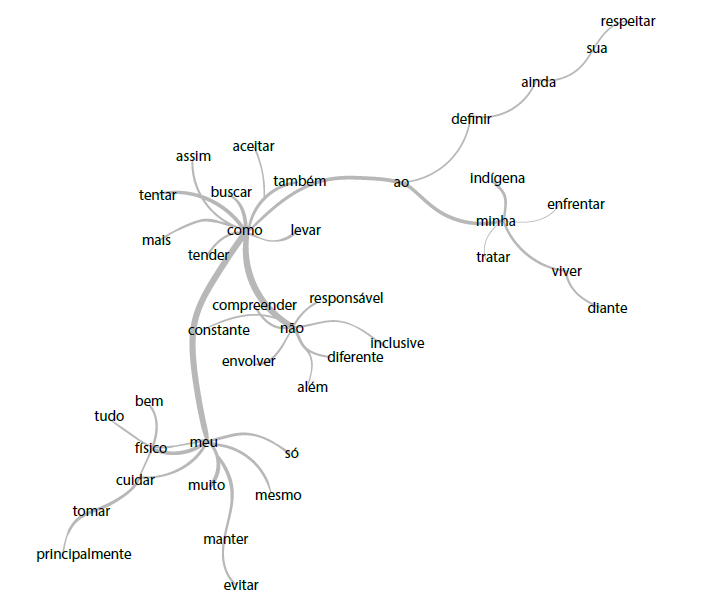
| Conteúdo temático 1: [...] o que ficou da pandemia em relação a minha saúde foi a necessidade de cuidado, que representou ter precaução para lidar com a escassez de recurso na comunidade indígena (H9); mesmo com todas as dificuldades que eu e o meu povo enfrentam, tento me manter em segurança, cumprindo com os resguardos que aprendi na minha comunidade indígena (H14); ter contato com a natureza, que vem sendo tão destruída, diminuindo os nossos espaços de proteção da saúde (H17); [...] vou tentando me livrar das doenças, cuidando com os alimentos que eu mesmo produzo (H36); [...] respirar ar puro (H37); [...] a alternativa que tive diante da pandemia foi tentar viver em paz na minha aldeia (H38); [...] como não posso contar de forma integral com as ações do governo, eu vou tentando manter o meu corpo em harmonia, buscando dormir bem, me alimentar bem, fazer exercícios físicos (H42); [...] cuidar da minha saúde foi essencial para a sobrevivência, principalmente, por se tratar de saúde indígena, que se vale do conhecimento ancestral e da purificação (H47); [...] foram momentos de atenção ao cuidado, a fim de observar atentamente o meu próprio corpo, o autoconhecimento, e, consequentemente, afastar as patologias (H50); [...] significou atenção para com os seres humanos e outros seres vivos, compreendendo que sou resultado das relações, em vários níveis, e, portanto, preciso ter e manifestar cuidado (H53); [...] da mata e da água do rio para me manter com saúde, consumindo os chás e as bebidas sagradas vindas das ervas (H54); [...] me cuidado diariamente, evitando bebidas, mantendo a casa limpa e organizada, bebendo água filtrada, cozinhando bem os alimentos e escovando os dentes (H57); cuidando da saúde em sinto que me faz bem, tanto fisicamente, quanto espiritualmente, que contribui para a normalidade do meu organismo, me fazendo viver bem, com boa disposição física e mental, deixando os dois andarem juntos, de forma síncrona e saudável, para me ajudar a enfrentar as dificuldades causadas pela pandemia (H65); [...] é uma luta constante, entre buscar estar saudável e não padecer nesta pandemia, pois sou afetado por vários problemas, como tentar consumir alimentos orgânicos, sem agrotóxicos, para o melhor funcionamento do meu corpo. É tentar ter um melhor acesso ao sistema de saúde, estar incluído nas políticas públicas, que muitas vezes se esquecem, assim como ter representatividade social, que repercute positivamente na manutenção do meu equilíbrio físico e psíquico (H66). |

 Indigenous masculinities and health: a qualitative analysis of traditional care in the context of the COVID-19 pandemic and post-pandemic period
 Thumbnail
 Fonte: Autores.