
 Health technologies in home care: concept analysis
Abstract
The aim is to analyze the concept of health technologies in home care. Concept analysis, guided by the Walker and Avant method, based on an integrative literature review. Eighty-one studies were selected, from which the attributes, antecedents and consequences of the concept were extracted and model, borderline and contrary cases were elaborated. The attributes found were knowledge applied to care; health communication resources; patient assistive products; electronic equipment and objects for adapting and monitoring the environment. The health needs of patients and improvements in the management and provision of care stood out as antecedents. Among the consequences, improvements in access, care, communication and management of data and/or information stood out. Health technology in HC revealed itself as applied knowledge, resources and communication strategies, objects, materials and equipment, electronic or not, used to monitor, adapt, generate information and interactions and assist, continuously, in person or remotely, in rehabilitation, recovery and/or maintenance of health.
Keywords:
Technology; Concept Formation; Home Care Services
Resumo
O objetivo é analisar o conceito de tecnologias em saúde na atenção domiciliar. Análise de conceito, orientada pelo método de Walker e Avant, operacionalizada a partir de revisão integrativa da literatura. Foram selecionados 81 estudos, destes foram extraídos os atributos, os antecedentes e os consequentes do conceito e elaborados casos: modelo, limítrofe e contrário. Os atributos encontrados foram conhecimentos aplicados para o cuidado; recursos de comunicação em saúde; produtos assistivos para o paciente; equipamentos eletrônicos e objetos para adaptações e monitoramento do ambiente. As necessidades de saúde dos pacientes e de melhorias na gestão e prestação dos cuidados destacaram-se como antecedentes. Dentre os consequentes, destacaram-se melhorias no acesso, cuidado, comunicação e gestão de dados e/ou informações. A tecnologia em saúde na AD revelou-se como conhecimentos aplicados, recursos e estratégias comunicacionais, objetos, materiais e equipamentos eletrônicos ou não, usados para monitorar, adaptar, gerar informações e interações e assistir, de forma contínua, presencial ou remota, na reabilitação, recuperação e/ou manutenção da saúde.
Palavras-chave:
Tecnologia; Formação de conceito; Serviços de Assistência Domiciliar
Resumo
El objetivo es analizar el concepto de tecnologías de salud en la Atención Domiciliaria (AD). Análisis de conceptos, guiado por el método de Walker y Avant, operacionalizado a partir de una revisión integradora de la literatura. Se seleccionaron 81 estudios, de los cuales se extrajeron los atributos, antecedentes y consecuencias del concepto y se elaboraron casos modelo, limítrofes y contrarios. Los atributos encontrados fueron conocimientos aplicados al cuidado; recursos de comunicación sanitaria; productos de asistencia para el paciente; Equipos y objetos electrónicos para adaptaciones y seguimiento del medio ambiente. Se destacaron como antecedentes las necesidades de salud de los pacientes y las mejoras en la gestión y prestación de la atención. Entre las consecuencias destacaron mejoras en el acceso, atención, comunicación y gestión de datos y/o información. La tecnología de la salud en la AD se reveló como conocimientos aplicados, recursos y estrategias de comunicación, objetos, materiales y equipos electrónicos o no electrónicos, utilizados para monitorear, adaptar, generar información e interacciones y ayudar, de manera continua, presencial o remota, en la rehabilitación, recuperación y/o mantenimiento de la salud.
Palavras clave:
Tecnología; Formación de conceptos; Servicios de atención domiciliaria
Introduction
Technology is a broad and polysemic term in the health field1,2. The World Health Organization (WHO) understands it as the application of knowledge and skills, using devices, medications, vaccines, procedures and the development of systems to deal with a health problem and improve populations’ quality of life. From this perspective, technology would be a set of devices that allow preventing and treating diseases, and rehabilitating people3-4.
For the Brazilian Ministry of Health, health technologies are represented by medications, materials, equipment and procedures, organizational, educational, information and support systems, programs and assistance protocols, through which healthcare and attention are provided to the population5.
Home care (HC) is part of Brazilian public health policies4, and is a type of care provided by the Unified Health System (In Portuguese, Sistema Único de Saúde - SUS) healthcare network. We have identified that this type of care is also offered in many countries around the world6. HC has the potential to produce ways of caring that permeate the projects of users, family members and the healthcare network, configuring new technical care arrangements7, and it has been evident that health technologies are significant in this context7-8.
It is understood that this innovative potential of HC is linked to the greater permeability of teams to the different aspects experienced by users and their families at home. Furthermore, it enables producing expanded care, capable of inducing technological innovations, characterized by the articulation of different knowledge and practices of users, family members or caregivers. From this perspective, HC can be configured as a field of work that enables producing and inventing care practices and assistance technologies7-8.
Since it involves care in a private environment, HC may require professionals to make some adaptations to provide care. Such adaptations may generate new technologies, since the purpose of this is, in principle, to meet social needs and become a way of reconfiguring the environment so that it contributes to care 9.
In HC, technology has often been associated with a set of knowledge and instruments that assist and favor the care process, whether with medications and materials or through professional care, with the aim of promoting or restoring health, thus presenting themselves as non-material technologies9.
This research is based on the premise that inventive and innovative creativity and the technologies present in the daily life of HC cannot, and should not, be reduced to static definitions. However, clarifying and presenting the concept of technologies in HC allows for a critical analysis of the different understandings associated with this term. This allows us to understand how health practices induce and are induced by technologies. We recognize that there are manifestations of technology, present in this context, that have not yet been explored.
The study of a concept provides a mental construction about a topic that represents a phenomenon, in order to build theoretical knowledge, elucidating its use in practice and favoring communication. It is common for a concept to vary over time, depending on the context10.
The process of analyzing a concept requires a scientific method that contributes to its clarification coherently11. This research chose the Walker and Avant framework, which understands that a concept can change over time and its analysis is never static. A solid concept clearly names the thing to which it refers, through a clear structure and a clear function12.
This framework has been used in scientific research to understand phenomena in different contexts of clinical practice12-15. However, no study was identified in the search for scientific productions that was dedicated to analyzing the concept of technologies in HC. Therefore, this research aimed to analyze the concept of health technologies in HC.
This study is timely, since the term is broad and can encompass different perspectives. It is expected that the clarification of the concept under investigation will favor its understanding and use in care practices, research and public policies.
Methodology
This is a conceptual analysis study, guided by the Walker & Avant12 framework, operationalized from an integrative literature review 17.
The theory applied in the study of the concept has as its main characteristic the exploration of a phenomenon. In this regard, the study of a concept consists of understanding which set of characteristics is frequently associated with it, i.e., phenomena that precede it and what the presence of the concept produces (consequents). To this end, a study of this nature must consider the attributes, also called defining characteristics, which are qualities or attributes capable of defining or referring to the event, i.e., they make the concept unique. Moreover, it needs to consider the antecedents, which are characterized or represented by events that occur before the existence or occurrence of the concept analyzed, and the concept consequents, which represent events or results of concept occurrence, locating it in its own phenomenon12.
To this end, this research adopted the following framework stages: 1 - selection of concept that will be the study’s object of analysis; 2 - establishment of analysis objectives; 3 - identification of possible concept uses; 4 - determination of attributes; 5 - identification of antecedents and consequents; 6 - elaboration of a model case; 7 - identification of an additional or contrary case; 8 - empirical evidence12.
The integrative literature review allowed identifying possible concept uses, and in this stage, the following stages were adopted: a) research problem identification and question elaboration; b) literature search based on search strategies; c) study assessment and stratification, methods used and data viability; d) data analysis, extraction and synthesis of results found; e) review presentation16.
To define the question that guided the literature search, the mnemonic PICo (Population, Phenomena of Interest, Context)17 was adopted. In the present study, Population refers to health technology; Phenomenon of Interest refers to the study of concept (attributes, antecedents and consequents); and Context refers to HC in the world. Thus, the question was: What are the attributes, antecedents and consequents of the concept of health technology in HC?
From a preliminary search in the literature, it was noticed that the descriptors “technology”, “home care services” and “concept formation” were frequent, which were adopted in this study. Literature search was carried out in four databases: Latin American and Caribbean Literature in Health Sciences (LILACS), PubMed, Embase and Web of Science (WoS).
Articles in Portuguese, English and Spanish were included. Articles that did not address the concept of “health technology” and/or the concept outside the context of HC services were excluded. Concerning time limit, documents published from 2007 onwards were considered, the year in which the WHO officially described the definition of health technology3.
The search was conducted between November 2021 and March 2022. A total of 8,275 files were found. After duplicates were excluded, studies were screened by two researchers independently, reading the title and abstract. Any discrepancies in screening were resolved in a meeting with a third researcher. From the initial analysis, 103 studies remained for analysis and full reading. After full reading, 81 articles, listed in the chart attached to this article, remained for concept analysis.
To extract the data, an electronic spreadsheet was created in Microsoft Office Excel 2019, consisting of the following fields: platform; original title; year; country of origin; context; article journal and main results; attributes defining the concept, antecedents, and consequents of the digital object identification (DOI). The information extraction process was carried out by two researchers independently and reviewed in a meeting with the research team for consensual definitions. The identified attributes, consequents, and antecedents constituted an extensive database, which underwent a careful separation process.
The instances that make up the concept were grouped according to the similarity of their nature as they were repeated in the observed contexts12. Grouping was carried out in periodic meetings among the researchers, and groups of characteristics were generated in each phase (attribute, consequent and antecedent), which represent the concept according to the similarity of terms found in included studies.
The analysis process to identify attributes, antecedents and consequents allowed developing model, borderline and contrary cases. A model case clearly and explicitly demonstrates all the essential attributes of the concept, being an evident example of what the manifestation of the concept in action is. A borderline case deals with an example that would apparently, superficially, be confused with the concept in everyday life, in order to make clear what the concept is and what cannot be considered as a concept representation. A contrary case expresses a situation in which no attribute is present, being the opposite of the model case12.
Results
The list of references that make up the database of this study is available in the material attached to this article and were coded as follows: letter A followed by a number corresponding to its identification in the text (e.g., A23, A24, A25, A26...). We started this coding with the number 23 because it is sequential to the references cited in this article, and this can favor the identification of the articles that made up the review.
The sample consisted of studies, which were quantified in parentheses (n), with the following distribution by country, such as United States of America (n29) A24-A50, Brazil (n13) A51-A58, Norway (n11) A59-A68, China (n8) A69-A75, Netherlands (n4) A76-A79, Switzerland (n4) A80-A83, United Kingdom (n2) A84,A85, South Korea (n2) A86,A87 and Australia (n2) A88,A89. And one study was identified in each of the following countries: Canada A90; Germany A91; Denmark A73; Slovenia A92; New Zealand A93; and Italy A94. In relation to the year of publication, there was a significant increase in studies in 2020. Among the selected studies, 17 included older adults A24, A25, A27, A29, A35, A36, A40, A62, A71, A73, A75, A82, A83, A86, A91, A92, A94 and with chronic diseases A27, A30, A31, A40, A83, A86, A92, A94, and three studies aimed to increase independence and postpone the admission of older adults to Nursing Homes A35, A73, A82. Among the included studies, 13 were carried out in situations involving technology-dependent children A30,A46,A50-A54,A66,A87,A90,A95; nine addressed chronic diseases, but the age range was not specified A47,A48,A52,A71,A72,A81,A83,A89,A93; and 16 addressed healthcare professionals working in HC (their perceptions, their difficulties) and/or their means of action (discussing, implementation of auxiliary devices such as websites, programs or specific platforms) A26,A27,A31,A32,A34,A37,A55,A59-A61,A63,A76,A80,A88,A93.
Article analysis allowed us to group the characteristics of attributes, according the similarity of their nature, into five categories, which sought to represent the phenomenon of technology in HC. Some studies were grouped into more than one category, as the authors mention the distinct characteristics related to technology in different ways, as shown in Chart 1. We clarify that the attributes related to the concept were extracted from all the articles analyzed, but in Chart 1 some examples of empirical evidence were chosen and presented that allow us to clarify the understanding of the attribute and its description.
By identifying the concept antecedents, it was possible to group them as shown in Chart 2.
When analyzing the consequents of the concept of technology in HC, it was possible to see that the presence of the concept generated many results. The variables analyzed were grouped according to the nature of the phenomena generated from the concept, as shown in Chart 3.
Chart 4 presents the three cases (model, borderline and contrary) designed to elucidate the concept “technologies in HC”.
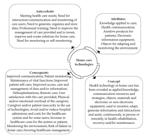
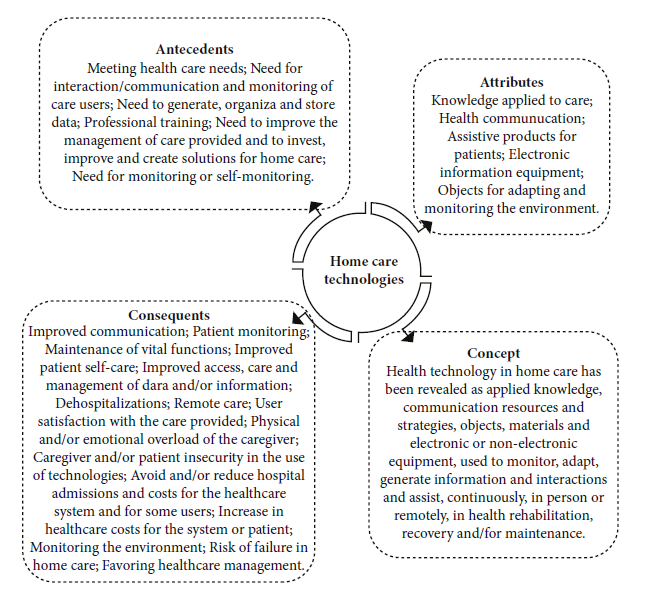
represents the attributes, antecedents and consequents found in this study and the concept developed.
Discussion
The analysis of the concept allowed us to identify the diversity of countries that produce evidence on the topic addressed. It was observed that this production is related to their population profile, with studies from developed countries being predominant. In these countries, population aging demands strategies to meet health needs, with HC being a care modalityA61. As in this investigation, other studies indicate that the prevalence of the population assisted by HC in the world is older adults and patients with chronic diseases, as well as children and adolescents dependent on technology due to the chronicity of vascular and/or neurological conditions15.
The analysis of attributes indicated that technologies in HC are significantly characterized by equipment, materials and/or electronics. Despite the important benefits that these components bring to innovation and improvements in HC care, it is not appropriate to reduce technologies to this single characteristic or adopt it as a synonym, given the dynamic, inventive and relational nature in which technologies are produced.
Assistive products for patients are attributes associated with technology to support them during health recovery. As for these products, their usage time varies according to individuals’ clinical condition. Some products, such as wheelchairs and crutches, can be part of patients’ routine for the rest of their lives. Others are installed temporarily, such as relief or delay tubes and feeding tubes. Thus, technologies in HC can be permanent or temporary. All of these products contribute to maintaining patients’ daily care, enabling and assisting in HCA79.
Electronic information equipment was found as an attribute and is represented by a set of physical devices capable of facilitating exchange of health information, such as telephones, webcams, computers, digital cameras and tablets. They enable data to be recorded and assistance to be requested in cases of health problems A61.
Knowledge applied to care is an attribute of HC technology, consisting of a set of actions, elaborations of critical thinking and practices. They are present in product and care management, execution of programs, development of techniques and procedures, creation and use of protocols and manuals. It is identified that there are different types of knowledge necessary to work in home settings. Among them, it is essential that professionals have the ability to combine scientific and popular knowledge 16-18.
It became evident that non-material technical-scientific knowledge, characterized as problem-solving skills, active listening and management skills, are also attributes of technologies in HC and were identified in the study 6,A24,A58. Studies show that the ability to apply different knowledge creatively is favorable for professionals’ performance in home settings, always maintaining professional perspective and holistic care 16-17-19.
The use of resources and strategies for health communication is another attribute of technologies in HC that allows assistance to be provided and recorded for continuity of care, regardless of distance, using instruments such as Telehealth, telemedicine, consumer health information technology applications and electronic health records. Data analysis allowed us to identify that during the COVID-19 pandemic, communication tools proved to be opportune and enabled communication, monitoring and the viability of healthcare, gaining notoriety for the significant contribution used to minimize risks to public health A99.
The attributes found when studying the concept under investigation express the etymological dimension of technologies, since “techno” comes from “techné”, which means know-how, and “logy” comes from “logos”, which means study and reason. Hence, technology expresses the reason for knowing how to do 20. These attributes also characterize technologies as social practices to the extent that it is within relationships, in their different contexts, that the senses, meanings and purposes of the use of technologies will configure care production at home.
Based on the results of this research and considering that studies 6-16 indicate that there is a health praxis in HC that composes a dialectical territory of reflections and actions on doing, knowing and knowing how to do, it is observed that there is potential for this space as a dynamic and historical territory for producing technologies that materialize in modes of operation involving professionals, family members and caregivers. In this regard, the defining attributes of technologies in HC highlight a set of devices, knowledge, communications and actions that characterize the concept under investigation.
Considering all of the above, it is identified that the attributes were shaped, adapted or created to enable meeting healthcare demands as well as to favor professionals’ work process. Thus, the meeting of healthcare needs was expressively evident as an antecedent of the concept under investigation.
Changes in the population, both in terms of age and health and illness, lead to creating means that can promote rehabilitation, therapy, assistance and well-being for individualsA61. However, HC is only possible through people and/or physical instruments capable of assisting in an extra-hospital reality and this was clear in the cases developed from the results of the present study of the concept.
The health needs that precede technology in HC vary according to patients’ conditions 21. Thus, technologies are generated or demanded not only by biological aspects, as in the case of children who depend on mechanical ventilation and professional counseling to maintain life, but also by environmental aspects. These situations are exemplified by the case of older adults who need to adapt the environment to facilitate access and monitoring by professionals, with the help of digital locks and/or to prevent injuries such as falls by means of security alarms and safety bars. Thus, the need to take care of health at home encourages creating the necessary means to provide care.
The need for interaction/communication and monitoring of professionals with care users was the second antecedent that stood out. Studies show that there are patients who have pathologies that require long treatment periods and need to be constantly monitored. The need to create technologies that enable these resources at home proved to be timely, allowing constant communication with the health team, providing safety for family members, dehospitalization and comfort during treatment A63,A80,A86. Interaction generated through technology requires an organization process so that the care provided is continuous and of high quality. Thus, the need to generate, organize and store data was also an antecedent identified.
HC and monitoring of patients requires data organization and storage so that they can be used by different professionals in different scenarios. As an example of this, we can mention the case of the Brazilian Ministry of Health, which, in order to organize and store information, implemented more than 37 Health Information Systems (HIS), with interfaces created to structure access, registration and exchange of information22 -23. In HC, a study addressed this organization in the creation of a software, Information System for Care Management in the Home Care Network (In Portuguese, Sistema de Informação para a Gestão do Cuidado na Rede de Atenção Domiciliar - SI GESCAD), which assists in the expanded clinic, in the coordination and continuity of care for patients in HCA98.
Data organization mechanisms can also be called health information technologies (HIT), which support decision-making in healthcare 22. HIT in home services are an opportune solution to meet the need to improve the management of the care provided; this was another antecedent identified and we understand that it contributes to expanding access to HIS through websites, applications and platforms to provide continuity in HC, including as support for the nursing team.
The need to invest, improve and create solutions is another precedent found when analyzing the concept of technologies in HC. Investments in strategies allow patients to seek information about their health and disease process, favor the monitoring of chronic patients and allow greater control of the health of older adults who live alone A86, A93. Improvement allows individuals to participate, and makes it necessary for them to be involved in their own health condition, through self-monitoring, so that they can maintain HC and take the necessary measures in complication casesA69.
Professional training proved to be a relevant antecedent, requiring caregiver training so that care can be provided at home, especially when it comes to complex devices such as feeding pumps, mechanical ventilators, and vital sign monitors. Considering the antecedents of technologies in HC, we identified the need to encourage developing something that favors structured provision of care for current conditions, which demands the presence of the concept studied. The presence of the “technological” phenomenon generates an impact on HC and consequences for both those who use it and those who will mediate care through it.
In relation to the consequents of technology in HC, we identified positive and negative impacts. The benefits arising from the presence of the concept in the home context were manifested in many studies through improved communication between users and professionals, facilitating continuity of care A45. Another benefit was the possibility of monitoring patients as well as the possibility of performing maintenance of vital functions and increasing self-care. Studies indicate that the adoption of technology contributes to the effectiveness of HC by encouraging co-responsibility for careA65, A69. A negative consequent of technology in HC is caregiver physical and/or emotional overload. Studies argue that taking full responsibility for the care of a person at home is a stressful factor A46. It is necessary to recognize that, in addition to the demand generated by care, additional technology, be it knowledge or equipment, for instance, can make the process more challenging, as they are additional demands imposed on the people who provide care at home. Added to this is the fact that non-material technology encompasses aspects such as care provision and care management A54, A87. In the health unit, this is done by qualified professionals who take turns providing care.
Providing technologies in HC, whether material or not, increases the costs for the system and patient, as discussed in some studies. Healthcare system costs are related to hiring qualified people for HC, carrying out training, using technologies implemented in the service and acquiring equipment for carrying out teleconsultations A29. In the same perspective, despite there being assistance from the public healthcare system, patients or their families often bear the costs of supplies and devices, as in some cases of children who depend on technology to surviveA57.
On the other hand, cost reduction for the healthcare system and for some users was also a consequent found. The care process in a family environment results in a reduction in the length of patient stay in the hospital, avoids unnecessary hospitalizations, and in some cases, such as older adults, delays the need for hospitalization in Nursing Homes, institutions that generate considerable costs for family membersA57.
Insecurity of using technology in HC by caregivers was also identified as a consequentA79. Caregivers are insecure about taking on care, even with health team support. Studies show that these challenges are linked to emotional aspects such as fear, worry and the lack of technical and scientific knowledge to deal with unforeseen eventsA53, A65,A76. Another negative consequent identified was failures in HC due to incorrect handling of materials or equipment that could compromise care provision, causing infections or incorrect monitoringA71, A79.
On the other hand, patient monitoring can become a favorable activity considering the use of technologies such as social robots that provide support in daily care, through appointment signaling, reminders to take medication and control of fluid balance. Studies show that such monitoring technologies can contribute to patient safety, independence and quality of life in their own homes, facilitating the logistics of careA61. Linked to this, environmental monitoring is also a strategy to assist in HC by providing information about changes in daily life activities and thus preventing domestic accidents and family stressA83.
Improvement in access, care and data and/or information management is also a consequent of technology in the home, as it enables the integration, sharing and access to patient data in the health network, facilitating the visualization of health history, the prescription of procedures and medications and the intersectoral interaction between pharmacies and places of care and/or consultationsA29, A36. In this context, such communication measures also enable the viability of remote care, as shown in some studies that portray depression treatment via videoconferencing, in addition to favoring care in areas that are difficult to accessA25, A74.
Dehospitalization was a positive consequent found because it was linked to reduced health complications. Studies report that the use of technologies in HC makes it possible to avoid and/or reduce the length of patient stay, especially in those with chronic diseases, by providing less exposure to external risks, disease management, decision-making and autonomy regarding careA78, A93.
Finally, improvement in user satisfaction with the care provided was also one of the consequents. The presence of the concept contributed to improving symptoms, maintaining health in cases of dependency, and increasing confidence in patients who live alone and in professionals who are able to monitor clinical progress more closelyA44, A78. The concept, whether in its material or non-material form, generally promoted health management in the healthcare network (In Portuguese, Rede de Atenção à Saúde - RAS) using the attributes combined or not, conveying knowledge through devices and software, favoring continuity and access to healthcare A29, A55.
Finally, we pointed out that the elaboration of cases was an exercise in trying to clarify how the concept “health technologies in HC” (model) manifests itself, when it can be confused with another situation because it is very similar (borderline) and another scenario in which the concept is not present because it does not have any of its attributes (contrary). These cases, although illustrative and fictitious, support the identification of the presence or absence of the attributes of health technologies in HC.
Based on the cases and evidence in this study, it is clear that the physical presence of supplies, medications, professionals as well as knowledge and communication resources are not enough to see the actual manifestation of the concept in its entirety. The intentionality and availability of professionals, caregivers and patients to establish interactions is a decisive aspect for providing recovery and/or life-sustaining care. This may indicate that the most powerful and innovative technology in the context of HC is human interaction.
Conclusion
This study made it clear that the attributes of health technologies in HC are knowledge applied to care, resources and strategies for health communication, assistive products for patients, electronic equipment and objects for adapting and monitoring the environment. Patients’ health needs and improvements in care management and provision stood out as antecedents. Among the consequents, improvements in access, care, communication and data and/or information management stood out.
The study of the concept, based on the adopted theoretical framework, indicated that health technologies in HC are revealed as applied knowledge, resources and strategies for health communication, objects, materials and electronic or non-electronic equipment, used to monitor, adapt, generate information and interactions and assist, continuously, in person or remotely, in health rehabilitation, recovery and/or maintenance.
We recognized that other databases, in addition to those included in the integrative review, and gray literature could provide additional information to this research, and this represents a limitation of this study. However, it is identified that the analysis of included articles allowed us to answer the integrative review question, study the concept in depth and achieve the proposed objective.
Acknowledgments
To CNPq for funding from a scientific and technological initiation grant.
References
- 1 Silva HP, Elias FTS. Incorporação de tecnologias nos sistemas de saúde do Canadá e do Brasil: perspectivas para avanços nos processos de avaliação. Cad Saude Publica 2019; 35(Supl.2):1-14.
- 2 Rajão FL, Martins M. Atenção Domiciliar no Brasil: estudo exploratório sobre a consolidação e uso de serviços no Sistema Único de Saúde. Cien Saude Colet 2020; 25:(5):1863-1877.
- 3 World Health Organization (WHO). Everybody's business strengthening health systems to improve health out comes who's framework for action. USA: WHO; 2007.
- 4 Brasil. Portaria no 825, de 25 de Abril de 2016. Redefine a Atenção Domiciliar no âmbito do Sistema Único de Saúde (SUS) e atualiza as equipes habilitadas. Diário Oficial da União; 2016; 25 abr.
- 5 Brasil. Portaria no 2510, de 19 de Dezembro de 2005. Institui Comissão para Elaboração da Política de Gestão Tecnológica no âmbito do Sistema Único de Saúde - CPGT. Diário Oficial da União, 2005; 19 dez
- 6 Feuerwerker LCM, Merhy EE. A contribuição da atenção domiciliar para a configuração de redes substitutivas de saúde: desinstitucionalização e transformação de práticas. Rev Panam Salud Publica 2008; 24:(3):180-188.
- 7 Silva KL, Braga PP, Silva AE, Lopes LFL, Souza TM. Discursos sobre tecnologias na atenção domiciliar: contribuições entre inovar, inventar e investir. Rev Gaúcha Enferm 2022; 43(1):1-11.
- 8 Palmira I, Zagonel S. Análise de Conceito: Um Exercício Intelectual em Enfermagem. Cogitare Enfer 1996; 1(1): 13-14.
- 9 Madureira VSF, Silva DMGV, Trentini M, Souza SS. Métodos de análise conceitual na enfermagem: uma reflexão teórica. Escola Anna Nery 2021; (2):1-7.
- 10 Euzebia V, Santos P, Barreto F, Chiavone T, Bezerril SR, Paiva RM, Ferreira LL, Dantas MNP. Concept Analysis Of The Safe Care Term In The Perspective Of Walker And Avant. New Trends in Qualitative Research 2019; (3):1-13.
- 11 Cláudia AF, Patrício A, Azevedo M, Ferreira M, Feitosa B, Santos TD. Análise de conceito da vulnerabilidade ao HIV/aids em mulheres profissionais do sexo. Rev. Eletr. Enf 2018; (4):1-18.
- 12 Wallker LO, Avant KC. Strategies for Theory Construction in Nursing. 6th edition. Boston: Pearson, Prentice Hall; 2019.
- 13 Firth K, Smith K, Sakallaris BR, Bellanti DM, Crawford C, Avant KC. Healing, a concept analysis. Glob Adv Health Med 2015; 4:44-50.
- 14 Bennett PN, Wang W, Moore M, Nagle C. Care partner: A concept analysis. Nurs Outlook 2017;65(2): 184-194.
- 15 Aromataris E, Munn Z. JBI Manual for Evidence Synthesis. Sydney: JBI; 2020.
- 16 Andrade AM, Braga PP, Lacerda MR, Duarte ED, Borges LHJ, Silva KL. Standards of knowledge that found nursing performance in home care. Texto Contexto Enferm 2020; 1(1):1-29.
- 17 Andrade AM, Silva KL, Seixas CT, Braga PP. Atuação do enfermeiro na atenção domiciliar: uma revisão integrativa da literatura. Rev Bras Enferm 2017; 210-219.
- 18 Björnsdóttir K. The place of standardisation in home care practice: an ethnographic study. J Clin Nurs 2014; 23(9-10)1411-1420
- 19 Lacerda MR. Tornando-se profissional no contexto domiciliar: vivência do cuidado da enfermeira [tese]. Florianópolis: Universidade Federal de Santa Catarina; 2000.
- 20 Pinto AV. O conceito de tecnologia. Ed Contraponto, organizador. 1.ed., Rio de Janeiro: Ed. Contraponto; 2005.
- 21 Freitas GC, Flores JA, Camargo Junior KR. "Necessidades de saúde": reflexões acerca da (in)definição de um conceito. Rev Bras Leprol 2022; 31(2):1-11.
- 22 Coelho GCN, Chioro A. Afinal, quantos Sistemas de Informação em Saúde de base nacional existem no Brasil?. Cad Saude Publica 2021; 37(7):1-10.

 Source: Prepared by the authors.