 Artificial neural network–based assessment and prediction of internal quality parameters of mango fruit cv. Timor
Abstract
Most existing techniques for assessing mango quality rely on biochemical analyses that destroy the fruit. This study evaluated and predicted the quality parameters of Timor mangoes using an artificial neural network (ANN) model. Data were collected from nine plantation sites in Gizan, Jazan Province, southwestern Saudi Arabia, over two growing seasons. The ANN model was configured with a 6-30-8 architecture and trained using 54 data patterns, while 18 patterns were used for testing. The input variables included peel weight, fruit length, fruit weight, fruit width, stone weight, and fruit firmness. The predicted output variables were ash content, pH, total soluble solids (TSS), titratable acidity (TA), vitamin C (VC), carotenoid content, total sugar content (TSC), and reducing sugar content (RSC) in mango juice, representing key internal quality attributes. The ANN model demonstrated satisfactory predictive performance on the testing dataset, with coefficients of determination (R2) of 0.9537, 0.9807, 0.9892, 0.9894, 0.9912, 0.9928, 0.9779, and 0.8436, respectively, for the output variables following the aforementioned sequence. These findings indicate that the proposed ANN-based approach is an effective, nondestructive tool for predicting internal mango quality attributes at harvest.
Keywords:
chemical characteristics; computer vision; mathematical modeling; nondestructive; physical characteristics; prediction model
Introduction
The majority of mango cultivars are consumed fresh because of their desirable flavor, aroma, texture, and overall eating quality. Internal and external fruit characteristics, including size, shape, and appearance, vary considerably among cultivars. Morphological traits such as fruit length, fruit width, fruit weight, and stone weight are commonly used to characterize mango fruit. Recently, increasing attention has been directed toward nondestructive fruit quality assessment methods because of the growing demand for accurate and efficient quality evaluation (Kishore et al., 2024).
Numerous studies have explored nondestructive techniques for fruit quality assessment using a variety of instruments and sensing technologies (Jha et al., 2011). However, many of these devices are expensive, limiting their practical application in commercial production systems. Consequently, there is a need for quantitative approaches that can reliably estimate mango fruit quality using readily measurable characteristics (Shi et al., 2021). In addition, most conventional assessment methods are labor-intensive, time-consuming, and destructive in nature (Lamptey et al., 2023). Therefore, the development of mathematical models and artificial intelligence–based tools capable of quantifying fruit quality attributes and supporting quality improvement decisions is of considerable interest (Ozdemir, 2025). Although multiple linear regression is more effective than simple linear regression for predicting dependent variables from multiple predictors, its ability to model complex nonlinear relationships is limited because it assumes a predefined linear relationship among variables (Emamgholizadeh et al., 2015).
An artificial neural network (ANN) is an information-processing model inspired by the structure and functioning of the human brain’s neural network (Saffari et al., 2009). An ANN typically comprises three layers: an input layer, one or more hidden layers, and an output layer (Tracey et al., 2010). These layers comprise interconnected neurons that process information through weighted connections. Each neuron performs a relatively simple function, while the collective network is capable of modeling complex relationships among variables. One of the major advantages of ANNs can adapt to different datasets, improve predictive performance, and model highly nonlinear relationships. As a result, they have become valuable tools for handling large datasets, reducing computational time, and solving complex prediction problems across a wide range of applications.
In recent years, ANNs have been increasingly applied in agricultural research for the prediction and assessment of fruit quality parameters. For example, Torkashvand et al. (2017) developed an ANN model based on the mineral composition of kiwi fruit to accurately predict fruit firmness. Similarly, Utai et al. (2019) used image-processing techniques to extract mango fruit characteristics, including length, width, thickness, and projected area, and employed these variables as inputs for an ANN model to estimate fruit mass. In another study, Schulze et al. (2015) measured the length, width, and thickness of Nam Dokmai mangoes and compared three approaches for fruit mass estimation: ANN, multiple linear regression, and simple linear regression. Their results demonstrated superior predictive performance of the ANN model. Alternative modeling approaches have also been explored for fruit quality prediction. For instance, Ulya & Chamidah (2021) investigated the use of multipredictor local polynomial regression to predict mango juice pH and reported high predictive accuracy with a low mean absolute percentage error. Furthermore, several studies (Lan et al.,2020; Huang et al., 2021; Al-Saif et al., 2022) have confirmed the effectiveness and reliability of ANN models for estimating fruit quality attributes across different fruit crops. These findings highlight the potential of ANN-based approaches as robust tools for nondestructive fruit quality assessment and prediction.
To provide a good indicator of mango quality for market distribution, this study evaluated the ability of an ANN model to predict key internal quality parameters of mango juice, including carotenoid content, vitamin C content, titratable acidity, pH, total soluble solids, ash content, total sugar content, and reducing sugar content. In addition, the study examined the effects of fruit weight, peel weight, stone weight, fruit length, fruit width, and fruit firmness on these quality attributes.
Material and Methods
Experimental site and plant materials
The study was conducted in nine mango orchards located in Gizan, Jazan Province, southwestern Saudi Arabia. Latitude and longitude coordinates of the study area are 17°10′25.743′′N and 42°42′27.399′′E, respectively. Data were collected over two consecutive growing seasons, with the first season conducted in 2023 and the second in 2024.
Description of the experimental procedures
This study aimed to evaluate and predict the quality parameters of Timor mango (Mangifera indica L.) fruit. Data were collected concurrently from nine mango orchards in Gizan, Jazan Province, southwest Saudi Arabia over two consecutive growing seasons.
The experimental orchards comprised 10-year-old Timor mango trees planted at a spacing of 8 m × 8 m in sandy loam soil with a pH ranging from 7.8 to 7.9. Trees were irrigated using a drip irrigation system comprising two lateral lines and four emitters per tree, each with a discharge rate of 8 L/h. Management practices differed among orchards because cultivation decisions were made independently by the growers. Variations were observed in irrigation, soil cultivation, pruning, fertilization, and pest management practices. In particular, fertilizer type, application timing, and application rate differed across orchards. During each growing season, field surveys were conducted to select representative trees and collect data required to achieve the study objectives. From each orchard, four trees were selected for sampling based on their uniform growth, consistent development, and absence of visible nutrient deficiency symptoms. Field assistants assisted with tree selection and sample collection, whereas all laboratory analyses were conducted by the authors. The physical characteristics measured for each mango sample included fruit length, fruit width, fruit firmness, fruit weight, peel weight, and stone weight. Chemical analyses were performed to determine ash content, titratable acidity (TA), total sugar content (TSC), total soluble solids (TSS), vitamin C content (VC), pH, carotenoid content, and reducing sugar content (RSC) using appropriate laboratory equipment and analytical procedures.
Measurements of the physical and chemical characteristics of mango samples
Fruit samples from each selected tree were harvested during the third week of April in both growing seasons after reaching full maturity. The samples were transported to the laboratory of the Plant Production Department, College of Food and Agriculture Sciences, King Saud University, Saudi Arabia, where physical and characteristics analyses were performed.
Fruit weight, peel weight, and stone weight were measured using a digital balance (Mettler Toledo, Switzerland) with an accuracy of 0.0001 g. To determine stone and pulp weights, the stone was separated from the pulp, and both components were weighed individually. Peel weight was calculated using the following equation (Dola et al., 2019):
Fruit length and fruit width were measured using a digital caliper (Mitutoyo, Kawasaki, Japan). Fruit length was determined from the base to the tip of the fruit. Fruit firmness (lb/inch2) was measured using a pressure tester equipped with a 5/16-inch plunger, with two readings obtained from opposite sides of each fruit. After the physical measurements were completed, the pulp from the remaining samples of each replicate was extracted and used for chemical characteristics. Eight chemical characteristics representing the internal quality parameters (IQPs) were evaluated: ash content, TSS, TA, VC, pH, carotenoid content, TSC, and RSC.
Ash content was determined according to the AOAC method (AOAC, 2019). TSSs were measured using a hand-held refractometer (Atago, Tokyo, Japan) by placing one or two drops of a well-mixed sample onto the refractometer prism. Titratable acidity, expressed as grams of citric acid per 100 mL of juice, was determined according to the AOAC method. The pH of the fruit pulp was measured using the filtered juice remaining after the titratable acidity analysis with a glass electrode pH meter (GLP 21, Crison, Barcelona, Spain). Vitamin C (ascorbic acid) content was determined using the AOAC standard method based on 2,6-dichloroindophenol dye titration, with metaphosphoric acid used for standardization, and expressed as mg ascorbic per 100 g fresh weight. Total carotenoid content was determined according to the method described by Ranganna et al. (1999). Absorbance was measured at 450 nm using hexane as a blank, and carotenoid concentration was expressed as µg/100 mL. Total sugar content was determined using the phenol–sulfuric acid method described by Malik & Singh (1980). Reducing sugar content was measured colorimetrically using the Lane and Eynon method as described by Egan et al. (1981), and absorbance was measured at 540 nm.
Development of an ANN model for prediction of mango IQPs
A standard feedforward neural network with supervised learning was developed to predict mango IQPs. The optimal ANN architecture was determined using a multi-layer perceptron (MLP) module implemented in commercial software (Qnet v2000 for Windows; Vesta Services Company, USA). The MLP model was trained using a backpropagation algorithm, in which network weights and biases were iteratively adjusted to minimize the error function. Although MLP models can comprise multiple hidden layers, previous theoretical and practical studies have shown that a single hidden layer is sufficient for approximating nonlinear functions (Gencel et al., 2011). Therefore, a single hidden-layer MLP was used in this study. The number of neurons in the hidden layer was determined using a trial-and-error approach.
A single dataset was generated by combining data from first and second growing seasons to develop the ANN model for predicting mango quality parameters. The input variables comprised easily measurable fruit characteristics, including peel weight, fruit width, fruit weight, fruit length, stone weight, and fruit firmness. The output variables represented the mango IQPs, including total sugar content, ash content, pH, total soluble solids, titratable acidity, carotenoid content, vitamin C content, and reducing sugar content. Data normalization and model simulation were performed using Qnet v2000 software (Vesta Services Company, USA). Input and output variables were normalized within the range of 0.15–0.85 using the software to improve training efficiency and prediction accuracy of the ANN model. Data normalization ensures that all variables are represented on a comparable scale, which improves numerical stability, accelerates convergence, and prevents variables with larger numerical values from disproportionately influencing the learning process. The same normalization parameters were applied consistently to both the training and testing datasets to ensure reproducibility. The normalization process was performed using the following equation:
Where:
V represents the original input or output value;
Vmax and Vmin represent the maximum and minimum values of the corresponding dataset, respectively, and
NV represents the normalized value. The maximum and minimum normalized values were set as NVmax = 0.85 and NVmin = 0.15, respectively.
The dataset was divided into training and testing subsets for ANN model development. A total of 54 data points (75%) were randomly selected by the Qnet v2000 software for model training, while the remaining 18 data points (25%) were used for testing. After evaluating different network configurations, an ANN architecture with a single hidden layer was selected. The input layer comprised six neurons representing fruit weight, peel weight, stone weight, fruit length, fruit width, and fruit firmness. The number of neurons in the hidden layer was optimized by testing configurations ranging from 2 to 50 neurons. Sigmoid and hyperbolic tangent activation functions were evaluated, and the initial weights and biases were randomly assigned. The ANN model was trained for 100,000 iterations and achieved a training speed of 45329 K, during which the network adjusted neuron weights and biases to minimize prediction errors (Brandic et al., 2022). The final optimized network comprised a single hidden layer with 30 neurons, an input layer with 6 neurons, and an output layer with 8 neurons, with a sigmoid activation function. This architecture was selected based on repeated trials (100,000 iterations) and adjustments of network parameters. The network structure and training control parameters are presented in Figure 1.

Network structure and training control parameters of the ANN model with a 6-30-8 architecture.
After completion of the prediction process, the software reverse-scaled the predicted values to their original units. The schematic representation of the ANN-based prediction model with a 6-30-8 architecture is presented in Fig. 2. The selected architecture reflects 6 input variables and 8 output parameters, while the 30 neurons in the hidden layer were determined using a systematic trial-and-error approach to achieve an optimal balance between prediction accuracy and model complexity. Several networks with different hidden-layer sizes were evaluated, and the selected architecture demonstrated superior performance based on error metrics, coefficient of determination, and convergence behavior using the validation dataset, without evidence of overfitting.

Performance criteria
The performance of the developed ANN model was evaluated using several statistical indicators, including the coefficient of determination (R2), mean absolute error (MAE), mean absolute percentage error (MAPE), and root mean square error (RMSE). These evaluation metrics were calculated using the following equations (Sammen et al., 2023; Tsae et al., 2023):
Where:
represents the predicted value,
Pq represents the observed value, and
Ntt represents the total number of samples in the training and testing datasets. According to Qazi et al. (2015), a MAPE value between 10% and 20% indicates good predictive performance, while a MAPE value of <10% indicates excellent prediction accuracy.
Sensitivity analysis
Sensitivity analysis, also referred to as contribution analysis, is a valuable approach for identifying the influence of input variables on the outputs of an ANN model (Nov & Peansupap, 2020). This analysis is applied to trained ANN models to determine the relative contribution of each input variable to the predicted outputs. In this study, the contribution percentages of input variables were determined using the input node interrogator option in Qnet v2000 software. This approach calculates the influence of individual inputs by repeatedly evaluating the trained network while varying each input variable and analyzing the resulting changes in model output. The contribution percentage method provides an indication of the relative importance of each predictor variable within the ANN model. Notably, the interpretation of contribution percentages assumes that the input variables are considered independently. Therefore, the obtained contribution values represent the relative influence of each input variable on model predictions rather than direct causal relationships. The calculation procedure for contribution analysis was performed according to the method described by Al-Dosary et al. (2023).
Results and Discussion
Physical properties of mango fruit
The physical characteristics of mango samples were evaluated based on fruit weight, peel weight, stone weight, fruit length, fruit width, and fruit firmness. These attributes are important quality indicators because fruit size and appearance can influence consumer preference and market demand (Prabhu & Shobha Rani, 2023). Considerable variations were observed among plantation sites and growing seasons for all measured physical characteristics, which were used as input variables in the ANN model (Figs. 3 and 4).

Variation in the investigated input variables of selected mango (Mangifera indica L. cv. Timor) samples from different plantation sites during the first growing season

Variation in the investigated input variables of selected mango (Mangifera indica L. cv. Timor) samples from different plantation sites during the second growing season
During the first growing season, Site-1 recorded the highest mean values for fruit weight (396.23 g), peel weight (41.50 g), stone weight (54.88 g), fruit length (13.87 cm), and fruit width (7.97 cm). However, the highest fruit firmness value was observed at Site-9 (18.51 lb/in2). In the second growing season, Site-1 again showed the highest mean values for fruit weight (388.52 g), peel weight (41.20 g), stone weight (53.37 g), fruit length (13.94 cm), and fruit width (7.98 cm), while fruit firmness reached its highest value at Site-1 (18.99 lb/in2).
Although differences in agricultural practices may have contributed to the observed variation among plantation sites, orchard management practices can influence fruit development and structural characteristics (Ngereza & Pawelzik, 2016). According to Ngereza & Pawelzik (2016), mango fruits weighing 500–700 g are classified as medium to large. By contrast, the average fruit weight observed in the present study ranged from 348.52 to 358.88 g across the first and second growing seasons, respectively, indicating that the evaluated Timor mango fruits were categorized as small-sized fruits.
As shown in Figs. 5 and 6, all investigated output variables of the ANN model varied among plantation sites. Fruit quality is an important factor influencing market value because it affects both fruit price and consumer acceptance (Ramjan & Ansari, 2018). In addition to its commercial importance, mango is recognized for its nutritional value and health benefits due to its bioactive compounds and essential nutrients. The energy content of mango pulp ranges from 60 to 190 kcal (250–795 kJ) per 100 g, highlighting its importance as a nutritious component of the human diet (Maldonado-Celis et al., 2019). In the first growing season, the measured ranges of ash content, pH, TSS, TA, VC content, carotenoid content, TSC, and RSC were 0.42%–0.69%, 3.77–4.87, 17.80%–22.46%, 0.43%–0.92%, 29.18–38.70 mg/100 g, 5708–89992.04 µg/100 mL, 15.61%–19.99%, and 6.20%–8.31%, respectively. In the second growing season, the corresponding ranges were 0.44%–0.70%, 3.85–5.01, 20.10%–23.17%, 0.38%–0.89%, 29.75–37.82 mg/100 g, 5823–9105.69 µg/100 mL, 15.40%–20.27%, and 6.60%–8.10%, respectively.

Variation in the investigated output variables of selected mango (Mangifera indica L. cv. Timor) samples from different plantation sites during the first growing season.

Variation in the investigated output variables of selected mango (Mangifera indica L. cv. Timor) samples from different plantation sites during the second growing season
The observed variations in fruit quality parameters may be associated with differences in agricultural practices among plantation sites. Furthermore, significant differences were observed among plantation locations for all evaluated fruit quality parameters. Tharanathan et al. (2006) reported ash contents ranging from 0.34 to 0.52 g per 100 g of mango fruit on a dry weight basis, which is comparable to the values observed in the present study. Similarly, Maldonado-Celis et al. (2019) reported vitamin C contents ranging from 13.2 to 92.8 mg per 100 g of edible mango fruit. As a climacteric fruit, mango continues to undergo ripening after harvest due to increased respiration and ethylene production, which contributes to changes in its physicochemical characteristics (Tharanathan et al., 2006).
The findings of the present study are consistent with previous reports demonstrating significant differences in physicochemical fruit quality attributes among mango cultivars. Based on differences in cultivation and management practices across production regions and countries, several studies have shown that mango varieties exhibit considerable variation in fruit quality parameters (Rahman et al., 2024; Pérez-Meza et al., 2024; Ulya et al.,2024).
Performance evaluation of the developed ANN model
The developed ANN model provided accurate predictions of the target mango IQPs. The developed ANN architecture comprised six input variables and eight output variables corresponding to the investigated IQPs. ANN models have increasingly been recognized as effective tools for solving complex nonlinear problems in agricultural applications. Previous studies have demonstrated that ANNs can successfully predict internal fruit quality characteristics (Saxena et al., 2024).
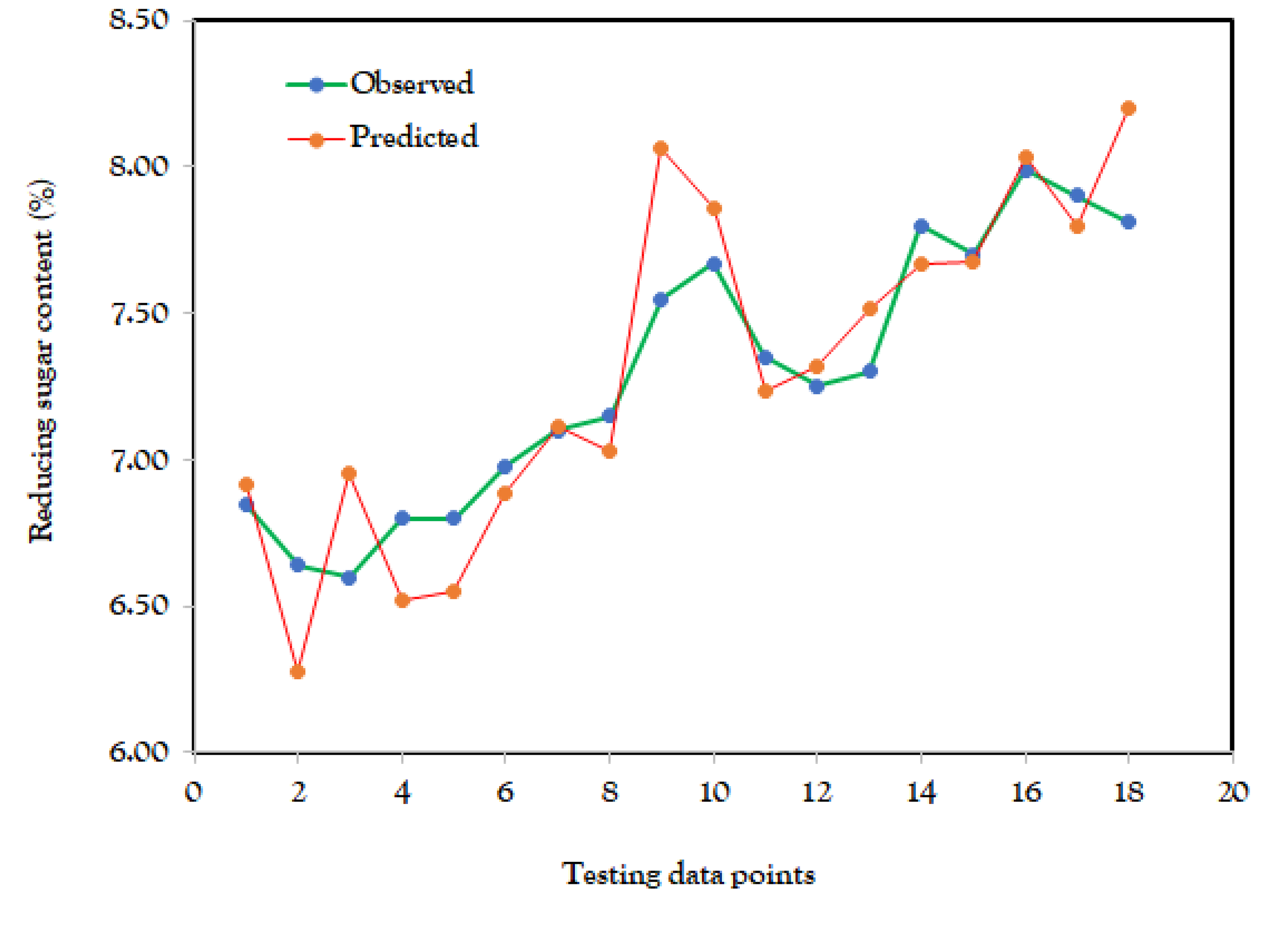
In this study, a feedforward backpropagation ANN model with a sigmoid transfer function in the hidden and output layers and a 6-30-8 architecture was evaluated for predicting carotenoid content, vitamin C content (VC), titratable acidity (TA), pH, total soluble solids (TSS), ash content, total sugar content (TSC), and reducing sugar content (RSC) of mango fruit. The performance evaluation criteria obtained from the Qnet v2000 software after the training and testing stages are presented in Table 1. As shown in Table 1, the predicted values generated by the developed ANN model showed strong agreement with the observed values for the investigated quality parameters. The coefficient of determination (R2) values ranged from 0.9815 to 0.9964 during the training stage and from 0.8436 to 0.9928 during the testing stage, indicating a high level of predictive performance. The bias values presented in Table 1 further supported the reliability of the model prediction. For the testing dataset, the ANN model achieved low RMSE, MAE, and MAPE values. In particular, the MAPE values were <10%, indicating excellent prediction accuracy according to Qazi et al. (2015). Previous studies in fruit quality assessment have similarly demonstrated the effectiveness of ANN models and deep learning approaches for predicting fruit quality attributes (Huang et al., 2021; Abdel-Sattar et al., 2021; Ren et al., 2020; Aherwadi et al., 2022; Huang et al., 2022; Zárate & Hernández, 2024). The selection of an appropriate modeling approach is essential for developing reliable prediction models capable of addressing complex agricultural applications (Eftekhari et al., 2018). Because of the relatively lower variability in reducing sugar content, this parameter showed a lower R2 during the testing phase. Fig. 7 illustrates the relationship between predicted and observed reducing sugar content values, with an R2 of 0.8436, indicating some variation between the predicted and measured values. Fig. 8 further presents the comparison between predicted and observed reducing sugar content values across different testing samples, allowing the magnitude of prediction deviations to be visualized and the samples with greater differences to be identified. The differences between observed and ANN-predicted values may be attributed to various physiological and management-related factors affecting mango growth, maturation, and postharvest behavior. Horticultural products naturally exhibit biological variability because fruit quality is influenced by environmental conditions, orchard management practices, and metabolic changes during ripening (Léchaudel et al., 2006). Therefore, some discrepancies between measured and predicted values are expected, even when highly accurate prediction models are developed. According to the contribution analysis (Table 2), fruit width showed the highest contribution to reducing sugar content, accounting for 28.03% of the model input contribution. However, further investigation is required to determine whether this relationship reflects a direct physiological effect or an association with other growth and management factors.
Statistical performance criteria of the developed ANN model for the investigated quality parameters during the training and testing stages.


Relationship between predicted and observed reducing sugar content values across different testing data points.
Based on the high predictive accuracy observed during both training and testing stages, the developed ANN model demonstrated strong potential for predicting the IQPs of Timor mango fruits. Accurate prediction of mango IQPs can support quality evaluation, selection of superior fruit samples, and decision-making in commercial and research applications by enabling more efficient assessment of fruit quality parameters.
The ANN model successfully predicted and assessed the internal quality parameters of Timor mango fruit with high accuracy (Table 1). Compared with conventional statistical and empirical modeling approaches, ANNs provide advantages in representing complex, nonlinear, and multidimensional relationships among physiological, metabolic, and environmental factors (Shams et al., 2021). The predictive performance observed in this study may be attributed to the ability of ANN models to identify hidden patterns within experimental datasets without requiring predefined assumptions regarding data distribution or variable interactions (Haykin, 2009).
Sensitivity analysis
In ANN models, sensitivity analysis or contribution analysis is a useful approach for understanding the relationship between input variables and model outputs (Davoudi Kakhki et al., 2019). This analysis evaluates the influence of each predictor (independent variable) on the predicted outputs of the ANN model (Pianosi & Wagener, 2015). In the present study, the contribution percentages of the input variables, including fruit weight, stone weight, fruit width, peel weight, fruit length, and fruit firmness, to predicted mango IQPs (carotenoid content, VC content, TA, pH, TSS, ash content, TSC, and RSC) were determined using the optimized ANN model. The results for Timor mango are presented in Table 2. Higher contribution percentages indicate greater influence of the corresponding input variable on the model output. The sensitivity analysis results indicated that peel weight had the highest contribution to ash content and pH, with contribution percentages of 22.68% and 22.84%, respectively. Stone weight showed the highest contribution to TSS, with a contribution of 28.68%. Fruit length contributed most strongly to carotenoid content and total sugar content, with contribution percentages of 45.17% and 27.39 %, respectively. Fruit width showed the highest contributions to VC content and TA, with contribution percentages of 30.52% and 28.15%, respectively. The relatively high contribution of fruit length (45.17%) indicates its importance within the set of input variables evaluated by the ANN model; however, it does not necessarily represent a direct causal relationship with carotenoid accumulation. The association between fruit length and carotenoid content may be related to broader fruit developmental processes, including maturity and biomass accumulation, which can influence internal biochemical changes during fruit development.
The sensitivity analysis provided deeper insights into the relationships between the ANN input variables and the predicted mango fruit quality attributes, including ash content, pH, TSS, TSC, TA, carotenoid content, VC, and RSC (Table 2). The contribution percentages indicated the relative influence of the input variables, including fruit weight, peel weight, stone weight, fruit length, fruit width, and fruit firmness, on the predicted quality attributes. The observed sensitivity patterns provide information on the factors associated with variation in mango fruit quality under different environmental and management conditions. This interpretation enhances the biological relevance of the ANN model results and supports the potential application of the proposed approach for nondestructive mango quality assessment and management decision-making.
The higher contribution percentages of fruit weight, peel weight, stone weight, fruit length, fruit width, and fruit firmness to the predicted quality parameters of Timor mango (Mangifera indica L.) may be associated with their relationship with fruit development and maturation processes. However, these contribution values represent the relative influence of the input variables within the ANN model and do not necessarily indicate direct physiological effects. Gianguzzi, et al. (2021) reported that mango fruits allowed to remain on the tree until physiological maturity achieved improved quality characteristics, highlighting the importance of maturity stage in determining fruit quality.
Conclusions
This study evaluated the use of morphological characteristics, fruit firmness, and IQPs to assess the quality of Timor mango (Mangifera indica L.) fruits collected from nine plantation sites with different agricultural practices. An ANN model was developed to predict mango IQPs, and the predicted values were compared with experimentally measured values. The developed ANN model demonstrated strong predictive performance, with high R2 values for ash content, pH, vitamin C content, TSSs, titratable acidity, carotenoid content, total sugar content, and reducing sugar content. Although the proposed measurement approach and ANN-based prediction model showed considerable potential for estimating mango IQPs, some limitations remain. The relatively small dataset (72 samples) used for model development may limit the generalizability of the model compared with studies using larger datasets. In addition, the model was developed using only one mango cultivar (Timor), and further validation is required before applying the approach to other mango cultivars. Integrating the ANN model with real-time mechanical, electronic, or machine vision–based systems for automated feature extraction may provide a rapid and practical approach for mango quality assessment. This integration could reduce the number of required input parameters while maintaining high prediction performance and supporting efficient nondestructive quality evaluation.
Acknowledgements
The authors would like to extend their sincere appreciation to the Ongoing Research Funding Program, (ORF-2026-707), King Saud University, Riyadh, Saudi Arabia.
References
- Abdel-Sattar, M., Al-Obeed, R. S., Aboukarima, A. M., & Eshra, D. H. (2021). Development of an artificial neural network as a tool for predicting the chemical attributes of fresh peach fruits. PLoS One, 16(7), e0251185.
- Aherwadi, N., Mittal, U., Singla, J., Jhanjhi, N. Z., Yassine, A., & Hossain, M. S. (2022). Prediction of fruit maturity quality and its life using deep learning algorithms. Electronics, 11(24), 4100.
-
Al-Dosary, N. M. N., Alnajjar, F. M., & Aboukarima, A. M. (2023). Estimation of wheel slip in 2WD mode for an agricultural tractor during plowing operation using an artificial neural network. Scientific Report, 13, 5975. https://doi.org/10.1038/s41598-023-32994-7
» https://doi.org/10.1038/s41598-023-32994-7 -
Al-Saif, A.M., Abdel-Sattar, M., Eshra, D.H., Sas-Paszt, L., & Mattar, M.A. (2022). Predicting the chemical attributes of fresh citrus fruits using artificial neural network and linear regression models. Horticulturae, 8, 1016. https://doi.org/10.3390/horticulturae8111016
» https://doi.org/10.3390/horticulturae8111016 - Association of Official Analytical Chemists. (2019). Official method of analysis (21st ed.). AOAC.
-
Brandic, I., Pezo, L., Bilandžija, N., Peter, A., Šuri´c, J., & Vo´ca, N. (2022). Artificial Neural Network as a Tool for Estimation of the Higher Heating Value of Miscanthus Based on Ultimate Analysis. Mathematics, 10, 3732. https://doi.org/10.3390/math10203732
» https://doi.org/10.3390/math10203732 -
Davoudi Kakhki, F., Freeman, S.A. & Mosher, G.A. (2019). Evaluating machine learning performance in predicting injury severity in agribusiness industries. Safety Science 117, 257 - 262. https://doi.org/10.1016/j.ssci.2019.04.026
» https://doi.org/10.1016/j.ssci.2019.04.026 -
Dola, S.T. I., Islam, Md. S., Robbani, M., & Rahman, Md. S. (2019). Physico-chemical properties comparison between released varieties and local germplasm of sapota (Manilkara zapota). European Journal of Nutrition & Food Safety, 10(4), 273-283. https://doi.org/10.9734/EJNFS/2019/v10i430121
» https://doi.org/10.9734/EJNFS/2019/v10i430121 -
Eftekhari, M., Yadollahi, A., Ahmadi, H., Shojaeiyan, A., & Ayyari, M. (2018). Development of an artificial neural network as a tool for predicting the targeted phenolic profile of grapevine ( Vitis vinifera ) foliar wastes. Frontiers in Plant Science, 9, 837. https://doi.org/10.3389/fpls.2018.00837
» https://doi.org/10.3389/fpls.2018.00837 - Egan, H., Kirk, R. S., & Sawyer, R. (1981). Pearson's chemical analysis of foods (8th ed.). Churchill Livingstone.
-
Emamgholizadeh, S., Parsaeian, M., & Baradaran, M. (2015). Seed yield prediction of sesame using artificial neural network. European Journal of Agronomy, 68,89-96. https://doi.org/10.1016/j.eja.2015.04.010
» https://doi.org/10.1016/j.eja.2015.04.010 -
Gencel, O., Kocabas, F., Gok, M. S., & Koksal, F. (2011). Comparison of artificial neural networks and general linear model approaches for the analysis of abrasive wear of concrete. Construction and Building Materials, 25, 8, 3486 - 3494. https://doi.org/10.1016/j.conbuildmat.2011.03.040
» https://doi.org/10.1016/j.conbuildmat.2011.03.040 -
Gianguzzi, G., Farina, V., Inglese, P., & Rodrigo, M. G. L. (2021). Effect of harvest date on mango ( mangifera indica L. cultivar Osteen) fruit's qualitative development, shelf life and consumer acceptance. Agronomy, 11(4), 811. https://doi.org/10.3390/agronomy11040811
» https://doi.org/10.3390/agronomy11040811 - Haykin, S. (2009). Neural networks and learning machines (3rd ed.). Pearson Education
-
Huang, X., Wang, H., Qu, S., Luo, W., & Gao, Z. (2021).Using artificial neural network in predicting the key fruit quality of loquat. Food Science & Nutrition, 9(3),1780-1791. https://doi.org/10.1002/fsn3.2166
» https://doi.org/10.1002/fsn3.2166 -
Huang,X., Chen,T., Zhou,P., Huang, X., Dan Liu, D., Jin, W., Zhang, H., Zhou, J., Wang, Z., & Gao, Z. (2022). Prediction and optimization of fruit quality of peach based on artificial neural network. Journal of Food Composition and Analysis ,111, 104604. https://doi.org/10.1016/j.jfca.2022.104604
» https://doi.org/10.1016/j.jfca.2022.104604 -
Jha, S. N., Narsaiah, K., Sharma A. D., Singh, M., Bansal, S., & Kumar, R. (2011). Quality parameters of mango and potential of non-destructive techniques for their measurement - A review. Journal of Food Science and Technology, 47, 1-14. https://doi.org/10.1007/s13197-010-0004-6
» https://doi.org/10.1007/s13197-010-0004-6 -
Kishore, K., Kumar, D., Srivastava, K.K., Dwivedi, S.K., Mishra, D., Singh, A., Singh, N., Saroj, P., & Kumar, D. (2024). Evaluation of mango fruit quality in relation to harvest time in the subtropical region of India. Notulae Botanicae Horti Agrobotanici Cluj-Napoca, 52 (4), 14157. https://doi.org/10.15835/nbha52414157
» https://doi.org/10.15835/nbha52414157 -
Lamptey, F. P., Teye, E., Abano, E. E., & Charles L.Y. A. (2023). Application of handheld NIR spectrometer for simultaneous identification and quantification of quality parameters in intact mango fruits. Smart Agricultural Technology, 6,100357. https://doi.org/10.1016/j.atech.2023.100357
» https://doi.org/10.1016/j.atech.2023.100357 -
Lan, H., Wang, Z., Niu, H., Zhang, H., Zhang, Y., Tang, Y., & Liu, Y. (2020). A nondestructive testing method for soluble solid content in Korla fragrant pears based on electrical properties and artificial neural network. Food Science & Nutrition, 8(9), 5172-5181. https://doi.org/10.1002/fsn3.1822
» https://doi.org/10.1002/fsn3.1822 -
Léchaudel, M., Normand, F., & Génard, M. (2006). Predicting harvest dates and quality of mango (cv 'Cogshall') fruit according to environmental factors. In 8th International Symposium on Mango (pp. 1-5). https://agritrop.cirad.fr/540819/1/document_540819.pdf
» https://agritrop.cirad.fr/540819/1/document_540819.pdf -
Maldonado-Celis, M.E., Yahia, E.M., Bedoya, R., Landázuri, P., Loango, N., Aguillón, J., Restrepo, B., & Ospina, G. J.C. (2019). Chemical composition of mango ( Mangifera indica L) fruit: nutritional and phytochemical compounds. Frontiers in Plant Science, 10,1073. https://doi.org/10.3389/fpls.2019.01073
» https://doi.org/10.3389/fpls.2019.01073 - Malik, C. P., & Singh, M. B. (1980). Plant enzymology and histo-enzymology: A text manual. Kalyani Publishers.
- Ngereza, A. J. & Pawelzik, E. (2016). Nutritional characterization of organically and conventionally grown mango ( Mangifera indica L.) and pineapple ( Ananas comosus ) of different origins. Journal of Crop Science and Agronomy, 1 (1), 1-17.
-
Nov, P., & Peansupap, V. (2020). Using artificial neural network for selecting type of subcontractor relationships in construction project. Engineering Journal, 24 (1), 73-88. https://doi.org/10.4186/ej.2020.24.1.73
» https://doi.org/10.4186/ej.2020.24.1.73 -
Ozdemir, S. (2025). Effectiveness of generative AI tool to determine fruit quality: watermelon case study. Horticulturae, 11, 308. https://doi.org/10.3390/horticulturae11030308
» https://doi.org/10.3390/horticulturae11030308 -
Pérez-Meza, N. B., Ayala-Tafoya, F., Vélez-de la Rocha, R., López-Orona, C. A., Martínez-Gallardo, J. Á. & Muy-Rangel, M. D., San-Martín-Hernández, C. (2024). The nutritional, mineral, and nutraceutical quality is differentially affected by the mango cultivar. Horticulturae, 10, 1082. https://doi.org/10.3390/horticulturae10101082
» https://doi.org/10.3390/horticulturae10101082 - Pianosi, F., & Wagener, T. (2015). A simple and efficient method for global sensitivity analysis based oncumulative distribution functions. Environmental Modelling & Software, 67, 1-11.
-
Prabhu, A., & Shobha Rani, N. (2023). AMDPWE: Alphonso mango dataset for precision weight estimation. Data in Brief, 51,109778. https://doi.org/10.1016/j.dib.2023.109778
» https://doi.org/10.1016/j.dib.2023.109778 -
Qazi, A., Fayaz, H., Wadi, A., Raj, R. G., Rahim, N. A. & Khan, W. A. (2015). The artificial neural network for solar radiation prediction and designing solar systems: a systematic literature review. Journal of Cleaner Production ,104,1 - 12. http://dx.doi.org/10.1016/j.jclepro.2015.04.041
» http://dx.doi.org/10.1016/j.jclepro.2015.04.041 -
Rahman, K. S., Salehin, M. M., Roy, R., Swarna, J. B., Rakib, Md. R. I., Saha ,C. K. & Rahman, A. (2024). Prediction of mango quality during ripening stage using MQ-based electronic nose and multiple linear regression. Smart Agricultural Technology ,9, 100558. https://doi.org/10.1016/j.atech.2024.100558
» https://doi.org/10.1016/j.atech.2024.100558 - Ramjan, Md. & Ansari, M. T. (2018). Factors affecting of fruits, vegetables and its quality. Journal of Medicinal Plants Studies, 6(6): 16-18
- Ranganna, S. (1999). Handbook of analysis and quality control for fruits and vegetables products ( 2nd ed.) Tata McGraw-Hill Publishing Company.
-
Ren, A., Zahid, A., Zoha, A., Shah, S. A., Imran, M. A., Alomainy, A., & Abbasi, Q. H. (2020). Machine learning driven approach towards the quality assessment of fresh fruits using non-invasive sensing. IEEE Sensors Journal, 20(4), 2075 - 2083. https://doi.org/10.1109/JSEN.2019.2949528
» https://doi.org/10.1109/JSEN.2019.2949528 -
Saffari, M., Yasrebi, J., Sarikhani, F., Gazni, R., Moazallahi, M., Fathi, H. & Emadi, M. (2009). Evaluation of artificial neural network models for prediction of spatial variability of some soil chemical properties. Research Journal of Biological Sciences, 4(7), 815-820. https://doi.org/10.1115/1.4005245
» https://doi.org/10.1115/1.4005245 -
Sammen, S. S., Kisi, O., Ehteram, M., El-Shafie, A., Al-Ansari, N., Ghorbani, M. A., Bhat, S. A., Ahmed, A. N. & Shahid, S. (2023). Rainfall modeling using two different neural networks improved by metaheuristic algorithms. Environmental Sciences Europe, 35, 112. https://doi.org/10.1186/s12302-023-00818-0
» https://doi.org/10.1186/s12302-023-00818-0 -
Saxena, A., Kumar, S., Saxena, S., Deogaonkar, A., Goyal, A. & Goyal, S. (2024). Quality prediction of fruits using artificial neural network and its application in food science. In 8th International Conference on Electronics, Communication and Aerospace Technology (pp. 609-614). https://doi.org/10.1109/ICECA63461.2024.10800800
» https://doi.org/10.1109/ICECA63461.2024.10800800 -
Schulze, K., Nagle, M., Spreer, W., Mahayothee, B. & Müller, J. (2015). Development and assessment of different modeling approaches for size-mass estimation of mango fruits (Mangifera indica L., cv. 'Nam Dokmai'). Computers and Electronics in Agriculture, 114, 269-276. https://doi.org/10.1016/j.compag.2015.04.013
» https://doi.org/10.1016/j.compag.2015.04.013 -
Shams, S. R., Jahani, A., Kalantary, S., Moeinaddini, M. & Khorasan, N. (2021). The evaluation on artificial neural networks (ANN) and multiple linear regressions (MLR) models for predicting SO 2 concentration. Urban Climate, 37 (2021), 100837. https://doi.org/10.1016/j.uclim.2021.100837
» https://doi.org/10.1016/j.uclim.2021.100837 -
Shi, Y., Guo, J., Li, X., Guo, Y., Liu, Y. & Zhou, J. (2021). Research status and development trend of non-destructive testing technology and grading equipment for Hami melon. Packaging and Food Machinery, 39 (6), 75- 82. https://doi.org/ 10.3969/j.issn.1005-1295.2021.06.014
» https://doi.org/ -
Tharanathan, R. N., Yashoda, H. M. & Prabha T. N. (2006). Mango ( Mangifera indica L.), the king of fruits-an overview. Food Reviews International, 22, 95-123. https://doi.org/10.1080/87559120600574493
» https://doi.org/10.1080/87559120600574493 -
Torkashvand, A. M., Ahmadi, A. & Nikravesh, N. L. (2017). Prediction of kiwifruit firmness using fruit mineral nutrient concentration by artificial neural network (ANN) and multiple linear regressions (MLR). Journal of Integrative Agriculture ,16(7), 1634-1644. https://doi.org/10.1016/S2095-3119 (16)61546-0
» https://doi.org/10.1016/S2095-3119 (16)61546-0 -
Tracey, J. A., Zhu, J. & Crooks, K. R. (2010). Modeling and inference of animal movement using artificial neural networks. Environmental and Ecological Statistics, 18(3), 393-410. https://doi.org/10.1007/s1065 1-010-0138-8
» https://doi.org/10.1007/s1065 -
Tsae, N.B., Adachi, T. & Kawamura, Y. (2023). Application of artificial neural network for the prediction of copper ore grade. Minerals, 13, 658. https://doi.org/10.3390/min13050658
» https://doi.org/10.3390/min13050658 - Ulya, M., & Chamidah, N. (2021). Multi-predictor local polynomial regression for predicting the acidity level of Avomango (Gadung Klonal 21). AIP Conference Proceedings, 2329.
-
Ulya, M., Chamidah, N., & Saifudin, T. (2024). Mango quality prediction based on near-infrared spectroscopy using multi-predictor local polynomial regression modeling. F1000 Research, 12:656. https://doi.org/10.12688/f1000research.130015.2
» https://doi.org/10.12688/f1000research.130015.2 -
Utai, K., Nagle, M., Hämmerle, S., Spreer, W., Mahayothee, B. & Müller, J. (2019). Mass estimation of mango fruits (Mangifera indica L., cv. 'Nam Dokmai') by linking image processing and artificial neural network. Engineering in Agriculture, Environment and Food, 12 ,103-110. https://doi.org/10.1016/j.eaef.2018.10.003
» https://doi.org/10.1016/j.eaef.2018.10.003 -
Zárate, V. & Hernández, D.C. (2024). Simplified deep learning for accessible fruit quality assessment in small agricultural operations. Applied sciences, 14, 8243. https://doi.org/10.3390/app14188243
» https://doi.org/10.3390/app14188243
-
Data Availability Statement
The datasets generated during and/or analyzed during the current study are available from the corresponding author on reasonable request.
-
Funding
This research was funded by Ongoing Research Funding Program, (ORF-2026-707), King Saud University, Riyadh, Saudi Arabia.
Edited by
-
Area Editor:
Gizele Ingrid Gadotti
The datasets generated during and/or analyzed during the current study are available from the corresponding author on reasonable request.