 Nursing and climate change: generative artificial intelligence as a tool for critical training on climate justice
Abstract
Objective to reflect on the use of artificial intelligence in nursing training for critical, ethical, and adaptive action in response to the challenges posed by climate change.
Method a reflective essay aimed at delving into the complexity of the topic, exploring the concept of climate justice, supported by an ecosystemic approach and dialogues with Global South epistemologies, considering diverse worldviews.
Results the critical application of artificial intelligence is associated with epistemological disruption, adaptive learning, algorithmic biases, digital inclusion, ethical regulation, and data privacy, which can be dialogued in a critical, reflective, and purposeful way from the diversities of territories for social transformation and climate justice.
Conclusion and implications for practice the use of artificial intelligence enables formative solutions that can foster discussions on ethics, representation, and diversity in nursing practice. When strategically applied, these solutions can disrupt and contribute to epistemological transformation. Along this path, they point to intervention strategies that engage with diverse forms of knowledge and modes of resistance in territories, addressing climate change through innovative articulation.
Keywords:
Nursing; Nurses; Ethics; Artificial Intelligence; Climate Change
Resumo
Objetivo refletir sobre o uso da inteligência artificial na formação de profissionais de enfermagem para atuação de forma crítica, ética e adaptativa mediante os desafios impostos pelas mudanças climáticas.
Método ensaio reflexivo, para esmiuçar a complexidade do tema que explora conceito de justiça climática, suportado pela abordagem ecossistêmica e pelos diálogos com epistemologias do Sul Global considerando as diferentes visões de mundo.
Resultados a aplicação crítica da inteligência artificial está associada à ruptura epistemológica, aprendizado adaptativo, vieses algorítmicos, inclusão digital, regulação ética e privacidade de dados, que podem ser dialogados de forma crítica, reflexiva e propositiva, a partir das diversidades dos territórios para a transformação social e para a justiça climática.
Considerações finais e implicações para a prática o uso da inteligência artificial possibilita soluções formativas capazes de aflorar discussões sobre ética, representatividade e diversidade na atuação dos enfermeiros e enfermeiras que, se aplicadas de forma estratégica, podem romper e contribuir com a transformação epistemológica. Nesse percurso, elas apontam estratégias de intervenção que dialogam com diferentes formas de conhecimento e modos de resistir dos territórios em detrimento do enfrentamento perante as mudanças climáticas com articulação inovadora.
Palavras-chave:
Enfermagem; Enfermeiros e Enfermeiras; Ética; Inteligência Artificial; Mudanças Climáticas
RESUMEN
Objetivo reflexionar sobre el uso de la inteligencia artificial en la formación de profesionales de enfermería para actuar de manera crítica, ética y adaptativa ante los desafíos impuestos por el cambio climático.
Método ensayo reflexivo que profundiza en la complejidad del tema, explorando el concepto de justicia climática, sustentado en el enfoque ecosistémico y en los diálogos con epistemologías del Sur Global, considerando las diferentes visiones del mundo.
Resultados la aplicación crítica de la inteligencia artificial está asociada a la disrupción epistemológica, el aprendizaje adaptativo, los sesgos algorítmicos, la inclusión digital, la regulación ética y la privacidad de datos, que pueden dialogarse de manera crítica, reflexiva y propositiva, desde las diversidades de los territorios para la transformación social y la justicia climática.
Conclusiones e implicaciones para la práctica el uso de la inteligencia artificial posibilita soluciones formativas que pueden suscitar debates sobre ética, representatividad y diversidad en la práctica de enfermería. Si se aplican de manera estratégica, estas soluciones pueden romper y contribuir a la transformación epistemológica. En este camino, señalan estrategias de intervención que dialogan con diversas formas de conocimiento y modos de resistencia de los territorios, frente a los desafíos del cambio climático con una articulación innovadora.
Palabras clave:
Enfermería; Enfermeros y Enfermeras; Ética; Inteligencia Artificial; Cambio Climático
INTRODUCTION
Climate change represents one of the greatest global challenges of our time, significantly impacting human health and causing global social and economic impacts.1 In this scenario, extreme weather events such as floods, droughts and long periods of dry weather are associated with climate change, as well as forest fires and heat and cold waves, which intensify phenomena such as El Niño and La Niña. According to reports from the United Nations, these contribute to the increase in respiratory, cardiovascular, vector-borne diseases and heat stress, generating alerts for healthcare institutions.1-3
In this context, it is essential that the training of healthcare professionals, for the development of knowledge, skills and values, is conducted to face such challenges, with a focus on sustainability, climate adaptation and health promotion.1,2,4 To this end, it is imperative that professional qualifications (re)signify approaches, which has been a challenge in terms of strengthening the dimension that involves health equity and emerging issues, such as climate change and innovation.
Despite the progress of discussions on the topic,1,2 there is a particularly significant gap concerning populations from Global South, i.e., social groups that live in countries that have historically been marginalized in global economic and political relations, such as indigenous, quilombola, and riverine communities, among others, located in Latin America, Africa, Asia, and parts of Oceania.5 These populations are disproportionately impacted by the effects of climate change, due to inequalities in access to health infrastructure and the absence of public policies that effectively meet their needs.5,6
In view of this, anchoring the concept of climate justice becomes essential in this discussion, as it recognizes that, as marginalized populations, the consequences of the climate crisis impact their lives more, exacerbating existing inequalities. On the other hand, climate justice recognizes that they are the ones who have contributed least to the climate crisis.6
With the advancement of climate change and the consequences of its impacts on the way of life of these populations, dialogues in the training of healthcare professionals must advance in order to endorse the assumptions of climate justice in different training proposals. From this perspective, in nursing, this means directing training towards healthcare that points out ways to reduce social inequalities and prioritize vulnerable populations. These proposals must be based on policies to promote health equity6,7 at different levels of higher education8 and aligned with social practice in nursing.9
Thus, it is necessary to promote sustainable health practices and implement strategies that strengthen affected populations’ resilience in the face of emerging challenges,1 in order to respond to the different Sustainable Development Goals (SDGs), with emphasis on SDG 13 – Climate Action. On the other hand, they must be mediated by different innovative mechanisms and already known inferences9 so that they contribute to the development of critical thinking among nurses when making public policy decisions6 and to raising awareness about climate change in the context of public health.
In light of this scenario, in recent years, the use of artificial intelligence (AI) as a mediating tool in tackling climate change has become more consistent. Different AI models allow the analysis and monitoring of environmental factors, such as air quality, water availability and the occurrence of extreme weather events. It therefore emerges as a potential instrument to contribute to risk assessment strategies and support decision-making and faster and more effective responses.10,11
Specifically in Brazil, the discussion about the use of AI as a tool aligned with ecosystem strategies and environmental awareness is advancing.12 On the other hand, there are ethical challenges related to regulation, data privacy and use in research and innovation.11 Furthermore, algorithmic racism refers to biases in AI algorithms that reproduce and amplify racial discrimination, perpetuating inequalities. Shaped by white supremacy, these systems unequally classify social groups, reinforcing the marginalization of oppressed populations11 . These discussions are advancing with the emergence of different emerging digital technologies and their implementation in innovation in health and education.
It is therefore imperative to take a comprehensive look at this situation. Thus, the ecosystem perspective emerges as a potential element for understanding the interdependence between environmental, social and biological components from the topic of climate change, since it helps to understand how changes in one of these aspects can affect the others, showing the need for integrated solutions to face climate challenges.13
However, it must incorporate the perspective of inclusion in view of cultural and social specificities. By adopting this approach, it is possible to contextualize the use of AI to integrate solutions that respect sociobiodiversity, traditional practices and local realities, promoting communities’ sustainability and resilience,1 providing an opportunity to discuss the hegemonic economic and historical movements surrounding the use of AI.
The intersection between AI, nursing and climate change thus requires an interdisciplinary discussion that incorporates a critical and reflective perspective according to Global South epistemologies in the face of hegemonic epistemologies. At the same time, it is essential that it involves training processes for nurses from an environmental and technological innovation perspective10-12 capable of transcending the mere technicality of knowledge.14
Therefore, the promotion of a dialogue between different forms of knowledge is raised, in accordance with an initial alignment with an “unprecedented viable” construct, due to the complexity of the pedagogical process.14 From this perspective, it is understood that technological mechanisms must be reoriented in health training based on other epistemologies, which oppose hegemonic Eurocentric epistemologies, proposing other ways of thinking and acting based on the political-pedagogical field.15,16
Thus, this essay is justified by the need to critically analyze how the use of AI can be integrated into training processes in nursing to address climate change, in line with an ecosystemic and intercultural approach, i.e., aligning with an approach that considers the interactions between the environment, cultures and different forms of knowledge.10-12,15-16 Furthermore, it is an innovative practice capable of promoting strategic actions for an epistemological transformation, understood as the change in the way of producing and understanding knowledge, taking into account new contexts and perspectives.
In absolute terms, it contributes to the gap in the promotion and understanding of nursing role in tackling climate change. Therefore, the objective is to reflect on the use of AI in nursing training to act critically, ethically and adaptively in the face of the challenges imposed by climate change.
METHOD
This is a reflective essay concerning the critical use of AI in nursing training to address climate change from an ecosystemic approach,13 based on Global South epistemologies.15,16 This approach considers the interactions between environmental impacts and health, guiding nursing training to identify and mitigate climate risks in different contexts.
To this end, it points to the combination of simulation and scenario analysis as methodological strategies to strengthen professionals’ capacity in risk management and in the implementation of care that is sensitive to the socio-environmental peculiarities of affected populations. The choice of a reflective essay as a method is justified by the complex and multifaceted nature of the topic, allowing a critical analysis of the different dimensions involving AI, nursing training and climate challenges based on contemporary literature.
Initially, the need for strategic embodiment of local singularities and knowledge is highlighted, in the sense that their materialization through the teaching-learning process can be a mechanism for political-pedagogical transformation to overcome colonial epistemology. Subsequently, interrelations between health, the environment and society are considered to outline strategies for the ethical use of AI. These singularities are analyzed, highlighting how technological use can contribute to contextualized solutions based on generative AI.
Given the above, the dynamic perspective in knowledge production is also considered, in which the insertion of innovative resources14 with AI leads to reflection on critical training, emerging challenges and the need to problematize health and technology issues in the context of training.
In the propositional sense, associated risks and potentialities are highlighted according to a dialogue between technological innovation based on an ecosystemic and intercultural perspective,15,16 highlighting how innovative pedagogical resources can mediate criticality in the face of Eurocentric epistemologies to address climate change.13 It is important to clarify that this dialogue was guided by reflective questions, namely: how can AI integrate local singularities and knowledge into nursing practices to discuss climate justice? What are the challenges and opportunities for incorporating these technologies ethically?
The reflections were organized through a critical analysis, based on principles of interdisciplinarity17 and interculturality,15,16 and a dialogical approach, due to the orientation of Global South13,14 and pedagogical innovation epistemologies.18
To this end, critical and transformative intercultural training is a central reference for this line of reasoning, which aims to overcome colonial impositions in the fields of education and health. In this context, interculturality15,16 is fundamental to thinking about teaching and practice in nursing, especially when dealing with the singularities, pluralities and diversities of marginalized peoples and populations.
In addition to this, it follows the reasoning of the concept of countercolonization, indicating that, instead of simply recognizing the impact of colonization through technological mechanisms, one should actively create alternatives to Eurocentric thinking,19 valuing local knowledge and forms of care that have not been historically recognized. In the context of AI, this translates into the need to question the algorithmic biases that emerge from predominantly Eurocentric databases, which often disregard the epistemic and sociocultural diversity of historically marginalized populations.
RESULTS AND DISCUSSION
Embedded hegemonies and the need for strategic embodiment of local singularities and knowledge
The training process of nurses in Global South has historically been guided by hegemonic epistemologies that do not represent the cultural and social diversity of the Brazilian contex.15 To break with these exclusionary models, it is important to incorporate innovative and interdisciplinary strategies20 that bring nursing professionals closer to social phenomena9 and promote an epistemological transformation. This includes the inclusion of aesthetic and corporeal knowledge in the field of training, valuing the singularities of territories and local populations.21
The critical application of AI, in this context, emerges as a potential mechanism for articulation between technology and local culture, which can contribute to social transformation and climate justice through previously planned strategies directed from dialogicity. AI can be used to personalize healthcare11 , but also to adapt teaching-learning processes, mediating the creation of educational and healthcare products that are responsive, intercultural15,16 and countercolonial.19 Even so, it is essential to recognize and confront the hegemonic neoliberal nuances inserted into the algorithms of generative AI that repeatedly reproduce inequalities and prejudices.
Although generative AI accelerates and automates tasks, studies on algorithmic racism show that the results produced21 do not reflect the diversity of peoples and populations. This scenario highlights the need to discuss representation and cultural diversity in the images and representations of bodies21 produced by AI. The lack of critical supervision in the process of constructing these images perpetuates prejudices and discrimination against groups, maintaining structural racism, which is already present in the results of images developed from different AI models, a fact that reflects the hegemony of groups from Global North.
There are several challenges that are not only related to digital inclusion, digital literacy and regulation.10,11 This involves, firstly, recognizing that the main AI models are products of a Global North hegemony, in which algorithmic systems silence groups and order, in a racialized way, information.22 Therefore, it is essential to problematize how these automated systems operate and reproduce these inequalities,22 essential to develop a critical and reflective outlook in professionals,11,12 enabling them to identify and interfere with the biases present in the algorithms.
The lack of understanding of this aspect reinforces structural racism in the production of technical and technological products. In a growing field, driven by professional masters and digital health, this invisibility perpetuates racist mechanisms and, in the long term, causes health services to receive and share products that do not reflect the diversity of their users. Hence, it becomes important to include different types of knowledge that come from territories, mainly in the dialogical sense of the concept of body-territory, of different world views and different ways of (re)existing,15,16,19 and as a practice of imagetic (re)existence in accordance with the technical and technological productions that come from academia.
For implementation, intercultural teaching15,16 must be strengthened and territorial immersion must be promoted. Case studies of different communities and the analysis of representations of the black body and ethnicities are starting points for understanding the importance of climate justice in different contexts. This supports the creation of simulations and by-products generated by AI that transform the training process, breaking with hegemonic epistemologies13 and promoting a critical and adaptive understanding of climate challenges1 that is not reduced to algorithmic biases.
Regarding algorithmic racism,22 the biases present in the data and the connection of certain races to negative characteristics highlight the need for critical supervision in the construction of images by AI. Ensuring adequate representations of bodies and cultures21 requires participatory creation, in which actors from the territories propose pedagogical and technological solutions as a field in dialogic construction. It is suggested to go beyond the processes of participation, proposing paths through involvement19 instead of product development, to converge knowledge that strengthens peculiarities, as a practice of resistance.
In the political-pedagogical field,15 this resistance occurs by strengthening Global South epistemologies and the emerging knowledge of territories19 in the curricula. In practice, it involves training critical professionals who understand how algorithms operate and can interfere with the process of constructing images generated by AI, ensuring that the products reflect cultural diversity and the principles of climate justice. This movement is aligned with the resistance thinking that proposes to move intelligently against the neoliberal system,19 incorporating other knowledge in nursing training.
The ecosystem approach, using generative AI, allows the integration of environmental and health data, implementing solutions that respect sociobiodiversity and contributing to tackling climate challenges.10 This technological advancement can be used to ensure innovation in health, in addition to promoting climate justice and the principles of self-determination of individuals and collectives,21 especially in relation to their rights and the fight against digital discrimination already perceived.22
Therefore, a critical interdisciplinary approach to the AI imagery construct is essential. Dialogue between areas such as public health, environmental sciences, information technology and social sciences17 broadens the understanding of factors that influence health in contexts of climate change and the social determinants that disproportionately affect territories, including gender, race, ethnicity and geography. These different areas offer valuable contributions and enhance the perception of biases in technological systems.
Furthermore, when using generative AI to create images, it is necessary to adopt a holistic view that reflects the complexity of cultural and environmental contexts. This means that when creating visual representations, the AI-driven process must be fed with data that integrates variables such as geographic access, pollution, climate change, deforestation, and how these issues affect the health of vulnerable communities.1,4,5 This ensures that the images produced are more representative and contribute to raising awareness and taking action in the face of climate challenges.
It can even mediate the epistemological transformation in nursing training, involving different dimensions of knowledge and strengthening resistance practices.19 By aligning AI with Global South epistemologies,15,16 it is feasible to promote teaching that values studies concerning environmental health and different forms of knowledge, overcoming colonial models and valuing dialogues with other knowledge.13
It is also essential to conduct mediations, based on technological innovation,10 through critical thinking based on efforts to address climate change. In theory, this is feasible through strategically implemented algorithmic movements and through dialogue about bodies21 and the confluence of knowledge.19
Opportunities and risks associated with embodiment in the face of climate challenge
The incorporation of AI in nursing, in nursing training, presents several opportunities and challenges when associated with climate change,10,11 as observed in Figure 1. This has been signaled, mainly, in care personalization.11,23 In the imagery sense, these opportunities can emerge in images24 for simulations of climate disasters, enriching teaching and understanding of environmental challenges.

In turn, in teaching, it enables the creation of virtual images and scenarios24 that can be used in educational simulations. This allows for dialogue regarding climate disaster situations, promoting a deeper understanding of environmental challenges and the necessary responses, considering the territorial nuances recorded in literature.17
Furthermore, the literature on evidence-based practices contains information that favors the generation of prompts for the construction of scripts and supports images for different technical and technological products.24 Prompts generated from scientific literature can simulate floods, heat waves, droughts, and population displacement. For instance, a prompt based on the Amazon might include the lack of access to health infrastructure, geographic isolation, and cultural needs of affected populations. These scenarios increase the realism of simulations and develop skills to identify issues related to equity, diversity, and climate justice.5,6,9
AI can be used to create communication products and educational technologies on climate change. For instance, the application of typologies, such as comic books,25 can be generated from adapted prompts and scripts that generate images using different dialects, capable of representing different groups. Furthermore, the generation of images for guides, leaflets, booklets and other products can enrich educational materials, with adapted visual illustration, as shown in Figure 1, based on the diagram of the concept of interculturality.13,14
The application of these reflections in the classroom can also be presented through conceptual maps that support reflective debates about the impacts of climate change on health, reflective portfolios aligned with perceptions about environmental inequalities and algorithmic racism, immersive and intercultural scenarios, ecosystem-based care, with associated traditional knowledge and screening simulation related to climate impacts in specific groups. This can be applied, through the discussion on digital health, ethics and climate justice, to understand the benefits and risks associated with the use of technology (Figure 2).

Diagram of the application of artificial intelligence from the perspective of interculturality.
Despite the opportunities,11 it is imperative to address the ethical challenges associated with the use of generative AI.26 The instructions applied to AI to generate images must be carefully predefined in training processes in order to achieve the modulation of a representative scenario to avoid the projection of biased images.21
Analyzing images and their meanings, in accordance with semiotics, social representations and algorithm biases, is essential.21 This can be done to the extent that the projected features may reflect the colonialism inherent in some technological innovations, making it necessary to make a conscious effort to break with these biases and promote diversity, inclusion and interculturality, encouraging a critical perspective.13,14
On the other hand, the instrument for the construction of products that incorporate cultural practices, beliefs, values and specific health contexts must be discussed beyond the perspective of diversity and equity. It is necessary to discuss in a more consistent manner,20 ensuring that there is no cultural appropriation or misuse of cultural symbols and practices.
Generated images and symbology involved, for instance, are powerful tools for analyzing symbolic representations of social and cultural groups,21 highlighting the importance of ensuring that these elements are respected and incorporated into the presentation of generated products. On the other hand, it is important to respect data sovereignty26 and ensure that communities have control over how their representations are used.
In this regard, it is urgent to think beyond semiotic analysis, but also about social representations,21 the biases of algorithms,22 colonialism,19 these innovations and the silencing of identities.21,22 Therefore, it is necessary to break this bias, through the critical construction of the use and application of these images in the different contexts of nursing training and in the recognition of the different ways of existing and producing knowledge.15,16
Moreover, there are questions about the protection of rights26 and the generation of images related to specific traditional groups. In these terms, it is understood that, from the perspective of the political-pedagogical field,15 there is a need for employability of introductory content on the topic in line with bias of ethical use, responsibility and regulation,11 in addition to the potential for innovation.10
Thus, a robust ethical and regulatory approach must be ensured, focused on respect, transparency and data sovereignty.11 The active participation of communities or their leaders must be ensured from the very beginning of the use of AI tools. Community leaders and members must be involved in decision-making and in the products developed so that there is no violation of privacy or misuse of data.
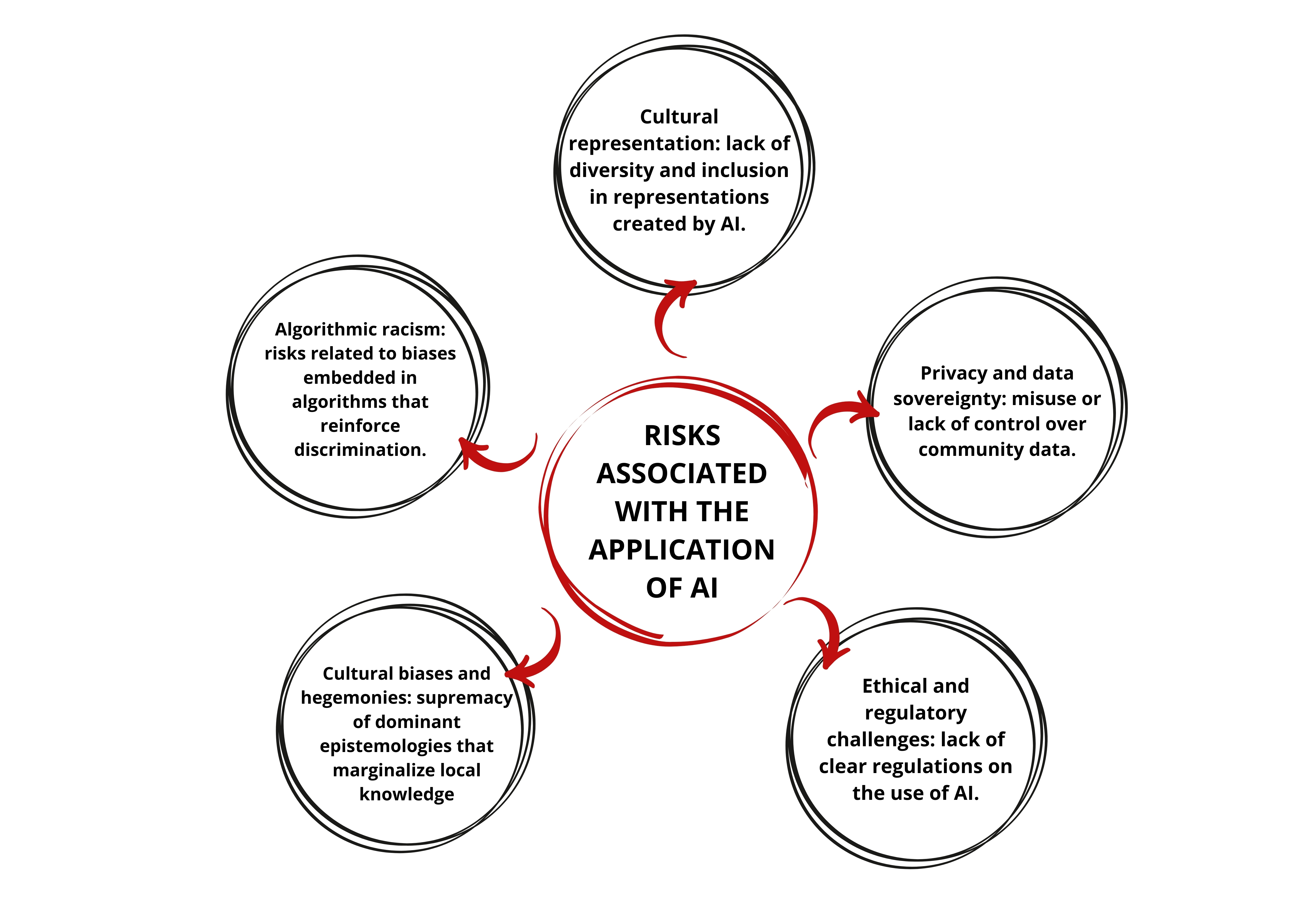
Therefore, it is imperative to discuss transparency regarding the use of generative AI in higher education23 and the images applied in technical and technological products. This implies not only explaining how algorithms are developed and trained,22 but also ensuring that data collection, processing and analysis processes describe the use of generative AI.26 These are risks that must be considered when applying AI, as shown in Figure 3.

Methodological transparency must include detailed documentation of data sources, the criteria used to generate results and how automated decisions are made.26 This transparency is particularly important in healthcare and nursing contexts, where the application of technologies must be continually guided by ethical and regulatory criteria.11 The use of AI can bring great benefits to nursing practice in unique contexts, but it also carries risks when processes are not sufficiently clear.
FINAL CONSIDERATIONS AND IMPLICATIONS FOR PRACTICE
This study outlines the complexities surrounding the use of AI while also pointing out indications of intervention strategies that engage with various forms of knowledge and ways of resisting in territories rather than tackling climate change. Thus, the ecosystemic approach indicates that pedagogical processes must be innovative in order to enhance knowledge and diversity, configuring themselves as transformative practices.
The use of AI can provide a deeper understanding of climate challenges and their ramifications for nursing care, based on critically and reflexively generated images. This study, therefore, contributes to innovative and inclusive teaching, allowing healthcare professionals to develop a richer and more multidimensional visual understanding of the challenges posed by climate change. From a political-pedagogical perspective, they can mediate the rupture of hegemonic epistemological models, as long as they are used critically and based on literature from Global South authors.
In practice, it is essential to break with the initial use of curricula, which, in nursing, presents a double challenge due to the limited evidence on climate change and nursing and the applicability of other epistemologies in curricula, whether they are from indigenous intellectuals, quilombolas and other minority groups in nursing training.
In this regard, while AI offers opportunities, biases, often present in the data used to train AI models, can result in distorted representations of vulnerable populations, reinforcing historical inequalities and limiting the effectiveness of simulations and educational materials. Therefore, incorporating Global South epistemologies into AI training can broaden the diversity of data sources, ensuring that representations of marginalized populations are more accurate and respect their cultural particularities.
Furthermore, strategies such as human supervision in the validation of AI-generated images, auditing of algorithmic models and the use of participatory methodologies are essential to avoid the reproduction of stereotypes. Furthermore, the discussion on cultural representations through AI in social media, educational technologies and image and voice generation is an opportunity to discuss ethics.
Given the above, this study is limited to reflecting on generative AI with a focus on image production, considering that AI maintains different models. In view of this, studies are recommended on the use of AI in child care and to address climate change, such as studies on technical products and representations of identities in images generated by AI and on the impacts of AI on nursing training.
DATA AVAILABILITY RESEARCH
The contents underlying the research text are included in the article.
ACKNOWLEDGMENTS
No acknowledgments.
-
FINANCIAL SUPPORT
No funding.
References
-
1 Artaxo P. As três emergências que nossa sociedade enfrenta: saúde, biodiversidade e mudanças climáticas. Estud Av. 2020;34(100):53-66. http://doi.org/10.1590/s0103-4014.2020.34100.005
» http://doi.org/10.1590/s0103-4014.2020.34100.005 -
2 Haigh F, Crimeen A, Green L, Moeller H, Conaty SJ, Prior JH et al. Developing a climate change inequality health impact assessment for health services. Public Health Res Pract. 2023;33(4):3342336. http://doi.org/10.17061/phrp3342336 PMid:38052203.
» http://doi.org/10.17061/phrp3342336 -
3 Moreira CVM, Costa MRA, Becker V. Impacts of extreme precipitation events in water quality: a scientometric analysis in global scale. Acta Limnol Bras. 2023;35:e17. http://doi.org/10.1590/s2179-975x0223
» http://doi.org/10.1590/s2179-975x0223 -
4 Silva MAD, Xavier DR, Rocha V. Do global ao local: desafios para redução de riscos à saúde relacionados com mudanças climáticas, desastre e emergências em saúde pública. Saúde Debate. 2021;44(spe2):48-68. http://doi.org/10.1590/0103-11042020e204
» http://doi.org/10.1590/0103-11042020e204 -
5 Guedes WP, Sugahara CR, Ferreira DHL. Racismo ambiental: reflexões sobre mudanças climáticas e Covid-19. Perspect Dialogo Rev Educ Soc. 2023;10(23):237-58. http://doi.org/10.55028/pdres.v10i23.17693
» http://doi.org/10.55028/pdres.v10i23.17693 - 6 Milanez B, Fonseca IF. Justiça climática e eventos climáticos extremos: uma análise da percepção social no Brasil. Rev Terceiro Incluído. 2011;1(2):82-100.
-
7 Torres PHC, Urbinatti AM, Gomes C, Schmidt L, Leonel AL, Momm S et al. Justiça climática e as estratégias de adaptação às mudanças climáticas no Brasil e em Portugal. Estud Av. 2021;35(102):159-76. http://doi.org/10.1590/s0103-4014.2021.35102.010
» http://doi.org/10.1590/s0103-4014.2021.35102.010 -
8 Duarte ACS, Chicharo SCR, Silva TASM, Oliveira AB. Ethical-legal dilemmas of nursing practice in emergencies and disasters: a scoping review. Rev Esc Enferm USP. 2024;58:e20230233. http://doi.org/10.1590/1980-220x-reeusp-2023-0233pt PMid:38624081.
» http://doi.org/10.1590/1980-220x-reeusp-2023-0233pt -
9 Castro NJC, Araújo JDSA, Santos RA, Castro PC, Santos DDN, Nascimento MTA et al. Processos de aprendizagem sobre equidade para reflexão da prática social da Enfermagem. REME Rev Min Enferm. 2023;27:e-1523. http://doi.org/10.35699/2316-9389.2023.42296
» http://doi.org/10.35699/2316-9389.2023.42296 -
10 Artaxo P, Rizzo LV, Machado LAT. Inteligência artificial e mudanças climáticas. Rev USP. 2024;(141):29-40. http://doi.org/10.11606/issn.2316-9036.i141p29-40
» http://doi.org/10.11606/issn.2316-9036.i141p29-40 -
11 Vitorino LM, Yoshinari Júnior GH. Artificial intelligence as an ally in Brazilian nursing: challenges, opportunities and professional responsibility. Rev Bras Enferm. 2023;76(3):e760301. http://doi.org/10.1590/0034-7167.2023760301pt PMid:37792851.
» http://doi.org/10.1590/0034-7167.2023760301pt -
12 Pedranzini HN, Freiria RC. A Inteligência Artificial como ferramenta para contenção da crise climática no Brasil. Homa Publica Rev Int Derechos Hum Empresas [Internet]. 2024 [citado 2024 nov 14];8(1):e126. Disponível em: https://periodicos.ufjf.br/index.php/HOMA/article/view/45106/27945
» https://periodicos.ufjf.br/index.php/HOMA/article/view/45106/27945 -
13 Siqueira HCH, Thurow MRB, Paula SF, Zamberlan C, Medeiros AC, Cecagno D et al. Health of human being in the ecosystem perspective. J Nurs UFPE Online. 2018;12(2):559-64. http://doi.org/10.5205/1981-8963-v12i2a25069p559-564-2018
» http://doi.org/10.5205/1981-8963-v12i2a25069p559-564-2018 -
14 Paro CA, Ventura M, Silva NEK. Paulo Freire e o inédito viável: esperança, utopia e transformação na saúde. Trab Educ Saúde. 2020;18(1):e0022757. http://doi.org/10.1590/1981-7746-sol00227
» http://doi.org/10.1590/1981-7746-sol00227 - 15 Baniwa G. Educação e povos indígenas no limiar do século XXI: debates e práticas interculturais. Antropol Soc Rev Lab Antropol Arqueol Bem-Viver UFPE. 2023;1(1):7-21.
-
16 Quijano A. Colonialidade, poder, globalização e democracia. Novos Rumos. 2002;17(37):4-28. http://doi.org/10.36311/0102-5864.17.v0n37.2192
» http://doi.org/10.36311/0102-5864.17.v0n37.2192 - 17 Meneses MN, Quadros JDD, Marques GP, Nora CRD, Carneiro FF, Rocha CMF. Popular health surveillance practices in Brazil: scoping review. Cienc Saúde Colet. 2023;28:2553-64. https://doi.org/10.1590/1413-81232023289.13542022
-
18 Santos PAF, Batista RCN, Coutinho VRD, Rabiais ICM. Interdisciplinary and interinstitutional simulation and cooperation: development of nursing students competencies in disaster. Esc Anna Nery. 2023;27:e20220077. http://doi.org/10.1590/2177-9465-ean-2022-0077pt
» http://doi.org/10.1590/2177-9465-ean-2022-0077pt - 19 Santos AB, Pereira S. A terra dá, a terra quer. São Paulo: Ubu Editora; 2023.
-
20 Calheiros Pereira Sobral JP, Rodrigues Viana ME, Alves Lívio T, Galdino dos Santos A, Souza Costa BGD, Alves Rozendo C. Metodologias ativas na formação crítica de mestres em enfermagem. Rev Cuid (Bucaramanga). 2020;11(1). http://doi.org/10.15649/cuidarte.822
» http://doi.org/10.15649/cuidarte.822 -
21 Gomes NL. Educação, identidade negra e formação de professores/as: um olhar sobre o corpo negro e o cabelo crespo. Educ Pesqui. 2003;29(1):167-82. http://doi.org/10.1590/S1517-97022003000100012
» http://doi.org/10.1590/S1517-97022003000100012 - 22 Silva T. Racismo algorítmico em plataformas digitais: microagressões e discriminação em código. In: Silva T, editor. Comunidades, algoritmos e ativismos digitais: olhares afrodiaspóricos. São Paulo: LiteraRua; 2020; 121-135.
-
23 Saccà R, Turrini R, Ausania F, Turrina S, Leo D. The ménage à trois of healthcare: the actors in after-AI era under patient consent. Front Med (Lausanne). 2024;10:1329087. http://doi.org/10.3389/fmed.2023.1329087 PMid:38269319.
» http://doi.org/10.3389/fmed.2023.1329087 -
24 Silva DC, Nobre LNB, Ladeia TAS, Viegas LEA. Identidade cultural e inteligência artificial: uma análise das imagens de festas populares brasileiras geradas pela plataforma Midjourney. Interfaces Comun. 2023;1(2):85-106. http://doi.org/10.11606/issn.2965-7474.v1i2p85-106
» http://doi.org/10.11606/issn.2965-7474.v1i2p85-106 -
25 Silva GB, Souza LP, Medeiros JGT, Pellanda LC. Inteligência Artificial OpenAI Chat-GPT-3.5® comparada ao método tradicional para construção de Histórias na saúde. Revista Interdisciplinar de Saúde e Educação. 2024;5(1):9-36. http://doi.org/10.56344/2675-4827.v5n1a2024.1
» http://doi.org/10.56344/2675-4827.v5n1a2024.1 - 26 Rodríguez EQ. Un artículo recursivo: la IA generativa de texto frente a la importancia de la transparencia en la citación de datos y los derechos de autoría. In Garcia CR, Garcia OB, editors. Tecnologías emergentes aplicadas a las metodologías activas en la era de la inteligencia artificial. Madrid: Dykinson SL; 2023. p. 968-80.
Edited by
-
ASSOCIATED EDITOR
Cristina Lavareda Baixinho https://orcid.org/0000-0001-7417-1732
-
SCIENTIFIC EDITOR
Marcelle Miranda da Silva https://orcid.org/0000-0003-4872-7252