
 TEACHERS’ PERSPECTIVES ON A DIGITAL GAMES RECOMMENDATION SYSTEM FOR MOBILIZING METACOGNITION IN HIGHER EDUCATION
ABSTRACT:
This study investigated the perspectives of higher education professors regarding their experience with the Meta Planner Strategy (MPS) recommendation system, developed to suggest games aligned with metacognitive strategies. Situated within the context of the growing adoption of digital technologies in education, the research is grounded in the recognition of metacognition as an essential competence for self-regulated learning. Employing a qualitative and exploratory approach, the study was conducted with professors from a public federal university through a structured questionnaire consisting of both objective (Likert scale) and open-ended questions. Ten professors fully participated in the system experience. The data were analyzed using content analysis of the questionnaire responses, allowing for a comprehensive understanding of faculty conceptions regarding the use of digital games and the functionality of the MPS. The results indicate that professors perceive games as motivational tools and learning reinforcers, although most still associate their use with traditional practices such as quizzes and show difficulty in distinguishing between gamification and digital games. Regarding the MPS system, its organization, clarity of feedback, and potential to support pedagogical planning were positively highlighted, although suggestions for improvement included enhanced personalization and the inclusion of complementary instructional resources. It is concluded that the MPS represents a promising approach for higher education; however, its effectiveness depends on student participation and teacher training for the intentional and critical use of digital games as mediators of metacognitive development.
Keywords:
higher education; digital games; metacognitive strategies; recommendation system
RESUMO:
A presente pesquisa investigou as perspectivas de professores do ensino superior sobre a experiência com o sistema de recomendação Meta Planner Strategy (MPS), desenvolvido para sugerir jogos alinhados a estratégias metacognitivas. Inserida no contexto da crescente adoção de tecnologias digitais na educação, a investigação parte do reconhecimento da metacognição como competência essencial para a autorregulação da aprendizagem. Com abordagem qualitativa e caráter exploratório, a pesquisa foi realizada com professores de uma universidade pública federal, por meio de um questionário estruturado composto por questões objetivas (escala Likert) e abertas. Dez docentes participaram integralmente da experiência com o sistema. Os dados foram analisados com base na técnica de análise de conteúdo a partir das respostas a um questionário, possibilitando uma compreensão das concepções docentes quanto ao uso dos jogos digitais e à funcionalidade do MPS. Os resultados indicam que os professores veem os jogos em atividades motivacionais e de reforço da aprendizagem, embora, em sua maioria, ainda associem seu uso a práticas tradicionais, como quizzes, e apresentem dificuldade em distinguir entre gamificação e jogos digitais. Em relação ao sistema MPS, destacaram-se positivamente sua organização, clareza dos feedbacks e potencial de apoio ao planejamento pedagógico, embora tenham sido sugeridas melhorias quanto à personalização e à inclusão de recursos instrucionais complementares. Conclui-se que o MPS representa uma proposta promissora para o ensino superior, mas sua eficácia depende da adesão discente e da formação docente para o uso intencional e crítico de jogos digitais como mediadores do desenvolvimento metacognitivo.
Palavras-chave:
ensino superior; jogos digitais; estratégias metacognitivas; sistema de recomendação
RESUMEN:
Esta investigación investigó las perspectivas de profesores de educación superior sobre su experiencia con el sistema de recomendación Meta Planner Strategy (MPS), desarrollado para sugerir juegos alineados con estrategias metacognitivas. En el contexto de la creciente adopción de tecnologías digitales en la educación, la investigación surge del reconocimiento de la metacognición como una competencia esencial para el aprendizaje autorregulado. Con un enfoque cualitativo y exploratorio, la investigación se realizó con profesores de una universidad pública federal, mediante un cuestionario estructurado compuesto por preguntas objetivas (escala Likert) y abiertas. Diez profesores participaron plenamente en la experiencia con el sistema. Los datos se analizaron mediante la técnica de análisis de respuestas al cuestionario, lo que permitió comprender las concepciones de los profesores sobre el uso de juegos digitales y la funcionalidad de MPS. Los resultados indican que los profesores ven los juegos como herramientas de motivación y refuerzo del aprendizaje, aunque la mayoría aún asocia su uso con prácticas tradicionales, como los cuestionarios, y tiene dificultades para distinguir entre gamificación y juegos digitales. En cuanto al sistema MPS, se destacaron positivamente su organización, la claridad de la retroalimentación y su potencial para apoyar la planificación pedagógica, aunque se sugirieron mejoras en la personalización y la inclusión de recursos didácticos complementarios. Se concluye que MPS representa una propuesta prometedora para la educación superior, pero su eficacia depende de la participación del alumnado y de la formación del profesorado para el uso intencional y crítico de los juegos digitales como mediadores del desarrollo metacognitivo.
Palabras clave:
educación superior; juegos digitales; estrategias metacognitivas; sistema de recomendación
INTRODUCTION
The intensified use of digital technologies in the educational environment has triggered significant transformations in teaching and learning methodologies, driving the adoption of innovative approaches, particularly learning mediated by digital games (Rocha; Gouveia; Peres, 2021). 2These approaches have gained relevance due to their capacity to engage students in activities that stimulate complex cognitive processes, especially those related to metacognition. According to Flavell (1979), metacognition refers to the ability to reflect on one’s own mental processes, involving the knowledge, monitoring, and control of cognition. In the educational context, this competence is essential for the development of self-regulated learning, as it allows the student to plan, monitor, and adjust their cognitive strategies according to the established goals.
In this regard, the systematic literature review conducted by Pimentel and Sales Junior (2021a) showed that digital games, when conceived or developed with pedagogical intentionality, have high potential to promote metacognition in higher education. Other studies corroborate and extend the findings of Pimentel and Sales Junior (2021a) by showing that the pedagogical use of digital games can foster not only students’ motivation and engagement but also the development of higher-order cognitive skills, such as problem solving, critical thinking, and self-regulated learning. Clark, Tanner-Smith, and Killingsworth (2016) and Anthonysamy, Koo, and Hew (2020), for example, show that the use of digital games in educational environments not only improves students’ engagement and motivation but also encourages practices of self-reflection, planning, and self-evaluation. These practices are directly linked to the metacognitive components described by Boruchovitch (2008), which include knowledge about oneself as a learner, about the task to be performed, and about the most appropriate strategies for achieving a given learning objective.
These studies also highlight the importance of technological artifacts that assist teachers in the curation and recommendation of games appropriate to the students’ profile and to the competencies to be developed. The scarcity of research that simultaneously combines digital games, metacognitive strategies, and recommendation systems reveals a gap in the literature and reinforces the relevance of studies such as the one proposed here, aimed at deepening the understanding of the interactions between digital technologies and self-regulated learning. This leads to the research question of this study: What is the perspective of higher education professors on the use of digital games in the educational context, based on their experience with the Meta Planner Strategy (MPS) recommendation system?
The use of recommendation systems such as the MPS constitutes a promising strategy to support professors’ planning, suggesting digital games aligned with cognitive strategies and educational objectives. This study is therefore justified by the need to understand the reception and applicability of this type of resource among professors, thereby contributing to the improvement of technology-mediated pedagogical practices. Thus, this study aimed to analyze the perspective of higher education professors based on their experience with the MPS as a recommendation system,3 seeking to identify the potential, limitations, and pedagogical implications of this approach.
The distinctive scientific contribution of this study lies in the unprecedented linkage between three dimensions still poorly integrated in the literature: digital games, metacognitive strategies, and recommendation systems. Unlike studies that address these elements in isolation, this study goes further by analyzing, from the faculty perspective, how this linkage materializes in a concrete support instrument for pedagogical planning in the context of Brazilian higher education, thus filling a gap identified in the systematic review by Pimentel and Sales Junior (2021a).
Educational recommendation systems (ERS) constitute a specific category of intelligent systems aimed at the personalization of learning, operating through the collection and analysis of data on students’ profiles, behavior, and needs in order to suggest resources, activities, or strategies that are pedagogically appropriate for each individual or group (Burke, 2002). In the educational context, these systems have gained increasing attention as instruments to support differentiated instruction, especially given the heterogeneity of learning profiles in higher education. Drachsler, Hummel, and Koper (2008) distinguish ERS from commercial recommendation systems by their explicitly pedagogical orientation: beyond maximizing engagement or immediate satisfaction, such systems aim to optimize learning outcomes based on previously defined educational objectives. From this perspective, Manouselis et al. (2011) highlight that ERS can integrate different data sources—such as performance history, stated preferences, and browsing behavior—to produce increasingly precise and contextualized recommendations. It is against this backdrop that the Meta Planner Strategy (MPS) recommendation system, the object of analysis of this study, is situated: a tool that, based on the mapping of the students’ metacognitive profile through the Metacognitive Awareness Inventory (MAI) instrument (Schraw; Dennison, 1994), generates personalized digital game recommendations for the professor, linking metacognitive diagnosis and the curation of digital educational resources according to the class’s pedagogical objectives.
The article is structured into sections. The Digital Games and Metacognition section develops the theoretical foundation in depth, bringing together contributions from Cognitive Psychology, Education, and Instructional Design. The Methodology section details the procedures adopted, emphasizing the qualitative nature of the study and the use of the MPS. The Data and Discussion section presents faculty perceptions based on quantitative Likert-scale instruments (Likert, 1932 apudMattar; Ramos, 2021) and qualitative instruments (open-ended responses), allowing for theoretical-empirical triangulation. Finally, the Limitations of the Study and Final Considerations sections summarize the findings, emphasize contributions to teaching practice, and indicate directions for future studies.
DIGITAL GAMES AND METACOGNITION
Drawing on the foundational literature (Boruchovitch, 1999, 2008; Dembo, 2001; Flavell, 1979; Zimmerman, 2008, among others) underpinning the investigations carried out by the Comunidades Virtuais Research Group at the Federal University of Alagoas (Ufal), metacognition is seen not only as an outcome of learning but as a competence that can be intentionally developed through well-designed pedagogical strategies. Among these strategies, educational digital games stand out; they are intentionally designed to pose complex and contextualized challenges and require students to make continuous use of planning, monitoring, and evaluation skills. This active mobilization of metacognitive processes allows the learner to reflect on their mistakes and successes, adapt their behavior, and improve their performance.
It is important to highlight that, for digital games to have this formative effect, they need to be integrated into a coherent pedagogical project that encompasses its objectives, content, and assessment methods. The mere introduction of games into the teaching environment, without instructional intentionality, may not have a meaningful effect on metacognition. As Gros (2003) and Zimmerman (2008) warn, teacher mediation and the context in which games are used are decisive in ensuring that self-regulated learning is effectively promoted.
The literature on the relationship between digital games and metacognitive strategies calls for a multidisciplinary approach that brings together the fields of Cognitive Psychology, Educational Sciences, Instructional Design, and Digital Technologies. The conceptual starting point is the understanding of metacognition, as outlined by Flavell (1979), as the knowledge individuals have about their own cognitive processes, as well as the ability to regulate them. This conception unfolds into two central components: metacognitive knowledge and metacognitive regulation. The former encompasses knowledge about oneself as a learner, about tasks, and about strategies; the latter refers to the ability to monitor, control, and adjust cognitive performance in the face of the demands of learning.
Researchers such as Dembo (2001) and Zimmerman (2008) deepened the understanding of these components by studying self-regulated learning, a competence that integrates the deliberate use of metacognition with intrinsic motivation and time and resource management strategies. According to these authors, the self-regulated learner is one who sets clear goals, chooses appropriate strategies, monitors their execution, and revises their methods in light of the results obtained.
In the field of education, Boruchovitch (1999, 2008) offers important reflections on the practical application of metacognition, especially in the Brazilian context. The author emphasizes that metacognition can be taught through pedagogical practices that encourage reflection, planning, and the evaluation of one’s own learning process. In this regard, the introduction of digital games in the educational environment emerges as a promising avenue for metacognitive development, since it offers experiences that require decision-making, problem solving, and the constant adaptation of strategies.
Gros (2003) and Prensky (2003) were pioneers in highlighting digital games as potentially transformative in education. Gros points out that, beyond entertainment, games can promote meaningful learning if they are planned with pedagogical intentionality. Prensky (2003), in turn, coined the term digital game-based learning (DGBL) to refer to the systematic use of digital games as a means of promoting cognitive and attitudinal skills. These skills include, among others, problem solving, creativity, collaboration, and, especially, metacognition.
A meta-analysis was conducted by Clark, Tanner-Smith, and Killingsworth (2016) to investigate the impacts of digital games on learning. The results indicated that, when compared with traditional methods, games promote better outcomes in terms of knowledge retention and transfer, in addition to stimulating metacognitive competencies such as self-evaluation and decision-making. In line with this, Wouters and Van Oostendorp (2013) observed that instructional support within games is a determining factor in the development of metacognition, which reinforces the need for pedagogical intentionality in the design of educational games.
In the context of self-regulated learning strategies, Anthonysamy, Koo, and Hew (2020) found, in a literature review focused on higher education, that digital games offer concrete opportunities for the application of metacognitive strategies. The authors list planning, time management, self-explanation, and progress checking as frequent behaviors among students who use games in blended learning environments. These findings are reinforced by Braad, Degens, and IJsselsteijn (2020), who, in analyzing games in the GBL (game-based learning) model, highlight the role of games in stimulating cycles of self-questioning and constant evaluation of performance, central elements of metacognitive regulation.
In addition, the study by Gjicali, Finn, and Hebert (2020) proposes that social simulation games foster the development of metacognitive skills related to cultural judgment and the appropriateness of responses. Such games require players to adjust their actions based on varying social contexts, promoting metacognitive processes in real time. Similarly, Taub and Azevedo (2018) applied sequence mining in digital games and observed that metacognitive efficiency was correlated with appropriate levels of emotion regulation and motivation.
From a complementary perspective, studies such as those by Doolittle (1995) and Christoph (2006) indicate that even games of lower complexity can engage users in metacognitive practices, provided that the proposed tasks require planning and reflection. This shows that instructional design—as a systematic process of planning, developing, implementing, and evaluating learning experiences, linking educational objectives, pedagogical strategies, teaching resources, technologies, and forms of assessment to foster students’ learning—is more important than the graphic or technical sophistication of the game. As Shannon (2008) highlights, the use of metacognitive strategies is associated with learners’ ability to reflect on their cognitive preferences and select approaches compatible with their learning style.
Over the last decade (Valentim; Beder; Otsuka, 2025), advances in educational data analysis have also contributed to the monitoring and assessment of metacognition in games (Porto; Dias; Battestin, 2023). Tools such as learning analytics and educational data mining have been used to track patterns in the use of metacognitive strategies, which allows educators to adjust learning environments with greater precision. These advances were documented by Sandberg, Wielinga, and Christoph (2012) and are being consolidated in recent research, especially from 2019 onward, on collaborative games and games based on interactive narratives (Acosta et al., 2024; Molnar; Garcia; Kostkova, 2024).
Although the formative potential of games is recognized, the literature emphasizes that their impact on metacognition depends on pedagogical mediation and on the players’ profile. According to Karam Rozo (2011), metacognitive development is more present when games are accompanied by guided reflective moments, such as learning journals, self-evaluations, or mediated tutoring. This finding aligns with Van Velzen’s (2016) proposal, which argues for viewing metacognition as general knowledge of the learning process, a skill that can be deliberately taught in formal and informal environments.
Reviews such as that by Vlachopoulos and Makri (2017) point out that, in higher education, the use of games and simulations has a positive effect on the development of self-regulation and metacognition, especially when integrated with active learning methodologies, such as project-based learning or problem solving. This reaffirms the idea that games should not be seen as isolated elements but as components linked to a broader pedagogical ecosystem that values autonomy, reflection, and meaningful learning.
Thus, the literature review points to a growing consensus: digital games, when well integrated into the curriculum and accompanied by reflective strategies, substantially enhance metacognitive development. The most recent studies reinforce the findings of the 2021 review (Pimentel; Sales Junior, 2021a), expanding the range of possibilities for the use of these resources across different educational levels and contexts.
METHODOLOGY
Given the nature of the research problem outlined in this study, a qualitative methodological approach, exploratory in nature, was adopted, since we consider it the most appropriate for gaining an in-depth understanding of faculty perceptions (Mattar; Ramos, 2021) regarding the use of a digital games recommendation system. The empirical setting of the study was a university in the federal higher education system with approximately 30,000 students regularly enrolled in undergraduate programs, in both face-to-face and distance education modalities.
The participants in the study were university professors who work at that institution in teacher education programs (licenciatura) and who agreed to collaborate voluntarily in the evaluation of the recommendation system called MPS, aimed at linking digital games and metacognitive strategies in the educational context. Data collection was carried out through a structured questionnaire with 10 questions, developed with the aim of capturing the professors’ impressions of the use and applicability of the MPS tool.
The study and the purpose of the MPS system were publicized among the institution’s professors, with a proper explanation of its aims and of the benefits expected for teaching and learning. The sample used in the study is a nonprobability sample, in line with the qualitative approach adopted, prioritizing depth of analysis over generalization of the data. Accordingly, 31 professors were invited by email, of whom 19 confirmed their interest in participating.
After expressing interest, each professor received, by email, a detailed step-by-step guide on the objectives of the study, as well as on how the recommendation system works and the relevance of their participation. Professors were also asked to send basic data for registration in the system, including the course name and code, the professor’s name, and the academic semester. Based on these data, registration in the MPS was completed.

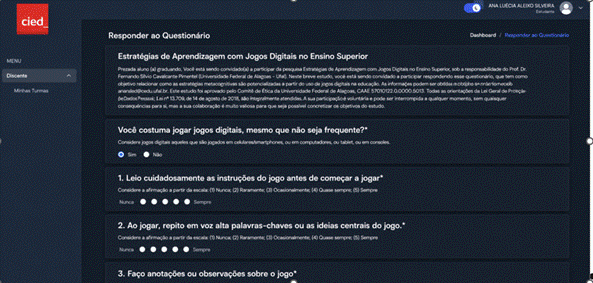
Once the professors’ registration was complete, the students enrolled in their courses were instructed by the professors themselves to access the platform and complete their own registration, being automatically linked to the corresponding class. With all participants duly registered, the system administrator released the Metacognitive Awareness Inventory (MAI) questionnaire, which is an assessment instrument developed by Schraw and Dennison (1994) to measure the degree of awareness a person has of their own cognitive and learning processes, in the version adapted with a focus on digital games by Pimentel and Sales Junior (2021b). After the completion of the instrument by the students (as illustrated in Figure 1), the system generated personalized feedback reports for the professors, thus closing the data collection cycle. Only 10 professors completed all stages of the process, thereby constituting the effective sample group of the study.
The attrition rate observed stems from the sequential nature of the protocol adopted: each professor could complete the experience with the MPS only after their students had answered the MAI questionnaire, a stage over which the researchers had no direct control. This type of dependence is compounded by the phenomenon of survey fatigue, documented in the literature as a factor that suppresses response rates in university settings, especially when instruments are administered remotely and in sequence (Adams; Umbach, 2012; Porter; Whitcomb; Weitzer, 2004; Possamai et al., 2024).
The questionnaire consists of 20 questions that focus on analyzing the mobilization of cognitive and metacognitive strategies through digital games (Pimentel; Sales Junior, 2021b), and is designed with a Likert scale. The students had one week to answer this questionnaire; on average, 25 to 30 students registered per class, and all those who registered responded. For the purposes of this study, each professor administered this questionnaire to a single class.
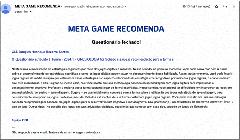
Once the students have finished submitting their responses to the questionnaire, the professor linked to the class, whose email has been previously registered, receives the personalized recommendation for the class (Figure 2).
Once the registration stages and the initial interaction with the MPS system were complete, the professors received, via an electronic link, access to the questionnaire developed specifically for this study. The data collection instrument used was the questionnaire designed and validated by Santos (2025), consisting of objective questions, statements, and an open-ended field for additional suggestions or comments from the participants.
The data collection instrument used with the professors, consisting of nine items on a five-point Likert scale, was designed and subjected to a content and face validation process by Santos (2025), following a methodology based on the Delphi technique. The validation was conducted by a group of nine judges with experience in higher education, comprising five holders of master’s degrees and four of doctoral degrees from the areas of the Humanities, Health Sciences, and Exact and Earth Sciences, who evaluated each item for objectivity, simplicity, clarity, relevance, precision, and readability. After the validation process, a pilot test was conducted with professors who did not take part in this stage. The data collection instrument for the students, the Inventory of Cognitive and Metacognitive Strategies with Digital Games (ICMSDG), proposed by Pimentel and Marques (2021), had a Cronbach’s alpha of 0.84, an indicator of high reliability according to Cohen, Manion, and Morrison (2018).
The questionnaire contained a filter question: “Do you use digital games in the context of your higher education classes?” Professors who answered affirmatively (“Yes”) were presented with an additional question, aimed at deepening the understanding of the pedagogical use of digital games in their teaching practice.
The questionnaire was administered through Google Forms, chosen for its accessibility and functionality. The data collected were organized and systematized using the spreadsheets automatically generated by the platform, which served as the basis for the subsequent analysis.
The data analysis was conducted based on the responses provided by the professors to the questionnaire, considering both the quantitative data and the qualitative contributions entered in the open-ended sections of the instrument. The interpretation of the results followed the principles of content analysis (Bardin, 2016), allowing the identification of patterns, recurrences, and particularities in the participants’ perceptions. The information was examined in light of the theoretical framework adopted, especially with regard to the use of digital games in higher education and to metacognitive strategies mediated by educational technologies. This analysis primarily aimed to answer the study’s guiding research question, and the triangulation between the empirical data and the theoretical contributions made it possible to build a critical and well-grounded understanding of the potential and the challenges of using digital games recommended by intelligent systems in the university environment.
This study rigorously observed the ethical precepts established by Law No. 13,709/2019, concerning the protection of personal data, as well as the guidelines of the National Research Ethics Commission (Comissão Nacional de Ética em Pesquisa, CONEP). The project was submitted to Plataforma Brasil and received a favorable opinion from the Research Ethics Committee of the Federal University of Alagoas (Ufal), under CAAE No. 57510122.0.0000.5013, and the methodological procedures began only after its approval.
DATA AND DISCUSSION
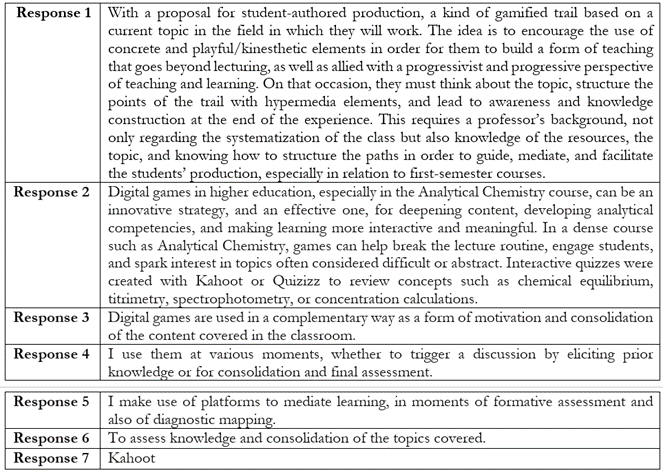
Of the 10 professors who answered the questionnaire, three answered that they do not use digital games in the context of higher education classes. The seven professors who answered that they use digital games in their classes had the option of answering the question “How do you use digital games to develop your classes and your students’ learning?” and all of them did so (Chart 1). Most of the responses showed the use of digital games as learning reinforcers, assessment instruments, or tools that help motivate students, with this understanding being far from the concept of digital games (Juul, 2018).

Response 1 presents the idea of the student as the main agent of their own learning. In this professor’s use of games, the objective is for the concrete to be perceived by the students and to lead them to practical interaction. In this way, the student is encouraged to move out of a passive role during the learning process. No description of how digital games are used to achieve these objectives was given in the comment; the professor mentioned the use of “hypermedia elements” and a “gamified trail.” Pombo and Marques (2020) establish a conceptual distinction between game-based learning and gamification and classify the latter as a set of technical concepts in the learning process, whereas game-based learning involves the use of the game itself as a means to promote learning. Thus, gamification, in this context, should not be interpreted as a direct synonym for digital games. The end of the professor’s response highlights the need for a “professor’s background” in knowing how to use the resources, which in this context are digital resources, and in mastering the content taught, especially for students who are beginning their studies in higher education, since the professor mentioned first-semester courses. By closing in this way, the response casts the professor’s role as that of someone who intervenes in this teaching and learning process, but it did not relate how this intervention manifests itself through digital games in the professor’s classes.
Response 2 revealed the professor’s understanding of digital games as “an innovative strategy” that is not present in the everyday routine of regular higher education teaching; therefore, when it is used, there is a break from the routine of lecture-based classes. In addition, the digital game works as a learning motivator and a facilitator of abstract elements. Egenfeldt-Nielsen (2011) presents a finding, drawn from different studies, that highlights a significant proportion of teachers who also recognize a high motivational potential in digital games within the teaching and learning context. This perception is shown by the fact that approximately 25% of the participating teachers mentioned motivation as the main benefit associated with the use of games in educational environments. This professor in Response 2 showed that they use digital games in the classroom through quizzes, as a way of reviewing previously learned content.
In this case, the game is not used as a strategy that by itself provides learning, but is one more element in the set of techniques and artifacts that can be used in teaching, especially with content considered denser. This predominance of the game as a reinforcer and assessor of learning, rather than as a promoter of complex cognitive processes, reveals a conceptual gap that goes beyond the distinction between games and gamification. According to Gros (2003) and Prensky (2003), the transformative potential of digital games in education is only realized when they are planned with pedagogical intentionality, which presupposes that the teacher understands the game not as support for content already taught, but as the means through which learning is built. The preference for quizzes, shown in the responses, suggests that the professors still operate within an instructionist logic, in which the game serves to check what has been transmitted, rather than to mobilize planning, monitoring, and self-evaluation skills, central components of metacognitive regulation described by Boruchovitch (2008) and Zimmerman (2008). Response 7 also showed the use of a quiz game—Kahoot—but did not specify whether and how they use other digital games.
Response 3 also presents the same idea of the digital game as a learning reinforcer that Response 2 presents, as something complementary and, therefore, less efficient than other methods not mentioned in the response. Response 6 showed the same perspective, but added to the concept the use of digital games as an instrument that can be used in the assessment of knowledge; however, the respondent did not indicate how they incorporate these artifacts for this purpose.
These perceptions, when added to the others, reveal a recurring pattern among the participants: content is superior to all the other elements of the educational context. With regard to digital games, their gameplay dimension is not considered within a formal teaching setting. This, in turn, reinforces what was highlighted by Egenfeldt-Nielsen (2011).
Response 4 presents the same idea of digital games for consolidation or assessment of learning, but, unlike in the other responses, this professor revealed that they make use of digital games at “various moments,” including as a means of raising discussions about prior knowledge. This response was the only one, among the seven, that indicated some kind of frequency of use in the classroom. Another important aspect to highlight is that this professor revealed that they make use of digital games for final assessments. Although other responses also mention the use of digital games for assessment purposes, this one stands out for showing the professor’s view that these artifacts can be used seriously, as in final assessments.
Response 5 pointed to the use of games in moments of formative assessment, just as Responses 3 and 6 also mention some assessment perspective. Response 5, however, was the only one that presented the use of platforms to mediate learning, but it did not make clear what kind of platforms these are and whether they have digital games as a means of delivering instruction. Furthermore, it also pointed to working with games from a perspective that provides “diagnostic mapping,” and this is a point of similarity with Response 4, which reports working with the digital game to collect “prior knowledge” from the students.
Responses 4 and 5 deserve analytical attention, as they indicate, albeit in an unsystematic way, a move toward the dimension of metacognitive knowledge described by Flavell (1979) and Boruchovitch (1999): by using games to elicit prior knowledge and carry out diagnostic mapping, these professors are, even without naming it as such, creating conditions for the student to reflect on what they already know and what they still need to learn. This practice, when made intentional, is precisely the type of mediation that Zimmerman (2008) associates with the development of self-regulated learning. The problem, however, is that these initiatives appear in isolation and are not integrated into a broader pedagogical project that links the use of games to metacognitive strategies systematically, which is exactly the role that the MPS system sets out to fulfill.
The professors’ responses reveal a pattern consistent with what Egenfeldt-Nielsen (2011) had already signaled: the difficulty in the diffusion of digital games in the educational context is not only technical but conceptual. The confusion between games and gamification, the preference for quizzes, and the emphasis on content at the expense of gameplay indicate that the professors, for the most part, still do not recognize the digital game as an artifact capable of mobilizing metacognitive processes. This has a direct implication for the application of the MPS: a system that recommends games aligned with metacognitive strategies presupposes that the professor is able to use them with this intentionality. Without adequate training for the critical and pedagogical use of digital games, as Gros (2003) and Zimmerman (2008) warn, the system’s recommendation may not be put to full use, which reinforces the need, already pointed out by the participants themselves, for teacher training initiatives in this area.
All 10 professors answered the statements (Chart 2), related to the use of the MPS recommendation system, using the five-point Likert scale (1: Strongly disagree; 2: Disagree; 3: Neutral; 4: Agree; 5: Strongly agree). However, since one of the respondents commented that they could not try out the MPS because their class had not answered the student questionnaire, their responses were not counted in this part of the study.

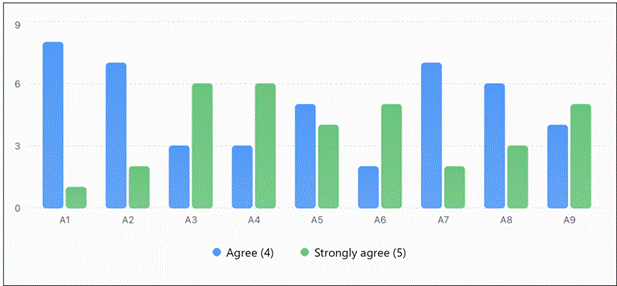
Graph 1 presents a summary of the professors’ responses concerning the use of the recommendation system for professors. The analysis of the data shows an overall positive trend in relation to the functionality and applicability of the system, particularly regarding aspects such as organization, clarity, feedback, personalization, and pedagogical contribution.

In statement A1, which deals with the organization of the system, there were eight Agree votes and one Strongly agree, indicating that the system is well organized and easy to understand. This positive perception among most respondents relates to the cognitive process of organizing, which, according to Anderson and Krathwohl (2001), involves the ability to identify relevant elements in a situation and structure them coherently, allowing the individual to integrate information and build meaningful connections. Organization, then, is essential to ensure clarity and functionality in the use of the system.
In statement A2, concerning the feedback provided by the system, seven professors agreed with its objectivity and two strongly agreed, reinforcing the effectiveness of the system in this respect. The general perception is that the feedback indeed contributes to the integration of digital games into teaching.
Statements A3 and A4, which involve suggestions for improvements to the system, such as the inclusion of instructional materials and the responsiveness of the recommendations, received the highest concentration of votes, with six Strongly agree votes and three Agree for each statement. This reveals that the professors recognize the value of these features and validate the effectiveness of the system in these dimensions, suggesting that the system is moving in the right direction by supporting more elaborate pedagogical practices.
Statement A5 highlights the system’s potential to enrich the content of classes, with five Agree votes and four Strongly agree votes, which shows the role of the MPS as support for diversifying pedagogical strategies, especially in the use of digital games as an innovative resource.
The personalization of the recommendations, addressed in statement A6, received two Neutral votes, five Agree, and two Strongly agree. Based on this distribution of votes, it can be pointed out that, although the majority have a positive perception, the neutral responses show that there is a degree of hesitation on the part of some professors, which may indicate limitations in the fit of the recommendations to the specific characteristics of each class.
This perception deserves analytical attention, since personalization is precisely one of the foundations that distinguish a recommendation system from a mere list of resources. According to Boruchovitch (1999), metacognitive strategies vary according to the learner profile, the type of task, and the educational context. A system that cannot adequately capture these variations runs the risk of offering generic recommendations, thereby hollowing out its formative potential. The neutral votes on A6 may, therefore, signal not only a technical limitation of the MPS but also the faculty perception that the data collection instrument (the MAI answered by the students) does not yet reflect the specific characteristics of each class and course with sufficient precision.
Statement A7, which deals with pedagogical reassurance, shows a voting pattern similar to that of statement A2, which received seven Agree votes and two Strongly agree, signaling confidence in the system as support for the adoption of digital games in the university context.
The last two statements, A8 and A9, also show positive results. A8, related to mobilizing metacognition through the use of digital games, received six Agree votes and three Strongly agree, showing that the system is recognized as a likely promoter of cognitive skills. A9, in turn, highlighted the professors’ willingness to recommend the system to other colleagues and received five Strongly agree votes and four Agree, which may highlight the confidence professors have in its applicability.
The analysis of the statements makes it possible to see that statements A3 and A4 were the ones that received the most level 5 votes, with six votes, thus revealing that the system is responsive in providing suggestions and feedback. In addition, statement A1 was the only one that received eight level 4 votes, revealing that the system has an objective organization. It is noteworthy that the absence of disagreeing votes on all the statements shows that, although there is room for improvement, the system proved to be efficient in its application.
Taken together, the statements reveal a pattern that goes beyond a mere usability evaluation and points to deeper dimensions of the relationship between technology, teaching, and metacognition. The broadly positive reception of statements A1 and A2, concerning the system’s organization and the clarity of the MPS feedback, indicates that the system was able to translate complex metacognitive data into pedagogically accessible language, a condition that Drachsler, Hummel, and Koper (2008) identify as one of the fundamental requirements for educational recommendation systems to fulfill their formative function.
At the points of greatest tension, the analysis becomes more revealing: the neutral votes recorded on statement A6, concerning the personalization of the recommendations, should not be read as indifference but as a sign that faculty perceptions of contextual fit are more demanding than the overall satisfaction levels suggest. This demanding stance is theoretically coherent, since, as Boruchovitch (1999) argues, metacognitive strategies are intrinsically situated, varying according to the learner profile, the nature of the task, and the institutional context, so that a system that does not capture these nuances tends to be perceived as generic, regardless of its technical quality.
On the other hand, the markedly positive results on statements A8 and A9, which deal with mobilizing metacognition and professors’ willingness to recommend the system to colleagues, suggest that the MPS was recognized not only as a functional tool but as an artifact with the potential to reconfigure pedagogical practices, which comes close to what Zimmerman (2008) describes as a necessary condition for the development of self-regulation: the existence of instruments that make visible, to the teachers themselves, the cognitive processes of their classes, turning the diagnosis into a starting point for pedagogical intentionality.
All 10 professors had a space to add further comments and make suggestions; however, the three professors who answered “No” to the question “Do you use digital games in the context of your higher education classes?” left this field blank, and, of the seven remaining professors, only three used this space. Nevertheless, as one of the professors did not have the opportunity to try out the MPS, their response was also not considered (Chart 3).

The first comment shows a demand that transcends the technical improvement of the system and extends to a formative dimension of pedagogical innovation. By advocating that sessions be held for presenting successful experiences with digital games, the professor signals that the incorporation of these technologies also depends on the establishment of collaborative spaces for professional development. The sharing of successful practices fosters the construction of shared pedagogical repertoires and reduces the uncertainties related to the adoption of innovative methodologies. This perception resonates directly with Gros (2003), who argues that the educational potential of digital games lies not in the technology itself but in the way it is integrated into instructional planning and mediated by the teacher. Likewise, it reinforces the perspective of Zimmerman (2008), according to which the development of self-regulated learning practices requires the teacher to understand and mobilize strategies capable of promoting processes of planning, monitoring, and evaluation of learning.
This comment also extends a pattern already identified in the responses presented in Chart 1. Although most professors recognize the motivational potential of digital games, their descriptions reveal a use predominantly associated with quizzes, content review, and assessment. The request for training and experience-sharing sessions indicates that the participants themselves recognize the need to broaden their understanding of the pedagogical possibilities of digital games. This result reinforces the discussion presented by Pimentel and Sales Junior (2021a), according to which the mobilization of metacognitive strategies depends less on the presence of the game and more on the pedagogical intentionality that guides its use. Thus, teacher training emerges as a condition for games to stop playing an ancillary role and become instruments capable of fostering planning, self-evaluation, monitoring, and reflection on one’s own learning process.
The second comment, in turn, points to an operational limitation of the system by reporting that the professor did not receive the email containing the feedback generated by the MPS. Although this is an apparently isolated occurrence, this account shows that the effectiveness of a recommendation system does not depend exclusively on the quality of the algorithms or the relevance of the recommendations produced. Intelligent educational systems presuppose a continuous flow of communication from data collection through information processing to making the results available to the user. When this chain is interrupted by technical failures, the entire pedagogical potential of the tool is compromised, since the professor is left without access to the system’s main product: the recommendations grounded in the metacognitive profile of their class.
Taken together, the two comments reveal that the challenges to the consolidation of the MPS fall into two complementary dimensions: one pedagogical and the other technological. While the first comment reinforces the need for continuing education and for the strengthening of communities of practice capable of disseminating innovative experiences with digital games, the second shows the importance of the system’s technical robustness, reliability, and usability in ensuring its effective incorporation into everyday teaching practice. This linkage confirms that educational recommendation systems, by themselves, do not transform pedagogical practices. As Flavell (1979), Boruchovitch (2008), and Zimmerman (2008) discuss, the promotion of metacognition depends on the teacher’s intentional mediation, while studies on game-based learning (Gros, 2003; Pimentel; Sales Junior, 2021a; Wouters; Van Oostendorp, 2013) demonstrate that the potential of digital games materializes only when technological resources, pedagogical mediation, and teacher training act in an integrated manner. From this perspective, the participants’ comments reinforce the view that the future improvement of the MPS must simultaneously encompass technical improvements and systematic actions for the professional development of professors.
From a technical standpoint, the MPS recommendation engine operates on the basis of a rule-based inference logic, built on the data collected by the Metacognitive Awareness Inventory (MAI) adapted to the context of digital games by Pimentel and Sales Junior (2021b). The instrument, consisting of 52 questions answered on a five-point Likert scale, with values from 0 to 1.0 assigned to each response level (Strongly disagree = 0; Disagree = 0.25; Undecided = 0.50; Agree = 0.75; Strongly agree = 1.0), is organized around two main metacognitive components, according to Schraw and Dennison’s (1994) taxonomy: knowledge of cognition (subdivided into declarative, procedural, and conditional knowledge) and regulation of cognition (composed of planning, information management, monitoring, debugging, and evaluation).
After the students’ responses have been collected and quantified, the system calculates the relative value of each metacognitive subcomponent in relation to the group as a whole and, based on the scores obtained, triggers inference rules that identify which metacognitive dimensions are less developed in the class. It is these underdeveloped dimensions that guide the recommendation: the MPS suggests to the professor digital games whose mechanics and challenge structure are especially conducive to exercising the corresponding metacognitive processes; for example, games that require explicit strategy planning are suggested for classes with low scores on the planning subcomponent, whereas games with iterative trial-and-error cycles are recommended to develop debugging. It is, therefore, a recommendation system based on content-based filtering (Burke, 2002), in which the matching criterion is not usage history or individual preference but the class’s collective metacognitive profile, operationalized by the scores on the adapted MAI.
LIMITATIONS OF THE STUDY
The limitations of this study lie, above all, in the delimitation of its empirical and methodological scope. The study was conducted exclusively with professors from a single public higher education institution, which limits the generalizability of the results to other educational settings, especially those from different regional or institutional contexts or teaching modalities. In addition, the analysis focused on faculty perceptions of the use of the recommendation system and did not include a direct evaluation of the impact of digital games on students’ learning, although this phase of the study is in progress.
It is also observed, hypothetically, that one limitation of the study is the fact that some professors are unfamiliar with the concept of a game. As no question about the concept was presented, further investigation in future research is suggested.
Another limiting factor was the dependence on student participation for the system to be effectively operational, which revealed a low participation rate and, consequently, compromised the complete experience of some professors with the MPS.
To complement this study and mitigate some of its limitations, it is suggested that a quantitative analysis be conducted involving a larger sample of professors and students from different institutions, regions, and teaching modalities, collecting numerical data on indicators such as the frequency of use of the recommendation system, students’ engagement rate with the recommended digital games, and measurable impacts on academic performance, so as to statistically correlate these variables and offer more robust evidence on the effectiveness of the MPS.
FINAL CONSIDERATIONS
The Meta Planner Strategy (MPS) recommendation system was developed with the purpose of suggesting digital games aligned with the students’ metacognitive strategies, operating on the basis of a structured cycle of data collection and analysis. To this end, the system used the Metacognitive Awareness Inventory (MAI) as its central metric, an instrument developed by Schraw and Dennison (1994) and adapted by Pimentel and Sales Junior (2021b) with a focus on digital games, capable of measuring both metacognitive knowledge (relating to what the student knows about themselves as a learner, about tasks, and about the strategies available) and metacognitive regulation, which concerns the ability to monitor, control, and adjust one’s own cognitive performance. Based on the students’ responses to the MAI, the system processed the data and generated personalized digital game recommendations for the professor, taking into account the predominant metacognitive profile in each class.
In this regard, the MPS did not operate as a generic repository of games, but as a pedagogical mediation system that linked the students’ metacognitive diagnosis to the curation of intentionally selected digital resources. The recommendation, therefore, was not random: it responded to the profile identified by the instrument, indicating to the professor which games would be most appropriate for mobilizing the metacognitive dimensions that the specific class in question needed to develop. This logic gives the system a formative and data-driven character, positioning it as a support for pedagogical planning and not as a substitute for teacher mediation, an aspect widely valued by the professors participating in this study.
The present study sought to identify the perspective of higher education professors regarding the use of digital games in the educational context, based on the use of the MPS recommendation system. Beyond this objective, it was found that most professors hold a conception of digital games that points to a failure to distinguish between the concepts of games and gamification. It was also possible to identify a preference for the use of quizzes.
With regard to the use of the MPS, the professors consider that the system has an objective organization and is responsive in providing suggestions and feedback. However, there are areas for improvement, such as the need to optimize the process, since there is still a need for an administrator (from the research team) to release the questionnaire to the students and to the professor. In addition, the steady decline in student participation in answering questionnaires was pointed out, and this raises a point of concern for the application of the MPS, which currently depends on this data collection method. The importance of disseminating knowledge about digital games to professors was emphasized. Therefore, technical reassessments are necessary, as well as new research and applications of the MPS recommendation system.
References
-
ACOSTA, Halim; LEE, Seung; MOTT, Bradford; BAE, Haesol; GLAZEWSKI, Krista; HMELO-SILVER, Cindy; LESTER, James. Multimodal learning analytics for predicting student collaboration satisfaction in collaborative game-based learning. In: INTERNATIONAL CONFERENCE ON EDUCATIONAL DATA MINING, 17., 2024, Atlanta. Proceedings [....] Atlanta: International Educational Data Mining Society, 2024. p. 224-235. DOI: https://doi.org/10.5281/zenodo.12729802.
» https://doi.org/10.5281/zenodo.12729802 -
ADAMS, Meredith J. D.; UMBACH, Paul D. Nonresponse and online student evaluations of teaching: understanding the influence of salience, fatigue, and academic environments. Research in Higher Education, v. 53, n. 5, p. 576-591, 2012. DOI: https://doi.org/10.1007/s11162-011-9240-5.
» https://doi.org/10.1007/s11162-011-9240-5 - ANDERSON, Lorin William; KRATHWOHL, David R.; (ed.). A taxonomy for learning, teaching, and assessing: a revision of Bloom’s taxonomy of educational objectives New York: Longman, 2001.
-
ANTHONYSAMY, Lilian; KOO, Ah Choo; HEW, Soon-Hin. Self-regulated learning strategies and non-academic outcomes in higher education blended learning environments: a one decade review. Education and Information Technologies, v. 25, n. 3, p. 2481-2513, 2020. DOI: https://doi.org/10.1007/s10639-020-10134-2.https://doi.org/10.1007/s10639-019-10027-z
» https://doi.org/10.1007/s10639-020-10134-2» https://doi.org/10.1007/s10639-019-10027-z - BARDIN, Laurence. Análise de conteúdo São Paulo: Edições 70, 2016.
-
BORUCHOVITCH, Evely. Estratégias de aprendizagem e desempenho escolar: considerações para a prática educacional. Psicologia: Reflexão e Crítica, v. 12, n. 2, p. 361-376, 1999. DOI: https://doi.org/10.1590/S0102-79721999000200008.
» https://doi.org/10.1590/S0102-79721999000200008 - BORUCHOVITCH, Evely. A metacognição e sua relação com a aprendizagem. In: BORUCHOVITCH, Evely; BZUNECK, José Aloyseo (org.). Motivação e aprendizagem Petrópolis: Vozes, 2008. p. 55-71.
-
BRAAD, Eelco DEGENS, Nick; IJSSELSTEIJN, Wijnand A. Designing for metacognition in game-based learning: a qualitative review. Translational Issues in Psychological Science, v. 6, n. 1, p. 53-69, 2020. DOI: https://doi.org/10.1037/tps0000217.
» https://doi.org/10.1037/tps0000217 -
BRASIL. Lei nº 13.853, de 8 de julho de 2019. Altera a Lei nº 13.709, de 14 de agosto de 2018, para dispor sobre a proteção de dados pessoais e para criar a Autoridade Nacional de Proteção de Dados; e dá outras providências. Brasília, DF: Presidência da República, 2019. Disponível em: Disponível em: https://www.planalto.gov.br/ccivil_03/_ato2019-2022/2019/lei/l13853.htm Acesso em: 20 jun 2025
» https://www.planalto.gov.br/ccivil_03/_ato2019-2022/2019/lei/l13853.htm -
BURKE, Robin. Hybrid recommender systems: survey and experiments.User Modeling and User-Adapted Interaction, v. 12, n. 4, p. 331-370, 2002. DOI: https://doi.org/10.1023/A:1021240730564.
» https://doi.org/10.1023/A:1021240730564 -
CHRISTOPH, Liesbeth H. The role of metacognitive skills in learning to solve problems 2006. Tese (Doutorado) - University of Twente, Enschede, 2006. Disponível em: Disponível em: https://research.utwente.nl/en/publications/the-role-of-metacognitive-skills-in-learning-to-solve-problems Acesso em: 2 jun. 2025.
» https://research.utwente.nl/en/publications/the-role-of-metacognitive-skills-in-learning-to-solve-problems -
CLARK, Douglas B.; TANNER-SMITH, Emily E.; KILLINGSWORTH, Stephen S. Digital games, design, and learning: a systematic review and meta-analysis. Review of Educational Research, v. 86, n. 1, p. 79-122, 2016. DOI: https://doi.org/10.3102/0034654315582065.
» https://doi.org/10.3102/0034654315582065 - COHEN, Louis; MANION, Lawrence; MORRISON, Keith. Research methods in education 8. ed. London: Routledge, 2018.
- DEMBO, Myron H. Learning to teach is not enough: future teachers also need to learn how to learn. Teacher Education Quarterly, v. 28, n. 4, p. 23-35, 2001.
-
DOOLITTLE, John H. Using riddles and interactive computer games to teach problem-solving skills. Teaching of Psychology, v. 22, n. 1, p. 33-36, 1995. DOI: https://doi.org/10.1207/s15328023top2201_10.
» https://doi.org/10.1207/s15328023top2201_10 -
DRACHSLER, Hendrik; HUMMEL, Hans G. K.; KOPER, Rob. Personal recommender systems for learners in lifelong learning networks: the requirements, techniques and model. International Journal of Learning Technology, v. 3, n. 4, p. 404-423, 2008. DOI: https://doi.org/10.1504/IJLT.2008.019376.
» https://doi.org/10.1504/IJLT.2008.019376 - EGENFELDT-NIELSEN, Simon. The challenges to diffusion of educational computer games. In: CONNOLLY, Thomas (ed.). Leading Issues in Games Based Learning Reading: Academic Publishing International, 2011. p. 141-158.
-
FLAVELL, John H. Metacognition and cognitive monitoring: a new area of cognitive-developmental inquiry. American Psychologist, v. 34, n. 10, p. 906-911, 1979. DOI: https://doi.org/10.1037/0003-066X.34.10.906.
» https://doi.org/10.1037/0003-066X.34.10.906 -
GJICALI, Kalina; FINN, Bridgid; HEBERT, Delano. Effects of belief generation on social exploration, culturally-appropriate actions, and cross-cultural concept learning in a game-based social simulation. Computers & Education, v. 156, 103959, 2020. DOI: https://doi.org/10.1016/j.compedu.2020.103959.
» https://doi.org/10.1016/j.compedu.2020.103959 -
GROS, Begoña. The impact of digital games in education. First Monday, v. 8, n. 7, 2003. Disponível em: Disponível em: http://www.firstmonday.org/issues/issue8_7/xyzgros/index.html Acesso em: 2 jun. 2025.
» http://www.firstmonday.org/issues/issue8_7/xyzgros/index.html -
JUUL, Jesper. The game, the player, the world: looking for a heart of gameness. Plurais Revista Multidisciplinar, v. 1, n. 2, p. 248-270, 2018. Disponível em: Disponível em: https://www.revistas.uneb.br/index.php/plurais/article/view/880 Acesso em: 10 mai. 2025.
» https://www.revistas.uneb.br/index.php/plurais/article/view/880 -
KARAM ROZO, Jorge Mario. Creatividad y videojuegos: nuevos paradigmas en la generación de aprendizaje autónomo. Repertorio de Medicina y Cirugía, v. 20, n. 1, p. 45-50, 2011. DOI: https://doi.org/ 10.31260/repertmedcir.v20.n1.2011.674.
» https://doi.org/10.31260/repertmedcir.v20.n1.2011.674 -
MANOUSELIS, Nikos; DRACHSLER, Hendrik; VUORIKARI, Riina; HUMMEL, Hans; KOPER, Rob. Recommender systems in technology enhanced learning. In: RICCI, Francesco et al (ed.). Recommender systems handbook New York: Springer, 2011. p. 387-415. DOI: https://doi.org/10.1007/978-0-387-85820-3_12.
» https://doi.org/10.1007/978-0-387-85820-3_12 - MATTAR, João; RAMOS, Daniela Karine. Metodologia de pesquisa em educação: abordagens qualitativas, quantitativas e mistas São Paulo: Edições 70, 2021.
-
MOLNAR, Andreea.; GARCIA, José.; KOSTKOVA, Patty. Learning analytics for assessment and gamification in digital storytelling. In: SAHIN, Muhittin.; IFENTHALER, Dirk. (ed.).Assessment analytics in education Cham: Springer, 2024. P. 313-326. DOI: https://doi.org/10.1007/978-3-031-56365-2_16.
» https://doi.org/10.1007/978-3-031-56365-2_16 -
PIMENTEL, Fernando Silvio Cavalcante; MARQUES, Margarida Morais. Learning strategies with digital games in the university context: multiple case study. In: INTERNATIONAL CONFERENCE ON EDUCATION AND NEW LEARNING TECHNOLOGIES 13., 2021. EDULEARN21 Proceedings. [S. l.] IATED, 2021. p. 8885-8894. DOI: https://doi.org/10.21125/edulearn.2021.1790.
» https://doi.org/10.21125/edulearn.2021.1790 -
PIMENTEL, Fernando Silvio Cavalcante; SALES JUNIOR, Valdick Barbosa. Mobilização das habilidades e estratégias metacognitivas por meio dos jogos digitais. Revista Docência e Cibercultura, v. 5, n. 3, p. 222-242, 2021a. DOI: https://doi.org/10.12957/redoc.2021.61036.
» https://doi.org/10.12957/redoc.2021.61036 - PIMENTEL, Fernando Silvio Cavalcante; SALES JUNIOR, Valdick Barbosa. Avaliação da consciência metacognitiva de usuários de jogos digitais. In: PIMENTEL, Fernando Silvio Cavalcante (org.). Aprendizagem baseada em jogos digitais: teoria e prática Rio de Janeiro: BG Business Graphics Editora, 2021b. p. 28-47.
-
POMBO, Lúcia; MARQUES, Margarida Morais. The potential educational value of mobile augmented reality games: the case of EduPARK app. Education Sciences, v. 10, n. 10, 287, 2020. DOI: https://doi.org/10.3390/educsci10100287.
» https://doi.org/10.3390/educsci10100287 -
PORTER, Stephen R.; WHITCOMB, Michael E.; WEITZER, William H. Multiple surveys of students and survey fatigue. New Directions for Institutional Research, v. 2004, n. 121, p. 63-73, 2004. DOI: https://doi.org/10.1002/ir.101.
» https://doi.org/10.1002/ir.101 -
PORTO, Bruno; DIAS, Dainer Marçal; BATTESTIN, Vanessa. Tendências de learning analytics em Moodle: uma revisão sistemática.EaD em Foco, [s. l.], v. 13, n. 1, e2070, 2023. DOI: https://doi.org/10.18264/eadf.v13i1.2070.
» https://doi.org/10.18264/eadf.v13i1.2070 -
POSSAMAI, Adam et al Got sick of surveys or lack of social capital? An investigation on the effects of the COVID-19 lockdown on institutional surveying. The Australian Educational Researcher, v. 51, p. 21-39, 2024. DOI: https://doi.org/10.1007/s13384-022-00569-6.
» https://doi.org/10.1007/s13384-022-00569-6 - PRENSKY, Marc. Digital game-based learning St. Paul: Paragon House, 2003.
- RAMOS, Daniela Karine; PIMENTEL, Fernando Silvio Cavalcante. Cognição, aprendizagem e jogos digitais. In: PIMENTEL, Fernando Silvio Cavalcante (org.). Aprendizagem baseada em jogos digitais: teoria e prática. Rio de Janeiro: BG Business Graphics Editora, 2021. p. 13-27.
- ROCHA, Daiana Garibaldi; GOUVEIA, Luis Borges; PERES, Paula. Práticas pedagógicas inovadoras: novos desafios. In. ROCHA, Daiana Garibaldi; OTA, Marcos Andrei; HOFFMANN, Gustavo. (Orgs.). Aprendizagem digital: curadoria, metodologias e ferramentas para o novo contexto educacional. Porto Alegre: Penso, 2021. p. 13-28.
-
SANDBERG, Jeroen A. C.; WIELINGA, Bob J.; CHRISTOPH, Liesbeth H. The role of prescriptive models in learning. Computers & Education, v. 59, n. 2, p. 839-854, 2012. DOI: https://doi.org/10.1016/j.compedu.2011.11.021
» https://doi.org/10.1016/j.compedu.2011.11.021 - SANTOS, Maria Jordana Cavalcanti. Sistema de recomendação para jogos digitais e estratégias metacognitivas no ensino superior 2025. Dissertação (Mestrado em Educação) - Universidade Federal de Alagoas, Centro de Educação, Maceió, 2025.
-
SCHRAW, Gregory; DENNISON, Rayne S. Assessing metacognitive awareness. Contemporary Educational Psychology, v. 19, n. 4, p. 460-475, 1994. DOI: https://doi.org/10.1006/ceps.1994.1033.
» https://doi.org/10.1006/ceps.1994.1033 -
SHANNON, Sheila V. Using metacognitive strategies and learning styles to create self-directed learners. Institute for Learning Styles Journal, v. 1, p. 14-28, 2008. Disponível em: Disponível em: https://www.learningstyles.org/journal/Using-Metacognitive-Strategies-and-Learning-Styles-to-Create-Self-Directed-Learners.pdf Acesso em: 2 jun. 2025.
» https://www.learningstyles.org/journal/Using-Metacognitive-Strategies-and-Learning-Styles-to-Create-Self-Directed-Learners.pdf -
TAUB, Michelle; AZEVEDO, Roger. Using sequence mining to analyze metacognitive monitoring and scientific inquiry based on levels of efficiency and emotions during game-based learning. Journal of Educational Data Mining, v. 10, n. 3, p. 1-26, 2018. Disponível em: Disponível em: https://jedm.educationaldatamining.org/index.php/JEDM/article/view/182 Acesso em: 2 jun. 2025.
» https://jedm.educationaldatamining.org/index.php/JEDM/article/view/182 -
VALENTIM, Daniel Irano; BEDER, Delano Medeiros; OTSUKA, Joice Lee. Analítica da aprendizagem em jogos educacionais: um mapeamento sistemático da literatura.RENOTE, Porto Alegre, v. 23, n. 2, p. 279-290, 2025. Disponível em: Disponível em: https://seer.ufrgs.br/index.php/renote/article/view/153552 Acesso em: 26 jun. 2026.
» https://seer.ufrgs.br/index.php/renote/article/view/153552 -
VAN VELZEN, Joke. Metacognitive learning: advancing learning by developing general knowledge of the learning process New York: Springer, 2016. Disponível em: Disponível em: https://link.springer.com/book/10.1007/978-3-319-24433-4 Acesso em: 18 jun. 2025.
» https://link.springer.com/book/10.1007/978-3-319-24433-4 -
VLACHOPOULOS, Dimitrios; MAKRI, Agoritsa. The effect of games and simulations on higher education: a systematic literature review. International Journal of Educational Technology in Higher Education, v. 14, n. 22, p. 1-33, 2017. DOI: https://doi.org/10.1186/s41239-017-0062-1.
» https://doi.org/10.1186/s41239-017-0062-1 -
WOUTERS, Pieter; VAN OOSTENDORP, Herre. A meta-analytic review of the role of instructional support in game-based learning. Computers & Education, v. 60, n. 1, p. 412-425, 2013. DOI: https://doi.org/10.1016/j.compedu.2012.07.018.
» https://doi.org/10.1016/j.compedu.2012.07.018 -
ZIMMERMAN, Barry J. Investigating self-regulation and motivation: historical background, methodological developments, and future prospects. American Educational Research Journal, v. 45, n. 1, p. 166-183, 2008. DOI: https://doi.org/10.3102/0002831207312909.
» https://doi.org/10.3102/0002831207312909
1
2
3
DATA AVAILABILITY STATEMENT
Section Editor:
CONFLICT OF INTEREST STATEMENT
History
-
Received
28 Feb 2026 -
Preprint posted on
16 Jan 2026
10.1590/SciELOPreprints.14841 -
Accepted
06 July 2026

 Source:
 Source:
 Source: The authors (2025)
 Source: The authors (2025)
 Source: The authors (2025)
 Source: The authors (2025)