
 IMPLEMENTING A DIDACTIC MODEL FOR TEACHING ATHLETICS IN SCHOOL
ABSTRACT:
His qualitative-quantitative research evaluated the implementation of a model for teaching athletics called the Systemic Ecological Model for Teaching Athletics (SEMA). Three Physical Education teachers and 26 students from public and private institutions attending Grade 2 and Grade 7 participated in the research. We used semi-structured interviews, reports, and questionnaires for data collection. Structured by an inductive perspective, we organized the results and analysis in two moments: a) coding based on the Discourse of the Collective Subject (DCS) and b) presenting the results in figures and statistical analysis. We present the challenges for the experience of the athletics content during remote classes, the adequacy of the model to the school identity and curriculum, the indispensability of the space provided in the model for reflections on the epistemology of the teaching practice and its potential for the achievement of the learning objectives stipulated by the teachers, supported by the statistical significance of the data produced by students.
Keywords:
athletics; model; Physical Education; epistemology
RESUMO:
A presente pesquisa quali-quantitativa avaliou a implementação de um modelo para o ensino do atletismo denominado modelo sistêmico ecológico para o ensino do atletismo. Participaram da investigação três professoras de educação física e 26 escolares de três instituições, uma pública e duas privadas, que frequentavam o 2.º e o 7.º anos do ensino fundamental. Para a coleta de dados, utilizaram-se entrevistas semiestruturadas, relatórios e questionários. Os resultados e análises, estruturados em uma perspectiva indutiva, foram dispostos em dois momentos: i) codificação embasada no discurso do sujeito coletivo, e ii) exposição dos resultados em figuras e quadros. Foram evidenciados os desafios para a vivência do conteúdo atletismo em tempos de aulas remotas, a adequação do modelo à identidade e ao currículo escolar, a indispensabilidade do espaço cedido intramodelo para reflexões sobre a epistemologia da prática docente, e o seu potencial para o alcance dos objetivos de aprendizagem estipulados pelas docentes, chancelados pela significância estatística dos dados produzidos pelos estudantes.
Palavras-chave:
atletismo; modelo; educação física; epistemologia
RESUMEN:
La presente investigación cuali-cuantitativa evaluó la implementación de un modelo para la enseñanza del atletismo denominado Modelo Ecológico Sistémico para la Enseñanza del Atletismo (MESA). Participaron de la investigación tres profesores de Educación Física y 26 alumnos de instituciones públicas y privadas que cursaban el 2º y 7º años de primaria. Para la recogida de datos se utilizaron entrevistas semiestructuradas, informes y cuestionarios. Los resultados y el análisis, estructurados en una perspectiva inductiva, fueron organizados en dos momentos, a saber: a) codificación basada en el Discurso del Sujeto Colectivo (DSC) y b) exposición de los resultados en figuras y tablas. Fueron evidenciados los desafíos para la vivencia de los contenidos de atletismo en tiempos de clases remotas, la adecuación del modelo a la identidad y al currículo escolar, la indispensabilidad del espacio brindado dentro del modelo para las reflexiones sobre la epistemología de la práctica docente y, además, su potencialidad para el logro de los objetivos de aprendizaje estipulados por los profesores, aprobados por la significancia estadística de los datos producidos por los estudiantes.
Palabras clave:
atletismo; modelo; Educación Física; epistemología
INTRODUCTION
Athletics is a subject of physical education in schools. Therefore, it is urgent to break with its low representation among children and young people who attend schools. We know that this paradigm encompasses various characters, contexts, and political and administrative structures that extend beyond its locus of experience. However, in one of these dimensions, specifically the pedagogical practice, it has been possible to note in recent decades a considerable advance in the development of proposals for models and methodologies for teaching athletics that reverberate in different contexts of its practice (Bressan; Impolcetto, 2020).
In the process of developing teaching models, scientific studies subsequently seek to evaluate their implementation in the contexts they were designed and also in other environments. In this case, in physical education classes, seeking evaluations between different proposals for teaching athletics (Ababei, 2017; Pereira, 2013), for comparability purposes (Valero-Valenzuela et al., 2005) and, also, in scientific productions that formulated evaluation methodologies, mainly for instructional category models (Metzler, 2005).
We know that the school environment is full of peculiarities. In Brazil, its organizational structure is established by Law 9394/1996 (Brazil, 1996), with federal, state, and municipal curricular guidelines aligning to ensure that society has adequate access to education (Boscatto; Impolcetto; Darido, 2016). Within educational settings, physical education classes encompass the teaching of athletics along with other components that are part of body culture and movement. These elements serve specific objectives; however, the presence of athletic content in these contexts is often notably limited (Mota E Silva, 2015).
In response to this situation, we understand that the school identity culture and the epistemology of teaching practice are dimensions to be considered to contribute to the problematization of the presented framework. As a result of this problematization, we are willing to implement a model for teaching athletics called the ecological systemic model for teaching athletics (MSEA-modelo sistêmico ecológico para o ensino do atletismo), as proposed by Bressan (2021)2. This model is organized into three phases: pre-intervention, intervention, and post-intervention, as explained below.
In our pre-intervention phase, the teachers engaged in a training course focused on MSEA to reflect on key aspects such as the epistemology of teaching practice, school identity, and knowledge related to athletics within the school context. They also explored the didactic and pedagogical organization of the model, which is represented through five movements: selection, relativization, awareness, appropriation, and reflection. Additionally, they constructed a didactic unit (DU) to guide the intervention process. During the intervention, this DU was implemented, and in the post-intervention phase, various evaluative, analytical, and propositional activities were conducted.
The MSEA didactic movements are not static. Therefore, they occur together at certain times, reaching their peak in specific classes, which mark their transitions to the other structures (movements). These movements are organized into different levels of complexity that can be represented as a color gradation process, from lightest to darkest, from reflection/selection to reflection, as shown in Figure 1.
Reflection represents both the introduction and conclusion, beginning with a rich exploration of meaning through the training provided to teachers on the epistemology of practice and school identity. By the end, it encompasses the insights and reflections arising from the empowerment afforded to students.

The selection process involves the joint choice (teachers and students) of the content to be worked on. Relativization seeks to intertwine the pedagogical processes with the reality experienced by students in their different contexts. Then, awareness-raising corresponds to the activities and experiences provided by teachers in a direct relationship with actors, agents close to and far from the students who can offer testimonies and activities related to the focus content (athletics). Appropriation seeks to provide a game-based learning environment that connects students to the characteristics of athletics, appropriate for the formative stage. In this movement, the teacher's appropriation of the pedagogy of the game as a teaching approach is crucial. Finally, we return to the reflection as already presented. In our research, since it is the first application of the model, we aim to evaluate it and, to this end, we use the representations of elementary school teachers and students.
METHODOLOGY
This is qualitative-quantitative research, which in turn “[...] progresses in an inductive process of developing hypotheses and theory as data are revealed” (Thomas; Nelson; Silverman, 2012, p. 41). We also attribute characteristics of a propositional and quasi-experimental study, which “[...] involves the manipulation of treatments in an attempt to establish cause and effect relationships” (Thomas; Nelson; Silverman, 2012, p. 41).
Thus, “[...] quasi-experimental designs attempt to achieve a degree of control close to experimental designs, to infer that a given treatment had the intended effect” (Cozby, 2003, p. 238). It is “[...] useful to consider them in the context of program evaluation research” (p. 238). This methodological option enabled the determination of the practices and opinions of a specific population, composed of three teachers who work in three schools, one public state school and two private schools, teaching elementary school classes in which branded sports content is offered following the National Common Curricular Base (Brazil, 2018). Regarding ethical aspects, we obtained approval from the Human Research Ethics Committee, under CAAE number 89320718.6.0000.5465 and opinion number 2,739,510, issued in 2018.
The methodological design is divided into five stages that will be presented below: i) athletics training course; ii) selection and acceptance of participants for the research; iii) pre-intervention (interviews, questionnaires, specific course on MSEA, DU planning); iv) intervention (adaptation of DU and its application); and v) post-intervention (interviews and questionnaires).
Participants and research locus
The choice of participating teachers was made through non-random convenience sampling. According to Freitag (2018, p. 671), “in a convenience sample, the field researcher selects speakers from the study population who are more accessible, collaborative, or available to participate in the process [...]”. Thus, the invitation was made respecting the following criteria: i) being a physical education teacher working in basic education teaching in classes in which the study was intended to be applied; ii) being among the participants of a continuing education program in athletics, offered in 2020, regulated and certified by the Pro-rectorate of Extension and Culture (Proec) of a certain public state university; and iii) that the athletics content was in their planning for pedagogical work in the period, being consistent with the intervention phase of the present study.
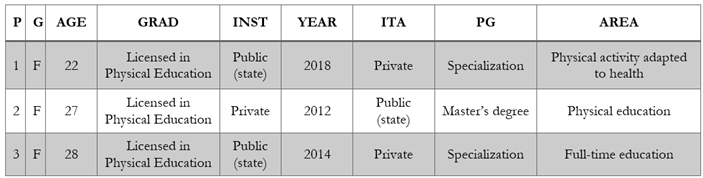
The opportunity to participate in this research materialized at the end of the course (item b) in December 2020. Five teachers were willing to contribute; however, in 2021, only three were able to participate. We express the profile of the teachers in Chart 1.
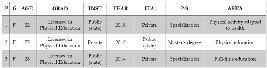
Each teacher selected a class in a non-random manner by judgment (Freitag, 2018) to apply the didactic unit (DU). Both P2 and P3 chose the 7th grade because they worked with track and field sports (athletics) in these classes at the time. The other participant (P1) chose a 2nd grade class because it works in the early years and offers track and field sports content for this formative stage. P1 had six authorized students who completed all stages of the research. P2 had 7 students who completed, and P3 worked with a class of 31 students, of which 13 were analyzed. The DUs of P1 and P3 were developed in 8 classes, and P2 in 10.
These periods of application of the DUs respected the planning of the teachers who had made the number of classes available for the development of the athletics content. Changes occurred in this number due to recurring pedagogical meetings on a specific day of the week, in addition to problems with internet connection, and also other pedagogical activities such as mathematics Olympiads that occupied P2 classes. All DU applications began and ended during the first semester of 2021.
Data collection procedures and instruments
The teachers signed the Informed Consent Form (ICF); the schools signed the authorization for research in a school environment; the students signed the Informed Assent Form (IAF); and their guardians, the ICF. After authorization and signing of the forms, the teachers participated in semi-structured interviews that occurred before the beginning of the training process on the MSEA, which corresponds to item “C” of our methodological design.
The two interviews (pre- and post-intervention) were conducted and recorded on the Google Meet® virtual platform, following a previously prepared script and containing a total duration, per participant, of 2 hours, 21 minutes, and 43 seconds (P1); 1 hour, 20 minutes, and 18 seconds (P2); and 59 minutes and 35 seconds (P3). They were faithfully transcribed, and the generated document was sent to the interviewees for their knowledge and confirmation, being endorsed by the participants. In our methodological design, the interview stages are arranged in items “C” and “E”.
The pre-intervention interview consisted of a preliminary analysis tool on knowledge related to the athletics content. The instrument was developed using as a reference the assumptions inherent to the knowledge necessary for understanding and acting with the MSEA, contemplating: knowledge about athletics; models and methodologies for its teaching; experiences with the athletics content as students in basic education; the athletics content in the undergraduate physical education course; and the pedagogical practice related to athletics in a school environment. These conditions elucidated the necessary paths for the training agenda, constant in the pre-intervention.
During the training phase, teachers were allowed to participate in a training course on MSEA, which, at the time, due to the pandemic conditions experienced in Brazil and worldwide, was also held via the Google Meet® virtual platform. The training sessions began in the second half of March and ended at the end of April 2021, totaling 30 hours, divided into approximately 4 hours per week.
Following this stage, the teachers conducted a semi-structured questionnaire with their students to assess their pre-existing knowledge of athletics. The instrument included themes pertinent to the students' educational level and was based on prior planning submitted by the teachers. They indicated that the questionnaire was inspired by the National Common Curricular Base (Brazil, 2018).
These questionnaires were submitted to students through virtual platforms and, in the case of P1 and P3 schools, also in person, as hybrid teaching was adopted in these schools. The questionnaires were answered and sent in a virtual class created by the researcher in Google Classroom®. After this stage, the teachers continued the experience of applying the teaching unit in the intervention stage.
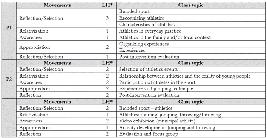
The MSEA intervention stage lasted a minimum of 4 and a maximum of 6 weeks, with 8 to 10 classes between May and July 2021, corresponding to the bimonthly closure of the three classes. The teachers sought to apply the DU that was developed during the MSEA training course. Chart 2 summarizes the organization of the planning according to the documents sent by them.
During the implementation of the DUs, the teachers kept notes in a reflective journal of the teaching unit, reporting impressions about the development of the proposal (Casey; Dyson, 2009). The reflective journal included the teachers' perceptions regarding frustrations and joys, and reflections originated during the implementation, corresponding to their planning (Mesquita et al., 2016).
At the end of the implementation, the teachers participated in the second semi-structured interview, and the students in the classes were invited to answer the semi-structured online questionnaire again. These instruments - interviews and reflective journal for the teachers, and questionnaires for the students - and their application are included in the post-intervention, and aimed to highlight perceptions about the development of the MSEA.
Reliability in the application of MSEA
The MSEA is characterized as a model for teaching athletics, and its first application occurred in this research. Thus, the participants had no previous experience with it. In response to this situation, we adapted the preparation protocol for the application of teaching models based on Mesquita et al. (2016), organized in the following stages: i) initial training with themes related to the teaching of athletics; ii) specific training on the theoretical, didactic and methodological foundations of the MSEA; and iii) structuring and planning for the application of the model.
The first stage consisted of offering a 30-hour athletics training course between July and November 2020, with topics related to the characterization of school athletics, psychometric indicators, challenges and overcoming practices in school athletics projects, and models and methodologies for teaching athletics. These meetings were mediated by nationally renowned speakers with experience in teaching athletic content.
The second stage was structured around a specific training course on MSEA, reiterating the characteristics of athletics, the epistemology of pedagogical practice, and identity of the school environment; the concept of teaching model, the theoretical foundations that support MSEA, and its didactic application and evaluation processes.
Finally, the third stage consisted of planning a DU to apply the model. During this process, the teachers contacted the researcher responsible through a messaging application, electronic correspondence, and also through weekly virtual meetings.
Procedures for presenting and analyzing data
The presentation and analysis of the data occurred from an inductive perspective (Thomas, Nelson, Silverman, 2012). For Mesquita et al. (2016, p. 31), this form of analysis “[...] refrains from imposing theories or hypotheses at the outset, with concepts being generated from the data, that is, without predefined analytical categories”. This makes it impossible to produce generalism and hypothetical testing, opting for the relevance of processes that allow the abstraction of the concrete (Mesquita, et al. 2016).
To code the interviews and reports (reflective diaries) produced by the teachers, we chose the collective subject discourse (CSD) (Lefèvre; Lefèvre, 2003). The CSD aggregates different discourses, through their excerpts, while maintaining coherence in the constitution of the parts that form it (Lefèvre; Lefèvre; Marques, 2009). Therefore, the idea is not to reproduce the discourse simplistically in a single category, but rather that these groupings and constructions result in a non-reductionist collective discourse.
According to Menezes, Marques and Nunomura (2015), to achieve the CSD, it is necessary to organize the coding process contemplating three methodological components: i) key expressions (KE), ii) central ideas (CI), and iii) the CSD. These are nothing more than: i) the literal transcriptions of excerpts of the discourse, ii) the succinct and faithful description of the meaning of a given discourse to reduce polysemy, and iii) the production of a first-person discourse, constituted by the KE.
Since it involves the application of a teaching model based on a systemic and complex logic, the use of CSD appears to be a fruitful path. Since “[...] CSD can be seen as a set of devices designed to allow collective thought, as an empirical reality, to express itself, or, using the framework of complexity theory, to self-organize [...]” (Lefèvre; Lefèvre; Marques, 2009, p. 1203). In the authors’ words:
[...] due to its characteristics, it opens up, concerning social representations as an object of empirical research, new possibilities for relationships - in the case of dialogue - between the whole and the parts, between the individual and the collective, between the theoretical and the empirical, between description and interpretation, between synthesis and analysis, between the paradigm and the syntagm and, last but not least, between the qualitative and the quantitative, which justifies, and perhaps demands, its insertion in the framework of current reflections on the theme of complexity (p. 1194, authors' emphasis).
The produced CSDs were submitted for evaluation to two researchers with expertise in applying the methodology within sports teaching contexts. Additionally, they were shared with the participating teachers to validate the generated discourse. Both the researchers and teachers provided positive feedback, affirming the reliability of the process and the coding conducted.
To analyze the data collected from the questionnaires completed by students, we employed statistical methods to compare two application stages—pre-intervention and post-intervention—utilizing SPSS® v.22 and Microsoft Excel® software. Given that the data did not follow a normal distribution, we implemented the Wilcoxon non-parametric test to assess the statistical differences between the two time points at which the questionnaires were administered. We established a significance threshold of P < 0.05 for determining statistically significant results. Following the analysis with these programs, the results were organized for presentation and discussion.
PRESENTATION AND DISCUSSION OF RESULTS
What the teachers say
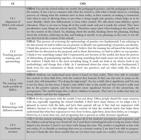
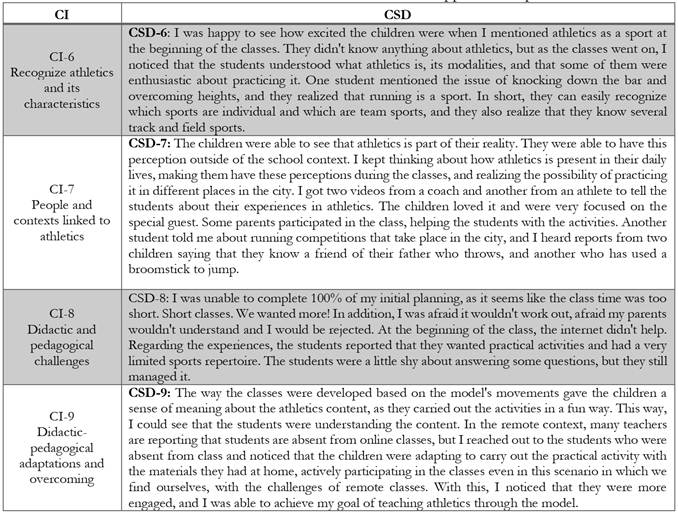
We present the results in two stages. In the first, the interviews and reports of the teachers were organized from an inductive perspective, characterized after data collection and based on the CSD coding methodology. The central ideas and discourses of the collective subject of the teachers were organized in two tables. Chart 3 lists the interviews, and Chart 4 highlights the material produced in the reports during the application of the teaching unit related to the MSEA, as seen below.

The analytical approach, which we confidently refer to as multifaceted, serves as an appropriate response to the research conducted. By employing the MSEA, it explores the relationships among various characters, generating interactions that influence one another. This reveals a paradigm that must be examined beyond Cartesian perspectives, initiating a convergence with existing frameworks towards a more complex and ecological viewpoint (Capra; Luisi, 2014; Kuhn, 2011).
We recognize that this option may evoke a sense of “infinity” in light of the vast amount of information available, necessitating a mixed typology to be revealed or at least taken into account. Therefore, while preserving the central focus, the arguments and data contribute to reinforcing our objective. Specifically, we aim to assess the experience of implementing MSEA in elementary school physical education classes, drawing insights from the perspectives of both teachers and students.
The foundation of the epistemic lens of analysis highlights the growing necessity, especially in recent decades, as we have observed a significant surge in scientific research aimed at examining the implementation of models and methodologies for teaching athletics within school settings. Notable examples include the “Ludotécnico model” (Valero-Valenzuela; Conde, 2003), the initiative “Athletics is learned at school” (Matthiesen, 2005), and the approach of “teaching athletics from a historical perspective” (Prado; Matthiesen, 2007; Matthiesen; Ginciene, 2013).
The utilization of a globally consolidated model for teaching sports has been emphasized, particularly the sports education model proposed by Siedentop in 1994. This model is extensively applied for instructing athletics content within school settings, as demonstrated in the research conducted by Mesquita et al. (2016) and Ginciene and Matthiesen (2017). Alongside numerous pedagogical experiences, there have been a range of studies, from descriptive analyses to comparative experiments, focused on the teaching of athletics (Goudas et al., 1995; Matthiesen, 2005; Prado; Matthiesen, 2007; Marques; Iora, 2009; Morgan, 2011; CBAT, 2011; Matthiesen; Ginciene, 2013; Bressan et al., 2018; Goméz; Calderón; Valero-Valenzuela, 2014; O’neil; Krause, 2016).
The framework demonstrates an effort to establish a new imagery that aligns with the necessity for athletics education to be integrated into schools, while simultaneously challenging the traditional paradigms that have shaped its organizational and instructional processes (Goudas et al., 1995; Valero-Valenzuela et al., 2006; Valero-Valenzuela; Delgado; Conde, 2009; Bressan et al., 2018; O’Neil; Krause, 2016). Following this premise, the teaching of sports content in physical education classes must foster the development of critically minded citizens who question the knowledge presented to them (Betti, 1997), rather than merely reproducing it.
Moving forward with these reflections, we have come across a new paradox regarding the application of athletics teaching models in school physical education classes, because, according to the narrative of the participating teachers, these models, although suitable for teaching the content, have not been fully experienced due to their difficulty in adapting to the peculiarities and objectives of the school and the classes of this subject. Among the concerns of the participants, we highlight the non-observance of the epistemology of teaching practice and school identities and temporality, as reports shown in CSD-1.
In this CSD, the participants exposed the adaptability of MSEA to pedagogical practices, curriculum, and teaching knowledge, in addition to its strong identity characteristic proved to be symbiotic with the school. This fact consolidates the need for models and methodologies to dialogue with the contexts in which they can be used. In this regard, supported by Silva and Scaglia (2021), we understand that for an adequate systematization of the contents to occur, it is urgent to have “[...] a pedagogical management between theory and practice guided by intentionality, as well as the mobilization of professional teaching knowledge, in turn, weighted by the epistemological constitution of the teacher” (p. 207), which must, or should, materialize in the school locus.
If the epistemology of teaching practice is an essential condition for acting in the face of the peculiarities of the physical education classroom environment, considering the reality experienced in school foundations, there is no exaggeration in considering that the proposed models for teaching athletics, when targeting this peculiar environment, grant in their methodological/training structure space and conditions for reflection on epistemology to be present. In other words, this moment is part of the model, as it was developed in the MSEA and can be observed in the CSD-2.
We analyzed that in the application of MSEA, CSD-1 mentioned the adequacy and coherence of the proposal to the school environment in physical education classes. The adequacy of the MSEA proposal to the curriculum in terms of its temporality, content, and also its physical and pedagogical structure is among the highlights mentioned by the teachers. Furthermore, according to CSD-4 and CSD-7, the model allowed the understanding of a school that is not isolated only to its territorial context, from the relationships with other characters, environments and with the instances of the institution and, mainly, in the approach and collaboration of the family as a participant in the formative process. The CSDs also mentioned that there was a relationship with people who experience athletics, whether for leisure or competitively. This fact, as expressed in the teachers' narratives, attributed meaning to the content, while bringing it closer to the reality experienced by the students, demonstrating its ecological and systemic core (Capra; Luisi, 2014).
The experience of implementing the MSEA was filled with new challenges that brought about various didactic and pedagogical difficulties, as reported in CSD-8. These challenges were closely related to issues such as internet connectivity problems, execution of planning, anxiety and fear regarding the potentially poor outcomes of the implementation process, and students’ shyness in participating—factors that were primarily influenced by the remote or hybrid learning environment. Many of these issues were further corroborated in CSD-5, which highlighted the difficulties presented by the pandemic context. The lack of interaction and inadequate access to the internet exacerbated the inherent challenges of pedagogical work, which, as is well-known, already encounters persistent obstacles in face-to-face settings.
In response to this problematic situation, the CSD-9 highlighted the possible didactic and pedagogical improvements organized within the MSEA. The teachers reported that the structures (movements) of the model provided greater participation by students - even in a remote context - who enjoyed the practical activities and were able to adapt the process to the conditions available in their homes. From this situation emerged the assertion of the teachers that the achievement of the pedagogical objectives set out in their plans occurred due to the flexibility provided by the MSEA. This condition enabled to contribute to the tone that has circumvented the criticism of proposals for teaching models that address the rigidity of the pedagogical practices of teachers who dedicated to these experiences, revealing the need for studies based on teaching models that allow for the evaluation of teaching action and its reflection on the teaching process of students (Folle; Pozzobon; Brum, 2005).
What the schoolchildren say
The second moment of the results corresponds to the questionnaires applied to the students of the three classes under the responsibility of the participating teachers. These instruments were organized based on learning objectives exposed by the teachers and which, according to their indications, are related to the National Common Curricular Base (Brazil, 2018).
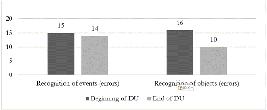
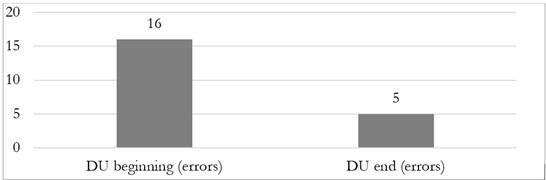
Therefore, for the 2nd grade, P1 aimed for students to recognize athletics and be able to differentiate it from other sports, identifying characteristic visual elements of the events. To illustrate this situation, students were asked to mark on a table with several pictures, which contained different sports practices, those that corresponded to athletics. This questionnaire was made available through a link that directed them to the Google Forms® platform. Students answered twice, on the first and last day of classes, in which the DU was applied. The results were organized by the number of errors as indicated in Figure 2.

P2 and P3 applied the DU in the 7th grade, and based on their objectives, which, like P1, are linked to the BNCC to some extent, we analyzed the recognition of athletics and the perception of the characteristics of the events, as explained in the methodological topic. Therefore, in the P1 class, the questionnaires have one more question.
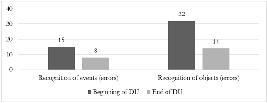
The responses to the questionnaires from the P2 and P3 classes revealed the results based on two applications, at the beginning and end of the DU. The results of P2 and P3 concerning the recognition of athletics events and their objectives are shown in Figures 3 and 4.
As explained in the methodological topic, we chose a specific analysis for this type of results. To express this feat, we created Table 1, which summarizes the information previously evidenced with the help of statistical tests.
Continuing with the presentation of the results, in the 7th grade classes, the hypothetical actions of the students to increase the community's access to athletics in general were also investigated, meeting the objective stated by the teachers of “proposing and producing alternatives for experimenting with sports not available and/or accessible in the community [...]” (BRASIL, 2018, n. p.), which is, as in the other cases, based on the National Common Curricular Base. The organized results are shown in Chart 5.

The second analytical stage produced support for conforming to the first. To this end, the students' perspective regarding certain learning objectives expressed by the teachers was highlighted. The teachers indicated in their objectives that the students needed to be able to, at the very least, recognize athletics as a sporting practice, which, in turn, has characteristics that differentiate it from other modalities. In this regard, in CSD-6, it was possible to identify that the expressed fact occurred during classes for 2nd-grade students. For 7th-grade students, this factor was added to the condition of understanding some characteristics and objectives of athletics as a brand sport, a fact also highlighted in CSD-6.
The teachers emphasized the formative value of MSEA, highlighted in CSD-3 when they noted the appropriation of knowledge related to athletics. In addition to fostering much-needed interaction during the pandemic, our study benefited from the hybrid teaching environment of two schools, which interconnected the content learned with the contexts experienced by the students. Moreover, the structure provided by the model's movements facilitated a teaching approach that aligned with the recommended objectives, leading to a reflective process on pedagogical intentions and the outcomes of this practice (Darido; Rangel-Betti, 2005).
Regarding the recognition of athletics, the difference in students' understanding between the first and last application of the investigative instruments was notable. The decrease in errors related to image linking was considerable (Figure 2) and was statistically significant (P-VALUE=0.026), considering the class monitored by P1. In the classes monitored by P2 and P3, there was a decrease in errors (Figure 3 and Figure 4). However, the results were not statistically significant (P-VALUE=0.317 and 0.121). This fact can be attributed to the school grade (7th grade), since considering the number of students, the errors in the pre-intervention questionnaire for these classes occurred in smaller quantities.
Because these are different classes at different learning stages, for the (7th) grade classes, following the teachers' planning, the students answered questions about the objectives of the athletics events (Figures 3 and 4) and about possible actions to highlight the content in their contexts (Chart 5). These questions contemplated a more advanced degree of complexity, which required greater density in the students' critical analyses as they progressed through the school years (Bagnara; Fensterseifer, 2019).
These situations pertain to the comprehension of test characteristics and the potential actions for promoting knowledge and practices related to athletics (protagonism). Both results demonstrated alignment with the objectives set by teachers P2 and P3. The data revealed a decrease in incorrect answers in the two classes monitored by P2 and P3 (see Figures 3 and 4). Additionally, the results indicated a statistically significant degree (P-VALUE=0.034 and 0.014, respectively).
The teachers’ objectives referring to the intentions of disseminating the content learned by the students in their contexts arose with greater emphasis on the reflection movement. In this MSEA movement, the students reported suggestions for increasing the community’s knowledge and access to athletics, including issues related to the promotion of athletics through the creation of videos and posts. There was also mention of the importance of public policies for financing structures and equipment for its practice, notably in neighborhoods, schools, and other public spaces located in socially vulnerable regions. These references enabled us to revisit chronic problems widely discussed by Freire and Scaglia (2003); Matthiesen (2005) and Darido and Souza Junior (2013).
Additionally, the students' proposal to enhance incentives for community participation in athletic projects can be further strengthened through campaigns that emphasize the health benefits of such activities. These insights align with the issues surrounding access to sports practices, as highlighted in the Brazilian Human Development Report produced by the United Nations Program on Physical and Sports Activities for All Ages (PNUD-Programa das Nações Unidas, 2017). This report followed the National Sports Diagnosis conducted by the Ministry of Sports (Brazil, 2015) and ultimately reflects a sound understanding on the part of the students, consistent with the needs identified in prior years' reports.
FINAL CONSIDERATIONS
Athletics is recognized as a distinctive school subject in Brazil, integrated into the official curriculum guidelines. As per the National Common Curricular Base (Brazil, 2018), it is featured in the 1st, 2nd, 6th, and 7th grades of both elementary and middle school. Despite its institutional endorsement and the body of research highlighting its educational significance, athletics often remains sidelined in school pedagogical planning. At best, it is superficially regarded as a "base" sport, which relegates it to a preparatory role, undermining its full identity and intrinsic values. Furthermore, it is frequently associated with official sports, complicating its implementation due to a lack of appropriate facilities and materials. This perspective limits the viability of incorporating many athletic disciplines into the school context without necessary adaptations.
In our study, we sought to evaluate the implementation of MSEA by considering the perspectives of both teachers and students within their respective classes. We observed that for a path to be effective, it must take into account the epistemology of teaching practices and the identity of the school. These dimensions are critical in addressing the unique characteristics of the school environment. Consequently, experiences in implementing teaching models and methodologies that overlook these factors face a significant risk of failure, even if they are intended to be successful in contexts such as sports training that extend beyond traditional educational settings.
In this way, the MSEA provided fruitful opportunities, both in terms of teacher and student representation. This fact was observed with the achievement of the pedagogical objectives advocated by the teachers, which are organized under the aegis of federal and state curricular guidelines and those of their professional institutions. The immersion in the epistemology of teaching practice, curricular flexibility, adaptation to the school identity, and the transcendence of the “school walls” provided by the planning of the teaching units based on the MSEA were the keynotes that endorsed the results of this scientific-pedagogical experience.
We recognize the necessity of advancing, particularly in the methodological realm, by critically examining results in future research and exploring various facets of the teaching profession and the institutional educational framework. However, we are only at the beginning of our journey, which has already unveiled the potential of the discourse surrounding the MSEA. This dialogue has enabled us to address the paradox of the scarcity of content on athletics within the school environment, a situation that may be linked to the neglect of the unique aspects of the school setting and the teaching profession. Could this be a paradigm that pedagogical proposals currently being explored in schools might help to transcend? According to the narratives shared by the participating teachers, this was the most significant foundation of the MSEA.
References
-
ABABEI, Catalina. Study regarding the introduction of the concept “IAAF kids' athletics” in the primary school in physical education lessons. Gymnasium: Scientific Journal of Education, Sports & Health, vol. XVIII. p. 80-86, 2017. <https://doi.org/10.29081/gsjesh.2017.18.1.07>
» https://doi.org/10.29081/gsjesh.2017.18.1.07 -
BAGNARA, Ivan. C.; FENSTERSEIFER, Paulo. E. O desafio curricular da Educação Física Escolar: sistematizações de uma pesquisa-ação na escola pública. Movimento, v. 25, p. e25008, 2019. Disponível em: <Disponível em: https://seer.ufrgs.br/Movimento/article/view/82888 >. Acesso em: 04/09/2021.
» https://seer.ufrgs.br/Movimento/article/view/82888 - BETTI, Mauro. A janela de vidro: esporte, televisão e Educação Física. Tese (Doutorado em Educação). Campinas: Unicamp, 1997.
-
BOSCATTO, Juliano. D.; IMPOLCETTO, Fernanda M.; DARIDO, Suraya. C. A Base Nacional Comum Curricular: uma proposição necessária para a Educação Física? Motrivivência, v. 28, n. 48, p. 96-112, 2016. Disponível em: <Disponível em: https://periodicos.ufsc.br/index.php/motrivivencia/article/viewFile/2175-8042.2016v28n48p96/32565 >. Acesso em: 04/09/2021.
» https://periodicos.ufsc.br/index.php/motrivivencia/article/viewFile/2175-8042.2016v28n48p96/32565 -
BRASIL. Ministério da Educação. Base Nacional Comum Curricular: educação é a base. Brasília, 2018. Disponível em: <Disponível em: http://basenacionalcomum.mec.gov.br/images/BNCC_EI_EF_110518_versaofinal_site.pdf >. Acesso em: 01/09/2021.
» http://basenacionalcomum.mec.gov.br/images/BNCC_EI_EF_110518_versaofinal_site.pdf - BRASIL. Lei n.º 9.394, de 20 de dezembro de 1996 Estabelece as Diretrizes e Bases da Educação Nacional. Brasília, 1996.
-
BRASIL. Ministério do Esporte. Diagnóstico Nacional do Esporte/caderno I Brasília, 2015. Disponível em: <Disponível em: http://arquivo.esporte.gov.br/diesporte/diesporte_grafica.pdf >. Acesso em: 27/11/ 2020.
» http://arquivo.esporte.gov.br/diesporte/diesporte_grafica.pdf - BRESSAN, João. C. M. Atletismo e desenvolvimento humano: proposição e análise de um modelo didático de ensino. Tese (Doutorado em Desenvolvimento Humano e Tecnologias). Rio Claro: Universidade Estadual Paulista Júlio de Mesquita Filho, 2021.
-
BRESSAN, João. C. M. et al Atletismo na escola é possível! Experiência do ensino do atletismo em aulas de Educação Física. Corpoconsciência v. 22, n. 01, p. 53-63, 2018. Disponível em: <Disponível em: https://periodicoscientificos.ufmt.br/ojs/index.php/corpoconsciencia/article/view/5760 >. Acesso em: 04/09/ 2021.
» https://periodicoscientificos.ufmt.br/ojs/index.php/corpoconsciencia/article/view/5760 -
BRESSAN, João. C. M.; IMPOLCETTO, Fernanda. M. Panorama da produção científica sobre o atletismo (1990-2017): uma análise dos artigos científicos em três idiomas com ênfase na subárea pedagógica. Motrivivência, v. 32, n. 63, p. 01-24, 2020. <https://doi.org/10.5007/2175-8042.2020e74034>
» https://doi.org/10.5007/2175-8042.2020e74034 - CAPRA, Fritjof; LUISI, Pier. L. A visão sistêmica da vida: Uma concepção unificada e suas implicações filosóficas, políticas, sociais e econômicas. Trad. Mayra Teruza Eichemberg. São Paulo: Cultrix, 2014.
-
CASEY, Ashley; DYSON, Ben. The implementation of models-based practice in physical education through action research. European Physical Education Review, v. 15, p. 175-199, 2009. <https://doi.org/10.1177/1356336X09345222>
» https://doi.org/10.1177/1356336X09345222 - CBAT - CONFEDERAÇÃO BRASILEIRA DE ATLETISMO. Miniatletismo: iniciação ao esporte: guia prático de atletismo para crianças, 2011.
- COZBY, Paul. C. Métodos de pesquisa em ciências do comportamento Tradução: Paula Inez Cunha Gomide; Emma Otta. Revisão técnica: José de Oliveira Siqueira. São Paulo: Atlas, 2003.
- DARIDO, Suraya C.; SOUZA JÚNIOR, Osmar M. de. Para ensinar Educação Física: possibilidades de intervenção na escola. Campinas: Papirus, 2013.
- DARIDO, Suraya. C.; RANGEL-BETTI, Irene C. (Org.) . Educação Física na escola: implicações para a prática pedagógica. Rio de Janeiro: Guanabara Koogan, 2005.
-
FOLLE, Alexandra; POZZOBON, Maria E.; BRUM, Carina F. Modelos de ensino, nível de satisfação e fatores motivacionais presentes nas aulas de educação física. R. da Educação Física, v. 16, n. 2, p. 145-154, 2005. Disponível em: <Disponível em: https://periodicos.uem.br/ojs/index.php/RevEducFis/article/view/3386/2424 >. Acesso em: 05/12/ 2021.
» https://periodicos.uem.br/ojs/index.php/RevEducFis/article/view/3386/2424 - FREIRE, João. B.; SCAGLIA, Alcides. J. Educação como prática corporal São Paulo: Scipione, 2003.
-
FREITAG, Raquel M. K. Amostras sociolinguisticas: probabilisticas ou por conveniência? Revista de Estudos da Linguagem, v. 26, n. 2, p. 667-686, 2018. <https://doi.org/10.17851/2237-2083.26.2.667-686>
» https://doi.org/10.17851/2237-2083.26.2.667-686 -
GINCIENE, Guy.; MATTHIESEN, Sara. Q. O modelo do sport education no ensino do atletismo na escola. Movimento, v. 23, n. 2, p. 729-742, 2017. <https://doi.org/10.22456/1982-8918.69788>
» https://doi.org/10.22456/1982-8918.69788 -
GOMÉZ, Alberto M.; CALDERÓN, Antonio L.; VALERO-VALENZUELA, Alfonso. Análisis comparativo de diferentes modelos de enseñanza para la iniciación al atletismo. Ágora para la EF y el Deporte, v. 2, n. 16, p. 104-121, 2014. Disponível em: <Disponível em: https://dialnet.unirioja.es/servlet/articulo?codigo=4908120 >. Acesso em: 05/12/2021.
» https://dialnet.unirioja.es/servlet/articulo?codigo=4908120 -
GOUDAS, Marios et al It ain't what you do it’s the way that you do it! Teaching style affects children's motivation in track and field lessons. The Sport Psychologist, v. 9, p. 254-264, 1995. <https://doi.org/10.1123/tsp.9.3.254>
» https://doi.org/10.1123/tsp.9.3.254 - KUHN, Thomas S. A tensão essencial: estudos selecionados sobre tradição e mudança científica. Trad. Marcelo Amaral Penna-Forte. São Paulo: Editora Unesp. 2011.
-
LEFÈVRE, Fernando; LEFÈVRE, Ana M. C.; MARQUES, Maria C. C. Discurso do Sujeito Coletivo, complexidade e auto-organização. Ciências e Saúde Coletiva, v. 14, n. 4, p. 1193-1204, 2009. < https://doi.org/10.1590/S1413-81232009000400025>
» https://doi.org/10.1590/S1413-81232009000400025 - LEFÈVRE, Fernando; LEFÈVRE, Ana M. C. Discurso do sujeito coletivo: um novo enfoque em pesquisa qualitativa. Caxias do Sul: EDUCS, 2003.
-
MARQUES, Carmen L.; IORA, Jacob A. Atletismo escolar: possibilidades e estratégias de objetivo, conteúdo e método em aulas de educação física. Movimento, v. 15, n. 2, p. 103118, 2009. <https://doi.org/10.22456/1982-8918.3078>
» https://doi.org/10.22456/1982-8918.3078 - MATTHIESEN, Sara. Q. (Org.). Atletismo se aprende na escola Jundiaí: Fontoura, 2005.
- MATTHIESEN, Sara. Q.; GINCIENE, Guy. História das corridas Jundiaí: Fontoura , 2013.
-
MENEZES, Rafael, P.; MARQUES, Renato, F. R.; NUNOMURA, Myrian. O ensino do handebol na categoria infantil a partir dos discursos de treinadores experientes. Movimento, v. 21, n. 2, p. 463-477, 2015. < https://doi.org/10.22456/1982-8918.47664>
» https://doi.org/10.22456/1982-8918.47664 -
MESQUITA, Isabel et al Representação dos alunos e professora acerca do valor educativo do Modelo de Educação Desportiva numa unidade didática de Atletismo. Motricidade, v. 12, n. 1, p. 26-42, 2016. <http://dx.doi.org/10.6063/motricidade.4213>
» https://doi.org/10.6063/motricidade.4213 - METZLER, M. W. Instructional models for physical education Arizona: Holcomb Hathaway, 2005.
- MORGAN, Kevin. Athletics Challenges A resource pack for teaching athletics. 2.ª ed. London: Routledge, 2011.
-
MOTA E SILVA, Eduardo V. et al Atletismo (ainda) não se aprende na escola? revisitando artigos publicados em periódicos científicos da educação física nos últimos anos. Movimento, v. 21, n. 4, p. 1111-1122, 2015. Disponível em: <Disponível em: https://www.redalyc.org/pdf/1153/115343227020.pdf >. Acesso em: 05/12/2021.
» https://www.redalyc.org/pdf/1153/115343227020.pdf -
O’NEIL, Kason; KRAUSE, Jennifer, M. The sport education Model: a track and field unit application. Journal of Physical Education, Recreation & Dance, v. 87, p. 14-20, 2016. <https://doi.org/10.1080/07303084.2016.1226217>
» https://doi.org/10.1080/07303084.2016.1226217 -
PEREIRA, José A et al . Estudo comparativo entre o modelo de educação desportiva e o modelo de instrução direta no ensino de habilidades técnico-motoras do atletismo nas aulas de Educação Física. Revista Portuguesa de Ciências do Desporto, 13 (2), p. 29-43, 2013. Disponível em: <Disponível em: https://rpcd.fade.up.pt/_arquivo/artigos_soltos/2013-2/02.pdf >. Acesso em: 15/07/2021.
» https://rpcd.fade.up.pt/_arquivo/artigos_soltos/2013-2/02.pdf - PNUD - Programa das Nações Unidas para o Desenvolvimento Humano. Relatório de Desenvolvimento Humano Nacional. Movimento é Vida: Atividades Físicas e Esportivas para Todas as Pessoas: 2017. Brasília: 2017.
-
PRADO, Vagner M.; MATTHIESEN, Sara Q. Para além dos procedimentos técnicos: o atletismo em aulas de Educação Física. Motriz, v. 13, n. 2, p.120-127, 2007. <https://doi.org/10.5016/757>
» https://doi.org/10.5016/757 - SIEDENTOP, Daryl. Sport education: Quality P.E. through positive sport experiences. Champaign, IL: Human Kinetics, 1994.
-
SILVA, Leonardo, F. N.; SCAGLIA, Alcides. J. Saberes profissionais: um ensaio sobre a epistemologia da prática docente. Cadernos da Pedagogia, v. 15, n. 32, p. 199-209, 2021. Disponível em: <Disponível em: https://www.cadernosdapedagogia.ufscar.br/index.php/cp/article/view/1378 >. Acesso em: 05/12/2021.
» https://www.cadernosdapedagogia.ufscar.br/index.php/cp/article/view/1378 - THOMAS, Jerry R.; NELSON, Jack K.; SILVERMAN, Stephen J. Métodos de pesquisa em atividade física 6. ed. Porto Alegre: Artmed, 2012.
-
VALERO-VALENZUELA, Alfonso; DELGADO, Manuel F.; CONDE, José L. C. Motivación hacia la práctica del atletismo en la educación primaria en función de dos propuestas de enseñanza/aprendizaje. Revista de Psicología del Deporte, v. 18, n. 2, p. 123-136, 2009. Disponível em: <Disponível em: https://digibug.ugr.es/handle/10481/33144 >. Acesso em: 10/03/2020.
» https://digibug.ugr.es/handle/10481/33144 -
VALERO-VALENZUELA, Alfonso et al Comparación de los enfoques tradicional y ludotécnico sobre la eficacia y la mejora técnica en el atletismo. Motricidad. European Journal of Human Movement, v. 14, p. 119-133, 2005. Disponível em: <Disponível em: https://dialnet.unirioja.es/servlet/articulo?codigo=2279134 >. Acesso em: 10/11/2021.
» https://dialnet.unirioja.es/servlet/articulo?codigo=2279134 -
VALERO-VALENZUELA, Alfonso et al Incidencia de los enfoques de enseñanza tradicional y ludotécnico sobre las variables relacionadas con el proceso de enseñanza-aprendizaje en la iniciación al atletismo. Apunts educación física y deportes, v. 2, n. 84, p. 32-38, 2006. Disponível em: <Disponível em: https://raco.cat/index.php/ApuntsEFD/article/view/300821 >. Acesso em: 16/03/2021.
» https://raco.cat/index.php/ApuntsEFD/article/view/300821 - VALERO-VALENZUELA, Alfonso.; CONDE, José. L. C. La iniciación atletismo a través de los juegos Málaga: Aljibe, 2003.
-
1
Article published with funding from theConselho Nacional de Desenvolvimento Científico e Tecnológico- CNPq/Brazil for editing, layout and XML conversion services.
-
2
For further information on the proposition, access the thesis completed in 2021, entitled Athletics and human development: proposition and analysis of a didactic teaching model - Atletismo e desenvolvimento humano: proposição e análise de um modelo didático de ensino (Bressan, 2021).
History
-
Received
08 July 2022 -
Preprint posted on
14 June 2022
10.1590/SciELOPreprints.4268 -
Accepted
11 Feb 2025

 Source:
  Legend: P=Participants; G=Gender; GRAD=Graduation; ITA=Institutional type of activity; PG=Postgraduate studies.Source:
  *Lesson hourSource:
  Source:
  Source:
  Source:
  Source:
  Source:
  Source: