
 INCLUSIVE EDUCATIONAL ARCHITECTURES: ASSISTIVE TECHNOLOGIES IN EDUCATIONAL SPACES FOR PEOPLE WITH DISABILITIES
ABSTRACT:
New digital technologies foster continuous changes in education. The reflection of innovation is also perceived in assistive technologies. Therefore, our objective was to understand how pedagogical architecture, as structuring supports meaningful learning, can foster more inclusive learning spaces. The methodology used was an integrative review of publications related to the keyword "pedagogical architectures" (and its English equivalent, "pedagogical architectures"), from 1993 to 2023, in seven scientific databases (BNTD, Scopus, Web of Science, Google Scholar, Science.gov, Scielo, and CAPES), analyzing 182 publications that reference long-term impairments of a physical, mental, intellectual, or sensory nature. As a result, we outlined the historical evolution of the term "pedagogical architectures" and the possibilities for its further exploration in breaking down barriers to inclusive education. The results reveal a significant scientific gap, indicating that less than 10% of academic publications address the topic in relation to disability. We conclude that by creating a concept of Inclusive Pedagogical Architectures, as learning supports that interact with users' assistive technologies, we will promote learning through accessibility. We also intend to shed light on assistive technologies and their applications in education, opening space for new studies that indicate strategies to overcome ableism, understood here as prejudice based on disability, especially in higher education in Brazil.
Keywords:
Pedagogical Architectures; Inclusive Education; Assistive Technologies
RESUMO:
Novas tecnologias digitais fomentam contínuas mudanças no ensino. O reflexo da inovação também é percebido nas tecnologias assistivas. Com isso, nosso objetivo foi conhecer como as arquiteturas pedagógicas, enquanto suportes estruturantes para a aprendizagem significativa, podem fomentar espaços de ensino mais inclusivos. A metodologia utilizada foi a revisão integrativa das publicações relacionadas ao termo chave “arquiteturas pedagógicas” (e seu correlato no inglês, “pedagogical architectures”), de 1993 a 2023, em sete bases de dados científicas (BNTD, Scopus, Web of Science, Google Acadêmico, Science.gov, Scielo e CAPES) com análise de 182 publicações que referenciam impedimentos de longo prazo, de natureza física, mental, intelectual ou sensorial. Como resultados, delineamos a evolução histórica do termo arquiteturas pedagógicas e as possibilidades de seu aprofundamento na quebra de barreiras ao ensino inclusivo. Os resultados revelam uma lacuna científica expressiva indicando que menos de 10% das produções acadêmicas articulam o tema à área da deficiência. Concluímos, que: criando um conceito de Arquiteturas Pedagógicas Inclusivas, como suportes de aprendizagem que dialogam com as tecnologias assistivas dos usuários, promoveremos a aprendizagem a partir da acessibilidade. Pretendemos, ainda, lançar luz sobre tecnologias assistivas e suas aplicações na educação, abrindo espaço para novos estudos que indiquem estratégias para superar o capacitismo, aqui entendido como preconceito em razão da deficiência, sobretudo no ensino superior, no Brasil.
Palavras-chave:
Arquiteturas Pedagógicas; Ensino Inclusivo; Tecnologias Assistivas
RESUMEN:
Las nuevas tecnologías digitales impulsan cambios continuos en la educación. El reflejo de la innovación también se percibe en las tecnologías de apoyo. Por lo tanto, nuestro objetivo fue comprender cómo las arquitecturas pedagógicas, como estructuras de apoyo para un aprendizaje significativo, pueden fomentar espacios de aprendizaje más inclusivos. La metodología empleada fue una revisión integradora de publicaciones relacionadas con la palabra clave "arquitecturas pedagógicas" (y su equivalente en inglés, "pedagogical architectures"), desde 1993 hasta 2023, en siete bases de datos científicas (BNTD, Scopus, Web of Science, Google Scholar, Science.gov, Scielo y CAPES), analizando 182 publicaciones que hacen referencia a discapacidades a largo plazo de naturaleza física, mental, intelectual o sensorial. Como resultado, delineamos la evolución histórica del término "arquitecturas pedagógicas" y las posibilidades para su exploración posterior en la superación de barreras para la educación inclusiva. Los resultados revelan una brecha científica significativa, que indica que menos del 10% de las publicaciones académicas abordan el tema en relación con la discapacidad. Concluimos que, al crear el concepto de Arquitecturas Pedagógicas Inclusivas, entendidas como apoyos al aprendizaje que interactúan con las tecnologías de asistencia de los usuarios, promoveremos el aprendizaje a través de la accesibilidad. Asimismo, buscamos visibilizar las tecnologías de asistencia y sus aplicaciones en la educación, abriendo espacio para nuevos estudios que propongan estrategias para superar el capacitismo, entendido aquí como prejuicio basado en la discapacidad, especialmente en la educación superior en Brasil.
Palabras clave:
Arquitecturas educativas; Educación inclusiva; Tecnologías de asistencia
INTRODUCTION
Studies on people with disabilities and education largely point to the integration of people with disabilities without promoting their true inclusion (Silva, 2013). This is because, alongside a vast normative framework - which creates coercive measures for inclusion to occur - practical difficulties related to the efficient removal of barriers stand out.
According to Mantoan (2023), although the terms integration and inclusion seem synonymous at first glance, they are based on opposing theoretical views and propose completely different forms of school inclusion. This is because integration functions as a reintegration effort to bring together students with disabilities who had previously been excluded by the system. Inclusion, on the other hand, proposes a radical and systematic reform of the educational structure: it challenges the traditional model and the very idea of integration, demanding, without exception, coexistence and learning of all in regular education.
Therefore, the hypothesis arises that new measures need to be developed in collaborative settings. However, such development cannot occur without considering the context of shortages of teachers, support resources, teaching materials, and assistive technologies capable of promoting accessibility in multiple learning environments.
The debate surrounding people with disabilities is a complex and multifaceted phenomenon. Based on Morin (1999), we consider it necessary to overcome the reductionism that has historically fragmented the understanding of this population, given that the experience of disability is inseparable from its web of interdependence. In this sense, it is important to elucidate the concept of assistive technology and how it relates to meaningful learning in the dialogical relationships between students and teachers.
In this research, we considered the most recent data from the People with Disabilities module of the 2022 Continuous National Household Sample Survey (IBGE, 2023), which indicate: (i) a higher illiteracy rate for people with disabilities (19.5% compared to 4.1% for those without disabilities); (ii) lower participation in the workforce, with 12 million people with disabilities outside the workforce in Brazil; (iii) lower school attendance, with 18.6 million people with disabilities (almost 9% of the population) having less access, especially to higher education.
Jacaúna et al. (2022) point to studies that show that the educational field is still lacking in new pedagogical practices, where we find students with a lack of interest in school and schools with poor infrastructure. This scenario makes us reflect both on the marginalization of people with disabilities, also in the context of education, and on proposals that seek to configure a new social system that is more inclusive, accessible, equitable, fair, and participatory.
To overcome this marginalization, it is essential to break with the ableist bias that discriminates against people with disabilities. Lorandi and Gesser (2023) point out that ableism is structural and meets the demands of the capitalist system, functioning as the basis for the daily barriers experienced by these students including through exclusionary pedagogical practices. Therefore, the central challenge lies in understanding: how can the pedagogical organization combat ableist structures and enhance the development and learning of these students?
Dias (2013, p. 2) indicates that ableism is the "conception present in society that views people with disabilities as unequal, less capable, or incapable of managing their own lives." Similarly:
(...) those who fall outside social norms are subjected to the colonization of normalizing laws through discipline, producing histories of exclusion. In the case of ableism, it alludes to a prejudiced stance that hierarchizes people based on the conformity of their bodies to body normativity. It is a category that defines how people with disabilities are generally treated as incapable (incapable of producing, working, learning, loving, caring, feeling desire, having sexual relations, etc.), bringing the demands of disability rights movements closer to other forms of social discrimination such as sexism, racism, and homophobia. This stance stems from a moral judgment that associates ability solely with the functionality of bodily structures and mobilizes the evaluation of what people with disabilities are capable of being and doing to be considered fully human. That is, it is "forgotten" that people with disabilities can develop other skills not related to their biological incapacity (not hearing, not seeing, not walking, not fully exercising all mental or intellectual faculties, etc.) and be socially capable of performing most of the abilities required of a "normal" person, as much as or even more than them (Mello, 2014, pp. 94-95).
This conception, unfortunately, is still found in formal and non-formal educational spaces, when we notice reports about the difficulties of working with students with disabilities; when we have teacher training courses aimed exclusively at a working group for "special students" or even in multiple examples of reinforcing stigmas and stereotypes involving long-term impairments of a physical, intellectual or sensory nature.
METHODOLOGY
Our research proposal aims to answer the question of how pedagogical architecture has been used in the practice of teaching people with disabilities. To this end, we conducted a literature review that allowed us to find concepts of pedagogical architectures associated with inclusion projects.
Thus, in this article, we seek to conduct a survey of instructional materials related to the term "pedagogical architecture" in online databases and documents referenced in academic publications to identify:
-
) number of publications;
-
) year of publication;
-
) theoretical frameworks of the expression "pedagogical architectures";
-
) Technologies related to people with disabilities for the application of architecture.
We sought to conduct an integrative review, considering that this research both rigorously reviews previously published content on the subject under analysis and combines studies with diverse methodologies to integrate the results, since it is necessarily an interdisciplinary analysis. In other words, our focus is on the field of education, but we do not disregard that various areas of knowledge may eventually make references to the key term.
Furthermore, although the division into disciplines and areas of knowledge is common in academic databases, we need to question to what extent this division can justify the depth of the published research. This consideration is of great importance in studies related to people with disabilities when we keep in mind that, even in the field of education, research points to issues of health, work, and communication, for example, produce necessary and direct implications for the results obtained.
When we began searching the databases, we noticed that many of them do not offer accessibility support. There are difficulties accessing them using screen readers, for example, which can simply prevent researchers with visual impairments from having equal access to the results presented on the platforms. This finding corroborated what our research group has been observing, demonstrating that it is a critical element of the investigative experience itself.
Furthermore, some databases could only be accessed through password-protected login, which is why some surveys cannot be repeated without the user accessing the research platform with authorization, as is the case with agreements with educational institutions. In our case, we used CAFe-CAPES access, linked to the Federal Fluminense University, to obtain more comprehensive results across all the platforms we accessed.
Regarding the risks and limitations of the study, we understand that the cross-cutting nature of the theme related to people with disabilities should permeate the reading. In this respect, it is worth highlighting Gadotti is (2004) observation that interdisciplinarity is the possibility of dialogue in teaching practice. It is dialogue that allows the integration of the unity of knowledge, including from a historical point of view. Cross-cuttingness in studies of people with disabilities is a concept that refers to the need to address disability as an issue that cuts across different areas of knowledge and not just as a topic restricted to a specific discipline.
Our aim is, therefore, to move towards defining a concept of pedagogical architectures from the perspective of inclusive education, highlighting primary works on the subject, identifying any gaps in the areas of study, and highlighting authors who have been working on the topic, including verifying in which regions of Brazil this theme has prevailed as an object of study.
On the one hand, it is important to highlight the number of publications and the years in which they occurred, and, even more importantly, to mine data that allows us to identify new assistive technologies and theoretical formulations that can contribute to our main research elements. For these reasons, our research uses a mixed-methods approach (Johnson, Onwuegbuzie, and Turner, 2007; Seawright, 2016) to achieve better analytical possibilities. Finally, we emphasize the central interest of the research in the question of meanings and their actions and interactions within a social context (Moreira, 2003).
The integrative review corresponds to our strategy for data collection; the descriptive quantitative approach organized this data into numbers and frequencies; the thematic analysis extracted the meaning and essence of this data; and integration unites the numbers and meanings to answer the research question completely.
RESULTS
The surveys were conducted between June and August 2023. We began the searches on June 18, 2023, in the Brazilian Digital Library of Theses and Dissertations, an online collection, where we identified 57 results for the term "pedagogical architectures," including 25 theses and 32 dissertations, distributed between the years 2007 and 2022. The database recorded duplicate publications by Rangel (2011), Voss (2014), and Falcade (2015). After deducting the duplicates, we obtained the following final count of 53 publications, which we present in Table 1.
In this repository, the Brazilian Digital Library of Theses and Dissertations, we analyzed the materials one by one and found direct mention of disability in three materials, which were read in their entirety. With this, we identified that approximately 5% of the materials produced address the theme of inclusion.
It should be noted that both the first reference work - Schneider (2007), and the most recent - Silva (2022), point to the elements of pedagogical architecture, without discussing the concepts of the approach throughout history, and without directly referencing people with disabilities.
In this initial survey, Reinoso's (2016) work stands out as a reference literature by bringing together pedagogical architectures for learning Libras (Brazilian Sign Language). The author also introduces information on new technologies for people with hearing impairments, such as LIBRASWeb; graW-S Deafword and, especially, CAP (Constructor of Pedagogical Architectures), which uses a library of digital resources called MVLIBRAS, aimed at Libras teachers - interpreter trainers.
It is important to highlight the research by Almeida (2017), which presents the development of a web platform that aims to provide Natural Language Processing tools and resources free of charge, including automatic translation from Portuguese to Libras (Brazilian Sign Language). Although some proposals do not explicitly mention accessibility for people with disabilities, their guidelines on support platforms apply directly to the development of inclusive virtual environments. Therefore, the structuring of any digital platform intrinsically requires navigation resources that ensure autonomy and comfort, such as screen readers, alternative text, contrast, and transcribers.
Subsequently, the search was expanded to new databases, discarding previously located works. In the Scopus database, a search conducted on June 26, 2023, yielded 31 results, distributed across the areas of Social Sciences, Computer Science, Engineering, Arts and Humanities, Business, Management and Accounting, Decision Sciences, Mathematics, and Psychology. After eliminating duplicates, the selected articles were organized in Table 2, which presents the final distribution of the corpus.
Only two publications (approximately 6% of the total) were related to people with disabilities, and those only covered the area of hearing impairment. Nevertheless, this survey included important references to early concepts of pedagogical architectures, particularly in Nevado, Carvalho, and Menezes (2007), who situate the topic within what they define as "pedagogy of uncertainty," indicating that knowledge arises from movement.
It is interesting to note that, for Franciosi (2005), pedagogical architecture can be understood as the construction of pedagogical strategies based on a specific theory and its assumptions in order to assist in the effective implementation of learning with the support of technological resources such as virtual learning environments and/or videoconferencing. The same author, in 1988, conducted a study on deaf people. Although it falls outside the proposed period for the review, we were able to locate the work, which pointed to hypotheses about the intellectual development of deaf children (delayed due to the absence of language, with repercussions on the development of logical reasoning). The author indicated the development of the deaf person's vision for non-symbolic images and pointed out that people with hearing impairments "are unique not because of the restriction of a physical capacity, but rather because of the way they understand" (Franciosi, 1988, p. 157).
In the Web of Science database, on June 19, 2023, we found six results, distributed among the areas of Education and Educational Research; Engineering and Informatics, without a direct thematic relationship to the issue of people with disabilities, with the following distribution by year, as shown in Table 3, which also excludes previously referenced works.
In the Scielo database, we found only one result on June 19, 2023, an article from 2018 related to Medical Education in Brazil (Machado et al, 2018). On the ERIC platform, on June 19, 2023, we found 13 results, mostly articles, without a direct thematic relationship to the issue of people with disabilities. Therefore, we considered the publications as per Table 4.
On the Science.gov platform, on June 19, 2023, we obtained 29 results, most of which were related to hydrogeology, with 9 references to the use of the term in the field of teaching/learning. These materials were read in full and are already referenced in previous tables, constituting a duplication of research location.
It is worth noting that the choice of the Science.gov platform aimed to identify so-called grey literature, which includes technical reports from governments, conference documents, accessibility guidelines, and patents. We understand that the few results related to education were a significant finding because we expected to find reports on digital accessibility and inclusive education guidelines developed by organizations, for example, which was not the case.
On August 27, 2023, in the CAPES online database of theses and dissertations, we found 82 results, including 30 Doctoral Theses, 43 master’s Dissertations, and 9 Professional Master's Dissertations, in the areas of business administration; computer science; education; teaching; literature; and social sciences and humanities.
In the CAPES repository, we analyzed the materials one by one and found applications related to people with disabilities in four materials, which were read in full. From this, we identified that approximately 8% of the materials produced address the theme of inclusion, with half of the works having a specific focus on elderly people. One of the publications is that of Lindner (2009), already referenced in the previous table.
Thus, we have added only one additional specific publication related to people with disabilities. This is a proposal for a Pedagogical Architecture to assist educators in the education of deaf people (Dos Santos, 2007). The author proposes a pedagogical architecture for an initial and continuing teacher training course. He presents a discussion on information and communication technology, considering the possibility of teachers and students being potential authors of the teaching materials necessary for the inclusion of deaf people.
We also searched for research groups in Brazil dedicated to the study of such architectures, but we did not obtain any results, whether based on the group's name, research area, keywords, or even the group's impact.
Based on the location of these materials, we observed that the term "pedagogical architectures" can still be considered a relatively new subject, totaling 182 publications in 7 databases.
Therefore, we conducted additional research in the Google Scholar database, with the search carried out on June 19, 2023. 1200 results were found, including 27 review articles. In this specific database, as a next step, we used another combined search term to locate more specific materials on the topic addressed.
This allowed a search in this database, conducted with the keywords “pedagogical + architectures" and "people + with + disabilities," to yield 76 publications. It is worth noting that Google Scholar includes articles, theses, books, abstracts, and other related publications, making it possible to find multiple versions of the same work.
For these reasons, we refined duplicate materials, discarded references to publications that did not address the issues in depth (such as course forms and calls for proposals), analyzed publications that addressed issues related to people with disabilities, and created a publication tracking table.
The unique aspect of this research lies in its specific search for accessible teaching methods and practices that suggest ways to bring people with and without disabilities closer together in the classroom, in pursuit of meaningful learning with the aid of technology.
We noticed a gap in knowledge regarding how to design educational architectures for students with autism spectrum disorder (ASD), visual, intellectual, or motor disabilities, and we envision the possibility of fostering structured research networks. Therefore, we aim to engage with the concepts of educational architecture and assistive technologies referenced in each of the materials chosen for study, based on all the results found.
DISCUSSIONS AND PERSPECTIVES
Initially, we noted that the diversity of research lines, by area of knowledge, indicates an important factor in the study of pedagogical architectures, as tools used in various fields of knowledge. Throughout the research, we observed that support for meaningful learning, with technological assistance, are present in the most varied areas of knowledge.
There is productive interdisciplinarity in the study of pedagogical architectures because the concept of architecture is an intentional borrowing from the fields of software engineering and infrastructure, which, when transposed to education, evokes the idea of structure, foundation, space for coexistence, and organization of flows. In pedagogy, this allows for the design of learning arrangements that integrate four clear axes: the organizational, the methodological, the content-related, and the technological.
The combination of these terms empowers the teacher to plan the digital or in-person learning space in a non-linear way. The concept allows for the creation of ecosystems where students have the autonomy to research, cooperate, and construct knowledge. The union of structural technique with pedagogical sensitivity has generated a new analytical model, with a solid foundation in Jean Piaget's Genetic Epistemology; Pappert’s Constructionism; and Paulo Freire's Pedagogy of Questioning.
The authors cited in the research mention Distance Education (DE), Inclusive Education, and Project-Based Learning, converging on the systemic organization of elements (supports, media, methods) to create learning opportunities. For us, the research highlights the evolution and expansion of the term, without dispersion, to foster a productive dialogue between structural design and interactionist learning theories.
Furthermore, pedagogical architecture opens a range of possibilities for teaching practices by bringing together types of architecture that can guide educational practice. This allows for the construction of integrative panels of disciplines and curricula, from early childhood education to higher education. In other words: "Pedagogical architectures are, above all, learning structures created from the confluence of different components: pedagogical approach, software, internet, artificial intelligence, distance education, conception of time and space" (Carvalho, Aragón and Menezes, 2005, p. 354).
The proposal of pedagogical architectures is characterized by encouraging the collaborative construction of knowledge, promoting continuous dialogue in learning processes. Simultaneously, this approach enables the fulfillment of the specificities of the human condition by providing adaptations tailored to the cognitive particularities of people with disabilities. Within this scope, the integration of assistive technologies becomes relevant, since these tools undergo improvements throughout the users' lives, supporting personalized strategies to aid the dynamics of teaching according to individual accessibility needs.
There are various techniques and processes for applying pedagogical architecture, which is why we find references to the term "plasticity" of architecture. This conceptual concern leads us to the concept of Pedagogical Architectures proposed by Carvalho, Aragón and Menezes (2005), referenced in most of the articles analyzed in the research. This concept indicates that pedagogical architecture depends on the learning structures that the teacher uses to assist the student.
Carvalho et al. indicate that architectures can encompass, for example, learning projects, problem-solving, and simulated action that are configured as "re-readings of pedagogical approaches," based on "the conception of interdisciplinary knowledge and the teacher training model as a network of relationships" (Carvalho, Aragón, and Menezes, 2005).
Figure 1 the Ecology of a Pedagogical Architecture), developed by Silva (2021, p. 57), indicates a possible formative path. Thus:
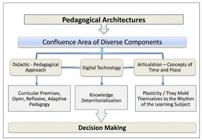
Another concept of Pedagogical Architecture, found in Behar (2009), considers Pedagogical Architecture as: a system of theoretical premises that represents, explains, and guides how the curriculum is approached and that is realized in pedagogical practices and in teacher-student-object of study/knowledge interactions”. Thus, the AP is constituted by a range of organizational, instructional, methodological, and technological elements, which maintain an interrelationship (Behar, 2009, p. 2).
In both concepts, commonly associated with the field of computer science in education, the construction of the pedagogical strategy involves the formation of an interdisciplinary team. The teacher acts as a mediator of integrative practices, uses technologies, and identifies not a single, but several possible architectures capable of better producing knowledge together.
Working with pedagogical architectures is not about using digital resources for their own sake, but about using digital resources within meaningful pedagogical strategies; that is, it is about considering which resources will be valid to use, for what purposes, and what needs will be met (Carvalho and Silveira, 2009, p. 4).
The increase in the number of publications per year suggests that this is a growing topic. The scatter plot below shows the distribution of the number of references by year of publication, indicating an absence of reported publications in the period preceding the 1990s, a peak in 2016, and a new upward trend around interest from the last two years onwards, as shown in Figure 2.
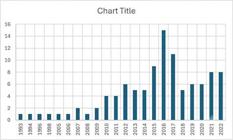
Although the topic of pedagogical architecture has grown in interest, its specific articulation with the inclusion of people with disabilities is still incipient in the reviewed academic production. This finding, based on quantitative and qualitative analysis of the literature, lends relevance to the proposition of the concept of Inclusive Pedagogical Architectures to advance in this field.
Furthermore, it is important to consider that, of the publications mapped, only a small fraction analyzes the issue of people with disabilities. This statistical asymmetry reflects the institutionalized ableism in research itself; that is, research is conducted for a "standard student" and functional diversity is neglected, which is a symptom of academic exclusion.
Pedagogical architecture can also be associated with inclusion tools, in the sense of promoting multiple literacies for a wide variety of individuals. We note that it is still something new to construct a pedagogical plan that anticipates the needs of students with disabilities. Although studies allude to the use of technologies, there is no in-depth analysis of assistive technologies.
At this point, it is worth remembering that we are dealing with a multitude of technologies, but just as not all technology is digital, not all technology is assistive either. Assistive technology is: "the entire arsenal of resources and services that contribute to providing or expanding the functional abilities of people with disabilities and consequently promoting independent living and inclusion" (Bersch, 2017, p. 2).
In this sense, assistive technology emerges as a resource used by people with disabilities, which, in the context of education, can function as tools for inclusion. There is still a lack of assistive technologies and reports of precarious access to information for students with disabilities - which makes it important to disseminate data on successful situations and, in the field of education, on plans that can be replicated. Furthermore:
Assistive Technology is an interdisciplinary field of knowledge that encompasses products, resources, methodologies, strategies, practices, and services aimed at promoting functionality related to the activity and participation of people with disabilities, impairments, or reduced mobility, with a view to their autonomy, independence, quality of life, and social inclusion (Minutes VII - Technical Aids Committee - CAT).
In the context of education, assistive technologies will play an essential role in ensuring content accessibility, enabling more efficient communication, more equitable access, and a more enriching exchange between teachers and students. It should even be considered that teachers with disabilities, based on their personal experiences, can endorse inclusion and information strategies using assistive technologies.
Throughout the research, we were able to perceive that many of the resources used by people with disabilities may represent techniques and instruments that are not related to the digital world. This is the case, for example, with slates, stylus and lip reading.
The presence of guide dogs in educational spaces also deserves discussion, since we found no reports on how the application of Law No. 11.126/05, which guarantees visually impaired people accompanied by guide dogs the right to enter and remain with the animal in all public spaces, is being implemented.
Furthermore, creating a technology from scratch is not necessarily the best option. This statement is corroborated by the number of applications that have been discontinued, support incompatible with digital technology updates, and reports of similar products that failed to reach a wide audience. It is common for older applications to stop working on newer devices, as developers generally focus on providing support for the latest versions of operating systems.
In the practice of teaching people with disabilities, it is still necessary to consider the role of individuals who assist in communication, such as sign language interpreters. Since we have few bilingual teachers, the interpreter is often the link between the deaf, signing student and the entire school community; therefore, it is essential that a pedagogical approach considers the role of the interpreter.
Thus, while there is a search for universal models for applying design to accessibility solutions, on the other hand, people are not "categorizable" (Mantoan, 2015). Architecture encourages teachers to act in response to what they encounter without relying on ready-made solutions. The notion of pedagogical architecture, from an inclusion perspective, points to a new posture for teachers who share new knowledge and other ways of solving problems and assessing learning with their students. Inclusion, in this sense, is...
This is an opportunity we have to reverse the situation in most of our schools, which attribute to students the deficiencies that are inherent in the teaching they provide — what the student has learned and what they don't know is always evaluated, but rarely is "what" and "how" the school teaches analyzed, so that students are not penalized by grade repetition, dropout, discrimination, exclusion, and so on (Mantoan, 2015, p. 18).
The same author warns us that innovation does not necessarily mean the unusual; it is often the realization of the obvious, the simple, that which is possible to do but needs to be worked on (Mantoan, 2015, p. 31). Therefore, if we are attentive to how students learn, we need to be attentive to how teachers learn, to professionalize themselves and improve their pedagogical knowledge.
It is evident that there is a need to foster lifelong learning and to monitor the unfolding of inclusion initiatives in education, enabling structured feedback to material developers on the effectiveness of the technologies applied. Similarly, the adoption of Plain Language, captioning and transcription resources for deaf people, the valorization of Libras (Brazilian Sign Language), and the guarantee of audio description are indispensable. These elements demand prior and systematic planning, making contingency approaches unfeasible for ensuring effective learning.
As an expected contribution, this research aims to support the reformulation of experiences related to disability from the perspective of equal opportunities, fostering the consolidation of plural learning environments. The relevance of this discussion is based on the premise that accessibility and inclusion are not limited to isolated actions, but constitute a continuous, dynamic, and necessarily collective institutional process that demands the restructuring of educational spaces for and with all students.
FINAL CONSIDERATIONS
It is noteworthy that technology allows for greater inclusion of students with disabilities because it expands forms of participation, communication, and access to content. Multiple forms of transmitting what is taught are necessary; ensuring the description of elements; visual and auditory indicators; and usability of support tools.
In this context, the notion of Inclusive Pedagogical Architecture, geared towards the specific needs of students with disabilities, presupposes the articulation of four fundamental planning principles:
-
) Recognition and Epistemic Investigation: Prior understanding of the biopsychosocial characteristics of the disability and the accessibility needs of the individual, preceding the mediation of curricular content;
-
) Design of Meaningful Activities: Proposing intentional pedagogical practices that enable the active participation and cognitive development of the student;
-
) Accessible Methodological Diversification: Selection and application of didactic-pedagogical approaches that guarantee the elimination of methodological barriers;
-
) Assistive Technology Mediation: Integration of technological resources and technical support tools that enhance the student's autonomy and inclusion in the learning environment.
Therefore, we understand that pedagogical architecture to be considered inclusive, it must take into account the items above, which is why we conceptualize Inclusive Pedagogical Architectures as learning supports that interact with users' assistive technologies and promote learning through accessibility.
This proposal allows teachers to feel challenged to seek necessary actions in light of new perspectives opening to school education through the implementation of inclusive projects. Thus, how to conduct accessible classroom activities requires planning that considers the individuals involved, how the content will be used, the means of promoting interaction, and how to combine the technologies used to support classes with the user's assistive technologies.
Inclusive projects are fundamental dynamics as strategies to overcome isolation and bring people with and without disabilities closer together, since problematization challenges the ableist view that students with disabilities are incapable of learning or cooperating, positioning them as active participants in the group.
Initially, to refer to the idea of pedagogical architecture, we consider the writings of Piaget, recognizing the importance of the lifelong learning approach to knowledge acquisition. There is a clear importance of tools for learning, as well as the recognition that all knowledge construction is a process.
We emphasize that, since there is no absolute beginning in any cognitive domain, development must be examined from the stages named and designated as formation. This development must consider the partial prior conditions, being a process to be worked on, trying to ensure collaboration to achieve historical-critical analysis as well as psychogenetic analysis.
This starting point allowed us to rethink the learning structures capable of leading the student to achieve autonomy. The mediation carried out by the teacher is fundamental to adapting the proposed content. When the teacher uses assistive technologies, including teaching tools, they take a further step in ensuring that the student, more than just being included in the classroom, is seen as an autonomous person. This way of acting in the classroom represents an important paradigmatic shift, an anti-ableist one. We also believe that we may be facing a new paradigm in the way we approach the notion of citizenship for people with disabilities.
We also concluded that the construction of an architecture that incorporates assistive technologies highlights, first and foremost, that the barriers are in the learning environments and, therefore, are external to the people. Furthermore, it allows for closer interaction between people with and without disabilities, creating more efficient communication channels. Communication fosters acceptance, which, in turn, is an essential factor in a person's continued presence in the learning environment.
Piagetian awareness occurs when the subject overcomes cognitive conflict, and in the case of a student with a disability, this conflict is often generated by a barrier (something external to them, communicational, architectural, or attitudinal, for example). The API (Integrated Psychogenetic Environment), therefore, acts as the environment that removes the barrier to allow the free course of psychogenetic development.
We emphasize here that the vision of autonomy for people with disabilities should not fall into a trap of a capitalist worldview but rather consider the possibility of people with disabilities achieving self-determination. In other words, it is possible for students to be protagonists in the construction of their knowledge when they find a facilitating environment, designed in an inclusive way.
The incorporation of assistive technologies broadens the framework originally proposed for Pedagogical Architectures, indicating that the originally formulated concept is not sufficiently comprehensive to encompass accessibility resources and strategies. The concept of Inclusive Pedagogical Architectures, in this sense, improves the theoretical basis and indicates essential elements for building accessibility.
In this context, accessibility is the ability to guarantee autonomy, comfort, and equity in the knowledge construction process, allowing students with disabilities to learn based on their own cognitive and sensory specificities. Accessibility should materialize through ensuring that virtual learning platforms and environments have accessible resources (such as compatibility with screen readers, alternative text for images, adjustable contrast, and audio transcribers, for example). The goal is to create an environment free of insurmountable barriers for people with disabilities.
Accessibility, then, is instrumental and interacts with assistive technologies. This means that accessibility occurs when the arrangement designed by the teacher anticipates and adapts to the use of the student's arsenal of resources, whether digital or non-digital. The focus of pedagogical architectures is not to use technology for technology's sake, but to use it with clear pedagogical purposes to achieve learning.
It is also about pedagogical, attitudinal, and methodological accessibility, which means planning non-linear and flexible learning paths that combat structural ableism. Instead of demanding that the student with a disability adapt to a class, accessibility lies in proposing diversifications of the student's representations of content and action.
Transposing the classic concept of Pedagogical Architectures (PA) to the model of Inclusive Pedagogical Architectures (IPA) requires more than simply adding technological tools to the teaching environment. Fundamentally, it demands an axiological and epistemological revision of the structuring axes that coordinate teaching practice. Thus, while traditional pedagogical architectures are systematically articulated through organizational, methodological, content, and technological axes, when these elements are filtered through inclusive education and the fight against ableism, their meanings are profoundly broadened, shifting the focus from instructional standardization to flexibility and accessibility.
Thus, educational objectives and the domain of knowledge are reconfigured to validate the multiple forms of representation of language and thought, such as bilingualism and natural language processing applied to communication. Prior knowledge, in turn, transcends the mere verification of academic prerequisites to encompass the biopsychosocial background of the learner, incorporating their life experience with disability and their proficiency in using their own assistive technologies.
From a Piagetian and Freinetian perspective, interactionist-problematizing dynamics and distributed mediation act as tools for breaking down attitudinal barriers, in which pedagogical support expands to cooperative networks, shifting the focus from punitive judgment of the failing student to critically analyzing the barriers of the learning environment itself, thus becoming a regulatory mechanism for the plasticity of the proposed architecture.
Overcoming ableist bias in education finds support in the most recent Decree No. 12,686/2025, and it is worth remembering that it is "a presupposition of any and all educational relationships that the educator is at the service of the learner's interests" (Saviani, 1986, p. 86).
It is in this relationship of socializing knowledge that we can assert the progressive character of education, with everyone and for everyone. The concept of inclusive pedagogical architecture can, in this scenario, contribute to a path of information, rapprochement, and realization of the rights of people with disabilities in the context of education.
References
-
ALMEIDA, Wanderson. R. PortService-Br: Uma Plataforma para Processamento de Linguagem Natural da Língua Portuguesa Dissertação de Mestrado. Programa de Pós-Graduação em Informática. Universidade Federal do Espírito Santo, Vitória, 2017. Disponível em: https://repositorio.ufes.br/items/1f1324ee-67c5-48f2-8988-4069ace19df8
» https://repositorio.ufes.br/items/1f1324ee-67c5-48f2-8988-4069ace19df8 -
ALVARES, Sandra Leonora.Programando a arquitetura escolar: a relação entre ambientes de aprendizagem, comportamento humano no ambiente construído e teorias pedagógicas 2016. Tese (doutorado), Faculdade de Engenharia Civil, Arquitetura e Urbanismo, Universidade Estadual de Campinas. São Paulo. Disponível em: Disponível em: https://repositorio.unicamp.br/acervo/detalhe/975310 Acesso em: 20/11/2023.
» https://repositorio.unicamp.br/acervo/detalhe/975310 - ARAGÃO, Rosane; DE MENEZES, Crediné S; DE CASTRO, Alberto.N. Learning Assessment in a Theses Debate. International Symposium on Project Approaches in Engineering Education; Active Learning in Engineering Education Workshop; International Conference on Active Learning in Engineering Education (PAEE/ALE'2022) , Alicante - Spain, 06 -08 July 2022
-
BEHAR, Patrícia A. Modelos pedagógicos para a educação a distância Porto Alegre: Artmed.; 2009. Disponivel em: Disponivel em: https://shre.ink/T5NJ Acesso em: 20/11/2023.
» https://shre.ink/T5NJ -
BERNARDI, Maira. Prática pedagógica em EAD: uma proposta de arquitetura pedagógica para formação continuada de professores Tese (doutorado), Faculdade de Educação da Universidade Federal do Rio Grande do Sul. Porto Alegre/RS. 2011. Disponível em: https: Disponível em: https: https://shre.ink/T5mW Acesso: 20/11/2023
» https://shre.ink/T5mW -
BERSCH, Rita. Introdução à tecnologia assistiva Porto Alegre, 2017.Disponível em: Disponível em: https://portalidea.com.br/cursos/tecnologia-assistiva-nas-escolas-apostila01.pdf Acesso: 20/11/2023.
» https://portalidea.com.br/cursos/tecnologia-assistiva-nas-escolas-apostila01.pdf -
BORGES, Karen Selbach. Um estudo sobre pensamento formal no contexto dos Makerspaces Educacionais 2018. Tese (doutorado), Pós-Graduação em Informática na Educação, Universidade Federal do Rio Grande do Sul; Porto Alegre RS. Disponível em: Disponível em: https://www.lume.ufrgs.br/handle/10183/187572 Acesso em: 20/11/2023.
» https://www.lume.ufrgs.br/handle/10183/187572 - BREMGARTNER, Vitor, N, José FranciscoNeto, & MENEZES, Crediné S. Conceptual framework of educational resources adaptation for improve collaborative learning in virtual learning environments.2017 IEEE Frontiers in Education Conference (FIE), 1-9, 2017.
-
BREMGARTNER, Vitor.; N NETTO, José Francisco; MENEZES, C. Estrutura conceitual para adaptação de recursos educacionais colaborativos em ambientes virtuais de aprendizagem. Anais dos Workshops do VII Congresso Brasileiro de Informática na Educação, 2018, Disponível em: Disponível em: http://milanesa.ime.usp.br/rbie/index.php/wcbie/article/viewFile/8203/5882 Acesso em: 20/11/2023.
» http://milanesa.ime.usp.br/rbie/index.php/wcbie/article/viewFile/8203/5882 -
CARVALHO, Marie J.; ARAGÓN, Rosane; MENEZES, Crediné S. Arquiteturas pedagógicas para educação a distância: concepções e suporte telemático, Anais do XVI SBIE, Juiz de Fora, MG, 2005. Disponivel em: Disponivel em: https://shre.ink/T5JR Acesso em: 20/11/2023.
» https://shre.ink/T5JR -
CARVALHO, Marie J. S. e SILVEIRA, Patrícia G. A exploração de uma arquitetura pedagógica em sala de aula. Anais do XX Simpósio Brasileiro de Informática na Educação Florianópolis. 2009. Disponivel em: Disponivel em: http://www.niee.ufrgs.br/eventos/SBIE/2009/conteudo/artigos/ws4/63600_1.pdf Acesso em: 20/11/2023.
» http://www.niee.ufrgs.br/eventos/SBIE/2009/conteudo/artigos/ws4/63600_1.pdf -
CASTRO, Antônio, TRINDADE, Rui, PEREIRA, Teresa. Proof of Concept Teaching for 21stCentury Digital Literacy in Portugal: A Pedagogical Approach Towards a New Educational Model. In: Passey, D., Leahy, D., Williams, L., Holvikivi, J., Ruohonen, M. (eds) Digital Transformation of Education and Learning - Past, Present and Future. OCCE 2021. IFIP Advances in Information and Communication Technology, vol 642., 2022. Springer, Cham. https://doi.org/10.1007/978-3-030-97986-7_14 Acesso em 25/11/2023.
» https://doi.org/10.1007/978-3-030-97986-7_14 - CEPPI, Giulio; ZINI, Michele.Children, Spaces, Relations: Metaproject for an Environment for Young Children Reggio Children, Piazza della Vittoria, 6, 42100, Reggio Emilia, Italy, 1998
-
CHENG, YUH Ming, L. -S. CHEN, H. -C. HUANG, S. -F. WENG, Y. -G. CHEN AND C. -H. LIN, Building a General Purpose Pedagogical Agent in a Web-Based Multimedia Clinical Simulation System for Medical Education, in IEEE Transactions on Learning Technologies, vol. 2, no. 3, pp. 216-225, July-Sept. 2009, https://doi.org/10.1109/TLT.2009.18
» https://doi.org/10.1109/TLT.2009.18 -
CREANOR, Linda; WALKER, Steve. Arquiteturas de aprendizagem e negociação de significado nos sindicatos europeus. Disponível em: Disponível em: https://abrir.link/tbCVi Acesso em: 20/11/2023.
» https://abrir.link/tbCVi -
DA SILVA Francisco. X.; MÜLLER, Miriam G; DE ARAUJO SAMPAIO LIMA Rafaela, JACAÚNA Ricardo D. P., Andrea PEREIRA AND DE MENEZES, Crediné. S., Evaluation of the Knowledge Construction Process in the application of the Pedagogical Architecture “Debate of Thesis”,"2021 XVI Latin American Conference on Learning Technologies (LACLO), Arequipa, Peru, 2021, pp. 310-317, DOI: 10.1109/LACLO54177.2021.00039
» https://doi.org/10.1109/LACLO54177.2021.00039 -
DA SILVA, Ketia Kellen Araújo; MACHADO, Letícia Rocha; RIBEIRO, Ana Carolina Ribeiro; DA SILVA, Jozelina Silva; BEHAR, Patricia Alejandra. Relatando um experimento de aulas ao vivo em um curso a distância. Disponível em: Disponível em: https://files.eric.ed.gov/fulltext/ED621985.pdf Acesso em: 25/11/2023.
» https://files.eric.ed.gov/fulltext/ED621985.pdf -
DE ALMEIDA, Renan Freitas; REINOSO, Luiz Fernando; DE LIRA TAVARES, Orivaldo. CAPCOM-Construtor de Arquiteturas Pedagógicas para Dinâmicas Colaborativas com Dados Multimídia.Revista de Informática Aplicada, 2015, 11.2. Disponível em: Disponível em: https://www.seer.uscs.edu.br/index.php/revista_informatica_aplicada/article/view/6882 Acesso em: 20/11/2023.
» https://www.seer.uscs.edu.br/index.php/revista_informatica_aplicada/article/view/6882 -
DE LIRA TAVARES, O. DE MENEZES, C.S. DE NEVADO, R.A.SANTOS, L.; CASTRO, A.; DE MENEZES, C.S. Ambientes virtuais flexíveis para ensino e aprendizagem. 2012 42nd ASEE/IEEE Frontiers in Education Conference Disponivel em: Disponivel em: https://abrir.link/MzP5A Acesso em: 20/11/2023.
» https://abrir.link/MzP5A - DIAS, Adriana. Por uma Genealogia do Capacitismo: da eugenia estatal à narrativa capacitista social. In.: Simpósio Internacional de Estudos sobre Deficiência, 2º, Anais eletrônicos... São Paulo, p. 1-14. 2013.
-
DINIZ, Debora COSTA , Envelhecimento e deficiência In: CAMARANO, Ana Amélia (Org.). Os novos idosos brasileiros: muito além dos 60? Rio de Janeiro: IPEA, 2004. p. 107-120. Disponível em: Disponível em: https://shre.ink/T6YD . Acesso em: 03 jul 2023.
» https://shre.ink/T6YD -
DOS SANTOS, Ricardo M.; ELIA, Marcus, da F.; SANTOS, Monica Pereira; MORENO, Moacyr de P.R. Proposta de Arquitetura Pedagógica para auxiliar formadores na Educação de surdos. In: Brazilian Symposium on Computers in Education (Simpósio Brasileiro de Informática na Educação-SBIE). 2007. p. 145-154. Disponivel em: Disponivel em: http://milanesa.ime.usp.br/rbie/index.php/sbie/article/view/564 Acesso em: 20/11/2023.
» http://milanesa.ime.usp.br/rbie/index.php/sbie/article/view/564 -
FALCADE, Andressa. Design instrucional aplicado ao mundo virtual TCN5. Dissertação de mestrado do programa de Pós-graduação em ciências da Computação, da Universidade Federal de Santa Maria. Santa Maria RS. 2015. Disponivel em: Disponivel em: https://repositorio.ufsm.br/handle/1/15406 Acesso em: 20/11/2023.
» https://repositorio.ufsm.br/handle/1/15406 -
FERRARI, Hélio Oliveira. Arquitetura pedagógica para groupwares baseada no pensamento freinetiano com suporte avaliativo em representações sociais de abordagem estrutural 2017. Faculdade de Engenharia elétrica; Universidade Federal de Uberlândia/MG. Disponível em: Disponível em: https://repositorio.ufu.br/handle/123456789/21311 Acesso em: 20/11/2023.
» https://repositorio.ufu.br/handle/123456789/21311 -
FERREIRA, Patrícia Castro. Digital Teaching Materials: Experiences of Production and use in Post-Graduate in Design Tese (doutorado) Pós-graduação em Designer; Universidade Católica do Rio de Janeiro. Rio de Janeiro, 2012. Disponível em: Disponível em: https://www.maxwell.vrac.puc-rio.br/21843/21843_1.PDF Acesso em: 20/11/2023.
» https://www.maxwell.vrac.puc-rio.br/21843/21843_1.PDF -
FIUSA, Patricia Jantsch; MOCELIN, Roberta Ribas. Arquiteturas Pedagógicas: revisão de conceitos e suas aplicações na educação brasileira. In: XXII Conferência Internacional sobre Informática na Educação Tese (doutorado), Fortaleza, Brasil. 2017. Disponivel em: Disponivel em: https://www.tise.cl/volumen13/TISE2017/01.pdf Acesso em: 20/11/2023.
» https://www.tise.cl/volumen13/TISE2017/01.pdf -
FRANCIOSI, Beatriz Regina Tavares. Projeto de interfaces gráficas para ensino de deficientes auditivos Porto Alegre. 1988. Dissertação de mestrado, Ciências da Computação, Universidade Federal do Rio Grande do Sul. Porto Alegre/RS. Disponivel em: Disponivel em: https://www.lume.ufrgs.br/handle/10183/25860 Acesso em: 20/11/2023
» https://www.lume.ufrgs.br/handle/10183/25860 -
FRONDANA, Fernanda Vieira.Estruturação de curso de capacitação mediado por tecnologia para otimizar a gestão de equipamentos médico-hospitalares 2020. Dissertação (mestrado) em Gestão e Inovação em Saúde, Universidade Federal do Rio Grande do Norte. Disponível em: Disponível em: https://repositorio.ufrn.br/handle/123456789/31876 Acesso em: 20/11/2023.
» https://repositorio.ufrn.br/handle/123456789/31876 -
FIUZA, Patricia Jantsch; MOCELIN, Roberta Ribas. Tecnologias digitais e arquiteturas pedagógicas na educação.Criar Educação, 2016. Disponivel em: Disponivel em: https://www.periodicos.unesc.net/ojs/index.php/criaredu/article/view/3095 Acesso em: 20/11/2023.
» https://www.periodicos.unesc.net/ojs/index.php/criaredu/article/view/3095 -
GARBIN, Mônica Cristina.Desenvolvimento de um programa de capacitação para professores de matemática do ensino público brasileiro com enfoque na aprendizagem colaborativa 2014. Tese (Doutorado) Faculdade de Educação UNICAMP. Campinas/SP. Disponivel em: Disponivel em: https://repositorio.unicamp.br/Busca/Download?codigoArquivo=457275 Acesso em: 20/11/2023.
» https://repositorio.unicamp.br/Busca/Download?codigoArquivo=457275 - GADOTTI, Moacir. Pensamento Pedagógico Brasileiro Ática. 2004.
-
GEIGER, Vince, GALBRAITH, Peter., NISS, Mogens, & DELZOPPO, Catherine. Developing a task design and implementation framework for fostering mathematical modelling competencies.Educational Studies in Mathematics,109(2), 313-336, 2022. Disponível em: Disponível em: https://link.springer.com/article/10.1007/s10649-021-10039-y Acesso em: 20/11/2023.
» https://link.springer.com/article/10.1007/s10649-021-10039-y -
GIRARDI, Michele. Arnold Jacobs à luz da Proposta Musicopedagógica CDG: do ensino individual à aprendizagem coletiva de instrumentos de metal 2021. Tese (doutorado) Pós-graduação em Música, Universidade Federal da Bahia, Salvador/Ba. Disponível em: Disponível em: https://repositorio.ufba.br/handle/ri/33208 Acesso em: 20/11/2023.
» https://repositorio.ufba.br/handle/ri/33208 -
GRASSI, Daiane. Arquiteturas pedagógicas aplicadas à educação a distância 2010. Dissertação de mestrado, Pós-graduação de Educação, Universidade Federal do Rio Grande do Sul. Porto Alegre/RS. Disponivel em: Disponivel em: https://www.lume.ufrgs.br/handle/10183/27683 Acesso em: 20/11/2023.
» https://www.lume.ufrgs.br/handle/10183/27683 -
GOMES, Renato de Amorim. Modelagem pedagógica na educação on-line: a influência do modelo pedagógico na sensação de proximidade e distância 2013. Teses (doutorado), Estudos Pós-Graduados em Tecnologias da Inteligência e Design Digital. PUC-SPDisponivel em: Disponivel em: https://repositorio.pucsp.br/handle/handle/18123 Acesso em: 20/11/2023.
» https://repositorio.pucsp.br/handle/handle/18123 -
GUIMARÃES, Cauley.; ANTUNES, Diego R.; GARCÍA, Laura S. PERES, Letícia M.; FERNANDES, Suely. Arquitetura Pedagógica - Artefatos da Internet para bilinguismo de Surdos (Língua de Sinais/Português) Disponivel em: Disponivel em: https://ieeexplore.ieee.org/document/6479839 Acesso em: 20/11/2023.
» https://ieeexplore.ieee.org/document/6479839 -
IBGE, Grupo de Trabalho de Deficiência. Divulgação de dados gerais. Brasília. 2023. Disponível em: https://agenciadenoticias.ibge.gov.br/media/com_mediaibge/arquivos/0a9afaed04d79830f73a16136dba23b9.pdf
» https://agenciadenoticias.ibge.gov.br/media/com_mediaibge/arquivos/0a9afaed04d79830f73a16136dba23b9.pdf -
JACAÚNA, Ricardo Daniell Prestes; MÜLLER, Miriam Garcia; DE MENEZES, Crediné Silva. O Uso de Laboratórios Virtuais por educandos com Deficiência Visual/Cegos no Ensino de Ciências: Uma Revisão Sistemática de Literatura. RENOTE, v. 20, n. 1, p. 91-101, 2022. Disponivel em: Disponivel em: https://shre.ink/T5Es Acesso em: 20/11/2023
» https://shre.ink/T5Es -
JOHNSON, R. Burke., ONWUEGBUZIE, Anthony. J., & TURNER, Lisa A. (2007). Toward a Definition of Mixed Methods Research. Journal of Mixed Methods Research, 1(2), 112-133. https://doi.org/10.1177/1558689806298224
» https://doi.org/10.1177/1558689806298224 -
Vieira, Ramon Rosa Maia Vieira JUNIOR . Uma arquitetura de software para o Morfeu: apoiando a realização de arquiteturas pedagógicas em espaços virtuais colaborativos. 2011. Dissertação (Mestrado em Informática)-UFES, Vitória-ES, agosto. Disponivel em: Disponivel em: https://www.lareferencia.info/vufind/Record/BR_e9df05925afda13b899d5b4dff43da7b Acesso em: 20/11/2023.
» https://www.lareferencia.info/vufind/Record/BR_e9df05925afda13b899d5b4dff43da7b -
KÁLMÁN, Sántha. Teacher trainees’ beliefs concerning efficient teaching and learning-pedagogical spaces in focus.The New Educational Review, 2019, 55: 17-29. Disponivel em: Disponivel em: https://czasopisma.marszalek.com.pl/en/10-15804/tner/4077-tner2019101 Acesso em: 20/11/2023.
» https://czasopisma.marszalek.com.pl/en/10-15804/tner/4077-tner2019101 -
LESMES, Clemencia Zapata; ACOSTA-SOLANO, Jairo; BENAVIDES, Luis Blanquicett; UMAÑA IBÁÑEZ,, Samir F. Design and Production of Educational Video Games for the Inclusion of Deaf Children, Procedia Computer Science, Volume 198, 2022, Pages 626-631. Disponível em: https://doi.org/10.1016/j.procs.2021.12.297 .
» https://doi.org/10.1016/j.procs.2021.12.297 -
LINDNER, Edson Luiz. Uma arquitetura pedagógica apoiada em tecnologias da informação e comunicação: processos de aprendizagem em Química no ensino médio. Tese (doutorado) Pós-graduação em Informática na Educação, Universidade Federal do Rio Grande do Sul. Porto Alegre/RS. 2009. Disponivel em: Disponivel em: https://shre.ink/T5D4 Acesso em: 20/11/2023.
» https://shre.ink/T5D4 -
LORANDI, Joana. M., & GESSER, M. (2023). A produção científica sobre o capacitismo no ensino superior: uma revisão integrativa de literatura. Revista Educação Especial, 36(1), e30/1-25. https://doi.org/10.5902/1984686X68635 .
» https://doi.org/10.5902/1984686X68635 - LOVATI, Marcos Paulo Drago, et al. Debate with Maps: A new Pedagogical Architecture. In:2019 IEEE Frontiers in Education Conference (FIE) IEEE, 2019. p. 1-7.
-
LYRA, Vanessa B. Nos rastros da formação profissional: o projeto de legitimação da escola superior de educação física de florianópolis a partir do currículo oficial.Movimento,(S. l.), v. 16, n. 1, p. 169-190, 2009. DOI: 10.22456/1982-8918.7532. Disponível em: Disponível em: https://seer.ufrgs.br/index.php/Movimento/article/view/7532 . Acesso em: 25 nov. 2023.
» https://doi.org/10.22456/1982-8918.7532» https://seer.ufrgs.br/index.php/Movimento/article/view/7532 -
MACHADO, Clarisse. D. B., WUO, Andrea., & HEINZLE, Marcia. Educação Médica no Brasil: uma Análise Histórica sobre a Formação Acadêmica e Pedagógica. Revista Brasileira de Educação Médica Brasília. 2018. Disponivel em: Disponivel em: https://www.scielo.br/j/rbem/a/kj4F6KSJnvPfjJjLGhkPKqL/?lang=pt Acesso em: 20/11/2023.
» https://www.scielo.br/j/rbem/a/kj4F6KSJnvPfjJjLGhkPKqL/?lang=pt -
MACHADO, Leticia Rocha. Construção de uma arquitetura pedagógica para cyberseniors: desvelando o potencial inclusivo da educação a Distância 2013. Pós-graduação em Informática da Educação da Universidade Federal do Rio Grande do Sul. Porto Alegre/RS. Disponivel em: Disponivel em: https://www.lume.ufrgs.br/handle/10183/70608 Acesso em: 20/11/2023.
» https://www.lume.ufrgs.br/handle/10183/70608 -
MAGRO, Alini Dal.Tecnologias digitais na educação: avaliação de uma plataforma de ensino online, a partir da abordagem de modelos pedagógicos e aprendizagem significativa 2017. Dissertação Mestrado; Faculdade de Economia, Administração e Contabilidade, Universidade de São Paulo. Disponível em: Disponível em: https://abrir.link/OYUCQ Acesso em 20/11/2023.
» https://abrir.link/OYUCQ - MANTOAN, Maria Teresa Eglér. Inclusão escolar - O que é? Por quê? Como fazer? Terceiro volume da Coleção Novas Arquiteturas Pedagógicas, da Summus Editorial, 2015.
-
MARQUES, Carla Katarina de Monteiro. Arquitetura e reconfiguração dinâmica de recursos em clusters de servidores web utilizando sistemas multiagentes 2010. Tese(doutorado), Pós-Graduação em Engenharia de Teleinformática da Universidade Federal do Ceará. Fortaleza/CE. Disponível em: Disponível em: https://repositorio.ufc.br/bitstream/riufc/66691/1/2010_tese_ckmmarques.pdf Acesso em: 20/11/2023.
» https://repositorio.ufc.br/bitstream/riufc/66691/1/2010_tese_ckmmarques.pdf -
MATTOS, Eduardo Britto Velho de. Projetos de aprendizagem na cultura digital: modelo de intervenção e aprendizagem de matemática 2017.Tese (doutorado), Pós-Graduação em Informática na Educação, Universidade Federal do Rio Grande do Sul. Porto Alegre/RS. Disponivel em: Disponivel em: https://www.lume.ufrgs.br/handle/10183/172178 Acesso em: 20/11/2023.
» https://www.lume.ufrgs.br/handle/10183/172178 -
MELLO, Anahí Guedes de. Gênero, deficiência, cuidado e capacitismo: uma análise antropológica de experiências, narrativas e observações sobre violências contra mulheres com deficiência 2014. Dissertação de Mestrado. Florianópolis, SC. Disponivel em: Disponivel em: https://repositorio.ufsc.br/handle/123456789/182556 Acesso em: 20/11/2023.
» https://repositorio.ufsc.br/handle/123456789/182556 -
MENEZES, C.S.; Aragão, R. Aprendizagem ativa para o desenvolvimento de sistemas colaborativos | Aprendizagem ativa no desenvolvimento de sistemas colaborativos 2016 Disponivel em: Disponivel em: https://abrir.link/4uirC Acesso em: 20/11/2023.
» https://abrir.link/4uirC -
MOREIRA, Marco Antonio. Pesquisa em ensino: aspectos metodológicos Actas del PIDEC: Programa internacional de Doctorado en Enseñanza de las Ciencias, Universidad de Burgos Departamento de Didácticas Específicas Burgos, España e Universidade Federal do Rio Grande do Sul Instituto de Física Porto Alegre, Brasil, v. 5, p. 101-136, 2003. Disponivel em: Disponivel em: https://www.if.ufrgs.br/~moreira/pesquisaemensino.pdf Acesso em: 20/11/2023.
» https://www.if.ufrgs.br/~moreira/pesquisaemensino.pdf - NEVADO, Rosane. A. ; CARVALHO, Marie. J. S. ; MENEZES, Crediné. S. Arquiteturas pedagógicas para a educação a distância. In: Rosane Aragon de Nevado, Marie Jane Soares Carvalho, Crediné Silva de Menezes. (Org.). Aprendizagem em rede na educação a distância: estudos e recursos para a formação de professores Porto Alegre, RS: RICARDO LENZ EDITOR, 2007, v. 1, p. 35-52.
-
OLIANI, Gilberto.Inovações pedagógicas e a educação superior a distância e semipresencial por meio de dispositivos móveis: estudos na USP, UNICAMP e UNESP 2019. Tese(doutorado), Faculdade de Educação, Universidade Estadual de Campinas. Disponivel em: Disponivel em: https://repositorio.unicamp.br/Busca/Download?codigoArquivo=545020 Acesso em: 20/11/2023.
» https://repositorio.unicamp.br/Busca/Download?codigoArquivo=545020 -
TEW, Allison. E., DORN, Brian, LEAHY-JR, William D., & GUZDIAL, Mark. Context as support for learning computer organization.Journal on Educational Resources in Computing (JERIC), 8(3), 1-18., 2008. Disponivel em: Disponivel em: https://abrir.link/FKWbS Acesso em 25/11/2023.
» https://abrir.link/FKWbS -
PANCERI, Sabrina Siqueira. Apoio a mediaç ao pedagógica em um “Debate de Teses” utilizando técnicas de processamento de texto 2015. Dissertação de mestrado, Programa em Informática, Universidade Federal do Espirito Santo. Disponível em: Disponível em: https://repositorio.ufes.br/items/c950135d-efa3-4c87-8a31-9a302373d65f Acesso em: 20/11/2023
» https://repositorio.ufes.br/items/c950135d-efa3-4c87-8a31-9a302373d65f - PIAGET, Jean. Psicologia e epistemologia: Por uma teoria do conhecimento Rio de Janeiro: Forense, 1973.
-
RAMOS, David Brito; RAMOS, Ilmara Monteverde Martins; CASTRO, Alberto; OLIVEIRA, Elaine Harada Teixeira de. Collaborative Content Construction: A Pedagogical Architecture to support distance education.In: Workshop on advanced virtual environments and education (wave), 3. , 2020, Fortaleza. Anais .... Porto Alegre: Sociedade Brasileira de Computação, 2021 . p. 9-16. DOI: https://doi.org/10.5753/wave.2020.212070.
» https://doi.org/10.5753/wave.2020.212070 -
RANGEL, Vinícius Gazzoli. VCom: Uma abordagem para modelagem de ambientes colaborativos. 2011. Dissertação de mestrado, Universidade Federal do Espírito Santo (UFES). Disponivel em: Disponivel em: https://www.lareferencia.info/vufind/Record/BR_2748c7c07c2fef9ccc81ae8299a49a02 Acesso em: 20/11/2023.
» https://www.lareferencia.info/vufind/Record/BR_2748c7c07c2fef9ccc81ae8299a49a02 -
REINOSO, Luiz Fernando. Uma plataforma para construção e uso de Arquiteturas Pedagógicas para aprendizagem de Libras. Dissertação de mestrado, Pós-graduzação em Informatica, Universidade Federal do Espírito Santo UFES, Vitória. 2016. Disponivel em: Disponivel em: https://core.ac.uk/download/pdf/161367466.pdf Acesso em: 20/11/2023.
» https://core.ac.uk/download/pdf/161367466.pdf -
REINHEIMER, Morgana Aline. Do coletivo ao individual e vice-versa: uma experiência de trabalho coletivo no uso combinado de diferentes Espaços Virtuais na formação continuada de professores de matemática 2020. Dissertação (mestrado), Pós-Graduação em Ensino de Matemática, Universidade Federal do Rio Grande do Sul, Porto Alegre/RS. Disponível em: Disponível em: https://www.lume.ufrgs.br/handle/10183/215257 Acesso: 20/11/2023.
» https://www.lume.ufrgs.br/handle/10183/215257 -
RIBEIRO, Ana Carolina Ribeiro. MP-SocioAVA: modelo pedagógico com foco nas interações sociais em um ambiente virtual de aprendizagem 2019. Tese (doutorado), Programa de Pós-Graduação em Educação. Universidade Federal do Rio Grande do Sul. Porto Alegre/RS. Disponível em: Disponível em: https://www.lume.ufrgs.br/handle/10183/201307 Acesso em: 20/11/2023.
» https://www.lume.ufrgs.br/handle/10183/201307 -
RIAHI, Sara. Strengthening the Teaching of Soft Skills in the Pedagogical Architecture of Moroccan Universities.International Journal of Engineering Pedagogy (iJEP),(S. l.), v. 12, n. 4, p. pp. 47-62, 2022. Disponível em: Disponível em: https://online-journals.org/index.php/i-jep/article/view/22329 . Acesso em: 25/11/2023.
» https://online-journals.org/index.php/i-jep/article/view/22329 -
RIBES, Adolf Murillo; GALAN, María Elena Riaño; GÓMEZ, Noemy Berbel. From solid spaces to liquid spaces: new ecologies of musical practices.Humanities & Social Sciences Reviews, 2019, 7.4: 93-102. Disponivel em: Disponivel em: https://core.ac.uk/download/pdf/268004551.pdf Acesso em: 20/11/2023
» https://core.ac.uk/download/pdf/268004551.pdf -
RIBEIRO, Adriano; KVAN, Thomas. Designing Learning Spaces for Interprofessional Education in the Anatomical Sciences. American Association for Anatomy, Disponivel em; https://anatomypubs.onlinelibrary.wiley.com/doi/10.1002/ase.1539 Acesso em: 25/11/2023. 2023
» https://doi.org/10.1002/ase.1539 -
ROSAS, Fátima Weber. Arquitetura pedagógica para a construção e uso de instrumentos musicais digitais: um olhar a partir dos aspectos socioafetivos 2018. Tese (doutorado) Pós-Graduação em Informática na Educação. Universidade Federal do Rio Grande do Sul. Porto Alegre/RS. Disponível em: Disponível em: https://www.lume.ufrgs.br/handle/10183/180561 Acesso em : 20/11/2023.
» https://www.lume.ufrgs.br/handle/10183/180561 -
ROSAS, Fátima.W.; MACHADO, L.R.; BEHAR, P.A. Competências tecnológicas musicais para a educação: uma proposta de arquitetura pedagógica para a educação a distância. 2016. Computer Science, Education Disponível em: Disponível em: https://abrir.link/SMoAn Acesso em: 20/11/2023.
» https://abrir.link/SMoAn -
SAITO, Ricardo Toshihito.Da lousa digital interativa aos webcurrículos coletivos: agências, letramentos e práticas translíngues em um curso de língua inglesa 2017. Dissertação de mestrado.Faculdade de Filosofia, Letras e Ciências Humanas. Universidade de São Paulo. Disponivel em: Disponivel em: https://www.teses.usp.br/teses/disponiveis/8/8147/tde-04042018-141319/en.php Acesso em: 20/11/2023.
» https://www.teses.usp.br/teses/disponiveis/8/8147/tde-04042018-141319/en.php -
SAMPSON, DEMÉTRIO G., ED.; SPECTOR, J. MIGUEL, ED.; IFENTHALER, DIRK, ED.; ISAÍAS, PEDRO. (IADIS)Anais da Conferência Internacional sobre Cognição e Aprendizagem Exploratória na Era Digital (CELDA) da Associação Internacional para o Desenvolvimento da Sociedade da Informação. Disponível em: Disponível em: https://files.eric.ed.gov/fulltext/ED608557.pdf Acesso em: 25/11/2023.
» https://files.eric.ed.gov/fulltext/ED608557.pdf -
SANTO, Eliseu Roque do Espírito. A mediação pedagógica na educação teológica a distância: um estudo de caso 2010. Tese (Doutorado) Teologia - Faculdades EST, São Leopoldo/RS. Brasil. Diponivel em: Diponivel em: http://dspace.est.edu.br:8080/jspui/handle/BR-SlFE/161 Acesso: 20/11/2023.
» http://dspace.est.edu.br:8080/jspui/handle/BR-SlFE/161 -
SANTOS, Givaldo Almeida dos, et al. Ambientes virtuais de aprendizagem: análise das arquiteturas pedagógicas do Curso de Bacharelado em Administração Pública do CESAD/UFS Dissertação de Mestrado, Pós-graduação em Educação, Universidade Federal do Sergipe. 2012. Disponivel em: Disponivel em: https://ri.ufs.br/jspui/handle/123456789/4742 Acesso em 20/11/2023.
» https://ri.ufs.br/jspui/handle/123456789/4742 -
SANTOS, Karen Christina Pinheiro dos. Arquiteturas pedagógicas como dispositivos de formação de professores em práticas multiletradas por meio das tecnologias digitais 2016. Tese (doutorado) Pós-graduação em estudos da Linguagem, Universidade Federal do Rio Grande do Norte. Natal/RN. Disponivel em: Disponivel em: https://repositorio.ufrn.br/handle/123456789/23493 Acesso em 20/11/2023.
» https://repositorio.ufrn.br/handle/123456789/23493 - SAVIANI, Dermeval. Escola e Democracia 14 ed. São Paulo: Autores Associados, 1986.
-
SAWATZKI, Carly. Lessons in financial literacy task design: Authentic, imaginable, useful.Mathematics Education Research Journal, 2017, 29.1: 25-43. Disponível em: Disponível em: https://link.springer.com/article/10.1007/s13394-016-0184-0 Acesso em: 20/11/2023.
» https://link.springer.com/article/10.1007/s13394-016-0184-0 -
SCHLATTER, Gabriel Vianna. Arquitetura pedagógica para construção de competências de gestão através de simuladores de negócoios 2016.Tese(doutorado) Pós-graduação em Informática na Educação, Universidade Federal do Rio Grande do Sul. Porto Alegre/RS. Disponível em: Disponível em: https://www.lume.ufrgs.br/handle/10183/143756 Acesso em: 20/11/2023.
» https://www.lume.ufrgs.br/handle/10183/143756 -
SCHNEIDER, Daisy. PLANETA ROODA: desenvolvendo arquiteturas pedagógicas para Educação Infantil e Anos Iniciais do Ensino Fundamental. 2007.Dissertação de mestrado, Pós-graduação em Educação da Universidade Federal do Rio Grande do Sul. Porto Alegre/RS. Disponivel em: Disponivel em: https://www.lume.ufrgs.br/handle/10183/12860 Acesso em: 20/11/2023.
» https://www.lume.ufrgs.br/handle/10183/12860 -
SCHNEIDER, D.; BORCLC, B.; DILLENBOURG, P.; RIBEIRO, M.; MENDELSOHN, P. Uma caixa de ferramentas experimental para ambientes de aprendizagem interativos avançados, 1994 Disponível em: https://dl.acm.org/doi/10.1145/1040032.174173 Acesso em: 20/11/2023.
» https://doi.org/10.1145/1040032.174173 - SEAWRIGHT, Jason.Multi-method social science: Combining qualitative and quantitative tools Cambridge University Press, 2016.
- SILVA, Diego Nassif da. Inclusão das pessoas com deficiência no mercado de trabalho. Curitiba: Juruá, 2013. Disponivel em: Acesso em: 20/11/2023.
-
SILVA, Lucicleide da. Formação docente: a tomada de consciência do professor sobre a ideia de arquiteturas pedagógicas, a partir de experiências de aprendizagem Tese (Doutorado). Pós-graduação em Educação, Universidade Federal do Rio Grande do Sul, Porto Alegre. 2021. Disponivel em: Disponivel em: https://www.lume.ufrgs.br/handle/10183/236984 Acesso em: 20/11/2023.
» https://www.lume.ufrgs.br/handle/10183/236984 -
SILVA, Suselaine da Fonseca et al. Torneio de robótica virtual-mutações da arquitetura pedagógica em um contexto de pandemia. Tese (doutorado) Pós-Graduação em Educação, Universidade Federal de Uberlândia, MG. 2022. Disponivel em: Disponivel em: https://repositorio.ufu.br/handle/123456789/36288 Acesso em: 20/11/2023.
» https://repositorio.ufu.br/handle/123456789/36288 - SILVA, Glauco Peres da. Desenho de pesquisa Edição revisada. Brasília: Enap, 2023.
-
SILVEIRA, Patrícia Grasel. Virtualização do conhecimento na formação de professores: estudos na educação a distância Dissertação de mestrado, Pós-graduação em Ciências da Educação da Universidade Federal do Rio Grande do Sul; Porto Alegre/RS. 2011. Disponivel em: Disponivel em: https://www.lume.ufrgs.br/handle/10183/33674 Acesso em: 20/11/2023.
» https://www.lume.ufrgs.br/handle/10183/33674 -
SLATOR, B., M., & CHAPUT, H. Learning by learning roles: A virtual role-playing environment for tutoring. In C. Frasson, G. Gauthier, & A. Lesgold (Eds.), Third international conference on intelligent tutoring systems, Vol. 1086, pp. 668-676, 1996. Berlin, German: Springer-Verlag. Disponivel em: Disponivel em: https://link.springer.com/chapter/10.1007/3-540-61327-7_167 Acesso em: 20/11/2023
» https://link.springer.com/chapter/10.1007/3-540-61327-7_167 -
SOARES, Raianny Lima. A prática de educação a distância desenvolvida pelo laboratório de pesquisa multimeios: diálogos com a sequência Fedathi 2017. Dissertação de mestrado; Universiade Federal do Ceará. Disponivel em: Disponivel em: https://repositorio.ufc.br/handle/riufc/26643 Acesso em: 20/11/2023.
» https://repositorio.ufc.br/handle/riufc/26643 -
SONEGO, Anna Helena Silveira. ARQPED-MOBILE: Uma arquitetura pedagógica com foco na aprendizagem móvel 2019. Tese(doutorado), Pós-graduação em Educação, Universidade Federal do Rio Jande do Sul, Porto Alegre/RS. Disponível em: Disponível em: https://www.lume.ufrgs.br/handle/10183/197443 Acesso em: 20/11/2023.
» https://www.lume.ufrgs.br/handle/10183/197443 -
SORATO, Maria Helena Machado- Arquitetura pedagógica: estratégias, estruturas e ferramentas para o uso das tecnologias digitais da informação e comunicação 2021. Dissertação (Mestrado), Pós-Graduação em Tecnologias da Informação e Comunicação; Universidade Federal de Santa Catarina. Disponível em: Disponível em: https://repositorio.ufsc.br/handle/123456789/230935 Acesso em: 20/11/2023.
» https://repositorio.ufsc.br/handle/123456789/230935 -
SORENSEN, E.K. E-learning dialógico2learn: Criando redes digitais globais e arquiteturas de construção de conhecimento educacional através da diversidade. Multicultural Education & Technology Journal, v1 n3 p162-177 2007. Disponível em: Disponível em: https://eric.ed.gov/?id=EJ801423 Acesso em: 20/11/2023.
» https://eric.ed.gov/?id=EJ801423 - SOUZA, M. I. F.Modelo de produção de microconteúdo educacional para ambientes virtuais de aprendizagem com mobilidade 146 p 2013. PhD Thesis. Tese (Doutorado) Ciências Sociais na Educação. Universidade Estadual de Campinas, Campinas/SP. Disponível em: Acesso em: 20/11/2023.
-
SUSSEX, Roland; CUMMING, Geoff; Cropp, Samantha. Estratégias de ensino e aprendizagem na aquisição de vocabulários: arquiteturas pedagógica e lexical, 1994. Disponível em: Disponível em: https://espace.library.uq.edu.au/view/UQ:391459 Acesso em: 25/11/2023.
» https://espace.library.uq.edu.au/view/UQ:391459 -
STEINØ, Nicolai; KHALID, Md Saifuddin. The hybrid studio: Introducing Google+ as a blended learning platform for architectural design studio teaching.Journal of problem Based learning in higher education, 2017, 5.1. Disponivel em: Disponivel em: https://journals.aau.dk/index.php/pbl/article/view/1562 Acesso em: 25/11/2023.
» https://journals.aau.dk/index.php/pbl/article/view/1562 -
TAVARES, Orivaldo de Lira; MENEZES, Crediné S; and de NEVADO, Rosane A. Pedagogical architectures to support the process of teaching and learning of computer programming,"2012 Frontiers in Education Conference Proceedings, Seattle, WA, USA, 2012, pp. 1-6, doi: 10.1109/FIE.2012.6462427.
» https://doi.org/10.1109/FIE.2012.6462427 -
TOVAR, Ernesto Javier Fernandez. Letramento Praxital: uma abordagem para mobilizar os conhecimentos, habilidades e atitudes do professor na perspectiva de aprimorar sua prática pedagógica mediada pelas TIC 2020. Tese (doutorado), Pós-Graduação em Infomática na Educação; Universidade Federal do Rio Grande do Sul; Porto Alegre/RS. Disponivel em: Disponivel em: https://www.lume.ufrgs.br/handle/10183/219420 Acesso em: 20/11/2023.
» https://www.lume.ufrgs.br/handle/10183/219420 -
VOSS, Gleizer Bierhalz, et al. TCN5-Teaching computer networks in a free immersive virtual environment 2014. Tese (doutorado) Pós-graduação em Informática da Universidade Federal de Santa Maria/RS. Disponivel em: Disponivel em: https://repositorio.ufsm.br/handle/1/5425 Acesso em: 20/11/2023.
» https://repositorio.ufsm.br/handle/1/5425 -
WorldCIST Conferência Mundial sobre Sistemas e Tecnologias de Informação, 2016. Disponível em: https://www.ufrpe.br/br/content/worldcist-2016-com-inscri%C3%A7%C3%B5es-abertas
» https://www.ufrpe.br/br/content/worldcist-2016-com-inscri%C3%A7%C3%B5es-abertas -
ZUALKERNAN, Imran A. Uma estrutura e uma metodologia para o desenvolvimento de ambientes de e-Learning construtivistas autênticos. Educational Technology & Society, v9 n2 p198-212 2006, Disponível em: Disponível em: https://eric.ed.gov/?q=Zualkernan%2c+Imran+A&id=EJ836834 Acesso em: 25/11/2023.
» https://eric.ed.gov/?q=Zualkernan%2c+Imran+A&id=EJ836834
The underlying content of the research text is contained within the manuscript.
History
-
Received
21 Feb 2024 -
Preprint posted on
22 Dec 2023
10.1590/SciELOPreprints.6635 -
Accepted
05 June 2026

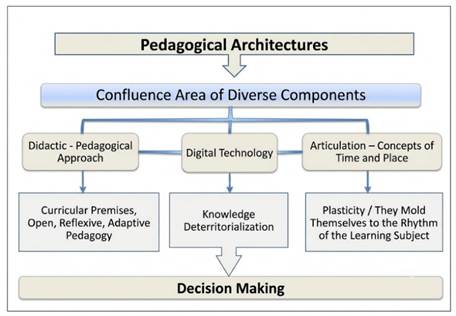 Source: 001137918.pdf (ufrgs.br).
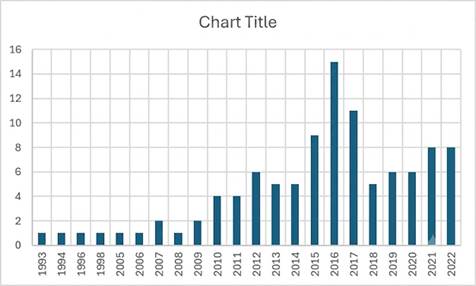 Source: prepared by the authors.