
 EDUCATION FOR CITIZENSHIP: CAN THE NATIONAL COMMON CURRICULAR BASE CONTRIBUTE?
ABSTRACT:
In times of attacks on democracy, Education for Citizenship acquires renewed importance. But it is not a spontaneous product of schooling, presupposing the development of certain student attitudes that, as we argue, require the school to articulate the pedagogical and organizational dimensions. In Brazil, policies aimed at this purpose are still incipient, but based on national research, recently carried out by the Center for Public Policies and Education Assessment at the Federal University of Juiz de Fora, on the implementation of the National Common Curricular Base in Education In children and elementary schools, we see an interesting potential in this policy, which needs to be recognized and valued. To better reflect on this hypothesis, we formulated an analysis model that allows a more systematic approach to the fundamental variables for Education for Citizenship. With this, we returned to the data of referred research and came to the conclusion that the Base has the potential to contribute to the strengthening of Education for Citizenship, especially if it is designed in a context of full participation of actors directly involved with education and the school community, which was not the case with the version approved by the National Education Council in the turbulent political environment of 2017.
Key words:
citizenship education; educational policy; Common national curricular base
RESUMO:
Em tempos de ataques à democracia, a educação para a cidadania adquire renovada importância. Mas ela não é um produto espontâneo da escolarização, pressupondo o desenvolvimento de determinadas atitudes estudantis que, conforme argumentamos, exigem da escola uma articulação entre as dimensões pedagógica e organizacional. No Brasil, as políticas voltadas para esse fim ainda são incipientes, mas a partir de pesquisa nacional, recentemente realizada pelo Centro de Políticas Públicas e Avaliação da Educação da Universidade Federal de Juiz de Fora, sobre a implementação da Base Nacional Comum Curricular na Educação Infantil e no Ensino Fundamental, vislumbramos um potencial interessante nessa política, que precisa ser reconhecido e valorizado. Para melhor refletir sobre essa hipótese, formulamos um modelo de análise que permite uma abordagem mais sistemática das variáveis fundamentais para a educação para a cidadania. Com isso, voltamos aos dados da referida pesquisa e chegamos à conclusão de que a Base tem potencial para contribuir para o fortalecimento da educação para a cidadania, sobretudo se for concebida em um contexto de plena participação dos atores diretamente envolvidos com a educação e a comunidade escolar, o que não foi o caso da versão aprovada pelo Conselho Nacional de Educação no conturbado ambiente político de 2017.
Palavras chave:
educação para cidadania; política educacional; Base Nacional Comum Curricular
RESUMEN:
En tiempos de ataques a la democracia, la Educación para la Ciudadanía adquiere una importancia renovada. Pero no es un producto espontáneo de la escolarización, ya que presupone el desarrollo de ciertas actitudes de los estudiantes que, como sostenemos, requieren que la escuela articule las dimensiones pedagógica y organizativa. En Brasil, las políticas orientadas a este propósito son aún incipientes, pero en una investigación nacional, realizada recientemente por el Centro de Evaluación de Políticas Públicas y Educación de la Universidad Federal de Juiz de Fora, sobre la implementación de la Base Curricular Común Nacional en Educación Infantil y Primaria, vemos un potencial interesante en esta política, que es necesario reconocer y valorar. Para reflexionar mejor sobre esta hipótesis, formulamos un modelo de análisis que permite un abordaje más sistemático de las variables fundamentales para la Educación para la Ciudadanía. Con esto retomamos los datos de la referida investigación y llegamos a la conclusión de que la Base tiene el potencial de contribuir al fortalecimiento de la Educación para la Ciudadanía, especialmente si se diseña en un contexto de plena participación de los actores directamente involucrados con la educación y la comunidad escolar, lo que no ocurrió con la versión aprobada por el Consejo Nacional de Educación en el convulso ambiente político de 2017.
Palabras clave:
educación para la ciudadanía; política educativa; Base curricular nacional común
INTRODUCTION
What is the role of schools in the development of students as citizens? Although this issue is often discussed in public debates and speeches, little thought is given to this issue in Brazil, despite that the 1988 Constitution gives schools a prominent role in the development of a democratic culture among us. It is true that the first and best measure to assess whether schools are capable of fostering citizenship in students is learning. A school that is unable to teach does not foster citizenship. This initial premise is particularly true in a context such as Brazil, where access to schools has not been widespread for a long time and where there are still serious problems in universalizing school learning, especially in the final years of middle and high school.
But if the focus is indeed on citizenship in its fullest sense, ensuring learning is essential, but not sufficient. After all, in school terms, the focus on citizenship demands the development of student skills that adhere to a culture of participation and responsibility towards society, which presupposes that the quality of the institutional environment, the degree of student participation in school life, and the extent to which the school encourages a commitment to society and political life, among others, are considered.
In times of rising political extremism, xenophobia, racism, religious intolerance, and frontal attacks on democracy, the issue has attracted the attention of the European Union (EU), which, in 2015, in the Paris Declaration, mobilized the commitment of education ministers of European states to make an effort to ensure that “[...] students acquire civic, social, and intercultural skills [...]”, with the promotion of “[...] democratic values and fundamental rights, social inclusion and non-discrimination, as well as active citizenship” (Ponce; Sarmiento; Bertolín, 2020, p. 2). In addition, Martins and Simão (2022) report that, in several EU countries, citizenship education has become a mandatory curricular dimension, worked on specifically or through transversal projects.
In Brazil, the topic has not yet received more consistent attention. An important exception was the Education for Diversity and Citizenship Program, developed between 2005 and 2014 by the Secretariat of Continuing Education, Literacy and Diversity (Secad/MEC). As Moreira Neto (2008) states, this program aimed to “[...] transform the school into a locus for transforming social relations and promoting knowledge, in favor of a more egalitarian and equitable society [...]”, for this very reason, one of its structuring points is “[...] the recognition of the determinants that prevent, or at least hinder, access and permanence in school, the trajectory of studies and success in school activities [...]” (p. 411). The program had the merit of focusing on issues related to historically excluded groups, especially the need to value ethnic-racial and cultural diversity, a fundamental issue for citizenship in the country. Because of its focused nature, its approach maintains as an undiscussed point the school's capacity to educate for citizenship, which requires measures that go beyond a specific action program.
In this article, we intend to highlight the breadth and complexity of citizenship education, arguing that it is located in an area of intersection between the pedagogical dimension and other organizational dimensions of the school. For heuristic purposes, we present an analysis model that allows a more systematic approach to the fundamental variables for citizenship education. Based on this analytical model and empirical research, we identify, in the experience of implementing the National Common Curricular Base for Early Childhood Education and Elementary Education (BNCC EI/EF-Base Nacional Comum Curricular para Educação Infantil e Ensino Fundamental), promising elements for strengthening citizenship education. Even recognizing the obvious importance of high school for the discussion, we chose to leave it out of the focus of this article because we understand that, at least from the point of view of empirical evidence, at the time this text is being written, it would be hasty to bet on a more assertive analysis of the effects of the BNCC on citizenship education.
This line of argument arises from the analysis of the results already public by the Center for Public Policies and Education Assessment of the Federal University of Juiz de Fora (CAEd/UFJF-Centro de Políticas Públicas e Avaliação da Educação), based on a national survey conducted between 2022 and 2023 on the implementation of the BNCC with managers, professionals from networks and schools, teachers and students3. These results suggest that the Base would be giving rise to innovations and practices at the intersection between the pedagogical dimension and the organization of networks and schools. We believe that shedding light on this relationship can be a relevant contribution to illuminating aspects of the BNCC that can be explored when it is revised, which should occur in the coming years, as well as a contribution to valuing the importance and specificity of other policies that intend to impact, directly or indirectly, education for citizenship.
The article is organized into three parts. The first part reflects on the relationship between school education and citizenship, mobilizing a set of concepts from sociological theory and the sociology of education, which will illuminate the most sensitive issues for debate. In this part, we also present a brief contextualization of this discussion within the historical context in which schools and the schooling process are found in Brazil. The second part presents a proposal for an analytical model that articulates pedagogical and organizational aspects, with the intention of serving as a tool for reflection on the potential of educational policies for citizenship education. The third part studies this potential in the BNCC. Based on the analysis of different data produced by the CAEd/UFJF research, and in dialogue with the critical literature on the topic, the article seeks to identify the different points of contact between the Base and citizenship education, pointing to possibilities of the policy that are still little recognized and explored. In the final considerations, we articulate the three parts of the article, highlighting the general scope of our discussion, as well as its specific yield for thinking about the BNCC and its relationship with education for citizenship.
SCHOOL AND CITIZENSHIP: A RELATIONSHIP IN PERMANENT TENSION
The relationship between school and citizenship cannot be taken for granted. Quite the contrary, it needs to be reconstructed and sustained at all times, especially because the notion of citizenship is alive - it transforms along with the changes that occur among the individuals and social actors that are part of the school community, as well as with the changes that occur in the meaning of notions such as equality, freedom and participation.
Even though schools are efficient in curricular learning, they may very well deny or restrict the provision of pedagogical situations that are more in line with students' citizenship. This is the direction that some of the well-known works of authors who reflect on the school system point in. This is the case of Vincent (2008), who talks about how school education can discourage speculative thinking, which is important to science, and which would be in line with the valorization of critical thinking and free argumentation, which are essential to democracy. For Vincent, the school system can, at its limit, compete with basic aspects of the demands that are important to democracy, which presupposes, among other attributes, the existence of subjects capable of dealing with different points of view. Along the same lines, Alarcão (2001) draws attention to the fact that a school that is rigid in a vertical and bureaucratic manner makes it difficult to think and, therefore, to value reflexivity among its individuals. After all, if professionals do not have or exercise the ability to discuss decision-making processes and build consensus amidst disagreements, why should they be able to provide situations in which these skills would be developed among their students? The most important thing, for now, is to emphasize that the relationship between school and citizenship is not a given, but needs to be permanently affirmed by the individuals, which also means admitting that school is a space of conflicts, whose logic is associated with different sociological variables related to the various actors that make up the school.
Despite being apparently resistant and frozen in time, the school form changes as the social relations established within it as school relations, and along with them, processes, practices and norms, change. Throughout the 20th century, the school was established as a space par excellence associated with the construction of a common culture and logic of thought. It was also almost always thought of as a guarantor of belonging to a national culture above classes and other social differences, supported by literacy in the native language and the sharing of a common history - which evokes the notion of school habitus, formulated by Bourdieu (1992b). Pioneering efforts in sociology applied to education have turned against the supposed neutrality of school work in the construction of this commonality, denouncing that schools produce and reproduce different types of inequalities. Studies such as those by Bernstein (1996), Willis (1991) and Bourdieu himself (1992a; 1992b) are essential reminders of this.
The broad and almost immediate reception of this critical sociology, even at the time it began to be developed, comes from the fact that it contributes to the understanding of the contradictions introduced into the school environment by the massification of its audience, especially in high school, a phenomenon that occurred more strongly in the United States and Europe, in the post-war context. Related to this massification, movements such as the feminist movement also gain strength - remember the impact of the growing presence of women in the occupational structure (Mills, 1979); the counterculture movement, including the “gay movement”, as it was still called in that context; and, the black movement. All of them aim to forge new subjects, producing a diversification of young students and the very possibilities for the enjoyment of youth. In other words, it is the very meaning of youth that changes as schools become more heterogeneous. After all, allowing poor young people and children of working-class families the status of student means also giving them the right to be young. Thus, from being the bearer of dreams and promises, until the mid-1960s, youth began to be treated in the plural, and as youth(s) they began to be seen as potentially violent and threatening, in the diffuse sense of the term, including in its cultural and political meaning.
With the changes in schools and in the very meaning of youth, a new generation of sociological studies has been gaining ground. In a pluralized world (Habermas, 1997), in which the common can no longer be taken as a given, schools are displaced, and even the notion of socialization, so naturalized as the social action par excellence of the school institution, loses its explanatory power. The common and communication itself become a problem, needing to be constructed or sustained in each situation (Burgos, 2023). Now, what matters are school experiences and the meaning that each person attributes to them, and what’s more: any institutional attempt to “socialize” can be seen as an affront to external identities and forms of solidarity, often hostile to schools. In this regard, digital transformations cannot be blamed for this explosion of fragmentation, but they certainly tend to accentuate its consequences, even though, contradictorily, they create new opportunities for encounter and affirmation of citizenship, which are not always well explored. Because, as Dussel and Cardona (2021) observe: “[...] the introduction of cell phones and digital platforms produces new arenas of participation in schools, with different regulations and hierarchy to pre-existing forms of institutional organization” (p.14).
This is the school that Alain Touraine (2003) talks about when he proposes a school reform aimed at establishing a “school of the person”, centered on communication and not on transmission. It is also the school that François Dubet (1996) talks about when he recognizes the notion of experience as central to accounting for the multiple logics of action that permeate the school routine. In this scenario, in which the school is at the same time one of the places where disagreements and new conflicts explode, and the institution from which new responses are expected, we can infer some basic aspects for the developments of our discussion. The first of these has to do with the importance of the existence of a common culture for thinking about citizenship, through which it would be possible to share basic rules of coexistence. While the school was seen as its main guarantor with the new generations, everything happened as if school work naturally generated the formation of citizens. This apparent symbiosis made the struggle for school an extension of the struggle for a certain conception of democracy and, in some contexts, a civilizing struggle - a dimension present, for example, in the Manifesto of the Pioneers in Brazil, in defense of public education, of 1932 (Azevedo, 1932) -, which helps to explain the spread of school, or of a certain form of school education, across all continents (Nóvoa, 2000). But as the common becomes a problem, the power of the school suffers a significant shock, leaving it to reform profoundly or else become compromised with an unacceptable cultural arbitrariness, to use a well-known expression by Bourdieu (1992a and 1992b). In this regard, the discussion about morality and religion in schools, and the definition of a new concept of secularism, is especially interesting (Monteiro, 2018).
On the other hand, the changes resulting from the expansion of schools and the consequent increase in the number of working-class children in secondary education tend to bring conflicts into the school that often cannot be expressed outside of it. After all, schools are safe enough for new voices, often those of young people from the most peripheral areas, to assert and transform schools into spaces of struggle. Thus, schools become “barricades,” to use an expression used by Benjamin Moignard (2008) when defining French schools that suffer from the internalization of ethno-religious and social conflicts that undermine their authority.
One of the consequences of this process is the fact that the symbolic violence of the school, which Bourdieu (1992a and 1992b) spoke about, is converted into situations of direct violence in the schoolyard. However, the tone of school violence often hides the fact that some of the conflicts in it become a new space for the affirmation of citizenship. Because even though they are presented as an affront to the school, often in a very hostile way, certain behaviors and attitudes can be read as exercises that are potentially favorable to citizenship, which only the school environment is capable of providing, even knowing that this type of situation is usually very challenging for school discipline and authority. After all, what should we do with adolescents/young people who challenge the school, and who often disdain its rules and authorities? Just punish them or try to understand what is behind their behavior to better educate them?
Reflecting on these questions would take us too far, and we have already said enough to establish the argument that citizenship is a living process, and that disputes about school and in school are a fundamental part of its affirmation. Therefore, we cannot think about education for citizenship without considering the concrete context in which school conflicts occur, and how they are more or less favorable to a grammar of citizenship, which leads us to question the Brazilian case more directly.
At the risk of being concise, we can say that the contemporary school scene in Brazil can be understood based on three major processes of change. The first concerns the fact that the expansion of access to school is still relatively recent in the country, as it was only in the 1990s that the country achieved universal enrollment in elementary and middle school. High school has not yet been fully achieved, currently ranging from 70% to 80% of adolescents between 15 and 17 years old, with significant variations between gender, per capita income, and race, as demonstrated by Menezes and Santos (2023). This means that the process of transformation of schools due to the massive arrival of poor students has not yet been fully consolidated in the country.
The second process concerns the fact that the massification of basic education in the country occurred amid a major regulatory shift in schools and children and adolescents. Through several articles - especially articles 205, 206, 208, 210, 211, 212, 213 and 214 - the 1988 Constitution gives centrality to the right to school education, recognizing, for the first time in the history of Brazilian constitutions, the leading role of public schools in the country's democratic project. Furthermore, article 227 states that it is an “absolute priority” of the State, the family and society to ensure the rights of children and adolescents (Brazil, 1988). After the approval of the Constitution, Brazilian legislation approved the Statute of Children and Adolescents - Law 8,069, of July 13, 1990 -, which recognizes the basic and fundamental rights of children, and transforms it into an institutional program, with the creation, among other measures, of the figure of the protection network (Brasil, 1990). The decantation of the constitutional command and the ECA, and the fact that the fight against child labor gained priority among state authorities, especially for the Public Prosecutor's Office, made the long-term school project gradually become a value widely recognized by working-class families (Burgos, 2020a).
The result of the combination of these two processes is the formation of a more educated society with a growing presence of more diverse youth, now also made up of young people from the working classes and the peripheries. Their presence in the public arena is becoming increasingly visible, and in this sense, nothing expresses the emergence of these new subjects in Brazilian life better than the school occupation movement, which spread across 21 states between 2015 and 2016, and which, in an unprecedented way, allowed young people from the favelas and peripheries to raise their voices in defense of a better quality school, above all, one that was more dialogic and attentive to their demands and claims. It makes sense to think of the school occupation movement as a dramatization of the awareness of these new subjects of Brazilian school life - poor high school students and those from the peripheries - that school, after all, is decisive for their lives (Camasmie, 2018).
A third process has to do with the massive arrival of Brazilian children and adolescents into the digital environment, and perhaps nothing symbolizes this phenomenon more than the spread of smartphones in society as a whole, but having a particularly important impact on the social relations that characterize school teaching and learning. The portrait presented in the 2021 TIC Kids Online Brasil report indicates that no less than 93% of children and adolescents in the country are internet users, and the cell phone continues to be the main device used to access the network. For 53% of children and adolescents, the cell phone is the only means used to carry out online activities - in the case of DE classes, 78% -, and school is the privileged place for accessing the internet for 39% of users aged 9 to 17 (CETIC.BR; NIC.BR, 2022).
The digitalization of school relations is practically ubiquitous and is of interest to our debate for several reasons, but especially because it affects aspects that are central to citizenship, such as student autonomy in conducting research; in producing knowledge; in seeking information; in the ability to participate and be heard; and also in issues related to school sociability. Incidentally, the school occupation movement was only possible in the way it occurred because students were equipped with their cell phones, allowing them to communicate with the world from inside the school buildings, triggering a national mobilization around schools. But while the digitalization of social relations has the potential to strengthen student citizenship, it also creates new challenges for schools, starting with the fact that students are increasingly exposed to other influences, from “digital influencers,” and to the logic of virtual bubbles, which tend to conspire against the formation of a common grammar necessary for citizenship education. Thus, we can say that the way in which the school deals with digitalization becomes a critical variable in defining its greater or lesser capacity to strengthen citizenship (Otrel-Cass, 2022; Mamede-Neves; Duarte, 2008).
In short , in this first part of the article, we sought to highlight how the relationship between school education and citizenship needs to be understood as a particularly complex process. It is conditioned by factors both internal and external to the school, and by the often contradictory way in which its different actors react and deal with a wide range of issues. In this regard, perhaps nothing better indicates this complexity than the challenges faced by schools when having to respond to new dynamics, such as those triggered by students considered difficult, or on a broader scale, by the digital metamorphosis, to use an expression adopted by Ulrich Beck (2018)4. Anticipating one of the conclusions, we can say that the way in which schools deal with these challenges depends on their ability to transform the conflicts arising from the diversity of their audience and their new languages into opportunities for strengthening citizenship. In the following part, we will explore this point further.
MODEL FOR ASSESSING CITIZENSHIP EDUCATION
Without ignoring the complexity of the issue but with the aim of organizing a more systematic reference for reflection on citizenship education, and which helps in assessing the scope of the BNCC based on this agenda, we propose an analytical model organized into two axes. The first assumes that a school that is more attentive to citizenship education should contribute positively to the development of certain attitudes among students, such as knowledge, participation and responsibility. The second axis concerns the organizational demands that the implementation of citizenship education imposes.
Without intending to be exhaustive, we suggest three attitudinal criteria that are particularly favorable to student citizenship: the first concerns the sphere of knowledge, the student's ability to formulate questions and critically reflect on reality and to articulate different sources of knowledge, which presupposes autonomy to conduct research, especially through the use of digital tools; the second relates to the practice of participating in collective actions and decisions that directly or indirectly affect the student's reality; and the third criterion refers to responsibility, for oneself, for the class/school environment, for one's community and society. Chart 1 systematizes the proposal.

Our assumption is that to contribute to the development of the attitudes that we consider favorable to an education for citizenship, the school must be prepared to truly place the guarantee of students' rights as the ultimate reason for its work, starting with the right to learning. To this end, we assume that the school must coordinate, in a planned manner, at least four organizational dimensions: the pedagogical dimension, committed to the rights to learning, but also paying attention to the collective criteria for defining school equity and to pedagogical forms that value student participation; the institutional dimension, focused on responsive management in the face of the internal and external environment, which refers to the school's ability to deal positively with conflicts, turning them into opportunities for transformation without losing its integrity5; the social dimension, driven by the search for rapprochement with the student, which is one of the fundamental aspects of the notion of educability6; and the ethical dimension, which refers to the care that the school must have with the destiny of its graduates, especially with those who in some way are defeated by the criteria of school justice, in the terms defended by François Dubet (2008). Chart 2 systematizes the organizational dimensions, listing some of the management objectives that the school needs to ensure to strengthen education for citizenship.

Chart 3 shows the dimensions of the two axes seen above, explaining the importance of the intersections between the dimensions of school organization and the attitudes that need to be encouraged among students for citizenship education. The idea is to signal that all of these intersections are important. However, we also think it is appropriate to highlight, as they are priorities, the column for the “pedagogical” dimension and the row for “knowledge”.

The idea is to emphasize that the pedagogical work carried out by the school, even if not sufficient, should be considered as being involved not only with strengthening student learning, but also with developing other attitudes associated with it, such as a culture of participation and a sense of responsibility. To be fully developed in the sense of education for citizenship, knowledge - which, as seen in Chart 1, refers to the development of attitudes related to the ability to formulate questions, autonomy for research, openness to different types of knowledge and digital skills - depends on the combination of the four dimensions of management, demanding attention not only to what would be strictly pedagogical but also to the other three dimensions: institutional, social, and the ethics of school work. In other words, if the reasoning proposed here makes sense, the development of the knowledge required for a fuller citizenship education requires educational management that is not only concerned with the learning dimension. Thus, it becomes clearer why an excessive concern with learning, without attention to other organizational dimensions, can make the school indifferent or even harmful to the development of citizenship.
The same type of reasoning applies to the other intersections of the two axes. It is true that schools may be irreplaceable in encouraging a culture of participation, critical thinking and responsibility - since we do not have many reasons to expect such attitudes to be ensured by the dynamics of cities or the virtual environment, nor by families -. Their valorization presupposes a more responsive institutional management, open to constant dialogue with students, teachers and the community, and concerned with valuing the feeling of responsibility of the school community, especially students, for the school environment; a social management oriented towards educability, this makes constantly seeking to get closer to the reality of students, making the school more sensitive and open to the expectations of families and students, favoring their participation and the feeling of joint responsibility; finally, a management of the ethical dimension, which deals with school injustices with concern, seeking to expand the school's support network, compromising the members of the school community to the premise that values, and even the feeling of empathy to be common, necessarily need to be built collectively, as a result of the participation of its members. More than a normative claim, our intention with the presented model is that it is a parameter that helps us to be more prepared for the complexity involved in the work of education for citizenship which, as we have seen, depends on a combination of pedagogical and organizational factors. We follow the premise that an education for citizenship is, first and foremost, an education in citizenship (Martins; Simão, 2022, p. 898, our emphasis).
BNCC AND CITIZENSHIP AT SCHOOL
Conceived as a public policy focused on the curriculum and committed to the pursuit of equity in access to learning, the BNCC was defined as mandatory by the II National Education Plan - Law 13,005 of 2014. However, far from being unanimous, its emphasis on ensuring a “common national curriculum base” gives rise to different types of reactions and resistance, the most frequent of which is the one that identifies as an unexplained motivation of the policy to impose a technocratic approach to school, which would be controlled by assessment systems concerned with measuring the learning of a minimum set of curricular competencies (Aguiar; Dourado, 2018), which in this way would reduce the conception of the quality of education to learning (Galian; Silva, 2019). But the criticisms go further, identifying in the choice of skills, including the general skills proposed by the Base, a “[...] political decision, linked to capital's demand for training workers with a profile for resilient performance in a labor market with a shortage of jobs and labor rights” (Filipe; Silva; Costa, 2021, p. 795).
This type of criticism is reinforced by works that point out the contradictions in the process of constructing the BNCC, especially due to the fact that its final design was dominated by the hegemony of private organizations and foundations (Avelar; Ball, 2019; Frossard, 2020; Michetti, 2020). From this, the conclusion would be that the “[...] prominence that such action [the Base policy] has received, in recent years, results from the interest of groups, mainly linked to the business world, who have sought to increase their profit margins through the commodification of education” (Girotto, 2019, p. 19).
For this critical approach, the fact that the Base adopts the premise of comprehensive education and places the student at the center of school concerns would be secondary. Because “[...] although the BNCC proclaims the principles of objectivity, distributive justice, learning rights, and democracy, the search for educational quality is based on efficiency, which reduces the right to Education to the granting of educational services in their practical-instructive dimensions, linking quality to the results of external evaluations” (Filipe; Silva; Costa, 2021, p. 798). Far from being an ally of citizenship in schools, the BNCC would be a policy that would distance schools from the civic centrality conferred upon them by the Federal Constitution.
Even without capturing the depth of the BNCC EI/EF implementation process, which, based on the data from the CAEd/UFJF survey that we will present below, would be enabling a redefinition of the policy by professionals in state and municipal education departments, these critical studies on the Base bring up important aspects that need to be considered. Not only because they point out the technocratic and neoliberal effects produced by the prevalence of private foundations in the management of the BNCC in the context of President Michel Temer's interim term (2016-2018) but also because they indicate a map of issues that, without a doubt, tend to weaken a greater affinity between the Base and education for citizenship.
We will not be able to delve into this discussion in this article, but it is enough to note that from this critical perspective it becomes more notable that the CAEd/UFJF study on the BNCC implementation process indicates a redefinition of the policy by professionals, in a direction that seems to highlight the potential of the Base for the citizenship education agenda. This is already evident in the results obtained from interviews conducted in 2021 with educational leaders from 139 municipalities and 23 states on the implementation of the BNCC EI/EF. The summary of these interviews, presented in a CAEd/UFJF report (2021), highlights four points consistently present in the managers' perception:
-
The basis for early childhood education and elementary education is a reality throughout the country. Although with varying degrees of mobilization and involvement, state and municipal networks have mobilized around the implementation of the BNCC, from the construction of curricula to the reorganization of Political-Pedagogical Projects (PPPs) in schools;
-
It would be favoring a collective effort to bring education departments and schools closer to the concrete reality of students and their communities, providing an improvement in the collaboration regime between states and municipalities;
-
The BNCC would not be received by municipal education departments as a kind of homogenizing “straitjacket”, but rather as an opportunity to value local diversity and even teaching autonomy, at least with in the development of new teaching materials and the search for new ways to approach the concrete reality of their students and their schools;
-
The Base would also be making it easier for schools to adopt an integrated approach and bring schools closer to managing their curricula. This would lead to concrete gains in terms of improving school equity in guaranteeing the right to learning.
Therefore, without prejudice to the diversity found in the statements of municipal and state education leaders interviewed in the research, it seems possible to state that, despite having been conceived in a closed environment, under the strong influence of private organizations linked to big capital, the process of implementing the Base ended up mobilizing the educational networks in the country, demanding from its professionals a creative effort of reflection and collective imagination that, at least potentially, dialogues with the organizational assumptions presented in the model formulated above. As we will see below, this qualitative approach is echoed in the quantitative data presented by the research regarding the participation and perception of professionals in the networks regarding the BNCC.
The quantitative research carried out by CAEd/UFJF includes six types of professionals, as indicated in Table 1. Two questionnaires were applied, in 2021 and 2022, reaching, respectively, 24,262 and 23,528 interviewees, of which teachers represent 77.6% of the total in the first application and 75% of the total in the second (CAEd/UFJF, 2021; 2022).
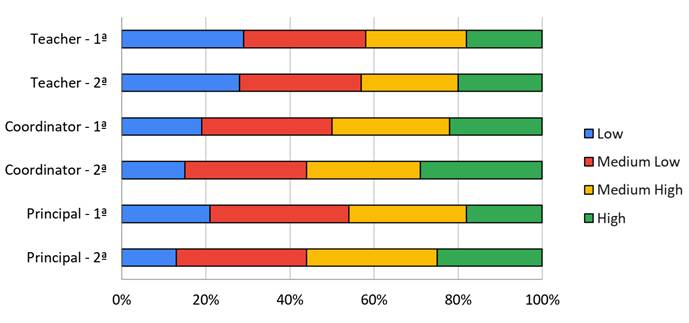
This is a very robust sample, especially of school professionals7. The questionnaire used by CAEd/UFJF measures the participation of professionals in activities related to the construction of the curricular framework aligned with the Base, in addition to activities aligned with it, such as training, teaching materials, internal and external assessment, and curriculum management in the school. Graph 1presents the results found in the two applications with the school professionals that interest us most closely here. The teacher, a fundamental figure for any educational policy, presents a stable percentage in both applications, of about 42% and 43% of participation. Principals, on the other hand, presented a significant jump between the two applications, from 46% to 56%, suggesting that in the space of one year the policy increased its level of mobilization, the same being true among pedagogical coordinators. These results attest to a reasonable level of mobilization of professionals by the policy, especially teachers.

In addition to the participation measure, presented in the graph above, the questionnaire also measures professionals' perception of the effects of the Base on educational management and on changes in professional culture, especially among teachers. Based on a set of items that deal with activities related to the implementation of the Base, such as the preparation of curricular documents, training, teaching materials, assessment, and curriculum management, the survey indicates that professionals from departments and schools have a very positive perception regarding the effects of the BNCC on educational management. The percentage of medium-high and high perception among teachers in the second application was 69%, and 88% among principals (CAEd/UFJF, 2022, p. 7).
Regarding professional culture, one of the points measured is the effects of the Base on the centrality of the curriculum in school life. For the second application, in addition to the five items that were already part of the battery presented to respondents in the previous survey, and which directly asked about the relationship between the BNCC and the degree of importance of the curriculum, seven new items were incorporated. They dialogue directly with the understanding that we are formulating in this article about education for citizenship, deserving to be listed below. These items and the others seek to adopt the language used by the Base policy.
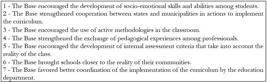
- Items incorporated into the second application of the CAEd/UFJF research on the effects of the Base on the centrality of the curriculum
All of them are relevant to our argument: items 2, 4 and 7 because they have a more direct relationship with organizational variables; and items 1, 3, 5 and 6, because they deal with the effects of the Base on school dynamics with the potential to give greater centrality to the student. The results obtained, both for the professionals in the secretariats and for those in the schools, confirm that all the research subjects have a very positive perception of the effect of the Base on these dimensions, and it is especially relevant to emphasize that 70% of the teachers are at the medium-high and high levels (CAEd/UFJF, 2022).
To conclude this brief incursion into the CAEd/UFJF research on professionals, it is important to highlight the teachers' responses to a set of items asking them to report their degree of agreement with the effects of the Base on aspects such as: pedagogical planning; appreciation of contemporary cross-cutting themes and integrative projects; appreciation of artistic and cultural manifestations and diversity; use of digital technologies; and concern for the reality of students. Once again, it is worth emphasizing the potential elective affinity between these items and the parameters adopted in this article to think about education for citizenship. Graph 2indicates that, in both applications, approximately 80% of the teachers were in the upper-middle and high ranges of the perception scale (CAEd/UFJF, 2022, p.16).

- Scale of teachers’ perception of the effects of the BNCC on attitudes related to their teaching practice
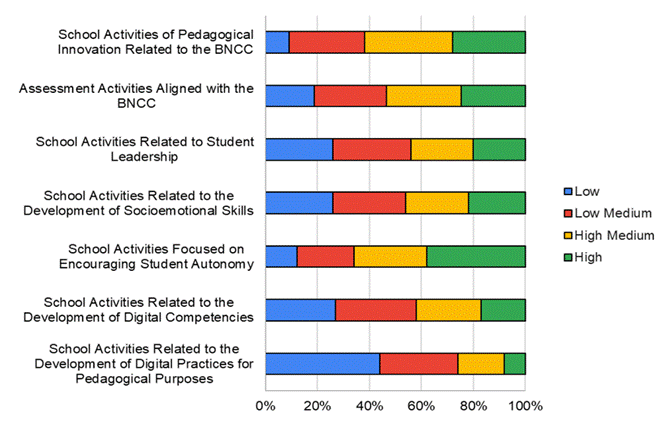
We believe that this data on professionals is sufficient to demonstrate how the CAEd/UFJF research detects consistent effects of the implementation of the Base on pedagogical and organizational dimensions that seem sensitive to strengthening citizenship education. We will now see the results brought by the research regarding the degree of exposure of 5th and 9th grade EF students to the innovations brought by the Base. It is important to highlight that CAEd/UFJF also carried out two questionnaire applications, the first in 2022, and the second in 2023, both with approximately 35 thousand respondents. The questionnaire seeks to measure the effects of the BNCC on seven dimensions of student education: pedagogical innovation; assessment; student protagonism; encouraging student autonomy to carry out school activities; development of socio-emotional skills; development of digital skills; and development of digital practices for pedagogical purposes.
Graph 3shows the results found in the second application. Of the seven measures, five are of particular interest to us. Those that deal with student autonomy, encouraging student protagonism, socio-emotional autonomy, and the two that deal with digital skills. Among them, the first, which deals with autonomy, presents the highest percentage of participation among the scales - 66% have medium-high or high participation -, indicating that at least in this aspect, and considering the specificities of the instrument used by CAEd/UFJF, the Base would be functioning as an inducer of an aspect that has clear affinity with citizenship education. However, the other four measures present medium-high or high participation percentages of less than 50%, with participation in activities related to the development of digital practices for pedagogical purposes being especially low - only 26% have medium-high or high participation.

The results found for the measures of students' exposure to the Base suggest that, on the one hand, it would favor autonomy in the face of school activities, strengthening an important focus for the citizenship education agenda. On the other hand, however, it seems to find it difficult to promote innovations in schools capable of providing a more vigorous exposure to activities that are especially relevant for the development of attitudes favorable to student citizenship. As evidence, we can find the encouragement of student protagonism, which requires the school to be more open to listening to the student; the development of socio-emotional skills, which requires the school to be more capable of combining activities that value collective actions that are closer to the student's reality; and the development of digital skills, which requires an even deeper institutional transformation of the school. This transformation goes far beyond the simple adaptation of its infrastructure, demanding greater attention to strengthening the autonomy of students to access knowledge outside the school, relevant to their affirmation as subjects of rights, and to act in new arenas of participation that can often compete with the school itself (Heinsfeld; Pischetola, 2017).
When we combine the data from professionals with those generated by the student questionnaire, we conclude that, although the Base has been received by professionals as a policy with potential congruent with the citizenship education agenda, the analysis of the degree of exposure of students to the innovations proposed by the policy indicates a more challenging scenario. This scenario challenges the school organization, reflecting how much the implementation of this agenda requires special attention to the intersections presented in the model proposed in the second part of this article, whether between the pedagogical dimensions and those of knowledge, participation and responsibility - the vertical direction of the matrix -, or between knowledge and the dimensions of institutional, social and ethical management - the horizontal direction.
FINAL CONSIDERATIONS
Strengthening citizenship among students cannot be taken as a natural and inevitable consequence of school work. Although schools tend to be an important asset for the formation of a democratic society organized around the premise of equality and equal opportunities for all, it is dangerous to ignore that school can also favor the formation of extremely competitive individuals and societies organized around new forms of inequality, fueling the fragmentation of the social fabric and the production of resentment between different subjects and groups. This warning reminds us that the relationship between school and democracy and citizenship must be the object of constant attention, as we have seen in societies with longer-lasting and more consolidated democracies than Brazil. After all, school is an institution too important in democracy to be assigned a secondary role in sustaining this type of regime. It is no coincidence that the agenda of education for citizenship has long been part of the order of priorities of authorities in European states concerned about the advance of subcultures hostile to democracy, such as neo-fascism and neo-Nazism, for example.
In this article, we argue for the need for deliberate action aimed at fostering the citizenship education agenda in Brazil. Using a model that we formulated for heuristic purposes, we think that it requires a combination of actions and organizational requirements that allow schools to foster the development of attitudes compatible with the exercise of citizenship. Based on the data gathered by CAEd/UFJF, we believe that the BNCC can indeed contribute to this end, as it has the potential to mobilize the creative efforts of education professionals and to highlight the importance of the curriculum as a means of valuing the centrality of the student.
The research data leads us to believe that the implementation of the Base, especially if we can imagine that its new version will be carried out in a more favorable political context, has the potential to awaken political and organizational energy in educational networks and schools that we may not have known existed, which possibly explains the skepticism found in the bibliography that focused on the process of developing the policy. However, now that this dynamic brought about by the Base is being revealed by the CAEd/UFJF research, it can no longer be seen as surprising. After all, the implementation of the BNCC would not only be reflecting the maturation of the educational networks themselves, resulting from more than three decades of institutional advances, but also the fact that they, and more specifically their schools, somehow echo the desires of families and students who identify school education as a fundamental arena in their affirmative movement for more rights and citizenship.
However, it is also true that the results on students' exposure to the innovations brought about by the BNCC suggest that to make the most of the potential contained in it for the development of education for citizenship, educational management will still need to act decisively on the school's organizational culture. Many innovations brought about by the Base depend on deeper reforms in the school structure to become effective.
In this article, we have not been concerned with discussing the meaning that the official BNCC document gives to the notion of citizenship. After all, in its more than 500 pages, it uses the word “citizenship” no less than 47 times, and the word “citizen” another 19 times - in the introductory texts, in the description of general and specific competencies, and in the description of the skills of different components - perhaps suggesting a certain trivialization of the word, an empty signifier sprinkled throughout the text. With its recurrent use, even unintentionally, the official document does not fail to point to the need to contemplate an agenda for strengthening education for citizenship. It seems that through this unplanned gap, education professionals passed by when giving multiple and new meanings to the policy, reflecting not only their desires for participation, but also those of the school community as a whole. Our expectation is that the discussion held in this article will contribute to highlighting the broad universe of opportunities that the Base can represent for the advancement of education for citizenship in Brazil, especially if we can ensure that, through its reformulation, the centrality of the student is reinforced, their rights to learning and critical awareness, skills and attitudes that only the school is capable of offering in an articulated manner.
References
-
AGUIAR, Márcia Angela da S.; DOURADO, Luiz Fernandes(orgs.). A BNCC na contramão do PNE 2014 - 2024: avaliação e perspectivas [Livro eletrônico]. Recife: ANPAE, 2018. Disponível: <Disponível: https://www.anpae.org.br/BibliotecaVirtual/4-Publicacoes/BNCC-VERSAO-FINAL.pdf >. Acesso em: 20/04/2024.
» https://www.anpae.org.br/BibliotecaVirtual/4-Publicacoes/BNCC-VERSAO-FINAL.pdf - ALARCÃO, Isabel. A Escola Reflexiva. In: ALARCÃO, Isabel(org.). Escola Reflexiva e Nova Racionalidade Porto Alegre: Editora Artmed, 2001, p 15-30.
-
AVELAR, Marina; BALL, Stephen J. Mapping new philanthropy and the heterarchical state: The Mobilization for the National Learning Standards in Brazil. International Journal of Educational Development, v. 64, p. 65-73, 2019. https://doi.org/<10.1016/j.ijedudev.2017.09.007>
» https://doi.org/10.1016/j.ijedudev.2017.09.007 - AZEVEDO, Fernando. A reconstrução educacional no Brasil ao povo e ao governo: Manifesto dos Pioneiros da Educação Nova. São Paulo: Cia. Editora Nacional, 1932.
- BECK, Ulrich. A Metamorfose do mundo. Novos conceitos para uma nova realidade. Editora Zahar: Rio de Janeiro, 2018.
- BERNSTEIN, Basil. A estruturação do discurso pedagógico: classe, códigos e controle. Petrópolis: Vozes, 1996.
- BOURDIEU, Pierre. Reprodução cultural e reprodução social. In: A Economia das Trocas Simbólicas São Paulo: Editora Perspectiva, 1992a.
- BOURDIEU, Pierre. Sistemas de ensino e sistemas de pensamento. In: A Economia das Trocas Simbólicas São Paulo: Editora Perspectiva , 1992b.
- BRASIL. Constituição da República Federativa do Brasil de 1988 Brasília, 1988.
- BRASIL. Lei n.º 8.069, de 13 de julho de 1990 Dispõe sobre o Estatuto da Criança e do Adolescente e dá outras providências. Brasília, 1990.
-
BURGOS, Marcelo Baumann. A dupla hermenêutica da sociologia da educação: a educação das novas gerações e a organização escolar. Revista Lua Nova, 110, p. 49-76, 2020a. <https://doi.org/10.1590/0102-049076/110>
» https://doi.org/10.1590/0102-049076/110 -
BURGOS, Marcelo Baumann. Redes de proteção dos direitos das crianças: a perspectiva de seus operadores. Tempo Social, v. 32, n. 3, p. 375-397, 2020b. <https://doi.org/10.11606/0103-2070.ts.2020.163553>
» https://doi.org/10.11606/0103-2070.ts.2020.163553 - BURGOS, Marcelo Baumann. Confiança e comunicação em tempos de negacionismo. In: MARGATO, Izabel; MOUNTARY, Alexandre(orgs.). Humanidades. Democracia e Liberdade Rio de Janeiro: Editora 7 Letras, 2023, p. 173-200.
-
CAEd/UFJF - Centro de Políticas Públicas e Avaliação da Educação da Universidade Federal de Juiz de Fora. Relatório da 1.ª etapa da pesquisa de avaliação e monitoramento da implementação da BNCC Juiz de Fora, MG: CAEd/UFJF, 2021. Disponível em:<Disponível em:https://plataformabncc.caeddigital.net/resources/arquivos/BNCC_2022_Relatorio_da_1_Etapa.pdf >. Acesso em: 20/04/2024.
» https://plataformabncc.caeddigital.net/resources/arquivos/BNCC_2022_Relatorio_da_1_Etapa.pdf -
CAEd/UFJF - Centro de Políticas Públicas e Avaliação da Educação da Universidade Federal de Juiz de Fora. Relatório da 2.ª Aplicação dos Instrumentos de Pesquisa Juiz de Fora, MG: CAEd/UFJF, 2022. Disponível em:<Disponível em:https://plataformabncc.caeddigital.net/resources/arquivos/BNCC_2022_Relatorio_2_Aplicacao_Instrumentos_Pesquisa.pdf >. Acesso em: 20/04/2024.
» https://plataformabncc.caeddigital.net/resources/arquivos/BNCC_2022_Relatorio_2_Aplicacao_Instrumentos_Pesquisa.pdf - CAMASMIE, Mariana Junqueira. O movimento de ocupação das escolas e as novas formas de fruição da juventude escolarizada nas classes populares do Brasil Dissertação (Mestrado em Ciências Sociais). Rio de Janeiro: Pontifícia Universidade Católica do Rio de Janeiro, 2018.
-
CETIC.BR- Centro Regional de Estudos para o Desenvolvimento da Sociedade da Informação; NIC.BR - Núcleo de Informação e Coordenação do Ponto. Pesquisa sobre o uso da Internet por crianças e adolescentes no Brasil: TIC Kids Online Brasil2021 [livro eletrônico]. São Paulo: Comitê Gestor da Internet no Brasil, 2022. Disponível em: <Disponível em: https://cetic.br/media/docs/publicacoes/1/20230825142135/tic_kids_online_2022_livro_eletronico.pdf >. Acesso em:03/05/2024.
» https://cetic.br/media/docs/publicacoes/1/20230825142135/tic_kids_online_2022_livro_eletronico.pdf - DUBET, François. Sociologia da Experiência Instituto Piaget: Lisboa, 1996.
- DUBET, François. O que é uma escola justa? Editora Cortez: São Paulo, 2008.
-
DUSSEL, Inés; CARDONA, María Guadalupe Fuentes. Los Grupos de whatsapp y la construcción de nuevas ciudadanías en las escuelas. Educação e Sociedade, v. 42, e251642, 2021. <https://doi.org/10.1590/ES.251642>
» https://doi.org/10.1590/ES.251642 -
FILIPE, Fabiana Alvarenga; SILVA, Dayana dos Santos; COSTA, Áurea de Carvalho. Uma base comum na escola: análise do projeto educativo da Base Nacional Comum Curricular. Ensaio: aval. pol. públ. Educ, Rio de Janeiro, v. 29, n. 112, p. 783-803, 2021. <https://doi.org/10.1590/S0104-40362021002902296>
» https://doi.org/10.1590/S0104-40362021002902296 - FROSSARD, Marcele. Raízes epistemológicas dos discursos sobre a Base Nacional Comum Curricular Tese (Doutorado em Ciências Sociais). Rio de Janeiro: Universidade do Estado do Rio de Janeiro, 2020.
-
GALIAN, Cláudia Valentina Assumpção; SILVA, Roberto Rafael Dias da. Apontamentos para uma avaliação de currículos no Brasil: a BNCC em questão. Estudos em Avaliação Educacional, v. 30, n. 74, p. 508-535, 2019. <https://doi.org/10.18222/eae.v30i74.5693>
» https://doi.org/10.18222/eae.v30i74.5693 -
GIROTTO, Eduardo Donizeti. Pode a política pública mentir? a base nacional comum curricular e a disputa da qualidade educacional. Educação e Sociedade, v. 40, e0207906, 2019. <https://doi.org/10.1590/ES0101-73302019207906>
» https://doi.org/10.1590/ES0101-73302019207906 - HABERMAS, Jürgen. Direito e Democracia: Entre Facticidade e Validade. Vol.1. Rio de Janeiro: Tempo Brasileiro, 1997.
-
HEINSFELD, Bruna Damiana; PISCHETOLA, Magda. Cultura digital e educação, uma leitura dos estudos culturais sobre os desafios da contemporaneidade. Revista Ibero-Americana de Estudos em Educação, v. 12, n. esp. 2 , p. 1349-1371, 2017. <https://doi.org/10.21723/riaee.v12.n.esp.2.10301>
» https://doi.org/https://doi.org/10.21723/riaee.v12.n.esp.2.10301 - LOPEZ, Néstor (2005). Equidad Educativa Y Desigualdad Social. Desafíos a la educación en el nuevo escenario latinoamericano. Buenos Aires: IIPE - UNESCO.
-
MAMEDE-NEVES, Maria Aparecida Campos; DUARTE, Rosalia. O Contexto dos novos recursos tecnológicos e informação e comunicação e a escola. Educação & Sociedade, vol. 29, n. 104- Especial, p. 769-789, 2008. <https://doi.org/10.1590/S0101-73302008000300007>
» https://doi.org/10.1590/S0101-73302008000300007 -
MARTINS, Maria José D.; SIMÃO, Ana Margarida Veiga. A (re)interpretação e a implementação das políticas educativas de cidadania pelos professores. Ensaio: avaliação e políticas públicas em educação, v. 30, n.117, p. 897-919, 2022. <https://doi.org/10.1590/S0104-40362021002902902>
» https://doi.org/10.1590/S0104-40362021002902902 -
MENEZES, Vitor Matheus Oliveira; SANTOS, Raquel Souza. Juventude, educação e trabalho no Brasil (2012-2022). Tempo Social, v. 35, n. 3, p. 137-160, 2023. <https://doi.org/10.11606/0103-2070.ts.2023.215306>
» https://doi.org/10.11606/0103-2070.ts.2023.215306 -
MICHETTI, Miqueli. Entre a legitimação e a crítica: As disputas acerca da Base Nacional Comum Curricular. Revista Brasileira de Ciências Sociais, Vol. 35, n.º 102, e3510221, 2020. <https://doi.org/10.1590/3510221/2020>
» https://doi.org/10.1590/3510221/2020 - MILLS, Wright. A nova classe média 3.ª ed. Rio de Janeiro: Editora Zahar, 1979.
- MOIGNARD, Benjamin. L´école et la rue: fabriques de délinquance. Paris: PUF, 2008.
- MONTEIRO, Sarah Laurindo. Escola pública sob disputa: moralidade e religião Dissertação (Mestrado em Ciências Sociais). Rio de Janeiro: Pontifícia Universidade Católica do Rio de Janeiro, 2018.
-
MOREIRA NETO, José Gonçalves. Sistema de indicadores educacionais no acompanhamento e avaliação de políticas públicas. Estudos em Avaliação Educacional, v. 19, n. 41, p. 407-431, 2008. <https://doi.org/10.18222/eae194120082068>
» https://doi.org/10.18222/eae194120082068 - NÓVOA, António. A Difusão da Forma Escolar Lisboa: Editor Educa-História, 2000.
-
OTREL-CASS, Kathrin. Presenting a students’ tale: The smartphone manifesto. International Journal of Educational Research, v. 114, 101999, 2022. <https://doi.org/10.1016/j.ijer.2022.101999>
» https://doi.org/10.1016/j.ijer.2022.101999 -
PONCE, Roberto Sanz; SARMIENTO, Ángela Serrano; BERTOLÍN, Aurelio González. La educación para la ciudadanía: una urgencia educativa para el siglo XXI. Educação e Sociedade, Campinas, v. 41, e225347, 2020. <https://doi.org/10.1590/ES.225347>
» https://doi.org/10.1590/ES.225347 - TOURAINE, Alain. Poderemos Viver Juntos? Iguais e Diferentes. 2.ª ed. Petrópolis: Vozes, 2003.
-
VINCENT, Guy. La socialisation démocratique contra la forme scolaire. Education et francophonie, v. 36, n. 2, p. 47-62, 2008. <https://doi.org/10.7202/029479ar>
» https://doi.org/10.7202/029479ar - WILLIS, Paul. Aprendendo a ser trabalhador. Escola, Resistência e Reprodução Social Porto Alegre: Editora Artes Médicas, 1991.
-
1
Article published with funding from theConselho Nacional de Desenvolvimento Científico e Tecnológico- CNPq/Brazil for editing, layout and XML conversion services. The translation of this article into English was funded by Coordenação de Aperfeiçoamento de Pessoal de Nível Superior - CAPES/Brasil.
-
2
The Editor-in-Chief participating in the open peer review process: Suzana dos Santos Gomes.
-
3
The reports of the Evaluation and Monitoring Research of the Implementation of the BNCC EI/EF, carried out by CAEd/UFJF, are available at Plataforma BNCC (CAEd/MEC) in the following link: <https://plataformabncc.caeddigital.net/#!/card-sumario-executivo>.
-
4
Beck (2018) called digital metamorphosis the “[...] unintended, often invisible side effects that create metamorphosed subjects, that is, digital human beings [...]”, which cross institutions, and the very boundaries between online and offline, questioning traditional categories that are so fundamental to sociology, such as “[...] status, social identity, collectivity and individualization” (p.190).
-
5
For a more in-depth characterization of the notion of school responsiveness, see Burgos (2020b).
-
6
An excellent characterization of the notions of school equity and educability can be found in López (2005).
-
7
The research achieved the participation of 61.5% in the 1st application and 72% of the teachers initially included in the sample. Considering the performance of one principal per school unit participating in the research, the study had the participation of 91% of the principals in the 1st application and 86.5% in the 2nd application (CAEd, 2021, p. 7; CAEd, 2022, p. 6)
History
-
Received
25 May 2024 -
Preprint posted on
28 May 2024
10.1590/SciELOPreprints.9013 -
Accepted
05 Sept 2024

 Source: created by the author.
 Fonte: elaborado pelo autor
 Fonte: elaborado pelo autor.
 Source: CAEd/UFJF,
  Source: CAEd/UFJF,
  Source: CAEd/UFJF,
  Source: CAEd/UFJF, 2023.