 Use of social media and its consequences in the spread of misinformation: possibilities for science learning
ABSTRACT:
The spread of scientific misinformation in virtual environments is a social problem with multiple layers and no simple solution. Addressing it requires understanding the phenomenon and the structures that sustain it in order to develop effective science media literacy. To analyze how social media structure influences belief in misinformation, we discuss two key concepts: e-phemerality and hyper-particularization. We examine how the merely momentary valuing of content shown to users fosters thinking that avoids generalizing explanations, and relate this to issues in science teaching and learning and to belief in misinformation. Finally, we present questions and possibilities regarding the demands of science media literacy.
Keywords:
Hyper-particularization; E-phemerality; Misinformation
RESUMO:
A propagação de desinformação científica em ambientes virtuais é um problema social que envolve diversas camadas, sem uma solução simples. Como forma de enfrentamento, é necessário compreender o fenômeno e as estruturas que o alimentam para o desenvolvimento adequado de uma Alfabetização Científica Midiática. Com o objetivo de analisar como a estrutura das mídias sociais influencia a crença em desinformação, trazemos considerações acerca de dois conceitos: a e-femeridade e a hiperparticularização. Discutimos como a valorização apenas momentânea do conteúdo exposto aos usuários influencia um pensamento que não busca por explicações generalizantes, relacionando com questões atreladas ao ensino e aprendizagem em ciências e a crença em desinformação. Por fim, trazemos questionamentos e potencialidades sobre as necessidades da Alfabetização Científica Midiática.
Palavras-chave:
Hiperparticularização; E-femeridade; Desinformação
RESUMEN:
La propagación de desinformación científica en entornos virtuales es un problema social que implica diversas capas, sin una solución sencilla. Como una forma de enfrentarlo, es necesario comprender el fenómeno y las estructuras que lo sostienen para desarrollar una alfabetización mediática científica adecuada. Con el objetivo de analizar cómo la estructura de las redes sociales influye en la creencia en la desinformación, abordamos dos conceptos clave: la e-femeridad y la hiperparticularización. Discutimos cómo la valoración meramente momentánea del contenido expuesto a los usuarios influye en un pensamiento que no busca explicaciones generalizadoras, relacionándolo con cuestiones asociadas a la enseñanza y el aprendizaje de las ciencias. Finalmente, planteamos preguntas y exploramos las potencialidades sobre las necesidades de la alfabetización mediática científica.
Palabras-clave:
Hiperparticularización; E-femeridad; Desinformación
INTRODUCTION
Discussions regarding misinformation in digital media have gained prominence in academic research (Fernandes et al., 2020; Oliveira et al., 2020; Pivaro & Girotto Jr., 2022, 2023; Recuero & Gruzd, 2019; Recuero et al., 2020; Soares et al., 2021), journalistic reporting (Martins, 2020; Petrola, 2019; Velasco et al., 2022), and have inevitably become a central concern for educators. Approaches aiming to identify fake news have been reported in the literature through research and experience reports indicating efforts to incorporate this theme into Brazilian basic education - K-12 equivalent (Santos et al., 2022; Silva, 2019; Winchuar et al., 2022). Misinformation is recognized as a phenomenon not exclusively driven by technology, as its dissemination is also guided by uncertain socio-psychological factors (Talwar et al., 2019; Kapantai et al., 2021). Cesarino (2022) argues that while misinformation was not an intended outcome for those who designed media architectures, it is currently an inherent part of their ecology.
Although there is no consensus in the literature regarding the definition of social media misinformation (Kapantai et al., 2020), we adopted the framework of Wu et al. (2019). These authors utilize “misinformation” as an umbrella term encompassing all false or inaccurate information spread, intentionally or otherwise, on social networks. They selected a definition that excludes intentionality precisely because of the difficulty researchers, users, and platform administrators face in determining whether or not a misinformation was created deliberately. Oliveira (2020), who criticizes definitions based on intentionality, also debates the issue of intent. According to the author, such models require deductions about intent that may allow for political persecution, in which the accused must prove innocence against a pre-judged accusation. While we acknowledge that specific individuals and sectors spread false information for various interests (Pivaro & Girotto Jr., 2020), we choose not to expand upon this discussion as it lies beyond the scope of this work.
In agreement with Wu et al. (2019), we use the word misinformation as an umbrella term encompassing both intentionally and unintentionally produced and propagated information. Misinformation also includes urban legends, fake news, unverified information, rumors, spam, troll discourse (hostile, annoying and not contributive messages) and hate speech, while considering conspiracy theories and pseudosciences (Kapantai et al., 2020). Although various knowledge areas are targets, this work specifically addresses scientific misinformation.
Given this definition, we acknowledge that misinformation delivery is not a new phenomenon (McIntyre, 2018) but has intensified in recent years in frequency and volume, primarily due to digital technology advances (D’Ancona, 2018). Chapman (2017) emphasizes that our fragmented media environment has heightened public distrust in mainstream outlets, leading individuals increasingly to seek information through alternative channels, such as virtual social networks, that lack commitment to factual guidelines.
According to Wasserman and Faust (1994), social environments can be expressed through patterns of regularities formed by interacting units called “actors.” Direct links between two actors are social ties, while relations are specific social ties among group members. Thus, a social network is defined as a finite set of actors and their relations. Social media, in turn, represents the organic action occurring through social network use for conversation and information exchange (Recuero, 2018; Recuero et al., 2015)
Information shared on digital social media possesses characteristics such as “(...) multiplicity, speed, ephemerality, decentralization, abundance, and complexity” (Spinelli & Santos, 2020, p. 150). Thus, it is necessary to navigate this sea of information with a critical sense to discern what, among everything shared, is true, understanding truth as something based on objective facts (Bucci, 2019).
For a critical analysis of scientific information shared in cyberspace (Lévy, 1999), we argue that knowing how information is shared is insufficient, as people must also have notions of how scientific knowledge is constructed. According to Dahlgren (2018), media logics influence how users access and utilize information. This determines the relationship between users and the assimilation of knowledge. Therefore, considering that science education must adapt to the fact that individuals increasingly rely on social media as their primary source of scientific information (Höttecke & Allchin, 2020), we highlight the importance of a science media literacy (SML) consistent with contemporary demands (Pereira & dos Santos, 2022).
In this theoretical work, which is aimed at analyzing how social media structure influences the belief in misinformation, we bring considerations regarding two concepts related to the development of an SML. In our view, what we call the e-phemerality of digital media relates to digital media literacy, while the hyper-particularization of scientific concepts relates to science literacy. We discuss the interconnection and mutual feeding of these phenomena. This investigation and proposed interpretation are justified as they can influence how diverse users access and interpret scientific content, leading to possibilities regarding formal and non-formal learning processes.
Based on the questioning of which social media structures sustain diverse beliefs in misinformation and how science teaching and learning theories relate to this discussion, in the following section we exam the term e-phemerality. We coined this term to refer to the behavior of digital social media users who constantly value only momentary information, refusing to consider information still available on networks that, for them, no longer possesses relevance. Next, we discuss what we call the hyper-particularization of scientific concepts, as they are used out of context and without concern for formulating explanatory generalizations of the phenomena seen, using the ideas of Davydov (1982, 1988, 1990, 1998) as the main theoretical support. Finally, we discuss how the two concepts interlink and what are their implications on beliefs, propagation of misinformation, and possible impacts on science teaching and learning processes.
Through this systematization and weaving of ideas, we present a possible theoretical tool to help interpret part of the problem related to the belief in misinformation on social media. We consider forms, strategies, and objectives for an SML consistent with contemporary issues. The elaboration of this tool is aimed at analyzing the articulation between elements of misinformation and aspects that allow for proposing interventions and actions for science teaching and learning. We hope to contribute to discussions on the topic, understanding that the proliferation of misinformation discourses is part of a complex social system. We take a specific focus, understanding this proliferation in cognitive terms involving how information is shared on social media in conjunction with difficulties linked to science teaching and learning.
The e-phemerality of digital social media
Considering the technological advances of the twenty-first century, the Organisation for Economic Co-operation and Development (OECD) has outlined global competencies required for individuals to examine local, global, and intercultural issues, interact respectfully with others, and reflect on responsibilities aimed at collective well-being (OECD, 2018). As noted, defining such competencies stems from the need for responsible use of digital platforms that, over the past two decades, have influenced how young people interact with the world and with themselves.
Regarding this influence, Burchell (2015) argues that individuals have developed a need for constant networked connectivity. Social and mobile media influence not only how people plan their behavior but also how they experience everyday life and the temporal flow of their existence. Given the impact of the virtual world on offline life, it becomes evident that social media also influences how individuals structure their ways of thinking.
Moreover, “(...) access to an unlimited amount of information is often paired with insufficient media literacy, meaning that young people are easily misled by partisan, biased, or fake news” (OECD, 2018, p. 5). Thus, beyond the clear influence of these media on daily life, much of the content circulating within them is permeated by misinformation for which individuals lack the necessary tools of identification. Addressing the spread of such content therefore requires the development of critical analytical capacities for engaging with digital social media and the information they disseminate.
In this regard, the United Nations Educational, Scientific and Cultural Organization (UNESCO) emphasizes not only access to information and its ethical use but also the need to understand media functions and evaluate how they operate, engaging with them for purposes of self-expression (UNESCO, 2013). In other words, critical and ethical engagement with media requires understanding how they are structured and how information is organized. We assume that grasping how information is shared on social media is essential for fostering responsible practices in their use. Accordingly, we advocate a form of media literacy in which individuals understand both how media operate and how to effectively use digital tools.
In this sense, Borges (2016) defines digital literacy as the set of knowledge involved in practices carried out within digital media. These practices include not only technical skills (such as operating devices or adjusting settings) but also “(...) reading skills, modes of interaction, communication, sharing, and understanding the media system as a constituent of the contemporary world and its social practices” (Borges, 2016, p. 707). The author highlights attention, memory, perception, and inferential reasoning as key cognitive processes required for participation in digital culture.
These processes point to the need to articulate information accessed in digital media with prior knowledge, establishing connections and expanding one’s cognitive repertoire. From a learning-theory perspective, learning is considered mechanical when students merely memorize content to solve isolated tasks, leading to rapid forgetting (Moreira & Massoni, 2015). This can be associated with passive media use, in which information is quickly replaced by the next without active effort to integrate knowledge. Initial curiosity may arise, but the abundance of content and algorithms designed to keep users continuously scrolling disperse it rapidly, replacing one fleeting interest with another. In this fragmented mode, knowledge is absorbed in ways that reinforce beliefs, dogmas, preconceptions, and simplified views of complex phenomena (Pivaro & Girotto Jr., 2023; Soares et al., 2021).
The issue becomes more complex when considering that social media structures rely on algorithms that personalize content, creating ideological “filter bubbles” (Pariser, 2012). As content is selected to align with prior biases, constant and excessive use is encouraged, while exposure to diverse perspectives is reduced. This dynamic hinders science learning, as discussed in the following section.
Cognitive processes such as perception and memory are also affected by information overload, as users have little time to reflect before new content appears. Dahlgren (2018) likewise notes the difficulty of accessing reliable and relevant information in such a fast-paced environment. Developing knowledge and engaging in reflection become challenging, as these require time and intentional effort, whereas media environments privilege novelty and fragmented attention.
Moving beyond mechanical learning requires that students use prior knowledge to establish new connections (Moreira & Massoni, 2015). Thus, critical, active, and meaningful engagement with social media involves attention, memory, perception, and inference, enabling individuals to relate old and new information, seek additional sources, investigate topics of interest, and verify suspicious claims.
Accordingly, critical media use requires awareness of how information is presented so that users can break from automatic and passive patterns. This does not imply that users lack agency in choosing media sources; rather, they mediate their exposure by selecting sources and making judgments - sometimes consciously and well-informed, sometimes not (Höttecke & Allchin, 2020). By automatic and passive, we refer to a mode of use in which individuals accept incoming information without questioning it, failing to recognize how their prior behavior shapes algorithmic selection and not seeking alternative perspectives.
Beyond informational abundance, contemporary communication technologies privilege immediacy (Ferreira et al., 2017), fostering a sense of an ever-present present (Sibilia, 2016). When the present dominates, processes such as attention, memory, perception, and inference are impaired. Social media increasingly embrace immediacy, including platforms designed for content that disappears after a certain period—so-called ephemeral social media (Bayer et al., 2015). We consider that:
Ephemeral acts are singular events created under unique spatiotemporal conditions, meaningful only at the moment of shared creation. Ephemerality is a dynamic phenomenon that vanishes as conditions of exchange dissipate. Thus, it cannot be controlled or reproduced, as it exists only within intuitive and momentary action. (Damin & Dodebei, 2019, p. 46)
Thus, we understand that ephemeral social media are those in which the shared content remains available to the public for a brief period. Within this time window, interactions regarding it occur.
Bayer et al. (2015) note that such media share characteristics with other ephemeral interactions, such as face-to-face communication or phone and video calls, in which no information is recorded. However, they differ in the possibility of an asynchronous experience of sharing ephemeral information, as it is possible to share content that remains available for a certain period of time, without instant interaction.
In prior research (Pivaro & Girotto Jr., 2022, 2023), we systematically observed a science-denialist community on the social network X (formerly Twitter) over eight months and identified a similar dynamic. A daily “agenda” would emerge, initially driven by influencers and then disseminated among community members. Topics would quickly replace one another; once a new agenda emerged, previous ones were no longer discussed. Although earlier posts remained accessible, they effectively disappeared from relevance. A detailed account of this study and its findings is available in Pivaro (2023).
Based on these discussions and our findings, we propose the concept of the e-phemerality of digital social media. Like ephemeral media, e-phemerality involves context-bound acts meaningful within a limited time frame. However, unlike ephemeral media, content is not deleted but remains accessible. Due to the speed and volume of interactions, such content becomes forgotten and loses relevance, making sense only within a specific time interval. We view e-phemerality not as a cause but as a consequence of human behavior and the evolving logic of social media, which increasingly prioritizes immediacy.
Reflecting on this phenomenon within media literacy contexts, memory and inferential capacities are not sufficiently stimulated, as attention is directed toward momentary topics, influencing thinking through the rejection of past information. Meaning is constructed, but it remains tied to the immediate moment. This structure, reinforced by platform dynamics, appears to stimulate the particularization of knowledge and meaning.
Other factors also influence users’ thinking, such as the rise of paywalled news - leading many users to read only headlines - or platform constraints like the 280-character limit on X, which influences communication patterns. Similar dynamics are found in other platforms (e.g., short-form video on TikTok or Instagram Reels). These features may encourage shallow, brief thinking, as platforms are designed to present short, sequential content that promotes continuous engagement.
Our concept of e-phemerality relates to learning theories on how science is learned. When content is engaging only at the moment it appears on screen, whether synchronously or asynchronously, cognitive processes that connect prior and new knowledge are not stimulated or are only briefly activated. Although content remains available for later reference, resistance to revisiting it affects how individuals relate to knowledge encountered in digital media.
In summary, the speed and abundance of information on social media leave little time for critical reflection. When information is considered only in the moment, cognitive processes that relate phenomena across contexts are not activated. In science education, exposure to multiple contexts is essential to form generalizing explanations through abstraction. E-phemerality discourages this by prioritizing immediate information and limiting inferential connections with prior knowledge, leading instead to particularized explanations for e-phemerous moments.
As a result, individuals may fail to establish connections among topics, interpreting each new concept in isolation. Without links among concepts sharing broader explanatory frameworks, localized explanations tend to be accepted without questioning their origins or broader implications. We refer to this process as hyper-particularization of concepts, which we examine next in terms of its potential impact on science learning and its contribution to belief in misinformation on social media.
Hyper-particularization of scientific concepts
Although scientific practice cannot be strictly defined in binary terms (Pérez et al., 2001), certain points of consensus can be identified. Praia et al. (2007, p. 149) highlight, for example, the search for “(...) laws and theories applicable to the greatest possible number of phenomena.” According to the authors, scientific development is oriented toward producing generalizations about nature. Pérez et al. (2001) further argue that the search for connections among seemingly unrelated fields deepens the understanding of reality and constitutes one of the most appropriate forms of scientific practice.
Within science learning, Mortimer (1996) emphasizes the importance of pursuing generalizations during the learning process. To learn to think scientifically, it is necessary to understand that there exists a generalized higher-level plane capable of accounting for the explanation of various phenomena that may initially appear disconnected. Recognizing the need to seek generalizations is one of the main difficulties in scientific culture, as individuals tend to interpret localized explanatory schemes as if they were general explanations without this understanding.
Drawing on the studies of Davydov (1982, 1988, 1990, 1998), the process of seeking generalization involves identifying what remains invariant within a given set of objects or properties. During learning, individuals must encounter multiple sets of objects or collections of impressions drawn from the concrete world in order to compare them and identify what remains constant across them. Generalization emerges through this process of comparison, in which properties are separated from a large number of objects or phenomena to identify what is essential (Davydov, 1982). The essential corresponds to what is repeated - that which remains invariant within a class of objects - and the knowledge derived from isolating such an essential quality is always abstract.
According to Davydov (1990), the process of generalization is inseparable from the process of abstraction. Encountering different phenomena in the concrete world produces the conditions necessary to stimulate the search for an abstract idea capable of explaining these phenomena in a generalized manner. However, this search for knowledge cannot be limited to generalization and abstraction based solely on external characteristics, as this would fail to uncover the internal relations that explain the nature of these objects or phenomena. Drawing on Marx, Davydov (1982) emphasizes that science must move beyond the apparent external features of phenomena in order to seek their internal connections. It should not be limited to describing what is immediately visible but should instead aim for a deeper and more theoretical understanding of reality. The goal of theoretical thinking is thus the reconstruction of the concrete by attempting to understand and represent reality in all its richness and complexity.
As Davydov (1982) explains, the concrete refers to objects or phenomena understood in their complex totality, encompassing all their interrelations and aspects. In the process of structuring knowledge, individuals continuously engage analyses and syntheses. Analysis consists of decomposing what is studied into its constituent parts, whereas synthesis involves bringing together different aspects into a coherent whole during the reconstruction of the concrete, unifying multiple abstractions into a complex representation. Thus, to synthesize adequately, it is necessary to constantly analyze the components of reality, identifying the abstractions required to better understand the concrete. Analysis and synthesis must operate continuously so that the representation of the concrete does not become merely a collection of disconnected abstractions; rather, it must be supported by ongoing critical examination.
Through the critical analysis of systems or sets of objects, individuals may determine whether there exists an essential principle capable of enabling predictions about the behavior of a system and, if so, identify its nature. By understanding the generalized development of a system, it becomes possible to examine specific features and consequences of its temporal unfolding and to understand their origin (Davydov, 1998). Thus, the development of generalizing thought allows movement in two directions: from apparently disconnected phenomena toward the identification of invariant principles, and from these principles toward the prediction of different behaviors in cases involving varying conditions, while remaining within the same generalization.
Encountering diverse phenomena, objects, or systems is therefore fundamental to structure abstractions. Davydov (1988) refers to the generalized abstract idea formed through this process as the kernel (germ cell) of content. The kernel functions as a key abstract concept, while the particularities of phenomena that share the same essential principle can be understood as branches deriving from this central germ.
In school contexts, when students are not encouraged or taught to search for kernels of content, the knowledge they acquire is insufficient to support deductions, explanations, or predictions about concrete phenomena encountered in everyday life (Engeström, 1991). According to the author, school knowledge becomes encapsulated - unable to be used outside the school environment - when students do not perceive its connections with knowledge “outside school.” When students fail to identify the invariant essential principle in what they study, this fosters a mode of thinking in which each phenomenon is explained in a particularized way, without any effort to seek generalizations.
An example from physics helps illustrate this process. A student might question what the nature of friction is and why it stops a moving object. An initial answer, although correct, would be that friction is a force opposing motion. However, further questioning may lead the student to consider that, at a microscopic level, irregularities between surfaces generate small collisions that hinder motion. This may prompt further inquiry into why such collisions impede movement, leading to the idea that they remove energy from the moving object, which eventually no longer has sufficient energy to continue moving. This, in turn, raises the question of why energy is removed, which can be explained by electromagnetic repulsions among electrons on interacting surfaces. Following this line of reasoning, one could ultimately arrive at a more general principle, such as that expressed in the second law of thermodynamics.
For those experienced in teaching physics, such a sequence of questions may seem unlikely to be posed by a high school student, even though the relevant concepts appear separately in the curriculum. This suggests that such questioning does not typically occur because students are not encouraged to pursue deeper understanding that would lead to generalization. Knowledge thus becomes empty of meaning when students remain at the level of definitions—for example, treating friction simply as the product of the normal force and a coefficient, without exploring its origins or broader implications. Without such deepening, knowledge remains encapsulated.
In a similar way, just as school knowledge can become encapsulated, we argue that the structure of social media may influence the development of cognitive structures that do not seek generalization. In this sense, social media contribute to the encapsulation of scientific knowledge within e-phemerous moments.
Davydov (1982) describes the complexity of the dialectical process of knowledge formation by examining the interplay of analysis and synthesis required for the movement from the abstract to the concrete. Learning occurs as individuals, when confronted with isolated phenomena (the immediate concrete), begin to identify general relations (abstractions) and subsequently return to these abstractions to interpret new concrete situations - a more mediated or complexified concrete.
Lago et al. (2020) suggest preferring the term genetic model rather than germ cell, as it emphasizes a continuous and dialectical movement rather than a fixed origin, with which we agree. In this perspective, concept formation occurs as individuals, when engaging with the world, generate abstract ideas to identify invariant principles and then reinterpret phenomena based on these abstractions. Concept formation thus becomes a continuous dialectical movement: from the immediate concrete to abstract generalizations, and back to a complexified concrete enriched by the subject’s mediation with their environment. The concrete is both the starting point and the endpoint of this process (Davydov, 1982).
Santos and Mattos (2009) coined the term hypercontextualization, in which the learning process of a concept should be understood as a generalization, understood in increasingly different contexts. In contrast to this perspective, we propose the concept of hyper-particularization of scientific concepts. In this process, instead of progressively expanding concepts across contexts, individuals employ different explanations for each specific situation without attempting to articulate them. In previous research, we showed how the flat-Earth denial community uses scientific concepts such as force, inertia, and energy out of context, and how their arguments would lead to explanatory contradictions if they delved deeper into the discussion. (Pivaro, 2019). If such reasoning were pursued further, it would likely lead to contradictions; however, as there is no effort to deepen or extend these concepts across contexts, such contradictions remain unexamined.
Hyper-particularized thinking, as stimulated by social media use, interrupts the return from abstraction to a complexified concrete. Thinking remains at the level of the immediate concrete. Due to the speed and abundance of information in digital media, algorithms create provisional and constantly shifting realities that both repeat similar types of information and discourage engagement with past content. These changing informational environments do not provide a stable basis for returning to a complexified concrete. As a result, although individuals may form abstractions to explain phenomena encountered in a given moment, by the time they might return to apply these abstractions, the informational context has already changed. Because media are used in an e-phemerous manner, there is no return to prior information.
Consequently, abstractions are not “put into practice,” remaining limited to explaining phenomena within specific contexts. Different, hyper-particularized explanations may therefore emerge for phenomena that could be explained by a single essential principle, but such unification does not occur because individuals do not compare their abstractions across diverse contexts.
In this process, there is no return from abstraction to a complexified concrete. Each abstraction refers only to an immediate situation, and each new situation generates a different abstraction. There is no search for generalization, and kernels are not treated as objects of inquiry. Considering the issue of school knowledge encapsulation, it is possible that many individuals are not even aware that such kernels exist.
Although processes that fail to stimulate the learning of content germ cells are not new in the literature, the emphasis here lies in how social media intensify this problem. They not only fail to encourage generalization but actively promote non-return to prior information. E-phemerality and hyper-particularization thus reinforce each other: e-phemeral media use fosters fragmented thinking and, in turn, it sustains e-phemeral engagement. This produces a self-reinforcing cycle in which the way individuals use social media influences how they structure their thinking, and the way they structure their thinking influences how they use media.
In the following section, we examine how these dynamics relate to beliefs in and spread of scientific misinformation on social media. We begin by discussing tendencies in contemporary society for individuals to seek knowledge independently, due to declining trust in media and science. Science-denialist movements benefit from such tendencies, as these individual searches are not always grounded in coherent processes of scientific knowledge construction and may rely on decontextualized uses of scientific concepts to discredit science. We then analyze how the concepts of e-phemerality and hyper-particularization relate to these movements and to broader belief in scientific misinformation.
Misinformation, e-phemerality, and hyper-particularization
Regarding the rise of scientific denialist movements that propagate misinformation on social media, we observe that an increased distrust in media and science has strengthened the desire among many individuals to discover “truths” on their own (McIntyre, 2018; Van-Zoonen, 2012). Van-Zoonen (2012) termed “I-pistemology” the contemporary cultural process in which people suspect expert knowledge and official sources, granting more credibility to alleged truths derived from personal experiences and opinions. These self-directed searches are individual in the sense that people, by rejecting scientific knowledge validated by institutions, consider themselves capable of seeking explanations for what they observe around them alone. This search undergoes personal critical analysis; however, as social media is a primary tool for seeking information (Höttecke & Allchin, 2020), such analyses are subject to media structures that stimulate what we call e-phemerality and hyper-particularization. Consequently, this search fails to articulate concepts across different contexts, utilizing specific explanations for each particular case instead.
Research shows that even within scientific denialist communities, there is still a quest for scientific validation (Oliveira, 2019; Pivaro, 2023). What changes are the parameters validating what can be considered reliable science. In these communities, misinformation commonly occurs when members rely on data from scientific research but distort the underlying theory, often removing results from a broader context. The discourse of questioning the veracity of information provided by scientific institutions reflects the conception that anyone, regardless of their level of education, is capable of analyzing scientific data and drawing conclusions from it.
We are not arguing that the population is incapable of knowing about science or interpreting data; however, researchers in specific fields hold their expertise due to years of study, and a theoretical foundation is necessary to interpret certain scientific data. Data alone does not represent consolidated information. It is necessary to know the context in which they were researched and the methodology used to reach conclusions. To believe it is possible to interpret primary data without a theoretical base is to believe that decontextualized information constitutes sufficient arguments to structure valid knowledge. Without understanding that explanations must be considered within a context and a sustaining theoretical framework, any punctual explanation that solves a problem seems valid. Misinformation appears as these seemingly valid, punctual explanations.
In our discussion, we work with the possibility that social media users, upon receiving new information, consider it pertinent only within a certain time interval from the moment it is seen. As this information is e-phemeral, connections between past and present knowledge do not develop. By not seeking relationships between different pieces of knowledge, a generalizing thought structure is not stimulated, making knowledge hyper-particularized. This process can lead to a misunderstanding of how scientific knowledge is constructed, considering that science is formed by exchanges and collaborations toward increasingly complex tools. Without knowing that scientific construction involves levels of reliability and exchanges between current and previous knowledge, believing in misinformation regarding alleged scientific facts becomes more plausible. People fail to perceive the errors in misinformation and also why it cannot discredit science validated by institutions.
Furthermore, with the personalized selection of content driven by algorithms, we must question the quality of the analysis and synthesis processes we can perform within limited contexts. What depth of analysis can be achieved if the “concrete” presented on screens is composed of similar information chosen by algorithms? First, how can we disaggregate components of reality in different contexts if they never appear? Second, how can we be aware of this limitation? Höttecke and Allchin (2020) address this, concluding that SML requires citizens to be aware that they may be trapped in filter bubbles.
Since synthesis is the process of reconstructing the concrete by unifying abstractions, sufficient memory is required to perform interconnections. There is no return of thought to include past information with e-phemerality in the construction of abstraction. Even if we attempt to formulate a content germ cell, what would be its applicability? Once abstractions are created and there is an impulse to look back at the concrete, they lack the chance to be tested. There is no return to the concrete because it is, paradoxically, both forgotten (due to e-phemerality) and repeated (by algorithms). Being forgotten prevents synthesis; being repeated prevents the contextual variation needed to test the abstraction's explanatory power.
Given that analysis and synthesis are a continuous process, the limitation of one conditions the other. Abstractions formed under these constraints are hyper-particularized, referring to a specific context and constituting a disconnected collection that merely describes what is apparent. By questioning the validity of the immediate concrete to which individuals are exposed, we know it could be a specific slice of algorithmic filters not genuinely real, as in the cases of concepts such as heterophobia or reverse racism. During the Covid-19 pandemic, for example, we saw a broad defense of “alternative treatments” such as hydroxychloroquine and ivermectin. The social media filter created a sensation within certain ideological communities that everyone using these medications was either cured or did not develop severe symptoms (Pivaro & Girotto Jr., 2022). Having the immediate concrete limited to similar information, the abstraction formulated to explain it is also limited.
These realities created by algorithms are both particular and provisional, providing no secure ground for the return of abstraction. After observing a phenomenon and contemplating an explanation, the return of the abstraction finds a different, e-phemeral concrete, rendering the explanation hyper-particularized. Due to the speed of information, another phenomenon appears, explained by another abstraction without stimulating analysis and synthesis. Belief in misinformation results from not encouraging users - who are also our students - to think about how content relates, if it can be done. It is necessary to encourage a critical sense of reflection on whether the available information presents different phenomena and contexts, or we are held hostage by a repeated scenario that either prevents the creation of a generalization or leads us to the formulation of a false one. (Pivaro & Girotto Jr., 2023).
In Figure 1, we synthesize the discussions, showing how network algorithms and the hyper-particularization of concepts influence the e-phemeral use of media. Directly, they are associated with the production, dissemination, and belief in misinformation. Both algorithms and e-phemerality can indirectly affect science learning, while hyper-particularization directly implies science teaching and learning processes. We understand e-phemerality as a phenomenon of network structure, a consequence of human behavior influenced by algorithms. When sharing misinformation, the e-phemeral character can prevent the return of reflection to the complexified concrete due to the constant introduction of new information. Thus, previous information that could connect to new one succumbs in virtual space, influencing hyper-particularized explanations. These, in turn, reinforce e-phemerality by valuing punctual explanations for momentary information. As discussed, science learning theories emphasize generalizing abstractions for complex phenomena. Thus, hyper-particularization relates directly to science learning by not seeking generalizing abstractions or the content kernel.
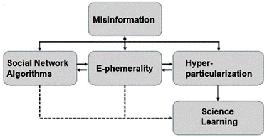
- Representation of the relationship among misinformation, e-phemerality and hyper-particularization.
By not seeking to generalize concepts, and instead focusing on the hyper-particularization of scientific concepts, users may also employ scientific terms removed from their original contexts - snippets that serve a particular explanation without considering the consequences of extrapolation. The e-phemerality of social media makes content interesting only when seen, with no subsequent reflection to relate to previous contents. These two phenomena influence a type of thinking focused on a punctual and particular explanation. Misinformation is characterized by explanations that make sense only within the particularity of the reality seen. Without critical analysis to understand whether the information is part of a filter bubble, or the need for inferences to seek an essential capable of explaining phenomena in different contexts, we are more prone to believe shallow explanations that only make sense within the e-phemeral reality.
Final considerations
Through this set of discussions we sought to show that when only momentary information is considered - without the pursuit of generalizing and contextualizing thought - e-phemerality shapes and sustains a hyper-particularized mode of thinking. In turn, when this mode prevails, belief in misinformation tends to increase, as individuals fail to recognize that such content may be incorrect and do not develop their own mechanisms for conducting scientifically coherent critical analyses.
With a large volume of information circulating on social media and without adequate structures to establish connections among them, users rely on particular explanations for each observed phenomenon. As information is filtered by algorithms, users become increasingly passive in receiving new content, with little active, curiosity-driven questioning. Moreover, such information tends to reinforce prior conceptions without encouraging engagement with differing perspectives - an essential condition for the dialectical process of constructing concepts through the movement from the abstract to the concrete.
In developing a tool to analyze belief in misinformation based on an understanding of how social media structures sustain this process, aligned with insights from science learning processes, it is necessary to identify ways to overcome this social problem. We argue that such pathways involve the development of SML.
Regarding strategies for developing scientific literacies, it is well established that science teaching has historically emphasized content rather than processes of knowledge construction (Camillo & Mattos, 2014). Accordingly, diverse methodological approaches seek to implement classroom practices that foster understanding of science as both a process and a social practice, i.e., a social epistemology of science addressing elements of the nature of science in its social dimension. Concepts such as expertise, credentials, consensus, and conflicts of interest thus become criteria for assessing the reliability and credibility of scientific information circulating in the media (Höttecke & Allchin, 2020).
Research shows that the use of history and philosophy of science (HPS) in the classroom helps students formulate questions and explore concepts and ramifications across diverse topics, revealing key aspects of the nature of science, how it is conducted, and how such understandings prepare students for future challenges (Gooday et al., 2008). It also helps avoid distorted views of scientific practice, enabling a more refined understanding of the elements involved in science teaching and learning (Martins, 2007). A central aim of HPS-based research is to provide students with a broader view of how scientific theories are constructed, countering notions of science as neutral and devoid of debate. In doing so, it opens space for critical thinking through problematization, discussion, and reflection (Bagdonas et al., 2014).
Inquiry-based activities in science education aim to present students with open-ended questions that encourage them to seek evidence in data to support their answers and, in doing so, systematize logical and proportional reasoning while developing scientific and argumentative language (Carvalho, 2014). As the author notes, students are not expected to think and act literally as scientists; rather, by creating an inquiry-oriented environment, teachers can guide and mediate students through a simplified version of the scientific work, gradually expanding their scientific culture.
These examples illustrate the field’s sustained concern with fostering students’ scientific literacy so that they understand how scientific knowledge is constructed, reflect on concepts, seek explanations within the scientific domain, and relate knowledge across contexts in a coherent manner. However, although research shows punctual effective targeted interventions with clearly defined aims and potential, the massive growth of misinformation suggests that these ideals may not have been implemented at scale.
Against this backdrop, and considering the implications of the two concepts developed throughout our argument, we also question emerging challenges and the role of science communication in digital media environments. Can science communication initiatives foster cognitive structures that counter the tendency toward hyper-particularization and e-phemerality?
This reflection may involve, but is not limited to questions about what needs to change - if anything - in current communication approaches on social platforms. Can existing platform formats be used to improve communication strategies, or must their structures be reconfigured? How can science communication break through algorithmic filter bubbles, or is this even feasible? What role does science communication play in promoting generalizing modes of thought, strengthening reasoning that draws inferences across phenomena and the abundant information encountered online?
Although this study focuses on how platform structures influence belief in misinformation, it is also necessary to consider counterpoints to clarify that our model is not intended as a universal explanation. Martins (2020), for instance, examined flat-Earth proponents during the First National Flat Earth Convention in 2019 and identified a “particularized” use of scientific tools, in which concepts were employed outside the laws and theories from which they derive. This resembles our discussion of hyper-particularization and suggests that algorithmic influence is not the sole driver of fragmented denialist argumentation. Nonetheless, from another analytical perspective, there is a shared core in the use of concepts to propagate misinformation, marked by a lack of connection among abstract ideas needed to explain complex phenomena.
Moreover, our analysis of belief in misinformation assumes that individuals seek explanations based on some form of internal logic, with cognitive structures supporting this search influenced by e-phemerality and hyper-particularization. Yet logical argumentation does not always lead individuals to accept knowledge that conflicts with their beliefs or ideological biases. The problem, therefore, is not only informational but also political and social (Cruz Jr., 2021). Finally, given that content-selection algorithms create ideological communities in which members share a common culture (Pivaro & Girotto Jr., 2022), there may be communities aligned with institutional scientific knowledge as well as those that reject it. There are also online communities that sustain long-term scientific debate and collectively construct knowledge, consistent with Lévy’s (2003) notion of collective intelligence; such communities may arise through either algorithmic guidance or active information seeking. These possibilities do not invalidate our theoretical model but highlight its limitations.
We understand that the problem of scientific misinformation on social media is multifaceted and complex, with no simple, single solution. The challenges are numerous and require responses across different levels of social organization. Developing SML to address this issue depends on understanding the modus operandi of media systems and their consequences. Establishing a theoretical framework capable of analyzing the problem helps identify ways to counter these processes. Furthermore, educators in both formal and non-formal settings can appropriate this knowledge and use it as a foundation for planning and implementing educational practices.
Aknowledgements
The first author expresses her gratitude for the support of the National Council for Scientific and Technological Development (CNPq), through process 153023/2024-4. The authors also thank Espaço da Escrita, an organization linked to the Pró-Reitoria de Pesquisa at Unicamp, for their support.
References
- Bagdonas, A., Zanetic, J., & Gurgel, I. (2014). Controvérsias sobre a natureza da ciência como enfoque curricular para o ensino da física. Revista Brasileira de História da Ciência, 7(2), 242-260.
-
Bayer, J. B., Ellison, N. B., Schoenebeck, S. Y., & Falk, E. B. (2016). Sharing the small moments: Ephemeral social interaction on Snapchat. Information, Communication & Society, 19(7), 956-977. https://doi.org/10.1080/1369118X.2015.1084349
» https://doi.org/10.1080/1369118X.2015.1084349 - Borges, F. G. B. (2016). Um olhar rizomático sobre o conceito de letramento digital. Trabalhos em Linguística Aplicada, 55(3), 703-730.
- Bucci, E. (2019). Existe democracia sem verdade factual? Barueri: Estação das Letras e Cores.
- Burchell, K. (2015). Tasking the everyday: Where mobile and online communication take time. Mobile Media & Communication, 3(1), 36-52.
- Carvalho, A. M. P. (2014). O ensino de ciências e a proposição de sequências de ensino investigativas. In A. M. P. Carvalho (Org.), Ensino de ciências por investigação: condições para implementação em sala de aula (pp. 1-20). São Paulo: Cengage Learning.
- Cesarino, L. (2021). Pós-Verdade e a Crise do Sistema de Peritos: uma explicação cibernética. Ilha, 23(1), 73-96.
- Cesarino, L. (2022). Bolsonarismo sem Bolsonaro? Públicos antiestruturais na nova fronteira cibernética. Revista do Instituto de Estudos Brasileiros,(82), 162-188.
-
Chapman, M. (2017). Fake news, echo chambers and filter bubbles: what you need to know. Better Internet for Kids https://www.betterinternetforkids.eu/web/portal/practice/awareness/detail?articleId=1990814
» https://www.betterinternetforkids.eu/web/portal/practice/awareness/detail?articleId=1990814 - Cruz Jr., G. (2021). “VER O QUE TEMOS DIANTE DO NARIZ REQUER UMA LUTA CONSTANTE”: A PÓS-VERDADE COMO DESAFIO À EDUCAÇÃO NA ERA DIGITAL. ETD Educação Temática Digital, 23(1), 273-290
-
Dahlgren, P. (2018). Media, knowledge and trust: The deepening epistemic crisis of democracy. Javnost-The Public, 25(1-2), 20-27. https://doi.org/10.1080/13183222.2018.1418819
» https://doi.org/10.1080/13183222.2018.1418819 - Damin, M. L., & Dodebei, V. (2018). Objetos digitais com extinção programada: ‘histórias’ e rastros memoriais no Instagram. Memória e Informação, 2(2), 45-57.
- D’Ancona, M. (2018). Pós - verdade: a nova guerra contra os fatos em tempos de fake news Barueri: Faro Editorial.
- Davydov, V. V. (1982). Problemas do ensino desenvolvimental: a experiência da pesquisa teórica e experimental na psicologia (J. C. Libâneo & R. A. M. da Madeira Freitas, Trad.). Textos publicados na Revista Soviet Education, August/VOL XXX, N° 8, sob o título “Problems of Developmental Teaching. The Experience of Theoretical and Experimental Psychological Research - Excerpts”.
- Davydov, V. V. (1988). Learning Activity in the Younger School-age Period. Soviet Education, 30(9), 3-47.
- Davydov, V. V. (1990). Soviet Studies in Mathematics Education Volume 2 National Council of Teachers of Mathematics.
-
Davydov, V. V. (1998). The Concept of Developmental Teaching. Journal of Russian & East European Psychology, 36(4), 11-36. https://doi.org/10.2753/RPO1061-0405360411
» https://doi.org/10.2753/RPO1061-0405360411 -
Engeström, Y. (1991). Non scolae sed vitae discimus: Toward overcoming the encapsulation of school learning. Learning and Instruction, 1(3), 243-259. https://doi.org/10.1016/0959-4752(91)90006-T
» https://doi.org/10.1016/0959-4752(91)90006-T -
Fernandes, C. M., Oliveira, L. A. de, Campos, M. M. de, & Coimbra, M. R. (2020). A Pós-verdade em tempos de Covid 19: o negacionismo no discurso de Jair Bolsonaro no Instagram. Liinc em Revista, 16(2), e5317. https://doi.org/10.18617/liinc.v16i2.5317
» https://doi.org/10.18617/liinc.v16i2.5317 - Ferreira, E., Constantino, F. A., & Lima, J. S. (2017). Cotidiano e Instagram: Efemeridade e narrativas de si no recurso Stories. Esferas, 6(11), 151-161.
-
Gooday, G., Lynch, J. M., Wilson, K. G., & Barsky, C. K. (2008). Does Science Education Need the History of Science? Isis, 99(2), 322-330. https://doi.org/10.1086/588690
» https://doi.org/10.1086/588690 -
Höttecke, D. & Allchin, D. (2020). Reconceptualizing nature‐of‐science education in the age of social media. Science Education, 104(4), 641-666. https://doi.org/10.1002/sce.21575
» https://doi.org/10.1002/sce.21575 -
Kapanai, E., Christopoulou, A., Berberidis, C., & Peristeras, V. (2021). A systematic literature review on disinformation: Toward a unified taxonomical framework. New Media & Society, 23(5), 1301-1326. https://doi.org/10.1177/1461444820959296
» https://doi.org/10.1177/1461444820959296 - Lago, L., Ortega, J. L., & Mattos, C. (2020). O modelo genético e o movimento dinâmico entre abstrato e concreto como instrumentos para o planejamento de sequências didáticas para o ensino de ciências. Alexandria: Revista de Educação em Ciência e Tecnologia, 13(1), 123-153.
- Lévy, P. (1999). Cibercultura Editora 34.
- Lévy, P. (2003). A inteligência coletiva: Por uma antropologia do ciberespaço Loyola
- Martins, A. F. P. (2008). História e Filosofia da Ciência no ensino: Há muitas pedras nesse caminho. Caderno Brasileiro De Ensino De Física, 24(1), 112-131
- Martins, A. F. P. (2020). Terraplanismo, Ludwik Fleck e o mito de Prometeu. Caderno Brasileiro de Ensino de Física, 37(3), 1193-1216
-
Martins, R. M. (2020, agosto 13). Bolsonaro entrega R$7,5 milhões para Google distribuir - inclusive a sites de fake news. The Intercept https://theintercept.com/2020/08/13/bolsonaro-usa-google-distribui-milhoes-reais-sites-fake-news-adsense/
» https://theintercept.com/2020/08/13/bolsonaro-usa-google-distribui-milhoes-reais-sites-fake-news-adsense/ - McIntyre, L. (2018). Post-truth Cambridge: The MIT Press.
- Moreira, M. A., & Massoni, N. T. (2015). Interfaces entre Teorias de Aprendizagem e Ensino de Ciências/Física. Textos de Apoio ao Professor de Física, 26(6).
- Mortimer, E. F. (1996). Construtivismo, mudança conceitual e ensino de ciências: para onde vamos? Investigações em Ensino de Ciências, 1(1), 20-39.
-
OECD. (2018). PISA 2018 Global Competence Framework OECD Publishing. http://www.oecd.org/pisa/Handbook-PISA-2018-Global-Competence.pdf
» http://www.oecd.org/pisa/Handbook-PISA-2018-Global-Competence.pdf -
Oliveira, J. (2021, outubro 20). Bolsonaro é “líder e porta-voz” das ‘fake news’ no país, diz relatório final da CPI da Pandemia. El País https://brasil.elpais.com/brasil/2021-10-20/bolsonaro-e-lider-e-porta-voz-das-fake-news-no-pais-diz-relatorio-final-da-cpi-da-pandemia.html
» https://brasil.elpais.com/brasil/2021-10-20/bolsonaro-e-lider-e-porta-voz-das-fake-news-no-pais-diz-relatorio-final-da-cpi-da-pandemia.html - Oliveira, T. M. (2019). Autoridade científica em tempos de crise epistêmica: a circulação de teorias da conspiração nas mídias sociais. In Anais do XXVIII Encontro Anual da Compós (pp. 1-23). Porto Alegre, RS.
-
Oliveira, T. M. (2020). Como enfrentar a desinformação científica? Desafios sociais, políticos e jurídicos intensificados no contexto da pandemia. Liinc em Revista, 16(2), e5374. https://doi.org/10.18617/liinc.v16i2.5374
» https://doi.org/10.18617/liinc.v16i2.5374 - Oliveira, T., Quinan, R., & Toth, J. P. (2020). Antivacina, fosfoetanolamina e Mineral Miracle Solution (MMS): mapeamento de fake sciences ligadas à saúde no Facebook. Revista Eletrônica de Comunicação, Informação & Inovação em Saúde, 14(1).
- Pereira, A. A. G., & dos Santos, C. A. (2022). Proposta teórico-conceitual para a análise da confiabilidade e credibilidade de (des) informações científicas nas mídias: implicações para o Ensino de Ciências. Caderno Brasileiro de Ensino de Física, 39(3), 688-711.
- Pérez, D. G., Montoro, I. F., Alís, J. C., Cachapuz, A., & Praia, J. (2001). Para uma imagem não deformada do trabalho científico. Ciência & Educação, 7(2), 125-153.
- Petrola, J. I. (2019). Fake news, guerra cultural e crise de credibilidade do jornalismo nas eleições de 2018. In C. Costa & P. Blanco (Orgs.), Liberdade de Expressão: questões da atualidade (pp. 84-110). ECA-USP.
-
Pivaro, G. F. (2019). A crença numa terra plana e os ambientes virtuais: identificando relações e construções de conhecimento. In Anais do XII Encontro Nacional de Pesquisa em Educação em Ciências Natal, RN, Brasil. https://abrapec.com/enpec/xii-enpec/anais/resumos/1/R2128-1.pdf
» https://abrapec.com/enpec/xii-enpec/anais/resumos/1/R2128-1.pdf -
Pivaro, G. F. (2023). Sobre a propagação de desinformações científicas nas redes sociais: uma pesquisa etnográfica no Twitter para reflexões sobre a educação em ciências Tese de doutorado, Universidade Estadual de Campinas. Repositório da Unicamp. https://doi.org/20.500.12733/11579
» https://doi.org/20.500.12733/11579 -
Pivaro, G. F., & Girotto Jr., G. (2020). O ataque organizado à ciência como forma de manipulação: do aquecimento global ao coronavírus. Caderno Brasileiro De Ensino De Física, 37(3), 1074-1098. https://doi.org/10.5007/2175-7941.2020v37n3p1074
» https://doi.org/10.5007/2175-7941.2020v37n3p1074 -
Pivaro, G. F., & Girotto Jr., G. (2022). QUAL CIÊNCIA É NEGADA NAS REDES SOCIAIS? REFLEXÕES DE UMA PESQUISA ETNOGRÁFICA EM UMA COMUNIDADE VIRTUAL NEGACIONISTA. Investigações Em Ensino De Ciências, 27(1), 435-458. https://doi.org/10.22600/1518-8795.ienci2022v27n1p435
» https://doi.org/10.22600/1518-8795.ienci2022v27n1p435 -
Pivaro, G. F., & Girotto Jr., G. (2023). Características dos Discursos de Desinformação Relacionados aos Conhecimentos Científicos das Redes Bolsonaristas no Twitter. Revista Brasileira De Pesquisa Em Educação Em Ciências, e40800, 1-25. https://doi.org/10.28976/1984-2686rbpec2023u631655
» https://doi.org/10.28976/1984-2686rbpec2023u631655 - Praia, J., Pérez, D. G., & Vilches, A. (2007). O papel da natureza da ciência na educação para a cidadania. Ciência & Educação, 13(2), 141-156.
- Recuero, R. (2018). Estudando discursos em mídia social: uma proposta metodológica. In T. Silva, J. Buckstege, & P. Rogedo (Orgs.), Estudando cultura e comunicação com mídias sociais (pp. 13-30). IBPAD.
- Recuero, R., Bastos, M., & Zago, G. (2015). Análise de Redes para Mídia Social Porto Alegre: Sulina.
- Recuero, R., & Gruzd, A. (2019). Cascatas de Fake News Políticas: um estudo de caso no Twitter. Galáxia,(41), 31-47.
-
Recuero, R., Soares, F. B., Vinhas, O., Volcan, T., Zago, G., Stumpf, E. M., Viegas, P., Hüttner, L. G., Bonoto, C., Silva, G., Passos, I., & Salgueiro. (2020). Desinformação, Mídia Social e COVID-19 no Brasil: Relatório, resultados e estratégias de combate. MIDIARS. https://wp.ufpel.edu.br/midiars/files/2021/05/Desinformac%CC%A7a%CC%83o-covid-midiars-2021-1.pdf
» https://wp.ufpel.edu.br/midiars/files/2021/05/Desinformac%CC%A7a%CC%83o-covid-midiars-2021-1.pdf -
Santos, F. P. P., & Mattos, C. (2009). Generalização e contextualização no ensino de ciências. In Anais do VII Encontro Nacional de Pesquisa em Ensino de Ciências Florianópolis, SC, Brasil. http://www.fep.if.usp.br/~profis/arquivos/viienpec/VII%20ENPEC%20-%202009/www.foco.fae.ufmg.br/cd/pdfs/737.pdf
» http://www.fep.if.usp.br/~profis/arquivos/viienpec/VII%20ENPEC%20-%202009/www.foco.fae.ufmg.br/cd/pdfs/737.pdf -
Santos, A. P., Souza, E. L. V., & Lima, M. M. (2022). A função educativa das bibliotecas escolares no combate à desinformação e às fake news: estudo de caso das bibliotecas escolares de Goiânia/GO. Informação & Informação, 27(1), 405-428. https://doi.org/10.5433/1981-8920.2022v27n1p405
» https://doi.org/10.5433/1981-8920.2022v27n1p405 - Sibilia, P. (2016). O show do eu: a intimidade como espetáculo Rio de Janeiro: Contraponto.
- Silva, L. H. O. (2019). Interações, leituras e sentidos em tempos de fake news desafios para a formação de leitores no contexto escolar. Estudos Semióticos, 15(2), 31-45.
-
Soares, F. B., Bonoto, C., Viegas, P., Salgueiro, I., & Recuero, R. (2021). Infodemia e Instagram: como a plataforma é apropriada para a produção de desinformação sobre a hidroxicloroquina? Fronteiras - estudos midiáticos, 23(2), 89-103. https://doi.org/10.4013/fem.2021.232.08
» https://doi.org/10.4013/fem.2021.232.08 - Spinelli, E. M., & Santos, J. A. (2020). Alfabetização Midiática na era da desinformação. ECCOM, 11(2), 147-164.
-
Talwar, S., Dhir, A., Kaur, P., Zafar, N., & Alrasheedy, M. (2019). Why do people share fake news? Associations between the dark side of social media use and fake news sharing behavior. Journal of Retailing and Consumer Services, 51, 72-82. https://doi.org/10.1016/j.jretconser.2019.05.026
» https://doi.org/10.1016/j.jretconser.2019.05.026 - UNESCO. (2013). Literacia Midiática e Informacional: currículo para a formação de professores UNESCO, UFTM.
-
Van Zoonen, L. (2012). I-Pistemology: Changing truth claims in popular and political culture. European Journal of Communication, 27(1), 56-67. https://doi.org/10.1177/0267323112438808
» https://doi.org/10.1177/0267323112438808 -
Velasco, C., Rocha, G., & Domingos, R. (2022, março 14). Fato ou Fake: Por que as pessoas criam fake news? G1 https://g1.globo.com/fato-ou-fake/noticia/2022/03/14/fato-ou-fake-por-que-as-pessoas-criam-fake-news.ghtml
» https://g1.globo.com/fato-ou-fake/noticia/2022/03/14/fato-ou-fake-por-que-as-pessoas-criam-fake-news.ghtml - Viscardi, J. M. (2020). Fake news, verdade e mentira sob a ótica de Jair Bolsonaro no Twitter. Trabalhos em Linguística Aplicada, 59(2), 1134-1157.
- Wasserman, S., & Faust, K. (1994). Social network analysis: Methods and applications Cambridge: University Press.
- Winchuar, M. J. L., Bahls, D. P., & Zanlorenzi, M. J. (2022). A escola e o ensino de leitura em tempos de fake news: uma proposta para os anos iniciais do ensino fundamental. Debates em Educação, 14(34), 155-173.
-
Wu, L., Morstatter, F., Carley, K. M., & Liu, H. (2019). Misinformation in social media: definition, manipulation, and detection. ACM SIGKDD Explorations Newsletter, 21(2), 80-90. https://doi.org/10.1145/3373464.3373475
» https://doi.org/10.1145/3373464.3373475
Not applicable.

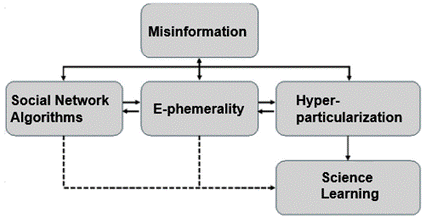 Source: The authors