
 Positive and negative affections, hopelessness and suicide ideation in youth
Abstract
Suicide is one of the leading causes of death worldwide. Even more prevalent than suicide itself is suicidal ideation, which plays an important role in understanding, preventing, identifying, and studying the phenomenon. Hopelessness and affect also deserve attention, as they are predictors of both suicidal ideation and suicide. This exploratory study aimed to examine the relationships among the latent variables positive affect, negative affect, hopelessness, and suicidal ideation, while controlling for sociodemographic variables in Brazilian young adults. The sample consisted of 750 participants aged 18 to 30 years, the majority of whom were female (80.53%). Structural equation modeling indicated that hopelessness mediated the relationship between affect and suicidal ideation – partially mediating the link with negative affect and fully mediating the link with positive affect. Older age, sex, and being enrolled in an undergraduate program were predictors of suicidal ideation.
Keywords
Medicine; Students; Suicide; Suicidal ideation; Young adult
Resumo
O suicídio é uma das principais causas de morte no mundo. Ainda mais prevalente que o suicídio é a ideação suicida, que exerce um papel importante na compreensão, prevenção, identificação e estudo do evento. A desesperança e afetos, também merecem atenção tendo em vista que são preditores da ideação e do suicídio. O estudo teve como objetivo investigar o impacto e a relação entre as variáveis latentes, afetos e desesperança na ideação suicida, controladas pelas variáveis sociodemográficas em jovens adultos brasileiros. Contou com uma amostra de 750 participantes de 18 a 30 anos, a maioria do sexo feminino (80,53%). A modelagem por equações estruturais apontou a desesperança como mediadora entre afetos e ideação suicida, parcial entre afetos negativos e ideação suicida e total entre afetos positivos e ideação suicida. Idade avançada, sexo e estar cursando uma graduação foram preditores da ideação.
Palavras-chave
Medicina; Estudantes; Suicídio; Ideação suicida; Adulto jovem
Suicide is among the 15 leading causes of death worldwide; in 2014, it accounted for 1.4% of all deaths and totaled 700,000 deaths in 2019 (Granieri et al., 2022; Klonsky et al., 2016). Thus, it constitutes a global public health problem that affects societies and families across generations (Boggs & Kafka, 2022; Martinez-Ales et al., 2022; Vasiliadis et al., 2020). Globally, suicide mortality has decreased – with the exception of the Americas, including Brazil (Boggs & Kafka, 2022; Cecchin et al., 2022; Martinez-Ales et al., 2022). In this region, between 2007 and 2017, more than 70% of suicide attempts occurred among people under the age of 40. Suicide remains the second leading cause of death worldwide among those aged 15 to 29 (Cecchin et al., 2022; Xiao et al., 2021).
Unlike suicide (the intentional act of ending one’s own life), suicidal ideation (thinking about, considering, or planning suicide) is even more prevalent and is considered the first step toward the act itself (Baryshnikov & Isometsa, 2022; Klonsky et al., 2016; Miller & Prinstein, 2019; Xiao et al., 2021). It is estimated that 29% of those who experience suicidal ideation will attempt suicide at least once in their lifetime (Nock et al., 2008). Thus, beyond being a predictor of the act (Hubers et al., 2018), and due to the difficulties inherent in conducting research using suicide as an outcome, suicidal ideation plays an important role in understanding this phenomenon (Klonsky et al., 2016).
There are different ways to measure and understand suicidal ideation – for example, through questions about thoughts of escape or planning, or by constructing latent variables (Klonsky et al., 2016; Wilcox et al., 2010). Both approaches contribute to the development of conceptual models that help explain motivation, guide prevention, and identify risk factors for suicide (Boggs & Kafka, 2022; Klonsky et al., 2016; May & Victor, 2018). One risk factor identified in the literature is the presence of mental disorders (e.g., bipolar disorder, posttraumatic stress disorder, depression, or substance use disorders), with about 90% of individuals who die by suicide having one or more of these conditions (Klonsky et al., 2016). However, compared to suicidal ideation, mental disorders are less predictive of actual suicide; instead, they are better at predicting ideation itself (Klonsky et al., 2016; Vasconcelos-Raposo et al., 2016; Xiao et al., 2021).
In addition to mental disorders, psychological constructs are crucial for assessing suicide or ideation risk (Klonsky et al., 2016). Hopelessness, for example, links depression to ideation, attempts, or death by suicide (Baryshnikov & Isometsa, 2022; Ribeiro et al., 2018; Schafer et al., 2021). Hopelessness is characterized by a generalized negative and fatalistic view of the future, coupled with the perception that present circumstances are unchangeable – leading an individual to see suicide as the only solution to their problems (De Berardis et al., 2020; Hernandez & Overholser, 2021; Mandracchia et al., 2021). It is an effective predictor of both ideation and suicide (Holler et al., 2022; Mandracchia et al., 2021; Ribeiro et al., 2018).
Another construct that has shown significant relevance for understanding suicidal ideation is affect (Cha et al., 2018; Granieri et al., 2022). Affect has two dimensions: positive affect (frequent experiences of joy, enthusiasm, confidence, and engagement in tasks) and negative affect (recurrent experiences of sadness, discouragement, and worry) (Cha et al., 2018; Otsuka Nunes et al., 2019). Affect has also been identified as a predictor of both ideation and suicidal behavior (Cha et al., 2018).
Regarding sociodemographic characteristics, suicide and suicidal ideation show heterogeneous patterns (Granieri et al., 2022; Klonsky et al., 2016; Martinez-Ales et al., 2022; Vasiliadis et al., 2020). High-income countries, for instance, have higher suicide rates. In terms of age, there are two distinct peaks for suicide: the highest among young adults, and a secondary peak among older adults. Other predictors include divorced marital status, low educational attainment, unemployment, and sex – one of the main predictors. Sex behaves in a particular way: the suicide rate is higher among men, although the prevalence of ideation is higher among women (Granieri et al., 2022; Vasiliadis et al., 2020). The greater lethality among men is explained by their use of more lethal methods (e.g., firearms and hanging) and their lower likelihood of seeking help, in an attempt to conform to traditional masculine behaviors. Among women, attempts by poisoning are more frequent (Miranda-Mendizabal et al., 2019).
Additionally, risk factors impact each sex differently (Miranda-Mendizabal et al., 2019). Bipolar disorder, posttraumatic stress disorder, depressive symptoms, and eating disorders present an increased risk for women. Disruptive behaviors, hopelessness, access to firearms, and exposure to suicidal behavior by someone known are more significant risk factors among men. Negative life events (e.g., the death of a parent, breakup of a romantic relationship), family problems, a history of abuse, and mental disorders are factors that increase risk for both sexes. When associated with age, suicide rates increase for women as they get older, whereas for men the rates increase up to early adulthood (Miranda-Mendizabal et al., 2019). Emerging adulthood is also relevant – a period when young people, aiming to enter the labor market, spend more time in training and studies, such as at the university. With delayed financial independence and/or family formation, young adults are exposed to feelings of insecurity, vulnerability, and instability (Pereira et al., 2018).
In the university population, social and academic pressure are variables that influence the level of suicidal ideation, along with other factors such as leaving one’s family, being far from home, the higher prevalence of mental disorders, and increased exposure to alcohol or other drugs (Cecchin et al., 2022; Granieri et al., 2022; Seo et al., 2021). Medical students in particular report higher levels of psychological distress and suicidal ideation (Rotenstein et al., 2016; Santa & Cantilino, 2016; Seo et al., 2021).
Based on the findings, this exploratory study aims to understand the relationships among the latent variables of positive affect, negative affect, hopelessness, and suicidal ideation, while controlling for sociodemographic characteristics.
Method
Participants
The sample consisted of 750 Brazilian participants aged between 18 and 30 years (M = 21.94; SD = 2.87), 70.26% (N = 527) of whom were female. Of the total sample, 80.53% (N = 604) were enrolled in undergraduate programs, with medical students accounting for 42% (N = 315) of the total.
Instruments
Sociodemographic questionnaire: Developed by the authors, this questionnaire aimed to characterize the sample in terms of age, sex, enrollment in higher education, and field of study. Suicidal Ideation Questionnaire (Reis, 1999): The Suicidal Ideation Questionnaire (SIQ) assesses the severity of suicidal thoughts in adolescents and young adults. It consists of 30 items scored on a Likert scale ranging from 0 to 6 points (0 = I never had this thought; 6 = almost every day). The instrument is one of the few capable of predicting suicide (Klonsky et al., 2016). Fit indices in this study: χ²(405) = 3318.539, p < 0.001; χ²/df = 8.19; Comparative Fit Index (CFI) = 0.969; Tucker-Lewis Index (TLI) = 0.967; and Root Mean Square Error of Approximation (RMSEA, 90% CI) = 0.098 (0.095–0.101).
Beck Hopelessness Scale (Cunha et al., 2001): The Hopelessness Scale (HS) consists of 20 dichotomous items that assess expectations about the future. Scores above 9 indicate greater risk for suicide attempts and suicidal ideation (Baryshnikov & Isometsa, 2022; Holler et al., 2022; Klonsky et al., 2016; Mandracchia et al., 2021). Fit indices in this study: χ²(170) = 652.124, p < 0.001; χ²/df = 3.83; CFI = 0.840; TLI = 0.826; and RMSEA (90% CI) = 0.061 (0.056–0.066).
Positive and Negative Affect Scale (Zanon et al., 2013): The Positive and Negative Affect Schedule (PANAS) comprises two factors – Positive Affect (PA) and Negative Affect (NA) – with 20 adjectives representing moods and emotions, scored on a five-point Likert scale (1 = very slightly or not at all; 5 = extremely). Fit indices: χ²(169) = 1334.430, p < .001; χ²/df = 7.89; CFI = 0.936; TLI = 0.928; and RMSEA (90% CI) = 0.096 (0.091–0.101).
Data Collection Procedures
The study was approved by the Research Ethics Committee (CAAE 12826519.4.0000.5515 – Universidade do Oeste Paulista. Data collection was conducted online between September and October 2019 using a snowball sampling strategy. To participate in the study, individuals had to agree to the Informed Consent Form and then complete the sociodemographic questionnaire and the scales.
Data Analysis Procedure
Analyses were performed using the R software (Team, 2010) with the lavaan package (Rosseel, 2012). First, descriptive statistics for the instruments – mean and standard deviation – were calculated, and Pearson’s correlation was performed to examine the relationships between the study constructs (Field, 2012).
Next, a full Structural Equation Modeling (SEM) was conducted to assess the impact of positive and negative affect on suicidal ideation, mediated by hopelessness and controlled for sex, age, enrollment in higher education, and enrollment in medical school. The estimation method used was Weighted Least Squares Mean and Variance Adjusted, as the data were ordinal (DiStefano & Morgan, 2014; Li, 2016; Muthén & Muthén, 2017). Model fit was assessed using the following fit indices: χ², χ²/df, Comparative Fit Index (CFI), Tucker-Lewis Index (TLI), and Root Mean Square Error of Approximation (RMSEA). The χ² should not be statistically significant; χ²/df should be less than or equal to 5; CFI and TLI should be greater than 0.90; and RMSEA should be less than or equal to 0.08, with the upper limit of the 90% confidence interval below 0.10 (Brown, 2015).
Results
Descriptive statistics for the instruments were as follows: For the Suicidal Ideation Questionnaire (M = 38.61; SD = 40.02); for the Beck Hopelessness Scale (M = 5.03; SD = 3.24); and for the PANAS: positive affect (M = 31.23; SD = 8.41) and negative affect (M = 28.57; SD = 9.42). Next, Pearson’s correlations were calculated to examine the extent to which the constructs were related; the results are presented in Table 1. All correlations were statistically significant (p < 0.001). Suicidal ideation, hopelessness, and negative affect showed positive correlations with each other. Positive affect was negatively correlated with the other constructs.
Pearson correlation between suicidal ideation, hopelessness, and negative and positive affect
Finally, a full structural equation model was tested to investigate the extent to which affect influenced suicidal ideation when mediated by hopelessness. Age, sex, enrollment in higher education, and enrollment in medical school were included as covariates, so the impact of the constructs on suicidal ideation was controlled for these covariates, as shown in Figure 1.
As indicated in Figure 1, hopelessness was significantly affected (p < 0.001) by levels of positive affect (standardized β = -0.462) and negative affect (standardized β = -0.445). Suicidal ideation was directly predicted by negative affect (standardized β = 0.399) and hopelessness (standardized β = 0.375). The model’s covariates were statistically significant (p < 0.001): being female (standardized β = 0.142), being enrolled in higher education (standardized β = 0.046), and higher age (standardized β = 0.043) were associated with higher levels of suicidal ideation, whereas being enrolled in medical school was associated with lower levels (standardized β = -0.182). Hopelessness fully mediated the effect of positive affect on suicidal ideation, since the direct effect (positive affect on suicidal ideation) was not statistically significant (p > 0.05), and it mediated 67% of the effect of negative affect on ideation (Figure 1).
Discussion
An effect of hopelessness on suicidal ideation was expected (De Berardis et al., 2020; Hernandez & Overholser, 2021; Klonsky et al., 2016; Mandracchia et al., 2021; Ribeiro et al., 2018). In the present study, hopelessness, in addition to being a predictor, plays a mediating role between affect and suicidal ideation. Negative affect can simultaneously predict hopelessness and suicidal ideation. This partial mediation shows that the persistent experience of sadness, discouragement, and worry, for example, predicts suicidal ideation both independently and through hopelessness.
The full mediation of the relationship between positive affect and suicidal ideation via hopelessness shows that low levels of positive affect predict suicidal ideation only through hopelessness. Therefore, in the presence of negative affect, both suicidal ideation and hopelessness should be screened simultaneously, whereas in the presence of low positive affect, hopelessness should be considered (Cha et al., 2018; Klonsky et al., 2016). In line with this, an analysis of religious coping, hopelessness, and suicidal ideation found a negative correlation between positive coping (spiritual connection, seeking spiritual support, religious forgiveness, collaborative religious coping, benevolent religious reappraisal, religious purification, and religious focus) and both hopelessness and suicidal ideation; a multiple linear regression analysis showed that higher levels of positive coping were associated with lower levels of suicidal ideation (De Berardis et al., 2020).
Although sociodemographic variables are less important than psychological constructs (Oi & Wilkinson, 2018), they can still influence suicidal ideation. In the present study, their regression coefficients (β) were smaller than those of the psychological constructs. As expected, the covariates sex and age showed a statistically significant impact. Being female and older were associated with higher levels of suicidal ideation. The literature also highlights sex as a moderator of the relationship between negative affectivity (a pathological personality trait) and suicidal ideation in a sample with major depression: when considering men, higher negative affectivity predicted higher suicidal ideation, whereas this effect was not statistically significant among women (Granieri et al., 2022).
Regarding the university covariate, in general, being enrolled in an undergraduate program was associated with higher levels of suicidal ideation, as this is a period marked by adaptation, pressure, and strain, which predispose individuals to ideation (Cecchin et al., 2022; Granieri et al., 2022; Seo et al., 2021). However, belonging to a medical program was associated with lower levels of suicidal ideation, which diverges from previous literature (Rotenstein et al., 2016; Santa & Cantilino, 2016; Watson et al., 2020). In this regard, a systematic review and meta-analysis sought to estimate the prevalence of depression, suicidal ideation, and suicidal tendencies among medical students and found these rates to be high (Rotenstein et al., 2016). Similarly, another systematic review indicated that suicide attempts among medical students are higher than among other academic groups (Santa & Cantilino, 2016). Higher rates of depression, substance abuse, and psychological distress resulting from heavy workloads, sleep deprivation, patient-related difficulties, and financial concerns are cited as contributing factors (Santa & Cantilino, 2016).
The structural equation modeling was carried out after evaluating the measurement models. For the Suicidal Ideation Questionnaire, a residual correlation was added between two items, which led to a substantial improvement in fit: χ²/df = 4.74; CFI = 0.974; TLI = 0.972; and RMSEA (90% CI) = 0.089 (0.086–0.092). For the PANAS, similarly, the fit indices improved after adding a residual correlation between two items with similar meanings: χ²/df = 4.79; CFI = 0.965; TLI = 0.960; and RMSEA (90% CI) = 0.071 (0.066–0.076). For the Beck Hopelessness Scale, two items with low factor loadings (< 0.30) that contributed little to the latent variable were removed, improving model fit: χ²/df = 2.89; CFI = 0.919; TLI = 0.908; and RMSEA (90% CI) = 0.050 (0.044–0.056) (Brown, 2015).
Conclusion
This study contributes to the quantitative understanding of suicidal ideation among young Brazilians. It highlights the important mediating role of hopelessness between affect and suicidal ideation. Higher levels of negative affect simultaneously predicted greater hopelessness and suicidal ideation. Higher levels of positive affect predicted lower levels of hopelessness, with the effect of positive affect on ideation depending on hopelessness.
Sociodemographic characteristics, though less influential than psychological constructs, were also predictors of suicidal ideation. The findings reinforce that being female is a predictor of ideation, as is being older, within the studied age range. Since, in this study, enrollment in a medical program was associated with lower levels of suicidal ideation – a result that contrasts with previous findings – it is relevant to investigate potential protective constructs for suicidal ideation (such as openness, conscientiousness, extraversion, self-efficacy, self-esteem, family relationships, social skills, sense of meaning in life, and hope) to develop models that clarify their roles in suicidal ideation and how they interact with medical training.
As this is a cross-sectional study without longitudinal monitoring of latent variables, the proposed mediation model is limited, given that latent traits tend to fluctuate over time. Prospective studies would help to better understand suicidal ideation. Other analytical approaches, such as network analysis, could also be useful. Regarding hopelessness, future research could examine its role as a moderating variable of suicidal ideation.
Initially, the measures used in this study did not perform adequately, requiring adjustments in order to conduct the full structural equation modeling. Redundancy of content was identified between items, indicated by high residual correlations and modification indices greater than 30. Such redundancy worsens model fit and does not contribute to the measurement of latent constructs. The use of item response theory and confirmatory factor analyses to shorten measurement instruments would be beneficial. Shorter instruments reduce response time, lower the likelihood of missing data, and decrease participant refusal rates.
-
How to cite this article:
Porto, T. I., & Murgo, C. S. (2026). Positive and negative affections, hopelessness and suicide ideation in youth. Estudos de Psicologia (Campinas), 43, e200248. https://doi.org/10.1590/1982-0275202643e200248
Data availability
The research data are available within the body of the document.
Referências
-
Baryshnikov, I., & Isometsa, E. (2022). Psychological pain and suicidal behavior: A review. Front Psychiatry, 13, 981353. https://doi.org/10.3389/fpsyt.2022.981353
» https://doi.org/10.3389/fpsyt.2022.981353 -
Boggs, J. M., & Kafka, J. M. (2022). A Critical Review of Text Mining Applications for Suicide Research. Current Epidemiology Reports, 9(3), 126-134. https://doi.org/10.1007/s40471-022-00293-w
» https://doi.org/10.1007/s40471-022-00293-w - Brown, T. A. (2015). Confirmatory factor analysis for applied research (2nd ed). The Guilford Press.
-
Cecchin, H. F. G., Murta, S. G., Macedo, E. O. S., & Moore, R. A. (2022). Scoping review of 30 years of suicide prevention in university students around the world: efficacy, effectiveness, and cost-effectiveness. Psicologia: Reflexão e Crítica, 35(1), 22. https://doi.org/10.1186/s41155-022-00227-x
» https://doi.org/10.1186/s41155-022-00227-x -
Cha, C. B., Franz, P. J., E, M. G., Glenn, C. R., Kleiman, E. M., & Nock, M. K. (2018). Annual Research Review: Suicide among youth - epidemiology, (potential) etiology, and treatment. Journal of Child Psychology and Psychiatry, 59(4), 460-482. https://doi.org/10.1111/jcpp.12831
» https://doi.org/10.1111/jcpp.12831 - Cunha, J., Cunha, J., Cunha, J., Cunha, J. D. S. M., Cunha, J. P. B. C., Cunha, R. L., Cunha, J. R., Cunha, A. C. Q., Cunha, L. C., Cunha, J. P. B., Cunha, M. S. R., Cunha, A. C. Q., Cunha, L. S., Cunha, J. S. M., Cunha, A. P., Cunha, B., Cunha, W. A., & Cunha, C. R. T. (2001). Manual da versão em português das Escalas Beck Casa do Psicólogo.
-
De Berardis, D., Olivieri, L., Rapini, G., Serroni, N., Fornaro, M., Valchera, A., Carano, A., Vellante, F., Bustini, M., Serafini, G., Pompili, M., Ventriglio, A., Perna, G., Fraticelli, S., Martinotti, G., & Di Giannantonio, M. (2020). Religious Coping, Hopelessness, and Suicide Ideation in Subjects with First-Episode Major Depression: An Exploratory Study in the Real World Clinical Practice. Brain Sciences, 10(12). https://doi.org/10.3390/brainsci10120912
» https://doi.org/10.3390/brainsci10120912 -
DiStefano, C., & Morgan, G. B. (2014). A Comparison of Diagonal Weighted Least Squares Robust Estimation Techniques for Ordinal Data. Structural Equation Modeling: A Multidisciplinary Journal, 21(3), 425-438. https://doi.org/10.1080/10705511.2014.915373
» https://doi.org/10.1080/10705511.2014.915373 - Field, A. (2012). Discovering statistics using R SAGE Publications.
-
Granieri, A., Casale, S., Sauta, M. D., & Franzoi, I. G. (2022). Suicidal Ideation among University Students: A Moderated Mediation Model Considering Attachment, Personality, and Sex. International Journal of Environmental Research and Public Health, 19(10). https://doi.org/10.3390/ijerph19106167
» https://doi.org/10.3390/ijerph19106167 -
Hernandez, S. C., & Overholser, J. C. (2021). A Systematic Review of Interventions for Hope/Hopelessness in Older Adults. Clinical Gerontology and Geriatrics, 44(2), 97-111. https://doi.org/10.1080/07317115.2019.1711281
» https://doi.org/10.1080/07317115.2019.1711281 -
Holler, I., Kremers, A., Schreiber, D., & Forkmann, T. (2022). Trapped in my inner prison-Cross-sectional examination of internal and external entrapment, hopelessness and suicidal ideation. Plos One, 17(7), e0270985. https://doi.org/10.1371/journal.pone.0270985
» https://doi.org/10.1371/journal.pone.0270985 -
Hubers, A. A. M., Moaddine, S., Peersmann, S. H. M., Stijnen, T., van Duijn, E., van der Mast, R. C., Dekkers, O. M., & Giltay, E. J. (2018). Suicidal ideation and subsequent completed suicide in both psychiatric and non-psychiatric populations: a meta-analysis. Epidemiology and Psychiatric Sciences, 27(2), 186-198. https://doi.org/10.1017/S2045796016001049
» https://doi.org/10.1017/S2045796016001049 -
Klonsky, E. D., May, A. M., & Saffer, B. Y. (2016). Suicide, Suicide Attempts, and Suicidal Ideation. Annual Review of Clinical Psychology, 12, 307-330. https://doi.org/10.1146/annurev-clinpsy-021815-093204
» https://doi.org/10.1146/annurev-clinpsy-021815-093204 -
Li, C. H. (2016). Confirmatory factor analysis with ordinal data: Comparing robust maximum likelihood and diagonally weighted least squares. Behavior Research Methods, 48(3), 936-949. https://doi.org/10.3758/s13428-015-0619-7
» https://doi.org/10.3758/s13428-015-0619-7 -
Mandracchia, J. T., Sunderland, M. N., & To, Y. M. (2021). Evaluating the role of interpersonal hopelessness in the interpersonal theory of suicide. Death Studies, 45(9), 746-750. https://doi.org/10.1080/07481187.2019.1671549
» https://doi.org/10.1080/07481187.2019.1671549 -
Martinez-Ales, G., Jiang, T., Keyes, K. M., & Gradus, J. L. (2022). The Recent Rise of Suicide Mortality in the United States. Annual Review of Public Health, 43, 99-116. https://doi.org/10.1146/annurev-publhealth-051920-123206
» https://doi.org/10.1146/annurev-publhealth-051920-123206 -
May, A. M., & Victor, S. E. (2018). From ideation to action: recent advances in understanding suicide capability. Current Opinion in Psychology, 22, 1-6. https://doi.org/10.1016/j.copsyc.2017.07.007
» https://doi.org/10.1016/j.copsyc.2017.07.007 -
Miller, A. B., & Prinstein, M. J. (2019). Adolescent Suicide as a Failure of Acute Stress-Response Systems. Annual Review of Clinical Psychology, 15, 425-450. https://doi.org/10.1146/annurev-clinpsy-050718-095625
» https://doi.org/10.1146/annurev-clinpsy-050718-095625 -
Miranda-Mendizabal, A., Castellví, P., Parés-Badell, O., Alayo, I., Almenara, J., Alonso, I., Blasco, M. J., Cebrià, A., Gabilondo, A., Gili, M., Lagares, C., Piqueras, J. A., Rodríguez-Jiménez, T., Rodríguez-Marín, J., Roca, M., Soto-Sanz, V., Vilagut, G., & Alonso, J. (2019). Gender differences in suicidal behavior in adolescents and young adults: systematic review and meta-analysis of longitudinal studies. International Journal of Public Health, 64(2), 265-283. https://doi.org/10.1007/s00038-018-1196-1
» https://doi.org/10.1007/s00038-018-1196-1 - Muthén, L. K., & Muthén, B. O. (2017). Mplus: Statistical Analysis with Latent Variables: User’s Guide Muthén & Muthén.
-
Nock, M. K., Borges, G., Bromet, E. J., Alonso, J., Angermeyer, M., Beautrais, A., Bruffaerts, R., Chiu, W. T., de Girolamo, G., Gluzman, S., de Graaf, R., Gureje, O., Haro, J. M., Huang, Y., Karam, E., Kessler, R. C., Lepine, J. P., Levinson, D., Medina-Mora, M. E., Ono, Y., Posada-Villa, J., & Williams, D. (2008). Cross-national prevalence and risk factors for suicidal ideation, plans and attempts. British Journal of Psychiatry, 192(2), 98-105. https://doi.org/10.1192/bjp.bp.107.040113
» https://doi.org/10.1192/bjp.bp.107.040113 -
Oi, K., & Wilkinson, L. (2018). Trajectories of Suicidal Ideation from Adolescence to Adulthood: Does the History of Same-Sex Experience Matter? Archives of Sexual Behavior, 47(8), 2375-2396. https://doi.org/10.1007/s10508-018-1234-3
» https://doi.org/10.1007/s10508-018-1234-3 -
Otsuka Nunes, L. Y., Campos Lopes Lemos, D., Castro Ribas Júnior, R., Brandão Behar, C., & Pires dos Santos, P. P. (2019). Análise psicométrica da PANAS no Brasil. Ciencias Psicológicas, 13, 45-55. http://www.scielo.edu.uy/scielo.php?script=sci_arttext&pid=S1688-42212019000100045&nrm=iso
» http://www.scielo.edu.uy/scielo.php?script=sci_arttext&pid=S1688-42212019000100045&nrm=iso -
Pereira, A. S., Willhelm, A. R., Koller, S. H., & Almeida, R. M. M. (2018). Fatores de risco e proteção para tentativa de suicídio na adultez emergente. Revista Ciência & Saúde Coletiva, 23(11), 3767-3777. https://doi.org/10.1590/1413-812320182311.29112016
» https://doi.org/10.1590/1413-812320182311.29112016 -
Reis, C. L. (1999). Testes e provas psicológicas em Portugal. Psicologia Escolar e Educacional, 3(2), 155-157. http://www.scielo.br/scielo.php?script=sci_arttext&pid=S1413-85571999000200006⟨=pt
» http://www.scielo.br/scielo.php?script=sci_arttext&pid=S1413-85571999000200006⟨=pt -
Ribeiro, J. D., Huang, X., Fox, K. R., & Franklin, J. C. (2018). Depression and hopelessness as risk factors for suicide ideation, attempts and death: meta-analysis of longitudinal studies. British Journal of Psychiatry, 212(5), 279-286. https://doi.org/10.1192/bjp.2018.27
» https://doi.org/10.1192/bjp.2018.27 -
Rosseel, Y. (2012). lavaan: An R Package for Structural Equation Modeling. Journal of Statistical Software, 48(2), 1-36. https://doi.org/10.18637/jss.v048.i02
» https://doi.org/10.18637/jss.v048.i02 -
Rotenstein, L. S., Ramos, M. A., Torre, M., Segal, J. B., Peluso, M. J., Guille, C., Sen, S., & Mata, D. A. (2016). Prevalence of Depression, Depressive Symptoms, and Suicidal Ideation Among Medical Students: A Systematic Review and Meta-Analysis. JAMA, 316(21), 2214-2236. https://doi.org/10.1001/jama.2016.17324
» https://doi.org/10.1001/jama.2016.17324 -
Santa, N., & Cantilino, A. (2016). Suicídio entre Médicos e Estudantes de Medicina: Revisão de Literatura. Revista Brasileira de Educação Médica, 40, 772-780. https://doi.org/10.1590/1981-52712015v40n4e00262015
» https://doi.org/10.1590/1981-52712015v40n4e00262015 -
Schafer, K. M., Kennedy, G., Gallyer, A., & Resnik, P. (2021). A direct comparison of theory-driven and machine learning prediction of suicide: A meta-analysis. Plos One, 16(4), e0249833. https://doi.org/10.1371/journal.pone.0249833
» https://doi.org/10.1371/journal.pone.0249833 -
Seo, C., Di Carlo, C., Dong, S. X., Fournier, K., & Haykal, K. A. (2021). Risk factors for suicidal ideation and suicide attempt among medical students: A meta-analysis. Plos One, 16(12), e0261785. https://doi.org/10.1371/journal.pone.0261785
» https://doi.org/10.1371/journal.pone.0261785 -
Team, R. D. C. (2010). A language and enviroment for statistical computing R Foundation. https://www.r-project.org/
» https://www.r-project.org/ -
Vasconcelos-Raposo, J., Soares, A. R., Silva, F., Fernandes, M. G., & Teixeira, C. M. (2016). Níveis de ideação suicida em jovens adultos. Estudos de Psicologia (Campinas), 33(2), 345-354. https://doi.org/10.1590/1982-02752016000200016
» https://doi.org/10.1590/1982-02752016000200016 -
Vasiliadis, H. M., Lamoureux-Lamarche, C., Pitrou, I., & Berbiche, D. (2020). Sex differences in type of lifetime trauma and suicidal ideation mediated by post-traumatic stress and anxio-depressive disorders in older adults. International Psychogeriatrics, 32(4), 473-483. https://doi.org/10.1017/S1041610219001893
» https://doi.org/10.1017/S1041610219001893 -
Watson, C., Ventriglio, A., & Bhugra, D. (2020). A narrative review of suicide and suicidal behavior in medical students. Indian Journal of Psychiatry, 62(3), 250-256. https://doi.org/10.4103/psychiatry.IndianJPsychiatry_357_20
» https://doi.org/10.4103/psychiatry.IndianJPsychiatry_357_20 -
Wilcox, H. C., Arria, A. M., Caldeira, K. M., Vincent, K. B., Pinchevsky, G. M., & O’Grady, K. E. (2010). Prevalence and predictors of persistent suicide ideation, plans, and attempts during college. Journal of Affective Disorders, 127(1-3), 287-294. https://doi.org/10.1016/j.jad.2010.04.017
» https://doi.org/10.1016/j.jad.2010.04.017 -
Xiao, Y., Cerel, J., & Mann, J. J. (2021). Temporal Trends in Suicidal Ideation and Attempts Among US Adolescents by Sex and Race/Ethnicity, 1991-2019. JAMA Netw Open, 4(6), e2113513. https://doi.org/10.1001/jamanetworkopen.2021.13513
» https://doi.org/10.1001/jamanetworkopen.2021.13513 -
Zanon, C., Bastianello, M. R., Pacico, J. C., & Hutz, C. S. (2013). Desenvolvimento e validação de uma escala de afetos positivos e negativos. Psico-UsF, 18, 193-201. https://doi.org/10.1590/S1413-82712013000200003
» https://doi.org/10.1590/S1413-82712013000200003
Edited by
-
Editors
João Carlos Caselli Messias, Raquel Souza Lobo Guzzo

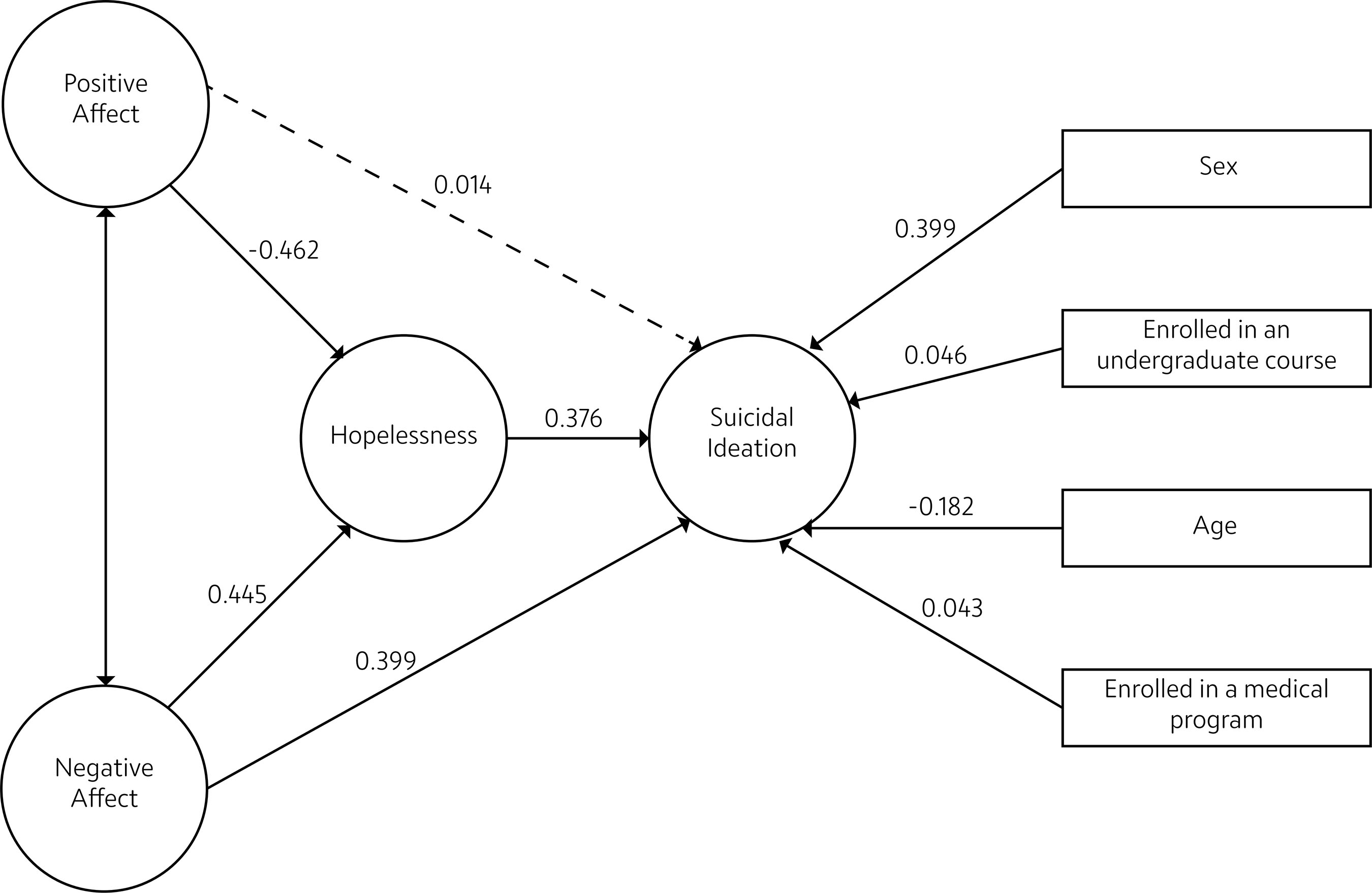 Note: Factor loadings for items were omitted for simplicity. Regressions display standardized estimates (β). Model fit indices: χ²(2472) = 8260.708, p < .001; χ²/df = 3.34; CFI = 0.998; TLI = 0.998; RMSEA (90% CI) = 0.056 (0.054–0.057).