 Cross-cultural adaptation of the knowledge of disease management-CF-adolescent questionnaire for Brazilian Portuguese
ABSTRACT
This study aimed to cross-culturally adapt the Knowledge of Disease Management-CF-Adolescent (KDM-CF-Adolescent) questionnaire for Brazilian Portuguese, as well as to test its measurement properties. Cross-cultural adaptation followed five standardized steps: translation; consensus version of the translation, back translation, consensus version of back translation, and application of the final version to 35 adolescent patients with cystic fibrosis (FC), aged 11 to 20 years. Due to the COVID-19 pandemic and social isolation measures, the questionnaire was applied online using the Google Forms. Data were subjected to Rasch analysis, using the WINSTEPS software. There were no problems regarding understanding the questions, so making changes in any of the translated items was not necessary. The KDM-CF-Adolescent divided the sample into two levels of knowledge and the items into three levels of difficulty, leading to person and item reliability indices of 0.67 and 0.81, respectively and internal consistency of 0.69. All items fit the Rasch model expectations, since all infit/outfit and associated z-values were within the expected range. The principal component analysis confirmed the existence of two dimensions; however, they did not function as independent scales. There was no duplication of any content and no floor and/or ceiling effects were found. The Brazilian Portuguese version of KDM-CF-Adolescent questionnaire demonstrated satisfactory properties to measure the knowledge adolescents with CF have about the disease.
Keywords:
Cystic Fibrosis; Patient Health Questionnaire; Knowledge Management; Health Knowledge, Attitudes, Practice; Healthy Lifestyle
O objetivo desse estudo foi adaptar transculturalmente o questionário Knowledge of Disease Management-CF-Adolescent (KDM-CF-Adolescentes) para a língua portuguesa falada no Brasil, bem como testar suas propriedades de medida. A adaptação transcultural seguiu cinco passos padronizados: tradução, versão consenso traduzida, tradução reversa, versão consenso da tradução reversa e aplicação da versão final a 35 pacientes adolescentes com Fibrose Cística (FC) com idade entre 11 e 20 anos. Devido às medidas de isolamento social impostas pela pandemia de COVID-19, a aplicação do questionário foi realizada de forma on-line, pela plataforma Google Forms. As respostas do questionário foram submetidos à análise de Rasch, usando o software WINSTEPS. Como não houve problema de entendimento das questões, não houve necessidade de fazer alterações em nenhum dos itens traduzidos. O questionário KDM-CF-Adolescentes dividiu a amostra em dois níveis de conhecimento e os itens em três níveis de dificuldade, levando a índices de confiabilidade dos indivíduos e dos itens de 0,67 e 0,81, respectivamente e consistência interna de 0,69. Todos os itens atenderam às expectativas do modelo Rasch, uma vez que todos os valores de infit/outfit e z associados estavam dentro do intervalo esperado. A análise de componentes principais confirmou a existência de duas dimensões; no entanto, elas não funcionaram como escalas independentes. Não houve duplicação de nenhum conteúdo nem efeitos chão e/ou teto. A versão brasileira do questionário KDM-CF-Adolescentes demonstrou propriedades de medidas satisfatórias, para medir o conhecimento que os adolescentes com FC têm sobre a doença.
Palavras-chave:
Fibrose Cística; Questionário de Saúde do Paciente; Gestão do Conhecimento; Conhecimento em Saúde, Atitudes, Prática; Estilo de vida saudável
RESUMEN
El objetivo de este estudio fue realizar una adaptación transcultural del cuestionario Knowledge of Disease Management-CF-Adolescent (KDM-CF-Adolescents) al portugués brasileño, así como probar sus propiedades de medición. La adaptación transcultural siguió cinco pasos estandarizados: Traducción, traducción consensuada, traducción reversa, traducción consensuada de la traducción reversa y aplicación de la versión final a 35 pacientes adolescentes con fibrosis quística (FQ), de entre 11 y 20 años de edad. Debido a las medidas de aislamiento social impuestas por la pandemia de la covid-19, el cuestionario se aplicó en línea mediante la plataforma Google Forms. Las respuestas al cuestionario se sometieron al análisis Rasch en el software WINSTEPS. Como no hubo problemas para comprender las preguntas, no fue necesario realizar cambios en ninguno de los ítems traducidos. El cuestionario KDM-CF-Adolescentes dividió la muestra en dos niveles de conocimiento; y los ítems en tres niveles de dificultad, lo cual dio como resultado índices de confiabilidad de individuos e ítems de 0,67 y 0,81, respectivamente, y la consistencia interna de 0,69. Todos los ítems cumplieron con lo esperado en el modelo Rasch, ya que todos los valores de infit/outfit y z asociados estaban dentro del rango esperado. El análisis de los componentes principales confirmó la existencia de dos dimensiones; sin embargo, estas no funcionaron como escalas independientes. No hubo duplicación de ningún contenido ni efectos de piso y/o techo. La versión brasileña del cuestionario KDM-CF-Adolescentes demostró propiedades de medidas satisfactorias para medir el conocimiento que tienen los adolescentes con FQ acerca de la enfermedad.
Palabras clave:
Fibrosis Quística; Cuestionario de Salud del Paciente; Gestión del conocimiento; Conocimiento de la salud, actitudes, práctica; Estilo de vida saludable
INTRODUCTION
Cystic Fibrosis (CF) is an autosomal recessive genetic disease caused by the mutation of the chromosome 7, known as cystic fibrosis membrane regulator (CFTR), which is the protein that regulates the transport of ions, chlorine, sodium, and bicarbonate, essential for transporting salt and water through the cell membrane in the exocrine glands. Nowadays, CF is diagnosed at birth by the foot test1),(2.
Given the early diagnosis and severity of the disease, it is necessary to start a respiratory and nutritional preventive care. Treatment is conducted by a multidisciplinary team throughout individuals lives. The approach changes based on the age group and severity of the condition3-5. Despite advances, CF has no cure; most efforts and resources are directed to the prevention of complications, especially those related to the respiratory system, which unfortunately destroy the lungs and lead to premature death4-8.
At the beginning of the treatment, parents or guardians care for the infants, but over the years the individuals must acquire autonomy to manage their own treatment, especially during adolescence. Considering that adolescence is a period of difficult maturation and the beginning of responsibility to two to three hours of daily treatment6, it is necessary to measure the knowledge acquired by individuals throughout the years.
Considering that knowledge is an important process of education and intervention7, that can lead to the prevention of complications, it is important to verify what individuals know about their disease and self-care, especially in adolescence, when they are encouraged to be responsible for their own care9. To address this issue, a previous study10 developed an educational program aiming at stimulating self-management, identifying the needs and then organizing practical activities involving individuals with CF and their families. Other two studies6),(11 showed that gaps in knowledge about the disease played important role in treatment adherence.
Due to the importance of learning preventive measures, the “I change adherence and rise expectations” (iCARE)12-14 group developed the Knowledge, Skills, and Adherence Measure of CF for the assessment of the knowledge of both adolescent with CF and their caregivers about the disease, considering that it can interfere with management and treatment adherence.
The 35-item of the Knowledge of Disease Management-CF-Adolescent (KDM-CF-Adolescent) questionnaire was created for the population aged 11 to 20 years. Bernstein et al.15 assessed the item difficulties and discrimination, reliability, and validity of the questionnaire in 266 adolescents from several reference American CF centers. They reduced the questions to 23, so that it could be applied in less time (10 to 15 minutes), making it more clinically useful15. The questionnaire may assist both health professionals and individuals with CF in building a path to prevent complications and improve self-care during treatment.
In Brazil, the multidisciplinary team who work with individuals with CF does not have access to any instruments for the evaluation of the knowledge our adolescents hold about the disease. Therefore, this study aimed to cross-culturally adapt the 23-item version of the KDM-CF-Adolescent questionnaire for Brazilian Portuguese and verify the measurement properties of the adapted version, based on the Rasch analysis model.
METHODOLOGY
Individuals with CF of both sexes, aged 11 to 20 years who were registered at the Associação Mineira de Assistência a Mucoviscidose (AMAM) were invited to participate. Recruitment occurred from November, 2020 to May, 2022. All participants and/or their parents provided written consent, prior to data collection.
Cross-cultural adaptation of the KDM-CF- Adolescent questionnaire followed recommended procedures16-18 and was conducted in five stages, as follows: 1) the questionnaire was translated from English into Brazilian Portuguese, independently, by two bilingual translators, whose native language was Portuguese; 2) the two translated versions were discussed between the translators and an expert committee composed of three physical therapists, to create a consensus synthesis version; 3) the synthesis version was back-translated, which was conducted independently by two other bilingual translators, whose native language was English. Neither had access to the original version, nor were informed about the concepts of the questionnaire; 4) following, an expert committee, composed of three physical therapists, one translator, and one back-translator, consolidated all versions of the questionnaire and developed the pre-final version; 5) Finally, the pre-final version was administered to 35 adolescents with CF, who responded the questionnaire and were asked to interpret each question and indicate possible understanding difficulties. As there was no problem regarding wording and items clarity the final version, the KDM-CF-Adolescent-Brazil, was established (Appendix 1).
At first, potential participants and their families were contacted via telephone, when they were asked about their interest in participating. All participants were screened for eligibility and received explanations about the study. Demographic and clinical information, including data on forced expiratory volume in one second (FEV1) over the previous six months were obtained from the medical records, for characterization purposes. Then, participants were contacted via e-mail to collect data regarding schooling, physical activity practice (based on participants’ report of regular exercise practice), hospitalization over the last year and use of medication, especially antibiotics. During the third contact, the KDM-CF-Adolescent-Brazil questionnaire was applied online, using the Google Forms. Participants who did not return the e-mails after four contacts were excluded.
Descriptive statistics were used to describe the sample. Clinical utility evaluation of the KDM-CF-Adolescent-Brazil was based on Tyson and Connell (2009)19 scale, which contains four items addressing time of administration/interpretation, cost, need for equipment/specialized training, and portability. Scores range from 0 to 3 (items 1 and 2) and from 0 to 2 (items 3 and 4), totaling 10 points. Higher scores indicate clinical utility and scores ≥9 indicate that the test can be recommended to clinical practice20. To address time of administration, participants were asked to report on the time necessary to fill out all the questions in the questionnaire.
Data were subjected to Rasch analysis, enabling the evaluation of the quality of the answers, according to a probabilistic model, in which the probability of choosing a response depends only on the individual’s ability and the difficulty of items21. The WINSTEPS software (version 5.2.2.0) was used to analyze the data and various measurement properties were verified, as follows:
Reliability: internal consistency and both person and item separation coefficients were used to estimate the number of strata within the range of the observed individuals’ abilities and item difficulties21. To estimate the number of strata, the following equation was employed: Number of strata=(4G+1)/3, in which “G” is the separation coefficient22. It was expected that the individuals were stratified into at least two strata (low and high levels of knowledge), which would imply a person reliability index >0.80, and that the items were stratified into at least three levels of difficulty (low, medium, and high). Reliability indices >0.60 are acceptable, >0.80 adequate, and >0.90 excellent22.
Unidimensionality: The following criteria21 were adopted: biserial point, principal component analysis (PCA), and fit statistics. Biserial point refers to the correlation between a given item and the total scores, whose value should be >0.50. To examine how well the items fit the model expectations, goodness-of-fit statistics were considered in two formats, infit and outfit (MnSq) in combination with standardized Z-values (Zstd)21. The critical values for a Type 1 error rate of 5% were calculated by the following equations, which considered the influence of the size of the sample: MnSq (infit)=1+2/√x; MnSq (outfit)=1+6/√x, in which “x” is the sample size21. Items with MnSq>critical values in combination with Z>2 indicated that the responses were erratic, i.e., misfit (14). When more than 5% of the total number of items are erratic, this is a great threat to the construct validity, as it indicates the items do not combine to measure a unidimensional construct23. The same fit statistics and criteria were used for the examination of person fit.
For the PCA, the principal component should explain at least 50% of the total residual variance and after removing this component, a second large dimension should explain less than 5% of the remaining variance or show an eigenvalue <222),(24. If a second dimension is identified, it is necessary to evaluate whether its size and nature would justify a separate analysis21.
Local independence: Success or failure in one item is not dependent on the score in another. High correlations between the residuals of two items (r>0.7) indicate that they are not independent, since the pair of items share more than half of the variance (V>0.49) and, thus, only one would be enough22.
The item-person map: This is a visual representation of the level of knowledge about CF, in which both items and individuals are displayed along the same linear continuum25. This enables the investigation of whether the KDM-CF-Adolescent-Brazil items were appropriate for the levels of knowledge of the sample, ceiling/floor effects, and gaps21),(25.
RESULTS
A total of 35 individuals (23 boys), who had a mean age of 15.7 years (SD 3.1), participated. Table 1 summarizes their descriptive data.
Clinical utility
Based on Tyson and Connels’ criteria, clinical utility of the KDM-FC-Adolescent-Brazil was ensured, since it reached 9 points (Table 2). The only item that affected the score was related to the time of application (between 15 and 20 minutes).
The Rasch analysis showed:
Reliability: the items were distributed into three levels of difficulty, leading to a 0.81 item reliability index. The person separation analysis indicated two levels of knowledge, leading to a 0.67 person reliability index. Internal consistency was 0.69.
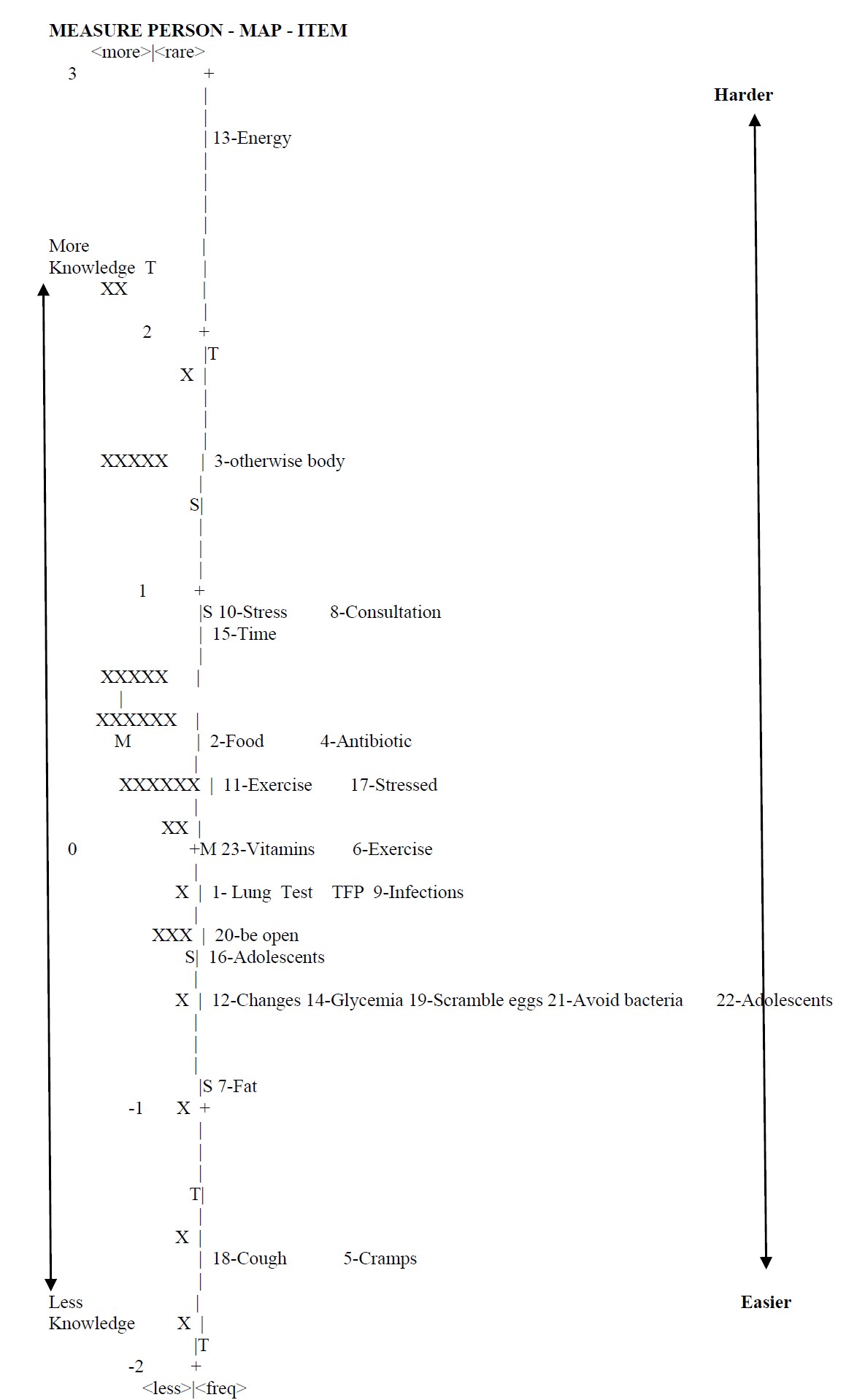
Unidimensionality: all items met the Rasch model expectations, since all Infit/Outfit values were within the expected range. Notably, item 12 showed negative biserial point and deserves attention. No predictable items were found, since all MnSq values were >0.6 in both Infit /Outfit formats 26. Table 3 shows the calibration of the KDM-CF-Adolescent-Brazil items in a decreasing order of difficulty, with error values associated with the calibration on each item. Item 13 (Food that contain the highest quantity of energy/calories are) was the most difficult and item 18 (with cystic fibrosis, the cough) was the easiest. Despite the adequate MnSq values, the PCA revealed that the explained variance of the principal component was only 24.6% with a 7.49 eigenvalue. These results suggest the existence of a second dimension, separating the questionnaire into two groups of items. However, subsequent analyses of the two sub-scales revealed that they did not work well independently, since there were decreases in the separation indices, reliability, and internal consistency values. Therefore, it seems that measurement of separated dimensions would not be justified.
Local independence: No correlations between the items >0.70 were found, indicating that all items were locally independent, i.e., they do not duplicate some content, and therefore, the response to one does not interfere with that to another.
The item-person map: This (Figure 1) represents the continuous of knowledge about CF, showing the relationship between the calibration of the level of difficulty of the items of the questionnaire and the measures of knowledge of the sample. The vertical line illustrates the continuum of knowledge, as defined by the items, organized by levels of difficulty on the right. On the left, the participants were distributed and organized by their levels of knowledge. There was a difference of only 0.45 logits between the average measure of knowledge of the participants and the average measures of the difficulty of the items. Thus, most of the items fell in the middle third of the continuum, in which the ability of most individuals was also located. The items were relatively well distributed throughout the continuum, but five (12, 14, 19, 21, and 22) were calibrated at the same levels of difficulty. At the top of the continuum, it can be seen the absence of individuals without aligned items and at the bottom, very easy items, but there were not any individuals with such low levels of knowledge in the sample. No floor or ceiling effects were found, since none of the participants had 100% correct or incorrect responses. Looking closer to the data, the maximum score of 20 (out of 23) was achieved by two participants (5.8%) and the minimum score of 4 was achieved by only one participant (2.9%). These results, together, confirm the absence of floor and ceiling effects. Five questions regarding self-care (3, 8, 10, 13, and 15) had less than 50% of correct responses, being question 13 the one with the lowest number of correct responses (1,4%).
Representative map of the item distribution in relation to the individuals’ levels of knowledge. WINSTEPS (version 5.2.2.0)
DISCUSSION
This study aimed to cross-culturally adapt the KDM-CF-Adolescent for the Brazilian Portuguese, a questionnaire for the assessment of knowledge that adolescents with CF have about the disease. Cross-cultural adaptation followed standardized procedures16),(17 and no adjustments or modifications were necessary in any of the items. Evaluation of the measurement properties of the adapted version was performed by Rasch analysis, which is considered a robust approach27. This analysis converts ordinal data into interval measurements, verifies the invariance of the measurement and the errors of the item, and orders the items and individuals in a linear continuum, showing that the probability of being successful on an item depends only on its difficulty or individuals’ knowledge28.
Reliability represent the instrument ability in indicating when people or items are estimated to have high abilities, when they are too high, or when they are estimated as having low abilities, when they are too low22. Analysis found adequate reliability coefficients for the items (0.81). However, reliability for the individuals was 0.67. Although reliability values below 0.80 are not the most adequate22, values above 0.60 are acceptable28. Internal consistent was 0.69, which was a little lower than the values of 0.76 and 0.78 reported by Bernstein et al. (2018)15 for the original version with 133 individuals with CF. Based on Linacre22, it is likely that the reduced sample could justify the lower reliability coefficients found in our studies.
Rasch analysis revealed that there were no erratic or unpredictable patterns of the answers29, the items were independent. Considering no participant obtained 100% of correct or incorrect answers, no ceiling or floor effects were established. When ceiling effect occurs, the measure is limited and decreases the probability of the test to accurately measure the intended domain and detect changes over time. Floor effect was also not observed since none of the participants scored at the lowest level of knowledge. Presence of ceiling/floor effects can influence important measurement properties, such as sensitivity and responsiveness30.
Another important point for the cross-cultural adaptation is the understanding of the questions. After applying the pre-final version of the questionnaire, no modifications were necessary, following the basic principle that the questions are easy to understand and equivalent to the original version of the questionnaire (16),(17.
The items were organized satisfactorily, and none was erratic, without fluctuations in the two Infit/Outfit formats, meeting the expectations of the Rasch model. However, the variance explained by the main component was only 24.6% with a 7.49 eigenvalue, suggesting the existence of more than one dimension, which compromises unidimensionality22-24),(26),(29. However, this division is consistent with the original version of the questionnaire, which has two dimensions, related to knowledge of the treatment and self-care. Subsequent analysis revealed that the two dimensions did not work as independent sub-scales, because when analyzed separately there was a reduction in the separation indices, reliability, and internal consistency. Therefore, it seems that the measurement of separated dimensions would not be justified.
When performing initial psychometric evaluation of the KDM-CF-Adolescent with 133 individuals with CF, Bernstein et al. (2018)15 also found the existence of two dimensions, given by exploratory factor analysis, self-care and knowledge of the disease sub-scales. Internal consistency for the self-care sub-scale was 0.74, while for the knowledge was 0.68 with a total calculated measure of 0.78. Reliability for the self-care subscale was 0.73 and for knowledge was 0.65 and the total measure was 0.76.
According to the established criterion (r>0.7), none of the items showed local dependency, i.e., no item duplicated the content of another or the response to one item did not interfere with that of another. Question 13 (Food that contain the highest number of energy/calories are) was considered the most difficult and question 18 (With Cystic Fibrosis, cough) was the easiest.
Evaluation of clinical utility of the KDM-CF-Adolescent-Brazil (Tyson and Connell19) criteria) resulted in a score of 9. The only item that affected the score was related to the time of application (15 to 20 minutes). This indicates that the questionnaire can be recommended for clinical practice20, helping professionals to identify and intervene in the patient’s knowledge of the disease and self-care.
Previous studies found that the most frequent doubts that CF patients have are related to diet, both because of the discomfort of ingesting enzymes before every meal, and the lack of knowledge regarding the influence of medication on food absorption, acting on pancreatic and intestinal insufficiency. Another neglected point is the relationship between the disease and pulmonary function2-4),(28.
Kazmerski et al. (2015)30 followed-up 38 adolescents (13 to 22 years) for two years. They observed that only eight individuals used nutritional supplementation and six were at nutritional risk with body mass index (BMI) of 33. Although this study did not get information on nutrition, 12 of the 35 participants had BMI values below the desired (<18.5). This corroborates the high percentage of errors (89%) on question 13 (Food that contain greater amount of energy/calories are). Regarding the questions related to respiratory care, the sample had better knowledge but ignored the order they should follow to perform their care, since 57% of the patients missed the answer to question 15 “Time is everything; what is the right order to do the following treatments?” which addresses this issue. These findings should serve as a warning to the multidisciplinary team to increase educational actions related to nutrition and respiratory interventions.
This study has limitations. First, the fact that it was performed with a small sample and only with patients registered in AMAM may not reflect the national reality. Second, due to the COVID-19 pandemic and social isolation, it was not possible to conduct in-person interviews, which may have limited the researchers’ perceptions of the participants’ understanding. However, all participants were literate, and most had completed high school. Moreover, adherence of individuals to the treatment could not be approached. Third, the results refer to a preliminary analysis. Future studies should include a larger and more diverse sample and evaluate other important measurement properties, such as test-retest reliability, responsiveness, and sensitivity. However, this was the first step towards the development of a multicenter project involving adolescents with CF from all over the country to continue the KDM-CF-adolescent-Brazil validation process.
In summary, cross-cultural adaptation of the KDM-CF-Adolescent questionnaire for Brazilian Portuguese was conducted and the adapted version showed good clinical utility, satisfactory measurement properties, and absence of floor and/or ceiling effects. Adolescents with CF had greater difficulty with questions related to the self-care domain, considering the high percentage of errors in questions related to nutrition and respiratory issues. The results suggest that the KDM-CF-Adolescent-Brazil questionnaire could be used within clinical and research contexts, to measure the knowledge that adolescents with CF have about the disease. Future studies are needed to apply the questionnaire in a larger CF population to access other important measurement properties.
Data Availability:
The entire dataset supporting the results of this study is available within the article.
REFERENCES
-
1 Cystic Fibrosis Foundations. Patient Registry Annual Report 2019 [Internet]. Maryland: CFF; 2019 [cited 2022 Mar]. Available from: Available from: https://www.cff.org/sites/default/files/2021-10/2019-Annual-Report.pdf
» https://www.cff.org/sites/default/files/2021-10/2019-Annual-Report.pdf -
2 Grupo brasileiro de estudo de fibrose cística. Registro brasileiro de fibrose cística [Internet]. 2021 [cited 2022 Aug]. Available from: Available from: http://www.gbefc.org.br/ckfinder/userfiles/files/Relatorio_Rebrafc_2021(1).pdf
» http://www.gbefc.org.br/ckfinder/userfiles/files/Relatorio_Rebrafc_2021(1).pdf -
3 Pakhale S, Baron J, Armstrong M, Tasca G, Gaudet E, et al. Lost in translation? How adults living with Cystic Fibrosis understand treatment recommendations from their health providers, and the impact on adherence to therapy. Patient Educ Couns. 2016;99(8):1319-24. doi: 10.1016/j.pec.2016.03.023
» https://doi.org/10.1016/j.pec.2016.03.023 -
4 Ratjen F, Bell SC, Rowe SM, Goss CH, Quittner AL, Bush A. Cystic fibrosis. Nat Rev Dis Primers. 2015;1:15010. doi: 10.1038/nrdp.2015.10
» https://doi.org/10.1038/nrdp.2015.10 -
5 Chomik S, Klincewicz B, Cichy W. Disease specific knowledge about cystic fibrosis, patient education and counselling in Poland. Ann Agric Environ Med. 2014;21(2):420-4. doi: 10.5604/1232-1966.1108617
» https://doi.org/10.5604/1232-1966.1108617 -
6 Marciel KK, Saiman L, Quittell LM, Dawkins K, Quittner AL. Cell phone intervention to improve adherence: cystic fibrosis care team, patient, and parent perspectives. Pediatr Pulmonol. 2010;45(2):157-64. doi: 10.1002/ppul.21164
» https://doi.org/10.1002/ppul.21164 -
7 Machado MFAS, Monteiro EMLM, Queiroz DT, Vieira NFC, Barroso MGT. Integrality, health professional education, health education and SUS proposals: a conceptual review. Cien Saude Colet. 2007;12(2):335-42. doi: 10.1590/s1413-81232007000200009
» https://doi.org/10.1590/s1413-81232007000200009 -
8 Almughem FA, Aldossary AM, Tawfik EA, Alomary MN, Alharbi WS, et al. Cystic fibrosis: overview of the current development trends and innovative therapeutic strategies. Pharmaceutics. 2020;12(7):616. doi: 10.3390/pharmaceutics12070616
» https://doi.org/10.3390/pharmaceutics12070616 -
9 Sawicki GS, Goss CH. Tackling the increasing complexity of CF care. Pediatr Pulmonol. 2015;50(S40):S74-S79. doi: 10.1002/ppul.23244
» https://doi.org/10.1002/ppul.23244 -
10 Bartholomew LK, Parcel GS, Seilheimer DK, Czyzewski D, Spinelli SH, et al. Development of health education program to promote the self-management of cystic fibrosis. Health Educ Q. 1991;18(4):429-43. doi: 10.1177/109019819101800403
» https://doi.org/10.1177/109019819101800403 -
11 Davis MA, Quittner A, Stack BS, Yang MC. Controlled evaluation of STARBRIGHT CD-ROM program for children and adolescents with cystic fibrosis. J Pediatr Psychol. 2004;29(4):259-67. doi: 10.1093/jpepsy/jsh026
» https://doi.org/10.1093/jpepsy/jsh026 -
12 Quittner AL, Riekert KA, Marciel KK, Kimberg CI, Eakin MN, et al. Adolescent management of CF: gaps in knowledge and treatment skills in the iCARE study. Pediatr Pulmonol. 2010;45(S33):199-200. doi: 10.1002/ppul.21338
» https://doi.org/10.1002/ppul.21338 -
13 Sawicki GS, Kimberg C, Marciel KK, Riekert K, Zhang J, et al. An assessment of disease-specific knowledge among parents of adolescents with cystic fibrosis. Pediatr Pulmonol. 2010;45(S33):438. doi: 10.1002/ppul.21339
» https://doi.org/10.1002/ppul.21339 -
14 Kimberg CI, Marciel KK, Riekert KA, Zhang J, Quittner AL. Knowledge of disease management in adolescents with cystic fibrosis. Pediatr Pulmonol. 2010;45(S33):447. doi: 10.1002/ppul.21340
» https://doi.org/10.1002/ppul.21340 -
15 Bernstein RM, Riekert KA, Quittner AL. Measuring knowledge of disease management in adolescents with cystic fibrosis: initial psychometric evaluation. Pediatr Aller Immunol Pulmonol. 2018;31(2):56-65. doi: 10.1089/ped.2017.0850
» https://doi.org/10.1089/ped.2017.0850 -
16 Beaton DE, Bombardier C, Guillemin F, Ferraz MB. Guidelines for the process of cross-cultural adaptation of self-report measures. Spine (Phila Pa 1976). 2000;25(24):3186-91. doi: 10.1097/00007632-200012150-00014
» https://doi.org/10.1097/00007632-200012150-00014 -
17 Wild D, Grove A, Martin M, Eremenco S, McElroy S, et al. Principles of good practice for the translation and cultural adaptation process for Patient-Reported Outcomes (PRO) measures: report of the ISPOR task force for translation and cultural adaptation. Value Health. 2005;8(2):94-104. doi: 10.1111/j.1524-4733.2005.04054.x
» https://doi.org/10.1111/j.1524-4733.2005.04054.x -
18 Guillemin F, Bombardier C, Beaton D. Cross-cultural adaptation of health-related quality of life measures: literature review and proposed guidelines. J Clin Epidemiol. 1993;46(12):1417-32. doi: 10.1016/0895-4356(93)90142-n
» https://doi.org/10.1016/0895-4356(93)90142-n -
19 Tyson S, Connell L. The psychometric properties and clinical utility of measures of walking and mobility in neurological conditions: a systematic review. Clin Rehabil. 2009;23(11):1018-33. doi: 10.1177/0269215509339004
» https://doi.org/10.1177/0269215509339004 -
20 Veiga RFN, Morais AF, Nascimento SJN, Avelino PR, Costa HS, et al. Translation, cross-cultural adaptation and reliability of the clinical utility scale of Tyson and Connell. Fisioter Pesqui. 2020;27(1):78-84. doi: 10.1590/1809-2950/19006227012020
» https://doi.org/10.1590/1809-2950/19006227012020 - 21 Bond TG, Yan Z, Heene M. Applying the Rasch Model: fundamental measurement in the human sciences. 4th ed. New York: Routledge; 2021.
-
22 Linacre JM. A user’s guide to Winsteps® Ministep Rasch-Model computer programs: program manual 3.81.0. Chicago: winsteps.com, ISBN 0-941938-03-4; 2021. [Cited 2021 Nov]. Available from: Available from: http://www.winsteps.com/winman/index.htm
» http://www.winsteps.com/winman/index.htm -
23 Chern JS, Kielhofner G, Gloria de las Heras C, Magalhães LC. The volitional questionnaire: psychometric development and practical use. Am J Occup Ther. 1996;50(7):516-25. doi: 10.5014/ajot.50.7.516
» https://doi.org/10.5014/ajot.50.7.516 -
24 Raîche G. Critical eigenvalue sizes in standardized residual principal component analysis. Rash Measurement Transactions. 2005;19(1):1012. Available from: https://www.rasch.org/rmt/rmt191.pdf
» https://www.rasch.org/rmt/rmt191.pdf -
25 Chien CW, Bond TG. Measurement properties of fine motor scale of Peabody developmental motor scales-second edition: a Rasch analysis. Am J Phys Med Rehabil. 2009;88(5):376-86. doi: 10.1097/phm.0b013e318198a7c9
» https://doi.org/10.1097/phm.0b013e318198a7c9 -
26 Tennant A, Conaghan PG. The Rasch measurement model in rheumatology: what is it and why use it? when should it be applied, and what should one look for in a Rasch paper? Arthritis Rheum. 2007;57(8):1358-62. doi: 10.1002/art.23108
» https://doi.org/10.1002/art.23108 - 27 Dumont C, Bertrand R, Fougeyrollas P, Gervais M. Rasch modeling and the measurement of social participation. J Appl Meas. 2003;4(4):309-25.
-
28 Fischer WP. The Rasch Model as a Construct Validation Tool - Cash value of reliability. Rasch Measurement Transactions. 2008; 22(1):1145-46. Available from: https://www.rasch.org/rmt/rmt221.pdf
» https://www.rasch.org/rmt/rmt221.pdf -
29 Rodrigues SLL, Rodrigues RCM, São-João TM, Pavan RBB, Padilha KM, el at. Impact of the disease: acceptability, ceiling and floor effects and reliability of an instrument in heart failure. Rev Esc Enferm USP. 2013;47(5):1091-8. doi: 10.1590/s0080-623420130000500012
» https://doi.org/10.1590/s0080-623420130000500012 -
30 Kazmerski TM, Miller E, Abebe KZ, Matisko J, Schachner D, Spahr J. Patient knowledge and clinic attendance in adolescent with cystic fibrosis. Pediatr Aller Immunol Pulmonol. 2015;28(2):107-11. doi: 10.1089/ped.2014.0475
» https://doi.org/10.1089/ped.2014.0475
Edited by
-
Responsible editor:
Sônia LP Pacheco de Toledo