
 Respiratory profile of patients with neuromuscular disease and adherence to the use of noninvasive ventilation
ABSTRACT
Neuromuscular diseases (NMD) are characterized by progressive loss of respiratory muscle strength, which alters pulmonary compliance and reduces bronchial hygiene. The objective of this study was to evaluate the clinical-functional respiratory profile of children, adolescents, and young adults with NMD who adhered or did not adhere to the use of noninvasive ventilation (NIV). This is a retrospective cohort study of patients with an indication for NIV use. A reduction in symptoms was observed (dyspnea, p<0.02), along with an association between the difference in peak expiratory flow and peak cough flow (r=0.503; p<0.02); an inverse relationship between peak cough flow and the number of hours of NIV use (r=−0.33; p<0.05); a linear relationship between maximal inspiratory pressure and age (r=0.413; p<0.01); and an inverse relationship between maximal expiratory pressure and the number of hours of NIV use (r=−0.34; p<0.04). The number of hospitalizations requiring intubation was zero. Among the benefits of NIV are a trend toward symptom reduction and a decrease in the rate of respiratory failure requiring hospitalization. There was an increase in maximal inspiratory pressures despite the decline in pulmonary function, which was not associated with the number of hours of NIV use.
Keywords:
Noninvasive Ventilation; Duchenne Muscular Dystrophy; Spinal Muscular Atrophy; Neuromuscular Diseases
RESUMO
As doenças neuromusculares (DNM) apresentam perda progressiva de força muscular respiratória, que altera a complacência pulmonar e reduz a higiene brônquica. O objetivo deste estudo foi avaliar o perfil clínico-funcional respiratório de crianças, adolescentes e adultos jovens com DNM que aderiram ou não ao uso da ventilação não invasiva (VNI). Trata-se de um estudo de coorte retrospectivo dos pacientes com indicação da VNI. Houve redução dos sintomas (dispneia p<0,02), além de associação entre a diferença do pico de fluxo expiratório e do pico de fluxo de tosse (r=0,503 p<0,02); relação inversa entre o pico de fluxo de tosse e o número de horas (r=-0,33 p<0,05); relação linear entre pressão máxima inspiratória e idade (r=0,413 p<0,01); e relação inversa entre a pressão máxima expiratória e o número de horas (r=-0,34 p<0,04). O índice de internação com necessidade de intubação foi igual a zero. Dentre os benefícios da VNI, está a tendência à redução dos sintomas e a diminuição no índice de falha respiratória com necessidade de hospitalização. Houve um aumento nas pressões inspiratórias máximas, apesar do declínio da função pulmonar o qual não está associado à quantidade de horas de uso da VNI.
Descritores:
Ventilação não Invasiva; Distrofia Muscular de Duchenne; Atrofia Muscular Espinhal; Doenças Neuromusculares
RESUMEN
Las enfermedades neuromusculares (ENM) presentan pérdida progresiva de la fuerza muscular respiratoria, lo cual altera la distensibilidad pulmonar y reduce la higiene bronquial. El objetivo de este estudio fue evaluar el perfil clínico-funcional respiratorio de niños, adolescentes y adultos jóvenes con ENM que adhirieron o no al uso de ventilación no invasiva (VNI). Se trata de un estudio de cohortes retrospectivo de pacientes con indicación de VNI. Hubo una reducción de los síntomas (disnea p<0,02), además de una asociación entre la diferencia del flujo espiratorio máximo y el flujo máximo de tos (r=0,503 p<0,02); relación inversa entre flujo máximo de tos y número de horas (r=-0,33 p<0,05); relación lineal entre presión inspiratoria máxima y edad (r=0,413 p<0,01) y relación inversa entre presión espiratoria máxima y número de horas (r=-0,34 p<0,04). La tasa de hospitalización que requirió intubación fue igual a cero. Entre los beneficios de la VNI está la tendencia a reducir los síntomas y disminuir la tasa de insuficiencia respiratoria que requiere hospitalización. Hubo un aumento en las presiones inspiratorias máximas a pesar de la disminución de la función pulmonar, lo cual no está asociado con el número de horas de uso de VNI.
Palabras clave:
Ventilación no invasiva; Distrofia muscular de Duchenne; atrofia muscular espinal; enfermedades neuromusculares
INTRODUCTION
Neuromuscular diseases (NMD) constitute a group of conditions characterized by progressive, degenerative, and irreversible loss of muscle strength, which also affects the respiratory muscles, resulting in a decline in pulmonary functional capacity, morbidity, and mortality1,2.
Alterations in pulmonary compliance reduce the capacity for effective bronchial hygiene and airway clearance via coughing. The removal of secretions is essential for the management of respiratory infections and the prevention of atelectasis and associated respiratory failure3.
The initiation of noninvasive ventilation (NIV) improves survival in patients with NMD. It is recommended that nocturnal NIV be initiated as soon as the initial signs of nocturnal hypoventilation manifest. With disease progression, the emergence of hypercapnia and hypoventilation during wakefulness justifies intermittent, and subsequently continuous, daytime NIV use4.
Respiratory assessment of patients with NMD is indispensable for monitoring the rate of decline in forced vital capacity (FVC), which is an important predictor of survival, and must be performed with the patient in both seated and supine positions. The difference should be less than 7%, as symptoms of hypoventilation worsen during sleep. A difference exceeding 20% constitutes an indication for nocturnal NIV5.
NMDs result in a severe reduction of lung volumes. Accordingly, muscle atrophy and contractures limit thoracic cage mobility, the restrictive progression of which diminishes pulmonary compliance6.
Positive pressure provided by ventilatory support reduces the predisposition to atelectasis by recruiting alveolar units with low gas compression. Moreover, the use of techniques such as air stacking (AS) can improve lung volumes and assist in bronchial hygiene7.
The recommendation for NIV use aims to reduce the work of breathing and stabilize gas exchange. However, some patients with NMD do not adapt to NIV due to discomfort associated with the oronasal mask, related claustrophobia, the pressure levels exerted by the equipment on the airway, or other factors.
The functional impairment of respiratory muscles constitutes a significant cause of morbidity in patients with NMD. Consequently, routine respiratory assessments are essential to prevent mortality, reduce the incidence of related infections and hospitalizations, and, therefore, lower associated costs. The chronic ventilatory deficit resulting from respiratory muscle failure justifies the implementation of mechanical ventilation as a partial or total substitution for muscle function.
This study aimed to evaluate the clinical-functional respiratory profile of children, adolescents, and young adults with NMD who adhered or did not adhere to NIV use.
METHODOLOGY
Study type, setting, and sample
A retrospective, observational cohort study was conducted involving patients with NMD (spinal muscular atrophy [SMA] and Duchenne muscular dystrophy [DMD]) at a clinic for the treatment of neuromuscular diseases (TND) in Rio de Janeiro, from December 1, 2013, to February 28, 2020.
The sample comprised children, adolescents, and young adults diagnosed with NMD by the medical team, according to the criteria established by Araujo et al.8, who were referred for outpatient follow-up at regular intervals (recommended every six months).
Patients with an indication for home NIV use, following ATS guidelines8, were included. Patients under five years of age who were unable to perform spirometry were excluded.
Study design
Data were extracted from medical records and recorded on individual forms without patient identification. Parameters from respiratory assessments conducted prior to NIV initiation, which determined its indication, and from a subsequent assessment performed after an interval of six to twelve months, were recorded.
The variables analyzed were: age and sex; anthropometric data including weight and height; functional data and respiratory assessment parameters; the incidence of respiratory infections, with or without hospitalization; clinical information associated with the patient’s condition, such as sleep-related breathing difficulties, morning headache, dyspnea, among other symptoms; and data pertaining to NIV use, including prescribed parameters at initiation, the indication for ventilatory support, and whether the patient utilized the Bi-level device according to recommendations. Adherence to NIV was defined as equipment use during sleep hours (from 6 to 8 hours), irrespective of the interface type (oronasal or nasal).
Assessments
Spirometry was performed by a pulmonologist following the American Thoracic Society and European Respiratory Society (ATS/ERS) standards9, with the patient seated and reclined. At least three maneuvers were performed to obtain measurements of FVC and percent predicted vital capacity (VC%), the latter being automatically estimated during spirometry.
Peak cough flow (PCF) and peak expiratory flow (PEF) tests were administered by physical therapists using a Peak Flow Meter. Maneuvers were performed with the patient seated, instructed to inhale to total lung capacity and exhale forcefully into the device’s mouthpiece5. In total, three maneuvers were performed, with a minimum interval of 60 seconds between each, and the highest recorded value was selected. Maximal respiratory pressure tests (MIP and MEP) were conducted using a manometer, adhering to established guidelines9.
Bi-level Positive Airway Pressure (Bi-level) NIV was administered using a Philips BiPAP device. Respiratory assessments are decisive in establishing the appropriate time to initiate NIV. Bi-level ventilatory support involves the delivery of positive airway pressure at two distinct levels via an interface (mouthpiece or mask) connecting the ventilator to the patient.
Data analysis
Data were recorded in a Microsoft Excel spreadsheet, version 2019. Measures of central tendency (mean, median, and standard deviation) were estimated using this software.
Data distribution was assessed using the Shapiro-Wilk test. Not all variables analyzed exhibited a Gaussian distribution, which required the use of tests that account for non-normality. That is, nonparametric tests were used to compare discrete variables.
Symptoms before and after NIV initiation were compared using the non-parametric McNemar test. Comparisons of respiratory parameters pre- and post-NIV were performed using the paired t-test. Finally, Spearman’s rank correlation coefficient was used to correlate the respiratory parameter variables. All tests were conducted using IBM SPSS Statistics 28.0 software.
RESULTS
Inclusion criteria were met by 60 patients: 14 with SMA and 46 with DMD. A total of 24 patients were lost to follow-up. Of these, five patients with DMD did not undergo post-NIV respiratory testing due to the SARS-CoV-2 pandemic; one patient with SMA did not undergo post-NIV testing due to presenting at the clinic with a respiratory infection; one patient with DMD lacked documentation regarding hours of Bi-level use; and 13 patients with DMD and four patients with SMA did not return to the clinic after receiving the equipment. A total of 36 patients were included in the analysis: nine with SMA and 27 with DMD. Age at NIV initiation ranged from 13 to 19 years (median=16) among patients with SMA, and from 10 to 21 years (median=16) among those with DMD (Table 1).
The comparison of respiratory muscle strength and pulmonary function variables before and after NIV, including standard deviation, mean, median, and p-value, is presented in Tables 2 and 3. The mean MIP demonstrated an 8.31% increase following the initiation of NIV.
Paired t-test analysis was used to compare each variable pre- and post-NIV. The correlation coefficient for the various pairs was extremely high. PCF demonstrated a mean of 197.6±76.7 (pre-NIV) and 171.8±77.4 (post-NIV) (p<0.05). Statistically significant differences were also observed in VC% pre-NIV (mean=0.52±0.25) versus post-NIV (mean=0.47±0.23; p<0.0001), and in FVC pre-NIV (mean=1.60±0.61) versus post-NIV (mean=1.51±0.71; p<0.006).
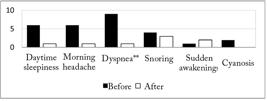
The most frequently reported symptom, reported by nine patients with NMD, was dyspnea. With the exception of dyspnea (p<0.02), the McNemar test revealed no statistically significant difference in the prevalence of other symptoms before and after NIV initiation (Graph 1).
No instances of orotracheal intubation were required among the patients studied.
Regarding the duration of NIV use, 58.4% of patients used the Bi-level equipment following recommendations (six to eight hours at night), whereas 36.1% used it for a shorter duration, and two patients used the equipment for longer than recommended, up to 24 hours daily.
An inverse relationship was observed between the difference in PCF (pre- and post-NIV) and the number of hours of NIV use (r=−0.33; p<0.05), as well as between the difference in MEP and hours of NIV use (r=−0.34; p<0.04). This indicates that a smaller difference between pre- and post-NIV PCF and MEP values was associated with longer duration of NIV use, as detailed in Table 4.
DISCUSSION
Most of our sample consisted of male, non-ambulatory patients with DMD, with a median age of 16 years. The respiratory parameters observed in this cohort substantiated the introduction of ventilatory support in accordance with ATS/ERS recommendations10.
Within the SMA type II and III groups, the majority of the sample was female; only one patient retained ambulation. The median age at initiation of ventilatory support was 16 years.
Adherence to nocturnal NIV treatment, defined as eight hours of daily use, was achieved by nearly 60% of the sample. In select medical records, a change in mask interface was noted as a factor associated with improved treatment adherence.
Attrition within the study was primarily related to the financial burden on patients and their families for travel to the clinic. Most patients lack the functional and socioeconomic independence necessary to maintain regular follow-up appointments and rely on the Brazilian Unified Health System (SUS) and public policies, which are often insufficiently accessible in their regions of residence; consequently, there is a scarcity of freely available specialized services.
This situation places considerable strain on families and informal caregivers11, and may precipitate early retirement due to lost productivity12.
Given that NIV has been shown to reduce healthcare costs by 73%, the timely initiation of this treatment is crucial for mitigating respiratory failure events that necessitate intensive or hospital-level care, in addition to decreasing indirect expenditures13.
Throughout the study period, there were no reported cases of infection or respiratory failure requiring hospitalization and orotracheal intubation. Conversely, a majority of patients exhibited a trend toward a reduction in symptoms such as dyspnea, daytime somnolence, and morning headache-symptoms associated with sleep quality-following NIV initiation.
Comparable findings regarding symptom amelioration have been reported in studies measuring arterial blood gases, pulmonary mechanics, and respiratory muscle strength before and after nocturnal NIV. Investigations into the presence of daytime somnolence, insomnia, morning headache, nightmares, or snoring have concluded that NIV optimizes both arterial blood gas parameters and sleep quality in these patients14,15.
Even daytime NIV (two hours daily) has been shown to reverse the sensation of dyspnea and signs associated with respiratory muscle overload, proving more effective than nocturnal NIV alone for patients experiencing dyspnea during unassisted breathing16.
Therefore, NIV alleviates dyspnea and improves gas exchange, thereby reducing mortality and hospitalizations secondary to respiratory failure. It also diminishes the incidence of respiratory infections and facilitates rest for the respiratory musculature17. Similar findings regarding the reduction of respiratory failure and hospitalization needs associated with NIV use indicate that adherence to ventilation correlates with improved prognosis and, in the long term, enhanced survival in patients with NMD18.
Conversely, in this study, despite the trend toward symptomatic improvement, objective data analysis using the McNemar test did not yield statistically significant results for the majority of symptoms, with the notable exception of dyspnea (p<0.02).
Although NIV treatment mitigates certain symptoms and reduces healthcare expenditures without adversely affecting patients’ quality of life1,13, a weak correlation between symptoms and objective clinical assessments, even among patients utilizing NIV, appears to be a common finding in children19.
Regarding regular NIV utilization, adherence to recommended protocols was not universal among participants. Nonetheless, adherence to therapy is strongly influenced by comfort, adaptation, and the appropriate selection of the NIV interface. Optimal ventilator adjustments can enhance tolerance and promote adherence, which, if exceeding four hours per night, is associated with improved survival irrespective of the underlying disease20-23.
Therefore, the use of a mouthpiece as a diurnal interface may be considered during NIV implementation for patients who experience difficulty tolerating a mask. This approach may facilitate initial acceptance or serve as an alternative for patients presenting with skin lesions, abdominal distention, or ocular irritation associated with oronasal or nasal interfaces. The mouthpiece thus constitutes a safe and viable alternative modality for stabilizing daytime vital capacity15-17.
Despite NIV use, the study sample exhibited a 5.5% reduction in FVC. While NIV does not entirely prevent the functional losses inherent to disease progression, its application may decelerate the rate of pulmonary function decline.
Consistent with this, Santos et al.4 demonstrated that the introduction of NIV attenuated the rate of decline in VC and maximal respiratory pressures in patients with DMD. The annual rate of decline in VC decreased from 4.28% to 1.36% of the predicted value following NIV initiation.
The negative correlations identified via Spearman’s test concerning PCF and MEP variables relative to hours of NIV use (MEP r=−0.340; PCF r=−0.326) suggest that a smaller difference between pre- and post-NIV values for PCF and MEP is associated with a longer cumulative duration of NIV use.
Reduction in expiratory muscle strength constitutes an initial indicator of respiratory dysfunction, predisposing patients to episodes of failure and subsequent hospitalization. Hahn et al.24 reported a linear correlation between MEP and age, and Santos et al.4 posited a deceleration in the decline of both maximal respiratory pressures and lung volumes following the initiation of NIV.
CONCLUSION
Based on the results obtained, it was determined that some of the benefits of NIV include a trend toward symptom reduction and a decrease in the rate of respiratory failure necessitating hospitalization. An increase in maximal inspiratory pressures was observed, despite the ongoing decline in pulmonary function, and this increase was not associated with the number of hours of NIV use. Our finding of an increase in MIP diverges from other studies4,25 and may be attributable to the asymmetric distribution of the sample.
Among the limitations of this study, it is noteworthy that it was conducted during the COVID-19 pandemic, which constrained the capacity for adequate longitudinal follow-up of patients receiving NIV. Future prospective studies may elucidate whether NIV can increase or stabilize maximal inspiratory pressures, whether NIV can alter or maintain respiratory test parameters, and whether regular NIV use correlates with improved patient survival, potentially utilizing objective data recorded by the BiPAP device to monitor adherence.
DATA AVAILABILITY
The data underlying this study are available in the published article.
REFERENCES
-
1 Annunziata A, Calabrese C, Simioli F, Coppola A, Pierucci P, et al. Psychological factors influencing adherence to NIV in neuromuscular patients dependent on non invasive mechanical ventilation: Preliminary results. J Clin Med. 2023;12(18):5866. doi: 10.3390/jcm12185866
» https://doi.org/10.3390/jcm12185866 -
2 Wasilewska E, Wasilewski A, Pilarska E, Wierzba J, Malgorzewicz S, et al. An underestimated factor for therapeutic decision-making in rare diseases: parents' (un)knowledge-the example of Duchenne muscular dystrophy caregivers and non-invasive ventilation. Orphanet J Rare Dis. 2025;20(280). doi: 10.1186/s13023-025-03762-9
» https://doi.org/10.1186/s13023-025-03762-9 -
3 Camela F, Gallucci M, Ricci G. Cough and airway clearance in Duchenne muscular dystrophy. Paediatr Respir Rev. 2019;31:35-9. doi: 10.1016/j.prrv.2018.11.001
» https://doi.org/10.1016/j.prrv.2018.11.001 -
4 Santos DB, Vaugier I, Boussaïd G, Orlikowski D, Prigent H, et al. Impact of noninvasive ventilation on lung volumes and maximum respiratory pressures in Duchenne muscular dystrophy. Respir Care. 2016;61(11):1530-5. doi: 10.4187/respcare.04703
» https://doi.org/10.4187/respcare.04703 -
5 Bach JR, Quiroga LB. Soporterespiratorio muscular para evitar el fallo respiratorio y la traqueotomía: ventilación no invasiva y técnicas de tos asistida [Internet]. Rev Am Med Respir. 2013 [cited 2026 Mar 6];13(2):71-83. Available from: https://www.scielo.org.ar/scielo.php?script=sci_arttext&pid=S1852-236X2013000200005&lng=es
» https://www.scielo.org.ar/scielo.php?script=sci_arttext&pid=S1852-236X2013000200005&lng=es -
6 Stehling F, Bouikidis A, Schara U, Mellies U. Mechanical insufflation/exsufflation improves vital capacity in neuromuscular disorders. Chron Respir Dis. 2015;12(1): 31-5. doi:10.1177/1479972314562209
» https://doi.org/10.1177/1479972314562209 -
7 Sarmento A, Resqueti VR, Fregonezi GAF, Aliverti A. Assessment of gas compression and lung volume during air stacking maneuver. Eur J Appl Physiol. 2017;117(1):189-99. doi: 10.1007/s00421-016-3511-y
» https://doi.org/10.1007/s00421-016-3511-y -
8 Araujo APQC, Carvalho AAS, Cavalcanti EBU, Saute JAM, Carvalho E, et al. Brazilian consensus on Duchenne muscular dystrophy. Part 1: diagnosis, steroid therapy and perspectives. Arq Neuropsiquiatr. 2017;75(8):104-13. doi: 10.1590/0004-282X20170112
» https://doi.org/10.1590/0004-282X20170112 - 9 Souza RB. Pressões respiratórias estáticas máximas. J Pneumol. 2002;28(3):S155-65.
-
10 American Thoracic Society, European Respiratory Society. ATS/ERS Statement on respiratory muscle testing. Am J Respir Crit Care Med. 2002;166(4):518-624. doi: 10.1164/rccm.166.4.518
» https://doi.org/10.1164/rccm.166.4.518 -
11 Andreozzi V, Labisa P, Mota M, Monteiro S, Alves R, et al. Quality of life and informal care burden associated with duchenne muscular dystrophy in Portugal: the COIDUCH study. Health Qual Life Outcomes. 2022;20(1):36. doi: 10.1186/s12955-022-01941-x
» https://doi.org/10.1186/s12955-022-01941-x -
12 Schepelmann K, Winter Y, Spottke AE, Claus D, Grothe C, et al. Socioeconomic burden of amyotrophic lateral sclerosis, myasthenia gravis and facioscapulohumeral muscular dystrophy. J Neurol. 2010;257(1):15-23. doi: 10.1007/s00415-009-5256-6
» https://doi.org/10.1007/s00415-009-5256-6 -
13 Rudolfsen JH, Vissing J, Werlauff U, Olesen C, Illum N, et al. Burden of Disease of Duchenne Muscular Dystrophy in Denmark-A National Register-Based Study of Individuals with Duchenne Muscular Dystrophy and their Closest Relatives. J Neuromuscul Dis. 2024;11(2):443-57. doi: 10.3233/JND-230133
» https://doi.org/10.3233/JND-230133 -
14 Barbé F, Quera-Salva MA, Lattre J, Gajdos P, Agustí AG. Long-term effects of nasal intermittent positive-pressure ventilation on pulmonary function and sleep architecture in patients with neuromuscular diseases. Chest. 1996;110(5):1179-83. doi: 10.1378/chest.110.5.1179
» https://doi.org/10.1378/chest.110.5.1179 -
15 Sunkonkit K, Al-Saleh S, Chiang J, Hamilton A, Medin D, et al. Volume-assured pressure support mode for noninvasive ventilation: can it improve overnight adherence in children with neuromuscular disease? Sleep Breath. 2021:25(4):1843-50. doi: 10.1007/s11325-021-02288-1
» https://doi.org/10.1007/s11325-021-02288-1 -
16 Annunziata A, Coppola A, Simioli F, Atripaldi L, Marotta A, et al. Indications and techniques of non-invasive ventilation (NIV) in neuromuscular diseases. Acta Myol. 2024;43(2):48-56. doi: 10.36185/2532-1900-553
» https://doi.org/10.36185/2532-1900-553 -
17 Fiorentino G, Annunziata A, Cauteruccio R, Frega GS, Esquinas A. Mouthpiece ventilation in Duchenne muscular dystrophy: a rescue strategy for noncompliant patients. J Bras Pneumol. 2016;42(6):453-6. doi: 10.1590/S1806-37562016000000050
» https://doi.org/10.1590/S1806-37562016000000050 -
18 Banfi P, Buscemi AAMD, Compalati E, Pisoni M, Mantero M, et al. Enhancing respiratory function in neuromuscular disease: the role of non-invasive ventilation. A narrative review. Acta Myol, 2024;43(2):78-82. doi: 10.36185/2532-1900-506
» https://doi.org/10.36185/2532-1900-506 -
19 Amaddeo A, Moreau J, Frapin A, Khirani S, Felix O, et al. Long term continuous positive airway pressure (CPAP) and noninvasive ventilation (NIV) in children: initiation criteria in real life. Pediatr Pulmonol. 2016;51(9):968-74. doi: 10.1002/ppul.23416
» https://doi.org/10.1002/ppul.23416 -
20 Annunziata A, Fiorentino G. Non-invasive mechanical ventilation in neuromuscular disorders: Presentation of this special issue. Acta Myol. 2024;43(2):47. doi: 10.36185/2532-1900-567
» https://doi.org/10.36185/2532-1900-567 -
21 Sarasate M, González N, Córdoba-Izquierdo A, Prats E, Gonzalez-Moro JMR, et al. Impact of early non-invasive ventilation in amyotrophic lateral sclerosis: a multicenter randomized controlled trial. J Neuromusc Dis. 2023;10(4):627-37. doi: 10.3233/JND-221658
» https://doi.org/10.3233/JND-221658 -
22 Kelly JL, Jaye J, Pickersgill RE, Chatwin M, Morrell MJ, et al. Randomized trial of 'intelligent' autotitrating ventilation versus standard pressure support non-invasive ventilation: Impact on adherence and physiological outcomes. Respirology. 2014;19(4):596-603. doi: 10.1111/resp.12269
» https://doi.org/10.1111/resp.12269 -
23 Patout M, Lhuillier E, Kaltsakas G, Benattia A, Dupuis J, et al. Long-term survival following initiation of home non-invasive ventilation: a European study. Thorax. 2020;75(11):965-73. doi:10.1136/thoraxjnl-2019-214204
» https://doi.org/10.1136/thoraxjnl-2019-214204 -
24 Hahn A, Bach JR, Delaubier A, Renardel-Irani A, Guillou C, et al. Clinical implications of maximal respiratory pressure determinations for individuals with Duchenne muscular dystrophy. Arch Phys Med Rehabil. 1997;78(1):1-6. doi: 10.1016/S0003-9993(97)90001-0
» https://doi.org/10.1016/S0003-9993(97)90001-0 -
25 Gayraud J, Ramonatxo M, Rivier F, Humberclaude V, Petrof B, et al. Ventilatory parameters and maximal respiratory pressure changes with age in Duchenne muscular dystrophy patients. Pediatr Pulmonol. 2010;45(6):552-9. doi: 10.1002/ppul.21204
» https://doi.org/10.1002/ppul.21204
-
This study is part of the master’s thesis “Analysis of the respiratory profile of patients with neuromuscular disease indicated for noninvasive ventilation (NIV),” conducted at the Universidade Federal do Rio de Janeiro (UFRJ) - Rio de Janeiro (RJ), Brazil.
-
Financing source:
nothing to declare
-
Approved by the Research Ethics Committee of the Instituto de Puericultura e Pediatria Martagão Gesteira (IPPMG) of UFRJ [CAAE: 45093321.0.0000.5264].

 **Statistically significant difference (p<0.02)