Variant profile of Brazilian patients with Sanfilippo syndrome type B
Abstract
Mucopolysaccharidosis type IIIB (MPS IIIB, or Sanfilippo syndrome type B) is a lysosomal storage disorder caused by variants in the NAGLU gene, leading to heparan sulfate accumulation. This study analyzed 27 MPS IIIB Brazilian patients diagnosed via the MPS Brazil Network (2014-2022). Diagnosis involved biochemical tests [NAGLU enzyme activity, urinary glycosaminoglycans (GAG)], showing expected low activity of the enzyme and high concentration of GAGs. Molecular analysis of the NAGLU gene by Sanger sequencing or Targeted Next-Generation Sequencing confirmed the diagnosis. Forty-nine variants were found across patient alleles, comprising twenty-two different variants. Two variants were described for the first time: p.Gly79Arg and p.Leu598Pro (both missense). In silico tools predicted the novel variants as damaging/deleterious. The study identified 90.7% of the expected mutant alleles, observing variant heterogeneity and a higher frequency of missense variants. This characterization enhances understanding of the Brazilian MPS IIIB genetic landscape and is instrumental to the design of diagnostic and screening strategies.
Keywords:
Mucopolysaccharidosis type IIIB; Brazil; novel variants
Mucopolysaccharidosis type IIIB (MPS IIIB), or Sanfilippo syndrome type B (OMIM #252920) is a lysosomal storage disorder (LSD). It is one of the four subtypes of mucopolysaccharidosis type III (or Sanfilippo syndrome), being caused by variants in the NAGLU gene that encodes the N-acetyl-alpha-glucosaminidase (NAGLU) enzyme. The primary biochemical consequence of deficient NAGLU activity is the impaired degradation of a specific glycosaminoglycan (GAG), heparan sulfate, leading to its progressive accumulation within the lysosomes of various tissues and cells, most notably in the central nervous system (Zhao et al., 1996; Neufeld and Muenzer, 2019). The disease displays considerable clinical heterogeneity and variability in its presentation and progression (Zhao et al., 1998; Weber et al., 1999; Coll et al., 2001). The condition is typically severe and progressive (Neufeld and Muenzer, 2019). Despite efforts to develop enzyme replacement therapy and gene therapy for MPS III, no specific treatment is available so far (Poswar et al., 2017, 2019; Wiesinger et al., 2025).
Accurate diagnosis of MPS IIIB is typically initiated through biochemical testing to measure the activity of the NAGLU enzyme (Marsh and Fensom, 1985), commonly performed on biological samples (cells or fluids). Also, urinary GAGs are important to analyze, especially to document its increase and identify the predominance of heparan sulfate. To further confirm the diagnosis, it is important to perform, whenever possible, the molecular analysis of the NAGLU gene (Yogalingam and Hopwood, 2001), which also allows carrier detection and prenatal diagnosis. The NAGLU gene is located on the long arm of chromosome 17 (17q21), comprising 6 exons and 5 introns, spanning approximately 8.3 kb. According to the Human Gene Mutation Database (HGMD), 292 different variants in the NAGLU gene have already been described, most of which being missense variants (73%) or small deletions (12%) (Stenson et al., 2003). These genetic alterations lead to reduced or complete loss of functional NAGLU enzyme activity, resulting in the accumulation of heparan sulfate (Neufeld and Muenzer, 2019). Techniques such as polymerase chain reaction (PCR), Sanger sequencing, next-generation sequencing (NGS) are utilized for the comprehensive detection and characterization of NAGLU gene variants (Brusius-Facchin et al., 2019; Montenegro et al., 2022).
Molecular genetic studies of MPS IIIB patients from diverse populations have demonstrated significant allelic heterogeneity (Beesley et al., 1998; Schmidtchen et al., 1998; Bunge et al., 1999; Coll et al., 2001; Emre et al., 2002; Pollard et al., 2013; Lin et al., 2018; Kong et al., 2020; Ozkinay et al., 2021) and have been instrumental in exploring genotype-phenotype correlations (Zhao et al., 1998; Weber et al., 1999). On the other hand, some studies have identified common NAGLU variants within specific populations, providing insights into their historical origins and prevalence. For instance, the c.700C>T p.(Arg234Cys) pathogenic variant is common in Portugal, accounting for 32% of Portuguese mutant alleles, and evidence suggests a single origin in the Iberian Peninsula (Mangas et al., 2008). Other common disease-causing variants includes c.419A>G p.(Tyr140Cys), found in different European populations, and c.1241A>G p.(His414Arg), which is relatively frequent in Greek families (Bunge et al., 1999; Beesley et al., 2004). In due course, the identification of pathogenic variants may be instrumental for the design of screening strategies, including neonatal screening. Sanfilippo syndrome is included in Brazil’s expanded neonatal screening program, which is approved but yet to be implemented in most of the country.
In Brazil, the MPS Brazil Network (Rede MPS Brasil) was initiated in 2004 as a research project under the direction of Roberto Giugliani (Giugliani et al., 2016; Trapp et al., 2025). This network functions as an integrated system, supporting medical services nationwide. The primary goals of this initiative are to enhance diagnostic accessibility for MPS within the community and disseminate information concerning the clinical management of these disorders. The network processes a notable volume of diagnostic requests, receiving samples for the investigation of all MPS subtypes in patients primarily from Brazil, with diagnostic requests originated from foreign countries. This organizational and operational structure addresses factors contributing to the delayed diagnosis of MPS in Brazil, such as limited awareness among healthcare professionals and challenges in accessing diagnostic services (Giugliani et al., 2016). In the present study, 27 patients diagnosed with Mucopolysaccharidosis type IIIB were evaluated between 2014 and 2022 through biochemical and molecular tests. The patient samples were part of a project approved by the HCPA’s Institutional Review Board (IRB0000921), which is recognized by the Office for Human Research. The data of this project is gathered in the MPS Brazil Network database. Considering this, we disclose that patients 10, 12, and 15 in this study correspond, respectively, to patients 29, 2, and 24 from the work previously published by our research group (Montenegro et al., 2022). The other individuals evaluated do not correspond between the cohorts.
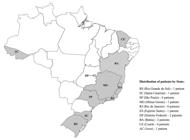
The patients were born in different regions of Brazil, as illustrated in Figure 1. Clinical information was variably available across the centers; therefore, a systematic comparison of clinical features was not feasible. Future prospective data collection within the MPS Brazil Network aims to harmonize clinical reporting and enable more comprehensive genotype-phenotype correlation analyses.
Firstly, biochemical tests were performed through assessment of NAGLU enzyme activity in leukocytes, plasma or dried blood spots (DBS) using a fluorimetric assay, with a specific substrate as previously reported (Marsh and Fensom, 1985). Additionally, quantification of urinary GAGs, by the DMB method, and qualitative identification of GAGs species with mono-dimensional electrophoresis (de Jong et al., 1992) were performed.
To confirm the biochemical diagnosis, the samples were submitted to molecular analysis. The techniques used for such analyses were PCR followed by Sanger sequencing or Targeted Next-Generation Sequencing (TNGS). The purified PCR products were subjected to direct sequencing using ABI 3500xl 96 capillary DNA analyzer (Applied BiosystemsTM) and the sequences were analyzed on BioEdit Sequence Alignment Editor. The TNGS was executed using a customized panel, that includes the NAGLU gene (Brusius-Facchin et al., 2019), in the Ion GenStudioTM System with AmpliSeqTM Library kit reagents (Thermo Fisher Scientific) (Oliveira Netto et al., 2021).
To ensure the quality of the analyses, we use the following coverage parameters: mean coverage >100x and >98% of bases ≥20×. In the presence of regions with low coverage, the analysis of the region was confirmed by Sanger sequencing.
For the analysis of results, the Single Nucleotide Polymorphism database (dbSNP; http://www.ncbi.nlm.nih.gov/) and HGMD database (http://www.hgmd.org) were used to check the pathogenicity, as well as the description of the variants in the literature.
Given the extensive number of identified and novel NAGLU variants, in silico tools are widely used to predict their potential functional impact and aid in pathogenicity classification. Commonly utilized tools for this purpose include SIFT, which predicts whether an amino acid substitution will affect protein function based on sequence homology, PolyPhen/PolyPhen-2, which assesses the likelihood of a variant being probably damaging, and MutationTaster, which evaluates disease-causing potential (Mangas et al., 2008; Pollard et al., 2013; Hettiarachchi et al., 2018; Khorrami et al., 2019; Nasir Shalal et al., 2024). The predictions generated by these tools offer crucial evidence supporting the classification of variants, especially when integrated with other lines of evidence such as familial segregation data and the patient’s clinical presentation.
NAGLU activity information was available for all the patients and urinary GAGs levels for 21 of the 27 patients included in the study. GAGs electrophoresis was available for 23 patients and the most frequent excreted GAG identified was Heparan Sulfate. The enzyme activity values in MPS IIIB patients were lower than reference values and urinary GAGs were higher than reference values, as expected. In one patient, an atypical electrophoretic pattern (DS + HS) was observed, which could reflect secondary accumulation of dermatan sulfate or cross-reactivity in the qualitative assay (Table 1). Although MPS IIIB is classically associated with isolated HS accumulation, similar atypical qualitative GAG profiles have been reported in MPS subtypes, including MPS IIIB (Shi et al., 2014), particularly when semi-quantitative or colorimetric screening assays are used. Such findings have been attributed to secondary accumulation of other GAGs or to cross-reactivity inherent to qualitative electrophoretic methods. From a diagnostic perspective, atypical GAG patterns may complicate biochemical interpretation and reinforce the importance of confirmatory enzymatic and molecular testing in suspected MPS cases. No consistent genotype-phenotype correlation has been established linking the homozygous c.1336G>A variant identified in this patient to mixed GAG patterns, suggesting that this observation is more likely related to technical or metabolic variability rather than a specific genetic mechanism.
Molecular analysis identified 22 different variants among the 27 patients diagnosed with MPS IIIB and 49 variants were detected in total. Two variants are described for the first time in this study, c.235G>C (p.Gly79Arg) and c.1793T>C p.(Leu598Pro), both being missenses (Table 2). In silico prediction tools were used to evaluate the pathogenicity of the novel variants (Table 3). Although the novel variants were identified in patients with a biochemical profile consistent with MPS IIIB and predicted as deleterious by multiple in silico tools, no segregation or functional validation was possible due to sample limitations. The two novel variants identified in this study were classified according to ACMG guidelines (Richards et al., 2015) as variant of uncertain significance (VUS), in agreement with the classifications presented in Table 3. Nonetheless, we acknowledge that segregation analysis or functional studies would further strengthen the pathogenicity assessment, particularly considering that both are currently classified as VUS. The high frequency of the p.(Leu296fs) variant (18% of the alleles identified in this cohort) caught our attention, raising the possibility of a founder effect within the Brazilian population. Future haplotype analysis would be valuable to determine whether these cases derive from a single ancestral mutation event or represent multiple independent occurrences. Excluding one patient, which did not have the second variant identified, all other patients bearing it are homozygous. In one of them, historical records indicate consanguinity. For most of the other cases, we do not have the consanguinity information available nor the origin of the patient. Therefore, although consanguinity may help explain our findings in part, we cannot reach a conclusion based on the limited data available.
MPS IIIB is characterized by prominent genetic heterogeneity. This variant heterogeneity is intricately linked to the wide variation in the clinical phenotype observed in patients with MPS IIIB (Yogalingam and Hopwood, 2001; Emre et al., 2002; Andrade et al., 2015). Phenotypes can range from severe forms, often associated with nonsense, insertion, or deletion variants that result in truncated proteins, to more attenuated phenotypes that may retain some residual enzymatic activity (Yogalingam and Hopwood, 2001).
The NAGLU gene from the cohort of 27 Brazilian Sanfilippo B patients was analyzed and 90.7% of the expected disease-causing alleles were identified. In four patients only one variant was found in heterozygosis, therefore the second one could be in a region that is not covered by the techniques used in this study. These may include deep intronic variants affecting splicing, large deletions or duplications not detectable by standard sequencing approaches, or variants in promoter or regulatory regions. The incorporation of complementary methodologies, such as MLPA or RNA-based analyses, may improve detection rates in future studies. According to the literature, we observed variant heterogeneity among our sample (Weber et al., 1999) and a higher frequency of missense variants compared to other variant types.
Studies involving targeted sequencing frequently leverage these bioinformatics approaches to evaluate novel or previously uncharacterized variants. The partial validation of newly diagnosed pathogenic variants through in silico analyses contributes significantly to the expansion and updating of genetic databases concerning Sanfilippo disease variations and NGS gene panels, ultimately improving the efficiency and accuracy of genetic counseling for rapid risk examinations and disease surveillance (Khorrami et al., 2019). Knowledge about mutational profile may improve the performance of screening protocols, including neonatal screening in asymptomatic babies, to be implemented when transforming therapies become available. While NAGLU activity was below reference values in all cases, molecular analysis using this approach did not allow the identification of both alleles in 5 of 27 patients. Considering this data and given the heterogeneity of variants found, a neonatal screening based on biochemical analysis seems more appropriate for the Brazilian population.
Even though Sanfilippo syndrome is included in Brazil’s expanded newborn screening program, nationwide implementation remains heterogeneous, with substantial regional variability in access and coverage (de Souza et al., 2025). The marked allelic heterogeneity observed in this study supports the prioritization of biochemical screening as a first-tier approach for MPS IIIB in Brazil. Nonetheless, the identification of p.(Leu296fs) as the most frequent variant may inform future tiered screening strategies combining biochemical assays with targeted molecular testing. While the 90.7% molecular detection rate observed in this cohort is encouraging for diagnostic confirmation, it remains below the threshold typically required for standalone molecular newborn screening, further supporting a combined biochemical-molecular approach.
Acknowledgements
ABON, RG and GB were supported by CNPq (grants #140064/2023-0, 303219/2019-0, 440286/2022-0 respectively). This work was funded by a research grant from CNPq, CAPES and FAPERGS.
References
- Andrade F, Aldámiz-Echevarría L, Llarena M and Couce ML (2015) Sanfilippo syndrome: Overall review. Pediatr Int 57:331-338.
- Beesley CE, Young EP, Vellodi A and Winchester BG (1998) Identification of 12 novel mutations in the alpha-N-acetylglucosaminidase gene in 14 patients with Sanfilippo syndrome type B (mucopolysaccharidosis type IIIB). J Med Genet 35:910-914.
- Beesley C, Moraitou M, Winchester B, Schulpis K, Dimitriou E and Michelakakis H (2004) Sanfilippo B syndrome: Molecular defects in Greek patients. Clin Genet 65:143-149.
- Brusius-Facchin AC, Siebert M, Leão D, Malaga DR, Pasqualim G, Trapp F, Matte U, Giugliani R and Leistner-Segal S (2019) Phenotype-oriented NGS panels for mucopolysaccharidoses: Validation and potential use in the diagnostic flowchart. Genet Mol Biol 42:207-214.
- Bunge S, Knigge A, Steglich C, Kleijer WJ, van Diggelen OP, Beck M and Gal A (1999) Mucopolysaccharidosis type IIIB (Sanfilippo B): Identification of 18 novel alpha-N-acetylglucosaminidase gene mutations. J Med Genet 36:28-31.
- Coll MJ, Antón C and Chabás A (2001) Allelic heterogeneity in Spanish patients with Sanfilippo disease type B. Identification of eight new mutations. J Inherit Metab Dis 24:83-84.
- de Jong JG, Wevers RA and Liebrand-van Sambeek R (1992) Measuring urinary glycosaminoglycans in the presence of protein: An improved screening procedure for mucopolysaccharidoses based on dimethylmethylene blue. Clin Chem 38:803-807.
- de Souza CFM, Tonon T, Silva TO and Bachega TASS (2025) Newborn screening in Brazil: Realities and challenges. J Community Genet 16:431-438.
- Emre S, Terzioglu M, Tokatli A, Coskun T, Ozalp I, Weber B and Hopwood JJ (2002) Sanfilippo syndrome in Turkey: Identification of novel mutations in subtypes A and B. Hum Mutat 19:184-185.
- Giugliani R, Vairo FP, Riegel M, de Souza CF, Schwartz IV and Pena SD (2016) Rare disease landscape in Brazil: Report of a successful experience in inborn errors of metabolism. Orphanet J Rare Dis 11:76.
- Hettiarachchi D, Nethikumara N, Pathirana BAPS, Weththasigha K, Dissanayake WDN and Dissanayake VHW (2018) A novel mutation in the NAGLU gene associated with Sanfilippo syndrome type B (mucopolysaccharidosis III B). Clin Case Rep 6:1051-1054.
- Khorrami M, Mahdavi M, Fakhr F and Kheirollahi M (2019) A novel pathogenic variant in NAGLU (N-Acetyl-Alpha-Glucosaminidase) gene identified by targeted next-generation sequencing followed by in silico analysis. Iran J Child Neurol 13:173-183.
- Kong W, Meng Y, Zou L, Yang G, Wang J and Shi X (2020) Mucopolysaccharidosis III in Mainland China: Natural history, clinical and molecular characteristics of 34 patients. J Pediatr Endocrinol Metab 33:793-802.
- Lin HY, Chuang CK, Lee CL, Tu RY, Lo YT, Chiu PC, Niu DM, Fang YY, Chen TL, Tsai FJ et al (2018) Mucopolysaccharidosis III in Taiwan: Natural history, clinical and molecular characteristics of 28 patients diagnosed during a 21-year period. Am J Med Genet A 176:1799-1809.
- Mangas M, Nogueira C, Prata MJ, Lacerda L, Coll MJ, Soares G, Ribeiro G, Amaral O, Ferreira C, Alves C et al (2008) Molecular analysis of mucopolysaccharidosis type IIIB in Portugal: Evidence of a single origin for a common mutation (R234C) in the Iberian Peninsula. Clin Genet 73:251-256.
- Marsh J and Fensom AH (1985) 4-Methylumbelliferyl alpha-N-acetylglucosaminidase activity for diagnosis of Sanfilippo B disease. Clin Genet 27:258-262.
- Montenegro YHA, Baldo G, Giugliani R, Poswar FO, Sobrinho RPO and Steiner CE (2021) Schizophreniform presentation and abrupt neurologic decline in a patient with late-onset mucopolysaccharidosis type IIIB. Psychiatr Genet 31:199-204.
- Montenegro YHA, de Souza CFM, Kubaski F, Trapp FB, Burin MG, Michelin-Tirelli K, Leistner-Segal S, Facchin ACB, Medeiros FS, Giugliani R et al (2022) Sanfilippo syndrome type B: Analysis of patients diagnosed by the MPS Brazil Network. Am J Med Genet A 188:760-767.
- Nasir Shalal M, Aminzadeh M, Saberi A, Azizi Malmiri R, Aminzadeh R and Ghandil P (2024) Genetic features of patients with MPS type IIIB: Description of five pathogenic gene variations. Gene 913:148354.
-
Neufeld EF and Muenzer J (2019) The Mucopolysaccharidoses. In: Valle DL, Antonarakis S, Ballabio A, Beaudet AL and Mitchell GA (eds). The Online Metabolic and Molecular Bases of Inherited Disease. McGraw-Hill, Columbus. https://ommbid.mhmedical.com/content.aspx?bookid=2709§ionid=225544161
» https://ommbid.mhmedical.com/content.aspx?bookid=2709§ionid=225544161 - Oliveira Netto AB, Brusius-Facchin AC, Leistner-Segal S, Kubaski F, Josahkian J and Giugliani R (2021) Detection of mosaic variants in mothers of MPS II patients by next generation sequencing. Front Mol Biosci 8:789350.
- Ozkinay F, Emecen DA, Kose M, Isik E, Bozaci AE, Canda E, Tuysuz B, Zubarioglu T, Atik T and Onay H (2021) Clinical and genetic features of 13 patients with mucopolysaccarhidosis type IIIB: Description of two novel NAGLU gene mutations. Mol Genet Metab Rep 27:100732.
- Pollard LM, Jones JR and Wood TC (2013) Molecular characterization of 355 mucopolysaccharidosis patients reveals 104 novel mutations. J Inherit Metab Dis 36:179-187.
- Poswar F, Baldo G and Giugliani R (2017) Phase I and II clinical trials for the mucopolysaccharidoses. Expert Opin Investig Drugs 26:1331-1340.
- Poswar FO, Vairo F, Burin M, Michelin-Tirelli K, Brusius-Facchin AC, Kubaski F, Souza CFM, Baldo G and Giugliani R (2019) Lysosomal diseases: Overview on current diagnosis and treatment. Genet Mol Biol 42:165-177.
- Richards S, Aziz N, Bale S, Bick D, Das S, Gastier-Foster J, Grody WW, Hegde M, Lyon E, Spector E et al (2015) Standards and guidelines for the interpretation of sequence variants: a joint consensus recommendation of the American College of Medical Genetics and Genomics and the Association for Molecular Pathology. Genet Med 17:405-424.
- Schmidtchen A, Greenberg D, Zhao HG, Li HH, Huang Y, Tieu P, Zhao HZ, Cheng S, Zhao Z, Whitley CB et al (1998) NAGLU mutations underlying Sanfilippo syndrome type B. Am J Hum Genet 62:64-69.
- Shi L, Li B, Huang Y, Ling X, Liu T, Lyon GJ, Xu A and Wang K (2014) “Genotype-first” approaches on a curious case of idiopathic progressive cognitive decline. BMC Med Genomics 7:66
- Stenson PD, Ball EV, Mort M, Phillips AD, Shiel JA, Thomas NS, Abeysinghe S, Krawczak M and Cooper DN (2003) Human Gene Mutation Database (HGMD): 2003 update. Hum Mutat 21:577-581.
- Tessitore A, Villani GR, Di Domenico C, Filocamo M, Gatti R and Di Natale P (2000) Molecular defects in the alpha-N-acetylglucosaminidase gene in Italian Sanfilippo type B patients. Hum Genet 107:568-576.
- Trapp FB, Riegel M, Michelin-Tirelli K, da Silva LAL, Iop GD, Bender-Pasetto F, Sebastião FM, da Silva Moraes I, Lopes FF, dos Santos ORT et al (2025) Diagnostic networks for IEM in Brazil: report on 10 years of activity of the LSD Brazil Network, helping Brazil and Latin America to identify patients with lysosomal storage diseases. J Community Genet 16:439-444.
- Weber B, Guo XH, Kleijer WJ, van de Kamp JJ, Poorthuis BJ and Hopwood JJ (1999) Sanfilippo type B syndrome (mucopolysaccharidosis III B): Allelic heterogeneity corresponds to the wide spectrum of clinical phenotypes. Eur J Hum Genet 7:34-44.
- Wiesinger AM, Bigger B, Giugliani R, Lampe C, Scarpa M, Moser T, Kampmann C, Zimmermann G and Lagler FB (2025) Development of a novel tool for individual treatment trials in mucopolysaccharidosis. J Inherit Metab Dis 48:e12816.
- Yogalingam G and Hopwood JJ (2001) Molecular genetics of mucopolysaccharidosis type IIIA and IIIB: Diagnostic, clinical, and biological implications. Hum Mutat 18:264-281.
- Zhao HG, Li HH, Bach G, Schmidtchen A and Neufeld EF (1996) The molecular basis of Sanfilippo syndrome type B. Proc Natl Acad Sci U S A 93:6101-6105.
- Zhao HG, Aronovich EL and Whitley CB (1998) Genotype-phenotype correspondence in Sanfilippo syndrome type B. Am J Hum Genet 62:53-63.
The dataset that supports the results of this study is not publicly available.