Strong evidence of mitochondrial polyphyly of the Leopardus tigrinus (Mammalia, Felidae) species complex revealed by expanded analyses of Andean populations
Abstract
Over the past two decades, molecular data have revealed a complex evolutionary history for the Neotropical felid genus Leopardus. A particularly problematic subset has been the L. tigrinus complex, which has been demonstrated to comprise more than one species. Recent molecular data indicated that it is not even monophyletic, comprising distinct Leopardus lineages with a similar morphology, which likely underlies the assumption that they formed a single species. To further investigate its composition and evolutionary history, we generated mtDNA data from multiple individuals sampled in Andean regions of Colombia and Peru. The Colombian samples formed a well-supported clade that was the sister-group of the Costa Rican lineage. Remarkably, the Peruvian L. tigrinus samples formed a different clade, placed at a distinct location within the Leopardus phylogeny, as a sister-group to (L. pardalis + L. wiedii). This unexpected result extends the inference of non-monophyly of the L. tigrinus complex, and raises the possibility that additional taxonomic entities may be contained in this genus.
Keywords:
Mammalia; Neotropics; mitochondrial DNA; Phylogenetics
Leopardus (Gray, 1982) is the most speciose genus of the Felidae, comprising between eight and 13 recognized species. It consists of an endemic Neotropical radiation that diverged from other felid lineages ca. 10 million years ago (MYA) and began its own diversification ca. 3 - 4.5 MYA (Li et al., 2016; Trindade et al., 2021; Lescroart et al., 2023). The genus has been the focus of several phylogenetic and taxonomic studies, which have revealed that it has had a much more complex evolutionary history than previously envisioned (e.g., García-Perea, 1994; Johnson et al., 1999; Trigo et al., 2008, 2013; Nascimento and Feijó, 2017; Nascimento et al., 2021; Trindade et al., 2021; Lescroart et al., 2023). These studies provided evidence that L. tigrinus (commonly known as ‘tigrinas’ or ‘tiger cats’) and L. colocola are actually two species complexes, indicating that the taxonomic diversity of Leopardus may be considerably underestimated. In addition, genetic data (Trigo et al., 2008, 2013; Santos et al., 2018) revealed massive introgression of L. colocola (or specifically its subset L. braccatus, following the taxonomic proposition of Nascimento et al. (2021)) mitochondrial DNA (mtDNA) into the central and northeastern Brazilian populations of L. tigrinus (specifically referred to as L. emiliae in the taxonomic proposition of Nascimento and Feijó (2017)). Furthermore, these genetic studies have revealed a current, secondary hybridization process between L. guttulus (the southernmost component of the ‘L. tigrinus’ complex (see below)) and another congener, L. geoffroyi, adding another layer of complexity to the evolution of this genus (Trigo et al., 2008, 2013; Sartor et al., 2021).
Prior to the realization that L. tigrinus comprises a complex, it was treated as a single, widely distributed species, occurring from Costa Rica to northern Argentina, and comprising four subspecies (e.g., Johnson et al., 1999; Wozencraft 2005): L. t. oncilla in Costa Rica and Panama, L. t. pardinoides in northwestern South America, L. t. tigrinus in the Guiana shield and north/northeastern Brazil, and L. t. guttulus in southern Brazil, Paraguay, and northeastern Argentina. An initial indication that it might comprise more than one evolutionary lineage was presented by Johnson et al. (1999), who found a deep divergence between L. t. oncilla and L. t. guttulus mtDNA sequences. This finding was corroborated by Trigo et al. (2008), also with mtDNA data, and demonstrated conclusively by Trindade et al. (2021) and Lescroart et al. (2023) with genome-wide data. In addition, Trigo et al. (2013) revealed that there was no gene flow between L. tigrinus populations sampled in northeastern (NE) and south-southeastern (SSE) Brazil, leading to the recognition of the latter as a distinct species, L. guttulus. This finding was supported by morphological analyses (Nascimento and Feijó, 2017) and formally recognized by the most recent felid taxonomic reference source (Kitchener et al., 2017).
The morphological analyses of Nascimento and Feijó (2017) indicated that L. tigrinus should be divided into two species: L. tigrinus in Central America, Andean region and Guiana Shield; and L. emiliae in NE Brazil. The reference work by Kitchener et al. (2017) provisionally maintained L. tigrinus as a single species, recognizing two subspecies (L. t. tigrinus in South America and L. t. oncilla in Central America) and indicating that additional units, such as L. t. pardinoides in the Andean region, may warrant species-level recognition pending additional research. Subsequently, Ruiz-García et al. (2018, 2023) suggested that Andean L. tigrinus populations harbor several mitochondrial haplogroups, including a single individual from southern Colombia that they hypothesized to represent a distinct species due to its phylogenetic distinctiveness. Due to the use of different mtDNA gene segments, those results could not be directly compared to previous studies focusing on the mitochondrial phylogeny of the L. tigrinus complex (e.g., Trigo et al., 2008, 2013). Moreover, since the nuclear datasets reported by Trigo et al. (2013) and Trindade et al. (2021) did not include Andean samples, the phylogenetic relationships of these L. tigrinus populations could not be addressed in those studies. A recent analysis of whole-genome sequences has included two Andean L. tigrinus individuals from Colombia, and showed them to be the sister-group of the Central American sample, and distinct from other South American lineages (Lescroart et al., 2023). An extensive analysis that included morphological, biogeographic and ecological niche information (de Oliveira et al., 2024), supported by the genomic findings of Lescroart et al. (2023), revealed three distinct species: L. pardinoides (that was raised to species level and included the former L. p. oncilla as a subspecies) from the cloud forests of Central American and Andean Cordilleras, L. tigrinus from the savannas of the Guiana Shield and central/northeastern Brazil, and L. guttulus from the Atlantic Forest domain. These intriguing results highlight the need to survey additional Andean individuals, including populations from different areas, to assess their evolutionary relationships and clarify their taxonomic status. An initial step in this survey is to investigate these groups with mtDNA markers that can be directly compared with ascertained data from other regions, so as to characterize their matrilineal evolutionary history and help direct further genomic studies.
To achieve this goal, we generated DNA sequences from multiple Colombian and Peruvian L. tigrinus complex individuals, targeting the same fragment of the mitochondrial gene ND5 that had been used previously to characterize this species complex (Trigo et al., 2008, 2013). We analyzed a mtDNA fragment containing a portion of the ND5 gene (positions 12521-13087 of the L. tigrinus sequence (NCBI: NC_028317) reported by Li et al. (2016)) from 53 individuals of genus Leopardus, along with three outgroup species (Caracal caracal, Lynx lynx and Puma concolor; NCBI accession numbers KP202272.1, KP202283.1 and KP202261.1, respectively). Most of the Leopardus samples were sequenced for this study from blood or tissue samples housed in the collection of the PUCRS Laboratory of Genomics and Molecular Biology (Brazil). Six samples from Colombia were obtained from museum-preserved specimens deposited in the Mammal collection of the Instituto Alexander von Humboldt (IAvH-M) or from fresh tissues deposited in the Humboldt’s tissue collection (IAvH-CT). Eight Peruvian individuals were represented by blood samples obtained from captive animals hosted in Huachipa Zoo, Parque Huáscar, Parque Sinchi Roca and Patronato Parque de las Leyendas Zoo (see Table S1 in Supplementary Information for sample details).
DNA extractions were performed either with the QIAamp® DNA Blood Mini Kit (Qiagen), with a standard phenol-chloroform protocol (Sambrook and Russell, 2006), or with a combination of both methods (for museum samples). We amplified the target fragment using the primers ND5-DF1 and ND5-DR1 (Trigo et al., 2008), as well as novel internal primers (Table S2) designed for Leopardus species, targeting short sub-fragments to maximize PCR efficiency with degraded samples, such as museum pelts. Each mtDNA fragment was amplified individually using the PCR protocols described by Trigo et al. (2008, 2013) and subsequently sequenced using Sanger technology.
Sequences generated here were complemented by others that had been previously reported by our group (Trigo et al., 2008, 2013), as well as the homologous segment of the L. jacobita mtDNA extracted from the mitogenome reported by Li et al. (2016) and downloaded from NCBI (NC_028322.1). This led to a nucleotide matrix comprising 563 bp and 55 individuals comprising all currently recognized Leopardus species and multiple populations belonging to the L. tigrinus complex, including Andean samples from Colombia and Peru. Specifically, the dataset comprised 24 individuals identified as part of the L. tigrinus complex (including L. guttulus and L. pardinoides), as well as representatives of the L. colocola complex (n=5), L. geoffroyi (n=5), L. guigna (n=2), L. jacobita (n=1), L. pardalis (n=8) and L. wiedii (n=8), along with the three individuals used as outgroups. We aligned this dataset using the MUSCLE algorithm within MEGA X (Kumar et al., 2018).
We reconstructed phylogenetic trees from the resulting alignment by applying two optimality criteria: a Maximum Likelihood (ML) approach in IQ-TREE v2 (Minh et al., 2020), and a Bayesian Inference (BI) approach in BEAST2 (Bouckaert et al., 2014). We used the IQ-TREE ModelFinder tool (Kalyaanamoorthy et al., 2017) to identify the best-fit nucleotide substitution model for our dataset, which was HKY+F+G4 (BIC=5523.465; see Table S3). IQ-TREE uses a stochastic algorithm for finding initial ML trees. The ML tree generated with the highest log likelihood is presented in this study. Additionally, 10,000 ultrafast Bootstrap (UFboot) (Hoang et al., 2018) replications, as implemented in IQ-TREE, were performed to assess nodal support. For the Bayesian analysis, we performed three independent runs using the HKY+F+G4 substitution model, a relaxed molecular clock, and a Calibrated Yule Model of speciation. We performed the age calibration with a uniform prior distribution for nodes using the minimum and maximum values of the most recent common ancestor time (MRCA) of the subfamily Felinae (7.42 - 15.48 Mya) and genus Leopardus (1.64 -5.03 Mya) reported by Li et al. (2016). Although first-order (e.g., fossil) calibrations would be preferred, due to the lack of Leopardus fossils with sufficient age and reliable phylogenetic placement, second-order (i.e., molecular) constraints are the only option presently available for this group, and have been regularly employed in our studies (e.g., Lescroart et al., 2023). All Markov chain Monte Carlo (MCMC) runs comprised 50,000 iterations, sampling every 1,000 steps, with a burn-in of 10%. Convergence of the chains was evaluated using Tracer v 1.7 (Rambaut et al., 2018) by assessing the effective sample sizes for all relevant parameters. We combined the results of the three runs in LogCombiner, and summarized them in a Maximum Clade Credibility tree, based on median heights, generated with TreeAnnotator. We then visualized and assessed the convergence of parameters across the iterations with Tracer v 1.7.
In addition to the phylogenetic analyses, we also inferred a haplotype network from our dataset to explore genealogical relationships among mtDNA sequences without assuming a strictly bifurcating evolutionary history. For that, we employed the median-joining algorithm (Bandelt et al., 1999) as implemented in POPART v.1.7 (Leigh and Bryant, 2015).
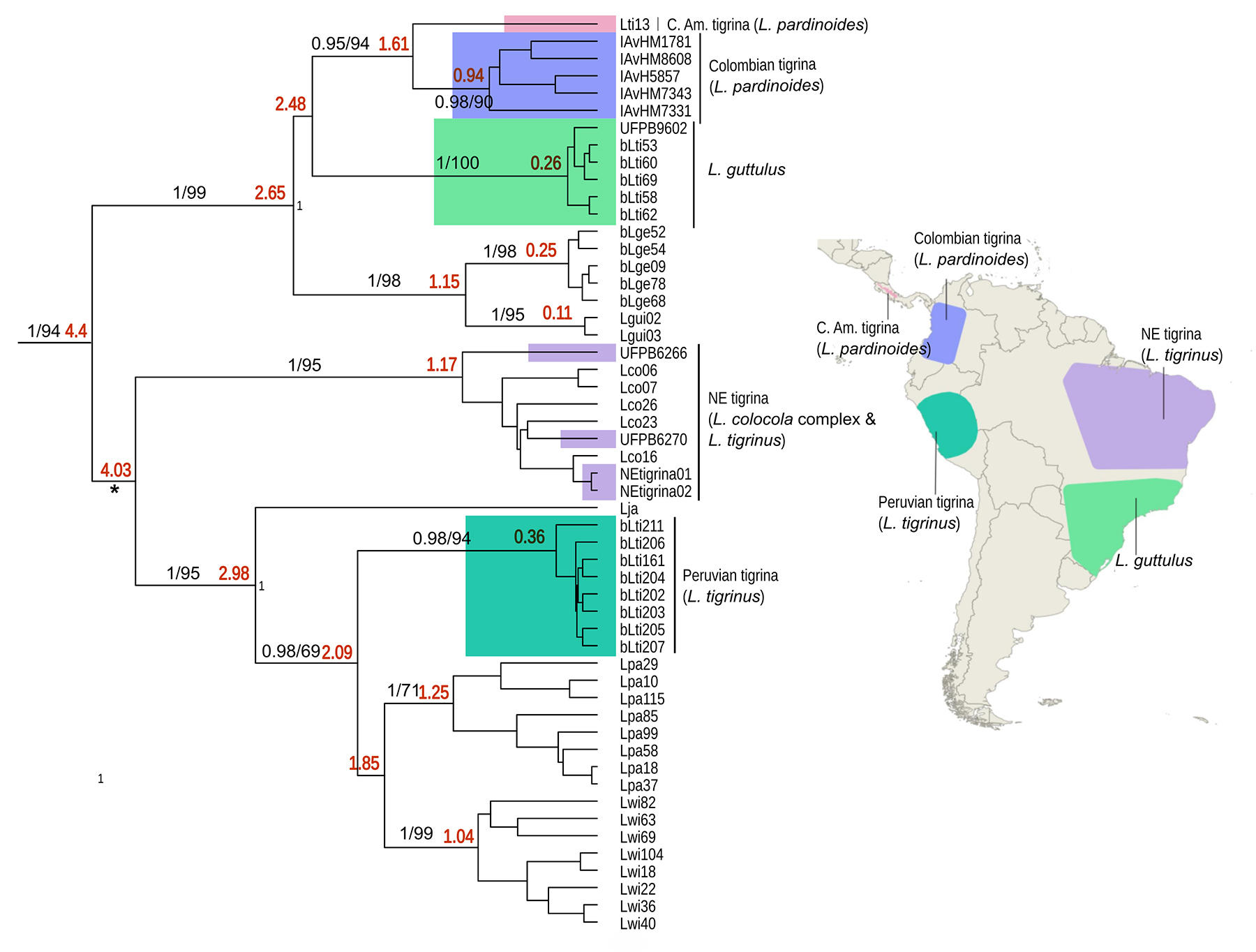
Both maximum likelihood (ML) and Bayesian Inference (BI) phylogenetic trees yielded high support (ML bootstrap >94% and posterior probability >0.95) for the monophyly of each of the L. tigrinus geographic units represented by more than one individual and bearing its own mtDNA lineage (Figure 1 and Figures S1 and S2). In contrast, as observed in previous studies (e.g., Trigo et al., 2013; Santos et al., 2018), the northeastern Brazilian tigrina individuals (NE tigrina) contained mtDNA haplotypes derived from an ancient introgression from the L. colocola complex. Therefore, its monophyly and relationships cannot be assessed with mitochondrial data, but both aspects have already been ascertained using genome-wide nuclear markers (Trindade et al., 2021; Lescroart et al., 2023).
Bayesian maximum clade credibility tree of mtDNA sequences from Neotropical felids of genus Leopardus, including all currently sampled geographic units of the L. tigrinus complex (color-coded on the map). A congruent tree was obtained with Maximum Likelihood (ML), with a topological difference observed at only one basal node, marked here with an asterisk (see Figure S2). Numbers above the branches indicate support for the adjacent node (Bayesian posterior probability/percent ML bootstrap). Dark red numbers at nodes indicate the age (time to the most recent common ancestor (TMRCA)) of that mtDNA divergence event, in million years ago (Mya) (see Figure S1 for credibility intervals). Support values and divergence dates are displayed only for species-level nodes, higher-level clades and nodes defining additional tigrina units. Sequences belonging to tigrina units are color-coded according to the map.
The monophyly of each tigrina geographic unit is particularly relevant in the case of the Colombian samples, whose clade support was high (posterior probability: 0.98; ML bootstrap: 90%) and whose mitochondrial Time to the Most Recent Common Ancestor (TMRCA) was quite recent (95% HPD: 0.42-1.51 Mya). Since our sample set included the individual (IAvH5857) that had been proposed to represent a distinct species (Ruiz-García et al., 2023), our results do not support such mtDNA phylogenetic uniqueness, and instead indicate that the Colombian tigrinas sampled so far comprise a single evolutionary unit. The finding that sample IAvH5857 belongs within the Colombian lineage (i.e., L. pardinoides) corroborates the results from Astorquiza et al. (2023) and Marín-Puerta et al. (2025), which had already indicated this relationship based on sequence-level identity between this specimen and other individuals from that region.
The mitochondrial relationships among the L. tigrinus units and the other Leopardus species were consistently reconstructed with the ML and BI analyses (see Figure 1 and Figures S1 and S2). Across the whole inferred tree, only one node was incongruent between the BI and ML phylogenies, namely that relating the three main Leopardus lineages, now recognized as subgenera (Lescroart et al., 2023; see below for additional details). The north Andean (i.e., Colombian) clade was retrieved as the sister-group of the Central American (C. Am.) sample (BI posterior probability 0.95; ML bootstrap 94%), consistent with the mitochondrial and nuclear results reported by Lescroart et al. (2023). Our estimate of the mtDNA TMRCA between Colombian and C. Am. units was ca. 1.6 Mya, considerably older than the coalescent-based estimate (ca. 0.15 Mya) of this population split derived from whole-genome sequences (Lescroart et al., 2023). This is not surprising, since the TMRCA estimated from mitochondrial-based phylogenetic analyses is expected to track the split of mtDNA lineages in the ancestor that gave rise to descendant populations, prior to their actual divergence (Nei, 1987). Additional sampling of whole-genome sequences from multiple individuals of both regions will be required to further refine the estimate of the age and dynamics of the separation between these regional tigrina units.
The L. guttulus mitochondrial clade was reconstructed as the sister-group of this C. Am./Colombian tigrina clade. This node received low support (Figures 1, S1 and S2), likely due to the short length of the mitochondrial segment analyzed here, but is consistent with the mitogenome-based phylogeny reported by Lescroart et al. (2023). It is noteworthy that this mitochondrial topology is distinct from the most prevalent tree retrieved from the nuclear genome, which places the C. Am./Colombian group externally to an inner clade that includes L. guttulus, NE tigrina, L. geoffroyi and L. guigna (Trindade et al., 2021; Lescroart et al., 2023). Such cyto-nuclear phylogenetic discordance has been shown to be common in the Felidae (e.g., Li et al., 2016, 2019), and part of the broader phylogenomic topological discordance that is prevalent in genus Leopardus (Lescroart et al., 2023).
A remarkable finding was the phylogenetic position of Peruvian tigrinas, which had not been included in any of our previous studies. These samples formed a strongly supported clade (Figures 1, S1 and S2), which was more closely related to ocelots (L. pardalis), margays (L. wiedii) and the Andean cat (L. jacobita) than to any of the other tigrina units. This reconstruction, uniting this tigrina mtDNA clade with those belonging to the three species that comprise subgenus Leopardus (Lescroart et al., 2023), was strongly supported in both BI (1.0 posterior probability) and ML (95% bootstrap support) analyses. In addition, the node comprising the mtDNA clades belonging to subgenus Oncifelis (which includes all other tigrina units with autochthonous mtDNA, along with L. geoffroyi and L. guigna) also received high support (1.0 posterior probability and 99% ML bootstrap support). Taken together, these two strongly supported nodes robustly refute the monophyly of tigrina mtDNA clades, and show that these lineages are associated with two distinct subgenera within Leopardus. Interestingly, since the L. colocola complex comprises the third subgenus (Lynchailurus) within Leopardus (Lescroart et al., 2023), the historical introgression of its mtDNA into NE tigrinas leads to a remarkable scenario in which present-day tigrina units harbor mitochondrial lineages stemming from all three subgenera within this genus.
Another relevant result was that the divergence between the Peruvian tigrina clade and its sister lineage was dated at 2.09 Mya (95% HPD: 1.46 - 2.78 Mya), indicating an old evolutionary separation between this mtDNA lineage and those belonging to any other Leopardus unit. Taken together, the phylogenetic placement of this Peruvian tigrina mtDNA clade and depth of its evolutionary divergence represent a very surprising result, since these cats are morphologically similar to the other tigrinas (Nascimento and Feijó, 2017; de Oliveira et al., 2024), and were expected to be geographically, demographically, and genetically connected to the N. Andean (Colombian) population (now recognized as L. pardinoides). Instead, their mtDNA sequences grouped together strongly in a distinct clade, which was much more closely related to other Leopardus species, belonging to a different subgenus. Interestingly, despite the strong morphological similarity with specimens from Central America and northwestern South America, tigrinas from the Andes south of the Huancabamba depression (located in northwestern Peru) showed a slightly distinct spotting pattern, suggesting that they might comprise a different taxonomic unit (de Oliveira et al., 2024), although the Huancabamba depression itself has so far not been retrieved as a historical barrier for ecological connectivity in this group (Bonilla-Sánchez et al., 2024). The genetic results presented here suggest that Peruvian tigrinas may (i) represent a distinct Leopardus taxon, either endemic to Peru or also occurring in other, yet-unsampled regions of South America; or (ii) bear an mtDNA lineage that has been introgressed in the past from a distinct (and potentially extinct) Leopardus species, similarly to what has happened between NE tigrinas and L. braccatus from the L. colocola complex (Trigo et al., 2013; Santos et al., 2018). Even in the latter case, the fact that these mtDNA lineages have so far only been found in Peru, and all eight sampled Peruvian tigrinas harbor these mitochondrial sequences, implies that this population is at least partially isolated from the other units (i.e., at least the matrilineal gene flow between them is absent or very low). These hypotheses can be tested in the future using nuclear sequences and expanded sampling of tigrinas from other regions in South America.
From a biogeographic perspective, this finding is intriguing, since the ecological niche modeling conducted by Bonilla-Sánchez et al. (2024) did not detect a suitability break at the Huancabamba depression or any at other site that could explain a discontinuity between Colombian and Peruvian populations. That study did identify ecological niche differences between these two Andean regions, although these were subtler than could be expected given the depth of evolutionary divergence indicated by our mtDNA results (Bonilla-Sánchez et al., 2024). Additional biogeographic and ecological data will be required to further investigate the spatial separation and potential adaptive differentiation between these units.
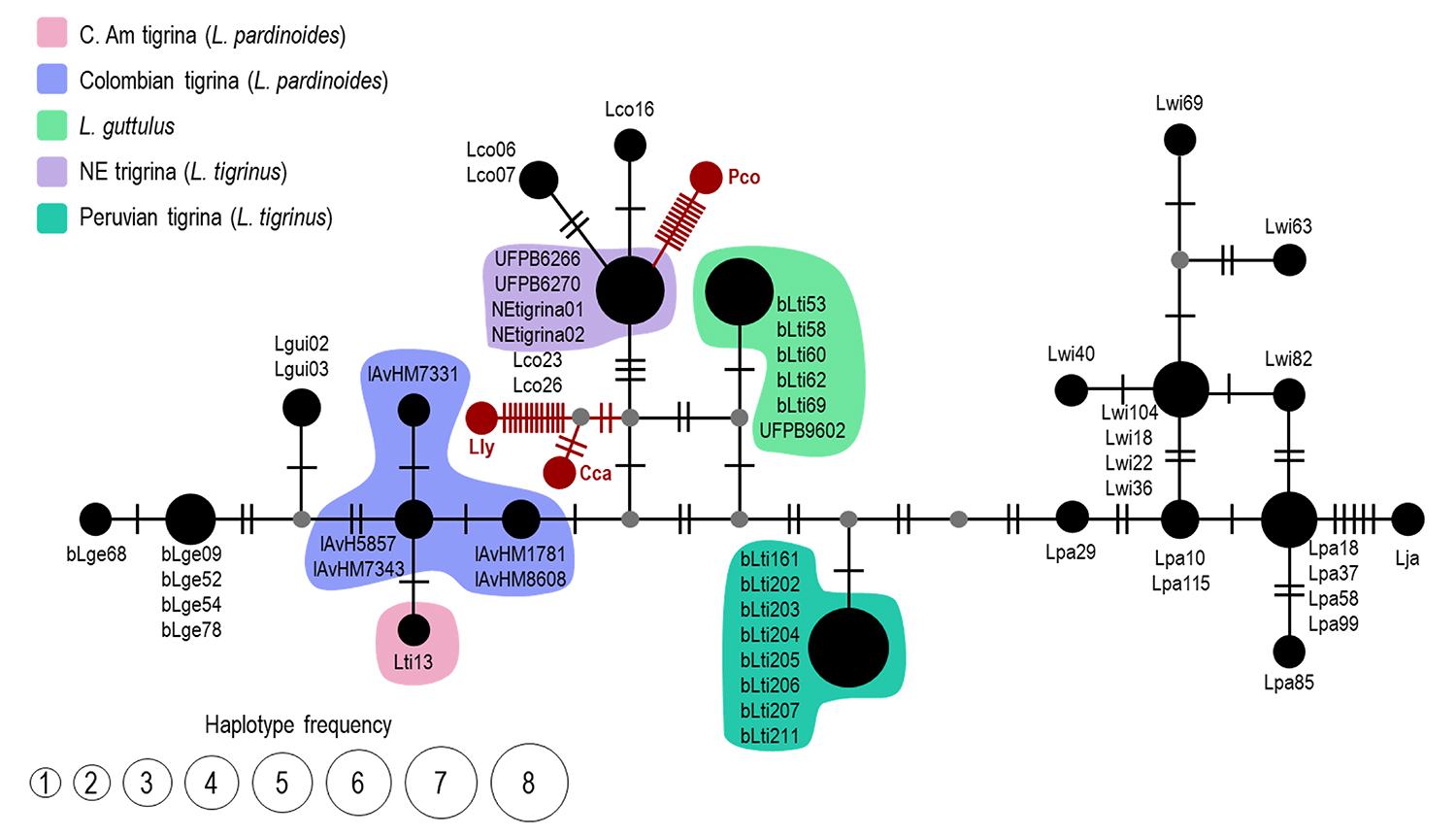
The inferred haplotype network (Figure 2) was congruent with the results of the phylogenetic analyses (Figure 1): each tigrina unit formed a well-defined haplogroup separated from each other by multiple mutational steps, indicating deep mitochondrial differentiation among these lineages. Although the position of the different outgroup sequences in this analysis was inconsistent (precluding a reliable inference of the Leopardus root), the mutational distances among the tigrina units were similar to, or higher than, the distances observed between other species in the genus (e.g., L. pardalis vs. L. wiedii or L. geoffroyi vs. L. guigna). In particular, the Peruvian unit was at least five mutational steps away from any other tigrina unit, the same distance that separated it from L. pardalis.
Haplotype network of mtDNA sequences from Neotropical felids of genus Leopardus, including all currently sampled geographic units of the L. tigrinus complex (color-coded as in Figure 1). Each circle represents a unique haplotype, with the circle diameter indicating haplotype frequency (see internal legend). Haplotype relationships are represented by connecting lines, on which crosslines indicate mutational steps. Small gray circles are median vectors that indicate inferred (extinct or unsampled) haplotypes. Due to the complete deletion of sites with any missing data, some closely related sequences shown in Figure 1 are collapsed into a single haplotype in this analysis. Outgroup species are represented by maroon circles (Cca: Caracal caracal; Lly: Lynx lynx; Pco: Puma concolor).
Overall, the present results demonstrate that mitochondrial polyphyly of the L. tigrinus complex is even more extreme than previously appreciated, and that additional taxonomic units may still be hidden within the ‘tigrina’ morphology. As previously suggested (Trindade et al., 2021), a plausible cause for this striking discrepancy between molecular phylogeny and morphological features is that the ‘tigrina’ phenotype may be ancestral (plesiomorphic) in the genus Leopardus. This would have led zoologists over the years to ‘lump’ distinct evolutionary units with a similar phenotype into the ‘L. tigrinus’ taxon, a problem that is only now being disentangled using molecular approaches and more refined morphological and ecological analyses. Hopefully the coming years will see a complete resolution of this problem enabled by the application of such improved approaches coupled with exhaustive geographic sampling across the whole L. tigrinus complex distribution.
Supplementary Material
The following online material is available for this article:
Table S1 -
Table S2 -
Figure S1 -
Figure S2 -
Acknowledgements
We thank the Mammal Collection (IAvH-M) and Tissue Collection (IAvH-CT) at the Alexander von Humboldt Biological Resources Research Institute in Colombia for access to museum specimens and tissues. Eduardo Tovar-Luque and Luis Miguel Leyton at IAvH-CT assisted in laboratory and sample collection. We also thank Berenice Ninaquipe for help with sample collection at Parque Sinchi Roca and Parque Huascar (Peru). We thank CNPq/Brazil (grants 305040/2008-1, 482387/2010-6, 311327/2011-7, 310803/2015-2) and Panthera Foundation for financial support.
References
- Astorquiza JM, Noguera-Urbano EA, Cabrera-Ojeda C, Cepeda-Quilindo B, González-Maya JF, Eizirik E, Bonilla-Sánchez A, Buitrago DL, Pulido-Santacruz P and Ramírez-Chaves HE (2023) Distribution of the northern pampas cat, Leopardus garleppi, in northern South America, confirmation of its presence in Colombia and genetic analysis of a controversial record from the country. Mammalia 87:606-614.
- Bandelt HJ, Forster P and Röhl A (1999) Median-joining networks for inferring intraspecific phylogenies. Mol Biol Evol 16: 37-48.
- Bonilla-Sánchez A, Sartor CC, Fox-Rosales LA, Feijó A, Ramírez-Fernández JD, Brenes-Mora E, Mooring MS, Blankenship SR, Sánchez-Lalinde C, Nascimento FO et al (2024) Ecological niche modeling of the Leopardus tigrinus complex sheds light on its elusive evolutionary history. J Mammal 105:953-964.
- Bouckaert, R, Heled, J, Kühnert, D, Vaughan, T, Wu, CH, Xie D, Suchard MA, Rambaut A and Drummond AJ (2014) BEAST 2: A software platform for Bayesian evolutionary analysis. PLoS Comput Biol 10:e1003537.
- de Oliveira TG, Fox-Rosales LA, Ramírez-Fernández JD, Cepeda-Duque JC, Zug R, Sanchez-Lalinde C, Oliveira MJR, Marinho PHD, Bonilla-Sánchez A, Marques MC et al (2024) Ecological modeling, biogeography, and phenotypic analyses setting the tiger cats’ hyperdimensional niches reveal a new species. Sci Rep 14:2395.
- García-Perea R (1994) The Pampas cat group (genus Lynchailurus Severtzov, 1858) (Carnivora, Felidae): A systematic and biogeographic review. Am Mus Novit 3096:1-36.
- Hoang DT, Chernomor O, von Haeseler A, Minh BQ and Vinh LS (2018) UFBoot2: Improving the ultrafast bootstrap approximation. Mol Biol Evol 35:518-22.
- Johnson WE, Slattery JP, Eizirik E, Kim JH, Menotti Raymond M, Bonacic C, Cambre R, Crawshaw P, Nunes A, Seuánez HN et al (1999) Disparate phylogeographic patterns of molecular genetic variation in four closely related South American small cat species. Mol Ecol 8:S79-S94.
- Kalyaanamoorthy S, Minh BQ, Wong TKF, von Haeseler A and Jermiin LS (2017) ModelFinder: fast model selection for accurate phylogenetic estimates. Nat Methods 14:587-589.
- Kitchener AC, Breitenmoser-Würsten C, Eizirik E, Gentry A, Werdelin L, Wilting A, Yamaguchi N, Abramov AV, Christiansen P, Driscoll C et al (2017) A revised taxonomy of the Felidae: The final report of the Cat Classification Task Force of the IUCN Cat Specialist Group. Cat News (Bougy) 11:3-80.
- Kumar S, Stecher G, Li M, Knyaz C and Tamura K (2018) MEGA X: Molecular evolutionary genetics analysis across computing platforms. Mol Biol Evol 35:1547.
- Leigh JW and Bryant D (2015) POPART: Full-feature software for haplotype network construction. Methods Ecol Evol 6:1110-1116.
- Lescroart J, Bonilla-Sánchez A, Napolitano C, Buitrago-Torres DL, Ramírez-Chaves HE, Pulido-Santacruz P, Murphy WJ, Svardal H and Eizirik E (2023) Extensive phylogenomic discordance and the complex evolutionary history of the Neotropical cat genus Leopardus Mol Biol Evol 40:msad255.
- Li G, Davis BW, Eizirik E and Murphy WJ (2016) Phylogenomic evidence for ancient hybridization in the genomes of living cats (Felidae). Genome Res 26:1-11.
- Li G, Figueiró HV, Eizirik E and Murphy WJ (2019) Recombination-aware phylogenomics reveals the structured genomic landscape of hybridizing cat species. Mol Biol Evol 36:2111-2126.
- Marín-Puerta S, Morales-Martínez DM, Pulido Santacruz P and Ramírez-Chaves HE (2025) Leopardus narinensis Ruiz-García, Pinedo-Castro and Shostell, 2023 (Mammalia, Carnivora, Felidae) is a junior synonym of Leopardus pardinoides (Gray, 1867): The need for good practices in nomenclatural and taxonomic proposals. Zoosyst Evol 101:1297-1307.
- Minh BQ, Schmidt HA, Chernomor O, Schrempf D, Woodhams MD, Von Haeseler A and Lanfear R (2020) IQ-TREE 2: New models and efficient methods for phylogenetic inference in the genomic era. Mol Biol Evol 37:1530-1534.
- Nascimento FO, Cheng J and Feijó A (2021) Taxonomic revision of the pampas cat Leopardus colocola complex (Carnivora: Felidae): An integrative approach. Zool J Linn Soc 191:575-611.
- Nascimento FO and Feijó A (2017) Taxonomic revision of the tigrina Leopardus tigrinus (Schreber, 1775) species group (Carnivora, Felidae). Pap. Avulsos Zool 57:231-264.
- Nei M (1987) Molecular evolutionary genetics. Columbia University Press, New York.
- Rambaut A, Drummond AJ, Xie D, Baele G and Suchard MA (2018) Posterior summarization in Bayesian phylogenetics using Tracer 1.7. Syst Biol 67:901-904.
- Ruiz-García M, Pinedo-Castro M and Shostell JM (2018) Small spotted bodies with multiple specific mitochondrial DNAs: Existence of diverse and differentiated tigrina lineages or species (Leopardus spp: Felidae, Mammalia) throughout Latin America. Mitochondrial DNA A 29:993-1014.
- Ruiz-García M, Pinedo-Castro M and Shostell JM (2023) Morphological and genetics support for a hitherto undescribed spotted cat species (genus Leopardus; Felidae, Carnivora) from the Southern Colombian Andes. Genes 14:1266.
- Sambrook J and Russell DW (2006) A Single-step method for the simultaneous preparation of DNA, RNA, and protein from cells and tissues. CSH Protoc 2006:pdb-prot4056.
- Santos A, Trigo TC, de Oliveira TG, Silveira L and Eizirik E (2018) Phylogeographic analyses of the pampas cat (Leopardus colocola; Carnivora, Felidae) reveal a complex demographic history. Genet Mol Biol 41:273-287.
- Sartor CC, Cushman SA, Wan HY, Kretschmer R, Pereira JA, Bou N, Cosse M, González S, Eizirik E, Freitas TRO et al (2021) The role of the environment in the spatial dynamics of an extensive hybrid zone between two neotropical cats. J Evol Biol 34:614-627.
- Trigo TC, Freitas TR, Kunzler G, Cardoso L, Silva JC, Johnson WE, O’Brien SJ, Bonatto SL and Eizirik E (2008) Inter‐species hybridization among Neotropical cats of the genus Leopardus, and evidence for an introgressive hybrid zone between L. geoffroyi and L. tigrinus in southern Brazil. Mol Ecol 17:4317-4333.
- Trigo TC, Schneider A, Lehugeur L, Silveira L, Freitas TRO and Eizirik E (2013) Molecular data reveal complex hybridization and a cryptic species of Neotropical wild cat. Curr Biol 23:2528-2533.
- Trindade FJ, Rodrigues MR, Figueiró HV, Li G, Murphy WJ and Eizirik E (2021) Genome-wide SNPs clarify a complex radiation and support recognition of an additional cat species. Mol Biol Evolution 38:4987-4991.
- Wozencraft WC (2005) Carnivora. In: Wilson DE and Reeder DM (eds). Mammal species of the world: A taxonomic and geographic reference. Johns Hopkins University Press, Baltimore, pp 532-628.
Novel sequences generated in this study have been deposited in GenBank (accession numbers PZ143437-PZ143486).