 Unveiling the application of Lean principles in car dealerships
Abstract
Abstract This article empirically investigates the implementation of Lean principles through specific tools and practices in service operations, with a focus on car dealerships. A multiple case study design was adopted to examine the Sales and After-Sales operations at two Brazilian dealerships, purposely selected to observe exemplary applications of lean concepts and methods in different service domains. As findings of the study, the research demonstrates that the application of Lean principles in dealerships can be effectively assessed by examining the integration of lean thinking into daily operations, organizational routines, and employee behaviors. Furthermore, the deployment of Lean principles is shown to occur through the consistent use of specific lean tools and practices, which act as operational enablers of the lean philosophy and support the development of continuous improvement capabilities in both Sales and After-Sales processes. Despite the close relationship between car dealerships and manufacturers, the spread of lean practices in this context remains limited. The cases analyzed offer practical insights and references for companies planning to adopt or improve lean service systems.
Keywords:
Lean service; Lean principles; Lean tools; Lean; Car dealer
Resumo
Resumo Este artigo investiga empiricamente a implementação dos princípios Lean por meio de ferramentas e práticas específicas em operações de serviços, com foco em concessionárias de automóveis. Foi adotado um projeto de estudo de casos múltiplos para examinar as operações de vendas e pós-vendas em duas concessionárias brasileiras, selecionadas propositadamente para observar aplicações exemplares de conceitos e métodos enxutos em diferentes domínios de serviços. Como resultados do estudo, a pesquisa demonstra que a aplicação dos princípios Lean em concessionárias pode ser avaliada de forma eficaz por meio do exame da integração do pensamento enxuto nas operações diárias, nas rotinas organizacionais e no comportamento dos funcionários. Além disso, a implantação dos princípios enxutos é demonstrada por meio do uso consistente de ferramentas e práticas enxutas específicas, que atuam como facilitadores operacionais da filosofia enxuta e apoiam o desenvolvimento de capacidades de melhoria contínua nos processos de vendas e pós-vendas. Apesar da estreita relação entre as concessionárias de automóveis e os fabricantes, a disseminação das práticas lean nesse contexto permanece limitada. Os casos analisados oferecem percepções práticas e referências para as empresas que planejam adotar ou aprimorar os sistemas de serviços enxutos.
Palavras-chave:
Serviço enxuto; Princípios enxutos; Ferramentas enxutas; Enxuto; Concessionária de automóveis
1 Introduction
Since early attempts to adapt mass-production methods to services, operations management has increasingly drawn from manufacturing logic (Levitt, 1976). Over the past two decades, influenced by the lean production system in manufacturing, pioneering service companies have begun adopting Lean principles, leading to a movement known as the reindustrialization of service (Bowen & Youngdahl, 1998). Encouraged by positive outcomes, the implementation of lean concepts is now spreading throughout service industries (Liker & Ross, 2017).
The lean paradigm generates significant interest, but successful implementation requires more than just tools and practices. Researchers emphasize that it relies on the consistent internalization and application of Lean principles across the organization (Bowen & Youngdahl, 1998; Hines et al., 2004; Leite & Vieira, 2015; Moyano‐Fuentes & Sacristán‐Díaz, 2012; Womack & Jones, 2003, 2015). While lean concepts have been widely discussed, the key elements—rules, principles, practices, tools, and techniques—lack clear definitions, leading to ambiguity that may hinder effective implementation in both the production of goods and the delivery of services. Several proposals aim to define lean production principles in a more practical manner (e.g., Åhlström, 2004; Womack & Jones, 2003), with the intention that these principles be easily translated into actionable practices and tools.
Research on the adoption of lean philosophy in the service sector, known as lean services, remains an emerging field. Nevertheless, it has garnered increasing global attention as organizations pursue innovation, operational excellence, and enhanced customer satisfaction in non-manufacturing domains such as healthcare, education, and finance (Arlinghaus & Knizkov, 2020; Nawanir & Fauzi, 2025; Singh & Rathi, 2019). Despite this growing interest, most current publications focus on literature reviews, theoretical conceptual models, or isolated case studies, which highlights a significant lack of validation and rigorous empirical evidence (Citybabu & Yamini, 2025; Singh & Rathi, 2019). Scholars emphasize the urgent need for empirical studies to test and validate existing conceptual frameworks in practical settings. Robust empirical investigations are necessary to evaluate the actual and multifaceted impact of lean implementations in service organizations. Such research would bridge the gap between theory and practice and provide managers with evidence-based guidelines to support the sustained success of these operations (Citybabu & Yamini, 2025; Gülyaz et al., 2019). There is, therefore, a strong global demand for comprehensive empirical research that clearly defines lean services across various contexts, including automotive after-sales (Arlinghaus & Knizkov, 2020).
The lean paradigm first emerged within the manufacturing operations of car assemblers and was subsequently widely disseminated throughout their supply chains (Arlinghaus & Knizkov, 2020; Netland & Powell, 2016). However, it was not until the turn of the 21st century that leading companies such as Toyota and Volvo began to engage in initiatives to adopt and promote lean concepts and practices in the echelon of car and truck dealerships. In 2000, Toyota’s president explicitly announced that it was time to apply its mastery of lean practices to distribution and marketing, while Volvo Trucks has since become a prominent example of implementing "Lean for Retail" to enhance customer satisfaction and operational efficiency (Amasaka, 2014; Bilbao Gato, 2023; Reichhart & Holweg, 2007). Consequently, while manufacturing achieved substantial operational performance gains, the pursuit of superior performance in sales processes and after-sales services received significantly less academic and practical attention until quite recently. This shift recognizes that courtesy and efficiency in after-sales service are now among the most relevant determinants of brand loyalty and repeat purchases (Atkinson & Linehan, 2009; Arlinghaus & Knizkov, 2020; Okutomi & Amasaka, 2013).
This study was conducted in car distribution companies in Brazil, highlighting significant changes in the retail motor industry that affect sales and after-sales operations. To thrive in this challenging environment, dealers need to provide compelling reasons for customers to choose them for both acquisition and maintenance, focusing on cost, delivery, and quality (Kiff, 2000). In response to increasing commoditization and rapid changes in the automotive market, dealerships are restructuring their operations to achieve greater efficiency and enhanced customer centricity (Golara et al., 2021). To realize lean efficiency, dealerships implement lean management principles to identify and eliminate waste within operational and after-sales processes. This approach reduces the operational and administrative workload of service consultants, enabling them to focus on high-value direct service activities (Malčic & Staš, 2024; Njoku et al., 2024). From a customer-centric standpoint, dealerships are transitioning from traditional transactional sales roles to serving as agents and managers of the consumer journey. This evolution involves the adoption of advanced customer relationship management (CRM) systems and an emphasis on critical quality dimensions, including empathy, expertise, transparency, and responsiveness (Nansubuga & Kowalkowski, 2024; Zhou et al., 2025). As noted by Amasaka (2002), even Toyota has been enhancing its sales and service operations to strengthen customer relationship and retention through quality management initiatives aimed at increasing customer value.
Much of the existing literature on this topic focuses on developed economies, highlighting the need to consider developing countries as well (Gupta et al., 2016). In these nations, the growing service sector is becoming a significant source of employment (Bogliaccini & Egan, 2017).
In this context, the present study aims to deepen our understanding of lean management in car dealerships by proposing a structured questionnaire designed to assess lean practices and collect empirical evidence on the application of Lean principles, tools, and practices in service operations. This paper is structured as follows: First, we discuss the conceptual elements guiding the lean production approach and outline the key tools and practices for building lean processes in service systems. Next, we describe the research method used to explore the connection between the philosophical and practical aspects of lean in improving service processes and analyze the collected data. Finally, we conclude with a discussion of the results and their implications.
2 Literature review
2.1 Lean production
In the automotive industry, where the lean production system was first introduced, it achieved broad dissemination because it offered a means to build production capabilities superior to those of the conventional mass-production system, thereby allowing firms to meet the sector’s increasingly demanding operational requirements. The lean system provided new means to overcome the trade-offs between productivity and quality, and between productivity and flexibility, enabling a wide range of businesses to operate economically beyond the high-volume, low-variety production environment. Thus, the lean production system became one of the most influential manufacturing paradigms of recent times (Holweg, 2007).
As a topic of managerial interest, the concept of ‘lean production’ can be considered from several perspectives. It is most frequently associated with the elimination of wastes in production processes or is used to label a bundle of tools aimed at production streamlining. In this work, we consider the definition offered by Shah & Ward (2007), according to which "lean production is an integrated socio-technical system whose primary objective is to eliminate waste by concurrently reducing or minimizing supplier, customer, and internal variability."
2.2 Lean in services
The application of Lean principles and practices in service operations has progressively matured over the past decades. According to Gupta et al. (2016), the evolution of lean thinking in services can be traced through four distinct eras. The Pre-Lean Era (prior to 1998) was marked by early efforts to enhance service productivity through scientific management, service system industrialization, and the advancement of service quality concepts. During the Lean Awareness Era (1998-2003), awareness grew regarding the universal applicability of Lean principles, while recognizing that their implementation in services required different approaches than in manufacturing (Kundu et al., 2011).
In the Lean Exploration Era (2004-2008), attention shifted toward adapting Lean principles to the specificities of service environments, with initial applications emerging in sectors such as healthcare, IT, and finance. Finally, the Lean Implementation Era (2009-2014) saw a surge in interest in applying lean thinking to service operations, accompanied by the development of models and frameworks aimed at guiding and assessing lean implementation in service contexts. This chronological perspective highlights how lean thinking in services has transitioned from conceptual awareness to practical application and structured evaluation (Kundu et al., 2011).
As in manufacturing, the implementation of lean concepts and practices in services has generated many benefits. Some of the reported benefits are increased flexibility, enhanced service delivery speed, reduced waiting time, improved service quality, improved productivity and efficiency, capacity expansion without an additional facility, increased utilization of resources, reduced costs, and reduced errors (Bowen & Youngdahl, 1998; Gupta et al., 2016). These potential benefits explain, in part, the growing diffusion of the lean system in the service sector. Lean principles have been extended to various service sectors, including healthcare, financial services, IT/software services, the public sector, and education (Kundu et al., 2011).
2.3 Principles of lean
The lean philosophy originated from the industrial production system and is an organizational model aimed at continuously eliminating waste (muda), reducing process variability (mura), and improving working conditions (muri) (Ohno, 1988). This approach seeks to deliver high-quality, low-cost products and services that effectively meet customer needs. While it was initially developed for manufacturing, its application to the service sector—referred to as "lean service"—has gained widespread recognition (Lander & Liker, 2007; Liker, 2021).
The transfer of Lean principles from manufacturing to services is not a straightforward process; it requires a "translation" that adapts to the unique characteristics of services, such as the involvement of customers in the process. While the core philosophy of creating value from the customer's perspective and eliminating non-value-adding activities remains consistent, different authors have attempted to systematize this adaptation. For instance, Womack & Jones (2003, 2015) established five fundamental principles, while Åhlström (2004) identified a set of principles specifically relevant to the service context.
By combining these perspectives with related literature, we can establish a set of essential principles for implementing the lean approach in service organizations. These principles, detailed in Table 1, provide guidance for transforming processes with the aim of achieving greater efficiency and delivering enhanced value to customers.
2.4 Lean tools and practices
While the underlying Lean principles provide philosophical guidance for the implementation of lean production systems, lean tools and practices are instruments to put this way of thinking into action (Gupta et al., 2016), constituting a toolkit that supports process improvement through waste removal and simplification of the work and workplace. In the literature on the deployment of the lean production approach, diverse versions of such kits are found (Lander & Liker, 2007; Marchwinski & Shook, 2003; Shah & Ward, 2007; Yadav et al., 2017). From among the lean tools and practices embraced by them, those acknowledged as most applicable in the context of service operations (Åhlström, 2004; Bowen & Youngdahl, 1998; Drotz & Poksinska, 2014; Gupta et al., 2016; Hadid & Afshin Mansouri, 2014; Leite & Vieira, 2015; Piercy & Rich, 2009a; Song et al., 2009; Swank, 2003) are enumerated and briefly described in the following:
-
− 5S: workplace organization method.
-
− Autonomation (Jidoka): making machinery and operators capable of detecting an abnormal condition and stopping the process immediately.
-
− Autonomous maintenance: enabling operators to perform simple machine maintenance and inspection tasks.
-
− Cellular layout: organization of production resources in groups to process items that feature similarities to simplify and rationalize the production scheduling, execution, and control.
-
− Employee empowerment: encouraging and authorizing employees to identify and resolve problems, furnishing them with information, knowledge, and a support structure to undertake roles like self-control, self-inspection, and self-regulation.
-
− Multi-skilling: developing more flexible operators capable of performing a broader range of tasks, thereby gaining a more systemic understanding of the process.
-
− Poka-yoke: error-proofing devices that help operators ensure defects do not occur in the process.
-
− Heijunka: production levelling by type and quantity during a fixed period, thus avoiding unevenness and large batches.
-
− Pull system: production control logic in which upstream activities deliver what their downstream activities need based on customer demand signaled by tools like kanban cards.
-
− Set up reduction: reduction of the time required by the process changeover between the completion of a task and the initiation of the next one.
-
− Small-batch production: pursuing more flexible production to depart from the stop-and-go operations characteristic of batch and queue systems and avoid overproduction.
-
− Standardized work: precise specification of procedures for each task of a production process, including the cycle time to be observed.
-
− Value stream mapping (VSM): visual representation of material and information flows that comprise a focal process used to identify wastes and their sources and opportunities for improvement.
-
− Visual control/management: establishing an environment rich in immediate and visually stimulating information that allows the realization of the system's status at a glance.
Besides these, several studies on the deployment of the lean approach in services have highlighted the inclusion of elements that are especially instrumental in this context (Åhlström, 2004; Apte & Goh, 2004; Bowen & Youngdahl, 1998; Drotz & Poksinska, 2014; Leite & Vieira, 2015; Piercy & Rich, 2009a, b; Song et al., 2009; Swank, 2003). Next, two that are noteworthy are pinpointed:
-
− Information technology (IT): adoption of IT solutions to improve efficiency and accuracy in services by using the internet, IT equipment, and software.
-
− Customer co-production: enabling customers to perform essential activities in the service delivery process.
The literature on lean service includes studies on how the lean approach is adapted to service operations, specifically how tools and practices originated in manufacturing are applied in service organizations. Researchers such as Hadid & Afshin Mansouri (2014), Leite & Vieira (2015), and Gupta et al. (2016) have identified a range of lean tools suited to service settings. Malmbrandt & Åhlström (2013) proposed examining these practices as a means of operationalizing the application of Lean principles. This study seeks to deepen the understanding of lean management in car dealerships by proposing a structured questionnaire designed to assess lean practices and support the gathering of empirical evidence on the adoption of Lean principles in service operations. Two research questions have been developed for this purpose.
-
RQ1: How can the extent of Lean principles implementation be evaluated in the context of car dealerships?
-
RQ2: How the application of the Lean principles can be deployed by means of lean tools and practices in dealerships?
3 Research method
We designed a case study in the car dealership sector to address our research questions. This sector, closely tied to the automotive industry, reveals significant non-value-adding wastes, highlighting the need for improved customer satisfaction and retention (Dombrowski & Malorny, 2017; Kiff, 2000). Literature suggests that implementing lean concepts in car dealerships is both viable and beneficial for enhancing service processes and adding value (Atkinson & Linehan, 2009; Brunt & Kiff, 2007; Womack & Jones, 2015; Dombrowski & Malorny, 2017; Kiff, 2000).
To further explore the applicability of the lean approach in the service sector, we adopted a multiple-case design (Yin, 2018) involving two car dealerships in Brazil, referred to as Dealer A and Dealer B. Dealer A represents a premium brand, whereas Dealer B represents a mainstream brand. Although both belong to the same multi-franchise group, they operate independently, target different market segments, and pursue distinct strategies. The two firms were selected due to their notable achievements in adopting lean production practices, supported by the same consulting firm founded by Pedro Simão, who is credited by Womack & Jones (2015) with playing a leading role in introducing lean management to car dealerships in Portugal. Dealer A began implementing Lean in 2012, which later inspired Dealer B to follow suit. The recognition Dealer A received in the magazine of the National Federation of Automotive Vehicle Distribution (FENABRAVE, 2017), along with its presentation as a benchmark business case at professional events such as the Lean Dealers Summit (Grupo Photon, 2019), underscores the pioneering nature of this initiative in Brazil and highlights the relevance of the operational improvements it achieved in the automotive market.
At Dealer A and Dealer B, consultants visit every three months to support process streamlining initiatives. They assess workshop and showroom operations, meet with employees to identify problems and improvement opportunities, and monitor the implementation of lean practices. The visits conclude with a meeting for the board, managers, and staff to present assessments, improvement recommendations, and address questions. In coaching teams on problem-solving and enhancements, consultants employ a Socratic approach to help members grasp the importance of new concepts and tools themselves.
Both dealers, driven by a commitment to enhance customer value, successfully implemented improved service processes and developed strong competencies in the lean approach. Dealer A was the first in the Americas to be certified by carmaker A for outstanding personal services, while Dealer B received certification from carmaker B for enhancing after-sales service efficiency.
We examined the push for lean operations at each dealer through two service domains— Sales and After-Sales—using an embedded multiple-case design (Yin, 2018) comprising four units of analysis. This design enables literal replication and supports the identification of cross-case patterns that contribute to further theoretical development on the central phenomenon under study.
To assess the degree of application of the Lean principles in each unit of analysis, we used a semi-structured questionnaire composed of 63 items. The instrument was developed by unfolding a set of statements for each principle, based on similar assessment tools proposed by Doolen & Hacker (2005), Shah & Ward (2007), Saurin & Ferreira (2008), and Malmbrandt & Åhlström (2013). Respondents were asked to rate the extent to which each principle was applied using a five-point Likert scale ranging from (1) never to (5) always. The full assessment instrument is provided in Appendix 1. Table 2 shows the distribution of the statements that make up the instrument across the Lean principles.
In order to consider RQ1, most of these statements were associated with an open-ended query to assist the interviewer in identifying the lean tools and practices used to operationalize the referred principle.
Two research team members conducted onsite visits to observe dealer operations and conduct interviews at various hierarchical levels. Utilizing the case method's ability to combine measurement methods evidence of adherence to principles was gathered through observations of workplaces and service installations. By involving different investigators and using multiple sources of evidence, triangulation strategies were applied for more accurate assessments.
The questionnaire evaluating the understanding of lean rules was conducted in the Sales and After-Sales functions of two car dealers. In Dealer A's After-Sales department, eight employees were interviewed, including the After-Sales director, manager, workshop manager, technical consultant, inventory analyst, two mechanics, and a car detailer. Dealer B had nine interviews with similar roles, plus a service consultant and washer. In the Sales department, six employees from each dealer were interviewed, comprising the sales director, manager, three commercial consultants, and a new vehicle detailer.
For the analysis of the application of the Lean principles, some of them were interviewed. The interviewees were selected according to the relevance of each principle to the function performed by each one. Thus, for instance, principles 1, 2, and 9 that require a more strategic and global perspective of the company were addressed to top management. Tables 3 and 4 show the allocation of the principles enumerated from 1 to 9 by interviewees' position:
The interviews lasted about forty minutes each and were conducted during working hours by two members of the research team. Written informed consent was obtained from all participants prior to their inclusion in the study.
4 Results
In this section, the data collected from the cases studied are analyzed in light of the two research questions addressed in this study.
4.1 Lean principles
For examining RQ1, the implementation of each Lean principle within the case organizations was assessed using the assessment instrument presented in Appendix 1, administered through interviews with employees or managers directly involved in their application or in fostering their adoption.
The quantitative data collected through the research instrument were organized and subjected to inferential statistical tests. Given the ordinal nature of the five-point Likert scale used to assess the perception of organizational practices, a non-parametric approach was adopted to compare the independent groups of companies.
To determine whether there were statistically significant differences in the distribution of responses between the groups, the Mann-Whitney U test was employed, which is widely recommended for ordinal variables when the assumption of normality is not met (Field et al., 2012). To quantify the magnitude of these differences (effect size), the rank-biserial correlation was calculated. This allows the practical impact of the observed differences to be classified as small, medium, or large effects, thereby mitigating the interpretative limitations of relying exclusively on p-values (Cohen, 1988)
Furthermore, the overall categorical association between the companies and the response levels was evaluated using the Chi-Square Test of Independence. Given the characteristic skewness in organizational maturity research, which frequently results in sparse contingency tables (with expected frequencies below 5 in some cells), a Monte Carlo simulation was applied to the Chi-Square test (using 2,000 replications). This procedure ensures the robustness and mathematical validity of the p-value, even in scenarios where the classical assumptions of the test are violated (Agresti, 2013). The strength of this categorical association was measured using Cramer's V coefficient.
A 5% significance level was adopted for all analyses. Data processing and statistical tests were performed in the R programming environment utilizing the tidyverse package for data manipulation, effectsize for calculating effect sizes, and DescTools for contingency statistics.
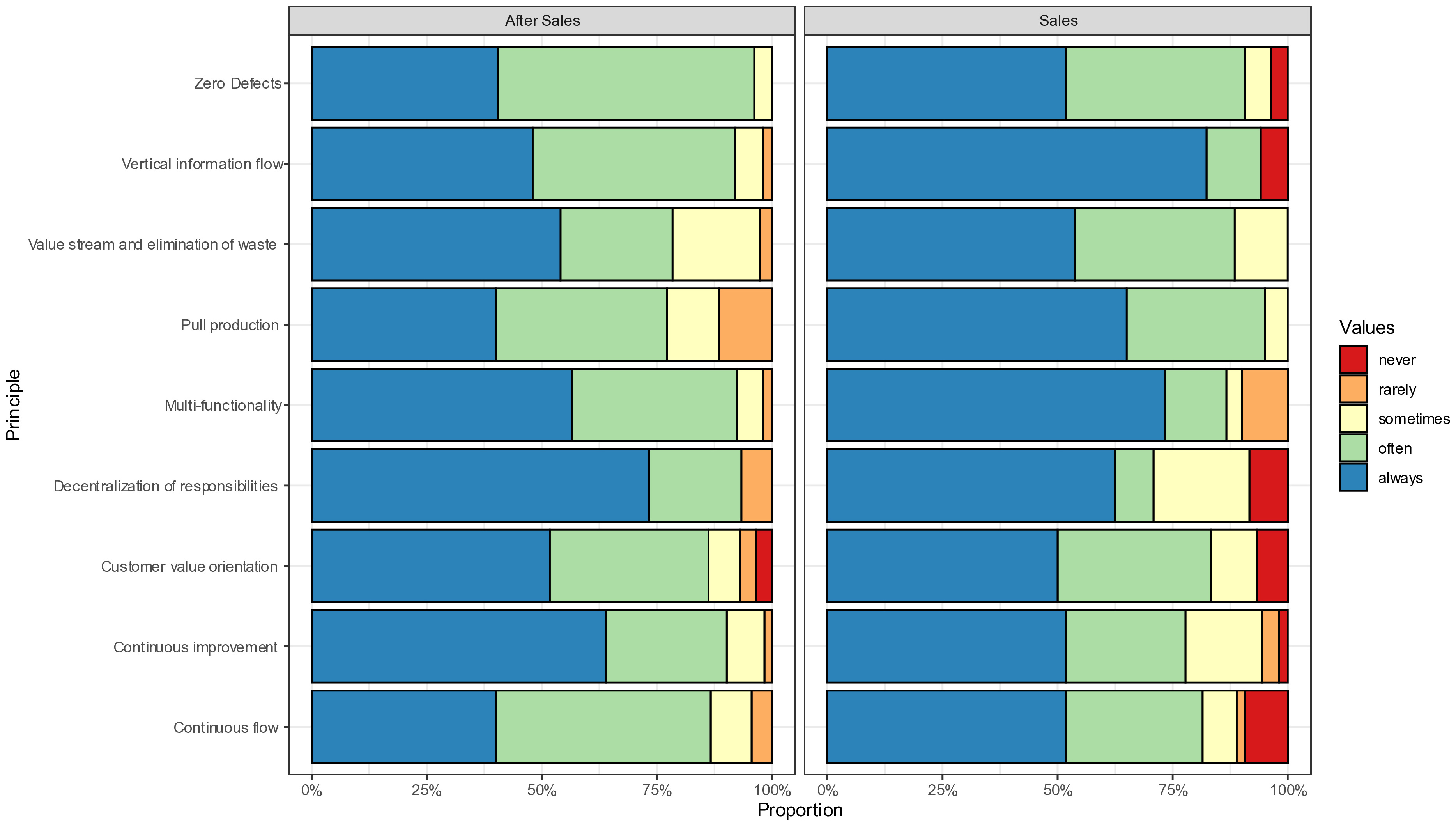
To evaluate the divergence in perceptions between the After-Sales and Sales sectors regarding lean practices, the Chi-square test of independence and the Mann-Whitney U test were applied at a 5% significance level (Table 5). The percentage distributions shown in Figure 1 illustrate how respondents rated each of the nine Lean principles across the different levels of adherence per sector.
Overall, the results indicate significant homogeneity between the profiles, with frequency distributions predominantly concentrated in the high-intensity categories ('often' and 'always'). Despite the convergence in most constructs, statistically significant differences were detected in three specific items. The most pronounced divergence occurred in Vertical information flow, which showed a difference both in the overall distribution of responses (Chi-square, p = 0.001, V = 0.441) and in the rank comparison (Mann-Whitney, p = 0.004, r = -0.322). Additionally, a significant difference was observed in the categorical distribution for Decentralization of responsibilities (Chi-square, p = 0.006, V = 0.468), as well as a difference in the medians for Pull production (Mann-Whitney, p = 0.042, r = -0.306). The effect sizes (Cramer's V and rank-biserial correlation) associated with these three variables range from moderate to strong.
A possible explanation for the statistical divergence observed in the construct Vertical information flow lies in how the lean philosophy is operationalized across different dealership departments. Vertical information flow is operationalized through the metrics evaluated in this study, namely, the intensive use of visual devices and the signaling of waiting workstations. These mechanisms ensure that critical information reaches the responsible personnel directly, enabling an immediate response to resolve problems. The flatter hierarchical structure and lower organizational complexity inherent to the Sales sector may explain the differences observed between the two departments, ultimately facilitating information flow within Sales. Furthermore, this flatter structure also helps to explain the differences observed in the constructs Decentralization of responsibilities and Pull production.
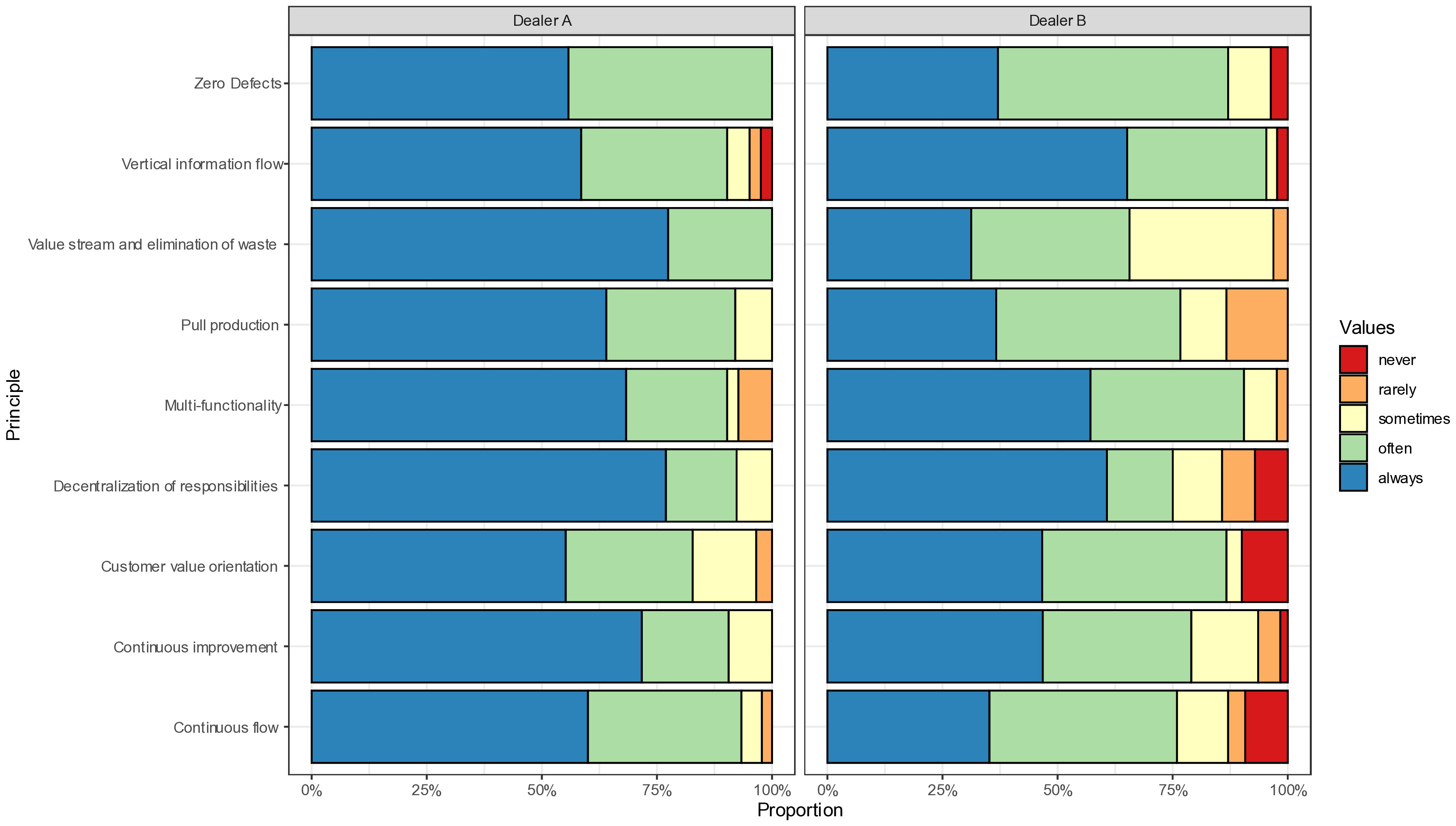
To assess the differences in perception between Dealer A and Dealer B regarding lean practices, the Chi-square test of independence and the Mann-Whitney U test were applied at a 5% significance level (Table 6). Additionally, the percentage distributions presented in Figure 2 illustrate how respondents rated each of the nine Lean principles across varying levels of adherence per dealer.

The combined analysis of the frequency distributions and inferential tests reveals that Dealer A generally exhibits a higher stage of consolidation compared to Dealer B. This pattern is evidenced by a marked concentration of Dealer A's responses in the highest perception category ('always') across most constructs, contrasting with a broader dispersion of Dealer B's responses across intermediate categories.
The most critical and significant divergence was observed in the item Value stream and elimination of waste (p < 0.001 in both tests), supported by strong effect sizes (V = 0.529 and r = -0.539). Consistent statistically significant differences (p < 0.05) were also confirmed for Continuous flow, Continuous improvement, and Zero Defects, scenarios in which Dealer A demonstrated a superior distribution of responses.
Additionally, the item Pull production revealed a statistically significant difference solely in the median comparison (Mann-Whitney, p = 0.029, r = -0.317). In contrast, homogeneity in perceptions was found for the items Customer value orientation, Decentralization of responsibilities, Multi-functionality, and Vertical information flow, which showed no statistically significant differences (p > 0.05) and exhibited weak association coefficients.
The higher stage of consolidation and the superior distribution of responses of Dealer A compared to Dealer B are strongly supported by the historical trajectory and the formalization of organizational routines within each company. Having begun its lean journey four years prior to Dealer B, Dealer A has developed a proactive and structured culture of continuous improvement. In contrast, the broader dispersion and intermediate profile of Dealer B's responses reflect a nascent and reactive level of maturity. In this context, lean tools are applied predominantly on demand when facing imminent failures, and the communication of corrective actions remains informal and verbal, lacking traceability. The literature indicates that an organization's historical trajectory and its prior level of routine formalization act decisively as either facilitators or barriers to adopting the lean philosophy (Titu & Pop, 2025). Conversely, contextual realities characterized by legacy operational systems, cultural inertia, and a lack of visibility severely hinder a company's readiness to adopt Lean, demanding significantly greater leadership effort to institutionalize these changes (Lawrence et al., 2026).
4.2 Lean principles and their tools and practices
This section addresses RQ2, exploring how lean tools and practices from manufacturing have been applied in the car distribution sector. The identification of these tools was guided by assessment questions in Appendix 1, prompting interviewees to provide evidence of their use. Additionally, the authors sought further physical evidence during fieldwork. Tables 7 and 8 summarize the implementation of Lean principles in the Sales and After-Sales departments of the case organizations.
An examination of the nature of each identified means of application reveals that they contemplate a set of factors that are critical for facilitating the integration of learning and work. The tools or practices were implemented for purposes such as stimulus of feedback, evaluation, and reflection on the outcomes of the work performed by employees; ensuring the formalization of work processes; promoting a high level of management involvement and employee participation in the handling of problems and development of work processes; and provision of learning resources and coaching support to employees at different levels of the organization. According to Ellström (2001), the combination of such means offers favorable conditions for nurturing individual and organizational learning.
Tables 7and 8 reveal that both Dealer A and Dealer B managed to adapt and implement the application of a wide range of lean tools and practices in their Sales and After-Sales departments. These units consist of operations of contrasting nature. While the former comprises more direct interactions with the customer in the front stage, the latter involves mainly backstage processes centered on the car to be delivered. Notwithstanding these differences, employees of both dealers in these two domains reveal similar levels of understanding of lean concepts and demonstrate that they are well-versed in applying various lean tools and practices.
To highlight an achievement made possible by the lean service capabilities developed through these initiatives, Dealer A—whose experience with lean transformation is more extensive—successfully pioneered the implementation of the 'one hour stop' service in Brazil with its After-Sales team, which has enabled the completion of approximately 80% of vehicle technical review service orders in under one hour. In addition, Dealer A played a significant role within carmaker A's global dealer network as a pilot unit for the development of the 'Lean in Sales' project aimed at improving sales processes. Owing to their relevance, these outcomes have been highlighted and publicized by specialized media in the Brazilian automotive market (Simões, 2016; Autos Segredos, 2021).
5 Final considerations
This work investigated the perspectives established in the case organizations for the categories of Lean principles. The body of evidence presented in Section 5 indicates that the principles of the lean production system used in this work were relevant to drive the process improvement initiatives that gave rise to the positive results observed in the cases analyzed. This suggests the potential of the rationalization logic advocated by the Lean principles to foster the development of lean service systems.
Faced with intensifying competition and the commoditization of vehicle sales (driven by the democratization of online information and the emergence of new technologies, such as electric vehicles), dealerships are challenged to reinvent their business processes to justify their market relevance and avoid disintermediation (Golara et al., 2021; Zhou et al., 2025). To deliver greater customer value and mitigate eroding profit margins, these companies are restructuring their operations by adopting both business model innovations—such as the transition to mobility subscription services, which cater to the contemporary preference for access and convenience over traditional ownership (Nansubuga & Kowalkowski, 2024)—and advanced operational excellence and governance methodologies, such as Lean and Six Sigma (Malčic & Staš, 2024; Singh & Rathi, 2019). The systematic application of these quality tools, particularly in the After-Sales department, enables the continuous identification and elimination of waste, drastically reducing faulty repair rates (rework) and optimizing the agility and technical precision of services (Arlinghaus & Knizkov, 2020; Valenzuela et al., 2019).
In this direction, to illustrate how each of the nine Lean principles can be implemented in the Sales and After-Sales operations of the car distribution sector, Tables 7 and 8 point out several organizational arrangements, work practices, and improvement tools that can be applied for this purpose and thus elucidate RQ2. The recognition of Dealer A and Dealer B as role models of lean dealers in Brazil, substantiated by the collection of diverse manners of deployment of the Lean principles identified in these tables, corroborates the assertion that the development of lean abilities by car dealers may enable them to implement and deliver more value-adding services to their customers. Moreover, they serve as a reference guide that may assist those car dealers willing to implement the lean production principles in their planning or diagnosis, besides providing insights into how to deploy the lean approach in the context of other service organizations.
Given the small number of cases studied in this work, further research could investigate the external validity of the results obtained, both in the context of car dealerships and in other service organizations. This could contribute to a clearer definition of the set of concepts and practices that characterize exemplary lean dealers and to the identification of the specific aspects that distinguish them from lean service organizations in general.
Appendix 1 Instrument to assess the adherence to the principles of Lean Production and application of associated practices and tools.
| Principle | Statement | Number of interviewees |
|---|---|---|
| 1. Customer value orientation | 1. The management makes an effort to grasp the vision of the customer value for this process. | 8 |
| 2. Customer complaints on a given process are collected and analyzed by the management. | 8 | |
| 3. The organization makes use of information technology to establish an interface with the customer. | 8 | |
| 4. Customers know the process and can easily follow it. | 12 | |
| 5. Process recovery procedures are used to cope with claims or interferences by the customer. | 12 | |
| 6. The conclusion of the service to final customers is fulfilled within the promised period. | 11 | |
| 2. Value stream identification and elimination of waste | 7. The activities that make up the value stream of the service processes are mapped and analyzed. | 8 |
| 8. The activities are classified into value-adding activities, non-value-adding activities that are unavoidable, and non-value-adding activities that may be eliminated. | 10 | |
| 9. The sources of wastes (non-value-adding activities that may be eliminated) are identified. | 10 | |
| 10. The value stream of service processes is designed so as to eliminate non-value-adding activities. | 10 | |
| 11. The value stream of the service process is fully known and understood by all employees involved. | 12 | |
| 12. The processes are revised to create more value with less waste. | 13 | |
| 3. Continuous flow | 13. The product or service flows seamlessly through the processes in a steady way. | 11 |
| 14. There are no long waits and or delays throughout the processes. | 11 | |
| 15. The activities are processed in such a way to minimize queuing and cycle times. | 11 | |
| 16. Production is leveled according to the resources (labor, materials, parts, equipment) required to perform each type of service. | 11 | |
| 17. When the type of activity to be performed must be changed, the setup is done quickly. | 11 | |
| 18. The setups are performed following specified procedures. | 11 | |
| 19. The variability of the time to carry out the process activities is low. | 11 | |
| 20. The physical layout of the workstations favors the execution of the activities without interruptions. | 11 | |
| 21. The layout is organized to minimize internal transports. | 11 | |
| 4. Pull production | 22. Requests for parts and materials are made according to the actual demand of the process (with the right components, in the right quantity, at the right time). | 11 |
| 23. High safety stock levels are not carried to assure the availability of materials, parts, and products. | 11 | |
| 24. The process activities are carried out according to the actual demand within the planned time. | 11 | |
| 25. The employees visually control the pulling process (for product or service deliveries). | 11 | |
| 26. A control mechanism for the picking of parts and materials is used in the process. | 11 | |
| 5. Continuous improvement (Perfection) | 27. Standard works reviews are documented and communicated to employees. | 11 |
| 28. When a problem occurs, the causes are identified for the development of action plans. | 13 | |
| 29. Improvement actions are identified, recorded, and tackled by the designated persons. | 13 | |
| 30. The improvement actions can be followed visually by all involved. | 13 | |
| 31. The process and result indicators are widely disseminated to operators. | 13 | |
| 32. Best practices are standardized and incorporated into the processes. | 13 | |
| 33. The company's goals are clearly and objectively deployed so that continuous improvement actions contribute to their achievement. | 13 | |
| 34. All employees involved in the service processes are trained to know lean production's philosophy, basic principles, and practices. | 13 | |
| 35. The top management is directly engaged in the continuous improvement program. | 13 | |
| 6. Zero defect | 36. The products or services are delivered right the first time. | 12 |
| 37. The processes are under control and feature low variability. | 12 | |
| 38. The failure effects are not propagated to the next process. | 12 | |
| 39. Mechanisms to prevent the occurrence of defects in the process are used. | 12 | |
| 40. When a problem is detected, a corrective action is quickly undertaken. | 12 | |
| 41. The root causes that originate events that result in defects are identified and eliminated. | 12 | |
| 42. There is none or little need for rework. | 12 | |
| 43. The standard work specifications are documented. | 11 | |
| 44. Standards are found in locations easily accessible to all employees, allowing quick and accurate checks. | 11 | |
| 7. Multi-functionality | 45. The work environment provides opportunities to exercise multifunctional skills. | 12 |
| 46. Preventive maintenance is preferred over corrective maintenance. | 12 | |
| 47. Employees perform the basic preventive maintenance of their machines and equipments (daily inspection, lubrication, and cleaning). | 12 | |
| 48. Workers are trained to detect abnormalities in the machines and equipments they use in their work. | 12 | |
| 49. Employees work in teams, self-managing their work and controlling the quality. | 12 | |
| 50. The workflow is organized in such a way as to reduce movements and transportations and facilitate control. | 12 | |
| 51. A housekeeping program (5S) or similar is established. | 11 | |
| 8. Vertical information flow | 52. Workstations that need assistance or that are on hold are visually signaled. | 12 |
| 53. The information necessary for decision-making is provided directly to the person responsible. | 12 | |
| 54. The response to a query is provided promptly to the person responsible for tackling an action. | 12 | |
| 55. Visual devices (e.g., boards, floor indications, alarms) are used for sharing information. | 12 | |
| 56. Computer systems are used to support the performing of operations and the transmission of information. | 12 | |
| 57. Information is shared between processes without layout obstacles. | 11 | |
| 58. The goals of the company are clearly defined and communicated to all employees. | 13 | |
| 9. Decentralization of responsibilities | 59. Employees have the autonomy to halt the workflow, partly or entirely, and request help when an abnormality is detected. | 10 |
| 60. Employees are responsible for controlling their own work. | 10 | |
| 61. Employees are responsible for self-inspecting their work aiming at quality assurance. | 10 | |
| 62. The participation of the employees in the development of the standards is fostered to consider their experience. | 11 | |
| 63. Managers receive and analyze suggestions for improvement made by employees and provide feedback. | 13 |
Statement on Data Availability
The datasets generated and/or analyzed during the current study are available upon request from the reviewers.
-
Financial support:
This research was conducted without the receipt of specific funding from any public, commercial, or not-for-profit funding agencies.
-
How to cite:
Torres Júnior, N., Miyake, D. I., Mendonça, A. L. C., & Carmo, G. M. (2026). Unveiling the application of Lean principles in car dealerships. Gestão & Produção, 33, e7725, https://doi.org/10.1590/1806-9649-2026v33e7725
References
- Agresti, A. (2013). Categorical data analysis. Hoboken: John Wiley & Sons.
-
Åhlström, P. (2004). Lean service operations: translating lean production principles to service operations. International Journal of Services Technology and Management, 5(5/6), 545-564. https://doi.org/10.1504/IJSTM.2004.006284
» https://doi.org/10.1504/IJSTM.2004.006284 -
Alves, A. C., Dinis‐Carvalho, J., & Sousa, R. M. (2012). Lean production as promoter of thinkers to achieve companies’ agility. The Learning Organization, 19(3), 219-237. https://doi.org/10.1108/09696471211219930
» https://doi.org/10.1108/09696471211219930 -
Amasaka, K. (2002). ‘New JIT’: a new management technology principle at Toyota. International Journal of Production Economics, 80(2), 135-144. https://doi.org/10.1016/S0925-5273(02)00313-4
» https://doi.org/10.1016/S0925-5273(02)00313-4 -
Amasaka, K. (2014). New JIT, new management technology principle: surpassing JIT. Procedia Technology, 16, 1135-1145. https://doi.org/10.1016/j.protcy.2014.10.128
» https://doi.org/10.1016/j.protcy.2014.10.128 -
Apte, U. M., & Goh, C.-H. (2004). Applying lean manufacturing principles to information intensive services. International Journal of Services Technology and Management, 5(5-6), 488-506. https://doi.org/10.1504/IJSTM.2004.006280
» https://doi.org/10.1504/IJSTM.2004.006280 -
Arlinghaus, J. C., & Knizkov, S. (2020). Lean maintenance and repair implementation; a cross-case study of seven automotive service suppliers. Procedia CIRP, 93, 955-964. https://doi.org/10.1016/j.procir.2020.03.144
» https://doi.org/10.1016/j.procir.2020.03.144 -
Atkinson, C., & Linehan, M. (2009). An analysis of lean management procedures within Irish motor dealerships. International Journal of Business and Management, 3(11), 3. https://doi.org/10.5539/ijbm.v3n11p3
» https://doi.org/10.5539/ijbm.v3n11p3 -
Autos Segredos. (2021, October 7). Valborg é a melhor revendas da Volvo na América Latina. Autos Segredos. Retrieved in 2025, July 23, from https://www.autossegredos.com.br/mercado/valborg-e-a-melhor-revendas-da-volvo-na-america-latina/
» https://www.autossegredos.com.br/mercado/valborg-e-a-melhor-revendas-da-volvo-na-america-latina/ -
Bilbao Gato, N. (2023). How to improve customer satisfaction with customer surveys and lean for retail (Master’s thesis). University of Gothenburg, Gothenburg. Retrieved in 2025, July 23, from https://gupea.ub.gu.se/server/api/core/bitstreams/1c4c4ad3-a5f3-42ba-a2e0-e9c6a9b42ab7/content
» https://gupea.ub.gu.se/server/api/core/bitstreams/1c4c4ad3-a5f3-42ba-a2e0-e9c6a9b42ab7/content -
Bogliaccini, J. A., & Egan, P. J. W. (2017). Foreign direct investment and inequality in developing countries: does sector matter? Economics and Politics, 29(3), 209-236. https://doi.org/10.1111/ecpo.12098
» https://doi.org/10.1111/ecpo.12098 -
Bowen, D. E., & Youngdahl, W. E. (1998). “Lean” service: in defense of a production‐line approach. International Journal of Service Industry Management, 9(3), 207-225. https://doi.org/10.1108/09564239810223510
» https://doi.org/10.1108/09564239810223510 - Brunt, D., & Kiff, J. (2007). Creating lean dealers: the lean route to satisfied customers, productive employees and profitable retailers. Llandudno, UK: Lean Enterprise Academy.
-
Citybabu, G., & Yamini, S. (2025). Integration and implementation of LSS 4.0 practices: a perspective from manufacturing and service sectors. The TQM Journal, 37(8), 2476-2508. https://doi.org/10.1108/TQM-04-2024-0141
» https://doi.org/10.1108/TQM-04-2024-0141 - Cohen, J. (1988). Statistical power analysis for the behavioral sciences (2nd ed.). Mahwah, NJ: Lawrence Erlbaum Associates, Inc.
-
Dombrowski, U., & Malorny, C. (2017). Service planning as support process for a lean after sales service. Procedia CIRP, 64, 324-329. https://doi.org/10.1016/j.procir.2017.03.080
» https://doi.org/10.1016/j.procir.2017.03.080 -
Doolen, T. L., & Hacker, M. E. (2005). A review of lean assessment in organizations: an exploratory study of lean practices by electronics manufacturers. Journal of Manufacturing Systems, 24(1), 55-67. https://doi.org/10.1016/S0278-6125(05)80007-X
» https://doi.org/10.1016/S0278-6125(05)80007-X -
Drotz, E., & Poksinska, B. (2014). Lean in healthcare from employees’ perspectives. Journal of Health Organization and Management, 28(2), 177-195. https://doi.org/10.1108/JHOM-03-2013-0066 PMid:25065109.
» https://doi.org/10.1108/JHOM-03-2013-0066 -
Ellström, P.-E. E. (2001). Integrating learning and work: problems and prospects. Human Resource Development Quarterly, 12(4), 421-435. https://doi.org/10.1002/hrdq.1006
» https://doi.org/10.1002/hrdq.1006 -
Federação Nacional da Distribuição de Veículos Automotores – FENABRAVE (2017). Atendimento exclusivo. Revista Dealer, 9(72), 32-33. Retrieved in 2025, July 23, from https://fliphtml5.com/ordey/qwjz/Revista_Dealer_Ed._72/32/
» https://fliphtml5.com/ordey/qwjz/Revista_Dealer_Ed._72/32/ - Field, A., Miles, J., & Field, Z. (2012). Discovering statistics using R. Los Angeles: SAGE Publications.
-
Golara, S., Dooley, K. J., & Mousavi, N. (2021). Are dealers still relevant? How dealer service quality impacts manufacturer success. Production and Operations Management, 30(10), 3560-3578. https://doi.org/10.1111/poms.13450
» https://doi.org/10.1111/poms.13450 -
Grupo Photon. (2019, June 26). Lean Dealers Summit 2019: evento especializado em gestão Lean para concessionárias de veículos e equipamentos acontecerá em agosto em São Paulo. Revista Mercado Automotivo. Retrieved in 2025, July 23, from https://photon.com.br/evento-especializado-em-gestao-lean-para-concessionarias-de-veiculos-e-equipamentos-acontecera-em-agosto-em-sao-paulo/
» https://photon.com.br/evento-especializado-em-gestao-lean-para-concessionarias-de-veiculos-e-equipamentos-acontecera-em-agosto-em-sao-paulo/ -
Gülyaz, E., van der Veen, J. A. A., Venugopal, V., & Solaimani, S. (2019). Towards a holistic view of customer value creation in lean: a design science approach. Cogent Business & Management, 6(1), 1602924. https://doi.org/10.1080/23311975.2019.1602924
» https://doi.org/10.1080/23311975.2019.1602924 -
Gupta, S., Sharma, M., & Sunder, M. V. (2016). Lean services: a systematic review. International Journal of Productivity and Performance Management, 65(8), 1025-1056. https://doi.org/10.1108/IJPPM-02-2015-0032
» https://doi.org/10.1108/IJPPM-02-2015-0032 -
Hadid, W., & Afshin Mansouri, S. (2014). The lean-performance relationship in services: a theoretical model. International Journal of Operations & Production Management, 34(6), 750-785. https://doi.org/10.1108/IJOPM-02-2013-0080
» https://doi.org/10.1108/IJOPM-02-2013-0080 -
Hines, P., Holweg, M., & Rich, N. (2004). Learning to evolve. International Journal of Operations & Production Management, 24(10), 994-1011. https://doi.org/10.1108/01443570410558049
» https://doi.org/10.1108/01443570410558049 -
Holweg, M. (2007). The genealogy of lean production. Journal of Operations Management, 25(2), 420-437. https://doi.org/10.1016/j.jom.2006.04.001
» https://doi.org/10.1016/j.jom.2006.04.001 -
Jayaram, J., Das, A., & Nicolae, M. (2010). Looking beyond the obvious: unraveling the Toyota production system. International Journal of Production Economics, 128(1), 280-291. https://doi.org/10.1016/j.ijpe.2010.07.024
» https://doi.org/10.1016/j.ijpe.2010.07.024 -
Kiff, J. S. (2000). The lean dealership – a vision for the future: “from hunting to farming”. Marketing Intelligence & Planning, 18(3), 112-126. https://doi.org/10.1108/02634500010327908
» https://doi.org/10.1108/02634500010327908 -
Kundu, G. K., Manohar, B. M., & Bairi, J. (2011). A comparison of lean and CMMI for services (CMMI‐SVC v1.2) best practices. Asian Journal on Quality, 12(2), 144-166. https://doi.org/10.1108/15982681111158715
» https://doi.org/10.1108/15982681111158715 -
Lander, E., & Liker, J. K. (2007). The Toyota Production System and art: making highly customized and creative products the Toyota way. International Journal of Production Research, 45(16), 3681-3698. https://doi.org/10.1080/00207540701223519
» https://doi.org/10.1080/00207540701223519 -
Lawrence, N. K., Mageto, J., & Heyns, G. (2026). Exploring lean six sigma-enabled demand management: a case study of an automotive aftermarket parts distributor. International Journal of Lean Six Sigma, 17(8), 109-132. https://doi.org/10.1108/IJLSS-07-2025-0208
» https://doi.org/10.1108/IJLSS-07-2025-0208 -
Leite, H. R., & Vieira, G. E. (2015). Lean philosophy and its applications in the service industry: a review of the current knowledge. Production, 25(3), 529-541. https://doi.org/10.1590/0103-6513.079012
» https://doi.org/10.1590/0103-6513.079012 - Levitt, T. (1976). The industrialization of service. Harvard Business Review, 54(5), 63-74.
- Liker, J. K. (2021). The Toyota way: 14 management principles from the world’s greatest manufacturer (2nd ed.). New York: McGraw-Hill Education.
- Liker, J. K., & Ross, K. (2017). The Toyota way to service excellence: Lean transformation in service organizations. New York: McGraw-Hill Education.
-
Malčic, T., & Staš, D. (2024). Application of the process mapping for identification of waste for sustainable performance improvement in the service processes. Rocznik Ochrona Środowiska, 26, 525-538. https://doi.org/10.54740/ros.2024.048
» https://doi.org/10.54740/ros.2024.048 -
Malmbrandt, M., & Åhlström, P. (2013). An instrument for assessing lean service adoption. International Journal of Operations & Production Management, 33(9), 1131-1165. https://doi.org/10.1108/IJOPM-05-2011-0175
» https://doi.org/10.1108/IJOPM-05-2011-0175 - Marchwinski, C., & Shook, J. (Ed.). (2003). Léxico Lean: glossário ilustrado para praticantes do pensamento lean. Barueri: Lean Institute Brasil.
- Modig, N., & Åhlström, P. (2012). This is lean: resolving the efficiency paradox (Vol. 41). Stockholm: Rheologica Publishing.
-
Moyano‐Fuentes, J., & Sacristán‐Díaz, M. (2012). Learning on lean: a review of thinking and research. International Journal of Operations & Production Management, 32(5), 551-582. https://doi.org/10.1108/01443571211226498
» https://doi.org/10.1108/01443571211226498 -
Nansubuga, B., & Kowalkowski, C. (2024). Moving to subscriptions: service growth through business model innovation in consumer and business markets. Journal of Service Management, 35(6), 185-215. https://doi.org/10.1108/JOSM-10-2023-0438
» https://doi.org/10.1108/JOSM-10-2023-0438 -
Nawanir, G., & Fauzi, M. A. (2025). Lean healthcare: A science mapping of current progress and future research avenues. Journal of Health Organization and Management, 39(4), 584-603. https://doi.org/10.1108/JHOM-04-2024-0167 PMid:39652095.
» https://doi.org/10.1108/JHOM-04-2024-0167 -
Netland, T. H., & Powell, D. J. (2016). The Routledge companion to lean management. New York: Routledge. https://doi.org/10.4324/9781315686899
» https://doi.org/10.4324/9781315686899 -
Njoku, J. N., Nwakanma, C. I., Lee, J.-M., & Kim, D.-S. (2024). Evaluating regression techniques for service advisor performance analysis in automotive dealerships. Journal of Retailing and Consumer Services, 80, 103933. https://doi.org/10.1016/j.jretconser.2024.103933
» https://doi.org/10.1016/j.jretconser.2024.103933 - Ohno, T. (1988). Toyota production system: beyond large-scale production. Cambridge: Productivity Press.
-
Okutomi, H., & Amasaka, K. (2013). Researching customer satisfaction and loyalty to boost marketing effectiveness: A look at Japan’s auto dealerships. International Journal of Management & Information Systems, 17(4), 193-200. https://doi.org/10.19030/ijmis.v17i4.8093
» https://doi.org/10.19030/ijmis.v17i4.8093 -
Piercy, N., & Rich, N. (2009a). High quality and low cost: the lean service centre. European Journal of Marketing, 43(11/12), 1477-1497. https://doi.org/10.1108/03090560910989993
» https://doi.org/10.1108/03090560910989993 -
Piercy, N., & Rich, N. (2009b). Lean transformation in the pure service environment: the case of the call service centre. International Journal of Operations & Production Management, 29(1), 54-76. https://doi.org/10.1108/01443570910925361
» https://doi.org/10.1108/01443570910925361 -
Reichhart, A., & Holweg, M. (2007). Lean distribution: concepts, contributions, conflicts. International Journal of Production Research, 45(16), 3699-3722. https://doi.org/10.1080/00207540701223576
» https://doi.org/10.1080/00207540701223576 -
Saurin, T. A., & Ferreira, C. F. (2008). Avaliação qualitativa da implantação de práticas da produção enxuta: estudo de caso em uma fábrica de máquinas agrícolas. Gestão & Produção, 15(3), 449-462. https://doi.org/10.1590/S0104-530X2008000300003
» https://doi.org/10.1590/S0104-530X2008000300003 -
Shah, R., & Ward, P. T. (2007). Defining and developing measures of lean production. Journal of Operations Management, 25(4), 785-805. https://doi.org/10.1016/j.jom.2007.01.019
» https://doi.org/10.1016/j.jom.2007.01.019 -
Simões, K. (2016, April 12). Oficinas de marcas premium apostam em agilidade. Webmotors. Retrieved in 2025, July 23, from https://www.webmotors.com.br/wm1/noticias/oficinas-de-marcas-premium-apostam-em-agilidade
» https://www.webmotors.com.br/wm1/noticias/oficinas-de-marcas-premium-apostam-em-agilidade -
Singh, M., & Rathi, R. (2019). A structured review of Lean Six Sigma in various industrial sectors. International Journal of Lean Six Sigma, 10(2), 622-664. https://doi.org/10.1108/IJLSS-03-2018-0018
» https://doi.org/10.1108/IJLSS-03-2018-0018 -
Song, W., Tan, K. H., & Baranek, A. (2009). Effective toolbox for lean service implementation. International Journal of Services and Standards, 5(1), 1-16. https://doi.org/10.1504/IJSS.2009.021663
» https://doi.org/10.1504/IJSS.2009.021663 - Spear, S., & Bowen, H. K. (1999). Decoding the DNA of the Toyota Production System. Harvard Business Review, (September-October), 2-11.
-
Staats, B. R., Brunner, D. J., & Upton, D. M. (2011). Lean principles, learning, and knowledge work: evidence from a software services provider. Journal of Operations Management, 29(5), 376-390. https://doi.org/10.1016/j.jom.2010.11.005
» https://doi.org/10.1016/j.jom.2010.11.005 - Swank, C. K. (2003). The lean service machine. Harvard Business Review, 81(10), 123. PMid:14521103.
-
Titu, A. M., & Pop, A. B. (2025). Integrated quality management for automotive services: addressing gaps with European and Japanese principles. Sustainability, 17(20), 9100. https://doi.org/10.3390/su17209100
» https://doi.org/10.3390/su17209100 -
Valenzuela, F., Estocalenko, J., Rojas, J., & Raymundo, C. (2019). Lean service quality model to improve the performance of service in automotive dealer. In T. Ahram, R. Taiar, S. Colson & A. Choplin (Eds.), Human interaction and emerging technologies. IHIET 2019 (pp. 917-923). Cham: Springer. https://doi.org/10.1007/978-3-030-25629-6_143
» https://doi.org/10.1007/978-3-030-25629-6_143 - Womack, J. P., & Jones, D. T. (1996). Beyond Toyota: how to root out waste and pursue perfection. Harvard Business Review, 74(5), 140-158.
- Womack, J. P., & Jones, D. T. (2003). Lean thinking: banish waste and create wealth in your corporation (2nd ed.). New York: Free Press.
- Womack, J. P., & Jones, D. T. (2015). Lean solutions: how companies and customers can create value and wealth together. London: Simon & Schuster.
-
Yadav, O. P., Nepal, B. P., Rahaman, M. M., & Lal, V. (2017). Lean implementation and organizational transformation: a literature review. Engineering Management Journal, 29(1), 2-16. https://doi.org/10.1080/10429247.2016.1263914
» https://doi.org/10.1080/10429247.2016.1263914 - Yin, R. K. (2018). Case study research and applications: design and methods (6th ed.). Thousand Oaks: SAGE Publications.
-
Zhou, Y., Dai, W., & Xiao, M. (2025). Beyond the battery: the impact of cultural factor on electric vehicle consumers’ service quality expectations in dealerships. World Electric Vehicle Journal, 16(4), 229. https://doi.org/10.3390/wevj16040229
» https://doi.org/10.3390/wevj16040229
-
Editor-in-Chief
Pedro Munari