 Planting density using mini-cutting seedlings: Effects on root and starch production of sweet potato
ABSTRACT
Traditional propagation of sweet potatoes using vines increases the transmission of pathogens in the crop. Using pathogen-free mini-cutting seedlings is a promising alternative, but it provides lower root production per plant. Adjusting the planting density can optimize this technique and compensate for the lower individual production of plants. This study aimed to determine the optimal planting density for maximizing storage root yield and quality of sweet potatoes propagated by mini-cutting seedlings. The experimental design was of randomized blocks with four treatments and five replications. The treatments were represented by planting densities of 25,000; 33,333; 41,667, and 50,000 plants/ha, with a row spacing of 1.20 m. The study demonstrated that increasing the planting density to 40,258 plants/ha increased total root yield by 24%, while starch yield increased by 17% up to a density of 41,624 plants/ha. Higher planting densities favored the production of roots of all sizes, including those of greater marketable value. However, to maximize the production of large and medium-sized roots, densities between 36,420 and 50,000 plants/ha are recommended. Although high densities may result in a small reduction of 7% in the root mean weight, the use of mini-cutting seedlings does not compromise root yield and quality, as long as the ideal planting density is adopted.
Keywords:
Ipomoea batatas; root number per plant; root size; root internal quality
RESUMO
A propagação tradicional da batata-doce por ramas aumenta a disseminação de patógenos na lavoura. O uso de mudas provenientes de miniestacas livre de patógenos é uma alternativa promissora, mas que proporciona menor produção de raízes por planta. Ajustar a densidade de plantio pode otimizar essa técnica e compensar a menor produção individual das plantas. Este estudo objetivou determinar a densidade ótima de plantio para maximizar a produtividade e a qualidade das raízes tuberosas de batata-doce propagadas por mudas de miniestacas. O delineamento experimental usado foi o de blocos casualizados com quatro tratamentos e cinco repetições. Os tratamentos foram representados pelas densidades de plantio de 25.000, 33.333, 41.667 e 50.000 plantas/ha, no espaçamento entre linhas de 1,20 m. O estudo demonstrou que o aumento da densidade de plantio até 40.258 plantas/ha elevou a produtividade total de raízes em 24%, enquanto a produtividade de amido aumentou em 17% até a densidade de 41,624 plantas/ha. Maiores densidades de plantio favoreceram a produção de raízes de todos os tamanhos, incluindo as de maior valor comercial. Porém, para maximizar a produção de raízes grandes e médias, recomenda-se densidades entre 36.420 e 50.000 plantas/ha. Embora altas densidades possam ocasionar uma pequena redução de 7% no peso médio das raízes, o uso de mudas provenientes de miniestacas não compromete a produtividade e a qualidade das raízes, desde que a densidade ideal de plantio seja adotada.
Palavras-chave:
Ipomoea batatas; número de raízes por planta; tamanho das raízes; qualidade interna das raízes
Sweet potato (Ipomoea batatas (L.) Lam.) is a vital food crop with nutritious storage roots. This root crop is produced in diverse grown conditions, demonstrating tolerance to high temperatures, adaptability to various soil types, rapid growth, and low production costs. Under optimal growth conditions, sweet potato can produce high storage root yields of 20-40 t/ha (Peressin & Feltran, 2014; Andrade Junior et al., 2012). However, achieving optimal storage root yields of sweet potato depends on using high-quality propagation material.
Traditionally, sweet potato is propagated vegetatively using vine cuttings without absorbent roots (Islam et al., 2002; Rós et al., 2015; CIP, 2024). Farmers normally employ vine cuttings taken from young plants developing in the field (Ozturk, 2021), a simple but risky method because it can transmit pests and diseases and result in inadequate final plant density, due to the use of unrooted vine cuttings (Nasser et al., 2020).
To overcome these challenges and enhance the sweet potato root yield, pathogen-free seedlings have emerged as a promising alternative (Islam et al., 2002; Rós et al., 2012; Montes et al., 2015; Ozturk, 2021). The production of sweet potato seedlings through mini-cutting propagation in greenhouses offers several advantages, such as increased multiplication rates, improved disease and pest control, increased crop uniformity and high survival rates in the field due to their established absorbent root system (Islam et al., 2002; Reghin et al., 2007; Rós-Golla et al., 2010; Rós et al., 2011; Ichikawa et al., 2019; Cardoso et al., 2021; Ozturk, 2021).
The storage roots originate from the buds of the vine cuttings (Rós et al., 2015; Perrud et al., 2021), which means that increasing buds buried into soil leads to a higher number of storage roots produced per plant (Perrud et al., 2021). So, while mini-cutting propagation offers numerous benefits, it also presents some challenges. For example, the reduced number of buds per mini-cutting or seedling, consequently, results in a lower storage root number per plant compared to the traditional propagation method that uses 30 cm long cuttings. To compensate for this, adequate adjustment of planting density is essential to maximize storage root yield.
Adequate planting density is a crucial factor influencing high-quality sweet potato yield (Sokoto et al., 2007; Szarvas et al., 2018; Liang et al., 2023). In traditional propagation system, increasing planting density generally increases the total storage root yield; however, at the expense of a reduction in the individual root size (Ambe, 1995; Sokoto et al., 2007) and root yield per plant (Szarvas et al., 2018).
Wider row spacing combined with lower planting density can lead to lower storage root yield but with a higher proportion of marketable storage roots (Sokoto et al., 2007; Szarvas et al., 2018). Furthermore, when fewer buds of each vine cutting are buried in the soil, the storage roots produced per plant are bigger (Perrud et al., 2021). However, the relationship between planting density, storage root number, and size may differ in mini-cutting propagation systems. It is hypothesized that increasing planting density can offset the lower number of storage roots per plant, leading to higher marketable storage root yield in sweet potato propagated from mini-cuttings. Therefore, this study aimed to determine the optimal planting density for maximizing storage root yield and quality of sweet potatoes propagated by mini-cutting seedlings.
MATERIAL AND METHODS
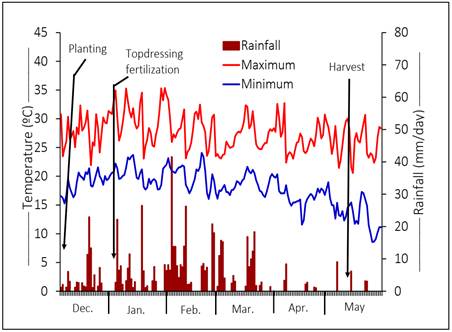
This study was conducted at the experimental field of São Paulo State University in Registro, São Paulo, Brazil (24°31’S; 47°51’W; altitude: 25 m). Daily rainfall and temperature were recorded throughout the experimental period (Figure 1). Soil samples were collected from the experimental area at 0-20 cm depth prior to the experiment installation. Soil chemical and textural properties were analyzed following the methods described by Raij et al. (2001) and Santos et al. (2006) (Table 1). Two months before sweet potato planting, the soil was limed with 396 kg/ha of dolomitic limestone (effective calcium carbonate equivalence = 90%). This liming was performed to increase soil base saturation to 60%, as recommended by Lorenzi et al. (1997).
The soil was conventionally tilled, and 30 cm high hills were made. Fertilization rates were determined based on soil analysis (Table 1) and the recommendations of Lorenzi et al. (1997). A total of 20 kg/ha nitrogen, 100 kg/ha phosphorus, and 100 kg/ha potassium were applied. This was achieved using N-P2O5-K2O 4-14-8 and potassium chloride (60% K2O) fertilizers. Fertilizers were incorporated into the soil during the building of the planting hills.
Sweet potato planting occurred on December 3, 2019. The experimental design used was a randomized block with five replications. Row spacing was maintained at 1.20 m. The cultivar used in this study was Canadense. The treatments were represented by planting densities. Four planting densities were evaluated: 25,000, 33,333, 41,667, and 50,000 plants/ha. These densities correspond to 3.0, 4.0, 5.0 and 6.0 plants per linear meter (Table 2). The plots had four three-meter-long rows, and the useful area was considered only the two centermost rows, two meters long.
To prepare the seedlings, three-month-old vines were harvested from the field. These vines were cut into mini-cuttings, each containing two nodes (buds). The mini-cuttings were subsequently rooted in trays filled with a substrate according to the methodology described by Ichikawa et al. (2019). The rooted seedlings from mini-cuttings were planted with their entire clod buried approximately 7 cm depth.
Thirty days after planting, 30 kg/ha N was applied in the form of urea (45% N). The urea was applied manually in a continuous band approximately 10 cm from the base of the plant row. During the cultivation period, all recommended management practices for sweet potato production in this region were followed.
Plants were harvested on May 14, 2020 (163 DAP). Plant shoots were manually removed from plants within the useful plot area. The plants were then excavated using a hoe, and their storage roots were collected. The collected storage roots were counted and classified into three size classes: <150 g, 150-300 g, and >300 g. The number of storage roots per plant was determined by dividing the total number of roots by six plants. Storage root density per m2 was calculated by dividing the number of roots per plant by the area occupied by each plant. After classification, storage roots were brushed to remove excess soil and weighed. Storage root yield was calculated by multiplying the weight of roots per plant by the planting density.
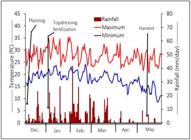
Daily rainfall (bars), and maximum (red line) and minimum (blue line) temperatures recorded in the experimental area between December 2019 and May 2020. Registro, UNESP, 2024.
Soil chemical properties of the experimental area at a 0.0-0.20 m depth before sweet potato planting. Registro, UNESP, 2024.
The total yield was determined by summing the yields of all three storage root size classes. Mean root weight was calculated by dividing the total root weight by the total root number in each plot. A representative sample of storage roots was collected, washed, sliced, and weighed to obtain the fresh weight. The fresh samples were dried in an oven at 65°C for 96 h and reweighed. Finally, the percentage of dry matter (DM) in the storage roots was calculated as the ratio of dry weight to fresh weight.
To determine reducing sugar, a 1 g sample received 50 mL of distilled water and was shaken and heated at 65°C for 30 minutes. After cooling, reducing sugars were quantified using the Somogyi methodology adapted by Nelson (1944). For total sugar content evaluation, samples of 500 mg received 30 mL of ethanol and 30 mL of distilled water. This suspension was shaken and heated at 60-65°C for 1 hour. After this, 1 mL of HCl was added and the suspension was shaken for another 1 hour at the same temperature. Subsequently, the total sugar content was determined using the Somogyi methodology adapted by Nelson (1944). Starch content was determined in samples of 200 mg that received 42 mL of distilled water, 100 μL of alpha-amylase enzyme, and 1 mL of 2 mol/L sodium acetate buffer (pH 5.35). This suspension was shaken for 2 hours at 90°C. The temperature was reduced to 50°C, and 100 μL of amyloglucosidase enzyme was added. The suspension was shaken again for 2 hours at 55°C. Sugar content was quantified using the Somogyi methodology adapted by Nelson (1944), and starch content was calculated by multiplying the sugar content by a factor of 0.9 (Mota et al., 2020). Data on reducing sugar, total sugar, and starch contents were converted to fresh weight (FW) contents. Starch yield was calculated by multiplying root starch content by total root yield.
Distance between plants in the row and the number of plants per meter of the row as a function of planting density. Registro, UNESP, 2024.
To analyze the data, analysis of variance (ANOVA) was performed using SISVAR software (Ferreira, 2011). The effect of plant density was assessed through regression analysis, where the model selection was based on significance (p<0,05) and the coefficient of determination (R2) criteria. Correlation analysis was conducted using the GGally package (Schloerke et al., 2024) in R 4.3.3 (R Core Team, 2021 and RStudio (Rstudio Team, 2021) softwares.
RESULTS AND DISCUSSION
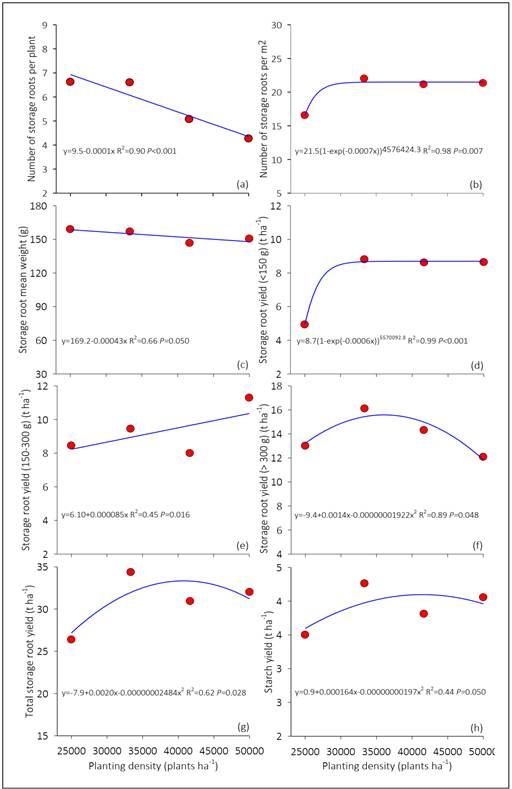
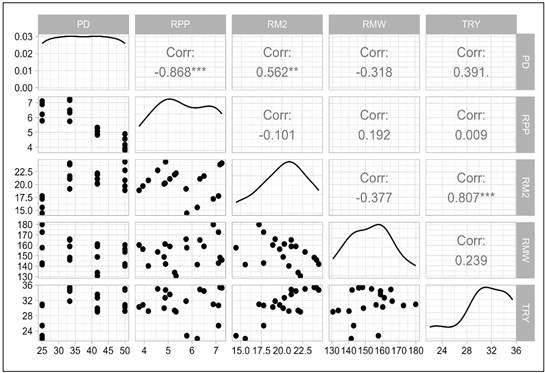
The results of this study demonstrated that increasing the planting density of mini-cutting seedlings can offset the reduction in root number per plant, leading to higher sweet potato yield without compromising root size or quality (Figures 2-4). As expected, the number of storage roots per plant decreased linearly by 36% with an increase in planting density (Figure 2a). This suggests that competition between sweet potato plants intensifies at higher planting densities, altering the development of individual storage roots. Consequently, a significant negative correlation was observed between planting density and the number of storage roots per plant (Figure 3). The impact of increased planting density was evident in the number of storage roots per plant that reduced by 36% (Figure 2a). At a density of 25,000 plants/ha, plants exhibited 7 roots per plant, while this number decreased to 4.5 roots per plant at 50,000 plants/ha (Figure 2a).
However, despite the reduction in root number per plant, increasing the planting density results in a 30% increase in the number of storage roots per unit area up to 33,333 plants/ha, stabilizing at higher planting densities (Figure 2b). The higher field survival rate of mini-cutting seedlings compared to traditional vine cuttings without roots (Islam et al., 2002) also contributes to increased root number per unit area. In this study, a positive and significant correlation was verified between the planting density and the number of storage roots per m2 (Figure 3), which is in accordance with previous findings (Ambe, 1995). Studies using the traditional propagation method and phosphate fertilization in soil with high P availability have observed values of 15 to 18.6 roots per m2 (Cordeiro et al., 2023). Our study, using mini-cutting seedlings, obtained a higher number of roots per m2 (16.5 to 21.5) (Figure 2b), which demonstrates that, if the planting density is adjusted, it is possible to increase the number of storage roots produced per area in a way similar to traditional propagation method.
An increase in the planting density led to a 7% linear decrease in the storage root mean weight (size) (Figure 2c). A negative and significant correlation between the number of roots per area and the root mean weight was verified in this study (Figure 3). Despite this size reduction, the mean weight of storage roots in high-density plantings remained within the range of 120-250 g obtained in a study using traditional propagation method (Cordeiro et al., 2023). While previous studies have shown that increased planting density can reduce storage root size (Ambe, 1995; Sokoto et al., 2007; Liang et al., 2023), the maximum planting density of 50,000 plants/ha used in this study did not compromise the shape quality of sweet potato storage roots propagated via mini-cuttings.
The yield of smaller storage roots (<150 g) increased by 76% with planting density up to 33,333 plants/ha and stabilized at the highest planting densities with an estimated storage root yield of 8.7 t/ha (Figure 2d). In the traditional sweet potato propagation method (using vine cuttings), increasing the number of buried buds in the soil or planting densities leads to higher yields of smaller roots (Perrud et al., 2021), due to increased competition for resources. However, in our study using mini-cutting seedlings, the yield of small storage roots did not increase beyond 33,333 plants/ha (Figure 2d).
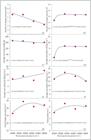
Effect of planting density on number of roots per plant (a, b), root mean weight (c), root yield by size class (d, e, f), total root yield (g), and starch yield (h) of the sweet potato crop.
Unlike sweet potatoes propagated using the traditional method, where increased planting density or number of storage roots per area correlates negatively with storage root size (Arancibia et al., 2014; Szarvas et al., 2018; Shrestha & Miles, 2022), our study found no correlation for mini-cutting propagation (Figure 3). This suggests that mini-cutting seedlings may be more efficient in use of resources, even at higher planting densities, resulting in fewer smaller roots and a more balanced yield distribution.
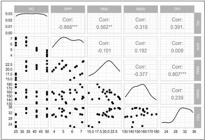
Pearson correlations among crop traits in the sweet potato crop. Crop traits correspond to: planting density (PD); storage root number per plant (RPP); storage root number per square meter (RM2); storage root mean weight (RMW); and total storage root yield (TRY). *p<0,05, **p<0,01, ***p<0,001. Planting density × 1000. Registro, UNESP, 2024.
In this study, the yield of storage roots weighing between 150 and 300 g increased linearly by 26% as planting density increased reaching 10.4 t/ha at 50,000 plants/ha (Figure 2e). This finding contrasts with traditional propagation method, where higher planting densities typically result in increased yields of smaller storage roots (Arancibia et al., 2014; Szarvas et al., 2018; Shrestha & Miles, 2022). The use of mini-cutting seedlings appears to mitigate the negative effects of increased competition, allowing for higher yields of larger storage roots.
For storage roots greater than 300 g, yield increased by 21% up to a planting density of 36,420 plants/ha reaching 15.6 t/ha and decreasing at higher densities (Figure 2f).This suggests that at optimal densities, mini-cutting propagation can improve the efficiency of resources use, reducing competition and leading to larger root development (Sokoto et al., 2007). While Islam et al. (2002, 2006) reported higher storage root yields for mini-cutting propagation compared to traditional propagation method, it is important to note that even this method can be negatively impacted by excessive plant density. High plant density can lead to reduced yields of larger storage roots, as verified in studies using traditional propagation methods with long vine cuttings (Schultheis et al., 1999; Sokoto et al., 2007; Szarvas et al., 2018). However, even when mini-cutting seedlings were used, adopting planting densities greater than 36,420 plants/ha reduced the yield of large roots by up to 24% (Figure 2f).
Increasing the planting density led to a 24% increase in total storage root yield up to a density of 40,258 plants/ha and a 17% increase in starch yield up to 41,624 plants/ha (Figure 2g and 2h). A significantly positive correlation was observed between the number of storage roots per m2 and total storage root yield (Figure 3). This indicates that higher planting density resulted in greater total root yield (Figure 2 g and 2h), due to increased storage roots per unit area (Figure 3). These findings demonstrate that increasing planting density can significantly improve the yield of storage roots and starch in sweet potatoes propagated via mini-cutting seedlings. While Nasser et al. (2020) reported lower root yields for mini-cutting propagation method compared to traditional method using long vine cuttings, their study used a single and lower planting density (31,250 plants/ha) for all mini-cutting treatments. Our results suggest that optimizing planting density can help maximize yield potential in mini-cutting propagation method.
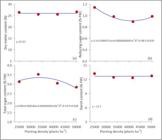
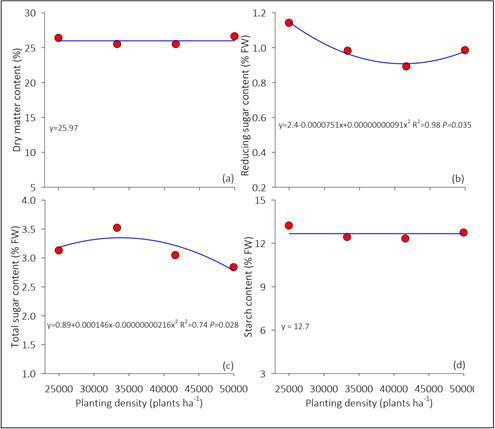
Effect of planting density on contents of dry matter (a), reducing sugar (b), total sugar (c), and starch (d) in the storage roots of the sweet potato crop. FW = fresh weight. Registro, UNESP, 2024.
While mini-cutting propagation method have fewer buried buds compared to traditional vine cutting propagation method (Rós et al., 2015; Nasser et al., 2020; Perrud et al., 2021), which would typically lead to fewer storage roots per unit area, the higher planting density in mini-cutting system compensates for this. Our results agree with other studies that have found that although individual storage root weight decreases at higher planting densities, the overall root yield increases due to the increased plant density (Sokoto et al., 2007). Additionally, the starch yield increased similarly to the total root yield as the treatments did not significantly affect the dry matter and starch contents of the storage roots (Figures 2g, 2h, 4a, and 4d).
The reducing sugar content decreased quadratically by 22% up to an estimated planting density of 41,264 plants/ha, while the total sugar content increased quadratically by 8% up to an estimated planting density of 33,796 plants/ha (Figures 4b and 4c). However, despite the changes in sugar content, the storage roots from mini-cutting propagated plants maintained a total sugar content range of 1.4 to 5.7% and a reducing sugar content range of 0.79 and 2.0%, i.e., values reported in other studies using traditional propagation method (Perrud et al., 2021; Fernandes et al., 2021). These results indicate that mini-cutting propagation method does not compromise the internal quality of sweet potatoes.
This study demonstrated that increasing the planting density of sweet potato propagated by mini-cutting seedlings led to higher total yields of storage roots and starch (Figures 2g and 2h). Analysis of storage root yield distribution revealed that higher planting densities favored the production of smaller roots and roots with sizes between 150 and 300 g. Furthermore, the optimal planting density to produce larger roots (>300 g) was 36,420 plants/ha. The results showed that increasing plant density did not negatively impact the size or internal quality of the storage roots compared to other studies using the traditional propagation method (Perrud et al., 2021; Fernandes et al., 2021; Cordeiro et al., 2023). Therefore, from a practical point of view, propagation of sweet potato using mini-cutting seedlings is technically feasible for cultivation areas, provided that an adequate planting density is adopted. While mini-cutting seedlings offer superior pests and disease quality compared to traditional vine cuttings, farmers face the additional challenge of either purchasing or producing them, which requires extra investment. Consequently, future economic studies will be crucial to determine the financial feasibility of this management practice in sweet potato production systems.
ACKNOWLEDGMENTS
We thank the Coordination for the National Council for Scientific and Technological Development (CNPq) for providing an award for excellence in research to the fourth author.
REFERENCES
- AMBE, JT. 1995. Effect of plant population density of sweet potato (Ipomoea batatas (L.) Lam) on weed incidence and severity in Cameroon. International Journal of Pest Management 41: 27-30.
- ANDRADE-JÚNIOR, VC; VIANA, DJS; PINTO, NAVD; RIBEIRO, KG; PEREIRA, RC; NEIVA, IP; AZEVEDO, AM; ANDRADE, PCR. 2012. Características produtivas e qualitativas de ramas e raízes de batata-doce. Horticultura Brasileira30: 584-589.
- ARANCIBIA, RA; SMITH, CD; LABONTE, DR; MAIN, JL; SMITH, TP; VILLORDON, AQ. 2014. Optimizing sweet potato production for fresh and processing markets through plant spacing and planting-harvest time. HortTechnology 24: 16-24.
- CARDOSO, AII; NASSER, MD; NAKADA-FREITAS, PG; VIEITES, RL; MARTINS, BN; RAMOS, JA; FURLANETO, KA; RÓS, AB. 2021. Productivity and quality of sweet potato roots propagated by mini-cuttings with different trays and seedling ages. Horticultura Brasileira39: 140-145.
-
CIP - International potato center. 2024. How sweet potato grows Available at: Available at: https://cipotato.org/sweetpotato/how-sweetpotato-grows/ Accessed on May 21, 2024.
» https://cipotato.org/sweetpotato/how-sweetpotato-grows/ - CORDEIRO, CFS; ECHER, FR; BATISTA, GD; FERNANDES, AM. 2023. Sweet potato yield and quality as a function of phosphorus fertilization in different soils. Revista Brasileira de Engenharia Agrícola e Ambiental27: 487-495.
- FERNANDES, AM; RIBEIRO, NP; ASSUNÇÃO, NS; NUNES, JGS; SORROCHE, CP; LEONEL, M. 2021. Impact of nitrogen and green manure on yield and quality of sweet potato in sandy soil: a Brazilian case study. Journal of Agriculture and Food Research 4: 100-131.
- FERREIRA, DF. 2011. Sisvar: A computer statistical analysis system. Ciência e Agrotecnologia35: 1039-1042.
- ICHIKAWA, ETM; FERNANDES, AM; MOTA, LHSO. 2019. Rooting of sweet potato seedlings submitted to supplemental calcium and phosphorus nutrition on the substrate. Revista Brasileira de Engenharia Agrícola e Ambiental23: 860-868.
-
ISLAM, AFMS; KUBOTA, C; TAKAGAKI, M; KOZAI, T. 2002. Sweet potato growth and yield from plug transplants of different volumes, planted intact or without roots. Crop Science42: 822-826. https://doi.org/10.2135/cropsci2002.8220
» https://doi.org/10.2135/cropsci2002.8220 - ISLAM, AFMS; KUBOTA, C; TAKAGAKI, M; KOZAI, T. 2006. Effects of ages of plug transplants and planting depths on the growth and yield of sweet potato. Scientia Horticulturae 108: 121-126.
-
LIANG, Q; CHEN, H; CHANG, H; LIU, Y; WANG, Q; WU, J; LIU, Y; KUMAR, S; CHEN, Y; CHEN, Y; ZHU, G. 2023. Influence of planting density on sweet potato storage root formation by regulating carbohydrate and lignin metabolism. Plants 12: 20-39. https://doi.org/10.3390/plants12102039.
» https://doi.org/10.3390/plants12102039 - LORENZI, JO; MONTEIRO, PA; MIRANDA FILHO, HS; RAIJ, B. 1997. Raízes e tubérculos. In: RAIJ, B; CANTARELLA, H; QUAGGIO, JA; FURLANI, AMC (eds). Recomendações de adubação e calagem para o Estado de São Paulo Campinas: Instituto Agronômico de Campinas. p.221-229 (Boletim Técnico, 100).
- MONTES, SMNM; PAULO, EM; MONTES, RM. 2015. Avaliação da ação de uma virose na produção e qualidade de tubérculos de batata-doce. Arquivos do Instituto Biológico82: 1-3.
- MOTA, LHSO; FERNANDES, AM; ASSUNÇÃO, NS; LEITE, HMF. 2020. Leaf area development and yield of cassava in response to pruning of shoots and the late supply of nitrogen and potassium. Agronomy Journal112: 1406-1422.
-
NASSER, MD; CARDOSO, AII; RÓS, AB; MARIANO-NASSER, FAC; COLOMBARI, LF; RAMOS, JA; FURLANETO, KA. 2020. Produtividade e qualidade de raízes de batata-doce propagadas por diferentes tamanhos de mini estacas. Scientia Plena16: 070204. https://doi.org/10.14808/sci.plena.2020.070204
» https://doi.org/10.14808/sci.plena.2020.070204 - NELSON, NA. 1944. photometric adaptation of the Somogyi method for the determination of glucose. Journal of Biological Chemistry153: 375-380.
- OZTURK, G. 2021. Performances of different seedling types used in sweet potato [Ipomea batatas (L.) Lam] growing. Turkish Journal of Field Crops 26: 54-59.
- PERESSIN, VA; FELTRAN, JC. 2014. Batata-doce: Ipomoea batatas (L.) Lam. In: AGUIAR, ATE; GONÇALVES, C; PATERNIANI, MEAGZ; TUCCI, MLS; CASTRO, CEF(eds). Instruções agrícolas para as principais culturas econômicas 7. ed. Revisada e ampliada. Campinas: Instituto Agronômico. p.59-61. (Boletim 200).
-
PERRUD, AC; BAVARESCO, LG; ZEIST, AR; LEAL, MH; SILVA JÚNIOR, AD; RESENDE; JT; SILVA, ML; TOROCO, BR. 2021. Relationship between bud number in seed branches and yield aspects of sweet potato. Horticultura Brasileira39: 451-457. https://doi.org/10.1590/s0102-0536-20210415
» https://doi.org/10.1590/s0102-0536-20210415 -
R Core Team. 2021. R: A language and environment for statistical computing Vienna, Austria: R Foundation for statistical computing. Available at: Available at: https://www.R-project.org/ Accessed at May 21, 2024.
» https://www.R-project.org/ - RAIJ, B; ANDRADE, JC; CANTARELLA, H; QUAGGIO, JA. 2001. Análise química para avaliação da fertilidade de solos tropicais Campinas: Instituto Agronômico. 284p.
- REGHIN, MY; OTTO, RF; OLINIK, JR; JACOBY CFS. 2007. Viabilidade do sistema de produção de mudas em bandejas em três cultivares de cebola. Ciência e Agrotecnologia31: 1075-1084.
- RÓS, AB; FERNANDES, AM; MONTES, SMNM; FISCHER, IH; LEONEL, M; FRANCO, CML. 2015. Batata-doce. In: LEONEL, M; FERNANDES, AM; FRANCO, CML (eds). Culturas Amiláceas: batata-doce, inhame, mandioca e mandioquinha-salsa 1 ed.Botucatu: CERAT/UNESP. p. 15-120.
- RÓS, AB; HIRATA, ACS; SANTOS, HS. 2012. Avaliação da produtividade de plantas de batata-doce oriundas de matrizes livres de vírus. Revista Brasileira de Ciências Agrárias7: 434-439.
-
RÓS, AB; MONTES, SMNM; NARITA, N; TAVARES FILHO, J. 2011. Technical viability of the production of sweet potatoes plantlets in trays. Semina: Ciências Agrárias 32: 1423-1428. https://doi.org/10.5433/1679-0359.2011v32n4p1423
» https://doi.org/10.5433/1679-0359.2011v32n4p1423 - RÓS-GOLLA, A; HIRATA, ACS; ARAÚJO, HS; SANTOS, VB; NARITA, N. 2010. Multiplicação de material vegetativo de batata-doce em diferentes bandejas e produção de raízes. Pesquisa & Tecnologia7: 1-7.
-
RStudio Team. 2021. RStudio: Integrated Development Environment for R Boston, MA: RStudio. Available at:Available at:http://www.rstudio.com/ Accessed at May 21, 21024.
» http://www.rstudio.com/ - SANTOS, HG; JACOMINE, PKT; ANJOS, LHC; OLIVEIRA, VA; OLIVEIRA, JB; COELHO, MR; LUMBRERAS, JF; CUNHA, TJF. 2006. Sistema brasileiro de classificação de solos 2. ed.Rio de Janeiro: EMBRAPA. 306p.
-
SCHLOERKE, B; COOK, D; LARMARANGE, J; BRIATTE, F; MARBACH, M; THOEN, E; ELBERG, A; CROWLEY, J. 2024. GGally: Extension to 'ggplot2'. R package version 2.2.1 Available at: Available at: https://github.com/ggobi/ggally Accessed at May 21, 21024.
» https://github.com/ggobi/ggally - SCHULTHEIS, JR; WALTERS, SA; ADAMS, DE. 1999. In-row plant spacing and date of harvest of ‘Beauregard’ sweet potato affect yield and return on investment. HortScience34: 1229-1233.
- SHRESTHA, S; MILES, C. 2022. Plastic mulch and in-row spacing effects on sweet potato yield in Northwest Washington. HortTechnology32: 241-251.
- SOKOTO, MB; MAGAJI, MD; SINGH, A. 2007. Growth and yield of irrigated sweet potato (Ipomoea batatas (L.) Lam.) as influenced by intra-row spacing and potassium. Journal of Plant Sciences2: 54-60.
- SZARVAS, A; HERCZEG, E; PAPP, L; MONOSTORI, T. 2018. The effect of planting density on the yield of sweet potato [Ipomoea batatas (l.) lam.] in South-East Hungary in 2017. Research Journal of Agricultural Science 50: 159-163.
Consent for publication
The data will be made available upon request to the corresponding author.