 Phytochemical profiling and antioxidant capacity of nine basil cultivars
ABSTRACT
The aim of this study was to evaluate the phytochemical potential of nine basil varieties (Ocimum basilicum) grown under the same growth conditions, placed in one-gallon black plastic pots, containing a sand:perlite (80:20) mixture in a greenhouse. The genus Ocimum, part of the Lamiaceae family, includes around 150 species, many of which have been used medicinally since ancient times. In basil, various secondary metabolites such as terpenoids (including methyl chavicol, geraniol, linalool, 1,8-cineole, methyl eugenol, p-allylanisole, neryl acetate, and trans-bergamotene), flavonoids, phenols, anthocyanins, steroids, and tannins have been identified. Plants sample collections were conducted using a randomized design to ensure representative sampling of all nine basil varieties. The obtained samples were subsequently analyzed for phytochemical analysis in which, spectrophotometric methods were used for extracting and quantifying the phenolic compounds and flavonoids. High-performance liquid chromatography (HPLC) further identified specific compounds. Phenolic compounds values ranged from 1.4 to 8.2 mg GAE/g DW, for flavonoids values oscillated between 54.7-8.1 mg QE/g DW and for antioxidant activity the best essay was by ABTS with superior numbers. Compared with the DPPH method, only the results obtained by the first method mentioned were analyzed. The highest values for gallic acid, morin and ferulic acid were 8.4, 2.1, 9.4 mg/g respectively. These findings can be useful for selecting basil varieties with high contents of bioactive compounds for applications in the food and pharmaceutical industries.
Keywords:
Ocimum basilicum; antioxidants; flavonoids; HPLC; phenolics; secondary metabolites
RESUMO
O objetivo deste estudo foi avaliar o potencial fitoquímico de nove variedades de manjericão (Ocimum basilicum) cultivadas sob as mesmas condições de crescimento, colocadas em vasos plásticos pretos de um galão, contendo uma mistura de areia:perlita (80:20) em uma estufa. O gênero Ocimum, parte da família Lamiaceae, inclui cerca de 150 espécies, muitas das quais têm sido usadas medicinalmente desde os tempos antigos. No manjericão, vários metabólitos secundários, como terpenoides (incluindo metil chavicol, geraniol, linalol, 1,8-cineol, metil eugenol, p-alilanisol, acetato de nerila e trans-bergamoteno), flavonoides, fenóis, antocianinas, esteroides e taninos foram identificados. As coletas de amostras de plantas foram conduzidas usando um delineamento casualizado para garantir amostragem representativa de todas as nove variedades de manjericão. As amostras obtidas foram posteriormente analisadas para análise fitoquímica, na qual métodos espectrofotométricos foram utilizados para extrair e quantificar os compostos fenólicos e flavonoides. A cromatografia líquida de alta eficiência (CLAE) identificou compostos específicos. Os valores de compostos fenólicos variaram de 1.4 a 8.2 mg GAE/g PS, para flavonoides. Os valores oscilaram entre 54.7 e 8.1 mg QE/g PS e para atividade antioxidante o melhor ensaio foi o da ABTS, com números superiores. Em comparação com o método DPPH, apenas os resultados obtidos pelo primeiro método mencionado foram analisados. Os maiores valores para ácido gálico, morina e ácido ferúlico foram 8.4, 2.1 e 9.4 mg/g, respectivamente. Esses resultados podem ser úteis para a seleção de variedades de manjericão com alto teor de compostos bioativos para aplicações nas indústrias alimentícia e farmacêutica.
Palavras-chave:
Ocimum basilicum; antioxidantes; flavonoides; CLAE; fenólicos; metabólitos secundários
The genus Ocimum, part of the Lamiaceae family, includes around 150 species (Simon, 1992), many of which have been used medicinally since ancient times. Notably, Ocimum basilicum L. (Siddiqui et al., 2012), commonly known as sweet basil, is a widely cultivated, perennial herbaceous plant (Bantis et al., 2016) used as an ornamental, culinary, and kitchen herb (Gülçin et al., 2007). Its essential oils are utilized in food flavoring, commercial fragrances, and food preservation (Nguyen, & Niemeyer, 2008). The plant is significant in fields such as pharmacology, food, agriculture, and cosmetics (Qasem et al., 2023).
Since ancient times, medicinal plants have been utilized in traditional and complementary medicine to treat, manage, or prevent various illnesses (Chaachouay et al., 2022). It is estimated that 80% of the global population relies on ethnomedicine or herbal remedies as their primary healthcare approach for various ailments across different regions (Tugume & Nyakoojo, 2019). Ocimum basilicum, also referred to as sweet basil or common basil, is one of the most important and widely consumed species in the Mediterranean region (Qamar et al., 2023). It is also a popular flavoring agent in American and Mediterranean cuisines (Luca et al., 2022). The Ocimum genus, known collectively as basil, encompasses more than 30 different species (Majdi et al., 2020). This plant is widely cultivated in Central and Southeast Asia, including regions like Iran and Pakistan (Aminian et al., 2022). In Ayurvedic and Unani medicine, sweet basil is well-regarded for treating numerous diseases (Yadav et al., 2022).
Ocimum basilicum is renowned for its diverse biological properties, such as anti-allergic, anti-angiogenic, anti-depressant, anti-inflammatory, anti-tumor, and anti-microbial effects. These properties are attributed to secondary metabolites like tannins, phenols, flavonoids, anthocyanins, and steroids, which protect against oxidative damage by neutralizing free radicals or absorbing reactive oxygen species (Gutierrez-de-Río et al., 2021). These antioxidants can work synergistically with other natural and synthetic antioxidants, enhancing their potential and reducing the therapeutic doses needed for various medications, thereby minimizing adverse effects (Beltran-Noboa et al., 2023).
Some principal species of Ocimum include O. basilicum, O. gratissimum, O. kilimandscharicum, O. lamiifolium, O. minimum, O. citriodorum, and O. americanum, categorized based on their chemical composition and morphology. However, analyzing the chemical composition of these species is complex and varies due to factors like edaphic conditions, climatic zones, cross-hybridization, polyploidization, morphogenesis, harvesting, drying, and storage (Beltran-Noboa et al., 2023).
The pharmacological potential of medicinal plants is linked to their bioactive compounds synthesized as secondary metabolites. In basil, various secondary metabolites such as terpenoids (including methyl chavicol, geraniol, linalool, 1,8-cineole, methyl eugenol, p-allylanisole, neryl acetate, and trans-bergamotene), flavonoids, phenols, anthocyanins, steroids, and tannins have been identified (Qasem et al., 2023). Aromatic herbs like basil can act as functional foods and nutraceuticals, reducing health risks and enhancing well-being due to their bioactive properties. Different parts of the basil plant, including roots, stems, flowers, and seeds, are used, but its green leaves are particularly popular. These leaves, consumed fresh or dried, are rich in essential oils, flavonoids, and phenolic acids, which have potent antioxidant, anti-inflammatory, antibacterial, and antiviral properties (Carvalho et al., 2024).
MATERIAL AND METHODS
Location of the experiment
The different varieties of basil were established in March 2023 in a greenhouse with sliding plastic covers and semi-automatic control anti-aphid mesh located at the Polytechnic University of Gómez Palacio, Durango (25°38'20''N; 103°31'52''W). The temperature and relative humidity values of the greenhouse were maintained between 25 to 30°C and 70-80%, respectively. The varieties of basil used were Thai, Red Rubin, Emily, Lemon, Anis, Nufar, Napolitano, White and Cinnamon.
Establishment of cultivars
Nine different varieties of basil were planted, the seeds of which were purchased online from the company Group Alter Mex. Sowing was carried out in 250-cavity polystyrene germination trays and peat moss was used as a substrate. The trays were watered twice a day with water until the day of transplanting. When the seedlings had three to four true leaves and a height of 10 to 15 cm, they were transplanted into one-gallon black plastic pots, which contained a mixture of sand:perlite (80:20).
Preparation of samples and obtaining extracts
After transplanting, 35 days were allowed to pass and leaf samples were taken from the nine varieties of basil until samples were obtained from all the plants in the experiment. All samples were washed with distilled water and the excess was removed on tan paper. The drying process was carried out at room temperature (25 ±2°C) for 15 days. After dehydration, the samples went through a grinding process until obtaining powder. This process was carried out in a blender (Hamilton Beach). After that, the pulverized samples were stored at room temperature, in tan paper bags, for the subsequent obtaining of extracts (Abkhoo & Jahani, 2017). Extracts were obtained using the solid-liquid extraction technique by adding 1 g of each of the pulverized samples placed in test tubes. 10 mL of Jalmek brand ethanol were added. An automated shaker was used for 24 h (Stuart®) to keep the mixture under stirring at room temperature (25±2°C). After the stirring time, the samples were allowed to rest in a rack for the dephasing and precipitation of each sample. When the separation was observed, the extract was obtained, leaving the precipitated sample in the tubes. The extracts were concentrated to obtain the compounds of interest with a rotary evaporator (Buchí, model-210) and a water bath (RIOSA, Mexico) at 35-40°C. The extracts obtained were stored ultra-frozen at -20°C until analysis (Ramírez-Aragón et al., 2019).
Quantification of total phenolics (TPC)
The determination of total phenolic compounds was carried out by spectrophotometry (Genesys® 10 UV equipment, USA), based on the colorimetric redox reaction according to Lillo et al. (2016) with some modifications. To 30 μL of extract, 2 mL of distilled water and 250 μL of Folin-Ciocalteu reagent (analytical grade, Sigma-Aldrich, St. Louis MO, USA) were added. Subsequently, 1 mL of 10% w/v Na2CO3 was added, and the mixture was brought to a final volume of 5 mL with distilled water. Samples were read at a wavelength of 765 nm after remaining at room temperature and in the absence of light for 1 hour. For the calculation of total phenolics, a calibration curve was made with analytical grade gallic acid (Sigma-Aldrich, St. Louis MO, USA). The phenolic content was expressed in mg GAE/g DW (mg gallic acid equivalents per gram of dry weight).
Quantification of total flavonoids (FVT)
Flavonoids were quantified through a spectrophotometric analysis (Genesys® 10 UV equipment, USA) based on the formation of a complex between Al (III) ions and the carbonyl and hydroxyl groups of the flavonoid, as described by Lillo et al. (2016) with some modifications. 50 μL of extract was mixed with 100 μL of 5% w/v AlCl3 in ethanol, 100 μL of 1M sodium acetate, and brought to a final volume of 5 mL with analytical grade methanol (JT Baker). Flavonoid compounds were measured at a wavelength of 425 nm after remaining in the dark for 30 minutes. A calibration curve was made with analytical grade quercetin (Sigma-Aldrich, St. Louis MO, USA) prior to the reading. The flavonoid content was expressed in mg QE/g DW (mg quercetin equivalents per gram of dry weight).
Determination of antioxidant capacity (AOX)
The antioxidant capacity was measured according to the methodology proposed by Chaves et al. (2020) with modifications. The ABTS radical (2,2’-azinobis-3-ethylbenzothiazoline-6-sulfonic acid) was obtained through the reaction of ABTS (7 mM) with potassium persulfate (K2S2O8) 2.45 mM, then brought to a volume of 10 mL with water and incubated at room temperature (±25°C) in the dark for 18 hours. The ABTS radical was diluted in ethanol to obtain an absorbance value between 0.7 (±0.1) at a wavelength of 754 nm. Extracts were dissolved in ethanol at a concentration of 200 mg/L. Then, 50 μL of sample and 1,950 μL of ABTS were placed in a test tube, shaken for 1 minute, and kept in the dark for 10 minutes. After the reaction, the absorbance was read at 754 nm (Genesys 10 UV spectrophotometer, USA). Results were expressed as the percentage of inhibition in micromoles of Trolox equivalents per gram of dry weight (μmol Trolox/g DW).
Other method used for AOX was by DPPH. To achieve this, a stock solution of 10-3 M DPPH radicals in ethanol or methanol was freshly prepared prior to analysis. For the DPPH solution preparation, 3 mL of the stock solution was diluted to 50 mL with methanol in a volumetric flask, and the mixture was protected from light using aluminum foil. The absorbance values were adjusted to 1.00±0.200. Subsequently, 3 mL of the DPPH working solution was added to 0.5 mL of the extract, mixed, and kept in the dark for 30 minutes. The purple color fades when an antioxidant is present in the reaction mixture. A reference sample containing 0.5 mL of the solvent was prepared in the same manner. A freshly prepared DPPH radical solution exhibits maximum absorption at 517 nm. All analyses were performed in triplicate, and absorbance was measured at 517 nm. The blank sample is the reaction mixture without the test compounds (Gulcin & Alwasel, 2023).
Determination of gallic acid, morin, and ferulic acid
The separation and quantification of gallic acid, morin, and ferulic acid were performed using high-performance liquid chromatography (HPLC, Agilent Technologies, USA) under conditions initially developed by Shan et al. (2005). The method was detailed previously by Nguyen & Niemeyer (2008). This method was adapted to the laboratory equipment conditions, utilizing a dilution gradient with 10% formic acid (Sigma Aldrich) (dilution A) and 80% methanol (ITEMS, Mexico) (dilution B) as mobile phases. The HPLC was equipped with a 5 μL injection flow and a C-18 column from Agilent Technologies, USA (5 μm, 4.6 mm x 50 mm).
Before analysis, the basil extracts were filtered using Millex GS microdiscs with a 45-micron pore size. The specific compounds were identified using absorbance at a wavelength of 280 nm by comparing the retention times from chromatography against analytical standards from Sigma Aldrich. Each compound was quantified by comparing the integrated peak areas to external calibration curves and reported as milligrams of gallic acid, morin, and ferulic acid per gram of sample (mg/g).
Statistical analysis
The statistical analysis was conducted through analysis of variance using the SAS 9.0 program, and mean comparisons were performed using the LSD test with a significance level of p≤0.05. A randomized block design was used, with three repetitions per treatment.
RESULTS AND DISCUSSION
Phenolic compounds
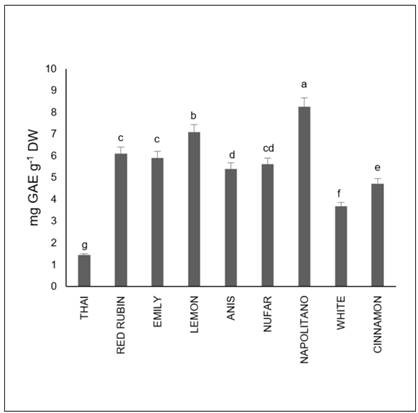
In this study, TPC values ranged from 1.4 to 8.2 mg GAE/g DW, with the Ocimum basilicum Napolitano variety having the highest TPC content and the Thai variety the lowest concentration. The nine analyzed varieties showed significant differences (p≤0.05) indicating that genetic variation among basil varieties plays a crucial role in determining phenolic compound levels. The Red Rubin and Emily varieties reported statistically similar values, as did the Anis and Nufar varieties (Figure 1).
A study conducted on leaf extracts from three different basil varieties reported phenolic compound concentrations ranging from 5.5 to 7.1 mg GAE/g FW. These results are consistent with the findings of the current study. The varieties used by Prinsi et al. (2019) were Italiano Classico, Red Rubin, and Dark Opal, which showed similar concentrations to the Red Rubin, Lemon, Anise, and Nufar varieties analyzed in this study. On the other hand, the Thai and White varieties showed lower concentrations than those previously mentioned.
Another study reported TPC values ranging from 1.14 to 0.89 mg GAE/g DW in basil leaf extracts using different solvents for extraction (Do et al., 2020). Despite one of the solvents, they used to be the same as in this study (ethanol), their reported results are significantly lower than those found in this study, where the lowest value recorded was 1.4 mg GAE/g DW.The presence of high phenolic content in certain basil varieties suggests their enhanced capacity for free radical scavenging, which is crucial for reducing oxidative stress in biological systems. Phenolic compounds, such as gallic acid and ferulic acid, have been extensively documented for their role in preventing chronic diseases, including cardiovascular disorders and neurodegenerative conditions (Chatterjee & Sarkar, 2024).
1. Concentration of phenolic acids in nine varieties of basil. Experiment carried out at the facilities of the Universidad Autonoma Agraria Antonio Narro (UAAAN). Torreón, Coahuila, México 2024. a-g Different letters indicate statistical differences at the p<0.05 for each sample.
Regarding the total phenol content in basil, it's noteworthy that reported values in the literature can differ by up to an order of magnitude. This variability is likely due to factors such as differences in the harvest time of plants, the use of fresh versus dried tissues for analysis, and the methodological approaches employed. Studies evaluating the total phenol concentrations in dried leaf tissues of various basil cultivars have found ranges from 5 to 27 mg GAE/g DW (Kwee & Niemeyer, 2011; Flanigan et al., 2014). Given these findings, high-TPC basil varieties such as Napolitano could be preferentially cultivated for the development of antioxidant-rich functional foods and dietary supplements.
Total flavonoids
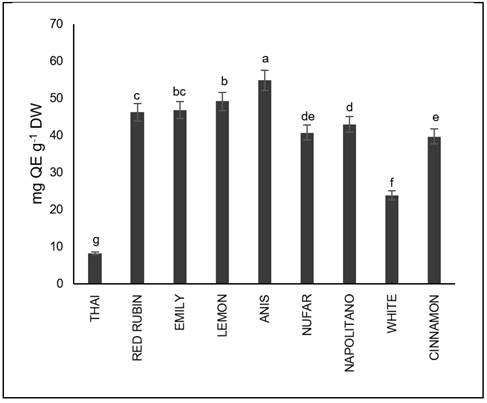
For FVT concentration, the Ocimum basilicum varieties Anis, Lemon, Emily, Red Rubin, Napolitano, Nufar, Cinnamon, White, and Thai obtained values of 54.7, 49.12, 46.7, 46.1, 42.9, 40.6, 39.6, 23.7, and 8.1 mg QE/g DW respectively (Figure 2), showing that the Thai variety had the lowest values in both TPC and FVT compared to the other analyzed varieties. These results highlight a broad variation in flavonoid content among basil cultivars, reinforcing the importance of genetic selection in optimizing basil's health benefits.
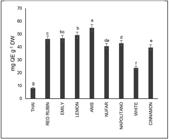
Concentration of total flavonoids in nine varieties of basil. Torreón, Coahuila, México 2024. a-gDifferent letters indicate statistical differences at the p<0.05 for each sample.
According to the reviewed literature, a study analyzed sweet basil extracts for total flavonoid content, varying the temperatures and concentrations of the extraction solvent. They found values ranging from 18.8 to 24.2 mg QUE/g DW (Qazizadah et al., 2023). Comparing these results with those obtained in the current study, the reported values are over 40% higher for most of the evaluated genotypes. The White variety matches the values reported by Qazizadahet al. (2023); however, the Thai variety showed values up to 50% lower for the total flavonoid content (TFC). It is worth noting that the Ocimum Thai variety has been reported to have the lowest concentrations for most of the evaluated antioxidant variables.
Another article that studied different basil varieties reported TFC concentrations ranging from 7.1 to 23.8 mg RU/g DW (Jakovljević et al., 2022). These aforementioned results are closer to those found in this study, as they are higher than those reported by Qazizadah et al. (2023). Nonetheless, TFC in this study still shows higher values for most of the Ocimum basilicum varieties analyzed.
Flavonoids have been widely studied for their potent anti-inflammatory, antimicrobial, and anticancer properties. The significant flavonoid content in the Anis and Lemon varieties suggests their potential use in pharmaceutical formulations for inflammatory diseases and microbial infections. Moreover, research has demonstrated that flavonoid-rich plant extracts exhibit strong neuroprotective effects, making these varieties promising candidates for the development of nutraceuticals aimed at preventing neurodegenerative disorders such as Alzheimer's disease (Jakovljević et al., 2023). Additionally, flavonoids contribute to the preservation of food products due to their antioxidant activity, which can delay lipid oxidation and extend shelf life (Ghasemzadeh et al., 2016). Thus, the high flavonoid content in select basil cultivars highlights their potential for commercial applications in both the food and pharmaceutical industries.
Antioxidant capacity
This study demonstrated free radical scavenging properties, with the obtained values indicating antioxidant capacities (AOX) based on the elimination of free radicals using the ABTS and DPPH techniques. It was observed that the values for free radical scavenging activity were higher when the ABTS technique was used. Most analyzed varieties reported higher values with the ABTS technique compared to the DPPH technique (Table 1).
The reported AOX values in this study ranged from 5394 to 602 and 6364 to 5277.9 μmol Trolox/g DW for the DPPH and ABTS techniques, respectively. The Nufar variety showed higher values compared to the other analyzed phenotypes, while the Thai variety had the lowest AOX concentration using the DPPH technique. When the ABTS technique was used, the Nufar, Anis, Napolitano, Lemon, and Cinnamon varieties did not show significant differences among themselves, showing higher values compared to the DPPH technique these results making them promising candidates for food preservation, cosmetic formulations, and pharmaceuticals aimed at combating oxidative stress. The observed results align with previous findings showing that basil extracts rich in polyphenols exhibit superior radical scavenging activity (Floegel et al., 2011). The Thai variety had the lowest concentration in the ABTS technique, consistent with the DPPH technique; however, the values obtained with the ABTS technique showed greater radical elimination than with the DPPH technique (Table 1).
According to the results obtained by Romano et al. (2022), the reported antioxidant activity ranged between 1.14 and 1.86 mmol Trolox equivalents (TE)/g of extract when using the DPPH technique. These results are lower than those found in the present study, except for the Thai variety, which has a lower value compared to the other varieties. However, the varieties analyzed by Romano et al. were Italiano Classico and Genovese, which may influence the concentration of antioxidant compounds since the variation among genotypes is quite broad.
A similar trend with comparable results was observed by Coelho et al. (2018). They found that the ethanolic extract exhibited higher antioxidant capacity in both the DPPH test (IC50 = 3.99 mg/mL) and the reducing power assay (285.1 TE/g extract) compared to the supercritical fluid extracts (5.63 mg/mL and 111.7 TE/g, respectively). Floegel et al. (2011) confirmed that in a wide range of food matrices, the ABTS assay values are often higher than those of the DPPH assay, indicating that the ABTS assay reacts with more components and in different ways than the DPPH assay.
Given the global rise in chronic diseases linked to oxidative damage, incorporating these basil varieties into functional foods or supplements could contribute to preventive healthcare strategies. Moreover, antioxidant-rich basil extracts have potential applications in skincare products, where oxidative stress plays a key role in premature aging and inflammatory skin conditions (Luca et al., 2022). Further studies should explore the synergistic effects of basil antioxidants with other bioactive compounds to enhance therapeutic efficacy.
Specific compounds (gallic acid, morin, and ferulic acid)
According to the results obtained for specific phenolic and flavonoid compounds, it was reported that for gallic acid, the Thai variety, with 8.4 mg GA/g, contains the highest concentration of gallic acid, while the Ocimum White and Ocimum Cinnamon varieties did not report the presence of gallic acid. Regarding the flavonoid morin, the Lemon basil variety had the highest concentration of this compound with a value of 2.1 mg MOR/g. On the other hand, the White and Cinnamon varieties did not report any morin concentration, coinciding with the absence of gallic acid in these two varieties. In terms of ferulic acid concentration, values ranged from 0.018 to 9.42 mg FA/g for the Cinnamon and Thai varieties, respectively. From the reported values, it is observed that the Thai variety presents the highest amount of both gallic acid and ferulic acid, both of which are phenolic acids. Concerning the flavonoid morin, the Lemon variety showed the highest concentration of this flavonoid, and in the analysis of total flavonoids, it was one of the varieties with the highest concentration (Table 2).
Studies have shown that extracts from various basil varieties contain different total phenolic compounds (TPC), particularly phenolic acids such as rosmarinic, caffeic, caftaric, and cichoric acids, which greatly enhance their antioxidant properties. Alongside phenolic acids, flavonoids are also present (Ghasemzadeh et al., 2016; Jakovljević et al., 2022). Understanding the metabolic differences between organs, tissues, and cells is crucial for comprehending plant metabolism (Miguel et al., 2016). However, there is limited information about the correlation between secondary metabolite content and phenylalanine ammonia-lyase (PAL) enzyme activity in different basil genotypes. A recent study investigating the induced synthesis of secondary metabolites in various basil cultivars under tissue culture conditions (Jakovljević et al., 2019) demonstrated that increased PAL activity, along with higher TPC and improved antioxidant capacity, can be achieved in three basil cultivars ('Genovese', 'small-leaved', and 'lemon basil') under nutrient deficiency conditions (Jakovljević et al., 2023).
Based on the aforementioned points, it can be deduced that the specific secondary metabolites reported in the study depend on various factors, starting with the basil genotype studied. As a result, the reported concentrations vary according to the genotype and the conditions during the plant's growth.
In this study, nine basil (Ocimum basilicum) varieties were analyzed to evaluate their phenolic and flavonoid compound contents, as well as their antioxidant capacity. The results showed a significant variation in the concentration of these compounds among the different varieties, influenced by the genotype and growth conditions of the plants. The Napolitano variety presented the highest TPC content, while the Thai variety showed the lowest concentration. The antioxidant capacity measured by the DPPH and ABTS methods showed that the Emily, Lemon, Nufar, and Napolitano varieties had the highest values, while the Thai variety had the lowest values. The Thai variety presented the highest concentration of gallic and ferulic acid, while the White and Cinnamon varieties did not report the presence of these compounds. The Lemon variety showed the highest concentration of morin.
Gallic acid is known for its antimicrobial properties and has been used in food preservation as a natural alternative to synthetic preservatives. Its presence in high concentrations in the Thai variety suggests its potential for inclusion in antimicrobial coatings for fresh produce or food packaging (Romano et al., 2022). Ferulic acid, on the other hand, has been identified as an effective photoprotective agent, with applications in cosmetic products aimed at preventing UV-induced skin damage (Coelho et al., 2018). The significant concentration of morin in the Lemon variety suggests its potential for inclusion in dietary supplements targeting inflammatory diseases, as morin has demonstrated anti-inflammatory and immunomodulatory properties in recent studies (Jakovljević et al., 2023). In conclusion, the study reveals a high degree of phytochemical variability in nine varieties of basil (Ocimum basilicum), with an enrichment of phenolic compounds, flavonoids, and antioxidant activity. These results highlight the impact of genotype and environment on the total phenolic and flavonoid content, composition, and their yield in basil, suggesting that breeding and cultivation approaches panning specific aspects of the environmental conditions as well as planting approaches can enhance the accumulation of these bioactive compounds.
Basil varieties such as Napolitano, Anis, Lemon, and Nufar showed superior antioxidant activity; this finding makes them ideal candidates for developing natural products that benefit health. Additionally, specific basil varieties suggest potential applications in functional foods, pharmaceuticals, and cosmetics due to the high concentrations of gallic acid, morin, and ferulic acid.
Future research should focus on optimizing cultivation practices or developing different types of fertilization to maximize the accumulation of beneficial phytochemicals in basil. Furthermore, in vivo and clinical studies are needed to validate the health benefits observed in vitro and facilitate the integration of basil-derived compounds into commercial products intended for the production of functional food byproducts or in various areas such as cosmetics, microbiology, and others.
ACKNOWLEDGMENTS
We thank the Secretaria de Ciencias, Humanidades, Tecnología e Innovacion (Secretary of Science, Humanities, Technology and Innovation; SECIHTI) for the postdoctoral fellowship of RAMG(CVU: 583735) and the support for the scholarship to carry out postgraduate studies of MAE.
REFERENCES
-
ABKHOO, J; JAHANI, S. 2017. Antibacterial effects of aqueous and ethanolic extracts of medicinal plants against pathogenic strains. International Journal of Infection4(2). https://doi.org/10.5812/iji.42624
» https://doi.org/10.5812/iji.42624 -
AMINIAN, AR; MOHEBBATI, R; BOSKABADY, MH. 2022. The effect of Ocimum basilicum L. and its main ingredients on respiratory disorders: An experimental, preclinical, and clinical review. Frontiers in Pharmacology 12: 805391. https://doi.org/10.3389/fphar.2021.805391
» https://doi.org/10.3389/fphar.2021.805391 -
BANTIS, F; OUZOUNIS, T; RADOGLOU, K. 2016. Artificial LED lighting enhances growth characteristics and total phenolic content of Ocimum basilicum, but variably affects transplant success. Scientia Horticulturae198: 277-283. https://doi.org/10.1016/j.scienta.2015.11.014
» https://doi.org/10.1016/j.scienta.2015.11.014 - BELTRÁN-NOBOA, A; JORDAN-ÁLVAREZ, A; GUEVARA-TERÁN, M; GALLO, B; BERRUETA, LA; GIAMPIERI, F; TEJERA, E. 2023. Exploring the chemistry of Ocimum species under specific extractions and chromatographic methods: a systematic review. ACS Omega8: 10747-10756.
-
CHAACHOUAY, N; DOUIRA, A; ZIDANE, L. 2022. Herbal medicine used in the treatment of human diseases in the Rif, Northern Morocco. Arabian Journal for Science and Engineering47: 131-153.https://doi.org/10.1007/s13369-021-05501-1
» https://doi.org/10.1007/s13369-021-05501-1 - CHATTERJEE, A; SARKAR, B. 2024. Polyphenols and terpenoids derived from Ocimum species as prospective hepatoprotective drug leads: a comprehensive mechanistic review. Phytochemistry Reviews 1-43. https://doi.org/10.1007/s11101-024-09992-2
-
CHAVES, N; SANTIAGO, A; ALÍAS, JC. 2020. Quantification of the antioxidant activity of plant extracts: Analysis of sensitivity and hierarchization based on the method used. Antioxidants 9: 76. https://doi.org/10.3390/antiox9010076
» https://doi.org/10.3390/antiox9010076 -
COELHO, J; VEIGA, J; KARMALI, A; NICOLAI, M; PINTO-REIS, C; NOBRE, B; PALAVRA, A. 2018. Supercritical CO2 extracts and volatile oil of basil (Ocimum basilicum L.) comparison with conventional methods. Separations 5: 21. https://doi.org/10.3390/separations5020021
» https://doi.org/10.3390/separations5020021 - CARVALHO, JVD; DE FREITAS, RV; BEZERRA, CV; TEIXEIRA-COSTA, BE; DOS-SANTOS, OV. 2024. Application of the cryo-drying technique in maintaining bioactive and antioxidant properties in basil leaves (Ocimum basilicum). Horticulturae10: 457.
-
DO, TH; TRUONG, HB; NGUYEN, HC. 2020. Optimization of extraction of phenolic compounds from Ocimum basilicum leaves and evaluation of their antioxidant activity. Pharmaceutical Chemistry Journal54: 162-169. https://doi.org/10.1007/s11094-020-02181-3
» https://doi.org/10.1007/s11094-020-02181-3 -
FLANIGAN, PM; NIEMEYER, ED. 2014. Effect of cultivar on phenolic levels, anthocyanin composition, and antioxidant properties in purple basil (Ocimum basilicum L.). Food Chemistry164: 518-526. https://doi.org/10.1016/j.foodchem.2014.05.061
» https://doi.org/10.1016/j.foodchem.2014.05.061 -
FLOEGEL, A; KIM, DO; CHUNG, SJ; KOO, SI; CHUN, OK. 2011. Comparison of ABTS/DPPH assays to measure antioxidant capacity in popular antioxidant-rich US foods. Journal of Food Composition and Analysis24: 1043-1048. https://doi.org/10.1016/j.jfca.2011.01.008
» https://doi.org/10.1016/j.jfca.2011.01.008 -
GHASEMZADEH, A; ASHKANI, S; BAGHDADI, A; PAZOKI, A; JAAFAR, HZ: RAHMAT, A. 2016. Improvement in flavonoids and phenolic acids production and pharmaceutical quality of sweet basil (Ocimum basilicum L.) by ultraviolet-B irradiation. Molecules21: 1203. https://doi.org/10.3390/molecules21091203
» https://doi.org/10.3390/molecules21091203 -
GULCIN, İ; ALWASEL, SH. 2023. DPPH radical scavenging assay. Processes 11: 2248. https://doi.org/10.3390/pr11082248
» https://doi.org/10.3390/pr11082248 -
GÜLÇIN, I; ELMASTAŞ, M: ABOUL‐ENEIN, HY. 2007. Determination of antioxidant and radical scavenging activity of Basil (Ocimum basilicum L. Family Lamiaceae) assayed by different methodologies. Phytotherapy Research: An International Journal Devoted to Pharmacological and Toxicological Evaluation of Natural Product Derivatives21: 354-361. https://doi.org/10.1002/ptr.2069
» https://doi.org/10.1002/ptr.2069 -
GUTIÉRREZ-DEL-RÍO, I; LÓPEZ-IBÁÑEZ, S; MAGADÁN-CORPAS, P; FERNÁNDEZ-CALLEJA, L; PÉREZ-VALERO, Á; TUÑÓN-GRANDA, M; LOMBÓ, F. 2021. Terpenoids and polyphenols as natural antioxidant agents in food preservation. Antioxidants 10: 1264. https://doi.org/10.3390/antiox10081264
» https://doi.org/10.3390/antiox10081264 -
JAKOVLJEVIĆ, D; SKRZYPEK, E; STANKOVIĆ, M; WARCHOŁ, M. 2023. Phytochemical diversity and biological activity of basil (Ocimum L.) secondary metabolites produced in vitro. In: Biosynthesisof Bioactive Compounds in Medicinal and Aromatic Plants: Manipulation by Conventional and Biotechnological Approaches. pp. 369-398. Cham: Springer Nature Switzerland. https://doi.org/10.1007/978-3-031-35221-8_16
» https://doi.org/10.1007/978-3-031-35221-8_16 -
JAKOVLJEVIĆ, D; STANKOVIĆ, M; WARCHOŁ, M; SKRZYPEK, E. 2022. Basil (Ocimum L.) cell and organ culture for the secondary metabolites production: a review. Plant Cell, Tissue and Organ Culture 149: 61-79.https://doi.org/10.1007/s11240-022-02286-5
» https://doi.org/10.1007/s11240-022-02286-5 -
JAKOVLJEVIĆ, D; TOPUZOVIĆ, M; STANKOVIĆ, M. 2019. Nutrient limitation as a tool for the induction of secondary metabolites with antioxidant activity in basil cultivars. Industrial Crops and Products 138:111462. https://doi.org/10.1016/j.indcrop.2019.06.025
» https://doi.org/10.1016/j.indcrop.2019.06.025 -
KWEE, EM; NIEMEYER, ED. 2011. Variations in phenolic composition and antioxidant properties among 15 basil (Ocimum basilicum L.) cultivars. Food Chemistry128: 1044-1050. https://doi.org/10.1016/j.foodchem.2011.04.011
» https://doi.org/10.1016/j.foodchem.2011.04.011 - LILLO, A; CARVAJAL-CAICONTE, F; NUÑEZ, D; BALBOA, N; ALVEAR-ZAMORA, M. 2016. Cuantificación espectrofotométrica de compuestos fenólicos y actividad antioxidante en distintos berries nativos del Cono Sur de América. RIA. Revista de Investigaciones Agropecuárias42: 168-174.
-
LUCA, I; DI CRISTO, F; VALENTINO, A; PELUSO, G; DI SALLE, A; CALARCO, A. 2022. Food-derived bioactive molecules from Mediterranean diet: nanotechnological approaches and waste valorization as strategies to improve human wellness. Polymers 14: 1726. https://doi.org/10.3390/polym14091726
» https://doi.org/10.3390/polym14091726 -
MAJDI, C; PEREIRA, C; DIAS, MI; CALHELHA, RC; ALVES, MJ. RHOURRI-FRIH, B; FERREIRA, IC. 2020. Phytochemical characterization and bioactive properties of cinnamon basil (Ocimum basilicum cv. ‘Cinnamon’) and lemon basil (Ocimum citriodorum). Antioxidants9: 369. https://doi.org/10.3390/antiox9050369
» https://doi.org/10.3390/antiox9050369 -
MIGUEL, M; GUEVARA, MÁ; SÁNCHEZ-GÓMEZ, D; DE MARÍA, N; DÍAZ, LM; MANCHA, JÁ; CERVERA, MT. 2016. Organ-specific metabolic responses to drought in Pinus pinaster Ait. Plant Physiology and Biochemistry 102: 17-26. https://doi.org/10.1016/j.plaphy.2016.02.013
» https://doi.org/10.1016/j.plaphy.2016.02.013 -
NGUYEN, PM; NIEMEYER, ED. 2008. Effects of nitrogen fertilization on the phenolic composition and antioxidant properties of basil (Ocimum basilicum L.). Journal of Agricultural and Food Chemistry56: 8685-8691. Doi: 10.1021/jf801485u
» https://doi.org/10.1021/jf801485u -
PRINSI. B; MORGUTTI, S; NEGRINI, N; FAORO, F; ESPEN L. 2019. Insight into composition of bioactive phenolic compounds in leaves and flowers of green and purple basil. Plants9: 22. https://doi.org/10.3390/plants9010022
» https://doi.org/10.3390/plants9010022 - QAMAR, F; SANA, A; NAVEED, S; FAIZI, S. 2023. Phytochemical characterization, antioxidant activity and antihypertensive evaluation of Ocimum basilicum L. in l-NAME induced hypertensive rats and its correlation analysis. Heliyon9(4).
- QASEM, A; ASSAGGAF, H; MRABTI, HN; MINSHAWI, F; RAJAB, BS; ATTAR, AA; BOUYAHYA, A. 2023. Determination of chemical composition and investigation of biological activities of Ocimum basilicum L Molecules28: 614.
- QAZIZADAH, AZ; NAKASHA, JJ; SINNIAH, UR; WAHAB, PEM. 2023. Quantification of total phenolic and total flavonoid compounds in sweet basil (Ocimum basilicum L.) leaves, through the optimization of temperature and concentration of ethanol. Journal of the International Society for Southeast Asian Agricultural Sciences 29: 36-51.
-
RAMÍREZ-ARAGÓN, MG; BORROEL-GARCÍA, VJ; SALAS-PÉREZ, L; LÓPEZ-MARTÍNEZ, JD; GALLEGOS-ROBLES, MA; TREJO-ESCAREÑO, HI. 2019. Ácido rosmarínico, fenólicos totales y capacidad antioxidante en tres variedades de Ocimum basilicum L. con diferentes dosis de potasio. Polibotánica47: 89-98. https://doi.org/10.18387/polibotanica.47.7
» https://doi.org/10.18387/polibotanica.47.7 -
ROMANO, R; LUCA, L; AIELLO, A; PAGANO, R; DI PIERRO, P; PIZZOLONGO, F; MASI, P. 2022. Basil (Ocimum basilicum L.) leaves as a source of bioactive compounds. Foods11: 3212. https://doi.org/10.3390/foods11203212
» https://doi.org/10.3390/foods11203212 -
SHAN, B; CAI, YZ; SUN, M; CORKE, H. 2005. Antioxidant capacity of 26 spice extracts and characterization of their phenolic constituents. Journal of Agricultural and Food Chemistry53: 7749-7759. DOI: 10.1021/jf051513y
» https://doi.org/10.1021/jf051513y -
SIDDIQUI, BS; BHATTI, HA; BEGUM, S; PERWAIZ, S. 2012. Evaluation of the antimyco bacterium activity of the constituents from Ocimum basilicum against Mycobacterium tuberculosis Journal of Ethnopharmacology144: 220-222. https://doi.org/10.1016/j.jep.2012.08.003
» https://doi.org/10.1016/j.jep.2012.08.003 - SIMON, JEA. 1992. Source of aroma compounds and a popular culinary and ornamental herb-505. Jarnick. Perspectives on New Crops and New Uses. ASHS Press Alexandria, VA
-
TUGUME, P; NYAKOOJO, C. 2019. Ethno-pharmacological survey of herbal remedies used in the treatment of pediatric diseases in Buhunga parish, Rukungiri District, Uganda. BMC Complementary and Alternative Medicine 19: 1-10. https://doi.org/10.1186/s12906-019-2763-6
» https://doi.org/10.1186/s12906-019-2763-6 -
YADAV, SS; SURYAVANSHI, P; NISHAD, I; SINHA, S. 2022. First report of downy mildew on sweet basil caused by Peronospora belbahrii in India Plant Disease 106: 318. https://doi.org/10.1094/PDIS-03-21-0621-PDN
» https://doi.org/10.1094/PDIS-03-21-0621-PDN
Statements and declarations:
The data will be made available upon request to the corresponding author.