 Performance of a Molecularly Imprinted Bifunctional Adsorbent Poly(methacrylic acid-phenyltrimetoxysilane) for High-Throughput Solid Phase Extraction of Diuron in Waters and Soymilk Samples
Abstract
This study reports the development of a novel high-throughput solid-phase extraction (SPE) method using a hybrid bifunctional organic-inorganic molecularly imprinted polymer (BHMIP) for the selective preconcentration of diuron in environmental waters and soymilk. The BHMIP was synthesized with methacrylic acid and phenyltrimethoxysilane as organic and inorganic monomers. The method involves preconcentration of 50.0 mL of sample through 150.0 mg of BHMIP at a high flow rate (14.0 mL min-1), followed by elution with 6.0 mL of methanol and analysis by high-performance liquid chromatography with diode array detector (HPLC-DAD). It showed excellent linearity (0.27-200.0 μg L-1, coefficient of determination (R2) = 0.999), with limits of detection and quantification of 0.08 and 0.27 μg L-1, respectively. A high preconcentration factor of 173-fold was achieved. The method was successfully applied to surface water and soymilk samples, with recovery rates of 92-104% and 93-110%, confirming negligible matrix effects. Precision assays yielded relative standard deviations of 3.16-4.07% at two concentration levels. The BHMIP demonstrated efficient clean-up of complex matrices without loss of extraction efficiency, enabling sensitive detection of diuron at trace levels. This validates the method as a robust, selective, and reliable tool for monitoring diuron residues in environmental and food samples.
Keywords:
diuron; MIP; hybrid polymer; soymilk
Introduction
The use of herbicides in agriculture enhances crop productivity and yield by controlling the growth of plants that can harm the plantation. However, exposure to pesticides is associated with health issues due to their high toxicity and bioaccumulation.1 In this sense, diuron is a widely used herbicide applied to different crops and can be found in environmental compartments and food. The European Union establishes the maximum allowed concentration of 0.1 μg L-1 in drinking water,2 while in natural water, the acceptable limit for diuron is 1.8 μg L-1,2 for soybeans and their derivates, the permitted limit for diuron residues is 0.2 mg kg-1.3
In Brazil, the Ministry of Health (GM/MS No. 888/2021) establishes a maximum limit of 20 µg L-1 for diuron in drinking water.4 In addition, the Agência Nacional de Vigilância Sanitária (Anvisa) monograph defines a maximum residue limit (MRL) of 0.1 mg kg-1 for diuron in soybeans.5 Therefore, it is necessary to identify and quantify this compound in different and complex matrices.6
The determination of diuron has primarily been performed using liquid and gas chromatography as separation techniques, coupled with various detectors such as mass spectrometry, quadrupole time-of-flight, diode array, and fluorescence, among others. In complex samples, where the analyte may be present at trace or ultra-trace level, a sample preparation step prior to instrumental analysis is necessary to eliminate possible interferents, extract and preconcentrate the analyte, thus increasing the sensitivity of the methodology.7
Different adsorbents have been employed for the removal of diuron from various matrices. For instance, nanofiltration and reverse osmosis membranes have been applied to surface and groundwater;8 graphene oxide has been used for the preconcentration of diuron in sugarcane juice;9 and natural coagulants, such as Moringa oleifera seeds, have been investigated for the removal of diuron from contaminated water.10
However, the limited selectivity of these adsorbent materials renders them inefficient in complex matrices. To address this issue, molecularly imprinted polymers (MIPs) have been widely used, thanks to their biomimetic features such as selective recognition sites tailored for template molecules and related structures. In addition, MIPs generally exhibit high adsorption capacity, reusability, and chemical stability.11
The few studies reported on the synthesis of molecularly imprinted polymers for diuron have focused on its detection in aqueous media using voltammetry,12 high-performance liquid chromatography with UV detection (HPLC-UV),13 and in foodstuffs using mass spectrometry.14 Additionally, as it is well-known, depending on the synthesis approach, MIPs may still present certain drawbacks, such as slow mass transfer, limited selectivity, and reduced compatibility in aqueous media.15 For these reasons, MIPs@hybrid adsorbents, by combination with carbonaceous nanomaterials, metal-organic framework (MOF), and magnetic materials, producing composites/nanocomposites have been developed.15
More recently, hybrid MIPs composed of organic-inorganic networks with dual imprinting within a single adsorbent have been reported.16 These materials are named hybrid bifunctional molecularly imprinted polymers (BHMIPs), in which the organic and inorganic phases are covalently bonded by using a coupling agent. The use of dual monomers (organic and inorganic) in the synthesis imparts bifunctionality to MIPs, enabling enhanced interactions with the template molecule. This synergistic effect enhances both the selectivity and adsorption capacity of the adsorbent. Moreover, the BHMIPs stand out due to their good stability in a wide range of pH, aqueous media, and organic solvents, attributed to the organic structure in the material, and eliminate the effect of swelling or shrinkage due to the inorganic matrix present in the BHMIPs, making them attractive materials for analytical applications.17
Despite their outstanding features, only a few attempts have been made to synthesize BHMIPs for the development of SPE analytical methodologies focusing on the cadmium determination in various matrices16 and acyclovir detection in urine samples,18 and no studies using this approach have been reported for diuron to date.
Therefore, in this study, a high-throughput solid-phase extraction (SPE) method was developed for the preconcentration of diuron in water and soymilk samples, using a BHMIP synthesized with methacrylic acid and phenyltrimethoxysilane as functional monomers. Methacrylic acid and phenyltrimethoxysilane are particularly effective for the selective binding of analytes bearing both polar and nonpolar functional groups, such as diuron, a member of the phenylurea subclass.
During the development of the MISPE (molecularly imprinted solid phase extraction) method, some parameters were evaluated and optimized, such as eluent type, preconcentration flow rate, elution flow rate, adsorbent mass, and eluent volume. Under the best conditions, the performance of the proposed selective material was investigated for analysis of real samples, surface water, and soymilk samples.
Experimental
Reagents and solutions
All reagents utilized were of analytical or high-performance liquid chromatography (HPLC) grade, and all working solutions were prepared in ultrapure water (18.2 MΩ cm) obtained from a purification system ELGA® PURELAB Maxima (High Wycombe, Bucks, UK). Diuron (≥ 98.8%), sodium hydroxide (NaOH ≥ 99.9%), dimethyl sulfoxide (DMSO ≥ 99.9%), and chloroform (CHCl3 ≥ 99.9%), were purchased from Vetec® (Rio de Janeiro, Brazil). Otherwise, acetic acid (HAc ≥ 99%), vinyltrimethoxysilane (VTMS ≥ 98%), trimethoxyphenylsilane (TMPS ≥ 97%), 2,2’-azobisisobutyronitrile (AIBN ≥ 98%), methacrylic acid (MAA ≥ 99.5%), tetraethoxysilane (TEOS ≥ 98%), methanol (MeOH ≥ 99.8%), phenyltrimetoxysilane (PTMS ≥ 97%), acetone (≥ 99.9%), acetonitrile (≥ 99.9%), hexane (≥ 95%) were from Sigma-Aldrich (St. Louis, Missouri, USA). Ethanol (EtOH ≥ 99.9%) and hydrochloric acid (HCl ≥ 37%) were purchased from Panreac® (Barcelona, Spain). A stock solution of herbicide containing 1000.0 mg L-1 was prepared in methanol and stored in amber bottles in a refrigerator. Work solutions of 0.5 mg L-1 were prepared by diluting the stock solutions in water.
BHMIP synthesis
The bifunctional hybrid organic-inorganic imprinted polymer was synthesized and characterized using scanning electron microscopy (SEM), Fourier transform infrared spectroscopy (FTIR), thermogravimetric analysis (TGA), nitrogen adsorption-desorption measurements, and wettability assessment via contact angle measurements. Additionally, kinetic studies, adsorption isotherms, and thermodynamic analyses for diuron were conducted to gain insight into the adsorption mechanism, as reported in our previous publication.19 Furthermore, selectivity studies were performed to confirm the imprinting effect achieved on the material. Readers are encouraged to consult this reference for complementary information.
In short, 10 mmol of diuron were dissolved in porogenic solvent (CHCl3/DMSO, 3:1, v/v) followed by the addition of 70 mmol of organic monomer MAA and 40 mmol of inorganic monomer TMPS in a bottom flask. After stirring the mixture, the coupling agent VTMS and the radical initiator AIBN were added to the bottom. TEOS (20 mmol) was dissolved in the porogenic solvent in a separate flask and then slowly added to the flask containing the initial solution, followed by the addition of 4.0 mL of hydrochloric acid 3%, which acted as a catalyst. The mixture was bubbled with nitrogen for 5 min, sealed, and heated at 60 ºC for 24 h. The resulting hybrid imprinted polymer was dried in an oven, ground, and sieved to obtain particle sizes between 106 and 150 μm. The template was removed from the imprinted polymer by washing several times with a methanol/acetic acid solution (9:1, v/v) in a Soxhlet apparatus for 72 h, followed by a final drying step in an oven for 24 h.
Molecularly imprinted solid phase extraction (MISPE)
The preconcentration procedure, under previously optimized conditions, was performed as follows. A SPE cartridge was filled with 150 mg of hybrid bifunctional molecularly imprinted polymer, and frits at its ends supported the adsorbent material. The SPE cartridge was coupled to a peristaltic pump, and before percolating the solution containing the target analyte, it was conditioned with 5.0 mL of ultrapure water. After that, 50.0 mL of sample solution at pH 4.0 were percolated onto the cartridge at a flow rate of 14.0 mL min-1 and then eluted with 6.0 mL of methanol at a flow rate of 2.0 mL min-1. The eluate was dried on a heating plate at 40 °C, resuspended in 200 μL of mobile phase (MeOH:H2O, 65:35 v/v), and injected into the chromatographic system. A pH of 4.0 was adopted in this study, in accordance with our previous publication.19
A Gilson® Miniplus Evolution peristaltic pump (Middleton, Wi, USA) equipped with Tygon® tubes (Coubervoie, France), was connected to polyethylene tubes (cartridge) to propel the samples and used in the preconcentration studies. A centrifuge QUIMIS® 0222T2 (Diadema, São Paulo, Brazil) was used to assist phase separation when dealing with soymilk samples.
HPLC analyses
Chromatographic analyses were performed on a Shimadzu® (Tokyo, Japan) Prominence LC-20AD/T LPGE KIT High Performance Liquid Chromatograph (HPLC) equipped with a CLC-ODS(M)® C18 column (250 mm × 4.5 mm internal diameter (id), 5 μm) from Shimadzu (Tokyo, Japan), a Kinetex C18 Phenomenex® (California, USA) guard column (4.0 mm × 3.0 mm id., 5 μm), a 7725i manual injector with a 20 μL sampling loop from Rheodyne® (California, USA), a CTO-10AVP column oven operating at 30 °C and a LC-20AT controller. The diode array detector (DAD) monitored at 254 nm and the mobile phase consisted of methanol and water (65:35, v/v) at a flow rate of 0.7 mL min-1 operated in isocratic elution mode. A manifold system (Bio-Rad) with a capacity for 12 cartridges, coupled to a vacuum pump (Marconi MA 2057), was used in the elution studies. The pH of the solution was measured using a Metrohm 827 pH lab digital pH meter (Herisau, Switzerland).
Sample collection and pretreatment
Water samples
Five surface water samples were collected from the Sol and Ouro stream located in the Medianeira city, western region of Paraná-BR (25º20’37.7”S54º05’47.1”W), and another five surface water samples were collected from Lake Schmidt, located in the agricultural city of Apucarana, Paraná-BR (23º32’12.2”S 51º25’39”W). The samples were collected in amber glass bottles, acidified with two drops of concentrated H2SO4 at the collection point, transported to the laboratory, and stored under refrigeration at 5 ºC. The water samples were filtered through 0.45 μm cellulose membranes and stored in a refrigerator at 5 ºC until analysis. The samples were spiked with 0.27, 0.81, and 1.35 μg L-1 of diuron and subjected to the MISPE method to determine the recovery rate.
Soymilk samples
Different brands of soymilk were purchased from local supermarkets in Londrina city. For the soymilk analysis, 100.0 mL were pipetted and transferred to a 150.0 mL volumetric flask. The pH was adjusted to 4.0 using a diluted HCl solution, and the total volume was made up with ultrapure water. Subsequently, the mixture was centrifuged for 15 min at 4000 rpm using Falcon® conical tubes with 15.0 mL capacity. Then, the supernatant was collected, and aliquots of 50.0 mL of this supernatant were percolated through the SPE cartridge containing 150.0 mg of BHMIP under optimized conditions. Soymilk samples were spiked with diuron before centrifugation at a concentration of 30 μg L-1 and subjected to the MISPE procedure.
Effect of the type of elution solvent
The diuron desorption from the 200.0 mg of BHMIP packed into a SPE cartridge coupled to the vacuum manifold system was evaluated using different solvents: methanol, chloroform, ethanol, acetone, acetonitrile, and hexane. First, the cartridge was conditioned with 5.0 mL of ultrapure water, then 10.0 mL of an aqueous diuron solution at 10.0 mg L-1 and pH 4.0 were percolated through the cartridge at 5.0 mL min-1. Then, 5.0 mL of each elution solvent were percolated through the cartridges to desorb diuron retained in the adsorbent polymeric matrix. The eluates were evaporated to dryness, resuspended in 5.0 mL of mobile phase (MeOH:H2O, 65:35 v/v), filtered through a 0.45 μm Nylon® membrane, and then injected into high-performance liquid chromatography with diode array detector (HPLC-DAD).
Preconcentration flow rate optimization
When optimizing a solid phase preconcentration system, it is essential to use a large sample volume with a low analyte concentration and an appropriate flow rate. This condition enables attaining a higher preconcentration factor and improved sample throughput. In this study, optimization focused on the preconcentration step, in which the analyte is retained on the sorbent material (BHMIP) prior to elution. In this way, 50.0 mL of the aqueous solution of diuron at 20.0 µg L-1 (pH 4.0) were percolated into an SPE cartridge containing 200.0 mg of BHMIP, previously conditioned with 5.0 mL of ultrapure water, followed by elution with 5.0 mL of methanol. The eluates were dried on a hotplate, resuspended in 5.0 mL of the mobile phase (MeOH:H2O, 65:35 v/v), and filtered through 0.45 µm Nylon® membranes before analysis by HPLC. Preconcentration flow rates of 2.0, 5.0, 8.0, 11.0, and 14.0 mL min-1 were studied. One should note that due to the morphological and physical characteristics of BHMIP, unusual and higher flow rates were investigated.
Elution flow rate optimization
To carry out elution flow rate studies, 50.0 mL of aqueous solution of diuron at 20.0 µg L-1 concentration at pH 4.0 were percolated in an SPE cartridge containing 200.0 mg of BHMIP at 14.0 mL min-1 and then eluted with 5.0 mL of methanol at flow rates of 2.0, 5.0, 8.0, 11.0, and 14.0 mL min-1. The eluates were evaporated on a hotplate until dry, resuspended in 5.0 mL of mobile phase (MeOH:H2O, 65:35 v/v), filtered through 0.45 µm Nylon® membranes, and injected into HPLC-DAD.
Effect of elution solvent volume
After establishing the optimal elution solvent, preconcentration, and elution flow rate, studies were conducted to minimize the required volume of eluent. Cartridges were conditioned with 5.0 mL of ultrapure water, and then 50.0 mL of a 20 μg L-1 diuron solution at pH 4.0 were percolated through the cartridge at 14.0 mL min-1. The elution volumes studied were: 1.0, 2.0, 3.0, 4.0, 5.0, 6.0, and 7.0 mL, and the elution flow rate was set at 2.0 mL min-1. The eluates were dried in a hotplate at 40 ºC, resuspended in mobile phase (MeOH:H2O, 65:35 v/v), in those same volumes of the elution solvents, filtered on 0.45 μm Nylon® membrane before injection into the HPLC-DAD.
Effect of BHMIP mass
Several quantities of BHMIP (50.0, 100.0, 150.0, 200.0, and 250.0 mg) were packed into SPE cartridges coupled to the peristaltic pump. After conditioning the cartridge with 5.0 mL of ultrapure water, 50.0 mL of the aqueous solution of diuron 20.0 µg L-1 at pH 4.0 were percolated through the cartridge at 14.0 mL min-1, and the analyte was desorbed using 6.0 mL of methanol at 2.0 mL min-1. The eluate was evaporated on a hotplate at 40 °C until dryness, resuspended in 6.0 mL of mobile phase (MeOH:H2O, 65:35 v/v), filtered through 0.45 μm Nylon® membranes, and injected into HPLC-DAD.
Breakthrough curve
The breakthrough curve is one of the most important factors in column preconcentration since the maximum adsorption capacity under hydrodynamic conditions can be achieved, as well as the breaking point, which is the point at which the adsorbent material no longer retains 100% of the diuron. The experiment was carried out by percolating 5.0 mL aliquots of diuron aqueous solution at 5.0 mg L-1 under pH 4.0 through the cartridge containing 150.0 mg of BHMIP at 14.0 mL min-1 until saturation were reached (C/C0 ≅ 1), where C = diuron concentration in the column effluent and C0 = initial diuron concentration. The concentration of diuron in each aliquot of the effluent was analyzed by HPLC.
Determination of figures of merit and validation of the analytical method
Figures of merit were determined under optimized conditions, the linear dynamic range was from 0.27 to 200 μg L-1 (0.27, 10.0, 20.0, 30.0, 50.0, 75.0, 100.0, 150, and 200.0 μg L-1), and the limit of detection (LOD) and quantification (LOQ) were determined according to International Union of Pure and Applied Chemistry (IUPAC),20 using equations 1 and 2, respectively.
where S is the standard deviation of blank measurements (n = 10) and b is the slope of calibration curve.The preconcentration factor (PF) was calculated as the ratio between the slope of the analytical curve obtained under optimized conditions of the preconcentration method and the analytical curve obtained by direct injection of diuron solutions into HPLC-DAD.
Analytical precision of the method was assessed by carrying out intraday and interday precision assays on replicates (n = 6) of diuron concentrations of 15.0 and 75.0 μg L-1. Interday precision tests were carried out on two different days (n = 12). To assess the accuracy of the developed method, water and soymilk samples were spiked with known diuron concentrations, and recoveries were subsequently calculated.
Results and Discussion
Effect of type of elution solvent and preconcentration flow rate
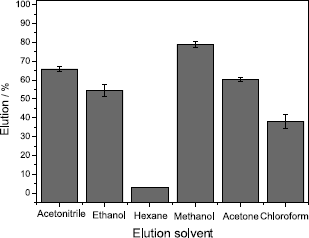
Figure 1 shows the influence of solvents on the elution of diuron. As observed, solvents with higher polarities, as indicated by their polarity index P, acetonitrile (P = 5.6), ethanol (P = 4.4), acetone (P = 5.1), and methanol (P = 5.1), provided higher elution (%). However, a higher elution of 80% was observed when using methanol, which may be explained by its strong acidity (α = 0.93),21 able to disrupt the hydrogen-bonding of diuron with carboxylic acid from methacrylic acid used as monomer. Although the diuron adsorption can also be performed by π-π stacking interactions between the benzene from phenyltrimethoxysilane,19 the use of hexane as a non-polar solvent provided a low elution efficiency, thus indicating that the interaction of diuron with carboxylic acid from methacrylic acid through hydrogen-bonding of diuron plays a more important role than π-π stacking interactions.22 Therefore, methanol was chosen as the best elution solvent.
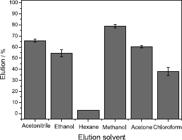
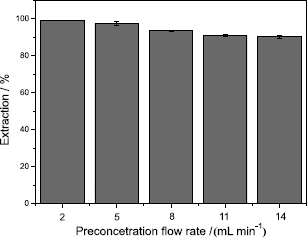
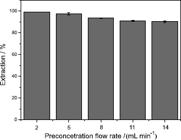
Figure 2 shows the influence of preconcentration flow rate. Due to the coupling of a cartridge filled with BHMIP with a peristaltic pump, higher preconcentration flow rates were evaluated. It was observed that, even using a higher preconcentration of 14.0 mL min-1, extraction efficiency of 90% was noticed. This outcome is attributed to the properties of the hybrid material, which displays minimal swelling and low density, thereby facilitating rapid adsorption kinetics. Thus, to increase the sample throughput of the method, the preconcentration flow rate of 14.0 mL min-1 was chosen as the best condition.
Effect of elution flow rate and solvent volume
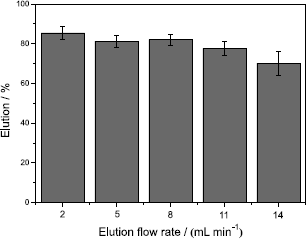
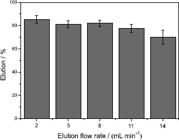
Figure 3 illustrates that a lower elution flow rate yields higher elution efficiency. An elution efficiency of 85% was achieved using 5.0 mL of methanol at a flow rate of 2.0 mL min-1, which was therefore selected for subsequent experiments.
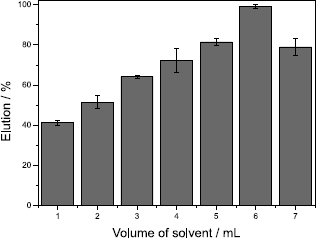
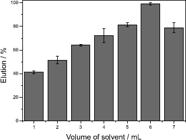
In order to improve the elution efficiency, higher volumes of methanol were evaluated (Figure 4). It was observed that quantitative elution (99.2%) of diuron was achieved when using 6.0 mL of methanol. When a larger volume (7.0 mL) was used, a side effect was observed due to dilution of the eluate. Therefore, 6.0 mL of methanol was selected for eluting diuron from the SPE cartridges.
In order to get improvements on the detectability of diuron, the 6.0 mL of methanol eluate were evaporated on a hotplate at 40 ºC and resuspended in 200 µL of the mobile phase (MeOH/H2O; 65:35, v/v), filtered through hydrophilic PTFE (polytetrafluorethylene) membranes 0.22 μm, and injected into the chromatographic system.
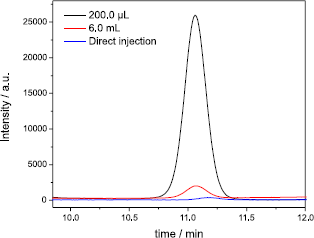
Figure 5 shows the chromatograms obtained before and after resuspension. It is clear an enhanced chromatographic peak after resuspension of eluate in 200 µL. Moreover, no analytical signal was observed from the direct injection of diuron at 20.0 µg L-1 into the chromatographic system, thereby highlighting the significant improvement in the detectability of diuron using the MISPE method.
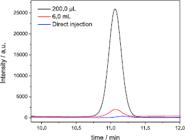
Chromatographic peaks of diuron from direct injection of diuron at 20.0 µg L-1, injection of methanol eluate, and injection of eluate resuspended in 200 µL of mobile phase.
Effect of BHMIP mass
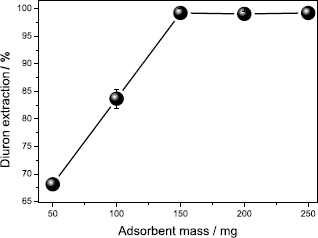
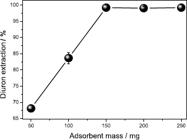
The amount of BHMIP packed into the column plays an important role in the performance of the SPE method. As shown in Figure 6, the diuron extraction (%) increases with the BHMIP mass up to 150.0 mg, after which it levels off. It is important to note that even using 250.0 mg of BHMIP at a high preconcentration flow rate of 14.0 mL min-1, no swelling, overpressure, or flow rate reduction was observed in the column, further demonstrating again the excellent performance of the hybrid material in column SPE.23,24 Thus, 150.0 mg of BHMIP were selected as the optimum condition rather than a higher mass to avoid excessive consumption of adsorbent.
Breakthrough curve
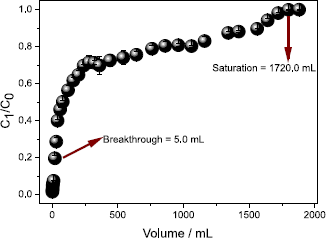
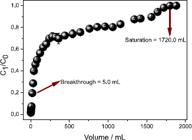
A breakthrough curve was constructed to evaluate the maximum adsorption capacity under dynamic conditions. Aliquots of 5.0 mL of aqueous diuron solutions at 5.0 mg L-1 were percolated at a preconcentration flow rate of 14.0 mL min-1 in a SPE cartridge filled with 150.0 mg of adsorbent, and the results are shown in Figure 7. As observed in this study, the breakthrough volume, indicating ≥ 95% retention of diuron, was attained after percolating 5.0 mL of the diuron solution through the column, yielding an adsorption capacity of 0.158 mg g-1. Under these conditions, 150.0 mg of BHMIP adsorbs 23.4 µg of diuron, corresponding to an adsorption efficiency of ≥ 95%. The saturation of the column was achieved only by loading a higher volume of 1720.0 mL, resulting in a maximum adsorption capacity (MAC) of 56.2 mg g-1. The amount of 23.4 µg of diuron obtained from the breakthrough volume is of paramount importance for improving the preconcentration factor under dynamic column conditions. In other words, if a larger sample volume can be used without compromising the adsorption capacity, a higher preconcentration factor can be achieved. As will be further demonstrated, the upper concentration of the analytical curve was found to be 200.0 µg L-1 by loading 50.0 mL of diuron solution through the column. Under these conditions, the adsorbed amount of diuron is 10.0 µg. Compared to the 23.4 µg obtained at the breakthrough point, it can be inferred that a loading of up to 115.0 mL of diuron solution could be performed without exceeding the adsorption capacity of BHMIP, with consequent improvements on the preconcentration factor.
Determination of figures of merit and validation of the analytical method
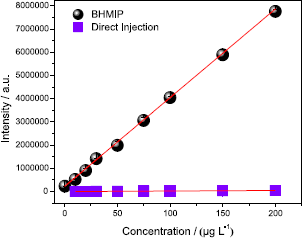
Analytical curves obtained by direct injection of the standard solutions (10.0-200 µg L-1) of diuron into the chromatographic system (linear equation –Int. = 220.73[Diu, µg L-1] – 199.54 and subjected to the MISPE procedure, (0.27-200 µg L-1) (linear equation –Int. = 38182.64[Diu, µg L-1] + 223155.41, coefficient of determination (R2) = 0.999) are shown in Figure 8. The linear model for the MISPE procedure did not present a lack of fit, as the value of MSlack of fit/MSpure error is 0.62, which is lower than the tabulated F1,14 (4.60). A high preconcentration factor of 173 was obtained. The obtained values of LOD and LOQ were 0.08 and 0.27 μg L-1, respectively. The LOD value is below the maximum limit recommended by the European Union for drinking water (0.1 μg L-1)25 and for natural water (1.8 μg L-1),26 as well as satisfying the maximum values regulated for drinking water in Brazil,27 Australia28 and New Zealand29 set as 20.0 μg L-1 and Canada for drinking water (30.0 μg L-1).30
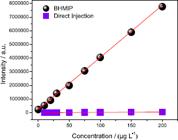
Analytical curves in the range 0.27-200.0 µg L-1 using the preconcentration with BHMIP and direct injection into the chromatographic system.
The analytical precision of the method was evaluated through intraday precision assays using six replicates (n = 6) at diuron concentrations of 15.0 and 75.0 µg L-1, yielding relative standard deviations (RSDs) of 3.48 and 4.07%, respectively. Interday precision was assessed over two consecutive days (total n = 12), resulting in RSD values of 3.16 and 3.41%, thereby confirming the precision of the proposed method.
Application of the proposed method in water and soymilk samples
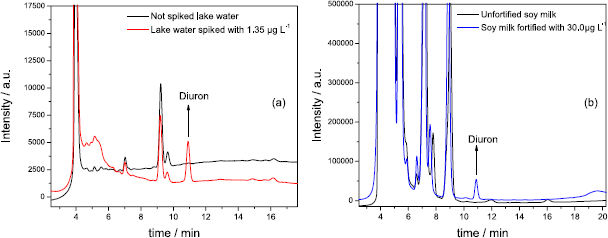
To evaluate the applicability of the developed method, stream water, lake water, and soymilk samples were subjected to the MISPE procedure. The results, presented in Table 1, show that diuron was not detected in the samples. To assess the accuracy of the method, recovery tests were performed by spiking samples with a known concentration of diuron. It is important to note that an external calibration curve was used for diuron quantification, which allows us to evaluate the influence of matrix effect. Furthermore, the washing step, which is commonly applied to eliminate interfering substances without removing the target analyte, was found to be unnecessary. Recovery values ranging from 91 to 110% were obtained, thus attesting to the interference-free diuron determination in complex matrices and the suitability of the method according to AOAC.31 The chromatograms of samples in the absence and presence of diuron are shown in Figure 9.
Applicability of the developed method using an imprinted polymer for analyses of water and soymilk samples
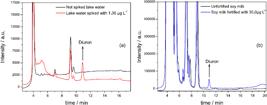
Chromatograms in the presence and absence of diuron in natural lake water (a) and soymilk samples (b).
Comparison of the proposed method with previous SPE methods for diuron determination
Table 2 shows the main methods based on SPE coupled with HPLC-DAD for diuron determination. A wide variety of materials has been employed for diuron extraction, including molecularly imprinted polymers, carbonaceous nanomaterials, mesoporous silica, C8/C18 columns, synthetic resins, zeolites, date seeds, and clay. As demonstrated, the method developed herein offers clear advantages over previously reported approaches, including lower LOD and LOQ values, minimal sample consumption, and reduced preconcentration time.
Comparison of the proposed method with other reported methods to determine diuron using solid phase extraction (SPE) and HPLC-DAD
Conclusions
In this study, a novel MISPE method was developed for the preconcentration of diuron in water and soymilk samples, employing a bifunctional hybrid organic-inorganic molecularly imprinted polymer. Methacrylic acid and phenyltrimethoxysilane were effectively employed to synthesize a hybrid bifunctional polymer with a low swelling effect, thereby enabling higher flow rates and high analytical throughput. Thanks to the selectivity of BHMIP, the proposed method also proved to be reliable and accurate for determining diuron residues in complex matrices without matrix effect, as demonstrated by the absence of a washing step in the MIPSPE and the use of an external calibration curve. Furthermore, the low limit of quantification demonstrates the suitability of the method for monitoring diuron in water and soymilk samples, in accordance with the maximum limits established by regulatory agencies.
Acknowledgments
The authors acknowledge the financial support and fellowships of Coordenação de Aperfeiçoamento de Nível Superior (CAPES) (Project Pró-Forenses 3353/2014 grant No. 23038.007082/2014-03), Finance Code 001, Conselho Nacional de Desenvolvimento Científico e Tecnológico (CNPq) (grant No. 307505/2021-9, 420097/2021-0, 190434/2017-1, 311113/2019-2, 408338/2024-5), SETI do Paraná, Instituto Nacional de Ciência e Tecnologia de Bioanalítica (INCT) (FAPESP grant No. 2014/50867-3 and CNPq grant No. 465389/2014-7) and PROEXT-PG/AUXPE/ grant No. 88881.927410 /2023-1.
Data Availability Statement
The data should be requested from the corresponding author.
References
-
1 Manasa, G.; Bhakta, A. K.; Mascarenhas, R. J.; Shetti, N. P.; Microchem. J. 2023, 191, 108778. [Crossref]
» Crossref -
2 Arvanitoyannis, I. S.; Choreftaki, S.; Tserkezou, P.; Int. J. Food Sci. Technol. 2005, 40, 1021. [Crossref]
» Crossref -
3 Agência Nacional de Vigilância Sanitária (Anvisa); Índice Monográfico - Diuron. [Link] accessed June 2025
» Link -
4 Ministério da Saúde; Portaria, GM/MS No. 888, de 4 de maio de 2021, Altera o Anexo XX da Portaria de Consolidação No. 5/GM/MS, de 28 de setembro de 2017, para Dispor sobre os Procedimentos de Controle e de Vigilância da Qualidade da Água Para Consumo Humano e seu Padrão de Potabilidade; Diário Oficial da União (DOU), Brasília, 2021. [Link] accessed September 2025
» Link -
5 Agência Nacional de Vigilância Sanitaria (ANVISA); Monografias de Agrotóxicos, 2021. [Link] accessed October 2025
» Link -
6 Skerratt, J.; Baird, M. E.; Mongin, M.; Ellis, R.; Smith, R. A.; Shaw, M.; Steven, A. D. L.; Sci. Total Environ. 2023, 879, 163041. [Crossref]
» Crossref -
7 Chen, L.; Yan, X.; Zhou, X.; Peng, P.; Sun, Q.; Zhao, F.; TrAC, Trends Anal. Chem. 2023, 160, 116976. [Crossref]
» Crossref -
8 Van der Bruggen, B.; Vandecasteele, C.; Environ. Pollut. 2003, 122, 435. [Crossref]
» Crossref -
9 Oliveira, T. C.; Lanças, F. M.; J. Chromatogr. A 2023, 1687, 463690. [Crossref]
» Crossref -
10 Bezerra, C. O.; Cusioli, L. F.; Quesada, H. B.; Nishi, L.; Mantovani, D.; Vieira, M. F.; Bergamasco, R.; Environ. Technol. 2020, 41, 191. [Crossref]
» Crossref -
11 Kupai, J.; Razali, M.; Buyuktiryaki, S.; Kecili, R.; Szekely, G.; Polym. Chem. 2017, 8, 666. [Crossref]
» Crossref -
12 Wong, A.; Foguel, M. V.; Khan, S.; de Oliveira, F. M.; Tarley, C. R. T.; Sotomayor, M. D. P. T.; Electrochim. Acta 2015, 182, 122. [Crossref]
» Crossref -
13 Field, J. A.; Reed, R. L.; Sawyer, T. E.; Martinez, M.; J. Agric. Food Chem. 1997, 45, 3897. [Crossref]
» Crossref -
14 Pereira, I.; Rodrigues, M. F.; Chaves, A. R.; Vaz, B. G.; Talanta 2018, 178, 507. [Crossref]
» Crossref -
15 Mumtaz, F.; Atif, M.; Naz, F.; Li, B.; Wang, K.; AlShehhi, M. R.; Chem. Bio. Eng. Rev. 2024, 11, 495. [Crossref]
» Crossref -
16 Tarley, C. R. T.; Corazza, M. Z.; de Oliveira, F. M.; Somera, B. F.; Nascentes, C. C.; Segatelli, M. G.; Microchem. J. 2017, 131, 57. [Crossref]
» Crossref -
17 Gomes, R. P.; Tonucci, M. C.; Prete, M. C.; Tarley, C. R. T.; Baeta, B. E. L.; Afonso, R. J. C. F.; J. Braz. Chem. Soc. 2023, 34, 1197. [Crossref]
» Crossref -
18 Yan, H.; Wang, M.; Han, Y.; Qiao, F.; Row, K. H.; J. Chromatogr. A 2014, 1346, 16. [Crossref]
» Crossref -
19 Nanicuacua, D. M.; Gorla, F. A.; de Almeida Silva, M.; Segatelli, M. G.; Tarley, C. R. T.; React. Funct. Polym. 2022, 181, 105432. [Crossref]
» Crossref -
20 Thompson, M.; Ellison, S. L. R.; Wood, R.; Pure Appl. Chem. 2002, 74, 835. [Crossref]
» Crossref -
21 Snyder, L. R.; Dolan, J. W.; High-Performance Gradient Elution: The Practical Application of the Linear-Solvent-Strength Model; John Wiley & Sons: New Jersey, USA, 2006. [Link] accessed in June 2025
» Link -
22 Tarley, C. R. T.; Scheel, G. L.; Suquila, F. A. C.; Prete, M. C.; Dragunski, D. C.; Segatelli, M. G.; Gonçalves Jr., A. G.; Gorla, F. A.; Desalin. Water Treat. 2017, 78, 172. [Crossref]
» Crossref -
23 Yazdanpanah, M.; Nojavan, S.; J. Chromatogr. A 2019, 1601, 9. [Crossref]
» Crossref -
24 Imbrogno, A.; Schäfer, A. I.; Sep. Purif Technol. 2021, 267, 118406. [Crossref]
» Crossref -
25 European Union (EU); Council Directive 75/440/EEC Concerning the quality required of surface water intended for the abstraction of drinking water in the Member States [Link] accessed June 2025
» Link -
26 Kern, K.; J. Eur. Environ. Plan. Law 2014, 11, 31. [Crossref]
» Crossref -
27 Ministério da Saúde; Revisão do Anexo XX da Portaria de Consolidação No. 5 de 28 de setembro de 2017do Ministério da Saúde (antiga Portaria MS No. 2914/2011) Padrão de Potabilidade e Planos de AmostragemSubstâncias Químicas - Agrotóxico, 2020 [Link] accessed February 2025
» Link -
28 National Health and Medical Research Council; Australian Drinking Water Guidelines 6 – Diuron, 2011. [Link] accessed June 2025
» Link -
29 New Zealand Legislation Water Services (Drinking Water Standards for New Zealand); 2022. [Link] accessed June 2025
» Link -
30 Government of Canada; Drinking Water Screening Value for Diuron; 2020. [Link] accessed June 2025
» Link -
31 AOAC; Guidelines for Standard Method Performance Requirements; AOAC International, 2016. [Link] accessed June 2025
» Link -
32 Delapena, A.; Mahedero, M.; Bautista-Sánchez, A.; Talanta 2003, 60, 279. [Crossref]
» Crossref -
33 Lu, Y. C.; Guo, M. H.; Mao, J. H.; Xiong, X. H.; Liu, Y. J.; Li, Y.; Ecotoxicol. Environ. Saf. 2019, 177, 66. [Crossref]
» Crossref -
34 Tarley, C. R. T.; Segatelli, M. G.; Casarin, J.; Justo da Fonseca, R.; RSC Adv. 2017, 7, 37959. [Crossref]
» Crossref -
35 López-Feria, S.; Cárdenas, S.; Valcárcel, M.; J. Chromatogr. A 2009, 1216, 7346. [Crossref]
» Crossref -
36 Gatidou, G.; Kotrikla, A.; Thomaidis, N. S.; Lekkas, T. D.; Anal. Chim. Acta 2005, 528, 89. [Crossref]
» Crossref -
37 Wang, Q.-Y.; Yang, J.; Dong, X.; Chen, Y.; Ye, L.-H.; Hu, Y.-H.; Zheng, H.; Cao, J.; J. Pharm. Biomed. Anal. 2020, 180, 113071. [Crossref]
» Crossref -
38 Li, M.; Wang, J.; Jiao, C.; Wang, C.; Wu, Q.; Wang, Z.; J. Chromatogr. A 2016, 1469, 17. [Crossref]
» Crossref -
39 Carbo, L.; Souza, V.; Dores, E. F. G. C.; Ribeiro, M. L.; J. Braz. Chem. Soc. 2008, 19, 1111. [Crossref]
» Crossref -
40 Su, M.; Jia, L.; Wu, X.; Sun, H.; J. Sci. Food Agric. 2018, 98, 4845. [Crossref]
» Crossref -
41 Tian, C.; Zhu, N.; Qiao, L.; He, M.; Chen, B.; Wu, Z.; Hu, B.; Microchem. J. 2024, 204, 111065. [Crossref]
» Crossref -
42 Duo, H.; Yue, J.; Yin, Y.; Xu, X.; Wang, L.; Yu, L.; Qian, X.; Li, J.; Zhu, Q.; Microchem. J. 2023, 185, 108190. [Crossref]
» Crossref