 Comparison of the Stability of Fatty Acid Composition in Freeze-Dried, Pasteurized, and Raw Human Milk During Long-Term Storage
Abstract
Human milk is the gold standard for newborn nutrition. When direct breastfeeding is not possible, donated human milk is recommended for premature or low-birth-weight infants. However, human milk banks face structural and logistical limitations, as they employ pasteurization as the standard treatment, which involves the use of temperature, and subsequently depend on a cold chain for storage and distribution. Freeze-drying appears to be a promising alternative, although still little used. It involves sublimation and water removal, extending shelf life and facilitating distribution. This study aimed to evaluate the fatty acid composition and quality of freeze-dried human milk during 90 days of storage at different temperatures (25 and 5 ºC), comparing it with raw and pasteurized human milk. The results, based on hierarchical cluster analysis of fatty acid composition, indicated that freeze-drying did not immediately alter the fatty acid profile and remained stable for up to 60 days, associated with prolonged refrigeration. Furthermore, freeze-dried human milk showed greater similarity to raw human milk. Variations in nutritional quality over time reinforce the predictions of freeze-drying, and further studies on other bioactive compounds are recommended to consolidate the technique in human milk banks.
Keywords:
GC-FID; fatty acid composition; lipid quality indices; storage; human milk bank
Introduction
Human milk is considered the gold standard of infant nutrition due to its composition, characterized by a high content of carbohydrates, lipids, proteins, and bioactive compounds with immunological and antioxidant functions.1-5 Breastfeeding in this way benefits the health of children, reducing the risk of infectious, inflammatory, and chronic diseases.1,6 Therefore, the World Health Organization (WHO) recommends exclusive breastfeeding until six months of age and its continuation, together with complementary foods, until two years or more, aiming to promote the health and healthy development of newborns.7
In situations where direct breastfeeding is not possible, donated human milk provided by human milk banks is recommended as the preferred alternative to meet the nutritional needs of preterm infants. Human milk banks are specialized institutions that promote breastfeeding and carry out a series of procedures, including donor screening, human milk collection and selection, processing, quality control, storage, and distribution.8,9 These procedures are conducted in accordance with strict health and ethical standards, endorsed by international organizations, to ensure the provision of safe human milk free from physical, chemical, and microbiological contaminants.10,11
However, the reality of human milk banks is still marked by structural and operational challenges, with a shortage of financial resources, a small number of units, strict temperature control conditions from collection to consumption, and transportation difficulties, especially to remote regions or those affected by natural disasters, hindering the equitable and safe supply of human milk to all newborns born there.11-16
In this scenario, freeze-drying of human milk emerges as a strategic and promising alternative, constituting part of the technological evolution of breastfeeding, showing progress towards simplified and safe access.17-20 Freeze-drying is considered an effective additional physical process employing sublimation for the removal of water from pasteurized human milk,9 thereby offering advantages such as greater stability and shelf life, ease of transport, and the possibility of reconstitution according to specific requirements.21-25 However, storage conditions directly affect the stability of freeze-dried human milk components, as they must safeguard against factors such as light, moisture, and oxygen, which accelerate the degradation of nutrients and sensitive bioactive compounds.9,23,26
Several studies have evaluated the effects of freeze-drying on human milk components, including lipids and fatty acids;26 however, important gaps remain regarding their stability and functionality during long-term storage. More evidence is still needed to ensure the safe and effective use of this technology in human milk banks. Although freeze-drying is costly, especially at a small scale, such as in human milk, the well-being of newborns, particularly preterm and low-birth-weight infants, must come first. Access to human milk supports healthy development and reduces future medical costs. Freeze-drying also enhances storage and transportation, reduces operational expenses, and expands distribution, benefiting lowand middle-income countries and remote areas by ensuring safer and more consistent access to human milk.26,27
Therefore, this study aimed to evaluate the stability of the fatty acid composition and quality of freeze-dried human milk during long-term storage of 90 days, compared to pasteurized and raw human milk. The work aims to contribute scientific evidence on the viability of freeze-drying as a strategy for preserving and expanding the availability of human milk for the nutritional support of newborns.
Experimental
Reagents
The reagents used were all analytical grade, with chloroform, methanol, n-heptane, and sodium chloride obtained from Synth (São Paulo, Brazil), and potassium hydroxide from Dinâmica (São Paulo, Brazil). A fatty acid methyl ester (FAME) standard (C4-C24 FAME Mix, purity ≥ 97%) was purchased from Sigma-Aldrich (São Paulo, Brazil).
Sampling
The study has a certificate of presentation of ethical assessment (CAAE) No. 93048818.0.0000.0104, opinion No. 6.233.963/2025, associated with the State University of Maringá. Samples of raw mature human milk were obtained from 31 donors, provided by the Human Milk Bank of the Regional University Hospital of Maringá. The human milk collected came from lactating women with full-term deliveries (over 37 weeks of gestation). It was considered unsuitable for neonatal consumption due to the presence of dirt involving exogenous causes (for example, hair, eyelashes), according to the quality control criteria of human milk banks. The samples were kept under cold storage (maximum 4 ºC), in accordance with the standards of the Agência Nacional de Vigilância Sanitária (Anvisa).9
The acidity content of each vial was then assessed by titration with N/9 sodium hydroxide solution (Dornic solution) and phenolphthalein as an indicator. Each 0.1 mL of Dornic solution corresponds to 1 ºD. Samples with acidity ≤ 8 ºD were considered suitable for processing.28 The selected samples were pooled in a single vial, totaling approximately 4,700 mL of human milk.
Processing in human milk
The samples were divided into different aliquots according to each processing to be studied (raw, pasteurized, and freeze-dried).
Raw human milk (untreated)
A 250 mL aliquot of untreated human milk was separated and stored in an appropriate glass bottle, considered as raw human milk (RAW).
Holder pasteurization
A 250 mL aliquot of human milk was transferred into an appropriate glass container and subjected to Holder pasteurization by heating to 62.5 ºC in a digital ultra-thermostatic bath (Solab Científica, model SL-152/10L, Piracicaba, Brazil) for 30 min. The temperature at the center of the bottle was continuously monitored using a digital laser thermometer (Suryha, Brazil) until reaching the target temperature, at which point the timing commenced. The bottle was manually agitated every 5 min to ensure sample homogenization. Following pasteurization, the pasteurized (PAST) sample was immediately cooled by immersion in a water bath until it reached 4 ºC.
Freeze-drying
An estimated volume of 4,200 mL of human milk was designated for the freeze-drying process. The sample was initially subdivided into 21 glass vials, each with an approximate capacity of 200 mL, and subjected to pasteurization via the Holder method as previously described, in strict accordance with the protocol established by Anvisa28 for human milk freeze-drying. Following pasteurization, the samples were transferred to rectangular high-density polyethylene containers, and the mass of each empty container and its contents was determined using a semi-analytical balance (model ATY224, Shimadzu). The samples were subsequently stored at -18 ºC for 24 h in preparation for freeze-drying.
Freeze-drying was carried out using a freeze-dryer (L108, LioBras) operating at -52 ºC and a pressure of 11.2 µHg. The process duration was recorded in full and continued until a moisture content between 4 and 5% was achieved, in accordance with the standards established for freeze-dried human milk (Anvisa),9 using an infrared analyzer (model I-Thermo, Bel Engineering). Upon completion of the process, the mass of dried human milk was determined to calculate the reconstitution ratio, considering moisture loss during processing. The freeze-dried (FD) samples were subsequently pooled and finely ground in a porcelain mortar until a homogeneous powder was obtained. The resulting powder was individually packaged in silver-colored metal pouches, vacuum-sealed, and labeled in accordance with the established storage and analysis schedule.
Storage conditions
The samples were stored under controlled temperature conditions in accordance with the respective processing method. The FD powder samples were stored at two distinct temperatures: refrigerated at 5 ºC in a domestic refrigerator (Electrolux, Brazil) as a novel approach, and at room temperature (25 ºC) in a controlled biochemical oxygen demand incubator (Solid Steel). Liquid samples, including raw (RAW) and pasteurized (PAST) human milk, were maintained frozen at -18 ºC (Electrolux, Brazil), in accordance with the recommendations of human milk banks in Brazil.9,29 Compositional analyses were initiated immediately following processing (day 0 - D0), with subsequent evaluations conducted at 30-day intervals (day 30 - D30; day 60 - D60; day 90 - D90). For analysis, RAW and PAST samples were thawed in a water bath at 37 ºC. The freeze-dried samples were reconstituted based on the measured water loss during drying to restore the original composition of raw human milk.
Analysis of fatty acids by gas chromatography
Lipids were extracted following the method of Folch et al.30 by mixing 1 mL of sample with 20 mL of chloroform and methanol (2:1, v/v), corresponding to a 1:20 sample-to-solvent ratio. Fatty acid methyl esters (FAMEs) were prepared by methylating the total lipids in accordance with the International Organization for Standardization.31 The fatty acid composition was assessed in raw, pasteurized, and freeze-dried human milk samples stored at 5 and 25 ºC. The resulting FAME extracts were analyzed using a gas chromatograph equipped with a flame ionization detector (Thermo Scientific, Trace GC Ultra, USA), fitted with a CP-7420 capillary column (100.0 m length, 0.25 mm internal diameter, 0.25 µm film thickness, cyanopropyl stationary phase) and a split/splitless injector. Chromatographic analysis used a 2 µL injection in 1:40 split mode. The injector temperature was maintained at 230 ºC, while the detector was set at 250 ºC. The oven temperature program started at 65 ºC (4 min), increased to 185 ºC (15 ºC min-1) for 12 min, and then advanced to 235 ºC (20 ºC min-1) for 14 min. Hydrogen was circulated as the carrier gas at 1.4 mL min-1, nitrogen was used as makeup at 30 mL min-1, and the flame received 30 mL min-1 of hydrogen and 300 mL min-1 of synthetic air. Chromatogram integrations were conducted using ChromQuestTM 5.0 software (Thermo Scientific Corporation, USA, 2008), and fatty acid methyl esters were identified by comparing their retention times with those of a commercial standard (C4-C24 FAME Mix), following the methodology described by Visentainer and Franco.32 The results were expressed as a percentage of relative area.
Nutritional indices of fatty acids
Considering the determined fatty acid composition, seven indices were calculated to evaluate the lipid nutritional quality of the fatty acids, as described in equations 1 to 4:
where ∑PUFA is the sum of polyunsaturated fatty acids, ∑SFA is the sum of saturated fatty acids, ∑n-6 is the sum of omega-6 fatty acids, ∑n-3 is the sum of omega-3 fatty acids, LA is the linoleic acid content (18:2n-6), ALA is the α-linolenic acid content (18:3n-3), ARA is arachidonic acid (20:4n-6), and DHA is docosahexaenoic acid (22:6n-3).
Statistical analysis
The data obtained were subjected to analysis of variance (ANOVA), and the means were compared using the Tukey’s test (p < 0.05) in the Statistica software version 7.0.33 Fatty acid composition was analyzed in RStudio software version 2024.04.2+76434 through Hierarchical Cluster Analysis (HCA) to identify similarities between samples. Clustering was performed employing squared Euclidean distances and Ward’s linkage method. The resulting dendrogram was combined with a heat map, enabling visualization of patterns and relationships between samples and variables.
Results and Discussion
Fatty acid composition
Table 1 presents the fatty acid composition of the evaluated samples (raw, pasteurized, and freeze-dried) throughout storage, revealing a profile comprising 31 fatty acids common to all samples.
Fatty acid composition (relative area percentage) after processing and during storage of raw, pasteurized, and freeze-dried human milk (25 and 5 ºC)
The stability of the lipid profile in human milk is crucial, because lipids perform essential functions, including providing an energy source, supporting cell membrane integrity, promoting neurological development, and facilitating metabolic processes in newborns.35-37 The fatty acid composition was stable regarding the saturated (SFAs), monounsaturated (MUFAs), and polyunsaturated (PUFAs) classes for all samples after processing, with no differences when observed on day 0. Similar results were reported by Neia et al.38 and Henderson et al.,39 indicating that Holder pasteurization and freeze-drying do not significantly impact the lipid profile of human milk.
In contrast to these findings, the literature indicates that pasteurization alters numerous lipid classes,40 including the decrease in PUFA fatty acids after Holder pasteurization in human milk.41 However, according to Ali et al.,42 no alterations in the fatty acid profile were observed in other species, such as bovine and buffalo milk, following extended pasteurization (65 ºC for 30 min) and subsequent freeze-drying.
According to the data obtained, the predominantly identified fatty acids were oleic acid (18:1n-9), palmitic acid (16:0), and linoleic acid (18:2n-6), respectively, configuring a characteristic pattern of human milk, as reported by Rydlewski et al.43 Fatty acids offer individual bioactive functionality, important for newborns.24 The 18:1n-9 is an efficient source of energy and participates in brain structuring, in addition to acting in the metabolism of fat globules.44 The 16:0 stands out for its specific location in the Sn-2 position of triacylglycerols, favoring the formation of monoacylglycerol, which is related to hormonal balance and potential analgesic effect in neonates.24,45 The 18:2n-6 is considered a strictly essential fatty acid, precursor of arachidonic acid (ARA, 20:4n-6), important for the modulation of inflammatory processes and brain development.46
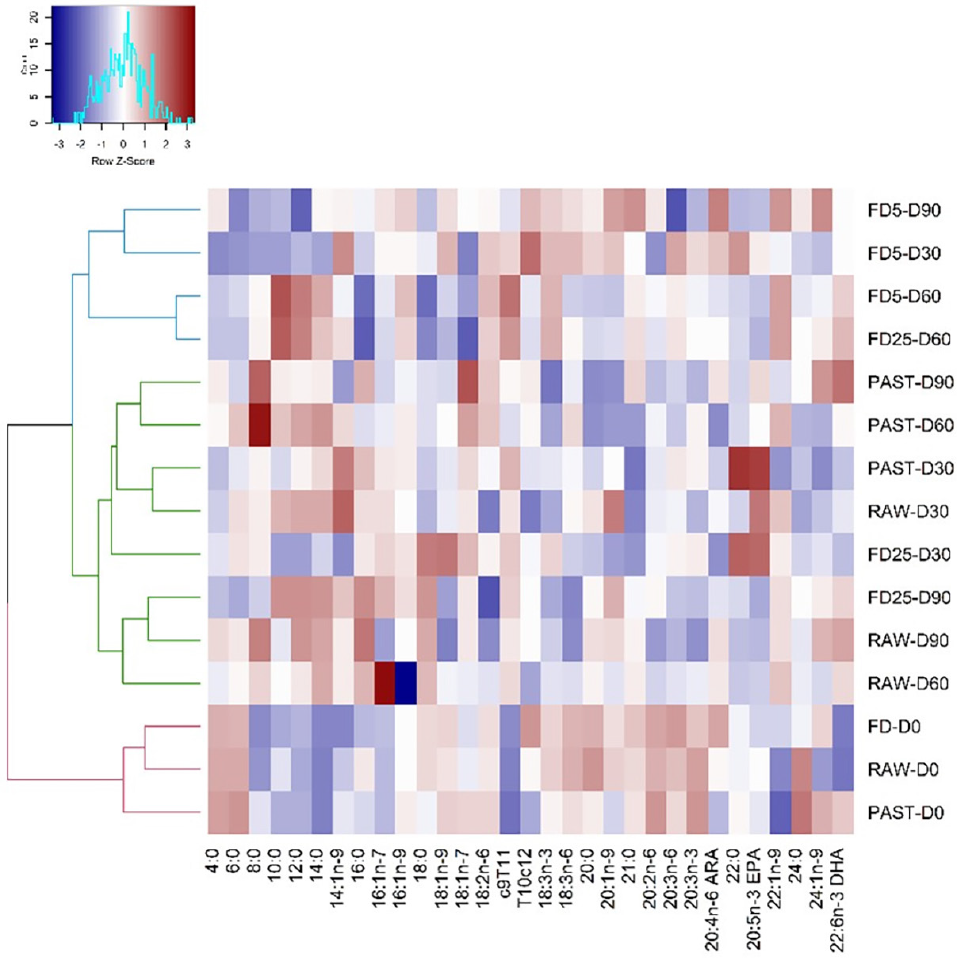
To more precisely assess the stability of fatty acids in human milk subjected to different processing methods, HCA coupled with a heat map was employed (Figure 1), enabling visualization of sample similarities and elucidation of the factors underlying these patterns.
Heat map grouped with a dendrogram illustrating the fatty acid composition in raw, pasteurized, and freeze-dried human milk samples evaluated on days 0, 30, 60, and 90 of storage.
Figure 1 highlights the formation of three main clusters. The first, highlighted in pink, includes the RAW-D0, PAST-D0, and FD-D0 samples, suggesting that the applied processing did not cause significant immediate changes in fatty acid composition. Within this cluster, the freeze-dried sample is less distinct from raw human milk, indicating a more similar fatty acid composition compared to the pasteurized sample. The differences between pasteurized human milk and the raw and freeze-dried samples were subtle, with a notable decrease in SFAs and a relative increase in unsaturated fatty acids, particularly MUFAs.
Holder pasteurization is the most widely used method in human milk banks worldwide to ensure the microbiological safety of donated human milk. However, as a thermal process, studies have shown that it can induce alterations in various bioactive components of human milk.10
Previously, another study40 reported that Holder pasteurization promoted a significant reduction in several compounds compared to raw human milk, including eight monoacylglycerols, seven diacylglycerols, four medium-chain fatty acids, and six phosphatidylserine and phosphatidylcholine derivatives.
A comprehensive analysis of the lipid profile revealed that Holder pasteurization exerts a distinct impact on fatty acids. The most pronounced reduction was observed in SFAs (25%), followed by PUFAs (18%), long-chain PUFAs (15%), and, to a lesser extent, MUFAs (12%). Overall, 76% of the evaluated fatty acids exhibited alterations after the process, resulting in a median decrease of 10% in relative concentration.47
Moro et al.48 investigated novel alternatives to human milk pasteurization, highlighting that pasteurization at higher temperatures (72 ºC for 15-25 s) can reduce the concentration of SFAs by 5% and increase that of PUFAs by 7%. Despite this, temperatures above 200 ºC are necessary to promote the non-oxidative breakdown of fatty acids, a level much higher than that used in any heat treatment applied to human milk and in the present study.49
In this context, Blackshaw et al.50 emphasized that prolonged frozen storage exerts a greater impact on lipid composition than pasteurization. Recommended storage conditions for raw and pasteurized human milk are at a maximum temperature of -3 ºC.28 Continuous freezing of human milk, although widely practiced, has limitations including high cost, the need for extensive cold chain infrastructure, and the preservation of enzymatic activity, which predominantly compromises lipid integrity.50 Furthermore, the formation of ice crystals can disrupt the emulsion of fat globules, promote the adhesion of the lipid fraction to the container walls, and lead to a reduction in lipid content.29
Thus, the second cluster, highlighted in green, included samples PAST-D90, PAST-D60, PAST-D30, RAW-D30, FD25-D30, FD25-D90, RAW-D90, and RAW-D60. Overall, all of them presented higher amounts of SFAs, likely due to lipolysis induced by endogenous lipase, whose activity is preserved even under freezing conditions. Human milk naturally contains high concentrations of lipase, activated by bile salts, to promote lipid digestion in newborns.51 Furthermore, microbial lipolysis in untreated human milk may intensify the release of free fatty acids, causing changes in the lipid profile during prolonged storage.52
Within this set, two distinct subgroups were identified: the first comprising PAST-D90, PAST-D60, PAST-D30, RAW-D30, and FD25-D30; and the second consisting of FD25-D90, RAW-D90, and RAW-D60.
PAST-D30 presented a similar fatty acid profile to RAW-D30, evidenced by the lower binding between these samples. Over 60 days, some changes in the composition of PAST-D60 were observed, including increases in the concentrations of caprylic acid (8:0), 7-octadecenoic acid (18:1n-7), and linoleic acid (18:2n-6), and decreases in behenic acid (22:0) and EPA (20:5n-3). After 90 days of storage, PAST-D90 showed an even more pronounced increase in 7-octadecenoic acid (18:1n-7) and other unsaturated fatty acids, such as nervonic acid (24:1n-9) and DHA (22:6n-3).
Conversely, sample FD25-D30, while classified within the same subgroup, exhibited a notably distinct fatty acid composition compared to RAW. In contrast, FD25-D90 closely resembled the fatty acid profiles of RAW-D60 and RAW-D90.
A third cluster, highlighted in blue, included the freeze-dried samples FD5-D90, FD5-D30, FD5-D60, and FD25-D60. Within this group, the fatty acid composition of the freeze-dried samples stored for 60 days was very similar, regardless of whether they were kept refrigerated or at room temperature. Furthermore, the freeze-dried samples stored under refrigeration maintained their fatty acid composition even after prolonged storage.
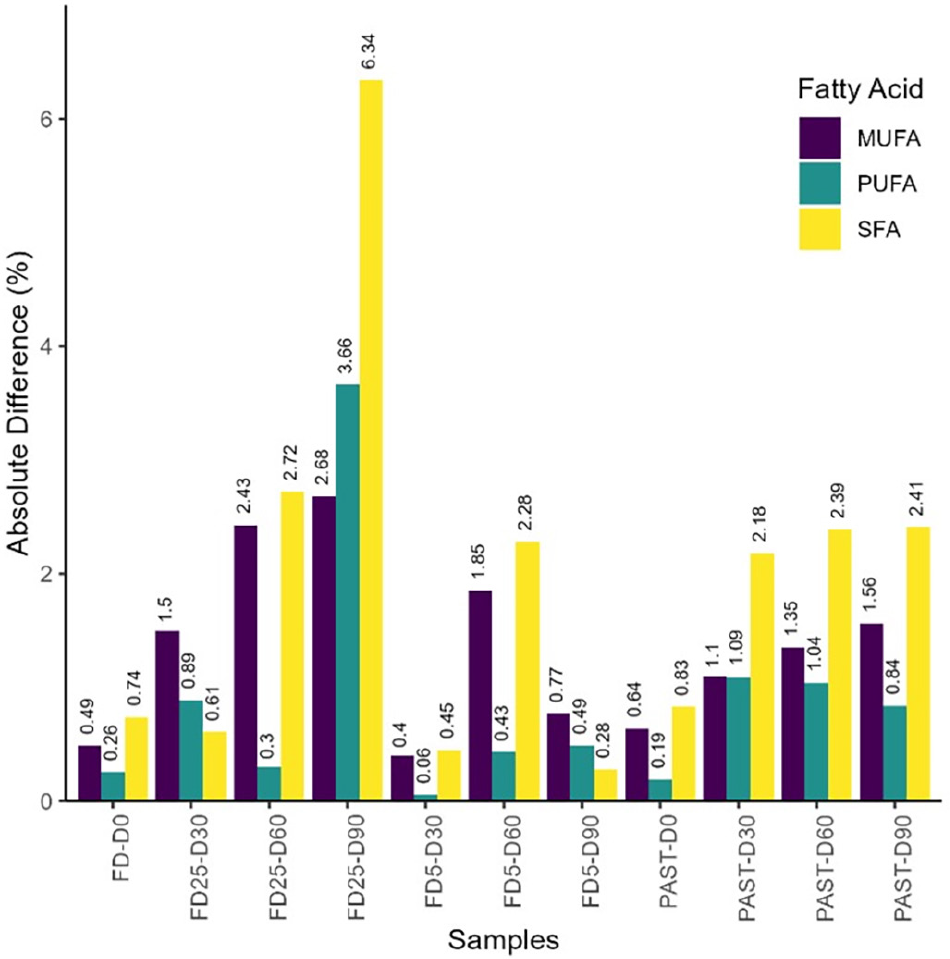
To reinforce these observations, the absolute differences between the total amounts of SFA, MUFA, and PUFA in each treatment were calculated relative to the composition found in the RAW-D0 sample. This calculation allowed us to accurately quantify changes in lipid composition over time and identify which treatments were most effective in preserving the fatty acid profile (Figure 2).
Absolute differences in the amounts of SFA, MUFA and PUFA in the treatments compared to the RAW-D0 sample.
As previously noted, on the first day of storage, the pasteurized and freeze-dried samples exhibited the least compositional differences compared to RAW-D0. Over the storage period, the freeze-dried samples stored under refrigeration showed the smallest variations in SFA, MUFA, and PUFA content, with differences of 0.4, 0.06, and 0.45 at 30 days, and 0.77, 0.49, and 0.28 at 90 days, respectively.
This finding suggests that freeze-drying can effectively preserve the integrity of the lipid profile of human milk, minimizing nutritional losses over time. Similar results have been reported by Lozano et al.,53 demonstrated that freeze-dried human milk maintained a stable lipid profile and antioxidant capacity for three months at 4 ºC, observing significant losses only under heat stress at 40 ºC for five days. Studies reinforce that freeze-drying contributes to extending the shelf life of foods by inhibiting microbial growth and delaying lipid oxidation.54 Therefore, freeze-drying combined with refrigerated storage emerges as a promising strategy for preserving the lipid quality of human milk, offering a viable and effective approach for human milk banks.
Nutritional quality of fatty acids
The nutritional composition of fatty acids was analyzed after human milk processing and during long-term storage for 90 days at the different temperatures indicated. The relationships between fatty acids and their groups were considered, with the nutritional value of the fatty acids in each sample shown in Table 2.
Nutritional quality of fatty acids during different conditions and storage intervals of raw and processed human milk
The ∑PUFA/SFA index is widely used as a parameter to evaluate the relationship between PUFAs and SFAs, considering that the former tends to reduce low-density lipoprotein (LDL) and plasma cholesterol concentrations, whereas the latter has the opposite effect. In the present study, ∑PUFA/SFA values ranged from 0.63 ± 0.03 (FD25-D60) to 0.52 ± 0.01 (FD25-D90), with significant differences (p < 0.05). This variation mainly reflected the reduction in SFA content observed in the samples. The FD25-D90 sample showed similarity only to FD5-D90 and FD25-D30, whereas FD25-D60 showed similarity to RAW-D0, RAW-D60, PAST-D0, PAST-D30, PAST-D90, FD-D0, FD5-D30, and FD5-D60. It is worth noting that the ∑PUFA/SFA index does not include the contribution of MUFAs, in addition to disregarding that certain SFAs do not have a relevant effect on the increase in plasma cholesterol (Ientz et al.24 and Neia et al.55). For this reason, alternative indices have been suggested to more accurately assess the impact of lipid composition on cholesterol metabolism (Alves et al.46).
The ∑n-6/n-3 expresses the relationship between fatty acids of the n-6 and n-3 series, which compete for the same enzymes and metabolic pathways,46 and is considered a relevant marker of the nutritional quality of human milk for neonatal development.56 The ∑n-6/n-3 showed a variation of 11.47 ± 0.73 (RAW-D0) to 17.89 ± 1.82 (PAST-D90). Recommended values are in the range between 5:1 and 10:1, associated with adequate control of the inflammatory response.57,58 The high values obtained in the present study can be attributed to the n-6 content of the maternal diet, characteristic of the Western diet, known for its low intake of foods rich in n-3.59 However, the intake of n-6 and n-3 should be analyzed together, as high concentrations of n-6 increase the demand for n-3.57,58 The n-6 fatty acids tend to stimulate inflammatory processes, while n-3 fatty acids have an anti-inflammatory effect.60
Furthermore, the n-6/n-3 ratio is directly associated with the LA/ALA ratio, since high values of n-6/n-3 tend to increase the LA/ALA ratio.61 The results obtained for n-6/n-3 ranged from 18.38 ± 0.23 (RAW-D0) to 31.38 ± 8.19 (PAST-D90), with significant differences (p < 0.05). It is understood that lower proportions are beneficial to human health.46 The LA/ALA index is a marker of the intake of essential fatty acids, serving as precursors to ARA, EPA, and DHA, which are bioactive molecules essential for immune function and neurodevelopment.62 This ratio is widely used to assess the lipid quality of infant formulas and can similarly indicate the nutritional quality of human milk. The Codex Alimentarius63 suggests a minimum ratio of 5:1 and a maximum of 15:1 for LA/ALA. However, none of the samples analyzed fell within this range. In the study by Toro-Ramos et al.,64 a ratio of 23:1 was observed, supporting the notion that these fatty acids compete for the same metabolic enzymes. Other studies have also reported values exceeding those recommended for human milk,61,62 highlighting the need to establish specific reference ranges for this matrix. Furthermore, it is important to note that the lipid quality of human milk is directly influenced by the maternal diet.43
ARA and DHA are highly physiologically important fatty acids, acting as structural components of cell membranes and signaling mediators. ARA is associated with the synthesis of inflammatory cytokines, while DHA has immunomodulatory properties, including inhibition of pro-inflammatory cytokine production.65 In the present study, ARA/DHA values ranged from 0.53 ± 0.06 (PAST-D0) to 1.73 ± 0.29 (FD-D0), with significant differences (p < 0.05). The FD-D0 and RAW-D0 samples did not show statistical differences, indicating similar ARA and DHA profiles. Despite the importance of these lipids, there is still no consensus on the ideal ARA:DHA ratio in infant foods. Imbalances in this ratio can result in adverse effects, especially on cognitive development.61 In human milk, the ARA/DHA ratio typically ranges from approximately 2:1 to 0.5:1, with ARA concentrations reflecting maternal body stores and DHA levels directly corresponding to dietary intake.66
The results indicate that freeze-dried human milk can remain stable for longer storage periods than those evaluated in this study. Therefore, we suggest future investigations into the lipid stability of freeze-dried human milk stored at 25 and 5 °C to better understand the potential of the proposed conditions for the long-term conservation of freeze-dried human milk.
Conclusions
The results revealed distinct patterns in fatty acid composition, with three main clusters evident in the HCA. The first cluster indicated that pasteurization and freeze-drying did not induce significant immediate changes in lipid composition, with freeze-dried samples exhibiting a profile more similar to raw human milk than pasteurized samples. The second cluster reflected an increase in SFAs during storage. The third cluster showed that freeze-dried samples stored for up to 60 days maintained a highly consistent lipid profile, regardless of storage conditions, demonstrating that freeze-drying under refrigeration effectively preserves fatty acid composition over extended periods. Nutritional indices also exhibited notable variations, with ∑PUFA/SFA exhibiting significant changes during storage, primarily driven by alterations in SFA content, ∑n-6/n-3 values exceeded recommendations for inflammatory control, and the ARA/DHA ratio varied significantly, although freeze-drying on day 0 preserved a profile similar to raw human milk, further supporting the efficacy of freeze-drying in maintaining the initial lipid profile.
The results reinforce that freeze-drying, especially when performed with refrigerated storage, is an effective method for preserving the lipid profile of human milk, minimizing nutritional changes during storage. Therefore, future studies suggest expanding the storage period and including analyses of other bioactive compounds to better understand their behavior under different human milk processing and storage methods.
-
Acknowledgments
The authors are grateful to CAPES, CNPq, the Fundação Cargill, and the Programa Pesquisa para o Sistema Único de Saúde (PPSUS) for their financial support. They also thank the Human Milk Bank of the University Hospital of Maringá for their partnership and donation of human milk samples.
Data Availability Statement
Data will be made available on request.
References
-
1 Froń, A.; Orczyk-Pawiłowicz, M.; Nutrients 2023, 15, 5016. [Crossref]
» Crossref -
2 Kainonen, E.; Rautava, S.; Isolauri, E.; Br. J. Nutr. 2013, 109, 1962. [Crossref]
» Crossref -
3 Trend, S.; Strunk, T.; Lloyd, M. L.; Kok, C. H.; Metcalfe, J.; Geddes, D. T.; Lai, C. T.; Richmond, P.; Doherty, D. A.; Simmer, K.; Currie, A.; Br. J. Nutr. 2016, 115, 1178. [Crossref]
» Crossref -
4 Hawkes, J. S.; Bryan, D.-L.; James, M. J.; Gibson, R. A.; Pediatr. Res. 1999, 46, 194. [Crossref]
» Crossref -
5 Meng, F.; Uniacke-Lowe, T.; Ryan, A. C.; Kelly, A. L.; Trends Food Sci. Technol. 2021, 112, 608. [Crossref]
» Crossref -
6 Theurich, M. A.; McCool-Myers, M.; Koletzko, B.; Semin. Perinatol. 2021, 45, 151387. [Crossref]
» Crossref -
7 World Health Organization (WHO); Exclusive Breastfeeding for Optimal Growth, Development and Health of Infants; Geneva: WHO, 2023. [Link] accessed in January 2026
» Link -
8 Hartmann, B. T.; Semin. Perinatol. 2019, 43, 151157. [Crossref]
» Crossref -
9 Agência Nacional de Vigilância Sanitária (Anvisa); Resolução da Diretoria Colegiada (RDC) No. 918, de 19 de setembro de 2024; Dispõe sobre o Funcionamento Humano de Bancos de Leite; Brasília: Anvisa, 2024. [Link] accessed in January 2026
» Link -
10 Ferreira, C. S. R.; Alves, E. S.; Mizuta, A. G.; Chiavelli, L. U. R.; de Abreu Filho, B. A.; Pontes, R. M.; Mikcha, J. M. G.; Santos, O. O.; J. Food Compos. Anal. 2025, 141, 107332. [Crossref]
» Crossref -
11 Hosseini-Motlagh, S.-M.; Samani, M. R. G.; Rahmani, M.; Int. J. Prod. Econ. 2025, 287, 109683. [Crossref]
» Crossref -
12 Alves, E. S.; da Costa, J. C. M.; Alvares, G. B.; Duarte, A. F. S.; Martins, I. C. K.; Lazilha, C. P. B. P.; Saqueti, B. H. F.; Marques, W. D. C.; Santos Jr., O. O.; Visentainer, J. V. In Avanços, Inovações e Saberes em Ciência e Tecnologia de Alimentos, vol.4; Editora Científica Digital: São Paulo, 2025, p. 37-50. [Crossref]
» Crossref -
13 Cao, W.; Çelik, M.; Ergun, Ö.; Swann, J.; Viljoen, N.; Socio-Econ. Plann. Sci. 2016, 53, 33. [Crossref]
» Crossref -
14 Ofori-Asumadu, N. A. G.; Adjei, B. A.; Akpan, C. M.; Ababio, N. A.; Kodji, J. N.; Adu-Kofi, M. A.; Int. J. Multidiscip. Res. 2025, 7, 1. [Link]
» Link -
15 Nakibuuka, V.; Kainza, J.; Nasiima, R.; Nalunga, S.; Nazziwa, R.; Mponye, H.; Nuwahereza, C.; Kyambadde, R.; Nantenza, R.; Nassonko, C.; Nalubwama, B.; Nabwami, I.; Nabaliira, M.; Kabategweta, C.; Nalule, O.; Nampijja, J.; Namugga, B.; Kirabira, P.; Weaver, G.; Front. Nutr. 2024, 10, 1275877. [Crossref]
» Crossref -
16 Wang, K.; Zhao, Y.; Song, S.; Lin, Y.; Luo, Y.; Zhang, Y.; Xue, Y.; Li, W.; Zhang, Y.; Lu, Y.; Quan, H.; Zhang, H.; Liu, H.; Gou, Q.; Luo, Z.; Guo, H.; Food Res. Int. 2024, 176, 113768. [Crossref]
» Crossref -
17 Blackshaw, K.; Wu, J.; Valtchev, P.; Lau, E.; Banati, R. B.; Dehghani, F.; Schindeler, A.; Foods 2021, 10, 2077. [Crossref]
» Crossref -
18 Cohen, M.; Counter Magazine 2022, 3, 15. [Link] accessed in January 2026
» Link -
19 Wesolowska, A.; Dobrowolska, I.; Sinkiewicz-Darol, E.; Barbarska, O.; Niewada, M.; Golicki, D.; Values Health 2020, 22, 54. [Crossref]
» Crossref -
20 Lis-Kuberka, J.; Orczyk-Pawiłowicz, M.; Nutrients 2019, 11, 306. [Crossref]
» Crossref -
21 Neia, V. J. C.; Zacarias, J. M. V.; de Alencar, J. B.; dos Santos, P. D. S.; Tavares, C. B. G.; Paula, M. G.; da Costa, S. C.; de Oliveira, M. M.; Nakamura, C. V.; Santos, O. O.; Visentainer, J. E. L.; Visentainer, J. V.; Dry. Technol. 2022, 40, 3149. [Crossref]
» Crossref -
22 Souza, P. M.; Ponhozi, I. B.; Manin, L. P.; Rydlewski, A. A.; Alves, E. S.; Cruz, V. H. M.; Santos, O. O.; Visentainer, J. V.; Res. Soc. Dev. 2022, 11, e554111335770. [Crossref]
» Crossref -
23 Alves, E. S.; Ferreira, C. S. R.; Souza, P. R.; Bruni, A. R. S.; Castro, M. C.; Saqueti, B. H. F.; Santos, O. O.; Madrona, G. S.; Visentainer, J. V.; Int. J. Biol. Macromol. 2023, 238, 124100. [Crossref]
» Crossref -
24 Ientz, G. A. S.; Alves, E. S.; Castro, M. C.; Frigo, G.; Tavares, C. B. G.; Visentainer, J. E. L.; Santos, O. S.; Visentainer, J. V.; J. Braz. Chem. Soc. 2023, 34, 1887. [Crossref]
» Crossref -
25 Oliveira, M. M.; Aragon, D. C.; Bomfim, V. S.; Trevilato, T. M. B.; Alves, L. G.; Heck, A. R.; Martinez, F. E.; Camelo, J. S.; PLoS One 2019, 14, e0210999. [Crossref]
» Crossref -
26 Martysiak-Żurowska, D.; Rożek, P.; Puta, M.; Drying Technol. 2022, 40, 615. [Crossref]
» Crossref -
27 Cheema, S. K.; Grimwade-Mann, M.; Weaver, G.; Collins, B.; Shenker, N.; Cameron, S.; J. Food Compos. Anal. 2025, 137, 106936. [Crossref]
» Crossref -
28 Agência Nacional de Vigilância Sanitária (Anvisa); Banco de Leite Humano: Funcionamento, Prevenção e Controle de Riscos; Brasília: Anvisa, 2008. [Link] accessed in January 2026
» Link -
29 Manin, L. P.; Rydlewski, A. A.; Galuch, M. B.; Pizzo, J. S.; Zappielo, C. D.; Senes, C. E. R.; Santos, O. O.; Visentainer, J. V.; J. Braz. Chem. Soc. 2019, 30, 1579. [Crossref]
» Crossref -
30 Folch, J.; Lees, M.; Stanley, G. H. S.; J. Biol. Chem. 1957, 226, 497. [Crossref]
» Crossref -
31 ISO No. 12966:2/2017: Animal and Vegetable Fats and Oils - Gas Chromatography of Fatty Acid Methyl Esters - Part 2: Preparation of Methyl Esters of Fatty Acids; ISO: Geneva, 2017. [Link] accessed in January 2026
» Link - 32 Visentainer, J. V.; Franco, M. R. B.; Ácidos Graxos em Óleos e Gorduras: Identificação e Quantificação; Varela, 2006.
- 33 Statistica, version 7.0; Statsoft Inc. Statsorft, Tulsa, OK, USA, 2004.
- 34 RStudio: Integrated Development for R - version 2024.04.2+764; RStudio, Boston, MA, USA, 2024.
-
35 Koletzko, B.; Rodriguez-Palmero, M.; Demmelmair, H.; Fidler, N.; Jensen, R.; Sauerwald, T.; Early Hum. Dev. 2001, 65, S3. [Crossref]
» Crossref -
36 Garwolińska, D.; Namieśnik, J.; Kot-Wasik, A.; Hewelt-Belka, W.; J. Agric. Food Chem. 2018, 66, 11881. [Crossref]
» Crossref -
37 German, J. B.; Dillard, C. J.; Crit. Rev. Food Sci. Nutr. 2006, 46, 57. [Crossref]
» Crossref -
38 Neia, V. J. C.; Santos, P. D. S.; Tavares, C. B. G.; Paula, M. G.; Costa, S. C.; Zacarias, J. M. V.; Alencar, J. B.; Silveira, R.; Santos, O. O.; Visentainer, J. E. L.; Visentainer, J. V.; J. Braz. Chem. Soc. 2022, 34, 54. [Crossref]
» Crossref -
39 Henderson, T. R.; Fay, T. N.; Hamosh, M.; J. Pediatr. 1998, 132, 876. [Crossref]
» Crossref -
40 Tran, L. C.; Marousez, L.; De Lamballerie, M.; McCulloch, S.; Hermann, E.; Gottrand, F.; Ley, D.; Lesage, J.; Front. Nutr. 2023, 10, 1107054. [Crossref]
» Crossref -
41 Jalali, K.; Pastor-Villaescusa, B.; Flores-Rojas, K.; Pleguezuelos, V.; Pérez-Cano, F. J.; Franch-Masferrer, À.; Trujillo-Mesa, A. J.; Hernández-Herrero, M. M.; Roig-Sagués, A. X.; Foods 2025, 14, 1310. [Crossref]
» Crossref -
42 Ali, A. H.; Wei, W.; Khalifa, S. A.; Zhang, X.; Wang, X.; Int. J. Dairy Technol. 2021, 74, 472. [Crossref]
» Crossref -
43 Rydlewski, A. A.; Manin, L. P.; Pizzo, J. S.; Silva, P. D.; da Silveira, R.; Tavares, C. B. G.; de Paula, M.; Pereira, O.; Santos, O. O.; Visentainer, J. V.; J. Food Compos. Anal. 2021, 100, 103797. [Crossref]
» Crossref -
44 Devaraj, S.; Giuffrida, F.; Hartweg, M.; Estorninos, E. M.; Buluran, K. B.; Lawenko, R. B.; Thakkar, S. K.; Samuel, T. M.; Prostaglandins, Leukotrienes Essent. Fatty Acids 2023, 190, 102543. [Crossref]
» Crossref -
45 Rydlewski, A. A.; Silva, P. D.; Manin, L. P.; Tavares, C. B. G.; Paula, M. G.; Figueiredo, I. L.; Neia, V. B. M. J. C.; Santos, O. O.; Visentainer, J. V.; J. Braz. Chem. Soc. 2019, 30, 1063. [Crossref]
» Crossref -
46 Alves, E. S.; Castro, M. C.; Saqueti, B. H. F.; Manin, L. P.; Alencar, J. B.; Zacarias, J. M. V.; Bruni, A. R. S.; Madrona, G. S.; Visentainer, J. E. L.; Cristianini, M.; Santos, O. O.; Visentainer, J. V.; J. Braz. Chem. Soc. 2024, 35, e20230102. [Crossref]
» Crossref -
47 Ten-Doménech, I.; Ramos-Garcia, V.; Moreno-Torres, M.; Parra-Llorca, A.; Gormaz, M.; Vento, M.; Kuligowski, J.; Quintás, G.; Food Chem. 2022, 384, 132581. [Crossref]
» Crossref -
48 Moro, G. E.; Girard, M.; Peila, C.; Garcia, N.; Escuder-Vieco, D.; Keller, K.; Cassidy, T.; Bertino, E.; Boquien, C.-Y.; Buffin, R.; Calvo, J.; Gaya, A.; Gebauer, C.; Lamireau, D.; Lembo, D.; Picaud, J.-C.; Wesolowska, A.; Arslanoglu, S.; Cavallarin, L.; Giribaldi, M.; Front. Nutr. 2024, 11, 1409381. [Crossref]
» Crossref -
49 Claeys, W. L.; Verraes, C.; Cardoen, S.; De Block, J.; Huyghebaert, A.; Raes, K.; Dewettinck, K.; Herman, L.; Food Control 2014, 42, 188. [Crossref]
» Crossref -
50 Blackshaw, K.; Wu, J.; Proschogo, N.; Davies, J.; Oldfield, D.; Schindeler, A.; Banati, R. B.; Dehghani, F.; Valtchev, P.; Food Chem. 2022, 373, 131402. [Crossref]
» Crossref -
51 Wesolowska, A.; Brys, J.; Barbarska, O.; Strom, K.; Szymanska-Majchrzak, J.; Karzel, K.; Pawlikowska, E.; Zielinska, M. A.; Hamulka, J.; Oledzka, G.; Nutrients 2019, 11, 1972. [Crossref]
» Crossref -
52 Alu’datt, M. H.; Rababah, T.; Al-Rabadi, G. J.; Althnaibat, R. M.; Ereifej, K.; Alhamad, M. N.; Al-Ismail, K.; Brewer, S.; J. Food Sci. Technol. 2015, 52, 5989. [Crossref]
» Crossref -
53 Lozano, B.; Castellote, A. I.; Montes, R.; López-Sabater, M. C.; Int. J. Food Sci. Nutr. 2014, 65, 703. [Crossref]
» Crossref -
54 Bomfim, V. S.; Jordão Jr., A. A.; Alves, L. G.; Martinez, F. E.; Camelo, J. S.; PLoS One 2018, 13, e0202794. [Crossref]
» Crossref -
55 Neia, V. J. C.; Landi Masquio, D. C.; Claudino, P. A.; Duso, P.; Tadano, D. K.; Bolognese, M. A.; Magalhães de Souza, P.; Santos, O. O.; Visentainer, J. V.; Molin Netto, B. D.; Clin. Nutr. ESPEN 2023, 57, 288. [Crossref]
» Crossref -
56 Srinivas, V.; Varma, S.; Kona, S. R.; Ibrahim, A.; Duttaroy, A. K.; Basak, S.; Prostaglandins, Leukotrienes Essent. Fatty Acids 2023, 191, 102566. [Crossref]
» Crossref -
57 Novak, E. M.: Dietary Omega-3 and Omega-6 Fatty Acids and Neonatal Liver Metabolism; PhD Thesis, University of British Columbia, Vancouver, 2011. [Crossref] accessed in January 2026
» Crossref - 58 Institute of Medicine; Dietary Reference Intakes for Energy, Carbohydrate, Fiber, Fat, Fatty Acids, Cholesterol, Protein and Amino Acids; The National Academies Press: Washington, USA, 2005. [Link]
-
59 Alves, E. S.; Castro, M. C.; Saqueti, B. H. F.; Manin, L. P.; da Silveira, R.; Souza, P. M.; Santos, O. O.; Visentainer, J. V.; J. Braz. Chem. Soc. 2021, 32, 1884. [Crossref]
» Crossref -
60 Chen, J.; Liu, H.; Int. J. Mol. Sci. 2020, 21, 5695. [Crossref]
» Crossref -
61 Muxfeldt, L. C.; Alves, E. S.; de Souza Zangirolami, M.; da Silva, C. R.; dos Santos, P. D. S.; Santos, O. O.; Visentainer, J. V.; J. Food Compos. Anal. 2025, 148, 108216. [Crossref]
» Crossref -
62 Castro, M. C.; Alves, E. S.; Saqueti, B. H. F.; Ferreira, C. S. R.; Zacarias, J. M. V.; Visentainer, J. E. L.; Trombelli, F. S. O.; Ichisato, S. M. T.; Santos, O. O.; Visentainer, J. V.; J. Braz. Chem. Soc. 2025, 36, e20250107. [Crossref]
» Crossref -
63 Codex Alimentarius; Standard for Infant Formula and Formulas for Special Medical Purposes Intended for Infants CXS 72-1981; Codex Alimentarius: Geneva, 2023. [Link] accessed in January 2026
» Link -
64 Toro-Ramos, T.; Méio, M. D. B. B.; Morsch, D. S.; Moreira, M. E. L.; Carmo, M. das G. T. do; Sichieri, R.; Hoffman, D. J.; J. Hum. Growth Dev. 2013, 23, 270. [Link]
» Link -
65 Wendel, K.; Aas, M. F.; Gunnarsdottir, G.; Rossholt, M. E.; Bratlie, M.; Nordvik, T.; Landsend, E. C. S.; Fugelseth, D.; Domellöf, M.; Pripp, A. H.; Stiris, T.; Moltu, S. J.; Clin. Nutr. 2023, 42, 22. [Crossref]
» Crossref -
66 Lien, E. L.; Richard, C.; Hoffman, D. R.; Prostaglandins, Leukotrienes Essent. Fatty Acids 2018, 128, 26. [Crossref]
» Crossref
Edited by
-
Editor handled this article: César Ricardo Teixeira Tarley (Associate)