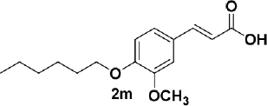
 Microwave-Assisted vs. Conventional Knoevenagel-Doebner Condensation for the Synthesis of 3-Arylacrylic Acids: a Pyridine-Rationalized Approach
Abstract
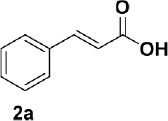
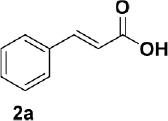
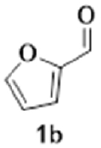
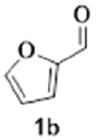
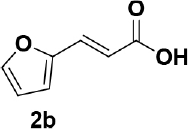
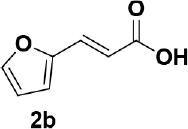
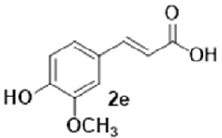
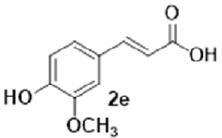
Microwave-assisted Knoevenagel-Doebner condensation mediated by pyridine has proven to be a highly efficient method for the synthesis of 3-aryl acrylic acids, which are important intermediates in the preparation of industrially and pharmacologically relevant compounds. The efficiency of the present approach is demonstrated by high reactant conversion, along with a significant reduction in reaction time compared to conventional heating methods. A comparative study revealed that the use of pyridine as both base and solvent under either conventional reflux or microwave-assisted conditions clearly favors the latter, with reactions proceeding at least eight times faster under microwave irradiation. Furthermore, the method was successfully scaled up for selected target molecules, enabling the synthesis on a 50 mmol scale of cinnamic acid (2a), (E)-3-(furan-2-yl) acrylic acid (2b), and ferulic acid (2e).
Keywords:
acrylic acids; microwave-assisted synthesis; Kenoevenagel-Doebner; large scale
Introduction
Compared to conventional reflux heating, literature reports microwave irradiation significantly accelerates reaction rates while maintaining or even enhancing product yields, in addition to offers high reproducibility across a broad range of substrates.1-3 Accordingly, this approach has emerged as a viable, sustainable, and environmentally friendly alternative, enabling highly efficient processes alongside practical and easily implemented technology in modern organic synthesis.4-7 As a widely recognized green technology, microwave-assisted methods provide not only shorter reaction times but also improved controllability and cleaner reaction profiles, making them particularly attractive for the preparation of organic compounds.1 The key feature of microwave heating lies in the direct interaction of electromagnetic radiation with molecular dipoles and ionic species present in the reaction medium. The rapid oscillation of these species generates heat through dielectric loss, resulting in efficient volumetric heating, in contrast to the conduction-limited heat transfer observed under conventional conditions.8 Consequently, localized overheating of polar media and the formation of hot spots may occur, creating thermal gradients that can influence reaction selectivity and even enable transformations not accessible under traditional heating.9 In this context, the choice of base plays a crucial role in determining both the efficiency and scalability of microwave-assisted Knoevenagel-Doebner condensations. Pyridine offers distinct advantages over more reactive amines such as piperidine, owing to its lower basicity and reduced nucleophilicity, which contribute to improved thermal control and minimized side reactions under microwave irradiation. Given that microwave-assisted processes are inherently sensitive to thermal gradients, this characteristic is particularly important for ensuring scalability.4 In addition, the use of pyridine instead of piperidine may simplify handling and regulatory compliance, as piperidine is subject to stricter monitoring due to its classification as a potential controlled precursor. Despite the well-established use of microwave-assisted methodologies in organic synthesis, there are still few reports on their application to the Knoevenagel-Doebner condensation.1 In that study, phenolic aldehydes were reacted with malonic acid in dimethylformamide (DMF) using piperidine as catalyst.
The Knoevenagel condensation is recognized as one of the most extensively explored reactions for the synthesis of α,β-unsaturated carbonyl compounds, particularly in the preparation of cinnamic acid derivatives.10 To date, its application in the production of 3-aryl acrylic acids has attracted considerable attention in both academic and industrial settings, owing to its broad functional group tolerance, which enables the synthesis of structurally diverse derivatives11 possessing a wide range of biological activities, such us antimicrobial effects,12 anti-inflammatory activity13-15 and anticancer properties.16 Further studies have demonstrated neuroprotective effects, mediated by HDAC2 inhibition and microRNA regulation,17 along with metabolic benefits, including antioxidant and hypolipidemic properties,18 and antidiabetic activity attributed to α-glucosidase inhibition and the reduction of postprandial glycemia.19,20
In this context and given the limited number of studies employing pyridine in microwave-assisted Knoevenagel-Doebner condensation in addition of more strictly regulated use of amines such as piperidine, we herein report an efficient and scalable protocol for the synthesis of 3-aryl acrylic acids using pyridine as both base and solvent.
Results and Discussion
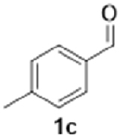
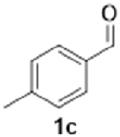
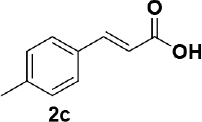
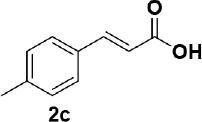
To initiate the investigation of the Knoevenagel Doebner condensation, reactions were first performed using equimolar amounts of p-tolualdehyde and malonic acid. Under conventional heating, compound 2c was obtained in 75% yield, whereas microwave irradiation afforded compound 2c in only 30% yield. Therefore, a broader range of reactant stoichiometries was evaluated by varying the amount of p-tolualdehyde from 1.0 to 2.0 equiv. and the amount of malonic acid up to 3.0 equiv. Analysis of these experiments revealed that, under microwave irradiation, the use of 1.5 and 2.0 equiv. of malonic acid afforded compound 3c in 55 and 98% yield, respectively. In contrast, only minor differences were observed under conventional heating. These results suggest that, although decarboxylation may be suppressed under relatively basic conditions such as pyridine, the thermal effect generated by microwave irradiation plays a significant role in promoting the partial consumption of malonic acid in the reaction medium.
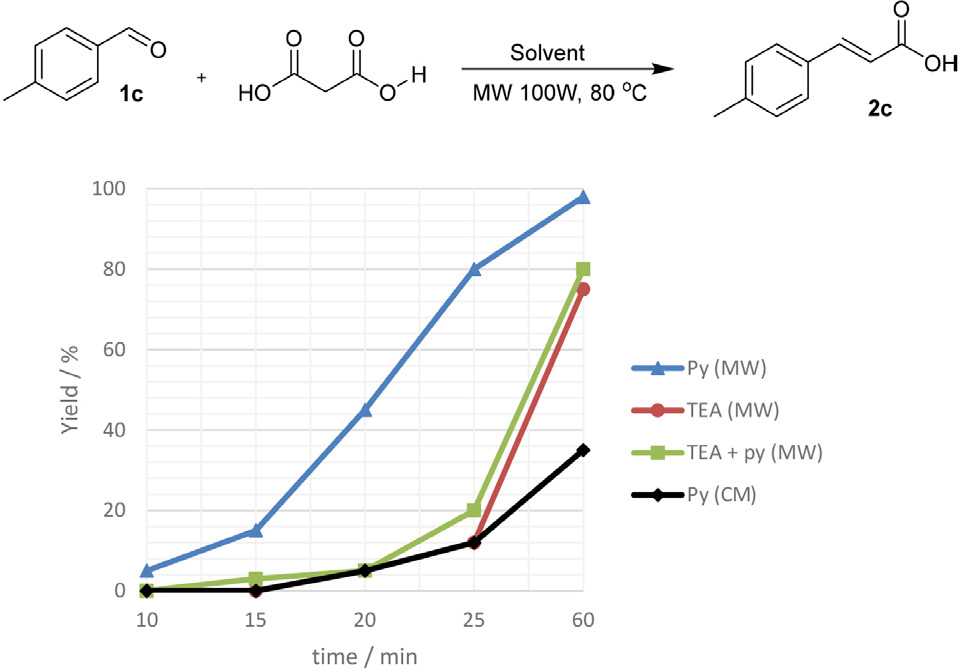
Accordingly, after optimization of the reactant ratio and considering parameters such as concentration, reaction time, and isolated yield, both pyridine and triethylamine were further evaluated as bases, under either conventional or microwave heating. In these experiments, 1.0-2.0 equiv. of malonic acid was reacted with 1.0 equiv. of benzaldehyde in order to establish the standard reaction conditions. The corresponding results are shown in Figure 1.
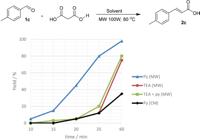
Knoevenagel-Doebner condensation upon Py, TEA and TEA + Py to obtain 2c. Py: pyridine; TEA: triethylamine; MW: microwave irradiation; CM: conventional method.
As shown in Figure 1, compound 2c was obtained in 98% yield within 60 min when pyridine was used as the sole solvent (light blue line, Figure 1). In contrast, significantly lower and comparable yields were observed when compound 1c was reacted for the same period in triethylamine or in a 1:1 mixture of triethylamine and pyridine, affording compound 2c in only 75 and 80% yield, respectively. Overall, based on the results summarized in Figure 1, the optimal conditions for the microwave-assisted synthesis of compound 2c were found to be compound 1c (10 mmol), malonic acid (20 mmol), and pyridine (4 mL), under microwave irradiation at 80 °C and 100 W. To determine the optimum reaction time under conventional heating, the reaction was monitored under analogous conditions. Since after 60 min only 30% yield of compound 2c was obtained (black line, Figure 1), the reaction time was extended until compound 3c was formed in 88 and 95% yield when 1.5 and 2.0 equiv. of malonic acid were employed, respectively. Under these conditions, 8 h were required for complete conversion.
The results also show the exclusive formation of the E isomer (see Supplementary Information (SI) section, for typically coupling constant for an E-isomer), which is consistent with the stereochemical outcome commonly reported for classical Knoevenagel-Doebner condensations. In these reactions, the E configuration is favored due to its greater thermodynamic stability compared to the corresponding Z isomer, after decarboxylation step.
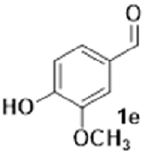
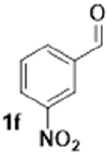
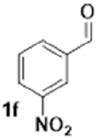
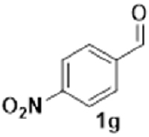
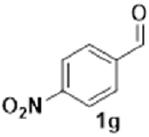
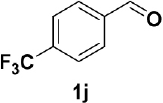
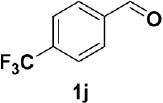
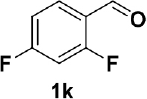
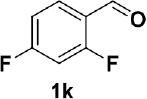
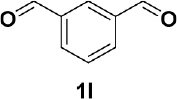
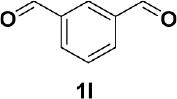
After optimization, and to demonstrate the generality of the method, aldehydes 1a-1m were subjected to the Knoevenagel-Doebner condensation under the optimized conditions. The results obtained as well as the comparison between microwave irradiation (MW) and conventional method (CM), are summarized in Table 1.
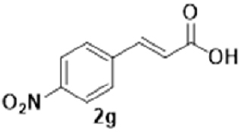
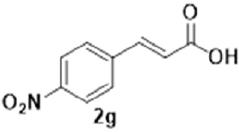
Under the conditions shown in Table 1, compounds 2c and 2g (entries 3 and 7) were obtained in 98% yield. In cases where comparable yields were achieved under both heating methods, the principal advantage of microwave irradiation was the substantial reduction in reaction time. For example, cinnamic acid derivative 2a (entry 1, Table 1) was obtained in 95% yield under both conventional and microwave conditions; however, under microwave irradiation the reaction was completed eight times faster, using identical stoichiometric ratios. This result is particularly noteworthy, since the literature21 reports only 68% yield for compound 2a under similar microwave conditions. Overall, the data presented in Table 1 clearly demonstrate the superiority of microwave irradiation.
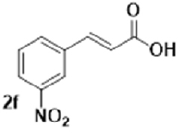
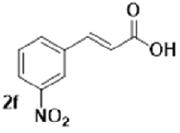
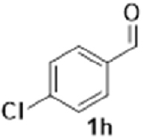
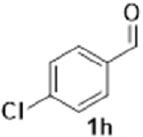
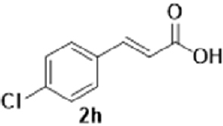
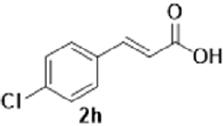
Furthermore, comparison of the present protocol with representative literature methods highlights its advantages. For instance, Viana et al.22 reported the synthesis of p-chlorocinnamic acid (2h) in 61% yield, 3-nitrocinnamic acid (2f) in 34% yield, and 4-nitrocinnamic acid (2g) in 59% yield under microwave irradiation. In contrast, the present methodology afforded compounds 2h and 2f in 95% yield and compound 2g in 98% yield. Niemczyk et al.23 obtained compound 2f in 65% yield. Importantly, m-nitrocinnamic acid (2f) is a key intermediate in the synthesis of Ro 24 5913, a potent and selective oral leukotriene D4 (LTD4) antagonist used in the treatment of asthma.23
Beyond their synthetic relevance, the prepared compounds exhibit a variety of noteworthy biological activities.22 Compound 2b acts as an auxin-response inhibitor, attenuating auxin-induced gene expression (IAA5/BA3-GUS) and suppressing root and hypocotyl elongation without interfering with the IAA7/AXR2 SCF(TIR1) interaction.24 Compound 2c exhibits antifungal activity and acts as a chemosensitizer toward agents that compromise fungal cell wall integrity.25
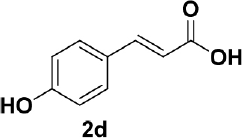
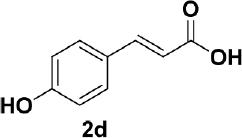
Compound 2d displays neuroprotective effects associated with modulation of cellular redox status, preservation of mitochondrial function, and increased adenosine triphosphate (ATP) production under oxidative stress conditions.26 Compound 2e (ferulic acid) demonstrated in vivo antitumor activity, reducing tumor growth and modulating pathways associated with cell proliferation and hypoxic stress responses.27 In addition, ferulic acid has broad metabolic applications and is widely employed in the treatment of metabolic syndrome, food preservation, and cosmetics.28 Finally, compounds 2g and 2h showed inhibitory activity against tyrosinase, involving interactions within the enzyme active site and, in the case of the nitro derivative, chelation of the catalytic copper ion.29
The methodology was further evaluated on a larger scale using selected compounds of particular interest, namely cinnamic acid (2a), (E)-3-(furan-2-yl)acrylic acid (2b), and ferulic acid (2e), which were prepared on a 50 mmol scale. Under the optimized conditions, compound 2b was isolated in 98% yield (20.3 g), whereas compounds 2a and 2e were obtained in 95% yield (21.4 and 27.6 g, respectively), thereby demonstrating the robustness and scalability of the proposed microwave-assisted protocol. For comparison, Mouterde and Allais1 also reported the use of microwave irradiation for the preparation of 4-hydroxycinnamic acid (2d), obtaining the product in 92% yield on an 8 mmol scale using N,N-dimethylformamide (DMF)/piperidine as the reaction medium. These results indicate that, even relative to previously established microwave-assisted methodologies, modification of the reaction medium exerts a decisive influence on reaction performance, further underscoring the high efficiency and sustainable potential of the method described herein.
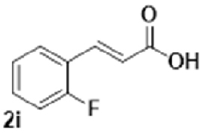
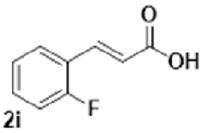
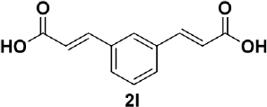
Finally, with the exception of compound 2i (entry 9), the protocol proved to be general, furnishing the desired products in very good yields. Moreover, the isolated yields obtained in the present study were consistently higher than those reported in the literature, highlighting the effectiveness of the reaction conditions employed.
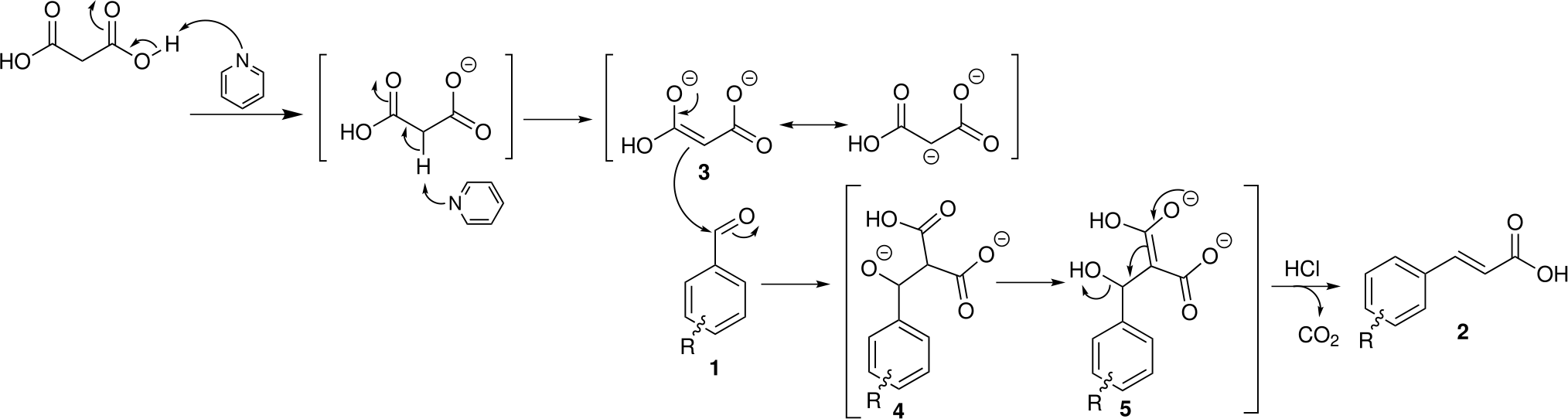
Regarding to the reaction mechanism, pyridine is proposed to act both as solvent and as base. Under the mildly basic conditions, the reaction is initiated by deprotonation of the acidic proton of malonic acid, followed by abstraction of a proton from the methylene group, both mediated by pyridine. The resulting resonance-stabilized enolate 3 then undergoes nucleophilic addition to the aldehyde, affording β-hydroxycarbonyl intermediate 4. Subsequent protonation by the pyridinium species furnishes intermediate 5. Under microwave irradiation, intermediate 5 is proposed to undergo a decarboxylation/E1cB sequence,30 ultimately yielding the corresponding α,β-unsaturated acid 2.1,31Scheme 1 summarizes the proposed reaction pathway.
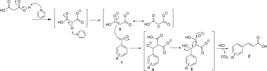
Mechanistically, the reaction differs from the conventional use of secondary amines (e.g., piperidine), which form iminium salts at the initial stage and undergo elimination with the loss of a piperidinium moiety.31 In contrast, when tertiary amines are employed, no nitrogen-based leaving group is lost, and the process predominantly follows an E1cB mechanism.
When ortho- or para-phenolic groups are present in the aromatic aldehyde, formation of a methylene quinone intermediate may divert the reaction pathway. In such cases, the phenolate stabilizes the negative formed charges and conjugates with the aromatic ring, promoting electronic reorganization that leads to an additional decarboxylation step and, consequently, to the formation of 4-vinylphenol. This behavior is significantly favored when the reactions are carried out at elevated temperatures or in the presence of excess piperidine.32
Conclusions
The results obtained highlight the use of pyridine under both conventional heating and microwave-assisted conditions as an effective and time-efficient strategy for the synthesis of 13 acrylic acid derivatives. This approach has proven to be scalable, offering a very simple and efficient alternative that enables the production of compounds 2a 2m in notable yields and with significantly reduced reaction times.
Experimental
Materials and reagents
All commercial reagents and solvents were used without further purification. Analytical thin-layer chromatography (TLC) was performed on silica gel 60 plates (Macherey Nagel®, 20 × 20 cm, 0.25 mm thickness) and visualized under UV irradiation (254 or 365 nm) or in an iodine chamber.
Instrumentation
Experimental conditions
General process for preparation of acrylic acids
Conventional method (CM)
The acrylic acids 2a to 2m were synthesized according to the conventional method (CM) as follows: to a 50 mL round-bottom flask, were sequentially added aldehyde (10 mmol), malonic acid (20 mmol) and pyridine (4 mL, ca. 50 mmol). The reaction mixture was heated at 80 °C and leaved for 8 h. The progress of the reaction was monitored by thin-layer chromatography (TLC) using an n-hexane:ethyl acetate (1:1, v/v) mixture as the eluent. Upon completion of the reaction, the mixture was cooled in an ice bath under continuous stirring. Hydrochloric acid (6 mol L-1) was then slowly added dropwise under constant stirring until the pH was adjusted to 2-3, promoting precipitation of the product as a solid. The resulting suspension was kept in an ice bath for 30 to 40 min to maximize precipitation. The solid product was then isolated by vacuum filtration and washed with small portions of distilled water to remove acidic residues and other soluble impurities. Finally, the material was dried under vacuum, yielding a white, opaque solid with yields ranging from 35 to 96% depending on the specific aromatic aldehyde used (Table 1).
Microwave-assisted synthesis method
The acrylic acids 2a to 2m were synthesized as follows: to a 50 mL round-bottom flask, were sequentially added aldehyde (10 mmol), malonic acid (20 mmol) and pyridine (4 mL, ca. 50 mmol). The reaction system was coupled to a microwave reactor configured to operate under controlled conditions. The reaction was carried out at 100 W, with temperature controlled between at 80 °C, for a period of 60 min. The progress of the reaction was monitored in the same way as in the conventional method. The extraction, precipitation, isolation, and purification processes of the products obtained by microwave irradiation were identical to those described for the conventional methodology, ensuring the reproducibility of the steps and allowing direct comparison between the two synthesis methods.
Cinnamic acid (2a)
Fine white opaque solid; yield 95 (CM) and 95% (MW); 1H NMR (100 MHz, CDCl3) d 7.86 (d, J 16 Hz, 1H), 7.57-7.31 (m, 5H), 6.51 (d, J 16 Hz, 1H); 13C NMR (25 MHz, DMSO-d6) d 172.78, 149.14, 139.54, 135.42, 134.14, 133.40, 124.53; HRMS (ESI) m/z, [M - H]-: 147.1, [2M - H]-: 295.01; CAS: 140-10-3.
(E)-3-(Furan-2-yl)acrylic acid (2b)
Pale brown solid; yield 95 (CM) and 95% (MW); 1H NMR (100 MHz, CDCl3) d 7.51-7.49 (m, 1H), 7.39 (d, J 15 Hz, 1H), 6.67-6.38 (m, 2H), 6.26 (d, J 15 Hz, 1H); 13C NMR (25 MHz, DMSO-d6) d 169.59, 150.91, 144.78, 131.56, 116.12, 114.70, 112.27; HRMS (ESI) m/z, [M - H]-: 137.1; CAS: 539-47-9.
(E)-3-(p-Tolyl)acrylic acid (2c)
Fine white opaque solid; yield 96 (CM) and 98% (MW); 1H NMR (100 MHz, DMSO-d6 and CDCl3) d 7.84 (d, J 15 Hz, 1H), 7.43 (d, J 8Hz, 2H), 7.27 (d, J 8Hz, 2H), 6.47 (d, J 15 Hz, 1H), 2.46 (s, 3H); 13C NMR (25 MHz, DMSO-d6 and CDCl3) d 168.79, 144.48, 140.35, 131.72, 129.50, 127.90, 117.72, 21.29; HRMS (ESI) m/z, [M - H]-: 161.1, [2M - H]-: 323.2; CAS: 940-61-4.
(E)-3-(4-Hydroxyphenyl)acrylic acid (2d)
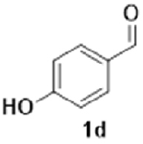
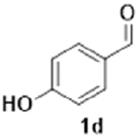
Fine white opaque solid; yield 75 (CM) and 95% (MW); 1H NMR (100 MHz, DMSO-d6 and CDCl3) d 9.18 (s, 1H), 7.60 (d, J 16 Hz, 1H), 7.38 (d, J 8 Hz, 2H), 6.84 (d, J 8 Hz, 2H), 6.23 (d, J 16 Hz, 1H); 13C NMR (25 MHz, CDCl3 and DMSO-d6) d 168.47, 160.03, 144.54, 130.14, 125.75, 116.22; HRMS (ESI) m/z, [M - H]-: 163.1, [2M - H]-: 327.1; CAS: 7400-08-0.
(E)-3-(4-Hydroxy-3-methoxyphenyl)acrylic acid (2e)
Pink solid; yield 70 (CM) and 90% (MW); 1H NMR (100 MHz, DMSO-d6 and CDCl3) d 9.0 (s, 1H), 7.66 (d, J 16 Hz, 1H), 7.37-6.72 (m, 3H), 6.17 (d, J 16 Hz, 1H), 3.82 (s, 3H); 13C NMR (25 MHz, DMSO-d6 and CDCl3) d 168.97, 148.54, 147.36, 144.78, 126.25, 122.52, 115.28, 109.96, 55.64; HRMS (ESI) m/z, [M - H]-: 193.1; CAS: 537-98-4.
(E)-3-(3-Nitrophenyl)acrylic acid (2f)
Fine white opaque solid; yield 90 (CM) and 95% (MW); 1H NMR (100 MHz, DMSO-d6 and CDCl3) d 8.28-8.10 (m, 2H), 7.86-7.47 (m, 3H), 6.48 (d, J 16 Hz, 1H); 13C NMR (25 MHz, DMSO-d6 and CDCl3) d 172.29, 153.40, 146.21, 141.22, 138.53, 134.93, 129.03, 127.17; HRMS (ESI) m/z, [M - H]-: 192.1, [2M - H]-: 385.1; CAS: 1772-76-5.
(E)-3-(4-Nitrophenyl)acrylic acid (2g)
Light yellow solid; yield 90 (CM) and 98% (MW); 1H NMR (100 MHz, DMSO-d6 and CDCl3) d 8.16 (d, J 9.0 Hz, 2H), 7.74 (d, J 9.0 Hz, 2H), 7.61 (d, J 16 Hz, 1H), 6.55 (d, J 16 Hz, 1H); 13C NMR (25 MHz, DMSO-d6 and CDCl3) d 167.47, 148.46, 141.76, 141.26, 129.74, 124.38, 124.13; HRMS (ESI) m/z, [M - H]-: 192.1, [2M - H]-: 385.1; CAS: 619-89-6.
(E)-3-(4-Chlorophenyl)acrylic acid (2h)
Fine white opaque solid; yield 85 (CM) and 95% (MW); 1H NMR (102 MHz, DMSO-d6 and CDCl3) d 7.85-7.77 (m, 1H), 7.53-7.726 (m, 3H), 7.51 (d, J 16.0 Hz, 1H), 6.35 (d, J 16.0 Hz, 1H); 13C NMR (25 MHz, DMSO-d6 and CDCl3) d 172.72, 147.52, 140.35, 138.09, 134.23, 133.90, 124.82; HRMS (ESI) m/z, [M - H]-: 181.1; CAS: 940-62-5.
(E)-3-(2-Fluorophenyl)acrylic acid (2i)
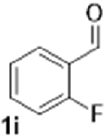
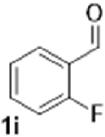
Fine white opaque solid; yield 35 (CM) and 50% (MW); 1H NMR (100 MHz, CDCl3) d 7.68 (d, J 16 Hz, 1H), 7.55 6.93 (m, 4H), 6.41 (d, J 16 Hz, 1H); 13C NMR (25 MHz, DMSO-d6 and CDCl3) d 165.53, 158.91 (d, 1JC,F 242 Hz, C-F), 134.09, 133.07 (d, 3JC,F 8 Hz, Ar-CH), 130.31, 129.97, 127.37, 123.09 (d, 4JC,F 3 Hz, Ar-CH), 122.98, 120.52 (d, 3JC,F 8 Hz, Ar CH), 120.25, 120.04, 114.20 (d, 2JC,F 21 Hz, Ar-CH); HRMS (ESI) m/z, [M - H]-: 165.1, [2M - H]-: 331.1; CAS: 18944-77-9.
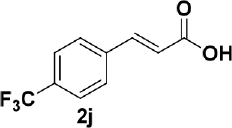
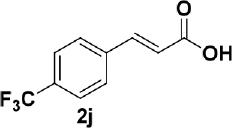
(E)-3-(4-(Trifluoromethyl)phenyl)acrylic acid (2j)
Fine white opaque solid; yield 80 (CM) and 86% (MW); 1H NMR (100 MHz, DMSO-d6) d 7.85-7.50 (m, 6H), 6.47 (d, J 16.0 Hz, 1H); 13C NMR (25 MHz, DMSO-d6) d 167.58, 142.44, 138.79, 129.80, 129.18, 126.15, 126.02, 122.66; HRMS (ESI) m/z, [M - H]-: 215.1; [2M - H]-: 431.2; CAS: 2062-26-2.
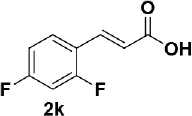
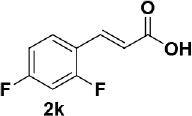
(E)-3-(2,4-Difluorophenyl)acrylic acid (2k)
Fine white opaque solid; yield 50 (CM) and 70% (MW); 1H NMR (100 MHz, CDCl3) d 7.73-7.46 (m, 2H), 6.98 6.79 (m, 2H), 6.38 (d, J 15 Hz, 1H); 13C NMR (25 MHz, DMSO-d6) d 167.68, 152.72, 135.31, 131.39 131.02 (m), 122.14 (d, JC,F 5Hz), 119.16, 112.9 (dd, 2JC,F 21 Hz, 4JC-F 3 Hz), 105.06 (t, 2JC-F 25 Hz); HRMS (ESI) m/z, [M - H]-: 183.0; CAS: 94977-52-3.
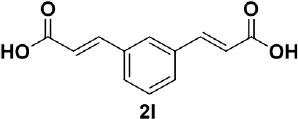
(2E,2’E)-3,3’-(1,3-Phenylene)diacrylic acid (2l)
Fine white opaque solid; yield 85 (CM) and 96% (MW); 1H NMR (100 MHz, DMSO-d6 and CDCl3) d 12.42 (s, 2H), 7.93-7.73 (m, 4H), 7.62 (d, J 16 Hz, 2H), 6.60 (d, J 16.0 Hz, 2H); 13C NMR (25 MHz, DMSO-d6 and CDCl3) d 167.93, 143.49, 136.40, 129.16, 120.76; HRMS (ESI) m/z, [M - H]-: 217.1, [2M - H]-: 435.2; CAS: 37710-81-9.
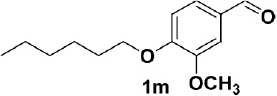
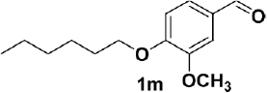
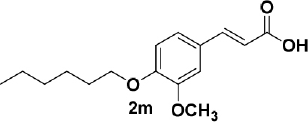
(E)-3-(4-(Hexyloxy)-3-methoxyphenyl)acrylic acid (2m)
Fine white opaque solid; yield 85 (CM) and 90% (MW); 1H NMR (100 MHz, DMSO-d6 and CDCl3) d 9.89 (s, 1H), 7.77 (d, J 16.0 Hz, 1H), 7.52-6.87 (m, 3H), 6.36 (d, J 16 Hz, 1H), 4.22-4.09 (m, 2H), 4.04-3.95 (m, 3H), 1.93 1.87(m, 2H), 1.44 (m, 7H), 1.02-0.96 (m, 2H); 13C NMR (25 MHz, DMSO-d6 and CDCl3) d 191.66, 154.23, 149.85, 144.57, 130.06, 126.44, 123.03, 112.62, 110.40, 69.03, 56.15, 31.46, 29.01, 25.63, 22.55, 14.33; HRMS (ESI) m/z, [M - H]: 177.2, [2M - H]-: 555.4; CAS: 79669-12-8.
-
This publication is part of the special issue “Organic Synthesis - BMOS”
-
1
H (100 MHz) and 13C (25 MHz) nuclear magnetic resonance (NMR) spectra were recorded on a Nanalysis 100 Pro spectrometer (100 MHz), using deuterated chloroform (CDCl3) as the solvent, with five drops of deuterated dimethyl sulfoxide (DMSO-d6) as a co solvent. Chemical shifts (d) are reported in ppm relative to tetramethylsilane (TMS, Me4Si) or the deuterated solvent (CDCl3), and coupling constants (J) are reported in Hz. The mass of the obtained products was confirmed using a Bruker Amazon SL mass spectrometer with electrospray ionization (ESI) in negative mode. The samples were diluted in acetonitrile/water (1:1) and filtered through a 0.22 µm Millipore filter. High-performance liquid chromatography (HPLC) analysis was performed using a Shimadzu prominence liquid chromatography system equipped with an LC 20AT pump, an SPD-M20A photodiode array detector (PDA DAD), an SIL-20A autosampler, and a Shim-pack C18 VP-ODS reverse-phase column (4.6 × 250 mm, 5 μm). The analyses were carried out at three wavelengths: 220 (channel 1), 250 (channel 2), and 280 nm (channel 3). The chromatographic method was carried out under isocratic conditions using acetonitrile/H2O (85:15, v/v) as the mobile phase, with a flow rate of 1.0 mL min-1 and a total run time of 15 min. An injection volume of 20 μL was used for the sample solution, prepared at a concentration of 0.5 mg in 2 mL of acetonitrile.
Supplementary Information
Supplementary information (NMR and MS spectra) is available free of charge at http://jbcs.sbq.org.br as PDF file.
Supplementary PDF
Acknowledgments
The authors thank CNPq, CAPES, FAPEMIG and Pep4Bio, for financial support. We also thank the grants to Laboratório Central Analítica do Campus CCO-LCACCO (FINEP, UFSJ and UFMG).
Data Availability Statement
The data supporting the findings of this study are available within the article and its SI section.
References
-
1 Mouterde, L. M. M.; Allais, F.; Front. Chem. 2018, 6, 426. [Crossref]
» Crossref -
2 Sidler, E.; Humair, R.; Hardegger, L. A.; Org. Process Res. Dev. 2020, 24, 1756. [Crossref]
» Crossref -
3 Pellon, R. F.; Mamposo, T.; Gonzalez, E.; Calderon, O.; Synth. Commun. 2000, 30, 3769. [Crossref]
» Crossref -
4 Kappe, C. O.; Angew. Chem., Int. Ed. 2004, 43, 6250. [Crossref]
» Crossref -
5 Bougrin, K.; Loupy, A.; Soufiaoui, M.; J. Photochem. Photobiol., C 2005, 6, 139. [Crossref]
» Crossref -
6 Bougrin, K. S.; Bashiardes, G. In Microwaves in Organic Synthesis; Loupy, A., ed.; Wiley-VCH: Weinheim, Germany, 2006. [Crossref]
» Crossref -
7 Kappe, C. O.; Dallinger, D.; Mol. Diversity 2009, 13, 71. [Crossref]
» Crossref -
8 de la Hoz, A.; Díaz-Ortiz, A.; Moreno, A.; Chem. Soc. Rev. 2005, 34, 164. [Crossref]
» Crossref -
9 Horikoshi, S.; Serpone, N.; Chem. Rec. 2019, 19, 118. [Crossref]
» Crossref -
10 Tietze, L. F.; Beifuss, U. In Comprehensive Organic Synthesis; Trost, B. M.; Fleming, I., eds.; Pergamon Press: Oxford, UK, 1991. [Crossref]
» Crossref -
11 Deng, H.; Xu, Q.; Guo, H.-Y.; Huang, X.; Chen, F.; Jin, L.; Quan, Z.-S.; Shen, Q.-K.; Phytochemistry 2023, 206, 113532. [Crossref]
» Crossref -
12 Kot, B.; Sytykiewicz, H.; Sprawka, I.; Witeska, M.; Int. J. Mol. Sci. 2020, 21, 102. [Crossref]
» Crossref -
13 Li, W.; Wang, K.; Liu, Y.; Wu, H.; He, Y.; Li, C.; Wang, Q.; Su, X.; Yan, S.; Su, W.; Zhang, Y.; Lin, N.; Front. Immunol. 2022, 13, 912933. [Crossref]
» Crossref -
14 Karatas, O.; Yuce, H. B.; Taskan, M. M.; Gevrek, F.; Alkan, C.; Kara, G. I.; Temiz, C.; J. Periodontal Res. 2020, 55, 676. [Crossref]
» Crossref -
15 El-Raouf, O. M. A.; El-Sayed, E. S. M.; Manie, M. F.; J. Biochem. Mol. Toxicol. 2015, 29, 426. [Crossref]
» Crossref -
16 Wang, R.; Yang, W.; Fan, Y.; Dehaen, W.; Li, Y.; Li, H.; Wang, W.; Zheng, Q.; Huai, Q.; Bioorg. Chem. 2019, 88, 102951. [Crossref]
» Crossref -
17 Guo, S.; Zhen, Y.; Zhu, Z.; Zhou, G.; Zheng, X.; Life Sci. 2019, 235, 116819. [Crossref]
» Crossref -
18 Nouni, C.; Nobelos, P. T.; Rekka, E. A.; Molecules 2023, 28, 6732. [Crossref]
» Crossref -
19 Rattanangkool, E.; Kittikhunnatham, P.; Damsud, T.; Wacharasindhu, S.; Phuwapraisirisan, P.; Eur. J. Med. Chem. 2013, 66, 296. [Crossref]
» Crossref -
20 Song, Y. H.; Kim, D. W.; Curtis-Long, M. J.; Park, C.; Son, M.; Kim, J. Y.; Yuk, H. J.; Lee, K. W.; Park, K. H.; Eur. J. Med. Chem. 2016, 114, 201. [Crossref]
» Crossref -
21 Dávila-Guzmán, N. E.; Medina-Almaguer, Y. B.; Reyes González, M. A.; Loredo-Cancino, M.; Pioquinto García, S.; de Haro Del Rio, D. A.; Garza-Navarro, M. A.; Hernández Fernández, E.; ACS Omega 2020, 5, 317. [Crossref]
» Crossref -
22 Viana, L. P.; Naves, G. M.; Medeiros, I. G.; Guimarães, A. S.; Sousa, E. S.; Santos, J. C.; Freire, N. M.; de Aquino, T. M.; Modolo, L. V.; de Fátima, A.; Bioorg. Chem. 2024, 146, 107247. [Crossref]
» Crossref -
23 Kuzemko, M. A.; Van Arnum, S. D.; Niemczyk, H. J.; Org. Process Res. Dev. 2007, 11, 470. [Crossref]
» Crossref -
24 Sungur, C.; Miller, S.; Bergholz, J.; Hoye, R. C.; Brisbois, R. G.; Overvoorde, P.; Plant Cell Physiol. 2007, 48, 1693. [Crossref]
» Crossref -
25 Kim, J. H.; Chan, K. L.; Cheng, L. W.; Molecules 2017, 22, 1783. [Crossref]
» Crossref -
26 Park, S.; Kim, Y. A.; Lee, J.; Seo, H.; Nam, S.-J.; Jo, D.-G.; Hyun, D.-H.; Food Sci. Hum. Wellness 2023, 12, 1287. [Crossref]
» Crossref -
27 Alghamdi, M. A.; Khalifah, T. A.; Alhawati, H. S.; Ruzayq, M.; Alrakaf, A.; Khodier, A.; Al-Gayyar, M. M.; Alghamdi, M.; Khalifah, T.; Alhawati, H. S.; Cureus 2023, 15, e41985. [Crossref]
» Crossref -
28 Jacobo-Velázquez, D. A.; Molecules 2025, 30, 3716. [Crossref]
» Crossref -
29 Cui, Y.; Hu, Y.-H.; Yu, F.; Zheng, J.; Chen, L.-S.; Chen, Q.-X.; Wang, Q.; Int. J. Biol. Macromol. 2017, 95, 1289. [Crossref]
» Crossref -
30 Pawar, H. S.; Wagh, A. S.; Lali, A. M.; New J. Chem. 2016, 40, 4962. [Crossref]
» Crossref -
31 Tokala, R.; Bora, D.; Shankaraiah, N.; ChemMedChem 2022, 17, e202100736. [Crossref]
» Crossref -
32 Bermúdez, E.; Ventura, O. N.; Méndez, P. S.; J. Phys. Chem. A 2010, 114, 13086. [Crossref]
» Crossref
Edited by
-
Editor handled this article:
Fernanda Gadini Finelli (Guest)