 Development of Task-Specific Benzothiadiazole-Based AIEE Luminogens for Latent Fingerprint Recognition
Abstract
Latent fingerprints (LFPs) are a key tool in forensic identification due to their uniqueness and long-term stability. However, their visualization at crime scenes remains challenging, highlighting the need for more efficient development methods. Recent studies have focused on organic compounds exhibiting aggregation-induced enhanced emission (AIEE), with weak luminescence in solution but strong emission in aggregated states. When incorporated into the sebaceous residues of fingerprints, these compounds can significantly enhance luminescence, enabling high-contrast and well-defined LFP images. In this work, new aryloxy-benzothiadiazole (BTD) derivatives were developed for LFP detection. Two compounds, OcA-BTD and Pyr-BTD, were synthesized, each designed according to a distinct fingerprint recognition strategy. For Pyr-BTD, a pyridine moiety was incorporated to promote interactions between the basic nitrogen and amino acids and fatty acids present in LFP residues. In contrast, OcA-BTD was designed with a highly lipophilic octadecyl chain to enhance affinity toward the lipid-rich components of LFPs. As a result, only the octadecyl-substituted compound exhibited pronounced AIEE, showing green emission in the aggregated state. This AIEEgen enabled the clear visualization of levels 1, 2, and 3 on fingerprint details on different substrates, providing excellent contrast between LFPs ridges and furrows.
Keywords:
latent fingerprint; aggregation-induced emission; fluorescence; benzothiadiazole; intramolecular charge-transfer
Introduction
Fingerprints are among the most reliable forms of personal identification in forensic science due to their uniqueness and permanence throughout a life of an individual.1 They consist of characteristic patterns of ridges and furrows on the fingertips and are widely used in criminal investigations, biometric authentication systems, and personal identification.2 The most common type of fingerprints found at crime scenes are latent fingerprints (LFPs), which are invisible and generated through the deposition of residue on the surface at the moment of contact.1,3 Their residue originates primarily from eccrine secretions, composed predominantly of aqueous components; and sebaceous secretions, composed of lipid-rich materials. Its composition is highly variable and dependent on intrinsic factors such as age, sex, diet, medication, and health conditions, as well as extrinsic factors including surface type, environmental exposure, and time elapsed since deposition.3-5 These variables significantly affect the quality, persistence, and detectability of LFPs in the process of analyzing their patterns.2 This analysis can generate first-level information, corresponding to the overall flow of the ridges and the type of pattern, second-level information, including details that are essential for individualization, and third-level information, comprising finer characteristics that can provide additional discriminatory power.6,7 Extracting this information requires the use of effective LFP development methods capable of revealing these features with sufficient contrast and resolution.2,7
Several techniques have been traditionally employed for the visualization of LFPs, including powder dusting, vacuum metal deposition (VMD), cyanoacrylate fuming, silver nitrate treatment, and ninhydrin staining.3,6,8 Although widely used, these methods often suffer from drawbacks such as limited sensitivity, background interference, toxicity, surface dependence, and potential degradation of the fingerprint or substrate.9 Consequently, there is a growing demand for alternative approaches that are simple, rapid, efficient, and less harmful to both the evidence and the examiner. In recent years, fluorescence-based methods have emerged as promising alternatives for LFPs development.9 Among them, organic compounds exhibiting aggregation-induced emission (AIE) or aggregation-induced enhanced emission (AIEE) have attracted considerable attention.10,11 Unlike conventional fluorophores, AIE/AIEE-active molecules are weakly emissive or non-emissive in solution but become highly luminescent upon aggregation due to the restriction of intramolecular motions and adoption of twisted conformations in aggregated states.11-14 This behavior makes them particularly suitable for fingerprint visualization, as the organic aggregate tends to display affinity to the lipid-rich residues present in LFPs.15
Several AIE/AIEE-active materials, including tetraphenylethylene derivatives, diphenylpyrimidinones, stilbenes, polymers, and metal-organic systems, have been reported for latent fingerprint imaging on various surfaces, enabling the visualization of first-, second-, and, for selected examples, third-level details.7,10,15-23 Despite these advances, many reported systems still present limitations related to synthetic complexity, application procedures, or imaging performance, highlighting the need for new molecular designs that combine simplicity, efficiency, and high contrast. In this context, benzothiadiazole (BTD) based compounds have emerged as promising building blocks for luminescent materials due to their favorable electronic properties and structural versatility.24-27 Modifications of the BTD core, particularly through aryloxy and alkynyl substitutions, allow fine tuning of photophysical behavior and AIE/AIEE properties.28 In our research group, various compounds containing the BTD nucleus substituted with an aryloxy moiety were described with the aim of extracting information from LFPs. Fiuza et al.15 reported an aryloxy BTD derivative in which the ArO-BTD moiety is responsible for ensuring the AIEE properties, while an additional styryl group was introduced to enhance interactions with the lipid-rich residues of latent fingerprints. The compound exhibited relevant emission enhancement upon aggregation that allowed the fluorescent visualization of second-level fingerprint details on glass and aluminum surfaces, with clear discrimination between ridges and furrows. Pina et al.29 reported two BTD derivatives (aryloxy BTD triphenylamine and aryloxy BTD-carbazole) that presented intense AIEE and have achieved efficient adhesion to LFPs with high contrast between ridges and furrows, allowing visualization of first-, secondand even third-level details on non-porous substrates.
Based on advances in the use of aryloxy-BTD-derived molecules as active AIEE probes for the development of latent fingerprints, this work investigates two novel compounds that preserve the aryloxy-BTD moiety, introducing on this platform distinct additional task-specific scaffolds to enhance selective interactions with fingerprint residues. In OcA-BTD, an octadecyl lipophilic substituent was incorporated to improve adhesion to lipid secretions, while in Pyr-BTD a basic pyridine group was introduced to promote interactions with amino-acid and/or fatty acid residues present in latent fingerprints.
Experimental
Materials and methods
The chemicals and solvents were acquired from commercial suppliers and used without additional purification unless otherwise stated. The solvents dimethylformamide (DMF) and toluene utilized in cross-coupling reactions were previously degassed using N2 flow. All novel molecules were characterized through 1H and 13C NMR spectroscopy using a Bruker Advance III HD 400 MHz spectrometer. Infrared spectra were obtained on a Bruker Invenio-R instrument with the Platinum ATR Universal accessory (diamond crystal). UV Vis absorption spectra were acquired in a Shimadzu UV-1900i spectrophotometer equipped with a 1.0 cm optical path quartz cuvette. Photoluminescence measurements were conducted on a Shimadzu RF 6000 spectrofluorometer, employing four clear-faced 1.0 cm quartz cuvettes, a scanning rate of 6000 nm min-1, and a spectral bandpass of 5.0 nm. Solutions with concentrations in the order of 10-4 and 10-5 mol L-1, were used for fluorescence and UV-Vis experiments, respectively. Fluorescence quantum yields determination in solution were also conducted in the Shimadzu RF-6000, utilizing the same conditions described above. Fluorescence quantum yields were determined through the comparative method using quinine sulfate (ϕFL = 0.55) in aqueous sulfuric acid 0.5 mol L-1 as standard.30 Aggregation induced emission experiments were performed in ethanol/water mixtures with water fraction (fw) ranging from 0 (pure ethanol) to 99% in 7.5 × 10⁻⁶ mol L-1 solutions for both OcA-BTD and Pyr-BTD. The fluorescence spectra of these samples were acquired using the same procedure as the photoluminescence measurements previously described. Dynamic light scattering (DLS) analyses were performed using a Horiba Scientific SZ-100 nanoparticle analyzer in triplicate at 25 ± 0.1 °C, 90° scattering angle, for 90 s. The SZ-100 Horiba for windows software was used to construct autocorrelation functions and obtain the size and hydrodynamic radio, and the CONTIN algorithm was used to perform the appropriate adjustments for the autocorrelation function. Measurements used Milli-Q, Millipore system (resistivity 18.2 MΩ cm) and ethanol (0.2 mmol L-1) solutions, varying water proportions, and solvent refractive indices present in the equipment were used to calculate the scattering vector.
Synthesis of the intermediate 2
The synthesis of the aryloxy-BTD intermediate (2) was performed according to the method described by Pazini et al.25
Synthesis of OcA-BTD via Heck C-C coupling
In an evacuated screw-cap Schlenk flask filled with nitrogen, the reaction mixture containing the intermediate 2 (0.20 mmol), octadecyl acrylate (0.24 mmol, 77.8 mg), Pd(OAc)2 (5.0 mol%, 1.0 mg), PPh3 (10 mol%, 2.3 mg), NaOAc (0.24 mmol, 20 mg), and degassed DMF (5 mL) was stirred at 130 °C for 24 h and allowed to cool to room temperature.31 The mixture was diluted with ethyl acetate and washed with water. The organic phase was dried with sodium sulfate, filtered, and concentrated under vacuum. The crude product was then purified by column chromatography on silica gel using hexane/ethyl acetate as the mobile phase.
Octadecyl (E)-3-(7-(4-methoxyphenoxy)benzo[c][1,2,5]thiadiazol-4-yl)acrylate (OcA-BTD)
Pale yellow wax; 23% yield; FTIR (ATR) ν / cm 1 2914, 2848, 1702, 1498, 1211, 1178, 827; 1H NMR (400 MHz, CDCl3) δ 7.90 (d, J 15.9 Hz, 1H), 7.54 (d, J 8.0 Hz, 1H), 7.43 (d, J 16.0 Hz, 1H), 7.17-7.12 (m, 2H), 6.99-6.95 (m, 2H), 6.66 (d, J 7.9 Hz, 1H), 4.23 (t, J 6.8 Hz, 2H), 3.84 (s, 3H), 1.76-1.67 (m, 2H), 1.31-1.20 (m, 30H), 0.86 (t, J 7.0 Hz, 3H); 13C NMR (101 MHz, CDCl3) δ 167.9, 157.4, 154.5, 152.5, 148.6, 147.8, 140.1, 133.4, 122.1, 121.9, 121.8, 121.4, 115.3, 115.2, 115.1, 110.1, 64.9, 55.8, 32.1, 29.8, 29.8, 29.7, 29.7, 29.5, 29.4, 28.9, 26.1, 22.8, 14.2; HRMS (ESI) calculated for C34H49N2O4S [M + H]+: 581.3413, found: 581.3415.
Synthesis of Pyr-BTD via Suzuki cross-coupling reaction
In an evacuated screw-cap Schlenk flask filled with nitrogen, the reaction mixture containing the intermediate 2 (0.20 mmol), 4-pyridylboronic acid (0.40 mmol), Pd(OAc)2 (5.0 mol%, 1.0 mg), PPh3 (10 mol%, 2.3 mg), K2CO3 (0.30 mmol, 42 mg), degassed toluene (7 mL) was stirred at 110 °C for 24 h and then allowed to cool to room temperature.26 The mixture was diluted with ethyl acetate and washed with water. The organic phase was then dried over sodium sulfate, filtered, and concentrated under vacuum. The crude product was then purified by column chromatography on silica gel using hexane/ethyl acetate as the mobile phase
4-(4-Methoxyphenoxy)-7-(pyridin-4-yl)benzo[c][1,2,5]thiadiazole (Pyr-BTD)
Yellow solid; 76% yield; melting point: 105-110 °C; FTIR (ATR) ν / cm-1 2919, 1498, 1214, 1193, 1068, 1029, 844, 813, 754, 512; 1H NMR (400 MHz, CDCl3) δ 8.73 (d, J 6.2 Hz, 2H), 7.87 (d, J 6.2 Hz, 2H), 7.68 (d, J 7.9 Hz, 1H), 7.18 (d, J 9.0 Hz, 2H), 6.99 (d, J 9.1 Hz, 2H), 6.80 (d, J 7.9 Hz, 1H), 3.86 (s, 3H); 13C NMR (101 MHz, CDCl3) δ 157.1, 154.2, 151.6, 150.04, 148.5, 147.9, 144.5, 129.4, 124.6, 123.2, 121.9, 115.2, 110.4, 55.7, 29.7; HRMS (ESI) calculated for C18H14N3O2S [M + H]+: 336.0807, found: 336.0820.
Latent fingerprint recognition experiments
Nonporous substrates, specifically glass slides, a plastic phone case, and aluminum foils, were selected for LFP recognition experiments. The fingerprint of a single donor has been evaluated. To prepare the fingerprints, the hands of the donor were thoroughly washed with soap and water, and the fingertips were lightly rubbed across the forehead before being gently pressed onto the substrate surfaces with minimal force. Suspensions at 0.7 mmol L-1 of OcA-BTD in ethanol-water mixtures (fw = 80%) were used for LFP development. The process involved putting the suspension on freshly-prepared fingerprint-loaded substrates for 10 min, followed by rinsing them with distilled water to remove the excess material. The substrates were then allowed to air dry at room temperature. The developed LFPs were photographed under 365 nm UV irradiation using a mobile phone camera for identification of LFPs minutiae. The fluorescence intensity contrast between ridges and furrows areas was analyzed in terms of grayscale value (G), using the open access ImageJ software, version 1.53k (National Institutes of Health, Bethesda, MD, USA). The fingerprint development experiments were performed at least in duplicate, and the images shown in Figures 4 and S8 (Suplementary Information (SI) section) are representative of the level of detail observed.
Results and Discussion
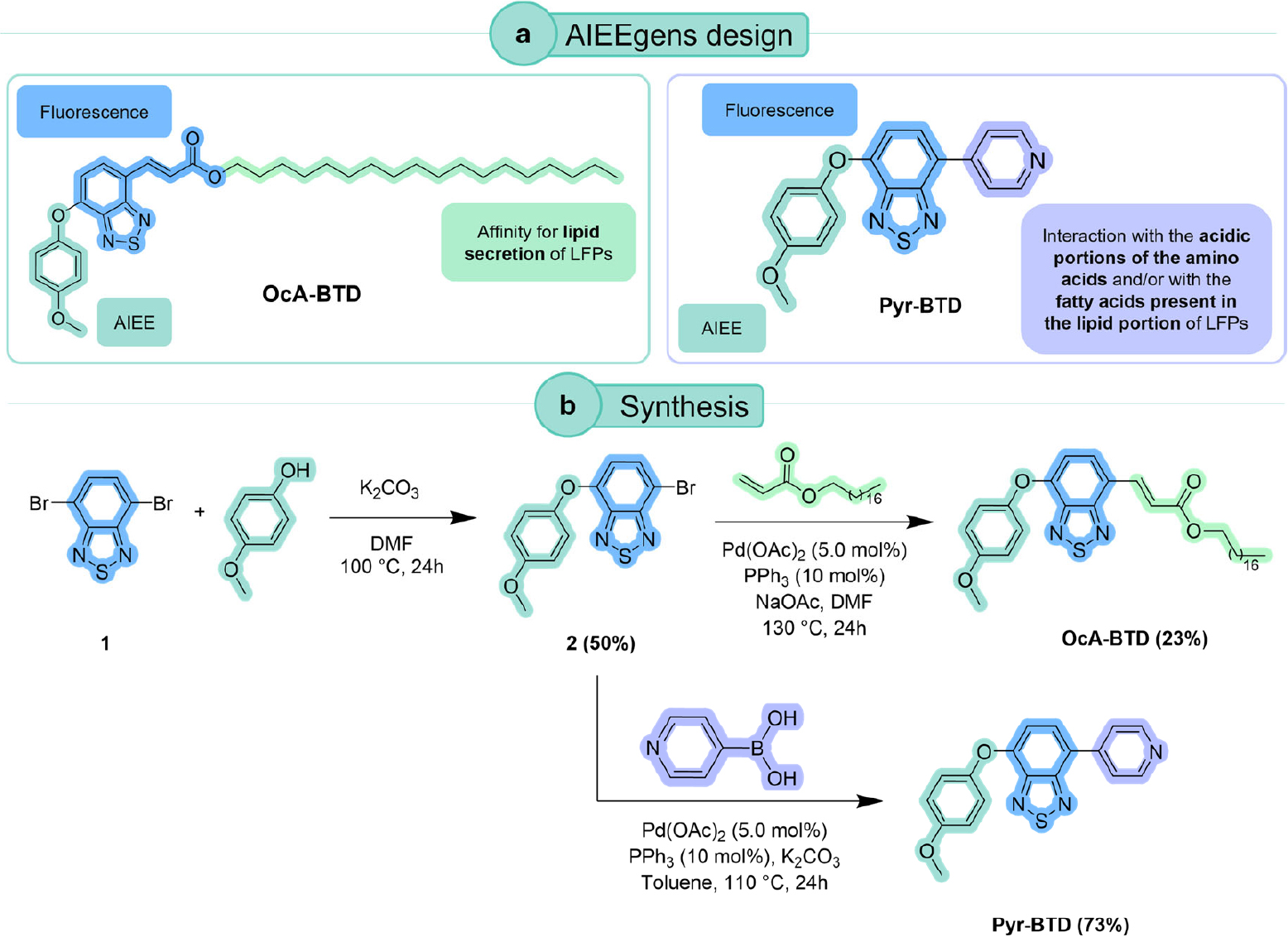
Several published studies have demonstrated that incorporating aryloxy (ArO-) moieties into BTD-based compounds effectively promotes AIE/AIEE behavior. These substituents favor the formation of twisted molecular conformations in the aggregated state, which suppress deleterious π-π stacking interactions and reduce excited-state deactivation pathways. In addition, ArO- units linked to the BTD core can undergo restriction of intramolecular rotation in the aggregated state, leading to a significant enhancement of luminescence intensity.15,24,28,29,32,33 Previous studies by our group15,29 have demonstrated that ArO BTD based compounds are effective AIEE luminogens for latent fingerprint visualization. Therefore, the ArO-BTD core was retained in the structure of two novel compounds, while two additional molecular design strategies were implemented to further enhance the adhesion of the fluorescent probes to fingerprint residues: (i) the introduction of a lipophilic octadecyl chain to improve affinity for lipid secretions (OcA-BTD), and (ii) the incorporation of a basic pyridine unit to promote interactions with amino acid residues and/or fatty acids present in latent fingerprints (Pyr-BTD), as illustrated in Scheme 1a.
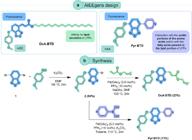
For the synthesis of the compounds, dibromo BTD (1) was subjected to a substitution reaction with 4-methoxyphenol, resulting in the monobrominated intermediate 2 in 50% yield, following a previously reported protocol.25 Subsequently, 2 was independently submitted to a Heck reaction with octadecylacrylate and to a Suzuki cross-coupling with 4-pyridylboronic acid, respectively, using simple catalytic systems based on Pd(OAc)2 and PPh3. These reactions produced the desired potential AIEEgens: OcA-BTD and Pyr-BTD in 23 and 73% yield, respectively (Scheme 1b).
Photophysical properties
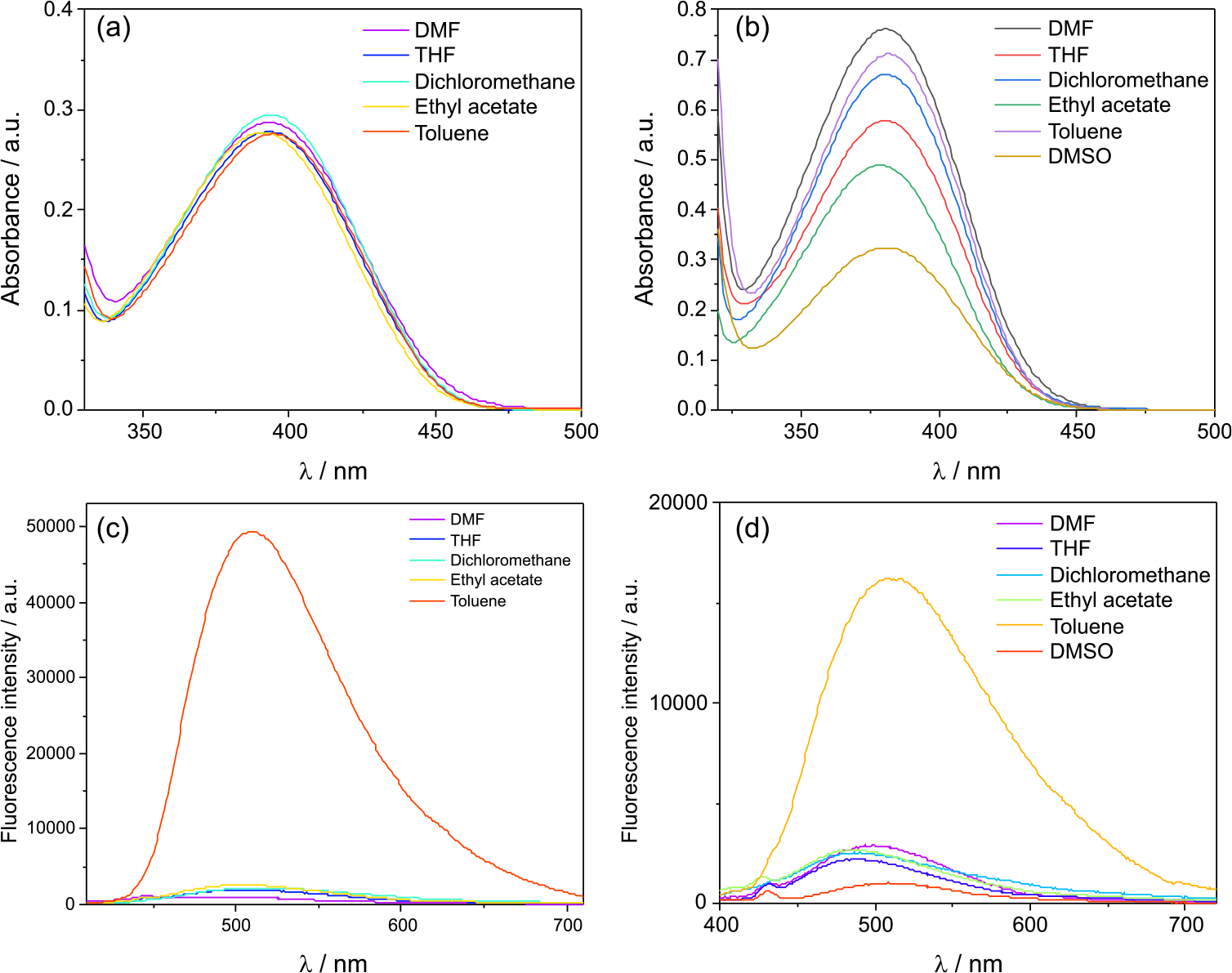
The photophysical properties of the aryloxy-BTD derivatives were investigated by UV-Vis absorption and fluorescence emission spectroscopy in solvents of different polarity (DMF, tetrahydrofuran (THF), dichloromethane, ethyl acetate, and toluene for both compounds; dimethyl sulfoxide (DMSO) was additionally evaluated for Pyr BTD). As shown in Figure 1, OcA-BTD and Pyr BTD exhibit absorption maxima (λabs) in the ranges of 391 395 nm and 378-382 nm, respectively, with molar absorption coefficients (ε) on the order of 104 L mol 1 cm 1, assigned to π-π* transitions. Pyr-BTD shows slightly stronger absorption in the visible region compared to OcA BTD. Both compounds display only weak solvatochromic effect in the absorption. These variation in λabs with solvent polarity suggests limited charge separation in the ground state. However, in Pyr-BTD, solvent polarity significantly affects absorption intensity, indicating modulation of electronic transition probabilities through specific solvent interactions. Upon excitation at the absorption maxima, both compounds exhibit fluorescence in all investigated solvents, with the most intense emission observed in toluene. A pronounced redshift is also observed with increasing solvent polarity. Fluorescence emission is also substantially quenched in more polar solvents, likely due to enhanced nonradiative decay pathways associated with stronger solvent-solute interactions that stabilize the excited state. OcA-BTD and Pyr-BTD exhibit emission maxima (λem) in the ranges of 445-521 nm and 485 509 nm, respectively, corresponding to violet-to-green emission for the acrylate derivative and blue-to-green emission for the pyridine derivative. Notably, both compounds display large Stokes shifts (∆λST), indicative of significant structural and/or electronic relaxation following excitation, related to intramolecular charge transfer (ICT) from the peripheral donors to the BTD acceptor group. The fluorescence quantum yields (ϕFL) were measured in toluene with values of 0.23 for OcA-BTD and 0.015 for Pyr-BTD, highlighting the markedly more efficient radiative decay of the acrylate-containing derivative under these conditions. The relevant photophysical data of both compounds is summarized in Table 1.
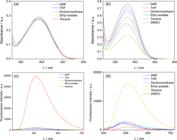
(a) OcA-BTD and (b) Pyr-BTD absorption spectra (C = 5 × 10⁻⁵ mol L-1); (c) OcA-BTD and (d) Pyr-BTD fluorescence spectra (C = 5 × 10⁻⁴ mol L-1).
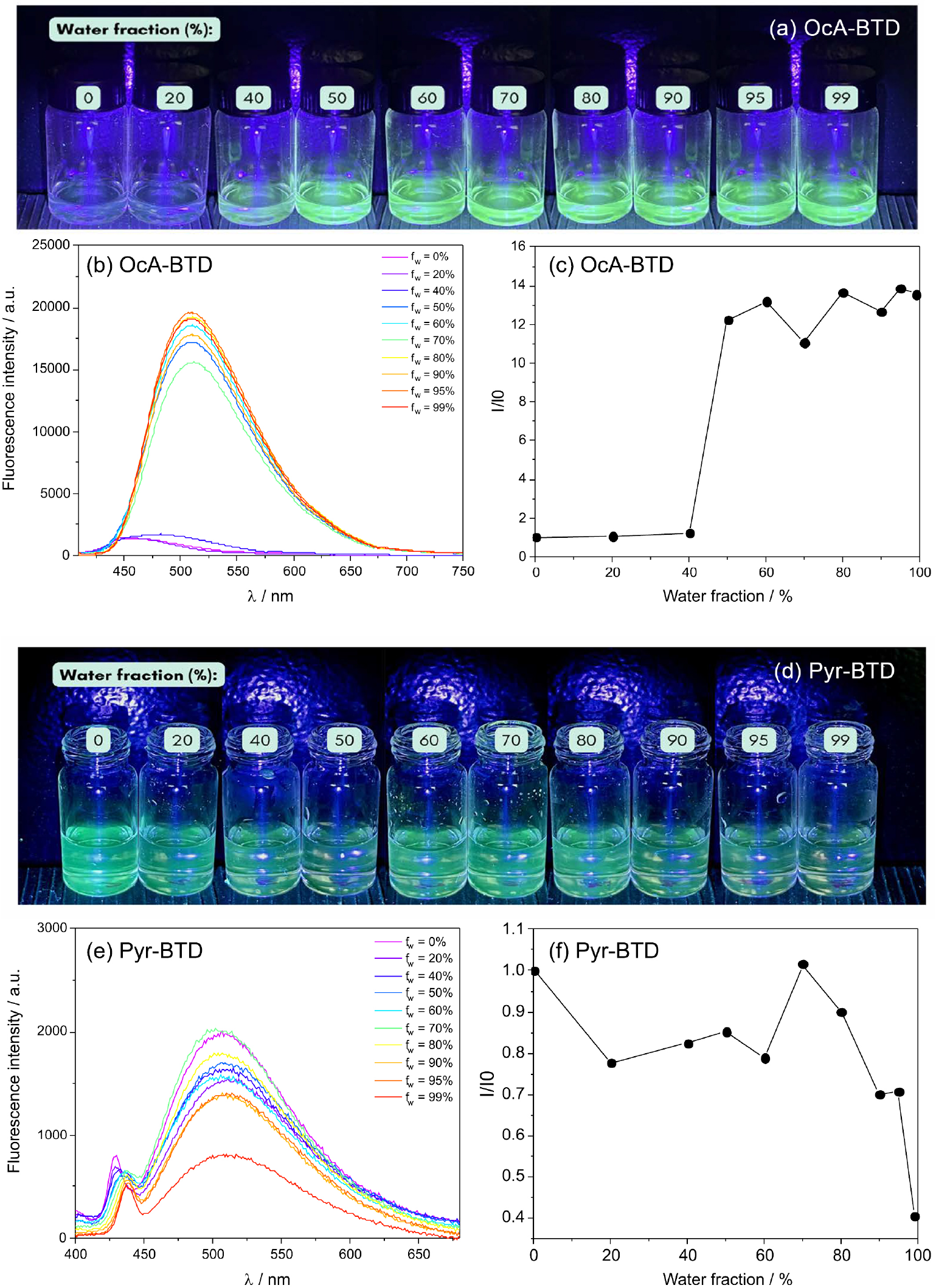
The aggregation-induced enhanced emission of OcA BTD and Pyr-BTD were investigated by fluorescence spectroscopy in ethanol-water mixtures with increasing water fractions (fw), ranging from 0 (pure ethanol) to 99% water, a poor solvent that promotes aggregation. Visual observations under UV (365 nm) irradiation revealed that OcA-BTD exhibits a pronounced increase in emission intensity in all mixtures containing fw ≥ 40%, a behavior consistent with the onset of aggregation and characteristic of AIEE systems (Figure 2a). On the other hand, Pyr-BTD shows negligible variation in visible fluorescence intensity across the entire fw range, indicating the absence of AIEE under these conditions (Figure 2d). Fluorescence measurements performed in the same solvent mixtures confirmed that OcA-BTD exhibits low emission intensity at low water fractions, followed by a sharp increase in fluorescence above a critical water content (Figure 2b). This behavior is attributed to the formation of nanoaggregates, which restrict intramolecular rotations and suppress nonradiative decay pathways, consistent with an AIEE mechanism. This trend is clearly reflected in the relative emission intensity (I/I0) plot, which shows a pronounced enhancement starting at fw ca. 50% and reaching a plateau at higher water fractions, with a maximum enhancement factor of 14.6 (Figure 2c). Conversely, Pyr-BTD exhibits consistently weak emission and a nearly flat I/I0 profile across all compositions (Figures 2e and 2f). In terms of structure, although both derivatives were expected to exhibit AIEE due to restriction of intramolecular motions upon aggregation and disruption of planarity by the aryloxy substituent, the flexible alkyl chain of the acrylate moiety in OcA-BTD provides additional conformational restriction under aggregation, effectively promoting radiative relaxation in the aggregate, whereas in Pyr-BTD the structural or solvation characteristics appear insufficient to significantly suppress nonradiative pathways or favor emissive aggregate morphologies.
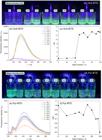
(a,d) OcA-BTD and Pyr-BTD AIEE experiments under UV irradiation and (b,e) their respective fluorescence emission spectra in ethanol/water mixtures with different ratios (fw); (c,f) plots of I/I0, where I is the fluorescence intensity at a specific fw value and I0 is the fluorescence intensity in ethanol.
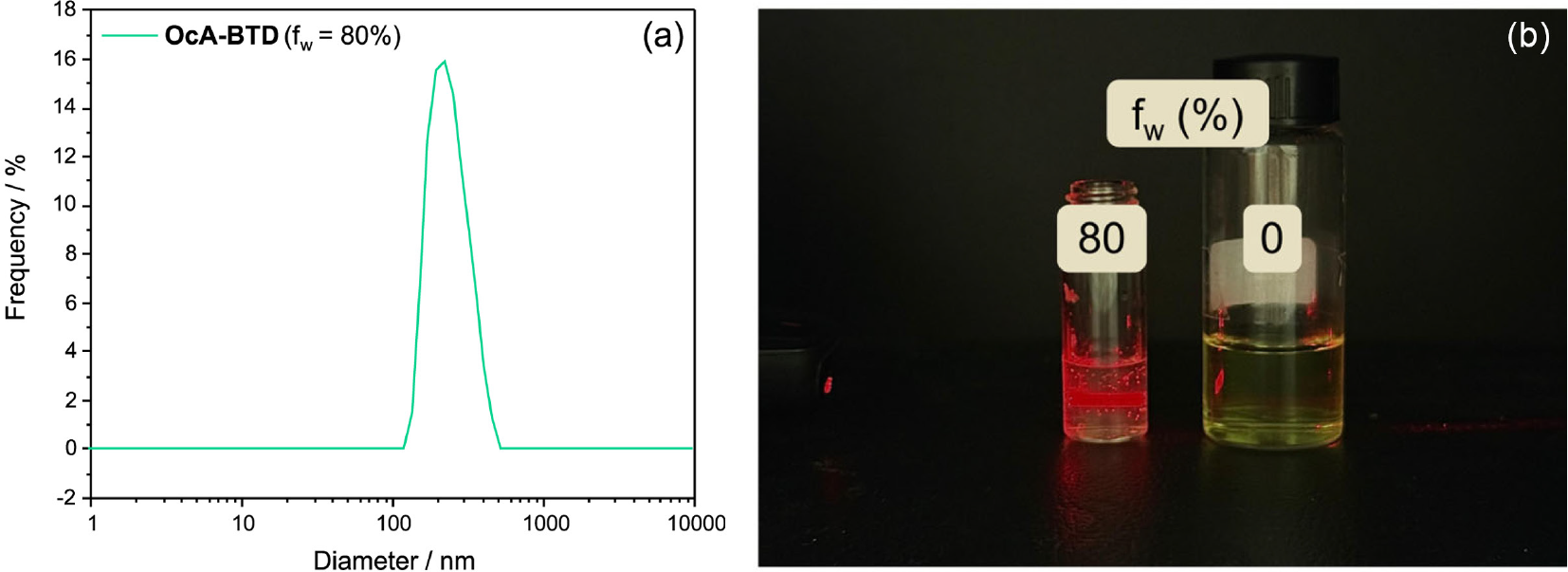
To confirm that the enhanced emission observed at high water fractions originates from nanoaggregate formation in OcA-BTD, DLS measurements were performed. Solutions of the molecule at fw = 0 and 80% were analyzed, revealing no detectable aggregates in pure ethanol, whereas well defined nanoaggregates with a hydrodynamic diameter of 213.6 nm were observed at fw = 80% (Figure 3a), thereby corroborating that the luminescence enhancement arises from the AIEE for this molecule. Additional evidence for nanoaggregate formation was obtained from the Tyndall effect, which involves the visible scattering of a light beam by dispersed particles in a colloidal medium.34 Accordingly, a red laser beam was directed through OcA-BTD in pure ethanol and in an ethanol-water mixture with an fw = 80%, and, as illustrated in Figure 3b, pronounced light scattering was observed only for the sample containing 80% water, whereas no scattering was detected in pure ethanol. Together, these results unequivocally demonstrate the formation of nanoaggregates under high water fraction conditions and support their direct role in the observed AIEE of OcA-BTD.
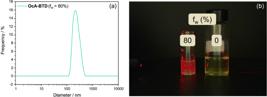
(a) DLS result for estimation of the hydrodynamic diameter of the nanoaggregates formed in the solution containing water/ethanol 80:20 for OcA-BTD and (b) Tyndall effect on this compound.
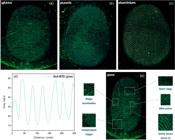
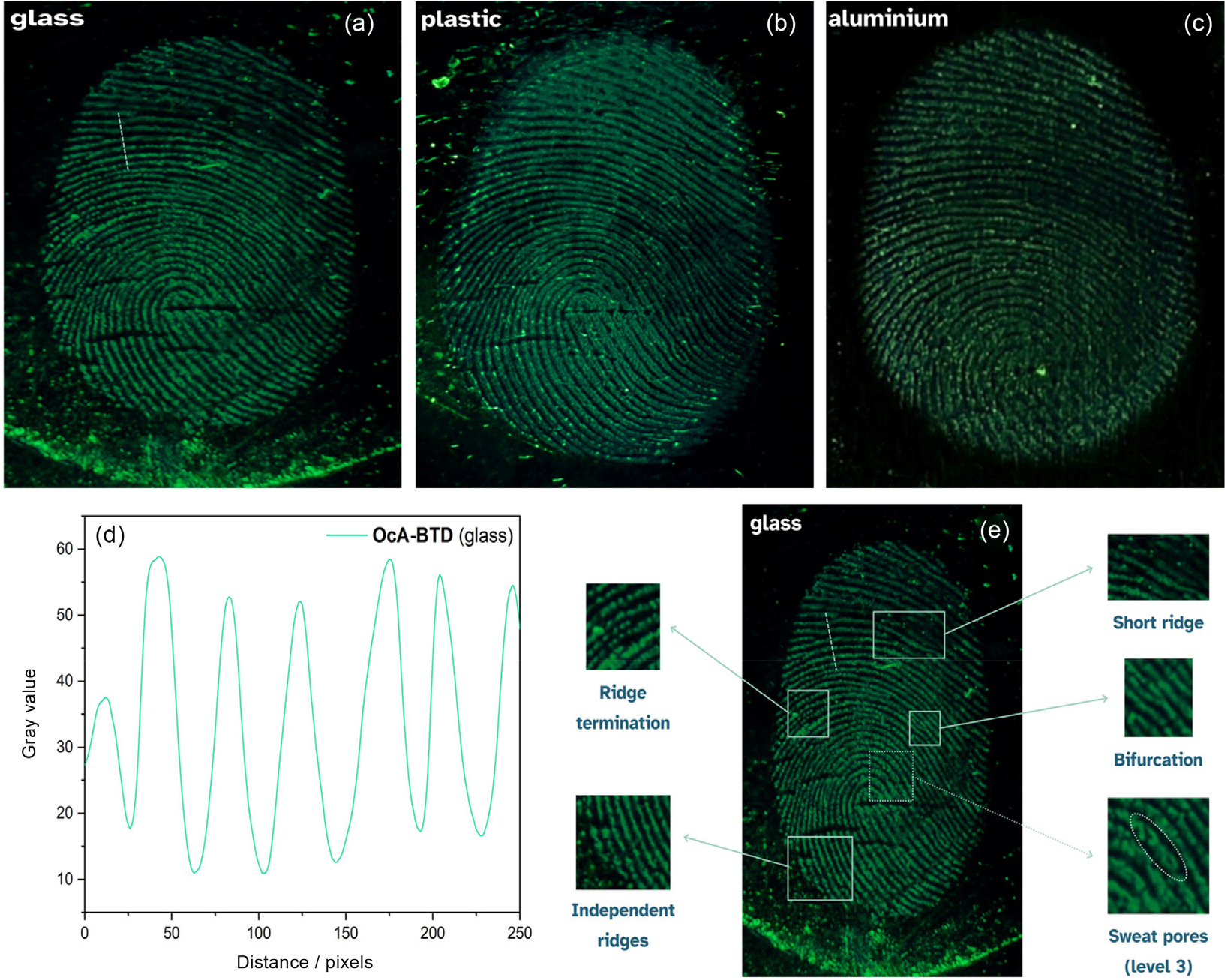
LFP development using OcA-BTD on (a) glass, (b) plastic, (c) aluminium, (d) grey value related to the line in (a) demonstrating the differentiation between ridges and grooves, (e) details of second and third levels of (a).
OcA-BTD as AIEEgen for latent fingerprint recognition
The applicability of the AIEE-active compound OcA BTD for LFP development was evaluated on glass, plastic, and aluminum substrates. An 80:20 (v/v) water/ethanol suspension of the compound was applied to surfaces bearing LFPs and allowed to interact for a few minutes. As shown in Figures 4a-4c, effective fingerprint visualization was achieved on all three substrates, affording high contrast between ridges and furrows. Image resolution was quantitatively assessed by G analysis of the developed LFPs, using the minimum grayscale value (G0) as a reference and employing the G/G0 ratio to evaluate ridge-furrow differentiation.35 For all substrates, first-, second-, and third-level fingerprint details were clearly resolved, with glass providing the highest contrast, for which G/G0 values of up to 60 were obtained (Figure 4d). Visual inspection further confirmed the presence of characteristic firstand second-level features, including ridge endings, bifurcations, short ridges, and well-defined separation between individual ridges (Figure 4e). Notably, sweat pores corresponding to third-level details were also distinctly visible, demonstrating the excellent capability of OcA-BTD to generate high-resolution LFP images across diverse surfaces. This performance is directly attributed to the AIEE behavior of the compound, which promotes strong fluorescence after aggregation with the lipid residues of fingerprint deposits, thus increasing image contrast and fine structural details.
The ability of OAc-BTD to highlight LFP details was further evaluated under more challenging conditions. In the first set of experiments, the latent fingerprint was deposited without sebaceous secretion enrichment (i.e., without rubbing the thumb on the forehead prior to deposition). Lately, the fingerprint was developed with OAc-BTD after an aging period of 18 h. In the first case, primaryand secondary-level fingerprint details could still be clearly detected (Figure S8, SI section). In contrast, the aged fingerprint exhibited a significant loss of definition after development (Figure S8, SI section), suggesting that the time interval between fingerprint deposition and visualization is a critical factor for successful detection using this AIEgen. The modest performance observed under these more challenging conditions indicates that further studies are still necessary, particularly focusing on the optimization of both the AIEgen structure and the developer formulation. Such improvements may enhance sensitivity, stability, and interaction with fingerprint residues, enabling the development of more robust systems suitable for practical forensic applications.
Conclusions
Two novel aryloxy-BTD derivatives, OAc-BTD and Pyr-BTD, were conceived and developed with LFP-affine substituents (octadecyl acrylate or pyridine) for fluorescent fingerprint visualization. In solution, both compounds exhibit absorption in the UV-A region and emission in blue-to-green region highly dependent of solvent polarity. OcA-BTD displays pronounced AIEE in ethanol/water mixtures as a result of restricted intramolecular rotation, as confirmed by DLS measurements and observation of the Tyndall effect. The nanoaggregates of OcA-BTD were successfully applied to fluorescent visualization of latent fingerprints, enabling clear visualization of firstand second-level ridge details with high contrast and good ridge-furrow discrimination across various substrates. Notably, OcA-BTD also enabled the visualization of sweat pores (third-level details), placing it among the limited number of AIE/AIEE luminogens capable of resolving such fine fingerprint features. Overall, these results highlight the effectiveness of the aryloxy substituent in promoting AIEE-active BTD derivatives and demonstrate the important role of the octadecyl acrylate moiety in selectively interacting with lipid components of fingerprint residues.
Acknowledgments
The authors would like to thank FAPERJ (Grant Nos. SEI-26/0003/001526/2022; SEI-260003/003400/2022; SEI-260003/015152/2021), CAPES (Finance Code 001) and CNPq.
Supplementary Information
Supplementary Information (NMR and FTIR spectra as well as DLS data) is available free of charge at http://jbcs.sbq.org.br as PDF file.
Supplementary PDF
Data Availability Statement
All data are available in the text and supporting information.
References
-
1 Lian, J.; Meng, F.; Wang, W.; Zhang, Z.; Front. Chem 2020, 8, 594864. [Crossref]
» Crossref -
2 Friesen, J. B.; J. Chem. Educ 2015, 92, 497. [Crossref]
» Crossref -
3 Bumbrah, G. S.; Sharma, R. M.; Jasuja, O. P.; Res. Rep. Forensic Med. Sci. 2016, 6, 39. [Crossref]
» Crossref -
4 Cadd, S.; Islam, M.; Manson, P.; Bleay, S.; Sci. Justice 2015, 55, 219. [Crossref]
» Crossref -
5 Girod, A.; Ramotowski, R.; Weyermann, C.; Forensic Sci. Int 2012, 223, 10. [Crossref]
» Crossref -
6 Malik, A. H.; Zehra, N.; Ahmad, M.; Parui, R.; Iyer, P. K.; New J. Chem. 2020, 44, 19423. [Crossref]
» Crossref -
7 Abebe, B.; Murthy, H. C. A.; Zereffa, E. A.; Dessie, Y.; J. Chem. Rev. 2020, 2, 40. [Crossref]
» Crossref -
8 Xu, L.; Zhang, C.; He, Y.; Su, B.; Sci. China: Chem 2015, 58, 1090. [Crossref]
» Crossref -
9 Li, Y.; Xu, L.; Su, B.; Chem. Commun. 2012, 48, 4109. [Crossref]
» Crossref -
10 Wang, Y.-L.; Li, C.; Qu, H.-Q.; Fan, C.; Zhao, P.-J.; Tian, R.; Zhu, M.-Q.; J. Am. Chem. Soc 2020, 142, 7497. [Crossref]
» Crossref -
11 Mei, J.; Leung, N. L. C.; Kwok, R. T. K.; Lam, J. W. Y.; Tang, B. Z.; Chem. Rev 2015, 115, 11718. [Crossref]
» Crossref -
12 Qi, Q.; Liu, Y.; Fang, X.; Zhang, Y.; Chen, P.; Wang, Y.; Yang, B.; Xu, B.; Tian, W.; Zhang, S. X.-A.; RSC Adv 2013, 3, 7996. [Crossref]
» Crossref -
13 da Costa, R. G. M.; Garcia, R. Q.; Fiuza, R. M. R.; Maqueira, L.; Pazini, A.; de Boni, L.; Limberger, J.; J. Lumin 2021, 239, 118367. [Crossref]
» Crossref -
14 Mei, J.; Hong, Y.; Lam, J. W. Y.; Qin, A.; Tang, Y.; Tang, B. Z.; Adv. Mater. 2014, 26, 5429. [Crossref]
» Crossref -
15 Fiuza, R. M.; Vesga-Hernández, C.; Padilha, J.; Maqueira, L.; Aucélio, R. Q.; Limberger, J.; J. Lumin 2022, 248, 118920. [Crossref]
» Crossref -
16 Singh, P.; Singh, H.; Sharma, R.; Bhargava, G.; Kumar, S.; J. Mater. Chem. C 2016, 4, 11180. [Crossref]
» Crossref -
17 Zhao, Z.; Geng, J.; Chang, Z.; Chen, S.; Deng, C.; Jiang, T.; Qin, W.; Lam, J. W. Y.; Kwok, H. S.; Qiu, H.; Liu, B.; Tang, B. Z.; J. Mater. Chem 2012, 22, 11018. [Crossref]
» Crossref -
18 Sodre, E. R.; Guido, B. C.; de Souza, P. E. N.; Machado, D. F. S.; Carvalho-Silva, V. H.; Chaker, J. A.; Gatto, C. C.; Correa, J. R.; Fernandes, T. A.; Neto, B. A. D.; J. Org. Chem 2020, 85, 12614. [Crossref]
» Crossref -
19 Malik, A. H.; Kalita, A.; Iyer, P. K.; ACS Appl. Mater. Interfaces 2017, 9, 37501. [Crossref]
» Crossref -
20 Xiang, X.; Zhou, Z.; Feng, H.; Feng, S.; Gai, L.; Lu, H.; Guo, Z.; CCS Chem. 2020, 2, 329. [Crossref]
» Crossref -
21 Li, S.; Wang, L.; Ma, Y.; Zhu, L.; Lin, W.; Sens. Actuators, B 2022, 371, 132595. [Crossref]
» Crossref -
22 Singh, H.; Verma, S.; Chem. Commun. 2021, 57, 5290. [Crossref]
» Crossref -
23 Duan, L.; Zheng, Q.; Tu, T.; Adv. Mater. 2022, 34, 2202540. [Crossref]
» Crossref -
24 Pazini, A.; Maqueira, L.; Santos, F. S.; Barreto, A. R. J.; Carvalho, R. S.; Valente, F. M.; Back, D.; Aucélio, R. Q.; Cremona, M.; Rodembusch, F. S.; Limberger, J.; Dyes Pigm. 2020, 178, 108377. [Crossref]
» Crossref -
25 Pazini, A.; Maqueira, L.; Avila, H. C.; Valente, F. M.; Aderne, R. E.; Back, D.; Aucélio, R. Q.; Cremona, M.; Limberger, J.; Tetrahedron Lett 2018, 59, 2994. [Crossref]
» Crossref -
26 Pazini, A.; Maqueira, L.; Stieler, R.; Aucélio, R. Q.; Limberger, J.; J. Mol. Struct 2017, 1131, 181. [Crossref]
» Crossref -
27 Mota, A. A. R.; Carvalho, P. H. P. R.; Guido, B. C.; de Oliveira, H. C. B.; Soares, T. A.; Corrêa, J. R.; Neto, B. A. D.; Chem. Sci 2014, 5, 3995. [Crossref]
» Crossref -
28 Neto, B. A. D.; Limberger, J.; Vesga-Hernández, C.; Beck, P. S.; Coord. Chem. Rev 2026, 550, 217410. [Crossref]
» Crossref -
29 Pina, V.; Lamosa, R.; Santos, A.; Cremona, M.; Barbieri, A.; Limberger, J.; Dyes Pigm. 2025, 241, 112902. [Crossref]
» Crossref -
30 Brouwer, A. M.; Pure Appl. Chem. 2011, 83, 2213. [Crossref]
» Crossref -
31 Limberger, J.; Poersch, S.; Monteiro, A. L.; J. Braz. Chem. Soc 2011, 22, 1389. [Crossref]
» Crossref -
32 Vesga-Hernández, C.; Carvalho, R. S.; Santos, A. M.; Peñafiel, M. J. P.; Maqueira, L.; Back, D. F.; Aucélio, R. Q.; Rodembusch, F.; Franchello, F.; Laureto, E.; Cremona, M.; Limberger, J.; ACS Phys. Chem. Au 2026, 6, 215. [Crossref]
» Crossref -
33 Costa, R. G. M.; Carvalho, R. S.; Isoppo, V. G.; Barreto, A. R. J.; Peñafiel, M. J. P.; dos Santos, A. M.; Back, D.; Aucélio, R. Q.; Cremona, M.; Rodembusch, F. S.; Limberger, J.; Dyes Pigm. 2023, 219, 111533. [Crossref]
» Crossref -
34 Xiao, W.; Deng, Z.; Huang, J.; Huang, Z.; Zhuang, M.; Yuan, Y.; Nie, J.; Zhang, Y.; Anal. Chem. 2019, 91, 15114. [Crossref]
» Crossref -
35 Qiu, Z.; Hao, B.; Gu, X.; Wang, Z.; Xie, N.; Lam, J. W. Y.; Hao, H.; Tang, B. Z.; Sci. China: Chem. 2018, 61, 966. [Crossref]
» Crossref
Edited by
-
Editor handled this article:
Giovanni Wilson Amarante (Executive)