 EFFECTS OF SMALL-SIDED AND CONDITIONED GAMES OF PASSING IN SPORT OF FOOTBALL: A SYSTEMATIC REVIEW
ABSTRACT
This study conducted a systematic review of research on small-sided and conditioned games (SSCG) of football passing. It comprised four stages: identification of studies, screening, eligibility and inclusion of articles. Eighteen keywords divided into two groups related to the small-sided and conditioned games and the pass were used, totaling 81 combinations between them. The search across six databases was finalized on April 30, 2024. Eighteen articles were included in the systematic review. The main results were: a) SSCG were more effective than decontextualized drills in improving passing performance; b) SSCG from other team sports enabled transfer to football decision-making and passing; c) offensive numerical configurations in SSCG influenced passing differently—superiority enhanced performance, while inferiority reduced it; d) numerical equality improved performance only in specific formats (e.g., GK + 6 vs. 6 + GK); e) fewer players in SSCG led to more passes and better performance; f) passing performance was influenced by SSCG complexity, players’ age, and tactical level—easier tasks and higher tactical performance favored effectiveness, with age groups responding differently to numerical configurations.
Keywords:
Small-sided game; Conditioned games; Football; Passing performance; Review
RESUMO
Este estudo desenvolveu uma revisão sistemática de pesquisas sobre jogos reduzidos e condicionados (JRC) no futebol com foco no passe. O processo envolveu quatro etapas: identificação dos estudos, triagem, elegibilidade e inclusão dos artigos. Foram utilizadas dezoito palavras-chave divididas em dois grupos — relacionadas aos jogos reduzidos e condicionados e ao passe — totalizando 81 combinações entre elas. A busca em seis bases de dados foi finalizada em 30 de abril de 2024. Dezoito artigos foram incluídos na revisão sistemática. Os principais resultados foram: a) os JRC foram mais eficazes do que os exercícios descontextualizados para melhorar o desempenho no passe; b) JRC de outros esportes coletivos permitiram transferência para a tomada de decisão e o passe no futebol; c) configurações numéricas ofensivas nos JRC influenciaram o passe de forma distinta — superioridade numérica aumentou o desempenho, enquanto inferioridade o reduziu; d) a igualdade numérica melhorou o desempenho apenas em formatos específicos (por exemplo, G + 6 vs. 6 + G); e) menos jogadores nos JRC resultaram em mais passes e melhor desempenho; f) o desempenho no passe foi influenciado pela complexidade dos JRC, idade dos jogadores e nível tático — tarefas mais simples e maior desempenho tático favoreceram a efetividade, com grupos etários respondendo de maneira diferente às configurações numéricas.
Palavras-chave:
Jogos reduzidos; Jogos condicionados; Futebol; Desempenho do passe; Revisão
Introduction
Over the last decades the small-sided and conditioned games (SSCG) have increasingly been recognized as an important strategy for promoting improvements in sports performance, including in the contexts of teaching and training in team sports1,2. Emerged from children and adolescents’ playful football activities performed on the streets, especially in Brazil3,4, it refers to a game subsystem whose complexity is inferior to the formal game, but with its dynamic system nature preserved2,5-10.
The basic assumption here is the SSCG enable the improvement of tactical and technical motor skills through practice trials near to the real situations, but with lower cognitive and socio-emotional demands, which facilitate understanding of the game's dynamics2,11-15. For instance, regarding the sport of football, SSCG have been manipulated in terms of decreasing the number of players in cooperation and/or opposition5,6,9,10,16, game field dimensions17-19, number of touches on the ball per player20, number and form of targets21,22, and practice distribution23.
Interestingly, it appears that over the past few years the number of studies on SSCG of football has increased, including about the motor skill of passing (e.g.,24-33). The passing is the most often motor skill performed in the football game34-36. It refers to a motor skill of transferring, predominantly with the feet, the ball to a teammate. In addition to transferring ball possession, passing allows the creation and use of space during attack15,34,37,38.
Despite the significant number of studies on SSCG, the specific effects of task constraints on the passing motor skill remain fragmented across literature using diverse methodologies. A comprehensive synthesis focusing solely on passing performance, distinct from general tactical behaviour, is lacking. Therefore, this systematic review aimed to identify and synthesize the effects of SSCG on passing performance, specifically analyzing the influence of: (i) numerical configurations; (ii) participants’ characteristics (age and expertise); and (iii) the assessment instruments used.
Methods
The literature review was based in the PRISMA statement for systematic reviews and meta-analyzes, which consists of a checklist of 27 items and four different stages39. The first stage involved the identification of the articles in English language in the databases by considering eighteen keywords related to the (i) pass or (ii) SSCG. They were: (i) “decision-making”; “interpersonal coordination”; “intrapersonal coordination”; “motor skills”; “pass”; “passing”; “specific motor skills”; “technical”; “technical performance”; (ii) “conditioned games”; “football game”; “small-sided games”; “soccer game”; “subsystems”; “task”; “task constraints”; “task manipulation”; “team sports”. All these keywords were used in articles on football passing and SSCG. The databases used were as follows: SciELO, Pubmed, Web of Science, Scopus, Lilacs and Google Scholar. The final search date for articles was April 30, 2024. The crossing of these two keywords groups (i and ii) resulted in 81 search combinations.
The second stage was screening, which involved the analysis of the titles and, when necessary, abstracts. Studies were excluded when they were not related to the aim of this systematic review or by duplication (same study founded in different databases). Additionally, review articles, book chapters, and conference abstracts were excluded to focus on original peer-reviewed research. Following that, eligibility was verified as the third stage. In this case, all articles were read in totum. Finally, articles were included in the systematic review (fourth stage). Data extraction was systematically performed to categorize key information: (i) study identification (author/year); (ii) participants’ characteristics (level of expertise and age); (iii) SSCG protocols (e.g., number of players, rules, and field dimensions); and (iv) specific assessment instruments and passing metrics used. These stages are presented in Figure 1.
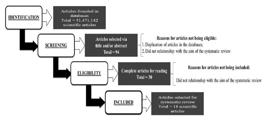
Flowchart of the systematic review, the four steps of selection and inclusion of the articles, and the reasons for exclusions. Source: Authors.
Results
This systematic review included 18 articles. Reporting a total of 34 SSCG (Table 1). They comprised: (i) those requiring ball possession or reaching a specific field zone, played without a goalkeeper; (ii) those involving a goalkeeper, with the primary objective of scoring goals; (iii) those featuring numerical superiority and/or inferiority scenarios; and (iv) those incorporating a floater player to introduce numerical inequality.
Regarding the participants’ characteristics, it was found that 52.9% of the articles had a sample with amateur football players20,24-26,28-32, and in 17.6% the sample comprised beginner football players7,8. Moreover, 11.8% of the articles had beginner football players who were experienced in futsal25,27,36; 11.8 % involved a sample of amateur and professional football players20,16, and only 5.9% of the articles had only professional football players27,28.
Concerning the assessment instruments (Table 2), 8 observational analysis tools were found in 11 articles, while 7 articles used notational analysis. Only one article assessed the performance of the pass without opposition26. Moreover, only one article used a visual search instrument (mobile eye tracking system) to analyze the location of the players' eyes before reception the ball and during the execution of the pass15.
In relation to the measures of passing performance, 47.1% of the articles accessed the level of success in decision-making and performance, including metrics such as the total number of ball touches per player during the match and the quantity of successful passes completed by the players 7,15,29-32,37; 17.6% considered only the numbers of passing6,16; 17.6% accessed only the level of successful in passes 20,26,28; 11.8% of the articles accessed the number and level of successful pass 24,25; and, 5.9% of the articles accessed only the level of successful decision-making of passing8.
Regarding the findings, articles showed that:
a) SSCG were more effective on the improvement of passing performance than the decontextualized drills26,29,30;
b) SSCG of other team sports (e.g., hockey and futsal) made possible the transfer for decision-making and performance of football passing8,15;
c) while SSCG involving offensive numerical superiority improved the decision-making and performance of passing, SSCG comprised by offensive numerical inferiority decreased the number of passes7,16,25,30-32;
d) SSCG involving numerical equality only improved the passing performance in GK + 6 vs. 6 + GK situations when compared to GK + 7 vs. 7 + GK and 3 vs. 3 in a long-term intervention20,24,26,28,32;
e) the smaller the number of players in SSCG, the greater the number of passes and the better the performance7,16,28;
f) the difficulty and complexity levels of the SSCG, associated with the players’ chronological age and tactical performance affected the passing performance7,8,28. Specifically: (i) in the easier SSCG there was more successful passes and less touch the ball before passing than in difficult SSCG; (ii) players with higher tactical performance touched less the ball before passing during difficult SSCG by considering players with smaller tactical performance and easier SSCG; (iii) younger players (U-15) performed more touches on the ball and more passes during a GK + 4 vs. 4 + GK situation than in a GK + 3 vs. 3 + GK situation, while older players (U-17) had a longer ball possession, performed more touches on the ball and more passes in a GK + 3 vs. 3 + GK than in a GK + 4 vs. 4 + GK one8.
Discussion
The aim of this research was to conduct a systematic review on small-sided and conditioned games (SSCG) applied to football passing. Specifically, it sought to identify the effects of SSCG on the passing performance regarding the participants’ characteristics, the assessment instruments and the measures of passing. Results showed that SSCG were more effective on passing performance than decontextualized drills26,29,30. This result provides support for the propositions about the pedagogical potential of the SSCG on the improvement of passing performance. In this case, SSCG have allowed proximity to the game environment in a way that the interactions between the players were preserved4,32. As we wrote previously, the choice of decontextualized tasks has been recognized as one of the main mistakes of coaches and teachers when handling task complexity11,12. To avoid this, two aspects are important to create a SSCG learning environment that reflects the football game: attunement and calibration.
Attunement refers to the players' ability to perceptually tune into the information emerging from the performance environment. Calibration, in turn, is the players' capacity to scale the perceived information according to their own action capabilities4,45,46. For example, to execute a pass, players must process multiple sources of information from the performance environment – even before receiving the ball – in order to select the most suitable affordance (i.e., opportunities for action)15,42,47,48.
Results also showed that benefits of SSCG are transferable, since those gains from hockey and futsal implied gains related to the passing performance in the sport of football8,15. This transfer is attributed to the similar characteristics between team sports in relation to the structure and function32,45,49. In fact, it has been proposed that general and operational principles are similar and consist of action rules that guide players in solving the tactical and technical problems of games1,50,51. General principles refer to the number of players near to the ball acting for creating numerical superiority, avoiding numerical equality, and not allowing numerical inferiority1,50. In turn, operational principles consist of collective actions of attacking and defending50,51. According to the action fidelity, the transfer occurs through performance goals (e.g. passing to the teammate), without “ideal” and rigid action patterns32,49,52.
Concerning the third and fourth results, they showed that the manipulation of the numerical relations in SSCG affected the passing performance. When attacking was under numerical superiority there was an increase of decision-making and passing performance. On the other hand, when attacking was in numerical inferiority the number of passing decreased7,16,25,30-32. In addition, situations involving numerical equality only improved the passing performance in GK + 6 vs. 6 + GK situations when compared to GK + 7 vs. 7 + GK and 3 vs. 3, considering a long-term intervention20,24,26,28,32. Regarding the numerical superiority and inferiority results, these effects may be attributable to the differentials in passing opportunities versus intercepting possibilities. Specifically, superior numbers create more passing lanes between the ball carrier and teammates, while inferior numbers result in fewer passing options compared to the intercepting lanes available to defenders42,49,52. In relation to the numerical equality results, effects were observed only on the passing performance practiced in an intermediate situation (GK + 6 vs. 6 + GK). Similar to passing performance in futsal, this intermediate situation may function as a zone of self-organized criticality where specific stimuli (e.g., SSCG training) can induce changes in passing performance42.
Regarding the fifth result, it was found that the smaller the number of players, the greater the number of passes and the better the passing performance6,8,28. This indicates the importance of reducing task complexity during the teaching, learning, and training of passing skills. Evidently, with fewer players, there are greater opportunities to receive and execute passes.
It was also revealed that practice of easier SSCG resulted in a greater number of successful passes and smaller number of touching the ball before passing performance7. On this regard, the easier SSCG provided higher space and time for performing a passing, which allowed players to explore the performance environment during on-ball possession. To perform a pass, players need to be tuned to the performance environment through exploratory behaviors4,42,47,50. Exploratory behaviors are movements of eye, head and body that support the capture of visual information from the performance environment48,49,51.
Concerning the sixth result, that players with superior levels of tactical performance performed fewer amounts of touching the ball before passing performance during the more difficult SSCG7, this result is attributed to the visual search. That is, experienced football players explore more visually the teammates, opponents, and football field than those not experienced players. The latter tend to focus more on the ball and the nearest opponent52,53. In this way, football players with a higher level of tactical performance may have already scanned the performance environment before receiving the ball, allowing them to know where to direct it upon reception and thus reducing their contact time with it15,50.
Also, results showed that while younger players (U-15) performed a greater number of ball touches and passes in the GK + 4 vs. 4 + GK compared to the GK + 3 vs. 3 + GK situation, older players (U-17) had longer ball possession time, performed a greater number of ball touches and passes in the GK + 3 vs. 3 + GK compared to the GK + 4 vs. 4 + GK situation7. Players’ age influenced the way they engaged with the SSCG. Younger players needed more time in complex SSCG to identify passing affordances, while older players could perceive them before receiving the ball15,50.
Two other results called attention to this discussion. First, results showed that all revised articles used notational analysis with arbitrary scales or scores for accessing decision-making and/or performance outcome in SSCG. No article used complementary measures such as relative angles5,42,47,48,49; number of opponents, occupied area during passing performance42; distance and velocity of the pass35,41,42,49, among others. This should be considered in future studies.
Second, results revealed that only slightly more than half of the studies used SSCG without a goalkeeper. As we wrote previously, teaching-learning and training of specific motor skills need be guided by representative tasks to guarantee the constraints inherent to the performance environment4,49,52. However, how the presence/absence of the goalkeeper in SSCG affects the passing performance was not clarified by this set of articles. Therefore, this aspect also should be considered in further studies.
Conclusion
In conclusion, the findings of this review reinforce the effectiveness of SSCG in enhancing passing performance in football, particularly when compared to decontextualized drills. Importantly, the benefits of SSCG are transferable across team sports, supporting the idea of shared tactical and technical principles that underlie game-based learning. Moreover, manipulating numerical relations - whether through superiority, inferiority, or equality - emerged as a crucial factor in shaping passing behavior, offering coaches a strategic tool to scaffold learning environments. Reducing the number of players also proved beneficial by increasing opportunities to engage in passing actions, especially under less complex conditions.
Additionally, the outcomes of SSCG were influenced by players’ age and tactical skill level, highlighting the need to tailor practice tasks according to individual and developmental characteristics. Notably, more experienced or older players displayed greater efficiency, driven by advanced perceptual-cognitive skills such as exploratory behavior and visual scanning. However, limitations in the methodologies used - such as reliance on arbitrary notational analyses and the lack of complementary performance indicators - suggest the need for more ecologically valid assessment tools in future research. Similarly, the influence of the goalkeeper in SSCG contexts remains under-investigated, pointing to another gap.
Overall, this review underscores the pedagogical value of SSCG as a representative, adaptable, and developmentally appropriate approach for fostering perceptual attunement, tactical awareness, and passing performance in football. Future studies should continue exploring the nuanced interactions between task constraints, individual characteristics, and performance outcomes to refine our understanding of how best to optimize learning through game-based practice.
References
-
1. Clemente FM, Sarmento H. The effects of small-sided soccer games on technical actions and skills: a systematic review. Hum Mov. 2020;21(3):100-19. DOI: https://doi.org/10.5114/hm.2020.94191
» https://doi.org/10.5114/hm.2020.94191 -
2. Davids K, Araújo D, Correia V, Vilar L. How small-sided and conditioned games enhance acquisition of movement and decision-making skills. Exerc Sport Sci Rev. 2013;41(3):154-61. DOI: https://doi.org/10.1097/JES.0b013e318292f3ec
» https://doi.org/10.1097/JES.0b013e318292f3ec -
3. Araújo D, Fonseca C, Davids K, Garganta J, Volossovitch A, Brandão R, et al. The role of ecological constraints on expertise development. Talent Dev Excell. 2010;2(2):165-79 [cited 2024 Apr 30]. Available from: https://socofeelab.wordpress.com/wp-content/uploads/2012/05/araujofonsecaetal2010_ecological_constraint_expertise.pdf
» https://socofeelab.wordpress.com/wp-content/uploads/2012/05/araujofonsecaetal2010_ecological_constraint_expertise.pdf -
4. Machado JC, Barreira D, Galatti L, Chow JY, Garganta J, Scaglia AJ. Enhancing learning in the context of street football: a case for nonlinear pedagogy. Phys Educ Sport Pedagogy. 2018;24(2):176-89. DOI: https://doi.org/10.1080/17408989.2018.1552674
» https://doi.org/10.1080/17408989.2018.1552674 -
5. Laakso T, Davids K, Liukkonen J, Travassos B. Interpersonal dynamics in 2-vs-1 contexts of football: the effects of field location and player roles. Front Psychol. 2019;10:1373. DOI: https://doi.org/10.3389/fpsyg.2019.01407
» https://doi.org/10.3389/fpsyg.2019.01407 -
6. Olthof SBH, Frencken WGP, Lemmink KAPM. A match-derived relative pitch area facilitates the tactical representativeness of small-sided games for the official soccer match. J Strength Cond Res. 2019;33(2):523-30. DOI: https://doi.org/10.1519/JSC.0000000000002978
» https://doi.org/10.1519/JSC.0000000000002978 -
7. Machado JC, Barreira D, Teoldo I, Travassos B, Júnior JB, Santos JOLD, et al. How does the adjustment of training task difficulty level influence tactical behavior in soccer? Res Q Exerc Sport. 2019;90(3):403-16. DOI: https://doi.org/10.1080/02701367.2019.1612511
» https://doi.org/10.1080/02701367.2019.1612511 -
8. Memmert D, Roth K. The effects of non-specific and specific concepts on tactical creativity in team ball sports. J Sports Sci. 2007;25(12):1423-32. DOI: https://doi.org/10.1080/02640410601129755
» https://doi.org/10.1080/02640410601129755 -
9. Machado JC, Ribeiro J, Palheta CE, Alcântara C, Barreira D, Guilherme J, et al. Changing rules and configurations during soccer small-sided and conditioned games: how does it impact teams’ tactical behavior? Front Psychol. 2019;10:2487. DOI: https://doi.org/10.3389/fpsyg.2019.01554
» https://doi.org/10.3389/fpsyg.2019.01554 -
10. Práxedes A, Del Villar F, Moreno A, Gil-Arias A, Davids K. Effects of a nonlinear pedagogy intervention programme on the emergent tactical behaviours of youth footballers. Phys Educ Sport Pedagogy. 2019;24(4):332-43 [cited 2024 Apr 30]. Available from: https://shura.shu.ac.uk/24107/3/Davids-EffectsNonlinearPedagogy%28AM%29.pdf
» https://shura.shu.ac.uk/24107/3/Davids-EffectsNonlinearPedagogy%28AM%29.pdf -
11. Garganta J. O ensino dos jogos desportivos colectivos: perspectivas e tendências. Movimento. 2007;4(8):19-27. DOI: https://doi.org/10.22456/1982-8918.2373
» https://doi.org/10.22456/1982-8918.2373 -
12. Garganta J, Gréhaigne JF. Abordagem sistêmica do jogo de futebol: moda ou necessidade? Movimento. 2007;5(10):40-50. DOI: https://doi.org/10.22456/1982-8918.2457
» https://doi.org/10.22456/1982-8918.2457 -
13. Gréhaigne JF, Godbout P, Bouthier D. Performance assessment in team sports. J Teach Phys Educ. 1997;16(4):500-16. DOI: https://doi.org/10.1123/jtpe.16.4.500
» https://doi.org/10.1123/jtpe.16.4.500 -
14. McGuckian TB, Beavan A, Mayer J, Chalkley D, Pepping GJ. The association between visual exploration and passing performance in high-level U13 and U23 football players. Sci Med Football. 2020. DOI: https://doi.org/10.1080/24733938.2020.1769174
» https://doi.org/10.1080/24733938.2020.1769174 -
15. Oppici L, Panchuk D, Serpiello FR, Farrow D. Futsal task constraints promote transfer of passing skill to soccer task constraints. Eur J Sport Sci. 2018;18(7):947-54. DOI: https://doi.org/10.1080/17461391.2018.1467490
» https://doi.org/10.1080/17461391.2018.1467490 -
16. Torrents C, Ric A, Hristovski R, Torres-Ronda L, Vicente E, Sampaio J. Emergence of exploratory, technical and tactical behavior in small-sided soccer games when manipulating the number of teammates and opponents. PLoS One. 2016;11(12):e0168866. DOI: https://doi.org/10.1371/journal.pone.0168866
» https://doi.org/10.1371/journal.pone.0168866 -
17. Martone D, Giacobbe M, Capobianco A, et al. Exercise intensity and technical demands of small-sided soccer games for under-12 and under-14 players. J Strength Cond Res. 2017;31(6):1486-92. DOI: https://doi.org/10.1519/JSC.0000000000001615
» https://doi.org/10.1519/JSC.0000000000001615 -
18. Menuchi MRTP, Moro ARP, Ambrósio PE, Pariente CAB, Araújo D. Effects of spatiotemporal constraints and age on the interactions of soccer players when competing for ball possession. J Sports Sci Med. 2018;17(3):379-91 [cited 2024 Apr 30]. Available from: https://pmc.ncbi.nlm.nih.gov/articles/PMC6090386/
» https://pmc.ncbi.nlm.nih.gov/articles/PMC6090386/ -
19. Olthof SBH, Frencken WGP, Lemmink KAPM. Match-derived relative pitch area changes the physical and team tactical performance of elite soccer players in small-sided soccer games. J Sports Sci. 2017;36(14):1557-63. DOI: https://doi.org/10.1080/02640414.2017.1403412
» https://doi.org/10.1080/02640414.2017.1403412 -
20. Dellal A, Hill-Haas S, Lago-Peñas C, Chamari K. Small-sided games in soccer: amateur vs professional players’ physiological responses, physical and technical activities. J Strength Cond Res. 2011;25(9):2371-81. DOI: https://doi.org/10.1519/JSC.0b013e3181fb4296
» https://doi.org/10.1519/JSC.0b013e3181fb4296 -
21. Castellano J, Silva P, Usabiaga O, Barreira D. The influence of scoring targets and outer-floaters on attacking and defending team dispersion, shape and creation of space during small-sided soccer games. J Hum Kinet. 2016;51(1):153-63. DOI: https://doi.org/10.1515/hukin-2015-0178
» https://doi.org/10.1515/hukin-2015-0178 -
22. Ribeiro J, Davids K, Araújo D, et al. Exploiting bi-directional self-organizing tendencies in team sports: the role of the game model and tactical principles of play. Front Psychol. 2019. DOI: https://doi.org/10.3389/fpsyg.2019.02213
» https://doi.org/10.3389/fpsyg.2019.02213 -
23. McLean S, Kerhervé H, Naughton M, Lovell G, Gorman A, Solomon C. The effect of recovery duration on technical proficiency during small-sided games of football. Sports (Basel). 2016;4(3):39. DOI: https://doi.org/10.3390/sports4030039
» https://doi.org/10.3390/sports4030039 -
24. Amatria M, Lapresa D, Arana J, Anguera MT, Garzón B. Optimization of game formats in U-10 soccer using logistic regression analysis. J Hum Kinet. 2016;54:163-71 [cited 2024 Apr 30]. Available from: https://pmc.ncbi.nlm.nih.gov/articles/PMC5187971/
» https://pmc.ncbi.nlm.nih.gov/articles/PMC5187971/ -
25. Clemente FM, Wong DP, Martins FML, Mendes RS. Acute effects of the number of players and scoring method on physiological, physical, and technical performance in small-sided soccer games. Res Sports Med. 2014;22(4):380-97. DOI: https://doi.org/10.1080/15438627.2014.951761
» https://doi.org/10.1080/15438627.2014.951761 -
26. Eniseler N, Şahan Ç, Özcan I, Dinler K. High-intensity small-sided games versus repeated sprint training in junior soccer players. J Hum Kinet. 2017;60(1):101-11. DOI: https://doi.org/10.1515/hukin-2017-0104
» https://doi.org/10.1515/hukin-2017-0104 -
27. Caso S, van der Kamp J. Variability and creativity in small-sided conditioned games among elite soccer players. Psychol Sport Exerc. 2020;48:101645. DOI: https://doi.org/10.1016/j.psychsport.2019.101645
» https://doi.org/10.1016/j.psychsport.2019.101645 -
28. Owen A, Wong DP, Paul D, Dellal A. Physical and technical comparisons between various-sided games within professional soccer. Int J Sports Med. 2014;35(4):286-92. DOI: https://doi.org/10.1055/s-0033-1351333
» https://doi.org/10.1055/s-0033-1351333 -
29. Práxedes A, Moreno A, Sevil J, García-González L, Del Villar F. A preliminary study of the effects of a comprehensive teaching program, based on questioning, to improve tactical actions in young footballers. Percept Mot Skills. 2016;122(3):742-56. DOI: https://doi.org/10.1177/0031512516649716
» https://doi.org/10.1177/0031512516649716 -
30. Práxedes A, Del Villar F, Pizarro D, Moreno A. The impact of nonlinear pedagogy on decision-making and execution in youth soccer players according to game actions. J Hum Kinet. 2018;62(1):185-98 [cited 2024 Apr 30]. Available from: https://pmc.ncbi.nlm.nih.gov/articles/PMC5187971/
» https://pmc.ncbi.nlm.nih.gov/articles/PMC5187971/ -
31. Práxedes A, Moreno A, Gil-Arias A, Claver F, Del Villar F. The effect of small-sided games with different levels of opposition on the tactical behaviour of young footballers with different levels of sport expertise. PLoS One. 2018;13(1):e0190157. DOI: https://doi.org/10.1371/journal.pone.0190157
» https://doi.org/10.1371/journal.pone.0190157 -
32. Sanchez-Sanchez J, Hernández D, Casamichana D, Martínez-Salazar C, Ramirez-Campillo R, Sampaio J. Heart rate, technical performance, and session-RPE in elite youth soccer small-sided games played with wildcard players. J Strength Cond Res. 2017;31(10):2678-85. DOI: https://doi.org/10.1519/JSC.0000000000001736
» https://doi.org/10.1519/JSC.0000000000001736 -
33. Santos S, Jiménez S, Sampaio J, Leite N. Effects of the Skills4Genius sports-based training program in creative behavior. PLoS One. 2017;12(2):e0172520. DOI: https://doi.org/10.1371/journal.pone.0172520
» https://doi.org/10.1371/journal.pone.0172520 -
34. Goes FR, Kempe M, Meerhoff LA, Lemmink KAPM. Not every pass can be an assist: a data-driven model to measure pass effectiveness in professional soccer matches. Big Data. 2018. DOI: https://doi.org/10.1089/big.2018.0067
» https://doi.org/10.1089/big.2018.0067 -
35. Reis M, Santos J, Matos M, Cruz T, Vasconcellos F, Almeida M. Assessment of the performance of novice futsal players in the execution of futsal-specific motor skills. Hum Mov. 2019;20(3):29-37. DOI: https://doi.org/10.5114/hm.2019.83994
» https://doi.org/10.5114/hm.2019.83994 -
36. Reis MAM, Vasconcellos FVA, Almeida MB. Analysis of the effectiveness of long-distance passes in the 2014 Brazil FIFA World Cup. Rev Bras Cineantropom Desempenho Hum. 2017;19(6):676-85. DOI: https://doi.org/10.5007/1980-0037.2017v19n6p676
» https://doi.org/10.5007/1980-0037.2017v19n6p676 -
37. Corrêa UC, Vilar L, Davids K, Renshaw I. Informational constraints on the emergence of passing direction in the team sport of futsal. Eur J Sport Sci. 2012;14(2):169-76. DOI: https://doi.org/10.1080/17461391.2012.730063
» https://doi.org/10.1080/17461391.2012.730063 -
38. Rein R, Raabe D, Memmert D. Which pass is better? Novel approaches to assess passing effectiveness in elite soccer. Hum Mov Sci. 2017;55:172-81. DOI: https://doi.org/10.1016/j.humov.2017.07.010
» https://doi.org/10.1016/j.humov.2017.07.010 -
39. Moher D, Liberati A, Tetzlaff J, Altman DG. Preferred reporting items for systematic reviews and meta-analyses: the PRISMA statement. PLoS Med. 2009;6(7):e1000097. DOI: https://doi.org/10.1371/journal.pmed.1000097
» https://doi.org/10.1371/journal.pmed.1000097 -
40. Fajen BR. Affordance-based control of visually guided action. Ecol Psychol. 2007;19(4):383-410. DOI: https://doi.org/10.1080/10407410701557877
» https://doi.org/10.1080/10407410701557877 -
41. Fajen BR, Riley MA, Turvey MT. Information, affordances, and the control of action in sport. Int J Sport Psychol. 2009;40(1):79-107 [cited 2024 Apr 30]. Available from: https://www.researchgate.net/publication/228364213_Information_affordances_and_the_control_of_action_in_sport
» https://www.researchgate.net/publication/228364213_Information_affordances_and_the_control_of_action_in_sport -
42. Corrêa UC, Vilar L, Davids K, Renshaw I. Interpersonal angular relations between players constrain decision-making on the passing velocity in futsal. Adv Phys Educ. 2014;4(2):93-101. DOI: https://doi.org/10.4236/ape.2014.42013
» https://doi.org/10.4236/ape.2014.42013 -
43. Corrêa UC, de Pinho ST, da Silva SL, Clavijo FAR, Souza TO, Tani G. Revealing the decision-making of dribbling in the sport of futsal. J Sports Sci. 2016;34(24):2321-8. DOI: https://doi.org/10.1080/02640414.2016.1232488
» https://doi.org/10.1080/02640414.2016.1232488 -
44. Travassos B, Araújo D, Davids K. Is futsal a donor sport for football? Exploiting complementarity for early diversification in talent development. Sci Med Football. 2017;2(1):66-70. DOI: https://doi.org/10.1080/24733938.2017.1390322
» https://doi.org/10.1080/24733938.2017.1390322 -
45. Costa IT, Silva JMG, Greco PJ, Mesquita I. Tactical principles of soccer: concepts and application. Motriz Rev Educ Fis. 2009:657-68. DOI: https://doi.org/10.5016/2488
» https://doi.org/10.5016/2488 -
46. Ribeiro J, Lopes R, Silva P, et al. A multilevel hypernetworks approach to capture meso-level synchronisation processes in football. J Sports Sci. 2019;38(5):494-502. DOI: https://doi.org/10.1080/02640414.2019.1707399
» https://doi.org/10.1080/02640414.2019.1707399 -
47. Hristovski R, Davids K, Araújo D, Passos P. Constraints-induced emergence of functional novelty in complex neurobiological systems: a basis for creativity in sport. Nonlinear Dyn Psychol Life Sci. 2011;15(2):175-206 [cited 2024 Apr 30]. Available from: http://labcmotor.fmh.ulisboa.pt/file/download/399
» http://labcmotor.fmh.ulisboa.pt/file/download/399 -
48. Clavijo FAR, Denardi RA, Drews R, Tani G, Corrêa UC. The influence of spatiotemporal constraints on decision-making in the penalty area of football. Cuad Psicol Deporte. 2018;18(3):49-61 [cited 2024 Apr 30]. Available from: https://scielo.isciii.es/scielo.php?script=sci_arttext&pid=S1578-84232018000300004
» https://scielo.isciii.es/scielo.php?script=sci_arttext&pid=S1578-84232018000300004 -
49. Silva SL, Travassos B, Davids K, Moreira A, Silva Filho AS, Corrêa UC. Effects of experience, knowledge and skill on regulating the performance of futsal passing actions. Int J Sport Psychol. 2017;48(1):37-49. DOI: https://doi.org/10.7352/IJSP.2017.48.037
» https://doi.org/10.7352/IJSP.2017.48.037 -
50. McGuckian TB, Cole MH, Chalkley D, Jordet G, Pepping GJ. Constraints on visual exploration of youth football players during 11v11 match-play: the influence of playing role, pitch position and phase of play. J Sports Sci. 2020;38(6):1-11. DOI: https://doi.org/10.1080/02640414.2020.1723375
» https://doi.org/10.1080/02640414.2020.1723375 -
51. Pacheco MM, Lafe CW, Newell KM. Search strategies in the perceptual-motor workspace and the acquisition of coordination, control, and skill. Front Psychol. 2019. DOI: https://doi.org/10.3389/fpsyg.2019.01874
» https://doi.org/10.3389/fpsyg.2019.01874 -
52. Roca A, Ford PR, McRobert AP, Williams AM. Identifying the processes underpinning anticipation and decision-making in a dynamic time-constrained task. Cogn Process. 2011;12(3):301-10. DOI: https://doi.org/10.1007/s10339-011-0392-1
» https://doi.org/10.1007/s10339-011-0392-1 -
53. Roca A, Ford PR, Memmert D. Creative decision making and visual search behavior in skilled soccer players. PLoS One. 2018;13(7):e0199381. DOI: https://doi.org/10.1371/journal.pone.0199381
» https://doi.org/10.1371/journal.pone.0199381
-
Data Availability Statement:
The data supporting the findings of this study are available within the article.
Edited by
-
Editor:
Carlos Herold Junior
The data supporting the findings of this study are available within the article.