
 Gravity table and X-ray images as strategies for the processing and quality control of Physalis ixocarpa Brot. Ex Hornem seeds
ABSTRACT:
Physalis ixocarpa is a Solanaceae species commonly consumed in Mexico and holds significant market value in horticulture in Brazil. Although seeds are the primary means of propagation for this species, there are few studies on seed quality assessment. The objectives of this research were: (i) to investigate the potential of X-ray imaging as a method for evaluating the morphological characteristics of P. ixocarpa seeds and as a complementary approach to verifying the quality of seed lots processed by a gravity table; and (ii) to correlate the data obtained from radiographic images with the physiological potential of the seeds. Seeds from two accessions were separated using a gravity table, generating seed lots of high, intermediate-high, intermediate-low, and low density. X-ray images of the seeds were acquired, and information on tissue filling and density was correlated with physiological performance. Seeds from the high-density discharge had intact and denser tissues, as well as higher primary root protrusion speed and germination rates. Seeds from the low-density lots exhibited embryo malformations and a lower proportion of reserve tissue, resulting in reduced germination percentages and a higher occurrence of abnormal seedlings. Through radiographic image analysis, it was possible to classify P. ixocarpa seeds based on their morphological characteristics and establish correlations with their physiological potential.
Index terms:
radiography; seed gravity separator; tissue density; tomatillo
RESUMO:
O tomatilho (Physalis ixocarpa Brot. Ex Hornem) é uma solanácea comum na alimentação dos mexicanos e de alto valor de mercado para a olericultura no Brasil. Embora as sementes sejam a principal forma de propagação da espécie, há poucos estudos sobre a avaliação da sua qualidade. Os objetivos da pesquisa foram: (i) investigar o potencial da técnica de raios X para a avaliação de características morfológicas de sementes de P. Ixocarpa e como método complementar para a verificação da qualidade dos lotes beneficiados pela mesa densimétrica; (ii) correlacionar os dados obtidos por meio das imagens radiográficas com o potencial fisiológico das sementes. Sementes de dois acessos foram separadas em mesa densimétrica originando lotes de alta, intermediária alta, intermediária baixa e baixa densidade. Foram adquiridas imagens de raios X das sementes e informações de preenchimento e densidade dos tecidos foram correlacionados com o desempenho fisiológico. Sementes provenientes da descarga de alta densidade tiveram tecidos íntegros e mais densos, além de maior velocidade de protrusão da raiz priméria e germinação. Sementes dos lotes de baixa densidade apresentaram malformações no embrião e menor proporção de tecido de reserva, o que resultou em baixo percentual de germinação e plântulas com anormalidades. Por meio da análise das imagens radiográficas, foi possível classificar as sementes de P. ixocarpa quanto as características morfológicas e correlacioná-las com o potencial fisiológico.
Termos para indexação:
radiografia; mesa densimétrica; densidade tecidual; tomatilho
INTRODUCTION
Physalis ixocarpa Brot. Ex Hornem, also known as tomatillo or Mexican husk tomatoes, plays an important role in traditional Mexican cuisine. The fruits are used for fresh consumption, cooked, and used as a seasoning in sauces and salads (Hernández and Yáñez, 2009; Martínez-Vega et al., 2022), with acidity being a valued characteristic in these preparations (Shenstone et al., 2020). In addition to its culinary value, it is a source of nutrients, proteins, and minerals, and the plants, flowers, and fruits of P. ixocarpa are widely used in folk medicine (Hernández and Yáñez, 2009; González-Pérez and Guerrero-Beltrán, 2021).
Central America and Mexico are considered the center of origin, diversity, and domestication of the species (Martínez, 1959; Chamroy, 2023). In addition, P. Ixocarpa is considered commercially the most important species of the genus and one of the most relevant vegetables for Mexicans (SIAP, 2017). The wide possibility of use for consumption and interests in medicinal research justify the exploration of the crop in other countries, including Brazil, where the fruits have the potential to be commercialized as exotic fruits with high added value (Muniz et al., 2014; Barroso et al., 2017).
The commercial propagation of P. ixocarpa is sexual and its dissemination occurs mainly by seeds. Although information on the commercial production of the crop is scarce, especially under our edaphoclimatic conditions, it is known that the species has uneven flowering and fruiting in the same plant, which makes it difficult to harvest fruits at the ideal point of physiological maturity of the seeds (Barroso et al., 2017).
It is known that seeds with greater mass, harvested after physiological maturity, generally have better development conditions (Barroso et al., 2017; García-Osuna et al., 2018) and are essential to promote the homogeneity of production fields and increase plant resistance to adverse environmental conditions (Bianchini et al., 2021). However, the same fruit has seeds at different stages of maturation, which results in the presence of empty and malformed seeds in the seed lot. Thus, the process of processing and classifying seeds based on their density is essential to add value and quality to the final lot (Santos et al., 2023).
The seed processing step aims to improve the characteristics of a lot by eliminating unwanted materials (Carvalho and Nakagawa, 2012) and standardizing the lot to meet the minimum quality requirements for commercialization. The process for Physalis seeds is not yet elucidated in the literature, but it is suggested that it is analogous to that of tomatoes due to the similarity between the fruits and the morphology of the seeds. In this case, after extraction and drying, the processing of these seeds includes an air and sieve machine and densimetric separation, using a gravity table (Melo et al., 2014).
The gravity table is a crucial piece of equipment in seed processing due to its accurate separation. It separates seeds based on their density, allowing the disposal of very light seeds, which have little reserve and possibly empty spaces (Peske et al., 2019). This step of processing has a great influence on the improvement of the physical and physiological attributes of the seed lot, with an effect on the germination rate and overall performance of the seedlings (Carvalho and Nakagawa, 2012). The process requires care to avoid mechanical damage that can compromise the quality of the lot. The efficiency of this step depends on the proper adjustment of machinery, and it is essential to use tools that provide immediate and accurate responses.
As a fast and non-destructive alternative, the use of X-ray images has shown to be a promising tool in the complementary analysis of seed quality. Through radiographic images, it is possible to visualize the internal structures of the seeds, such as the state and integrity of the embryo and endosperm (Silva et al., 2020; Bianchini et al., 2021). The technique is based on exposing the seeds to X-rays, which are absorbed by the seed tissues and generate grayscale images. In the images, the lighter regions, close to white, indicate greater tissue density, corresponding to a high degree of radiopacity (clear), being more difficult to be crossed by X-rays. On the other hand, the darker areas, close to black, reflect low density or absence of tissues, characterized by greater radioluminescence (dark), allowing X-rays to pass through with less resistance (Brasil, 2009).
After acquiring radiographic images, it is possible to visualize and measure lesions, cracks, empty spaces, filling, and insect damage, characteristics that are often correlated with seeds that originate abnormal seedlings or dead seeds (ISTA, 2023; Araújo et al., 2023; Silva et al., 2023; Zacharias et al., 2024). Tissue density evaluated by means of the gray values of the images has also provided important information about the physiological attribute of seed quality. Through computational techniques for analyzing the images, variables such as Relative Density and Integrated Density are calculated based on the gray scale (0 - 255) per pixel and seed area (Medeiros et al., 2020b) and have shown a positive relationship with germination potential and vigor (Nunes et al., 2021; Araújo et al., 2023). This can be a valuable tool to assess the quality of seeds during processing steps, as it allows the disposal of low-quality lots or, if necessary, indicates the need to adjust the machines to ensure the quality of the lot (Jeromini et al., 2019).
In view of the above, the objectives of this research were: (i) to investigate the potential of the X-ray technique for the evaluation of morphological characteristics of P. Ixocarpa seeds and as a complementary method to verify the quality of the lots processed by the gravity table; and (ii) to correlate the data obtained through radiographic images with the physiological potential of the seeds.
MATERIAL AND METHODS
Seeds of Physalis ixocarpa, accessions Viçosa and México, were produced at the Unit of Teaching, Research and Extension in Management, Production, Improvement and Conservation of Phytogenetic Resources of Vegetables and Agroecological Systems (UEPE Horta Velha), located at 20°45’14” S and 42°52’53” W, on the campus of the Universidade Federal de Viçosa (UFV), whose regional climate condition is of the Cwa type (humid subtropical), according to Köppen’s classification.
The production process began with the development of seedlings in a greenhouse, where the seeds acquired from the UFV germplasm bank, for each accession, were sown in polystyrene trays containing commercial substrate. The seedlings were transplanted to the field when they had four true leaves, approximately 25 days after sowing, and the plants were staked for support throughout their development. The entire production process was carried out in an irrigated area, in soil classified as Argissolo Vermelho (Ultisol) from May to August 2023.
Fruit harvest was carried out manually, close to physiological maturity, characterized by the partial or complete rupture of the fruit calyx (Barroso et al., 2017). After harvesting, the fruits were kept at rest for approximately 45 days in a shed environment (uncontrolled) in order to standardize the maturity of the seeds and optimize the extraction process. Extraction was carried out manually, and the seeds were transferred to a container with water. The seeds were subjected to the separation and washing process, using tanks and washing spouts. In this process, empty seeds, fruit parts and other undesirable materials (supernatant) were physically removed, due to the difference in density between these materials and well-formed and superior-quality seeds (sedimented material). Subsequently, the seeds were subjected to artificial drying, maintaining the temperature of the seed mass at approximately 35 °C up to the moisture content of about 8%. Then, the seeds were processed on a Sutton® gravity table, model 135-A, consisting of four discharges: high (D1), intermediate-high (D2), intermediate-low (D3) and low (D4), with a total width of 60 cm in the region of the outlets, with a distance of 14 cm between the centers of the discharge spouts. The table was tilted at 3.4° on the X-axis and 2.3° on the Y-axis, and the airflow was manually adjusted to ensure seed segregation. At the end of the process, four lots were obtained for each accession, with densities corresponding to the outlet through which the seeds were deposited. The seed samples from each lot were stored in duly identified Kraft paper bags and sent to the Seed Analysis Laboratory of the Universidade Federal de Viçosa, where they were stored in a cooled environment for 30 days until the following tests were performed:
Moisture content: carried out by the oven method at 105 °C (± 3 °C), for 24 hours, with four replications of 1 g of seeds for each lot, according to Brasil (2009). The results were expressed as a percentage of moisture calculated on wet weight basis.
Weight of one thousand seeds: performed by counting eight replications of 100 seeds for each treatment. Then, the replications were weighed on a Bel M214-AIH digital analytical scale, with a precision of four decimal places, and the weight of one thousand seeds was calculated according to Brasil (2009).
X-ray test: radiographic images were obtained using a Faxitron system, model MX-20, coupled to a computer. The voltage and time of exposure of the seeds to X-rays were adjusted to 35 kV and 10 seconds, respectively, with a focal length of 16.7 cm. The contrast of the images was adjusted to 4724 x 6720 (width x center) and the images were saved in TIFF (Tag Image File Format) format. For handling and identification, the seeds were fixed on Contact® paper, in eight replications of 25 seeds per lot. The variables obtained by the ImageJ® software (Medeiros et al., 2020b) are described in Table 1.
Description of the physical variables obtained by the ImageJ® software through the analysis of radiographic images.
Germination test: carried out with eight replications of 25 seeds arranged in transparent plastic boxes. The seeds were sown on two sheets of germitest paper, moistened with distilled water in the proportion of 2.5 times the weight of the dry paper. The boxes were placed in a germinator with an alternating temperature of 20-30 °C and a photoperiod of 16-8 hours (dark-light). The evaluations were carried out on the seventh (first germination count) and seventeenth (germination) days after the beginning of the test, calculating the percentage of normal seedlings at the end of the test (Brasil, 2009).
Primary root protrusion: carried out together with the germination test, considering seeds with radicle length equal to or greater than 2 mm, measured by a graduated ruler. This test was conducted throughout the germination test period. The results were expressed as a percentage (%).
Radicle emergence speed index (RSI) and germination speed index (GSI): performed together with the germination test, by counting the daily number of seeds that had radicle with length equal to or greater than 2 mm, as well as the daily number of normal seedlings, being calculated by the formula proposed by Maguire (1962).
Data from the daily counts of the number of seedlings were used to calculate the time required for 50% (T50) and 90% (T90) of the seeds to germinate, variation in germination time (VarGer), uniformity of germination (UnifG) and germination synchrony (Sync), using the SeedCalc package of the R software (Silva et al., 2019).
The experiment was conducted in a completely randomized design, with eight replications. The data were tested for normality and homogeneity using the Shapiro-Wilk and Bartlett tests, and analysis of variance (ANOVA) was performed separately for each accession. Means of the physical quality data, obtained through the analysis of the radiographic images, as well as the physiological quality data, were compared using Tukey test (p ( 0.05). In addition, the data extracted from the radiographic images and the data related to seed physiological quality were subjected to multivariate principal component analysis. All statistical analyses were performed using R software, version 4.3.3 (R Core Team, 2024).
RESULTS AND DISCUSSION
The moisture content of P. ixocarpa seeds ranged from 7.1% to 8.5% in the different lots, which allowed a clear visualization of their morphology and internal structures (integument, endosperm and embryonic axis) on the radiographic images (Figure 1A). The embryonic axis was highlighted in the heat map representation of the X-rayed seed (Figure 1B). Additionally, it was possible to identify malformed seeds, seeds with lower density and empty seeds (Figure 1C).

X-ray images showing the seed of Physalis ixocarpa and its three-dimensional representation (A); representation of the internal morphology (B); from left to right, malformed seeds (i), with low reserve content (ii) and empty seeds (iii) (C). Seed X-ray (D), binarized image (E), selection of the area of interest (F), illustration of the variables relative density (G), feret, area, perimeter and filling extracted from the images of each seed.
Moisture content uniformity between lots is essential to ensure similar metabolic conditions, allowing the comparison of physiological performance in germination and vigor tests, as well as the analysis of the relative and integrated density of tissues in radiographic images (Krzyzanowski et al., 2020; Medeiros et al., 2020a). This is fundamental, because the moisture content interferes with the optical density of the images, being higher in seeds with high moisture content, which results in greater light absorbance and, consequently, less detail of the internal structures (Simak, 1991).
There was no statistical difference for the area and feret variables between the lots of both accessions (Figure 2). However, the perimeter was higher for the high-density lots and lower for the low-density lots. These variables are related to cell expansion during seed development, which undergo morphological and physiological changes throughout the maturation process (Bewley and Nonogaki, 2017; Medeiros et al., 2020c). Monitoring these changes is essential to identify the optimal harvest point and assess the integrity of the internal tissues. During this period, structural changes directly affect seed quality, such as embryo differentiation and reserve tissues, with maximum accumulation of dry matter for subsequent seedling development.

Physical characteristics of seeds from lots of two accessions of Physalis ixocarpa separated by means of a gravity table. Area (A); perimeter (B); feret, defined by the greatest distance between two points of the seed (C); IntDens = integrated density (D); RelDen = relative density (E); filling (F); percentage of full seeds (G); and WTS = weight of one thousand seeds (H). Equal letters do not differ from each other by Tukey test at 5% probability level, comparing the lots of each accession. Bars in each column indicate the standard error.
For both accessions, the variables relative density and integrated density were higher for the lots of high discharges and lower for the lots of low discharges. When radiographed, seeds with well-developed tissues and absence of damage have greater resistance to the passage of X-ray photons, giving rise to shades of light gray in the image, while damaged tissues or tissues with little reserve are darkened by the free passage of photons (Kotwaliwale et al., 2014; Pinheiro et al., 2020). Thus, mean gray values are expected to be higher for intact seeds, so that the relative density can be used to identify malformation or damage capable of compromising the physiological performance of seedlings.
Among the factors that can affect tissue density, it is known that seeds extracted from unripe fruits may not have reached physiological maturity and have not completed the accumulation of essential reserves for embryo and seedling development, showing shades of dark gray due to low seed filling (Medeiros et al., 2020c). In this context, the variables filling, percentage of full seeds and WTS were higher for lot D1 (high discharge) and lower for lot D4 (low discharge) of both accessions.
The evaluation of the physiological potential confirms the influence of the gravity table in segregating the seeds as a function of weight and its effect on the germination performance of the lot (Figure 3). The variables related to radicle emergence and germination (P.Root, RSI, FGC and GSI) were higher for lot D1 and lower for lot D4 for both accessions. The germination speed and radicle emergence indices correspond to vigor and are higher for well-formed seeds (Copeland and McDonald, 2001; Reed et al., 2022). Although the variables related to germination time, T50, T90 and ATG, showed no statistical difference between densities, the variation in germination time (VarGer) indicated greater variation for seeds of lower density (D4). The variables of germination uniformity and synchrony showed no significant differences between densities.

Physiological performance of seeds from lots of two accessions of Physalis ixocarpa separated by means of a gravity table. Primary root protrusion (A); primary root emergence rate index (B); first germination count (C); germination (D); germination speed index (E); variation in germination time (F); time for 50% of the seeds to germinate (G); time for 90% of the seeds to germinate (H); average time of germination (I); germination uniformity (J) and germination synchrony (K). Equal letters do not differ from each other by Tukey test at 5% probability level, comparing the lots of each accession. Bars in each column indicate the standard error.
Processing is essential to increase the physical purity of seed lots, as well as enhancing morphological and physiological characteristics, and must be adapted according to the species. The adjustment of the gravity table interferes with the separation of materials and, therefore, must be routinely checked. Seeds collected in the upper and middle spouts of the gravity table generally have higher germination and vigor values, as is the case for other species such as Cicer arietinum L. and Coriandrum sativum (Gadotti et al., 2020; Santos et al., 2023), but so far no specific information has been found for P. ixocarpa.
In general, the means obtained in the analysis of the physiological potential of the seeds, for both accessions, were higher for the lots of high discharge (D1) and lower for the lot of low discharge (D4), and the lots of high density showed higher physiological quality. These results indicate a correlation between the physiological and physical variables obtained by the X-ray images, verified by principal component analysis (Figure 4A).
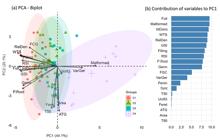
Biplot of the principal component analysis of the physiological data and physical characteristics of Physalis ixocarpa seed lots (a). Contribution of each variable to PC1 (b). IntDens: integrated density; WTS: weight of one thousand seeds; RelDen: relative density; GSI: germination speed index; RSI: radicle emergence speed index; P.Root: primary root protrusion; Germ: germination; FGC: first germination count; VarGer: variation in germination time; Perim: perimeter; Sync: germination synchrony; T50: time for 50% of the seeds to germinate; UnifG: uniformity of germination; ATG: average time of germination; T90: time for 90% of the seeds to germinate.
The total variability of the data was explained in 64.2% by the principal components 1 and 2 (PC1 and PC2), and it is possible to observe the segregation of the seed lots according to the discharges from the gravity table, with opposite separation of the extreme lots (D1 and D4) and overlaps in the intermediate lots (D2 and D3). The vectors associated with the physical variables of full seeds, filling, WTS and relative and integrated densities demonstrate a positive correlation between the physical and physiological variables of germination, FGC, GSI, RSI and radicle emergence. Conversely, the vector associated with malformed seeds indicates a negative correlation between physiological variables and appears in the same quadrant of lot D4, of low quality.
Just as horizontality reveals the opposition between variables, the overlapping of vectors indicates the high correlation that exists, as occurred between WTS, RelDen and filling, and for GSI, integrated density and full seeds. WTS is indicative of seed maturity by the accumulation of reserves, and IntDens and RelDen are associated with the integrity and density of embryonic and endosperm tissues (Medeiros et al., 2020d; Colombari et al., 2021). The reserves used for the initial development of the seedling in the germination process are stored in the endosperm or cotyledons (Kathpalia and Bhatla, 2018), and the low reserve or severe damage are determining factors for the low vigor of the lot and performance of seedlings.
The positive correlation observed between area and time of germination (ATG, T50 and T90), and the absence of correlation of these variables with germination reinforces that, although seed size does not determine quality, area is one of the factors that interferes in the duration of germination phases. Smaller seeds have a larger surface of contact with the substrate, which favors imbibition and rapid germination (Marcos-Filho, 2015).
The contribution of each variable to the first component (PC1) was determined by the coefficients obtained in the principal component analysis (Figure 4B). The variables full seeds, malformed seeds, integrated and relative density, WTS, germination speed index, filling, radicle emergence speed index, primary root protrusion and germination had the greatest contributions, which indicates that changes in these variables are strongly correlated with the variation observed in the data. On the other hand, the measures of variation in germination time, uniformity, synchrony, T50, T90, area, feret and perimeter had little contribution. Thus, germination uniformity and speed, as well as seed size, have a smaller contribution compared to filling and density.
Figure 5 shows the radiography of empty (A), malformed (B) and full (C) seeds, as well as the heat map for the gray value per pixel and the respective seedlings originated from each seed. Empty and heavily damaged seeds will certainly not give rise to seedlings, but full seeds will not always originate normal seedlings, since biochemical and environmental factors can interfere with the viability and vigor of the seeds and their ability to give rise to normal seedlings (Silva et al., 2020; Carrera-Castaño et al., 2020).

Radiographic and RGB images of Physalis ixocarpa seeds with different densities and their respective seedlings. A) empty seeds, with low relative density and ungerminated seed; B) malformed seed, poorly filled with reserves and which originated a weak seedling; C) full seed, with high relative density and which originated a normal seedling.
Thus, viable seeds with high vigor, in general, are intact seeds with higher tissue density, which can be seen by means of the X-ray test. However, a limitation of this test is precisely not allowing researchers to directly infer on the physiological quality of the seeds. Non-viable seeds can be intact and have a high density. However, seeds with lower density and/or with apparent damage on the X-ray can be discarded, as they surely also have low physiological quality. Therefore, although efficient for checking damage and filling, images should not be used as a substitute for germination and vigor tests.
The results presented in this study demonstrate that the gravity table was efficient to segregate seed lots with different densities and that differed in terms of physiological quality. The relationship between physical and physiological variables confirms the efficiency of the X-ray test to classify seeds according to tissue density and presence of damage. The technique can be a useful tool in making decisions regarding the adjustment of machine settings during the processing of P. ixocarpa seeds.
CONCLUSIONS
The analysis of X-ray images of P. ixocarpa seeds was efficient in identifying malformed, empty and damaged seeds, in addition to allowing the evaluation of their physical attributes.
Seeds from the high-density discharge of the gravity table had superior physiological performance compared to seeds from the low-density discharge, and a correlation between the physical parameters of the seeds and the physiological potential was observed.
ACKNOWLEDGMENTS
To the Federal University of Viçosa (UFV), the National Council for Scientific Development and Technological Development (CNPq), the Coordination for the Improvement of Higher Education Personnel - Brazil (CAPES - Financial Code 001), and the Minas Gerais State Research Support Foundation (FAPEMIG).
REFERENCES
-
ARAÚJO, J.O.; PINHEIRO, D.T.P.; QUEIROZ, G.B.; SOARES, J.M.; HOSHIDE, A.K.; JUNIOR, V.T.M.M.; ROCHA, S.J.S.S.; DIAS, D.C.F.S. Selection of superior Senna macranthera seeds, carbon stock, and seedling survival, and costs for habitat restoration. Sustainability, v.15, n.13, 2023. https://doi.org/10.3390/su15139875
» https://doi.org/https://doi.org/10.3390/su15139875 -
BARROSO, N.S.; SOUZA, M.O.; RODRIGUES, L.C.S.; PELACANI, C.R. Maturation stages of fruits and physiological seed quality of Physalis ixocarpa brot. Ex Hornem. Revista Brasileira de Fruticultura, v.39, n.3, 2017. https://doi.org/10.1590/0100-29452017151
» https://doi.org/https://doi.org/10.1590/0100-29452017151 -
BEWLEY, J.D.; NONOGAKI, H. Seed maturation and germination. Reference Module in Life Sciences, p.623-626, 2017. https://doi.org/10.1016/B978-0-12-809633-8.05092-5
» https://doi.org/https://doi.org/10.1016/B978-0-12-809633-8.05092-5 -
BIANCHINI, V.J.M.; MASCARIN, G.M.; SILVA, L.C.A.S.; ARTHUR, V.; CARSTENSEN, J.M.; BOELT, B.; SILVA, C.B. Multispectral and X-ray images for characterization of Jatropha curcas L. seed quality. Plant Methods, v.17, n.9, p.1-13, 2021. https://doi.org/10.1186/s13007-021-00709-6
» https://doi.org/https://doi.org/10.1186/s13007-021-00709-6 -
BRASIL. Ministério da Agricultura, Pecuária e Abastecimento. Regras para Análise de Sementes. Ministério da Agricultura, Pecuária e Abastecimento. Secretaria de Defesa Agropecuária. Brasília: MAPA/ACS, 2009. 399p. https://www.gov.br/agricultura/pt-br/assuntos/insumos-agropecuarios/arquivos-publicacoes-insumos/2946_regras_analise__sementes.pdf
» https://www.gov.br/agricultura/pt-br/assuntos/insumos-agropecuarios/arquivos-publicacoes-insumos/2946_regras_analise__sementes.pdf -
CARRERA-CASTAÑO, G.; CALLEJA-CABRERA, J.; PERNAS, M.; GOMEZ, L.; OÑATE-SÁNCHEZ, L. An Updated Overview on the Regulation of Seed Germination. Plants, v.9, n.6, 703, 2020. https://doi.org/10.3390/plants9060703
» https://doi.org/https://doi.org/10.3390/plants9060703 - CARVALHO, N.M.; NAKAGAWA. J. Sementes: Ciência, Tecnologia e Produção Jaboticabal: FUNEP, 2012. 590p.
-
CHAMROY, T. Production technology of underutilized vegetables of Solanaceae family. In: SAVITA; RAWAT, M.; VIMAL, V. (Eds.). Production technology of underutilized vegetable crops Cham: Springer, 2023. https://doi.org/10.1007/978-3-031-15385-3_8
» https://doi.org/https://doi.org/10.1007/978-3-031-15385-3_8 -
COLOMBARI, L.F.; SILVA, G.F.; CHAMMA, L.; CHAVES, P.P.N.; MARTINS, B.N.; JORGE, L.G.; SILVA, P. N.L.; PUTTI, F.F.; CARDOSO, A.I.I. Maturation and resting of sweet pepper fruits on physiological quality and biochemical response of seeds. Brazilian Archives of Biology and Technology, v.64, e21200733, 2021. https://doi.org/10.1590/1678-4324-2021200733
» https://doi.org/https://doi.org/10.1590/1678-4324-2021200733 - COPELAND, L.O.; MCDONALD, M.B. Seed vigor and vigor testing. In: COPELAND, L.O.; MCDONALD, M.B (Eds.). Principles of Seed Science and Technology New York: SPRINGER, 2001. p.165-191
-
GADOTTI, G.I.; HORNKE, N.F.; CAVALCANTE, J.A.; SILVA, J.G.; GONÇALVES, V.P.; CAPILHEIRA, A.F. Efficiency of the gravity table in the processing of coriander sedes. Horticultura Brasileira, v.38, n.2, p.211-216, 2020. https://doi.org/10.1590/S0102-053620200214
» https://doi.org/https://doi.org/10.1590/S0102-053620200214 -
GARCÍA-OSUNA, H.T.; BOCARDO, L.E.; ROBLEDO-TORRES, V.; MENDOZA, A.B., GODINA, F. R. Germinación y micropropagación de tomate de cáscara (Physalis ixocarpa) tetraploide. Revista Mexicana de Ciencias Agrícolas, n.12, p.2301-2311, 2018. https://doi.org/10.29312/remexca.v0i12.763
» https://doi.org/https://doi.org/10.29312/remexca.v0i12.763 -
GONZÁLEZ-PÉREZ, J. E.; GUERRERO-BELTRÁN, J.Á. Tomatillo or husk tomato (Physalis philadelphica and Physalis ixocarpa): A review.Scientia Horticulturae, v.288, p.110306, 2021. https://doi.org/10.1016/j.scienta.2021.110306
» https://doi.org/https://doi.org/10.1016/j.scienta.2021.110306 -
HERNÁNDEZ, J.F.S.; YÁÑEZ, S.B. Aprovechamiento tradicional de las especies de Physalis en México. Revista de Geografía Agrícola, n.43, p.81-86, 2009. https://www.redalyc.org/articulo.oa?id=75715608006
» https://www.redalyc.org/articulo.oa?id=75715608006 - ISTA. International Seed Testing Association. International Rules for Seed Testing; Zurich International Seed Testing Association: Wallisellen, Switzerland, 2023. 180p.
-
JEROMINI, T.S.; MARTINS, C.C.; PEREIRA, F.E.C.B.; GOMES-JUNIOR, F.G. The use of X-ray to evaluate Brachiaria brizantha seeds quality during seed processing. Revista Ciência Agronomica, v.50, n.3, p.439-446, 2019. https://doi.org/10.5935/1806-6690.20190052
» https://doi.org/https://doi.org/10.5935/1806-6690.20190052 - KATHPALIA, R.; BHATLA, S. Seed dormancy and germination. In: BHATLA, S.C.; LAL, M.A. Plant Physiology Development and Metabolism Springer, 2018. p.885-906
-
KOTWALIWALE, N.; SINGH K.; KALNE, A.; JHA, S.N.; SETH, N.; KAR, A. X-ray imaging methods for internal quality evaluation of agricultural produce. Journal of Food Science and Technology, v.51, p.1-15, 2014. https://doi.org/10.1007/s13197-011-0485-y
» https://doi.org/https://doi.org/10.1007/s13197-011-0485-y - KRZYZANOWSKI, F.C.; FRANÇA-NETO, J.B.; GOMES-JUNIOR, F.G.; NAKAGAWA, J. Testes de vigor baseados em desempenho de plântulas. In: KRZYZANOWSKI, F.C.; VIEIRA, R.D.; FRANÇA-NETO, J.B.; MARCOS-FILHO, J. (Eds.). Vigor de Sementes: Conceitos e Testes Londrina: ABRATES, 2020. p.79-140.
-
MAGUIRE, J.D. Speed of germination-and in selection and evaluation for seeding emergence and vigor. Crop Science, v.2, n.2, p.176-177, 1962. https://doi.org/10.2135/cropsci1962.0011183X000200020033x
» https://doi.org/https://doi.org/10.2135/cropsci1962.0011183X000200020033x - MARCOS-FILHO, J. Fisiologia de sementes de plantas cultivadas Londrina: ABRATES , 2015. 660p.
- MARTÍNEZ, M. Las plantas útiles de la flora mexicana Ed. Botas. 1959. 621p.
-
MARTÍNEZ-VEGA, A.L.; OREGEL-ZAMUDIO, E.; GARCÍA-RUIZ, I.; VILLAPANDO-ARTEAGA, E.V.; TORRES-GARCÍA, J.R. Genetic and metabolomic differentiation of Physalis ixocarpa Brot. Ex Hornem populations in Michoacan State, Mexico. Genetic Resources and Crop Evolution, v.69, p.1867-1877, 2022. https://doi.org/10.1007/s10722-022-01347-0
» https://doi.org/https://doi.org/10.1007/s10722-022-01347-0 -
MEDEIROS, A.D.; MARTINS, M.S.; SILVA, L.J.; PEREIRA, M.D.; LEÓN, M.J.Z.; DIAS, D.C.F.S. X-ray imaging and digital processing application in non-destructive assessing of melon seed quality. Journal of Seed Science, v.42, e202042005, 2020a. https://doi.org/10.1590/2317-1545v42229761
» https://doi.org/https://doi.org/10.1590/2317-1545v42229761 -
MEDEIROS, A.D.; SILVA, L.J.; PEREIRA, M.D.; OLIVEIRA, A.M.S.; DIAS, D.C.F.S. Hight-throughput phenotyping of brachiaria grass seeds using free access tool for analysing X-ray images. Anais da Academia Brasileira de Ciências, v.92, p.1-17, 2020d. https://doi.org/10.1590/0001-3765202020190209
» https://doi.org/https://doi.org/10.1590/0001-3765202020190209 -
MEDEIROS, A.D.; SILVA, L.J.; SILVA, J.M.; DIAS, D.C.F.S.; PEREIRA, M.D. IJCropSeed: An open-access tool for high-throughput analysis of crop seed radiographs. Computers and Electronics in Agriculture, v.175, 2020b. https://doi.org/10.1016/j.compag.2020.105555
» https://doi.org/https://doi.org/10.1016/j.compag.2020.105555 -
MEDEIROS, A.D.; ZAVALA-LEÓN, M. J.; SILVA, L.J.; OLIVEIRA, A.M.S.; DIAS, D.C.F.S. Relationship between internal morphology and physiological quality of pepper seeds during fruit maturation and storage. Agronomy Journal, v.112, n.1, p.25-35, 2020c. https://doi.org/10.1002/agj2.20071
» https://doi.org/https://doi.org/10.1002/agj2.20071 -
MUNIZ, J; KRETZSCHMAR, A.A; RUFATO, L; PELIZZA, T.R; RUFATO, A.R; MACEDO, T.A. General aspects of physalis cultivation. Ciência Rural, v.44, n.6, p.964-970, 2014. https://doi.org/10.1590/S0103-84782014005000006
» https://doi.org/https://doi.org/10.1590/S0103-84782014005000006 - MELO, P.C.T; MELO, A.M.T; NASCIMENTO W.M; FREITAS, R.A. Produção de Sementes de Tomate. In: NASCIMENTO W.M. (Ed.). Produção de Sementes de Hortaliças Embrapa: Brasília, 2014. p.235-263.
-
NUNES, V. V.; SILVA-MANN, R.; VASCONCELOS, M.C.; RODRIGUES, A.M.B.; SOUZA, J.L. Physical and physiological quality of mangaba seeds obtained by different processing methods. Revista Brasileira de Engenharia Agrícola e Ambiental, v.25, p.429-435, 2021. https://doi.org/10.1590/1807-1929/agriambi.v25n6p429-435
» https://doi.org/https://doi.org/10.1590/1807-1929/agriambi.v25n6p429-435 - PESKE, S.T.; VILLELLA, F.A.; MENEGHELLO, G.E. Sementes: fundamentos científicos e tecnológicos PELOTAS: Becker e Peske, 2019. 579p.
-
PINHEIRO, D.T.; MEDEIROS, A.D.; ZAVALA-LEÓN, M.J.; DIAS, D.C.F.S.; SILVA, L.J. Physical and physiological quality of Jatropha curcas L. seeds at different maturity stages using image analysis. Spanish Journal of Agricultural Research, v.18, n.3, 2020. https://doi.org/10.5424/sjar/2020183-16028
» https://doi.org/https://doi.org/10.5424/sjar/2020183-16028 - R Core Team. R: A Language and Environment for Statistical Computing R Foundation for Statistical Computing, Vienna, Austria. 2024.
-
REED, R.C.; BRADFORD, K.J.; KHANDAY, I. Seed germination and vigor: ensuring crop sustainability in a changing climate. Heredity, v.128, p.450-459, 2022. https://doi.org/10.1038/s41437-022-00497-2
» https://doi.org/https://doi.org/10.1038/s41437-022-00497-2 -
SANTOS, S.G.F.; ARAUJO, E.F.; ARAUJO, R.F.; KOHL, S.; COELHO, A.P.F.; NASCIMENTO, W.M. Processing on the physical and physiological quality of chickpea (Cicer arietinum L.) seeds. Journal of Seed Science , v.45, e202345025, 2023. https://doi.org/10.1590/2317-1545v45268779
» https://doi.org/https://doi.org/10.1590/2317-1545v45268779 -
SHENSTONE, E.; LIPPMAN, Z.; ECK, J.V. A review of nutritional properties and health benefits of Physalis species. Plant Foods for Human Nutrition, v.75, p.316-325, 2020. https://doi.org/10.1007/s11130-020-00821-3
» https://doi.org/https://doi.org/10.1007/s11130-020-00821-3 -
SIAP. Servicio de Información Agroalimentaria y Pesquera. Servicio Nacional de Inspección y Certificación de Semillas. Tomate de cáscara (Physalis spp.). 2017. https://www.gob.mx/snics/acciones-y-programas/tomate-de-cascara-physalis-spp
» https://www.gob.mx/snics/acciones-y-programas/tomate-de-cascara-physalis-spp -
SILVA, A.S.; CICERO, S.M.; SILVA, F.F.; GOMES-JUNIOR, F.G. X-ray, multispectral and chlorophyll fluorescence images: innovative methods for evaluating the physiological potential of rice seeds. Journal of Seed Science , v.45, e202345003, 2023. https://doi.org/10.1590/2317-1545v45257617
» https://doi.org/https://doi.org/10.1590/2317-1545v45257617 -
SILVA, L.J.; MEDEIROS, A.D.; OLIVEIRA, A.M.S. SeedCalc, a new automated R software tool for germination and seedling length data processing. Journal of Seed Science , v.41, n.2, p.250-257, 2019. https://doi.org/10.1590/2317-1545v42n2217267
» https://doi.org/https://doi.org/10.1590/2317-1545v42n2217267 -
SILVA, P. P.; BARROS, A.C.S.A.; MARCOS-FILHO, J.; GOMES-JUNIOR, F. G.; NASCIMENTO, W. M. Morphological study of squash seeds at different stages of maturation through the use of X-ray. Revista Ciência Agronômica, v.51, n.3, 2020. https://doi.org/10.5935/1806-6690.20200056
» https://doi.org/https://doi.org/10.5935/1806-6690.20200056 - SIMAK, M. Testing of forest tree and shrub seeds by X-radiography. In: GORDON, A.G.; GOSLING, P.; WANG, B.S.P. (Ed.) Tree and shrub seed handbook Zurich: ISTA, 1991. p.1-28.
-
ZACHARIAS, M.B.; CICERO, S.M.; GOMES-JUNIOR, F.G.; FORTI, V.A.; SILVA, J.B. Use of the X-ray technique to evaluate the internal morphology of seeds of green manure species. Journal of Seed Science , v.46, e202446017, 2024. https://doi.org/10.1590/2317-1545v46280489
» https://doi.org/https://doi.org/10.1590/2317-1545v46280489


