
 From measuring to feeling: meanings and affects in digital self-tracking of physical exercise
Abstract
This article investigates digital self-tracking of physical exercise (DSTPE) from a socio-material perspective, aiming to map the emerging affects and the meanings associated with and attributed by self-trackers. The qualitative research involved 34 wearable device users, with data produced through observation in training spaces, analysis of digital platforms (Strava/Garmin Connect), and electronic questionnaires, analyzed via ATLAS.ti using the General Inductive Approach. The results highlight that DSTPE assumes multiple meanings: motivation for sports practice, engagement with goals and challenges, emotional impacts, risk of obsessive behaviors, frustration with data manipulation, intolerance to technical failures, competition (with self and others), curiosity about new monitoring modalities, interest in specific body metrics, and adaptation of training routines. Thus, it is demonstrated how technologies and bodies co-produce these affects, reinforcing the hybrid nature of contemporary self-tracking practices.
Keywords
Digital technology; Wearable electronic devices; Physiological monitoring; Physical Education
Resumo
Este artigo investiga o autorrastreamento digital de exercícios físicos (ADEF) sob uma perspectiva sociomaterialista, com o objetivo de mapear as afetações emergentes e os significados associados e atribuídos por autorrastreadores. A pesquisa qualitativa envolveu 34 usuários de dispositivos vestíveis, com dados produzidos por meio de observação em espaços de treinamento, de plataformas digitais (Strava/Garmin Connect) e de questionários eletrônicos, analisados via ATLAS.ti segundo a Abordagem Indutiva Geral. Os resultados destacam que o ADEF assume múltiplos significados: motivação para a prática esportiva, engajamento em metas e desafios, impactos emocionais, risco de comportamentos obsessivos, revolta com manipulação de dados, intolerância a falhas técnicas, competição (consigo e com outros), curiosidade por novas modalidades de monitoramento, interesse em métricas corporais específicas e adaptação das rotinas de treino. Evidencia-se, assim, como tecnologias e corpos co-produzem essas afetações, reforçando a natureza híbrida das práticas contemporâneas de autorrastreamento.
Palavras-chave
Tecnologia digital; Dispositivos eletrônicos vestíveis; Monitorização fisiológica; Educação Física
Resumen
Este artículo investiga el autorrastreo digital del ejercicio físico (ADEF) desde una perspectiva sociomaterialista, con el objetivo de mapear las afectaciones emergentes y los significados asociados y atribuidos por quienes practican el autorrastreo. La investigación cualitativa involucró a 34 usuarios de dispositivos vestibles, con datos producidos mediante observación en espacios de entrenamiento,, análisis de plataformas digitales (Strava/Garmin Connect) y cuestionarios electrónicos, analizados mediante ATLAS.ti siguiendo el Enfoque Inductivo General. Los resultados destacan que el ADEF asume múltiples significados: motivación para la práctica deportiva, compromiso con metas y desafíos, impactos emocionales, riesgo de comportamientos obsesivos, frustración ante la manipulación de datos, intolerancia a fallos técnicos, competencia (consigo mismo y con otros), curiosidad por nuevas modalidades de monitoreo, interés en métricas corporales específicas y adaptación de las rutinas de entrenamiento. Se evidencia así cómo las tecnologías y los cuerpos coproducen estas afectaciones, reforzando el carácter híbrido de las prácticas contemporáneas de autorrastreo.
Palabras clave
Tecnología digital; Dispositivos electrónicos vestibles; Monitorización fisiológica; Educación Física
1 INTRODUCTION
This article presents an excerpt from a study1 focused on the digital self-tracking of physical exercise (DSPE) from a sociomaterialist perspective. In this sense, the study systematizes and discusses developments arising from the association between humans and digital self-tracking technologies (DSTs), with the aim of mapping the emerging affects and the meanings self-trackers attribute to them.
The relatively recent term “self-tracking” refers to practices involving the monitoring and measurement of physiological indicators, habits related to nutrition and hydration, physical exercise, stress levels, rest and sleep routines, among other aspects of life. One of the main purposes of self-tracking is the practitioner’s self-improvement through reflection and the expansion of bodily awareness based on monitored data (Lupton, 2016). More specifically, in the field of Physical Education, the topic of self-tracking has attracted the attention of researchers who have gradually engaged in theoretical discussions (Araújo, 2025) and explored its entanglements with everyday life (Lima, 2023b; Oliveira; Fraga, 2022a, 2022b).
It is worth noting that, as self-tracking has shifted into digital formats, its effectiveness has increased while simultaneously presenting new challenges. Because it involves the production of personal data—generally stored on online platforms—self-trackers become subject to the business models of the information economy, which are based on the monetization of personal information2 exploited within contemporary culture.
In this context, the body is progressively translated into metrics, comparable records, and performance standards (Lima, 2025), a characteristic that reconfigures and introduces new ways of understanding physical exercise, health, and human beings themselves in their intelligibility of the world. What can be observed is a subtle yet significant shift in which health care practices and the production of biodata become integrated into broader informational ecosystems shaped by interests that transcend those of the individual subject, converging with economic and institutional spheres.
The understanding of what is referred to in this text as “affect,” and its implication in the formation of a given “meaning,” requires a brief explanation of some elements of Actor-Network Theory (ANT), the theoretical-methodological framework underpinning the investigation reported here. First, it is important to bear in mind that this theory evokes a relational dimension between humans and nonhumans and, from this perspective, Latour (2004, p. 397, emphasis added) conceptualizes ANT as a ‘sociology of associations,’ whose purpose is to “[...] follow things through the networks in which they circulate, describe them in their entanglements [... and] study them [...] symmetrically [...].”
Latour’s (2004) reference to “things” reveals an analytical-descriptive interest in considering everything capable of acting and, within its field of action, promoting transformations along its path. This idea evokes the concept of the “actant,” which relates to the term “actor” in the expression “actor-network.” Thus, an actant is whoever or whatever generates actions and difference within a given narrative, whether human or nonhuman.
The second conceptual construct explored by Latour (2004), and which forms part of the very name of the theory, is that of the “network,” which should not be confused with “[...] structure, infrastructure, or sociability, [...] [nor] a place through which things pass, move, or are deposited, but rather the [...] [space-time in which] relationships [between actants] are established and transformed” (Oliveira; Porto, 2016, p. 64). As illustrated in Figure 1, the idea of the network makes explicit associative dynamics that “refer to flows, circulations, and alliances in which the actors involved both influence and are constantly influenced” (Freire, 2006, p. 55).

With this in mind, the understanding of what is referred to in this article as the “affect” of a state of the world is directly related to the power dynamics established within heterogeneous networked associations. Regarding this object of investigative interest, Latour (2017, p. 356) emphasizes that every actor-network study must consider and describe “[...] the work through which actors modify, displace, and translate their various and contradictory interests.”
In practical terms, a study grounded in actor-network theory must provide a sociomaterialist perspective and, therefore, consider the elements sustaining the investigated reality as entangled and mutually constitutive. It is precisely here that the prerogative of composing a “symmetrical” analysis of networks lies (Latour, 2004), in which the agential capacities of both humans and nonhumans are taken into account. However, it is essential to recognize that this “[...] symmetry is not ethical ([the] things are worth the same as humans), but analytical (things make us do things and have important implications)” (Lemos, 2014, p. 6, emphasis added).
Therefore, ANT challenges the separation between actants and any hierarchical differentiation that places them on distinct analytical planes. From this emerges a perspective that understands human beings as “hybrid” entities who have always culturally interacted with technical objects, that is:
Yet the human, as we now understand, cannot be grasped and saved unless that other part of itself, the share of things, is restored to it. So long as humanism is constructed through contrast with the object that has been abandoned to epistemology, neither the human nor the nonhuman can be understood
(Latour, 1994, p. 134).
In other words, “[…] we (human beings) are a hybrid collective that does not exist without things” (Coutinho; Viana, 2019, p. 24). From this perspective, it is argued that it is through our connections with nonhumans that we shape our subjectivity and our understanding of the world—precisely from where the social emerges. This is the perspective adopted in this study to understand associative dynamics and their developments regarding the incorporation of DSTs.
2 METHODOLOGICAL PATHWAY
This research adopts a qualitative orientation (Yin, 2016), was registered and approved on Plataforma Brasil under the Certificate of Presentation for Ethical Review protocol number 45393621.3.0000.5151, and its methodological pathway involved an empirical immersion aimed at capturing details of self-trackers’ experiences. Although briefly, it is important to note that the group of self-trackers who agreed to collaborate with this investigation consisted of 19 men and 15 women, with an average age of 44 years, residing in the city of São João del-Rei, Minas Gerais state, Brazil. It was found that the group had engaged in the digital self-tracking of physical exercise (DSPE) for an average of seven years and ten months. In terms of DSTs, the possession and use of different devices—including more than one per user—were identified, with a notable preference within the group for gadgets produced by Garmin.
The first stage of the investigation was dedicated to observing posts on the Strava and/or Garmin Connect platforms3, as well as users of traditional training spaces (streets, trails, swimming pools, etc.). From these environments, collaborators were identified according to the following criteria: 1) maintaining a frequent physical exercise routine; 2) using DSTs during training sessions; 3) being an active user of digital platforms for sharing self-tracked exercise data (Strava and/or Garmin Connect); and 4) meeting the ethical requirements established by the study’s Certificate of Presentation for Ethical Review protocol.
Once identified, potential collaborators were invited to voluntarily participate in the research. This procedure was carried out in different ways: 1) by email; 2) through messages sent via fitness platforms in the form of comments on a selected collaborator’s post (Strava or Garmin Connect); 3) through WhatsApp messages; and 4) in person, through face-to-face interactions in different physical settings.
After a self-tracker agreed to participate, all necessary information about the study was provided in order to ensure prior informed consent. It should be noted that, in addition to the observations conducted, the empirical data were produced through an electronic questionnaire (containing open- and closed-ended questions), which was designed to allow collaborators to express themselves regarding different aspects of their DSPE practices. It should also be emphasized that some questionnaire responses were mediated through a Likert scale4.
The objective of the questionnaire was to support the construction of indicators concerning the meanings the group attributed to DSPE and to the data produced through it. To achieve this purpose, the collaborators’ responses were incorporated in textual form into the ATLAS.ti software and analyzed through an inductive coding process, following the procedures proposed by the General Inductive Approach (Liu, 2016; Thomas, 2003, 2006).
The General Inductive Approach (GIA) aims to identify significant patterns and/or themes within empirical data. In this process, through repeated readings of the corpus, the researcher seeks to interpret it and identify its semantic cores by developing summary categories or thematic groups. The inductive nature of this approach allows researchers to examine empirical data without predefined models or the intention of validating a prior hypothesis. In practical terms, the GIA aims to:
1. condense extensive and varied raw text data into a brief, summary format; 2. to establish clear links between the research objectives and the summary findings derived from the raw data and to ensure that these links are both transparent (able to be demonstrated to others) and defensible (justifiable given the objectives of the research); and 3. to develop a model or theory about the underlying structure of experiences or processes that are evident in the text data
(Thomas, 2006, p. 238).
In summary, the methodological work based on the GIA and mediated through ATLAS.ti: 1) facilitated the reading of the corpus, the creation of semantic5 codes, and their selective/inductive association with the data (step 1 of the GIA); 2) enabled the systematization of thematic groups (step 2 of the GIA) based on the grouping of codes from the previous step; and 3) supported the production of interpretive syntheses of the empirical data intertwined with the theoretical framework underpinning this investigation, which guided the discussion of the results.
The intended outcome of the process is to create a small number of summary categories (e.g., between three and eight categories) that in the evaluator’s view capture the key aspects of the themes identified in the raw data and are assessed to be the most important themes given the evaluation objectives. Inductive coding that finishes up with many major themes (e.g., more than eight) can be viewed as incomplete. In this case, some of the categories may need combining, or the evaluator must make hard decisions about which themes or categories are most important
(Thomas, 2006, p. 242, emphasis added).
Considering the thematic focus adopted in this article and the methodological procedures carried out in ATLAS.ti, the next section addresses one of the thematic6 categories developed in the study. At its core, the first category related to the DSPE process indicated “personal and routine affects,” both experienced by the self-trackers. Thus, the category grouped together transformations perceived by the participants, encompassing both emotional dimensions and practical adaptations in their daily lives.
It should be noted that, in cases where questionnaire responses were produced using a Likert scale, the data synthesis was represented percentage-wise in parentheses, considering the following acronyms: 1) SA for “strongly agree”; 2) PA for “partially agree”; 3) NN for “neither agree nor disagree”; 4) PD for “partially disagree”; and 5) SD for “strongly disagree.”
3 RESULTS AND DISCUSSION
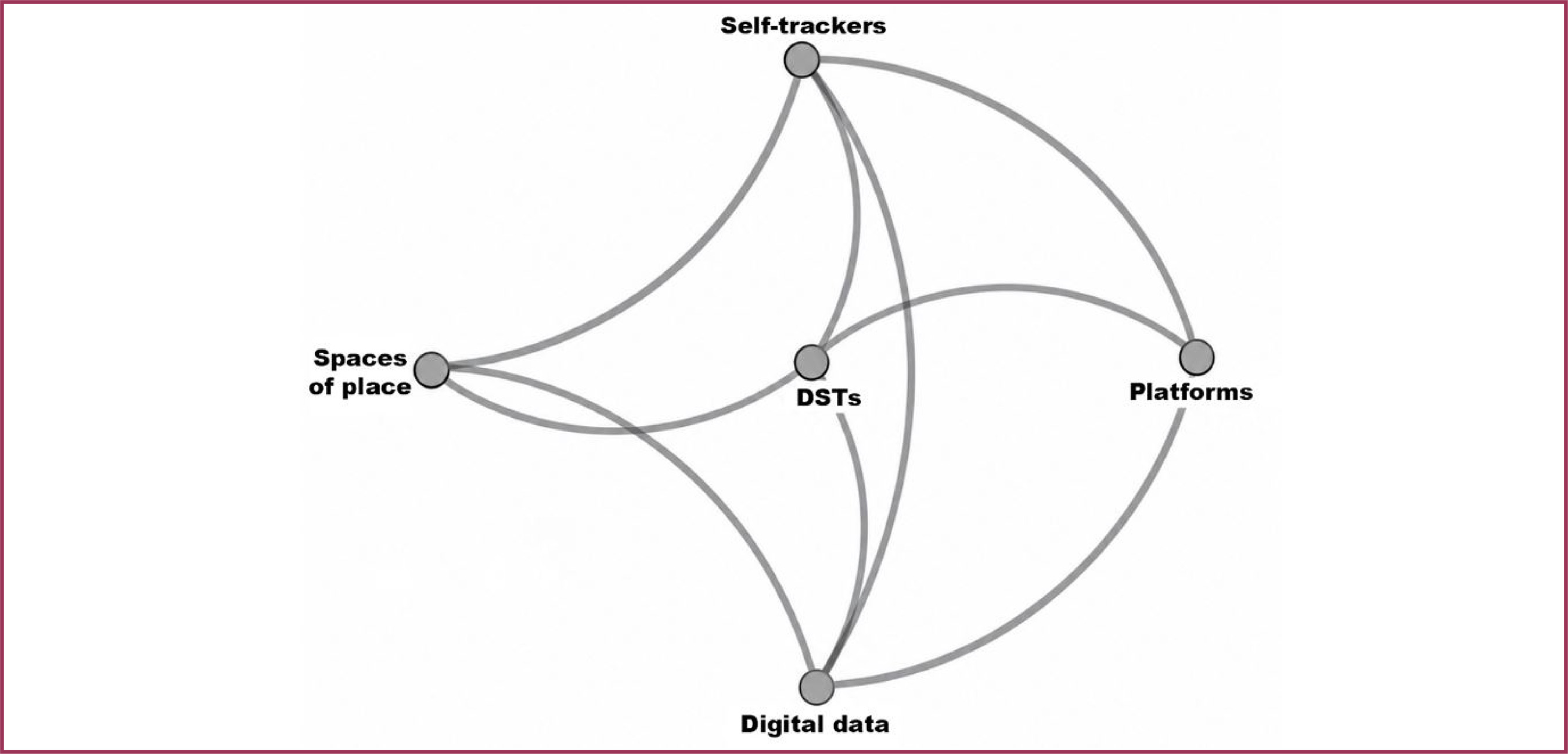
The objective of this study was to map the affects and meanings attributed to DSPE practices. The analytical work conducted with the empirical data from the thematic category “personal and routine affects” encompassed indicators that were systematized in such a way as to consider a collective of associated actants which, within a network, expressed themselves and mutually influenced one another (Figure 2).

The rhizome presented in Figure 2 should not be considered a fixed representation of the collective under study. The purpose of the image is to provide an illustration of a network status—always provisional—while still offering a satisfactory notion of the presence of, and associations among, the actants (nodes of the rhizome) that constituted the core focus of the research. Didactically, the image makes it possible to identify “what” and “who” composed the network, as well as “how” these entities became associated. Nevertheless, it is acknowledged that actants produce affects within the arrangements in which they are situated, which may destabilize the network and generate a new reality (Lima, 2022).
To describe this network, it is necessary to indicate that: 1) “self-trackers” refers to the group of 34 human participants who collaborated in this investigation; 2) the acronym “DSTs” includes all digital self-tracking technologies7 used by the collaborators; 3) the expression “spaces of place” refers to the locations where the monitored physical exercise self-tracking activities occurred (for example, swimming pools, trails, roads, yoga studios, tennis courts, etc.); 4) the term “platforms” is used to refer to online services that receive, process, and display self-trackers’ physical exercise data through a graphical interface; and 5) the expression “digital data” consolidates the product of the self-tracking practices carried out by the research collaborators.
Analytically, when focusing on the associations among actants in Figure 2, one can observe the centrality of the DST actant, from which the greatest number of associations with the other entities in the network is established. This could not be otherwise, since what makes digital self-tracking possible is precisely the program of action of these technologies. Thus, it is from the encounter between self-trackers and DSTs that the narrative of this research emerged: by activating their gadget, a self-tracker allowed the device to access and record their biological and geolocation data (within a given space of place), thereby initiating the monitoring of the exercise that generated digital data. At the end of the exercise session, the self-tracker indicated to the self-tracking device that the workout had concluded, and once again the program of action of that gadget carried out a routine of systematizing and transmitting data to one or more online platforms (in case that was the self-tracker’s preference).
3.1 AFFECTS AND MEANINGS EMERGING FROM DSPE PRACTICES
A first element that formed part of the set of meanings attributed to DSPE was its characterization as a motivating practice, one that inspires individuals to be physically active and to engage in monitored training sessions (85.3% SA; 8.8% PA; 2.9% NN; 2.9% PD; and 0% SD). Regarding this aspect, it is worth highlighting the statement of one member of the collaborating group, who affirmed:
I have already noticed, and I can affirm, that for me it is a clearly effective form of motivation for the regular practice of physical exercise and that [...] it makes my experience as a user truly different from what it would normally be if physical activity were performed without the use of self-tracking
(Collaborator 10, own translation).
Notably, Collaborator 10’s statement expresses a meaning (motivation) that is produced through the “agency” exercised by the DST within this association.
In the case of self-tracking, these assemblages include humans, other humans with whom they engage, the technologies they take up to monitor themselves (which may be digital or non-digital), the information that is generated by these technologies, the spaces and places in which they enact their practices and the broader discourses and ideas that animate and motivate their practices. This approach seeks to avoid a dualistic perspective in which humans are positioned on one side and technologies on the other. Instead, it views humans and technologies as working together [...]
(Lupton; Smith, 2018, p. 60)
In line with this perspective, Lupton (2021) explains that engagement among self-tracking practitioners is related to the desire to lose weight, improve physical fitness, sleep satisfactorily, become more productive, achieve well-being, and so forth. Even so, online services and digital devices themselves also contain engagement triggers, that is, “[...] built-in reward or docking systems so that points, badges or real money can be collected or paid, if various commitments (e.g. to regular exercise or weight loss goals) are either met or unmet” (Lupton, 2013, p. 394).
Figure 3 illustrates records of recognition received by a self-tracker for achieving goals.

From this point onward, the empirical investigation sought to situate the feelings of the group under study regarding challenges, performance rankings, and their respective rewards. In the first case, the collaborating self-trackers proved responsive to the platforms’ prompts, as the majority of the group stated that they made some kind of effort to complete challenges (26.5% SA; 32.4% PA; 26.5% NN; 11.8% PD; and 2.9% SD). With some variation, this result converges with what the group indicated regarding their appreciation for rankings, rewards, and the achievement of goals proposed by the platforms: the majority reported feeling rewarded in some way (29.4% SA; 23.5% PA; 26.5% NN; 8.8% PD; and 11.8% SD). These triggers activated by online platforms and digital devices themselves constitute strategies aimed at engaging users in self-tracking practices and, no less importantly, ensuring the constant production of data to be transmitted to the information databases of fitness services.
Continuing the systematization of meanings involving an emotional dimension, an attempt was made to identify whether failure to meet goals and/or the data resulting from self-tracking could generate frustration. Based on the participants’ responses, it was found that self-tracking practices can indeed generate frustration or disappointment (14.7% SA; 32.4% PA; 11.8% NN; 20.6% PD; and 20.6% SD).
In practical terms, this system of incentives designed to generate engagement in self-tracking practices ultimately reveals a “pushed” process (Lupton, 2014). In this case, although the rhetoric centers on producing data (levels of physical exertion during exercise, body weight, etc.) in order to support self-reflection with a pedagogical-motivational character, it is important to recognize that the emotional sphere becomes susceptible both to the joy associated with successfully achieving a goal and to the guilt and/or frustration caused by the failure exposed through the numbers generated by self-tracking.
Although, to some extent, self-tracking practices and exercise data can be frustrating, it was observed that, for the group of collaborating self-trackers, this aspect primarily involved the individual sphere. This perception is plausible, since the self-trackers were asked to evaluate whether comparing their self-tracking data with the data of other people diminished their self-esteem or mental well-being. The result revealed a strong rejection of this viewpoint (2.9% SA; 11.8% PA; 8.8% NN; 17.6% PD; and 58.8% SD).
Still within the sphere of emotionally oriented meanings, the group of self-trackers was questioned about the manipulation of physical performance data aimed at registering digital records in online platform rankings, which in practice constitutes fraudulent activity. On this issue, the majority of the group expressed irritation regarding this type of illicit conduct (55.9% SA; 14.7% PA; 14.7% NN; 2.9% PD; and 11.8% SD). This suggested that such actions were unacceptable to the group.
As mentioned at the beginning of this subsection, what determines the conditions of existence for DSPE practices is the formation of the human-DST hybrid. Considering that any association is subject to failures—in this case, device freezing or loss of GPS signal—it is possible for disruptions to occur in the recording of the tracked activity, thereby destabilizing the human-DST association. It is important to recall here that what is established in the human-DST association is the “delegation” of the task of monitoring physical exercise to the digital device, that is: there is a “[...] transfer of responsibilities from one actant to another [...] [since] we allow nonhumans to do things for us” (Lemos, 2013, p. 49). The group of self-trackers studied was asked to reflect on this type of incident, and the majority agreed to a considerable extent that DST failures provoke anger (47.1% SA; 26.5% PA; 5.9% NN; 2.9% PD; and 17.6% SD). Symmetrically, only 17.6% of the self-trackers indicated that they dealt calmly with failures in their electronic artifacts, demonstrating tolerance.
Among the collaborators, there was also the perception that DSPE practices may involve obsessive behavior and lead to dependency (addiction). Below are two contributions present in the corpus that are particularly illuminating with regard to the topic discussed in this paragraph.
Through this technological innovation, we begin to improve and try to move beyond our comfort zone; it [the self-tracking device] encourages us to become better every day. It knows every step you take, even the way you sleep (whether you slept well or not). It can provide feedback on whether or not you should train, give advice on whether you can push yourself that day, and even indicate whether your training load and overload levels are leading you toward overtraining [...]. Once you have one of these [smartwatches], it becomes very difficult to want to be without it. I do not even know to what extent it is really beneficial or whether it may be a kind of ‘time bomb’ in which we end up becoming ‘hostage’ to this technology and constantly trying to challenge ourselves
(Collaborating self-tracker 12, emphasis added, own translation).
I would like to say that it has become a healthy addiction! I cannot carry out any activity without monitoring it.
(Collaborator 33, emphasis added, own translation).
When the perspective that the self-tracking of physical exercise could generate addiction was presented to the group of self-trackers, a tendency toward balance among opinions was observed (23.5% SA; 26.5% PA; 20.6% NN; 23.5% PD; and 5.9% SD). In this sense, the possibility cannot be dismissed that the digital self-tracking of physical exercise may produce behavioral deviations associated with compulsion.
All the aspects mentioned thus far, which express meanings attributed to DSPE practices, proved to be intertwined with the emotional/sentimental sphere of the self-trackers. However, it is also reasonable to assume that engaging in physical exercise monitored through DSTs produces affects in the routines of self-trackers. It should be emphasized, however, that from a sociomaterial perspective, both the meanings associated with an emotional/sentimental sphere and those linked to modifications in daily routines stem from an always-hybrid “making-do” process, after all: “Action is not what someone does, but the “fait-faire”, the make-do, by others in an event, at the occasion of circumstances. These others are not ideas, nor things, but non-human entities which have their own ontological specifications [...]” (Latour, 2017, p. 341).
What Latour (2017) emphasizes through his binomial “making-do” is that “acting” carries an inherently hybrid meaning. Thus, every action is the result of a “[...] simultaneous construction of humans and objects in which materiality and sociality blend together, resulting in our very condition of humanity” (Melo, 2008, p. 258). The data indicated that 60% of the collaborators had their exercise routines modified through their association with DSTs, as illustrated in the graph in Figure 4.

The most significant change indicated in the graph in Figure 4 suggests that self-trackers became more competitive with themselves (75%). The issue of competitiveness also involves sociality (competing with other self-trackers), which likewise appears in the graph, although to a lesser extent (35%). These findings are consistent with what Lupton (2013) also identified in her investigative work:
[...] this display of one’s biometric data may take an overtly competitive form, as in websites such as strava.com, where people can upload data from digital devices which have GPS and heart monitor functions from a run, hike or cycle which show how many kilometres they have covered and at what speeds, power and heart rates, and then compare these data with others engaging in similar activities on the same route. Exercisers can also strive for their personal best by comparing data from previous outings with their latest and again broadcast the resultant data to their social networks
(Lupton, 2013, p. 399-400).
Based on the data presented in the graph, it can be observed that the collaborators in this study acknowledged that they began monitoring other sports activities (55%), altered the way they exercised in order to facilitate the recording of training sessions (35%), became attentive to metrics such as heart rate (40%), number of steps taken (45%), and floors climbed in a day (10%), also (re)affirmed that they exercised more in order to complete challenges proposed by digital platforms (45%), and paid attention to sleep quality data (45%) and stress levels (25%).
It was understood that the information tabulated in the graph in Figure 4 reinforces the idea that, by wearing/incorporating a digital self-tracking technology, self-trackers place themselves in a state of affect, simultaneously modifying and being modified by the device. This symmetrical relationship also leads us to acknowledge that the:
Self-tracking devices are therefore biographical and personal in several ways: they collect and record data about one's life; they archive these data; and they themselves become transformed and personalised, marked by the user's body and behaviours in unique ways, as part of a process of appropriation [...]
(Lupton, 2016, p. 73).
Considering the findings gathered from the collaborators in this investigation, it became evident that the systematized data align with Lupton’s (2016) indicators. In this sense, it can be assumed that DSPE practices express a process of incorporating digital technologies endowed with biographical meaning, lived experience, and entanglement within the spaces in which self-trackers place themselves in motion. Thus, engaging in DSPE is not something unilateral or exclusively centered on the human being, but rather a sociomaterial process intertwined with digital platforms, information, technologies, and diverse spaces and temporalities.
Finally, as an exercise in synthesizing the discussions developed from the thematic category “affect of the self and routine,” Table 1 is presented. This systematization was structured based on the empirical data analysis conducted in ATLAS.ti. Table 1 is composed of an abstract noun expressing the meaning associated with the practice of DSPE, accompanied by an explanatory descriptor.
4 CONCLUDING CONSIDERATIONS
Research on DSPE practices, beyond quantitative metrics, requires further efforts to expand understanding regarding the construction of subjectivity, the intelligibility of the contemporary world, and the personal and collective affects forged through the human-DST hybrid. The investigative focus presented here provided a set of meanings indicating digital self-tracking as an evocative and engaging practice capable of mobilizing its adherents toward movement and transformation.
Aligned with a sociomaterialist perspective, the empirical work sought to capture nuances of the reality under study, offering a systematization that is simultaneously entangled and provisional. It should be emphasized that the indicators presented are fragments of a fluid and unstable reality, subject to the continuous productions of the hybrid collective that composes it.
Thus, it is not possible to affirm the existence of a single, correct, or definitive way of practicing DSPE, which, in its multiple facets, is configured as a multifaceted practice. The very methodological choice to express affects and meanings through abstract nouns highlights the possibility (and necessity) of broadening and deepening the understanding of the topic and its connections with digital culture. In this way, new contours may be attributed to the reality produced through DSPE practices, which alternate between the abstract and the concrete. The emotional reactions described in this article are grounded in the production of sensitive biodata, which translate the body monitored through DSTs into quantifications.
As an effort of synthesis, the results presented in this study align with the assumptions of ANT, as they demonstrate that the mapped affects and the meanings attributed by self-trackers to DSPE emerge from an associative, distributed, hybrid process that is subject to the instability characterizing realities forged through encounters among humans, technologies, data, platforms, and so forth. From this perspective, DSPE distances itself from an anthropocentric view or from a reductive and technocentric instrumentalization. Both empirically and analytically, indicators were identified that were constituted symmetrically, thereby opening a pathway for understanding how humans and nonhumans co-produced one another within DSPE practices.
The affects observed in the collaborators’ routines—for example, adapting the way they exercised, expanding monitoring to other modalities, and maintaining constant attention to bodily metrics—reinforce the notion of human-technology hybridization. From this standpoint, the systematized results indicate DSPE as a biographical practice constitutive of movement and, therefore, of the production of subjectivity among self-trackers.
Although this was not the primary focus of the study, it is important to reiterate that the platforms mediating DSPE attribute economic value to the data produced. From this perspective, it becomes essential to remain aware of the capture and processing of these data by online digital services, carried out with the consent—though not always fully informed—of users.
In this way, there is no neutrality in the collection and processing of personal data, but rather a regime of data processing guided by the business models of digital services aimed at monetizing sensitive information. Finally, it is necessary to deepen the critical reading of this reality in order to foster awareness regarding the quantification of the body promoted by digital self-tracking, as well as issues related to the ownership, privacy, and security of personal data.
-
FUNDING
Academic research funded by the Minas Gerais Research Foundation (FAPEMIG) through Call No. 001/2022 – Universal Demand, Process APQ-00755-22.
-
RESEARCH ETHICS
The study followed the protocols established in Resolutions 466/12 and 510/2016 of the Brazilian National Health Council and was approved by the Research Ethics Committee (REC) of the Federal University of São João del-Rei (UFSJ/MG). Plataforma Brasil Certificate of Submission for Ethical Review (CAAE, acronym in Portuguese) number: 5393621.3.0000.5151, Approval Opinion: 7.644.386.
-
HOW TO CITE
LIMA, Marcio Roberto de. From measuring to feeling: meanings and affects in digital self-tracking of physical exercise. Movimento, v. 32, p. e32022, jan./dec. 2026. DOI: https://doi.org/10.22456/1982-8918.148846.
-
1
Research funded by the Minas Gerais Research Foundation (FAPEMIG) through Public Call No. 001/2022 – Universal Demand, Process APQ-00755-22.
-
2
This article acknowledges the critical issues inherent to the processes of collecting and using personal data within the context of DSPE. Given the editorial limits of this publication, readers are referred to the discussion of the topic available in Lima (2023a, 2025).
-
3
Platforms such as Strava (https://www.strava.com) and Garmin Connect (https://connect.garmin.com) aggregate DSPE data collected through wearables (smartwatches, cycling computers) or smartphones with fitness apps, offering social features for sharing georeferenced routes and training sessions, as well as mediating competitions among users based on the published data.
-
4
A tool developed by Rensis Likert that measures degrees of agreement/disagreement with specific statements, allowing researchers to assess respondents’ attitudes, opinions, and perceptions regarding the topics under investigation (Likert Scale, 2021).
-
5
The definition of creation criteria and the association of semantic codes with the corpus, as well as their grouping into categories/thematic groups, are implemented inductively and in accordance with the research objective(s). For a detailed discussion of the coding, grouping, and use of ATLAS.ti, see Lima (2020).
-
6
The full study systematized four empirical categories: (1) self- and routine-related affects; (2) self-knowledge and learning; (3) sociability; and (4) data ownership, privacy, and security. The latter three are discussed in publications currently under development/review.
-
7
This is admissible because these technologies follow a similar program of action: recording their users’ physical exercise metrics and subsequently sending these data to an online platform.
AVAILABILITY OF RESEARCH DATA
The research data are not available.
References
-
ARAÚJO, Allyson Carvalho. Hiperconexão em tempos de tecnologias de estilo de vida saudável: relações entre saúde, privacidade de dados e educação. Movimento, v. 31, p. e31005, 2025. DOI: https://doi.org/10.22456/1982-8918.137904.
» https://doi.org/10.22456/1982-8918.137904 - COUTINHO, Francisco Ângelo; VIANA, Gabriel Menezes. Alguns elementos da Teoria Ator-Rede. In: COUTINHO, Francisco Ângelo; VIANA, Gabriel Menezes (org.). Teoria Ator-Rede e educação Curitiba: Apris, 2019. p. 17–33.
-
ESCALA LIKERT. In: WIKIPÉDIA: a enciclopédia livre. 2021. Disponível em: https://pt.wikipedia.org/w/index.php?title=Escala_Likert&oldid=60492629. Acesso em: 11 mar. 2024.
» https://pt.wikipedia.org/w/index.php?title=Escala_Likert&oldid=60492629 -
FREIRE, Leticia de Luna. Seguindo Bruno Latour: notas para uma antropologia simétrica. Comum, v. 11, n. 26, p. 46–65, 2006. Disponível em: https://app.uff.br/riuff/bitstream/handle/1/12232/latour.pdf?sequence=1&isAllowed=y. Acesso em: 13 jan. 2026.
» https://app.uff.br/riuff/bitstream/handle/1/12232/latour.pdf?sequence=1&isAllowed=y - LATOUR, Bruno. A esperança de Pandora: ensaios sobre a realidade dos estudos científicos. São Paulo: Editora Unesp Digital, 2017.
- LATOUR, Bruno. Jamais fomos modernos São Paulo: Ed. 34, 1994.
-
LATOUR, Bruno. Por uma antropologia do centro. Mana, v. 10, n. 2, p. 397–413, 2004. DOI: https://doi.org/10.1590/S0104-93132004000200007.
» https://doi.org/10.1590/S0104-93132004000200007 - LEMOS, André. A comunicação das coisas: teoria ator-rede e cibercultura. São Paulo: Annablume, 2013.
- LEMOS, André. Mídia, tecnologia e educação: atores, redes, objetos e espaço. In: LINHARES, Ronaldo Nunes; PORTO, Cristiane; FREIRE, Valeria (org.). Mídia e educação: espaços e (co)relações de conhecimentos. Aracaju: EdUNIT, 2014. p. 11–28.
-
LIMA, Marcio Roberto de. Autorrastreamento de exercícios físicos: prática de dados na plataforma Strava. Motrivivência, v. 35, n. 66, p. 1–18, 2023a. DOI: https://doi.org/10.5007/2175-8042.2023.e94307.
» https://doi.org/10.5007/2175-8042.2023.e94307 -
LIMA, Marcio Roberto de. Corpo afetado: uma experiência de autorrastreamento com uma tecnologia vestível. Revista Brasileira de Ciências do Esporte, v. 45, p. e20230055, 2023b. DOI: https://doi.org/10.1590/rbce.45.e20230055.
» https://doi.org/10.1590/rbce.45.e20230055 -
LIMA, Marcio Roberto de. Corpo dataficado: autorrastreamento na cultura digital. Encontros Bibli, v. 30, p. e106471, 2025. DOI: https://doi.org/10.5007/1518-2924.2025.e106471.
» https://doi.org/10.5007/1518-2924.2025.e106471 -
LIMA, Marcio Roberto de. Exergames como possibilidade de ressignificação da docência na cultura digital. Revista e-Curriculum, v. 18, n. 4, p. 1857–1878, 2020. DOI: https://doi.org/10.23925/1809-3876.2020v18i4p1857-1878.
» https://doi.org/10.23925/1809-3876.2020v18i4p1857-1878 -
LIMA, Marcio Roberto de. Performance: operador teórico no campo da Educação a partir da Teoria Ator-Rede. Linhas Críticas, v. 28, p. e43415, 2022. DOI: https://doi.org/10.26512/lc28202243415.
» https://doi.org/10.26512/lc28202243415 -
LIU, Lisha. Using generic inductive approach in qualitative educational research: a case study analysis. Journal of Education and Learning, v. 5, n. 2, p. 129, 2016. DOI: https://doi.org/10.5539/jel.v5n2p129.
» https://doi.org/10.5539/jel.v5n2p129 -
LUPTON, Deborah. Quantifying the body: monitoring and measuring health in the age of mHealth technologies. Critical Public Health, v. 23, n. 4, p. 393–403, 2013. DOI: https://doi.org/10.1080/09581596.2013.79493.
» https://doi.org/10.1080/09581596.2013.79493 -
LUPTON, Deborah. Self-Tracking. In: KENNERLY, Michele; FREDERICK, Samuel; ABEL, Jonathan (ed.). Information: a reader. New York: Columbia University Press, 2021. p. 187–198. Disponível em: http://www.jstor.org/stable/10.7312/kenn19876 Acesso em: 13 jan. 2026.
» http://www.jstor.org/stable/10.7312/kenn19876 -
LUPTON, Deborah. Self-tracking modes: reflexive self-monitoring and data practices. SSRN Electronic Journal, 2014. Disponível em: https://papers.ssrn.com/sol3/papers.cfm?abstract_id=2483549 Acesso em: 16 nov. 2022.
» https://papers.ssrn.com/sol3/papers.cfm?abstract_id=2483549 - LUPTON, Deborah. The quantified self: a sociology of self-tracking. Cambridge, UK: Polity, 2016.
-
LUPTON, Deborah; SMITH, Gavin. ‘A Much Better Person’: the agential capacities of self-tracking practices. In: AJANA, Btihaj (org.). Metric culture: ontologies of self-tracking practice. Londres: Emerald, 2018. p. 57–75. DOI: https://doi.org/10.1108/978-1-78743-289-520181004.
» https://doi.org/10.1108/978-1-78743-289-520181004 -
MELO, Maria de Fátima Aranha de Queiroz. Mas de onde vem o Latour? Pesquisas e Práticas Psicossociais, v. 2, n. 2, p. 258–268, 2008. Disponível em: https://ufsj.edu.br/portal-repositorio/File/revistalapip/queiroz_melo_artigo.pdf Acesso em: 13 jan. 2026.
» https://ufsj.edu.br/portal-repositorio/File/revistalapip/queiroz_melo_artigo.pdf -
OLIVEIRA, Braulio Nogueira de; FRAGA, Alex Branco. Cultura fitness digital no léxico da cultura corporal de movimento: temas emergentes para a educação física escolar. Revista Brasileira de Ciências do Esporte, v. 44, p. e001922, 2022a. DOI: https://doi.org/10.1590/rbce.44.e001922.
» https://doi.org/10.1590/rbce.44.e001922 -
OLIVEIRA, Braulio Nogueira de; FRAGA, Alex Branco. Movimento quantified self: a vida fitness orientada por números. Movimento, v. 28, p. e28035, 2022b. DOI: https://doi.org/10.22456/1982-8918.117533.
» https://doi.org/10.22456/1982-8918.117533 - OLIVEIRA, Kaio Eduardo de Jesus; PORTO, Cristiane de Magalhães. Educação e teoria ator-rede: fluxos heterogêneos e conexões híbridas. Ilhéus: Editus, 2016.
-
THOMAS, David. A general inductive approach for analyzing qualitative evaluation data. American Journal of Evaluation, v. 27, n. 2, p. 237–246, 2006. DOI: https://doi.org/10.1177/1098214005283748
» https://doi.org/10.1177/1098214005283748 -
THOMAS, David R. A general inductive approach for qualitative data analysis 2003. Disponível em: https://www.frankumstein.com/PDF/Psychology/Inductive%20Content%20Analysis.pdf Acesso em: 13 jan. 2026.
» https://www.frankumstein.com/PDF/Psychology/Inductive%20Content%20Analysis.pdf - YIN, Robert. Pesquisa qualitativa do início ao fim Porto Alegre: Penso, 2016.
Edited by
-
EDITORIAL RESPONSIBILITY
Alex Branco Fraga*, Elisandro Schultz Wittizorecki*, Mauro Myskiw*, Raquel da Silveira** Federal University of Rio Grande do Sul, School of Physical Education, Physiotherapy and Dance, Porto Alegre, RS, Brazil.

 Source: The author.
 Source: Produced in the Gephi software by the author based on the research data.
 Source: Screenshot from the Garmin Connect platform.
 Source: The author based on the research data.