
 THE UNDERREPRESENTATION OF BLACK COACHES IN BRAZILIAN FOOTBALL – HETEROIDENTIFICATION OF FOOTBALLERS AND COACHING STAFF FROM 2023 MEN’S TEAMS IN THE BRAZILIAN SÉRIE A CHAMPIONSHIP
Abstract
Social inequality is evident in Brazilian society, a reality also reflected in sports. This study aims to examine the ethnic-racial representation of footballers, head coaches, and assistant coaches in Brazil’s top men’s football (Série A). The study adopts a qualitative approach and applies a heteroidentification process to 1,062 footballers, 20 head coaches, and 45 assistant coaches. The findings reveal that 53.3% of footballers are Black and 31.7% are White. Regarding head coaches, 90% are White, and the remaining 10% could not be reliably classified, indicating a lack of Black head coaches in the top tier of Brazilian men’s football and highlighting their underrepresentation in the sport. This study underscores the importance of examining the various stakeholders involved in sports from an ethnic-racial perspective to develop measures and policies aimed at combating racial inequality in the field.
Keywords
Underrepresentation; Black coaches; Brazilian football; Racial inequalities; Heteroidentification
Resumo
A desigualdade social é evidente na sociedade brasileira, uma realidade também refletida no esporte. Esta pesquisa tem como objetivo examinar a representação étnico-racial de jogadores de futebol, treinadores e assistentes técnicos na principal liga masculina brasileira (Série A). O estudo adota uma abordagem qualitativa e emprega um processo de heteroidentificação com 1.062 jogadores de futebol, 20 treinadores e 45 assistentes técnicos. Os resultados revelam que 53,3% dos jogadores de futebol são negros e 31,7% são brancos. Em relação aos treinadores, 90% são brancos, e os 10% restantes não puderam ser classificados adequadamente, indicando uma falta de treinadores negros na elite do futebol masculino brasileiro e destacando sua sub-representação no esporte. Esta pesquisa ressalta a importância de examinar os vários atores envolvidos no esporte a partir de uma perspectiva étnico-racial para desenvolver medidas e políticas voltadas ao combate à desigualdade racial no campo.
Palavras-chave
Sub-representatividade; Treinadores negros; Futebol brasileiro; Desigualdades raciais; Heteroidentificação
Resumen
La desigualdad social es evidente en la sociedad brasileña, una realidad que también se refleja en el deporte. Esta investigación tiene como objetivo examinar la representación étnico-racial de futbolistas, entrenadores y entrenadores asistentes en la principal liga masculina brasileña (Série A). El estudio adopta un enfoque cualitativo y aplica un proceso de heteroidentificación con 1.062 futbolistas, 20 entrenadores y 45 asistentes técnicos. Los resultados revelan que el 53,3% de los futbolistas son negros y el 31,7% son blancos. En cuanto a los entrenadores, el 90% son blancos y el 10% restante no pudo clasificarse adecuadamente, lo que indica una falta de entrenadores negros en la élite del fútbol masculino brasileño y destaca su subrepresentación en el deporte. Esta investigación subraya la importancia de examinar a los diversos actores involucrados en el deporte desde una perspectiva étnico-racial para desarrollar medidas y políticas destinadas a combatir la desigualdad racial en el campo.
Palabras clave
Subrepresentación; Entrenadores negros; Fútbol brasileño; Desigualdades raciales; Heteroidentificación
1 INTRODUCTION
The 10th Report on Racial Discrimination in Football 2023, published by the Observatório da Discriminação Racial no Futebol (2024) (Observatory of Racial Discrimination in Football), reveals that Brazilian football is permeated with racism. The report portrays cases of prejudice and discrimination that occurred among Brazilian individuals involved in sports nationally and internationally in 2023. The cases of intolerance have targeted athletes, coaches, fans, and many others involved with football. They occurred in places such as stadiums, on the internet, in sports programs, radio and television news programs, and at the premises of sports organizations. The document identified 97 athletes, 13 referees, 29 fans, and 23 employees working at the stadiums or members of the football clubs’ coaching staff among the victims.
Discrimination against Black Brazilian footballers has been happening since the nineteenth century, when the sport was brought to the country. At that time, according to Filho (2003), football was played in clubs and schools (overwhelmingly by white men), and Black players were not allowed to participate. This barrier was progressively broken throughout the early decades of the twentieth century (Filho, 2003), first in clubs and then in the Brazilian National men’s team. A key development in this process was when Brazil won its first FIFA World Cup in 1958.
Despite increased opportunities for Black players, racial inequality is present in football and in many other segments of Brazilian society. According to data from the census of the Instituto Brasileiro de Geografia e Estatística (IBGE- Brazilian Institute of Geography and Statistics), Black people represent 55.5% of the country’s 213,4 million inhabitants. It is worth clarifying that, according to IBGE, the following categories are used to characterise the Brazilian population: White, Afro-Brazilian (‘Pretos’), Brazilian Pardo (or mixed race, “Pardo”), Asian and Indigenous. The Black population in Brazil encompasses the individuals who identify as “Afro-Brazilian” and as “Brazilian Pardo” (IBGE, 2023). According to IBGE (2023), 45.3% of Brazilians identify as being “Brazilian Pardo” (mixed-raced), 43,5% as “White”, 10.2% as “Afro-Brazilian”, 0,6% as ‘Indigenous’ and 0,4% as “Asian”.
Despite being the majority of the population, Black Brazilians suffer the most from social inequalities, including poor access to housing, building assets, education, the labour market, and income distribution (IBGE, 2023). This scenario is partially explained by the legacies of slavery in Brazil and the lack of governmental policies to integrate Black people into the labour market after the abolition took place (Santos, 2001).
Concerning the job market and income distribution, Black people are the racial group with the highest rate of unemployment and also the group that engages more often in informal work (IBGE, 2023). Regarding income from work, the monthly income of White employed people was much higher than that of Black people.
Furthermore, 69% of management positions are occupied by white people, while 29.5% are occupied by black people. In addition, the higher the remuneration of the position, the lower the proportion of Black people filling these posts. In top management positions, the gap increases – 84.4% of White people and 14.6% of Black people (IBGE, 2023). This underrepresentation of the Black population demonstrated in management positions is also visible in leadership positions in sports organizations, including football coaches.
Research on the representation of Black people holding leadership positions in sports is still scarce in the Brazilian academic literature (Roque; Silva, 2021). Also, there is a lack of studies addressing the underrepresentation of Black coaches in Brazil, unlike the literature examining the cases of the USA and Europe.
Therefore, this research aims to examine the ethnic-racial representation of players, head and assistant coaches of football teams in the main Brazilian men’s league (known as Série A) and demonstrate the underrepresentation of Black coaches in Brazilian football). Since men’s football attracts more investment and enjoys greater popularity in Brazil, and considering that women’s football is still under developed in the country, (Brasil, 2023a) this study is delimited to men’s football.
2 THEORETICAL FOUNDATIONS
Racism and the underrepresentation of ethnic minority1 sports coaches are widely studied topics by researchers around the world. The USA, the UK, Australia, and Belgium are some countries where this issue has been thoroughly examined.
Research and publications cover diverse subjects, including the impact of policies to promote racial representation equity (Conricode; Bradbury, 2025; Conricode, 2022; Duru, 2017), access and barriers encountered by ethnic minoritized coaches (Foreman et al., 2024; Bradbury, 2013; Braddock II; Smith; Dawkins, 2012; Cunningham, 2010; Cunningham; Singer, 2010), experiences and trajectories of these coaches (Howe, 2023; Bennie et al., 2019; Bozeman; Fay, 2013) and their occupational turnover (Cunningham; Sagas, 2004).
Many of these studies demonstrate the underrepresentation of racial minority ethnic coaches by comparing it with the percentage of athletes in the sport (rather than with that of the general population) and explore how racism is related to such underrepresentation. This approach is justified by pointing out that one of the (statistically proven) main ways to become a sports coach is to have been an athlete in the sport (Everhart; Chelladurai, 1998).
In the United States of America, Cunningham (2020) presents the ethnic-racial representation of head coaches, assistant coaches, and athletes in that country’s leading professional sports leagues. In the Professional Basketball League (NBA), the percentage of racial minority ethnic players is above 80%. The percentage of racial minority ethnic assistant coaches is around 45%, and that of head coaches is around 30%. The disparity is even more significant in the Professional American Football League (NFL), with percentages of 72.6%, 31.3% and 25%, respectively.
In Europe, the underrepresentation of racial minority ethnic coaches is also demonstrated by comparing the percentage of athletes with that of football coaches. Bradbury (2020) reports that in England, France, and the Netherlands, the percentage of racial minority ethnic athletes is around 30%, while the percentages of minoritized head coaches and assistant coaches are 2.3% and 4.5%, respectively. In England, Szymanski (2022) shows that Black players in the English Premier League in the 2020/21 season represented 42,7% of the players, while the Black coaching workforce represented 4,4%.
Regarding the impact of policies on equity in racial representation, there is a substantial amount of research and studies on this topic in both the USA and England. In one of the studies, DuBois (2016) analyses the impact of the “Rooney Rule”, a US law that requires NFL teams to interview at least two Black coaches during the selection process for this position. In England, Conricode (2022) researched the operational implementation of the voluntary code of coach recruitment in the English Football League. The author analyses the effectiveness of the law in combating the underrepresentation of coaches in the second, third and fourth tiers of the English football.
In Brazil, some studies have dealt with racism in sports from different perspectives (Mamede, 2018; Pereira, 2021; Roque; Silva, 2021). Mamede (2018) conducted a bibliography review and carried out two interviews with Black coaches, and analysed material published in the media in a doctoral thesis that aimed to understand the limited presence of Black coaches in Brazilian football. The author indicates that the scarcity and exclusion of Black people in leadership positions, such as head coaches, result from racism and stereotypes about Black people, who are perceived as either too humble and subservient or authoritarian and too aggressive.
More recently, Pereira’s doctoral thesis analyses the meaning of racist acts in Brazilian professional football from the perspective of Black footballers and former footballers (Pereira, 2021). The author found out that among those interviewed, there was recognition of racism (on and off the field), but highlights that some interviewees deny the issue or try to minimize their experiences.
Roque and Silva (2021) surveyed the representation of Black men in head coaching positions in elite football clubs in the main Brazilian male league. The results show that Black head coaches occupied only 3.41% of the positions offered by clubs in the main league in Brazil. The authors also conducted interviews with Black coaches and journalists, and the latter’s opinions contrast with Black athletes’ and coaches’ perceptions of racism and what can be seen in the literature. Despite the low representation and obstacles for Black coaches in Brazilian football, interviewees emphasized that affirmative action is unnecessary. The research in Brazil mentioned above, despite analysing the situation of Black coaches in Brazilian football, does not have a specific approach to examine the underrepresentation of these coaches by comparing their numbers with that of Black footballers.
Regarding race identification, IBGE adopts self-declaration and heteroidentification (Osorio, 2013). The first occurs when the person itself chooses the race/ethnicity to which they identify themselves. The second happens when another person is responsible for choosing which race/ethnicity group a person belongs to, for instance, when a family member states which race/ethnicity group their relatives belong to (Osorio, 2013).
Heteroidentification has been used in Brazil in the selection processes of public employees and for the admission of students to public universities that have adopted affirmative action policies of racial quotas for Black people (Brasil 2025, 2023b). It has been adopted because of the increase of fraud when self-declaration methods were employed. In these cases, heteroidentification is carried out to verify when a candidate’s self-declaration race/ethnicity is questioned or to validate the candidate’s race/ethnicity self-declaration (Silva; Melo, 2024).
In 2018, the Brazilian Government passed a law which regulated the heteroidentification procedures for the selection of public employees (Brasil, 2018). Amongst these, there is one which states that a committee must be created and that its members will use the phenotypic characteristics in order to validate the candidates’ race/ethnicity self-declaration (Brasil, 2018).
These procedures have been adopted by federal institutions and universities across the country, with limitations, though. The main one concerns the validation of candidates’ race/ethnicity self-declaration who self-declared as being ‘Brazilian Pardo’ (Silva; Melo 2024).
Despite the downsides, heteroidentification is considered to be legitimate and important for the success of affirmative action policies implemented in Brazil, through the racial quotas for Black people in the access in public universities and selection processes for public employees (Nascimento; Porto; Duarte, 2022).
Regarding sports, no specific methods are established to proceed with heteroidentification in Brazil in terms of legislation or literature. As for other areas, in a recent study Perez et al. (2023) examined the issue of Black people occupying leadership positions in Brazilian Ministries. The authors used various resources to obtain images of the individuals studied, such as official government websites, historical collections, media sources, and self-declarations from some of them. In cases with no self-declaration, the authors adopted heteroidentification, but the article did not explain the process used to carry out the assessments.
Studies in other countries have applied the heteroidentification process through the image of athletes, coaches, and sports coaches. Zhang (2017) evaluated 163 coaches and 2,360 NBA players using photos obtained online, classifying the subjects as “Black” or ‘‘White”. The author conducted an assessment and compared the results with the opinion of a colleague, obtaining a level of agreement between them of 99%. The few cases in which there was no agreement and the cases where the photos of the individuals were unavailable were excluded from the sample.
In a more recent study, Williams et al. (2022) researched stereotypes linking leadership to the fact that sports coaches were White, as well as the stereotypes that promote the maintenance of a leadership role and the perception that one is suitable for leadership in organizations. To evaluate the race/ethnicity of coaches, the authors used the following classifications: “Definitely Black”, “Probably Black”, “Probably White”, “Definitely White”, or “other race/ethnicity”. The authors examined 1,155 photographs with viable ratings from at least two evaluators. Coaches were categorized as White/Black if most evaluators considered them probably or definitely White/Black. Intraclass correlations (ICCs) were calculated using one-way random effects models, to assess the reliability between the two evaluators, with a mean of 0.95. Of the total, 49 coaches who were not consensually perceived as Black or White (or belonging to another race/ethnicity) were excluded. This resulted in a final sample size of 1,106 subjects (808 White coaches and 298 Black coaches).
In England, as previously mentioned, Szymanski (2022) presented a report which heteroidentified players and members of managerial positions from the English Premier League and the English Football League. Data on players for the research was taken from the Website Transfermarkt and the heteroidentification of players was undertaken by the Black Footballers Partnership2.
These studies indicate the possibility of applying heteroidentification methods to evaluate the subjects’ race/ethnicity in cases where it is impossible to obtain self-declaration. In addition, in Zhang (2017) and Williams et al. (2022) researches, there were exclusion of individuals when an agreement among the evaluators were not reached, which emphasises the limitation of heteroidentification, that is identifying the race/ethnicity of mixed-raced individuals. These aspects were taken into account when constructing the research data collection procedures.
3 METHODOLOGY
This exploratory and descriptive research was based on document analysis and adopted a qualitative approach (Pitts; Li; Kim, 2018; Veal; Darcy, 2014). Footballers, head coaches, and assistant coaches of clubs playing in the main Brazilian male league in 2023 were submitted to heteroidentification. In this study, we adopt the term ‘race/ethnicity’ to refer to the subjects’ race.
3.1 PILOT RESEARCH
A pilot study was conducted to validate the methodological procedures since no established methods for heteroidentification in sports in the literature in Brazil were identified. Thus, a committee of five evaluators was invited to assess the clarity and relevance of the proposed procedures for the ethnic-racial heteroidentification process. Data collection procedures for by judges, both in the Pilot Research and in the research itself, had the approval and agreement of the Research Ethics Committee with human beings of the Departamento de Ciências do Movimento Humano, Campus Baixada Santista (Instituto de Saúde e Sociedade) da Universidade Federal de São Paulo. Opinion n. 6.749.849, CAAE 76492323.2.0000.5505 and protocol n. 1121/2023, in accordance with Brazilian legislation.
Regarding the evaluators’ profiles, the committee members included three individuals with experience in the theme of racial equality and combating racism (one Black man and two Black women) and two laypeople (one White man and one White woman). An email was sent to the evaluators containing an explanatory booklet with the following content: the research objective, theoretical bases, guidelines for carrying out the evaluation, and an access link to the Excel spreadsheet with information about the subjects.
Among the guidelines for carrying out the evaluation and identification of footballers and members of the coaching staff of football teams, the main orientation was that the measurement should be based on the physical/phenotypic characteristics of the subjects, considering the shape of the eyes, nose, skin tone, and hair colour and texture. Evaluators were instructed to make their classifications, taking into account their personal perceptions.
The spreadsheet also contained a link to access the photographs of the subjects organized as follows: a tab for footballers and another for members of the coaching staff – head coaches and assistant coaches – of four teams playing in the fourth tier of the Brazilian male league (known as Série D) in 2023. In each tab, there was, in addition to a link leading to the subject’s photo, their position, the name of the club, and a cell with the race options to make the selection. The total number of subjects analysed in the test was 167, including 159 footballers, four head coaches, and four assistant coaches.
The five evaluators completed their task without presenting any doubts or difficulties during the process. However, changes were suggested regarding the spreadsheet format, requesting the inclusion of the subjects’ images directly (instead of a link) and removing information about the football club and their name and surname. These suggestions were accepted and implemented in the spreadsheets in this research.
3.2 POPULATION AND SAMPLE
The population consisted of the 20 clubs participating in the main Brazilian male league in 2023 (Série A), officially registered with the Confederação Brasileira de Futebol (CBF) (Brazilian Football Confederation) after the deadline for registration or replacement of athletes, which, according to the regulations of the main league, took place on September 15, 2023.
The data collected from the CBF’s website (CBF, 2023), on September 18, 2023, identified 1,081 athletes. Nineteen registers duplicates (athletes who appeared on two teams) were excluded, along with one whose photo was unavailable on the entity’s website or social media. Athletes who were traded internationally were identified and kept in the sample, as their inclusion would not interfere with the result and objective of the research.
Thus, the sample consisted of 1,062 footballers, with 955 Brazilians and 107 foreigners (Table 1). The definition of the nationality of the players was determined through research on the Transfermarkt website (Transfermarkt, 2023).
As for the teams’ head coaches and assistant coaches (coaching staff), the sample consisted of 65 professionals on the clubs’ coaching staff until October 9, 2023, of which 20 were head coaches and 45 assistant coaches. Information on the composition of each club’s coaching staff and the photos of these subjects were obtained from the clubs’ websites and search engines (this data was not available on the CBF’s website).
Regarding the nationality of the head coaches and assistant coaches, 43 were Brazilian, and 22 were foreigners. Among the head coaches, 12 were Brazilian, and 08 were foreigners. In the case of assistant coaches, 31 were Brazilian, and 12 were foreigners. Information on the nationality of these individuals was obtained through online research.
3.3 DATA COLLECTION
Committees of evaluators were formed to apply the ethnic-racial heteroidentification process. They were composed of members with literacy and experience promoting racial equality and combating racism, as well as lay members. The composition also took into consideration gender and race/ethnicity diversity. Due to the high number of subjects in the sample, three committees were formed.
Thus, 12 evaluators were invited to participate: 3 Black male evaluators, 3 Black female evaluators, 3 White male, and 3 White female. The committees were formed through a draw to obtain three groups, each of them consisting of 4 members: a Black male, a Black female, a White male and a White female.
For the evaluation process, a booklet presenting the objectives and foundations of the research was made available by email to the members of each of the three committees, with guidelines on the procedures and the link to access the Excel spreadsheet. Each of the three spreadsheets contained two tabs. One tab had a list of a third of the 1062 footballers in the sample (or 354), with the same image available in their registration with the CBF (CBF, 2023).
The other tab contained a list of approximately a third of the 65 head coaches and assistant coaches of the teams (22 subjects in the list of two committees and 21 in the list of one committee). The tab contained images obtained from the football clubs’ official websites or images found through research on social media. In both tabs, in addition to the photos of the subjects evaluated, there was also a cell containing a list with the options “Branco” (White), “Preto” (Afro-Brazilian), “Pardo” (Brazilian Pardo), “Amarelo” (Asian), and “Indígena” (Indigenous), from which the evaluators should select one. The study adopts “Afro-Brazilian” and “Brazilian Pardo” simply to facilitate classification, irrespective of whether the subject evaluated is Brazilian or foreign.
The procedures for evaluation by committee members took place in two steps: 1) access to the spreadsheet, and 2) observation of each photo on the list and selection of the race/ethnicity of each person analysed, taking into account their personal perceptions. The classification of each subject analysed was carried out by each evaluator individually, without any contact among them.
The inter-rater agreement criterion was followed for each subject analysed to be classified with a race/ethnicity. This criterion refers to the degree to which two or more evaluators assess the same situation equally using the same evaluation scale. The degree of agreement between evaluators is considered a measure of consistency between the absolute values of the evaluators’ classifications ( Matos, 2014; Graham; Milanowski; Miller, 2012).
Thus, the evaluators’ assessment records were linked to a general Excel spreadsheet, which imported the individual classifications carried out by each evaluator. This spreadsheet contained a tab with all 1062 players and another with all 65 head coaches and assistant coaches.
The percentage of absolute agreement was considered to calculate the degree of agreement between evaluators. This involves calculating the times the evaluators agree and dividing by the total number of evaluations, with rates between 0 and 100%. As indicated by Stemler (2004), the value of 75% was considered the minimum acceptable degree of agreement.
Therefore, the agreement between the evaluators determined for this research was three classifications out of a possible four. Then, the subject evaluated was classified by the indicated race/ethnicity. The evaluation result was considered inconclusive when any other percentage below 75% occurred, except when the disagreement referred to Afro-Brazilian and Brazilian Pardo. In this case, when two evaluators considered a subject as Afro-Brazilian and the two others considered the same subject as Brazilian Pardo, this subject was classified as part of a racial group named “Afro Brazilian-Pardo”. Therefore, the Black players and coaches of this study are the ones which encompass the groups categorized as Afro-Brazilian, Brazilian Pardo and “Afro-Brazilian/Pardo”.
4 RESULTS
The results are presented regarding the findings of each committee and their disagreement rate. After that, the results for footballers and coaching staff, (head coaches and assistant coaches) are presented.
4.1 EVALUATORS CATEGORIZATION AND COMMITTEE’S INCONCLUSIVE RATE
The individual evaluator’s categorization can be seen in tables 2, 3 and 4. They also demonstrate the disagreement rate of each committee, which in the results’ table is called inconclusive results.
The data shows that the inter-evaluator agreement among evaluators from committees 1 and 2 was higher than the one of evaluators from committee 3. In this case, the disagreement rate (inconclusive result) reached 20,1%, whereas in the first two the rates were 11,2% and 11,9%, respectively. These data emphasize the limitation of heteroidentifying someone, especially a person who is mixed-raced.
4.2 FOOTBALLERS
The results of the classifications of the 1062 footballers registered in the main Brazilian men’s league in 2023 (Série A) are presented in Table 5.
The most representative race/ethnicity is White footballers (31.7%). Next are Afro-Brazilian and Brazilian Pardo athletes, representing 28.2% and 19.1%, respectively. The fourth-highest percentage (6%) refers to footballers who received two classifications as Afro-Brazilian and two as Brazilian Pardo, i.e., classified in the study as “Afro-Brazilian/Pardo”.
However, when adding the percentages of footballers classified as Afro-Brazilian, Brazilian Pardo, and “Afro-Brazilian/Pardo”, the participation of Black people (as understood by IBGE) in Brazilian football rises to 53.3%. The results also show a timid participation of Indigenous and Asian people and the inconclusive represent 14.5% of cases. We understand that this inconclusive percentage is due to the quality and non-standardization of the photographs available on the CBF website, with full-body or even a photo of the athlete as a child/adolescent, and the limitation of heteroidentification methodology, as mentioned above.
Regarding the footballers’ nationality, given the presence of foreign players in Brazilian clubs and analysing the Brazilian footballers (Table 6), Afro-Brazilian were the most representative (29.8%). White footballers were the second-largest group (29.1%), followed by Brazilian Pardo (20.5%), and those where evaluators did not reach an agreement between Afro-Brazilian and Brazilian Pardo, i.e., they were classified as “Afro-Brazilian/Pardo” (6.7%). Asian and Indigenous athletes made up 0.2% of the sample.
Regarding foreign players, there was also a substantial difference concerning the general sample of players. Among foreigners, White footballers represented 55.1%, followed by those classified by evaluators as Afro-Brazilian with 14,0%, Brazilian Pardo with 6.5%, and Indigenous players with 0.9%. The percentage of inconclusive results increased to 23.4%. We believe that this high degree is due to the difficulty of evaluators in classifying players from other countries, where there are different ethnic/racial origins, in addition to the aforementioned poor quality of the photos.
The representation of Black Brazilian footballers corresponds to 57%, which is nearly 4% more than the percentage of Black footballers in the sample encompassing foreigners. As for White players, their representation fell from 31.7% to 29.1%. The percentage of inconclusive results among Brazilians was 13.5%, lower than when considering all players without distinguishing nationality.
The comparison of the percentage of Brazilian footballers and the race/ ethnicity percentage of White and Black people in the Brazilian population shows that Black players have greater representation than Black people in Brazil (IBGE, 2023). Considering the Afro-Brazilian population, footballers are almost three times more representative than people who were classified Afro-Brazilians in the country (Figure 1).
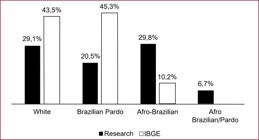
The population of White and Brazilian Pardo players fell significantly in relation to people of these races in the Brazilian population. While the former two were classified as 29.1% and 20.5%, respectively, 43.5% of people were classified as being White in the population and 45.3% as being Brazilian Pardo.
These results demonstrate how Black footballers broke down the barriers that prevented them from playing football at the beginning of the last century, with Afro-Brazilian players being the most representative.
4.2 COACHING STAFF
The data about the coaching staff (considering Brazilians and foreign professionals in Brazilian clubs) reveals that White professionals are more representative, reaching the majority (75.4%) (Table 7). Next are Afro-Brazilian, Brazilian Pardo, and those classified as “Afro-Brazilian/Pardo”. The total percentage of Black professionals was 12.3%, with Asian and Indigenous professionals not receiving any classification. The percentage of inconclusive was 12.3%, a lower percentage than that of players.
When analysing the head coaches and assistant coaches separately, we observe that among the former, 90% of the total are White. The other 10% were considered inconclusive, with other races not being classified.
As for assistant coaches, we observed that White people continue to have a high degree of representation, comprising 68.9%, followed by Afro-Brazilian, Brazilian Pardo, and Black. The total number of Black assistant coaches was 17.8%, with Asian and Indigenous people not being classified. The percentage of inconclusive cases was 13.3%.
When comparing representation in management positions in the highest income class in Brazil with the position of Brazilian football head coaches (Figure 2), we find that the racial inequality present in football clubs in the main male league is even greater than in other sectors of Brazilian society. While White and Black people occupy 84.4% and 14.6% of management positions in society in general, in Brazilian football, the representation of head coaches was 90% White, and none of the football clubs had a Black head coach when the data for this study was collected.

The analysis of the data regarding the members of the coaching staff indicates that, among head coaches, whose position is the most prestigious, commanding, and leading, White people predominate, with no members of any other race/ethnicity in Brazil. Among assistant coaches, White people continue to be the vast majority. However, among these professionals, Black people have achieved some representation.
Concerning coaching staff data and the underrepresentation of Black people in Brazilian football, the study revealed that Black people are 53.3% of footballers in Brazil and 17.8% of assistant coaches. None of the clubs in the main Brazilian male league has a black head coach.
When excluding the foreign footballers and members of the coaching staff, Black people represent 57% of footballers, and assistant coaches represent 25.8% of the professionals. This perspective still results in no Black head coaches working in leading clubs in Brazil.
After identifying the underrepresentation of Black head coaches and assistant coaches in the main Brazilian men’s football league in 2023, this research compares the numbers in Brazil with the findings of Premier League, one of the main football leagues in the world. This comparison reveals that in both football leagues, Black coaches are underrepresentated.
In the Premier League, Szymanski (2022) shows that Black players in the 2020/21 season represented 42,7%, while the head coaches represented 4,4%. In Serie A of Brazilian men’s League, we found no representatives of Black head coaches in its main football league in 2023.

Therefore, despite the differences in context and methodologies used, we found that the situation of Brazilian head coaches is generally worse when compared to their counterparts in England.
5 FINAL CONSIDERATIONS
This research aimed to examine the ethnic-racial representation of footballers, head coaches and assistant coaches of football teams in the main Brazilian male league (Série A).
The results demonstrated that the racial inequality suffered by the Black population in Brazil extends to Black coaches in Brazilian football. Although Black players represent the vast majority of footballers, and being a footballer is a natural path to becoming a coach, no Brazilian football club playing in the main male league in 2023 had a Black head coach, and the percentage of Black assistant coaches was modest.
In methodological terms, heteroidentification was used to classify the research subjects regarding ethnic/racial categories. This technique is widely used in Brazilian public organizations. Despite this, there was no record of its use for sporting purposes in the country. The validation procedures (Pilot study) and the criteria used to form the evaluation committees indicate that the method used in this research is an important theoretical contribution to the study of the topic in the context of sport, which can be reproduced in future studies. However, as described along the text, heteroidentificiation has some limitations, especially identifying mixed-raced individuals.
As for the limitations of this study, it is important to highlight some. The first concerns the information on the official websites of the Brazilian football clubs accessed and the CBF. Some of them do not contain information about the coaching staff. In others, the information is incomplete or difficult to access. The second is related to identifying players available in the institution that governs Brazilian football – the CBF. The official list of footballers registered by clubs in the main Brazilian male league has not been updated, resulting in duplicate registrations of athletes who were traded between the clubs playing in the main league. There are also situations of players who were traded internationally but were still on the CBF list. Another limitation related to the CBF concerns the quality of the footballers’ photos on its official website. There is no defined standard, with good and poor-quality photos. There are many examples of records of players as children. The non-standardization and poor quality of the photos certainly contributed to the high percentage of inconclusive research results.
Another critical point related to the athletes’ records present on the CBF’s official website concerns the data made available. The website contains the player’s full name, surname, and date of birth. We suggest that, in addition to these, the entity should also register the race/ ethnicity of athletes, information that could be requested from registered players, obtained through self-declaration.
We also understand that the CBF should adopt the self-declaration of people who work or are connected with the entity, whether athletes, head coaches, coaching staff, administrative sectors, etc. Self-declaration would provide a general ethnic/racial map of Brazilian football sports organizations, providing more accurate and reliable data on these actors.
For future studies, we suggest that similar research be carried out to quantify the ethnic-racial representation of players, head coaches, and assistant coaches of football teams in the second, third, and fourth tiers of the Brazilian male leagues (Séries B, C, and D), football teams of the women’s league, regional tournaments, and youth for men’s and women’s teams. Furthermore, we propose a study analysing ethnic/racial positions on the playing field to identify whether discrimination is related to positions, a theme covered in part of the international literature.
Finally, we believe that recording data on race/ethnicity is a practice that should be implemented not only in football. Other sports organizations or national governing bodies related to sports would benefit from collecting and exploring this information. We consider that these data are crucial and relevant for directing the actions of sports governing bodies at the federal/regional level and serve as support for improving public policies to combat racial inequality in sports in the country.
-
1
The term “minority” is used here in the same way as described by Bradbury (2020): “minoritized groups” are characterized by a lower degree of power or representation in comparison to others (White), within society.
-
2
The Black Footballers Partnership (BFP, 2025) is an English organization launched in 2022, which one of their goals is to form a well-resourced and strategic organization to unite Black current and former players and give them a voice.
-
RESEARCH ETHICS
The research project was submitted and approved by the Universidade Federal de São Paulo Ethics Committee, protocol number 1121/2023.
-
FUNDING
This study was financed in part by the Coordenação de Aperfeiçoamento de Pessoal de Nível Superior - Brasil (CAPES) - Finance Code 001.
-
HOW TO CITE
SILVA, Donald Veronico Alves da; BASTOS, Flavia da Cunha; SILVA, Douglas Veronico Alves. The Underrepresentation of Black Coaches in Brazilian Football – Heteroidentification of Footballers and Coaching Staff from 2023 Men’s Teams in the Brazilian Série A Championship. Movimento, v. 31, p. e31049, jan./dez. 2025. DOI: https://doi.org/10.22456/1982-8918.143025
RESEARCH DATA AVAILABILITY
Research data is not available.
REFERENCES
-
BENNIE, Andrew et al Cultural connections and cultural ceilings: exploring the experiences of Aboriginal Australian sport coaches. Qualitative Research in Sport, Exercise and Health, v. 11, n. 3, p. 299–315, 2019. DOI: https://doi.org/10.1080/2159676X.2017.1399924
» https://doi.org/10.1080/2159676X.2017.1399924 -
BLACK FOOTBALLERS PARTNERSHIP (BFP). 2025. Available at: https://www.bfporg.com/ Accessed on: May 5, 2025.
» https://www.bfporg.com/ -
BOZEMAN, Barry; FAY, Daniel. Minority football coaches' diminished careers: why is the ‘pipeline’ clogged? Social Science Quarterly, v. 94, n. 1, p. 29–58, 2013. DOI: https://doi.org/10.1111/j.1540-6237.2012.00931.x
» https://doi.org/10.1111/j.1540-6237.2012.00931.x - BRADBURY, Steven. ’Fit for doing but not fit for organising’: racisms, stereotypes and networks in coaching in professional football in Europe. In: BRADBURY, Steven; LUSTED, Jim; VAN STERKENBURG, Jacco (ed.). 'Race', ethnicity and racism in sports coaching. London: Routledge, 2020. p. 22–42.
-
BRADBURY, Steven. Institutional racism, whiteness and the underrepresentation of minorities in leadership positions in football in Europe. Soccer and Society, v.14, n. 3, p. 296–314, 2013. DOI: https://doi.org/10.1080/14660970.2013.801262
» https://doi.org/10.1080/14660970.2013.801262 -
BRADDOCK II, Jomills Henry; SMITH, Eryka; DAWKINS, Marvin P. Race and pathways to power in the national football league. American Behavioral Scientist, v. 56, n. 5, p. 711–727, 2012. DOI: https://doi.org/10.1177/0002764211433802
» https://doi.org/10.1177/0002764211433802 -
BRASIL. Ministério do Esporte. Estratégia Nacional para o Futebol Feminino: Decreto n. 11.458, de 30 mar. 2023a. Available at: https://www.gov.br/esporte/pt-br/acoes-e-programas/futebol-feminino/docestrategianacionalfutebeolfemv5_15-08-202313.pdf Accessed on: May 3, 2025.
» https://www.gov.br/esporte/pt-br/acoes-e-programas/futebol-feminino/docestrategianacionalfutebeolfemv5_15-08-202313.pdf -
BRASIL. Ministério do Planejamento, Desenvolvimento e Gestão. Portaria Normativa n. 4, de 6 de abril de 2018. Diário Oficial da União, edição 68, seção 1, p. 34, 2018. Available at: https://www.in.gov.br/materia/-/asset_publisher/Kujrw0TZC2Mb/content/id/9714349/do1-2018-04-10-portaria-normativa-n-4-de-6-de-abril-de-2018-9714345 Accessed on: Jan. 24, 2024.
» https://www.in.gov.br/materia/-/asset_publisher/Kujrw0TZC2Mb/content/id/9714349/do1-2018-04-10-portaria-normativa-n-4-de-6-de-abril-de-2018-9714345 -
BRASIL. Presidência da República. Lei Nº 14.723. Altera a Lei nº 12.711, de 29 de agosto de 2012. Diário Oficial da União, seção 1, n. 216, 14 nov. 2023b. Available at: https://pesquisa.in.gov.br/imprensa/jsp/visualiza/index.jsp?data=14/11/2023&jornal=515&pagina=5&totalArquivos=101. Accessed on: Jan. 24, 2024.
» https://pesquisa.in.gov.br/imprensa/jsp/visualiza/index.jsp?data=14/11/2023&jornal=515&pagina=5&totalArquivos=101 -
BRASIL. Presidência da República. Lei nº 15.142, de 3 de junho de 2025 Reserva às pessoas pretas e pardas, indígenas e quilombolas o percentual de 30% (trinta por cento) das vagas... e revoga a Lei nº 12.990, de 9 de junho de 2014. Available at: https://www.planalto.gov.br/ccivil_03/_Ato2023-2026/2025/Lei/L15142.htm#art13 Accessed on: Sep. 12, 2025.
» https://www.planalto.gov.br/ccivil_03/_Ato2023-2026/2025/Lei/L15142.htm#art13 -
CONFEDERAÇÃO BRASILEIRA DE FUTEBOL (CBF). Campeonato Brasileiro Série A 2023. Available at: https://www.cbf.com.br/futebol-brasileiro?csrt=2032126893015251846 Accessed on: Oct. 10, 2023.
» https://www.cbf.com.br/futebol-brasileiro?csrt=2032126893015251846 -
CONRICODE, Dominic. The operational implementation of the English Football League’s voluntary code of coach recruitment and its effectiveness in addressing the underrepresentation of minoritised managers. Soccer and Society, v. 23, n. 6, p. 631–645, 2022. DOI: https://doi.org/10.1080/14660970.2021.1956476
» https://doi.org/10.1080/14660970.2021.1956476 -
CONRICODE, Dominic; BRADBURY, Steven. ‘You just want the right person for the right job’: ‘race neutral’ and ‘race conscious’ rationales for the implementation of positive action measures in sports coaching. Sport in Society, p. 1-24, 2025. DOI: https://doi.org/10.1080/17430437.2025.2453843
» https://doi.org/10.1080/17430437.2025.2453843 -
CUNNINGHAM, George B. Understanding the underrepresentation of African American managers: a multilevel perspective. Sport Management Review, v. 13, n. 4, p. 395–406, 2010. DOI: https://doi.org/10.1016/j.smr.2009.07.006
» https://doi.org/10.1016/j.smr.2009.07.006 - CUNNINGHAM, George.B. The under-representation of racial minorities in coaching and leadership positions in the United States. In: BRADBURY, Steven; LUSTED, Jim; VAN STERKENBURG, Jacco (ed.). 'Race', ethnicity and racism in sports coaching. London: Routledge, 2020. p. 3–21.
-
CUNNINGHAM, George B.; SAGAS, Michael. Racial differences in occupational turnover intent among NCAA division IA assistant football coaches. Sociology of Sport Journal, v. 21, n. 1, p. 84–92, 2004. DOI: https://doi.org/10.1123/ssj.21.1.84
» https://doi.org/10.1123/ssj.21.1.84 -
CUNNINGHAM, George B.; SINGER, John N. You’ll face discrimination wherever you go: student athletes’ intentions to enter the coaching profession. Journal of Applied Social Psychology, v. 40, n. 7, p. 1708–1727, 2010. DOI: https://doi.org/10.1111/j.1559-1816.2010.00636.x
» https://doi.org/10.1111/j.1559-1816.2010.00636.x -
DUBOIS, Cynthia. The impact of ’soft’ affirmative action policies on minority hiring in executive leadership: the case of the NFL's Rooney Rule. American Law and Economics Review, v. 18, n. 1, p. 208–233, 2016. DOI: https://doi.org/10.1093/aler/ahv019
» https://doi.org/10.1093/aler/ahv019 -
DURU, N. Jeremi. The Rooney Rule’s reach: how the NFL’s equal opportunity initiative for coaches inspired local government reform. In: MCCANN, Michael A. (ed.) The Oxford Handbook of American Sports Law New York, NY: Oxford University Press, 2017. p. 525–540. DOI: https://doi.org/10.1093/oxfordhb/9780190465957.013.32
» https://doi.org/10.1093/oxfordhb/9780190465957.013.32 -
EVERHART, Chad Bonnie; CHELLADURAI, Packianathan. Gender differences in preferences for coaching as an occupation: the role of self-efficacy, valence, and perceived barriers. Research Quarterly for Exercise and Sport, v. 69, n. 2, p. 188–200, 1998. DOI: https://doi.org/10.1080/02701367.1998.10607683
» https://doi.org/10.1080/02701367.1998.10607683 - FILHO, Mario. O negro no futebol brasileiro Rio de Janeiro: Mauad, 2003.
-
FOREMAN, Jeremy J. et al Race, market size, segregation and subsequent opportunities for former NFL head coaches. Jahrbücher für Nationalökonomie und Statistik, v. 244, n. 5-6, p. 533-555, 2024. DOI: https://doi.org/10.1515/jbnst-2023-0092
» https://doi.org/10.1515/jbnst-2023-0092 -
GRAHAM, Matthew; MILANOWSKI, Anthony; MILLER, Jackson. Measuring and promoting inter-rater agreement of teacher and principal performance ratings Center for Educator Compensation Reform (CECR). 2012. Available at: https://files.eric.ed.gov/fulltext/ED532068.pdf Accessed on: Jan. 23, 2024.
» https://files.eric.ed.gov/fulltext/ED532068.pdf -
HOWE, Jonathan E. In the shadows no more: making a case for Black college assistant football coaches as strategic hybrid resistors in and through sport. Journal of Issues in Intercollegiate Athletics, v. 16, n. 2, p. 4, 2023. Available at: https://scholarcommons.sc.edu/jiia/vol16/iss2/4 Accessed on: Jan. 23, 2024.
» https://scholarcommons.sc.edu/jiia/vol16/iss2/4 -
INSTITUTO BRASILEIRO DE GEOGRAFIA E ESTATÍSTICA (IBGE). Censo 2022: de 2010 a 2022, população brasileira cresce 6,5%... Agência IBGE Notícias, 27 out., 2023. Available at: https://agenciadenoticias.ibge.gov.br/agencia-noticias/2012-agencia-de-noticias/noticias/37237-de-2010-a-2022-populacao-brasileira-cresce-6-5-e-chega-a-203-1-milhoes Accessed on: Oct. 10, 2023.
» https://agenciadenoticias.ibge.gov.br/agencia-noticias/2012-agencia-de-noticias/noticias/37237-de-2010-a-2022-populacao-brasileira-cresce-6-5-e-chega-a-203-1-milhoes -
MATOS, Daniel Abud Seabra. Confiabilidade e concordância entre juízes: aplicações na área educacional. Estudos em Avaliação Educacional, v. 25, n. 59, p. 298–324, 2014. DOI: https://doi.org/10.18222/eae255920142750
» https://doi.org/10.18222/eae255920142750 -
MAMEDE, Rodrigo Neres Silva. Negro no campo, branco no comando: técnicos negros de futebol e questões raciais. 2018. 136 f. Dissertation (Master's in Ethnic-Racial Relations) - Centro Federal de Educação Tecnológica Celso Suckow da Fonseca, Rio de Janeiro, 2018. Available at: https://dippg.cefet-rj.br/pprer/attachments/article/81/116_Rodrigo%20Neres%20da%20Silva%20Mamede.pdf Accessed on: Oct. 10, 2023.
» https://dippg.cefet-rj.br/pprer/attachments/article/81/116_Rodrigo%20Neres%20da%20Silva%20Mamede.pdf -
NASCIMENTO, Jacklady Dutra; PORTO, Leudjane Michelle Viegas Diniz; DUARTE, Regyna Kleyde de Holanda. A Lei 12.711/2012 e o racismo: estratégias e controvérsias na implantação das comissões de heteroidentificação nos Institutos Federais. Educação e Fronteiras, v. 12, esp. 2, p. e023023-e023023, 2022. DOI: https://doi.org/10.30612/eduf.v12iesp.2.17399
» https://doi.org/10.30612/eduf.v12iesp.2.17399 -
OBSERVATÓRIO DA DISCRIMINAÇÃO RACIAL NO FUTEBOL. Relatório da Discriminação Racial no Futebol 2024. Criação Julho/2024. Available at: https://observatorioracialfutebol.com.br/wp-content/uploads/2024/09/ODRF_relatorio2023_completo.pdf Accessed on: May 05, 2025.
» https://observatorioracialfutebol.com.br/wp-content/uploads/2024/09/ODRF_relatorio2023_completo.pdf - OSÓRIO Rafael G. A classificação de cor ou raça do IBGE revisitada. In: PETRUCCELLI, José. Luis; SABOIA, Ana. Lucia (org.). Características étnico-raciais da população Classificações e Identidades. Rio de Janeiro: IBGE, 2013.
-
PEREIRA, Igor Moreira Dias. Racismo no futebol brasileiro: a ótica do jogador negro. 2021. 172 f. Thesis (Doctoral Degree in Social Sciences) - Pontifícia Universidade Católica de São Paulo, São Paulo, 2021. Available at: https://tede2.pucsp.br/bitstream/handle/24505/1/Igor%20Moreira%20Dias%20Pereira.pdf Accessed on: Jan. 23, 2024.
» https://tede2.pucsp.br/bitstream/handle/24505/1/Igor%20Moreira%20Dias%20Pereira.pdf -
PEREZ, Olivia Cristina et al A inserção de pessoas negras no alto escalão dos ministérios do Governo Federal. Revista Mundo Livre, v. 9, n. 1, p. 119–140, 2023. Available at: https://periodicos.uff.br/mundolivre/article/view/57320 Accessed on: Jan. 23, 2024.
» https://periodicos.uff.br/mundolivre/article/view/57320 - PITTS, Brenda G.; LI, Ming; KIM, Amy Chan Hyung. Research methods in sport management. 2. ed. Morgantown, US: Fit Publishing, 2018.
-
ROQUE, Luiz Felipe; SILVA, Carlos Alberto Figueiredo. Are there opportunities for blacks in Brazilian sports command? The case of football. International Journal of Humanities and Social Science, v. 11, n. 6, p. 40–49, 2021. Available at: https://www.researchgate.net/publication/354906762_Are_there_Opportunities_for_Blacks_in_Brazilian_Sports_Command_The_Case_of_Football, 2024. Accessed on: Feb. 24, 2024.
» https://www.researchgate.net/publication/354906762_Are_there_Opportunities_for_Blacks_in_Brazilian_Sports_Command_The_Case_of_Football - SANTOS, Hélio. A busca de um caminho para o Brasil: a trilha do círculo vicioso. São Paulo: Editora Senac São Paulo, 2001.
-
SILVA, Líbia Aguiar Moreira; MELO, Sônia Pinto de Albuquerque. Cotas raciais e bancas de heteroidentificação no contexto educacional. SCIAS. Direitos Humanos e Educação, v. 7, n. 2, p. 180-203, 2024. DOI: https://doi.org/10.36704/sdhe.v7i2.9140
» https://doi.org/10.36704/sdhe.v7i2.9140 -
STEMLER, Steven E. A comparison of consensus, consistency, and measurement approaches to estimating interrater reliability. Practical Assessment, Research & Evaluation, v. 9, n. 1, p. 1–11, 2004. DOI: https://doi.org/10.7275/96jp-xz07
» https://doi.org/10.7275/96jp-xz07 -
SZYMANSKI, Stefan. Black representation in English professional football: a statistical analysis. [S.l.]: Black Footballers Partnership, 2022. Available at: https://api.blackfootballerspartnership.com/wp-content/uploads/2022/02/BFP-Stefan-Szymanski-16th-Feb.pdf Accessed on: May 03, 2025.
» https://api.blackfootballerspartnership.com/wp-content/uploads/2022/02/BFP-Stefan-Szymanski-16th-Feb.pdf -
TRANFERMARKET. Campeonato Brasileiro Série A. 2023. Available at: https://www.transfermarkt.com.br/serie-a/startseite/wettbewerb/BRA1 Accessed on: Jan. 23, 2024.
» https://www.transfermarkt.com.br/serie-a/startseite/wettbewerb/BRA1 - VEAL, Anthony James; DARCY, Simon. Research methods in sport studies and sport management: a practical guide. London: Routledge, 2014.
-
WILLIAMS, Melissa J. et al Looking the part: stereotypicality in appearance among white professionals predicts leadership attainment and perceived leadership suitability. Personality and Social Psychology Bulletin, v. 50, n. 4, p. 1–16, 2022. DOI: https://doi.org/10.1177/01461672221143756
» https://doi.org/10.1177/01461672221143756 -
ZHANG, Letian. A fair game? Racial bias and repeated interaction between NBA managers and players. Administrative Science Quarterly, v. 62, n. 4, p. 603-625, 2017. Available at: https://www.hbs.edu/ris/Publication%20Files/0001839217705375_b057841c-7a25-4c04-9828-22e0731d3653.pdf Accessed on: Jan. 23, 2024.
» https://www.hbs.edu/ris/Publication%20Files/0001839217705375_b057841c-7a25-4c04-9828-22e0731d3653.pdf
Edited by
-
EDITORIAL RESPONSIBILITY
Alex Branco Fraga* https://orcid.org/0000-0002-6881-1446Elisandro Schultz Wittizorecki* https://orcid.org/0000-0001-7825-0358Guilherme Nothen** https://orcid.org/0000-0002-9344-4772Mauro Myskiw* https://orcid.org/0000-0003-4689-3804Raquel da Silveira* https://orcid.org/0000-0001-8632-0731* Universidade Federal do Rio Grande do Sul, Escola de Educação Física, Fisioterapia e Dança, Porto Alegre, RS, Brazil.**University of Edinburgh. Edinburgh, Scotland

 Source: research data and
  Source: research data and
  Source: research data and