Effects of Chromium and Aluminum Additions on High-Entropy Alloys of the NbTiCrAl System: Development and Characterization
Abstract
This study investigates the design, synthesis, and characterization of novel high-entropy alloys (HEAs) in the NbTiCrAl system, focusing on the compositions NbTi, Nb7Ti7Cr2, Nb7Ti7Al2, Nb7Ti7Cr1Al1, and Nb3Ti3Cr1Al1. Microstructural analysis identified a single-phase BCC solid solution with dendritic structure, where compositional segregation is driven by melting point differences, with Ti, Cr, and Al migrating to interdendritic regions. Mechanical testing demonstrated that Cr and Al additions significantly improved hardness and strength, with Nb3Ti3Cr1Al1 exhibiting the highest microhardness (387.9 ± 6.1 HV0.5) and compressive yield strength (986.4 ± 70.0 MPa). Statistical analysis through a 22 full-factorial + central point design and ANOVA indicated that Cr predominantly influences the mechanical properties, with minimal interaction from Al. Multivariable linear regression models were developed to predict mechanical performance. These findings underscore the importance of Cr and Al balance for phase stability and mechanical properties, establishing the NbTiCrAl system as a promising candidate for advanced structural applications.
Keyword:
High-entropy alloy; NbTiCrAl; as-cast; microhardness; compressive tests
1. Introduction
Nickel-based superalloys have long been the basis of high-temperature applications, particularly in the aerospace field, due to their excellent mechanical properties and resistance to oxidation and corrosion1-3. However, their operating temperature is typically limited to approximately 1100°C, beyond which their mechanical properties deteriorate significantly. Additionally, the high density of these alloys, often exceeding 8 g/cm3, poses challenges for applications where minimizing weight is critical, such as in aerospace components1,4. These limitations highlight the need for alternative materials that are able operate at higher temperatures while maintaining or even reducing the component weight5,6. Consequently, the growing demand for materials with superior high temperature performance has driven extensive research into alternative materials, including ceramics, refractory alloys, intermetallic compounds, and composites materials7-11.
In the last decades, the concepts of high-entropy alloys (HEAs) and complex concentrated alloys (CCAs) concepts have revolutionized the design of advanced materials, particularly for high-temperature applications12-16. Among the many subclasses of HEAs, high-entropy superalloys (HESAs), refractory high-entropy alloys (RHEAs), refractory superalloys (RSAs), and lightweight refractory high-entropy alloys (LW-HEAs) have garnered significant attention due to their promising high-temperature properties17-20. In addition to metallic HEAs, high-entropy ceramics, silicides, and coatings have emerged as promising materials for high-temperature applications21-29.
Despite their high-temperature performance, many developed RHEAs had densities over 12 g/cm3 which is higher than the nickel-based superalloys and brittleness at room temperature30. Additionally, not satisfactory oxidation resistance is reported in the literature, as highlighted by Dainezi et al.31 for the TiNbCr alloy oxidized in air at 800-1000°C up to 100h and by Welch et al.32 for alloys in the system TaTiCr system oxidized at 1200°C up to 24h, both studies in air. These characteristics are incompatible with aerospace superalloy requirements, so these limitations emphasize that the design of novel lightweight structural alloys with excellent high-temperature behavior remains a significant challenge18,33.
Addressing these challenges, the design of LW-HEAs, defined as alloys with densities less than 7.00 g/cm34, has emerged as a promising strategy. Incorporating lighter refractory elements such as Cr, Ti, Zr and V instead of W, Ta, and Hf, can reduces the density while maintaining satisfactory high-temperature mechanical properties. Senkov et al.35 explored LW-RHEAs in the Cr-Nb-Ti-V-Zr system, achieving densities bellow 7 g/cm3. Comparing Cr-free alloys with Cr-containing alloys, they reported that Cr-free alloys exhibited significant room temperature ductility (> 50%), although their yield strengths at 1000°C were lower (58 MPa and 72 MPa). While Cr-containing alloys exhibited room temperature ductility (< 10%) and yield strengths at 1000°C of 115-259 MPa, which exhibited brittle failure due to the Laves phase precipitation35,36.
Furthermore, the addition of light non-refractory elements such as Al has been investigated to reduce the density while improving the mechanical performance, as suggested by Senkov et al.37. For instance, the AlMo0.5NbTa0.5TiZr alloy demonstrated an impressive yield strength of 100 MPa at 1000 °C, with a dual-phase microstructure similar to that of superalloys, classifying it as a "refractory high-entropy superalloy"37.
The addition of Al and Cr represents further opportunities to optimize the properties of LW-RHEAs, such as reducing density while maintaining high-temperature performance. However, the vast number of possible compositions and the complexity of alloy design create significant challenges in developing new LW-RHEAs with optimized properties. This study investigates the effects of Al and Cr additions to an equiatomic NbTi base alloy. Mechanical properties are evaluated at room temperature, providing valuable insights into the structure-property relationships of these alloys and their potential as replacements for Ni-based superalloys in aerospace applications.
2. Methodology
2.1. Alloy design
The selection of the NbTiCrAl system was based on the specific properties of each element and the synergistic interactions, essential for achieving LW-RHEAs with a body centred cubic (BCC) phase stability at high temperatures. Alloys with a BCC phase structure are known for their high strength, and the elements niobium (Nb), titanium (Ti) and chromium (Cr), are recognized for their ability to stabilize the BCC phase in RHEAs30,38-43. Ti and aluminum (Al) are low-density elements and are often selected to reduce the density of RHEAs, maintaining a balance between strength and ductility30,38,40,44,45. Additionally, Al promotes the formation of the BCC structure when added in appropriate concentrations30, though excessive concentrations can, like Cr, promote the formation of brittle phases such as Laves30,39,41,45-47. Cr, in contrast, enhances corrosion resistance by forming a protective passive layer on the surface and contributing to solid solution strengthening and microstructural refinement38,40-42.
The balance between Cr and Al contents was carefully optimized, limiting their total additions to a maximum of 12.5 at. % to extend the stability range of the BCC phase. The LW-RHEAs of the NbTiCrAl system were designed to investigate the effects of Cr and Al additions in the equiatomic NbTi binary system. A 22 factorial + central point design was used to isolate the effects of Cr and Al, both individually and in combination.
The following five alloy compositions were selected: NbTi, Nb7Ti7Cr2, Nb7Ti7Al2, Nb7Ti7Cr1Al1 and Nb3Ti3Cr1Al1. High Entropy Alloy Predict Software (HEAPS)48 was used to predict phase stability based on semi-empirical parameters and criteria for high-entropy alloys. Additionally, Thermo-Calc calculations were carried out using the TCHEA 6 database to evaluate phase equilibrium and verify the stability of the single-phase BCC structure targeted in this work.
2.2. Experimental
The alloys were produced using high purity (≥99.95 wt. %) commercial Nb, Ti, Cr and Al starting materials. Synthesis was carried out in a vacuum arc melting furnace equipped with a water-cooled copper crucible. Materials were weighed according to their atomic composition, and the chemical composition of the developed alloys are shown in Table 1. The alloys were designated as A1, A2, A3, A4 and A5 for NbTi, Nb7Ti7Cr2, Nb7Ti7Al2, Nb7Ti7Cr1Al1 and Nb3Ti3Cr1Al1 alloys, respectively, to facilitate discussions.
The raw materials were melted under a high purity argon atmosphere after three cycles of evacuation/purging and firing of a titanium getter to minimize oxygen contamination. The ingots were turned over and remelted at least five times to ensure compositional homogeneity. Following synthesis, the ingots were cut using a Struers Accutom-100 precision cutter. Surface preparation involved sequential grinding with silicon carbine papers (240-2400 grit) and polishing with alumina suspensions (1 µm, 0.3 µm), followed by a final step with 0.02 µm colloidal silica suspension (OPS). The samples were then cleaned with distilled water and isopropyl alcohol for 15 minutes in an ultrasonic bath.
The microstructure of the alloys was characterized by X-ray diffraction (XRD) and scanning electron microscopy (SEM) coupled with energy dispersive X-ray spectroscopy (EDS). XRD analyses were performed using Cu-Kα radiation (λ = 0.154 nm), over a 2θ range of 30° to 90°, operating at 40 kV and 30 mA. The diffraction data were analyzed using PANalytical X'Pert HighScore Plus software to identify crystal structures and to perform Rietveld refinement to determine the lattice parameters and density of the alloys. SEM analyses were carried out with a Hitachi SU5000 microscope equipped with backscatter electron (BSE) and EDAX Octane Elite EDS detector, providing high-resolution images of dendritic and interdendritic regions (BSE mode), as well elemental distribution maps (EDS mode at 15 kV), respectively.
The mechanical properties of the alloys were evaluated through microhardness and compression tests at room temperature. Microhardness measurements were performed using a Shimadzu HMV-2 microhardness tester with a Vickers diamond indenter under a load of 0.5 kgf for 10 seconds. Ten indentations were made per sample, and the average microhardness values were calculated. Compression tests were performed according to DIN 50106 standards using a Zwick/Roell Z050 universal testing machine. Cylindrical specimens of 5 mm height × 3.3 mm diameter were cut by wire electrical discharge machining (WEDM) and tested at a strain rate of 1 mm/min. Each test was performed in triplicate to ensure the reliability of the results.
3. Results and Discussion
3.1. Alloys design: HEAPS predictions and CALPHAD calculations
The designed alloys were analyzed using the High Entropy Alloy Predicting Software (HEAPS)48 in combination with thermodynamic calculations based on the CALPHAD method. This combined approach was employed to validate the microstructural stability criteria of the developed compositions. The results, summarized in Table 2, demonstrate that all alloys satisfy the MC1, MC2, and MC3 criteria, which are widely used to predict the formation of solid solutions (SS) and to reduce the occurrence of undesirable intermetallic or amorphous phases in high-entropy alloys.
Melting point (Tm), mixing enthalpy (ΔHmix), atomic size difference (δ), thermodynamic parameter (Ω), valence electron concentration (VEC), and predicted phase for the developed alloys, according to HEAPS predictions.
Specifically, the MC1 criterion, proposed by Zhang et al.49, relates the enthalpy of mixing (ΔHmix) and atomic radius difference (δ) to distinguish solid solutions from intermetallic and amorphous phases, with solid solutions expected in the range −17.5 < ΔHmix< 5 kJ/mol and 0.5 < δ < 6.5%. The MC2 criterion, introduced by Yang et al.50, incorporates the Ω parameter (which combines ΔHmix, entropy of mixing ΔSmix, and the average melting temperature Tm) and δ, indicating solid solution formation when Ω ≥ 1.1 and δ ≤ 6.6%. The MC3 criterion, proposed by Guo et al.51,52, further refines this approach by defining the solid solution region as −11.6 ≤ ΔHmix≤ 3.2 kJ/mol and δ ≤ 6.6%.
In addition, the LSS1 criterion, based on the valence electron concentration (VEC), was applied to predict the crystal structure of the solid solution phases. According to this criterion, alloys with VEC < 6.87 are expected to favor the formation of body-centered cubic (BCC) solid solutions51,52, which is consistent with the experimental observations for all compositions analyzed. To provide a clearer understanding of the alloy design strategy and support these predictions, Table 2 presents the calculated thermodynamic and physical parameters used in these criteria, including ΔHmix, δ, ΔSmix, Ω, and VEC for each alloy.
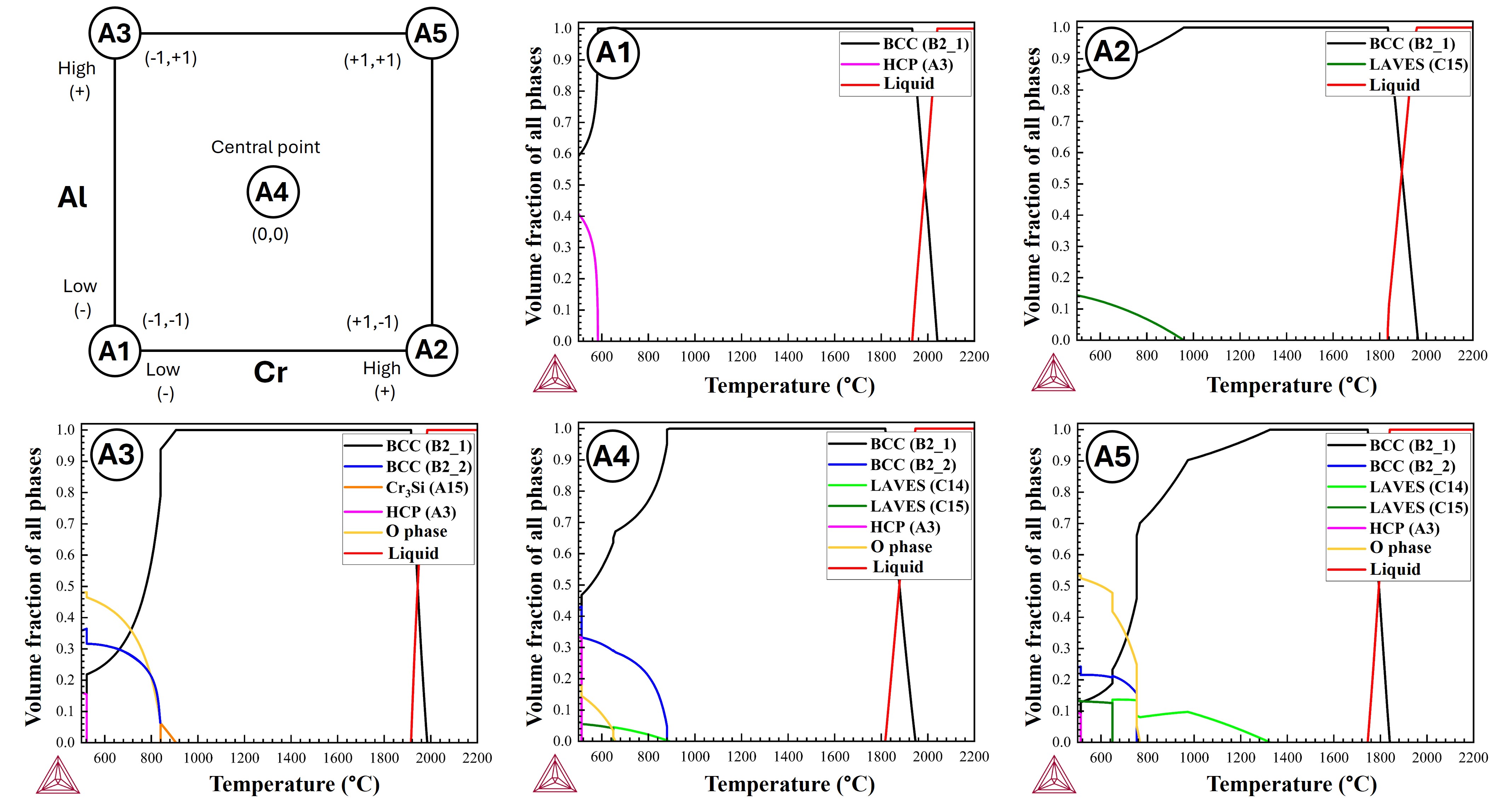
Figure 1 presents the 22 factorial design model, including a central point, used to design the five alloys. This model, together with CALPHAD calculations, allowed for a detailed analysis of the phase behavior under equilibrium conditions for each of the selected systems, complementing the HEAPS predictions. The volume fraction versus temperature diagrams indicated a wide range of BCC phase stability and a high melting point, highlighting the potential of the alloys for high-temperature applications45,53. These results confirm compliance with the MC1, MC2, MC3 and LSS1 criteria, evidencing their thermodynamic viability.
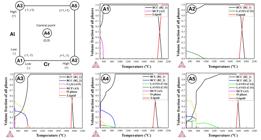
Experimental design and equilibrium phase fractions calculated by CALPHAD for the developed alloys: NbTi (A1), Nb7Ti7Cr2 (A2), Nb7Ti7Al2 (A3), Nb7Ti7Cr1Al1 (A4), and Nb3Ti3Cr1Al1 (A5).
Additionally, thermodynamic calculations based on CALPHAD method indicated the potential formation of secondary phases at high temperatures, depending on the specific chemical composition of each alloy. These phases are predicted to emerge in limited volume fractions and at elevated temperatures, suggesting possible microstructural evolution during long-term thermal exposure or processing. However, it is important to highlight that the criteria initially developed for alloys in the "as-cast" condition, which are subject to heterogeneous microstructures due to the solidification process, potentially limiting the accuracy of these predictions30.
3.2. Microstructure characterization
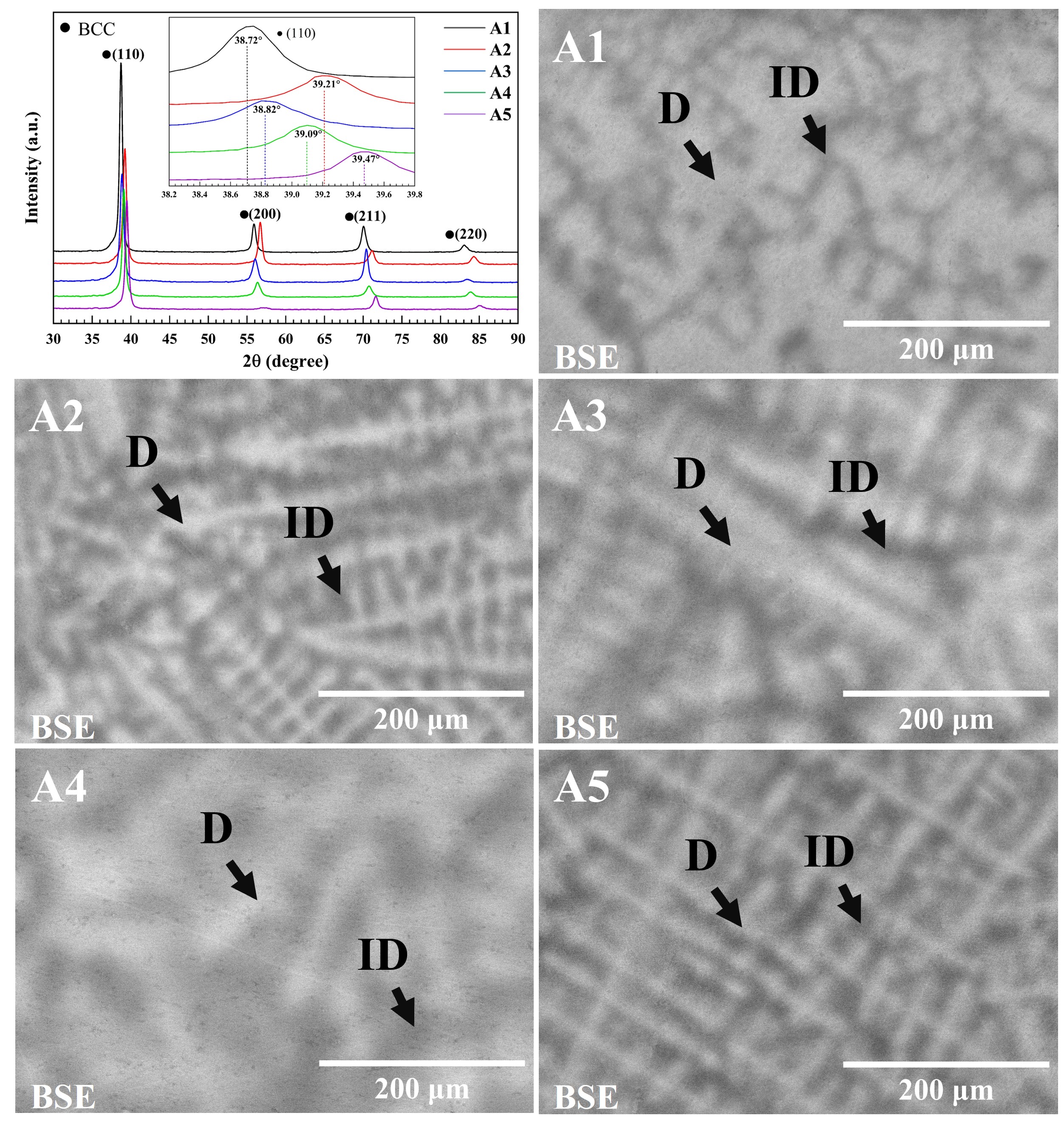
Figure 2 presents the X-ray diffraction patterns and an overview of the microstructural evolution of the developed alloys. All compositions (A1 to A5) exhibited diffraction peaks characteristic of a Body-Centered Cubic (BCC) structure, in agreement with both the HEAPS predictions and the equilibrium phase diagrams generated by CALPHAD method. While the thermodynamic calculations suggest the possible formation of secondary phases at elevated temperatures, especially under equilibrium conditions, only the BCC phase was experimentally detected by XRD and SEM-BSE. This difference is likely related to the rapid solidification conditions, which can inhibit the development of equilibrium phases.
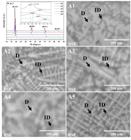
X-ray diffraction patterns and SEM backscattered electron (SEM-BSE) images showing dendritic (D) and interdendritic (ID) regions in developed alloys: NbTi (A1), Nb7Ti7Cr2 (A2), Nb7Ti7Al2 (A3), Nb7Ti7Cr1Al1 (A4), and Nb3Ti3Cr1Al1 (A5).
Furthermore, the X-ray spectra were refined using the PANalytical X'Pert HighScore Plus software to determine the lattice parameters and alloy density based on the unit cell volume, as shown in Table 3. The results indicate that the density of all alloys remains below 7 g/cm3, meeting the design goal for lightweight high-entropy alloys20. Moreover, the experimental densities (Densityexp) closely match the theoretical values estimated by the rule of mixtures (Densitymix), validating the accuracy of the compositional design approach. The rule of mixtures used to calculate the theoretical density is expressed as shown in Equation 1, where ci, Ai, and ρi are the atomic fraction, atomic weight, and density of the i-th element, respectively35.
Scanning electron microscopy (SEM) in backscattered electron (BSE) mode corroborates the XRD results, revealing a single-phase microstructure with dendritic morphology in all alloys characterized by dendritic (D) and interdendritic (ID) regions. By comparing the SEM-BSE images at the same magnification (Figure 2b-f), it was observed that the addition of Cr, Al or both, results in changes at the dendrite size. Notably, the alloy A2 exhibited the smallest dendrite size, correlating well with the lattice parameters shown in Table 3, which suggest that Cr addition promotes microstructure refinement. In contrast, the addition of Al did not significantly refine the microstructure. The final microstructure of the alloy A3 appeared slightly coarser than that of the base alloy, NbTi. Similar behavior was reported by Wang et al.54 and Carlucci et al.30 during the evaluation of the NbTa0.5TiAlx and AlMoNbTiVZr high-entropy alloys systems, respectively.
On the other hand, the Cr addition generated the effect of microstructure refinement. As reported in the literature, the Cr addition leads to a microstructure refinement of single-phase solid solution RHEA in their as-cast state. For instance, in the Hf0.5Mo0.5NbTiZr alloy system, Cr addition results in a refined dendritic structure, improving both strength and plasticity at lower Cr concentrations, although higher Cr content tends to increase strength at the expense of plasticity55. Similarly, in WVTaTiCrx, laser cladding coatings, increasing the Cr content leads first to dendritic microstructure refinement, then promotes the precipitation of a second phase, improving the hardness, high-temperature oxidation resistance and corrosion resistance of the coating56.
Table 4 presents the average elemental composition (at. %), obtained by EDS, of dendritic (D - light areas) and inter-dendritic (ID - dark areas) regions for all alloys, as observed in Figure 2. The data reveal a consistent segregation pattern across the developed alloys, driven by the varying melting points of the constituent elements (TmNb > TmCr > TmTi > TmAl). During solidification, elements with lower melting points (Ti, Cr and Al) migrate to the crystallization front, while the dendrites initially form with a composition enriched in Nb. As observed, in alloy A1, which contains only Nb and Ti, the dendritic region exhibited a composition of 52.6% Nb and 47.4% Ti, while the inter-dendritic region was enriched in Ti (53.9%). Similar trends were observed in alloys with Cr and/or Al additions (A2 to A5), where Cr and Al also tended to concentrate in the inter-dendritic regions.
Elemental composition (at. %) of dendritic and interdendritic regions obtained from EDS point analysis for the developed alloys.
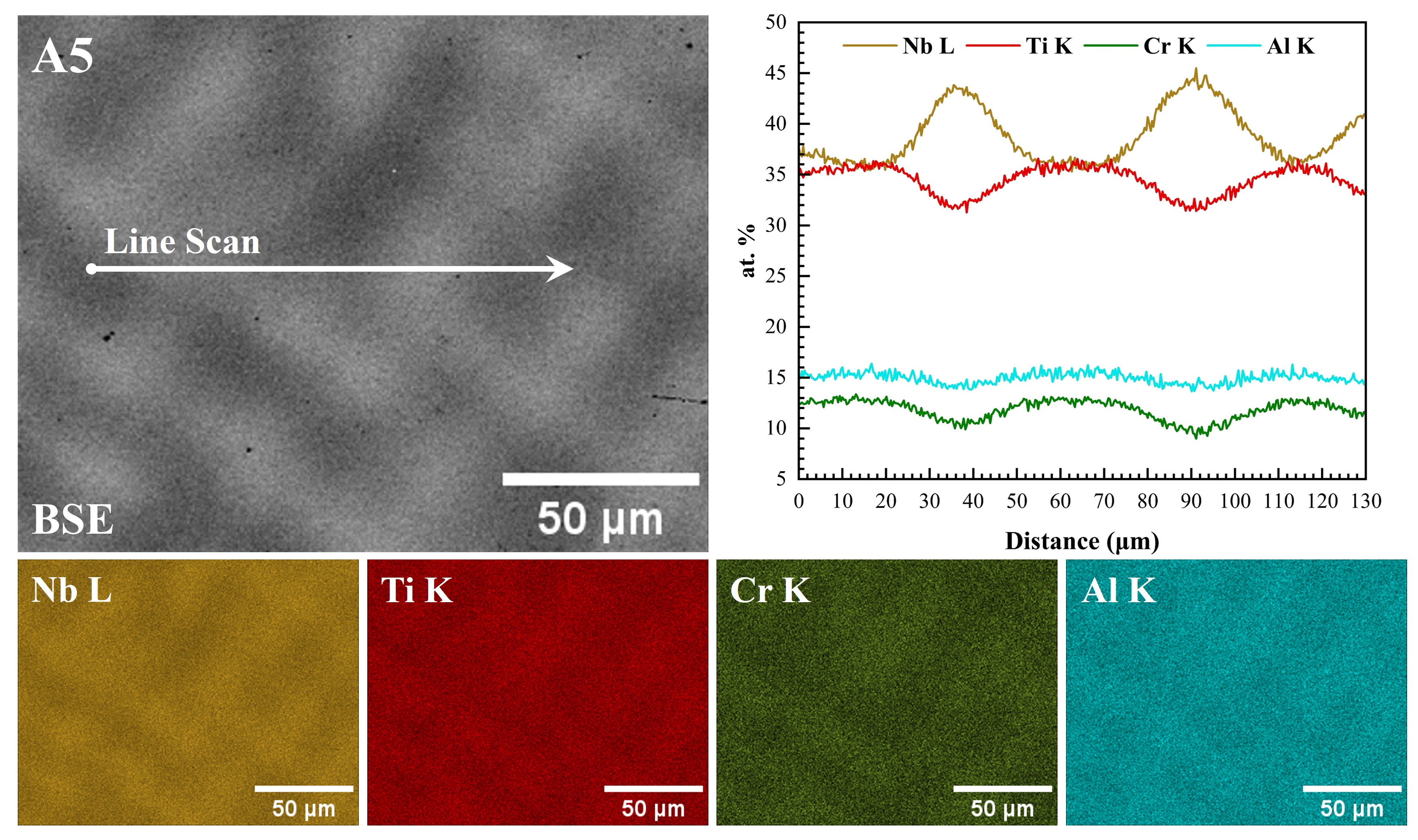
These observations are corroborated by EDS line scan and elemental mapping analyses conducted on the alloy A5, as presented in Figure 3. The line scan and mapping profiles quantify these fluctuations along the microstructure, where Nb was predominantly found in the dendritic regions, and Ti, Cr, and Al were more concentrated in the inter-dendritic regions. This segregation pattern is consistent with previously reported observations in other refractory high-entropy alloy systems. For instance, Ti and Al segregation was observed by Wang et al.54 during the evaluation of the NbTa0.5TiAlx refractory high entropy alloys system and by Dainezi et al.31 for the TiNbCr equiatomic alloy. A similar segregation phenomenon was previously reported by Pasini et al.24,25, who investigated the as-cast dendritic microstructures of alloys in the MoNbTaWTi system, showing a segregation of lower melting points Ti and Nb for the inter-dendritic region.
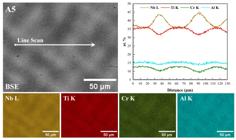
Microstructural and compositional analysis of alloy Nb3Ti3Cr1Al1 (A5): SEM-BSE image with EDS line scan path, corresponding line scan composition profile, and elemental maps.
3.3. Mechanical properties at room-temperature: microhardness and compression test
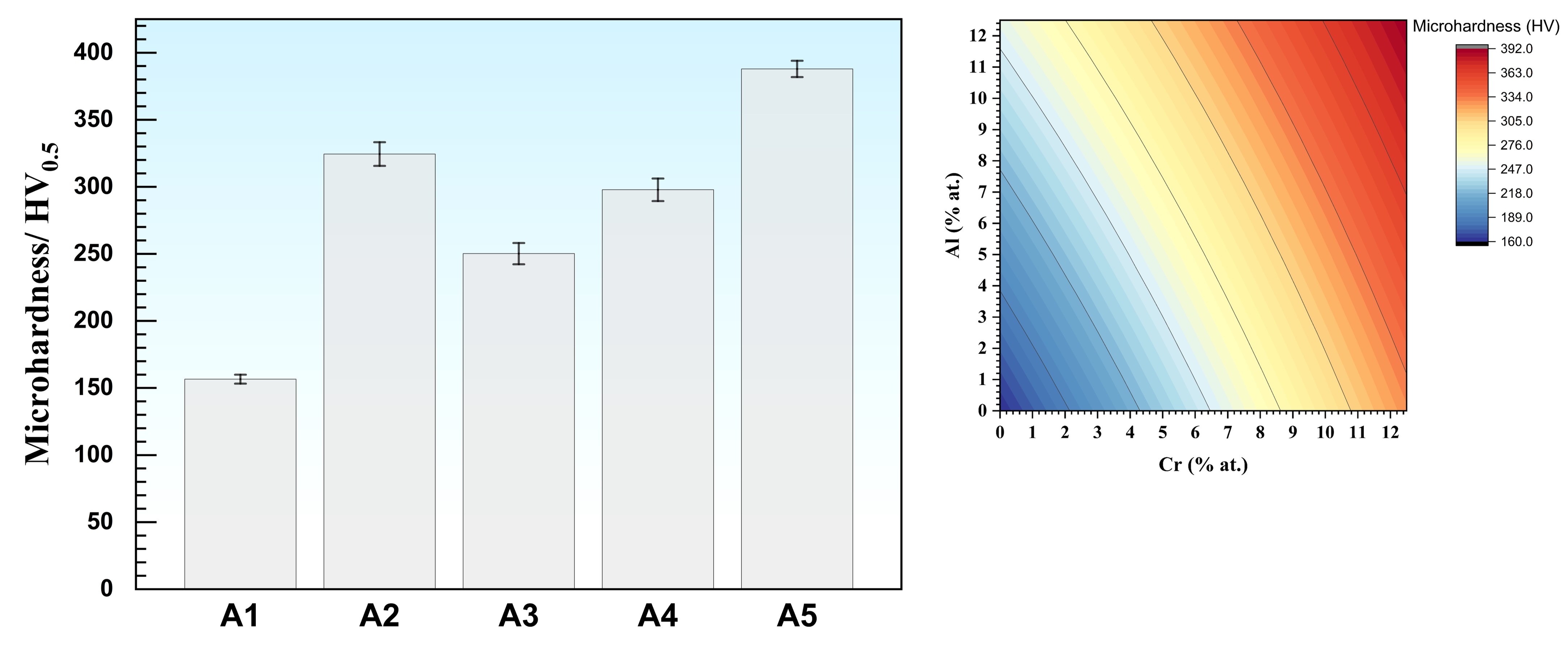
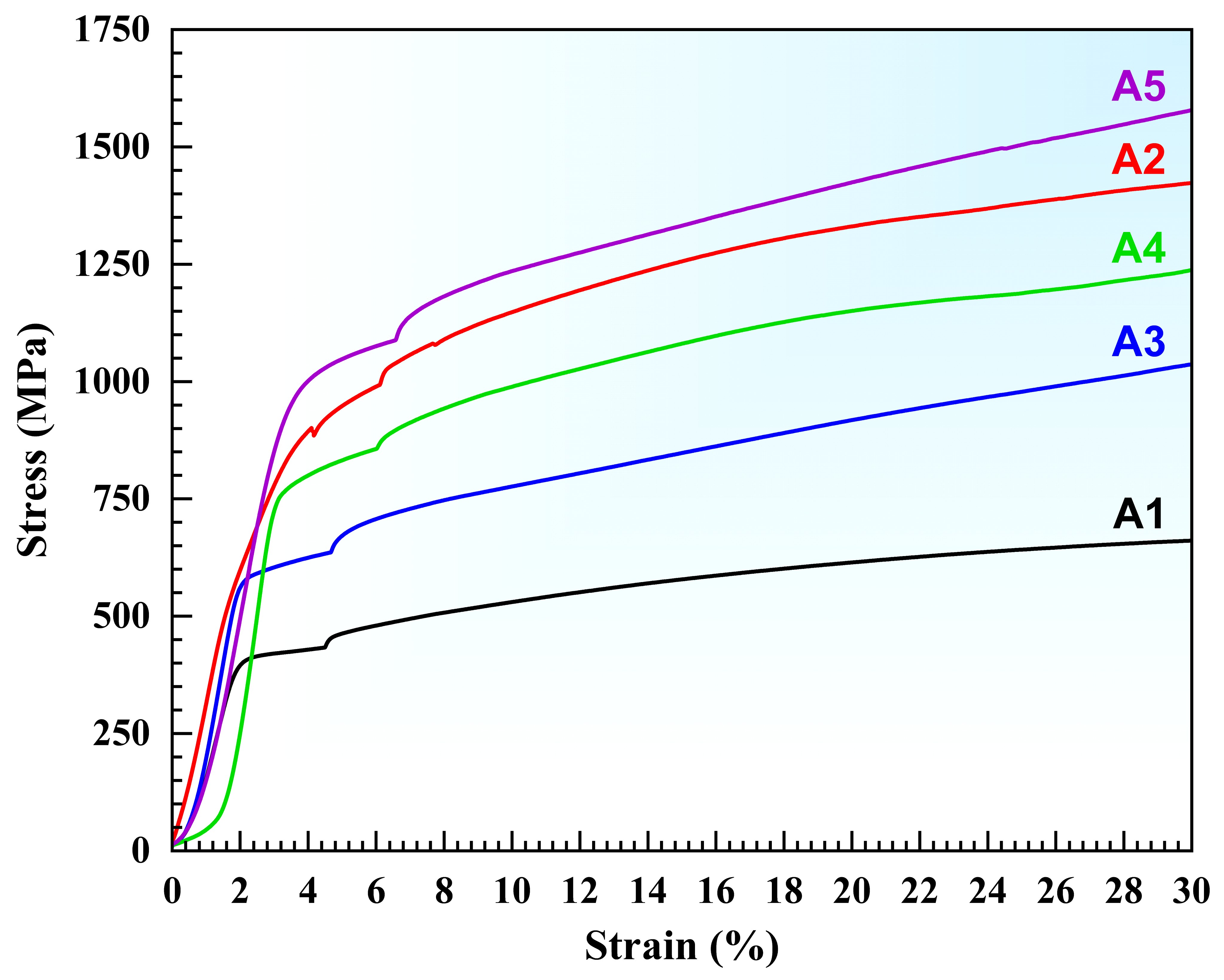
The mechanical properties at room temperature were evaluated through microhardness and compressive tests. The trends of the microhardness and the compressive stress-strain curves for the developed as-cast alloys, are graphically represented in Figure 4 and Figure 5 respectively.
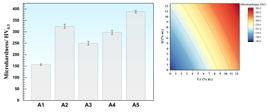
Microhardness values of the developed alloys: NbTi (A1), Nb7Ti7Cr2 (A2), Nb7Ti7Al2 (A3), Nb7Ti7Cr1Al1 (A4), and Nb3Ti3Cr1Al1 (A5), and contour plot showing the influence of Cr and Al contents on microhardness.
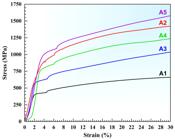
Engineering stress-strain curves from compression tests at room temperature for the developed alloys: NbTi (A1), Nb7Ti7Cr2 (A2), Nb7Ti7Al2 (A3), Nb7Ti7Cr1Al1 (A4), and Nb3Ti3Cr1Al1 (A5).
From the compressive stress-strain curves, Young's modulus (E) and yield strength (Rdp0.2) were determined, and the average values, along with microhardness (HV0.5), are summarized in Table 5. As expected, the addition of Al and Cr resulted in a significant increase in both hardness and compressive yield strength. For instance, the base alloy A1 exhibited a microhardness of 156.6 ± 3.3 HV0.5, while the addition of 12.5 at. % Cr (alloy A2) nearly doubled this value to 324.4 ± 8.8 HV0.5. Similarly, the compressive yield strength improved from 403.9 ± 3.4 MPa in alloy A1 to 564.4 ± 10.0 MPa with the addition of 12.5 at. % Al in alloy A3. These results demonstrate that the Cr and/or Al addition improves the mechanical properties of the developed alloys.
Microhardness and compressive test results at room temperature (Young’s modulus and yield strength) for the developed alloys.
The observed enhancement in mechanical properties can be directly linked to the microstructural evolution described in Section 3.2. As presented in Figure 4 and Figure 5 and summarized in Table 5, alloy A5 demonstrates the highest microhardness and compressive yield strength among the developed alloys. This superior performance could be attributed to its higher content of alloying elements additions, specifically 12.5% atomic percent (at. %) of both Cr and Al, leading to a total of 25 at. %. The increased alloying elements content results in highest lattice distortion among the developed alloys, as evidenced by XRD patterns (Figure 2a), which show significantly deviations from the reference alloy A1.
Lattice distortion plays a crucial role in enhancing the mechanical properties of high-entropy alloys57. The lattice distortion in alloys A2, A3, A4 and A5, relative to the reference alloy A1, is a result of the atomic size mismatch and the interactions between different elements, as highlighted in Table 3 through the different lattice parameters. This distortion creates barriers to dislocation motion, increasing the yield strength and hardness of the alloy58,59. The relationship between lattice distortion and mechanical properties has been well-documented, with studies showing that higher atomic size differences lead to increased microhardness and yield strength58,60-62.
Specifically, the effects of Cr and Al addition on mechanical properties of single-phase solid solution refractory high-entropy alloys have been reported in the literature, showing similar trends. For instance, in the WMoNbTiCr alloy, increasing Cr content from 5 to 20 at. % leads to a refined microstructure and improved mechanical properties, such as higher hardness, fracture toughness, and compressive strength63. In addition, increasing Al content in the AlxHfNbTaTiZr and AlxMoNbTaTiV alloy system significantly improves the yield strength of multi-component system but reduces ductility64,65.
3.4. Mechanical properties at room-temperature: statics analysis of the effect of Cr and Al addition
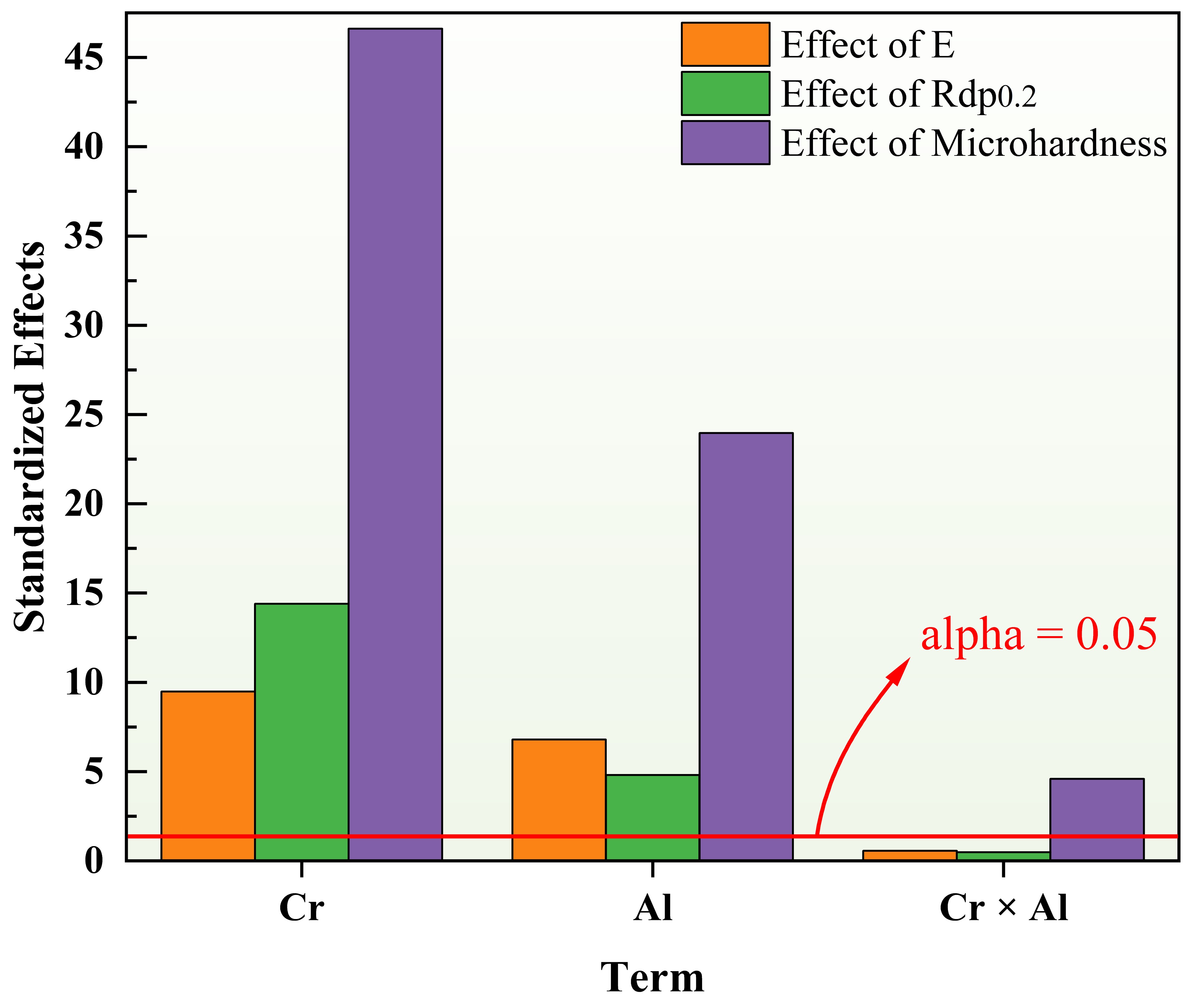
To evaluate the effects of Cr and Al additions on the mechanical properties of the developed alloys, a full factorial 22 experimental design with a central point was employed. The results were analyzed using ANOVA (Analysis of Variance) at a 95% confidence level (alpha = 0.05), ensuring the statistical reliability of the findings by minimizing the likelihood that observed differences arise from random variation66. The analysis focused on the three key mechanical properties: Young's modulus (E), compressive yield strength (Rdp0.2), and microhardness (HV0.5), evaluating the individual influences of Cr and Al addition and their interaction (Cr × Al).
The ANOVA results, summarized in Table 6, show the F-values, which represent the ratio of the variance explained by the factor to the residual variance. Higher F-values suggest a stronger influence of the factor on the mechanical property being analyzed. The P-value indicates the probability that the observed differences occurred by chance; P-values below 0.05 signify statistically significant effects at the 95% confidence level67. Figure 6 graphically illustrates the standardized effects of Cr, Al, and Cr × Al, with the significance threshold (alpha = 0.05) marked by a red line. Effects above this threshold is considered significant.
ANOVA results for the effects of Cr, Al, and Cr × Al interaction on the mechanical properties of the developed alloys.
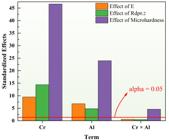
Standardized effects of Cr, Al, and their interaction (Cr × Al) on the mechanical properties (Young’s modulus, yield strength, and microhardness) of the developed alloys.
From the analysis, it is evident that Cr has the most significant influence on all mechanical properties, followed by Al, while the interaction between Cr and Al (Cr × Al) had a limited impact, except for HV0.5. For E and Rdp0.2, Cr was the dominant factor, with Al also contributing significantly (p < 0.05). However, the Cr × Al interaction did not show significances for these properties (p > 0.05), suggesting independent effects. In contrast, for HV0.5, both Cr and Al show significant effects, and the Cr × Al interaction becomes relevant (p < 0.05), suggesting a combined contribution to this property. Additionally, the results reveal that Cr has a stronger effect on Rdp0.2, while Al predominantly influences E.
Based on the ANOVA results, final models were developed using multivariable linear regression, considering only statistically significant terms. These models showed high adjusted R-squared values of 0.94295, 0.96616, and 0.98259 for E (Equation 2), Rdp0.2 (Equation 3), and HV0.5 (Equation 4), respectively, demonstrating a strong correlation between composition and mechanical performance. The adjusted equations, presented below, can be used to predict properties within the compositional range investigated (up to 12.5% Al and 12.5% Cr), highlighting the potential for tailored compositional adjustments to optimize the mechanical performance of refractory high-entropy alloys.
4. Conclusion
In this study, the effects of Cr and Al additions on the microstructure and mechanical properties of the LW-RHEA NbTiCrAl system, were systematically investigated using a strategic design approach integrating Design of Experiments methodologies, semi-empirical high-entropy alloy criteria, and CALPHAD thermodynamic calculations. The findings can be summarized as follows:
-
CALPHAD thermodynamic calculations and semi-empirical parameters confirmed the single-phase solid solution BCC structure across all developed alloy compositions, providing theoretical validation that aligns with the results of XRD and microstructural analyses. These analyses further establish that all alloys exhibit a single-phase BCC structure with a dendritic structure, where the addition of Cr refines the microstructure while Al slightly coarsens it.
-
Microstructural analyses revealed compositional segregation between dendritic and interdendritic regions, driven by differences in melting points of the constituent elements. Elements with lower melting points, such as Cr, Ti and Al, preferentially migrate to the interdendritic regions, while Nb, with a higher melting point, concentrates in the dendrites.
-
Mechanical testing revealed that the addition of Cr and Al improved the mechanical properties of all developed compositions. Among the compositions, the Nb3Ti3Al1Cr1 (A5) alloy exhibited the highest Young's modulus (50.5 ± 1.8 GPa), compressive yield strength (986.4 ± 70.0 MPa), and microhardness (387.9 ± 6.1 HV0.5). This superior performance is attributed to its 25.0 at. % combined Cr and Al content, which induces significant lattice distortion, thereby hindering dislocation motion and enhancing mechanical strength.
-
Statistical analysis through a 22 full-factorial design and ANOVA demonstrated that Cr has a dominant influence on the analyzed mechanical properties, followed by Al. The interaction between Cr and Al was minimal for most properties, except for microhardness, where a combined effect was observed. Based on these statistical analyses, multivariable linear regression models were developed to predict the mechanical properties as a function of alloy composition in the NbTiCrAl system in the as-cast condition, varying the concentration of Al and/or Cr up to 12.5 at. %. The high adjusted R2 values of the models validate the strong correlation between alloy composition and mechanical performance.
-
LW-RHEAs, such as Nb3Ti3Al1Cr1 (A5), show promise for replacing nickel-based superalloys in high-temperature applications due to their low density and enhanced mechanical performance. However, achieving an optimal balance between mechanical properties and oxidation resistance remains a challenge. Future research will focus on mechanical behavior at high temperatures, oxidation resistance and alloy designs, using the methodology established in this work to further enhance phase stability and performance under extreme conditions.
5. Acknowledgments
The authors thank the Brazilian research funding agencies FAPEMIG, FAPESP, CNPq, FINEP, and CAPES for their financial support. We also gratefully acknowledge the financial support from the National Science Centre, Poland, under the Grant no. UMO-2021/43/B/ST5/01907 (OPUS 22).
-
Data Availability
Data will be made available on request.
6. References
-
1 Pollock T, Tin S. Nickel-based superalloys for advanced turbine engines: chemistry, microstructure and properties. J Propuls Power. 2006;22(2):361-74. http://doi.org/10.2514/1.18239
» http://doi.org/10.2514/1.18239 -
2 Long H, Mao S, Liu Y, Zhang Z, Han X. Microstructural and compositional design of Ni-based single crystalline superalloys: a review. J Alloys Compd. 2018;743:203-20. http://doi.org/10.1016/j.jallcom.2018.01.224
» http://doi.org/10.1016/j.jallcom.2018.01.224 -
3 Perrut M, Caron P, Thomas M, Couret A. High temperature materials for aerospace applications: ni-based superalloys and γ-TiAl alloys. C R Phys. 2019;19(8):657-71. http://doi.org/10.1016/j.crhy.2018.10.002
» http://doi.org/10.1016/j.crhy.2018.10.002 -
4 Xia W, Zhao X, Yue L, Zhang Z. Microstructural evolution and creep mechanisms in Ni-based single crystal superalloys: A review. J Alloys Compd. 2020;819:152954. http://doi.org/10.1016/j.jallcom.2019.152954
» http://doi.org/10.1016/j.jallcom.2019.152954 -
5 Backman D, Williams J. Advanced materials for aircraft engine applications. Science. 1992;225(5048):1082-7. http://doi.org/10.1126/science.255.5048.1082
» http://doi.org/10.1126/science.255.5048.1082 -
6 MacKay R, Gabb T, Smialek J, Nathal M. A new approach of designing superalloys for low density. J Miner Met Mater Soc. 2010;62(1):48-54. http://doi.org/10.1007/s11837-010-0011-0
» http://doi.org/10.1007/s11837-010-0011-0 -
7 Fahrenholtz W, Hilmas G. Ultra-high temperature ceramics: materials for extreme environments. Scr Mater. 2017;129:94-9. http://doi.org/10.1016/j.scriptamat.2016.10.018
» http://doi.org/10.1016/j.scriptamat.2016.10.018 -
8 Meschter P, Schwartz D. Silicide-matrix materials for high-temperature applications. J Miner Met Mater Soc. 1989;41(11):52-5. http://doi.org/10.1007/BF03220384
» http://doi.org/10.1007/BF03220384 -
9 Dimiduk DM, Perepezko JH. Mo-Si-B alloys: developing a revolutionary turbine-engine material. MRS Bull. 2003;28(9):639-45. http://doi.org/10.1557/mrs2003.191
» http://doi.org/10.1557/mrs2003.191 -
10 Bewlay BP, Jackson MR, Subramanian PR, Zhao JC. A review of very-high-temperature Nb-silicide-based composites. Metall Mater Trans, A Phys Metall Mater Sci. 2003;34(10):2043-52. http://doi.org/10.1007/s11661-003-0269-8
» http://doi.org/10.1007/s11661-003-0269-8 -
11 Yamaguchi M, Inui H, Ito K. High-temperature structural intermetallics. Acta Mater. 2000;48(1):307-22. http://doi.org/10.1016/S1359-6454(99)00301-8
» http://doi.org/10.1016/S1359-6454(99)00301-8 -
12 Miracle DB, Senkov ON. A critical review of high entropy alloys and related concepts. Acta Mater. 2017;122:448-511. http://doi.org/10.1016/j.actamat.2016.08.081
» http://doi.org/10.1016/j.actamat.2016.08.081 -
13 Gorsse S, Couzinié JP, Miracle DB. From high-entropy alloys to complex concentrated alloys. C R Phys. 2018;19(8):721-36. http://doi.org/10.1016/j.crhy.2018.09.004
» http://doi.org/10.1016/j.crhy.2018.09.004 -
14 George EP, Raabe D, Ritchie RO. High-entropy alloys. Nat Rev Mater. 2019;4(8):515-34. http://doi.org/10.1038/s41578-019-0121-4
» http://doi.org/10.1038/s41578-019-0121-4 -
15 Gorsse S, Miracle DB, Senkov ON. Mapping the world of complex concentrated alloys. Acta Mater. 2017;135:177-87. http://doi.org/10.1016/j.actamat.2017.06.027
» http://doi.org/10.1016/j.actamat.2017.06.027 -
16 Chen J, Zhou X, Wang W, Liu B, Lv Y, Yang W, et al. A review on fundamental of high entropy alloys with promising high–temperature properties. J Alloys Compd. 2018;760:15-30. http://doi.org/10.1016/j.jallcom.2018.05.067
» http://doi.org/10.1016/j.jallcom.2018.05.067 -
17 Chen YT, Chang YJ, Murakami H, Gorsse S, Yeh AC. Designing high entropy superalloys for elevated temperature application. Scr Mater. 2020;187:177-82. http://doi.org/10.1016/j.scriptamat.2020.06.002
» http://doi.org/10.1016/j.scriptamat.2020.06.002 -
18 Senkov ON, Miracle DB, Chaput KJ, Couzinie JP. Development and exploration of refractory high entropy alloys: a review. J Mater Res. 2018;33(19):3092-128. http://doi.org/10.1557/jmr.2018.153
» http://doi.org/10.1557/jmr.2018.153 -
19 Miracle DB, Tsai MH, Senkov ON, Soni V, Banerjee R. Refractory high entropy superalloys (RSAs). Scr Mater. 2020;187:445-52. http://doi.org/10.1016/j.scriptamat.2020.06.048
» http://doi.org/10.1016/j.scriptamat.2020.06.048 -
20 Wang Z, Chen S, Yang S, Luo Q, Jin Y, Xie W, et al. Light-weight refractory high-entropy alloys: a comprehensive review. J Mater Sci Technol. 2023;2023:41-65. http://doi.org/10.1016/j.jmst.2022.11.054
» http://doi.org/10.1016/j.jmst.2022.11.054 -
21 Feng L, Fahrenholtz WG, Brenner DW. High-entropy ultra-high-temperature borides and carbides: a new class of materials for extreme environments. Annu Rev Mater Res. 2021;51(1):165-85. http://doi.org/10.1146/annurev-matsci-080819-121217
» http://doi.org/10.1146/annurev-matsci-080819-121217 -
22 Gild J, Braun J, Kaufmann K, Marin E, Harrington T, Hopkins P, et al. A high-entropy silicide: (Mo0.2Nb0.2Ta0.2Ti0.2W0.2) Si2 Journal of Materiomics. 2019;5(3):337-43. http://doi.org/10.1016/j.jmat.2019.03.002
» http://doi.org/10.1016/j.jmat.2019.03.002 -
23 Liu L, Zhang L, Liu D. Complete elimination of pest oxidation by high entropy refractory metallic silicide (Mo0.2W0.2Cr0.2Ta0.2Nb0.2) Si2 Scr Mater. 2020;189:25-9. http://doi.org/10.1016/j.scriptamat.2020.07.059
» http://doi.org/10.1016/j.scriptamat.2020.07.059 -
24 Pasini WM, Polkowska A, Nowak R, Bruzda G, Kudyba A, Jawańska M, et al. Boron enhanced complex concentrated silicides – new pathway for designing and optimizing ultra-high temperature intermetallic composite materials. J Mater Res Technol. 2023;27:6182-91. http://doi.org/10.1016/j.jmrt.2023.11.056
» http://doi.org/10.1016/j.jmrt.2023.11.056 -
25 Pasini WM, Polkowska A, Nowak R, Bruzda G, Kudyba A, Górniewicz D, et al. Boron enhanced complex concentrated silicides: a bridge between lightweight, oxidation-resistant refractory metal silicides and refractory complex concentrated alloys. Next Materials. 2024;3:100052. http://doi.org/10.1016/j.nxmate.2023.100052
» http://doi.org/10.1016/j.nxmate.2023.100052 -
26 Pasini WM, Polkowska A, Boroń Ł, Podsiadło M, Rząd E, Bruzda G, et al. Synthesis of complex concentrated silicide coatings via reactive melt-infiltration: exploring interfacial phenomena between Si-B melt and MoNbTaW high-entropy alloy. Surf Coat Tech. 2024;494(1):131401. http://doi.org/10.1016/j.surfcoat.2024.131401
» http://doi.org/10.1016/j.surfcoat.2024.131401 -
27 Li J, Huang Y, Meng X, Xie Y. A review on high entropy alloys coatings: fabrication processes and property assessment. Adv Eng Mater. 2019;21(8):1900343. http://doi.org/10.1002/adem.201900343
» http://doi.org/10.1002/adem.201900343 -
28 Kumar S. Comprehensive review on high entropy alloy-based coating. Surf Coat Tech. 2024;477:130327. http://doi.org/10.1016/j.surfcoat.2023.130327
» http://doi.org/10.1016/j.surfcoat.2023.130327 -
29 Dixit S, Rodriguez S, Jones MR, Buzby P, Dixit R, Argibay N, et al. Refractory high-entropy alloy coatings for high-temperature aerospace and energy applications. Journal of Thermal Spray Technology. 2022;31(4):1021-31. http://doi.org/10.1007/s11666-022-01324-0
» http://doi.org/10.1007/s11666-022-01324-0 -
30 Carlucci G, Fiocchi J, Motta C, Tuissi A, Casati R. Effect of Al and Nb on microstructure and mechanical properties of novel Al-Mo-Nb-Ti-V-Zr lightweight refractory high-entropy alloys. J Alloys Compd. 2024;1008:176655. http://doi.org/10.1016/j.jallcom.2024.176655
» http://doi.org/10.1016/j.jallcom.2024.176655 -
31 Dainezi I, Gleeson B, Buzatti BR, Malafaia AMS, Rovere CAD. TiNbCr multi-principal element alloy oxidation behavior in air at 800-1000 °C. High Temperature Corrosion of Materials. 2024;101(4):789-810. http://doi.org/10.1007/s11085-024-10246-x
» http://doi.org/10.1007/s11085-024-10246-x -
32 Welch NJ, Quintana MJ, Butler TM, Collins PC. High-temperature oxidation behavior of TaTiCr, Ta4Ti3Cr, Ta2TiCr, and Ta4TiCr3 concentrated refractory alloys. J Alloys Compd. 2023;941:169000. http://doi.org/10.1016/j.jallcom.2023.169000
» http://doi.org/10.1016/j.jallcom.2023.169000 -
33 Gorr B, Schellert S, Müller F, Christ HJ, Kauffmann A, Heilmaier M. Current status of research on the oxidation behavior of refractory high entropy alloys. Adv Eng Mater. 2021;23(5):2001047. http://doi.org/10.1002/adem.202001047
» http://doi.org/10.1002/adem.202001047 -
34 Feng R, Gao MC, Lee C, Mathes M, Zuo T, Chen S, et al. Design of light-weight high-entropy alloys. Entropy. 2016;18(9):333. http://doi.org/10.3390/e18090333
» http://doi.org/10.3390/e18090333 -
35 Senkov ON, Senkova SV, Woodward C, Miracle DB. Low-density, refractory multi-principal element alloys of the Cr–Nb–Ti–V–Zr system: microstructure and phase analysis. Acta Mater. 2013;61(5):1545-57. http://doi.org/10.1016/j.actamat.2012.11.032
» http://doi.org/10.1016/j.actamat.2012.11.032 -
36 Senkov ON, Senkova SV, Miracle DB, Woodward C. Mechanical properties of low-density, refractory multi-principal element alloys of the Cr–Nb–Ti–V–Zr system. Mater Sci Eng A. 2013;565:51-62. http://doi.org/10.1016/j.msea.2012.12.018
» http://doi.org/10.1016/j.msea.2012.12.018 -
37 Senkov ON, Woodward C, Miracle DB. Microstructure and properties of aluminum-containing refractory high-entropy alloys. J Miner Met Mater Soc. 2014;66(10):2030-42. http://doi.org/10.1007/s11837-014-1066-0
» http://doi.org/10.1007/s11837-014-1066-0 -
38 Gao T, Gao J, Yang S, Zhang L. Data-driven design of novel lightweight refractory high-entropy alloys with superb hardness and corrosion resistance. npj Computational Materials. 2024;10(1):256. http://doi.org/10.1038/s41524-024-01457-6
» http://doi.org/10.1038/s41524-024-01457-6 -
39 Jiang W, Wang Y, Wang X, Jiang B, Ma T, Kang H, et al. Effect of Al on microstructure and mechanical properties of lightweight AlxNb0.5TiV2Zr0.5 refractory high entropy alloys. Mater Sci Eng A. 2023;865:144628. http://doi.org/10.1016/j.msea.2023.144628
» http://doi.org/10.1016/j.msea.2023.144628 -
40 Guo M, Xu L, Qi L, Zhao Y, Li Z, Wei S. Effect of Cr addition on the microstructure and mechanical properties of MoNbVTa0.5Crx refractory high-entropy alloys. Int J Refract Hard Met. 2024;124:106857. http://doi.org/10.1016/j.ijrmhm.2024.106857
» http://doi.org/10.1016/j.ijrmhm.2024.106857 -
41 Tian Z, Chen W, Wang H, Chu C, Liu J, Hao L, et al. Microstructural evolution, mechanical behavior, and deformation mechanisms of a lightweight Ti–Nb–Cr–V refractory high-entropy alloy at room and elevated temperatures. Mater Sci Eng A. 2024;910:146883. http://doi.org/10.1016/j.msea.2024.146883
» http://doi.org/10.1016/j.msea.2024.146883 -
42 Wang H, Chen W, Fu Z, Chu C, Tian Z, Jiang Z, et al. Lightweight Ti-Zr-Nb-Al-V refractory high-entropy alloys with superior strength-ductility synergy and corrosion resistance. Int J Refract Hard Met. 2023;116:106331. http://doi.org/10.1016/j.ijrmhm.2023.106331
» http://doi.org/10.1016/j.ijrmhm.2023.106331 -
43 Wang T, Jiang W, Wang X, Jiang B, Rong C, Wang Y, et al. Microstructure and properties of Al0.5NbTi3VxZr2 refractory high entropy alloys combined with high strength and ductility. J Mater Res Technol. 2023;24:1733-43. http://doi.org/10.1016/j.jmrt.2023.03.103
» http://doi.org/10.1016/j.jmrt.2023.03.103 -
44 Xiao Y, Peng X. Design of lightweight Ti3Zr1.5NbVx refractory high-entropy alloys with superior mechanical properties. J Mater Res Technol. 2023;27:330-41. http://doi.org/10.1016/j.jmrt.2023.09.283
» http://doi.org/10.1016/j.jmrt.2023.09.283 -
45 Jin C, Li X, Kang J, Wang H. Achieving excellent strength-ductility balance in the lightweight refractory high-entropy alloy by incorporating aluminum. Mater Sci Eng A. 2024;915:147248. http://doi.org/10.1016/j.msea.2024.147248
» http://doi.org/10.1016/j.msea.2024.147248 -
46 Qingda Z, Liu C, Wang L, Su B, Li Z, Li Z, et al. Activating multiple slip systems in the laves phase improves the high-temperature strength and elastic coordination of (TiZr)65-XNb15Mo20CrX alloy. Mater Sci Eng A. 2024;898:146369. http://doi.org/10.1016/j.msea.2024.146369
» http://doi.org/10.1016/j.msea.2024.146369 -
47 Dainezi I, Gleeson B, Della Rovere CA. Failure analysis of TiNbCr multi-principal element alloy: temperature-dependent oxidation and internal degradation in oxygen atmospheres. Eng Fail Anal. 2025;175:109573. http://doi.org/10.1016/j.engfailanal.2025.109573
» http://doi.org/10.1016/j.engfailanal.2025.109573 -
48 Martin P, Madrid-Cortes CE, Cáceres C, Araya N, Aguilar C, Cabrera JM. HEAPS: a user-friendly tool for the design and exploration of high-entropy alloys based on semi-empirical parameters. Comput Phys Commun. 2022;278:108398. http://doi.org/10.1016/j.cpc.2022.108398
» http://doi.org/10.1016/j.cpc.2022.108398 -
49 Zhang Y, Zhou YJ, Lin JP, Chen GL, Liaw PK. Solid-solution phase formation rules for multi-component alloys. Adv Eng Mater. 2008;10(6):534-8. http://doi.org/10.1002/adem.200700240
» http://doi.org/10.1002/adem.200700240 -
50 Yang X, Zhang Y. Prediction of high-entropy stabilized solid-solution in multi-component alloy. Mater Chem Phys. 2012;132(2-3):233-8. http://doi.org/10.1016/j.matchemphys.2011.11.021
» http://doi.org/10.1016/j.matchemphys.2011.11.021 -
51 Guo S, Hu Q, Ng C, Liu CT. More than entropy in high-entropy alloys: forming solid solutions or amorphous phase. Intermetallics. 2013;41:96-103. http://doi.org/10.1016/j.intermet.2013.05.002
» http://doi.org/10.1016/j.intermet.2013.05.002 -
52 Guo S, Liu CT. Phase stability in high entropy alloys: formation of solid-solution phase or amorphous phase. Prog Nat Sci. 2011;21(6):433-46. http://doi.org/10.1016/S1002-0071(12)60080-X
» http://doi.org/10.1016/S1002-0071(12)60080-X -
53 Tian Z, Chen W, Wang H, Chu C, Liu J, Hao L, et al. Microstructural evolution, mechanical behavior, and deformation mechanisms of a lightweight Ti–Nb–Cr–V refractory high-entropy alloy at room and elevated temperatures. Mater Sci Eng A. 2024;910:146883. http://doi.org/10.1016/j.msea.2024.146883
» http://doi.org/10.1016/j.msea.2024.146883 -
54 Wang F, Yang T, Zhong Y, Li L, Yuan T. Design crystallographic ordering in NbTa0.5TiAlx refractory high entropy alloys with strength-plasticity synergy. J Mater Res Technol. 2023;27:8386-402. http://doi.org/10.1016/j.jmrt.2023.11.254
» http://doi.org/10.1016/j.jmrt.2023.11.254 -
55 Gao X, Wang L, Guo N, Luo L, Zhu G, Shi C, et al. Microstructure characteristics and mechanical properties of Hf0.5Mo0.5NbTiZr refractory high entropy alloy with Cr addition. Int J Refract Hard Met. 2021;95:105405. http://doi.org/10.1016/j.ijrmhm.2020.105405
» http://doi.org/10.1016/j.ijrmhm.2020.105405 -
56 Xu Z, Sun Z, Li C, Wang Z. Effect of Cr on microstructure and properties of WVTaTiCrx refractory high-entropy alloy laser cladding. Materials. 2023;16(8):3060. http://doi.org/10.3390/ma16083060
» http://doi.org/10.3390/ma16083060 -
57 Yeh J. Physical metallurgy of high-entropy alloys. J Miner Met Mater Soc. 2015;67(10):2254-61. http://doi.org/10.1007/s11837-015-1583-5
» http://doi.org/10.1007/s11837-015-1583-5 -
58 Chen H, Kauffmann A, Laube S, Choi I, Schwaiger R, Huang Y, et al. Contribution of lattice distortion to solid solution strengthening in a series of refractory high entropy alloys. Metall Mater Trans, A Phys Metall Mater Sci. 2018;49(3):772-81. http://doi.org/10.1007/s11661-017-4386-1
» http://doi.org/10.1007/s11661-017-4386-1 -
59 Lee C, Song G, Gao M, Feng R, Chen P, Brechtl J, et al. Lattice distortion in a strong and ductile refractory high-entropy alloy. Acta Mater. 2018;160:158-72. http://doi.org/10.1016/j.actamat.2018.08.053
» http://doi.org/10.1016/j.actamat.2018.08.053 -
60 Roy A, Sreeramagiri P, Babuska T, Krick B, Ray P, Balasubramanian G. Lattice distortion as an estimator of solid solution strengthening in high-entropy alloys. Mater Charact. 2021;172:110877. http://doi.org/10.1016/j.matchar.2021.110877
» http://doi.org/10.1016/j.matchar.2021.110877 -
61 Lee C, Chou Y, Kim G, Gao M, An K, Brechtl J, et al. Lattice‐distortion‐enhanced yield strength in a refractory high‐entropy alloy. Adv Mater. 2020;32(49):2004029. http://doi.org/10.1002/adma.202004029
» http://doi.org/10.1002/adma.202004029 -
62 Coury FG, Butler T, Chaput K, Saville A, Copley J, Foltz J, et al. Phase equilibria, mechanical properties and design of quaternary refractory high entropy alloys. Mater Des. 2018;155:244-56. http://doi.org/10.1016/j.matdes.2018.06.003
» http://doi.org/10.1016/j.matdes.2018.06.003 -
63 Yan J, Li M, Li K, Qiu J, Guo Y. Effects of Cr content on microstructure and mechanical properties of WMoNbTiCr high-entropy alloys. J Mater Eng Perform. 2020;29(4):2125-33. http://doi.org/10.1007/s11665-020-04744-7
» http://doi.org/10.1007/s11665-020-04744-7 -
64 Lin C, Juan C, Chang C, Tsai C, Yeh J. Effect of Al addition on mechanical properties and microstructure of refractory AlxHfNbTaTiZr alloys. J Alloys Compd. 2015;624:100-7. http://doi.org/10.1016/j.jallcom.2014.11.064
» http://doi.org/10.1016/j.jallcom.2014.11.064 -
65 Ge S, Fu H, Zhang L, Mao H, Li H, Wang A, et al. Effects of Al addition on the microstructures and properties of MoNbTaTiV refractory high entropy alloy. Mater Sci Eng A. 2020;784:139275. http://doi.org/10.1016/j.msea.2020.139275
» http://doi.org/10.1016/j.msea.2020.139275 - 66 Box GEP, Hunter WG, Hunter JS. Statistics for experimenters: design, innovation, and discovery. New Jersey: John Wiley & Sons; 2005.
- 67 Montgomery DC. Design and analysis of experiments. 8th ed. New Jersey: John Wiley & Sons; 2013.
Edited by
-
Associate Editor:
Hamilton Abreu
-
Editor-in-Chief:
Luiz Antonio Pessan.
Data will be made available on request.