Analysis of the Interaction of Saponified Sunflower Oil Surfactant in Potato Starch Biodegradable Films (Solanum tuberosum)
Abstract
The gradual replacement of petrochemical derivatives with sustainable alternatives is fundamental to reducing environmental impact. Biopolymers such as potato starch stand out for their low cost, biodegradability and sustainability, however, they exhibit hydrophilic properties, leading to poor water resistance and necessitating modifications for improved performance. This study investigated the use of the anionic surfactant saponified sunflower oil (SSO) in the formulation of potato starch films, evaluating its effects on the polymer network and film properties. The films were prepared using the casting method with different dosages of SSO (0.01 g, 0.02 g, 0.04 g, 0.06 g and 0.08 g). Properties such as water vapor permeability (WVP), mechanical behavior, and optical characteristics were analyzed. Micelle formation in the polymer matrix generated vacancies, increasing WVP. At low concentrations, there was a reduction of up to 47.82% in WVP, attributed to the interaction of polar groups in the biopolymer with surfactant monomers, without compromising optical properties. Mechanical properties, such as tensile strength and elasticity, improved at micellar concentrations, to 22.80 MPa and 62.16% respectively. Moreover, this study suggests that the use of additional lipophilic agents may be avoided, reducing costs and broadening post-harvest preservation applications as fruit coatings that extend shelf life.
Keywords:
Starch; anionic surfactant; water vapor permeability; Kraft point
1. Introduction
Replacing harmful materials, such as oil derivatives, with sustainable alternatives is considered essential to mitigate environmental impacts. This transition involves reconciling material quality with the promotion of conscious consumption across all sectors1. The excessive use of non-biodegradable petrochemical polymers has been associated with severe environmental issues, prompting a growing demand for technological solutions. Among these alternatives, biopolymers stand out due to their significant advantages, such as renewability, abundance, low cost, and accessibility2.
Biopolymers, produced from renewable resources by microorganisms, plants, animals, and chemical synthesis using sugars, oils, starch, and fats, are recognized as sustainable sources with vast industrial applicability and unique functional properties3. Among natural polymers, starches have gained attention for their high availability, low cost, biodegradability, renewability, and sustainability. Tuber starch, extensively studied for the production of biodegradable films1,4-7, is abundant in nature and economically viable. Films derived from these starches offer advantages, such as good mechanical performance, transparency, biodegradability, biocompatibility, and low toxicity8. However, starch-based materials are inherently hydrophilic, which limits their moisture barrier capabilities and may compromise their performance in applications that demand water resistance9.
Enhancing the hydrophobicity of starch-based films is therefore a key challenge to improve their functional properties, especially in packaging and related applications. Recent studies have explored various approaches to enhance these properties. Méité et al.10 evaluated the effect of metakaolin content on the mechanical and water barrier properties of cassava starch films, reporting significant improvements in maximum elongation and Young's modulus by 34.54% and 195.78%, respectively, and a 30.66% reduction in water vapor permeability. Puca Pacheco et al.11 analyzed biodegradable films based on potato starch, graphene and aloe vera gel, concluding that water permeability depended on the concentrations of graphene and aloe vera gel as well as the polymer-particle interactions, which determined dispersion. Bhasin et al.12 explored blends of corn, rice, and potato starches with carrot powder and tulsi extract, concluding that this formulation is a viable option for biodegradable films. Gonçalves et al.13 investigated the use of residual frying oils and potato peels, comparing the resulting films with commercial materials, and demonstrated the viability of these wastes for producing yellowish transparent films with enhanced surface hydrophobicity, mechanical strength, and elasticity. Other studies have also implemented modifications to reduce the hydrophilicity of various biopolymer films14-19.
The use of saponified oils may offer a promising strategy to reduce the permeability of potato starch films, as these amphiphilic compounds can enhance the hydrophobic characteristics of the material. While film solutions are commonly enriched with lipids and surfactants, the specific mechanisms of surfactants in biopolymers remain underexplored. Thus, this study aimed to incorporate the anionic surfactant saponified sunflower oil (SSO) into potato starch films and evaluate its interactions with the biopolymer network and the consequent changes in film properties.
2. Experimental
2.1. Materials
Potato starch (Solanum tuberosum) (PS) was purified according to the methodology of Viana et al.20. The anionic surfactant was obtained through the saponification of sunflower oil (SSO), purchased from a local market in Mossoró-RN. Analytical grade glycerol was supplied by Sigma-Aldrich LTDA (Brazil).
2.2. Methods
2.2.1. Determining the amylose and amylopectin content of starch
The amount of amylose and amylopectin was determined using the colorimetric method described by Zavareze et al.21.
2.2.2. Determining the Kraft point and CMC of SSO
SSO is an anionic surfactant. The formation of micelles by these compounds is related to their critical micellar concentration (CMC), which varies with temperature. This behavior is directly associated with the Kraft point, defined as the minimum temperature required for micelle formation by anionic surfactants. Understanding this parameter is essential to avoid phase separation when incorporating the surfactant into the film solution, ensuring the cohesion and homogeneity of the films produced.
SSO solutions were prepared at concentrations of 0.01 g, 0.02 g, 0.04 g, 0.06 g, and 0.08 g. The solutions were initially cooled to 10 °C and then gradually heated. The exact temperature at which the solution transitioned from cloudy to clear was recorded using a digital thermometer. The same concentrations were prepared with deionized water to measure conductivity using a conductivity meter (BEL, W12D), as the inflection point indicates the CMC. All procedures were carried out in triplicate.
2.2.3. Film preparation
The films were prepared following a methodology adapted from Oliveira et al.2, using distilled water as a solvent, the PS biopolymer, glycerol as a plasticizer, and saponified sunflower oil surfactant (SSO) at different concentrations to prepare the film solutions. Potato starch films were made with varying surfactant levels (0.01 g, 0.02 g, 0.04 g, 0.06 g, and 0.08 g). Initially, the surfactant was weighed in an Erlenmeyer flask and then dissolved in distilled water under constant stirring at 25 °C. In a separate Erlenmeyer flask, 2 g of biopolymer and 0.4 g of glycerol were weighed. This mixture was topped up with distilled water and heated in a magnetic thermoshaker until it reached 75±5 °C, while being continuously stirred for 30 minutes to promote gelatinization. The solution was then cooled to 25 °C under constant stirring and placed in a vacuum system using a vacuum pump for 1 hour. Finally, 60 g of the solution was deposited onto acrylic plates measuring 15 x 15 cm and dried using the casting method at 25 °C. The obtained films were characterized in terms of morphology using scanning electron microscopy (SEM), Fourier transform infrared spectroscopy (FTIR), water vapor permeability (WVP), solubility, optical properties, and mechanical properties.
2.2.4. Thickness
The thickness of the films was measured using a Mitutoyo micrometer (Model MDC-25M, MFG/Japan), accurate to 0.001 mm. Measurements were taken at five different points along the films.
2.2.5. Optical properties
The color parameters of the films were determined using a methodology adapted from Zavareze et al.7. Measurements were made with a colorimeter (Konica Minolta Sensing, Inc., Japan), using black and white backgrounds, at five different points on the film. The results were obtained directly from the equipment, where L represents luminosity on a scale from L = 0 (black) to L = 100 (white), and a* and b* represent chromaticity, ranging from -a* (green) to +a* (red) and from -b* (blue) to +b* (yellow). The analyses were performed in a properly lit environment.
The total color difference (ΔE), compared to a standard black plate, was calculated using Equation 1. Opacity was determined according to Menezes et al.4, based on the ratio between the L value of the film overlaid on the black standard (L_black) and the L value overlaid on the white standard (L_white), measured at five different points on the film, according to Equation 2. The yellowing index (YI) was calculated using the formula proposed by Dudeja et al.22 according to Equation 3. Whiteness (WI) was assessed following the methodology of Dursun Capar23 using Equation 4.
where L, a and b are the color attributes of the film samples and L∗, a∗ and b∗ are the color parameters of the standard black plate.
The transparency of the films was determined according to a methodology adapted from Halim et al.24. Rectangular cuts measuring 4x1 cm were made in the films at five different points. The samples were placed in acrylic cuvettes and read using a BELphotonics® spectrophotometer (Model SP 2000 UV). Transparency was calculated using Equation 5.
where, A is the absorbance at a wavelength of 600 nm and x is the film thickness (mm).
2.2.6. Water vapor permeability (WVP)
The water vapor permeability (WVP) of the films was determined gravimetrically, following the ASTM E96/E96M-22 standard25. Film discs with a diameter of 4.5 cm were sealed in a permeation cell containing distilled water, allowing mass loss to occur exclusively through the passage of water vapor in the film. The cell-film set was kept in a desiccator containing silica gel under 10% RH at 25 °C. Successive weighings were carried out every hour for a total of 8 hours. WVP was calculated in g.mm/kPa.m2.h, as described in Equation 6, carried out in triplicate.
where: g: weight of the water that permeated the film (g); 𝐴: exposed permeation area (m2); e t: permeation time interval (h); x: thickness of the water permeation disc (mm); △P: the pressure difference for water vapor between the two sides of the film (kPa).
2.2.7. Solubility
The solubility of the films was determined according to the methodology adapted from Oliveira et al.2. Samples measuring 3x3 cm were dried at 105 °C for 90 minutes and weighed. The films were then placed in Erlenmeyer flasks containing approximately 50 mL of distilled water and kept under agitation using a shaker table for 6 hours (TE-4200, Tecnal) at 25 °C. After the stirring period, the solutions were filtered using qualitative filter paper. The film-filter sets were then dried at 105 °C for 90 minutes until they reached a constant weight. The tests were carried out in triplicate, and solubility was calculated using Equation 7.
where: m(i): initial mass of the dry film (g); m(filter+film): final mass of the dry film-filter set (g); m(filter): initial mass of the dry filter (g).
2.2.8. Mechanical tests
Tensile strength refers to the maximum force the film can withstand during an elastic test, considering the unit area of its cross-section. Elongation values indicate the film's ability to stretch. Young's modulus, in turn, characterizes the film's rigidity, with higher values corresponding to a more rigid material1.
The mechanical tests were conducted following the ASTM D882-18 standard26 (Standard Test Method for Tensile Properties of Thin Plastic Films) and performed using a DL5000/10000 universal testing machine (EMIC 23 series), operating at 25 °C and 50% relative humidity (RH). The tests were carried out at a speed of 5 mm/min, applying a total force of 5 kN. The specimens were prepared as strips measuring 50 mm in length and 10 mm in width. The load was monitored using a dynamometer integrated into the machine, while the deformation was recorded by a mechanical extensometer with a precision of 0.001 mm.
Tensile strength (TS) was calculated by dividing the maximum force applied by the original cross-sectional area of the specimen. The tensile strength at break was determined by the ratio between the maximum force at break and the original cross-sectional area. The percentage elongation at break (EB) was obtained by dividing the change in length at break by the initial length of the specimen (the distance between the grips) and multiplying the result by 100. The modulus of elasticity (E) was derived from the slope of the stress-strain curve and was calculated as the ratio between the nominal tensile strength and the deformation of the specimen27.
2.2.9. Scanning electron microscopy (SEM)
Scanning electron microscopy (SEM) was used to investigate the microstructure of the films. This technique allowed for the acquisition of high-resolution images of the sample surfaces.
Samples measuring 1 cm2 were fixed onto a metal support using carbon tape. The surface was then coated with a gold layer approximately 10 nm thick, deposited by sputtering (QR 150 ES Quorum, Laughton, England) for 360 s at a current of 20 mA. The VEGA 3 LMU equipment (TESCAN Brno, Czech Republic) was used to analyze the microstructure of the surface and cross-section of the films after rupture during the mechanical test. The analyses were carried out at a voltage of 20 kV, with magnifications of 500x and 2500x. High-resolution images of the surface topography were obtained using secondary electron detection, with a working distance of approximately 15 mm.
2.2.10. Fourier Transform Infrared Spectroscopy (FTIR)
Fourier Transform Infrared Spectroscopy with Attenuated Diffuse Reflectance (FTIR-ATR) was carried out in the 4000 to 600 cm-1 range with a resolution of 4 cm-1 and 64 scans were obtained from the films produced, using Agilent CrossLab, Cary 630 FTIR equipment. The spectral data was processed using Excel® software and compared with the literature to identify the functional groups present in the molecular structure of the film.
2.2.11. Statistical analysis
For the purpose of statistical analysis of the evaluations, the data was submitted to analysis of variance (ANOVA) and the Tukey test at 5% probability, using SISVAR software28.
3. Results and Discussion
3.1. Amylose and amylopectin ratio of potato starch
The amylose and amylopectin contents of the potato starch used in the films were determined as 33.56±0.415% and 66.44±0.415%. Studies in the literature show that varying the amylose/amylopectin ratio implies changes in their physicochemical characteristics and interactions with other molecules, resulting in different gelatinization temperatures, water solubility, as well as microscopic and barrier properties in starch films.
In the analysis of the amylose content of this biopolymer described in the literature, values in the range of 15-31% have been identified for PS12,13,29-31. It is to be expected that a higher amylose content implies greater hygroscopicity of potato starch, since the greater the number of amylose chains, the greater the amount of hydrogen bonds between the hydroxyls of adjacent polymers and the humidity of the air1.
3.2. Saponified sunflower oil (SSO)
Information on the composition of sunflower oil helps to understand the factors contributing to variations in the hydrophobicity of the films. Table 1 shows the composition of the fatty acids present in sunflower oil obtained in Rio Grande do Norte from the study by Correia et al.32.
Table 1 shows that oleic (49.02%) and linoleic (45.35%) acids predominate in the oil used to make the surfactant. Oleic acid (C18:1) is a monounsaturated fatty acid with a single double bond in a cis configuration along the carbon chain. This unsaturation causes a curvature in the molecular structure, reducing the packing density between the molecules. In turn, linoleic acid (C18:2) contains two double bonds, also in the cis configuration, resulting in an even more pronounced curvature in the chain. The curvatures in their molecular structures directly impact the surfactant properties, reducing the need for short-chain monomers to stabilize the surfactant in the film, due to the organization of the unsaturated molecules. As a result, the critical micellar concentration (CMC) is lowered.
The hydrophilic-lipophilic balance (HLB), calculated based on the number of chemical groups comprising the surfactant molecule33, was 18.025, indicating that SSO is a highly water-soluble surfactant.
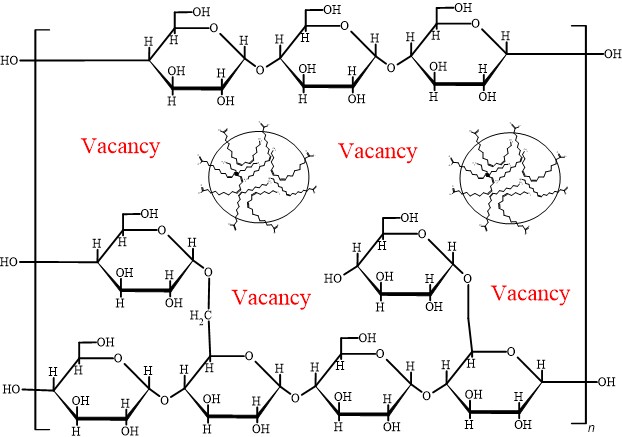
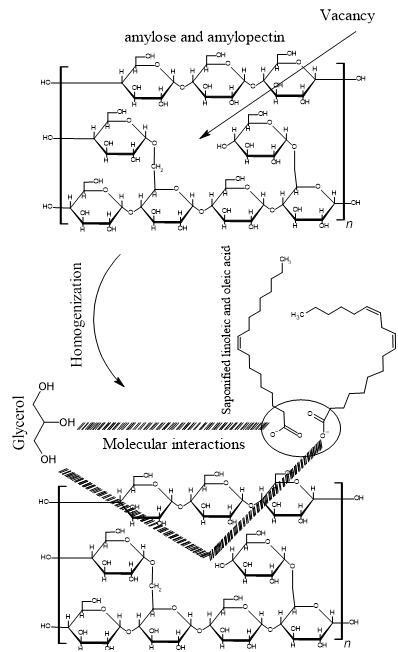
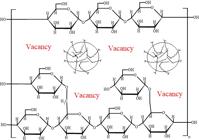
When the critical micellar concentration (CMC) is reached, there is a molecular reorganization of the surfactant present in the film solution system. At this point, surfactant molecules that were previously dispersed in the medium begin to associate into micellar structures. These micellar agglomerates, present in the film matrix, create voids in the polymer network, as illustrated in Figure 1. The presence of micelles increases the water solubility and permeability of the film, as water molecules and gases can more easily penetrate the voids formed.
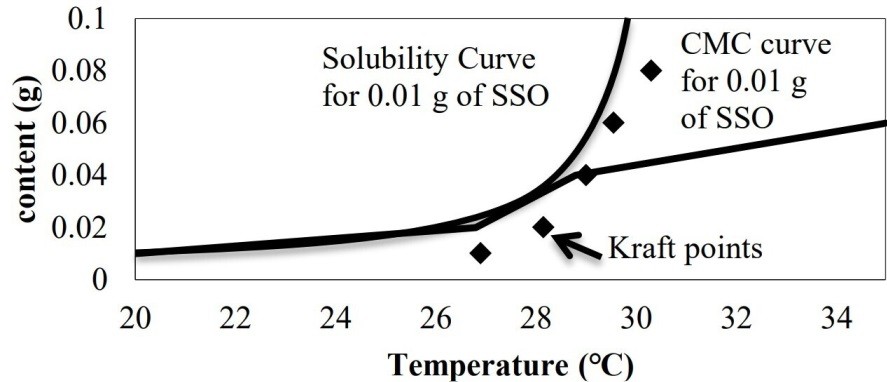
To ensure total homogeneity of the film solutions, they were prepared separately and then homogenized (biopolymer solution and surfactant solution) under controlled conditions, specifically below the Kraft point, as shown in Figure 2. This procedure avoided phase separation, thus ensuring uniform dispersion of the surfactant, which is essential for the film's performance.
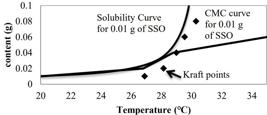
The behavior of the graph, for example with 0.01 g of SSO, highlighted that the solubility curve showed exponential growth after the Kraft point, while the CMC curve indicated that, as the temperature increased, a higher concentration of surfactant was required to initiate micelle formation. This data reinforced the importance of carefully adjusting the temperature and concentration during the preparation of the film solution to facilitate the interaction between the components and achieve the desired results in the film.
3.3. Film characterization
Table 2 shows the thickness results and color parameters of the films.
Thickness and color parameters of PS films measured in standard black color. The data set is presented as mean ± standard deviation. Different letters indicate statistical difference (p<0.05).
The thickness of the films plays a crucial role in various properties, such as water vapor permeability (WVP), mechanical properties, and color parameters34,35. According to the values shown in Table 2, consistency was observed in the total thicknesses of the films, as indicated by the lowercase letters denoting a statistically significant difference (p<0.05). Thakur et al.34 and Costa et al.36 highlight the complexity of controlling the thickness of biodegradable films during casting production processes, where films are dried on supports, leading to small variations in thickness. This parameter was considered statistically the same for all the films produced.
The color parameters of the films, such as luminosity (L), total color difference (△E), whiteness (WI), and yellowishness (YI), shown in Table 2, indicated that the PS films did not exhibit significant differences in these properties with increasing SSO concentration, as indicated by the lowercase letters with statistical difference (p<0.05). Menezes et al.4 observed that the color of the starch granule directly interferes with the WI and YI results, and since the PS powder used to make the films was white, the similarity between the results is justified. The same explanation applies to the results of the total color difference (△E). Although the saponified sunflower oil (SSO) had a yellowish hue, it did not significantly increase the yellowing (YI) of the film, as indicated by the lowercase letters with statistical difference (p<0.05).
The opacity results (Op %) all remained within the same margin of significance (p<0.05). There was a significant variation in transparency for the films with contents of 0.01 g and 0.02 g, indicated by the lowercase letters with a statistical difference (p<0.05), which may indicate better dispersion of the SSO, making it less transparent.
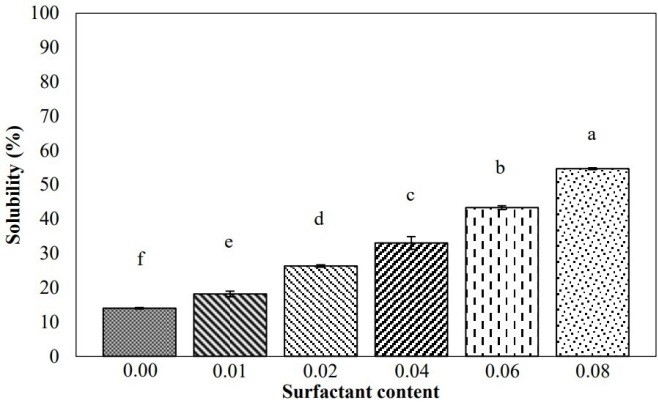
Figure 3 shows the solubility results of the films with different SSO contents. The solubility of the PS film was recorded at 14%, a value close to that obtained by Zavareze et al.7, who used 4% PS (4 g) and 0.3 g glycerol, showing a solubility of 14.78%. The solubility of the films increases significantly (p<0.05) with the addition of SSO to the biopolymer matrix.
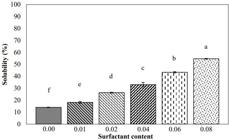
Solubility of films with different SSO contents. Different letters indicate statistical difference (p<0.05).
The increase in solubility with the incorporation of SSO can be explained by several factors. The anionic nature of the surfactant in aqueous media promotes greater interaction between the film's surface and water. The negative charges associated with the oxygen atoms increase the polarity of the molecule, attracting more water33. Additionally, SSO reduces the surface tension of water, facilitating its penetration into the film. The high HLB index and the greater presence of hydrophilic groups also contribute to the dissolution of the matrix in aqueous media.
Films with high solubility can be advantageous depending on their application. For instance, in agricultural seed coatings, the rapid dissolution of films is desirable as it accelerates the germination process in the field37. However, for applications where the films require greater resistance to humidity, it is recommended to use lower SSO contents. Therefore, adjusting the SSO content in the film formulation is crucial to balance its properties according to the specific requirements of each application.
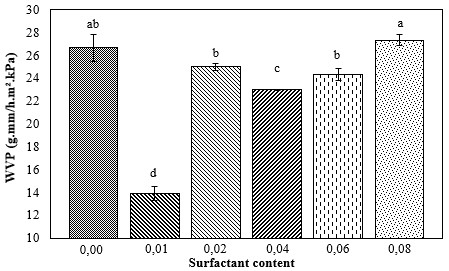
Figure 4 shows the results of the water vapor permeability (WVP) of PS films with different concentrations of the surfactant SSO. As seen in the Figure 4, the water vapor permeability of the PS films decreased significantly with surfactant contents of 0.01 g and 0.04 g, as indicated by the lowercase letters denoting statistical differences (p<0.05). In the film with 0.01 g of SSO, a reduction of 47.82% was recorded, while for the 0.04 g content, the reduction was 13.75%. It can therefore be concluded that the SSO surfactant had a significant effect on reducing the WVP in the PS films at these concentrations.
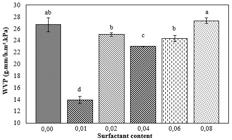
WVP of PS films with different SSO contents. Different letters indicate statistical difference (p<0.05).
This reduction in WVP suggests that the SSO contributed to the biopolymer matrix by filling vacancies, thereby inhibiting the passage of water vapor. An interaction between the SSO and the hydrophilic groups (OH) of the molecules present in the film (amylose:amylopectin:glycerol) likely occurred, decreasing the availability of hydrophilic groups and reducing the interactions between water and the film. This behavior was also observed in the study by Menezes et al.4, who found that TiO2 inhibited the diffusion of water vapor in cassava starch films due to its interaction with the hydrophilic groups, thus reducing the availability of these groups and lowering water interactions with the film.
Starting at a concentration of 0.02 g, an increase in WVP was observed. This is likely due to the saturation of the surfactant in the film composition, meaning there is no longer space or bonding between the surfactant and the polymeric chain of the film (amylose:amylopectin). The excess surfactant leads to the formation of micelles, which increase vacancies that facilitate the passage of water, as illustrated in Figure 1. This behavior was also reflected in the difficulty of cohesive film formation at the higher concentrations. Micellar aggregates of the surfactant show similar behavior to studies reporting the formation of aggregates of lipid additives and inorganic oxides. Chalapud et al.38 observed discontinuities in pectin films using sunflower wax, which caused a lack of cohesion between the film components (pectin and waxes), creating microcracks around wax aggregates that increased the flow of water vapor. Similarly, Oliveira et al.39 found that WVP values for arrowroot films with nanoemulsions were lower than those of microemulsion films containing carnauba wax. The authors suggested that this difference was due to discontinuities caused by wax aggregates in the microemulsion. Promhuad et al.40 incorporated ZnO into biodegradable PBAT/PBS nanocomposite films and explained the increased WVP as a result of larger agglomerates formed by the higher incorporation of ZnO.
Figure 5 shows the molecular interaction mechanism of how SSO and glycerol molecules bind to the biopolymer matrix in the amylose and amylopectin chains during the homogenization stage, excluding water molecules. The structure of the PS granules (amylose:amylopectin) is hydrated during the gelatinization process in the production of the film solution (heating under agitation). As the granules hydrate, their volume increases, causing the amylose to be released from the starch granule. Once the amylose is fully released, the molecules disperse in the solution along with glycerol. When this film solution, cooled to 25 °C, is mixed with a solution containing the surfactant SSO, the hydroxyl groups (OH) of the glycerol, amylose, and amylopectin molecules interact with the surfactant. At the lowest concentration of SSO, these bonds result in the formation of a homogeneous matrix that enhances the film's water vapor barrier properties.
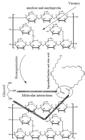
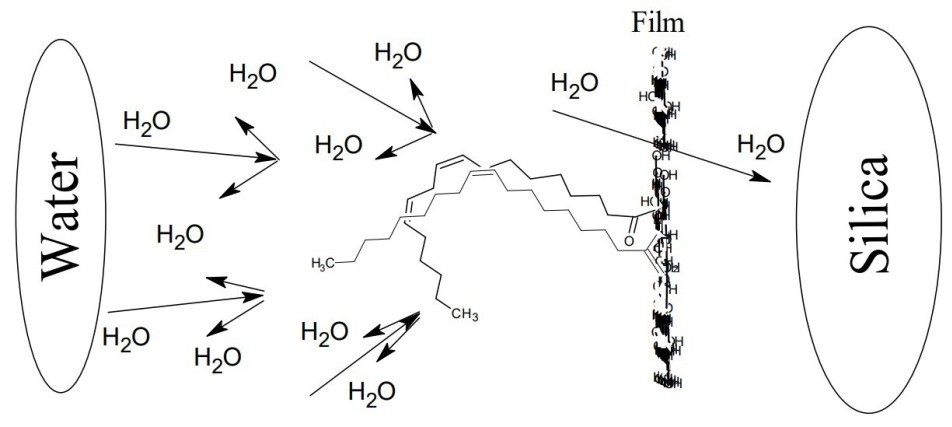
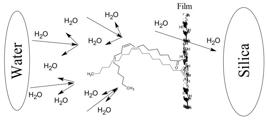
Figure 6 shows a schematic illustrating the mechanism of water permeation through the film, whereby the SSO film reduces the passage of water vapor. This behavior is attributed to the spatial filling of the matrix by the intermolecular interactions formed by the surfactant molecules with the polar points of the other constituent molecules of the films.
The other characterizations were performed with the film composition both below the CMC (0.01 g of SSO), where only surfactant monomers were present in solution, and at a concentration where sufficient micelles were present (0.08 g of SSO). This approach was used to investigate the morphological behavior of the films and their mechanical properties.
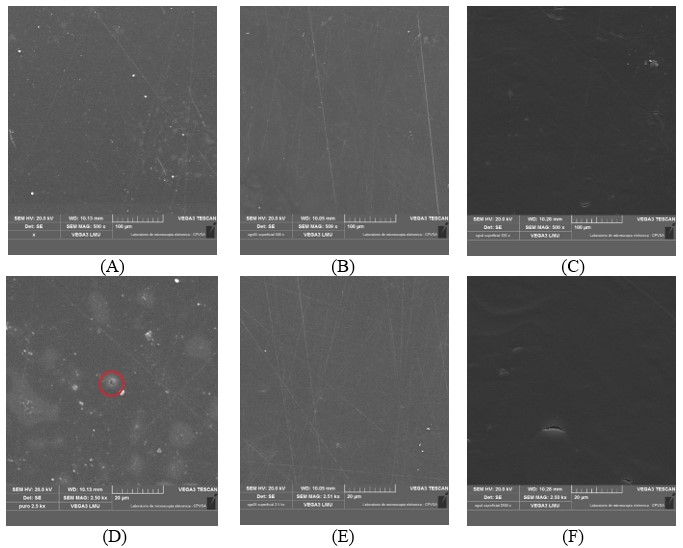
As seen in Figure 7A, which shows the image of the PS film at 500x magnification, the continuous matrix has few unsolubilized potato starch granules. At 2.5kx magnification (Figure 7D), pores and a clearer view of the granules, highlighted in the red circle, are visible. Microscopic particles are observed due to the retrogradation stage. This phenomenon has also been reported in other studies41-43.
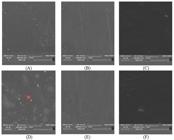
Surface morphology of the films: (A) PS with 500x; (B) 0.01 g SSO with 500x; (C) 0.08 g SSO with 500x; (D) PS with 2.5kx; (E) 0.01 g SSO with 2.5kx; (F) 0.08 g SSO with 2.5kx.
Figure 7B shows the surface morphology of the film with 0.01 g of SSO. It can be seen that the crystallization of the film was cohesive and without pores or tears, demonstrating a continuous matrix, best seen at 2.5kx in Figure 7E.
Figure 7C shows the surface morphology of the film with 0.08 g of SSO. This sample showed the formation of micellar aggregates, which allowed the formation of vacancies in the matrix during the crystallization stage, where the water molecules evaporated and caused the appearance of micro-scratches, best seen at 2.5kx (Figure 7F).
Table 3 shows the results for tensile strength (MPa), elongation (%), and Young's modulus (MPa/%). The maximum tensile strength of the films remained at 0.284 MPa for SSO contents of 0.00 g and 0.01 g. However, when the SSO content was increased to 0.08 g, there was a significant increase in tensile strength. This increase may be directly related to the formation of micelles, their homogeneous dispersion, and interactions with the polymer matrix, which could have acted as structural reinforcements in the material. Menezes et al.4 found that the homogeneous dispersion of TiO2 in polymeric matrices increased the tensile strength of chitosan:cassava starch biocomposite films. Similarly, Queiroz et al.27 studied the addition of beeswax incorporated as a lipid in sodium alginate films and noted that its homogeneous dispersion increased the film's tensile strength.
Mechanical properties of films with different SSO contents. Different letters indicate statistical difference (p<0.05).
Elongation, which reflects the film's ability to deform before breaking, increased substantially with higher SSO content. In the samples with 0.00 g and 0.01 g of SSO, the values were statistically similar (p<0.05), at 0.062% and 0.077%, respectively. However, with 0.08 g of SSO, elongation reached 62.16%. This behavior can be attributed to the unsaturated fatty acids present in sunflower oil (oleic and linoleic acids), whose unsaturated chains reduce matrix rigidity, thereby increasing the flexibility of the polymer matrix.
Young's modulus, which reflects the rigidity of a material, decreased with increasing SSO content. In the absence of SSO (0.00 g), the modulus was highest at 462.525 MPa/%, indicating greater rigidity. This was followed by 0.01 g of SSO at 368.333 MPa/%, with a statistically significant difference (p<0.05). For 0.08 g of SSO, the modulus dropped sharply to 36.806 MPa/%, aligning with the observed increase in flexibility during elongation. Thus, higher SSO content led to a less rigid polymer matrix.
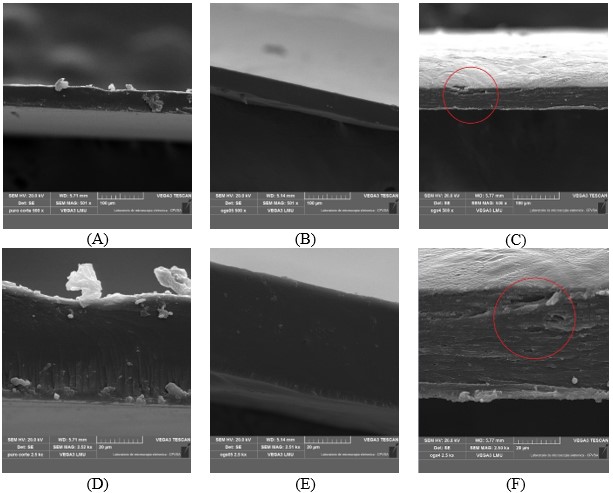
Figure 8 shows the morphology of the films at break after the mechanical tests. In Figure 8A, agglomerates of undissolved biopolymer were observed. These agglomerates compromised the structural integrity of the film, acting as stress concentrators and weakening its mechanical properties, resulting in a material that was not very ductile, as seen in Table 3.
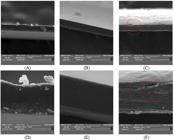
Morphology of film rupture: (A) PS at 500x; (B) 0.01 g SSO at 500x; (C) 0.08 g SSO at 500x; (D) PS at 2.5kx; (E) 0.01 g SSO at 2.5kx; (F) 0.08 g SSO at 2.5kx.
At a higher magnification of 2.5kx (Figure 8D), the ruptures and characteristics of the film surface became more evident, with filaments present in the matrix, typical of starch biodegradable films, similar to the morphology of biodegradable cassava starch films in the study by Jacobs et al.42.
With 0.01 g of SSO, a cohesive, homogeneous, and continuous matrix was achieved. The introduction of a small amount of SSO did not significantly impact the structure, resulting in a reduction of up to 47.82% in WVP. Figure 8E shows that the film's fracture surface was more homogeneous compared to PS films containing 0.00 g SSO and 0.08 g SSO (Figures 8D and 8F, respectively). This suggests that the surfactant, in small quantities, interacted with the polar sites of amylose and amylopectin, reducing vacancies in the polymer network (as shown in Figure 5) and smoothing small surface irregularities (Figure 8E).
The formulation with 0.08 g of SSO exhibited structural changes, highlighted by the red circle. These changes can be attributed to micelle formation, which created pathways for water permeation, leading to an increase in WVP. At 2.5kx magnification (Figure 8F), more pronounced defects and greater matrix separation were observed (highlighted by the circle). As previously discussed, excess surfactant promoted micelle formation, generating voids that facilitated water passage, as illustrated in Figure 1.
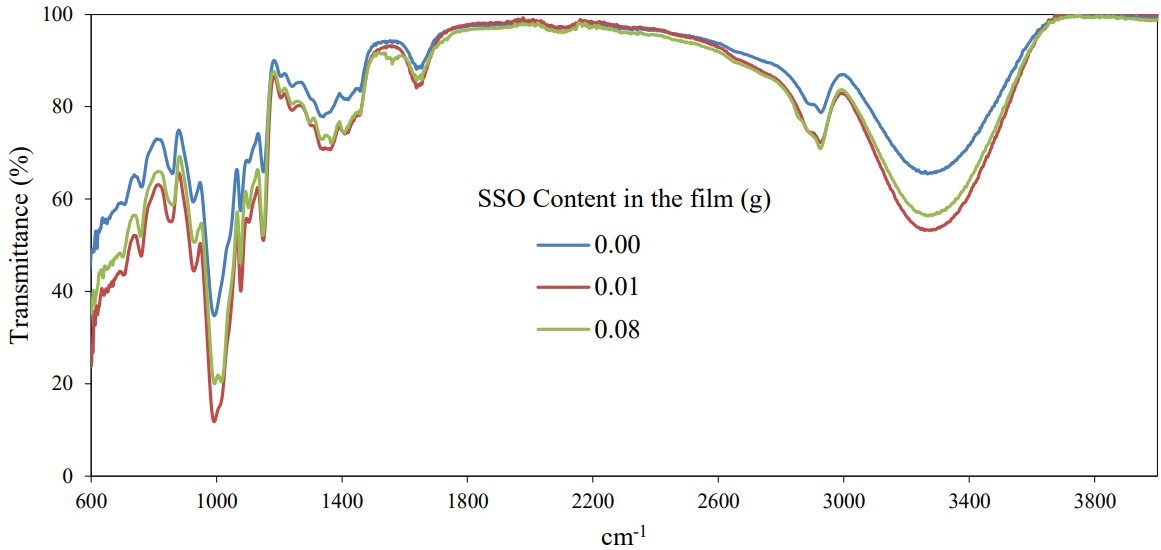
FTIR analysis was performed to identify the functional groups present in the synthesized biodegradable films and to assess the chemical interactions within the films. The main absorption peaks observed corresponded to the characteristic bands of glycerol, amylose, amylopectin, and SSO. The results are presented in Figure 9, providing a detailed view of the spectra.
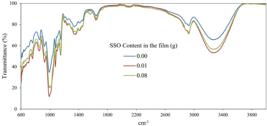
Similar bands were reported in the FTIR analysis conducted by Lapa et al.44 on corn starch films, demonstrating consistency with materials of starch origin. The infrared absorption spectrum (FTIR) of the produced film revealed a broad band at 3300 cm−1, corresponding to hydroxyl stretching (-OH) with inter or intramolecular hydrogen bonding. This hydroxyl group is particularly significant for moisture barrier properties as it readily interacts with water molecules, thus increasing the hydrophilicity of starch-based materials. Bands at 2900–2890 cm−1 were characteristic of axial deformations of C-H bonds, while absorptions at 1144–1073 cm−1 corresponded to axial deformation of the C-O bond. Additionally, intense bands at 1043 and 990 cm−1 were attributed to asymmetric axial deformation of the C-O-C bond.
Variations in the intensity of these bands were observed as the surfactant content increased, suggesting interactions among the film components, such as hydrogen bonding. Notably, the reduction in the intensity of the OH band indicates that the SSO interacts with the polymer matrix, as illustrated in Figure 5, reducing the availability of free hydrophilic sites and potentially limiting water uptake. This observation is in line with the FTIR study by Oliveira et al.39, who reported similar reductions in free hydroxyl groups when incorporating carnauba wax into arrowroot starch films. By reducing the amount of accessible hydroxyl groups, SSO can improve the film's moisture barrier characteristics, as reflected in the lower WVP values observed for PS films containing 0.01 g of SSO.
4. Conclusion
This study showed that incorporating the anionic surfactant saponified sunflower oil (SSO) into potato starch films at a low concentration was able to reduce water vapor permeability by up to 47.82% and increase film elasticity by 62% in CMC, without significantly altering optical properties. These results confirm that the aim of the study was achieved, showing that SSO can modify the polymer matrix to reduce hydrophilicity, thus providing the same functional effect as lipids or non-polar substances, but with a simpler formulation. A proposed mechanism, based on the molecular interactions between SSO, glycerol and starch, indicates that the reduction of hydroxyl groups is key to improving moisture barrier properties. This study provides valuable information on surfactant-polymer interactions and establishes a simplified basis for future investigations into the optimization of starch-based biodegradable films for advanced packaging and post-harvest preservation applications. Future studies should address the long-term performance of these films in practical environments.
6. Acknowledgments
The authors are thankful to Universidade Federal Rural do Semi-Árido (UFERSA), Núcleo de Pesquisa em Economia de Baixo Carbono (NPCO2), Centro de Pesquisa em Ciências Vegetais do Semi-Árido (CPVSA) and Conselho Nacional de Desenvolvimento Científico e Tecnológico (CNPq).
5. References
- 1 Silva MHL, Leite RHL, Aroucha EMM, Santos FKG. Obtaining cassava starch biofilms with hydroxyapatite using egg shells. Agrop Cient Sem. 2022;17:11-6.
-
2 Oliveira VRL, Santos FKG, Leite RHL, Aroucha EMM, Silva KNO. Use of biopolymeric coating hydrophobized with beeswax in post-harvest conservation of guavas. Food Chem. 2018;259:55-64. http://doi.org/10.1016/j.foodchem.2018.03.101 PMid:29680062.
» http://doi.org/10.1016/j.foodchem.2018.03.101 -
3 Justino HFM, Cunha JS, Martins CCN, Leite BRC Jr. Principais biopolímeros derivados de subprodutos alimentares: uma breve revisão. J Eng Exact Sci. 2022;8(7):14711-01. http://doi.org/10.18540/jcecvl8iss7pp14711-01e
» http://doi.org/10.18540/jcecvl8iss7pp14711-01e -
4 Menezes FLG, Leite RHL, Santos FKG, Aria AI, Aroucha EMM. TiO2-enhanced chitosan/cassava starch biofilms for sustainable food packaging. Colloids Surf A Physicochem Eng Asp. 2021;630:127661. http://doi.org/10.1016/j.colsurfa.2021.127661
» http://doi.org/10.1016/j.colsurfa.2021.127661 - 5 Silva MJB, Alves FS, Queiroz RN, Queiroz NLF, Lago GVP, Pereira GVS, et al. Starch: a review of biopolymeric products and their derivations. Res Soc Dev. 2022;11(12):e280111234470.
-
6 Monteiro MKS, Oliveira VRL, Santos FKG, Barros EL No, Leite RHL, Aroucha EMM, et al. Incorporation of bentonite clay in cassava starch films for the reduction of water vapor permeability. Food Res Int. 2018;105:637-44. http://doi.org/10.1016/j.foodres.2017.11.030 PMid:29433257.
» http://doi.org/10.1016/j.foodres.2017.11.030 -
7 Zavareze ER, Pinto VZ, Klein B, El Halal SL, Elias MC, Prentice-Hernández C, et al. Development of oxidised and heat–moisture treated potato starch film. Food Chem. 2012;132(1):344-50. http://doi.org/10.1016/j.foodchem.2011.10.090 PMid:26434300.
» http://doi.org/10.1016/j.foodchem.2011.10.090 - 8 Madella DKSF, Melo NR. Organic-based material as an alternative for packaging food products. Res Soc Dev. 2022;11(10):e15111032244.
-
9 Carvalho LGG, Marques NN, Fernandes RS, Villetti MA, Souza MSM Fo, Balaban RC. Effect of starch laurate addition on the properties of mango kernel starch films. Mater Res. 2021;24(3):e20200331. http://doi.org/10.1590/1980-5373-mr-2020-0331
» http://doi.org/10.1590/1980-5373-mr-2020-0331 -
10 Méité N, Konan LK, Tognonvi M, Oyetola S. Effect of metakaolin content on mechanical and water barrier properties of cassava starch films. S Afr J Chem Eng. 2022;40:186-94. http://doi.org/10.1016/j.sajce.2022.03.005
» http://doi.org/10.1016/j.sajce.2022.03.005 -
11 Puca Pacheco M, Aguilar Vega M, Canché Escamilla G, Neira Velázquez G. Evaluation of thermal properties and permeability of bioplastic films based on starch, aloe vera and graphene. Rev Soc Quím Perú. 2022;88(1):63-77. http://doi.org/10.37761/rsqp.v88i1.376
» http://doi.org/10.37761/rsqp.v88i1.376 - 12 Bhasin S, Shukla A, Kishore K, Sb S. Production of edible bioplastic (toffee wappers) by using corn (Zea mays), potato (Solanum tuberosum) and rice (Oryza sativa) starch. Indian J Sci Res. 2023;14(1):1-6.
-
13 Gonçalves I, Lopes J, Barra A, Hernández D, Nunes C, Kapusniak K, et al. Tailoring the surface properties and flexibility of starch-based films using oil and waxes recovered from potato chips byproducts. Int J Biol Macromol. 2020;163:251-9. http://doi.org/10.1016/j.ijbiomac.2020.06.231 PMid:32615230.
» http://doi.org/10.1016/j.ijbiomac.2020.06.231 -
14 Oyekanmi AA, Kumar USU, Abdul Khalil HPS, Olaiya NG, Amirul AA, Rahman AA, et al. Functional properties of antimicrobial neem leaves extract based macroalgae biofilms for potential use as active dry packaging applications. Polymers. 2021;13(10):1664. http://doi.org/10.3390/polym13101664 PMid:34065404.
» http://doi.org/10.3390/polym13101664 -
15 Surya I, Chong EWN, Abdul Khalil HPS, Funmilayo OG, Abdullah CK, Sri Aprilia NA, et al. Augmentation of physico-mechanical, thermal and biodegradability performances of bio-precipitated material reinforced in Eucheuma cottonii biopolymer films. J Mater Res Technol. 2021;12:1673-88. http://doi.org/10.1016/j.jmrt.2021.03.055
» http://doi.org/10.1016/j.jmrt.2021.03.055 -
16 Oyekanmi AA, Abdul Khalil HPS, Rahman AA, Mistar EM, Olaiya NG, Alfatah T, et al. Extracted supercritical CO2 cinnamon oil functional properties enhancement in cellulose nanofibre reinforced Euchema cottoni biopolymer films. J Mater Res Technol. 2021;15:4293-308. http://doi.org/10.1016/j.jmrt.2021.10.025
» http://doi.org/10.1016/j.jmrt.2021.10.025 -
17 Olaiya NG, Oyekanmi AA, Hanafiah MM, Olugbade TO, Adeyeri MK, Olaiya FG. Enzyme-assisted extraction of nanocellulose from textile waste: a review on production technique and applications. Bioresour Technol Rep. 2022;19:101183. http://doi.org/10.1016/j.biteb.2022.101183
» http://doi.org/10.1016/j.biteb.2022.101183 -
18 Garrido MA, Leite RHL, Aroucha EMM, Santos FKG. Biodegradable films of gelatin incorporated with bentonite clay ionically modified. Rev Verde Agroecol Desenvolv Sustent. 2021;16(2):182-8. http://doi.org/10.18378/rvads.v16i2.7593
» http://doi.org/10.18378/rvads.v16i2.7593 -
19 Taktak FF, Kaya HN. Biodegradable PVA/chitosan-based films enriched with rose hip extract and seed oil: investigation of the influence of tragacanth gum ratio on functional properties and its application in cherry preservation. Int J Biol Macromol. 2025;307(Pt 1):141023. http://doi.org/10.1016/j.ijbiomac.2025.141023 PMid:40010468.
» http://doi.org/10.1016/j.ijbiomac.2025.141023 - 20 Viana KM, Rigueto CVT, Borges RT, Ribeiro CRM, Geraldi CAQ. Extração e estudo da cinética de secagem da fécula de batata-doce. Nat Resour. 2018;8(1):1-8.
- 21 Zavareze ER, Halal SLME, Pereira JM, Radünz AL, Elias MC, Dias ARG. Caracterização química e rendimento de extração de amido de arroz com diferentes teores de amilose. Braz J Food Technol. 2009;1:24-30.
-
22 Dudeja I, Mankoo RK, Singh A, Kaur J. Development, characterisation and biodegradability of rice straw lignin based sustainable biopolymeric films. Int J Food Sci Technol. 2022;58(5):2754-63. http://doi.org/10.1111/ijfs.16105
» http://doi.org/10.1111/ijfs.16105 -
23 Dursun Capar T. Characterization of sodium alginate-based biodegradable edible film incorporated with Vitis vinifera leaf extract: nano-scaled by ultrasound-assisted technology. Food Packag Shelf Life. 2023;37:101068. http://doi.org/10.1016/j.fpsl.2023.101068
» http://doi.org/10.1016/j.fpsl.2023.101068 -
24 Halim ALA, Kamari A, Phillip E. Chitosan, gelatin and methylcellulose films incorporated with tannic acid for food packaging. Int J Biol Macromol. 2018;120(Pt A):1119-26. http://doi.org/10.1016/j.ijbiomac.2018.08.169 PMid:30176328.
» http://doi.org/10.1016/j.ijbiomac.2018.08.169 - 25 ASTM: American Society for Testing and Materials. ASTM E96/E96M-22: standard test methods for gravimetric determination of water vapor transmission rate of materials. West Conshohocken: ASTM; 2022.
- 26 ASTM: American Society for Testing and Materials. ASTM D882-18: standard test method for tensile properties of thin plastic films. West Conshohocken: ASTM; 2022.
- 27 Queiroz LPO, Aroucha EMM, Leite RHL. Optimization of novel sustainable Dictyota mertensii alginate films with beeswax using a simplex centroid mixture design. Food Hydrocoll. 2024;160(1):110782.
- 28 Ferreira DF. SISVAR: a computer analysis system to fixed effects split plot type designs. Rev Bras Biom. 2019;37(4):529-35.
-
29 Podshivalov A, Zakharova M, Glazacheva E, Uspenskaya M. Gelatin/potato starch edible biocomposite films: correlation between morphology and physical properties. Carbohydr Polym. 2017;157:1162-72. http://doi.org/10.1016/j.carbpol.2016.10.079 PMid:27987819.
» http://doi.org/10.1016/j.carbpol.2016.10.079 -
30 Jiang S, Liu C, Wang X, Xiong L, Sun Q. Physicochemical properties of starch nanocomposite films enhanced by self-assembled potato starch nanoparticles. Lebensm Wiss Technol. 2016;69:251-7. http://doi.org/10.1016/j.lwt.2016.01.053
» http://doi.org/10.1016/j.lwt.2016.01.053 -
31 Pacheco MP, Gómez ORT, Escamilla GC, Aranda SD, Velázquez MGN. Obtaining and characterization of bioplastics based on potato starch, aloe, and graphene. Polímeros. 2022;32(4):e2022037. http://doi.org/10.1590/0104-1428.20220084
» http://doi.org/10.1590/0104-1428.20220084 - 32 Correia IMS, Araújo G, Paulo JBA, Sousa EMBD. Avaliação das potencialidades e características físicoquímicas do óleo de Girassol (Helianthus annuus L.) e Coco (Cocos nucifera L.) produzidos no Nordeste brasileiro. Scientia Plena. 2014;10(3):1-7.
- 33 Daltin D. Tensoativos química, propriedades e aplicações. São Paulo: Blucher; 2011.
-
34 Thakur R, Pristijono P, Scarlett CJ, Bowyer M, Singh SP, Vuong QV. Starch-based films: major factors affecting their properties. Int J Biol Macromol. 2019;132:1079-89. http://doi.org/10.1016/j.ijbiomac.2019.03.190 PMid:30926503.
» http://doi.org/10.1016/j.ijbiomac.2019.03.190 -
35 Basiak E, Lenart A, Debeaufort F. Effect of starch type on the physico-chemical properties of edible films. Int J Biol Macromol. 2017;98:348-56. http://doi.org/10.1016/j.ijbiomac.2017.01.122 PMid:28137462.
» http://doi.org/10.1016/j.ijbiomac.2017.01.122 -
36 Costa TL, Leite RHL, Aroucha EMM, Santos FKG. Filmes comestíveis de blendas políméricas de quitosana, pectina e fécula de mandioca. Rev Verde Agroecol Desenvolv Sustent. 2020;15(4):391-7. http://doi.org/10.18378/rvads.v15i4.6713
» http://doi.org/10.18378/rvads.v15i4.6713 -
37 Farias MG, Fakhouri FM, Carvalho CWP, Ascheri JLR. Caracterização físico-química de filmes comestíveis de amido adicionado de acerola (Malphigia emarginata D.C.). Quim Nova. 2012;35(3):546-52. http://doi.org/10.1590/S0100-40422012000300020
» http://doi.org/10.1590/S0100-40422012000300020 -
38 Chalapud MC, Salgado-Cruz MP, Baümler ER, Carelli AA, Morales-Sánchez E, Calderón-Domínguez G, et al. Study of the physical, chemical, and structural properties of low- and high-methoxyl pectin-based film matrices including sunflower waxes. Membranes. 2023;13(10):846. http://doi.org/10.3390/membranes13100846 PMid:37888018.
» http://doi.org/10.3390/membranes13100846 -
39 Oliveira JG Fo, Bezerra CCON, Albiero BR, Oldoni FCA, Miranda M, Egea MB, et al. New approach in the development of edible films: the use of carnauba wax micro- or nanoemulsions in arrowroot starch-based films. Food Packag Shelf Life. 2020;26:100589. http://doi.org/10.1016/j.fpsl.2020.100589
» http://doi.org/10.1016/j.fpsl.2020.100589 -
40 Promhuad K, Phothisarattana D, Laorenza Y, Bumbudsanpharoke N, Harnkarnsujarit N. Zinc oxide enhanced the antibacterial efficacy of biodegradable PBAT/PBS nanocomposite films: morphology and food packaging properties. Food Biosci. 2023;55:103077. http://doi.org/10.1016/j.fbio.2023.103077
» http://doi.org/10.1016/j.fbio.2023.103077 -
41 Gonçalves FCP, Fontes K, Assis MCP, Barbalho APCB, Costa BJP, Oliveira DA, et al. Caracterização ópticas e morfológicas de filmes biodegradáveis compostos por fécula de batata, gelatina bovina e quitosana. Des Soc Sust Cien Agr. 2020;3:132-44. http://doi.org/10.22533/at.ed.72620141012
» http://doi.org/10.22533/at.ed.72620141012 - 42 Jacobs V, Souza FS, Hamm JBS, Mancilha FS. Produção e caracterização de biofilmes de amido incorporados com polpa de acerola. Rev Iberoam Polim. 2020;21(3):107-19.
-
43 Araújo AWO, Galvão AMMT, Silva C Fo, Mendes FRS, Oliveira M, Barbosa FG, et al. Okra mucilage and corn starch bio-based film to be applied in food. Polym Test. 2018;71:352-61. http://doi.org/10.1016/j.polymertesting.2018.09.010
» http://doi.org/10.1016/j.polymertesting.2018.09.010 -
44 Lapa LSS, Silva YRO, Sales PF. Aplicação das análises espectroscópicas e termogravimétricas em filmes biodegradáveis de amido de milho incorporados com extrato de própolis-verde. ForScience. 2020;8(2):e00712. http://doi.org/10.29069/forscience.2020v8n2.e712
» http://doi.org/10.29069/forscience.2020v8n2.e712