Synthesis and Electrochemical Investigation of TiO2 Nanofiber/Reduced Graphene Oxide/NiO Nanosheet Hybrid Composites
Abstract
In order to develop high-performance electrode materials for electricity storage applications, novel composite designs that integrate many functional components in an efficient manner must be developed. Titanium dioxide (TiO2) nanofibers, reduced graphene oxide (rGO), and nickel oxide (NiO) nanosheets were effectively combined to create ternary nanocomposites in this work using a simple fabrication technique. Using X-ray diffraction (XRD), scanning electron microscopy (SEM), Raman spectroscopy, cyclic voltammetry (CV), galvanostatic charge-discharge (GCD), the composites' structural, morphological, and electrochemical characteristics were thoroughly studied. Raman spectroscopy revealed the successful reduction of graphene oxide, while XRD examination proved the crystalline phases of anatase TiO2 and cubic NiO. The hierarchical nanostructure with TiO2 nanofibers wrapped with rGO sheets and enhanced with NiO nanosheets was seen in SEM pictures. The electrochemical performance of the TiO2/rGO/NiO composite electrode was slightly better than that of all three materials. The potential of multi-component nanocomposites for cutting-edge energy storage devices is made apparent in these studies.
Keywords:
TiO2 nanofibers; Nanosheet composites; Morphological studies; electrochemical properties; super capacitors; energy storage
1. Introduction
The growing rise of renewable energy systems, electric cars, and portable devices has resulted in extensive research into better energy storage technology. With their quick charge-discharge rates, high power density, and superior cycle stability, super capacitors is also referred to as electrochemical capacitors and have become a promising technology that fills the gap between regular batteries and capacitors1. Extensive efforts been made to create new materials with improved electrochemical characteristics since the performance of supercapacitors depends crucially on the features of electrode materials. Because of their high potential capacitance, redox activity, and various oxidation states, metal oxide-based materials have attracted considerable amounts of attention for use as supercapacitor electrodes2,3. One of the metal oxides Titanium dioxide (TiO2) that has been studied the most because of its low cost, strong electrochemical capabilities, sustainability and chemical stability4. On the other hand, TiO2's moderate specific capacitance and relatively low electrical conductivity limit its practical use. Comparable to this, NiO has high theoretical capacitance and a good redox activity, but it has a small rate limitation and low electrical conductivity.
Researchers are researching into combining metal oxides with carbon-based materials, especially graphene and its derivatives, to get above these limitations. rGO is a perfect conductive matrix for composite electrode materials because of its excellent electrical conductivity, huge specific surface area, outstanding mechanical strength, and high chemical stability. Incorporating rGO may greatly offer a large number of active sites, enhance electron transport, and stop aggregating metal oxide nanoparticles.
A possible method for achieving combined benefits and improved electrochemical performance is the multi-component nanocomposites development. By combining rGO sheets, TiO2 nanofibers, and NiO nanosheets, may be combined to form layered designs that provides for each component's limitations while using its advantages5. The NiO nanosheets provide high pseudocapacitance through faradaic redox processes, the two-dimensional rGO sheets improve surface area and electrical conductivity, and the one-dimensional TiO2 nanofibers support structure and promote ion transport. There are yet few systematic studies of TiO2/rGO/NiO nanocomposites for electrochemical applications, despite the potential benefits of such ternary composites. Enhancing these multi-component systems' performance and expanding their practical applications need an understanding of their interfacial interactions, structural features and electrochemical activity6-9.
This work discuss the synthesis of composites comprising TiO2 nanofibers, reduced graphene oxide, and NiO nanosheets and thoroughly analyze their morphological, structural, and electrochemical characteristics. XRD, SEM, and Raman spectroscopy were used to analyze the produced materials in order to explain their morphology, structural characteristics, and phase composition. CV and GCD measurements were used to determine the electrochemical performance, with a focus on cycle stability, rate capability, and specific capacitance. The design and optimization of multi-component nanocomposite for high-performance energy storage applications are enhanced in this study.
2. Experimental Analysis
2.1. Materials
Graphite powder, Titanium tetraisopropoxide (TTIP), nickel nitrate hexahydrate (Ni(NO3)2•6H2O), polyvinylpyrrolidone (PVP), potassium permanganate (KMnO4), sodium hydroxide (NaOH), hydrogen peroxide (H2O2), sulfuric acid (H2SO4), deionized water and ethanol have been utilized precisely as supplied by commercial suppliers. The compounds were all analytical grade.
2.2. Synthesis of TiO2 nanofibers
Electrospinning and calcination were used to create TiO2 nanofibers. To create a homogenous solution, PVP 1.5 g with 10 mL ethanol and 5 mL acetic acid was typically dissolved in a solution of while being magnetically stirred for two hours. To create a thick precursor solution, 3 mL of TTIP was then added drop by drop to the mixture and agitated for a further three hours. The precursor solution with a stainless steel needle was put into a plastic syringe and electrospun at a flow rate of 0.3 mL/h, tip-to-collector distance of 15 cm, and 15 kV an applied voltage. The as-spun nanofibers were gathered and dried for 12 hours at 60°C on aluminum foil. In order to produce crystalline TiO2 nanofibers, the dried nanofibers were finally calcined for three hours at 400°C10.
2.3. Graphene oxide and reduced graphene oxide preparation
A modified Hummers technique was used to prepare GO from graphite powder. In short, concentrated H2SO4 of 46 mL in an ice bath was mixed with 2 g of graphite powder while and vigorously stirred. After that, KMnO4 6 g was added gradually while keeping under 10°C temperature. After two hours at 35°C stirring, deionized water of 100 mL was added to the mixture. After adding 10 mL of a 30% H2O2 solution to stop the reaction, the product was periodically cleaned with diluted HCl and deionized water until the pH reached neutral. Finally, brown colored mixture was dried for the whole night at 60°C in a vacuum oven.
2.4. NiO nanosheets synthesis
A hydrothermal process was used to create NiO nanosheets. In a typical synthesis, deionized water 40 mL was used to dissolve 2.91 g of Ni(NO3)2•6H2O. Then, NaOH of 1.6 g was added while stirring to create an environmentally friendly residue. After being moved to a stainless steel autoclave with a Teflon lining, the mixture at 180°C was heated for 12 hours. The precipitate was recovered by centrifugation after cooling to ambient temperature, continuously cleaned with deionized water and ethanol, and then dried at 60°C for six hours11. NiO nanosheets were produced by calcining the dry product in air for three hours at 350°C.
2.5. Fabrication of TiO2/rGO/NiO composites
The method of solution mixing and subsequent heat treatment was used to create the ternary TiO2/rGO/NiO nanocomposites. Initially, 50 milliliters of ethanol were mixed with 100 milligrams of TiO2 nanofibers using ultrasonication for thirty minutes. The TiO2 dispersion was then mixed uniformly by adding 20 mL of GO suspension (1 mg/mL) and sonicating for an additional hour. The mixture was then sonicated for 30 minutes after 50 mg of NiO nanosheets were added. At 60°C, the resultant suspension was agitated until all of the solvent had evaporated. To strengthen interfacial bonding and increase structural integrity, the dry composite was annealed in a nitrogen environment and ground into a fine powder for two hours at 300°C.
2.6. Electrochemical measurements
A three-electrode setup in a aqueous electrolyte of 1 M KOH at room temperature was used for electrochemical experiments. The carbon black (10 weight percent), 80% active material, and 10 weight percent of polyvinylidene fluoride (PVDF) binder were combined in N-methyl-2-pyrrolidone (NMP) to create a homogenous solution for the operation of the electrodes. After coating nickel foam substrates (1 cm x 1 cm), the solution at 80°C was vacuum-dried for a period of twelve hours. The Ag/AgCl electrode was taken as a reference electrode, while the platinum wire was taken as counter electrode. Within a potential window of 0 to 1.2 V, at different scan speeds ranging from 10 to 100 mV/s in cyclic voltammetry (CV) measurements were carried out.
3. Results and Discussion
3.1. X-Ray diffraction analysis (XRD)
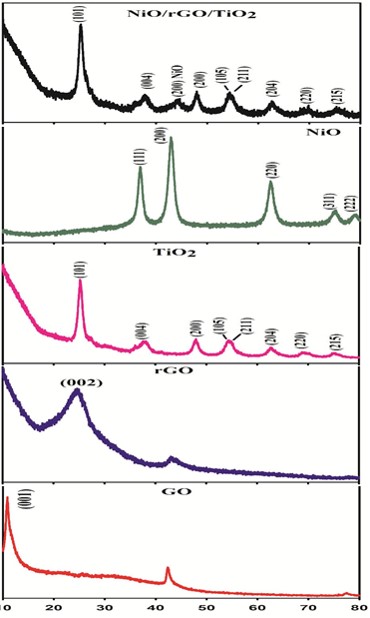
X-Ray Difffraction analysis was utilized to examine phase composition and sample crystalline structure. XRD patterns of GO, rGO, NiO nanosheets, TiO2 nanofibers and TiO2/rGO/NiO composite are shown in Figure 1. As GO contains oxygen-containing functional groups, at around 2θ = 10.8° the XRD pattern shows a high diffraction peak, represents to the (002) plane with an interlayer spacing of about 0.84 nm. Compared to pure graphite, this is significantly larger (0.34 nm). Following thermal reduction, GO's distinctive peak disappears and a wide peak emerges at approximately 2θ = 25°, suggesting that GO was successfully reduced to rGO and that the graphitic structure was partially restored with a decreased interlayer spacing of about 0.37 nm. TiO2 nanofibers' XRD pattern displays distinct diffraction peaks at 2θ = 25.3°, 37.8°, 48.0°, 53.9°, 55.1°, 62.7°, 68.8°, 70.3°, and 75.0°. These peaks correspond to the anatase TiO2 crystal planes (101), (004), (205), (211), (204), (220), (116), and (215) (JCPDS card No. 21-1272).
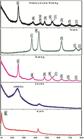
X-Ray Diffraction patterns of (a) GO, (b) rGO, (c) TiO2 nanofibers, (d) NiO nanosheets, and (e) TiO2/rGO/NiO composite.
The noteworthy crystallinity of the TiO2 nanofibers formed after calcination at 400°C can be observed by the strong and powerful peaks. Preferential crystal formation in this direction is shown by the dominant (101) peak. The XRD pattern of NiO nanosheets displays characteristic diffraction peaks at 2θ = 37.2°, 43.3°, 62.9°, 75.4°, and 79.4°, corresponding to the (111), (200), (220), (311), and (222) crystal planes of cubic NiO (JCPDS card No. 47-1049). The relatively sharp peaks show that the NiO nanosheets produced by hydrothermal synthesis and calcination have high crystallinity. The efficient incorporation of anatase TiO2 and cubic NiO phases is confirmed by the XRD pattern of the TiO2/rGO/NiO composite, which shows diffraction peaks corresponding to these phases. Because of its very low content and overlap with other peaks, the distinctive rGO peak is not readily apparent in the composite pattern12. The very existence of both TiO2 and NiO peaks without extra phases suggests that the unique crystal structures have remained and there was no notable interaction of chemicals between the constituents throughout the composite creation process.
3.1.2. Raman spectroscopy analysis
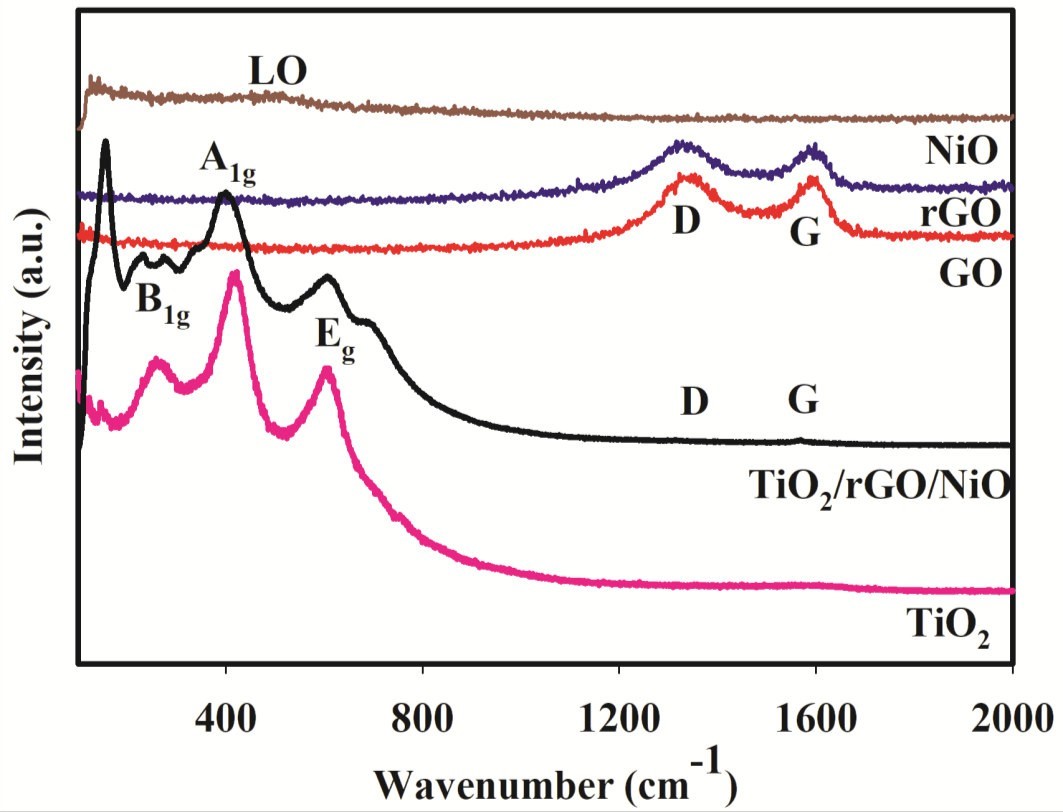
The structural properties of the materials, in particular the degree of graphene reduction and the presence of other components in the composite, were further studied using Raman spectroscopy. The Raman spectra of rGO, GO, TiO2, NiO, and the TiO2/rGO/NiO composite are pictured in Figure 2. The G band (graphitic band) and D band (disorder-induced band) are represented by two strong peaks in the Raman spectra of GO, which are located at 1590 cm−1 and 1350 cm−1, respectively. The D band is derived from the breathing mode of sp2 carbon rings, whereas G band is linked to the in-plane vibration of sp2 bonded carbon atoms and is triggered by defects and disorder in the graphene structure13. The degree of disorder and flaws in carbon materials is frequently assessed using the D band to the G band (ID/IG) intensity ratio.
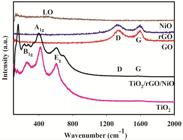
The rGO displays both D and G bands upon thermal reduction, however the ID/IG ratio is higher than that of GO. This rise suggests the oxygen-containing functional groups removal and the formation of new graphitic domains with a reduced average size throughout the reduction process. Additionally, the G band in rGO moves significantly to a higher wavenumber, indicating that the sp2 carbon network has been restored. The anatase phase of TiO2 is compatible with the Raman spectra of TiO2 nanofibers, which shows distinctive peaks at around 144 cm−1 (Eg), 197 cm−1 (Eg), 399 cm−1 (B1g), 519 cm−1 (A1g + B1g), and 639 cm−1 (Eg). The TiO2 crystal lattice's many vibrational modes are represented by these peaks. The longitudinal optical (LO) mode of NiO are responsible for the large peaks in the Raman spectra at around 550 cm−1. Nanostructured NiO materials are characterized by these peaks' relatively wide nature.
Features from all three components are visible in the TiO2/rGO/NiO composite's Raman spectra. The existence of reduced graphene oxide in the composite is confirmed by the D and G bands of rGO, which are clearly visible at around 1350 cm−1 and 1590 cm−1. Due to the presence of additional components, the distinctive peaks of TiO2 (B1g, A1g, and Eg modes) are also seen, but with slightly lower intensity. Because NiO has a smaller Raman scattering cross-section than TiO2 and carbon materials, the NiO peaks are present but less apparent. The effective production of the ternary TiO2/rGO/NiO nanocomposite is confirmed by the occurrence of these particular peaks in the composite range14.
3.2. Morphological characterization
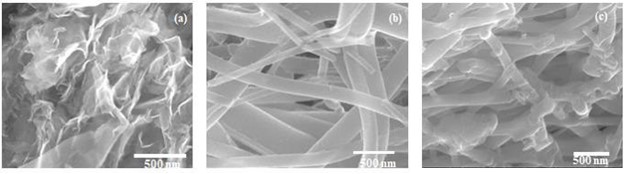
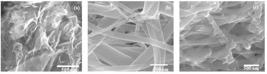
SEM was used to analyze the produced materials' microstructure and morphology. SEM pictures of NiO nanosheets, TiO2 nanofibers, and the TiO2/rGO/NiO composite at various magnifications are shown in Figure 3. NiO nanosheets have a sheet-like morphology with uneven forms and lateral diameters ranging from several hundred nanometers to a few micrometers, as seen in Figure 3a SEM picture. The nanosheets appear to be thin and have a tendency to collect, resulting in linked networks. A significant surface area for electrochemical reactions is provided by this two-dimensional structure15. The SEM picture of TiO2 nanofibers made by electrospinning and then calcining is shown in Figure 3b. The nanofibers have a one-dimensional fibrous structure, with lengths up to several micrometers and reasonably uniform diameters between 100 and 200 nm. The smooth, continuous surfaces of the nanofibers show that the polymer template was completely removed during calcination. For the purpose of ion transport and electrolyte penetration, the nanofibers create a non-woven mat structure with linked pores16. A complicated hierarchical architecture can be seen in the SEM picture of the TiO2/rGO/NiO composite shown in Figure 3c. Thin, wrinkled rGO sheets are intertwined with the TiO2 nanofibers, which retain their one-dimensional structure. A three-dimensional conductive network is created by the translucent, flexible layers of rGO that encircle and join the TiO2 nanofibers. NiO nanosheets are dispersed throughout the composite structure, adorning the rGO sheets as well as the TiO2 nanofibers. The benefits of various dimensional structures are combined in this hierarchical morphology: the NiO nanosheets add more active sites for electrochemical reactions, the two-dimensional rGO sheets improve electrical conductivity and prevent nanoparticle aggregation, and the one-dimensional TiO2 nanofibers offer structural support and ion diffusion pathways17. It is anticipated that the close proximity of the three elements will help with effective ion and electron transport, enhancing electrochemical performance.
3.3. Electrochemical performance
3.3.1. Cyclic voltammetry analysis (CV)
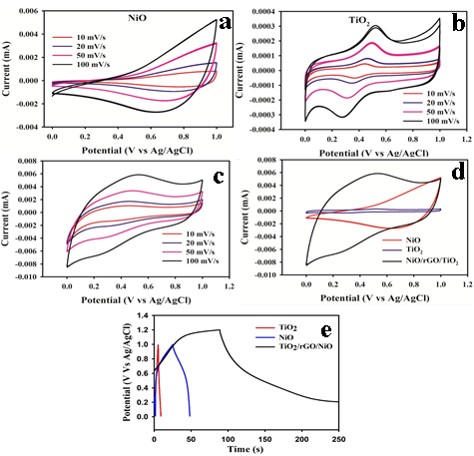
Electrochemical behavior and capacitive properties of the produced materials were studied using CV experiments. The CV curves of NiO, TiO2, and the TiO2/rGO/NiO composite are shown in Figure 4 at different scan speeds. The CV curves of NiO nanosheets of 10, 20, 50, and 100 mV/s at scan speeds in the potential region of 0 to 1.0 V are shown in Figure 4a. The existence indicates that faradaic reactions, not electric double-layer capacitance, are the main basis for NiO's charge storage mechanism. Due to polarization effects and kinetic constraints, the anodic and cathodic peak currents both rise as the scan rate rises, and the peaks a little shift toward more positive and negative possibilities, accordingly. The redox peaks' reversibility and the CV curves' comparatively symmetric form show that the NiO nanosheets have strong electrochemical reversibility18.
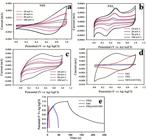
(a) CV curves at different scan rates (10, 20, 50, and 100 mV/s) for (a) NiO nanosheets, (b) TiO2 nanofibers, (c) TiO2/rGO/NiO composite and (d) Comparative CV curves of NiO, TiO2, and TiO2/rGO/NiO composite at 100 mV/s, clearly demonstrating the superior electrochemical performance of the composite.
The CV curves of TiO2 nanofibers at the same scan speeds are shown in Figure 4b. Compared to NiO, the CV curves have a smaller current response and a more rectangular structure. A combination of weak pseudocapacitive contributions and electric double-layer capacitance is provided by the quasi-rectangular form. Reversible lithium or proton insertion/extraction reactions can occur in TiO2, although they are rather slow and limited in solution form. The low electrochemical activity of TiO2 in aqueous electrolytes is in line with the comparatively low specific capacitance of TiO2 nanofibers, as indicated by the little current response. The CV curves show an adequate level capability as the scan rate rises while maintaining their form and current density19.
The TiO2/rGO/NiO composite CV curves at different scan speeds are shown in Figure 4c. When compared to NiO and TiO2 separately, the composite shows a much higher current response and a bigger enclosed area, indicating greater energy storage capabilities20. The CV curves exhibit a mix of characteristics from both components: a more rectangular background contribution of rGO and TiO2 from the electric double-layer capacitance, and redox peaks characteristic of NiO pseudocapacitance. A number of synergistic effects are responsible for the increased current response: (1) short ion diffusion pathways and an abundance of active sites are provided by the hierarchical structure; (2) rapid electron transfer is facilitated by rGO's high electrical conductivity; (3) TiO2 nanofibers' structural stability prevents aggregation and preserves the electrode's integrity during cycling, and (4) intimate contact between components facilitates efficient charge transfer.
The CV curves of NiO, TiO2, and the TiO2/rGO/NiO composite at a scan rate of 100 mV/s, are directly compared in Figure 4d. Among the three samples, the composite displays the highest current density and the biggest enclosed area, showing its better electrochemical stability. While NiO exhibits moderate performance with clear redox peaks, TiO2 nanofibers have the weakest current response. The composite's greatly improved performance shows that the three components were well integrated and that advantageous outcomes were achieved21,22. A high-performance electrode material is produced by combining the high pseudocapacitance of NiO, the structural stability of TiO2 nanofibers, and the superior electrical conductivity of rGO23.
3.3.2. Specific capacitance
The following formula was used to determine the electrode materials specific capacitance based on the CV curves. C_s = ∫I(V)dV / (2 × m × ΔV × v), At scan speeds of 10, 20, 50, and 100 mV/s, the computed specific capacitances of the TiO2/rGO/NiO composite were much greater than those of the individual NiO and TiO2 components. The composite showed a specific capacitance that was around 3–4 times greater than pure TiO2 and 1.5–2 times higher than pure NiO at a 10 mV/s scan rate. The three components' synergistic effects and the systemic structure's optimization are accountable for this enhancement. A key aspect for real-world applications is the rate capability, which indicates an electrode material's capacity to retain its capacitance at high charge-discharge rates. Even at high scan rates, the TiO2/rGO/NiO combination maintained a significant amount of its capacitance, demonstrating exceptional rate capability. The rGO high electrical conductivity, which promotes quick electron transport, and the hierarchical porous structure, which permits effective ion diffusion, are responsible for this higher rate performance24.
4. Conclusion
The ternary TiO2 nanofibers/reduced graphene oxide/NiO nanosheets composite was successfully fabricated through a facile synthesis approach involving electrospinning, chemical reduction, hydrothermal synthesis, and solution mixing methods. Comprehensive characterization using SEM, XRD and Raman spectroscopy confirmed the three components effective integration and revealed the hierarchical nanostructure of the composite. XRD analysis verified the crystalline phases of anatase TiO2 and cubic NiO, while Raman spectroscopy confirmed the successful reduction of graphene oxide and the presence of all components in the composite. SEM observations revealed a unique hierarchical architecture in which TiO2 nanofibers were interwoven with rGO sheets and decorated with NiO nanosheets, providing abundant active sites and efficient pathways for electron and ion transport. Electrochemical characterization further demonstrated that the TiO2/rGO/NiO composite exhibited significantly enhanced performance compared with the individual components. The composite showed high cycle stability, better specific capacitance, and outstanding rate capability. The additive effects of the high electrical conductivity of rGO, the high pseudocapacitance of NiO, and the structural stability offered by TiO2 nanofibers were identified as the cause of these benefits. The results demonstrate the potential for enhanced energy storage applications of multi-component nanocomposites with multilevel structures. One possible method for creating high-performance electrode materials is the design strategy of integrating one and two-dimensional nanomaterials with similar characteristics. Future research should concentrate on improving the composition ratios, investigating different synthesis techniques, and assessing these composites performance in whole supercapacitor systems. The TiO2/rGO/NiO composite created in this work is a significant development in nanostructured electrode materials, demonstrating the significance of logical design and cooperative integration of several functional components to attain excellent electrochemical performance. Using in situ and sophisticated spectroscopic methods, future research should additionally examine the charge transfer process and interfacial interactions inside the ternary composite. Furthermore, by assessing the material's performance in flexible and solid-state energy storage devices, large-scale manufacturing procedures, and real-time electrochemical applications such super capacitors, sensors, and hybrid energy systems, its practical applicability can be expanded.
5. Data Availability
The datasets used and/or analysed during the current study are available from the corresponding author on reasonable request.
6. References
-
1 Reenu S, Phor L, Kumar A, Chahal S. Electrode materials for supercapacitors: a comprehensive review of advancements and performance. J Energy Storage. 2024;84:110698. https://doi.org/10.1016/j.est.2024.110698
» https://doi.org/10.1016/j.est.2024.110698 -
2 Baig MM, Khan MA, Gul IH, Rehman SU, Shahid M, Javaid S, et al. A review of advanced electrode materials for supercapacitors: challenges and opportunities. J Electron Mater. 2023;52(9):5775-94. https://doi.org/10.1007/s11664-023-10532-5
» https://doi.org/10.1007/s11664-023-10532-5 -
3 Chen X, Mao SS. Titanium dioxide nanomaterials: synthesis, properties, modifications, and applications. Chem Rev. 2007;107(7):2891-959. https://doi.org/10.1021/cr0500535 PMid:17590053.
» https://doi.org/10.1021/cr0500535 -
4 Kakaei K, Esrafili MD, Ehsani A. Graphene-based electrochemical supercapacitors. Interface Sci. Technol. 2019;27:339-86. https://doi.org/10.1016/B978-0-12-814523-4.00009-5
» https://doi.org/10.1016/B978-0-12-814523-4.00009-5 -
5 Sumithanandhi SS, Pari S, Muthupandi S, Victor Antony Raj M, Kasinathan K, Joselene Suzan Jennifer P. Enhanced electrochemical characteristics of rgo incorporated NiFe2O4 nanorods electrode structure for supercapacitor applications. Results in Surfaces and Interfaces. 2026;23:100756. https://doi.org/10.1016/j.rsurfi.2026.100756
» https://doi.org/10.1016/j.rsurfi.2026.100756 -
6 Varghese D, Muthupandi S, Arun S, Francis J, Ruban M JR, Jennifer P JS, et al. Visible light-driven cubic structured NiFe2O4@MWCNTs/TiO2 ternary nanocomposite for photocatalytic degradation of ciprofloxacin. New J Chem. 2024;48(10):4351-71. https://doi.org/10.1039/D4NJ00107A
» https://doi.org/10.1039/D4NJ00107A -
7 Hodlevska M, Kotsyubynsky V, Boychuk V, Budzulyak I, Rachiy B, Zapukhlyak R, et al. Hydrothermally synthesized NiFe2O4/rGO composites: structure, morphology and electrical conductivity. Appl Nanosci. 2023;13(7):5199-209. https://doi.org/10.1007/s13204-022-02741-x
» https://doi.org/10.1007/s13204-022-02741-x -
8 Biswal R, Yadav P, Mishra P, Kumar P, Singh MK. A comprehensive study of NiFe2O4 and NiFe2O4/rGO (reduced graphene oxide) nanocomposite: synthesis, structural, optical, dielectric, magnetic and magneto-dielectric analysis. J Mater Sci Mater Electron. 2024;35(12):1-18. https://doi.org/10.1007/s10854-024-12612-6
» https://doi.org/10.1007/s10854-024-12612-6 -
9 Satheesh K, Jayavel R. Synthesis and electrochemical properties of reduced graphene oxide via chemical reduction using thiourea as a reducing agent. Mater Lett. 2013;113:5-8. https://doi.org/10.1016/j.matlet.2013.09.044
» https://doi.org/10.1016/j.matlet.2013.09.044 -
10 Tamilselvi R, Lekshmi GS, Padmanathan N, Selvaraj V, Bazaka O, Levchenko I, et al. NiFe2O4/rGO nanocomposites produced by soft bubble assembly for energy storage and environmental remediation. Renew Energy. 2022;181:1386-401. https://doi.org/10.1016/j.renene.2021.07.088
» https://doi.org/10.1016/j.renene.2021.07.088 -
11 Kannan K, Chanda D, Meshesha MM, Yang B. Impressive efficiency of zinc oxide-manganese oxide/MAX composite in two-electrode system for photovoltaic-electrolyzer water splitting. Colloids Surf A Physicochem Eng Asp. 2024;689:133599. https://doi.org/10.1016/j.colsurfa.2024.133599
» https://doi.org/10.1016/j.colsurfa.2024.133599 -
12 Ansari MZ, Hussain I, Mohapatra D, Ansari SA, Rahighi R, Nandi DK, et al. Atomic layer deposition: a versatile toolbox for designing/engineering electrodes for advanced supercapacitors. Adv Sci (Weinh). 2024;11(1):e2303055. https://doi.org/10.1002/advs.202303055 PMid:37937382.
» https://doi.org/10.1002/advs.202303055 -
13 Kannan K, Chanda D, Gautam J, Meshesha MM, Jang SG, Yang BL. Facial synthesis of pp heterojunction composites: evaluation of their electrochemical properties with photovoltaics-electrolyzer water splitting using two-electrode system. Int J Hydrogen Energy. 2023;48(37):13814-26. https://doi.org/10.1016/j.ijhydene.2022.12.235
» https://doi.org/10.1016/j.ijhydene.2022.12.235 -
14 Cui D. Preparation of transition metal oxide mixed graphene electrode materials and its application in supercapacitors. Dean & Francis. 2024;2(5):1-8. https://doi.org/10.61173/rpqbr688
» https://doi.org/10.61173/rpqbr688 -
15 Wang N, Li J, Li T, Xue A, Chen L, Li Y. Research progress on the preparation process of graphene-based/semiconductor metal oxide composite photocatalyst. Gongye Shui Chuli. 2024;44(2):63-72. https://doi.org/10.19965/j.cnki.iwt.2022-1287
» https://doi.org/10.19965/j.cnki.iwt.2022-1287 -
16 Du H, Zhou Z, Du Y, Lin Y, Zhao Y. Hydrogenated titania nanotube arrays supporting polypyrrole for supercapacitor electrodes. J Mater Sci Mater Electron. 2026;37(1):68. https://doi.org/10.1007/s10854-025-16449-5
» https://doi.org/10.1007/s10854-025-16449-5 -
17 Farbod M, Elahi Asl E, Shojaeenezhad SS. Polypyrrole/multi-walled carbon nanotube nanocomposite as a high-performance material for supercapacitors’ electrodes. J Appl Electrochem. 2023;53(8):1623-30. https://doi.org/10.1007/s10800-023-01852-9
» https://doi.org/10.1007/s10800-023-01852-9 -
18 Lu X, Wang G, Zhai T, Yu M, Gan J, Tong Y, et al. Hydrogenated TiO2 nanotube arrays for supercapacitors. Nano Lett. 2012;12(3):1690-6. https://doi.org/10.1021/nl300173j PMid:22364294.
» https://doi.org/10.1021/nl300173j -
19 Mahmoudi-Qashqay S, Zamani-Meymian MR, Maleki A. A simple method of fabrication hybrid electrodes for supercapacitors. Sci Rep. 2024;14(1):29105. https://doi.org/10.1038/s41598-024-80243-2 PMid:39582044.
» https://doi.org/10.1038/s41598-024-80243-2 -
20 Kannan K, Chanda D, Gautam J, Behera A, Meshesha MM, Jang SG, et al. Hydrothermally synthesized mixed metal oxide nanocomposites for electrochemical water splitting and photocatalytic hydrogen production. Int J Hydrogen Energy. 2023;48(93):36412-26. https://doi.org/10.1016/j.ijhydene.2023.06.042
» https://doi.org/10.1016/j.ijhydene.2023.06.042 -
21 Sriram G, Arunpandian M, Dhanabalan K, Sarojamma VR, David S, Kurkuri MD, et al. Recent progress using graphene oxide and its composites for supercapacitor applications: a review. Inorganics (Basel). 2024;12(6):145. https://doi.org/10.3390/inorganics12060145
» https://doi.org/10.3390/inorganics12060145 -
22 Kaveri S, Thirugnanam L, Dutta M, Ramasamy J, Fukata N. Thiourea assisted one-pot easy synthesis of CdS/rGO composite by the wet chemical method: Structural, optical, and photocatalytic properties. Ceram Int. 2013;39(8):9207-14. https://doi.org/10.1016/j.ceramint.2013.05.025
» https://doi.org/10.1016/j.ceramint.2013.05.025 -
23 Dharmalingam P, Palani G, Apsari R, Kannan K, Lakkaboyana SK, Venkateswarlu K, et al. Synthesis of metal oxides/sulfides-based nanocomposites and their environmental applications: a review. Materials Today Sustainability. 2022;20:100232. https://doi.org/10.1016/j.mtsust.2022.100232
» https://doi.org/10.1016/j.mtsust.2022.100232 -
24 Chanda D, Kannan K, Gautam J, Meshesha MM, Jang SG, Dinh VA, et al. Effect of the interfacial electronic coupling of nickel-iron sulfide nanosheets with layer Ti3C2 MXenes as efficient bifunctional electrocatalysts for anion-exchange membrane water electrolysis. Appl Catal B. 2023;321:122039. https://doi.org/10.1016/j.apcatb.2022.122039
» https://doi.org/10.1016/j.apcatb.2022.122039
Edited by
-
Associate Editor:
Jose Eiras.
-
Editor-in-Chief:
Luiz Antonio Pessan.