The Influence of Temperature and Magnetic Field on the Corrosion of AA6060 Aluminum Wire in Seawater
Abstract
This study explores the combined influence of temperature and magnetic field on the corrosion behavior of AA6060 aluminum wire in seawater. By employing electrochemical techniques, including free corrosion tests conducted with and without a low-intensity magnetic field, the research aims to assess the impact of these factors on corrosion rates and mechanisms. Additionally, surface analysis techniques are utilized to characterize the corrosion products and examine the morphology of the corroded surfaces. The findings are expected to reveal that both temperature and magnetic field significantly affect the corrosion behavior of AA6060. While elevated temperatures generally accelerate corrosion by enhancing the kinetics of electrochemical reactions, the effect of the magnetic field varies depending on its orientation and strength, potentially either accelerating or mitigating the corrosion process.
Keywords:
Corrosion; aluminum AA6060; temperature; magnetic field; oxide film; metal ions; electrochemical reactions
1. Introduction
The corrosion of AA6060 aluminum wire in seawater presents a significant challenge due to the harsh conditions it faces. Various factors, such as temperature and magnetic fields, can influence the corrosion process of aluminum alloys like AA6060. The alloy composition, including elements like Si, Fe, Cu, and Mg, plays a crucial role in determining its corrosion resistance. Previous research has indicated that certain elements can either enhance or diminish the corrosion resistance of aluminum alloys1-6. The behavior of AA6060 aluminum wire in seawater is particularly sensitive to temperature fluctuations. Elevated temperatures can accelerate corrosion by speeding up chemical reactions at the metal surface. Temperature variations can also impact the formation and stability of protective oxide layers on the alloy, affecting its overall ability to resist corrosion7-12. Furthermore, magnetic fields have been shown to have an effect on the corrosion behavior of metals in various contexts. The orientation and strength of magnetic fields can influence metal dissolution rates and alter the appearance of corrosion products on their surfaces. Understanding how magnetic fields interact with aluminum alloys like AA6060 is crucial for anticipating and addressing potential corrosion challenges. Studies have shown that the presence of a magnetic field can increase the effectiveness of corrosion inhibition, particularly when using linear alkylbenzene sulfonate (LAS) on iron. The alignment of surfactant chains on metal surfaces under the influence of the magnetic field enhances shielding and reduces entropy, improving inhibition processes13-19. The Lorentz force generated by magnetic fields plays a crucial role in accelerating negatively charged sulfonate groups, thereby enhancing surfactant chain alignment. In seawater, varying the orientation of magnetic fields affects the electrochemical corrosion process by reducing diffusion time and concentration polarization at the electrode surface. Additionally, magnetic fields can either mitigate or exacerbate corrosion rates in metallic components depending on factors such as the corrosive environment, type of metal, intensity, direction of the magnetic field, and gradients present20-26. The impact of temperature on the corrosion behavior of materials is a crucial aspect to consider when examining their performance in various settings. High temperatures can negatively affect the magnetic characteristics and corrosion resistance of alloys, as demonstrated by Fe-based nanocrystalline alloys. The annealing temperature is a critical factor in determining the magnetic properties and corrosion resistance of these alloys. With increasing temperature, the alloy's permeability and coercivity gradually increase due to the formation of uniform and fine grains27-33. Nevertheless, excessively high temperatures can lead to the precipitation of phases that degrade soft magnetic properties. Conversely, higher annealing temperatures can improve corrosion resistance by promoting the development of a protective layer rich in insoluble oxides. Additionally, temperature has been observed to decrease the magnetic attraction force in permanent magnets used in dental applications. Exposure to high temperatures disrupts electron spin, resulting in a decrease in magnetic strength. Heating the retainer during attachment procedures can also diminish magnetic attraction forces by altering the surface structure and creating gaps between components. In summary, temperature plays a significant role in corrosion processes by influencing both the magnetic properties and corrosion resistance of various materials34-42.
2. Experimental Methodology
2.1. Sample preparation and exposure conditions
To study the impact of temperature and magnetic field on the corrosion of AA6060 aluminum wire in seawater, with the substrate being the central longitudinal surface of the wire, sample preparation and exposure conditions were of utmost importance. The aluminum wire samples underwent meticulous preparation: cold-embedding to achieve a specific surface, polishing with silicon carbide emery papers of varying grits, cleaning with ethanol and distilled water, and air drying. To enable electrochemical measurements, the samples were welded to copper wires and subjected to low-intensity permanent magnets (45 mT) to introduce constant magnetic fields. The reference electrode used is the Ag/AgCl electrode, with a standard potential E° = 0. 223V.Precise machining ensured uniform samples for consistent exposure conditions (1.2 mm diameter and 1 cm length), while the use of different grits during polishing removed surface imperfections that could affect corrosion in seawater (pH=8.018). Cleaning with ethanol and distilled water eliminated contaminants that could disrupt experimental results. Welding the samples to copper wires enabled efficient electrical connectivity for potential and current measurements during corrosion analysis.
2.2. Optical microscopy analysis techniques
To explore the effects of temperature and magnetic fields on corrosion using optical microscopy analysis techniques, proper sample preparation for observation is essential. The use of optical microscopy allows for the visual examination of alterations in corrosion morphology under varying temperature conditions (ambient and 55°C). Optical microscopy proves valuable in examining how the direction of a weak magnetic field influences corrosion behavior. By meticulously examining samples in different magnetic field orientations, insights can be gained into the impact of magnetic fields on the corrosion process.
2.3. Potential and current measurements
The importance of potential and current measurements lies in understanding corrosion behavior, such as the longitudinal surface of AA6060 aluminum wire in seawater with pH = 8.018 and at ambient temperature and another temperature range of 55°C. These measurements provide insights into the impact of factors like temperature and magnetic fields on corrosion processes. Studies have shown alterations in corrosion potentials due to abrasive treatment, variations in polarization resistance with surface modifications, and changes in impedance parameters in materials annealed at different temperatures. Experiments on steel exposed to magnetic fields have also revealed modifications in charge transfer processes impacting corrosion resistance. Overall, the analysis of potential and current values helps assess corrosion rates and mechanisms, offering valuable information on how temperature and magnetic fields influence corrosion resistance under various conditions8,22,37. The chemical composition of the studied material is given by Table 1.
3. Results and Discussion
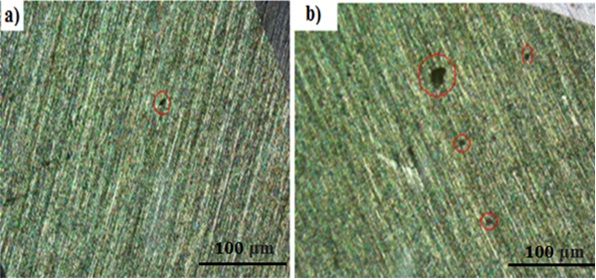
Figure 1 shows the central longitudinal surface of the AA6060 aluminum wire before corrosion for a polished sample (a) and after immersion of a polished and unetched sample in Keller's reagent (b). Keller's reagent is a solution used to reveal the microstructure of aluminum alloys. It preferentially attacks grain boundaries and precipitates, making them visible under an optical microscope. In image (a), a smooth and homogeneous surface is observed, indicating that the sample is free from corrosion. In contrast, image (b) shows the presence of corrosion pits, which are localized areas of intense corrosion. The pits are generally circular or elliptical and may be surrounded by an area of less intense corrosion. The presence of corrosion pits indicates that the sample has been corroded by Keller's reagent. This is likely due to the fact that Keller's reagent is an acidic solution, which can attack aluminum.
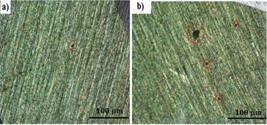
The central longitudinal surface of the AA6060 aluminum wire, a) before corrosion for a polished sample, b) after immersion of a polished and unetched sample in Keller's reagent.
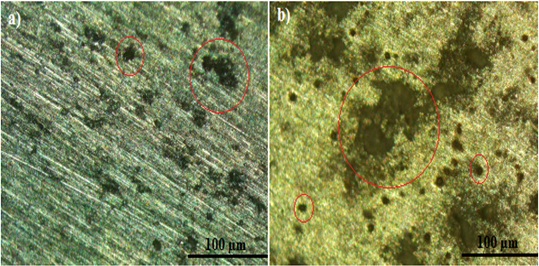
Vickers microhardness measurements along the longitudinal surface of the AA6060 aluminum wire at different distances reveal variations in hardness, indicating that the material's mechanical properties are not uniform. As shown in Table 2, the microhardness values fluctuate, suggesting possible differences in the microstructure, residual stresses from manufacturing, or uneven distribution of alloying elements. These variations could also influence the wire’s corrosion behavior, as regions with lower hardness may be more susceptible to localized degradation. At ambient temperature (Figure 2a), corrosion is primarily observed in areas where the wire surface has been physically damaged, indicating that surface defects serve as initiation sites for corrosion. Scratches and microstructural inconsistencies compromise the protective oxide layer, making the exposed metal more vulnerable to the aggressive seawater environment. However, at an elevated temperature of 55°C (Figure 2b), corrosion becomes more extensive and uniform across the surface. This suggests that higher temperatures accelerate corrosion by enhancing electrochemical reaction kinetics and weakening the stability of the oxide layer. Additionally, increased ion mobility in seawater at higher temperatures intensifies the corrosive attack on the aluminum wire. These findings underscore the significant impact of temperature on the corrosion behavior of AA6060 aluminum wire in seawater. The combined effects of microhardness variations, surface defects, and temperature-induced acceleration of corrosion highlight the need for careful consideration of environmental factors when assessing the durability of aluminum alloys in marine applications.
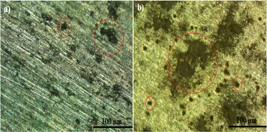
Microstructure of the longitudinal surface of the AA6060 aluminum wire after 24 hours of immersion in seawater: a) ambient temperature, b) at a temperature of 55°C.
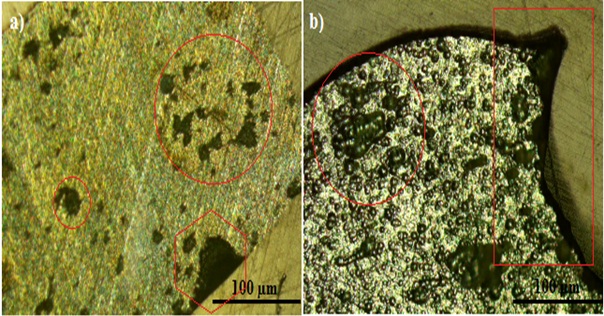
Vickers microhardness measurements were performed on the cross-section of the AA6060 wire in its as-received condition. Prior to testing, the samples were cold-embedded and polished to a mirror finish to ensure surface integrity. The 'distance from the surface' indicated in Table 2 refers to the radial depth measured from the outer periphery of the wire towards the center. The observed fluctuation in hardness values, ranging from approximately 12 HV to 34 HV, is attributed to the inherent microstructural heterogeneity resulting from the wire drawing process. Unlike macro-hardness, microhardness testing is highly sensitive to local microstructural features; the variations likely reflect the non-uniform distribution of hardening precipitates (such as Mg & Si) and differences in local grain orientation. The lower hardness values observed in the sub-surface region suggest a localized zone with lower precipitate density, while the increase in hardness towards the core (1000 µm) is consistent with the preservation of bulk mechanical properties.The microstructure of the longitudinal surface of the AA6060 aluminum wire after 24 hours of immersion (Figure 3) in seawater at ambient temperature is shown. Images (a) and (b) correspond respectively to a potentiostatic test and an imposed potential of 1.5 V, both performed in the presence of a magnetic field. In both cases, the presence of corrosion pits is observed, which are localized areas of intense corrosion. The pits are generally circular or elliptical and may be surrounded by an area of less intense corrosion. The size and density of the pits vary depending on the experimental conditions. In the potentiostatic test (a), the pits are relatively small and few in number. This suggests that the magnetic field has an inhibitory effect on corrosion. In contrast, in the imposed potential test (b), the pits are larger and more numerous. This indicates that the magnetic field can also have a promoting effect on corrosion, depending on the applied potential. The presence of corrosion pits is a significant problem for aluminum alloys, as they can lead to loss of mechanical strength and premature failure.
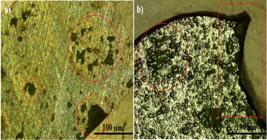
Microstructure of the longitudinal surface of the AA6060 aluminum wire after 24 hours of immersion in seawater at ambient temperature: a) potentiostatic test in the presence of a magnetic field, b) imposed E = 1.5V in the presence of a magnetic field.
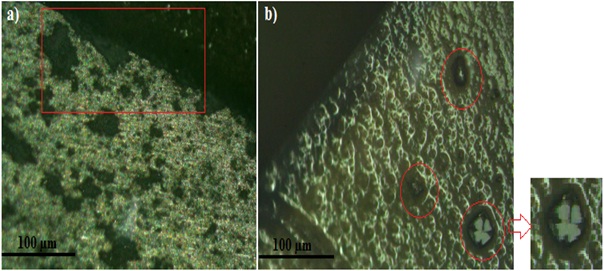
On the other hand, Figure 4 shows the microstructure of the longitudinal surface of the AA6060 aluminum wire after 24 hours of immersion in seawater at 55°C. Images (a) and (b) correspond respectively to a test in the presence of a magnetic field and an imposed potential of 1.5 V, also in the presence of a magnetic field. In the test in the presence of a magnetic field (a), the pits are relatively small and numerous. This suggests that the magnetic field has an inhibitory effect on corrosion. In contrast, in the imposed potential test (b), the pits are larger and more numerous. This indicates that the magnetic field can also have a promoting effect on corrosion, depending on the applied potential. The presence of salt crystals on the surface of the aluminum wire is also observed. These crystals can form when seawater evaporates, leaving behind dissolved salts. The salt crystals can accelerate corrosion by creating localized areas of high chloride ion concentration.
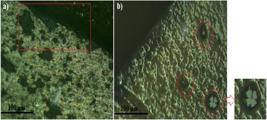
Microstructure of the longitudinal surface of the AA6060 aluminum wire after 24 hours of immersion in seawater at T= 55°C: a) in the presence of a magnetic field, b) imposed E = 1.5V in the presence of a magnetic field.
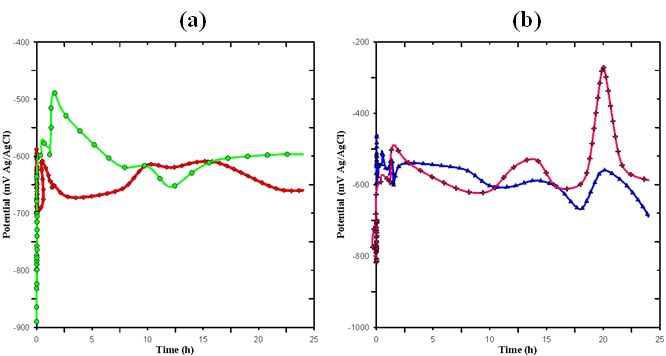
Figure 5a presents the time evolution of the open circuit potential (OCP) of the longitudinal surface of AA6060 aluminum wire after 24 hours of immersion in seawater at ambient temperature and 55°C. The potential values shift towards more negative directions over time in both cases, indicating a transition of the metal surface towards a more active state. Notably, the potential at 55°C is consistently more negative (anodic) than at ambient temperature. This shift suggests a decrease in the thermodynamic stability of the protective oxide film at elevated temperatures, rendering the material more susceptible to corrosion. This observation aligns with the principle that higher temperatures promote the breakdown of passive layers and enhance surface activity. Figure 5b further illustrates the effect of a magnetic field on the electrochemical behavior of the wire. The results show that the free corrosion potential becomes more negative when a magnetic field is applied compared to its absence. This indicates that the magnetic field interferes with the passivation process, maintaining the aluminum in a thermodynamically active dissolution range. While magnetic fields can sometimes inhibit corrosion by altering mass transport, the negative potential shift observed here points to a destabilizing effect on the surface film, which correlates with the enhanced localized attack discussed in the microstructural analysis.
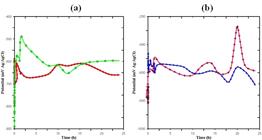
(a) Time evolution of Open Circuit Potential (OCP) of the longitudinal surface of AA6060 aluminum wire after 24 hours of immersion in seawater at ambient temperature and 55°C. (b) Effect of a magnetic field on the OCP of AA6060 aluminum wire in seawater over 24 hours.
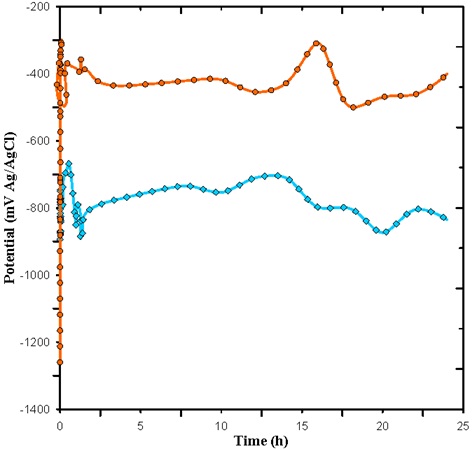
The evolution of the open circuit potential (OCP) of the longitudinal surface of the AA6060 aluminum wire after 24 hours of immersion in seawater, in the presence of a magnetic field and an imposed potential of 1.5 V at ambient temperature and 55°C, is shown in Figure 6. In both temperature conditions, it is observed that the potential values are significantly more negative in the combined presence of a magnetic field and an imposed potential compared to the magnetic field alone (refer to Figure 5). This pronounced negative shift suggests that the imposed potential, in conjunction with the magnetic field, drives the aluminum surface into a more active state. This result indicates a loss of passivity and a higher thermodynamic instability of the oxide layer. While this does not directly measure the reaction rate, the persistence of such negative potentials is consistent with a system prone to severe degradation, as the external electrical stress likely hinders the re-passivation of the metal surface.
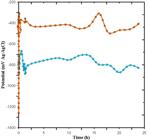
Evolution of Open Circuit Potential (OCP) of the longitudinal surface of the AA6060 aluminum wire after 24 hours of immersion in seawater in the presence of a magnetic field and "imposed E = 1.5V") ambient temperature at a temperature of 55°C.
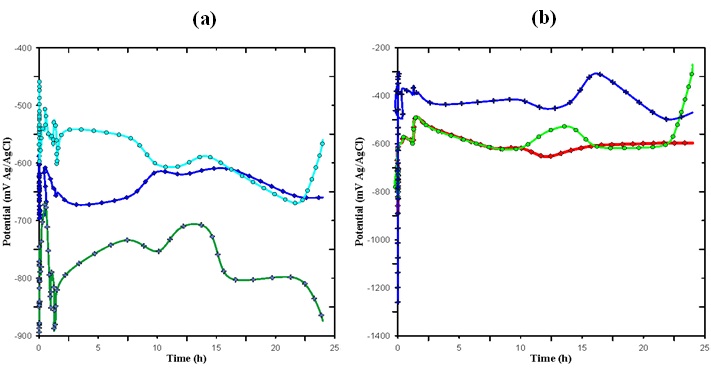
The evolution of the open circuit potential (OCP) of AA6060 aluminum wire in seawater was analyzed at both ambient temperature and 55°C under three different conditions: free immersion (♦), exposure to a magnetic field (●), and the application of an imposed potential of 1.5 V in the presence of a magnetic field (╬), as shown in Figures 7a and 7b. In all cases, the potential progressively shifts towards more negative values over time, indicating a transition towards a more active surface state. However, a much more pronounced shift towards negative values is observed when both a magnetic field and an imposed potential are applied, compared to free immersion or the magnetic field alone. This suggests that the synergistic effect of these factors hinders the natural passivation capability of the aluminum alloy. This observation aligns with electrochemical theories where a magnetic field may enhance local mass transport and ion mobility, thereby preventing the stabilization of the oxide layer. Additionally, the imposed potential of 1.5 V further acts as a driving force for oxidation, keeping the material in a thermodynamically unstable region. The combined effect of these electromagnetic influences significantly modifies the electrochemical behavior of aluminum in seawater, highlighting the need to consider these environmental factors for marine applications.
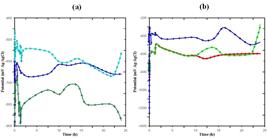
(a) Comparison of OCP evolution of AA6060 aluminum wire in seawater at ambient temperature and 55°C under free immersion (♦), in the presence of a magnetic field (●), and with an imposed potential of 1.5 V in the presence of a magnetic field (╬). (b)Effect of temperature, magnetic field, and imposed potential (1.5 V) on the corrosion potential of AA6060 aluminum wire in seawater over 24 hours.
4. Conclusion
In summary, this study explores the combined influence of temperature and magnetic field on the corrosion behavior of AA6060 aluminum wire in seawater. By employing electrochemical techniques, including free corrosion tests conducted with and without a low-intensity magnetic field, the research aims to assess the impact of these factors on corrosion rates and mechanisms. Additionally, surface analysis techniques are utilized to characterize the corrosion products and examine the morphology of the corroded surfaces. The findings are expected to reveal that both temperature and magnetic field significantly affect the corrosion behavior of AA6060. While elevated temperatures generally accelerate corrosion by enhancing the kinetics of electrochemical reactions, the effect of the magnetic field varies depending on its orientation and strength, potentially either accelerating or mitigating the corrosion process.
-
Data Availability
The entire dataset supporting the results of this study was published in the article itself.
5. References
- 1 Li Y, Zhang J. Corrosion behavior of aluminum alloy 6061 in NaCl solution containing S2O82- Corros Sci. 2012;55:154-61.
- 2 Luo X, Li D. Corrosion behavior of aluminum alloy 6060 in simulated marine environment. J Mater Sci Technol. 2023;72:128-37.
- 3 Song G, Atrens A. Corrosion mechanisms of magnesium alloys. Adv Eng Mater. 2014;16(11):1281-93.
- 4 Zamanzade M, Dehghanian C. Effect of alloying elements on the corrosion behavior of aluminum alloys. Int J Electrochem Sci. 2011;6(8):3328-41.
- 5 Chen C, Lin J. The influence of alloying elements on the corrosion behavior of aluminum alloys. Corros Sci. 2004;46(4):833-44.
- 6 Cao SX, Zhu M, Yuan YF, Guo SY. Corrosion behavior of 6061 aluminum alloy in simulated SO2-polluted seawater. J Mater Eng Perform. 2025;34(4):2850-61.
- 7 Li P, Chen Y, Huang H, Zhang H, Xie H, Piao HG. Investigation of corrosion behavior of galvanized steel as submarine cable armor in seawater under weak magnetic fields. Int J Electrochem Sci. 2023;18(9):100264.
- 8 Kuznetsova I, Lebedeva O, Kultin D, Perova N, Kalmykov K, Chernavskii P, et al. Is a 2D nanostructured surface capable of changing the corrosion and magnetic properties of an amorphous alloy? Int J Mol Sci. 2023;24(17):13373.
- 9 Laska A, Szkodo M, Cavaliere P, Perrone A. Influence of the tool rotational speed on physical and chemical properties of dissimilar friction-stir-welded AA5083/AA6060 joints. Metals. 2022;12(10):1658.
- 10 Raja PB, Sethuraman R. Corrosion behavior of aluminium alloy 6061 in chloride and sulphate solutions. Corros Sci. 2016;111:87-97.
- 11 Gutiérrez-Menchac J, Cabral-Miramontes JA, Garay-Tapia AM, Torres-Torres D, GaonaTiburcio C, Jaquez-Muñoz JM, et al. Influence of microstructure on corrosion behavior of Zn-Al-Sr alloys in sodium chloride solution. Int J Electrochem Sci. 2022;17(10): 221038.
- 12 Orłowska M, Ura-Bińczyk E, Śnieżek L, Skudniewski P, Kulczyk M, Adamczyk-Cieślak B, et al. Increasing the mechanical strength and corrosion resistance of aluminum alloy 7075 via hydrostatic extrusion and aging. Materials. 2022;15(13):4577.
- 13 Umehara Y, Takizawa T. Effect of magnetic field on corrosion behavior of aluminum alloys. Mater Trans. 2003;44(11):2340-4.
- 14 Cullity BD, Graham CD. Introduction to magnetic materials. Hoboken: John Wiley & Sons; 2011.
- 15 Zhang T, Wu Y. Influence of magnetic field on corrosion behavior of aluminum alloy in NaCl solution. J Magn Magn Mater. 2015;381:313-8.
- 16 Jiles DC. Introduction to magnetism and magnetic materials. Boca Raton: CRC Press; 2015.
- 17 Chikazumi S. Physics of ferromagnetism. Oxford: Oxford University Press; 1997.
- 18 He Z, Zhao Y, Fu J, Chen F, Chen G, Qin Y. Effect of alternating magnetic field on the organization and corrosion resistance of 2205 duplex stainless steel narrow-gap laser-MIG hybrid weld head. Coatings. 2023;13(12):2000.
- 19 Zhao S, Wang Y, Zhao Y, Sun X, Zhang H, Piao H-G, et al. The effect of magnetic field pretreatment on the corrosion behavior of carbon steel in static seawater. RSC Adv. 2020;10(4):2060-6.
- 20 Zhao M, Chen J, Yu M, Li B, Feng X. Effect of transverse magnetic field on weld formation and microstructure & properties of high-speed hot-wire tungsten inert gas welding joints. Sci Technol Weld Join. 2020;25(5):407-14.
- 21 Wu J, Xing SH, Liang CH, Lu L, Yan YG. The influence of electrode position and output current on the corrosion related electro‑magnetic field of ship. Adv Eng Softw. 2011;42(10):902-9.
- 22 Parapurath S, Ravikumar A, Vahdati N, Shiryayev O. Effect of magnetic field on the corrosion of API‑5L‑X65 steel using electrochemical methods in a flow loop. Appl Sci. 2021;11(19):9329.
- 23 Slimani R, Zazi N, Chopart J-P. Investigation of nickel deposition onto section and central longitudinal surfaces of AA1370 aluminum electrical wire with and without a weak permanent magnetic field. Prot Met Phys Chem Surf. 2016;52(1):111-8.
- 24 Maayta AK, Fares MM, Al‑Shawabkeh AF. Influence of linear alkyl benzene sulphonate on corrosion of iron in presence of magnetic field: kinetic and thermodynamic parameters. Int J Corros. 2010;2010:156194.
- 25 Zhao S, Wang Y, Zhao Y, Sun X, Zhang H, Piao HG, et al. The effect of magnetic field pretreatment on the corrosion behavior of carbon steel in static seawater. RSC Adv. 2020;10(4):2060-6.
- 26 Mitre CIN, Tosin G, Colnago LA. In‑operando analysis of the corrosion patterns and rates under magnetic fields using metallic film. npj Mater Degrad. 2022;6:24.
- 27 Alamri AS, AlGhamdi AS. Effect of temperature on the corrosion behavior of aluminum alloys in seawater. J Mater Eng Perform. 2014;23(10):3621-8.
- 28 Liu Y, Xu Z. Effect of temperature on the corrosion behavior of aluminum alloy 6061 in seawater. Corros Sci. 2010;52(10):3232-8.
- 29 Li P, Su HL, Song YJ, Wu YC. Effects of annealing temperature on microstructure and magnetic properties of Fe73.37Cu0.92Nb2.9Si13.56B9.24 amorphous alloy. Mater. Sci. Technol. 2013;29(4):460-63.
- 30 Nayak SK, Kumar A, Sarkar K, Banerjee A, Laha T. Corrosion behavior of Fe-based amorphous/nanocrystalline composite coating: correlating the influence of porosity and amorphicity. Mater. Proc. 2021;6(1):24.
- 31 Fu C, Xu L, Dan Z, Qin F, Makino A, Chang H, Hara N. Annealing effect of amorphous Fe-Si-BP-Cu precursors on microstructural evolution and redox behavior of nanoporous counterparts. J. Alloys Compd. 2017;726:810-19.
- 32 Cramer SD, Covino BS Jr. ASM handbook volume 13: corrosion. Ohio: ASM International; 2003.
- 33 Saji VS, Cook RM. Corrosion protection and control using nanomaterials. Sawston: Woodhead Publishing Limited; 2012.
- 34 Hasiak M, Chęcmanowski JG, Kucharska B, Łaszcz A, Kolano‑Burian A, Kaleta J. Effect of Co, Ti and Cr additions on microstructure, magnetic properties and corrosion resistance of magnetocaloric Gd‑Ge‑Si alloys. Materials. 2020;13(24):5758.
- 35 Ivashchenko O, Peplińska B, Gapiński J, Flak D, Jarek M, Zaleski K, et al. Silver and ultrasmall iron oxide nanoparticles in hydrocolloids: effect of magnetic field and temperature on self‑organization. Sci Rep. 2018;8:4041.
- 36 El‑Bagoury N, El‑Hadad S, Shoeib M. Influence of various alloying element additions on microstructure and magnetic and mechanical properties and corrosion behavior of cast Fe–Ga–Z shape memory alloys. Metallogr Microstruct Anal. 2023;12:1009-19.
- 37 Liu Y, Wang Y, Li J, Zhang H, Chen W. Effect of annealing temperature on the microstructure, magnetic properties, and corrosion resistance of Fe75.8Si12B8Nb2.6Cu0.6P1 alloy. J Mater Res Technol. 2021;15:3880-94.
- 38 Kusumadewi AN, Damayanti L. Rukiah, Risdiana. Factors affecting the attractive force of dental magnetic attachment: a literature review for guiding dentists in clinical application. Int J Dent. 2022;2022:9711285.
- 39 Mo X, Lv J, Liu Q, Jiang X, Si G. A magnetic field SPR sensor based on temperature self‑reference. Sensors. 2021;21(18):6130.
- 40 Zhu Y, Zhou H, Chen Z, Wang Z, He F, Xu C. Study on microstructure and properties of Ni60A/WC composite coating by alternating‑magnetic‑field‑assisted laser cladding. Micromachines. 2022;13(5):653.
- 41 Li YH, Chen YJ. The effect of magnetic field on the dynamics of gas bubbles in water electrolysis. Sci Rep. 2021;11:9346.
- 42 Chen S, Deng H, Liu G, Zhang D. Corrosion of Q235 carbon steel in seawater containing Mariprofundus ferrooxydans and Thalassospira sp. Front Microbiol. 2019;10:936.
Edited by
-
Associate Editor:
Hugo Sandim.
-
Editor-in-Chief:
Luiz Antonio Pessan.
The entire dataset supporting the results of this study was published in the article itself.