 First report of Hyssuridae (Isopoda: Anthuroidea) from Japan, with the description of a new Kupellonura species
Abstract
We describe Kupellonura tamago sp. nov., collected from the North Pacific off the southern coast of the Boso Peninsula, Japan, at a depth of 445-407 m. This is the first record of Hyssuridae not only for Japan but also for the Temperate Northern Pacific ecoregion. Female K. tamago closely resembles Kupellonura gidgee Poore and Lew Ton, 1988 and Kupellonura indonesica Annisaqois and Wägele, 2021 in the shape of the uropodal exopod but differs from them in having a broader uropodal exopod (length/width ratio 1.47), a broader uropodal endopod (length/width ratio 1.64), and the telson margins smooth. We transfer Kupellonura flexibilis (Pasternak, 1982), originally described in Ananthura Barnard, 1925 but provisionally transferred to Kupellonura Barnard, 1925, to Anthelura Norman and Stebbing, 1886 in Antheluridae, as Anthelura flexibilis (Pasternak, 1982) comb. nov.
Keywords:
Crustacea; Cymothoida; deep sea; new combination; taxonomy
INTRODUCTION
Species in the anthuroid isopod family Hyssuridae are distinguished from members in the other families by having (1) elongate pleonites 1-5, (2) similar, non-operculiform pleopods 1-5, and (3) the carpi of pereopods 2-3 strongly produced ventrodistally (Poore, 2001). This family currently comprises 41 species in six genera: BeluraPoore and Lew Ton, 1988 (2 species); GalziniellaMüller, 1991 (1 species); HyssuraNorman and Stebbing, 1886 (7 species); KupellonuraBarnard, 1925 (18 species); NeohyssuraAmar, 1953 (6 species); and XenanthuraBarnard, 1925 (7 species) (Poore and Bruce, 2012; Annisaqois and Wägele, 2021).
Kupellonura is the most species-rich hyssurid genus and differs from the other five genera by combining the following characters: (1) the uropodal exopod longer than wide, (2) the uropodal exopod and telson without cuticular spine, (3) the carpi of pereopods 4-7 trapezoidal, with 1 marginal spiniform seta, and (4) the pleopod 1 endopod longer and broader than the exopod (Poore, 2001). At present, Kupellonura species have been reported from the intertidal zone to 2,829 m depth, from all marine ecoregions except the Arctic, Temperate Northern Pacific, Tropical Eastern Pacific, and Temperate South America (Poore, 2001; Poore and Bruce, 2012; Annisaqois and Wägele, 2021; cf. Spalding et al., 2007) (but see the Remarks section for Kupellonura below).
Here we describe a new species of Kupellonura collected in the North Pacific off the southern coast of the Boso Peninsula, Japan, at a depth of 445-407 m. This is the first record of Hyssuridae not only for Japan but also for the Temperate Northern Pacific ecoregion. In addition, we transfer Kupellonura flexibilis (Pasternak, 1982) to the genus AntheluraNorman and Stebbing, 1886 in Antheluridae.
MATERIAL AND METHODS
Our specimen was collected in 2003 off the southern coast of Boso Peninsula, Japan, with a biological dredge having a 1 m opening, during cruise KT03-17 of RV “Tansei-maru”, and fixed and preserved in 70 % ethanol. The methods used for dissection, preparation of slides, light microscopy, and drawing were as described by Shiraki et al. (2021). Body length was measured from the tip of the anterolateral lobe of the head to the tip of telson, and body width at the widest portion of pereonite 7. Measurements were made axially from digital images by using ImageJ (http://rsb.info.nih.gov/ij). We treated non-manca individuals without oostegites or appendix masculina as females lacking oostegites. The material examined is deposited in the collections of the Seto Marine Biological Laboratory (SMBL), Wakayama, Japan.
SYSTEMATICS
Superfamily Anthuroidea Leach, 1814
Family Hyssuridae Wägele, 1981
Genus Kupellonura Barnard, 1925
Type species. Kupellonura mediterranea Barnard, 1925
Diagnosis. See Poore (2001).
Remarks. Kupellonura flexibilis was described from the Mediterranean as Ananthura flexibilisPasternak, 1982. Negoescu (1984) provisionally transferred it to Kupellonura, but noted that this species does not show some of the features diagnostic for Kupellonura; its short pleonites 1-5 and the operculiform pleopod 1 contradict even the familial diagnosis of Hyssuridae. Here we transfer this species to Anthelura in Antheluridae as Anthelura flexibilis (Pasternak, 1982) comb. nov., based on the following features: (1) pleonites 1-5 free, (2) broad maxillipedal palp, (3) pereopods 4-7 carpi much longer than wide, and (4) pereopod 1 merus broader than the propodus (cf. Poore, 2001). This species differs from the sole congener Anthelura elongataNorman and Stebbing, 1886 in the number of articles in the antennal flagellum, which are eight in A. flexibilis but seven in A. elongata (see Pasternak, 1982; Negoescu, 1984; Poore, 2001). This changes the deepest record for Kupellonura to 1,141 m (Negoescu, 2006), reported for Kupellonura cryosiNegoescu, 2006.
Species composition. Eighteen species: Kupellonura afareaituMüller, 1991; Kupellonura biriwaPoore and Lew Ton, 1988; Kupellonura capensis (Kensley, 1975); Kupellonura caudoserrataNegoescu, 1994; K. cryosi; Kupellonura currawanPoore and Lew Ton, 1988; Kupellonura formosa (Menzies and Frankenberg, 1966); Kupellonura gidgeePoore and Lew Ton, 1988; Kupellonura imswe (Kensley, 1982); Kupellonura indonesicaAnnisaqois and Wägele, 2021; Kupellonura macaroniAnnisaqois and Wägele, 2021; Kupellonura marrongiePoore and Lew Ton, 1988; Kupellonura mediterraneaBarnard, 1925 (type species); Kupellonura probertiWägele, 1985; Kupellonura racovitzaiGeorge and Negoescu, 1985; Kupellonura serritelsonWägele, 1981; Kupellonura tamago sp. nov.; and Kupellonura weraweraPoore and Lew Ton, 1988.
Kupellonura tamago sp. nov.
[New Japanese name: Tamago-haranaga-uminanafushi]
Zoobank: urn:lsid:zoobank.org:act:E4E7C71C-DA76-486F-98B3-2256ABA69AC3

Kupellonura tamago sp. nov., holotype, female, lateral view of fixed specimen. Scale bar: 1 mm.

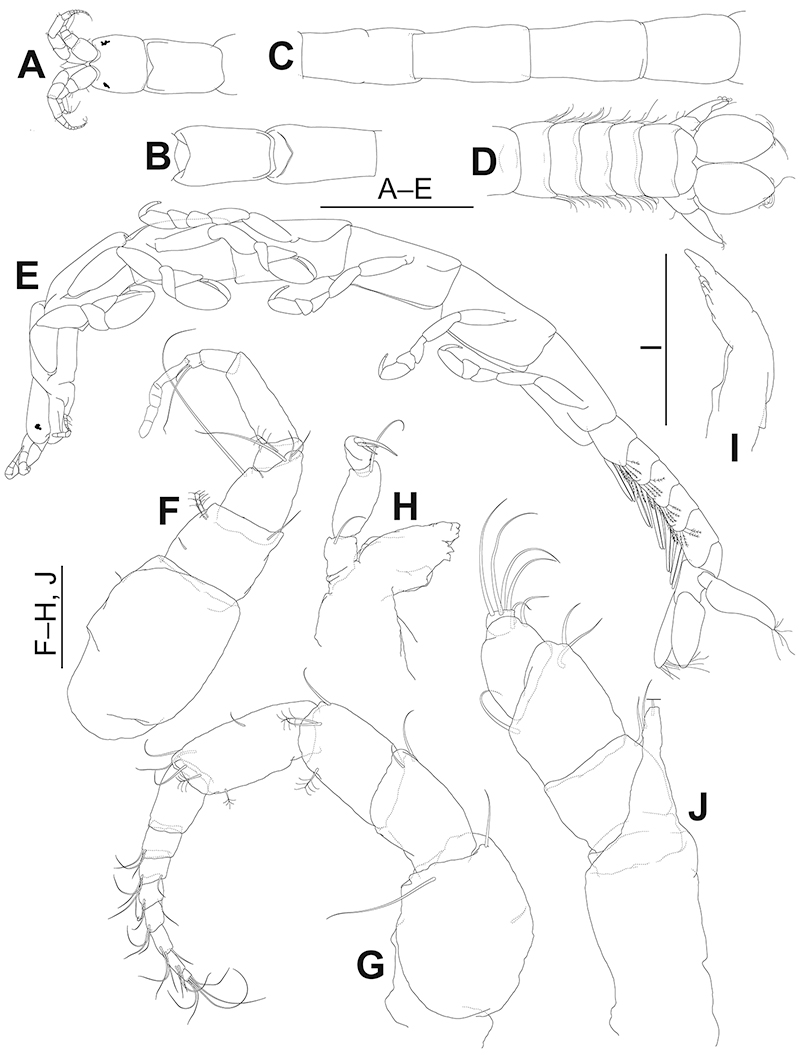
Kupellonura tamago sp. nov., holotype, female. A-D, dorsal view; E, lateral view. A, head and pereonite 1; B, pereonites 2 and 3; C, pereonites 4-7; D, pleon; E, body; F, left antennula; G, right antenna; H, right mandible; I, maxilla; J, left maxilliped. Scale bars: 1 mm (A-E); 100 µm (F-J).

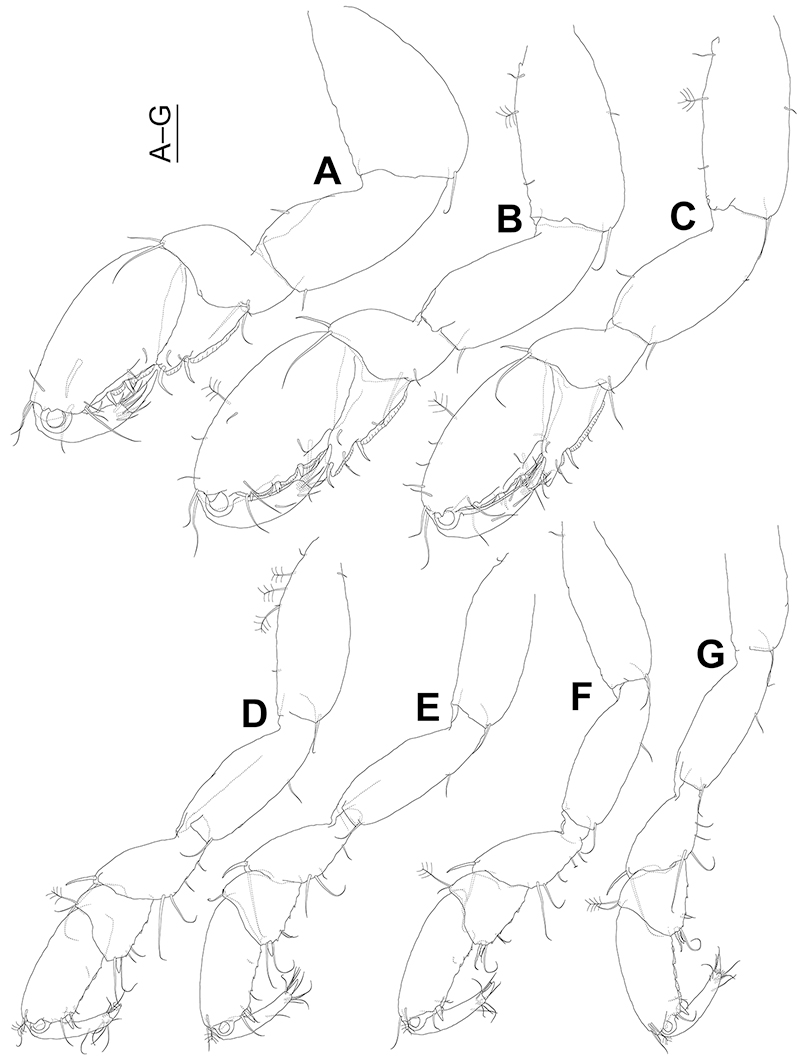
Kupellonura tamago sp. nov., holotype, female. A-G, left pereopods 1-7. Scale bar: 100 µm.

Kupellonura tamago sp. nov., female. A, B, D, E, left pleopods 1, 2, 4, and 5; C, right pleopod 3; F, left uropodal endopod; G, left uropodal exopod; H, telson. Scale bars: 100 µm.
Etymology. The specific name is derived from the Japanese noun tamago (“egg”), referring to the oval shape of uropodal exopod.
Diagnosis. Eyes present. Telson margins smooth. Length of antennular flagellum article 2, 2.50 times width. Margins of uropodal endopod smooth, without serrations. Length of uropodal exopod 1.47 times width, oval, widest at proximal third; inner margin smooth, without serration or crenulation; outer margin not concave.
Type material. Holotype: female without oostegites (SMBL-V0638, 14 slides and 1 vial; body length 6.79 mm, body width 0.44 mm, head length 0.38 mm, head width 0.38 mm, eye length 0.04 mm); 34°57.091'N 140°07.774'E to 34°57.404'N 140°07.626'E, Stn. KG-4, off the southern coast of the Boso Peninsula, Japan, Northern Pacific, 445-407 m depth; 17 November 2003; collected by M. Shimomura.
Description of female holotype. Body length (Figs. 1, 2A-E) 15.31 times body width, slender, without dorsal pigmentation in fixed specimen. Head length (Fig. 2A) 1.00 times head width; rostrum protruding as much as anterolateral lobes; eyes dorsolateral, small; length ratio of eye to head, 0.04. Pereonites 1-7 (Fig. 2A-C) with length ratio 1.00:1.22:1.25:1.65:1.74:1.74:1.57. Pleonites 1-6 (Fig. 2D) articulated, with length ratio 1.00:1.04:0.99:0.93:1.08:0.93; combined length pleonites 1-6, 0.19 times body length; pleonites 1-4 with several lateral plumose setae. Telson (Fig. 4H) oval, margins smooth, with simple seta laterally and 16 distal simple setae.
Antennula (Fig. 2F) with three peduncular articles and four flagellar articles. Peduncular article 1 longest, with outer simple seta; article 2 with 2 outer distal plumose sensory setae, and 1 outer distal, 1 mid-dorsal, and 1 inner distal simple seta; article 3 with 5 distal simple setae. Flagellar article 1 with distal plumose sensory seta; article 2 length 2.50 times width, naked; article 3 naked; article 4 with 2 outer distal simple setae and prominent aesthetasc.
Antenna (Fig. 2G) with 5 peduncular articles and 8 flagellar articles. Peduncular article 1 naked; article 2 with 2 distal and 1 inner middle simple seta; article 3 with 2 inner distal simple setae; article 4 with 1 outer and 1 distal plumose sensory seta and 2 distal simple setae; article 5 with one outer and 1 distal plumose sensory seta, and 1 inner middle and 3 distal simple setae. Flagellar articles 1-8 with 0, 3, 4, 4, 3, 4, 3, and 5 distal simple setae, respectively.
Mandible (Fig. 2H) with tri-articulate palp. Palp article 1 with distal simple seta; article 2 longest, with distal simple seta; article 3 with 3 distal spiniform setae. Incisor with 2 cusps; lamina dentata with 2 teeth, molar rounded.
Maxilla (Fig. 2I) with 1 strong and 5 smaller distal teeth.
Maxilliped (Fig. 2J) with 5-articulate palp. Palp article 1 naked; article 2 with inner distal simple seta; article 3 with 3 distal simple setae; article 4 with 2 distal simple setae; article 5 with 4 distal simple setae. Endite overreaching distal margin of palp article 2, with distal simple seta and distal seta (tip broken).
Pereopod 1 (Fig. 3A) subchelate, robust. Basis with ventrodistal simple seta. Ischium with 1 dorsal and 1 ventrodistal simple seta. Merus with 2 dorsodistal and 3 ventrodistal simple setae. Carpus triangular, not produced ventrodistally, with 1 ventroproximal and 1 ventrodistal transparent membrane-like process, and 2 ventral spiniform setae and 2 subdistal simple setae. Propodus broad, with inner spiniform seta, and 1 outer proximal, 3 dorsodistal, and 1 ventrodistal simple seta. Palm with 1 ventroproximal and 1 mid-ventral transparent membrane-like process, 2 ventral spiniform setae, and 2 ventro-subproximal and 3 ventro-subdistal simple setae. Dactylus with ventrodistal short spiniform seta and 1 mid-ventral, 5 subdistal, and 3 distal simple setae. Unguis naked, length nearly two-thirds dactylus length.
Pereopod 2 (Fig. 3B) subchelate, as robust as pereopod 1. Basis with dorsal plumose sensory seta, and 2 dorsal and 2 ventral simple setae. Ischium with ventrodistal simple seta. Merus with dorsodistal spiniform seta, and 1 dorsodistal and 3 ventrodistal simple setae. Carpus triangular, with ventrodistal prolongation, 1 ventroproximal and 1 ventrodistal transparent membrane-like process, 1 mid-ventral and 1 ventrodistal spiniform seta, and 1 outer and 3 ventral simple setae. Propodus with dorsal plumose sensory seta and 2 subproximal, 2 dorsal, and 3 dorsodistal simple setae. Palm with 1 ventroproximal, 1 mid-ventral, and 1 ventro-subdistal transparent membrane-like process, mid-ventral two-pronged spiniform seta, 1 ventro-subproximal and 1 ventro-subdistal spiniform seta, and 3 ventro-subdistal simple setae. Dactylus with 2 middle and 6 distal simple setae. Unguis naked, length nearly half dactylus length.
Pereopod 3 (Fig. 3C) subchelate, similar to pereopod 2 except in number of simple setae.
Pereopod 4 (Fig. 3D) with basis, ischium, merus similar to those of pereopod 3 but narrower and bearing different numbers of plumose sensory setae and simple setae. Carpus trapezoidal, with 4 small ventral processes, ventrodistal spiniform seta, dorsodistal plumose sensory seta, and 1 dorsodistal and 4 ventral simple setae. Propodus with dorsodistal plumose sensory seta and 2 dorsodistal simple setae. Palm with several small ventral processes, ventrodistal spiniform seta, and 1 inner and 4 ventrodistal simple setae. Dactylus narrow, with 1 ventro-subproximal, 1 dorso-subdistal, and 9 distal simple setae. Unguis naked, length nearly one-quarter dactylus length.
Pereopods 5-7 (Fig. 3E-G) similar to pereopod 4, except for number of plumose sensory setae and simple setae.
Pleopod 1 (Fig. 4A) protopod with 2 inner hooks and outer simple seta. Exopod not operculiform, length 1.82 times width, with 22 plumose setae (one broken). Endopod length 1.80 times width, 0.96 times exopod length, with 9 plumose setae. Protopod, exopod, and endopod partly covered with fine setae.
Pleopods 2-5 (Fig. 4B-E) similar to pleopod 1, except for number of plumose setae on endopod (9, 8, 9, 8 plumose setae on endopods 2-5, respectively).
Uropodal endopod (Fig. 4F) length 1.64 times width, with 3 distal plumose sensory setae and 34 simple setae. Exopod (Fig. 4G) oval, widest at proximal third, length 1.47 times width, with 15 simple setae (2 with tip broken); inner margin smooth, without serration or crenulation; outer margin not concave.
Remarks. The uropodal exopod in female K. tamago sp. nov. is widest at the proximal third; the inner margin is smooth, without serration or crenulation; the outer margin is not concave. Females of K. tamago sp. nov. share these features with females of K. gidgee and K. indonesica, but differ from them as follows (character states in parentheses, K. gidgee and K. indonesica, respectively): uropodal exopod broader, with the length/width ratio 1.47 (2.1; 2.4); uropodal endopod broader, with the length/width ratio 1.64 (2.1; not mentioned); telson margins smooth (dentate distally; paired prominent dentations on distolateral margins) (Poore and Lew Ton, 1988; Annisaqois and Wägele, 2021).
The description of the tailfan of female K. serritelson is insufficient, but K. tamago sp. nov. differs from this species in having a more-elongate antennular flagellum article 2 (length 2.50 times the width in K. tamago sp. nov.; 1.44 times in K. serritelson), a more-elongate antennal peduncle article 5 (length 2.14 times the width in K. tamago sp. nov.; 1.56 times in K. serritelson), and the carpus of pereopod 1 lacking the ventrodistal prolongation present in pereopods 2 and 3 (ventrodistal prolongation present on the carpus of pereopod 1 in K. serritelson) (Wägele, 1981).
ACKNOWLEDGEMENTS
We thank Prof. Emeritus Suguru Ohta of the University of Tokyo for the opportunity to join cruise KT03-17; the captain and crew of RV “Tansei-maru” and researchers aboard for support; and Dr. Matthew H. Dick for reviewing the manuscript and editing the English. This study was supported in part by a KAKENHI grant (JP15770062) from the Japan Society for the Promotion of Science (JSPS).
REFERENCES
- Amar, R. 1953. Isopodes marins du littoral corse. Bulletin de Société Zoologique de France, 77:349-355.
- Annisaqois, M. and Wägele, J.W. 2021. Morphology and taxonomy of Isopoda Anthuroidea (Crustacea) from Sulawesi with description of six new species. European Journal of Taxonomy, 768:1-52.
- Barnard, K.H. 1925. A revision of the family Anthuridae (Crustacea Isopoda), with remarks on certain morphological peculiarities. Zoological Journal of the Linnean Society, 36:109-160.
- George, R.Y. and Negoescu, I. 1985. Anthuridean isopods (Crustacea: Isopoda: Anthuridea) from the subantarctic islands-South Georgia, Elephant, South Orkney and Falkland. Travaux du Muséum d’Histoire Naturelle “Grigore Antipa”, 27:17-47.
- Kensley, B. 1975. Marine Isopoda from the continental shelf of South Africa. Annals of the South African Museum, 67:35-89.
- Kensley, B. 1982. Anthuridea (Crustacea: Isopoda) of Carrie Bow Cay, Belize. Smithsonian Contributions to Marine Science, 12:321-353.
- Leach, W.E. 1814. Crustaceology. p. 383-429. In: D. Brewster (ed), The Edinburgh Encyclopaedia, vol 7. Edinburg, Balfour.
- Menzies, R.J. and Frankenberg, D. 1966. Handbook on the Common Marine Isopod Crustacea of Georgia. Athens, University of Georgia Press, 93p.
- Müller, H.G. 1991. Three new species and a new genus of eyeless isopods from coral reefs at Moorea, Society Islands (Crustacea: Isopoda: Hyssuridae, Gnathostenetroididae). Senckenbergiana Biologica, 71:289-301.
- Negoescu, I. 1984. The study of the Anthuridean isopods (Crustacea, Isopoda, Anthuridea) from the cruises of the French oceanographic vessels. Travaux du Muséum d’Histoire Naturelle “Grigore Antipa”, 26:45-59.
- Negoescu, I. 1994. Isopoda Anthuridea (Crustacea: Peracarida) from New Caledonia and Loyalty Islands (South-western Pacific Ocean), I. Travaux du Muséum d’Histoire Naturelle “Grigore Antipa”, 34:147-225.
- Negoescu, I. 2006. Anthuridean isopods (Crustacea: Isopoda: Anthuridea) from the eastern Atlantic Ocean (off Ibero-Moroccan coasts). II. Kupellonura cryosi new species. Travaux du Muséum National d’Histoire Naturelle “Grigore Antipa”, 49:35-47.
- Norman, A.M. and Stebbing, T.R.R. 1886. V. On the Crustacea Isopoda of the ‘Lightning’, ‘Porcupine’, and ‘Valorous’ Expeditions. Part I.- Apseudidae, Tanaidae, Anthuridae. Transactions of the Zoological Society of London, 12(4):77-141.
- Pasternak, B. 1982. Composition, origin and peculiarities of distribution of the Mediterranean deep-sea isopod fauna. Trudy Instituta Okeanologii Akademiya Nauk SSSR, 117:163-177.
- Poore, G.C.B. 2001. Families and genera of Isopoda Anthuridea. p. 63-173. In: B. Kensley and R.C. Brusca (eds), Isopod Systematics and Evolution. Rotterdam, Balkema. (Crustacean Issues, 13)
- Poore, G.C.B. and Bruce, N.L. 2012. Global diversity of marine isopods (except Asellota and crustacean symbionts). PLoS ONE 7(8):e43529, 15p.
- Poore, G.C.B. and Lew Ton, H.M. 1988. A generic review of the Hyssuridae (Crustacea: Isopoda) with a new genus and new species from Australia. Memoirs of the Museum of Victoria, 49:169-193.
- Shiraki, S.; Shimomura, M. and Kakui, K. 2021. A new species of Expanathura (Crustacea: Isopoda: Anthuroidea) from Iriomote Island, Japan, with a note on male polymorphism. Zootaxa, 5047:377-390.
- Spalding, M.D.; Fox, H.E.; Allen, G.R.; Davidson, N.; Ferdaña, Z.A.; Finlayson, M.; Halpern, B.S.; Jorge, M.A.; Lombana, A.L.; Lourie, S.A.; Martin, K.D.; McManus, E.; Molnar, J.; Recchia, C.A. and Robertson, J. 2007. Marine ecoregions of the world: a bioregionalization of coastal and shelf areas. BioScience, 57:573-583.
- Wägele, J.W. 1981. Study of the Hyssuridae (Crustacea: Isopoda: Anthuridea) from the Mediterranean and the Red Sea. Israel Journal of Zoology, 30:47-87.
- Wägele, J.W. 1985. Two new genera and twelve new species of Anthuridea (Crustacea; Isopoda) from off the west coast of New Zealand. New Zealand Journal of Zoology, 12:363-423.