
 Do policing strategies affect political attitudes? The effects of police stops on satisfaction with democracy in São Paulo
Abstract
The police are among the most visible state representatives. Yet, little is known about how police-citizen contacts affect political attitudes. In Brazil, police stops have been central to public security measures since the late 1990s. These stops often violate citizens’ civil rights. Drawing upon panel data representative of the city of São Paulo, we investigate whether being stopped or being stopped at gunpoint by the police affect citizens’ satisfaction with democracy. To conduct this analysis we apply the panel match model that combines difference-in-differences with matching. We also test a causal mechanism that relates police stops to satisfaction with democracy considering perceptions of police procedural fairness. Our results indicate that police stops at gunpoint reduce satisfaction with democracy because the stops reduce perceptions of procedural fairness.
police stops; satisfaction with democracy; procedural justice; police-citizen contacts; political attitudes
Resumo
A polícia está entre os braços mais visíveis do estado. No entanto, sabemos pouco sobre a relação entre contatos com a polícia e atitudes políticas. No Brasil, as abordagens policiais são centrais na segurança pública desde o final da década de 1990. Essas abordagens frequentemente violam direitos civis. Utilizando dados de painel representativos da cidade de São Paulo, investigamos se ser abordado ou ser abordado à mão armada afetam a satisfação com a democracia. Para realizar essa análise, aplicamos o modelo panel match, que combina diferenças-em-diferenças com matching. Também testamos um mecanismo causal que relaciona as abordagens com a satisfação com a democracia por meio das percepções de justiça procedimental da polícia. Nossos resultados indicam que as abordagens à mão armada reduzem a satisfação com a democracia por meio da redução das percepções de justiça procedimental.
abordagem policial; satisfação com a democracia; justiça procedimental; contatos polícia-cidadão; atitudes políticas
Resumen
La policía es una parte visible del Estado, pero se sabe poco sobre cómo los encuentros con la policía afectan las actitudes políticas. En Brasil, las paradas policiales han sido fundamentales en la seguridad pública desde la década de 1990 y a menudo violan los derechos civiles. Utilizando datos de la ciudad de São Paulo, se investiga si ser detenido o ser detenido a punta de pistola afecta la satisfacción con la democracia. Se aplicó el modelo panel match que combina diferencias en diferencias con el matching. También se probó un mecanismo causal que relaciona las paradas policiales con la satisfacción con la democracia a través de las percepciones de justicia procedimental de la policía. Los resultados indican que las paradas policiales a punta de pistola reducen la satisfacción con la democracia al disminuir las percepciones de justicia procedimental.
paradas policiales; satisfacción con la democracia; justicia procedimental; contactos entre la policía y los ciudadanos; actitudes políticas
Résumé
La police est l'une des branches les plus visibles de l'État, mais on sait peu de choses sur la manière dont les contacts avec la police affectent les attitudes politiques. Au Brésil, les contrôles de police sont au cœur de la sécurité publique depuis les années 1990. Ces contrôles violent fréquemment les droits civils. Le texte examine l'impact des contrôles de police, avec ou sans arme au poing, sur la satisfaction à l'égard de la démocratie. En utilisant des données de panel de la ville de São Paulo, l'étude applique le modèle panel match qui combine la méthode des doubles differénces avec le matching et teste un mécanisme causal liant ces contrôles à la satisfaction à l'égard de la démocratie, en se basant sur les perceptions de justice procédurale de la police. Les résultats révèlent que les contrôles policiers l’arme au poing ont un impact négatif sur cette satisfaction, en raison d'une perception réduite de la justice procédurale.
contrôles policiers; satisfaction à l'égard de la démocratie; justice procédurale; contacts police-citoyens; attitudes politiques
Introduction
Do policing strategies affect political behavior and attitudes? Surprisingly, we do not know. The criminal justice system is a part of the state that is in constant contact with many citizens, particularly poor individuals and ethnic minorities who live in the peripheral regions of large cities3. In addition, interaction with the police influences how principles that sustain democracy are practiced – such as guaranteeing and respecting human rights, security, and freedom of association and expression – in a way that it is central to building relationships between citizens and the state. Yet only a handful of studies have analyzed the associations between police actions, such as police stops, and political attitudes and behavior (Weaver; Lerman, 2010; Lerman; Weaver, 2014; Laniyonu, 2019).
This article is intended to help fill that gap by analyzing the effect of police stops in general, and particularly police stops at gunpoint, on satisfaction with democracy. Drawing upon panel data representative of residents of the city of São Paulo, Brazil, we find that police stops at gunpoint reduce satisfaction. This finding has important theoretical and policy implications, since it demonstrates that policing strategies affect not only attitudes towards the criminal justice system, but also towards democratic values in general.
Despite the lack of analysis of the effects of police-citizen interactions on political behavior and attitudes, studies on public safety and criminal justice have analyzed how such encounters impact attitudes toward the police, particularly trust and legitimacy. Research confirms that the perception of procedural fairness during police-citizen interactions influences trust in and the legitimacy of the police (Tyler; Huo, 2002; Hough et al., 2010; Li; Ren; Luo, 2016; Van Damme, 2017).
Procedural fairness consists of a notion of justice that emphasizes procedures over results (Tyler, 1990). Police are procedurally fair, for example, when they satisfactorily explain why they are approaching citizens, the procedures to be followed during the approach, when they make citizens’ rights clear, and when they do not apply unnecessary violence. It is, therefore, a conception of justice directly linked to democratic principles, such as the rule of law, due process, and accountability. There is evidence that perceptions of procedural fairness in encounters with the police are among the main predictors of trust and legitimacy of the institution (Tyler; Huo, 2002; Hough et al., 2010).
Given the major role procedural fairness plays in explaining trust and legitimacy of the police in democratic states where people expect the police to follow clear rules and procedures, we also test a causal mechanism that links police stops to satisfaction with democracy through its effects on perceptions of police fairness. Thus, one of our hypotheses is that being stopped by the police reduces confidence in the procedural fairness of police actions and as a consequence negatively impacts satisfaction with democracy. Our results confirm that stops at gunpoint reduce satisfaction with democracy through their negative impact on confidence in the procedural fairness of the police.
To test our hypotheses, we used a recent development of the difference-in-differences technique, the panel match model (Imai; Kim; Wang, 2021), using panel data representative of the city of São Paulo, Brazil, for 2015 and 2017, collected by the Center for the Study of Violence at the University of São Paulo (NEV/USP)4. In addition, we used one of the most recent mediation analysis techniques to test the causal mechanism – the regression-with-residuals method (Zho; Wodtke, 2019).
This article is organized into seven sections: (1) Police stops and attitudes towards the police, (2) Police stops, political attitudes, and behaviors, (3) Police stops in Brazil, (4) The objective of this article, (5) Data and methods, (6) Results, and (7) Discussion and conclusion.
Police stops and attitudes towards the police
Most studies on the effects of police stops on attitudes have focused on attitudes towards the police and the criminal justice system, such as trust and legitimacy (Tyler; Fagan, 2008; Gau, 2011; Li; Ren; Luo, 2016; Van Damme, 2017).
The hypothesis underlying such investigations is that better perceptions of the decision-making process and the way police treat citizens during encounters with them are positively related to attitudes toward the police (Gau, 2011; Li; Ren; Luo, 2016; Van Damme, 2017). The idea is that recognition of police legitimacy derives from citizens perceiving that the police behave fairly and follow procedures. This means that fairness in the procedures adopted during police-citizen interactions promotes the belief that the police have legitimate authority and are worthy of allegiance (Hinds; Murphy, 2007; Tyler; Fagan, 2008; Hough et al., 2010).
Contact with police happens in different ways and each form of contact has distinct effects on attitudes. Silva and Beato (2013) found that the adverse effects of police-initiated interactions on trust in the police were higher than those arising from citizen-initiated interactions. In the city of São Paulo, Oliveira (2022) found that police approaches at gunpoint reduced the institution's legitimacy, while those that did not happen at gunpoint did not affect this legitimacy. At gunpoint, expectations of procedural justice decline, while perceptions that the police act as if they were above the law increase, undermining police legitimacy. Several other studies carried out in countries such as the United States, the United Kingdom, and Australia demonstrate that negative evaluations of procedural fairness in police-citizen contacts negatively impact the trust and legitimacy of the institution (Skogan, 2006; Li; Ren; Luo, 2016; Van Damme, 2017; Oliveira et al., 2020).
Thus, policing strategies affect perceptions of the police. The perception of procedural fairness plays a central role in this process, with a more significant impact on the trust and legitimacy of the institution than perceptions of police effectiveness (Van Damme, 2017; Oliveira et al., 2020).
Police stops, political attitudes, and behaviors
Investigations into beliefs, values, attitudes, and feelings towards a democratic system and its institutions are essential for studies that link political attitudes with the stability of political systems (Easton, 1975; Norris, 1999; Booth; Seligson, 2009). For this reason, satisfaction with democracy is an indicator frequently used in studies of political behavior.
Satisfaction with the political system is a component of the specific dimension of political legitimacy. Components of the specific dimension of legitimacy are more susceptible to short-term changes linked to individual experiences and serve as indicators of the evaluation of the performance of a government, while diffuse dimensions measure general attitudes towards the state that are less affected by everyday perceptions about the performance of governments (Easton, 1975; Norris, 1999; Booth; Seligson, 2009). Satisfaction with democracy, as measured by most surveys, consists of an indicator of satisfaction with the performance of the political system in terms of its ability to deliver public policies that improve the well-being of citizens (Norris, 1999; Booth; Seligson, 2009). It differs from diffuse dimensions of political legitimacy, which are much more abstract. Support for democracy, for example, is related to citizens’ preferences for democracy over other types of government, such as authoritarian or dictatorial states. Hence, specific dimensions and, specifically, satisfaction with democracy, are more concrete, concerning citizen’s evaluation of the state’s performance in tangible aspects such as education, health care, combating crime, etc. These characteristics make satisfaction with democracy, as well as other specific dimensions of legitimacy, a political attitude that is highly sensitive to citizens' daily experiences.
Considering that for many individuals the police are the representatives of the state they most frequently have contact with (Weaver; Lerman, 2010), it is curious to notice that no study, to our knowledge, has analyzed the effects of police-citizen contact on satisfaction with democracy. Political attitudes, especially those related to specific dimensions of legitimacy, are highly influenced by citizens’ daily experiences with the state. Nevertheless, very few studies have tried to understand how contact with the criminal justice system influences political attitudes and behaviors. Among the rare examples, there is evidence that contact with criminal justice influences behaviors and attitudes toward democratic regimes. In a pioneering study in the United States, Weaver and Learman (2010) found that different types of experiences with criminal justice, including being stopped by the police, reduce trust in government and decrease the propensity to vote. Learman and Weaver (2014) demonstrated that policing patterns affect levels of civic engagement in communities, and that frequent violent stops reduce citizens’ engagement. In a study of New York City, Laninyonu (2019) showed that participation in the electoral process and even voting choices are impacted by policing patterns. In areas with more police stops, candidates who supported the stops had a lower vote share than candidates who opposed them.
Since the police are, for many people, the most visible and frequently encountered representative of the state, these results are to be expected. Positive perceptions of the criminal justice system can improve attitudes toward democracy. In contrast, negative impressions can lessen them (Weaver; Learman, 2010).
Concerning satisfaction with democracy, we did not find any studies that analyzed the relationship between police stops and political support for democracy. However, some studies at the interface between the fields of political science and criminology have investigated the effects of variables such as victimization and fear of crime on satisfaction with the democratic regime. Blanco (2013), for example, found a negative association between victimization and satisfaction with democracy in Mexico. Blanco and Ruiz (2013) had similar findings in Colombia. Other studies have had similar findings for several Latin American and African countries (Fernandez; Kuenzi, 2010; Ceobanu; Wood; Ribeiro, 2011).
Even more diffuse attitudes towards the political system, which are more resistant to the effects of everyday events, can be negatively impacted by contact with crime. Studying Latin American countries, Carreras (2013) found that crime victims had weaker support for the political system. Other studies have found evidence that support the hypothesis that being the victim of crime reduces support for democracy in several Latin American countries (Bateson, 2012; Visconti, 2020; Teles, 2023). Such findings reinforce the thesis that strengthening democratic legitimacy is dependent on improving citizens’ well-being (Huntington, 1991; Lipset, 1994).
Police stops in Brazil
Since the transition to democracy in Brazil in the 1980s, successive governments have had difficulty introducing reforms that could lead to more effective control of police actions and influence police-citizen relationships (Pinheiro; Izumino; Fernandes, 1991; Gonzalez, 2017). Part of this difficulty is due to the country's institutional public safety architecture, which consists of two state-level police forces with exclusive powers. The civil police are responsible for investigations, while the so-called military police5 are responsible for prevention and overt policing. The military police are responsible for routine police stops. This division foments confusion among the population, which does not understand well what the different police forces should or are able to do, influencing their expectations and attitudes towards the police.
Police stops, the primary policing strategy in Brazilian states, are central to building police-citizen relationships. As a central axis of public safety policy in São Paulo state, for example, stops often involve police violence (Mata, 2021). According to Campos and Alvarez (2017), this can be partly explained by insufficient training and the lack of defined and explicit standards for procedurally fair policing. Poncioni (2013), for example, concluded that Rio de Janeiro state’s military police lack basic instructions on how to treat citizens in accordance with due process. In addition, Trindade and Porto (2011) demonstrated how in comparison to Canadian police, the Brazilian military police lack rules and procedures for police-citizen engagement.
The absence of procedural norms produces a scenario where police action is highly discretionary. A common perception is that police face a dilemma in their work between respecting democratic rights and maintaining order (Costa, 2004). Although these two dimensions are not mutually exclusive, maintaining order with a discretionary use of force, common in Brazilian police forces, often violates basic civil rights and fundamental precepts of due process. Furthermore, the discretionary action of the Brazilian police leads to a duality in how they perform that reproduces the country's historical inequalities. Thus, the police follow fair procedures in middle and upper-class districts and use excessive force in poor neighborhoods, such as the favelas of Rio de Janeiro and the peripheries of the city of São Paulo (Paixão, 1997).
The extensive use of police stops has resulted in a steady increase in the prison population in Brazil, mainly in São Paulo state. Sinhoretto, Silvestre and Melo (2013) identified a 500% increase in the state's prison population in the decade between 1990 and 2000. The use of mass incarceration to combat relatively minor crimes such as possession of small amounts of recreational drugs has concentrated much of the increase in imprisonment among the poor, Black, and marginalized populations.
The increase in incarceration rates can thus be attributed in part to the police stops policy. Productivity metrics based on the number of arrests made, particularly those in flagrante delicto, guide the military police, increasing the discretion of police action (Soares, 2019). There is also evidence that in Latin America, individuals with authoritarian points of view, which may be incentives to violent police strategies, tend to have higher trust in the police than those who support democracy (Silva et al., 2023). Since a significant part of the population is directly affected by police stops, how the police conduct their duties may influence the level of satisfaction with democracy among many citizens.
Hypotheses of this study
This article analyzes the effects of police stops on satisfaction with democracy. It also tests a causal mechanism that explains the effect of stops on satisfaction with democracy through their impact on perceptions of police procedural fairness. Our expectation is that stops reduce perceptions of police procedural fairness, diminishing satisfaction with democracy. The negative effect on satisfaction is likely to stem from citizens' perception that the state fails to guarantee fundamental rights by not preventing police from performing procedurally unfair stops.
In the case of stops at gunpoint, the lower level of procedural fairness of the contact tends to generate even more harmful effects on satisfaction with democracy. In these situations, perceptions of procedural fairness are very low, since pointing a gun at someone puts their life at risk. Thus, we believe the negative impacts on satisfaction of stops at gunpoint will be even more significant. Formally, our hypotheses are:
H1: Police stops, in general, reduce satisfaction with democracy.
H2: Police stops at gunpoint reduce satisfaction with democracy.
H3: The effect of police stops at gunpoint on satisfaction with democracy is greater, on average, than the effect of police stops in general.
We believe that the causal mechanism that connects police approaches and satisfaction with democracy involves citizens' perceptions of police procedural fairness. Procedural fairness consists of a conception of justice characteristic of democratic states since it is oriented towards procedures, not just results. Fair treatment is, in this sense, that in which police officers give citizens the right to explain themselves when stopped, when their rights are made clear, and there is no excessive use of force. Thus, police stops, particularly at gunpoint, tend to undermine people's perception of police procedural fairness (Van Damme, 2017; Oliveira, 2022). Given that procedurally fair practices should be the hallmark of police action in democratic states, we believe that police stops reduce satisfaction with democracy through their negative impact on perceptions of police procedural fairness. Citizens may comprehend police stops, especially violent ones, as failures of the democratic regime to enforce its rules of procedural justice in policing, reducing satisfaction with the regime. Thus, we hypothesize that:
H4: The effects of stops on satisfaction with democracy occur through their impact on perceptions of police procedural fairness.
We seek to contribute to the literature that evaluates the impact of interactions between citizens and police on political attitudes toward democracy. In this sense, we make an innovative contribution by analyzing how police-initiated contact with citizens affects satisfaction with democracy, an attitude linked to the support for the democratic system. Previous work has focused on the effect of such contact on attitudes toward the police and the criminal justice system. By analyzing the impact of stops on attitudes towards democracy, we contribute to the advancement of the available knowledge on the relationship between police stops and political attitudes. Furthermore, most research looks at the connection between bad experiences with institutions or state representatives, like police harassment, and political attitudes (Cardoso; Borba, 2023). They do not investigate the processes behind those connections. This study takes a different approach. We examine a chain reaction: how institutions with questionable practices, like aggressive policing, can lead to dissatisfaction with democracy by making people feel like the police are not following the rules. This adds a new perspective to the field.
Data and methods
This text analyzes two rounds of a panel representative of the residents of the city of São Paulo developed by the Center for the Study of Violence at the University of São Paulo (NEV-USP). The panel conducted 2,929 interviews divided into three rounds: 2015, 2017, and 2018. The sample, representative of eight regions (key areas) of the municipality of São Paulo, was selected following a cluster analysis of census sectors (Nery et al., 2019). The sampling was conducted in two stages. First, census tracts were randomly selected. Then, respondents within each census tract were chosen to fulfill predetermined sociodemographic quotas based on gender, race, and education. The first round was collected in 2015 and had 1,200 respondents, with 150 in each key area. The second round, which was conducted in 2017, included 928 respondents from the original sample. Finally, the third round, collected in 2018, included 801 interviewees out of the 1,200 initially surveyed in 2015. Thus, the panel had a total of 2,929 responses and an attrition rate of less than 25% between each round, which is considered an expected and acceptable level (Nery et al., 2019; Oliveira, 2022). All interviews were conducted in person. For this article, we have chosen to use only the first two rounds, as the number of individuals in the third round was too small to conduct reliable calculations.
The wording of the questions concerning the main variables can be found in Table 1. The dependent variable, satisfaction with democracy, consists of a four-point scale from 1 (unsatisfied) to 4 (very satisfied). The two treatments, ‘being stopped by the police’ and ‘being stopped at gunpoint’, are Yes (1) or No (0) questions. The mediator, ‘perception of police procedural justice’, is a four-point scale that measures how often people believe the police treat individuals well, ranging from 1 (Never) to 4 (Always). The wording of the control questions we used can be found in the Appendix.
A summary of the descriptive statistics of the explanatory variable and the dependent variable used in the article by round can be seen in Table 2. In the first round, approximately 40% of our sample was stopped by the police, including 17% at gunpoint. In the second, the percentages fell to about 25% and 12%, respectively. Levels of satisfaction with democracy, in turn, are low in both rounds.
In subsequent analyses, individuals who were stopped and stopped at gunpoint in the first round were removed from the study, as the difference-in-differences does not include individuals treated in the first period available for analysis (Sant'Anna; Zhao, 2020). The sociodemographic characteristics of the sample before and after the removal of these cases can be seen in Table 3. Those in the samples who were not stopped or not stopped at gunpoint in the first round include a significant number of women, higher income individuals (according to Critério Brasil6), and individuals who were a little older. The percentage of non-whites also drops, albeit slightly. This indicates that the people stopped by the police in the first round of the panel were primarily men, relatively poorer than those not approached, younger, and less white.
Descriptive statistics before and after the withdrawal of individuals treated in the first round of the panel
The differences observed between the samples after removing the individuals who had been stopped and stopped at gunpoint in the first round could generate biases in identifying our causal effects. However, our identification strategy solves this problem by combining matching and weighting with the difference-in-differences. The pre-treatment of samples with matching and weighting ensures that the treatment and control groups are comparable in terms of the observed covariates, reducing the possibility of biases and improving the internal validity of the findings (Morgan; Winship, 2015). Our identification strategy, therefore, consists of applying a new difference-in-differences estimator, the panel match, which combines matching and weighting to the estimation of difference-in-differences (Imai; Kim; Wang, 2021).
The most fundamental assumption of difference-in-differences is the parallel trends assumption. It assumes that the treatment and control groups would have followed similar trajectories concerning the dependent variable if the treatment group had not been treated (Angrist; Prischke, 2009). However, our sample consists of people from various regions of São Paulo, with different backgrounds, so it should not be expected that the treatment and control groups would have similar trajectories in their levels of satisfaction with democracy except for the fact that they were stopped. Therefore, the assumption of parallel trends would likely not be satisfied by our data. As a solution, the panel match model relaxes the assumption of parallel trends from its original unconditional form to an assumption of parallel trends conditional on observed covariates, making it more realistic (Imai; Kim; Wang, 2021).
Figure 1 shows the balancing results for the three forms of matching and weighting. We have a balance for analyzing the effects of being stopped and another for being stopped at gunpoint because, to calculate the difference-in-differences, we need to drop all individuals treated in the first round of the panel, resulting in two datasets with different numbers of observations.

In Figure 1, the closer the points are to the value 0 on the y-axis, the better the balance of covariates between the treatment and control groups after refinement. Thus, in the two datasets, propensity score weighting achieves the best balance, while the Mahalanobis distance presents the worst results. We used the following covariates for balancing in their first-round values: age, sex, race, income, neighborhood, religion, level of interpersonal trust, perception of violence in the neighborhood where the individual lives, support for police authoritary, and support for democracy. We included sociodemographic variables due to their influence on treatment distribution. Policing standards are highly biased by the socioeconomic characteristics of citizens, with Black and poor men being the preferred targets of approaches (Misse, 2010). The attitudinal variables, in turn, were chosen as controls due to their correlation with satisfaction.
Results
Figure 2 shows that, in the three forms of matching and weighting, stops at gunpoint reduce satisfaction with democracy, but stops, in general, do not. In our sample, which is representative of the city of São Paulo, only more violent approaches reduce satisfaction with democracy. Hence, we confirm H2 and H3 but not H1.

Causal mechanism
Being stopped by the police at gunpoint reduces satisfaction with democracy. However, how does this effect occur? To answer this question, we developed and tested a causal mechanism that links violent police stops and satisfaction with the democratic regime through perceptions of police procedural fairness.
Police-citizen contacts may result in a restriction of movement, a person or vehicle search and, in many cases, a coercive act that can range from a police officer's hand on the weapon at their waist to aiming it at the person stopped. Since people expect the police to respect the integrity of citizens in democratic states, individuals may perceive stops at gunpoint as violations of fundamental rights, fueling dissatisfaction with democracy. Stops at gunpoint may lead citizens to believe that the rules and principles of democracy are not observed in the streets. Thus, we believe that the effect of stops at gunpoint on satisfaction with democracy occurs through the impacts of stops on confidence in the procedural fairness of the police. Stops at gunpoint reduce perceptions of procedural fairness, negatively affecting satisfaction with democracy.
Procedural fairness has several dimensions, such as the clarity in the explanations given by the police to citizens they are in contact with, the attention given to the information citizens provide and the treatment, in general, given to individuals. Most of the available empirical findings indicate that the central aspect involved in constructing political attitudes is citizens’ perceptions of the treatment they receive from the police (Tyler; Huo, 2002; Hough et al., 2010). Thus, we measure confidence in police procedural fairness, our mediating variable, using a question in which citizens state how often they believe the police treat people like them well on a scale of 1 (never) to 4 (always).
We applied a mediation analysis model called regression with residuals to test the causal mechanism. This model supports the decomposition of the observed effect between direct and indirect components, making it possible to analyze to what extent stops at gunpoint influence satisfaction with democracy through their effect on confidence in the procedural fairness of the police. In addition, it allows the inclusion of post-treatment controls, facilitating the fulfillment of the sequential ignorability assumption (Zhou; Wodtke, 2019). Therefore, regression with residuals is more flexible than other mediation models, such as the mediation approach (Imai; Keele; Tingley, 2010).
We used seven pretreatment controls strongly related to the odds of someone being stopped by the police: age, gender, race, income, neighborhood, religion, and panel round. Young Black and poor men are those most frequently stopped by the police in Brazil (Misse, 2010). Concerning post-treatment controls, we selected variables that tend to be associated with perceptions of police procedural fairness, our mediator, or with satisfaction with democracy, our outcome. They are fear of crime, trust in the police, support for police authority, and support for democracy.
The results displayed in Figure 3 confirm the causal mechanism. Being stopped by the police at gunpoint has negative indirect effects (rNIE or randomized natural indirect effects) on satisfaction with democracy due to perceptions of police procedural fairness. Being approached at gunpoint reduces confidence in the procedural justice of the police, thus decreasing satisfaction with democracy among São Paulo residents. The direct effects (rNDE or randomized natural direct effects) are not statistically significant.

Although they point in the expected direction, these findings have some limitations. First, mediation analysis methods with longitudinal data are still developing, so our test is tentative. Second, even when applying a weaker version of the sequential ignorability assumption by using the regression with residuals approach, meeting it is still a difficult task. We have included pretreatment and post-treatment controls considered central to the literature on police approaches and political attitudes. However, there may still be unobserved variables that could alter our findings. Thus, we suggest that readers interpret our results concerning the causal mechanism with caution.
Robustness tests
To make an alternative estimation of the models in the results section and to show that our findings are not dependent on the specified model, we performed a second calculation of effects using the doubly-robust difference-in-differences estimator (Sant'Anna; Zhao, 2020). It defines an equation for propensity scores, which estimates the chance of an individual being treated considering their characteristics. This equation is also used in difference-in-differences estimation, resulting in doubly robust results, similar to the panel match model.
Here, to demonstrate that our findings are also not dependent on the covariates used in the results section, we employ only four covariates from the first round of the panel: sex, race, income, and neighborhood.
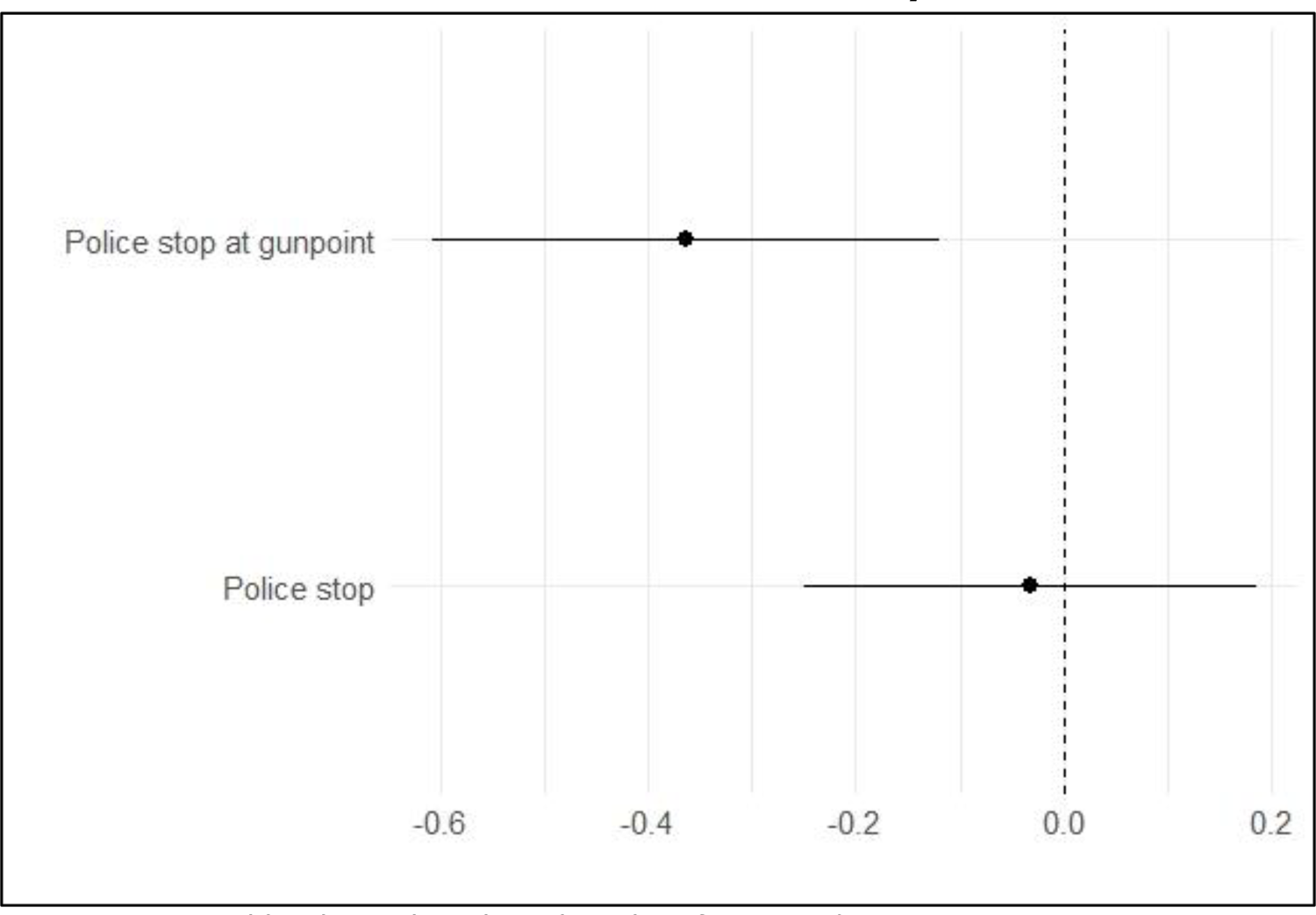
Figure 4 displays the results. Like the panel match model, the doubly-robust difference-in-differences estimator finds effects only in the case of approaches at gunpoint. When police did not point guns at citizens, the stop did not significantly affect satisfaction.

Doubly-robust difference-in-differences: the effects of police stops on satisfaction with democracy
Given that our dependent variable is a categorical variable with four levels, where higher levels mean greater satisfaction with democracy, we performed a second robustness test using ordinal models. In this case, we chose to apply the classic difference-in-differences design, the two-way fixed effects model, so we can specifically use ordinal models. We included fixed effects by time and by individual, controlling for observed and unobserved time-invariant characteristics (Klein, 2022).
The coefficients found reinforce the findings of the results section. Being approached at gunpoint reduces satisfaction with democracy, while stops in general did not have a significant effect on the dependent variable. The odds ratios of the ordinal model 2 indicate that being stopped by the police at gunpoint reduces by 87% the chances of increasing satisfaction with democracy.
Discussion and conclusion
In this article, we investigated whether police stops reduce the satisfaction of citizens of São Paulo with democracy. More specifically, we analyzed stops as follows: first, we looked at whether stops in general influence satisfaction with democracy. Second, we examined the effects of stops at gunpoint. Using two different difference-in-differences models and distinct matching and weighting specifications, we concluded that only stops at gunpoint reduce the satisfaction with democracy of São Paulo residents. In the case of stops in general, no effect was found.
The lack of effects for stops in general may stem from various factors. One plausible explanation is that, given that stops are prevalent in Brazil, especially in cities like São Paulo, their impact on individuals' beliefs and attitudes might not be as pronounced as in countries where policing does not heavily rely on stop and frisk strategies. On the other hand, stops at gunpoint are rarer, constituting a more shocking experience with effects on attitudes and expectations that are more pronounced.
These results add new findings to the growing literature dedicated to studying the relationship between police stops and political attitudes. While most available analyses focus on the effect of police approaches on attitudes towards the police and the criminal justice system, this article demonstrates that police action influences attitudes towards the political system, such as satisfaction with democracy. Hence, it indicates that encounters with a specific representative of the state, a police officer, generate consequences that go beyond attitudes towards the police, also reducing satisfaction with democracy.
Moreover, we show that police stops at gunpoint worsen perceptions of procedural fairness of the police. Our findings indicate that people perceive stops at gunpoint as substantial violations of the precepts of procedural fairness that should guide police action in democratic states, undermining satisfaction with the political system’s performance. This evidence connects policing patterns to attitudes toward the police and these, in turn, to attitudes toward democracy.
Our findings are in line with the few studies available in the area. Previous work has found negative effects of police and criminal justice contacts on civic engagement, propensity to vote, and trust in government (Weaver; Lerman, 2010; Lerman; Weaver, 2014; Laniyonu, 2019). Similarly, we found that being approached at gunpoint reduces satisfaction with democracy. In relation to these studies, we broke new ground by testing a causal mechanism that explains the negative effect of approaches at gunpoint on satisfaction through their impact on confidence in police procedural fairness. The idea underlying this mechanism, that approaches worsen perceptions of the police and that this spills over into opinions about the state as a whole, is also present in other studies. However, this was the first article to test the mechanism directly, and it was also the first to verify the effect of police approaches specifically on satisfaction with democracy. In addition, this article is also innovative from a geographic point of view since it is the first to analyze a major city in the Global South.
This study has limitations. Firstly, concerning the causal mechanism, mediation analyses with panel data are still evolving, and require cautious interpretation of their results. Secondly, police procedural fairness is a multifaceted concept that encompasses various dimensions. In this study, we chose to emphasize the perception of treatment by the police, as most available studies suggest it to be a pivotal aspect of perceptions about procedural justice (Tyler; Huo, 2002; Hough et al., 2010). However, the results may have differed had we examined other aspects of fairness, such as neutrality in decision-making or attention to citizens. Therefore, further studies focusing on the role played by other dimensions of procedural fairness are encouraged.
This article has policy implications. Aggressive police stops, particularly those involving firearms, tend to worsen individuals' perceptions of democracy, compounding the already established negative effects on attitudes towards law enforcement and the criminal justice system. Consequently, policymakers concerned about the proliferation of anti-democratic sentiments should take heed of the attitudinal repercussions of aggressive policing strategies. Additionally, it is plausible to believe that while unfair police stops diminish satisfaction with democracy, fair stops may enhance it. Although intuitive, this assumption remains untested. Furthermore, there is evidence suggesting that procedurally fair police stops do not improve attitudes towards law enforcement as much as unfair ones harm them, a phenomenon termed the asymmetrical effects of police encounters (Skogan, 2006). If this asymmetry observed in trust and legitimacy towards the police also extends to satisfaction with democracy and other attitudes towards the political system, then the potential of procedurally fair policing strategies to enhance those attitudes would be limited. In such a scenario, fair stops would merely mitigate the harm caused by unfair ones.
To advance the research agenda on policing and political attitudes, more studies are needed that examine the impacts of experiences with police and criminal justice officers on citizens' opinions, particularly on perceptions of the democratic system. Thus, quasi-experimental techniques with observational data, such as difference-in-differences, offer a fertile path for further investigations.
Bibliographic references
- Angrist, J. D.; Pischke, J. S. Mostly harmless econometrics: an empiricist's companion. Nova Jersey: Princeton University Press, 2009.
- Bateson, R. "Crime Victimization and Political Participation". The American Political Science Review, vol. 106, nº 3, p. 570-87, 2012.
- Blanco, L. "The Impact of Crime on Trust in Institutions in Mexico". European Journal of Political Economy, vol. 3, p. 38-55, 2013.
- Blanco, L.; Ruiz, I. "The Impact of Crime and Insecurity on Trust in Democracy and Institutions". American Economic Review, vol. 103, nº 3, p. 284-88, 2013.
- Booth, J. A.; Seligson, M. A. The Legitimacy Puzzle in Latin America Cambridge: Cambridge University Press, 2009.
- Campos, M.; Alvarez, M. "Políticas de segurança pública, violência e punição no Brasil". In: Miceli, S.; Martins, C. B. Sociologia Brasileira Hoje Cotia: Editorial Atelier, 2017.
- Carreras, M. "The Impact of Criminal Violence on Regime Legitimacy in Latin America". Latin American Research Review, vol. 48, nº 3, p. 85-107, 2013.
- Cardoso, G. R.; Borba, J. "Violência e legitimidade democrática: um balanço da literatura sobre o contexto latino-americano". Revista Sociedade e Estado, vol. 38, nº 1, p. 193-210, 2023.
- Ceobanu, A. M.; Wood, C. H.; Ribeiro, L. "Crime Victimization and Public Support for Democracy: Evidence from Latin America". International Journal of Public Opinion Research, vol. 23, nº 1, p. 56-78, 2011.
- Costa, A. T. M. Entre a lei e a ordem Rio de Janeiro: Editora FGV, 2004.
- Easton, D. "A Re-Assessment of the Concept of Political Support". British Journal of Political Science, vol. 5, nº 4, p. 435-457, 1975.
- Fernandez, K. E.; Kuenzi, M. "Crime and Support for Democracy in Africa and Latin America". Political Studies, vol. 58, nº 3, p. 450-471, 2010.
- Gau, J. M. "The convergent and discriminant validity of procedural justice and police legitimacy: An empirical test of core theoretical propositions". Journal of Criminal Justice, vol. 39, nº 6, p. 489-498, 2011.
- González, Y. M. "What citizens can see of the state: Police and the construction of democratic citizenship in Latin America". Theoretical Criminology, vol. 21, nº 4, p. 494-511, 2017.
- Hinds, L.; Murphy, K. "Public satisfaction with police: Using procedural justice to improve police legitimacy". Australian & New Zealand Journal of Criminology, vol. 40, nº 1, p. 27-42, 2007.
- Hough, M., et al. "Procedural justice, trust, and institutional legitimacy". Policing: a journal of policy and practice, vol. 4, nº 3, p. 203-210, 2010.
- Huntington, S. P. "Democracy's Third Wave". Journal of Democracy, vol. 2, nº 2, p. 12-34, 1991.
- Imai, K.; Keele, L.; Tingley, D. "A General Approach to Causal Mediation Analysis". Psychological Methods, vol. 15, nº 4, p. 309-334, 2010.
- Imai, K.; Kim, I. S.; Wang, E. H. "Matching Methods for Causal Inference with Time-Series Cross-Sectional Data". American Journal of Political Science, vol. 67, nº 3, 2021.
- Klein, N. The Effect: an introduction to research design and causality. Boca Raton: CRC Press, 2022.
- Laniyonu, A. "The political consequences of policing: Evidence from New York City". Political Behavior, vol. 41, nº 2, p. 527-558, 2019.
- Lerman, A. E.; Weaver, V. "Staying out of sight? Concentrated policing and local political action". The ANNALS of the American Academy of Political and Social Science, vol. 651, nº 1, p. 202-219, 2014.
- Li, Y.; Ren, L.; Luo, F. "Is bad stronger than good? The impact of police-citizen encounters on public satisfaction with police". Policing: An International Journal of Police Strategies & Management, vol. 39, nº 1, p. 109-126, 2016.
- Lipset, S. M. "The Social Requisites of Democracy Revisited: 1993 Presidential Address". American Sociological Review, vol. 59, nº 1, p. 1-22, 1994.
- Mata, J. A política do enquadro. São Paulo: Thomson Reuters, 2021.
- Misse, M. "Crime, sujeito e sujeição criminal: aspectos de uma contribuição analítica sobre a categoria bandido". Lua Nova, vol. 79, p. 15-38, 2010.
- Morgan, S. L.; Winship, C. Counterfactuals and causal inference. Cambridge: Cambridge University Press, 2015.
- Nery, M.B.; Souza, A.; Adorno, S. "Os padrões urbano-demográficos da capital paulista". Estudos Avançados, vol. 33, p. 5-36, 2019.
- Norris, P. "Introduction: The growth of critical citizens?". In: Norris, P. (Ed.). Critical citizens: Global support for democratic government, p. 1-27, 1999.
-
Oliveira, T. R. “Aggressive policing and undermined legitimacy: assessing the impact of police stops at gunpoint on perceptions of police in São Paulo, Brazil”. J Exp Criminol, 2022. Available at: <https://doi.org/10.1007/s11292-022-09527-9 Accessed on: 19 Sep. 2024.
» https://doi.org/10.1007/s11292-022-09527-9 - Oliveira, T. R., et al. "Are trustworthiness and legitimacy 'hard to win, easy to lose'? A longitudinal test of the asymmetry thesis of police-citizen contact". Journal of Quantitative Criminology, vol. 37, p. 1003-1045, 2020.
- Paixão, A. L. "Crime, controle social e consolidação da cidadania". In: Reis, F.; O'Donnell, G. (Eds.). A democracia no Brasil São Paulo: Vértice, p. 168-199, 1997.
- Pinheiro, P. S.; Izumino, E. A.; Fernandes, M. C. J. "Violência fatal: conflitos policiais em São Paulo". Revista USP, vol. 9, p. 95-112, 1991.
- Poncioni, P. "Democratic governance of public security: the case of police education in Brazil". Civitas, vol. 13, nº 1, p. 48-55, 2013.
- Sant'Anna, P. H.; Zhao, J. "Doubly robust difference-in-differences estimators". Journal of Econometrics, vol. 219, nº 1, p. 101-122, 2020.
- Silva, G. F.; Beato, C. "Confiança na polícia em Minas Gerais: o efeito da percepção de eficiência e do contato individual". Opinião Pública, vol. 19, nº 1, p. 118-153, 2013.
- Silva, G. F., et al. "Confianza en la policía y actitudes políticas autoritarias en América Latina". Estudios Internacionales, vol. 55, nº 206, p. 145-180, 2023.
- Sinhoretto, J.; Silvestre, G.; Melo, F. A. L. "Encarceramento em massa em São Paulo". Tempo Social, vol. 25, nº 1, p. 14-25, 2013.
- Skogan, W. G. "Asymmetry in the impact of encounters with police". Policing & Society, vol. 16, nº 2, p. 99-126, 2006.
- Soares, L. E. Desmilitarizar: segurança pública e direitos humanos. São Paulo: Boitempo Editorial, 2019.
- Sunshine, J.; Tyler, T. R. "The role of procedural justice and legitimacy in shaping public support for policing". Law & Society Review, vol. 37, nº 3, p. 513-548, 2003.
-
Teles, J. “From the specific to the diffuse: the indirect effect of crime victimization on support for democracy”. Brazilian Political Science Review, vol. 17, nº 2, p. 1-30, 2023. Available at: <https://doi.org/10.1590/1981-3821202300020005 Accessed on: 19 Sep. 2024.
» https://doi.org/10.1590/1981-3821202300020005 - Trindade, A.; Porto, M. S. G. "Controlando a atividade policial: uma análise comparada dos códigos de conduta no Brasil e Canadá". Sociologias, vol. 13, nº 27, p. 342-381, 2011.
- Tyler, T. R. Why people obey the law. New Jersey: Princeton University Press, 1990.
- Tyler, T. R. "Psychological perspectives on legitimacy and legitimation". Annu. Rev. Psychol., vol. 57, p. 375-400, 2006.
- Tyler, T. R.; Fagan, J. "Why do people cooperate with the police". Ohio State Journal of Criminal Law, vol. 6, nº 1, p. 231-75, 2008.
- Tyler, T. R.; Huo, Y. Trust in the law: Encouraging public cooperation with the police and courts. New York: Russell Sage Foundation, 2002.
- Van Damme, A. "The impact of police contact on trust and police legitimacy in Belgium". Policing and Society, vol. 27, nº 2, p. 205-228, 2017.
- VanderWeele, T. Explanation in causal inference: methods for mediation and interaction. Oxford: Oxford University Press, 2015.
- Visconti, G. "Policy Preferences after Crime Victimization: Panel and Survey Evidence from Latin America". British Journal of Political Science, vol. 50, nº 4, p. 1481-1495, 2020.
- Weaver, V. M.; Lerman, A. E. "Political consequences of the carceral state". American Political Science Review, vol. 104, nº 4, p. 817-833, 2010.
- Wodtke, G. T.; Zhou, X. "Effect Decomposition in the Presence of Treatment-induced Confounding: A Regression-with-residuals Approach". Epidemiology, vol. 31, nº 3, p. 369-375, 2020.
- Zhou X.; Wodtke, G. T. "A Regression-with-Residuals Method for Estimating Controlled Direct Effects". Political Analysis, vol. 27, nº 3, p. 360-369, 2019.
-
3
In Brazil, peripheries are how low-income neighborhoods with inadequate services and infrastructure are known.
-
5
In Brazil, the “military police” is the term for police forces organized by each state in accordance with a military code, not an internal force that polices the conduct of the armed forces.
-
6
The Critério Brasil consists of a methodology for calculating income based on ownership of items such as vehicles, TVs, and other home appliances. It is often used in Brazilian national surveys, such as the Pesquisa Nacional por Amostra de Domicílios (PNAD).
-
4
The study received financial support from grant no. 2013-07923-7, from the São Paulo Research Foundation (FAPESP), as part of the project 'Building Democracy Daily: Human Rights, Violence, and Institutional Trust,' developed by the Center for the Study of Violence at the University of São Paulo (NEV/USP). As of the time of publication, the data used in this study are not available to the general public. Those interested in accessing the data should contact the authors directly or send an email to the institutional address nevusp@gmail.com. R scripts used in the study are also available upon request.

 Source: Prepared by the authors based on data from NEV/USP, 2024.
 Source: Prepared by the authors based on data from NEV/USP, 2024.
 Source: Prepared by the authors based on data from NEV/USP, 2024.
 Source: Prepared by the authors based on data from NEV/USP, 2024.

