
 The institutionalization of local food and nutritional security councils in the face of an anti-citizen participation government and COVID-191
Abstract
The National Food and Nutritional Security System (SISAN) and its participatory bodies have been operating since 2006. Local councils are its lowest level parts. Their institutionalization has mostly been linked to their legal creation rather than their regular operation. In this context, we collected evidence of their activities in Paraná between 2018 and 2022. This period was peculiarly adverse to councils, given the federal government's strong anti-participatory position between 2019 and 2022, and the COVID-19 pandemic. Has their institutionalization continued or collapsed? Three swings of activity were found. First, activity increased in 2019, declined sharply in 2020, and recovered to 2018 levels by 2021. Councils with stronger ties to SISAN, formal mechanisms, in larger municipalities, and in those with better state capacities displayed stronger institutionalization.
policy councils; food security; participation; institutionalization
Resumo
O Sistema Nacional de Segurança Alimentar e Nutricional (SISAN) com seus órgãos participativos está em funcionamento desde 2006. Os conselhos locais são seus ramos finais. Sua institucionalização tem sido mais ligada à criação legal do que à sua operação regular. À luz disso, coletamos evidências de suas atividades entre 2018 e 2022 no Paraná. Este período é particularmente adverso para os conselhos diante do forte viés antiparticipativo do governo federal entre 2019 e 2022, e da pandemia de COVID-19. Sua institucionalização continuou ou sucumbiu? Três oscilações de atividade foram encontradas. Primeiro, a atividade aumentou em 2019, caiu drasticamente em 2020, e em 2021 recuperou os níveis de 2018. Conselhos com laços mais fortes com o SISAN, instrumentos formais, em municípios maiores e naqueles com melhores capacidades estatais mostraram uma institucionalização mais consistente.
conselhos de políticas públicas; segurança alimentar e nutricional; participação; institutionalização
Resumen
El Sistema Nacional de Seguridad Alimentaria y Nutricional (SISAN) con sus órganos participativos está en funcionamiento desde 2006. Los consejos locales son sus ramas finales. Su institucionalización ha estado más ligada a su creación legal que a su operación regular. A la luz de esto, recopilamos evidencia de sus actividades entre 2018 y 2022 en Paraná. Este período es particularmente adverso para los consejos, dado el fuerte sesgo anti participativo del gobierno federal entre 2019 y 2022, y la pandemia de COVID-19. ¿Su institucionalización continuó o sucumbió? Se encontraron tres oscilaciones de actividad. Primero, la actividad aumentó en 2019, cayó drásticamente en 2020, y en 2021 recuperó los niveles de 2018. Los consejos con lazos más fuertes con el SISAN, instrumentos formales, en municipios más grandes y en aquellos con mejores capacidades estatales mostraron una institucionalización más consistente.
consejos de políticas públicas; seguridad alimentaria y nutricional; participación; institucionalización
Résumé
Le Système National de Sécurité Alimentaire et Nutritionnelle (SISAN) avec ses organes participatifs est en place depuis 2006. Les conseils locaux en sont les branches finales. Leur institutionnalisation a été davantage liée à leur création légale qu’à leur fonctionnement régulier. À la lumière de cela, nous avons recueilli des preuves de leurs activités entre 2018 et 2022 au Paraná. Cette période est particulièrement défavorable aux conseils, compte tenu du fort biais anti-participatif du gouvernement fédéral entre 2019 et 2022, et de la pandémie de COVID-19. Leur institutionnalisation a-t-elle continué ou a-t-elle succombé ? Trois oscillations d’activité ont été observées. Tout d’abord, l’activité a augmenté en 2019, puis a chuté drastiquement en 2020 et, en 2021, elle a retrouvé les niveaux de 2018. Les conseils ayant des liens plus forts avec le SISAN, des engagements formels, dans les grandes communes et dans celles ayant de meilleures capacités étatiques ont montré une institutionnalisation plus cohérente.
conseils de politique publique; sécurité alimentaire et nutritionnelle; participation; institutionnalisation
Introduction
In 2006, the Brazilian Congress passed the Organic Law on Food and Nutrition Security (LOSAN), which created the National Food and Nutritional Security System (SISAN) (Brasil, 2006). This law combined two main efforts: one sought to establish a more comprehensive approach to food and nutritional security (FNS), while the other sought to involve citizens in decision-making about policy by establishing participatory councils. A National Council (CONSEA) was formed to coordinate SISAN. Created in 1993 and extinguished in 1995, CONSEA was reinstated in 2003 as “a democratic space to articulate the dialogue between government and society” (Recine; Pacheco; Maluf; Menezes, 2019).
State councils were also quickly established. At the municipal level, replication was gradual but steady. Eleven years after CONSEA’s establishment, a survey identified 734 local food and nutritional security councils created by law (Brasil, 2014). This represented 13% of Brazil’s 5,568 municipalities. A 2018 survey identified 1,371 councils, thus covering 24% of all municipalities (Brasil, 2018a).
However, on January 1, 2019 President Jair Bolsonaro issued Executive Order 870, which did not include the national council in his new administration's organizational chart (Brasil, 2019a). Asked by journalists about the omission, a member of the presidential cabinet stated: “Consea, as well as the other councils linked to the presidency, were extinguished” (Mazui, 2019). SISAN’s participatory fabric was torn from above (Castro, 2019). Three months later, Presidential Decree 9,759 (Brasil, 2019b) made its demise official. Centralized decision-making power and severe fiscal constraints hastened the demise of the FNS policies. Resources and organizational structures were cut for initiatives such as school meals, cistern acquisition for low-income families, and credit for small local farmers (Rahal; Del Porto; Muchagata, 2024).
Adding to this convoluted situation, COVID-19 reached pandemic status in March 2020, aggravating world hunger and malnutrition (FAO et al., 2023). The challenge of tackling hunger was thus aggravated by the urgent call to take on a global health crisis. As Smith; Hughes; Adams; Obijiaku (2021, p.1) stated: “In the face of an emergency, the working assumption has too often been that the centralization and concentration of political power and curtailment of democratic rights is justified and effective”. As a result, participatory spaces like policy councils were sidelined or simply ignored.
Concerns were aroused about the potential effects of these two events on political mobilization and even on Brazil’s young democracy. Have efforts to increase citizens’ participation in SISAN been in vain? Has the institutionalization of FNS municipal councils progressed despite CONSEA’s dissolution and the COVID-19 pandemic? This article addresses the issue, focusing on the southern Brazilian state of Paraná as a case study.
The next section, “On institutionalization”, discusses theoretical concepts on institutions and institutionalization relevant to this article. The two subsequent sections, “SISAN and its design” and “The case: Paraná state”, provide essential background for the empirical work, outlining the structure of SISAN and sketching the context of the Paraná case. Then our “Methods” are detailed, followed by the “Results” of our empirical work and their “Discussion”. The “Conclusion” section summarizes our findings and speculates on themes for further research.
On institutionalization
FNS councils are part of a legally established system for public participation. When examining their purpose, they can be broadly seen as institutions. It is said, for instance, that policy councils are a specific kind of participatory institution. But expressions used in the literature such as “institutionalization of a participatory institution” or “creation of participatory institutions” can cause confusion. We thus define institutions as shared habits of thought and action that form lasting systems of rules and patterns of interaction (Pessali, 2023). Institutionalization, then, is the “transformation of something into an institution” (Lavalle et al., 2018, p. 22) or, in our terms, the process by which an idea or practice becomes a collective habit.
This collectively held habit may or may not be formally codified and detailed in rules, laws, canonical texts, or other official records. An idea or practice can be turned into law and yet not be institutionalized. For institutionalization to occur, a critical mass of people must adopt the tenets of the law as part of their habits of thought and action. As Geoffrey Hodgson (2020, p. 56) affirms, “legal rules always depend on inexplicit norms and customary rules in order to operate… [and] become important by being bolstered by customs and habits, including habits to respect and obey institutionalized authority”.
According to this view, the formal or legal creation of an FNS council is necessary but not sufficient to make it an institution. When established by law, a council can be seen as a system of rules. The law is a powerful means for reconstituting habits of thought and action (Buchen, 2024), and may help persuade people of the value of participation. But it alone cannot grant a council’s institutionalization. It is the council’s regular operation that allows the identification of stable patterns of interaction that either result from or promote shared habits of thought and action. The institutionalization of councils proceeds when the legal act is backed by their regular and manifest operation. Hodgson (2006) notes that the British monarchy does not cease to exist when its members are asleep, but its institutional dispositions may fade if they do not frequently exercise their prerogatives. Institutions are seen when their prerogatives are exercised.
Isolated ideas, erratic practices, and founding norms can thus serve as starting points for institutions. They are proto-institutions, or the earliest elements of a compound that may or may not come to be. In this light, it is not granted that local FNS councils created by law are institutions. As in the biblical parable, let the law be the seed and lawmakers be the sower (New International Version, 1973/2001, Matthew 13:1-9). The law may face challenges in some areas in order to thrive, while other areas may provide the needed conditions for it to germinate and develop into an institution.
SISAN tries to engage municipalities in a multipart design, as detailed in the next section. Councils, one of its components, maintain inflows and outflows with the other parts. This is likely to elicit reinforcement drives among them. The more they interact, the stronger their bonds grow. These binding effects are expected to foment institutionalization. We thus regard the legal creation of local FNS councils as an early step towards institutionalizing participation. Has this effort succeeded? To what extent? This can be examined by observing the manifest behavior of the councils.
This approach leads us to treat a set of variables slightly differently from previous research on the institutionalization of participation. Earlier studies that focused on quantitative metrics emphasized formal aspects, such as laws, regulations, and design attributes (e.g. Pires; Vaz, 2009; Martelli; Tonella; Coelho, 2021; Almeida; Ribeiro; Carlos; Silva, 2022) as dimensions of institutionalization. Almeida; Ribeiro; Carlos; Silva (2022, p. 392, authors’ translation), for instance, developed an institutionalization index based on “measures that indicate the degree of formalization of the councils’ operating rules, of the human and physical resources held by councils to fulfill their role, and the degree to which they are formally recognized as members of the state network of public policy production and control”. Our interest here lies not in the metrics of institutionalization but in whether it occurred during a particularly hostile moment for participation. We then use formal aspects of institutionalization, paired with an indicator of the regular operation of councils.
The creation of SISAN in 2006 marks the beginning of a movement to induce the creation of new local FNS councils. This movement was a major step toward institutionalization in the broadest sense and endorsed earlier efforts in places where councils already existed. After that, some councils were legally established and became institutions as defined earlier. Others have progressed more slowly in this direction. Still others remain legally constituted, but have not become largely institutionalized.
The latter group is termed inactive, for which institutionalization ceased before 2018. The two former groups are both considered active councils, in which some institutionalization occurred during the study period. While these councils may not present the entire set of formal requirements, they show evidence of fostering expected interactions between government and society. Indeed, this seems to be an overly generous indicator of institutionalization. The literature does not specify thresholds for the number of years, meetings, or legal instruments that determine the institutionalization of councils, and this research does not aim to establish one. Instead, we use observed differences between groups as analytical references.
Other factors influencing councils’ functioning, such as the policy sector, subnational regulation, population size, state capacities, and longevity, have been emphasized in the literature (Almeida; Tatagiba, 2012; Lavalle; Guicheney; Vello, 2021; Martelli; Coelho, 2021). Given this article’s focus on a specific policy area within a single subnational unit, the first two factors lie outside its scope, but not the latter three.
Therefore, we consider population size at face value. The federal government uses it as a criterion for funding municipalities, and research indicates a positive correlation between population size and both state capacities and council operation (Arretche, 2012; Almeida; Carlos; Silva, 2016; Lavalle; Guicheney; Vello, 2021). It is not our intention to discuss the intermediate institutional ties that might lead to the eventual institutionalization of local FNS councils. We follow the path opened by Carlos, Silva and Almeida (2018), who looked for a correlation between population size and the institutionalization of local social welfare councils.
State capacities can be viewed as the type of institutional basis upon which public policies are built. They have been defined as the capabilities and resources used by the state to develop and execute policies (Pires; Gomide, 2016). Participatory policies are also subject to these conditions. Martelli, Tonella and Coelho (2021) ranked Brazil’s state FNS capacities as the second weakest among eleven policy areas, implying a gloomy scenario for the institutionalization of local FNS councils. This, however, did not entirely align with our initial empirical findings.
We then adopted Leite de Souza’s (2017, p. 106) view that state capacities are “resources that can be mobilized, moved, or made available as needed.” Policy councils, like those in the FNS field, also need to engage with the expertise and resources of non-governmental actors. This calls for a different indicator that better fits our needs. In keeping with a capabilities perspective, we used the IFDM-2018 (FIRJAN, 2023), an index of human development. The IFDM combines indicators of income, education, and health into a composite index ranging from 0 to 1. Higher values represent higher development levels, serving as a proxy for enhanced local capacities. The demand for enhanced state capacities and the supply of human capabilities to meet such demand operate at higher levels. Municipalities with greater human and organizational capacities to undertake public policies are expected to be better equipped to support councils, especially during challenging times.
Lastly, we will look into time. Some studies suggest that the longevity or maturity of councils plays a role in their institutionalization. The underlying idea is that repeated use of an institution fosters a self-reinforcing cycle in which trust and learning develop through ongoing interactions. In empirical terms, as in the Sorites or heap paradox, there is no precise timeline or threshold of rounds of interaction that determines whether a council has become institutionalized. In order to avoid the paradox, we check whether the institutionalization process itself has unfolded.
SISAN and its design
The first national food and nutrition conference was held in 1986 as part of the 8th National Health Conference, and then independently in 1994 (Brasil, 2018b). In 2004, the second conference focused on consolidating a national FNA policy (Castro, 2019). This helped design the 2006 LOSAN, which created SISAN. SISAN is a landmark in joining grassroots forces to combat food and nutritional insecurity in Brazil (CONSEA, 2009). From that point, a triad formed by conferences, councils, and interministerial or intersectoral chambers has been gradually built (Brasil, 2006).
A four-year cycle began with the 2007 national conference, which drafted the first National FNS Plan guidelines and nominated the first CONSEA members (Brasil, 2006). The following cycle would begin with thematic meetings and local conferences open to the public. Ideas and demands would be gathered, scaled up to state conferences, refined, and taken upstream to the national conference. Conferences were held in 2011 and 2015, each with over 2,000 invited guests (CONSEA, 2015). CONSEA’s dissolution in January 2019 delayed the call to the sixth conference until 2023.
Councils operate at municipal, state and federal levels. They must include representatives from civil society (two-thirds) and government (one-third), establish their own selection procedures, and set internal regulations (Brasil, 2006). Their tasks include monitoring FNS policies, engaging affected groups, and helping regional or focus-based communities participate. Local councils initiate the process leading to the national conference, in which new policy guidelines are established. This closes a loop intended to enhance participation, decentralize decision-making, and extend the reach of FNS policy.
Intersectoral chambers (CAISAN) convene government officials from FNS-related domains to coordinate actions across state agencies and develop an FNS plan (Brasil, 2006). Plans include targets, funding sources, and monitoring and evaluation mechanisms. Mutual engagement among the triad is a designed need, extending vertically to councils and conferences.
SISAN faced a serious setback when CONSEA was dissolved in 2019, leading to a normative void. Questions arose regarding the follow-up to decisions made by the interministerial chamber, the continuity of previous guidelines, and the fate of the 6th National Conference (Castro, 2019).
The law that created SISAN was passed by Congress, and the presidential executive order that dissolved CONSEA could not do away with all parts of the system (Lavalle, 2023). Former CONSEA members and their organizations initiated talks about convening a non-official summit. After the COVID-19 outbreak, the idea shifted to creating a virtual forum to sustain mobilization. In the absence of federal support, states and municipalities addressed local FNS problems independently with the help of local SISAN agencies. SISAN was not entirely dysfunctional.
SISAN operates intersectorally and lacks the fiscal autonomy of traditional policy sectors. Its decisions require consultation with other offices. By the end of 2022, 532 out of 5,568 Brazilian municipalities had joined the system (Brasil, 2022). Membership is voluntary and does not give municipalities prompt access to policy funds. This helps explain why adhesion has been slow. Yet, states and municipalities, although heterogeneously, served as steppingstones for SISAN (Maluf, 2021). Intense grassroots work helped direct public policy toward a more systemic approach during progressive administrations. Paraná State was no exception (Rigon, 2012).
The case: Paraná state
Since 2008, Paraná has had a legal framework in place to develop its FNS policy, in keeping with the 2006 LOSAN (Paraná, 2008). The work of the Paraná State Council for FNS (henceforth referred to as the State Council), legally created in 2003, was auspicious for that landmark. The State Council seats 36 counselors. Civil society holds 24 seats, 23 of which are distributed across regional areas that oversee Paraná’s 399 municipalities. Each area is home to a Regional FNS Commission (CORESAN). CORESANs are consultative bodies connected to the State Council that help mediate the flow of information and decisions to and from the local triad (CONSEA-PR, 2019).
Despite the well-known challenges faced by councils (Tatagiba, 2002), the State Council has had diverse and constant representation from civil society (Rigon, 2012; Paraná, 2024). Its by-laws require regular meetings. Records for the period from 2015 to 2024 show that it convened at least five times a year. With nine meetings, 2021 was the only outlier. Although presidential support for participation began to wane–in December 2015, Congress initiated impeachment proceedings against President Dilma Rousseff–there is evidence of regular engagement by civil society and bureaucratic support. And an active state council is crucial to fostering local councils.
The Paraná State Public Prosecutor's Office attends State Council meetings regularly, without voting rights. Since 2017, the Office has been monitoring whether municipalities are setting up SISAN components at the local level, and publicizing all related information on an open-access website. This effort is part of a collaborative initiative involving the Prosecutor’s Office, the Paraná State Secretary of Agriculture, the State Council, and CORESANs to advance the agenda of the Human Right to Adequate Food. In 2019, the Prosecutor’s Office partnered with the State Council to monitor local SISAN conditions through the SISAN Panel project, the only one of its kind filed with the Project Database of the National Council of the Public Ministry. The project identifies the dismantling of FNS policies after President Jair Bolsonaro’s Executive Order 870 abolished CONSEA (CNMP, 2022) as a significant challenge to be addressed. In its approach, the Prosecutor’s Office acknowledges the challenges that smaller municipalities face in complying with regulations, and focuses on supportive and educational actions (CNMP, 2022). This collaborative work helped marshal the 2019 cycle of local conferences, which serve as the initial step toward establishing a council.
As for the political context, Paraná State has elected a succession of conservative governments since the early 2010s. In 2018, the incumbent governor stood for reelection under an extreme right-wing alliance whose election manifesto explicitly rejected participatory institutions. Two years later, that same alliance held 77% of the elected mayors in Paraná, yet the State Council remained operative. More strikingly, by the end of 2022, 213 out of the 399 municipalities in Paraná (53.3%) had joined SISAN (Paraná, 2022). They accounted for 40% of all Brazilian municipalities in SISAN.
By the late 2010s, two competing vectors were clearly visible. One included the Public Prosecutor’s Office and the State Council actively working to spread SISAN components and encourage legal compliance. The other comprised conservative forces that took over the presidency in 2016 and hindered participatory instances. In 2019, federal government hostility towards participation increased sharply, and CONSEA was one of its first targets (Brasil, 2019b). In the midst of these extremely volatile political conditions, the COVID-19 pandemic struck, affecting all forms of interaction and standing atop the political agendas. Emergency issues then raised questions about emergency powers. As stated by Ginsburg and Versteeg (2021, p. 1499), it “is conventional wisdom that emergencies require massive delegation of power to the executive... Checks and balances that ordinarily constrain constitutional governance thus cease to exist during times of crisis”. If the well-institutionalized legislative and judicial powers faced difficulties in their actions, what could be expected of participatory bodies in the course of institutionalization, such as local FNS councils? Would they persevere in Paraná?
Methods
From June 2022 to May 2023, we collected documented information about the local FNS councils. The period covers from 2018 to 2022. This is a marginally shorter time frame than that covered by Almeida; Ribeiro; Carlos; Silva (2022) to investigate the institutionalization of municipal social welfare councils. This limits the robustness of any attempt to determine if and to what extent a council is institutionalized. Since our database has no missing years, however, the study of whether institutionalization happened during the era is unaffected.
Our database begins in 2018, one year before the first adverse event. It may be too short a period from which to extract much analytical content. The impeachment of President Dilma Rousseff in 2016 might have either discouraged participation and halted the institutionalization of councils, or just the opposite. No substantial evidence supporting either case has been found for local councils. Almeida, Ribeiro, Carlos e Silva (2022), for instance, showed that neither of the two scenarios were true for local social welfare councils. Our limited database is unable to help elucidate the matter. This is still an open question for local FNS councils5
The adverse events began in 2019 and 2020. The final years, 2021 and 2022, witnessed echoes of midterm effects and reactions to the events, allowing for intertemporal comparisons.
A first round of document collection counted on active transparency. We searched the official websites and social media of all 399 Paraná municipalities. A second round resorted to mechanisms of passive transparency. We inquired at municipal government offices through all available contact channels, including ombudspersons’ offices, dedicated information systems, e-mails, and phone calls. We eventually filed formal appeals under the Information Access Act, which gives public agencies 20 days to reply. Ordinary citizens can access these latter channels, but greater effort is required. In a third and final round, in December 2022 and April 2023, we requested assistance from the State Council in reaching out to those municipalities that had not responded. The set of collected documents is summarized on Table 1:
First, the legal document creating a council indicates the extent to which the idea of formalizing participation has permeated local FNS discussions and policy-making.
Second, meeting minutes are critical for capturing council activities, or manifest behavior. They are our main variable, against which the other four will be paired.
Third, the presence of internal rules suggests a higher commitment to the regular functioning of a council. Even if not required by law, a council is expected to have internal regulations over its operations. They help members better understand their roles, structure their interactions, and care for the council's regular and coalescent operation.
Fourth, an operational FNS plan calls for council oversight and implies interaction with other local SISAN entities. Municipalities are not legally obliged but are expected to create a four-year plan. The local CAISAN is responsible for setting it up, based on the guidelines decided upon during the local conference and council deliberations. The council is thereafter in charge of overseeing the plan’s execution. An operational plan is thus evidence of working interactions.
The fifth document, adhesion to the national SISAN, is a strong formal act of commitment to institutionalizing the local system. Adhesion requires the creation of the local triad and a pledge to draw up an FNS plan within a year of joining. While it does not give direct access to funds, it does enhance a municipality’s chances of obtaining them when vying for FNS-related programs and projects.
The latter three documents indicate an effort to establish a regular pattern of interaction for citizens, their chosen councilors, and government officials. In other words, they try to ensure that ongoing concerns about FNS can, as a rule, be addressed therein.
Information about these variables was obtained exclusively from documentary sources, which might result in underreporting. Considering the exhaustive procedures adopted, however, this is unlikely to be significant. In addition, SISAN’s tiered structure promotes communication. Thus, lack of information strongly suggests that the municipality’s council does not exist or is inactive. Such cases are classified as non-existent councils.
Three other variables are considered: population size, state capacities, and longevity. Data from IBGE’s 2022 census on the population of municipalities are used and related to the councils’ activities. Municipalities have been divided into two groups: those with up to 20,000 residents (n=118) and those with more than 20,000 residents (n=44).
State capacities, as explained earlier, use a human development index for Brazilian municipalities as a proxy—the IFDM-2018 (FIRJAN, 2023). Considering their IFDM values, municipalities were divided into two groups. The first group contains municipalities (n=132) within the range of medium and medium-high development (IFDM values between 0.4 and 0.8). No municipality in our case was in the low development range (IFDM values lower than 0.4). The second group contains municipalities (n=30) in the high development cluster (IFDM values higher than 0.8)6
Longevity is measured by the ages of councils in 2022 since their legal creation. Correlation and causality tests are performed to assess the likely association between longevity and institutionalization.
The next section shows the results in two stages: for the entire set of councils and for groups of councils. Groups have been formed according to their formal institutionalization, connection with other SISAN bodies, and the other two local trait-related factors. Each group’s average number of meetings is calculated independently. The purpose is to check whether variations in these variables are mirrored by councils’ activities before, during, and after both adverse events.
Results7
A total of 352 municipalities (88% of the total), representing 91% of the population of Paraná State, responded to our request. Of these, 292 (83%) showed documentary proof of having a legally established council.
Aggregate
As a first step, we registered the pace at which councils spread throughout Paraná State and how active they were. Figure 1 shows the year in which they were legally created.

Figure 2 presents the distribution of the average number of meetings per year for the 2018–2022 period under study.

: Distribution of meetings by local councils (average number of meetings per year–2018-2022)*
Minutes from 2018 provide proof of activities preceding the extinction of CONSEA in 2019 and the onset of the COVID-19 pandemic in 2020. Minutes from 2019 and 2020 show the most immediate impact of these events on the councils’ activities. Minutes from 2021 and 2022 show the mid- to long-term effects after COVID-19 vaccinations allowed in-person activities to be resumed and the dismantling of FNS policy unfolded. As we focused on the institutionalization of councils before and during those events, the 130 municipalities that lacked evidence of council activity were excluded from further analysis.
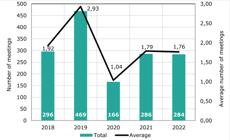
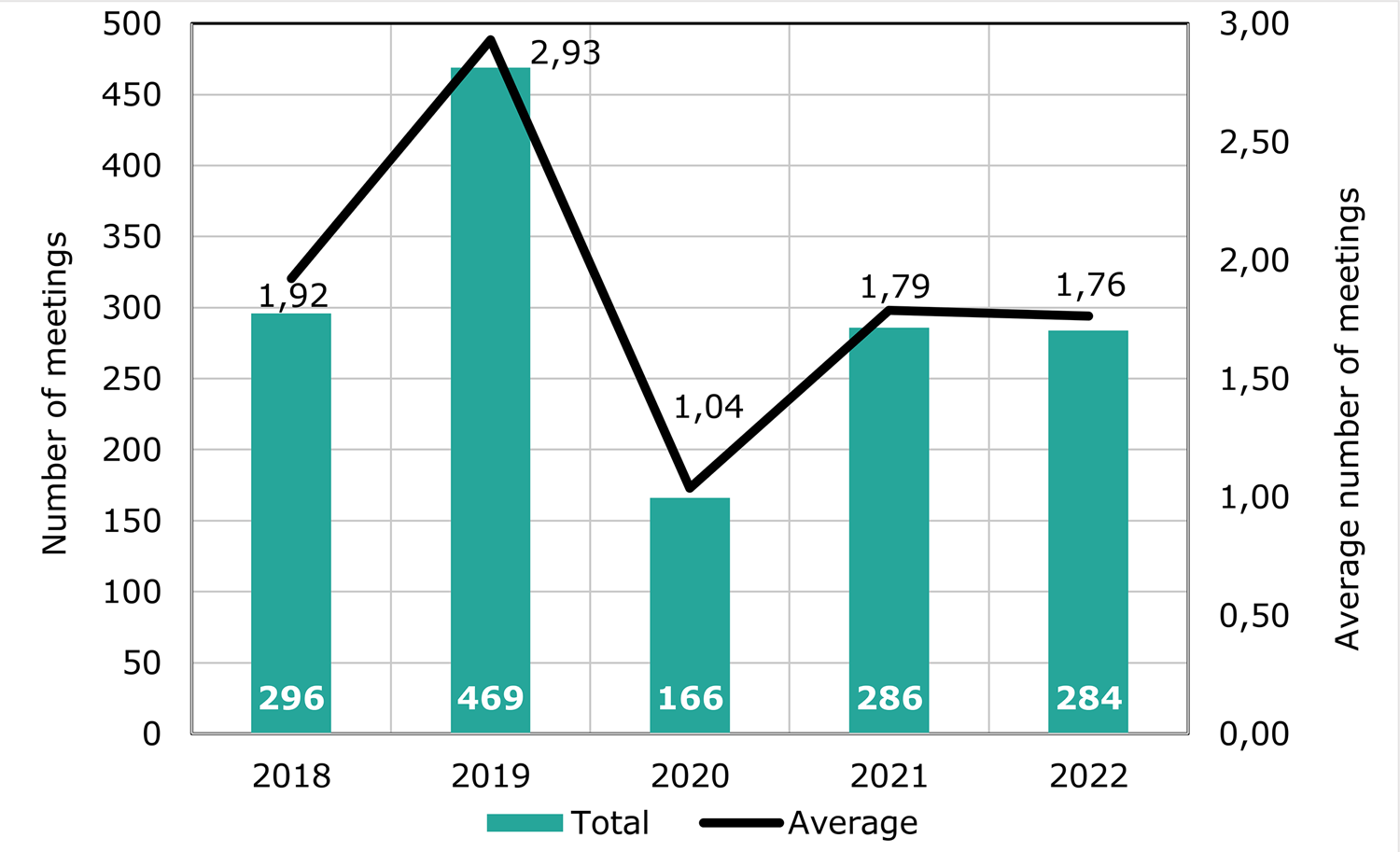
In Figure 3 the total number of meetings held annually by the 162 active councils is displayed at the base of each bar. The left-hand vertical axis indicates the scale. The line, scaled by the right-hand vertical axis, depicts the average number of meetings (the absolute number of meetings per year divided by the number of councils).
Groups
We considered two groups of variables for the councils’ functioning: the SISAN environment in which they operate and local traits.
There was evidence that 59 local councils had by-laws. The remaining 103 councils were set apart. Figure 4 depicts the average number of meetings held by each group:

: Average number of meetings held by local councils with (yes) and without (no) internal by-laws–2018-2022*
FNS plans categorize municipalities with councils into three groups. The first group had a plan in force over the entire study period (n=46). The second group had a plan in effect in 2018 that expired and was not renewed (n=44). A third group had no plan for the entire period (n=72). Figure 5 displays the results.

: Average number of meetings held by councils in municipalities with operative FNS plans over the five years (“yes2022”), with a plan that expired (“expired”), and without (“no”) a plan–2018-2022*
Similarly, municipalities that adhered to SISAN were classified into three groups. Those affiliated with SISAN prior to 2018 compose one group (n=86). Municipalities that joined SISAN between 2018 and 2022 form a second group (n=38). And the third group includes municipalities that joined later or did not join (n=38). The results are displayed in Figure 6:

: Average number of meetings held by councils in municipalities that adhered to SISAN before 2018, between 2018-2022, and did not adhere*
The second differential aspect considered is that of two relevant local traits. Two traits were used: population sizes and IFDM values (as proxies for state capacities). The findings for population size are shown in Figure 7, and the results for IFDM values in Figure 8:

: Average number of meetings held by councils in municipalities according to population size–2018-2022*
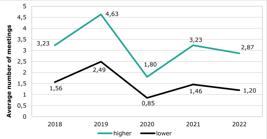
: Average number of meetings held by councils in municipalities according to 2018 IFDM values*
A few tests of causality and correlation were conducted to investigate the potential relationships between council institutionalization and longevity. Table 2 explains the tests and presents the outcomes:
Discussion
The timeline of councils’ legal creation (Figure 1) reveals notable fluctuations from 2003 to 2022. A first wave of local councils arose after the first national conference, coinciding with the reinstatement of the National Council and the launch of the Fome Zero (Zero Hunger) Program. The enactment of the 2006 federal organic law and the 2007 conference cycle marked a consolidation phase for SISAN. A second wave began with preparations for the 2011 national conference and the enactment of the First National FNS Plan, which sought to implement SISAN in 60% of Brazilian municipalities by 2015 (CAISAN, 2011). The wave endured until the 2017 conference before losing momentum.
In 2019, over 100 Paraná municipalities lacked an FNS council. Only 12 were created from 2019 to 2022, averaging three per year. From 2003 to 2018, the average was slightly over 17.
Figure 2 shows that 130 councils, representing 45% of all the respondent municipalities where one existed, produced no evidence of a single working meeting over the five years studied. By 2018, 280 councils had been created by law. Among them, 26 (9%) joined SISAN before 2018, 13 (4%) had evidence of developing an FNS plan at some point, and 9 (3%) had internal norms. Many seeds—or creation laws—were sown in unfit settings and have failed to thrive.
The other 162 active councils had a skewed distribution of meetings. Councils in 72 municipalities met less than once per year, and only 13 councils averaged five or more sessions annually. Out of 352 respondent municipalities, 90 (over 25%) had councils that met more often than once a year on average.
Figure 3 shows that the 162 councils active in 2018 met less than twice, on average. This average rose 54% in 2019. Despite the dissolution of CONSEA, local council activities increased during a conference year. Previous mobilization was able to keep expectations high for a conference cycle. It became clear months later that the federal government would not call a new national conference. Civil organizations proposed an unofficial meeting, which ultimately did not materialize. Some people in smaller municipalities contacted by our research team reported demobilization in their local councils because of these circumstances. Our research design, however, is not able to verify the claim.
At the same time, the State Council urged local councils to organize their conferences to facilitate the State Conference scheduled for August 2019. Out of 352 responding municipalities, 222 (63%) provided evidence of holding a 2019 local conference, 207 of which had a council (active or inactive). Another 85 municipalities with councils did not provide evidence of hosting a conference. Concurrently, 73 municipalities with inactive councils held a 2019 conference.
Thus, there is a mix of municipalities in which only a portion of the local SISAN exists or is operational. Some institutionalization of the local system can be inferred from the activities of the councils. There are concerns, however, that mobilization may diminish once the momentum from the conference and the expectations for rescuing the national conference have waned. This is depicted in Figure 3. The average number of meetings dropped by 64% in 2020, reaching its lowest in our time frame. While our data cannot directly show the impact of each event separately, an indirect approach may help.
Consider two opposing vectors in action. One encourages councils to resume work as usual. By 2021, the severity of the COVID-19 pandemic had lessened with widespread vaccination, and virtual tools were developed to aid work and interaction. Many activities returned to their usual pace. Moreover, former CONSEA members and their networks, the Public Prosecutor’s Office, and CONSEA-PR remained active. Some believed that structured interactions around FNS issues had collapsed during the pandemic. Like the British monarchy, they may have been dormant but not extinct. The March 2021 launch of the “National Survey of Food Insecurity in the Context of the COVID-19 Pandemic in Brazil” (Rede PENSSAN, 2021) provided vivid evidence for this case.
The other vector inhibits councils from resuming activity. The Federal Supreme Court’s (STF) partial suspension of Decree 9,759/2019 (Brasil, 2019b) did not reverse CONSEA's dissolution or the federal government's assault on participation. Efforts to reschedule the national FNS conference were ineffective, and no new policy or participation guidelines were framed. By 2021 and 2022, as the pandemic crisis subsided, the institutional crisis had grown worse.
Had the inhibiting forces prevailed, activity levels in 2021-2022 would have been lower than in 20188. But by 2021, after the worst of the COVID-19 pandemic, meetings resumed at a frequency similar to that in 2018. This suggests that the impact of CONSEA’s dissolution on local councils emerged later and was less severe than the pandemic's effects. Data for 2021 and 2022 support this claim. Furthermore, the legal creation of 12 councils between 2019 and 2022—a seemingly meager figure at first—reinforces the claim of ongoing institutionalization.
It thus seems that the pandemic had a larger impact on the institutionalization of local FNS councils than the national government’s stance against participation. But was this impact evenly distributed? Local councils may strive to become institutions themselves while, at the same time, they belong in a broader system aiming for institutionalization. Reinforcing drives give institutions some stability. When councils create by-laws, for instance, they show commitment to their own functioning and forge a bond with future behavior.
The same applies to the existence of a local FNS plan. A plan shows that the local council has given it some consideration. Since the plan involves the intersectoral chamber and the mayor’s office, it is reasonable to expect an extended commitment to oversee its execution.
Figure 4 depicts the average number of meetings held by councils with and without by-laws. The first group met 60%–245% more often. Activity rose for both groups in 2019. But in 2020, meetings in the first group decreased by 53%, compared to 78% in the second group. Both groups recovered partially in 2021–2022. Councils with by-laws recovered to 83%–95% of their 2018 meeting levels, while those without by-laws recovered to 68%–82%. This supports the idea of binding effects, through which councils’ current actions feedback on future commitments. Councils engaged with internal norms were consistently more active, returning to activity levels closer to those before the events.
Figure 5 shows three groups of municipalities based on FNS plans. The average number of meetings held by the municipalities with a plan was 67% higher than that of the municipalities without a plan in 2018 and 264% higher in 2020. After the adverse events, the average number of meetings fell by 51% in the first group and by 75% in the second. These findings also support the idea of binding effects, this time in terms of local system interactions.
The third group, in which the plan expired and was not renewed, initially followed the first group’s pattern in 2018 and 2019. After the adverse events, however, they shifted toward the second group’s trend. The first group returned to levels higher than before the events (about 135% higher), while the second group recovered partially (around 84%). The third group, however, recovered to just around 68% of previous activity. This also supports the binding effect idea, showing that prior commitment to a FNS plan correlates with the councils’ continuous activities.
Figure 6 depicts councils’ activities and adhesion to SISAN. It shows patterns similar to those displayed in Figures 4 and 5. The average number of meetings held in municipalities that joined SISAN before 2018 is higher than in those that did not join. Lines vary similarly over time regarding conference preparations in 2019, effects from the two adverse events, and recovery.
The third group, those municipalities that joined SISAN between 2018 and 2022, displays a distinct pattern. In 2018, their councils were slightly more active than those not affiliated with SISAN. Their activity increased in preparation for joining SISAN, the 2019 conference, and with the drawing up of internal norms and FNS plans. Activity rose markedly once they joined SISAN, surpassing the first group's meeting frequency in later years. This contrasts with the pattern for the third group in Figure 4—municipalities whose plans expired and were not renewed. Councils that did not join SISAN had the lowest average number of meetings among all groups.
The data in Figures 4, 5, and 6 point in the same direction. Binding devices suggest that councils with prior commitments show higher levels of manifest behavior. The required interaction among the local SISAN triad strengthens their bonds and advances institutionalization.
The results shown in Figures 7 and 8 test the hypothesis that two local traits may help institutionalization. Councils in medium- to large-sized municipalities met 70%–240% more often than councils in small ones. Larger cities with extensive agendas are likely to require more frequent decision-making. Despite this, both groups were similarly impacted by the two events, with meetings declining by roughly 64%. Councils in larger municipalities, however, recovered faster.
Figure 8 compares the activities of councils in two groups of municipalities: those with higher and lower state capacities, as expressed by IFDM values. Both groups exhibit similar variations over time, with a 60% drop in activity after the two adverse events set in. On average, though, the first group met twice as often as the second group. It also returned to 2018 levels more swiftly (89%–100% in contrast to 77%-93%).
These two variables move closely. As previous research (Carlos; Silva; Almeida, 2018) indicates, population size correlates positively with the institutionalization of local councils. As for state capacities, municipalities with higher IFDM values show more consistent institutionalization of councils compared to those with lower values. When examining the two variables, a difference in absolute values stands out. Except for 2022, the annual average number of meetings in municipalities with higher IFDM values consistently outpaced those in larger cities. This wider view of state capacities seems to warrant further research.
Using data from the IBGE’s Munics 2014 Survey, Martelli, Tonella and Coelho (2021) concluded that Brazil's FNS policy had a weak participatory framework. There were 139 local FNS councils in Paraná that year. That number increased by 110% over the next eight years. As noted earlier, Paraná held nearly 40% of all SISAN-affiliated municipalities in Brazil by the end of 2022. Paraná may be an outlier, or the database may have been disrupted by the dismantling of SISAN’s supporting tools. As for our findings, a portion of the FNS participation system appears to have gained institutional muscle.
Lastly, Table 2 displays the tests run on the potential influence of longevity on institutionalization. Both tests involving the regular operation of councils (1 and 3) revealed a weak association. Both tests involving the formal aspects of institutionalization (2 and 4) had slightly better results. The correlation between the age of the councils and their formal commitments (test 2) was statistically stronger, but with a low coefficient. And the causality test (4) indicated that, on average, the best chances are that nine years are needed for councils to implement the whole set of formal commitments. Nine years was the median age for the 162 active councils. Yet only 37 of them had all the documents.
Conclusion
A major effort to radiate local FNS councils began with LOSAN in 2006. Two surveys revealed that their legal creation was progressing (Brasil, 2014; 2018a). The surveys, however, did not address whether they were operating regularly. Legislation is a first step to institutionalization, a process that continues through regular use and incorporation into people's cognition and behavior patterns.
No more surveys have been conducted. The anti-participation thrust of the Bolsonaro administration, along with the acute stages of the COVID-19 pandemic, created a hostile environment for FNS councils. Those events could have been a fatal blow for them. But has their institutionalization continued after all? At least in Paraná, the answer is yes, with caveats.
In 2019, there was an increase in meetings, indicating that the 162 active councils in the 2018–2022 period continued to operate despite CONSEA’s dissolution. The internal impulse of Paraná’s SISAN and Public Prosecutor’s Office, as well as the expectations that a conference would be convened, undoubtedly played a role in this matter. In 2020, however, there was a salient drop in activities. The pandemic crisis, frustration over the failure to hold the 2019 conference, and the cumulative effects of dismantling FNS policies all appear to have had an impact.
But this deserves some examination. First, as the situation deteriorated, councils reacted differently. According to our data, during the most turbulent period, councils 1) better placed in SISAN’s triad network, 2) with formal commitments, 3) in larger cities, and 4) in municipalities with stronger state capacities, maintained higher activity levels and stability. These councils developed better systemic ties and binding instruments. Longevity showed only a tenuous link with high activity and stability. Upon testing the potential role of longevity, however, we found further evidence of asymmetries in the process.
Second, it appears that each event had different impacts on institutionalization. The COVID-19 pandemic disrupted council operations for one to two years, as it did with most activities. In parallel, the federal government maintained its anti-participation stance throughout its four-year mandate (2019–2022). Activities in councils, however, began to recover in 2021. By 2022, they had returned to 2018 levels. This indicates that the pandemic challenge left a larger, albeit transient, imprint on institutionalization. The impact of the political strife was smaller, which is to some extent consistent with the findings of Bezerra, Almeida, Lavalle and Dowbor (2024) for the federal level.
The main caveat is that this applies to a set of only 162 local FNS councils, of which 101 met less than twice a year on average over a five-year period. Laying aside the difficulty in determining a threshold that indicates a council has attained institutional status, these figures reveal how uneven the institutionalization process was. Yet, it was possible to identify attributes positively related to it. This can help inform future efforts to enhance participation in FNS policy.
The article’s aggregated approach left little room to examine some critical topics that require more in-depth consideration. Disaggregated research on individual or small groups of councils can provide more thorough evidence of institutionalization, or resilience, at the floor level. In addition, a more detailed account of local capacities and resources—e.g. information about dedicated staff, funding, organizational apparatus by municipal governments and civil society organizations, as well as the local context—can shed more light on our findings. The same applies to an examination of local activism or defense coalitions, their underlying institutional work, and the occurrence of institutional fit.
1 A preliminary version of this article was presented at the ”GT Controles Democráticos” during the 47th Annual Meeting of the National Association of Graduate Studies and Research in Social Sciences (Anpocs), held in 2023 at Unicamp, Campinas (SP). We thank Débora Cristina Rezende de Almeida, our discussant, and the other participants of the GT for their valuable comments. We also express our gratitude to the anonymous reviewers of Opinião Pública for fostering an insightful discussion throughout the review procedure. Additionally, we thank the Public Prosecutor’s Office of the State of Paraná, especially those at the CAOP-Protection of Human Rights Center, and the State Council for Food and Nutritional Security of Paraná for their help in gathering information and documents from the municipalities. Finally, we want to extend our gratitude to the researchers from the Observatório dos Conselhos-UFPR, Angela Leite, Angelita Bazotti, Beatriz Rocha, Bruno Gomes, Charlise Pereira, Heloysa Mauad, Luísa Chudzij, Luiz Carlos Betenheuser Jr., and Maria Letícia Xavier for their work in the collection and organization of documents and in the data extraction stages of the study. The authors are solely responsible for any errors that may be present in this article.
Bibliographic Referencies
- Almeida, C.; Carlos, E.; Silva, R. "Efetividade da participação nos conselhos municipais de assistência social do Brasil. " Opinião Pública, vol. 22, iss. 2, p. 250-285, 2016.
- Almeida, C.; Ribeiro, E.; Carlos, E.; & Silva, R. "Efetividade e institucionalização dos conselhos de assistência social: padrões e variações da participação nos municípios brasileiros (2012-2018). " Opinião Pública, vol. 28, iss. 2, p. 386-424, 2022.
- Almeida, C.; Tatagiba, L. "Os conselhos gestores sob o crivo da política: balanços e perspectivas. " Serviço Social & Sociedade, vol. 109, p. 68-92, 2012.
- Arretche, M. Democracia, federalismo e centralização no Brasil. Rio de Janeiro: FGV/Fiocruz, 2012.
- Bezerra, C.; Almeida, D.; Lavalle, A.; Dowbor, M. "Entre a desinstitucionalização e a resiliência: participação institucional no Governo Bolsonaro. " Dados, vol. 67, iss. 4, e20220118, 2024.
-
Brasil. Lei nº 11,346, de 15 de setembro de 2006. Cria o Sistema Nacional de Segurança Alimentar e Nutricional–SISAN... 2006. Available from: <https://www.planalto.gov.br/ccivil_03/_Ato2004-2006/2006/Lei/L11346.htm Accessed on: 9 June 2024.
» https://www.planalto.gov.br/ccivil_03/_Ato2004-2006/2006/Lei/L11346.htm - Brasil. "Mapeamento de segurança alimentar e nutricional nos estados e municípios-resultados preliminares. " Brasília: Ministério do Desenvolvimento Social e Combate à Fome, 2014.
- Brasil. "Mapeamento de Segurança Alimentar e Nutricional-MapaSAN 2018. " Brasília: Ministério da Cidadania, 2018a.
- Brasil. Política Nacional de Promoção da Saúde: PNPS. Brasília: Ministério da Saúde, 2018b.
-
Brasil. Medida Provisória nº 870, de 1o de janeiro de 2019 Estabelece a organização básica dos órgãos da Presidência da República e dos Ministérios. 2019a. Available from: <https://www.planalto.gov.br/ccivil_03/_ato2019-2022/2019/Mpv/mpv870.htm Accessed on: 9 June 2024.
» https://www.planalto.gov.br/ccivil_03/_ato2019-2022/2019/Mpv/mpv870.htm -
Brasil. Decreto nº 9,759/2019, de 11 de abril de 2019 Extingue e estabelece diretrizes, regras e limitações para colegiados da administração pública federal. 2019b. Available from: <https://www.planalto.gov.br/ccivil_03/_ato2019-2022/2019/decreto/d9759.htm Accessed on: 9 June 2024.
» https://www.planalto.gov.br/ccivil_03/_ato2019-2022/2019/decreto/d9759.htm -
Brasil. Adesão dos municípios ao SISAN 2022 Available from: <https://www.gov.br/cidadania/pt-br/caisan/sisan/ControleAdesesMunicipais.pdf Accessed on: 5 June 2023.
» https://www.gov.br/cidadania/pt-br/caisan/sisan/ControleAdesesMunicipais.pdf -
Buchen, C. "Institutional resilience: how the formal legal system sustains informal cooperation." Journal of Institutional Economics, vol. 20, iss. 1, doi:10.1017/S1744137422000418, 2024.
» https://doi.org/10.1017/S1744137422000418 - Câmara Interministerial De Segurança Alimentar E Nutricional - CAISAN. Plano Nacional de Segurança Alimentar e Nutricional: 2012/2015. Brasília: CAISAN, 2011.
- Carlos, E.; Silva, R.; Almeida, C. "Participação e política pública: efetividade dos conselhos de assistência social na gestão da política". Revista de Sociologia e Política, vol. 26, iss. 67, p. 67-90, 2018.
- Castro, I. "A extinção do Conselho Nacional de Segurança Alimentar e Nutricional e a agenda de alimentação e nutrição". Cadernos de Saúde Pública, vol. 35, iss. 2, p. 1-4, 2019.
-
Conselho Nacional Do Ministério Público - CNMP. Banco Nacional de Projetos: Painel SISAN e Monitoramento do DHAA 2022. Available from: <https://bancodeprojetos.cnmp.mp.br/Detalhe?idProjeto=3514 Accessed on: 9 June 2024.
» https://bancodeprojetos.cnmp.mp.br/Detalhe?idProjeto=3514 - Conselho Nacional De Segurança Alimentar E Nutricional - CONSEA. Construção do Sistema e da Política Nacional de Segurança Alimentar e Nutricional: a experiência brasileira. Brasília: Presidência da República/IICA/FAO, 2009.
- Conselho Nacional De Segurança Alimentar E Nutricional - CONSEA. V Conferência Nacional de Segurança Alimentar e Nutricional-Relatório final. Brasília: CONSEA, 2015.
-
Conselho Estadual De Segurança Alimentar E Nutricional Do Paraná- CONSEA-PR. Regimento interno Curitiba: CONSEA-PR, 2019. Available from: <https://www.agricultura.pr.gov.br/pagina/regimento-interno Accessed on: 5 Feb. 2024.
» https://www.agricultura.pr.gov.br/pagina/regimento-interno - Cruz, L.; Delgado, N.; Leca, B.; Gond, J-P. "Institutional resilience in extreme operating environments: the role of institutional work". Business & Society, vol. 55, iss. 7, p. 970-1016, 2016.
-
FAO, IFAD, UNICEF, WFP, WHO. The state of food security and nutrition in the world, 2023 Roma: FAO, IFAD, UNICEF, WFP and WHO, 2023. Available from: <https://doi.org/10.4060/cc3017en Accessed on: 11 Feb. 2024.
» https://doi.org/10.4060/cc3017en -
Federação Das Indústrias Do Estado Do Rio De Janeiro - FIRJAN. IFDM–Índice FIRJAN de Desenvolvimento Municipal 2023. Available from: <https://www.firjan.com.br/ifdm/consulta-ao-indice/ Accessed on: 9 Feb. 2024.
» https://www.firjan.com.br/ifdm/consulta-ao-indice/ - Ginsburg, T.; Versteeg, M, "The bound executive: emergency powers during the pandemic," International Journal of Constitutional Law, vol. 19, iss. 5, p. 1498-1535, 2021.
- Hodgson, G. "What are institutions?" Journal of Economic Issues, vol. 40, iss. 1, p. 1-25, 2006.
- Hodgson, G. Institutions and the economy. In: Zafirovski, M. (Ed.). A modern guide to Economic Sociology. Cheltenham: Edward Elgar, p. 52-69, 2020.
- Lavalle, A., et al. Movimentos sociais, institucionalização e domínios de agência. In: Lavalle, A.; Carlos, E.; Dowbor, M.; Szwako, J. (Eds.). Rio de Janeiro: EdUERJ, p. 21-88, 2018.
- Lavalle, A.; Guicheney, H.; Vello, B. "Conselhos e regimes de normatização: padrões decisórios em municípios de grande porte. " Revista Brasileira de Ciências Sociais, v. 36, iss. 106, p. 1-27, 2021.
-
Lavalle, A. Social control and participation in Brazil. Washington, DC: The Accountability Keywords Project, Accountability Research Center, October 2023. Available from: <https://accountabilityresearch.org/social-control-and-participation-in-brazil/ Accessed on: 7 June 2024.
» https://accountabilityresearch.org/social-control-and-participation-in-brazil/ - Lawrence, T.; Suddaby, R. Institutions and institutional work. In: Clegg, S; Hardy, C; Lawrence, T. (Eds.). Handbook of Organization Studies, 2 nd ed. London: Sage, p. 215-254, 2006.
- Leite De Souza, C. "Capacidades estatais para a promoção de processos participativos: atributos do aparato burocrático ou condições temporárias para a ação? " Sociedade e Cultura, vol. 20, iss. 1, p. 105-126, 2017.
- Maluf, R. Segurança alimentar e nutricional. Petrópolis: Vozes, 2021.
- Martelli, C.; Tonella, C.; Coelho, R. "Estrutura institucional e arquitetura participativa em setores de políticas públicas". Política & Sociedade, v. 20, p. 257-299, 2021.
- Martelli, C.; Coelho, R. "Avaliar o quê? Os vários sentidos de efetividade no campo de estudos da participação". Opinião Pública, vol. 27, iss. 2, p. 623-649, 2021.
-
Mazui, G. “Bolsonaro altera lei e extingue atribuições do conselho de segurança alimentar. ” G1-Política, 3rd Jan, 2019. Available from: <https://g1.globo.com/politica/noticia/2019/01/03/bolsonaro-muda-regras-e-retira-atribuicoes-do-conselho-de-seguranca-alimentar.ghtml Accessed on: 4 Nov. 2024.
» https://g1.globo.com/politica/noticia/2019/01/03/bolsonaro-muda-regras-e-retira-atribuicoes-do-conselho-de-seguranca-alimentar.ghtml - Moraes, V.; Machado, C.; Magalhães, R. "Governance and intersectoral coordination of public policies: the Intersectoral Chamber for Food and Nutritional Security." Saúde em Debate, vol. 45, iss. 130, p. 575-589, 2021.
-
Paraná. Decreto nº 1,556 de 9 de julho de 2003 Institui e regulamenta o funcionamento do Conselho Estadual de Segurança Alimentar e Nutricional– CONSEA/PR, e dá outras providências. 2003. Available from: <https://www.legislacao.pr.gov.br/legislacao/exibirAto.do?action=iniciarProcesso&codAto=34624&codItemAto=292030 Accessed on: 9 May 2024.
» https://www.legislacao.pr.gov.br/legislacao/exibirAto.do?action=iniciarProcesso&codAto=34624&codItemAto=292030 -
Paraná. Lei nº 15,791 de 1o de abril de 2008 Institui, no âmbito do Estado do Paraná, a Política Estadual de Segurança Alimentar e Nutricional, e adota outras providências. 2008. Available from: <https://leisestaduais.com.br/pr/lei-ordinaria-n-15791-2008-parana-institui-no-ambito-do-estado-do-parana-a-politica-estadual-de-seguranca-alimentar-e-nutricional-conforme-especifica-e-adota-outras-providencias Accessed on: 9 July 2024.
» https://leisestaduais.com.br/pr/lei-ordinaria-n-15791-2008-parana-institui-no-ambito-do-estado-do-parana-a-politica-estadual-de-seguranca-alimentar-e-nutricional-conforme-especifica-e-adota-outras-providencias -
Paraná. “Mais quatro municípios aderem ao Sistema Nacional de Segurança Alimentar e Nutricional ” 2022. Available from: <https://www.aen.pr.gov.br/Noticia/Mais-quatro-municipios-aderem-ao-Sistema-Nacional-de-Seguranca-Alimentar-e-Nutricional Accessed on: 7 June 2024.
» https://www.aen.pr.gov.br/Noticia/Mais-quatro-municipios-aderem-ao-Sistema-Nacional-de-Seguranca-Alimentar-e-Nutricional -
Paraná. “Reuniões.” 2024. Available from: <https://www.agricultura.pr.gov.br/Pagina/Reunioes Accessed on: 30 May 2024.
» https://www.agricultura.pr.gov.br/Pagina/Reunioes - Pessali, H. "Institutional entropy." Journal of Economic Issues, vol. 57, iss. 2, p. 397-406, 2023.
- Pessali, H. "Public policy design in developing societies: beyond transplantation." Journal of Developing Societies, vol. 27, iss. 1, p. 11-28, 2011.
- Pires, R.; Gomide, A. "Governança e capacidades estatais: uma análise comparativa de programas federais. " Revista de Sociologia e Política, vol. 24, iss. 58, p 121-143, 2016.
- Pires, R.; Vaz, A. Participação faz diferença? Uma avaliação das características e efeitos da institucionalização da participação nos municípios brasileiros. In: Avritzer, L. (Coord.). Democracia, desigualdade e políticas públicas no Brasil. Belo Horizonte: FINEP, p. 164-211, 2009.
- Rahal, L.; Del Porto, E.; Muchagata, M. "Para tirar o Brasil do mapa da fome: a retomada das políticas de segurança alimentar e nutricional. " Diálogos Socioambientais, vol. 7, iss. 18, p. 30-33, 2024.
-
Recine, E.; Pacheco, M.; Maluf, R.; Menezes, F. “CONSEA under threat: challenges for engagement in defense of real food and realization of rights.” In: Global Civil Society Report on the 2030 Agenda and the SDGs 2019 [ci. Available from <https://www.2030spotlight.org/sites/default/files/spot2019/Spotlight_Innenteil_2019_web_special_contribution_02_Recine.pdf Accessed on: 22 Sept. 2024.
» https://www.2030spotlight.org/sites/default/files/spot2019/Spotlight_Innenteil_2019_web_special_contribution_02_Recine.pdf - Rede Penssan. National Survey of Food Insecurity in the Context of the Covid-19 Pandemic in Brazil. São Paulo: Friedrich Ebert Stiftung, 2021.
- Rigon, S. "A construção de políticas públicas promotoras de Saúde: um estudo de caso sobre a Política de Segurança Alimentar e Nutricional do Paraná". PhD thesis, Public Health College. University of São Paulo - USP, São Paulo, 2012.
- Salles-Costa, R., et al. "Rise and fall of household food security in Brazil, 2004 to 2022." Reports in Public Health, vol. 39, iss. 1, p 1-4, 2023.
- Smith. G.; Hughes, T.; Adams, L.; Obijiaku, C. Democracy in a pandemic: participation in response to crisis. London: University of Westminster Press, 2021.
- Tatagiba, L. Os conselhos gestores e a democratização das políticas públicas no Brasil. In: Dagnino, E. (Ed.). Sociedade civil e espaços públicos no Brasil. São Paulo: Paz e Terra, p. 47-103, 2002.
-
5
We thank the two anonymous reviewers for bringing up this issue.
-
6
One reviewer suggested that population size and development indicators could be highly correlated. We ran a few tests on this hypothesis. Although the correlation was positive, the value was not high (0.26). A linear estimation for causality produced poor regression and determination coefficients (<0.2 and <0.08). Non-linear estimations did not perform better. We thus decided to keep both variables.
-
7
As of the time of publication, the data used in this study are not available to the general public. Those interested in accessing the data should contact the authors directly.
-
8
If participation in general, or in the FNS area, and councils’ institutionalization had already been in sharp decline since President Dilma Rousseff’s impeachment, the two events recounted here would have been a coup de grâce. Should that be the case, activity levels in 2021-2022 would have been much lower than in 2018.

 Source: The authors, based on the collected documents.
 Note (*): About 20% of the Responding municipalities’ records were gathered before the end of 2022. It is thus likely that some 2022 meetings were not accounted for. Since no particular skewing over all the groups considered was detected, a simple extrapolation for the remaining months was made for each council to mitigate the problem. The mean number of meetings in 2022 up until the month of data collection is used to fill in the gaps.Source: Prepared by the authors based on the documents collected.
 Note (*): Since the number of councils grew over time, the average number of meetings was calculated by dividing the total number of meetings by the number of councils in the previous year. Average figures are different at the 0.01 significance level in unpaired t-tests for the years 2019 and 2020 when compared to all others and each other. There is no difference even at the 0.10 level for the years 2018, 2021, and 2022 when compared to one another.Source: Prepared by the authors based on the documents collected.
 Note (*): All sequential means are different at the 0.01 significance level in standard t-tests. All means between the two groups, yes and no, for each year are different at the 0.01 level in unpaired t-tests.Source: Prepared by the authors based on the documents collected.
 Note (*): Sequential average values are different at the 0.01 significance level in standard t-tests, except for years 2021-2022 in the group “expired.” Average annual values for the three groups are different from each other at the 0.01 level in unpaired t-tests, except for years 2018 and 2019 for the “yes2022” and “expired” groups, and for years 2021 and 2022 for the “expired” and “no” groups.Source: Prepared by the authors, based on the documents collected.
 Note (*): All of the sequential average figures are different at the 0.01 significance level in standard t-tests. Average figures between the groups “yes_before_2018” and “no” for each year are different at the 0.01 level in unpaired t-tests. Average figures between the groups “yes2018_2022” and “yes_before_2018” for each year are different at the 0.01 level in unpaired t-tests only for 2018. Average figures between the groups “yes2018_2022” and “no” for each year are different at the 0.01 level in unpaired t-tests for all years except 2018.Source: Prepared by the authors based on the documents collected.
 Note (*): All of the sequential means are different at the 0.01 significance level in standard t-tests. All of the means between the two groups for each year are significantly different at the 0.01 level in unpaired t-tests.Source: Prepared by the authors based on the documents collected.
 Note (*): All of the sequential means are different at the 0.01 significance level in standard t-tests. All of the means between the two groups for each year are different at the 0.01 level in unpaired t-tests.Source: Prepared by the authors based on the documents collected.