 Gamma rays and ethyl methanesulfonate applied to lentil cultivars
Abstract
The objective of this work was to evaluate the effect of gamma radiation and ethyl methanesulfonate application to four lentil cultivars (Firat-87, Koc-21, Tigris, and Sakar) under both growth chamber and field conditions. One thousand seeds from each cultivar were subjected to gamma radiation doses of 100, 200, and 300 Gy and to ethyl methanesulfonate (EMS) concentrations of 20, 40, 60, 80, and 100 mmol L-1. Fifty seed from each cultivar were used to record seedling traits; and the remaining seed were sown as M1 generation in the field. For all cultivars, gamma radiation and EMS concentrations showed significant effects on seedling length, seedling fresh weight, seedling dry weight, and root dry weight. The median growth reduction varied from 278.5 to 337.3 Gy for gamma radiation, and from 49.03 to 86.029 mmol L-1 for EMS. In the field experiments, plant height, first pod height, number of flowers, pods, and seed per plant were investigated in the M1 generation. All gamma radiation doses, especially 300 Gy, caused a reduction in the evaluated traits in every cultivar. Regarding EMS, concentrations higher than 40 mmol L-1 caused a reduction in all analyzed traits in every cultivar, except in Tigris. Therefore, the Tigris lentil cultivar shows potential for mutant selection for high-yield and yield traits.
Index terms:
Lens culinaris
; EMS; lentil; gamma radiation; GR50; LD50
Resumo
O objetivo deste trabalho foi avaliar os efeitos da radiação gama e da aplicação de metanossulfonato de etila a quatro cultivares de lentilha (Firat-87, Koc-21, Tigris e Sakar), em condições de câmara de crescimento e em campo. Mil sementes de cada cultivar foram submetidas a doses de radiação gama de 100, 200, e 300 Gy e a concentrações de metanossulfonato de etila (EMS) de 20, 40, 60, 80, e 100 mmol L-1. Cinquenta sementes de cada cultivar foram utilizadas para registrar as características das plântulas; e as sementes restantes foram semeadas em campo como geração M1. Em todas as cultivares, a radiação gama e as concentrações do EMS apresentaram efeitos significativos sobre tamanho de plântulas, massa de matéria fresca de plântulas, massa de matéria seca de plântulas e massa de matéria seca de raízes. A redução média de crescimento variou de 278,5 a 337,3 Gy para radiação gama, e de 49,03 a 86, 029 mmol L-1 para EMS. Nos experimentos em campo, as características altura de planta, altura da primeira vagem, número de flores, vagens e sementes por planta foram avaliadas na geração M1. Todas as doses de radiação gama, especialmente a de 300 Gy, reduziram as características avaliadas em todas as cultivares. Quanto ao EMS, as concentrações acima de 40 mmol L-1 causaram redução em todas as características analisadas, em todas as cultivares, exceto na Tigris. Portanto, a cultivar de lentilha Tigris apresenta potencial para a seleção de mutantes quanto às características de alta produtividade e produção.
Termos para indexação:
Lens culinaris
; EMS; lentilha; irradiação por raios gama; GR50; LD50
Introduction
Lentil (Lens culinaris Medik.) is important for the diet of low-income populations in developing countries. Lentil seed contain significant amounts of proteins, carbohydrates, oils, iron, calcium, phosphorus, magnesium, vitamin A, and vitamin B. Like other legumes, lentil has the ability to fix atmospheric nitrogen (N2) with rhizobia bacteria through symbiosis, which is advantageous for this plant growth in soils with low N2 content (Montejano-Ramírez & Valencia-Cantero, 2024).
Lentil production and productivity in Türkiye can be low or high, due to the use of low or medium yielding cultivars that are sensitive to biotic and abiotic stresses, which are related to, respectively: insects, such as Dolycoris baccarum (L.) and Piezodorus lituratus Fabricius (Mutlu et al., 2016), Sitona, Bruchus, and aphids (Bayaa et al., 1998; Chowhan et al., 2022), as well as to diseases, including soilborne fungal pathogen complexes as Fusarium oxysporum, Fusarium solani, Phoma medicaginis var. pinodella, Alternaria spp., and Fusarium spp. (Aydın & Koç, 2008); and climate change, such as waterlogging (Wiraguna et al., 2017), terminal drought (Sarker et al., 2005), temperature, low soil fertility, and frost during flowering period in March (Bicer & Sakar, 2011). Moreover, the current narrow genetic base of improved varieties is a major limiting factor to the current production of the crop and continues to be a major obstacle to lentil breeding (Tripathi et al., 2021).
Conventional breeding methods have been successful in increasing lentil genetic diversity, despite the narrow genetic base of lentil. Conventional breeding methods, such as hybridization, require more time and labor, due to their small and self-pollinating flower structure. Therefore, increasing the genetic variability in less time can be difficult. Among breeding approaches, mutation breeding has been a cost-effective and fast-breeding method for the creation of genetic variability (Laskar et al., 2019; Jahan et al., 2024).
The plant mutation breeding has been, among several others, has proved to be one of the potential tools to increase the genetic variability of lentil crops (Roy et al., 2023). Until present, the total of 18 mutant cultivars have been developed for lentil, and most of them were created by physical mutagenesis, therefore, studies are ongoing to develop new mutant lines by chemical mutagenesis in lentil (Jahan et al., 2024).
In mutation breeding program, chemical mutagenesis is the most widely used and cheapest tool to create new alleles, but chemical mutagen dose in studies on lentil crops have not been completed yet, and studies on chemical mutagenesis are still being conducted to create new mutagenicity. In addition, the range of inducing mutation with different mutagenic doses varies, depending on the genotype used and on the targeted trait (Amin et al., 2015).
The mutagens are categorized as physical (x-rays, gamma rays, UV radiations, β-particles, neutrons), chemical (base analogues, antibiotics, alkylating agents, azides, hydroxylamine and nitrous acid) or biological agents. Lentil is responsive to both chemical and physical mutagens. Mutation in lentil cause changes in traits such as plant height, growth habit, branching and stem structure, leaf morphology, inflorescence, calyx, flower and pod characters, fertility and seed color (Jeena & Singh, 2000). Gamma rays at the dose of 15 kR can induce chlorophyll mutants (Paul et al., 2002), and it produces also dwarf mutants (Sinha, 1989), fasciated fertile mutant (Tyagi & Gupta, 1991). Among the various mutagens, EMS has been found to be more effective than salicylic acid (SA). The EMS-induced mutants vary more for growth habit and foliage types, whereas SA treatments generate more mutants for flowering behavior, maturity duration, and plant height in lentil (Khan et al., 2006). Additionally, EMS is more effective and efficient than gamma rays in inducing chlorophyll and morphological mutation in lentils (Ravi et al., 1980).
Median lethal dose (LD50) and median growth reduction (GR50) are utilized to establish the adequate gamma radiation dose for chemical mutagen for mutations induction. LD50 and GR50 parameters are assumptions that low doses of radiation produce minimum impacts on the genome (rarely generating phenotypic changes); whereas high doses may cause multiple impacts on the genome (deviations or negative changes), according to Álvarez-Holguín et al. (2019). Therefore, the first step in a mutagenesis-based plant breeding process is to determine LD50 and GR50. For a successful mutation induction in plants, the dose should be below GR50, in order that the size of M2 population in field and higher mutation efficiency can be easily obtained. Kangarasu et al. (2014) reported that LD50 dose was affected by seed size, maturity, hardiness, moisture content, and time of the treatment influences variation and cultivars of same crop.
In the present study, four different lentil cultivars were subjected to irradiation with gamma radiation at 100, 200, and 300 Gy, and to EMS concentrations at 20, 40, 60, 80, and 100 mmol L-1. In growth chambers, LD50 and GR50 were determined with effective mutation doses to cultivars in the seedling period, under gamma radiation and EMS induction. In addition, in field conditions, agro-morphological traits of M1 seed, obtained after gamma irradiation and EMS mutagenic induction, were investigated.
Materials and Methods
The experiments were carried out both in plant growth chambers and in field, in the food legume area of the GAP (Southeastern Anatolia Project) International Agricultural Research and Training Center, in the 2023-2024 growing season.
Meteorological data of 2023-2024 growing season were obtained in Diyarbakir Meteorological Service (Turkish State Meteorological Service, 2024) and shown in Table 1. The soil type of the experiment area was reddish brown. The soil was clayey in texture, and it was very low in phosphorus and organic matter.
The lentil cultivars used in the study were Firat-87, Koc-21, Tigris, and Sakar, whose characteristics are described (Table 2). Gamma rays (Co-60) and ethyl methanesulfonate (EMS) were used as mutagen. Seed of the four cultivars were subjected to Cobalt-60 at 100, 200, and 300 Gy. For each gamma dose, 1,000 seed from each cultivar were used. Cobalt-60 radiation was performed at the Sarayköy Nuclear Research Institute of the Türkiye Atomic Energy Agency (Co-60 dose rate 0.549 kGy per hour). Untreated seed were used as controls for comparison.
Plant and phenological characteristics of four lentil (Lens culinaris) cultivars used in the study.
In EMS (C3H8O3S), molar mass is 124.16 g mol-1, density is 1.1452 g cm-3 (22°C). Seed were sterilized with bleach solution for 15 min and then washed three times with water. Lentil seed were placed in a glass, and pure water was added to a volume of 1 mL per seed. Then, seeds were soaked for three hours, at 22°C, and water was decanted. The EMS solution was prepared using phosphate buffer (pH 7.0) at 20 mmol L-1, 40 mmol L-1, 60 mmol L-1, 80 mmol L-1, and 100 mmol L-1 (v/v) added in water. One thousand seed of each cultivar were immersed in each solution (1 mL per seed) and incubated for six hours at 20°C. EMS-treated seed were washed five times for 5 min with water. Lentil seed were washed again with running tap water for six hours. Untreated seed were used as controls for comparison.
The treated seed of gamma rays (50 seed) and EMS (50 seed) were sown in polyethylene bags containing perlite at 1:1 ratio, and placed in the plant growth chamber at 24±1°C temperature. The experiment was carried out in a completely randomized design with three replicates. The polyethylene bags were irrigated every day. Emergence tests in bags were ended at the 14th day, and seedling length, root length, seedling fresh and dry weights, root fresh and dry weights, and number of leaves per plant were measured. Normal seedlings were weighed for fresh weight, and the seedling length and root length were measured, after which all samples were oven dried at 75°C, for 12 hours, and weighed.
For field experiment, the area was plowed in the autumn season, the seedbed was prepared by disc harrowing and bottoming. Sowing rows were furrowed manually, and 880 treated seeds were planted in the field as M1 generation.
The experiment was carried out in a randomized complete block design, with three replicates, in the 2023-2024 growing season, with three rows of 1.50 m length per plot, and 0.30 m distance between rows. A total of 880 seed were sown on December 19, 2023, distributed in 90 seed in each row, being 200 seed per square meter. M1 plants were harvested on their maturity dates as about 1 to 30 plants from each gamma radiation and EMS treatments (Table 3).
Number of lentil (Lens culinaris) plants surviving at harvest under gamma radiation and EMS doses.
Plant height, first pod height, and number of flowers on the flower peduncle were recorded on five plants over three replicates. Number of samples for number of pods and seed per plant, and seed yield per plant were given (Table 3). Number of days to flowering and maturity, and 100-seed weight were recorded for plots on three replicates (Table 4).
Number of days to flowering and maturity for the Firat-87, Koc-21, Sakar, and Tigris lentil (Lens culinaris) cultivars, for each dose of gamma radiation and ethyl methanesulfonate (EMS) treatments.
After 14 days of sowing in the growth chamber, seedling length was measured, and mean growth reduction (GR50) was estimated, using the resulting regression equation (y=ax+b) from the seedling length for gamma ray doses and EMS concentrations. GR50 was calculated using the regression equation (y=ax+b).
In gamma-irradiated seed, the median lethal dose (LD50) was based on the number of seed after 30 days of sowing (DAS 30) in the field. The corresponding probit value was generated using the probit table over mortality percentage (Robertson et al., 2017), and regression was analyzed in Microsoft excel. LD50 was calculated using the regression equation (y=ax+b) based on the probit value.
Results obtained from both growth chamber and field experiments were analyzed using the JUMP package program, and were subjected to a variance analysis and to the Duncan’s mean comparison test, where the influence factor was the radiation dose with significance at 5% probability.
Results and Discussion
The average low temperature was in the seedling period of December, January, and February, in which plant development was slow. Temperature and precipitation increased in late March and early April, when plants were flowering. The temperature increased in May, during the seed formation period, and precipitation decreased completely towards June (Table 1).
There were differences for the effect of doses, between gamma irradiation and EMS treatments, in all cultivars, for seedling length, seedling fresh weight, seedling dry weight and root dry weight (Tables 5 and 6). Seedling length and seedling fresh and dry weight decreased at high gamma-radiation doses, in comparison with the control. The effect of gamma ray doses on root fresh and dry weight values differed among cultivars. The highest root fresh weight was in obtained in 'Sakar' at 300 Gy dose. Gamma ray doses affected the root length in 'Firat-87' and 'Koc-21', but not in 'Sakar' and 'Tigris'.
Analysis of variance and means for the phenological characteristics and median growth reduction (GR50) of seedlings of the Firat-87, Koc-21, Sakar, and Tigris lentil (Lens culinaris) cultivars, which were grown in chamber from seed subjected to gamma radiation doses(1).
The rapid assessment for mutagenicity and identification of cultivars with low resource needs is a major benefit for seedling stage screening. According to the regression equation for seedling length in the Firat-87, Koc-21, Sakar, and Tigris cultivars, the GR50 occurred at 337.3 Gy, 278.5 Gy, 287.1 Gy, and 314.4 Gy, respectively (Figure 1). However, higher doses were needed for 'Firat- 87' and 'Tigris'. Pramanik et al. (2023) reported a GR50 value of 217.2 Gy based on seedling length and root length.

Median growth reduction (GR50) values on the length of seedlings from seed of the Firat-87, Koc-21, Sakar, and Tigris lentil (Lens culinaris) cultivars (grown in chamber), subjected to gamma radiation and ethyl methanesulfonate (EMS) doses.
There were significant differences among EMS doses for all cultivars, which showed a decrease, in comparison with the control, as EMS doses increased. Root length in 'Sakar' did not differ significantly between the control and the 20 and 40 mmol L-1 treatments. Conversely, in 'Koc-21', root length was significantly higher at both 20 and 40 mmol L-1 than control. The number of leaves per plant in 'Firat- 87' was similar to that of the control, at the doses 20 mmol L-1 and 40 mmol L-1; however, the dose at 100 mmol L-1 caused a sharp decrease in all seedling traits (Table 6).
Analysis of variance and means for the phenological characteristics of seedlings of the Firat-87, Koc-21, Sakar, and Tigris lentil (Lens culinaris) cultivars, grown in chamber from seed subjected to doses of ethyl methanesulfonate (EMS)(1).
According to the regression equation for seedling length in cultivars Firat-87, Koc-21, Sakar, and Tigris, the GR50 occurred at 86.029 mmol L-1, 64.3 mmol L-1, 64.06 mmol L-1, and 49.03 mmol L-1, respectively (Figure 1). The first stage in mutation breeding is to identify the dose, since the radio sensitivity of every species, cultivars, and genotypes are completely different. The LD50 should be considered the optimal dose that causes high frequency of favorable mutation with minimum damage to the plant, since doses lower than LD50 favors the plant recovery after treatments, while the use of higher doses increases the possibility to induce mutations either in positive or negative ways. Therefore, to avoid an excessive loss of actual experimental materials, LD50 test is conducted before any mutation breeding program (Kumar et al., 2020). El-Mouhamady et al. (2020) reported that ethyl methanesulfonate (EMS) at 0.3 mmol L-1 dose was superior in all traits than that of the control group, and 0.3 mmol L-1 EMS dose showed a higher performance than 0.1 and 0.2 mmol L-1 EMS.
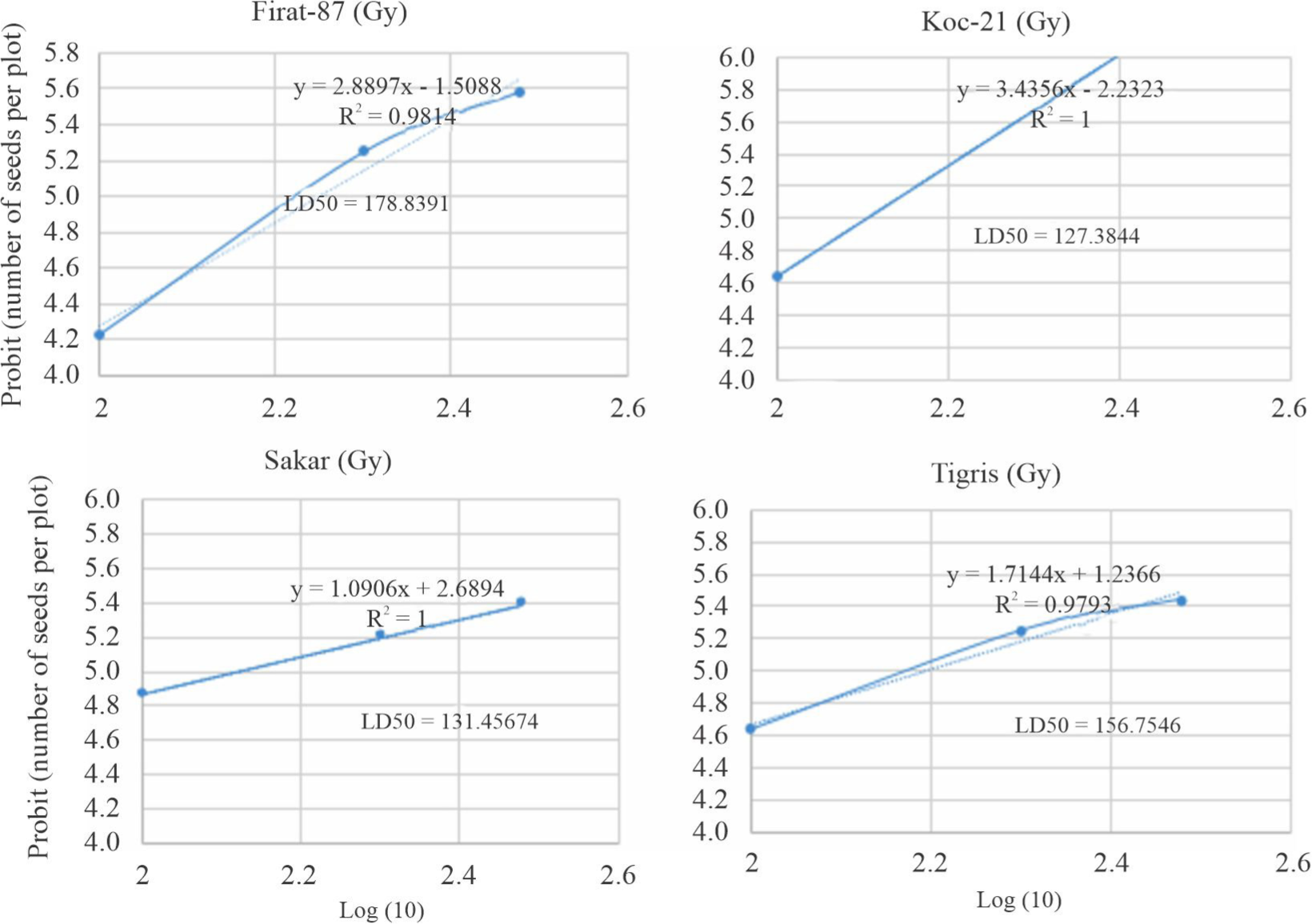
Although the GR50 value for lentil seed treated by gamma irradiation showed that a dose above 300 Gy was appropriate, the dose at 300 Gy was decided as the highest dose for seed in the present study. The number of seedlings per plot was accounted 30 days after sowing; and the LD50 values for the four lentil cultivars were determined over the number of seedlings per plot for 30 days after sowing. With the analysis of the probit curve, it was possible to show that the LD50 for each cultivar was different. The LD50 dose in 'Koc-21' (LD50=127.384) and 'Sakar' (LD50=131.45) was lower than 150 Gy gamma radiation. The LD50 dose for 'Tigris' (LD50=156.75) and 'Firat-87' (LD50=178.84) was higher than 150 Gy gamma radiation (Figure 2). LD50 dose of gamma rays in a lentil cultivar was calculated as 104.34 Gy based on the germination percentage (Tabti et al., 2018). Sharma & Sharma (1986) reported that the lethal dose for lentil types usually varied from 135 to 186 Gy. The GR50 and LD50 values are very significant, as they increase the probability of acquiring the desired mutants. Low doses of radiation and EMS treatments cause small changes in the genome. However, high doses result in unwanted or lethal mutations.

Lethal dose (LD50) based on the number of seed that emerged 30 days after sowing (DAS 30), grown in field conditions, from seed of the Firat-87, Koc-21, Sakar, and Tigris lentil (Lens culinaris) cultivars, subjected to gamma radiation doses.
In 'Firat-87', gamma radiation doses affected the plant height, first pod height, and seed yield per plant. The effect of gamma radiation doses on 'Koc-21' were significant for all traits. In 'Sakar', the doses of gamma rays affected the plant height, first pod height, and the number of flowers and seed per plant, with differences among doses. In 'Tigris', the irradiation treatment with gamma rays affected the number of pods per plant and seed yield per plant (Table 6).
The EMS doses effect showed a significant difference among all traits in 'Koc-21' and 'Sakar'. In 'Firat-87', the EMS doses affected plant height, number of flowers per peduncle, number of pods and seed, and seed yield per plant. In 'Tigris', EMS affected the first pod height, number of pods and seed per plant, and seed yield per plant (Table 6).
M1 plants were counted 30 days after planting and at harvest. While almost all seed planted at 100 Gy emerged, the number of emerged and harvested plants decreased significantly, depending on the variety at increasing radiation doses (Figure 3). Similarly, Pramanik et al. (2023) reported that the germination efficiency and germination percentage were delayed with increasing radiation doses. In Koc-21 cultivar, the number of seedlings emerging from the first dose of 100 Gy was less than 1/3, when the next dose of 200 Gy was to be applied. The number of plants harvested at 300 Gy was lower in cultivar Sakar (27.0) and in Koc-21 (32.0) than in Firat-87 (40.0) and Tigris (65.0). Laskar et al. (2018) reported that 300 Gy gamma rays in lentils could be successfully applied to a wide genetic variation through micro mutations, although it reduced the survival rate of the plants.

Number of M1 plants from seed of the Firat-87, Koc-21, Sakar, and Tigris lentil (Lens culinaris) cultivars (grown in field conditions), subjected to gamma radiation and ethyl methanesulfonate (EMS) doses at the stages of sown, germination and harvest.
Although 4/3 of the planted seed germinated in field, in treatments with all EMS doses, at the harvest time surviving plants were only those of 'Firat 87', 'Koc-21', and 'Sakar' treated at 20 mmol L-1 and, rarely, those subjected to 40 mmol L-1. The number of surviving plants increased as EMS doses was increased in 'Tigris'; in addition, at the harvest time, the highest number of 'Tigris' plants per plot were those treated at 20 mmol L-1 (121.0), 40 mmol L-1 (100.0), and 60 mmol L-1 (65.0). However, at seedling stage, GR50 values were determined at high EMS dose for 'Firat-87' (86.029 mmol L-1), 'Koc-21' (64.3 mmol L-1), 'Sakar' (64.06 mmol L-1), and 'Tigris' (49.03 mmol L-1) (Figure 3). High values of GR50 and LD50 in the seedling period caused lethal mutations, even at low doses under field conditions, due to environmental factors.
Gamma radiation doses affected plant height and first pod height in 'Firat-87', 'Koc-21' and 'Sakar', as well as the number of flowers per peduncle in 'Koc-21'. EMS doses affected plant height in 'Firat-87' and 'Koc-21', and first pod height in 'Koc-21', 'Sakar', and 'Tigris'. EMS doses affected the number of flowers per peduncle of all cultivars (Table 6).
Plant height in 'Firat-87' and 'Koc-21' (42.2 cm and 41.0 cm, respectively) was not affected by gamma radiation at 100 Gy, which did not differ from their controls (45.7 cm and 40.1 cm, respectively). In addition, for 'Sakar', 100 Gy (35.0 cm) and 200 Gy (33.3 cm) gamma radiation did not differ from the control (41.3 cm). First pod height decreased by increasing gamma radiation dose in in all cultivars, except for Tigris (Table 7).
Analysis of variance for the phenological characteristics of plants of the Firat-87, Koc-21, Sakar, and Tigris lentil (Lens culinaris) cultivars, grown in field conditions from seed subjected to doses of gamma radiation and ethyl methanesulfonate (EMS)(1).
Plant height in 'Koc-21' and 'Sakar' was not affected by EMS dose at 20 mmol L-1 (43.0 cm and 41.0 cm, respectively), incomparisonwiththeircontrols(40.6 cm and 43.6 cm, respectively). In addition, in 'Firat-87', the effect of 20 mmol L-1 (46.8 cm) EMS did not differ from the control (43.2 cm). The number of flowers per peduncle decreased as EMS doses increased in all cultivars, except for 'Tigris' (Table 7). While low doses of gamma radiation caused small changes in plant height, higher radiation doses shortened this parameter. Similarly, Verma et al. (1999), Laskar & Khan (2017) and Roy et al. (2023) reported that plant height reduced with increasing concentrations of radiation doses.
The number of flowers per peduncle ranged from 2.0 to 2.4 on the control plants, in all cultivars; however, this variable in the EMS-treated plants were reduced from 1.1 to 1.9 in 'Firat-87', 'Koc-21', and 'Sakar', as a result of high dose applications. The number of flowers per stem, which is an important productivity parameter, is significantly related to the yield potential of food legumes. Laskar (2018) founded a genotype multipodding and very small seed named 'mutant mp' obtained from the 'Pant L 406' cultivar, treated at 300 Gy.
The lentil cultivars showed different responses to increased gamma radiation doses for the number of flowers per plant (Figure 6). The number of flowers per plant in 'Koc-21' and 'Sakar' were similar in the treatment at 100 Gy and the control. However, the number of flowers per plant drastically decreased at 300 Gy in the treatments of the other cultivars (Figure 4).

Number of flowers per plant and number of pods per plant from seed of the Firat-87, Koc-21, Sakar, and Tigris lentil (Lens culinaris) cultivars, subjected to doses of gamma radiation and ethyl methanesulfonate (EMS). Gamma radiation doses for the number of flowers per plant were significant at the probabilities of 5% in Koc-21, 1% in Sakar, and 5% in Firat-87 and Tigris. For the number of pods per plant, gamma radiation doses were significant at the probabilities 1% in Koc-21 and Tigris, and 5% in Firat-87 and Sakar. For the number of flowers per plant, EMS doses were significant at the probabilities 1% in Koc-21 and in Sakar, and at 5% in Firat-87 and Tigri’. For the number of pods per plant, EMS doses were significant at 1% probability in all cultivars.
The number of pods per plant of the control in 'Koc-21' and 'Tigris' (89.3 and 76.3, respectively) was lower under gamma radiation doses at 100 Gy (105.7 and 91.0, respectively) and 200 Gy (100.3 and 135.3, respectively). In 'Koc-21', the number of pods per plant was drastically reduced at 300 Gy (25.0), in comparison with the control (89.3) and with the doses at 100 Gy (105.7) and 200 Gy (100.3). 'Tigris' consistently bloomed and podded even at high radiation doses (Figure 4). Many researchers have also reported that, similarly to seedling height, increasing gamma radiation decreases the pollen fertility percentage (Wani et al., 2019; Pramanik et al., 2023). Kumar et al. (2016) stated that more than 50% pollen sterility was observed in pea seed irradiated with high gamma doses.
Lentil cultivars were observed as continuously blooming under gamma radiation doses in the experimental plots. Although many plants in the plots had never set pods, although flowering continuously, especially at the 300 Gy dose, the flower-to-pod transformation rate was significantly higher in 'Tigris' (Figure 4).
The number of flowers per plant in 'Koc-21', 'Sakar', and 'Tigris' increased with increasing EMS doses, in comparison with the control; however, the number of flowers per plant decreased, after the dose application at 80 mmol L-1 to 'Koc-21' and 'Sakar'. 'Tigris' showed a positive response to increasing EMS doses, and the highest number of flowers per plant occurred at 100 mmol L-1 dose (Figure 4), when the flowering period was even prolonged at high doses.
The number of pods per plant decreased by increasing EMS doses, in comparison with the control. 'Firat-87' and 'Koc-21' treated with doses higher than 40 mmol L-1 did not produce pods. 'Sakar' produced pods in the treatment doses at 20 mmol L-1 (56.0) and 40 mmol L-1 (59.0), but the pod production considerably decreased at 60 mmol L-1 (6.9) EMS. In 'Tigris', the number of pods per plant was high at all EMS doses, in comparison with the control, and twice as many pods were produced at the highest EMS dose (100 mmol L-1). Taziun et al. (2018) and Raina et al. (2022) reported an increased number of pods per plant in mutagen-treated plants. Wani et al. (2021) reported that the number of pods per plant in mutagen-treated plants was significantly different from that of the control, and the highest number of pods per plant was observed in plants with high number of flowers per plant.
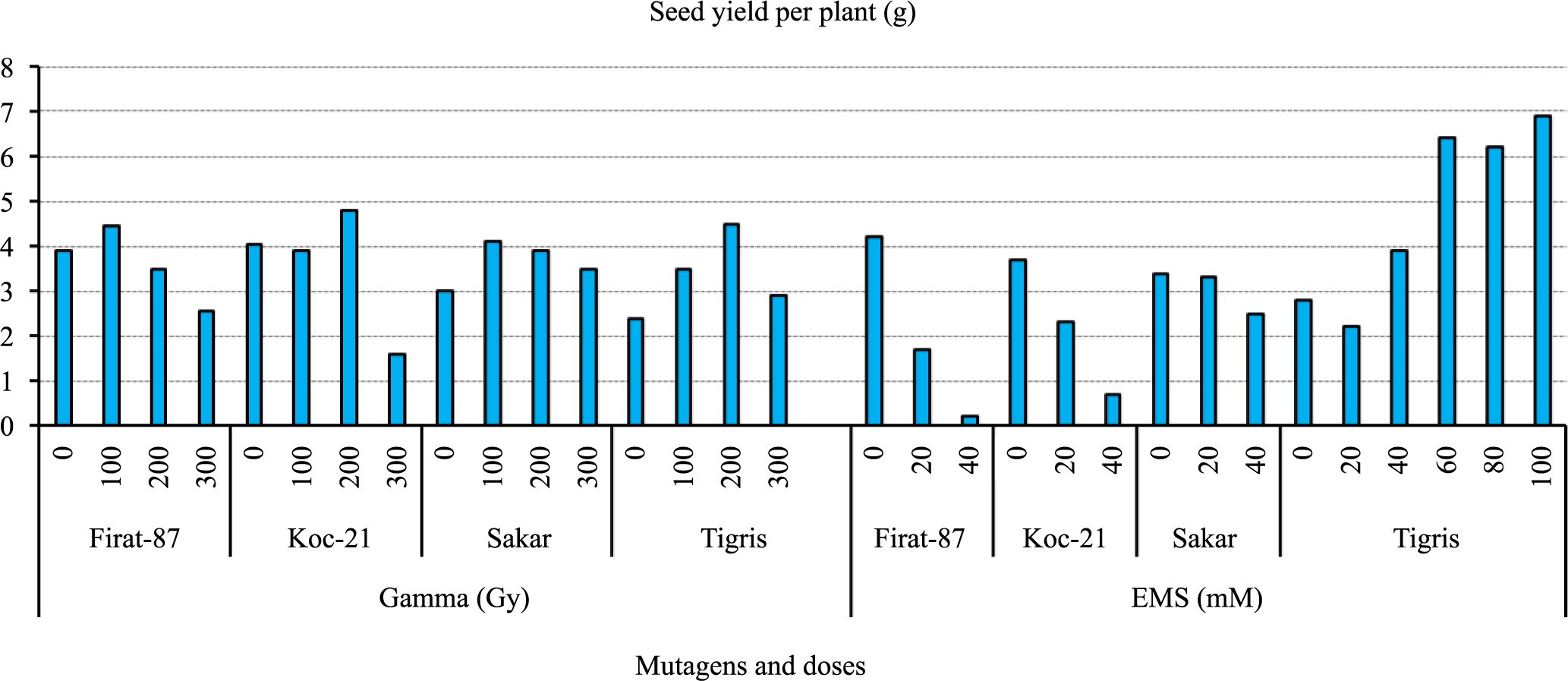
The number of seed per plant and seed yield per plant of the studied cultivars were high at 100 Gy and 200 Gy (Figure 5 and 6). In 'Koc-21', the number of seed per plant and seed yield per plant was drastically reduced by the radiation dose at 300 Gy (26.7 and 1.6 g, respectively), in comparison with the control and the other doses. Laskar et al. (2019) reported that mutant plants had smaller seed, however, they produced more pods.
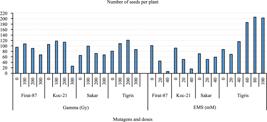
Number of seed per plant, from seed of the Firat-87, Koc-21, Sakar, and Tigris lentil (Lens culinaris) cultivars, subjected to doses of gamma radiation and ethyl methanesulfonate (EMS). Doses of gamma radiation were significant at 1% probability in Koc-21, Firat-87, and Tigris, and at 5% probability in Sakar. Doses of EMS were significant at 1% probability in Koc-21, Firat-87, and Tigris, and at 5% probability in Sakar.

Seed yield per plant from seed of the Firat-87, Koc-21, Sakar, and Tigris lentil (Lens culinaris) cultivars, subjected to doses of gamma radiation and ethyl methanesulfonate (EMS). Gamma radiation doses were significant at 1% probability in Firat-87, Koc-21, and Tigris, and significant at 5% probability in Sakar. EMS doses were significant at 1% in all cultivars.
Data on the number of seed per plant and seed yield per plant were obtained from the control group and from plants treated with doses up to 40 mmol L-1 EMS. In 'Tigris', the number of seed per plant ranged from 69.5 at 20 mmol L-1 to 205.0 at 80 mmol L-1; besides, at high EMS doses, 'Tigris' had higher seed yield than that of the control. In 'Tigris', a significant positive shift occurred in the M1 generation for the number of seed and yield per plant. However, grain yield is polygenic and complex. Therefore, Wani et al. (2021) stated that plant yield generally increased in the M2 generation rather than in the M1 generation, showing a complete positive shift in the next generations. Considering the number of seed per plant and seed yield per plant, high EMS doses were lethal in 'Firat-87', 'Koc-21', and 'Sakar'. The lowest number of seed per plant (7.0) and seed yield per plant (0.2 g) resulted from the application of 40 mmol L-1 dose, and in plants of the lentil 'Firat-87' (Figure 5 and 6).
Mean, standard deviation (sd), min and max, and CV percentage of plant height, first pod height, and number of flowers per peduncle of plants, from seed of the Firat-87, Koc-21, Sakar, and Tigris lentil (Lens culinaris) cultivars, subjected to doses of gamma radiation and concentrations of ethyl methanesulfonate (EMS)(1).
Conclusions
-
Gamma radiation and ethyl methanesulfonate (EMS) applications at increasing doses cause decreases in lentil (Lens culinaris) germination, seedling and root characteristics, plant height, number of flower per peduncle, number of flowers, pods, seeds and seed yield per plant.
-
In field conditions, EMS doses above 20 and 40 mmol L-1 concentrations show lethal effects on all cultivars, except on Tigris.
-
Among the studied cultivars, Tigris stands out due to positive mutations up to 80 mmol L-1 EMS for number of flower per plant, pods, seed and seed yield per plant, meaning it is promising for the development of new mutant varieties with a high yield.
Data availability statement
Data available upon request: research data are only available upon reasonable request to the corresponding author.
-
Declaration of use of AI technologies
No generative artificial intelligence (AI) was used in this study.
-
Disclaimer/Publisher’s note:
The statements, opinions, and data contained in all texts published in Pesquisa Agropecuária Brasileira (PAB) are solely those of the individual author(s) and not of the journal’s publisher, editor, and editorial team, who disclaim responsibility for any injury to people or property resulting from any referred ideas, methods, instructions, or products.The mention of specific chemical products, machines, and commercial equipment in the texts published in this journal does not imply their recommendation by the publisher.
References
-
ÁLVAREZ-HOLGUÍN, A.; MORALES-NIETO C.R.; AVENDAÑO-ARRAZATE, C.H.; CORRALES-LERMA, R.; VILLARREAL GUERRERO, F.; SANTELLANO-ESTRADA, E.; GÓMEZ-SIMUTA, Y. Mean lethal dose (LD50) and growth reduction (GR50) due to gamma radiation in Wilman lovegrass (Eragrostis superba). Revista Mexicana de Ciencias Pecuarias, v.10, p.227-238, 2019. DOI: https://doi.org/10.22319/rmcp.v10i1.4327
» https://doi.org/10.22319/rmcp.v10i1.4327 -
AMIN, R.; LASKAR, R.A.; KHAN, S. Assessment of genetic response and character association for yield and yield components in lentil (Lens culinaris L.) population developed through chemical mutagenesis. Cogent Food & Agriculture, v.1, art. 1000715, 2015. DOI: https://doi.org/10.1080/23311932.2014.1000715
» https://doi.org/10.1080/23311932.2014.1000715 - AYDIN, M.; KOÇ, M. The researches on determination of reaction of some lentil cultivars against soilborn fungal pathogens in Southeast Anatolia Region. Plant Protection Bulletin, v.48, p.33-41, 2008.
- BAYAA, B.; KUMARI, S.G.; AKKAYA, A.; ERSKINE, W.; MAKKOUK, K.M.; TURK, Z.; ÖZBERK, I. Survey of major biotic stresses of lentil in South-East Anatolia, Turkey. Phytopathologia Mediterranea, v.37, p.88-95, 1998.
- BICER, T.B.; SAKAR, D. The evaluation for yield and its components in the lentil (Lens culinaris Medik.) lines. Journal of the Faculty of Agriculture of Harran University (Turkey), v.15, p.21-27, 2011.
-
CHOWHAN, S.; ISLAM, M.; SULTANA, M.R.; EADUN NABI, K.M.; GHOSH, S.R.; AHMMED, M.F.; FERDOUS, H.M. Magnitude of aphid infestation, root rot and rust disease of lentil. Journal of Plant Science and Phytopathology, v.6, p.15-21, 2022. DOI: https://doi.org/10.29328/journal.jpsp.1001068
» https://doi.org/10.29328/journal.jpsp.1001068 -
EL-MOUHAMADY, A.B.A.; GAD, A.A.M.; ABDEL KARIM, G.S.A. Genetic amelioration in lentil (Lens culinaris L.) using different doses of ethyl methane sulphonate. Bulletin of the National Research Centre, v.44, art.88, 2020. DOI: https://doi.org/10.1186/s42269-020-00319-7
» https://doi.org/10.1186/s42269-020-00319-7 - JAHAN, R.; RAINA, A.; MALIK, S.; KHAN, S. Gamma rays and sodium azide induced variations in bio-physiological and agronomical traits in linseed (Linum usitatissimum L.). Heliyon, v.10, e31329, 2024.
- JEENA, A.S.; SINGH, L.S. Field evaluation of wild relatives of lentil. Indian Journal Pulses Research, v.1, p.50-51, 2000.
- KANGARASU, S.; GANESHRAM, S.; JOEL, A.J. Determination of lethal dose for gamma rays and ethyl methane sulphonate induced mutagenesis in cassava (Manihot esculenta Crantz.). International Journal of Scientific Research, v.3, p.1-6, 2014.
- KHAN, S.; WANI, M.R.; PARVEEN, K. Sodium azide induced high yielding early mutant in lentil. Agricultural Science Digest, v.26, p.65-66, 2006.
- KUMAR, A.; CHAURASIA, A.K.; MARKER, S.; SHUKLA, P.K.; RAI, P.K.; VERMA, P.K.; BARA, B.M. Effect of gamma radiation of macro mutations, effectiveness and efficiency under M2 generation in pea (Pisum sativum L.). Annals of West University of Timişoara, Series of Biology, v.19, p.71-76, 2016.
-
KUMAR, A.; PAUL, S.; THAKUR, G. Determination of lethal dose (LD50) and effects of gamma rays and ethyl methane sulphonate (EMS) induced mutagenesis in linseed (Linum usitatissimum L.). International Journal of Current Microbiology and Applied Sciences, v.9, p.2601-2608, 2020. DOI: https://doi.org/10.20546/ijcmas.2020.910.313
» https://doi.org/10.20546/ijcmas.2020.910.313 -
LASKAR, R.A.; KHAN, S. Mutagenic effectiveness and efficiency of gamma rays and HZ with phenotyping of induced mutations in lentil cultivars. International Letters of Natural Sciences, v.64, p.17-31, 2017. DOI: https://doi.org/10.56431/p-01u3v7
» https://doi.org/10.56431/p-01u3v7 -
LASKAR, R.A.; KHAN, S.; DEB, C.R.; TOMLEKOVA, N.; WANI, M.R.; RAINA, A.; AMIN, R. Lentil (Lens culinaris Medik.) diversity, cytogenetics and breeding. In: AL-KHAYRI, J.M.; JAIN, S.; JOHNSON, D.V. (Ed.). Advances in Plant Breeding Strategies: legumes, 2019. v.7, p.319-369. DOI: https://doi.org/10.1007/978-3-030-23400-3_9
» https://doi.org/10.1007/978-3-030-23400-3_9 -
LASKAR, R.A.; WANI, M.R.; RAINA, A.; AMIN, R.; KHAN, S. Morphological characterization of gamma rays induced multipodding mutant (mp) in lentil cultivar Pant L 406. International Journal of Radiation Biology, v.94, p.1049-1053, 2018. DOI: https://doi.org/10.1080/09553002.2018.1511927
» https://doi.org/10.1080/09553002.2018.1511927 -
MONTEJANO-RAMÍREZ, V.; VALENCIA-CANTERO, E. The importance of lentils: an overview. Agriculture, v.14, art.103, 2024. DOI: https://doi.org/10.3390/agriculture14010103
» https://doi.org/10.3390/agriculture14010103 -
MUTLU, Ç.; KARACA, V.; EREN, S.; BUYUK, M.; GOZUACIK, C.; DUMAN, M.; BAYRAM, Y.; BOLU, H.; KUTUK, H. Chalky spot damage caused by stink bugs on red lentil seeds in Southeast Anatolia Region, Turkey. Legume Research - An International Journal, v.39, p.623-629, 2016. DOI: https://doi.org/10.18805/lr.v0iOF.9437
» https://doi.org/10.18805/lr.v0iOF.9437 - PAUL, A.; SINGH, D.P.; PAUL, A. Induced chlorophyll mutations in lentil (Lens culinaris Medik.). Indian Journal of Genetics and Plant Breeding, v.62, p.263-264, 2002.
-
PRAMANIK, B.; DEBNATH, S.; RAHIMI, M.; HELAL, M.M.U.; HASAN, R. Morphometric frequency and spectrum of gamma-ray-induced chlorophyll mutants identified by phenotype and development of novel variants in lentil (Lens culinaris Medik.). Plos One, v.18, e0286975, 2023. DOI: https://doi.org/10.1371/journal.pone.0286975
» https://doi.org/10.1371/journal.pone.0286975 -
RAINA, A.; WANI, M.R.; LASKAR, R.A.; KHAN, S. Chemical mutagenesis: role in breeding and biofortification of lentil (Lens culinaris Medik.) mutant lines. Molecular Biology Reports, v.49, p.11313-11325, 2022. DOI: https://doi.org/10.1007/s11033-022-07678-6
» https://doi.org/10.1007/s11033-022-07678-6 - RAVI, V.; MINOCHA, J.L.; SINGH, A. Induced mutations for quantitative traits in lentil. In: SYMPOSIUM ON ROLE OF INDUCED MUTATIONS IN CROP IMPROVEMENT, 1979, Hyderabad. Proceedings. Hyderabad: Osmania University, 1980. p.414-419.
-
ROBERTSON, J.L.; JONES, M.M.; OLGUIN, E.; ALBERTS, B. Bioassays with arthropods. 3rd ed. Boca Raton: CRC Press, 2017. https://doi.org/10.1201/9781315373775
» https://doi.org/10.1201/9781315373775 -
ROY, A.; SAHU, P.K.; DAS, C.; BHATTACHARYYA, S.; RAINA, A.; MONDAL, S. Conventional and new-breeding technologies for improving disease resistance in lentil (Lens culinaris Medik.). Frontiers in Plant Science, v.13, art.1001682, 2023. DOI: https://doi.org/10.3389/fpls.2022.1001682
» https://doi.org/10.3389/fpls.2022.1001682 -
SARKER, A.; ERSKINE, W.; SINGH, M. Variation in shoot and root characteristics and their association with drought tolerance in lentil landraces. Genetic Resources and Crop Evolution, v.52, p.89-97, 2005. DOI: https://doi.org/10.1007/s10722-005-0289-x
» https://doi.org/10.1007/s10722-005-0289-x -
SHARMA, S.K.; SHARMA, B. Mutagen sensitivity and mutability in lentil. Theoretical and Applied Genetics, v.71, p.820-825, 1986. DOI: https://doi.org/10.1007/BF00276424
» https://doi.org/10.1007/BF00276424 - SINHA, R.P. Induced shy mutant of lentil (Lens culinaris Med.). Current Science, v.58, p.252-253, 1989.
-
TABTI, D.; LAOUAR, M.; RAJENDRAN, K.; KUMAR, S.; ABDELGUERFI, A. Identification of desirable mutants in quantitative traits of lentil at early (M2) generation. Journal of Environmental Biology, v.39, p.137-142, 2018. DOI: https://doi.org/10.22438/jeb/39/2/MRN-476
» https://doi.org/10.22438/jeb/39/2/MRN-476 -
TAZIUN, T.; LASKAR, R.A.; AMIN, R.; KHAN, S.; PARVEEN, K. Effects of dosage and durations of different mutagenic treatment in lentil (Lens culinaris Medik.) cultivars Pant L 406 and DPL 62. Legume Research-An International Journal, v.41, p.500-509, 2018. DOI: https://doi.org/10.18805/LR-3757
» https://doi.org/10.18805/LR-3757 -
TRIPATHI, K.; MISHRA, G.P.; TRIPATHI, D.; DIKSHIT, H.K.; MEHRA, R.; KUMAR, A.; SARKER, A.; SINGH, K. First report of a novel multi-flowering germplasm with fasciated stem in lentil (Lens culinaris Medik.). Indian Journal of Plant Genetic Resources, v.34, p.1-4, 2021. DOI: https://doi.org/10.5958/0976-1926.2021.00001.2
» https://doi.org/10.5958/0976-1926.2021.00001.2 -
TURKISH STATE METEOROLOGICAL SERVICE. Cities & Holiday Resorts: Diyarbakir. 2024. Available at: <https://www.mgm.gov.tr/eng/forecast-cities.aspx?m=DIYARBAKIR>. Accessed on: Mar. 25 2026.
» https://www.mgm.gov.tr/eng/forecast-cities.aspx?m=DIYARBAKIR - TYAGI, B.S.; GUPTA, P.K. Induced mutations for fasciation in lentil (Lens culinaris Med.). Indian Journal of Genetics and Plant Breeding, v.51, p.326-331, 1991.
- VERMA, R.P.; SRIVASTAVA, G.K.; KUMAR, G. Comparative radio-cytological studies in three varieties of Lens culinaris Journal of Cytology & Genetics, v.34, p.49-56, 1999.
-
WANI, M.R. Comparative biological sensitivity and mutability of chemo-mutagens in lentil (Lens culinaris Medik.). Legume Research, v.44, p.26-30, 2019. DOI: https://doi.org/10.18805/LR-4058
» https://doi.org/10.18805/LR-4058 - WANI, M.R.; LASKAR, R.A.; RAINA, A.; KHAN, S.; KHAN, T.U. Application of chemical mutagenesis for improvement of productivity traits in lentil (Lens culinaris Medik.). Annals of Biology, v.37, p.69-75, 2021.
-
WIRAGUNA, E.; MALIK, A.I.; ERSKINE, W. Waterlogging tolerance in lentil (Lens culinaris Medik. subsp. culinaris) germplasm associated with geographic origin. Genetic Resources and Crop Evolution, v.64, p.579-586, 2017. DOI: https://doi.org/10.1007/s10722-016-0385-0
» https://doi.org/10.1007/s10722-016-0385-0
Edited by
-
Chief editor: Edemar CorazzaEdited by: Madalena Rinaldi