Two new deep-water alpheid shrimps from the Indo-West Pacific (Malacostraca: Decapoda: Caridea)
Abstract
In the present study, two deep-water species of the caridean shrimp family Alpheidae are described from two localities in the Indo-West Pacific, each based on a single specimen. Bannereus kebir sp. nov. is described based on a female holotype collected at a depth of 230-243 m in the Kai Islands, Indonesia. The new species can be easily separated from the two congeners, B. anomalus Bruce, 1988 and B. chani Anker & Pachelle, 2020, by the presence of strap-like epipods on the first to third pereiopods. Salmoneusprofundus sp. nov. is described based on an incomplete hermaphrodite holotype collected at a depth of 218-225 m near Hanover Island, Papua New Guinea. This species differs from all other species of Salmoneus Holthuis, 1955 by the shape and armature of the enlarged minor cheliped, the elongate walking legs, and the absence of a strap-like epipod on the fourth pereiopod. It also represents by far the deepest-known member of Salmoneus, since all other known species in this genus occur at depths shallower than 90 m.
Keywords
Decapod crustaceans; Alpheidae; Caridean shrimps; New taxa; Indonesia; Papua New Guinea
INTRODUCTION
Alpheid shrimps are particularly well represented in shallow waters, with the vast majority of species recorded from depths less than 50 m (Anker et al., 2006). Below 200 m, alpheids are much less common and mostly represented by species of the largest genus of the family, Alpheus Fabricius, 1798 (e.g., Hayashi & Nagata, 2000; Anker & Nizinski, 2011; Komai & Ohtomi, 2018; Anker, 2020a; De Grave et al., 2020). However, a small Indo-West Pacific clade containing four genera, namely Batella Holthuis, 1955, Bannereus Bruce, 1988, Vexillipar Chace, 1988, and Batellopsis Ashrafi, Ďuriš & Anker, 2024, appears to be restricted to deep-water habitats, with possibly all of its members being associated with hexactinellid sponges (Bruce, 1988; Chace, 1988; De Grave, 2004; Anker & Pachelle, 2020; Ashrafi et al., 2024). On the other hand, the currently third largest alpheid genus Salmoneus Holthuis, 1955 contains mainly shallow-water species found at depths less than 50 m (e.g., Anker & Marin, 2006; Anker, 2010a), with one incomplete specimen tentatively identified as “S. ? jarli (Holthuis, 1951)” dredged from a depth of 90 m (Holthuis & Gottlieb, 1958; Dworschak et al., 2000).
In the present study, two new alpheid species are described, one in Bannereus and one in Salmoneus, based on deep-water material collected during two expeditions organised by the Museum National d’Histoire Naturelle, Paris, France (MNHN), the first in Indonesia in 1991, and the second in Papua New Guinea in 2014 (Crosnier et al., 1997; Corbari et al., 2020).
MATERIAL AND METHODS
The type specimens are deposited in the MNHN crustacean collection. Carapace length (cl, from the tip of the rostrum or rostral projection to the posterior margin of the carapace) is used as a standard measurement of the specimens.
Systematics
Alpheidae Rafinesque, 1815 Bannereus Bruce, 1988 Bannereus kebir sp. nov. (Figs. 1,2,3)
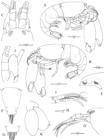
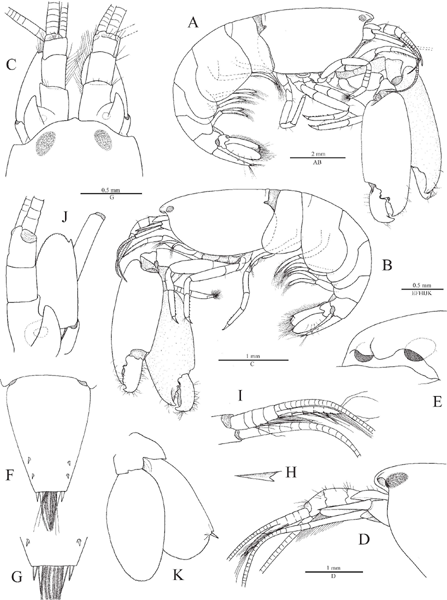
Bannereus kebir sp. nov., holotype, female (cl 4.2 mm), Kai Islands, Indonesia, MNHN-IU-2010-4187; (A) habitus, lateral (right); (B) same, lateral (left); (C) frontal region, dorsal; (D) same, lateral; (E) rostro-orbital region of carapace and eyes, anterolateral; (F) telson, dorsal; (G) same, posterior region (dorsal simple setae omitted); (H) ventromesial tooth on first article of antennular peduncle, lateral; (I) antennular flagella, lateral; (J) antennule and antenna, dorsal (setae omitted); (K) uropod, dorsal (setae omitted).
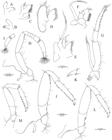
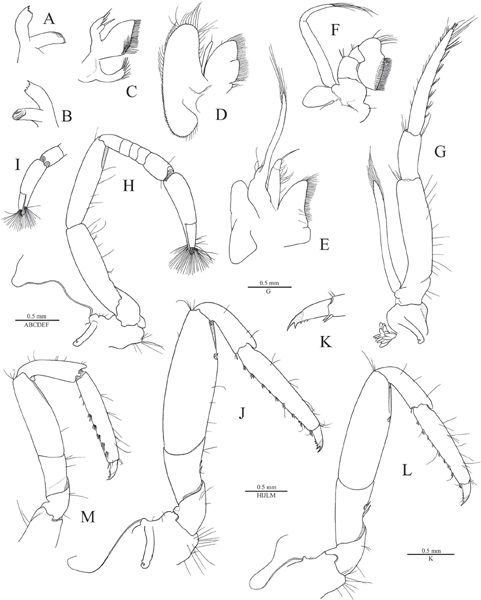
Bannereus kebir sp. nov., holotype, female (cl 4.2 mm), Kai Islands, Indonesia, MNHN-IU-2010-4187; (A) mandible, lateral; (B) same, mesial; (C) maxillule, lateral; (D) maxilla, lateral; (E) first maxilliped, lateral; (F) second maxilliped, lateral; (G) third maxilliped, lateral; (H) second pereiopod, lateral; (I) same, distal portion of carpus and chela, mesial; (J) third pereiopod, lateral; (K) same, dactylus, mesial; (L) fourth pereiopod, lateral; (M) fifth pereiopod, lateral.
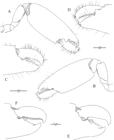
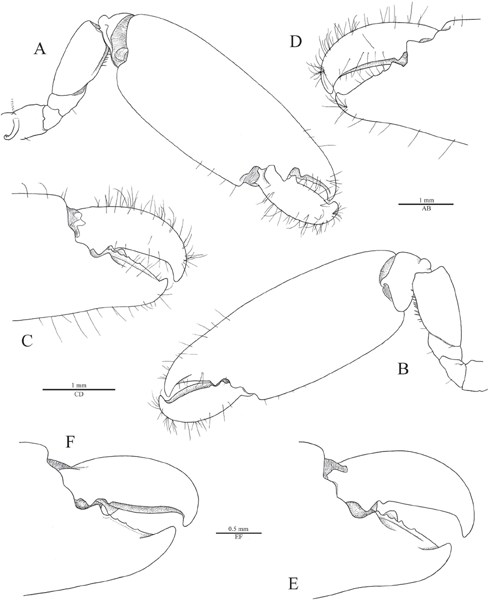
Bannereus kebir sp. nov., holotype, female (cl 4.2 mm), Kai Islands, Indonesia, MNHN-IU-2010-4187; (A) right cheliped, lateral; (B) same, mesial; (C) same, distal portion of chela, mesial; (D) same, distal portion of chela, lateral; (E) same, chela fingers, ventromesial (setae omitted); (F) same, chela fingers, mesial (setae omitted).
Bannereus cf. chani – Chow et al., 2021: 2903, fig. 3 (phylogenetic tree); Ashrafi et al., 2024: 3, fig. 1 (phylogenetic tree), 4.
Type material: Holotype: female (cl 4.2 mm), MNHN-IU-2010-4187, Indonesia, Kai Islands, east of northern point of Dullah Island, Expedition KARUBAR, sta. DW24, 05°32′S/132°51′E, depth: 230-243 m, 26.10.1991.
Description: Small-sized alpheid shrimp (holotype: cl 4.2 mm). Carapace glabrous; pterygostomial angle broadly rounded; cardiac notch deep (Fig. 1A, B, D). Rostrum (Fig. 1C,D,E) reduced to small broad triangular lobe, projecting slightly beyond anterior margin of orbital hoods. Orbital hoods (Fig. 1C, D) partly open anteriorly, broadly rounded, unarmed. Each epistomial sclerite with short blunt process.
Pleon glabrous; pleura of first to fifth pleonite rounded posteroventrally (Fig. 1A, B); sixth pleonite with posterior margin bearing blunt projection; preanal plate broadly rounded. Telson (Fig. 1F, G) broad proximally, distinctly tapering distally, 1.4 times as long as maximal width, ratio proximal/distal width 3.1; dorsal surface with two pairs of small spiniform setae, both situated in posterior third, first pair at 0.7 telson length, second pair at 0.85 telson length; posterior margin straight, with several erect simple setae, six plumose setae and two pairs of stout spiniform setae, one at each angle, mesial stouter and about twice as long as lateral.
Eyes (Fig. 1C, E) completely covered dorsally and largely concealed laterally, except for small portion of cornea; cornea not particularly reduced, normally pigmented.
Antennular peduncle (Fig. 1C, D, H,I,J) relatively stout; stylocerite stubby, with rounded tip, latter not reaching distal margin of first article; ventromesial carina with anteriorly directed, sharp tooth; second article about 1.2 times as long as wide; third article slightly shorter than second; lateral antennular flagellum with fused portion composed of four subdivisions; accessory (free) ramus with six or so poorly demarcated subdivisions, groups of aesthetascs extending from second subdivision of fused portion to end of accessory ramus. Antenna (Fig. 1C, D, J) with basicerite relatively small, its distoventral margin bluntly projecting, not forming distinct tooth; scaphocerite reaching distal end of antennular peduncle, with small distolateral tooth, its tip exceeded by anterior margin of blade; carpocerite long, reaching way beyond scaphocerite and end of antennular peduncle; flagellum slender.
Mouthparts typical for genus, as illustrated (Fig. 2A,B,C,D,E,F). Third maxilliped (Fig. 2G) pediform, moderately slender; coxa with strap-like epipod (mastigobranch) and dorsally slightly produced lateral plate; penultimate article about 0.4 length of antepenultimate article, 2.3 times as long as maximal width; ultimate article about 2.5 as long as penultimate article, strongly tapering distally, apex with two stout spiniform setae; exopod well developed, reaching end of antepenultimate article; arthrobranch small.
First pereiopods (= chelipeds) equal in size and symmetrical in shape (Figs. 1A, B, 3); coxa with strap-like epipod and at least one setobranch; ischium short; merus moderately swollen, about 1.8 times as long as maximal width, smooth, ventromesial margin with row of small spiniform setae in distal third; carpus cup-shaped, with deep proximal constriction, distal margin with blunt lobes; chela enlarged, swollen, much longer than all other cheliped articles combined, smooth; palm twice as long as maximal width, ovate, subcylindrical, feebly compressed; fingers somewhat unequal, with dactylus longer than pollex and about 0.6 times as long as palm, fingertips strongly curved, blunt; cutting margin of pollex with two prominent subtriangular teeth on lateral edge and one such tooth on mesial edge, all teeth situated in proximal half or third of pollex, surface between edges and blade slightly excavated, blade with five smaller spaced teeth in proximal half, unarmed in distal half; cutting margin of dactylus shallowly excavated, with one subtriangular tooth on lateral edge and two subtriangular teeth on mesial edge, proximal much larger, all teeth situated in proximal third.
Second pereiopod (Fig. 2H, I) relatively short, stout; coxa with strap-like epipod and one setobranch; ischium and merus subequal in length; carpus composed of five subarticles with ratio approximately equal to 2 : 1 : 1 : 1 : 2.3; chela elongate, as long as carpus; palm cylindrical; fingers unequal, with dactylus 0.7 length of palm and slightly longer than pollex; pollex with simple tip, with subdistal transverse dense row of elongate microserrulate setae of about same length; dactylus apparently with bifid tip, with subdistal transverse dense row (or pair of two rows) of elongate microserrulate setae of about same length; both rows of microserrulate setae somewhat fan-shaped, almost completely obscuring distal portion of fingers.
Third pereiopod (Fig. 2J, K) stout, flattened; coxa with strap-like epipod and one setobranch; ischium slightly longer than distal width, armed with two small spiniform setae on ventrolateral surface; merus swollen, with broadly convex ventral and dorsal margins, about 2.5 times as long as ischium, 3.3 times as long as maximal width, armed with small spiniform seta at about 0.7 of article length; carpus half as wide as merus, less than half-length of merus, distoventrally with slender spiniform seta; propodus almost twice as long as carpus, ventral margin armed with numerous small spiniform setae, most of them inserted in pairs or triplets, distoventral margin adjacent to dactylar base with additional pair of spiniform setae; dactylus about 0.25 of propodus length, composed of two parts divided by faint suture, ventral margin of basal part with three minute triangular denticles, ventral margin of distal part with two strong, somewhat divergent ungui. Fourth pereiopod (Fig. 2L) similar to third pereiopod, however, shorter and more slender; coxa without strap-like epipod, with one setobranch; ischium armed with two slender spiniform setae on ventrolateral surface; merus armed with small spiniform seta at about 0.6 of article length; propodus and dactylus very similar to those of third pereiopod, including proportions and armature. Fifth pereiopod (Fig. 2M) smallest of walking legs; coxa without setobranch; ischium about five times as long as wide, unarmed; merus about twice as long as ischium, three times as long as maximal width, slightly swollen, unarmed; carpus 0.6 times length of merus, unarmed distally; propodus 1.6 times as long as carpus, ventromesial margin with three widely spaced spiniform setae, distoventral margin adjacent to dactylar base with one additional spiniform seta; propodal grooming brush composed of five transverse rows of microserrulate setae extending from about 0.4 to 0.9 of article length; dactylus about 0.2 times propodus length, similar to that of third and fourth pereiopod.
Second pleopod with appendix interna; male characters currently unknown. Uropod (Fig. 1K) with lateral lobe of protopod distally bluntly produced; exopod broad, with convex lateral margin, and with small blunt distolateral tooth adjacent to well-developed but slender spiniform seta; diaeresis reduced, distinct only laterally close to spiniform seta; endopod as long as exopod, ovate, without diagnostic features.
Colour in life unknown.
GenBank accession numbers: 16S rRNA gene: MZ661678; 12S rRNA gene: MZ661582 (see also Ashrafi et al., 2024).
Etymology: The new species is named after the author’s friend and colleague, Rachid Kebir, technician in the crustacean laboratory of MNHN, for his help reconditioning and relabelling thousands of shrimp specimens over the years; used as a noun in apposition.
Distribution: Presently known only from the type locality in the Kai Islands, Indonesia.
Ecology: Largely unknown, except for the depth range (230-243 m), at which the holotype specimen was collected.
Remarks: The new species evidently belongs to the genus Bannereus, based on the diagnostic features of the frontal margin of the carapace and pereiopods, including the very characteristic armature on the chela fingers (Bruce, 1988). Prior to the present study, Bannereus included only two formally described species, the type species, B. anomalus Bruce, 1988 from the Coral Sea off southern Great Barrier Reef and waters around New Caledonia, and B. chani Anker & Pachelle, 2020 from Taiwan (Bruce, 1988; Anker & Pachelle, 2020). The herein described B. kebir sp. nov., which was reported under “B. cf. chani” in recent phylogenetic analyses by Chow et al. (2021) and Ashrafi et al. (2024) represents the third species of this rare genus.
Bannereus kebirsp. nov. can be separated from both B. anomalus and B. chani by the presence of a straplike epipod (= mastigobranch) on the coxae of the first, second and third pereiopods (Figs. 2H, J, 3A), and their respective setobranchs. In the female holotype of B. anomalus, there are no strap-like epipods at all, whereas in the male specimen tentatively assigned to the same species by Bruce (1988), but not designated as paratype, the third maxilliped has a strap-like epipod below the coxal lateral plate. In the holotype and only specimen known of B. chani, a strap-like epipod is present on the coxa of the third maxilliped (Anker & Pachelle, 2020), as in the male of B. anomalus of Bruce (1988). Within the hexactinellid-associated alpheid clade sensu Ashrafi et al. (2024), an almost complete set of strap-like epipods (on the coxae of the third maxilliped and first to third pereiopods) is also present in the monotypic Vexillipar and Batellopsis, whereas these structures are lacking in all three species of Batella (cf. Chace, 1988; De Grave, 2004; Ashrafi et al., 2022, 2024).
Bannereus kebirsp. nov. differs from B. anomalus by the chelipeds being equal in size and symmetrical in shape, which could be a generic novelty for Bannereus. The chelipeds are strongly unequal and somewhat asymmetrical in the female holotype of B. anomalus (cf. Bruce, 1988: figs. 1, 4AB,C,D,E,F), whereas the male specimen only has its (presumably) minor cheliped (cf. idem.: fig. 4G,H,I). The holotype of B. chani has only one cheliped, too, which appears to be a major cheliped (Anker & Pachelle, 2020: fig. 2), based on its size and overall similarity with the major cheliped of the holotype of B. anomalus. In addition, Anker & Pachelle (2020) hypothesised that Bruce’s (1988) male specimen could well belong to B. chani, in which case, the chelipeds of this species would be unequal and slightly asymmetrical. However, the possibility that in B. chani, the chelipeds are equal and symmetrical cannot be completely discarded at this stage.
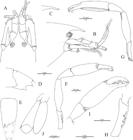
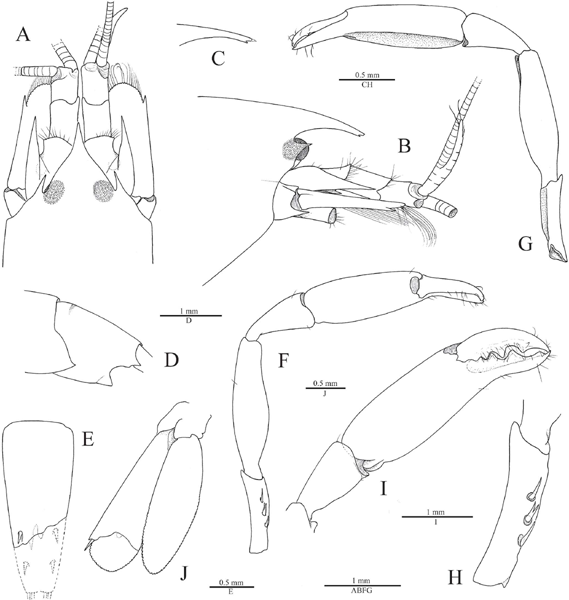
Salmoneus profundus sp. nov., holotype, non-ovigerous hermaphrodite (cl 4.5 mm), west of New Hanover Island, Papua New Guinea, MNHN-IU-2015-1059; (A) frontal region, dorsal; (B) same, lateral; (C) rostrum, lateral; (D) posterior pleonites, lateral; (E) telson, dorsal (damaged); (F) right (minor?) cheliped, lateral; (G) same, mesial; (H) same, ischium, lateral; (I) same, carpus and chela, lateral; (J) uropod, dorsal.
Other differences between B. kebir sp. nov. and B. anomalus include the presence of spiniform setae on the merus of the chelipeds in the new species vs. their absence in B. anomalus; and between B. kebir sp. nov. and B. chani, in the more distal position of spiniform setae on the meri of the third and fourth pereiopods, and the noticeably shorter first subarticle of the second pereiopod carpus (cf. Fig. 2H, J, L; Anker & Pachelle, 2020: figs. 1I, 3A, C). As some of these differences involve features known to be relatively variable in alpheid shrimps, more specimens are needed to confirm their validity. Nevertheless, the three species of Bannereus were found to be significantly divergent in DNA and beyond any doubts represent distinct biological species (Ashrafi et al., 2024: fig. 1, B. kebir sp. nov. under “B. cf. chani”).
Salmoneus Holthuis, 1955 Salmoneus profundus sp. nov. (Figs. 4, 5)
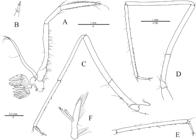
Salmoneus profundus sp. nov., holotype, non-ovigerous hermaphrodite (cl 4.5 mm), west of New Hanover Island, Papua New Guinea, MNHN-IU-2015-1059; (A) third maxilliped, lateral; (B) same, tip of ultimate article, dorsomesial; (C) fourth pereiopod, lateral; (D) fifth pereiopod, lateral; (E) same, propodus and dactylus, mesial; (F) endopod of second pleopod, anterior.
Type material: Holotype: non-ovigerous hermaphrodite (cl 4.5 mm), MNHN-IU-2015-1059, Papua New Guinea, west of New Hanover Island, Expedition KAVIENG 2014, sta. DW4494, 02°26′S/149°55′E, depth: 218-225 m, 06.09.2014.
Description: Small-sized alpheid shrimp (holotype: cl 4.5 mm). Carapace glabrous, without thick erect setae; anterolateral suture not distinct; pterygostomial angle broadly rounded; cardiac notch deep. Rostrum (Fig. 4A,B,C) broad in proximal half, with convex lateral margins, much narrower in distal half, about as long as wide (measured between orbital notches), slightly descending in lateral view; tip acute (apical point broken), with minute ventral subdistal tooth, almost reaching mid-length of second article of antennular peduncle; rostral carina not distinct; post-rostral tubercle absent. Orbital teeth (Fig. 4A, B) well developed, sharp, about 0.2 of rostrum length, slightly turned mesially, extending well beyond eyes; orbital notches between base of rostrum and orbital teeth deep, narrowly U-shaped. Each epistomial sclerite with short blunt process.
Pleon largely glabrous; pleura of first to fourth pleonite rounded or rounded-angular posteroventrally, that of fifth pleonite (Fig. 4D) produced in small subacute tooth; sixth pleonite (Fig. 4D) not particularly elongate, posterior margin with subacute projection, posteroventral angle with subtle suture; preanal plate broadly rounded. Telson heavily damaged (Fig. 4E), subrectangular, distinctly tapering distally; dorsal surface probably with two pairs of spiniform setae, both situated in posterior half, first pair at about 0.65 telson length; configuration of posterior margin and its spiniform setae unknown.
Eyes (Fig. 4A, B) almost completely covered dorsally, somewhat exposed laterally; cornea not particularly reduced, normally pigmented; anterodorsal margin rounded.
Antennular peduncle (Fig. 4A, B) moderately stout; stylocerite slender, with acute tip, latter reaching midlength of second article; ventromesial carina with anteriorly directed, sharp tooth (visible in Fig. 4B); second article about 1.2 times as long as wide; third article slightly shorter than second; lateral antennular flagellum with fused portion composed of three subdivisions; accessory (free) ramus with six or so poorly demarcated subdivisions, distally with some groups of aesthetascs. Antenna (Fig. 4A, B) with basicerite moderately large, armed with sharp distoventral tooth; scaphocerite not reaching distal end of antennular peduncle, with small distolater-al tooth, its tip greatly exceeded by anterior margin of blade; carpocerite very short, not reaching half-length of scaphocerite; flagellum missing.
Mouthparts not dissected, typical for genus in external view. Third maxilliped (Fig. 5A, B) pediform, slender; coxa with strap-like epipod (mastigobranch) and rounded lateral plate; penultimate article about 0.4 length of antepenultimate article, more than four times as long as distal width; ultimate article about twice as long as penultimate article, strongly tapering distally, apex in form of subacute corneous point, without spiniform setae; exopod well developed, however, not reaching end of antepenultimate article; arthrobranch well developed.
Only right first pereiopod (= presumably minor cheliped) present (Fig. 4F,G,H,I); coxa with strap-like epipod and at least two setobranchs; ischium with three strong spiniform setae, middle one bifid, on ventrolateral surface; merus about 3.5 times as long as maximal width, smooth, ventral margin strongly convex; carpus constricted proximally, much wider distally, distal margin with blunt lobes; chela moderately enlarged, not particularly swollen, about as long as merus and ischium combined, smooth; palm twice as long as maximal width, about as long as merus, subcylindrical; fingers about 0.7 length of palm, subequal in length, slightly twisted, fingertips moderately curved; cutting edges of pollex and dactylus each with three large subtriangular teeth, large gape (hiatus) present distally.
Second and third pereiopod unknown (both pairs missing in holotype). Fourth pereiopod (Fig. 5C) elongate, slender; coxa without strap-like epipod, with two setobranchs only; ischium about 6.5 times as long as wide, armed with one small spiniform seta on ventrolateral surface; merus with straight ventral and dorsal margins, about 1.5 times as long as ischium, 9.1 times as long as maximal width; carpus half as wide as merus, about 0.9 length of merus, distoventrally with slender spiniform seta; propodus subequal to carpus in length, ventral margin armed with five small, widely spaced spiniform setae, distoventral margin adjacent to dactylar base with one pair of much longer spiniform setae; dactylus about 0.35 of propodus length, moderately slender, simple, conical, gently curved. Fifth pereiopod (Fig. 5D, E) longer than fourth pereiopod, similarly elongate and slender; coxa without setobranchs; ischium about five times as long as wide, unarmed; merus about 2.2 times as long as ischium, almost 11 times as long as wide; carpus 0.7 times width and 1.2 times length of merus; propodus 1.1 times as long as carpus, ventromesial margin with four small, widely spaced spiniform setae, distoventral margin adjacent to dactylar base with one additional spiniform seta; propodal grooming brush composed of at least eight transverse rows of curved microserrulate setae extending from about 0.6 of article length to its distal end; dactylus about 0.25 times propodus length, similar to that of fourth pereiopod.
Second pleopod with appendix masculina significantly longer than appendix interna (Fig. 5F), not exceeding distal margin of endopod. Uropod (Fig. 4J) with lateral lobe of protopod distally produced as acute tooth; exopod narrow, with small blunt distolateral tooth adjacent to slender spiniform seta; diaeresis present as uneven line, with small rounded lateral lobe; endopod shorter and slightly narrower than exopod, elongate-ovate, without diagnostic features.
Colour in life unknown.
GenBank accession numbers: Will be provided as part of a comprehensive worldwide phylogeny of Salmoneus and related genera (Ashrafi et al., accepted).
Etymology: The new species name (profundus, Latin word for deep) refers to the fact that it represents the deepest-known member of the genus (see below); used as an adjective.
Distribution: Presently known only from the type locality west of New Hanover Island, Papua New Guinea.
Ecology: Largely unknown, except for the depth range (218-225 m), at which the holotype specimen was collected.
Remarks: The holotype of S. profundus sp. nov. is incomplete, having a damaged telson and missing most of its thoracic appendages, including the left (presumably major) cheliped, and both pairs of the second and third pereiopods. However, some diagnostic features on the enlarged right (presumably minor) cheliped (Fig. 4F,G,H,I) and the general proportions of the unusually elongate and slender fourth and fifth pereiopods (Fig. 5C, D), combined with the absence of a strap-like epipod (= mastigobranch) on the fourth pereiopod (Fig. 5C), allow to separate the new species from all other species hitherto described in the genus.
Within Salmoneus, the following species have a greatly enlarged and/or elongate minor cheliped, also called “subminor cheliped” (Anker, 2003, 2010a): S. jarli Holthuis, 1951; S. sketi Fransen, 1991; S. caboverdensis Dworschak, Anker & Abed-Navandi, 2000; S. erasimorum Dworschak, Anker & Abed-Navandi, 2000; S. seticheles Anker, 2003; S. brucei Komai, 2009; S. degravei Anker, 2010; S. paulayi Anker, 2011; S. komaii Anker, 2011; S. poupini Anker, 2011; S. yoyo Anker, Firdaus & Pratama, 2014; S. durisi Anker & Ashrafi, 2019; and S. spiridonovi Marin, 2021 (Holthuis, 1951; Fransen, 1991; Dworschak et al., 2000; Anker, 2003, 2010a, 2011, 2022; Komai, 2009; Anker et al., 2014; Anker & Ashrafi, 2019; Marin, 2021). Among all these taxa, the minor chelipeds of S. sketi, S. caboverdensis, S. seticheles (in subminor condition), S. brucei, S. paulayi, S. komaii, S. poupini, S. yoyo, S. durisi, and S. spiridonovi differ from that of the new species in several characteristics (general shape, armature of the finger cutting edges or carpus, presence of setal fringes, etc.) (cf. Fransen, 1991; Dworschak et al., 2000; Anker, 2003, 2010a, 2011, Komai, 2009; Anker et al., 2014; Anker & Ashrafi, 2019; Marin, 2021). The morphologically heterogenous material assigned to S. poupini by Anker (2011, 2022) likely represents more than one species and is currently under study. The minor cheliped of S. erasimorum is remarkably similar to that of S. profundus sp. nov.; however, this eastern Atlantic shallow-water species can be easily separated from the new species by the very different shape of the frontal margin of the carapace (cf. Dworschak et al., 2000; D’Udekem d’Acoz et al., 2022). The somewhat abnormal condition of the larger cheliped of the holotype of S. jarli may be due to a regeneration process (Anker, 2020b). Nevertheless, S. jarli differs from S. profundus sp. nov. by the carapace having a pronounced and posteriorly far-reaching carina, and the relative proportions of the articles of the walking legs (cf. Holthuis, 1951).
The presence of three very strong spiniform setae (one of them bifid) on the ischium of the minor cheliped in the holotype of S. profundus sp. nov. (Fig. 4H) is noteworthy. In all other species of Salmoneus, in which the cheliped ischia are armed with spiniform seta(e), their typical number is one or two, although three spiniform setae are sometimes present on the ischia of the second or third pereiopods (examples in Fransen, 1991; Dworschak et al., 2000; Anker, 2010a). In the holotype of the species originally described as S. armatus Anker, 2010 and later tentatively transferred to Triacanthoneus Anker, 2010b, three spiniform setae are present on the ischium of the major cheliped, however, two of them are very small (Anker, 2010a).
Salmoneus profundussp. nov. currently represents by far the deepest record for the genus Salmoneus, with all other species found between the intertidal and 32 m (De Man, 1911), exceptionally 90 m (Holthuis & Gottlieb, 1958). The elongate and slender walking legs of S. profundus sp. nov. (Fig. 5C, D), as expected for a deep-water shrimp, represent another important diagnostic feature of the new species. Few other species of Salmoneus have similarly long and slender walking legs; among them are the cave-dwelling S. sketi and S. antricola Komai, Yamada & Yunokawa, 2015, and S. hispaniolensis Anker, 2010, all three with very different minor chelipeds and frontal margins (cf. Fransen, 1991; Anker, 2010a; Komai et al., 2015).
-
FUNDING INFORMATION:
The Total Foundation, Laboratoire d’Excellence Diversités Biologiques et Culturelles (LabEx BCDiv, ANR-10-LABX-0003-BC-Div), Programme Investissement d’Avenir (ANR-11-IDEX-0004-02), Fonds Pacifique, and Institut Écologie et Environnement du Centre National de la Recherche Scientifique (CNRS).
ACKNOWLEDGMENTS:
The author would like to thank Laure Corbari and Paula Martin-Lefèvre (MNHN) for their hospitality and assistance, as well as Hossein Ashrafi and Zdenëk Duris (University of Ostrava) for enabling the study of the Salmoneus specimen. The specimen of Bannereus was collected by the KARUBAR expedition (principal investigators: A. Crosnier, B. Richer de Forges, P. Bouchet, K. Moosa), involving Indonesian and French scientists from several institutions: Pusat Penelitian dan Pengembangan Oseanologi LIPI (P30 LIPI) [Institute of Oceanology of the Indonesian Academy of Sciences], Balai Penelitian Perikanan Laut (BALITKANLAUT) [lndonesian Institute of Fisheries], Badan Pengkajian dan Penerapan Teknologi (BPPT) [lndonesian Ministry of Science and Technology], Institut Français de Recherche Scientifique pour le Développement en Coopération (ORSTOM), and Muséum National d’Histoire Naturelle (MNHN). The specimen of Salmoneus was collected during the “Kavieng 2014 Leg 2 Profond” biodiversity survey (principal investigators: P. Bouchet, J. Kinch), part of the “Our Planet Reviewed” expedition series, organised jointly by MNHN, Pro-Natura International and Institut de Recherche pour le Développement (IRD), with support from Papua New Guinea’s National Fisheries Authority.
REFERENCES
-
Anker, A. 2003. New records of Salmoneus Holthuis, 1955 (Crustacea: Decapoda: Alpheidae) from northern Australia, with description of one new species and remarks on S. serratidigitus (Coutière, 1896). The Beagle: Records of the Museums and Art Galleries of the Northern Territory, 19: 101-117. https://doi.org/10.59627p.286314
» https://doi.org/10.59627p.286314 -
Anker, A. 2010a. The shrimp genus Salmoneus Holthuis, 1955 (Crustacea, Decapoda, Alpheidae) in the tropical western Atlantic, with description of five new species. Zootaxa, 2372(1): 177-205. https://doi.org/10.11646/zootaxa.2372.1.18
» https://doi.org/10.11646/zootaxa.2372.1.18 -
Anker, A. 2010b. A new genus and three new species of alpheid shrimps (Crustacea, Decapoda, Caridea) from the tropical American coasts. Zootaxa, 2652(1): 47-63. https://doi.org/10.11646/zootaxa.2652.1.4
» https://doi.org/10.11646/zootaxa.2652.1.4 -
Anker, A. 2011. Three new species of the alpheid shrimp genus Salmoneus Holthuis, 1955 (Crustacea, Decapoda) from the tropical western Pacific. Zootaxa, 2839(1): 67-84. https://doi.org/10.11646/zootaxa.2839.L3
» https://doi.org/10.11646/zootaxa.2839.L3 -
Anker, A. 2020a. On two new deep-water snapping shrimps from the In-do-West Pacific (Decapoda: Alpheidae: Alpheus). Zootaxa, 4845(3): 393-409. https://doi.org/10.11646/zootaxa.4845.3.5
» https://doi.org/10.11646/zootaxa.4845.3.5 -
Anker, A. 2020b. Two new species and new records in the alpheid shrimp genera Salmoneus Holthuis, 1955 and Deioneus Dworschak, Anker & Abed-Navandi, 2000 in the Atlantic Ocean (Malacostraca: Decapoda). Zootaxa, 4786(3): 345-368. https://doi.org/10.11646/zootaxa.4786.3.2
» https://doi.org/10.11646/zootaxa.4786.3.2 -
Anker, A. 2022. Three new species of the shrimp genus Salmoneus Holthuis, 1955 from the Red Sea, with a new record of S. poupini Anker, 2010 (Malacostraca: Decapoda: Alpheidae). Zootaxa, 5138(3): 261-282. https://doi.org/10.11646/zootaxa.5138.3.3
» https://doi.org/10.11646/zootaxa.5138.3.3 -
Anker, A. & Ashrafi, H. 2019. Salmoneus durisi sp. nov., an infaunal alpheid shrimp probably associated with callianassid ghost shrimps in the tropical Indo-West Pacific (Malacostraca: Decapoda: Caridea). Zootaxa, 4651(1): 64-74. https://doi.org/10.11646/zootaxa.4651.1.4
» https://doi.org/10.11646/zootaxa.4651.1.4 - Anker, A. & Marin, I.N. 2006. New records and species of Alpheidae (Crustacea, Decapoda) from Vietnam. Part I. Genus Salmoneus Holthuis, 1955. Raffles Bulletin of Zoology, 54(2): 295-319.
-
Anker, A. & Nizinski, M. 2011. Description of a new deep-water species of Alpheus Fabricius, 1798 from the Gulf of Mexico (Crustacea, Decapoda, Alpheidae). Zootaxa, 2925(1): 49-56. https://doi.org/10.11646/zoot-axa.2925.1.5
» https://doi.org/10.11646/zoot-axa.2925.1.5 -
Anker, A. & Pachelle, P.P.G. 2020. Description of a second deep-water species in the alpheid shrimp genus Bannereus Bruce, 1988 (Malacostraca: Caridea). Zootaxa, 4894(1): 133-142. https://doi.org/10.11646/zootaxa.4894.1.8
» https://doi.org/10.11646/zootaxa.4894.1.8 -
Anker, A.; Ahyong, S.T.; Noël, P.Y. & Palmer, A.R. 2006. Morphological phylogeny of alpheid shrimps: parallel preadaptation and the origin of a key morphological innovation, the snapping claw. Evolution, 60(12): 2507-2528. https://doi.org/10.1111/j.0014-3820.2006.tb01886.x
» https://doi.org/10.1111/j.0014-3820.2006.tb01886.x -
Anker, A.; Firdaus, M. & Sumarto Pratama, I. 2014. Salmoneus yoyo nov. sp., a peculiar new infaunal shrimp from Lombok, Indonesia (Decapoda, Caridea, Alpheidae). Zootaxa, 3852(4): 489-495. https://doi.org/10.11646/zootaxa.3852.4.6
» https://doi.org/10.11646/zootaxa.3852.4.6 -
Ashrafi, H.; Duris, Z. & Anker, A. 2022. The first complete specimen of the deep-water shrimp Batella praecipua De Grave, 2004 (Crustacea: Decapoda: Alpheidae). Zootaxa, 5092(3): 378-386. https://doi.org/10.11646/zootaxa.5092.3.8
» https://doi.org/10.11646/zootaxa.5092.3.8 -
Ashrafi, H.; Duris, Z. & Anker, A. 2024. Description and phylogenetic position of a new genus and species of deep-water alpheid shrimp associated with glass sponges off New Caledonia (Decapoda: Caridea). Zoological Studies, 63: 3, 1-14. https://doi.org/10.6620/ZS.2024.63-03
» https://doi.org/10.6620/ZS.2024.63-03 - Bruce, A.J. 1988. Bannereus anomalus, new genus, new species, a deep-sea alpheid shrimp from the Coral Sea. Pacific Science, 42(3-4): 139-149.
-
Chace Jr., F.A. 1988. The caridean shrimps (Crustacea: Decapoda) of the Albatross Philippine Expedition, 1907-1910, Part 5: Family Alpheidae. Smithsonian Contributions to Zoology, 466: 1-99. https://doi.org/10.5479/si.19436696.391.1
» https://doi.org/10.5479/si.19436696.391.1 -
Chow, L.H.; De Grave, S.; Anker, A.; Poon, K.K.Y.; Ma, K.Y.; Chu, K.H.; Chan, T.Y. & Tsang, L.M. 2021. Distinct suites of pre-and post-adaptations indicate independent evolutionary pathways of snapping claws in the shrimp family Alpheidae (Decapoda: Caridea). Evolution, 75(11): 2898-2910. https://doi.org/10.1111/evo.14351
» https://doi.org/10.1111/evo.14351 - Corbari, L.; Ahyong, S.T. & Chan, T.Y. 2020. Tropical deep-sea benthos, volume 31: Deep-sea crustaceans from Papua New Guinea. Mémoires du Muséum National d’Histoire Naturelle, 213: 1-481.
- Crosnier, A.; Richer de Forges, B. & Bouchet, P. 1997. La campagne KARUBAR en Indonésie, au large des îles Kai et Tanimbar. Mémoires du Muséum National d’Histoire Naturelle, 172: 9-26. (Résultats des Campagnes MUSORSTOM, Vol. 16).
-
D’Udekem d’Acoz, C.; Gully, F.; Cochu, M. & Anker, A. 2022. The rare infaunal shrimp Salmoneus erasimorum Dworschak, Abed-Navandi & Anker, 2000 (Malacostraca: Decapoda: Alpheidae) is not a Mediterranean endemic – first record from the French side of the English Channel. Zootaxa, 5091(2): 393-400. https://doi.org/10.11646/zootaxa.509L2.10
» https://doi.org/10.11646/zootaxa.509L2.10 -
De Grave, S. 2004. A new species of Batella (Crustacea, Decapoda, Alpheidae) from New Caledonia. Zoosystema, 26(3): 503-509. Available: https://sciencepress.mnhn.fr/sites/default/files/articles/pdf/z2004n3a10.pdf
» https://sciencepress.mnhn.fr/sites/default/files/articles/pdf/z2004n3a10.pdf -
De Grave, S.; Krishnan, A.S.; Anil Kumar, K.P. & Christodoulou, M. 2020. A new species of Alpheus (Crustacea, Decapoda, Alpheidae) from the Arabian Sea, Kerala, India. Zootaxa, 4750(2): 277-285. https://doi.org/10.11646/zootaxa.4750.2.11
» https://doi.org/10.11646/zootaxa.4750.2.11 -
De Man, J.G. 1911. The Decapoda of the Siboga Expedition. Part II. Family Alpheidae. Siboga Expeditie, 39a1: 133-465; (1915) Supplement - Explanations of plates of Alpheidae, 23 pls., Leiden, E.J. Brill. https://doi.org/10.5962/bhl.title.10512
» https://doi.org/10.5962/bhl.title.10512 - Dworschak, P.; Anker, A. & Abed-Navandi, D. 2000. A new genus and three new species of alpheids (Decapoda: Caridea) associated with thalassinids. Annalen des Naturhistorischen Museums in Wien, 102B: 301-320.
-
Fabricius, J.C. 1798. Supplementum Entomologiae Systematicae. Hafniae, Proft & Storch. 572p. https://doi.org/10.5962/bhl.title.65803
» https://doi.org/10.5962/bhl.title.65803 - Fransen, C.H.J.M. 1991. Salmoneus sketi, a new species of alpheid shrimp (Crustacea: Decapoda: Caridea) from a submarine cave in the Adriatic. Zoologische Mededelingen, Leiden, 65(11): 171-179.
-
Hayashi, K.I. & Nagata, M. 2000. A new species of Alpheus (Decapoda, Caridea, Alpheidae) from Kagoshima Bay, Japan. Crustaceana, 73(9): 1109-1120. https://doi.org/10.1163/156854000505119
» https://doi.org/10.1163/156854000505119 - Holthuis, L.B. 1951. The caridean Crustacea of tropical West Africa. Atlantide Report, 2: 7-187.
-
Holthuis, L.B. 1955. The recent genera of the caridean and stenopodide-an shrimps (class Crustacea, order Decapoda, supersection Natantia) with keys for their determination. Zoologische Verhandelingen, Leiden, 26: 1-157. Available: https://repository.naturalis.nl/pub/317800/ZV1955026001.pdf
» https://repository.naturalis.nl/pub/317800/ZV1955026001.pdf - Holthuis, L.B. & Gottlieb, E. 1958. An annotated list of the Decapod Crustacea of the Mediterranean Coast of Israel, with an appendix listing the Decapoda of the eastern Mediterranean. Bulletin of the Research Council of Israel, 7B(1-2): 1-126, pls. 1-3.
-
Komai, T. 2009. A new species of the alpheid shrimp genus Salmoneus (Decapoda, Caridea) from the Ryukyu Islands, Japan, associated with a callianassid ghost shrimp (Decapoda, Thalassinidea). Crustaceana, 82(7): 869-880. https://doi.org/10.1163/156854009X427405
» https://doi.org/10.1163/156854009X427405 -
Komai, T. & Ohtomi, J. 2018. A new deep-sea species of the snapping shrimp genus Alpheus Fabricius, 1798 (Decapoda: Caridea: Alpheidae) from Kagoshima Bay, Japan. Zootaxa, 4434(1): 1-12. https://doi.org/10.11646/zootaxa.4434.1.6
» https://doi.org/10.11646/zootaxa.4434.1.6 -
Komai, T.; Yamada, Y. & Yunokawa, K. 2015. A new cave-dwelling species of the alpheid shrimp genus Salmoneus Holthuis, 1955 (Crustacea: Decapoda: Caridea) from the Ryukyu Islands, southern Japan. Zootaxa, 4028(3): 413-420. https://doi.org/10.11646/zootaxa.4028.3.6
» https://doi.org/10.11646/zootaxa.4028.3.6 -
Marin, I.N. 2021. A new infaunal species of the alpheid shrimp genus Salmoneus Holthuis, 1955 (Crustacea: Decapoda: Alpheidae) and a new crustacean association from anoxic mangrove habitats in southern Vietnam. Arthropoda Selecta, 30(3): 369-385. https://doi.org/10.15298/arthsel.30.3.10
» https://doi.org/10.15298/arthsel.30.3.10 -
Rafinesque, C.S. 1815. Analyse de la Nature ou Tableau de l’Univers et des corps organisés. Palermo. 224p. https://doi.org/10.5962/bhl.title.106607
» https://doi.org/10.5962/bhl.title.106607
Edited by
-
Edited by:
Marcos Domingos Siqueira Tavares