New South American records of the Lestremiinae (Diptera: Cecidomyiidae), with an identification key to the Neotropical genera
Abstract
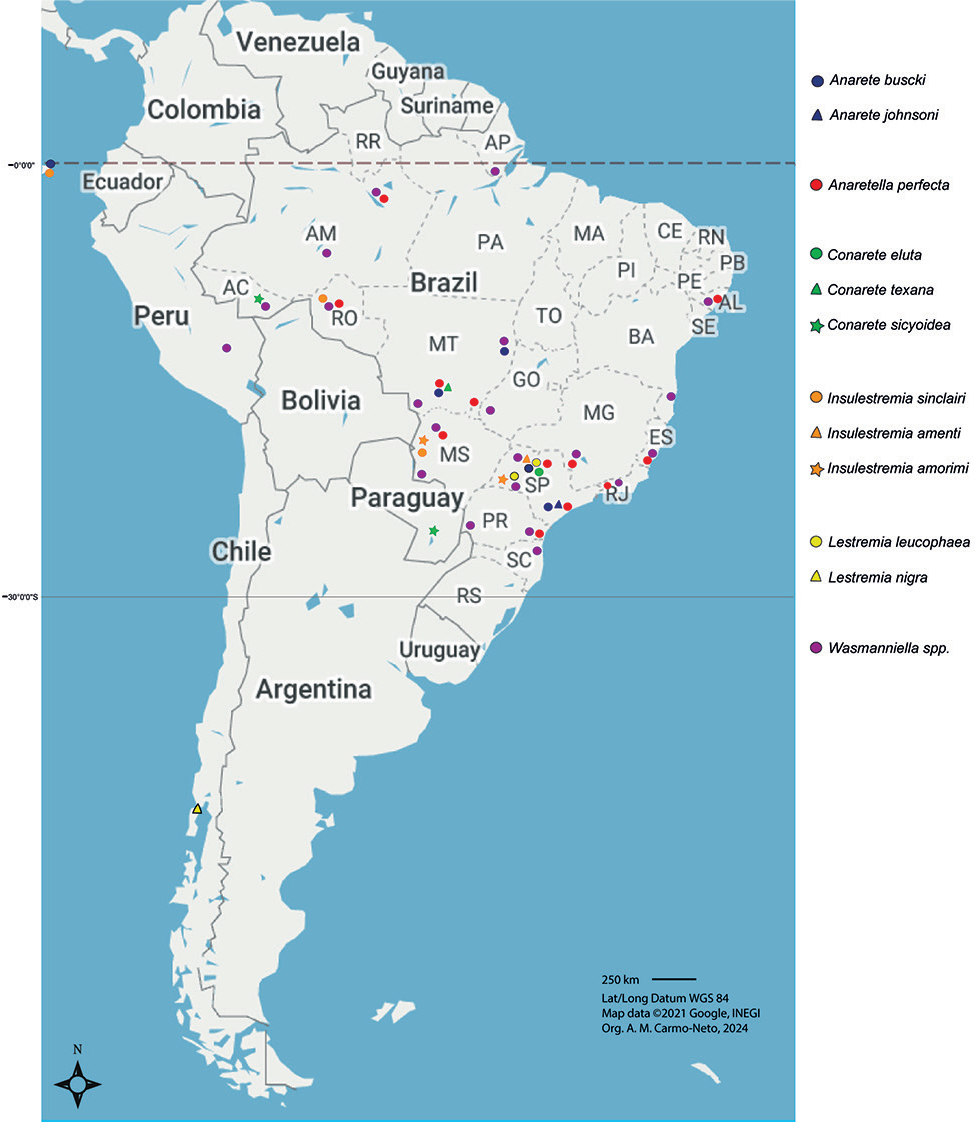
Mycophagous midges of the subfamily Lestremiinae are widespread, yet their diversity in the Southern Hemisphere remains poorly understood. Six species in four genera were known to occur in South America: Anarete buscki Felt, 1915, Anaretella perfectaCarmo-Neto, Lamas & Urso-Guimarães, 2024, Insulestremia sinclairiJaschhof, 2004, Insulestremia amorimiCarmo-Neto, Lamas & Urso-Guimarães, 2021, Insulestremia amentiCarmo-Neto, Lamas & Urso-Guimarães, 2021, and Lestremia nigra Blanchard, 1852. This study consolidates recent findings on Lestremiinae in Brazil and neighboring countries, providing new faunistic records that summarizes the knowledge of their diversity. We present new records of seven species in four genera: Anarete Haliday, 1833 in Brazil, including the species A. buscki Felt, 1915 and A. johnsoni (Felt, 1908); ConaretePritchard, 1951 in Brazil and Paraguay, including C. elutaPritchard, 1951, C. texana Felt, 1912, and C. sicyoidea Li & Bu, 2002; Lestremia Macquart, 1826 in Brazil, represented by L. leucophaea Meigen, 1818; and Wasmanniella Kieffer, 1898 in Brazil and Peru. Notably, the Lestremiinae are now formally recorded for the first time in Paraguay and Peru, and Wasmanniella in the Neotropical Region. A key to the genera found in the Neotropical region is also presented.
Keywords
Bibionomorpha; Biodiversity; Neotropical Region; Taxonomy; Mycophagous midges
INTRODUCTION
Tiny mycophagous midges of the family Cecidomyiidae are easily overlooked by researchers because they are inconspicuous, unlike the galling species that leave showy traces of their presence in the form of entomogen galls and, therefore, have been studied more consistently around the globe (Gagné & Jaschhof, 2021). Nevertheless, the mycophagous taxa represent about 25% of the 6,590+ known species in the family, and they are ubiquitous in the natural environment as part of the recycling of nutrients by their association with decaying vegetal matter and fungi (Mamaev & Krivosheina, 1965; Jaschhof & Jaschhof, 2009).
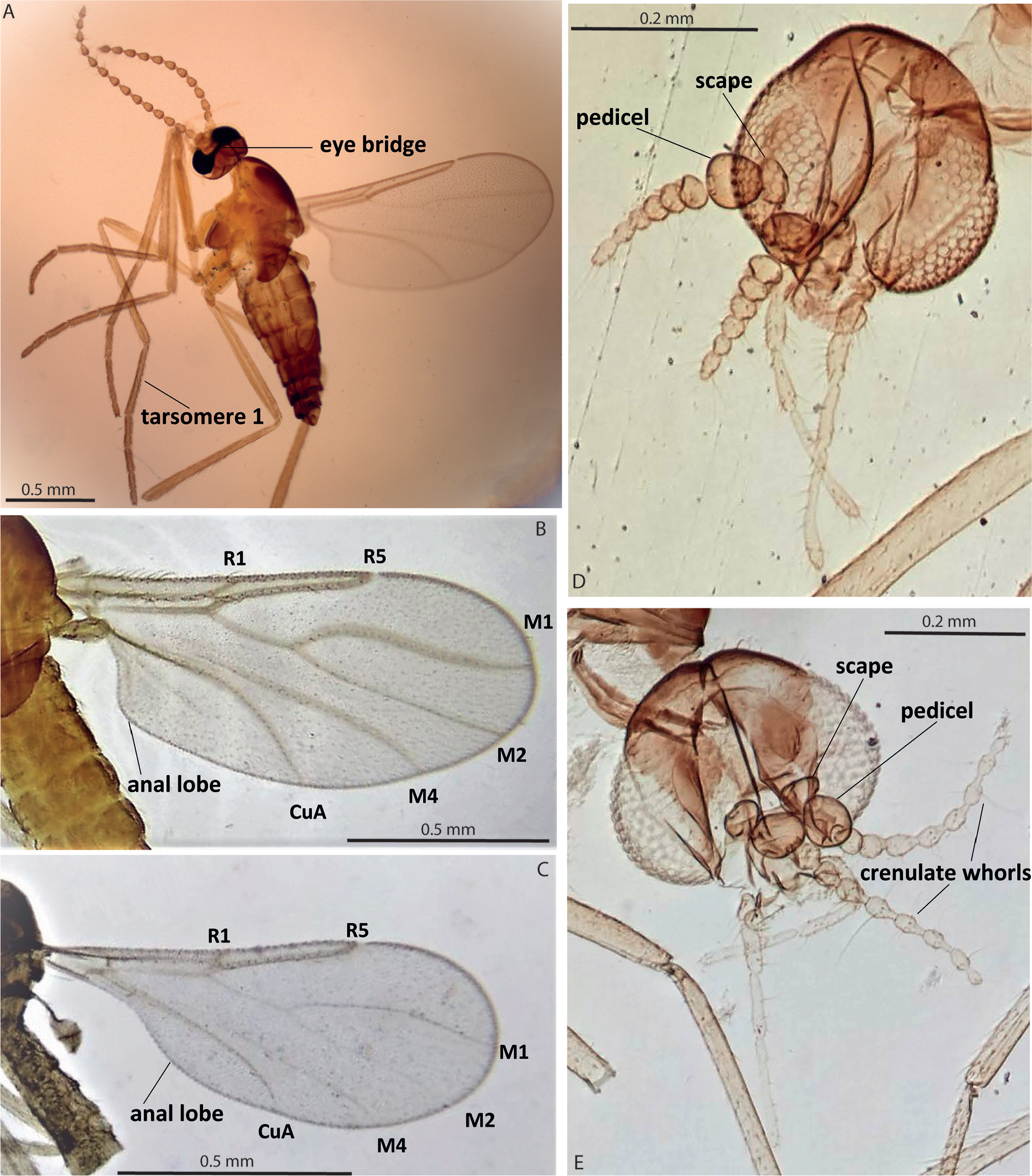
The Lestremiinae sensuJaschhof & Jaschhof (2009) is one of the five subfamilies within Cecidomyiidae composed entirely of mycophagous species. This subfamily is one of the most ancient clades of Cecidomyiidae (Sikora et al., 2019), including 13 extant genera and 107 extant and four fossil species (Carmo-Neto et al., 2021; Gagné & Jaschhof, 2021; Nel, 2021). Lestremiines are recognized by the following combination of characters: the first tarsomere is longer than the second, a relatively short vein R₅ that joins the Costa well before the wing apex (except in Eomastix Jaschhof, 2009 and Gongromastix Enderlein, 1936), and a forked vein M₁₊₂, with the fork being longer than the stem (Fig. 1A).
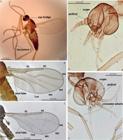
Lestremiinae male adult morphology, including (A) Habitus of adult male of Anaretella defecta Winnertz, without genitalia; (B) wing of Insulestremia amorimi Carmo-Neto, Lamas & Urso-Guimarães; (C) wing of Wasmanniella sp.; (D) head of Anarete johnsoni (Felt); (E) head of Conarete eluta Pritchard.
Although not the most abundant of the cecidomyiids, Lestremiinae taxa have been documented as being notably widespread (Jaschhof & Jaschhof, 2011; Gagné & Jaschhof, 2021); species of the genera Anaretella Enderlein, 1911 and Lestremia Macquart, 1826 are listed as cosmopolitan (Gagné & Jaschhof, 2021). Notwithstanding, the records for the Southern regions are scarce, including the recent records of Anaretella for South America (Carmo-Neto et al., 2024) and only a few genera besides the cosmopolitan ones: Anarete Haliday, 1833 for the Australasian Region; Anarete, ConaretePritchard, 1951, and InsulestremiaJaschhof, 2004 for the Neotropical Region; and AllaretePritchard, 1951 and Conarete for the Afrotropical Region.
The study of the Lestremiinae in the Neotropical Region began with the description of Lestremia nigra Blanchard, in 1852, from Chile. More than 60 years later, Felt described Anarete buscki, in 1915, from Cuba. In 1994, Gagné added the record of Conarete eluta Pritchard for Dominica. Ten years later, Jaschhof (2004) recorded the occurrence of A. buscki in the Galapagos Islands, Ecuador, and erected the monotypic genus Insulestremia to include the species I. sinclairi. Altogether, six species in four genera are known to occur in South America, Anarete buscki, Anaretella perfectaCarmo-Neto, Lamas & Urso-Guimarães, 2024, Insulestremia sinclairi, Insulestremia amorimiCarmo-Neto, Lamas & Urso-Guimarães, 2021, Insulestremia amentiCarmo-Neto, Lamas & Urso-Guimarães, 2021, and Lestremia nigra.
In Brazil, mycophagous taxaon such as the Lestremiinae and the Stomatosematidi have been completely unnoticed until recently (Carmo-Neto et al., 2019, 2021, 2024). To further expand our knowledge of this fauna, and benefiting from several taxonomic initiatives promoted in Brazil, we studied samples from five of the major Brazilian biomes: the Amazon Forest, the Atlantic Forest, the Cerrado (Brazilian savannah), the Pantanal (Brazilian wetlands), and the Caatinga (dry tropical forest). Those biomes are known to be both rich in endemics and highly threatened by landscape changes (Brazil Flora Group, 2021; MMA, 2018), hence the increasing necessity of assessing their biodiversity. Additional samples from other South American countries were combined for the present inventory and the first identification key to the genera occurring in the Neotropical region is also presented.
MATERIAL AND METHODS
Specimens from Brazil examined in our study are from samples collected all over the country by various collecting initiatives (e.g.,Lamas et al., 2023). Additionally, we obtained material from other South American countries which, along with the Brazilian specimens, will be deposited in the MZUSP. Types and determined specimens of described taxa were studied as reference material for the identifications. Morphological variation between our specimens and the reference material, when present, are noted in the Remarks. Reference material came from the institutions listed below (the respective contacts in parentheses):
MZUSP - Museu de Zoologia da Universidade de São Paulo, São Paulo, Brazil (curator Carlos Lamas)
NHRS - Naturhistoriska Riksmuseet, Stockholm, Sweden (curator Yngve Brodin)
SDEI - Senckenberg Deutsches Entomologisches Institut, Müncheberg, Germany (curator Frank Menzel)
USNM - National Museum of Natural History, Smithsonian Institution, Washington D.C., U.S.A. (Raymond Gagné)
Specimens were previously stored in 70% alcohol. They were first mounted into temporary slides with glycerin and characterized into morphospecies with compound microscope analysis; afterwards, the best preserved representants of each morphospecies were selected to be mounted into permanent slides with Canada balsam as described by Jaschhof & Jaschhof (2009), while the remaining specimens are kept in alcohol. The study focuses on the male specimens, as the taxonomy of the group is based on adult male morphology (Jaschhof & Jaschhof, 2009, 2011).
Photographs were taken by a DFK 23UX236 camera attached to the Nikon microscope. Stack images were obtained with the software CombineZP. Measurements of body size were taken from outstretched specimens, including genitalia, with the software IC Measure. Morphological terminology followed Jaschhof & Jaschhof (2009), except for thorax and wing, which was updated following Cumming & Wood (2017). Classification and previous distributional data follow Gagné & Jaschhof (2021). Geographical data (longitude/latitude) were gathered from the labels of the samples; for some specimens, no precise locality data were available and for these we used geographical coordinates that are central to the specified area to plot the record in the maps. The maps were prepared in the Google INEGI (https://www.inegi.org.mx/servicios/api_map.html).
Abbreviations used: leg. (collectors); mun. (municipality); N.P. (National Park); s.m. (slide-mounted); S.T. (State Park); U.A.E. (United Arab Emirates); UEMS (Universidade Estadual de Mato Grosso do Sul); UFSCar (Universidade Federal de São Carlos); UNEMAT (Universidade do Estado de Mato Grosso); U.S.A. (United States of America); USP (Universidade de São Paulo).
RESULTS
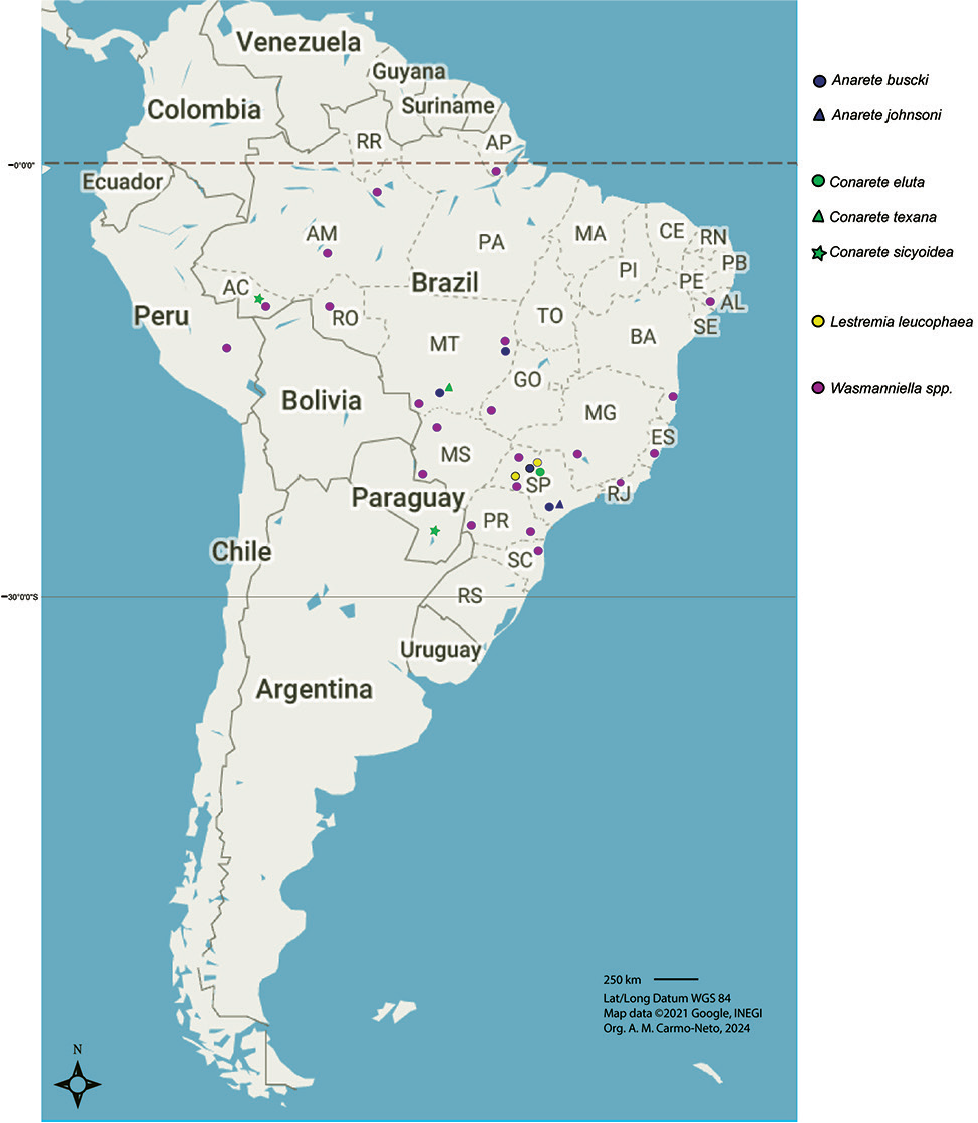
We report here our findings after the study of 394 adult male specimens of Lestremiinae (507 specimens in total). This study provides the first published records of the subfamily in Paraguay and Peru (Fig. 2). We are reporting the new records of seven species in four genera (Table 1): Anarete Haliday, 1833 in Brazil, including the species A. buscki Felt, 1915 and A. johnsoni (Felt, 1908); ConaretePritchard, 1951 in Brazil and Paraguay, including C. elutaPritchard, 1951, C. texana Felt, 1912, and C. sicyoidea Li & Bu, 2002; Lestremia Macquart, 1826 in Brazil, represented by L. leucophaea Meigen, 1818; and Wasmanniella Kieffer, 1898 in Brazil and Peru., which are also the first records of this genus from the Neotropical Region. The updated scenario summarizes twelve species in six genera of Lestremiinae for South America (Fig. 3). The austral-most record for each genus is indicated and a key to the genera found in the Neotropical region is also presented.
Number of genera, species, and specimens per State of Brazil that were included in this study.
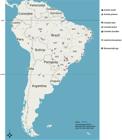
Geographic distribution of Lestremiinae species newly reported in this study for South America.
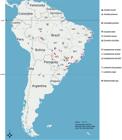
New faunistic records
Genus Anarete Haliday, 1833
Refs:Edwards, 1938; Pritchard, 1951; Kim, 1967; Jaschhof & Jaschhof, 2011.
Distribution
Previous: Australasian, Holarctic, Neotropical, and Oriental regions. New records: Brazil (Neotropical). Austral-most records: Brazil, São Paulo, Sorocaba (23°34′52.011″S, A. buski and A. johnsoni, this study)
Anarete buscki (Felt, 1915)
Distribution
Previous: U.S.A. (Nearctic); Cuba, Galapagos Islands and Puerto Rico (Neotropical) (Gagné & Jaschhof, 2021). New record: Brazil (Neotropical).
Material examined: BRAZIL: Mato Grosso state, Nova Xavantina mun., campus UNEMAT, Malaise point 56, refugo, 1♂ s.m., 03.iv.1997, Batista, J.D. & team leg.; 2♂ s.m., 06.xii.2006; Mato Grosso state, Poconé mun., Malaise 50 (SISBIOTA-Diptera), Farm Rio Clarinho, wood’s trail, 16°36′16,8″S, 56°43′19,0″W, 1♂ s.m., 16.viii 19.ix.2012, Lamas, Nihei & team leg.; Mato Grosso state, Poconé mun., Malaise 53 (SISBIOTA-Diptera), Farm Rio Clarinho, former road Transpantaneira, 16°35′28,7″S, 56°43′57,1″W, 5♂ s.m., 19.x 30.xii.2012, Lamas, Nihei & team leg.; São Paulo state, Ribeirão Preto mun., USP, Guest House, 593 m, sweeping, 21°09′54″S, 47°50′56″W, 3♂, 17.xii.2019, Buzati, Pirani & Riccardi leg.; sweeping, 3♂, 31.i.2020, P.R. Riccardi leg.; Malaise 1, 1♂, 17-28.xii.2019, Riccardi & Flores leg.; Malaise 1, 4♂ s.m., 28.xii.2019-09.i.2020, Riccardi & Flores leg.; Malaise 1, 1♂ s.m., 09-21.i.2020, Riccardi & Flores leg.; Malaise 2, 2♂, 17-28.xii.2019, Amorim & Riccardi leg.; Malaise 2, 7♂, 09-21.i.2020, P.R. Riccardi leg.; Malaise 2, 6♂ (1 s.m.), 21-31.i.2020, P.R. Riccardi leg.; Malaise 2, 8♂, 01-27.ii.2020, P.R. Riccardi leg.; São Paulo state, Sorocaba mun., campus UFSCar, flying at the window of Laboratory of Systematics of Diptera, 23°34′52.0″S, 47°31′37.9″W, 1♂ s.m. and 3♀, 07.x.2020, A.M. Carmo-Neto leg.; Malaise in vegetation behind Laboratory of Systematics of Diptera, 23°34′52.0″S, 47°31′37.9″W, 2♂, 04-21.i.2021,; 1♂, 21.i 05.iii.2021, A.M. Carmo-Neto leg.
Anarete johnsoni (Felt, 1908)
Distribution
Previous: U.S.A. (Nearctic); UK, Sweden, Germany, Japan, Latvia and Russia (Palearctic); Hawaiian Is.? (Australasian) (Gagné & Jaschhof, 2021). New record: Brazil (new to Neotropical region).
Material examined: BRAZIL: São Paulo state, Ribeirão Preto mun., USP, Guest House, 593 m, Malaise 2, 21°09′54″S, 47°50′56″W, 1♂, 17-28.xii.2019, Amorim & Riccardi leg.; sweeping, 21°09′54″S, 47°50′56″W, 18♂, 17.xii.2019, Buzati, Pirani & Riccardi leg.; São Paulo state, Sorocaba mun., campus UFSCar, Malaise in vegetation behind Laboratory of Systematics of Diptera, 23°34′52.0″S, 47°31′37.9″W, 1♂, 18.xi 02.xii.2020, C.A. Garcia & A.M. Carmo-Neto leg.
Genus ConaretePritchard, 1951
Refs:Pritchard, 1951; Jaschhof & Jaschhof, 2011.
Distribution
Previous: U.S.A. (Nearctic); Dominica (Neotropical) (Gagné & Jaschhof, 2021). New records: Brazil (Neotropical). Austral-most records: Paraguai, Caaguazú, Pastoreo (25°22′S, C. sicyoidea, this study).
Conarete eluta Pritchard, 1951
Distribution
Previous: U.S.A. (Nearctic); Dominica (Neotropical) (Gagné & Jaschhof, 2021). New record: Brazil (Neotropical).
Material examined: BRAZIL: São Paulo state, Ribeirão Preto mun., USP, Guest House, 593 m, Malaise 2, 21°09′54″S, 47°50′56″W, 2♂, 17-28.xii.2019, Amorim & Riccardi leg.
Remarks
The specimens found in Brazil present more than one tooth in the pretarsal claws, the ejaculatory apodeme slightly shorter, about 1.5 times as long as tegmen, and the eye bridge with two facets wider medially. As these are slight and continuous differences, we attributed it to intraspecific variations and assigned the specimens tentatively under the name C. eluta.
Conarete sicyoidea Li & Bu, 2002
Distribution
Previous: U.A.E. (Palearctic); China - Hainan (Oriental) (Gagné & Jaschhof, 2021). New records: Brazil, Paraguay (new to Neotropical region).
Material examined: BRAZIL: Acre, Bujari mun., Fe3, 09°20′01″S, 68°19′17″W, 1♂ s.m., 25.viii.2006, A.A. Agudelo, F.F. Xavier, M.M. Mendes & J.A. Rafael leg.; PARAGUAY: Caaguazú mun., Pastoreo district, 65♂ (5 s.m.), 03-07.i.1972.
Conarete texana Felt, 1913
Distribution
Previous: U.S.A. (Nearctic) (Gagné & Jaschhof, 2021). New record: Brazil (new to Neotropical region).
Material examined: BRAZIL: Mato Grosso state, Poconé mun., Malaise 52 (SISBIOTA-Diptera), Farm Rio Clarinho, opposite riverbank of Rio Claro, 16°36′24,8″S, 56°43′16,7″W, 2♂ s.m., 19.x 26.xi.2012, 19♂ (10 s.m.), 19.ix 19.x.2012 Lamas, Nihei & team leg.
Genus Lestremia Macquart, 1826
Refs:Pritchard, 1951; Jaschhof & Jaschhof, 2003, 2009.
Distribution
Previous: Cosmopolitan (Gagné & Jaschhof, 2021). New record: Brazil (Neotropical). Austral-most record: New Zealand, Auckland Islands (50°43″S, L. novaezelandiae,Jaschhof & Jaschhof, 2003).
Lestremia leucophaea (Meigen, 1818)
Distribution
Previous: Australasian, Holarctic (Gagné & Jaschhof, 2021). New record: Brazil (new to Neotropical region).
Material examined: BRAZIL: São Paulo state, Ibitinga mun., environmental licensing: “Seringueira BA, clone/GA/1328 e RRIM 600”, 3♂ s.m., 30.ii.1988, 1♂ s.m., 14.xii.1988; São Paulo state, Ribeirão Preto mun., USP, Guest House, 593 m, Malaise 1, 21°09′54″S, 47°50′56″W, 1♂ s.m., 10-17.xii.2019, 4♂, 17-28.xii.2019, Riccardi & Flores leg.
Genus Wasmanniella Kieffer, 1898
Refs:Pritchard, 1951; Jaschhof & Jaschhof, 2011.
Distribution
Previous: Holarctic, Oriental (Gagné & Jaschhof, 2021). New records: Brazil, Peru (new to Neotropical region). Austral-most record: Brazil, Santa Catarina, São Bento do Sul (26°15′50.8″S, W. sp., this study).
Material examined: BRAZIL: Acre state, Senador Guiomard mun., experimental farm Catuaba, campus Universidade Federal do Acre, Malaise, 10°04′28″S, 67°37′00″W, 13♂ (3 s.m.), 16-24.xi.2013, J.T. Câmara leg.; Alagoas state, Quebrângulo, Reserva Biológica Pedra Talhada, Malaise fifth trail, 1♂, 11-14.ix.2002, third trail, 3♂ and 1♀, 08-11.ix.2002, Penteado-Dias & team leg.; Amapá state, Serra do Navio mun., 00°52′28,1″S, 51°57′43,4″W, 2♂ and 1♀, 20.xi.2014, J.A. Rafael & F.F. Xavier Filho leg.; Amazonas state, Manaus mun., Reserva Biológica do Cueiras ZF2, 02°35′21″S, 60°06′55″W, 1♂, 06-09.viii.2013, Agudelo, A., Maldaner, C. leg.; Malaise, trail tower, 02°35′29″S, 60°12′53″W, 2♂, 03-06.vii.2015, D.D.D. Carmo, F. Xavier Filho & team leg.; km 14, 02°35′21″S, 60°06′55″W, small Malaise near tower, 45♂ (16 s.m.), 08-17.viii.2016, J.A. Rafael & F.F. Xavier Filho leg.; 6 m Malaise on the ground, 02°35′21″S, 60°06′55″W, 17♂ (9 s.m.) and 21♀, 01-15.x.2016, 02°35′21″S, 60°09′55″W, 1♂ and 1♀, 17-31.viii.2017, J.A. Rafael & F.F. Xavier Filho leg.; Amazonas state, Novo Airão mun., Ramal Mato Grosso, 02°48′51″S, 60°56′24″W, 2♂ (1 s.m.), 07-11.vii.2015, D.D.D. Carmo, F. Xavier Filho & team leg.; Amazonas state, Tapauá mun., Rio Ipixuna, Porto Cotinha, Malaise, 1♂ s.m. and 2♀ (1 s.m.), 08-13.x.2013, D.M.M. Mendens leg.; Bahia state, Mata de São João mun., Reserva de Sapiranga, Malaise point B5 (Biota FAPESP), 1♂, 22-25.viii.2001, M.T. Tavares & team leg..; Bahia state, Porto Seguro mun., N.P. Monte Pascal, 100-200 m, Malaise 1 in the woods, 16°53′S, 39°24′W, 3♂ and 5♀, 12.viii 02.ix.2013, B. Santos, M.T. Tavares & team leg.; Bahia state, Porto Seguro mun., Estação Ecológica Pau Brasil, 101 m, woods point 1, Malaise (Biota-FAPESP), 16°23′17.6″S, 39°10′55.6″W, 1♂ and 3♀, 17.v.2002, C.O. Azevedo & team leg.; 107 m, trail point 1, Malaise (Biota-FAPESP), 16°23′17.6″S, 39°10′55.6″W, 3♂, 17.v.2002, 3♂ and 2♀, 20.v.2002, C.O. Azevedo & team leg.; Espírito Santo state, Linhares mun., Reserva Biológica Sooretama, 23 m, Malaise point 5, trail, 18°58′02.7″S, 40°08′06.8″W, 2♂, 24-27.iii.2002, C.O. Azevedo & team leg.; 49 m, Malaise point 4 in the woods, 18°58′03″S, 40°08′03.6″W, 3♂ (1 s.m.), 21-24.iii.2002, C.O. Azevedo & team leg.; Espírito Santo state, Santa Teresa mun., Estação Biológica Santa Lucia, 867 m, Malaise point 5 in the woods, 19°58′19.5″S, 40°32′10.3″W, 1♂ and 1♀, 09-12.iv.2001, C.O. Azevedo & team leg.; Goiás state, Mineiros mun., N.P. de Emas, Malaise 1, parcel 2, forest, 17°54′8.011″S, 52°59′47.074″W, 1♂ and 17♀, 19.xii.2015-15.i.2016, 5♂ (1 s.m.) and 7♀, 19.iii 19.iv.2017; Malaise 2, parcel 4, Cerrado sensu stricto, 17°54′44.903″S, 52°59′20.648″W, 3♂ (1 s.m.) and 8♀, 17.xi 19.xii.2015, Oliveira, Lopes & Fava leg.; Mato Grosso state, Poconé mun., Malaise 52 (SISBIOTA-Diptera), Farm Rio Clarinho, opposite riverbank of Rio Claro, 16°36′24,8″S, 56°43′16,7″W, 1♂, 19.x 26.xi.2012, 4♂ (2 s.m.), 26.xi 30.xii.2012, Lamas, Nihei & team leg.; Malaise 53 (SISBIOTA-Diptera), Farm Rio Clarinho, former road Transpantaneira, 16°35′28,7″S, 56°43′57,1″W, 1♂ s.m., 19.x 30.xii.2012, Lamas, Nihei & team leg.; Mato Grosso do Sul state, Aquidauana mun., Reserva Ecológica, Universidade Estadual do Mato Grosso Sul, semideciduous seasonal forest, dense vegetation, Malaise 07 (SISBIOTA-Diptera), 20°26′03.7″S, 55°39′20.8″W, 1♂, 11-26.x.2012, Lamas, Nihei & team leg.; riparian forest, Córrego Fundo, Malaise 09 (SISBIOTA-Diptera), 20°26′07.2″S, 55°39′32.8″W, 1♂ s.m., 11-26.iii.2012, Lamas, Nihei & team leg.; Mato Grosso do Sul state, Bodoquena mun., Serra da Bodoquena, transitional forest, farm Califórnia, Malaise 05 (SISBIOTA-Diptera), 20°41′53.5″S, 56°52′55.7″W, 1♂, 06-21.v.2012, Lamas, Nihei & team leg.; Mato Grosso do Sul state, Porto Murtinho mun., farm Retiro Conceição, trail Mata Bruta, 89 m, Malaise 33 (SISBIOTA-Diptera), 21°41′54.2″S, 57°45′57.1″W, 3♂, 15.v 01.vii.2012, 3♂ and 1♀, 01.vii 15.vii.2012, Lamas, Nihei & team leg.; Minas Gerais state, Botelhos mun., Córrego da onça, Malaise, forest, 21°40′90″S, 46°22′05″W, 1♂, 05-20.xi.2006, Amorim, Falaschi & Oliveira leg.; Paraná state, Morrestes mun., S.P. do Pau Oco, Malaise point 84, 1♂ s.m., 10-13.iv.2002, Tavares & team leg.; Paraná state, Ponta Grossa mun., Itaiacoca district, Malaise A, 25°07′03.7″S, 49°56′27.8″W, 2♂, 19-04.ix.2016, 1♂, 19-04.xi.2016, Almeida, M.C., Toletto, L., Santos, M.H leg.; Malaise B, 1♂, 19.iii 19.iv.2018, 1♂, 19.iv 21.v.2018, Almeida, M.C., Araújo, E., Santos, M.H leg.; Paraná state, Serranópolis mun., N.P. do Iguaçú, Malaise - TEC - 03, 25°28′9.5″S, 53°51′57.6″W, 4♂ s.m. and 11♀, 10-15.i.2007; Paraíba state, João Pessoa mun., Malaise p6, 1♂, 25-28.vii.2002; Rio de Janeiro state, Itatiaia mun., N.P. do Itatiaia, Administração, rain forest, Malaise, 762 m, 22°27′17″S, 44°36′35″W, 7♂, 07-14.i.2016, Amorim & Silva leg.; Rondônia state, Cacaulândia mun., Sítio do Cabeça, 133 m, Malaise 25 (SISBIOTA-Diptera), 10°17′56.5″S, 63°14′12″W, 9♂ (4 s.m.), 15.x 04.xi.2011, Lamas, Nihei & team leg.; Rondônia state, Campo Novo, 10°40.128″S, 63°29.004″W, 4♂, 06-10.xii.2013, Amorim, Ament & Riccardi leg.; Rondônia state, Monte Negro mun., 10°16.347″S, 63°20.762″W, 1♂ s.m., 05-07.xii.2011, Amorim, Ament & Riccardi leg.; Rondônia state, Porto Velho mun., river Madeira, Área Mutum, Jirau hydroelectric, transects M6 M8, campaign 11, Malaise, 09°35′54.4″S, 65°02′53.7″W, 1♂, 17.vi 01.vii.2012, C.E.D. Sanhudo & F. Andriolli leg.; São Paulo state, Campos do Jordão mun., Malaise 5 (INCT), 5♂ (2 s.m.) and 1♀, 17.v.2010, N.W. Perioto & team leg.; S.P. Campos do Jordão, Malaise 1, 658 m, 22°42′07″S, 42°28′48″W, 1♂, 17-21.v.2015, Dell’Erba, R., Moraes, S.S., Quintero, A. & Silva, R.O. leg.; Horto Florestal, 1,546 m, Malaise 4 (INCT), 22°39′42.6″S, 45°27′28″W, 5♂ and 2♀, 14.iii.2011, Airton & Cassice leg.; São Paulo state, Jundiaí mun., Serra do Japi (INCT), 23°14′19,1″S, 46°56′15,3″W, 2♂ and 5♀, 29.vi.2009, A.S. Soares leg.; Malaise 1 (INCT), 1,173 m, 23°14′29.6″S, 45°56′14,1″W, 7♂, 29.vi.2009, Malaise 3 (INCT), 1,173 m, 23°14′2.5″S, 45°56′18.5″W, 6♂ and 1♀, 29.vi.2009, A.S. Soares leg.; São Paulo state, Ribeirão Grande, S.P. Intervales, Malaise point B1, 24°15′S, 48°10′W, 4♂ and 2♀, 13-16.xii.2000, M.T. Tavares & team leg.; Malaise point T1, 24°15′S, 48°10′W, 1♂, 13-16.xii.2000, M.T. Tavares & team leg.; São Paulo state, Ribeirão Preto mun., USP, Guest House, 593 m, Malaise 1, 21°09′54″S, 47°50′56″W, 1♂ s.m., 03-10.xii.2019, 1♂, 10-17.xii.2019, 4♂ (2 s.m.), 17-28.xii.2019, 1♂ s.m., 09-21.i.2020, Riccardi & Flores leg.; Malaise 2, 1♂ s.m., 01-27.ii.2020, P.R. Riccardi leg, 3♂ s.m., 28.xii.2019-09.i.2020, Amorim & Riccardi leg.; São Paulo state, Salesópolis mun., Reserva Biológica Boracéia, trilha dos pilões, Malaise point 3, 23°39′04.8″S, 45°53′41.8″W, 1♂, 30.iii 02.iv.2001; Malaise point 6, 23°39′05.3″S, 45°53′51.7″W, 1♂, 02.iii 02.iv.2001, T.P. Amarante & team leg.; São Paulo state, São Luis do Paraitinga, S.P. da Serra do Mar, Núcleo Santa Virgínia, Malaise point 7 (INCT), 23°19′27.2″S, 45°05′38.5″W, 2♂, 22.x.2010, N.W. Perioto & team leg.; São Paulo state, Santo André mun., Reserva Biológica Paranapiacaba, Malaise 02, 23°46′44″S, 46°18′40″W, 2♂ s.m., 20.vi 23.viii.2011, Takakoshi & Ribeiro leg.; São Paulo state, Sertãozinho mun., Reserva Biológica Augusto Ruschi, Malaise, fragment 2, border, 1♂ s.m., 23.ii 03.iii.2011, D.S. Amorim & V.C. Silva leg.; white Malaise, fragment, 1♂, 11-25.v.2011, V.C. Silva, P.F. Donda & G. Ignácio leg.; São Paulo state, Sorocaba mun., campus UFSCar, first expedition, Malaise fragment 4, 11♂ (6 s.m.) and 1♀, 06.xi.09, Tauhyl leg.; São Paulo state, Teodoro Sampaio mun., S.P. Morro do Diabo, Malaise point 1, 22°36′15,8″S, 52°18′02,5″W, 2♂ and 10♀, 17.ii.2011, N.W. Perioto & team leg.; São Paulo state, Ubatuba mun., S.P. Serra do Mar, Malaise 02 trail, 23°21′43″S, 44°49′22″W, 2♂ and 1♀ s.m., 24.i.2002, N.W. Perioto & team leg.; Malaise 9, 1♂, 24.I.2002; Santa Catarina state, São Bento do Sul mun., Cepa - Rugendal, first Malaise - trail, 1♂ and 1♀, 16-19.x.2001; Santa Catarina state, São Francisco do Sul mun., Vila da Glória, fifth Malaise, trail (Biota-Fapesp), 1♂, 17-20.x.2001 (MZUSP); PERU: Cusco, 19 RD km W of Quincemil, Rio Araza tributary, 874 m, 13°26′10″S, 70°50′57″W, 3♂ and 6♀, 23-31.viii.2012, R.R. Cavichioli, J.A. Rafael, A.P.M. Santos & D.M. Takiya leg.
Remarks
Adults of Wasmanniella are largely uniform in their slender morphology. The genus has long been noted to be abundant outside the Holarctic Region, and potentially speciose (Jaschhof & Jaschhof, 2009, 2011). In this study, we recorded an abundance of Wasmanniella specimens, probably belonging to several unnamed species.
-
1. Antennae with 6 to 9 flagellomeres; pedicel more than 1.5 times the length of scape (Figs. 1D E) .......... 2
-
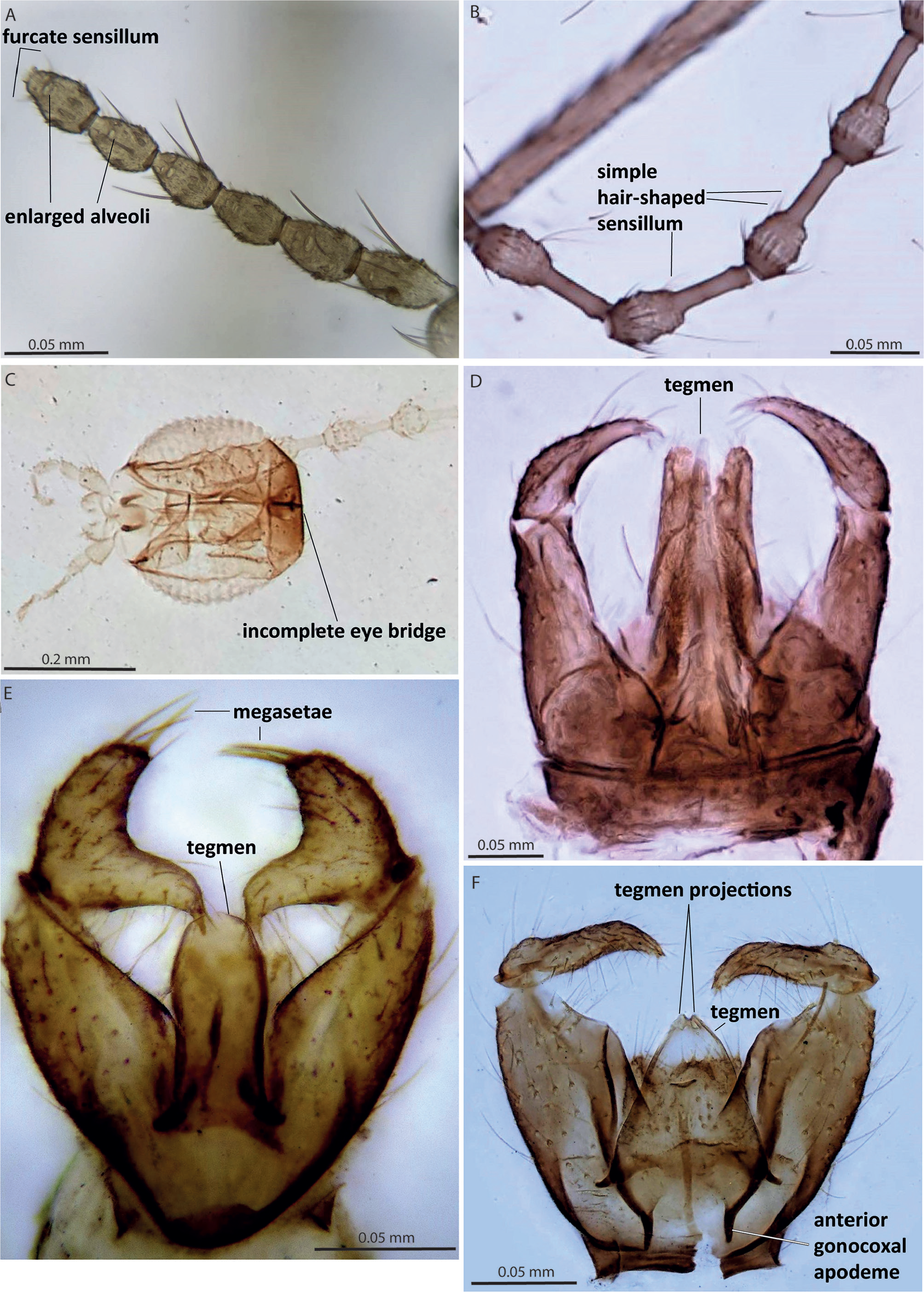
- Antennae with 14 flagellomeres; pedicel subequal in length and width relative to scape (Fig. 4C) .......... 3
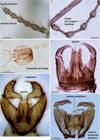 Figure 4
Lestremiinae male adult morphology, including (A) Antenna of Insulestremia amorimi Carmo-Neto, Lamas & Urso-Guimarães; (B) Antenna of Lestremia leucophaea (Meigen); (C) head of Wasmanniella clauda Pritchard; (D) terminalia of Lestremia leucophaea (Meigen); (E) Terminalia of Insulestremia amorimi Carmo-Neto, Lamas & Urso-Guimarães; (F) Terminalia of Anaretella defecta Winnertz.
-
2. Antennae with 6 to 7 flagellomeres; flagellomeres without neck and crenulate whorl of setae (Fig. 1D) .......... Anarete
-
- Antennae with 7 to 9 flagellomeres; flagellomeres with neck and crenulate whorl of setae (Fig. 1E) .......... Conarete
-
3. Eye bridge incomplete, without ommatidia dorsally (Fig. 4C); wing with only a slightly convex anal lobe (Fig. 1C) .......... Wasmanniella
-
- Eye bridge complete (Fig. 1A); wing with strongly convex anal lobe (Fig. 1B) .......... 4
-
4. Antennae with regular hair-shaped translucent sensilla (Fig. 4B); tegmen acuminate (Fig. 4D) .......... Lestremia
-
- Antennae with furcate antennal translucent sensilla, arising from enlarged alveoli, and regular hair-shaped translucent sensilla (Fig. 4A); tegmen not acuminate (Fig. 4E F) .......... 5
-
5. Tegmen with subapical projections; gonostylus without megasetae; anterior portion of gonocoxal apodemes present (Fig. 4F) .......... Anaretella
-
- Tegmen without subapical projections; gonostylus with megasetae; anterior portion of gonocoxal apodemes absent (Fig. 4E) .......... Insulestremia
GENERAL CONSIDERATIONS
The specimens of Wasmanniella were relatively abundant in the samples examined from the southern regions. Their previous absence from taxonomic studies may be attributed to the challenges associated with their identification. Similarly to Anaretella, they are found across a diverse array of habitats. In contrast, specimens of Lestremia were found to be scarce, despite being reported as abundant in New Zealand and throughout the Holarctic Region (Jaschhof & Jaschhof, 2003, 2009). These findings suggest a shift in the relative dominance between these genera in the Neotropical region, as it is contrary to the pattern observed in the Northern Hemisphere.
Anarete and Conarete were recorded mainly in the central parts of Brazil, while their presence was rare in samples collected in the Amazon Forest and in the Atlantic Forest, particularly along the eastern coast. These findings align with previous studies suggesting their predominance in open habitats, including deserts, where they gather into swarms (Kim, 1967; Jaschhof, 2004; Jaschhof & Jaschhof, 2011).
The widespread occurrence of some species represents another significant contribution of the new records. Species of Conarete may display distribution and phenotypic diversity at levels comparable to the widespread species such as Anaretella defecta Winnertz, 1870, Lestremia cinerea Macquart, 1826, and L. leucophaea. This is evidenced by the presence of C. sicyoidea in South America and the intraspecific variation reported for C. eluta. Future studies focused on unraveling the diversity of southern Wasmanniella should consider the same aspects.
Our key is the first for the Neotropical genera of Lestremiinae. As such, it is the first key to include the identification of the genus Insulestremia, which is exclusively Neotropical. By providing this information, we hope to facilitate future studies of the Lestremiinae in the region. The biodiversity account presented here includes samples from threatened and severely degraded localities and can serve as a reference for future studies on the conservation and recovery of their fauna.
-
FUNDING INFORMATION: This study is part of the unpublished doctoral thesis of Antonio Marcelino do Carmo Neto† (Carmo-Neto, 2022) that was financed in part by the Coordenação de Aperfeiçoamento de Pessoal de Nível Superior - Brasil (CAPES) - Finance Code 001. Additional funding was provided by the Fundação de Amparo à Pesquisa do Estado de São Paulo (FAPESP) and the Conselho Nacional de Desenvolvimento Científico e Tecnológico (CNPq) for grants supporting the Sisbiota-Diptera Program (FAPESP 2010/52314-0; CNPq 563256/2010-9). The Coordenação de Aperfeiçoamento de Pessoal de Nível Superior (CAPES) supported AMCN’s research internship abroad (program 6685 - PDSE/PRINT; ID 406.896.848-94). CJEL received financial support from CNPq (310997/2023-2).
ACKNOWLEDGEMENTS:
We are thankful to Dr. Dalton S. Amorim and the technician Maria Isabel P.A. Balbi, who received AMCN in multiple visits to the Laboratory of Systematics and Evolution of Diptera at USP campus Ribeirão Preto, where part of the material studied was sorted; to Dr. Rafaela Falaschi who provided material collected in the state of Paraná; to Dr. Paula R. Riccardi, who provided the material collected around the Guest House of USP campus Ribeirão Preto mun., São Paulo state; to Dr. Sarah de Oliveira, who provided material from N.P. de Emas, Mineiros mun., Goiás state; to researchers who coordinated projects from which material was added to this study: Dr. José A. Rafael (“Diversity of selected groups of insects in the Amazon” - INPA, INCT BioDossel), Dr. Nelson W. Perioto (“Parasitoid Hymenoptera from the Southeast Region of Brazil” - INCT, CNPq 573802/2008-4; 2008/57949-4; FAPESP 14/50940-2), Dr. Vera C. Silva (“Diversity and endemism of Diptera in a fragment of Atlantic Forest in Sertãozinho, state of São Paulo, FAPESP 2009/54.497-8)”.
REFERENCES
-
Brazil Flora Group. 2021. Brazilian Flora 2020 project - Projeto Flora do Brasil 2020. V393.274. Instituto de Pesquisas Jardim Botânico do Rio de Janeiro. [dataset]. Available: https://www.gbif.org/dataset/aacd816d-662c-49d2-ad1a-97e66e2a2908 Access: 13/11/2023.
» https://www.gbif.org/dataset/aacd816d-662c-49d2-ad1a-97e66e2a2908 -
Carmo-Neto, A.M. 2022. Cladistic analysis of Lestremiinae (Diptera: Cecidomyiidae). Tese de Doutorado. São Paulo, Museu de Zoologia, Universidade de São Paulo. https://doi.org/10.11606/T.38.2022.tde-24012023-170217 Access: 27/05/2024.
» https://doi.org/10.11606/T.38.2022.tde-24012023-170217 -
Carmo-Neto, A.M.; Lamas, C.J.E. & Urso-Guimarães, M.V. 2019. New species and records of the supertribe Stomatosematidi (Diptera: Cecidomyiidae) in Brazil. Zootaxa, 4608(1): 119-130. https://doi.org/10.11646/zootaxa.4608.1.6
» https://doi.org/10.11646/zootaxa.4608.1.6 -
Carmo-Neto, A.M.; Lamas, C.J.E. & Urso-Guimarães, M.V. 2021. Review of Insulestremia Jaschhof, 2004 (Diptera; Cecidomyiidae; Lestremiinae) with description of two new species from Brazil. Zootaxa, 4966(3): 367-375. https://doi.org/10.11646/zootaxa.4966.3.8
» https://doi.org/10.11646/zootaxa.4966.3.8 -
Carmo-Neto, A.M.; Lamas, C.J.E. & Urso-Guimarães, M.V. 2024. The genus Anaretella Enderlein 1911 (Diptera: Cecidomyiidae: Lestremiinae) in South America, with description of a new species from Brazil. Studies on Neotropical Fauna and Environment, 59(2): 1-9. https://doi.org/10.1080/01650521.2024.2353008
» https://doi.org/10.1080/01650521.2024.2353008 - Cumming, J.M. & Wood, D.M. 2017. Adult morphology and terminology. In: Kirk-Spriggs, A.H.; Sinclair, B.J. (Eds.). Manual of Afrotropical Diptera. Pretoria, South African National Biodiversity Institute v. 1, p. 89-133.
-
Edwards, F.W. 1938. On the British Lestremiinae, with notes on exotic species. I. (Diptera, Cecidomyiidae). Proceedings of the Royal Entomological Society of London, 7: 18-24. https://doi.org/10.1111/j.1365-3113.1938.tb01227.x
» https://doi.org/10.1111/j.1365-3113.1938.tb01227.x -
Gagné, R.J. & Jaschhof, M. 2021. A Catalog of the Cecidomyiidae (Diptera) of the world. 5. ed. Available: https://www.ars.usda.gov/ARSUserFiles/80420580/Gagne_Jaschhof_2021_World_Cat_5th_Ed.pdf Access: 16/04/2024.
» https://www.ars.usda.gov/ARSUserFiles/80420580/Gagne_Jaschhof_2021_World_Cat_5th_Ed.pdf - Jaschhof, M. & Jaschhof, C. 2003. Wood midges of New Zealand (Cecidomyiidae, Lestremiinae). Part I: Introductory notes and tribes Lestremiini, Strobliellini, Campylomyzini and Pteridomyiini Jaschhof trib. nov. Studia Dipterologica, 10: 97-132.
- Jaschhof, M. & Jaschhof, C. 2009. The wood Midges (Diptera: Cecidomyiidae: Lestremiinae) of Fennoscandia and Denmark. Studia Dipterologica, 18: 1-333.
- Jaschhof, M. & Jaschhof, C. 2011. Order Diptera, family Cecidomyiidae: Subfamilies Lestremiinae and Micromyinae. In: van Harten, A. (Ed.). Arthropod fauna of the UAE. Abu Dhabi, Dar Al Ummah. v. 4, p. 654-683.
- Jaschhof, M. 2004. Wood midges (Diptera: Cecidomyiidae: Lestremiinae) from the Galápagos Islands, Ecuador. Faunistische Abhandlungen, 25: 99-106.
-
Kim, K.C. 1967. The North American species of the genus Anarete (Diptera: Cecidomyiidae). Annals of the Entomological Society of America, 60: 521-530. https://doi.org/10.1093/aesa/60.3.521
» https://doi.org/10.1093/aesa/60.3.521 -
Lamas, C.J.E.; Fachin, D.A.; Falaschi, R.L.; Alcantara, D.M.C.; Ale-Rocha, R.; Amorim, D.S.; Araújo, M.X.; Ascendino, S.; Baldassio, L.; Bellodi, C.F.; Bravo, F.; Calhau, J.; Capellari, R.S.; Carmo-Neto, A.M.; Cegolin, B.M.; Couri, M.S.; Carvalho, C.J.B.; Dios, R.V.P.; Falcon, A.V.G.; Fusari, L.M.; Garcia, C.A.; Gil-Azevedo, L.H.; Gomes, M.M.; Graciolli, G.; Gudin, F.M.; Henriques, A.L.; Krolow, T.K.; Mendes, L.L.; Limeira-de-Oliveira, F.; Maia, V.C.; Marinoni, L.; Mello, R.L.; Mello-Patiu, C.A.; Morales, M.N.; Oliveira, S.S.; Patiu, C.; Proença, B.; Pujol-Luz, C.V.A.; Pujol-Luz, J.R.; Rafael, J.A.; Riccardi, P.R.; Rodrigues, J.P.V.; Roque, F.O.; Sallum, M.A.M.; Santis, M.D.; Santos, C.M.D.; Santos, J.R.; Savaris, M.; Shimabukuro, P.H.F.; Silva, V.C.; Schelesky-Prado, D.C.; Silva-Neto, A.M.; Camargo, A.; Sousa, V.R.; Urso-Guimarães, M.V.; Wiedenbrug, S.; Yamaguchi, C. & Nihei, S.S. 2023. The SISBIOTA-Diptera Brazilian Network: A longterm survey of Diptera from unexplored Brazilian Western Arc of Amazon, Cerrado. Revista Brasileira de Entomologia, 67(4): e20230051. https://doi.org/10.1590/1806-9665-rbent-2023-0051
» https://doi.org/10.1590/1806-9665-rbent-2023-0051 - Mamaev, B.M. & Krivosheina, N.P. 1965. The larvae of Gall Midges (Diptera, Cecidomyiidae). Moscow, Akademiya Nauk USSR.
-
Ministério do Meio Ambiente (MMA). 2018. Biodiversidade Brasileira. Available: https://www.gov.br/mma/pt-br/assuntos/biodiversidade-e-biomas Access: 27/01/2024.
» https://www.gov.br/mma/pt-br/assuntos/biodiversidade-e-biomas -
Nel, A. 2021. New Cecidomyiidae from the Lowermost Eocene French amber (Diptera). Paleoentomology, 4(6): 620-628. https://doi.org/10.11646/palaeoentomology.4.6.11
» https://doi.org/10.11646/palaeoentomology.4.6.11 - Pritchard, A.E. 1951. The North American gall midges of the tribe Lestremiini; Itonididae (Cecidomyiidae); Diptera. University of California Publications in Entomology, 8: 239-275.
-
Sikora, T.; Jaschhof, M.; Mantič, M.; Kaspřák, D. & Ševčík, J. 2019. Considerable congruence, enlightening conflict: molecular analysis largely supports morphology-based hypotheses on Cecidomyiidae (Diptera) phylogeny. Zoological Journal of the Linnean Society, 185: 98-110. https://doi.org/10.1093/zoolinnean/zly029
» https://doi.org/10.1093/zoolinnean/zly029
-
Edited by:
Rafaela Lopes Falaschi