A new Amazonian species of Dysmerus Casey (Coleoptera, Cucujoidea, Laemophloeidae) from Brazil
Abstract
This paper describes and illustrates a new Amazonian species of the lined flat bark beetle genus Dysmerus Casey, 1884. Dysmerus calicicornis sp. nov. is most similar to two species, D. curvicornis Thomas, 2009 and D. hamaticornis Thomas, 2009, sharing with them the male antennal scape apically flat, strongly deflected internally. The new species, however, can be easily distinguished from both by the male antennal scape caliciform in dorsal view, with a curved, tooth-like outer projection, and the presence of secondary sublateral lines on the pronotal surface. Additionally, the previous key to Dysmerus males is modified to include D. calicicornis sp. nov.
Keywords
Neotropical Region; Flat beetles; South America; Taxonomy; Morphology
INTRODUCTION
The New World genus Dysmerus Casey, 1884 is a small group of lined flat bark beetles, currently including 15 species distributed from the southeastern United States south to Argentina (Thomas, 2009). Thomas (2009) revised Dysmerus, which was composed of only one species: D. basalis Casey, 1884 (type species by monotypy). He elucidated the taxonomic history of the genus, resurrected D. caseyi (Grouvelle, 1898) and D. sulcicollis Grouvelle, 1908 as valid species (both syn-onymized under D. basalis by Lefkovitch (1958)), and described 13 new species.
Although the phylogenetic placement and relationships of Dysmerus have never been tested, the genus belongs to an informal group of laemophloeids along with Leptophloeus Casey, 1916 and Cryptolestes Ganglbauer, 1899, all of which include species with a subcylindrical body and a similar structure of the male genitalia (Thomas, 2009). Members of Dysmerus, and many species of Cryptolestes, are distinctive by possessing an extreme sexual dimorphism in which the male antennal scape is enlarged and adorned with projections and tubercles. Nevertheless, Dysmerus is easily distinguished from Cryptolestes by the following features: head prolonged anteriorly and deeply excavated anterior to the eyes, antennal pedicel laterally attached to scape, procoxal cavities posteriorly closed, and intercoxal process of sternite III narrow (Casey, 1884; Thomas, 2009).
Biological information on Dysmerus is scarce in the literature. Schwarz (1889) related the subcylindrical body form of D. basalis to the wood-gallery lifestyle and collected one larva in the galleries of Pityophthorus consimilis LeConte, 1878 (Coleoptera: Curculionidae: Scolytinae), although he also reported D. basalis under the bark of poisonwood Metopium toxiferum (L.) Krug &. Urb. (Anacardiaceae) (Schwarz, 1888). Species of Dysmerus are attracted to light at night. The great majority of individuals examined by Thomas (2009) were collected with light traps.
In this paper, a series of male and female individuals from the Amazon biome of Brazil are recognized as a new species of Dysmerus, which is described and illustrated in detail, allowing easy separation from its most similar congeners. Additionally, the key to males of Dysmerus by Thomas (2009) is modified to include the new species.
MATERIAL AND METHODS
Type material of the new species is deposited in the Coleção Zoológica Paulo Bührnheim (CZPB; Sérgio Luis Gianizella) and the Coleção de Invertebrados do Instituto Nacional de Pesquisas da Amazônia, Manaus, Brazil (INPA; Márcio de Oliveira).
Morphological terms follow Beutel & Lawrence (2005) for the general morphology, with the adoption of terms proposed and/or discussed by Thomas (2009), such as the primary and secondary sub-lateral lines on the pronotal surface. Total body length was measured from the anterior margin of clypeus to the apex of elytra; and body width was measured at mid-elytra. Surfaces were considered smooth if there was no punctation, moderately punctate if punctures were two to six punctures diameters apart and densely punctate if punctures were less than two puncture diameters apart.
Photographs were taken using a Leica DFC295 camera attached to a Leica M205C stereomicroscope, and a Leica DFC290HD camera attached to a Leica DM5500B compound microscope. All produced images were processed using the Leica Application Suite (LAS) version 4.1 and Helicon Focus (HeliconSoft) software.
RESULTS
Dysmerus calicicornis sp. nov. (Coleoptera: Cucujoidea: Laemophloeidae) (Figs. 1, 2)
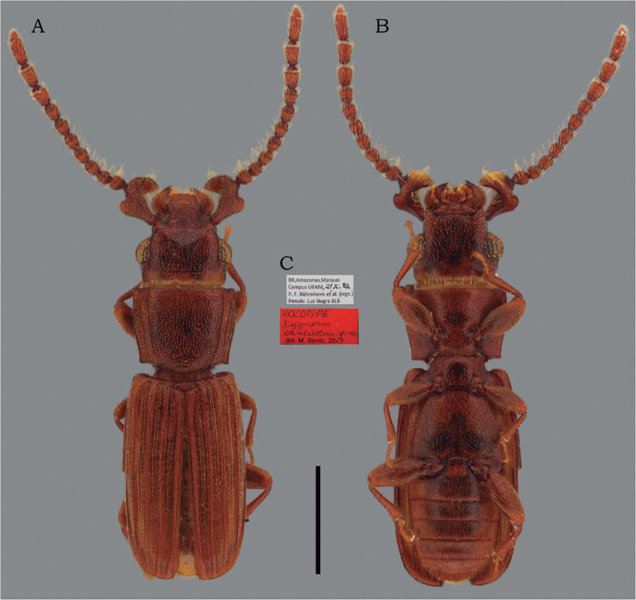
Holotype male of Dysmerus calicicornis sp. nov. in (A) dorsal and (B) ventral views; (C) labels. Scale bar: 0.4 mm.
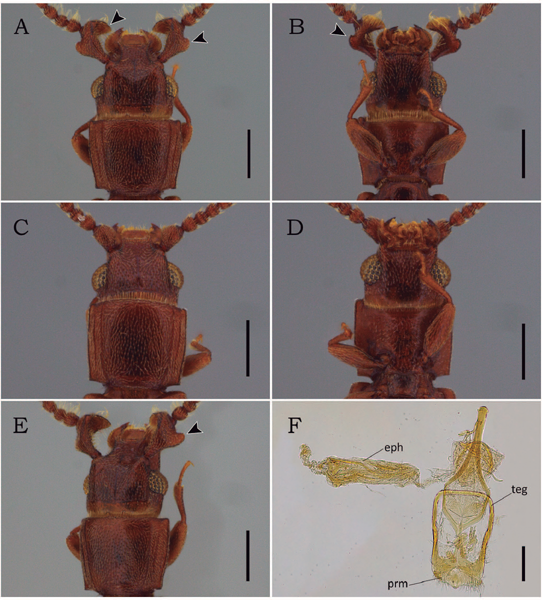
Dysmerus calicicornissp. nov.: head and prothorax of the (A, B) holotype male, with black arrows indicating the outer and innner projections of the antennal scape; and the (C, D) paratype female in dorsal and ventral views; (E) head and prothorax of the holotype male in dorsolateral view, with black arrow indicating the tooth-like outer projection of the antennal scape; (F) genitalia of the paratype male. Scale bars: A-E = 0.2 mm; F = 0.1 mm. Abbreviations: eph = endophallus; teg = tegmen; prm = parameres.
Type material: Holotype male deposited at CZPB, labeled (Fig. 1C): “BR, Amazonas, Manaus / Campus UFAM, 21.X.82 / P.F. Bührnheim et al. (leg.) / Pensilv. Luz Negra BLB” (white, printed with date handwritten) // “HOLOTYPE / Dysmerus / calicicornis sp. nov. / det. M. Bento, 2024” (red, printed and handwritten). Paratypes. Same data as holotype (m*, 2 f*f*, CZPB); same, but “20-21.x.82” (m*, INPA); same, but “30-31.x.1982” (m*, INPA); same, but “16-17.xi.1982”(m*, INPA).
Diagnosis: Male antennal scape caliciform in dorsal view, strongly constricted at base and gradually expanding towards apex (Figs. 1A; 2A), strongly curved internally, with apex flat and somewhat sickle-shaped; inner face densely setose, with short basal and moderately long apical pale setae; inner margin with a deep dorsoapical notch; outer margin with a curved, tooth-like ventromedial projection at pedicel insertion (Figs. 1A; 2E). Male antennomeres 2-6 with short outer setae and an inner tuft of long setae (Figs. 1A; 2A, B). Secondary sublateral lines of pronotum present, not reaching posterior margin (Fig. 2A, E).
Description of male (Figs. 1A, B; 2A, B, E, F): Body length 2.0-2.2 mm; width at mid-elytra 0.4-0.5 mm. Body elongate, parallel-sided, subcylindrical, conspicuously pubescent. Coloration. General color uniformly reddish brown, with elytra lighter. Head (Fig. 2A, B, E) large, slightly longer than pronotum, 0.8 times longer than wide, with anterior region prolonged, shortly rostrate. Surface moderately punctuate; punctures small and circular, much smaller than an eye facet, separated by one or more puncture diameters; each subtending a short pale seta; surface between punctures smooth and shining. Clypeus declivous, elongate, 0.4 times total length of head at midline, with lateral carinae strongly curved and extending to apex; anterior margin shallowly emarginate, sides not strongly reflexed but corners sharply pointed; angle above antennal insertion obtuse, strongly elevated. Frons with a short, not carinate median line not reaching anterior margin of clypeus. Eyes evenly convex, not conical. Antennae (Fig. 2A, B). Scape large, strongly modified, 0.7 times as long as head, caliciform in dorsal view, strongly constricted at base and gradually expanding towards apex; strongly curved internally, with apex flat, somewhat sickle-shaped; inner face densely setose, with short basal and moderately long apical pale setae; inner margin with a deep dorsoapical notch at pedicel insertion; outer margin with a small, curved, tooth-like, ventromedial projection at pedicel insertion; outer face with long apical pale setae. Antennomeres 2-6 with short outer setae and an inner tuft of long setae. Pedicel small, subglobose, slightly larger than antennomere 3; antennomeres 3-8 subglobose, gradually increasing in size; antennomeres 9-11 oblong-globose, forming a loose club, with sensillar field surrounding apex; antennomere 11 longest. Labrum subrectangular, with anterior margin straight. Mandibles strongly curved, conjunctly rounded in closed position, with apicies trifid. Pronotum (Fig. 2A, B) subquadrate, as long as wide, slightly broadest at apex, thence narrowing slightly to base. Surface sculpture and pubescence as on head. Width across anterior angles 1.1 times width across posterior angles. Posterior and anterior angles acute, not projected. Sublateral lines present as wide, externally carinate grooves. Secondary sublateral lines present, extending from anterior margin to posterior third. Sides gradually descending from sublateral line to margin. Elytra (Fig. 1A, B) 1.6 times longer than combined width at middle, parallel-sided, with apices gradually converging. Cells well defined; third cell more deeply impressed, with outer margin strongly carinate. Dorsal surface flat, with sides strongly declivous laterad of humeral carinae. Thoracic venter (Fig. 1B). Prosternal process broad, with apex expanded posteriad of procoxae, 2.7 times wider than procoxal diameter, with apical margin straight. Procoxal cavities closed. Mesoventral process broad, 2 times wider than mesocoxal diameter. Tarsal formula 5-5-4. Abdomen (Fig. 1B). Intercoxal process of sternite III broadly rounded. Genitalia (Fig. 2F). Median lobe sharply pointed. Parameres fused to each other, with apex deeply incised, bifurcate; apical margin densely setose, with long lateral setae inserted in projected lobes. Endophallus with inverted, U-shaped basal sclerite, and a large apical sclerite.
Female (Fig. 2C, D): The female paratypes have the same size as the males. They are very similar in general appearence and can be associated to conspecific males by the conspicuously pubescent body surface and the secondary sublateral lines of pronotum, but differ from them in the following respects: Clypeus weakly declivous, with lateral carinae less raised than male. Antennae shorter than males, with scape oblong-globose, somewhat swollen on internoapical surface, without projections or dense tufts of long setae. Genal region not prolonged. Tarsal formula 5-5-5.
Etymology: The specific epithet “calicicornis” derives from the Latin words “calyx” (= chalice) and “cornis” (= horn, antenna), referring to the male antennal scape, which is caliciform in dorsal view.
Type-locality: Brazil. Amazonas: Manaus.
Discussion: This is a quite distinctive species in the genus Dysmerus and shares with D. curvicornis Thomas, 2009 and D. hamaticornis Thomas, 2009 the general appearance of the male antennal scape, which is internally flat and sickle-shaped at the apex, with the inner margin apically notched. However, D. calicicornis sp. nov. is easily distinguished from them by the male antennal scape being caliciform with a curved, tooth-like, ventromedial projection externally to the pedicel insertion, and by the presence of secondary sublateral lines of pronotum, which are absent in the aforementioned species.
Like the great majority of the specimens examined by Thomas (2009), individuals composing the type series of D. calicicornis sp. nov. were collected with Pennsylvania light traps equipped with ultraviolet light (BLB blacklight bulb).
Key to species of Dysmerus Casey, 1884 (based on males) (modified from Thomas [2009])
1. Head with median longitudinal carina...............................................2
— Head without median longitudinal carina..........................................5
2(1). Median longitudinal carina on head continues almost to anterior margin of clypeus (Peru) ............................. D. skelleyi Thomas, 2009
— Median longitudinal carina on head does not continue to anterior margin of clypeus...........................................................................3
3(2). Head above antennal insertions produced, lobe-like. Pronotum shallowly, longitudinally sulcate. Body conspicuously pubescent...15
— Head above antennal insertions neither produced nor lobe-like. Pronotum not sulcate longitudinally. Body not conspicuously pubescent...........4
4. Dorsal integument glossy, not microreticulate (Bolivia, Brazil) ................................................................................. D. politus Thomas, 2009
— Dorsal integument dull, strongly microreticulate (Brazil) ...................................................................................... D. impolitus Thomas, 2009
5(1). Eyes small, pyramidal in shape...........................................................6
— Eyes larger, not pyramidal in shape.....................................................9
6(5). Pronotum shallowly but distinctly longitudinally sulcate. Scape with long, curved dorsal extension (Mexico) ........................................................................................................... D. mexicanus Thomas, 2009
— Pronotum not sulcate. Scape without long, curved dorsal extension 7
7(6). Scape with ventral extension.............................................................8
— Scape without ventral extension (USA, Bahamas) ........................................................................................................ D. basalis Casey, 1884
8(7). Gena with laterally directed spine next to anteroventral corner of eye. Ventral process of scape bifurcate. Dorsal tubercle of scape located at anterior third (Venezuela) ............. D. genaspinosus Thomas, 2009
— Gena without spine near eye. Ventral process of scape simple. Dorsal tubercle of scape located at midpoint (Argentina, Brazil) .............................................................................. D. monstrosus Thomas, 2009
9(5). Pronotum deeply longitudinally sulcate (Lesser Antilles) ................................................................................... D. sulcicollis Grouvelle, 1908
— Pronotum not or shallowly longitudinally sulcate............................10
10(9). Pronotum with secondary sublateral lines........................................11
— Pronotum without secondary sublateral lines.................................12
11(10). Scape small, not projected externally. Antennae very thick, with flagellomeres slightly imbricated. Sides of clypeus reflexed, forming lateral carinae ......................................... D. symphilus Thomas, 2009
— Scape large, with a curved, tooth-like outer projection. Antennae slender, with flagellomeres not imbricated. Sides of clypeus not reflexed ......................................................... D. calicicornis sp. nov.
12(10). Body not conspicuously pubescent (Central and South America, Lesser Antilles) ........................................ D. caseyi (Grouvelle, 1898)
— Body conspicuously pubescent.........................................................13
13(12). Scape curved, somewhat sickle-shaped........................................14
— Scape complex, emarginate anteriorly, with blunt ventral projections (Bolivia) .................................................. D. boliviensis Thomas, 2009
14(13). Clypeus acute anterolaterally, but not reflexed. Scape apically blunt (Argentina, Brazil) ................................. D. curvicornis Thomas, 2009
— Clypeus acute anterolaterally, produced and reflexed. Scape apically acute (USA, Mexico, Costa Rica) .......... D. hamaticornis Thomas, 2009
15(3). Dorsal surface of scape without a tubercle. Head above antennal insertions more produced (Trinidad, Brazil) ................................................................................................. D. trinidadensis Thomas, 2009
— Dorsal surface of scape with a strong tubercle at midpoint. Head above antennal insertions less produced (Brazil) .................................................................................................... D. rondoniensis Thomas, 2009
ACKNOWLEDGEMENTS:
I am grateful to Sérgio Luis Gianizella (CZPB) for providing material for this study, and José Albertino Rafael (INPA) for his supervision. I especially acknowledge Joseph McHugh and Takahiro Yoshida for their valuable suggestions and corrections to the manuscript.
-
FUNDING INFORMATION:
This research is part of MB’s postdoctoral project, which is financed by the Conselho Nacional de Desenvolvimento Científico e Tecnológico (CNPq, Brazil; process 170142/2023-0). Financial support was also provided by the Coordenação de Aperfeiçoamento de Pessoal de Nível Superior (CAPES, Brazil) and the Fundação de Amparo à Pesquisa do Estado do Amazonas (FAPEAM-POSGRAD, Brazil).
REFERENCES
-
Beutel, R.G. & Lawrence, J.F. 2005. Coleoptera, Morphology. In: Beutel, R.G. & Leschen, R.A.B. (Ed.). Coleoptera, Beetles. Volume 1: Morphology and Systematics (Archostemata, Adephaga, Myxophaga, Polyphaga partim). 2 ed. Berlin, De Gruyter. p. 35-40. https://doi.org/10.1515/9783110904550
» https://doi.org/10.1515/9783110904550 -
Casey, T.L. 1884. Revision of the Cucujidae of America North of Mexico. Transactions of the American Entomological Society, 11: 69-112. https://doi.org/10.2307/25076432
» https://doi.org/10.2307/25076432 -
Lefkovitch, L.P. 1958. Unusual antennal characters in some Laemophloeinae (Coleoptera: Cucujidae) and their taxonomic importance. Proceedings of the Royal Entomological Society of London, 27: 93-100. https://doi.org/10.1111/j.1365-3113.1958.tb00419.x
» https://doi.org/10.1111/j.1365-3113.1958.tb00419.x - Schwarz, E.A. 1888. Proceedings of the meeting August 4, 1887. Proceedings of the Entomological Society of Washington, 1: 91-94.
- Schwarz, E.A. 1889. Notes on the food habits of some North American Scolytidae and their coleopterous enemies. Proceedings of the Entomological Society of Washington, 1: 163-165.
- Thomas, M.C. 2009. A review of the genus Dysmerus Casey (Coleoptera: Laemophloeidae). Insecta Mundi 0074, 1-30.
Edited by
-
Edited by:
Simone Policena Rosa