Extreme weather event causes the death of White-collared Swift Streptoprocne zonaris (Shaw, 1796) (Aves, Apodidae) individuals in sinkholes in the State of Goiás, Brazil
Abstract
The use of caves and rocky walls is common for some birds, like swifts, to shelter, sleep, nest, feed, and protect themselves from predators, wind, and rain. Several environmental and ecological factors associated with the habits and adaptations of certain species allow birds to use cave environments. The White-collared Swift Streptoprocne zonaris (Shaw, 1796) is distributed from Mexico and the Antilles south to northern Argentina, Paraguay, and southern Brazill, being frequent in areas with waterfalls and river rapids with rocky beds and crystal-clear water. Individuals live in flocks and have the habit of roosting and nesting in damp, dark caves or behind waterfalls. Herein, we aim to report the case and identify the cause of death of S. zonaris individuals found dead in a sinkhole in the State of Goiás, Brazil, in 2020. Global warming resulting from anthropogenic emissions of greenhouse gases can alter the natural fluctuations of atmospheric circulation systems, responsible for rainfall distribution, substantially affecting rainfall and increasing the frequency of heavy rainfall events in some locations. Due to climate change and the increasing frequency of flooding records, we have raised the hypothesis and drawn attention to our record may have been originated due to these climatic events. However, we do not dismiss the hypothesis that the flooding may be due to an extreme event. The fact that S. zonaris spends the night and nests close to water bodies makes the species more susceptible to the effects of a flash flood. Further studies will be able to show the real effects of global warming on the species.
Keywords
Cave; Climate change; Flood; Mass die-off
INTRODUCTION
The use of caves and rock walls is common for some species (Sick, 1997), which use these environments to shelter, sleep, nest, feed, and protect themselves from predators, wind, and rain (Brinkløv et al., 2013; Andrade et al., 2020). However, adaptations such as echolocation, a greater proportion of rods in the retina, larger eye size in relation to body size or morphological adaptation of the feet are necessary for them to be able to use the cave environment (Sick, 1997; Martin et al., 2004; Warrant, 2008; Brinkløv et al., 2013). Environmental factors such as the shape and size of the cave entrance, the size of the cavity, the presence or absence of water courses and the presence of food resources also determine the use of these environments by animals (Sick, 1997; Brinkløv et al., 2013). Therefore, several environmental and ecological factors associated with the habits and adaptations of certain species allow birds to use the cave environment.
Swifts (Family Apodidae) have a bony callus on the metatarsus and strong, curved, and sharp nails, constituting adaptations that enable them to land on rough vertical surfaces such as rocks, quarries, and escarpments, but which make it impossible for them to perch on branches, wires, or fence posts (Sick, 1997). Swifts have large eyes in relation to body size when compared to other birds and have good visual sensitivity (Warrant, 2008). Echolocation is known in some species of swifts (Brinkløv et al., 2013), but has not yet been reported in any Brazilian species. Brazil has 17 species of birds listed in the Apodidae family (Pacheco et al., 2021), with six species recorded in caves (Costa et al., 2022).
The White-collared Swift Streptoprocne zonaris (Shaw, 1796) occurs from Mexico and the Antilles south to northern Argentina, Paraguay, and southern Brazil, associated with areas with waterfalls, river rapids with rocky beds and crystal-clear water, caves, and rocky walls (Roper, 2020). It is the largest swift species that occurs in Brazil, measuring approximately 22 cm (Roper, 2020). Adult males and females have black feathers and a broad band of white feathers circling the neck (Roper, 2020). Streptoprocne zonaris roosts and nests in colonies inside damp, dark caves or behind waterfalls (Sick, 1997). Streptoprocne zonaris presents high fidelity to the nesting site, reusing niches, crevices, and the structure of nests from previous years (Biancalana, 2014). The species lays from one to three eggs, and the nesting period is 41 to 51 days (Biancalana, 2014). The couple incubates the eggs and feeds the young with small insects (Biancalana, 2014). The reproduction period coincides with the rainy season (Passeggi, 2011; Biancalana, 2014), which is an adaptive behavior to benefit from the abundance of insects in this period (Marín & Stiles, 1992). They seem to migrate after the reproductive period, presumably in search of better foraging conditions (Biancalana, 2014).
Streptoprocne zonaris individuals are observed roosting and nesting in caves and waterfalls in the Nascentes do Rio Vermelho Environmental Protection Area (EPA) region in the northeast of the State of Goiás. Swifts have already been observed inside the doline where the Segredo waterfall is located, nesting both on the rocky wall near the waterfall and inside the Córrego Sumidouro I cave. A team from the Nascentes do Rio Vermelho EPA went to the doline on 05/03/2020 to carry out a routine inspection. Upon arriving at the site, they found dozens of S. zonaris individuals dead on the floor of the sinkhole and inside the Córrego Sumidouro I cave. The swifts were found on the floor and on rocks on the cave wall. The team photographed the site and collected 77 dead swifts, which were deposited at the Laboratory of Fauna and Conservation Units, Brasília University. A team composed of civil servants from the Nascentes do Rio Vermelho EPA and the National Center for Research and Conservation of Caves (Centro Nacional de Pesquisa e Conservação de Cavernas - ICMBio/Cecav) subsequently visited the site to assess the circumstances of the event and formulate a hypothesis for what happened. Thus, we aim to report the premises and the investigation that evidenced the cause of death of S. zonaris individuals that occurred in a sinkhole in the State of Goiás, Brazil.
MATERIAL AND METHODS
Study area
Carbonate rocks, such as limestone, dolomite, and marble, have high solubility, with most caves in this lithology formed by the chemical action of water, which dissolves the rock and forms the voids we call caves (Cruz & Piló, 2019). Most of the existing caves in the world are found in these rocks due to their high solubility (Cruz & Piló, 2019). In addition to caves, several karst features result from the dissolution of carbonate rocks (Travassos, 2019). Dolines are circular or oval geometric shapes that are usually formed by the dissolution or collapse of the rock (Travassos, 2019). The sinkholes are openings in the rocks through which surface rivers are captured underground, which can demarcate cave entrances (Auler & Piló, 2019; Travassos, 2019).
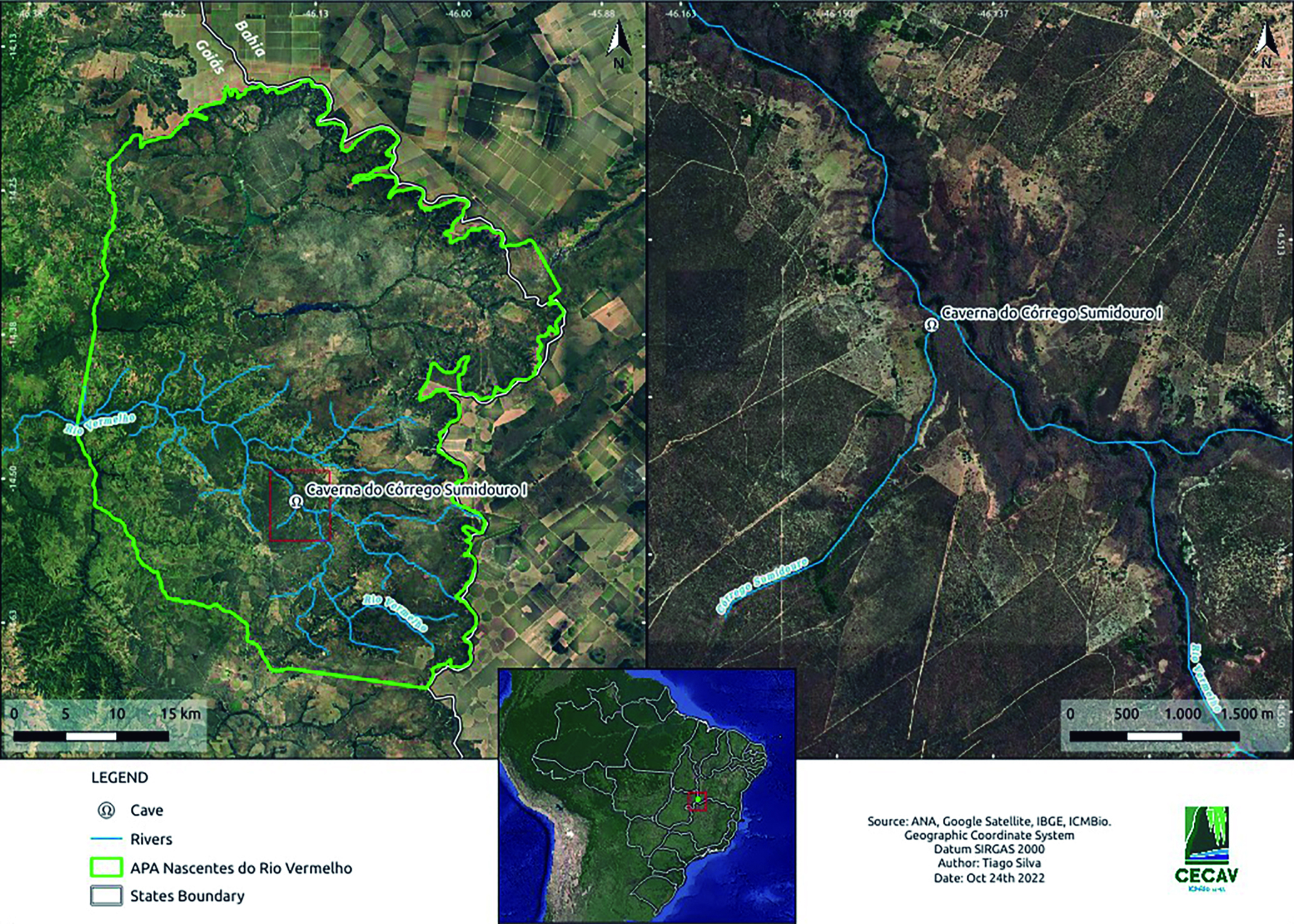
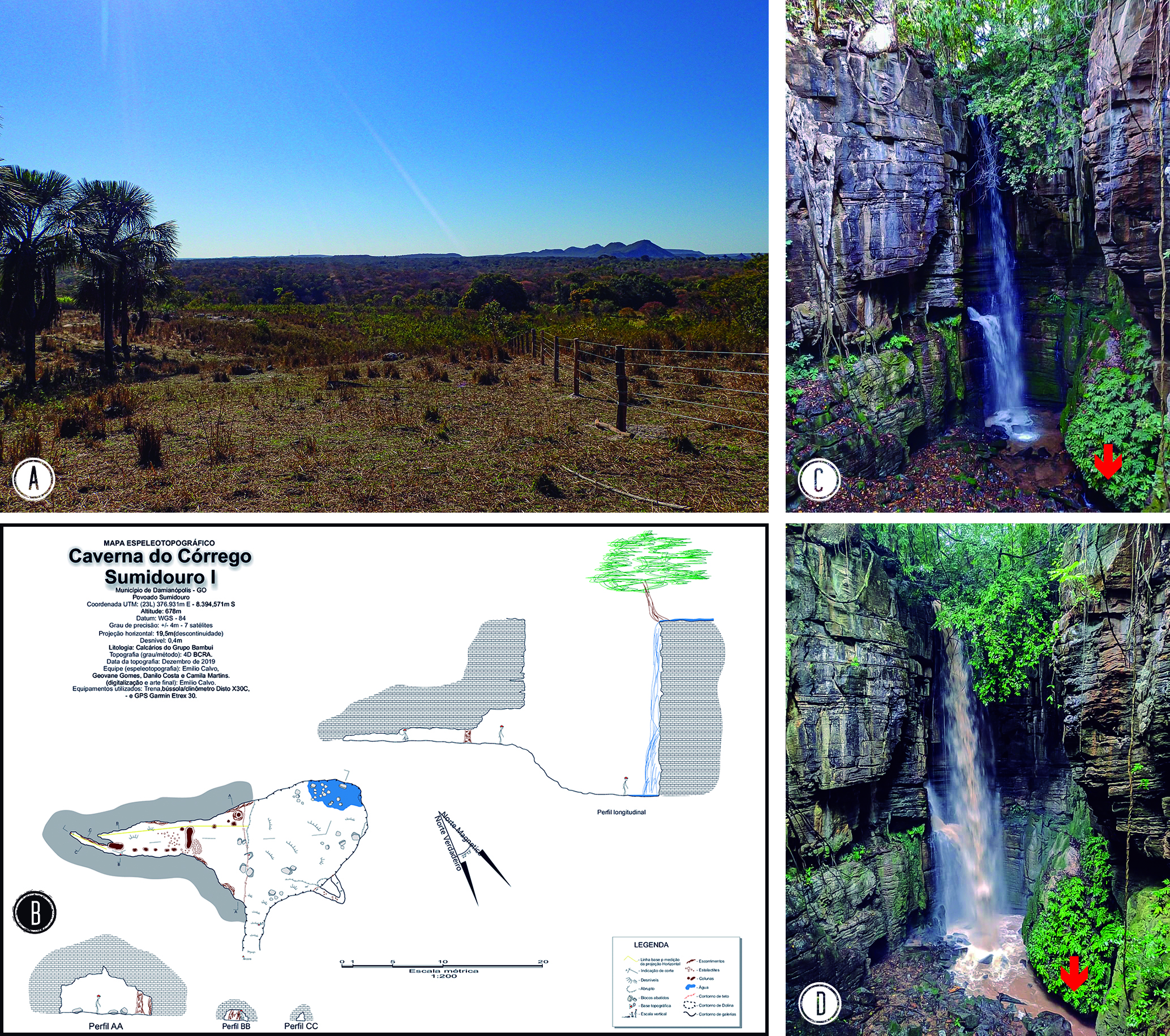
Limestones and dolomites of the Bambuí group represent the most favorable rocks for forming caves in Brazil (Cruz & Piló, 2019). This group is distributed over a large area of Brazilian territory, covering four states: Minas Gerais, Bahia, Tocantins and Goiás (Cruz & Piló, 2019). The Nascentes do Rio Vermelho EPA federal conservation unit in the northeast of Goiás is within the Bambuí Group, located in the municipalities of Buritinópolis, Damianópolis, Mambaí and Posse, which has 162 caves registered in the National Register of Speleological Information (Cadastro Nacional de Informações Espeleológicas - Canie) until the year 2022. The EPA has the protection of natural attributes, biological diversity, water resources and speleological heritage among its objectives. Several caves in this region are found close to the Rio Vermelho and its tributaries due to the genesis of these cavities being associated with the action of water, as previously explained. Among them is the Córrego Sumidouro I cave (UTM coordinate: (23L) 376,931 m E - 8,394.571 m S), located in Córrego Sumidouro, a tributary of the Rio Vermelho, in the municipality of Damianópolis (Fig. 1). This cave is located inside a doline of about 15 meters in diameter in the shape of a “funnel”, where the waters of the Sumidouro stream form a waterfall called Cachoeira do Segredo, which a few meters further on enter a sinkhole (Fig. 2). The aforementioned cave inside the doline is located on the opposite side of the waterfall and the sinkhole.
Nascentes do Rio Vermelho EPA (left) and the Córrego Sumidouro I cave area (right). Author: Tiago Castro Silva.
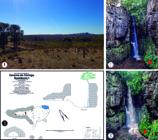
(A) Córrego do Sumidouro region; (B) Map of the doline and Córrego do Sumidouro I cave; (C) Water flow in the doline in the dry season; (D) Water flow in the doline in times of heavy rains; red arrow: location where the sinkhole is located. Authors: Maurício C.M. de Andrade (A); Emílio Manoel Calvo (B); Milos Nicolas Andric Fersula (C, D).
Data collection and analysis
To identify the circumstances that led to the death of S. zonaris individuals, we collected testimonials from a tour guide and residents of the region. We photographed the dead swifts from Nascentes do Rio Vermelho EPA and later collected, frozen, and sent them to the University of Brasília (UnB) to perform necropsy and laboratory tests. We subsequently conducted an on-site survey to verify the geological, geomorphological, and water conditions of the environment and tried to formulate a hypothesis for the fact. We also took photographic records of the site during this inspection to help understand the dynamics of what happened. We obtained rainfall data for the site from the Agrometeorological Monitoring System (Sistema de Monitoramento Agrometeorológico - Agritempo) of the Brazilian Agricultural Research Corporation (Empresa Brasileira de Pesquisa Agropecuária - Embrapa).
It was not possible to perform a necropsy due to the advanced state of autolysis of the individuals. We suspected that the swifts could have died from pesticide poisoning. Thus, to test this hypothesis, we collected liver samples and sent to the Pesticide Laboratory of the Federal Laboratory of Agricultural Defense (Laboratório de Pesticidas do Laboratório Federal de Defesa Agropecuária - LFDA MG), linked to the Ministry of Agriculture, Livestock and Supply (Ministério da Agricultura, Pecuária e Abastecimento - MAPA) located in Pedro Leopoldo/MG, for toxicological examination, aiming to detect some type of contaminant (pesticide) in the tissues of these animals. The multi-residue method was used to analyze pesticides in animal matrices by LC MS/MS. This procedure involves an initial single-phase extraction of 10 g of sample with 10 mL of acetonitrile, followed by a liquid-liquid partition formed by the addition of 4 g of anhydrous MgSO₄ plus 1 g of NaCl. Residual water removal and cleaning were simultaneously performed using a rapid procedure called dispersive solid phase extraction (dispersive SPE), in which 150 mg of anhydrous MgSO₄ and 25 mg of primary secondary amine (PSA) sorbent are mixed with 1 mL of acetonitrile extract. The dispersive SPE with PSA removes components of the polar matrix, such as organic acids, certain polar pigments, and sugars. Gas chromatography/mass spectrometry (GC/MS) was subsequently used for quantitative and confirmatory analysis of pesticides amenable to GC. This method allows recoveries between 85 and 100% and repeatabilities typically < 5% for a wide range of fortified pesticides, including very polar and basic compounds such as methamidophos, acephate, omethoate, imazalil and thiabendazole. The samples were tested for 128 types of pesticides used in Brazil, including the most used in soy, cotton, corn and sorghum crops, present in the eastern region of the Nascentes do Rio Vermelho EPA. The LFDA MG control code is PL LP2021/0714.
RESULTS AND DISCUSSION
The Nascentes do Rio Vermelho EPA is inserted in the Cerrado biome, with a predominance of savanna formations (typical cerrado and paths) and forest formations (gallery forests), but suffers pressure from agribusiness. Extensive low-technology livestock activities are carried out within the EPA, but there is expanding mechanized farming of soy, cotton, corn, sorghum, and other grains in the eastern region outside the EPA. Thus, one of the suspects for the cause of death of swifts was poisoning by pesticides. However, the results of the laboratory tests were 0 mg of pesticide residues in the samples, showed that no pesticide residues were found in the collected samples.
Local residents reported that heavy rain hit the Córrego do Sumidouro region on 03/03/2020. This information is corroborated by data from the Agrometeorological Monitoring System (Agritempo/Embrapa), which indicated that there was a rainfall of 53.5 mm in the municipality of Damianópolis on that day (Agritempo, 2022). According to Marcuzzo et al. (2012), the historical average rainfall for the month of March in Goiás is 211.90 mm. Therefore, it rained approximately 25% of the historical average in a single day in Damianópolis/GO. This large rain volume caused sudden flooding of Córrego Sumidouro. Flash floods, also called killer floods (Hjalmarson, 1984), are caused by intense convective storms with high discharge peaks; they occur in areas with particular hydrological characteristics, such as small hydrographic basins, steep slopes and low infiltration capacity (Kobiyama & Goerl, 2007). These torrential downpours have an extremely sudden onset and cause the river water level to rise rapidly and suddenly, with abnormally high velocity, often creating a “wall” of water that moves into the lower parts of the watershed (Kobiyama & Goerl, 2007).
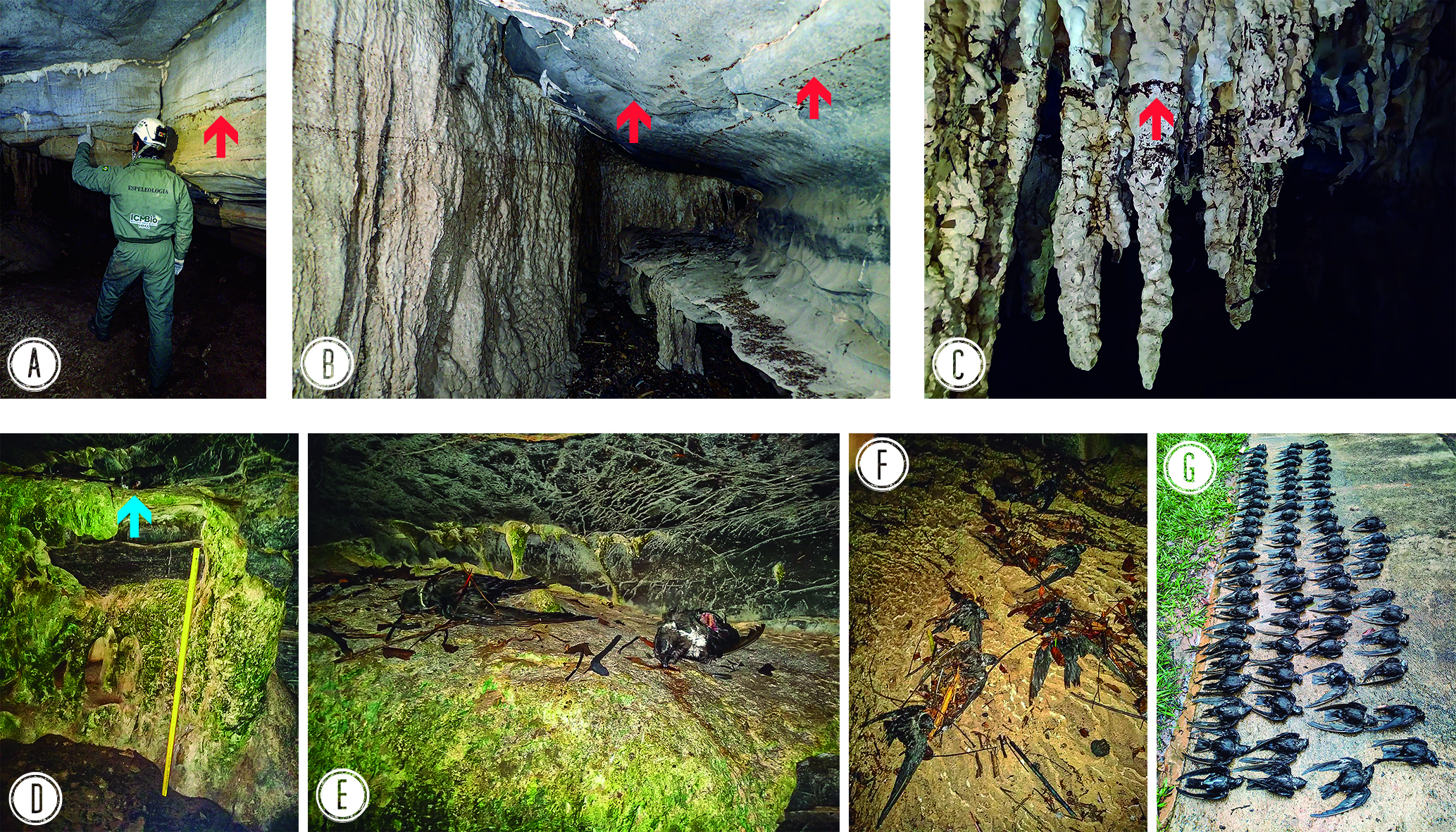
On rainy and cold days, swifts can remain on the ground all day (Sick, 1997). These birds can reach torpor on these days, which helps the body overcome food shortages and cold periods (Sick, 1997). Due to the intermittent rains that fall in March, the S. zonaris individuals were probably in rest and torpor on 03/03/2020. Thus, the individuals who were in the doline and in the cave were surprised by the sudden flood, causing their death. The water inside the cave reached the ceiling, reaching a height of 1.86 meters. (Fig. 3).
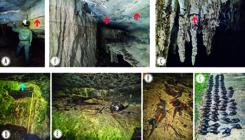
(A, B, C) Interior of the Córrego do Sumidouro I cave, highlighting the level at which the water reached the walls, ceiling and speleothems (red arrow) during the flash flood; (D, E, F) Swifts dead on rocks on the wall and on the floor of the Córrego do Sumidouro I cave; (G) Swifts collected in the doline and Córrego do Sumidouro I cave. Photos: Maurício C.M. de Andrade (A, B, C); Lauana Costa Nogueira (D, E, F, G).
The Córrego Sumidouro basin coincides with the description of an area conducive to the occurrence of flash floods. The basin is small and features impermeable rocks. Despite the relief of the hydrographic basin not having a high slope, the relief is quite rough near the doline. The sinkhole normally present in the doline drains all the water coming from the waterfall. However, the flow is small on days of heavy rain, causing the sinkhole to fill up. A tour guide witnessed the doline filling in 30 minutes of heavy rain in 2021. The sinkhole present in the doline does not hold large volumes of rainwater and ends up filling the doline. The information and analyzes presented above showed that a heavy rain, followed by a rapid flood, suddenly flooded the doline, surprising and causing the death of the swifts that were on the doline wall and inside the cave. Streptoprocne zonaris generally lives in flocks of 50 to 100 individuals (Sick, 1997), occasionally reaching hundreds of thousands of individuals (Sick, 1997; De Luca et al., 2009). As no living S. zonaris individuals were found in the doline in the days following the occurrence, we suspect that the flash flood killed the entire colony.
Reports of heavy rains 40% above the historical monthly average in the province of San Jose (Costa Rica) have produced an increase in river water levels, severe flooding and flooding of caves with the destruction of many S. zonaris nests (Marín, 2016). Six chicks of the species drowned due to a cave flooding (Marín, 2016). However, in this case, cave filling probably occurred gradually since adult individuals were not reached.
Global warming affects bird species in many ways and among them are changes in the frequency and severity of tropical storms (Şekercioğlu et al., 2012). Global warming resulting from anthropogenic emissions of greenhouse gases can alter the natural fluctuations of atmospheric circulation systems which are responsible for rainfall distribution, substantially affecting rainfall and increasing the frequency of heavy rainfall events in some locations (Allan, 2011; Pall et al., 2011). Thus, the risk of flooding is “substantially increased” by anthropogenic greenhouse gas emissions (Pall et al., 2011). Heavy rains are local specificities but are increased by atmospheric humidity from more distant locations, causing increases in the intensity, duration and/or frequency of precipitation (Allan, 2011). Several climate models robustly show intensified extreme precipitation on global and regional scales influenced by anthropogenic action (Madakumbura et al., 2021). These changes may have already become visible in some regions (Allan & Soden, 2008). Rainfall in Goiás varies greatly throughout the year, with the rainy season being concentrated between October and March (spring and summer) (Marcuzzo et al., 2012). The month of March historically has high levels of rainfall for the State of Goiás and is one of the months with the highest rainfall, with a historical average of 211.90 mm (Marcuzzo et al., 2012). Estimates made in 2012 indicated an annual growth trend in average precipitation in March for Goiás (Marcuzzo et al., 2012). Therefore, we raised the hypothesis that the event reported here may be a consequence of a climate event potentiated by global warming. On the other hand, it’s important to make clear that we do not dismiss the possibility that this event could be a random extreme. We would like to draw attention to the fact that this event could be reported because it was a visitation site, where the conservation unit team came across dead swifts during an inspection. However, swifts occur in a large part of the Brazilian territory and are recorded in several wild places. An event like this is likely to occur in such places and will hardly be recorded. In addition, with global warming, such events tend to increase and reach more and more individuals of this species.
Climate change, along with habitat destruction, is increasingly recognized as one of the most serious threats to biological diversity (Pachauri & Reisinger, 2007). Certain bird species are more susceptible to climate change due to their physiological, ecological and biogeographic characteristics (Şekercioğlu et al., 2012). The fact that S. zonaris spends the night and nests close to bodies of water makes the species susceptible to the effects of a flash flood. Migratory bird species may also be affected by food scarcity in their wintering sites due to reduced rainfall caused by climate change (Studds & Marra, 2007). Thus, S. zonaris can suffer the effects of both flash floods in its breeding site and droughts in its wintering location. Long-term studies of tropical bird communities are needed to understand the implications of climate change on bird ecology and conservation (Perry et al., 2011). Therefore, further studies may show the real effects of global warming on the species.
ACKNOWLEDGMENTS:
The authors would like to thank the owner of the doline site for authorizing access to the area; tourist guide Milos Nicolas Andric Fersula for the reports and photos provided; environmental analyst Tiago Castro Silva (ICMBio/Cecav) for preparing the map of the Nascentes do Rio Vermelho EPA region; to ICMBio/Cecav for providing the speleotopographic map of the “Córrego do Sumidouro I cave”, from the Project “Susceptibility, Hydrology and Karst Geomorphology Applied to the Conservation of the Speleological Heritage of the Environmental Protection Area of Nascentes do Rio Vermelho” which used resources from Speleological Compensation Term of Commitment - TCCE No. 01/2018; and to the Pesticide Laboratory of the Federal Agricultural Defense Laboratory (LFDA MG)/Ministry of Agriculture, Livestock and Supply (MAPA) for carrying out the toxicological tests.
-
FUNDING INFORMATION:
This project used financial resources from the Speleological Compensation Term of Commitment (TCCE ICMBio/Vale No. 01/2018), signed between Vale S.A. and the Chico Mendes Institute for Biodiversity Conservation (ICMBio), with operational management carried out by Brazilian Institute of Development and Sustainability (IABS).
-
Published with the financial support of the “Programa de Apoio às Publicações Científicas Periódicas da Universidade de São Paulo”
REFERENCES
-
Allan, R.P. 2011. Human influence on rainfall. Nature, 470(7334): 344-345. https://doi.org/10.1038/470344a
» https://doi.org/10.1038/470344a -
Allan, R.P. & Soden, B.J. 2008. Atmospheric warming and the amplification of precipitation extremes. Science, 321(5895): 1481-1484. https://doi.org/10.1126/science.1160787
» https://doi.org/10.1126/science.1160787 -
Andrade, M.C.M.; Costa, J.C.R.; Pinto, J.H.F.; Starling, M.D.F.V. & Vasconcelos, M.F. 2020. First description of the nesting site, nest, and eggs of the Rock Tapaculo (Scytalopus petrophilus). Ornithology Research, 28(2): 138-141. https://doi.org/10.1007/s43388-020-00014-1
» https://doi.org/10.1007/s43388-020-00014-1 -
Biancalana, R.N. 2014. Breeding biology of the White-collared Swift Streptoprocne zonaris in southeastern Brazil. Ornithology Research, 22(4): 341-346. https://doi.org/10.1007/BF03544271
» https://doi.org/10.1007/BF03544271 -
Brinkløv, S.; Fenton, M.B. & Ratcliffe, J.M. 2013. Echolocation in oilbirds and swiftlets. Frontiers in Physiology, 4(123): 1-12. https://doi.org/10.3389/fphys.2013.00123
» https://doi.org/10.3389/fphys.2013.00123 - Costa, J.C.R.; Andrade, M.C.M.; Duarte, M.H.L.; Assis, E.C.P.; Marujo, L.S. & Biancalana, R.N. 2022. Aves. In: Zampaulo, R.A. & Prous, X. (org.) Fauna cavernícola do Brasil. Belo Horizonte, Editora Rupestre. p. 511-545.
- Cruz, J.B. & Piló, L.B. 2019. Espeleologia e licenciamento ambiental. Brasília, ICMBio.
- De Luca, A.C.; Develey, P.F.; Bencke, G.A. & Goerck, J.M. 2009. Áreas importantes para a conservação das aves no Brasil parte II: Amazônia, Cerrado e Pantanal. São Paulo, SAVE Brasil.
-
Hjalmarson, H.W. 1984. Flash flood in Tanque Verdi Creek, Tucson, Arizona. Journal of Hydraulic Engineering, 110(12): 1841-1852. https://doi.org/10.1061/(ASCE)0733-9429(1984)110:12(1841).
» https://doi.org/10.1061/(ASCE)0733-9429(1984)110:12(1841 -
Kobiyama, M. & Goerl, R.F. 2007. Quantitative method to distinguish flood and flash flood as disasters. SUISUI Hydrological Research Letters, 1: 11-14. https://doi.org/10.3178/suisui.1.11
» https://doi.org/10.3178/suisui.1.11 -
Madakumbura, G.D.; Thackeray, C.W.; Norris, J.; Goldenson, N. & Hall, A. 2021. Anthropogenic influence on extreme precipitation over global land areas seen in multiple observational datasets. Nature Communications, 12(1): 1-9. https://doi.org/10.1038/s41467-021-24262-x
» https://doi.org/10.1038/s41467-021-24262-x -
Marcuzzo, F.F.N.; Faria, T.G. & Pinto Filho, R.D.F. 2012. Chuvas no estado de Goiás: análise histórica e tendência futura. ACTA Geográfica, Boa Vista, 6(12): 125-137. https://doi.org/10.5654/actageo2012.0612.0007
» https://doi.org/10.5654/actageo2012.0612.0007 -
Marín, M. 2016. Breeding biology and natural history notes for White-collared Swift Streptoprocne zonaris in Costa Rica. Bulletin of the British Ornithologists’ Club, 136(3): 199-208. https://doi.org/10.1007/BF03544271
» https://doi.org/10.1007/BF03544271 - Marín, M. & Stiles, F.G. 1992. On the biology of five species of swifts (Apodidae, Cypseloidinae) in Costa Rica. Proceedings of the Western Foundation of Vertebrate Zoology, 4: 287-351.
-
Martin, G.R.; Rojas, L.M.; Ramírez, Y. & McNeil, R. 2004. The eyes of Oilbirds (Steatornis caripensis): pushing a the limits of sensitivity. Naturwissenschaften, 91: 26-29. https://doi.org/10.1007/s00114-003-0495-3
» https://doi.org/10.1007/s00114-003-0495-3 -
Pachauri, R.K. & Reisinger, A. 2007. IPCC fourth assessment report. IPCC, Geneva, 2007. Available: https://www.ipcc.ch/assessment-report/ar4 Access: 23/03/2023.
» https://www.ipcc.ch/assessment-report/ar4 -
Pacheco, J.F.; Silveira, L.F.; Aleixo, A.; Agne, C.E.; Bencke, G.A.; Bravo, G.A.; Brito, G.R.R.; Cohn-Haft, M.; Maurício, G.N.; Naka, L.N.; Olmos, F.; Posso, S.R.; Lees, A.C.; Figueiredo, L.F.A.; Carrano, E.; Guedes, R.C.; Cesari, E.; Franz, I.; Schunck, F. & Piacentini, V.Q. 2021. Annotated checklist of the birds of Brazil by the Brazilian Ornithological Records Committee - second edition. Ornithology Research, 29(2): 94-105. https://doi.org/10.1007/s43388-021-00058-x
» https://doi.org/10.1007/s43388-021-00058-x -
Pall, P.; Aina, T.; Stone, D.A.; Stott, P.A.; Nozawa, T.; Hilberts, A.G.; Lohmann, D. & Allen, M.R. 2011. Anthropogenic greenhouse gas contribution to flood risk in England and Wales in autumn 2000. Nature, 470(7334): 382-385. https://doi.org/10.1038/nature09762
» https://doi.org/10.1038/nature09762 -
Passeggi, J.M. 2011. First Description of the Breeding Chronology of the White-collared Swift (Streptoprocne zonaris) in Argentina. The Wilson Journal of Ornithology, 123(3): 613-618. https://doi.org/10.1676/10-108.1
» https://doi.org/10.1676/10-108.1 -
Perry, J.J.; Kutt, A.S.; Garnett, S.T.; Crowley, G.M.; Vanderduys, E.P. & Perkins, G.C. 2011. Changes in the avifauna of Cape York Peninsula over a period of 9 years: the relative effects of fire, vegetation type and climate. Emu, 111(2): 120-131. https://doi.org/10.1071/MU10009
» https://doi.org/10.1071/MU10009 -
Roper, E.M. 2020. White-collared Swift (Streptoprocne zonaris), version 1.0. In: Birds of the World (T.S. Schulenberg, Editor). Ithaca, NY, Cornell Lab of Ornithology. https://doi.org/10.2173/bow.whcswi.01
» https://doi.org/10.2173/bow.whcswi.01 -
Şekercioğlu, Ç.H.; Primack, R.B. & Wormworth, J. 2012. The effects of climate change on tropical birds. Biological conservation, 148(1): 1-18. https://doi.org/10.1016/j.biocon.2011.10.019
» https://doi.org/10.1016/j.biocon.2011.10.019 - Sick, H. 1997. Ornitologia Brasileira. Rio de Janeiro, Nova Fronteira.
-
Sistema de Monitoramento Agrometeorológico (Agritempo). 2022. Sistema de Monitoramento Agrometereológico. Campinas, Embrapa Informática Agropecuária, Empresa Brasileira de Pesquisa Agropecuária, Ministério da Agricultura, Pecuária e Abastecimento. Available: https://www.agritempo.gov.br/br Access: 19/10/2022.
» https://www.agritempo.gov.br/br -
Studds, C.E. & Marra, P.P. 2007. Linking fluctuations in rainfall to nonbreeding season performance in a long-distance migratory bird, Setophaga ruticilla. Climate Research, 35(1-2): 115-122. https://doi.org/10.3354/cr00718
» https://doi.org/10.3354/cr00718 - Travassos, L.E.P. 2019. Princípios de carstologia e geomorfologia cárstica. Brasília, ICMBio.
-
Warrant, E. 2008. Nocturnal vision. In: Masland, R.H. & Albright, T. The Senses: A Comprehensive Reference. New York, Academic Press. v. 2, p. 53-86. https://doi.org/10.1016/B978-012370880-9.00297-8
» https://doi.org/10.1016/B978-012370880-9.00297-8
-
Edited by:
Luís Fábio Silveira