New species and records of Leucospis Fabricius, 1775 (Hymenoptera, Leucospidae) from Brazilian savannah in Central Brazil
Abstract
This study documented the species of Leucospis Fabricius, 1775 (Hymenoptera, Leucospidae) found in Parque Nacional da Chapada dos Veadeiros, Alto Paraíso de Goiás, Goiás state, and Parque Nacional Grande Sertão Veredas, Chapada Gaúcha, Minas Gerais state, Brazil. Surveys were conducted using Malaise, Moericke and light traps, and sweep nets over a year, from February 2018 to May 2019. During these samplings four species of Leucospis were captured: L. claudomiroi sp. nov. Perioto and Lara (16 specimens), L. aliena Bouček, 1974 (26), L. enderleini Ashmead, 1904 (five), and L. cayennensis Westwood, 1839 (one). Leucospis aliena and L. enderleini are recorded for the first time in Goiás and Minas Gerais states, while L. cayennensis is newly recorded for Goiás.
Keywords
Chalcidoidea; Parque Nacional da Chapada dosVeadeiros; Parque Nacional Grande SertãoVeredas; Neotropical region
INTRODUCTION
Members of Leucospidae (Hymenoptera), one of the smallest families within Chalcidoidea, are infrequently encountered (Bouček, 1974a; Wisniowski, 2019). These insects are typically robust, with fore wings folded longitudinally and, the females have an ovipositor turned up over the metasoma, sometimes reaching the scutellum in certain species (Bouček, 1974a; Grissell & Schauff, 1997).
Leucospidae have a worldwide distribution and are predominantly found in warm tropical and subtropical regions of the world, with a few species extending into the temperate zones of America and Eurasia (Bouček, 1974a; Hanson, 1995).
Four genera and approximately 140 species of Leucospidae are recognized: Leucospis Fabricius, 1775 (about 130 species, cosmopolitan), Micrapion Kriechbaumer, 1894 (around ten species, from South Africa), Polistomorpha Westwood, 1839 (seven species, Neotropical), and Neleucospis Bouček, 1974 (one species, West Africa) (Noyes, 2019).
In the New World, the Leucospidae are represented by Leucospis, with 50 extant species, 21 of which have been reported to Brazil, and by Polistomorpha (Noyes, 2019).
Since Boucek’s comprehensive taxonomic revision of Leucospidae in 1974, only six extant species of Leucospis have been described from the Neotropical region: L. leptomera Bouček, 1974b (Bolivia), L. pinna Grissell & Cameron, 2002 (Ecuador), L. vallicaucaensis Pujade-Villar & Caicedo, 2010 (Colombia), L. gomezi Genaro, 2012 (Dominican Republic), L. copepucu Lima & Dias, 2018 (Brazil), and L. muru Lima & Dias, 2018 (Brazil). In addition to describing L. copepucu and L. muru, as well as the male of L. opalescens Weld, 1922, Lima & Dias (2018) also provided diagnoses and illustrations for ten Brazilian species and one Argentinian species, and presented a dichotomous key to the species occurring in the New World.
Host records for Leucospidae have been reported for only 33 of the known species (Grissell, 2007; Lima & Dias, 2018; Pujade-Villar & Caicedo, 2010; Noyes, 2019). The knowledge about the hosts of Neotropical Leucospis is summarized in Table 1.
In past, it was presumed that all leucospids parasitize aculeate Hymenoptera, primarily solitary bees from the families Megachilidae and Apidae, and less frequently, solitary wasps such as those in the families Vespidae and Sphecidae (Boucek, 1974a; Grissell, 2007). This host specificity was put in check by Hesami et al. (2005), who reported that L. dorsigera Fabricius, 1775, known to parasitize larvae of Anthidiellum Cockerell, 1904, Megachile Latreille, 1802, and Osmia Panzer, 1806 (Hym., Megachilidae), also acts as a hyperparasitoid of a species of Xoridinae (Hymenoptera, Ichneumonidae) through a Cerambycidae (Coleoptera). Except for L. pinna Grissell & Cameron, 2002, a gregarious species, all Leucospis with known biology develop as solitary parasitoids (Grissell & Cameron, 2002).
In the present paper, which aims to characterize the Leucospidae collected in areas of Brazilian savannah of Central Brazil, four species of Leucospis occurring at Parque Nacional da Chapada dos Veadeiros, in Alto Paraíso de Goiás, Goiás state and at Parque Nacional Grande Sertão Veredas, in Chapada Gaúcha, Minas Gerais state, are treated. One of these species, new to science, is described and illustrated, while the geographic distributions of the other three species are expanded.
Illustrations and maps showing the geographical distribution of the studied species, based on literature, new records, and examined material, are also provided.
MATERIAL AND METHODS
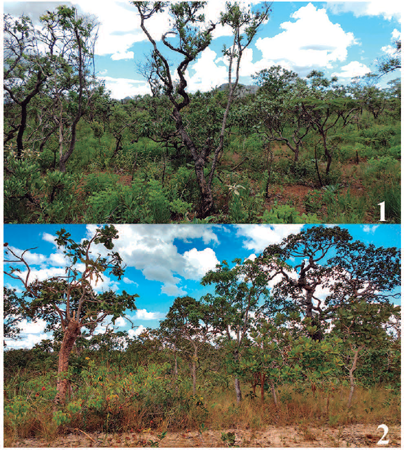
The studied specimens were collected during sampling events that took place between February 2018 and May 2019 in areas of Brazilian savannah at Parque Nacional da Chapada dos Veadeiros (PNCV) in Alto Paraíso de Goiás, Goiás state (Fig. 1), and at Parque Nacional Grande Sertão Veredas (PNGSV) in Chapada Gaúcha, Minas Gerais state (Fig. 2).
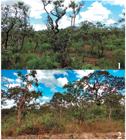
Views of Brazilian savannah. (1) Parque Nacional da Chapada dos Veadeiros, in Alto Paraíso de Goiás, Goiás state. (2) Parque Nacional Grande Sertão Veredas, in Chapada Gaúcha, Minas Gerais State.
The climate in both localities is Köppen AW type (tropical with wet summers and dry winters); in PNCV, the total annual rainfall is 1,792 mm concentrated between October and April, with a mean annual temperature of 21.7°C and, in PNGSV, the total annual rainfall is 1,217 mm, also concentrated between October and April, with a mean annual temperature of 22.3°C (Climate Data, 2024).
In areas of Brazilian savannah at PNCV two sets of five Townes-style Malaise traps (Townes, 1972) were installed, using a 96% ethanol solution as a preservative to collect continuously over the study period. The traps in each set were distributed in line, separated at least 50 m apart. Insects were collected every two weeks. The first set was placed in an area without direct anthropic impact (14°08′36″S, 47°46′0.4″W, ~1,100 m above sea level [asl]), while the second set was located in an area that experienced a severe fire in November 2016 (14°07′44″S, 47°44′0.4″W, ~1,200 m asl).
At PNGSV, only one set of five Malaise traps was installed in an area of Brazilian savannah without direct anthropic impact (15°10′30.6″S, 45°43′16.62″W, ~750 m asl); the trap model used, preservative solution, installation conditions, and insect removal procedures were the same as those used at PNCV.
At PNGSV, samplings were also conducted on the second new moon of the second month of each season with the following methods: (a) 300 Möricke traps (disposable plastic yellow dishes, 15 cm in diameter and 4.5 cm height, containing saline solution and neutral detergent as a preservative) were distributed in line, separated from each other by two meter; (b) three light traps equipped with compact fluorescent lamps (40W, 6,400K), using 96% ethanol solution as preservative, spaced approximately 100 meters apart, fixed in trees at about 4.0 m above the ground, and active for three nights, from dusk to dawn; and (c) two hours of vegetation sweeping. The collections were conducted under Brazilian Biodiversity Information and Authorization System (SISBIO) license #16473-1.
In the laboratory, the Leucospidae were separated from other Hymenoptera and stored in plastic vials with 96% ethanol solution. They were then air dried, mounted on entomological pins or cards and labeled. The studied specimens were identified using the keys provided by Boucek (1974a) and Lima & Dias (2018). The morphological terminology was based on Boucek (1974a) and Heraty et al. (2013), and the integument sculpturing follows Harris (1979). The consistency of anatomical data with the Hymenoptera Anatomy Ontology project (Yoder et al., 2010; Seltmann et al., 2012) was determined using the tool available through the Hymenoptera Glossary (HAO, 2019).
The images were obtained at the Laboratório de Sistemática e Bioecologia de Predadores e Parasitoides (Instituto Biológico, Ribeirão Preto, Brazil) using a Leica DFC295 digital camera attached to a Leica M205C automated research stereomicroscope. The specimens under study were illuminated using a Leica LED5000 HDI high diffuse dome of illumination (Kerr et al., 2008). Serial images from different layers were captured using Leica Application Suite software (LAS version 4.12.0), partially focused images were combined using Helicon Focus software (v. 5.3), and image clarity was enhanced using Adobe Photoshop software (v. 11.0).
Collecting sites indicated on the maps are primarily based on Kirby (1883), Boucek (1974a), Fidalgo (1980), De Santis (1983), Arias-Penna (2008), Garcete-Barrett (2001), Lima & Dias (2018) and Universal Chalcidoidea Database (Noyes, 2019). Geographic coordinates of the species records, if not available, were obtained using Google Earth software (https://www.google.com/earth). If the collection location was specified only as a country or state, a coordinate corresponding to the center of that area was used. The geographic coordinates were compiled into a dataset and incorporated into distribution maps, which were generated using the web software Simple Mappr (Shorthouse, 2010).
Abbreviations are as follows: Fn, flagellomeres (n = number of the flagellomere); OOL, ocular ocellar line; POL, posterior ocellar line; Tn, metasomal tergum (n = number of the metasomal tergum).
The specimens studied herein are deposited in the Coleção Entomológica do Laboratório de Sistemática e Bioecologia de Predadores e Parasitoides of the Instituto Biológico (LRRP), Ribeirão Preto, SP, Brazil, N.W. Perioto, curator.
Information on specimen labels is given ad litteram.
RESULTS AND DISCUSSION
During one year of sampling the Malaise traps captured 48 specimens of Leucospis. At PNCV 38 specimens were captured (79.2% of the total): 20 females and one male of L. aliena (13 females and one male in fired area), 13 females L. claudomiroi sp. nov. (eight females in fired area), three females of L. enderleini Ashmead, 1904, and one female of L. cayennensis (Table 2). At PNGSV 10 specimens were captured (20.8% of the total): five females of L. aliena, three females L. claudomiroi sp. nov. and, one female and one male of L. enderleini (Table 2).
Species of Leucospis Fabricius, 1775 collected with Malaise traps at the Parque Nacional da Chapada dos Veadeiros (PNCV), in Alto Paraíso de Goiás, Goiás state, and at the Parque Nacional Grande Sertão Veredas (PNGSV), in Chapada Gaúcha, Minas Gerais state, Brazil, between February 2018 and May 2019: number of specimens per environment and sample effort in trap-days.
Wasps belonging to the family Leucospidae are very rarely encountered (Ye et al., 2017; Sankararaman et al., 2020). In this study, a substantial sampling effort was made to capture parasitic Hymenoptera at PNCV and PNGSV, utilizing a total of 5,475 trap-days with Malaise traps. At PNCV, the effort involved 3,650 trap-days, split equally between two areas: one without direct anthropic interference and another that suffered a severe fire in November 2016, with each area accounting for 1,825 trap-days. Meanwhile, at PNGSV, 1,825 trap-days were carried out in a Brazilian savannah area without direct anthropic action. Despite the effort made with other sampling methods such as Möricke and light traps, with sampling efforts equivalent to 3,600 trap/days and, 36.0 trap/days respectively, and about two hours of vegetation sweep in each of the studied areas, no specimens of Leucospidae were obtained with such methods. The data regarding the sampling effort for capturing each of the studied species, categorized by locality and environment, are detailed in Table 2.
In the studied areas of the Brazilian savannah at Goiás (PNCV) and Minas Gerais (PNGSV) states, the sampling effort amounted to 96.1 and 182.5 trap-day/specimen, respectively. In a separate study of Perioto & Lara (in preparation), conducted over three years (2007-2009) with six Malaise traps in a Brazilian savannah area in São Paulo state, only 18 specimens of Leucospidae were collected: one female of L. cayennensis, one of L. egaia, 13 of L. signifera Boucek, 1974 and four of Polistomorpha sp., with sampling effort that amounted to 365 trap-days/specimen.
The small number of specimens of Leucospidae collected precludes more sophisticated analyzes of abundance and population fluctuation. The reasons that lead to this small catch rate are unknown and factors such their development in small populations and/or the low efficiency of the traps used should be taken into account. The use of trap nests may be an efficient alternative for the sampling of this group of insects as shown by the reports of Gazola & Garófalo (2003, 2009), Torretta et al. (2014) and Oliveira & Gonçalves (2017).
TAXONOMY
HOPEI species-group
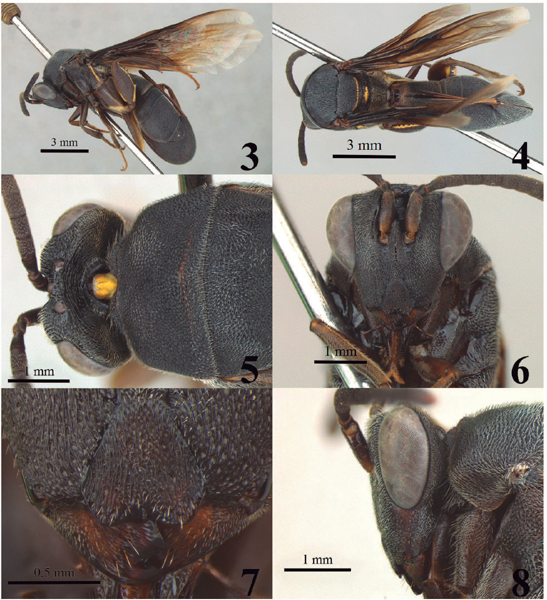
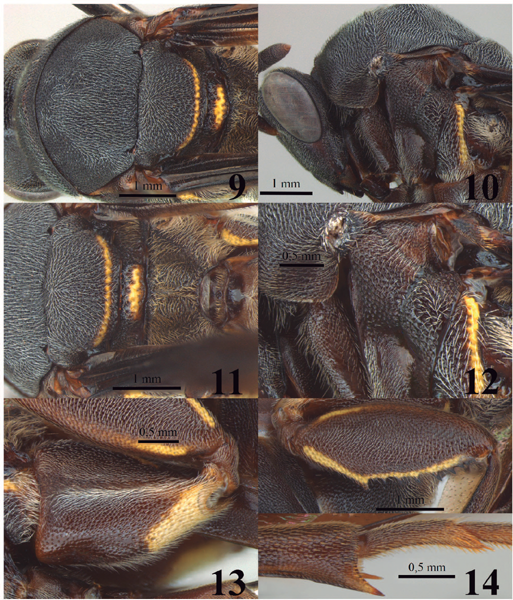
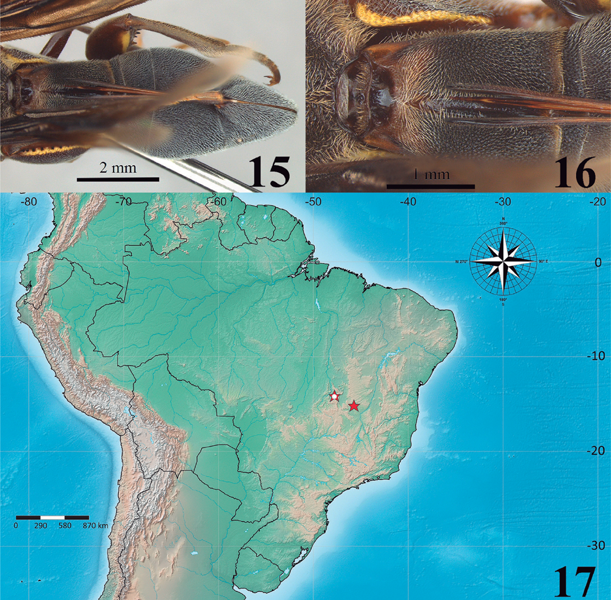
Leucospis claudomiroi Perioto & Lara, sp. nov. (Figs. 3 4 5 6 7 8 9 10 11 12 13 14 15 16 17)
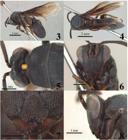
Leucospis claudomiroi Perioto & Lara, sp. nov. (Hymenoptera, Leucospidae). (3) Habitus lateral. (4) Habitus dorsal. (5) Head and pronotum, dorsal view. (6) Head, frontal view. (7) Detail of clypeus and mandible. (8) Head, lateral view.
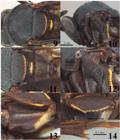
Leucospis claudomiroi Perioto & Lara, sp. nov. (Hymenoptera, Leucospidae). (9) Mesosoma, dorsal view. (10) Mesosoma, lateral view. (11) Metadorsellum and propodeum, dorsal view. (12) Detail of mesespisternum. (13) Metacoxa. (14) Metafemur and detail of apex of metatibia and basitarsus.
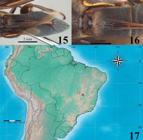
Leucospis claudomiroi Perioto & Lara, sp. nov. (Hymenoptera, Leucospidae). (15) Metasoma, dorsal view. (16) First tergite, dorsal view. (17) Map of part of South America with geographic records of the new species (red star with white dot = type locality).
https://zoobank.orq/946C3A40-B753-404E-9715-809BC67F9C46
Type material: Holotype female, labeled “BR, GO, Alto Paraíso de Goiás; P.N. Chapada dos Veadeiros; cerrado queimado, Malaise, 14°07′44″S, 47°44′0.4″W, 08/V/2018; Perioto, N.W. & Lara, R.I.R. cols.” [LRRP #23259]. Paratypes [15 females]: same data as holotype except: 11/IX/2018, 1 female [LRRP #23260]; 25/IX/2018, 3 females [LRRP #22724-22726]; 09/X/2018, 1 female [LRRP #22727]; 20/XI/2018, 1 female [LRRP #23262]; 04/XII/2018, 1 female [LRRP #23261]; same data as holotype except: cerrado, 14°08′36″S, 47°46′04″W, 09/X/2018, 1 female [LRRP #23263]; cerrado, 23/X/2018, 2 females [LRRP #22728-22729]; 06/XI/2018, 2 females [LRRP #22730-22731]; “BR, MG, Chapada Gaúcha; P.N. Grandes Sertões Veredas, cerrado/Malaise, 15°10′30.6″S, 45°43′16.6″W, 02/I/2019, Perioto & R.I.R. Lara, cols.” 1 female [LRRP #23264]; same data except: 15/I/2019, 1 female [LRRP #22722]; 12/111/2019, 1 female [LRRP #22723]. The holotype and paratypes, glued on pins, are in good condition.
Diagnosis:Leucospis claudomiroi Perioto & Lara, sp. nov. is distinguished by the occipital carina conspicuous only behind ocellar triangle; POL about 1.2× OOL; inner margin of eyes not emarginate; clypeus apically bilobate, with a small median tooth; pronotum with premarginal carina; metascutellum rectangular, foveate-reticulate, carinate only in median portion of apical margin; propodeum setose, median carina present, plicae absent; metacoxal depression uniformly punctate, without a conspicuous tooth-like projection dorso-laterally; metafemur 2.7× as long as broad, excluding teeth; fore wing blackish in proximal two-thirds and subhyaline in apical third; T6 without spiniform projection at posterior margin; ovipositor reaching base of gaster.
Description: Holotype female (Figs. 3-4). Body length 10.9 mm. Color: body mainly dark brown to black. Yellow on: narrow band on posterior margin of scutellum, metascutellum, posterior margin of metapleuron, anteroapical margin of metacoxa, ventral margin of metafemur, ¼ basal dorsal margin and internal face of metafemur. Brown on: antennae (except basal portion of the escape and radicle which are light brown), mandibles, labiomaxillary complex, mesofemoral depression, legs, ¼ basal of tergite I dorsally and ovipositor sheath. Fore wing blackish, subhyaline apically. Head: dorsally 2.3× as broad as long and 0.9× as broad as pronotum posteriorly (Fig. 5). Occipital carina conspicuous only behind ocellar triangle; POL 1.2× OOL, ocellar triangle 2.3:1 (length: height); lateral ocelli touching occipital carina (Fig. 5); median ocellus touching the upper carinate margin of antennal scrobe; temples as long as maximum width of median ocellus (Fig. 5). Vertex punctate with hairs. Scrobal depression striate, dorsally raised. Flagellum slightly clavate, F1 1.1, F5 1.0 and F8 0.9× as long as maximum width. In frontal view, head 1.2× as broad as high; upperface densely punctate-reticulate, lowerface vertically strigulate, both with white setation (Fig. 6). Clypeus in frontal view 0.9× as high as broad and 0.6× as broad as mouth, finely vertically strigulate, apically bilobate, with small median tooth (Fig. 7). Mandible with slender tooth separated from upper edge by a triangular notch (Fig. 7). Malar space 0.5× eye height, in lateral view, finely vertically strigulate (Fig. 8). Occiput concentrically strigulate, with yellowish setation. Mesosoma: dorsally with white short setation. Pronotum and mesoscutum punctate-reticulate (Figs. 5, 9); mesoscutellum punctate (Fig. 9). Pronotum 2.1× as wide as long, with premarginal carina (Fig. 5); posterior margin almost straight, weakly carinate; lateral panel concave, with lower corner rounded (Fig. 10). Mesoscutum in lateral view bowed (Fig. 10); notaulus absent (Fig. 9). Tegula densely punctate basally and sparcelly apically, with pale yellowish setation. Mesoscutellum, in lateral view, evenly convex (Fig. 10), 0.7× as long as maximum breadth in dorsal view (Fig. 9). Metascutellum almost rectangular, foveate-reticulate, carinate only in median portion of apical margin, 2.6× as broad as long medially (Fig. 11). Propodeum medially 2.1× as long as dorsellum, setose, punctate-reticulate, median carina present, low, plicae absent (Fig. 11). Subalar area and mesepisternum punctate-reticulate; mesepimeron and metapleuron densely foveolate, pilosity of the last one as long as that of the lateral of propodeum; mesofemoral depression deep, finely coriaceous at anterior border (Fig. 12). Legs: upper edges of profemur and protibia not carinate. Metacoxa uniformly punctate, upper edge blunt, ½ apical with faint carina, without a tooth-like projection posteriorly, with dense white setation, in depression downward directed, and below depression backward directed (Fig. 13). Metafemur 2.7× as long as broad, excluding teeth; densely and regularly punctate, with short dense white setation directed to ventral edge which has a basal tooth (basally broader than long) and 8 other teeth (Fig. 14). Metatibia densely finely punctate, not truncated at apex, ending in a distinct solid spine (Fig. 14). Wings: fore wing 3.5× as long as wide, uniformly setose, blackish, subhyaline in apical third, moderately infuscate posterior to R1. Stigmal vein slightly clavate, forming an angle of about 45° to R1, 1.0× as long as marginal vein. Uncus 0.7× as long as stigmal vein. Hind wing uniformly setose, blackish, sub-hyaline in apical third. Gaster: densely punctate-reticulate, 2.7× as long as its maximum width in dorsal view (Fig. 15). T1 dorsally trapezoidal, as long as broad, with carinate ovipositorial furrow reaching the base, covered with yellowish setation directed upwards (Fig. 16); other tergites densely covered by white setae directed downwards. T6 without spiniform projection at posterior margin. Ovipositor virtually straight, reaching the base of T1 (Figs. 15-16).
Variation: Some specimens are darker colored with yellow marks on the premarginal carina of the pronotum that vary from a small central spot to a fine stripe over the entire carina. Body length 8.9-11.9 mm. Head dorsally 2.1 -2.5× as broad as long. POL 1.2-1.3× OOL, ocellar triangle 2.3-2.5:1 (length : height). F1 1.2-1.5, F5 1.0-1.1 and F8 0.8-1.1× as long as maximum width. Clypeus (frontal view) 0.7-1.1× as high as broad. Metascutellum 2.6-3.2× as broad as long medially. Propodeum 1.8-2.2× as long as metadorsellum; in some specimens reduced setation in the central region. Metafemur 2.4-2.7× as long as broad, excluding teeth; 6-9 other tooth. Fore wing 3.2-3.6× as long as wide. Stigmal vein forming angles of 38-45° to R1. Stigmal vein 1.0-4.5× as long as marginal vein. Uncus 0.4-0.7× as long as stigmal vein.
Male: Unknown.
Biology: Unknown.
Species identification: In the key provided by Lima & Dias (2018) this species runs to couplet 14 and could be separated by an additional couplet as follows (morphological terms updated according to the Hymenoptera Anatomy Ontology portal):
-
14(13) Body black, non-metallic, with white or yellow bands; metacoxal depression extensively smooth or punctate 49
-
49(14) Body deep black, with white bands on pronotum, metacoxa, usually also on gaster and mesoscutellum, contrasting with bright red flagellum, metatibia and apex of metafemur; metacoxal depression extensively smooth Leucospis hopei Westwood
-
49’(14) Body black, with yellow bands on pronotum, mesoscutellum, metascutellum, metapleuron, metacoxa and metafemur; metacoxal depression entirely punctate ___ Leucospis claudomiroi sp. nov. Perioto & Lara
Comments:Leucospis claudomiroisp. nov. belongs to the HOPEI species-group, characterized by a non-metallic body without iridescent reflections, elongated metatibia with concave adtarsal margin, and indistinct external spur.
Geographical distribution: BRASIL, Goiás, Minas Gerais (Fig. 17).
Etymology: This species is named in honor of Claudomiro de Almeida Cortes, who served as our guide during collection expeditions to PNCV. This tribute recognizes his tireless efforts in organizing local communities to preserve and restore areas of Brazilian savannah vegetation.
SPEIFERA species-group
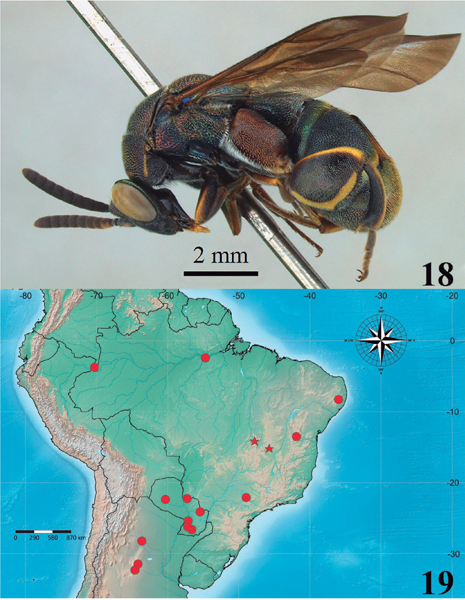
Leucospis enderleini Ashmead, 1904 (Figs. 18-19)
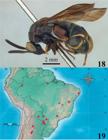
Leucospis enderleiniAshmead, 1904 (Hymenoptera, Leucospidae). (18) Habitus lateral. (19) Map of part of South America with geographic records (red stars = new records; red dots = known records).
Material examined: Four females and one male: “BR, GO, Alto Paraíso de Goiás; P.N. Chapada dos Veadeiros; cerrado, Malaise, 14°08′36″S, 47°46′04″W, 17/VII/2018; N.W. Perioto & R.I.R. Lara, cols.”, 1 female [LRRP #23265]; same data except: 06/XI/2018, 2 females [LRRP #23266-23267]; “BR, MG, Chapada Gaúcha; P.N. Grandes Sertões Veredas, cerrado/Malaise, 15°10′30.6″S, 45°43′16.6″W, 20/XI/2018, Perioto & R.I.R. Lara, cols.”, 1 female [LRRP #22721], 1 male [LRRP #23268].
Geographical distribution:Leucospis enderleini has been recorded in Argentina (province of Cordoba) (Boucek, 1974a), Colombia (department of Amazonas) (Arias-Penna, 2008), and Paraguay (departments of Boquerón, Concepción, Canindeyú, Cordillera, Paraguarí) (Garcete-Barrett, 2001). In Brazil, it has been reported in the states of Pará (Ashmead, 1904), Pernambuco (Boucek, 1974a), Bahia (Lima & Dias, 2018), and São Paulo (Weld, 1922). These new records extend the known geographical distribution of L. enderleini to the states of Goiás and Minas Gerais (Fig. 19).
Host: Unknown.
CAYENNENSIS species-group
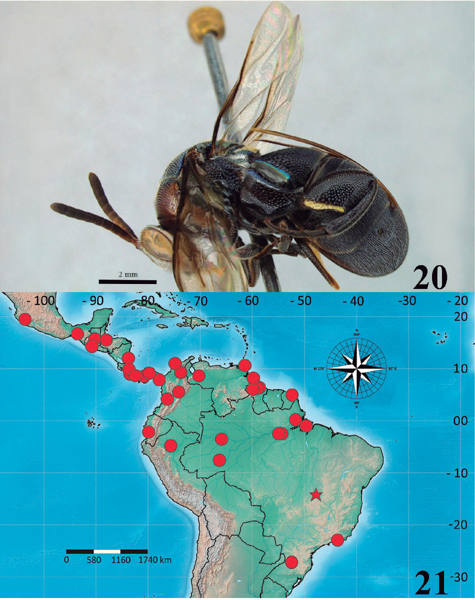
Leucospis cayennensis Westwood, 1839 (Figs. 20-21)
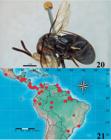
Leucospis cayennensis Westwood, 1839 (Hymenoptera, Leucospidae). (20) Habitus lateral. (21) Map of part of North, Central and South America with geographic records (red stars = new records; red dots = known records).
Material examined: “BR, GO, Alto Paraíso de Goiás; P.N. Chapada dos Veadeiros; cerrado queimado, Malaise; 14°07′44″S, 47°44′0.4″W; 23/X/2018; Perioto, N.W. & Lara, R.I.R. cols.”, 1 female [LRRP #22732].
Geographical distribution:Leucospis cayennensis has been recorded in Colombia, Costa Rica, Ecuador, French Guiana, Guatemala, Guyana, Honduras, Mexico, Nicaragua, Panama, Trinidad & Tobago, Venezuela (Boucek, 1974a; Noyes, 2019), Argentina (Fidalgo, 1980; De Santis, 1983), Peru (De Santis, 1979; Noyes, 2019), and US Virgin Islands (Kirby, 1883; Noyes, 2019). In Brazil, it has been reported in the states of Acre, Amazonas, Pará, Minas Gerais, São Paulo, Rio de Janeiro e Santa Catarina (Lima & Dias, 2018). This new record extends the known geographical distribution of L. cayenensis to the state of Goiás (Fig. 21).
Hosts:Centris (Heterocentris) bicornuta Mocsáry, 1899, Centris (Hemisiella) nitida Smith, 1874, Centris (Hemisiella) tarsata Smith, 1874 and, Centris (Hemisiella) vittata Lepeletier, 1841, Centris analis (Fabricius, 1804) (Hym.: Apidae) (Table 1).
EGAIA species-group
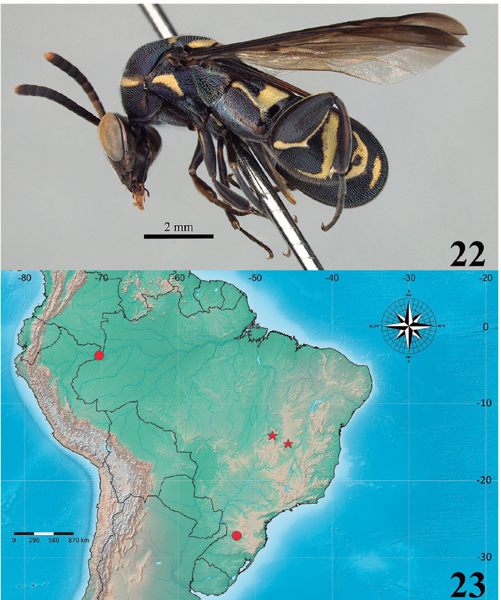
Leucospis aliena Bouček, 1974 (Figs. 22-23)
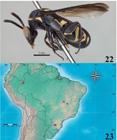
Leucospis aliena Boucek, 1974 (Hymenoptera, Leucospidae). (22) Habitus lateral. (23) Map of part of South America with geographic records (red stars = new records; red dots = known records).
Material examined: 25 females and one male: “BR, GO, Alto Paraíso de Goiás; P.N. Chapada dos Veadeiros; cerrado, Malaise; 14°08′36″S, 47°46′04″O; 03/VII/2018; Perioto, N.W. & Lara, R.I.R. cols., 1 female [LRRP #22735]; same data except: 28/VIII/2018, 1 female [LRRP #22736]; 25/IX/2018, 1 female [LRRP #22737]; 09/X/2018, 1 female [LRRP #22738]; 23/X/2018, 1 female [LRRP #22739]; 04/XII/2018, 2 females [LRRP #22741-22742]; same data except: cerrado queimado, 14°07′44″S, 47°44′0.4″W; 31/VII/2018, 1 female [LRRP #22743]; cerrado queimado, 14°07′44″S, 47°44′0.4″W; 11/IX/2018, 1 female [LRRP #22744]; cerrado queimado, 14°07′44″S, 47°44′0.4″W; 25/IX/2018, 3 females [LRRP #23269-23271], 1 female [LRRP #22745]; cerrado queimado, 14°07′44″S, 47°44′0.4″W; 09/X/2018, 4 females [LRRP #23272-23275]; cerrado queimado, 14°07′44″S, 47°44′0.4″W; 23/X/2018, 2 females [LRRP #22746-22747]; cerrado queimado, 14°07′44″S, 47°44′0.4″W; 06/XI/2018, 1 male [LRRP #22748]; cerrado queimado, 14°07′44″S, 47°44′0.4″W; 15/I/2019”, 1 female [LRRP #23276]; “BR, MG, Chapada Gaúcha; P.N. Grande Sertão Veredas; 15°10′30.6″S, 45°43′16.6″W; 05/VI/2018, 1 female [LRRP #22733]; same data except: 09/X/2018, 1 female [LRRP #22734]; 23/X/2018, 1 female [LRRP #22740]; 20/XI/2018, 1 female [LRRP #23277]; 26/II/2019”, 1 female [LRRP #23278].
Geographical distribution:Leucospis aliena has been recorded in Colombia (Department of Amazonas) (Arias-Penna, 2008). In Brazil, it has been reported in the state of Santa Catarina (Boucek, 1974a). This new record extends the known geographical distribution of L. cayenensis to the states of Goiás and Minas Gerais (Fig. 23).
Host: Unknown.
-
FUNDING INFORMATION:
The studied specimens were collected during execution of project “Instituto Nacional de Ciência e Tecnologia dos Hymenoptera Parasitoides” coordinated by Dr. Angelica Penteado-Dias (UFSCar) and funded by CNPq (CNPq #465562/2014-0), FAPESP (FAPESP #2008/57949-4) and CAPES.
ACKNOWLEDGMENTS:
We thank to the anonymous reviewers for their critical reading.
REFERENCES
- Arias-Penna, D.C. 2008. New records of species of Leucospidae (Hymenoptera: Chalcidoidea) for Colombia. Acta Biológica Colombiana, 13(3): 161-166.
-
Ashmead, W.H. 1904. Classification of the chalcid flies of the superfamily Chalcidoidea, with descriptions of new species in the Carnegie Museum, collected in South America by Herbert H. Smith. Memoirs of the Carnegie Museum, 1(4): 405. https://doi.org/10.5962/bhl.title.10341
» https://doi.org/10.5962/bhl.title.10341 -
Boucek, Z. 1974a. A revision of the Leucospidae (Hymenoptera: Chalcidoidea) of the world. Bulletin of the British Museum (Natural History), Entomology, 23 (Supplement): 1-241. https://doi.org/10.5962/p.140909
» https://doi.org/10.5962/p.140909 - Boucek, Z. 1974b. Description of a new Leucopsis [sic] (Hymenoptera: Leucospidae) from Bolivia. Studia Entomologica, 17(1-4): 430-432.
-
Climate Data. 2024. Dados climáticos para cidades mundiais. Available: https://pt.climate-data.org. Access: 06/08/2024.
» https://pt.climate-data.org - De Santis, L. 1979. Catálogo de los himénopteros calcidoideos de América al sur de los Estados Unidos. La Plata, Comisión de Investigaciones Cientificas de la Província de Buenos Aire. 488p. (Publicación Especial)
- De Santis, L. 1983. Catálogo de los himenopteros calcidoideos de America al Sur de los Estados Unidos – primer suplemento. Revista Peruana de Entomología, 24(1): 2.
- Fidalgo, A.P. 1980. Nuevas citas de Calcidoideos para Argentina, Bolivia y Peru (Hymenoptera). Neotropica, 26(76): 193-196.
- Garcete-Barrett, B.R. 2001. Catálogo de la familia Leucospidae en el Paraguay. Boletín del Museo Nacional de Historia Natural del Paraguay, 13: 50-52.
- Gazola, A.L. & Garófalo, C.A. 2003. Parasitic behavior of Leucospis cayennensis Westwood (Hymenoptera: Leucospidae) and rates of parasitism in populations of Centris (Heterocentris) analis (Fabricius) (Hymenoptera: Apidae: Centridini). Journal of the Kansas Entomological Society, 76(2): 131-142.
-
Gazola, A.L. & Garófalo, C.A. 2009. Trap-nesting bees (Hymenoptera: Apoidea) in forest fragments of the state of São Paulo, Brazil. Genetics and Molecular Research, 8(2): 607-622. https://doi.org/10.4238/vol8-2kerr016
» https://doi.org/10.4238/vol8-2kerr016 - Genaro, J.A. 2012. New species of Leucospis (Hymenoptera: Leucospidae) from La Hispaniola, Antilles. Solenodon, 10: 81-86.
- Grissell, E.E. 2007. Torymidae (Hymenoptera: Chalcidoidea) associated with bees (Apoidea), with a list of chalcidoid bee parasitoids. Journal of Hymenoptera Research, 16(2): 234-265.
- Grissell, E.E. & Cameron, S.A. 2002. A new Leucospis Fabricius (Hymenoptera: Leucospidae), the first reported gregarious species. Journal of Hymenoptera Research, 11(2): 271-278.
- Grissell, E.E. & Schauff, M.E. 1997. A handbook of the families of Nearctic Chalcidoidea (Hymenoptera). 2. ed. rev. Washington, The Entomological Society of Washington.
-
Hanson, P.E. 1995. Leucospidae. In: Hanson, P.E. & Gauld, I.D. (Eds.). The Hymenoptera of Costa Rica. Oxford, Oxford University Press. p. 342-344. https://doi.org/10.1093/oso/9780198549055.001.0001
» https://doi.org/10.1093/oso/9780198549055.001.0001 - Harris, R.A. 1979. A glossary of surface sculpturing. Occasional Papers in Entomology, 28: 1-32.
-
Heraty, J.M.; Burks, R.A.; Cruaud, A.; Gibson, G.A.P.; Liljeblad, J.; Munro, J.; Rasplus, J.-Y.; Delvare, G.; Jansta, P.; Gumovsky, A.; Huber, J.; Woolley, J.B.; Krogmann, L.; Heydon, S.; Polaszek, A.; Schmidt, S.; Darling, D.C.; Gates, M.W.; Mottern, J.; Murray, E.; Dal Molin, A.; Triapitsyn, S.; Baur, H.; Pinto, J.D.; van Noort, S.; George, J. & Yoder, M. 2013. A phylogenetic analysis of the megadiverse Chalcidoidea (Hymenoptera). Cladistics, 29: 466-542. https://doi.org/10.1111/cla.12006
» https://doi.org/10.1111/cla.12006 - Hesami, S.; Akrami, M.A. & Baur, H. 2005. Leucospis dorsigera Fabricius (Hymenoptera, Leucospidae) as a hyperparasitoid of Cerambycidae (Coleoptera) through Xoridinae (Hymenoptera: Ichneumonidae) in Iran. Journal of Hymenoptera Research, 14(1): 66-67.
-
Hymenoptera Anatomy Ontology (HAO). 2019. Hymenoptera Anatomy Consortium. Available: http://glossary.hymao.org. Access: 05/06/2024.
» http://glossary.hymao.org -
Kerr, P.H.; Fisher, E.M. & Buffington, M.L. 2008. Dome lighting for insect imaging under a microscope. American Entomologist, 54(4): 198-200. https://doi.org/10.1093/ae/54.4.198
» https://doi.org/10.1093/ae/54.4.198 -
Kirby, W.F. 1883. Remarks on the genera of the subfamily Chalcidinae, with synonymic notes and descriptions of new species of Leucospidinae and Chalcidinae. Journal of the Linnean Society (Zoology), 17: 53-78. https://doi.org/10.1111/j.1096-3642.1883.tb00236.x
» https://doi.org/10.1111/j.1096-3642.1883.tb00236.x -
Lima, A.R. & Dias, P.G. 2018. The New World species of Leucospis Fabricius, 1775 (Hymenoptera, Chalcidoidea, Leucospidae): an update of Boucek’s revision with description of two new species from Brazil. Zootaxa, 4441(1): 1-45. https://doi.org/10.11646/zootaxa.4441.1.1
» https://doi.org/10.11646/zootaxa.4441.1.1 -
Noyes, J.S. 2019. Universal Chalcidoidea Database. World Wide Web electronic publication. Database last updated: March 2019. Available: http://www.nhm.ac.uk/our-science/data/chalcidoids/database/listGenera.dsml?FamilyCode=L&ValFamTrib=Leucospidae&type=family. Access: 09/04/2019.
» http://www.nhm.ac.uk/our-science/data/chalcidoids/database/listGenera.dsml?FamilyCode=L&ValFamTrib=Leucospidae&type=family -
Oliveira, P.S. & Gonçalves, R.B. 2017. Trap-nesting bees and wasps (Hymenoptera, Aculeata) in a Semidecidual Seasonal Forest fragment, southern Brazil. Papéis Avulsos de Zoologia, 57(13): 149-156. https://doi.org/10.11606/0031-1049.2017.57.13
» https://doi.org/10.11606/0031-1049.2017.57.13 - Pujade-Villar, J. & Caicedo, G. 2010. Description of a new Colombian species of Leucospidae: Leucospis vallicaucaensis n. sp. (Hymenoptera: Chacidoidea [sic]). Dugesiana, 17(2): 138-142.
-
Sankararaman, H.; Manickavasagam, S. & Ghorpade, K.D. 2020. Taxonomic studies on Leucospis Fabricius collection (Hymenoptera: Chalcidoidea: Leucospidae) at Annamalai University, Tamil Nadu, India. Oriental Insects, 54(1): 58-74. https://doi.org/10.1080/00305316.2019.1579116
» https://doi.org/10.1080/00305316.2019.1579116 -
Seltmann, K.; Yoder, M.; Miko, I.; Forshage, M.; Bertone, M.; Agosti, D.; Austin, A.; Balhoff, J.; Borowiec, M.; Brady, S.; Broad, G.R.; Brothers, D.; Burks, R.; Buffington, M.L.; Campbell, H.; Dew, K.; Ernst, A.; Fernandez-Triana, J.; Gates, M.; Gibson, G.; Jennings, J.; Johnson, N.; Karlsson, D.; Kawada, R.; Krogmann, L.; Kula, R.; Mullins, P.L.; Ohl, M.; Rasmussen, C.; Ronquist, F.; Schulmeister, S.; Sharkey, M.; Talamas, E.;Tucker, E.; Vilhelmsen, L.; Ward, P.S.; Wharton, R. & Deans, A. 2012. Hymenopterists’ guide to the Hymenoptera Anatomy Ontology: utility, clarification, and future directions. Journal of Hymenoptera Research, 27: 67-88. https://doi.org/10.3897/jhr.27.2961
» https://doi.org/10.3897/jhr.27.2961 -
Shorthouse, D.P. 2010. SimpleMappr, an online tool to produce publicationquality point maps. Available: https://www.simplemappr.net. Access: 05/06/2024.
» https://www.simplemappr.net -
Torretta, J.P.; Durante, S.P. & Basilio, A.M. 2014. Nesting ecology of Megachile (Chrysosarus) catamarcensis Schrottky (Hymenoptera: Megachilidae), a Prosopis-specialist bee. Journal of Apicultural Research, 53(5): 590-598. https://doi.org/10.3896/IBRA.1.53.5.06
» https://doi.org/10.3896/IBRA.1.53.5.06 - Townes, H.A. 1972. A light-weight Malaise trap. Entomological News, 83: 239-247.
-
Weld, C.J. 1922. Studies on chalcid-flies of the subfamily Leucospidinae, with descriptions of new species. Proceedings of the United States National Museum, 61(6): 1 -40. https://doi.org/10.5479/si.00963801.61-2439.1, https://doi.org/10.5479/si.00963801.61-2440.1, https://doi.org/10.5479/si.00963801.61-2427.1
» https://doi.org/10.5479/si.00963801.61-2439.1» https://doi.org/10.5479/si.00963801.61-2440.1» https://doi.org/10.5479/si.00963801.61-2427.1 -
Wisniowski, B. 2019. Leucospidae (Hymenoptera: Chalcidoidea) in the collection of the Upper Silesian Museum in Bytom (Poland). Acta Entomologica Silesiana, 27(1): 1-7. https://doi.org/10.5281/zenodo.2615459
» https://doi.org/10.5281/zenodo.2615459 -
Ye, X-h; Achterberg, C.V.; Yue, Q. & Xu, Z-f. 2017. Review of the Chinese Leucospidae (Hymenoptera, Chalcidoidea). ZooKeys, 651: 107-157. https://doi.org/10.3897/zookeys.651.11235
» https://doi.org/10.3897/zookeys.651.11235 -
Yoder, M.J.; Mikó, I.; Seltmann, K.C.; Bertone, M.A. & Deans, A.R. 2010. A gross anatomy ontology for Hymenoptera. PloS ONE, 5(12): e15991. https://doi.org/10.1371/journal.pone.0015991
» https://doi.org/10.1371/journal.pone.0015991
Edited by
-
Edited by:
Helena Carolina Onody